Sample Category Title
RBNZ Conway hopeful that inflation has peaked
RBNZ Chief Economist Paul Conway said annual inflation rate of 7.2% was "obviously too high". But, he added, "we expect to see inflationary pressures easing going forward" and "are hopeful that it has peaked."
The "very rapid tightening in monetary policy" is starting to have an effect and "there are early signs that the economy is starting to cool," he said.
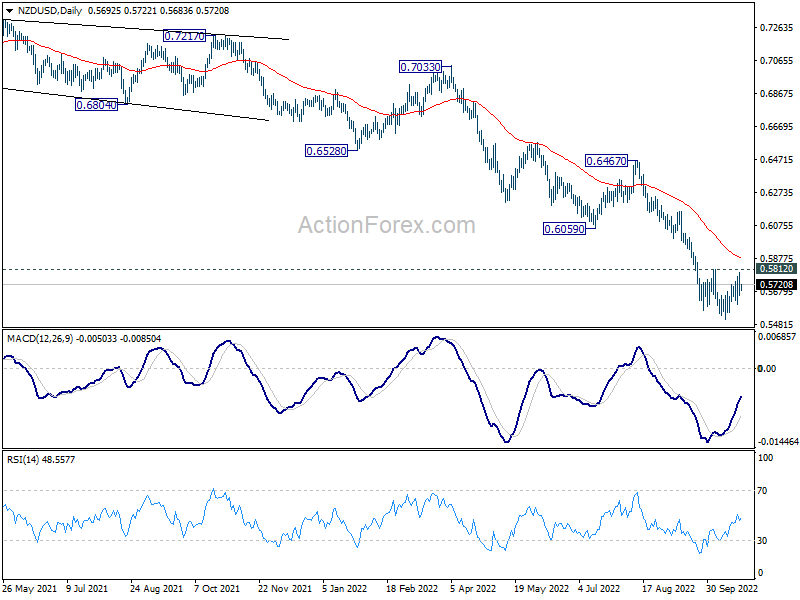
NZD/USD is currently still bounded inside the consolidation pattern from 0.5511. While a breach of 0.5812 resistance cannot be ruled out, upside could be capped by 55 day EMA (now at 0.5876). That is, an eventual downside breakout is expected, sooner or later, through 0.5511 to resume larger down trend.
GBP/USD Eyes Key Upside Break Above 1.1400
Key Highlights
- GBP/USD is correcting higher above the 1.1250 resistance.
- A key contracting triangle is forming with resistance near 1.1380 on the 4-hours chart.
- EUR/USD is slowly moving higher towards the 1.0000 resistance.
- Bitcoin price is still consolidating near the $19,500 resistance zone.
GBP/USD Technical Analysis
The British Pound formed a base above the 1.1000 against the US Dollar. GBP/USD started a recovery wave and was able to climb above the 1.1200 resistance.
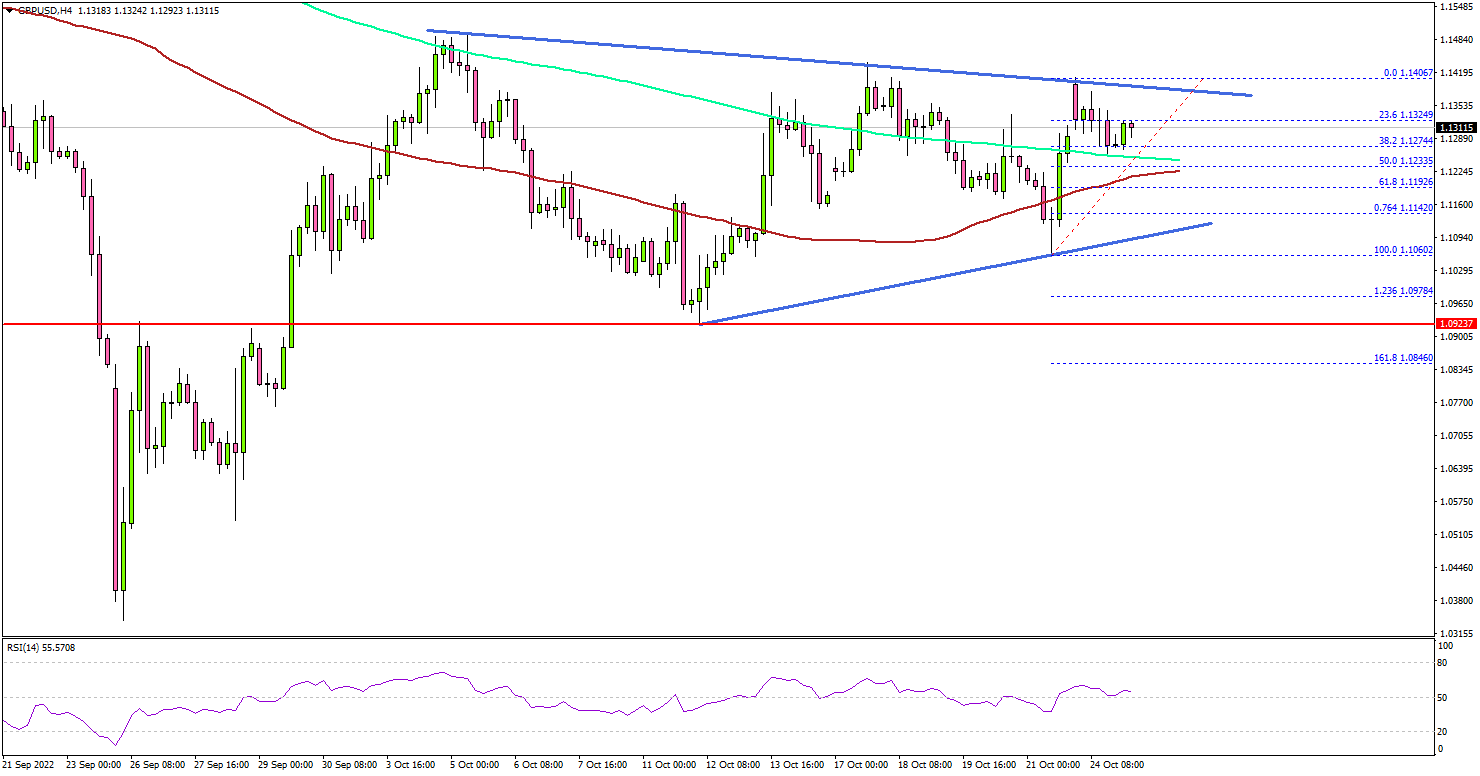
Looking at the 4-hours chart, the pair settled above the 1.1250 level, the 100 simple moving average (red, 4-hours), and the 200 simple moving average (green, 4-hours).
The bulls attempted to clear the 1.1400 resistance zone, but struggled. A high was formed near 1.1406 and the pair is now consolidating gains. On the upside, an immediate resistance is near the 1.1380 zone. There is also a key contracting triangle forming with resistance near 1.1380 on the same chart.
The next major resistance on the upside may perhaps be near 1.1400. Any more gains could set the pace for a move towards the 1.1500 level. If there is a downside correction, the pair might test the 1.1200 support.
The next major support is near the 1.1140 level. A downside break below the 1.1140 support and the triangle lower trend line may perhaps send GBP/USD towards the 1.1050 support. Any more losses could lead the pair towards 1.1000.
Looking at bitcoin price, the bulls are still struggling to clear the $19,500 and $19,650 resistance levels, above which the price could accelerate higher.
Economic Releases
- German IFO Business Climate Index for Oct 2022 – Forecast 83.3, versus 84.3 previous.
- US Housing Price Index for August 2022 (MoM) - Forecast -0.3%, versus -0.6% previous.
Pound is Recovering Fast
On Monday, GBPUSD is rising, chiefly fluctuating near 1.1380.
The pound quite fast recovered from the stress provoked by Liz Truss leaving her post. This reshuffling of the government might have been inevitable because Truss's economic policy was unpopular and could have some consequences.
Now London needs to be patient and wait for the election of a new Prime Minister. The most probable candidate is the former minister of finance Rishi Sunak.
The new Prime Minister will face a most complicated task to reassemble the British economy after the Brexit trauma, with all the supply issues and foreign trade trouble.
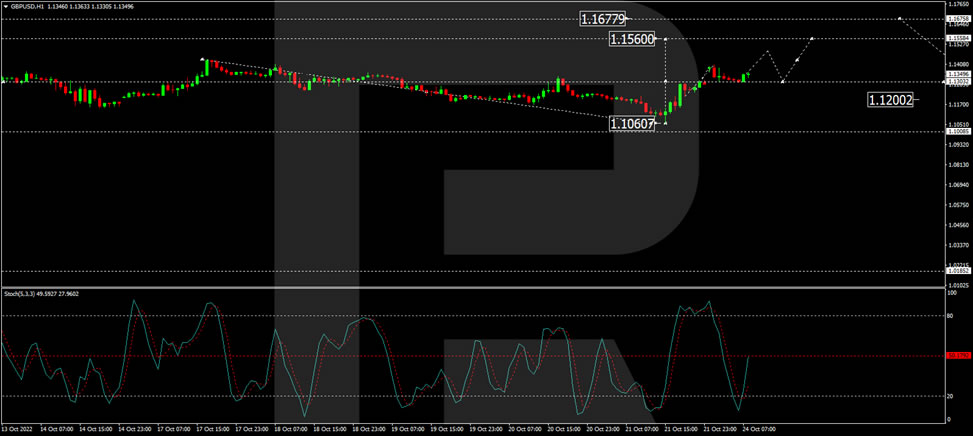
On H4, the currency pair completed a wave of correction to 1.1060. At a certain point, the market demonstrated an impulse of growth to 1.1300 and is today consolidating around this level. With an escape upwards, the wave of growth may continue to 1.1560; the goal is local. After the goal is reached, a correction to 1.1300 is possible (with a test from above), followed by growth to 1.1677. Then the trend may continue to 1.0200. Technically, this scenario is confirmed by the MACD oscillator. Its signal line is above zero and continues developing a structure of growth to new highs.
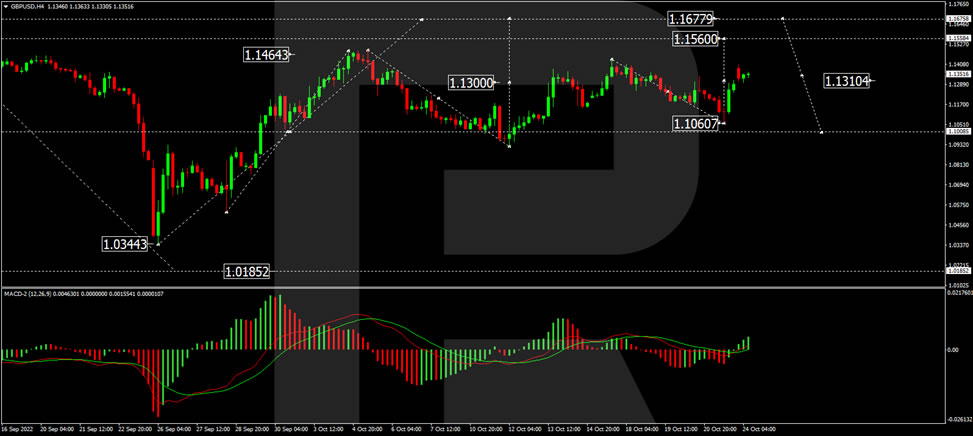
On H1, GBP/USD performed an impulse of growth to 1.1300. Today the market opened with a gap upwards and continues forming a consolidation range around the level. With an escape upwards, the impulse may continue to 1.1560. With an escape downwards, the wave of decline may continue to 1.1010. Technically, the scenario is confirmed by the Stochastic oscillator. Its signal lines bounced off 20 and goes on growing to 50. With a breakaway upwards, growth will continue to 80. If the line bounces off 50 downwards, another link of decline to 20 is not excluded.
NZDUSD Wave Analysis
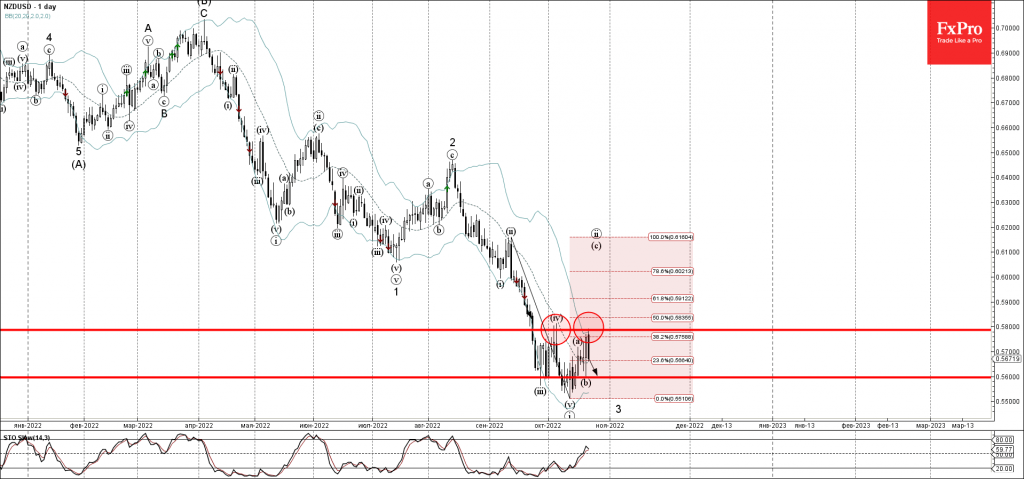
- NZDUSD reversed from resistance level 0.5785
- Likely to fall to support level 0.5600
NZDUSD recently reversed down from the resistance level 0.5785 (top of the previous wave (iv) from the start of October).
The resistance level 0.5785 was further strengthened by the upper daily Bollinger Band and by the 38.2% Fibonacci correction of the downward impulse from September.
Given the strong daily downtrend, NZDUSD can be expected to fall further toward the next support level 0.5600 (low of the previous wave (b)).
USDJPY Wave Analysis
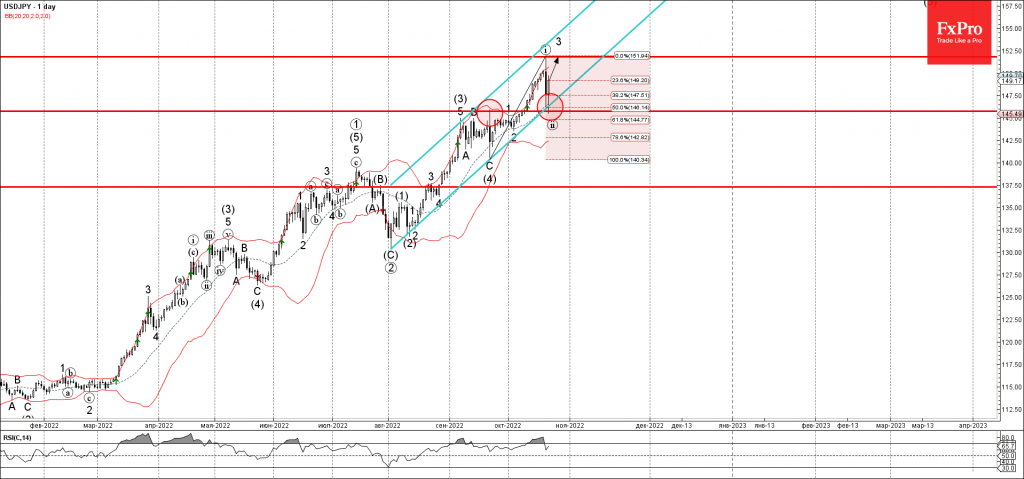
- USDJPY reversed from support level 145.75
- Likely to rise to resistance level 151.85
USDJPY currency pair recently reversed up from the support level 145.75 (former monthly high from September).
The support level 145.75 was strengthened by the support trendline of the daily up channel from August and by the 50% Fibonacci correction of the upward impulse from September.
Given the overriding uptrend on the daily and the weekly charts, USDJPY can be expected to rise further toward the next resistance level 151.85 (top of the previous impulse wave (i)).
Pound Drifting, Sunak Takes Over as PM
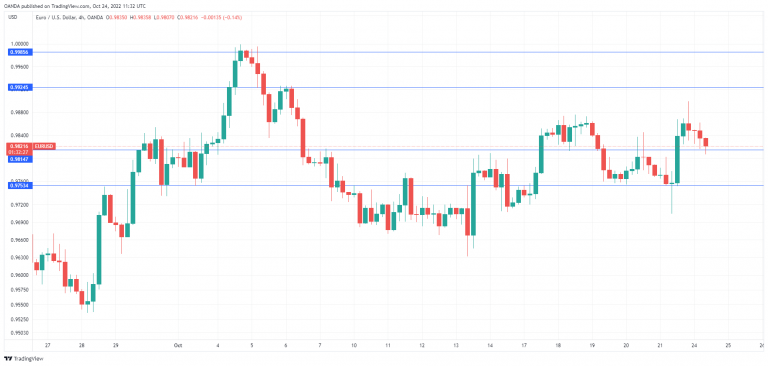
The pound pushed higher at the start earlier today but has given up all of these gains. GBP/USD is trading at 1.1293, down 0.03%.
Sunak takes over as PM
Rushi Sunak has become the new UK Prime Minister after Penny Mordaunt dropped out of the Conservative leadership race. Liz Tross beat Sunak for the leadership last month but her short tenure as Prime Minister was an unmitigated political disaster. Elizabeth Truss’s record of a mere 44 days in office caused financial damage as well, as her financial plan with unfunded tax cuts roiled the markets, with the pound taking a beating and the Bank of England intervening in an emergency move to stabilize the bond market.
Sunak, a former finance minister, will have his work cut out. The Conservative party remains deeply divided and will have to coalesce quickly or face a general election that it would likely lose. Sunak inherits a weak economy, high inflation and uncertainty over the UK’s direction in the post-Brexit era. Last week ended on a sour note, as retail sales for September declined by 6.9% YoY, down from -5.6% in August and below the consensus of -5.6%. Core retail sales also dropped sharply to -6.2%, down from -5.3% and well below the consensus of -4.1%.
The Bank of England can hopefully concentrate on more routine matters, such as its policy meeting on November 3rd. Inflation has climbed back into double digits and the Bank will have to deliver an oversize interest rate in order to curb inflation. This will slow the economy which may already be in recession. A 0.75% hike is most likely, although a full-point increase is a slight possibility.
GBP/USD Technical
- 1.1388 and 1.1471 are the next resistance lines
- 1.1266 is a weak support level. This is followed by 1.1093
Rishi Sunak Set to Become UK’s New Prime Minister
Markets
Investor attention was focused on the release of PMI business confidence today. As one could have expected, they didn’t really paint a rosy picture on the European economy. They scream “stagflation” with the Eurozone economy having slipped into a deeper downturn at the start of the final quarter. High energy prices weigh on activity in the manufacturing sector (from 48.4 to 46.6) while the cost of living crisis and broad-based economic uncertainty hurts services (from 48.8 to 48.2). Business confidence in the year ahead remains at one of the lowest levels seen over the past two years all the while price pressures remain elevated at historical highs. Rising energy and staff costs as well as the weakened euro offset lower commodity prices due to supply chains having gradually improved. S&P Global (rightly) says this will likely add to the ECB’s resolve to tighten policy further in coming months despite a growing recession risk. This conclusion is what drove markets in a first reaction. European stocks extended losses while yields in Germany sprinted higher to erase opening losses - partially a catch-up move with the US on Friday - of more than 10 bps. Things went in reverse again around noon. Yields topped, equities bottomed, perhaps in a sign that enough (hiking) news is priced in going into the ECB policy meeting this week and the Fed and Bank of England next week. European stocks at the moment add almost 2% (EuroStoxx50). US indices add half a percent after surging last Friday. Net changes in yields range between -2.2 bps to -9.1 bps in a flattener for Europe/Germany. Yields in the US add 1.1 -4 bps across the curve. UK gilts hugely outperform on the news that former Chancellor Rishi Sunak is set to become the UK’s new prime minister. Johnson backed out over the weekend and his other rival, Mordaunt, withdrew after not having secured enough backing from Tory MPs. UK yields tank 15.3 bps (30y) to 33.1 bps (2y). Money markets further price out BoE tightening with the terminal rate now seen at 5% compared to 6% just a few weeks ago. Sterling is also one of the better performers on FX markets. EUR/GBP briefly fell through 0.87 but the pound was unable to maintain all gains. Dramatic PMIs immediately flagged the downside of having a fiscally conservative PM. UK politics are a lose-lose for sterling either way. Cable is trading almost unchanged around 1.128. Despite risk-on, the dollar is well bid in general. EUR/USD loses slightly to 0.983. Trade-weighted DXY rises from 111.6 to 112.3, thanks to USD/JPY. The yen already erased virtually every gain made last Friday after the MoF stepped in with interventions. Most commodities are under pressure today. Oil loses about 1.5% with Brent hovering north of $90/b. Gas prices (Dutch TTF) drop below €100/MWh for the first time since June this year. News Headlines
Czech consumer & business confidence deteriorated further in October, dropping from -2.6 to -2.9 for the aggregate index. It’s the lowest level since March 2021. Consumer confidence slid from -33.8 to -34.5 (softest since March 1999) with business confidence decelerating from 5.2 to 5 (weakest since March 2021). Consumers fear a worsening of their financial situation amid great economic uncertainty and the rising threat of unemployment. On a bright note, they become less concerned about future price growth. Great uncertainty about future developments, material shortages, deteriorating demand and high prices affect most businesses (trade and selected services are notable exceptions this month).
The Belgian debt agency tapped OLO 94 (€1.17bn 0.35% Jun2032) and OLO 95 (€1.01bn 1.4% Jun2053) today. The auction bid cover was 1.69 with the combined amount raised being near the upper end of the targeted €1.7-2.2bn. The debt agency now raised €42.17bn via OLO’s this year, which is above the stated goal of €41bn. There is still one official OLO auction date remaining (November 21).
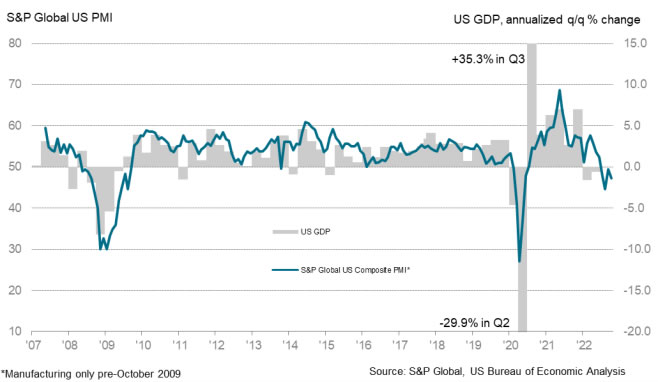
US PMI composite dropped to 47.3, downturn gathered significant momentum
US PMI Manufacturing dropped from 52.0 to 49.9 in October, a 28-month low. PMI Services dropped from 49.3 to 46.6, a 2-month low. PMI Composite dropped from 49.5 to 47.3, a 2-month low.
Chris Williamson, Chief Business Economist at S&P Global Market Intelligence said:
"The US economic downturn gathered significant momentum in October, while confidence in the outlook also deteriorated sharply. The decline was led by a downward lurch in services activity, fuelled by the rising cost of living and tightening financial conditions. While output in manufacturing remains more resilient for now, October saw a steep drop in demand for goods, meaning current output is only being maintained by firms eating into backlogs of previously placed orders. Clearly this is unsustainable absent of a revival in demand, and it's no surprise to see firms cutting back sharply on their input buying to prepare for lower output in coming months.
"One upside of this drop in input buying has been a further alleviation of supply constraints, which alongside the stronger dollar have helped cool price pressures in the manufacturing sector.
"Although price pressures picked up slightly in the service sector due to high food, energy and staff costs, as well as rising borrowing costs, increased competitive forces meant average prices charged for services grew at only a fractionally faster rate. Combined with the easing of price pressures in the goods-producing sector, this adds to evidence that consumer price inflation should cool in coming months.
"The surveys therefore present a picture of the economy at increased risk of contracting in the fourth quarter at the same time that inflationary pressures remain stubbornly high. However, there are clearly signs that weakening demand is helping to moderate the overall rate of inflation, which should continue to fall in the coming months, especially if interest rates continue to rise."
China is Under Pressure
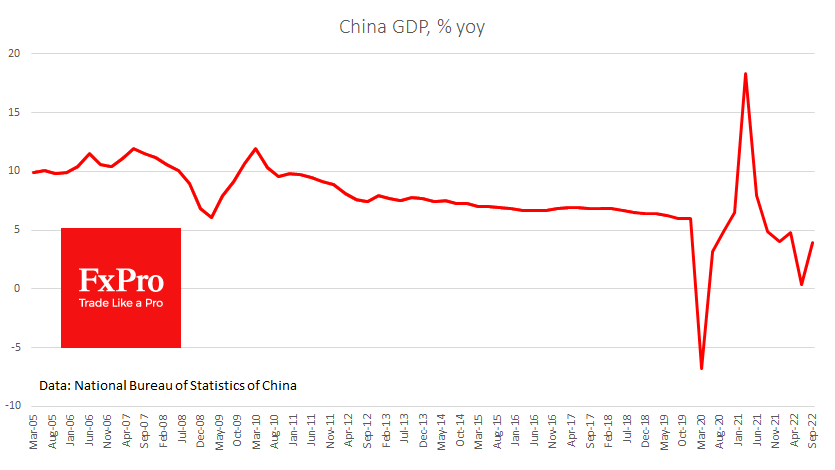
After a delay related to the Communist Party congress, China published a batch of monthly and quarterly statistics, which caused mainly disappointing reactions from analysts.
GDP added 3.9% in the third quarter compared to a year earlier against expectations of 3.5%. In the three quarters, the economy added 3.0% over the same period a year ago against 2.5%, the first-rate increase in more than a year.
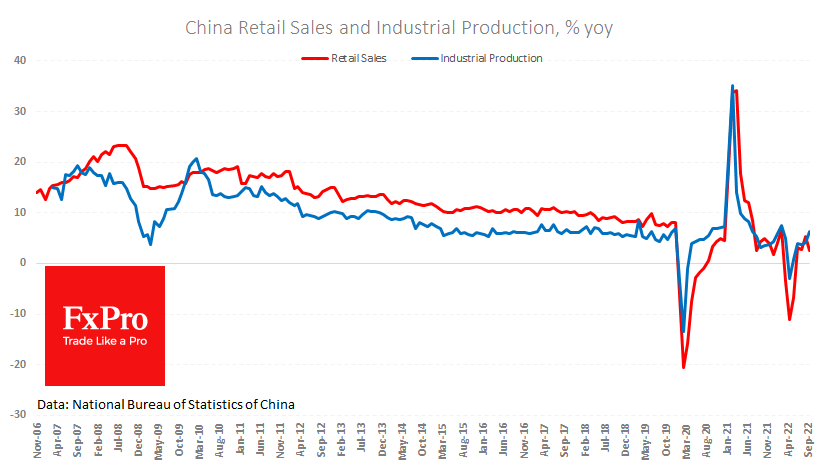
Also among the positive signals was a jump in industrial production by 6.3% y/y in September compared to 4.2% the month before and the expected 4.9%.
A trade surplus is also higher than expected, but an essential reason for its growth was a fall in imports rather than increased exports, which is not good macroeconomic news.
A very alarming signal was the cooling of retail sales from 5.4% to 2.5% (3.1% expected). Chinese government officials declare a further commitment to a zero covid expansion policy, potentially preventing economic activity from getting firmly back on the growth track.
An additional worrying factor for Asian markets is the reappointment of Xi Jinping for a third term. Investors are selling off Chinese assets on this news, suggesting a further course of austerity in the country, escalating tensions around Taiwan and anti-market reforms.
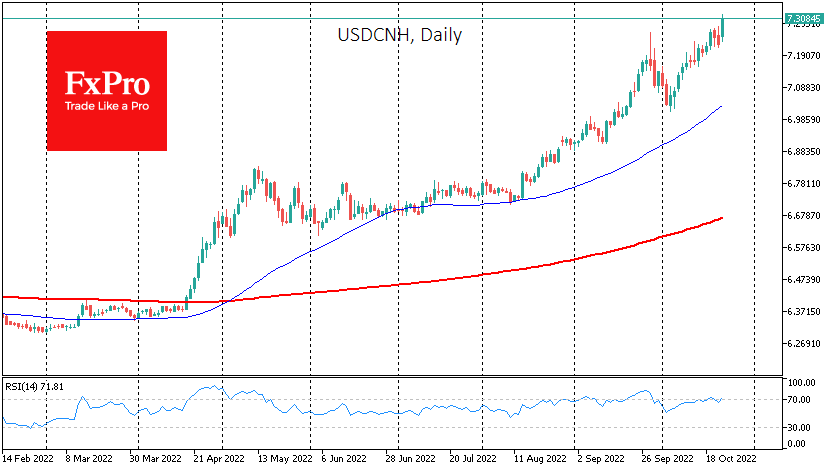
Contrary to the famous adage, markets have not been “selling the fact” of Xi’s unprecedented third term, for which they have been preparing in recent months. The Chinese yuan has rewritten lows against the dollar since 2008, and the offshore USDCNH exchange rate has surpassed 7.30. Key Chinese stock indexes are losing about 7% on Monday, pushing the Hang Seng index to lows since 2009 and the China H-share to 2005.