Sample Category Title
USD/JPY Mid-Day Outlook
Daily Pivots: (S1) 145.23; (P) 148.59; (R1) 150.97; More...
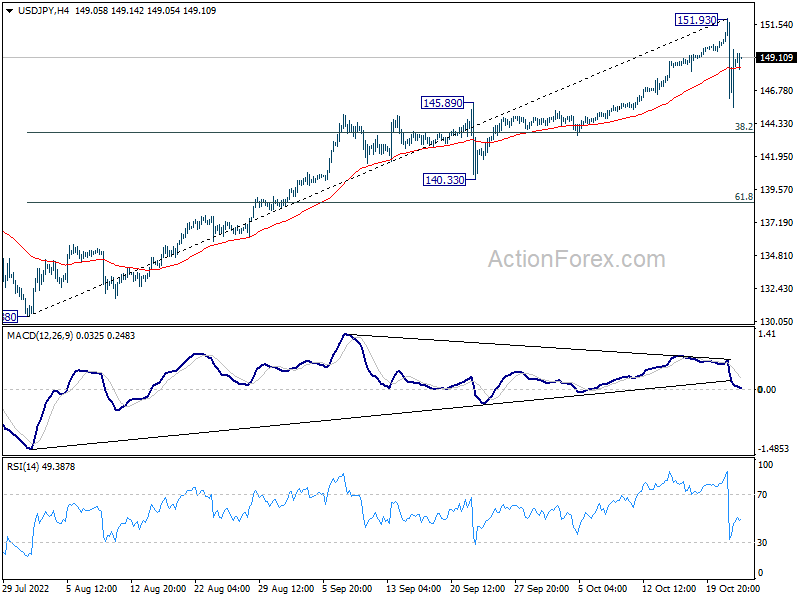
Intraday bias in USD/JPY remains neutral and outlook is unchanged. More consolidation would be seen for the near term. In case of another fall, downside should be contained by 38.2% retracement of 130.38 to 151.93 at 143.69 to bring rebound. Upside of rally attempt should be limited by 151.39 resistance.
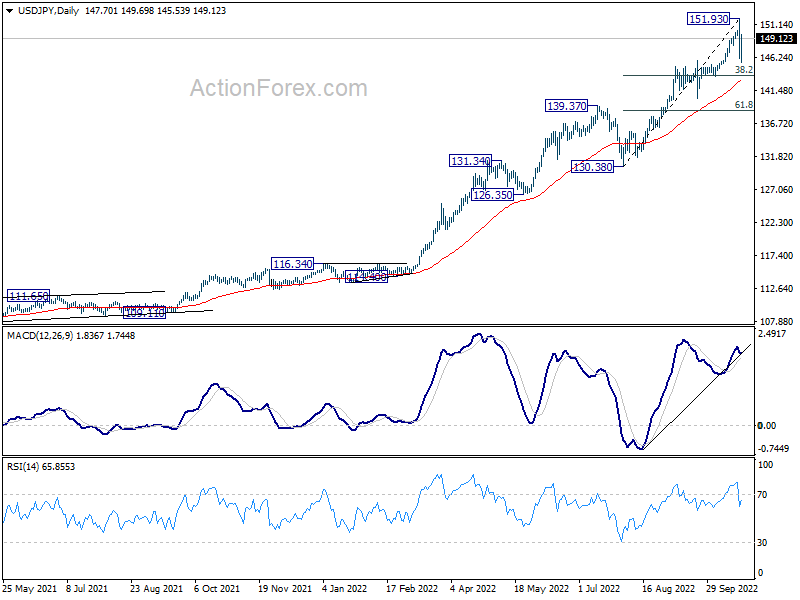
In the bigger picture, up trend from 101.18 is still in progress, as part of the whole up trend from 75.56 (2011 low). 147.68 (1998 high) was already met and there is no clearly sign of topping yet. In any case, break of 140.33 support is needed to be the first sign of medium term topping. Otherwise, further rise is in favor to next target at 160.16 (1990 high).
USD/CHF Mid-Day Outlook
Daily Pivots: (S1) 0.9911; (P) 1.0030; (R1) 1.0097; More...
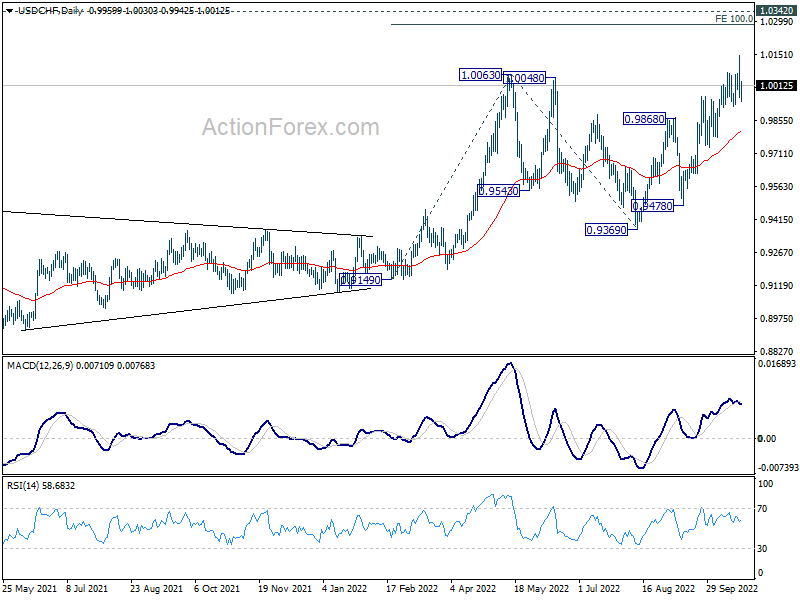
USD/CHF is staying in consolidation from 1.0146 and intraday bias remains neutral. Deeper retreat cannot be ruled out, but downside should be contained above 0.9799 support. On the upside, break of 1.0146 will resume larger up trend to 1.0283 projection level.
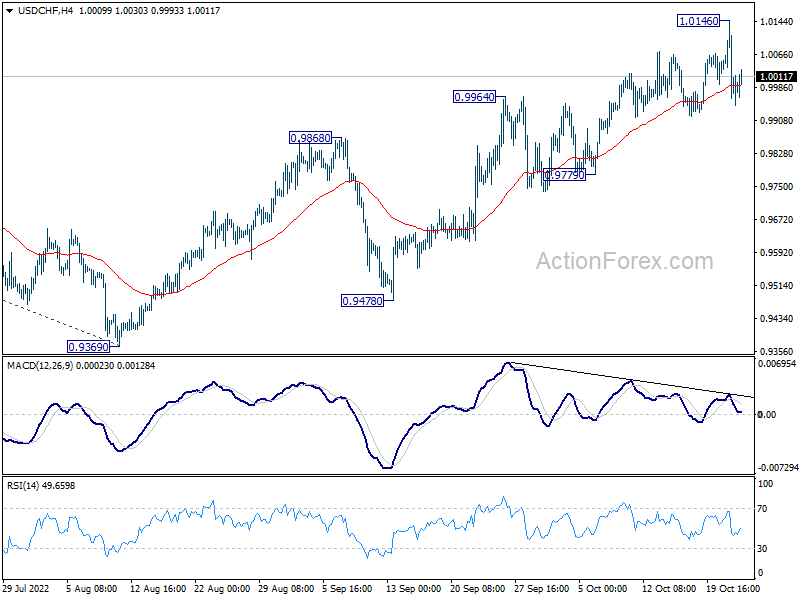
In the bigger picture, current development suggests that up trend from 0.8756 (2021 low) is still in progress. Sustained break of 1.0063 will target 100% projection of 0.9149 to 1.0063 from 0.9369 at 1.0283, and then 1.0342 (2016 high). For now, this will remain the favored case as long as 0.9779 support holds, even in case of deep pull back.
GBP/USD Mid-Day Outlook
Daily Pivots: (S1) 1.1134; (P) 1.1225; (R1) 1.1388; More...
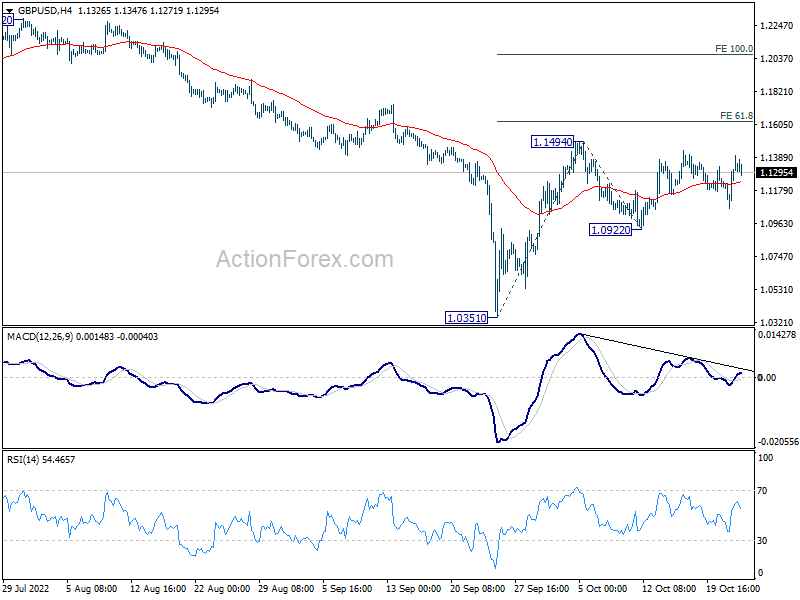
Intraday bias in GBP/USD remains neutral as sideway trading continues. Further rally is in favor as long as 1.0922 minor support holds. On the upside, break of 1.1494 will resume the rise from 1.0351 to 61.8% projection of 1.0351 to 1.1494 from 1.0922 at 1.1628. On the downside, below 1.0922 will turn bias back to the downside for 1.0351 low instead.
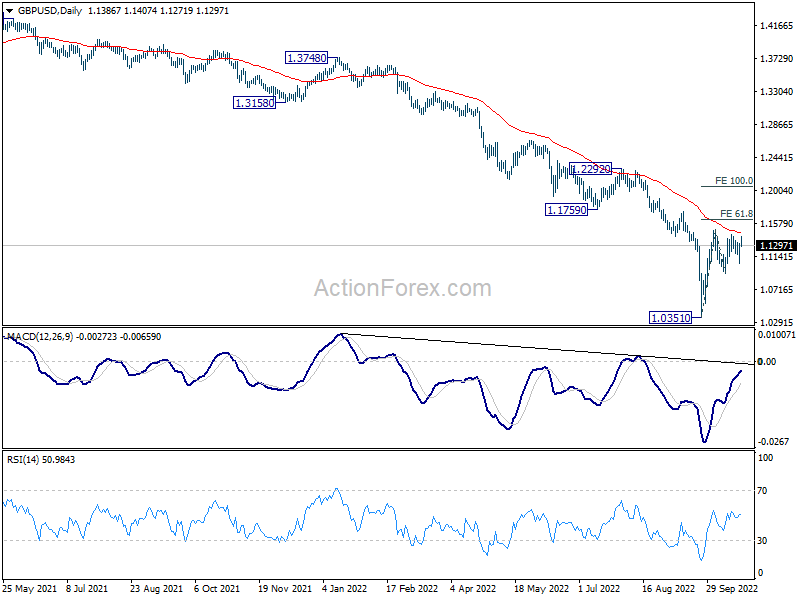
In the bigger picture, fall from 1.4248 (2018 high) is resuming long term down trend from 2.1161 (2007 high). Next target is 100% projection of 2.1161 to 1.3503 from 1.7190 at 0.9532. There is no scope of a medium term rebound as long as 1.1759 support turned resistance holds.
EUR/USD Mid-Day Outlook
Daily Pivots: (S1) 0.9755; (P) 0.9812; (R1) 0.9919; More...
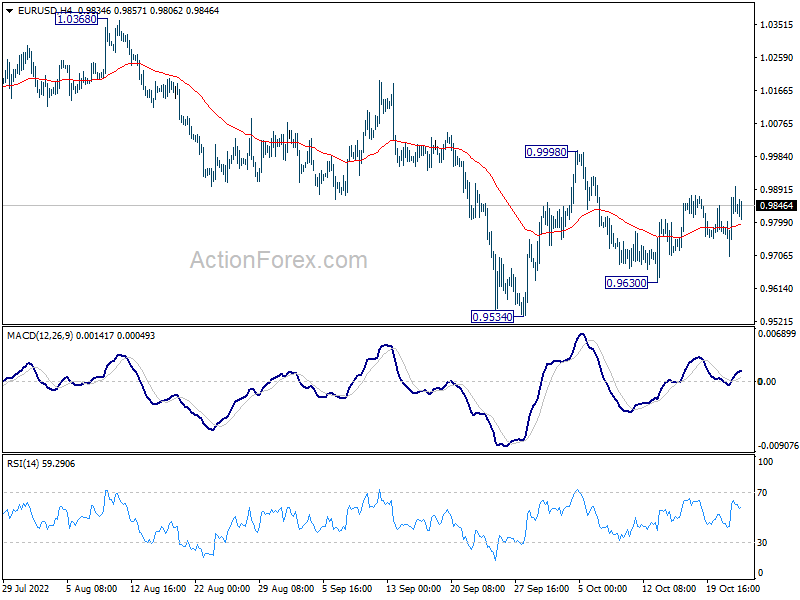
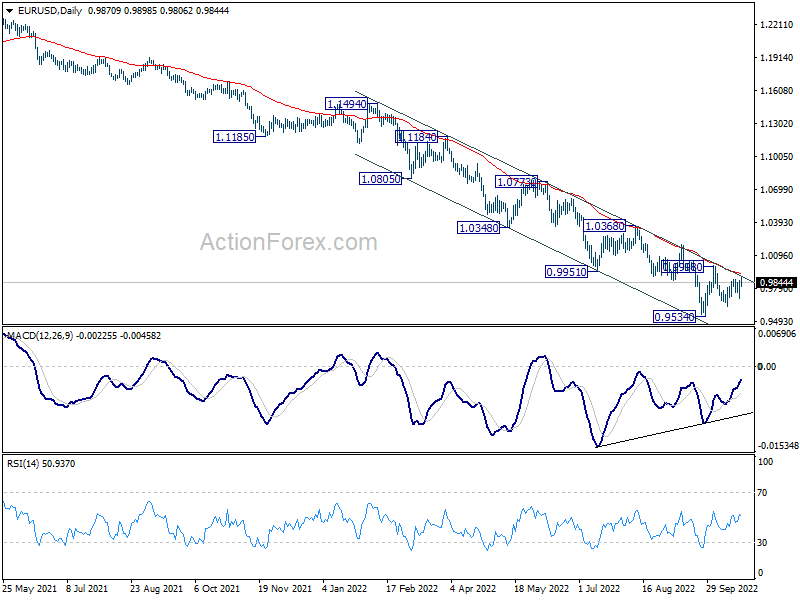
Range trading continues in EUR/USD and intraday bias stays neutral at this point. On the downside, break of 0.9630 bring retest of 0.9534 first. Firm break there will resume larger down trend. However, break of 0.9998 resistance will resume the rise from 0.9534, and carry larger bullish implications.
In the bigger picture, down trend from 1.6039 (2008 high) is still in progress. Next target is 100% projection of 1.3993 to 1.0339 from 1.2348 at 0.8694. In any case, break of 0.9998 resistance is needed to be the first sign of medium term bottoming. Otherwise, outlook will stay bearish even with strong rebound. However, considering bullish convergence condition in daily MACD, firm break of 0.9998 will confirm medium term bottoming, and bring further rise back to 1.0368 resistance first.
Euro and Sterling Shrug Poor PMIs, Overall Sentiment Mixed
Overall market sentiment is mixed today. European stocks are trading up together with US futures. But heavy selling was seen in Hong Kong and China stocks earlier. Commodity currencies appear to be weighed down by the negative side of the picture, while Dollar is firmer with European majors. Sterling is so far the better performer but there is no follow through buying. The Pound is awaiting news on whether Rishi Sunak will become the next UK Prime Minister. There is little reaction to the poor PMI data from Eurozone and the UK. Yen is mixed for now, slightly on the soft side.
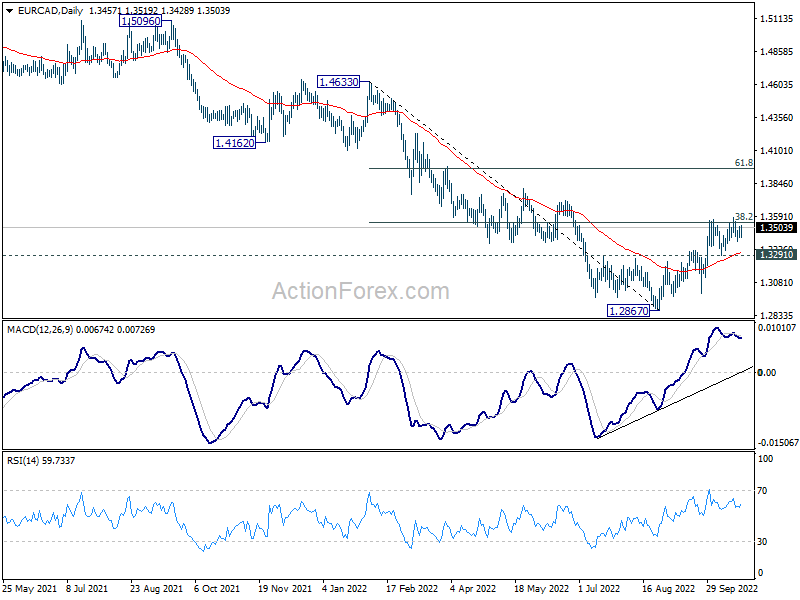
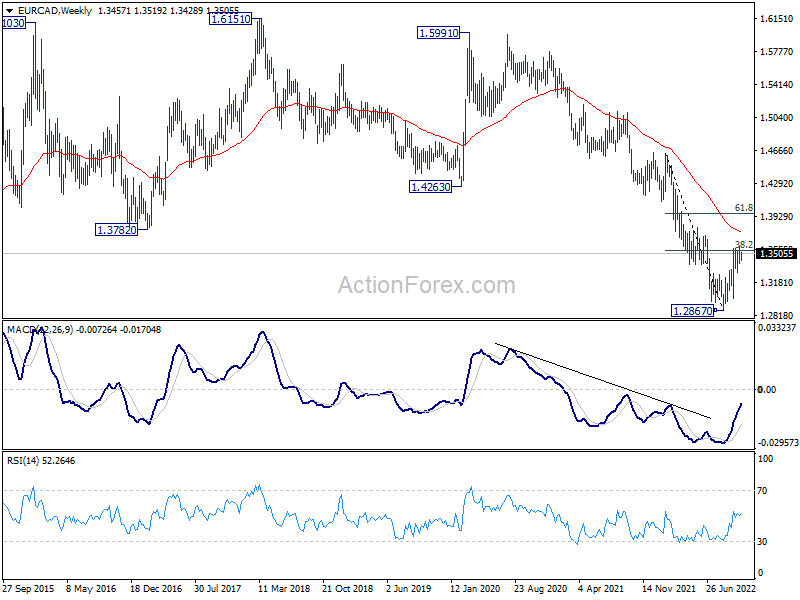
EUR/CAD is a pair to watch this week with ECB and BoC featured. Technically, rebound from 1.2867 short term bottom is in favor to continue as long as 1.3291 support holds. Sustained break of 38.2% retracement of 1.4633 to 1.2867 at 1.3542 will add to the case of medium term bullish reversal, and target 55 week EMA (now at 1.3748). However, rejection by 1.3542, followed by break of 1.3291, will resume larger down trend through 1.2867 low.
In Europe, at the time of writing, FTSE is up 0.34%. DAX is up 1.59%. CAC is up 1.67%. Germany 10-year yield is down -0.088 at 2.332. Earlier in Asia, Nikkei rose 0.31%. Hong Kong HSI dropped -6.36%. China Shanghai SSE dropped -2.02%. Japan 10-year JGB yield rose 0.0005 to 0.257.
UK PMI manufacturing fell to 47.2, a worryingly deep UK recession
UK PMI Manufacturing dropped further from 48.4 to 45.8 in October, a 29-month low. PMI Services dropped from 50.0 to 47.5, a 21-month low. PMI Composite dropped from 49.1 to 47.2, a 21-month low.
Chris Williamson, Chief Business Economist at S&P Global Market Intelligence said: "October's flash PMI data showed the pace of economic decline gathering momentum after the recent political and financial market upheavals... GDP therefore looks certain to fall in the fourth quarter after a likely third quarter contraction, meaning the UK is in recession...
"The resulting elevated, albeit easing, price pressures look set to drive the Bank of England into further aggressive interest rate hikes. On top of the collapse in political stability, financial market stress and slump in confidence, these higher borrowing costs will add to speculation of a worryingly deep UK recession."
Eurozone PMI composite dropped to 47.1, economy to contract in Q4, risks on downside
Eurozone PMI Manufacturing dropped from 48.4 to 46.6 in October, a 29-month low. PMI Services dropped from 48.8 to 48.2, a 20-month low. PMI Composite dropped from 48.1 to 47.1, a 23-month low.
Chris Williamson, Chief Business Economist at S&P Global Market Intelligence said: "The eurozone economy looks set to contract in the fourth quarter given the steepening loss of output and deteriorating demand picture seen in October, adding to speculation that a recession is looking increasingly inevitable.
"While October's headline flash PMI is consistent with GDP falling at a modest rate of around 0.2%, demand is falling sharply and companies are increasingly growing worried over high inventories and weaker than expected sales, especially as winter approaches. The risks are therefore tilted towards the downturn accelerating towards the year-end."
Japan refrains from commenting on currency intervention
Japan Finance Minister Shunichi Suzuki declined to confirm if there was intervention in the currency markets last Friday. But he reiterated, "we cannot tolerate excessive volatility caused by speculative moves, and we are ready to take necessary steps when needed.... we are in a situation where we are confronting speculative moves strictly."
Masato Kanda, Vice Finance Minister for International Affairs also said, "we won't comment" on whether Japan will intervene gain. He said, "we will take appropriate steps against excessive volatility 24 hours a day, 365 days a year."
Chief Cabinet Secretary Hirokazu Matsuno also said, "we refrain from commenting specifically on any currency intervention".
Japan PMI composite rose to 51.7, but manufacturing struggles
Japan PMI Manufacturing ticked down from 50.8 to 50.7 in October, weakest in 21 months. PMI Manufacturing Output improved slightly from 48.3 to 48.7. PMI Services rose from 52.2 to 53.0. PMI Composite also rose from 51.0 to 51.7.
Laura Denman, Economist at S&P Global Market Intelligence, said: "Latest flash PMI data has pointed to a further improvement in Japan's private sector economy in October... The manufacturing sector, however, continued to struggle in the face of weak demand conditions and severe cost pressures... With inflationary pressures remaining elevated across the private sector, business confidence dipped to a six-month low."
RBA Kent: Depreciation in AUD will have very modest uplift in prices
RBA Assistant Governor Christopher Kent said in a speech, "The Board expects to increase interest rates further in the period ahead, given the need to establish a more sustainable balance of demand and supply and in the face of a very tight labour market." The "size and timing" of rate increases will depend on "incoming data" and "outlook for inflation and the labour market."
Kent also said the appreciation of the US dollar will "add to the cost of imports for a time" because much the global trade is invoices in it. At the same time, rise in US interest rates will also "contribute to a decline in global inflation pressures". The depreciation of Australia's nominal trade-weighted exchange rate over the year to date will contribute only a "very modest uplift in the level of consumer prices over the period ahead".
Australia PMI composite dropped to 49.6, renewed contraction
Australia PMI Manufacturing dropped from 53.5 to 52.8 in October, a 14-month low. PMI Services dropped from 50.6 to 49.0, a 9-month low. PMI Composite dropped from 50.9 to 49.6, a 9-month low.
Jingyi Pan, Economics Associate Director at S&P Global Market Intelligence said: "Australia's private sector saw renewed contraction in October with the service sector primarily showing signs of stress. A fall in demand for services was underpinned by higher interest rates and prices, altogether reflective of the detriments of aggressive monetary policy tightening and capacity constraints upon business activity."
China posted solid production but weak retail sales data
After a delay amid the 20th Communist Party Congress last week, China released a batch of economic data today.
GDP grew 3.9% yoy in Q3, and beat expectation of 3.3% yoy. In September, industrial grew 6.3% yoy, faster than August's 4.2% yoy, and beat expectation of 4.9% yoy. Retail sales, however, rose only 2.5% yoy, slowed from August's 5.4% yoy, and missed expectation of 3.1% yoy. Fixed asset investment rose 5.9% ytd yoy, below expectation of 6.0%.
Also released, in USD term, exports rose 10.7% yoy in September. Imports rose 0.3% yoy. Trade surplus widened from USD 79.4B to USD 84.0B, above expectation of USD 81B.
EUR/USD Mid-Day Outlook
Daily Pivots: (S1) 0.9755; (P) 0.9812; (R1) 0.9919; More...
Range trading continues in EUR/USD and intraday bias stays neutral at this point. On the downside, break of 0.9630 bring retest of 0.9534 first. Firm break there will resume larger down trend. However, break of 0.9998 resistance will resume the rise from 0.9534, and carry larger bullish implications.
In the bigger picture, down trend from 1.6039 (2008 high) is still in progress. Next target is 100% projection of 1.3993 to 1.0339 from 1.2348 at 0.8694. In any case, break of 0.9998 resistance is needed to be the first sign of medium term bottoming. Otherwise, outlook will stay bearish even with strong rebound. However, considering bullish convergence condition in daily MACD, firm break of 0.9998 will confirm medium term bottoming, and bring further rise back to 1.0368 resistance first.
Economic Indicators Update
| GMT | Ccy | Events | Actual | Forecast | Previous | Revised |
|---|---|---|---|---|---|---|
| 22:00 | AUD | Manufacturing PMI Oct P | 52.8 | 53.5 | ||
| 22:00 | AUD | Services PMI Oct P | 49 | 50.6 | ||
| 00:30 | JPY | Jibun Bank Manufacturing PMI Oct P | 50.7 | 51.3 | 50.8 | |
| 07:15 | EUR | France Manufacturing PMI Oct P | 47.4 | 47 | 47.7 | |
| 07:15 | EUR | France Services PMI Oct P | 51.3 | 51.5 | 52.9 | |
| 07:30 | EUR | Germany Manufacturing PMI Oct P | 45.7 | 47.2 | 47.8 | |
| 07:30 | EUR | Germany Services PMI Oct P | 44.9 | 44.8 | 45 | |
| 08:00 | EUR | Eurozone Manufacturing PMI Oct P | 46.6 | 48 | 48.4 | |
| 08:00 | EUR | Eurozone Services PMI Oct P | 48.2 | 48.2 | 48.8 | |
| 08:30 | GBP | Manufacturing PMI Oct P | 45.8 | 48 | 48.4 | |
| 08:30 | GBP | Services PMI Oct P | 47.5 | 49 | 50 | |
| 13:45 | USD | Manufacturing PMI Oct P | 51.2 | 52 | ||
| 13:45 | USD | Services PMI Oct P | 49.2 | 49.3 |
November Flashlight for the FOMC Blackout Period: Our Expectations Ahead of the November 2nd FOMC Meeting
Summary
- We look for the FOMC to deliver its fourth consecutive 75 bps rate hike at the conclusion of its meeting on November 2. Inflation continues to run much too hot for the FOMC, and the labor market remains extraordinarily tight.
- The odds of a 100 bps rate hike on November 2 are low, in our view. Although some Committee members may favor a 100 bps hike, an increase of that magnitude does not appear to be a consensus view.
- Financial markets have become volatile in recent weeks, raising some questions about the outlook for Fed policy. But we think the probability is low that the FOMC will opt for a rate hike that is less than 75 bps. The market is fully priced for 75 bps, and most Committee members believe that financial markets are generally functioning properly at present despite its recent volatility.
- In our view, the most important aspect of the November 2 FOMC meeting will be how the post-meeting statement and press conference frame policy considerations ahead. The FOMC could begin to stress the cumulative effect of tightening, which could signal that it is preparing to shift to a slower pace of rate hikes in the meetings ahead. Indeed, we are starting to hear more caution slip into the remarks of some Fed speakers.
Along with our estimates for key inflation and jobs data to soften ahead of the December meeting, the more cautionary notes we are beginning to hear from some policymakers leads us to expect that the November meeting may very well deliver the last 75-bps hike this cycle, and that the Fed is likely to step down to "only" a 50 bps hike in its final meeting of the year.
The Fed's Barrage on Inflation Continues
Anyone hoping that the FOMC's barrage of 75 bps hikes would come to end by now likely will be sorely disappointed at the conclusion of the FOMC's upcoming meeting on November 2. We expect the FOMC will deliver its fourth consecutive 75 bps hike next week, bringing the fed funds target range to 3.75-4.00%.
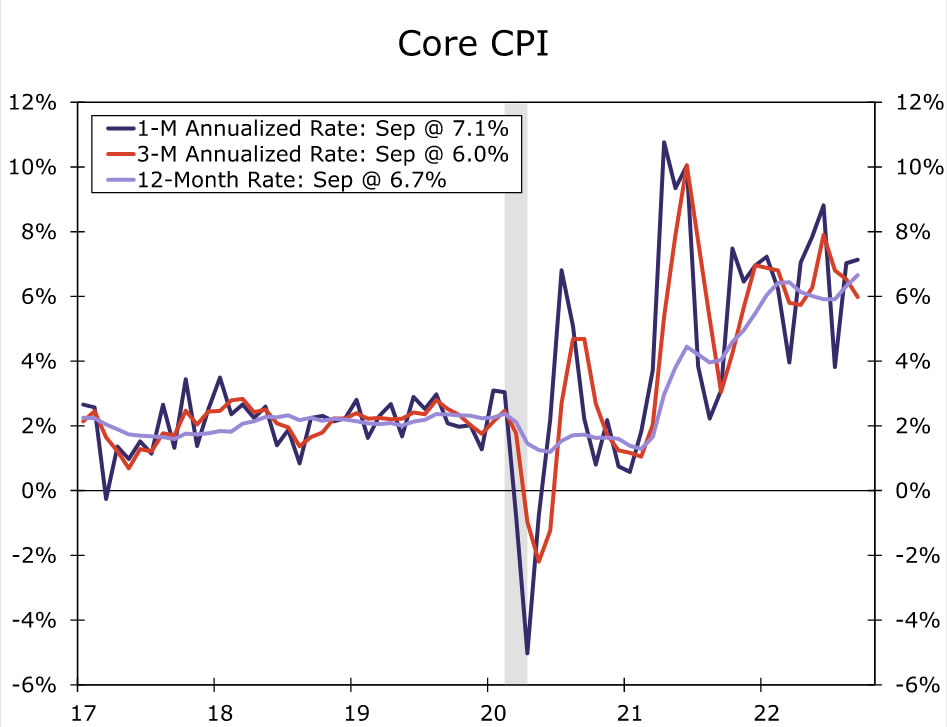
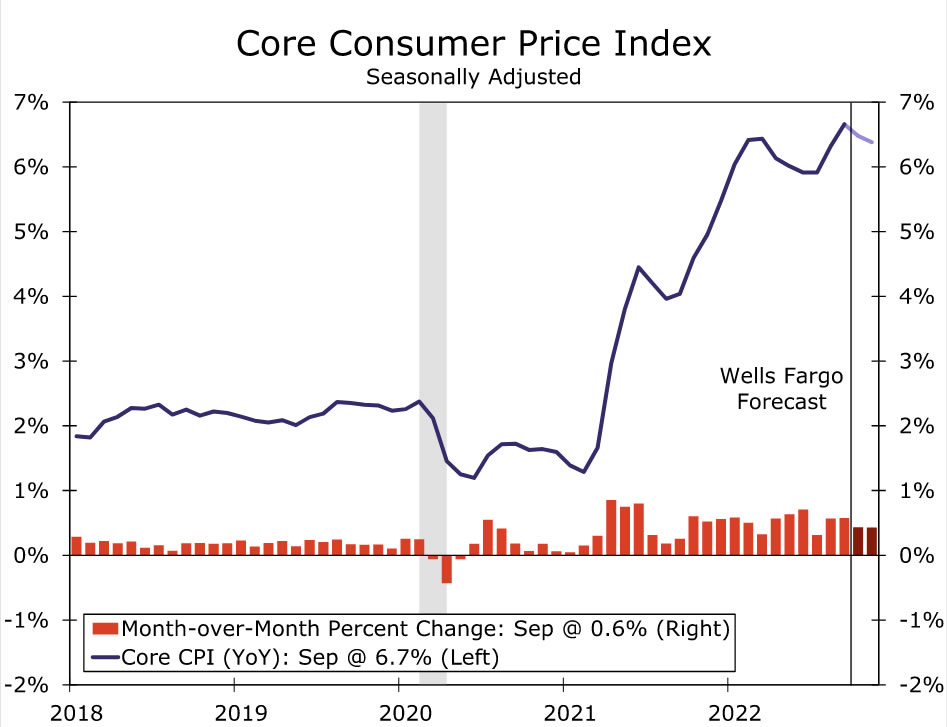
Fed officials all appear to be on the same page: inflation remains much too high, and risks are still skewed to the upside. For months now, Committee members, including Chair Powell, have been looking for "compelling evidence" of inflation moving down. That evidence has yet to materialize. All three of the major U.S. inflation indices—the Consumer Price Index, PCE deflator and Producer Price Index—surprised to the upside in their most recent prints. Most glaringly, the core CPI advanced another 0.6% in September, consistent with a 7.1% annualized rate of price growth and above both the 3-month and 12-month pace (Figure 1). Notably, the strong upturn came from services inflation picking up further speed, which more than offset the highly-anticipated softness in goods prices. All in all, the trend in inflation has yet to turn, let alone approach a level at which the Fed could be reasonably comfortable.
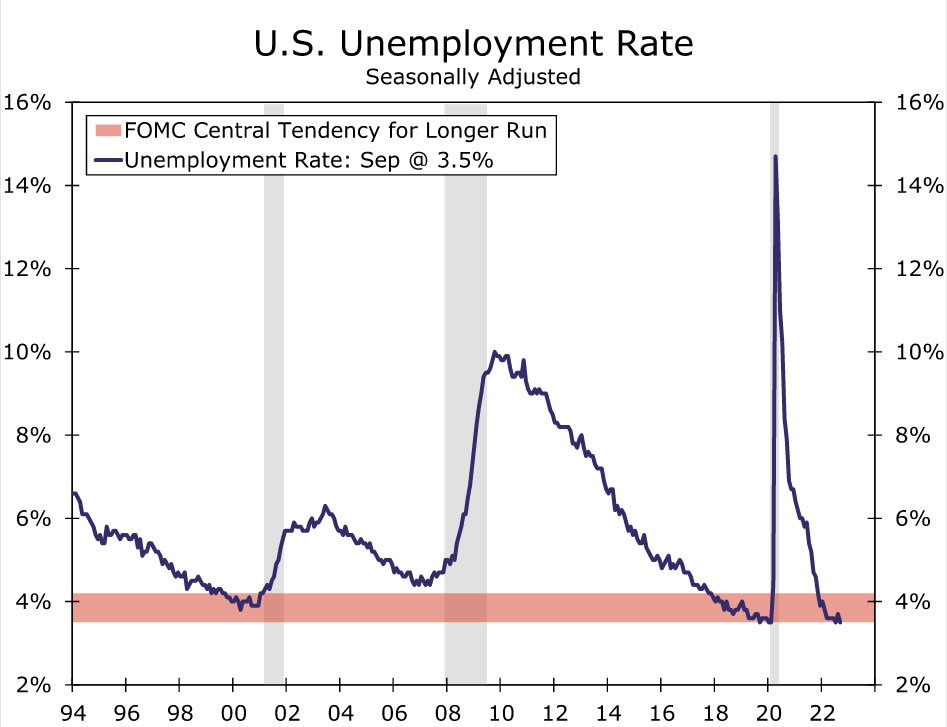
There are also no signs that the Fed's inflation and employment mandates are in tension at present. The unrelenting pace of inflation comes with what is still an extraordinarily tight labor market. The unemployment rate ticked back down to 3.5% in September to match a 52-year low as a robust rebound in labor force participation remains elusive (Figure 2). Job growth has slowed in recent months, but even September's gain of 263K, the smallest in 18 months, remains well above last cycle's average of 185K. Other signs of demand for workers have cooled since the spring, including job openings and hiring plans, but remain notably higher than when the unemployment rate was this low in the prior cycle. Similarly, average hourly earnings growth has eased slightly, but at a 4.4% annualized pace the past three months, continues to run above a rate consistent with 2% inflation.
The probability of a 100 bps rate hike on November 2, as implied by market pricing, is only 10% or so as of this writing. We agree that the odds on a full percentage point rate increase in the target range for the federal funds rate are low. Although some of the more hawkish members of the FOMC may be in favor of a 100 bps rate hike, an increase of that magnitude does not appear to be a consensus on the Committee. As we discuss in more detail below, some Fed officials are starting to indicate that the FOMC will soon need to move more cautiously. But we do not think the FOMC is set to deliver a rate hike of "only" 50 bps next week. Not only does the high rate of inflation at present support the case for another 75 bps rate hike, but financial markets are fully priced for an increase of that magnitude. A smaller increase could lead to a significant "risk on" rally in financial markets, which could thwart the Fed's efforts to cool off the economy. Moreover, there has been few indications from Fed officials in public comments that they are ready to slow the pace of tightening at this time.
Will Financial System Stress Influence the FOMC?
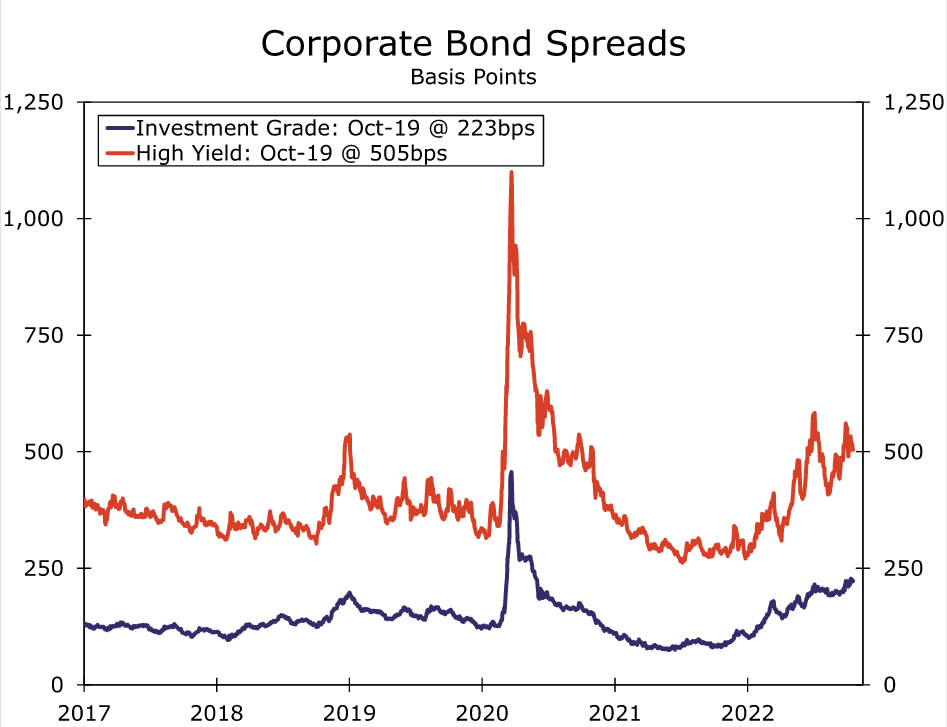
Global financial markets have become increasingly volatile in recent weeks, which has raised questions about how Federal Reserve officials will proceed with their intended path of monetary policy tightening. In the United States, equity markets have contributed to the volatility. The S&P 500 index has fallen 5.1% since the end of August and is down 21.8% this year. Bond prices have plunged as markets have repriced expectations of future monetary policy actions, and credit spreads have widened (Figure 3).
Some financial market pain is a normal part of monetary policy tightening. Monetary policy primarily impacts the real economy through changes in financial conditions, such as interest rates, credit spreads and equity prices. That said, the pace of monetary policy tightening by the FOMC this year has been stunning. As recently as early March, the Federal Reserve was still buying bonds. Yet less than eight months later, 75 bps rate hikes have become the norm, and the Fed is reducing the size of its balance sheet by up to $95 billion per month. Furthermore, with inflation remaining stubbornly high, it has become increasingly clear that monetary policy will need to become even more restrictive in the coming months via a higher fed funds rate and a smaller central bank balance sheet. Many fear that something will "break" in the financial system if the Federal Reserve continues to tighten policy at such an aggressive pace.
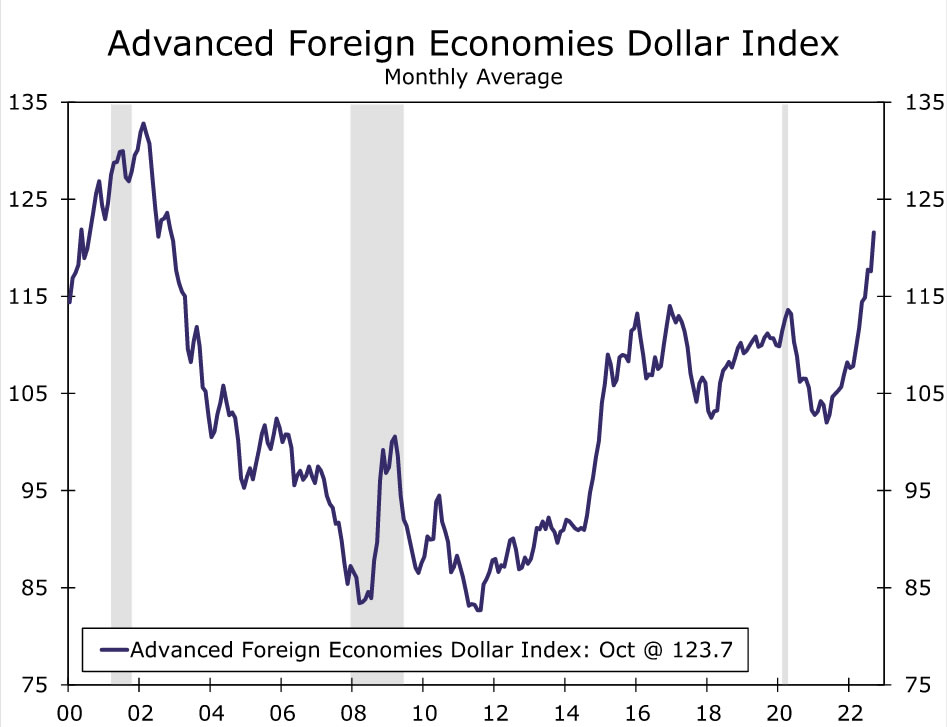
A recent episode outside the United States offered an example of what could go wrong. The prospect of much tighter monetary policy in the United Kingdom, paired with a proposed easing of fiscal policy by the short-lived Truss government, led to a sharp upward move in long-term interest rates. Eventually, the Bank of England was forced to carry out temporary purchases of long-dated U.K. government bonds to "restore orderly market conditions" amid the interest rate surge that threatened to cause a crisis for the U.K. pension system and, perhaps, the broader U.K. financial system. It remains to be seen whether this remedy has solved the problems or merely kicked them down the road. Elsewhere, worries have mounted regarding everything from Treasury market liquidity to the U.S. dollar, which has climbed to a 20-year high against a basket of other major currencies (Figure 4).
At this point in time, the consensus among Fed officials appears to be that critical financial market plumbing remains operative despite some bumps in the road. Governor Waller recently characterized himself as "a little confused" by the worries over financial stability risks, saying that "while there has been some increased volatility and liquidity strains in financial markets lately, overall, I believe markets are operating effectively." Cleveland Fed President Mester's view in a recent interview was that "there's no evidence disorderly market functioning is going on at present." New York Fed President John Williams acknowledged that market liquidity was lower due to significant uncertainty surrounding the outlook for monetary policy and the global economy, but he noted that "core markets are functioning, continue to function reasonably well." The latest FOMC minutes made a similar claim, asserting that "the markets for Treasury securities and agency MBS continued to function in an orderly manner, though liquidity conditions in both markets remained low, reflecting elevated interest rate uncertainty."
That said, most FOMC participants appear to be cognizant of the risks. In the same speech, President Williams noted that Fed officials need to watch these developments very closely, and President Daly of the San Francisco Fed recently argued that "we definitely don't raise rates until something breaks."
In our view, it is not surprising that financial market volatility is high and market liquidity has deteriorated accordingly. The economic outlook is far more uncertain than usual, and this leads to a broad range of potential outcomes with which financial market participants must grapple. But with important markets such as the Treasury market still functioning reasonably well given the circumstances, we doubt recent developments are enough to derail the Fed's aggressive policy moves at this juncture.
What the November Tea Leaves Could Say for December
While the recent stress in financial markets does not appear to be enough to alter the FOMC's pace of policy tightening in November, it likely does argue for a slower pace in the not-too-distant future. Supersized 75 bps rate hikes made sense when the FOMC was playing "catch up" on rates, but with the fed funds rate rapidly approaching the core inflation rate and forward-looking measures of the economy showing signs of a pending cool down, a more moderate pace of rate hikes may soon be in order. This in turn should help reduce interest rate uncertainty on the margin and could help improve financial market stability, with the latter helping to ensure that the Fed has the breathing room it needs to complete its fight against inflation.
Therefore, in our view, the most important aspect of the November FOMC meeting will be how the post-meeting statement and press conference frame policy considerations ahead. We suspect Chair Powell to reiterate that quelling inflation remains the FOMC's utmost priority, and that the FOMC will "keep at it until the job is done."
However, we also expect to see signs of the FOMC approaching a crossroad in its campaign to battle inflation. Monetary policy famously works with a lag. To that end, increased emphasis on the significant tightening done in short-order this year could begin to position the FOMC for a slower pace of tightening as soon as its December 14 meeting, even as inflation is still expected to be well-above target. After all, the purpose of front-loading hikes is to quickly get policy close to where it would ultimately need to be and then to let the effects of higher rates take their course.
The most impactful place we could see this consideration show up in November would be in the post-meeting policy statement. The statement could perhaps see the addition that when "assessing the appropriate stance of monetary policy, the Committee will continue to monitor the implications of incoming information and cumulative policy adjustments for the economic outlook" (bolded text our insertion). Chair Powell could further indicate that the cumulative tightening by the Committee this year is taking on greater weight in the Committee's policy deliberations by including in his opening press conference remarks more than just a passing reference to the need to "at some point" slow rate hikes. Mentioning the need to also account for monetary policy tightening globally would further hint that the FOMC may nearing the point when it is ready to ease its foot off the brake at least slightly.
Our own view is that the FOMC will downshift to "only" a 50 bps hike at its December 14 meeting. We are starting to hear more caution slip into the remarks of some Fed speakers. Notably, Vice Chair Brainard in a recent speech stressed that the effects of tighter Fed policy this year was already working to temper demand and was "being amplified by concurrent foreign tightening." Policy needed to move forward "deliberately" to learn the effects of cumulative tightening in her view. Kansas City Fed President Esther George, a voting member of the Committee this year, expressed concern that a string of jumbo rate hikes "might cause you to oversteer and not be able to see those turning points."
We also expect to see more material weakening in economic activity generally, and the jobs market and inflation in particular, ahead of the FOMC's December 14 meeting. The FOMC received only one additional reading on CPI and nonfarm payrolls between its September and November meetings. But some softening in core inflation and a slowdown in hiring should become more obvious by our estimations in the two CPI reports (Figure 5) and the two employment reports (Figure 6) that will be received prior to the FOMC's December meeting.
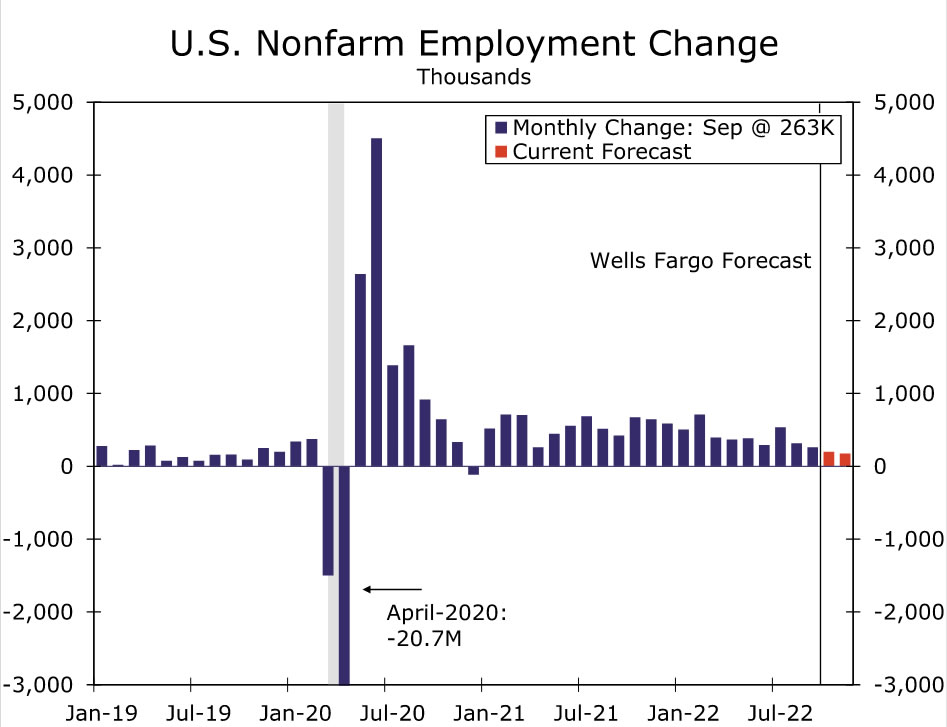
However, a downshift in the pace of tightening from 75 bps per meeting to 50 bps per meeting should not be conflated with a full pivot on policy. Rather, it would be the first step in an effort to tame inflation with a bit more precision. The FOMC will therefore need to carefully message that it remains firmly committed to reducing inflation, while highlighting the progress made at getting policy to a position that is better able to achieve that outcome.
DXY: Bears Continue to Push the Market Down
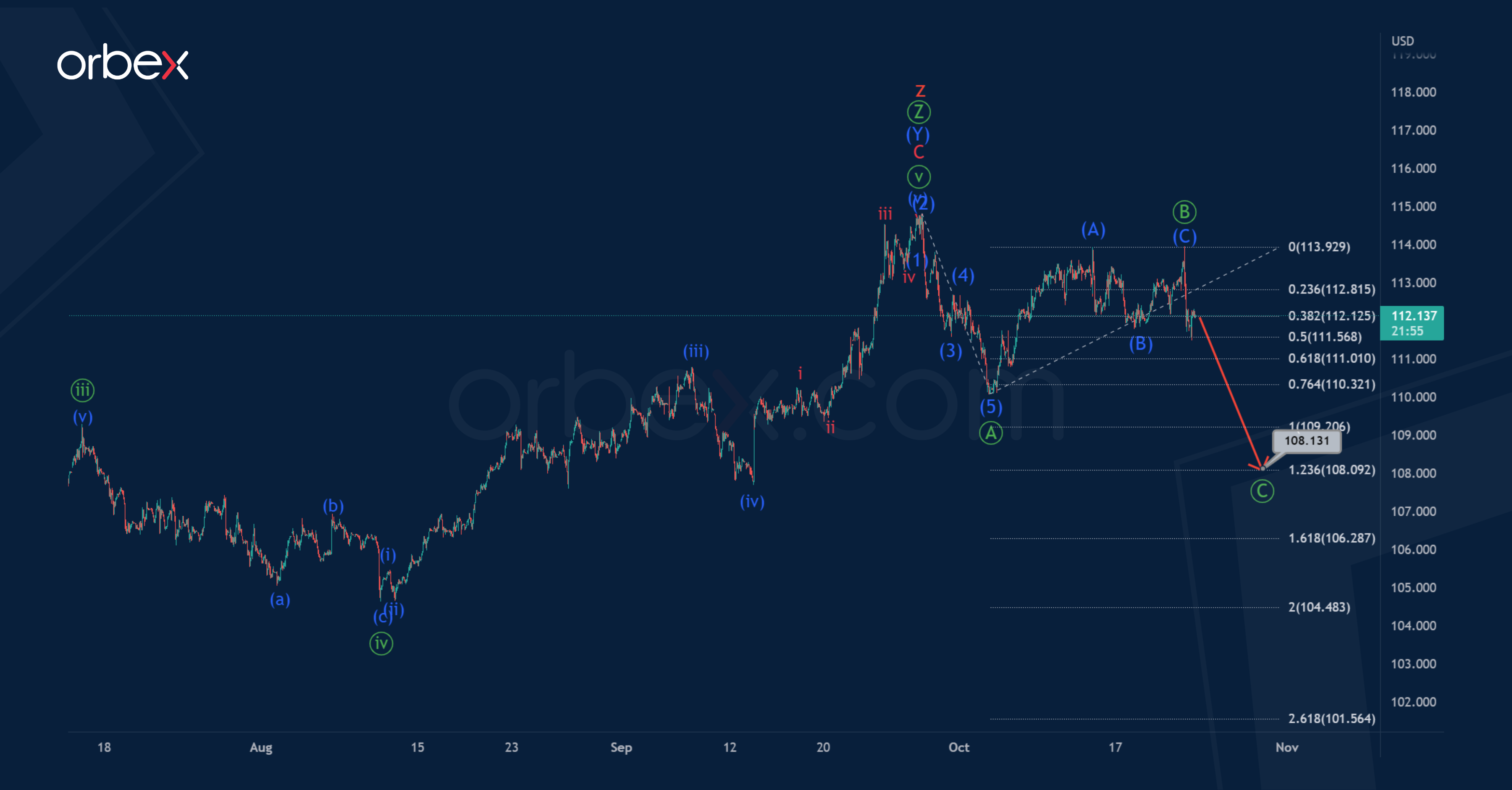
Apparently, the internal structure of the DXY index shows the completion of the global corrective trend, which took the form of a triple zigzag consisting of five main cycle waves w-x-y-x-z.
It is possible that the market has now begun the formation of the initial part of a new bearish trend.
It is assumed that bears form a zigzag pattern. The impulse and correction have already been completed. In the near future, the price is expected to continue falling in the primary impulse wave. Its end is expected to reach 108.13. At that level, it will be at 123.6% of first impulse wave.
Another option is also allowed, in which the formation of a cycle triple zigzag is not yet fully completed.
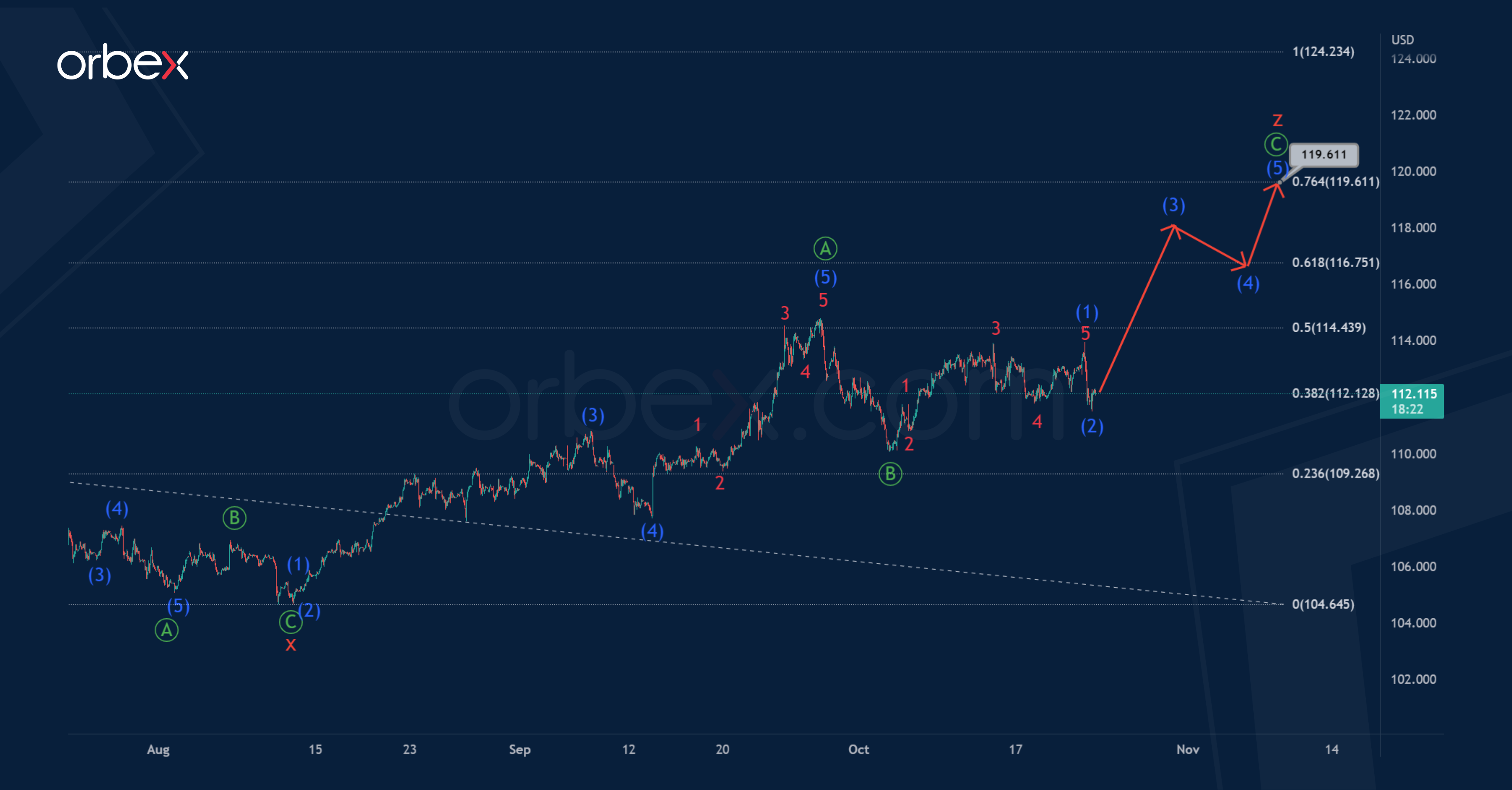
Most likely, at the level of 104.64, the bearish cycle wave x was completed, which took the form of a standard zigzag of the primary degree. After that, an upward impulse price movement in the wave z began.
The wave z may take the form of a zigzag, where the first impulse and correction are already completed.
The entire wave z may complete its pattern near 119.61. At that level, it will be at the 76.4% Fibonacci extension of wave y.
USD/JPY: Regains Traction after Friday’s Intervention; Eyes Key Barriers at 150.00/42
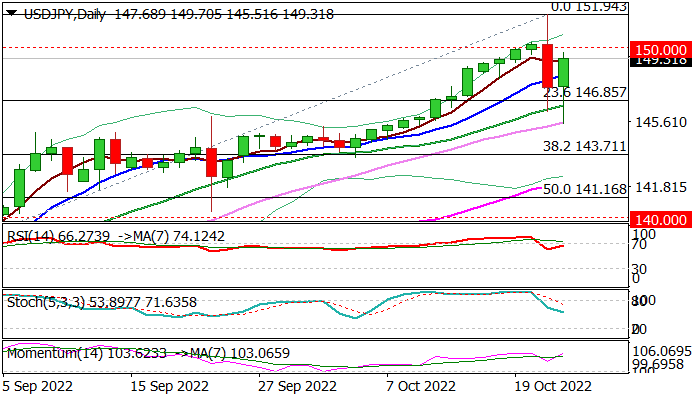
The USDJPY bounces strongly in early Monday and regains levels near 150 barrier, signaling that a positive impact from a massive intervention to support yen on Friday, was not lasting long.
The pair dipped from new 32-year high (151.94) to 145.51 following Japan’s record nearly $20 billion intervention, but yen was unable to hold gains as a cocktail of factors continues to strongly support dollar, even though the media report on Friday signaled that the US central bank will likely debate the size of future rate hikes, suggesting that aggressive tightening mode would start to ease soon.
Fresh strength eyes pivotal barriers at 150.00/42 (psychological / Fibo 76.4% of 151.94/145.51 pullback), break of which would firm the structure and open way for further advance.
Larger bulls remain intact but need a close above 150 pivot to generate fresh signal and open way for retest of new peak at 151.94, violation of which would unmask Apr 1990 peak at 159.16.
Rising 20DMA offers initial support at 148.40, followed by 146.85 (Fibo 23.6% of 130.39/151.94) and today’s spike low at 145.51 (reinforced by 30DMA).
Caution on failure to clear 150 barrier that would signal extended consolidation, but bullish structure is expected to remain unharmed while the action stays above 146.85 Fib support.
Res: 149.70; 150.00; 151.94; 153.46.
Sup: 148.40; 147.68; 146.85; 145.51.
GBP/USD: Downside Remains Vulnerable After Short-lived Advance
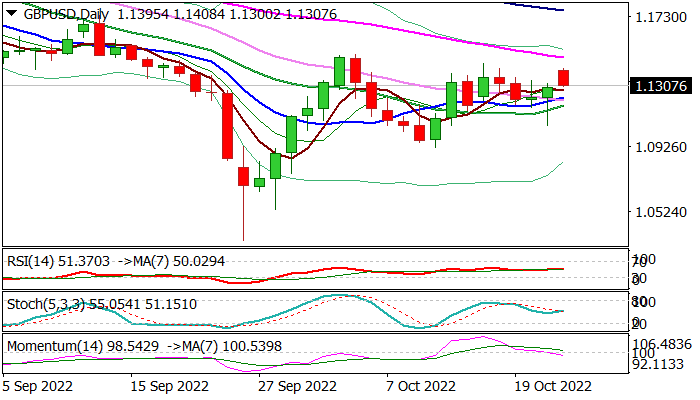
Cable started trading on Monday with a gap-higher, but gains were so far short-lived and stalled under last week’s high at 1.1439.
Fresh optimism about a solution for deepening political crisis in Britain on expectations that Rishi Sunak will be next Prime Minister, after Boris Johnson retreated, inflated pound in early Monday, but fresh bulls lacked strength to break higher.
Daily studies are bearishly aligned as negative momentum rises but firmer signals are still needed.
Filling today’s gap would add to negative near-term structure, with extension and close below 20DMA (1.1181) to generate bearish signal and make the downside more vulnerable for test of key supports at 1.1060/00 (Friday’s spike low / psychological).
Initial resistance lays at 1.1439 (Oct 17 high) guarding pivot at 1.1495 (monthly high), violation of which would bring bears fully in play.
Res: 1.1439; 1.1495; 1.1550; 1.1590.
Sup: 1.1272; 1.1229; 1.1181; 1.1091.
Euro Slips Lower on Soft German PMIs
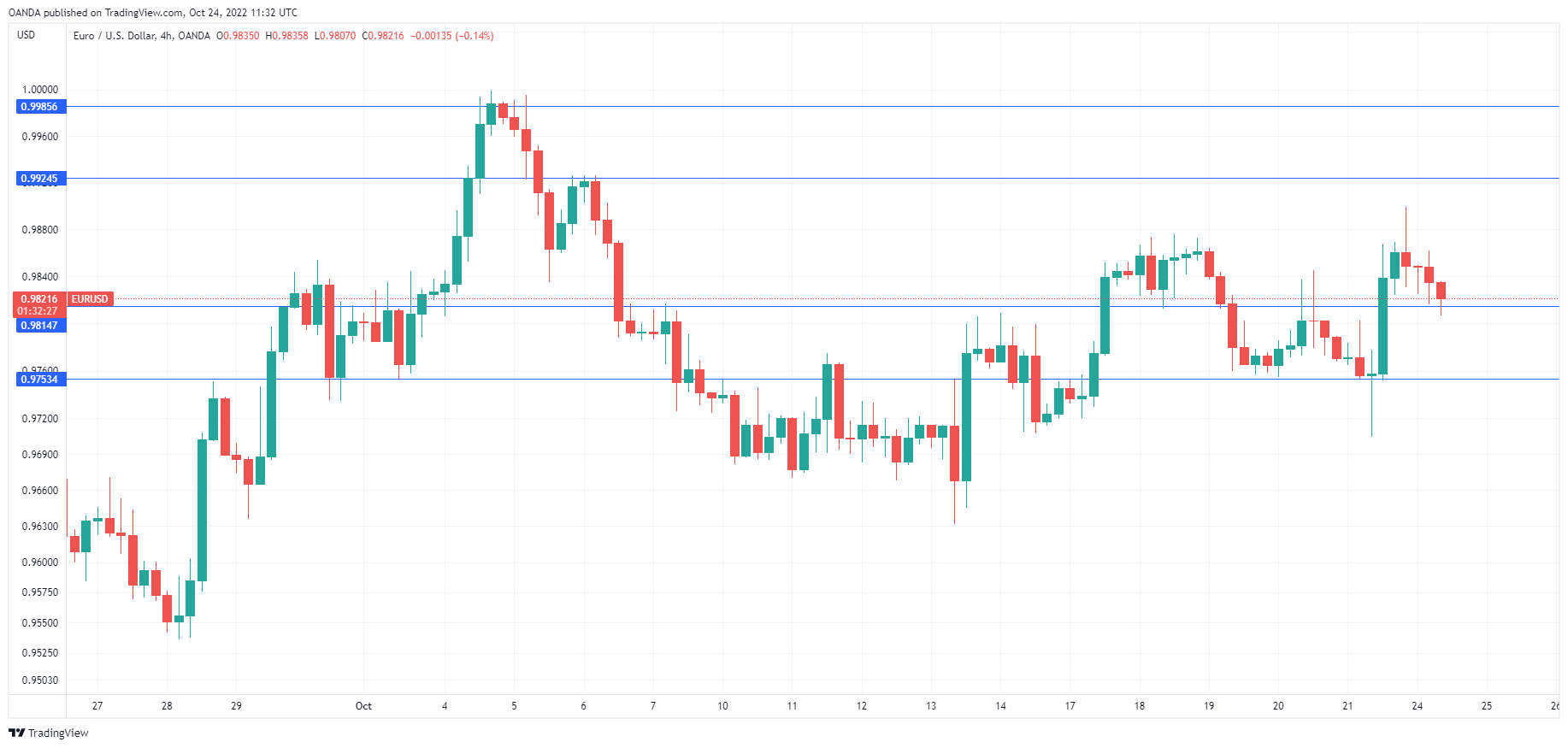
EUR/USD has edged lower at the start of the week. In the European session, EUR/USD is trading at 0.9824, down 0.37%.
Manufacturing, services PMI point to contraction
Germany is the locomotive of the Eurozone, and a faltering economy means trouble for the entire bloc. German Service and Manufacturing PMIs remained in contraction territory in September, below the neutral level of 50.0. The Manufacturing PMI fell to 45.7, down from 47.8 (47.0 est). The PMI has declined for a fourth straight month, as high energy costs and weak demand for goods have dampened factory production. German business activity is also struggling, as the Services PMI ticked lower to 44.9, down from 45.0, (44.7 est). The eurozone PMIs are also mired in contraction territory, and with winter coming and no end in sight to the Ukraine war, the PMIs will likely continue to decline in the short term.
ECB expected to hike by 0.75%
The ECB meets on Thursday, with policy makers having to contend not only with a gloomy economic outlook, but also with spiralling inflation, with no sign of a peak. Eurozone CPI jumped to 9.9% in September, up sharply from the 9.1% rise in August. The markets have priced in a supersize 0.75% hike, which would bring the cash rate to 2.0% and will be looking for the Bank to declare its commitment to bring inflation back to the 2% target.
A jumbo full-point increase is unlikely, but a possibility, given that inflation is close to double-digits. Investors will be monitoring the follow-up press conference, and the euro’s movement could well depend on ECB President Lagarde message to the markets – a signal that further rate hikes are coming would be bullish for the euro.
EUR/USD Technical
- EUR/USD is testing support at 0.9814. Next, there is support at 0.9753
- There is resistance at 0.9924 and 0.9985