Sample Category Title
Chinese Markets Don’t Take Xi Jinping’s Third Term in Power Well
Markets
The US yield curve turned less inverse at the 2-10 part last Friday with yields dropping 0.9 bps (10-yr) to 13.7 bps (2-yr). The very long end underperformed, still adding 10 bps (30-yr). A doji-like pattern is emerging in the US 10-yr yield with shorter tenors displaying more engulfing-style pictures. We admit that calling corrections in this year’s bond sell-off turned out the new widow-maker trade, but nevertheless make our shot. The turnaround started last Friday as the Wall Street Journal – closely tied to Fed offices – published an article suggesting that Fed policy makers are contemplating slowing down the tightening pace from the current 75 bps pace. Such move is granted for next week, but could be watered down to 50 bps moves from December. The article caught markets off guard as one of last week’s main trading themes was Fed talk about a 5% rather than 4.5% policy rate peak. While the article doesn’t question the need to move further than suggested by the September dot plot if needed, it makes the case for more incremental hikes given that the (absolute) level reached after last month will already be a restrictive one. SF Fed Daly was the first to follow-up on the planted (?) article saying that it’s time to start thinking about slowing interest rate hikes. With the Fed about to enter the blackout period ahead of the November 2 policy meeting and next important US eco data only due that same week, we see scope for correction on one-way traffic higher in bond yields with some investors for once not willing to err on the hawkish side anticipating new guidance from Chair Powell.
Chinese markets don’t take Xi Jinping’s third term in power well this morning. They lose 1% to 2%. Hong Kong is the obvious underperformer, sliding 5% to 6%, as a foreign proxy for investing in China. A mixed bag of eco data (see below) gives no guidance. USD/CNY trades at 7.25 for the first time since early 2008. Other talking points this morning are Japan’s new batch of FX interventions last Friday. They pulled USD/JPY off the multidecade high just below 152 to a close around 147.50. This morning’s action shows that the invisible hand of the Ministry of Finance remains at play around 149. The FT suggests that Japan used at least $30bn after spending $20bn in September. Sterling is stronger this morning after ex-PM Johnson dropped out of the Downing Street race before he even stepped in. Today’s eco calendar contains October EMU PMI’s. We don’t expect them to derail thinking on the outcome of Thursday’s ECB meeting.
News Headlines
Delayed Chinese GDP data showed its economy growing 3.9% q/q or 3.9% y/y in Q3. It marked a stark rebound from Q2, when growth was weighed down by a harsh two-month lockdown in Shanghai. In accompanying September data, industrial production rose 6.3% y/y but retail sales came in at an underwhelming 2.5% y/y. Highlighting the ongoing real estate crisis, property investment fell 8% YtD compared to the same period last year while home prices eased for a thirteenth consecutive month. The unemployment rate ticked higher, from 5.3% to 5.5%. September exports rose 10.7% y/y in CNY terms while imports advanced 5.2%, keeping the trade balance surplus near its series high.
Rating agency Fitch affirmed the Czech Republic’s long-term foreign currency debt rating at AA- with a negative outlook. The solid rating is underpinned by credible macroeconomic and monetary policies, a robust institutional framework and strong external finances. The negative outlook reflects downside risks coming from the energy crisis on the economic and fiscal performance which Fitch expects to keep the debt/GDP ratio on an upward trajectory in 2022 (43.4%) and 2023 (45.4%). It sees Czechia’s deficit hitting 5.2% this year and 4.8% in the next amongst others due to electricity and gas price caps. Growth is forecasted at 2.3% in 2022, better than the 1.5% in the previous review before stagnating in 2023. Inflation was revised upwards, to 15.2% this year and 8% in 2023. Easing inflation and slowing growth could spell the beginning of an easing cycle in mid-2023.
A Busy Week Ahead: US Big Tech Earnings, BoC, ECB, BoJ Decisions and UK PM
Last week ended on a strong positive footage, on hints that some Federal Reserve (Fed) officials have started talking about pausing the interest rate rises to avoid going too far.
Chicago Fed’s Evans warned that pushing the Fed funds beyond 4.6%, from around 3 to 3.25%, would ‘really begin weighing on the economy’, while San Fransisco Fed President Daly said’ it’s time to start planning for stepping down’ to avoid pushing economy into an ‘unforced downturn’.
Fed members starting to look hesitant on the pace of the rate increases is a positive development for investors, even though it doesn’t change the expectation that the Fed will raise its rates by another 75bp at its next policy meeting next week.
Softer Fed comments & better-than-expected earnings fuel optimism
Softer Fed expectations pulled the US 2-year yield to 4.42% on Friday, from above 4.60% seen earlier last week, the US 10-year pulled to 4.15%, from above 4.30%, the US dollar retreated, and equities rallied. The S&P00 jumped 2.40%, and 4.70% over the week, the Dow Jones advanced 4.9%, while Nasdaq advanced 5.2%.
70% of the S&P500 companies that reported earnings so far did better than earnings expectations.
Besides, China – finally - announced its Q3 GDP- The Chinese economy grew 3.9% last quarter, above the 3.4% expected by analysts, but the year-to-date growth fell to 3%, below the official target of around 5.5%. The gap is due to China’s impossible Covid zero mission, which has been confirmed and cemented with the Xi’s third term in office. Appetite in Chinese stocks remain low; despite the rebound in major US indices, Nasdaq’s Golden China Dragon index extended losses last week
Big tech and big oil earnings
Many big US tech companies will be reporting earnings this week. Among them, Google’s Alphabet and Microsoft are due to report on Tuesday, Facebook’s Meta on Wednesday, Apple and Amazon on Thursday. Then, Exxon Mobil and Chevron are due to report their earnings on Friday.
GM, Coca-Cola, UPS, Visa, Boeing, Kradt Heinz, Ford, Hilton, McDonalds, Caterpillar, Altria and Intel will also be going to the earnings confessional this week.
So, the week will be busy, and perhaps a volatile one!
Walking into important earnings, it’s important to note that the latest stats warn of high correlation between the S&P stocks. The S&P’s 3-month realized correlation is now at the highest levels since July 2020. The latter makes this week’s Big Tech results even more crucial for the overall market mood, as Apple, Microsoft, Alphabet and Amazon, together, stand for 20% of the S&P500’s total valuation.
We will see how the tightening monetary conditions, slowing global demand due to high inflation, and Chinese Covid zero policy, and the strong US dollar impacted the big US companies’ earnings, and how they will impact the overall market mood.
Sunak is the frontrunner as BoJo pulls out
Boris Johnson announced yesterday evening that he will not be running for the PM role this week. That makes the British ex-Chancellor of Exchequer Rishi Sunak the front runner in the contest.
Sterling kicked off the week on a positive note, mostly on the back of a broadly softer US dollar, but the 50-DMA, which stands around 1.1410 level, has already showed its teeth, and shelters strong offers to a further positive move.
No one expects the British pound, and the sovereigns to magically shrug off the past weeks’ turmoil. Investor confidence has been severely damaged, and it will take time to build it back, if everything goes perfectly well.
Who will hike, who will not?
The Bank of Canada (BoC) is expected to raise interest rates by another 50bp when it meets this week, the European Central Bank (ECB) will certainly raise its rates by 75bp, while the Bank of Japan (BoJ) is expected to stay pat.
The BoJ intervened again in the currency markets on Friday to pull the USDJPY lower, after the pair flirted with the 152 level last week. The pair eased to 145.50 following the intervention and is back to almost 149 at the time of writing.
But the growing divergence between the soft BoJ stance versus an increasingly hawkish stance from the rest of the G7 central banks should continue playing against the yen. Therefore, price pullbacks could offer interesting dipbuying opportunities for those who continue betting against the yen.
In commodities
US crude kicks off the week around $85per barrel level and could test the 50-DMA offers to the upside if the overall market sentiment remains bullish enough. But strong resistance is seen into the $93/95 range as rising oil prices fuel recession expectations and could jeopardize any strong oil rally into the $100pb level.
Gold jumped 1.80% on Friday on the back of softer US yields. Softer US yields could play in favour of gold if we really start seeing material easing in Fed expectations. But the latter is data dependent.
Due this week, investors will closely watch the US latest GDP update, and the PCE index, which is another gauge of inflation, closely monitored by the Fed. A strong GDP, and/or a strong PCE could easily fuel the Fed hawks, send the US yields and the US dollar higher, equities and gold lower.
From a price perspective, $1690/1700 per ounce range will be an important test for gold, as it includes the 50-DMA, March-to-date descending channel top and an important psychological resistance.
For now, the medium-term outlook for gold remains bearish, with the possibility of a further dive below the $1600 level.
Sunak Closer to Become New UK Prime Minister as Johnson Withdraws
Market movers today
Today's key focus will be the October Flash PMIs. We expect further signs that euro area is sliding towards a recession already this year, while US growth remains modestly positive.
On the political front the UK Conservative MPs will select the two final candidates this afternoon and after Boris Johnson pulled out of the race late last night, Rishi Sunak is firmly on course to become UK's next prime minister with the deciding online vote on Friday among the Conservative party members.
Later this week, central banks will take over the limelight with Bank of Canada meeting on Wednesday, ECB meeting on Thursday (where we expect it to hike its policy rates by 75bp) followed by the Bank of Japan Friday morning, where it is expected to defend its yield curve control. The US Q3 GDP report on Thursday followed by Germany and Sweden on Friday will also attract market attention.
The 60 second overview
Boris Johnson withdraws from race: This afternoon Conservative members of parliament will select the final candidates to replace prime minister Liz Truss, where candidates must secure the backing of at least 100 MPs out of a total 357 to reach the ballot. If more than one candidate reaches the threshold of 100 backers, the Conservative party members will cast the final deciding vote in an online election set to conclude Friday 28 October. In a turn of events, Boris Johnson pulled out of the race late last night leaving former chancellor Rishi Sunak as the only contender with public backing exceeding the threshold. At present, second runner up Penny Mourdant is far behind. At the time of writing it is in our view reasonable to expect that Rishi Sunak will be the UK's next prime minister, which will be welcomed by markets given his stance on fiscal discipline. If Mourdant fails to get above the 100 threshold, the announcement of the new PM may thus take place as early as this afternoon.
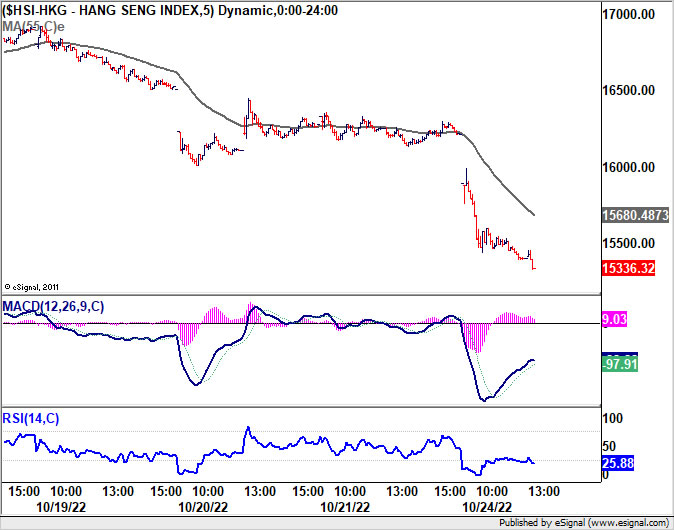
Chinese markets sink as Xi cements power: Chinese stocks plunged in Monday's trading following a reshuffle of China's top leadership that cements president Xi Jinping's power. Offshore stocks are down more than 5% this morning falling from already low levels. Four new members in the Standing Committee of the Politburo that consists of China's top seven leaders, were mostly close allies to Xi Jinping. There was also no successor lined up suggesting Xi plans to stay on also after 2027. The result of the Congress thus points to a continuation of the zero-Covid policy, intensifying US-China rivalry and a continuation of an economic path that has caused anxiety among Western investors, see Research China - CPC Congress cements Xi's power - and US-China rivalry, 24 October. That foreign investors drive most of the move is suggested by a smaller decline in the domestic A-share market (down 1.7% at time of writing).
China data a mixed bag: A range of Chinese data, which was delayed due to the CPC Congress, was released this morning. GDP for Q3 surprised to the upside rising 3.9% y/y (consensus 3.3%, previous 0.4%). Retail sales for September rose a weaker-than-expected 2.5% (consensus 3.0%, previous 5.4%) while industrial production beat expectations being up 6.3% y/y (consensus 4.8%, previous 4.2%). The numbers show that underlying growth is still very weak with consumers hesitant to spend and that the main growth engine now is stimulus, which drives up industrial production as infrastructure is beefed up.
Russia warns of escalation in Ukraine: Russian defence minister Sergei Shoigu warned of an escalation of the war saying that Ukraine could escalate by using a "dirty bomb" (a conventional bomb with nuclear material). The claim was rejected as absurd by Ukraine foreign minister Dmytro Kuleba saying "Russians often accuse others of what they plan themselves".
Fed pivot or not: On Friday, a Wall Street Journal article by Nick Timiraos suggested that some Fed officials consider moderating the future pace of tightening, which caused markets to pull back on Fed's rate hike pricing, and supported a rally in risk sentiment. Timiraos was the journalist who Fed likely tipped off about the decision to up the hiking pace to 75bp in June, when both the CPI and University of Michigan consumers' inflation expectations surprised to the upside during the silent period. While Timiraos has been well informed in the past, the situation is now different as Fed officials had plenty of opportunities to guide the markets last week ahead of the November silent period, which begun on Saturday. In our view, the recent rise in markets' inflation expectations, only modest tightening in real financial conditions and high spot core CPI suggest that Fed is not yet in a good position to 'pivot' verbally. For now, we stick to our call of two more 75bp hikes in the last meetings of the year, but if Fed prefers to slow the hiking pace in December, we could see the cycle extending into 2023.
Italy new government: Giorgia Meloni was sworn in as Italy's first female prime minister. The important finance ministry went not to a technocrat, but to League member Giancarlo Giorgetti, which could create some fiscal sustainability concerns, as the League is also advocating tax cuts and a bigger deficit to support the economy. However, Giorgetti was also part of the previous Draghi government and hails from the more moderate, business-friendly wing of the party. The awarding of the foreign ministry to Forza Italia's second in command Antonio Tajani leaves some question marks on the coalition's Russia stance after Berlusconi's contentious Ukraine comments during the last days. League leader Matteo Salvini will also be part of the government as infrastructure minister and together with Tajani serve as deputy PM.
With ongoing internal power struggles, we expect the parties' collaboration to be volatile, leaving the risk of occasional market jitters. Especially any signs of fiscal profligacy or slackening in the reform pace that could endanger continued NGEU disbursements and/or ECB TPI activation will be seen as warning bells by markets. After securing a confidence vote in both chambers of parliament during this week, the first big hurdle of the new government will be agreeing and passing the 2023 budget before year-end, while also dealing with the economic fall-out of the energy crisis and maintaining a united EU front against Russia.
Equities: Equities rallied into the close of the US cash session on Friday and hence ended sharply higher not just Friday but for the week. Once again equities were driven by yields and the turnaround in yields half way through the Friday cash session was a big catalyst for the gains. No surprise to see cyclicals leading the gains but worth highlighting all sectors were higher. Dow +2.5%, S&P 500 +2.4%, Nasdaq +2.3% and Russell 2000 +2.2%.
The rally on Wall Street Friday continues in most of China this morning with Chinese stocks being a big exemption. Hang Seng is down 5% at the time of writing as a sign of investors' aversion against Xi Jinpings increased power and the delayed GDP figures. US and European futures are higher this morning.
FI: It was another dramatic week in the global fixed income markets with global yields rising. 10Y US Treasuries tested the 4.3%-level and 10Y German government bond yields tested the 2.5%-level as the global central banks continue to tighten monetary policy.
FX: MoF/BoJ made new FX interventions on Friday which sent USD/JPY significantly lower, but part of the losses were soon erased. Sterling gained while the political landscape seems to shift in favour of Rishi Sunak. Scandies ended last week in tight links with risk sentiment.
Credit: Credit spreads moved only marginally on Friday where iTraxx Xover tightened 1.3bp while Main widened 0.2bp.
Nordic macro
No key movers in the Nordics today. In Sweden we get consumer and business surveys on Wednesday and GDP on Thursday. Norway releases data on unemployment Wednesday and retail sales Thursday.
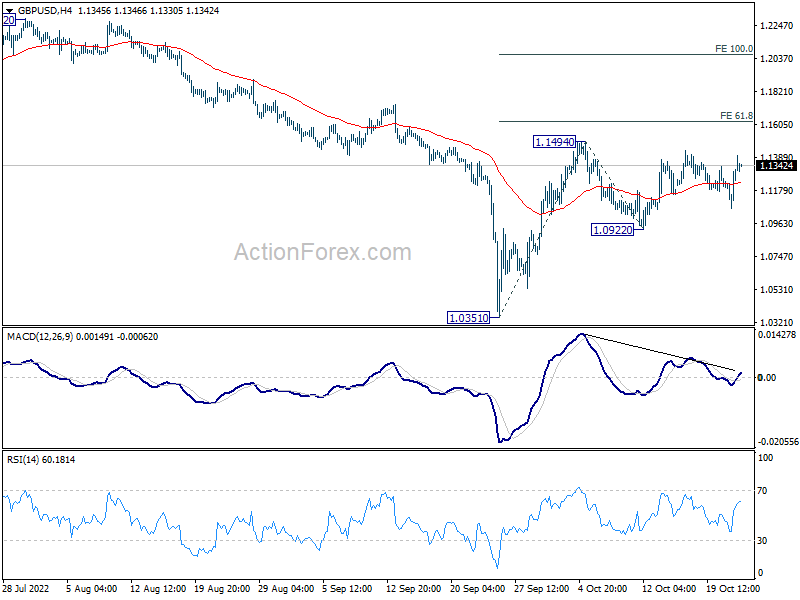
GBP/USD Daily Outlook
Daily Pivots: (S1) 1.1134; (P) 1.1225; (R1) 1.1388; More...
Range trading continues in GBP/USD and intraday bias stays neutral. Further rally is in favor as long as 1.0922 minor support holds. On the upside, break of 1.1494 will resume the rise from 1.0351 to 61.8% projection of 1.0351 to 1.1494 from 1.0922 at 1.1628. On the downside, below 1.0922 will turn bias back to the downside for 1.0351 low instead.
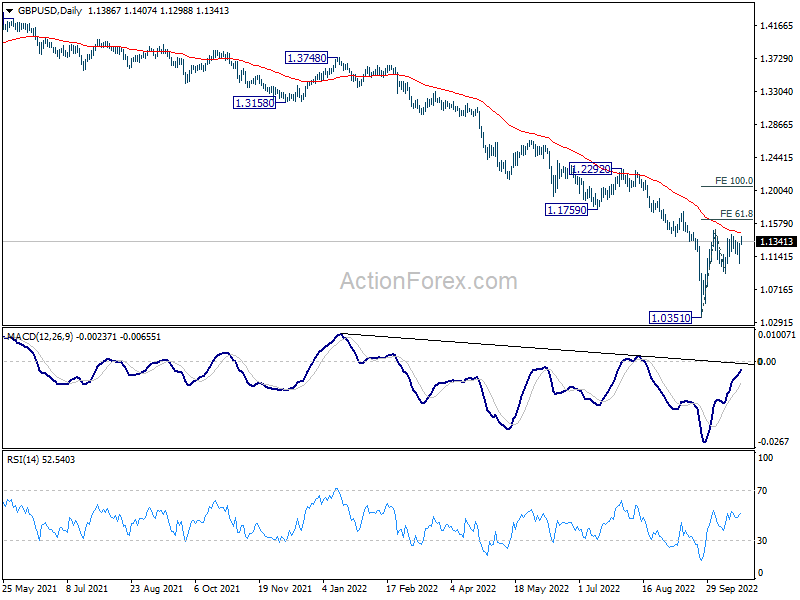
In the bigger picture, fall from 1.4248 (2018 high) is resuming long term down trend from 2.1161 (2007 high). Next target is 100% projection of 2.1161 to 1.3503 from 1.7190 at 0.9532. There is no scope of a medium term rebound as long as 1.1759 support turned resistance holds.
Sterling Trades Higher as BoJo Quits Leadership Race; Three Central Banks to Meet This Week
Sterling is the better performer in Asian session today. It's supported by news that former Prime Minister Boris Johnson withdrew from party leadership contest on Sunday, even with enough support to make the final ballot. The development left business friendly Rishi Sunak, a former Finance Minister, as a favorite to replace outgoing Prime Minister Liz Truss. That would give some political stability, at least until a general election.
Dollar and Swiss Franc are also firmer on mixed market sentiment. Japan Nikkei followed the strong rebound in the US on Friday. But Hong Kong HSI is down as much as -5%, as reaction to the result of China's 20th Communist Party Congress, where President Xi Jinping cemented absolute power. China's Shanghai SSE and Singapore Strait Times are also down. Yen softens as impact of last week's intervention faded. Commodity currencies are on the soft side while Euro is mixed.
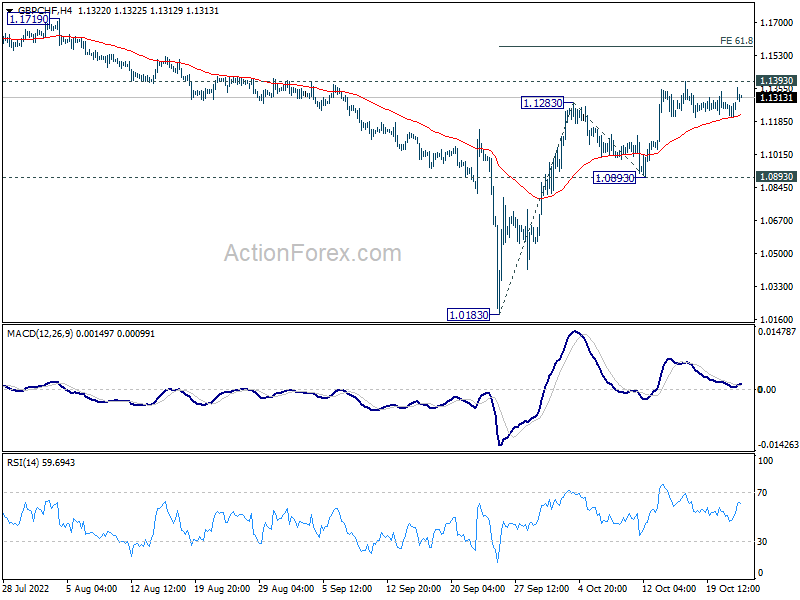
Technically, one focus is on 1.1393 minor resistance in GBP/CHF. Break there will resume the near term rebound from 1.0183 for 61.8% projection of 1.0183 to 1.1283 from 1.0893 at 1.1573. Such development, if accompanied by break of 1.1494 resistance in GBP/USD and 0.8577 support in EUR/GBP, would indicate more persistent rebound in the Pound.
Japan refrains from commenting on currency intervention
Japan Finance Minister Shunichi Suzuki declined to confirm if there was intervention in the currency markets last Friday. But he reiterated, "we cannot tolerate excessive volatility caused by speculative moves, and we are ready to take necessary steps when needed.... we are in a situation where we are confronting speculative moves strictly."
Masato Kanda, Vice Finance Minister for International Affairs also said, "we won't comment" on whether Japan will intervene gain. He said, "we will take appropriate steps against excessive volatility 24 hours a day, 365 days a year."
Chief Cabinet Secretary Hirokazu Matsuno also said, "we refrain from commenting specifically on any currency intervention".
Japan PMI composite rose to 51.7, but manufacturing struggles
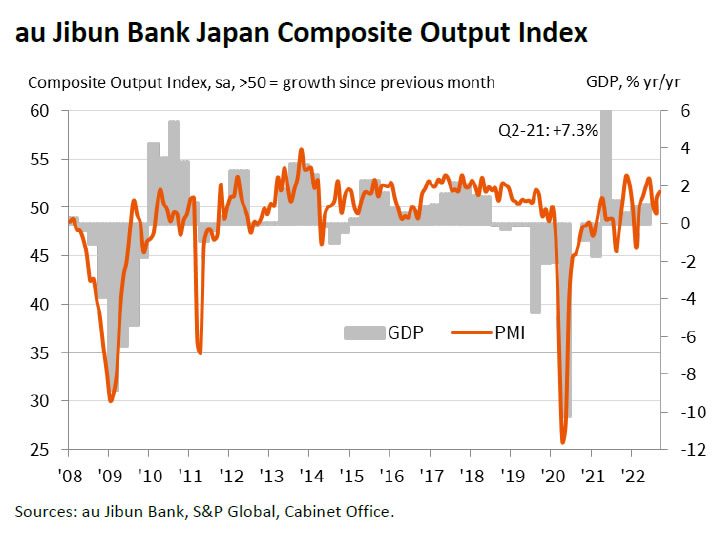
Japan PMI Manufacturing ticked down from 50.8 to 50.7 in October, weakest in 21 months. PMI Manufacturing Output improved slightly from 48.3 to 48.7. PMI Services rose from 52.2 to 53.0. PMI Composite also rose from 51.0 to 51.7.
Laura Denman, Economist at S&P Global Market Intelligence, said: "Latest flash PMI data has pointed to a further improvement in Japan's private sector economy in October... The manufacturing sector, however, continued to struggle in the face of weak demand conditions and severe cost pressures... With inflationary pressures remaining elevated across the private sector, business confidence dipped to a six-month low."
RBA Kent: Depreciation in AUD will have very modest uplift in prices
RBA Assistant Governor Christopher Kent said in a speech, "The Board expects to increase interest rates further in the period ahead, given the need to establish a more sustainable balance of demand and supply and in the face of a very tight labour market." The "size and timing" of rate increases will depend on "incoming data" and "outlook for inflation and the labour market."
Kent also said the appreciation of the US dollar will "add to the cost of imports for a time" because much the global trade is invoices in it. At the same time, rise in US interest rates will also "contribute to a decline in global inflation pressures". The depreciation of Australia's nominal trade-weighted exchange rate over the year to date will contribute only a "very modest uplift in the level of consumer prices over the period ahead".
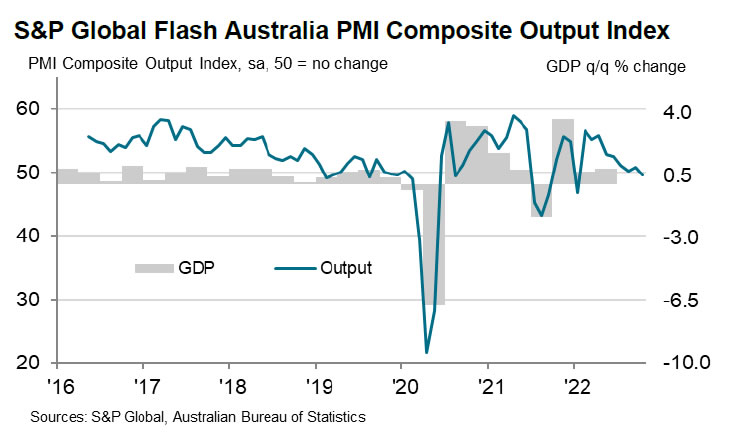
Australia PMI composite dropped to 49.6, renewed contraction
Australia PMI Manufacturing dropped from 53.5 to 52.8 in October, a 14-month low. PMI Services dropped from 50.6 to 49.0, a 9-month low. PMI Composite dropped from 50.9 to 49.6, a 9-month low.
Jingyi Pan, Economics Associate Director at S&P Global Market Intelligence said: "Australia's private sector saw renewed contraction in October with the service sector primarily showing signs of stress. A fall in demand for services was underpinned by higher interest rates and prices, altogether reflective of the detriments of aggressive monetary policy tightening and capacity constraints upon business activity."
China posted solid production but weak retail sales data
After a delay amid the 20th Communist Party Congress last week, China released a batch of economic data today.
GDP grew 3.9% yoy in Q3, and beat expectation of 3.3% yoy. In September, industrial grew 6.3% yoy, faster than August's 4.2% yoy, and beat expectation of 4.9% yoy. Retail sales, however, rose only 2.5% yoy, slowed from August's 5.4% yoy, and missed expectation of 3.1% yoy. Fixed asset investment rose 5.9% ytd yoy, below expectation of 6.0%.
Also released, in USD term, exports rose 10.7% yoy in September. Imports rose 0.3% yoy. Trade surplus widened from USD 79.4B to USD 84.0B, above expectation of USD 81B.
BoC and ECB to hike, BoJ to stand pat
Three central banks will meet this week. BoC is expected to slow down its tightening pace, and raise the overnight rate by 50bps to 3.75%. But opinions are divided as higher than expected August consumer inflation data increased the chance of another 75bps hike. Nevertheless, the bigger question is whether BoC will signal that tightening cycle is starting to be close to an end.
ECB is widely expected to increase the main refinancing rate by 75bps to 2.00%. President Christine Lagarde should signal that tightening is going to continue until early next year while the pace would be data dependent. A focus will be on the signal of the start of QT discussions, as rate is approaching neutral, if not there after this week's hike.
BoJ is widely expected to keep monetary policy unchanged. Governor Haruhiko Kuroda will reiterate that current inflation is largely import driven, and local wage growth doesn't warrant that inflation will stay above target in sustainable way. Nevertheless, like with recent meeting, there are speculations that BoJ might loosen up its 0.25% ceiling for 10-year JGB yield.
On the data front, GDP from the US, Eurozone and Canada will be featured, together with PMIs from Australia, Japan, Eurozone US and US. Germany will release Ifo business climate and GFK consumer sentiment. Australia will release CPI.
Here are some highlights for the week:
- Monday: Australia PMIs; Japan PMI Manufacturing; Eurozone PMIs; UK PMIs; US PMIs.
- Tuesday: Germany Ifo business climate; US house price index, consumer confidence.
- Wednesday: Japan corporate services prices; New Zealand ANZ business confidence; Australia CPI. Swiss Credit Suisse economic expectations; US goods trade balance, new home sales; BoC rate decision.
- Thursday: Australia import prices; Germany Gfk consumer sentiment; ECB rate decision; US GDP, durable goods orders, jobless claims.
- Friday: Australia PPI; BoJ rate decision, Japan Tokyo CPI, unemployment rate; France GDP; Germany CPI, GDP; Swiss KOF economic barometer; Canada GDP; US personal income and spending, employment cost index, pending home sales.
GBP/USD Daily Outlook
Daily Pivots: (S1) 1.1134; (P) 1.1225; (R1) 1.1388; More...
Range trading continues in GBP/USD and intraday bias stays neutral. Further rally is in favor as long as 1.0922 minor support holds. On the upside, break of 1.1494 will resume the rise from 1.0351 to 61.8% projection of 1.0351 to 1.1494 from 1.0922 at 1.1628. On the downside, below 1.0922 will turn bias back to the downside for 1.0351 low instead.
In the bigger picture, fall from 1.4248 (2018 high) is resuming long term down trend from 2.1161 (2007 high). Next target is 100% projection of 2.1161 to 1.3503 from 1.7190 at 0.9532. There is no scope of a medium term rebound as long as 1.1759 support turned resistance holds.
Economic Indicators Update
| GMT | Ccy | Events | Actual | Forecast | Previous | Revised |
|---|---|---|---|---|---|---|
| 22:00 | AUD | Manufacturing PMI Oct P | 52.8 | 53.5 | ||
| 22:00 | AUD | Services PMI Oct P | 49 | 50.6 | ||
| 00:30 | JPY | Jibun Bank Manufacturing PMI Oct P | 50.7 | 51.3 | 50.8 | |
| 07:15 | EUR | France Manufacturing PMI Oct P | 47 | 47.7 | ||
| 07:15 | EUR | France Services PMI Oct P | 51.5 | 52.9 | ||
| 07:30 | EUR | Germany Manufacturing PMI Oct P | 47.2 | 47.8 | ||
| 07:30 | EUR | Germany Services PMI Oct P | 44.8 | 45 | ||
| 08:00 | EUR | Eurozone Manufacturing PMI Oct P | 48 | 48.4 | ||
| 08:00 | EUR | Eurozone Services PMI Oct P | 48.2 | 48.8 | ||
| 08:30 | GBP | Manufacturing PMI Oct P | 48 | 48.4 | ||
| 08:30 | GBP | Services PMI Oct P | 49 | 50 | ||
| 13:45 | USD | Manufacturing PMI Oct P | 51.2 | 52 | ||
| 13:45 | USD | Services PMI Oct P | 49.2 | 49.3 |
China posted solid production but weak retail sales data
After a delay amid the 20th Communist Party Congress last week, China released a batch of economic data today.
GDP grew 3.9% yoy in Q3, and beat expectation of 3.3% yoy. In September, industrial grew 6.3% yoy, faster than August's 4.2% yoy, and beat expectation of 4.9% yoy. Retail sales, however, rose only 2.5% yoy, slowed from August's 5.4% yoy, and missed expectation of 3.1% yoy. Fixed asset investment rose 5.9% ytd yoy, below expectation of 6.0%.
Also released, in USD term, exports rose 10.7% yoy in September. Imports rose 0.3% yoy. Trade surplus widened from USD 79.4B to USD 84.0B, above expectation of USD 81B.
Japan refrains from commenting on currency intervention
Japan Finance Minister Shunichi Suzuki declined to confirm if there was intervention in the currency markets last Friday. But he reiterated, "we cannot tolerate excessive volatility caused by speculative moves, and we are ready to take necessary steps when needed.... we are in a situation where we are confronting speculative moves strictly."
Masato Kanda, Vice Finance Minister for International Affairs also said, "we won't comment" on whether Japan will intervene gain. He said, "we will take appropriate steps against excessive volatility 24 hours a day, 365 days a year."
Chief Cabinet Secretary Hirokazu Matsuno also said, "we refrain from commenting specifically on any currency intervention".
Japan PMI composite rose to 51.7, but manufacturing struggles
Japan PMI Manufacturing ticked down from 50.8 to 50.7 in October, weakest in 21 months. PMI Manufacturing Output improved slightly from 48.3 to 48.7. PMI Services rose from 52.2 to 53.0. PMI Composite also rose from 51.0 to 51.7.
Laura Denman, Economist at S&P Global Market Intelligence, said: "Latest flash PMI data has pointed to a further improvement in Japan's private sector economy in October... The manufacturing sector, however, continued to struggle in the face of weak demand conditions and severe cost pressures... With inflationary pressures remaining elevated across the private sector, business confidence dipped to a six-month low."
RBA Kent: Depreciation in AUD will have very modest uplift in prices
RBA Assistant Governor Christopher Kent said in a speech, "The Board expects to increase interest rates further in the period ahead, given the need to establish a more sustainable balance of demand and supply and in the face of a very tight labour market." The "size and timing" of rate increases will depend on "incoming data" and "outlook for inflation and the labour market."
Kent also said the appreciation of the US dollar will "add to the cost of imports for a time" because much the global trade is invoices in it. At the same time, rise in US interest rates will also "contribute to a decline in global inflation pressures". The depreciation of Australia's nominal trade-weighted exchange rate over the year to date will contribute only a "very modest uplift in the level of consumer prices over the period ahead".
Australia PMI composite dropped to 49.6, renewed contraction
Australia PMI Manufacturing dropped from 53.5 to 52.8 in October, a 14-month low. PMI Services dropped from 50.6 to 49.0, a 9-month low. PMI Composite dropped from 50.9 to 49.6, a 9-month low.
Jingyi Pan, Economics Associate Director at S&P Global Market Intelligence said:
"Australia's private sector saw renewed contraction in October with the service sector primarily showing signs of stress. A fall in demand for services was underpinned by higher interest rates and prices, altogether reflective of the detriments of aggressive monetary policy tightening and capacity constraints upon business activity.
"Although input price inflation declined in October, output price inflation climbed in the private sector according to the PMI data suggesting that price pressures have yet to ease steadily. A tight labour market also indicates that wage inflation may persist.
"Overall business confidence meanwhile continued to trend lower in October to the weakest since the height of the COVID-19 pandemic in April 2020, which is not a positive sign for the Australian economy."