Sample Category Title
Week Ahead – Crucial ECB and BoJ Decisions on the Menu
A central bank extravaganza lies ahead. The show will kick off with the Bank of Canada meeting, where markets expect another rate increase but are split on the size. Meanwhile in Europe, a triple-barreled hike by the ECB is already locked in, putting the emphasis on the press conference. Finally, the Bank of Japan is unlikely to throw a life jacket to the sinking yen.
ECB ready to swing big
With inflation running around 10%, the European Central Bank is widely expected to roll out another ‘turbo’ rate increase on Thursday. Markets have priced in a three-quarter-point boost to rates, after a swathe of ECB officials put their weight behind such a move. Since that’s already baked into the cake, the market reaction will come from President Lagarde’s commentary.
In this sense, Lagarde and her lieutenants might be inclined to strike a hawkish tone and attempt to defend the devastated euro. Since the Eurozone imports most of its energy, a falling euro makes power prices even more expensive, amplifying inflationary forces and crippling economic growth. Further currency depreciation is the last thing Europe needs.
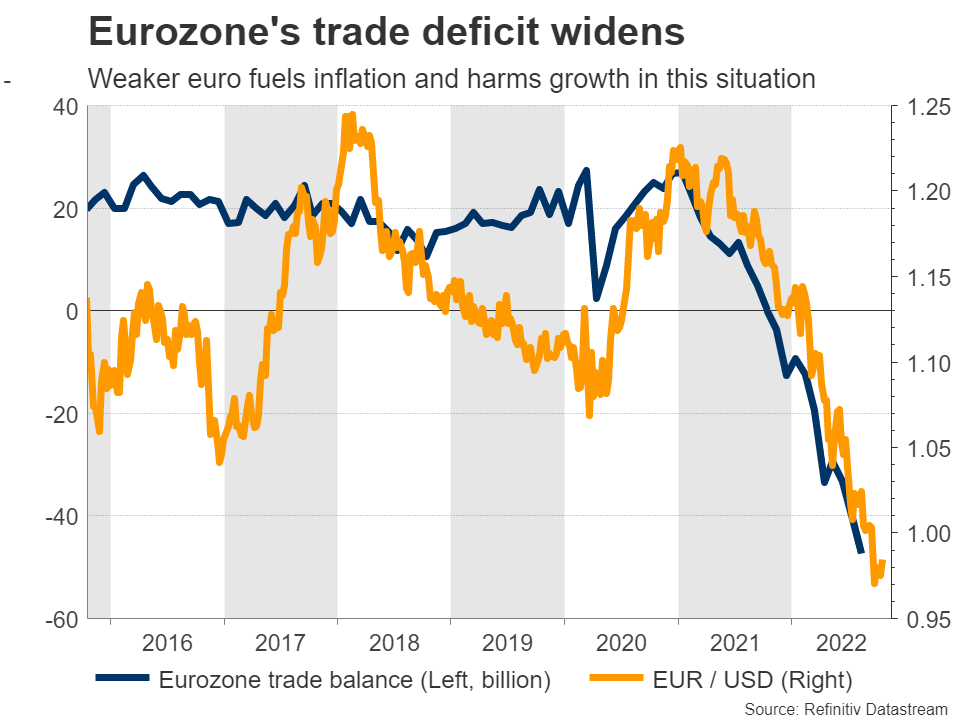
There are two ways the ECB can ‘talk up’ the euro - either by signaling that interest rates could peak at a level higher than the 3% markets currently envision, or through the balance sheet by opening the door for quantitative tightening. The balance sheet route is unlikely after the UK bond market fiasco, and also considering the debt burden Italy faces. This leaves the terminal rate as the most realistic channel.
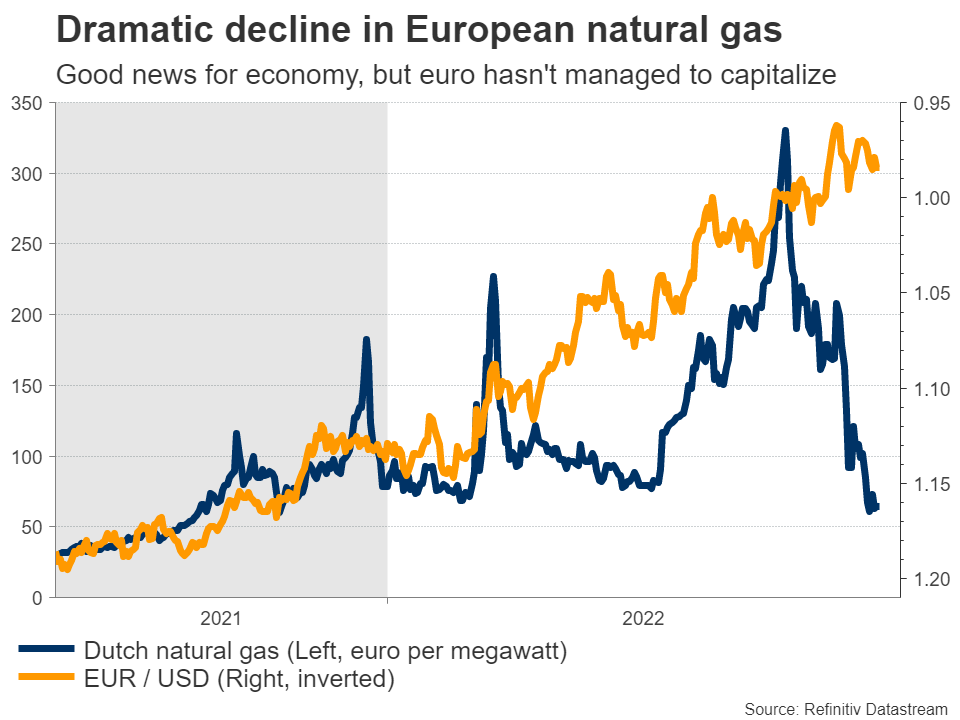
On a positive note, European gas prices have declined dramatically in recent weeks, after the EU intervened in the power market. With prices falling, the energy crisis seems to be calming down and the winter might not be Armageddon after all. A recession is still on the menu, but perhaps it won’t be as deep as investors feared.
This means there’s scope for a relief rally in the euro, as the ECB puts a floor under the currency and energy prices keep moving in the right direction. It’s still too early to envision a trend reversal though, as that would require a pivot from the Fed that weakens the dollar, which doesn’t seem imminent.
On the data front, the ball will get rolling on Monday with the preliminary PMI business surveys for October, which will reveal how close the economy is to recession and how inflationary pressures are evolving. Then on Friday, Germany’s preliminary GDP growth estimate for the third quarter and inflation stats for October will hit the markets.
BoJ unlikely to rescue yen
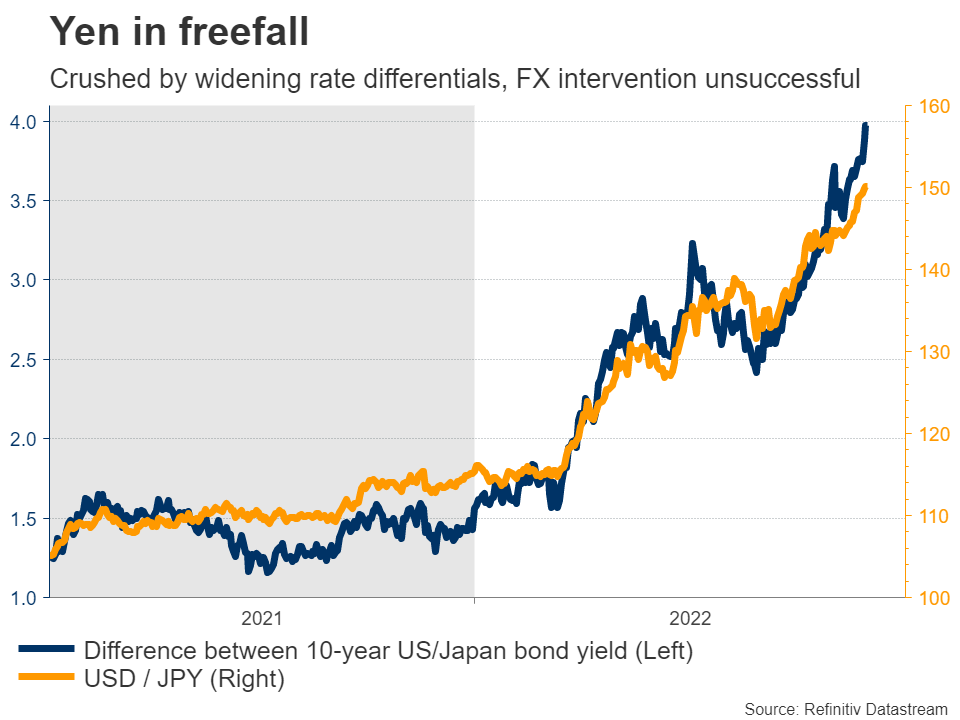
Over in Japan, the central bank’s refusal to even consider higher interest rates has annihilated the yen, which has lost an incredible 30% of its value against the US dollar this year. Direct intervention in the FX market by the government and threats for more have not accomplished much, other than slowing the bleeding.
Heading into the Bank of Japan’s decision on Friday, the question is whether anything has changed to elicit a policy shift. The answer is probably not. Inflation has fired up and is running at 3%, but wage growth and inflation expectations are still muted, reinforcing the BoJ’s thinking that the current inflation wave is driven by supply factors that will fade away soon.
Funds are still betting that the BoJ will be forced to relax the ceiling it has imposed on Japanese yields, but the timing is highly uncertain. An acceleration in wage growth would be the signal such a move is coming. Without that, there’s a real chance nothing changes until April, when Governor Kuroda’s term expires.
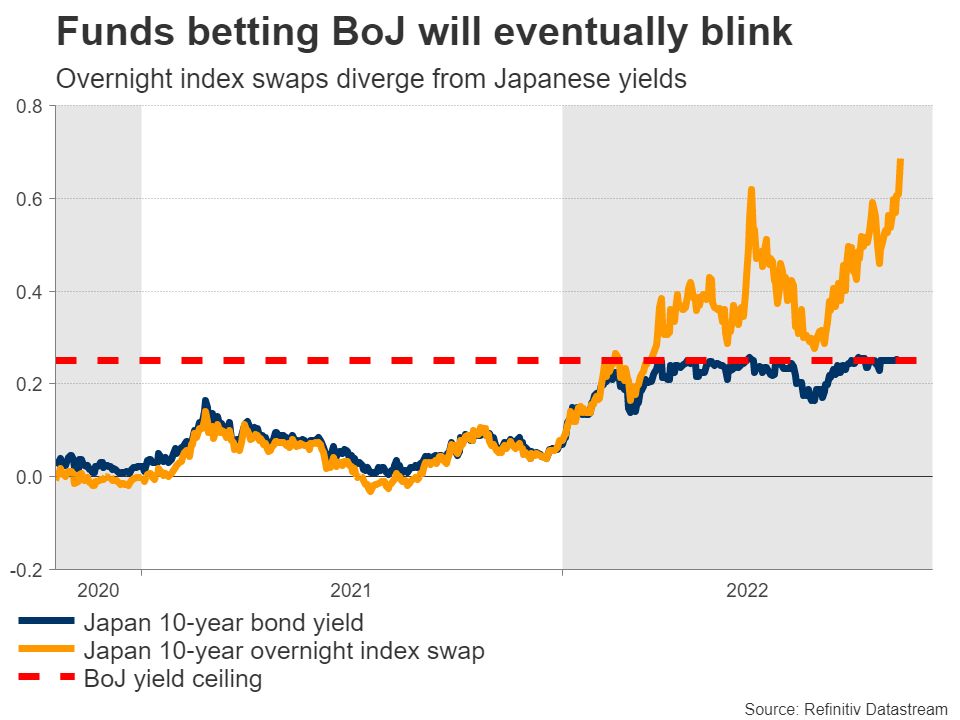
As for the yen, the outlook remains gloomy. As long as the underlying force of interest rates is working against the currency, any rallies will likely remain shallow and any episodes of FX intervention might simply delay the inevitable. A trend reversal would require a change of heart from the BoJ or Fed, or both.
BoC - double or triple?
Crossing into Canada, a rate increase is almost certain when the central bank concludes its meeting on Wednesday. The question is how large the move will be, with investors split between half or three quarters of a percentage point.
There are solid arguments on both sides. Inflation is still hot and the labor market is in solid shape, which suggests the Bank can keep pushing. However, house prices have started to decline and the latest business survey from the central bank itself showed that most Canadian companies already expect a recession.
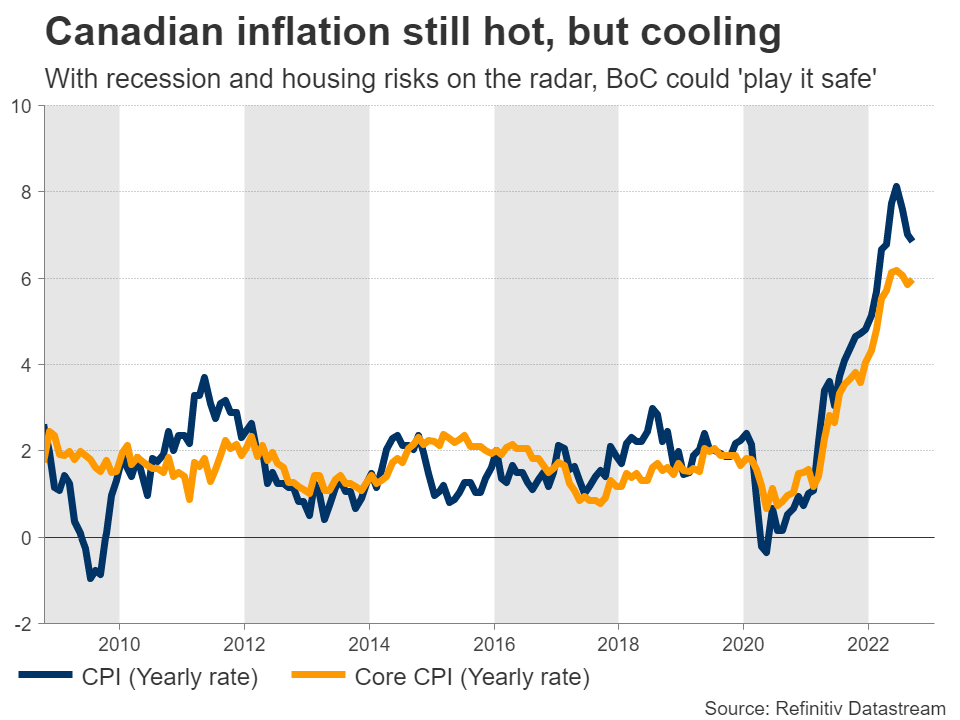 With oil prices also marching lower, the more prudent option seems to be a smaller, half-point rate increase. Pushing this ‘bubbly’ housing market too hard could spell disaster, so the BoC has an incentive to tread lightly. In this case, the initial reaction in the loonie would likely be lower.
American, British, and Australian data
In the United States, there’s a flurry of crucial data releases coming up, starting with the S&P Global business surveys on Monday. But the main event will be on Thursday, when the preliminary estimate of GDP for the third quarter is published.
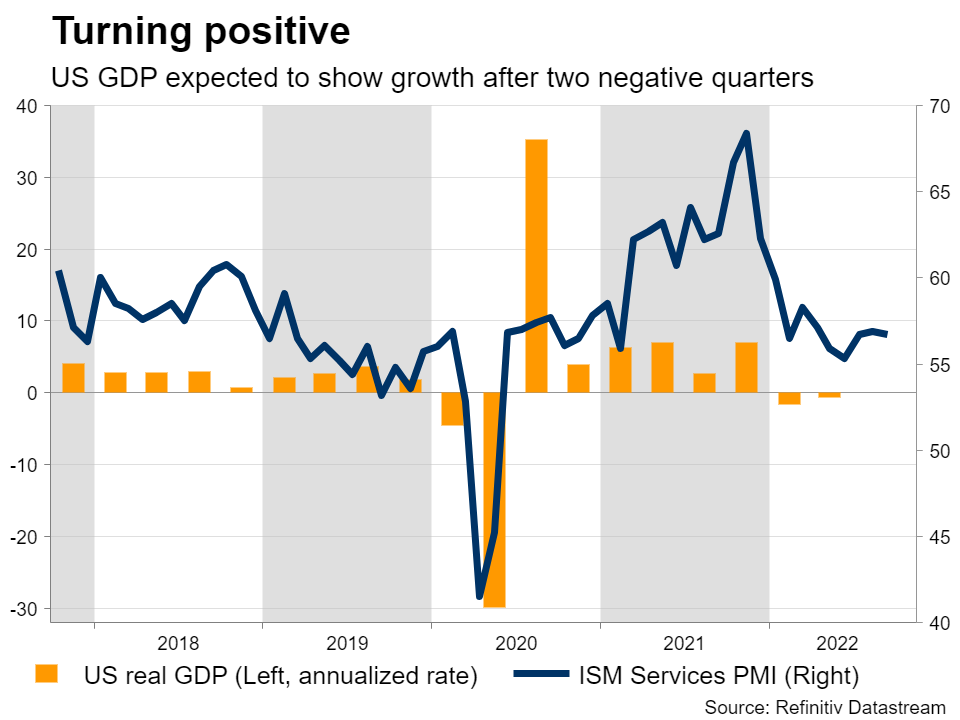
The Atlanta Fed GDPNow model points to growth of almost 3%. Coupled with sizzling inflation and a labor market that’s still firing on all cylinders, such a GDP print could cement expectations that the Fed will push rates all the way to 5% or beyond. The week will culminate with the core PCE price index on Friday.
In the UK, politics will remain front and center after the resignation of Prime Minister Truss. A new leader is expected to take over next week, with the frontrunners being Rishi Sunak and Boris Johnson. Sunak is probably the most sterling-positive choice given his more stable economic policies, but Johnson is more popular with the Conservative base. On the data front, the PMIs for October are out on Monday.
Finally in Australia, the inflation report for Q3 will hit the markets early on Wednesday.
Japan finally intervenes at correcting timing
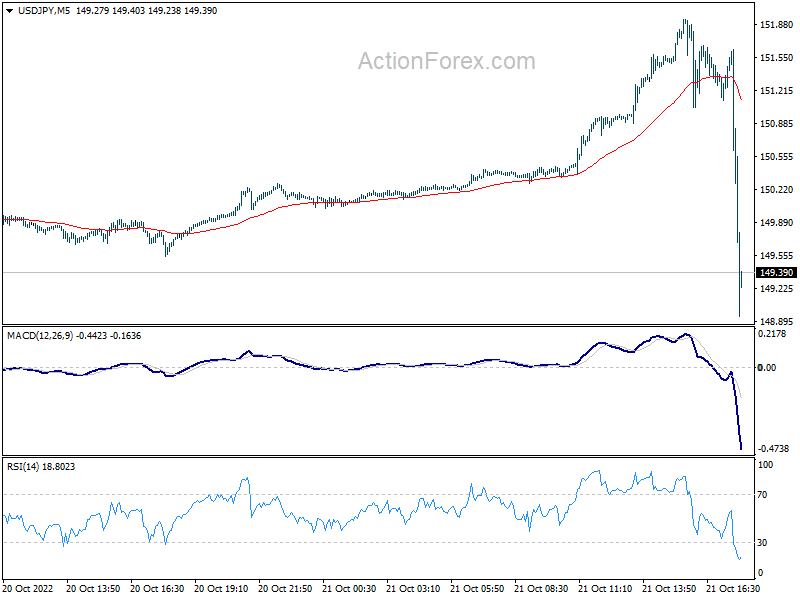
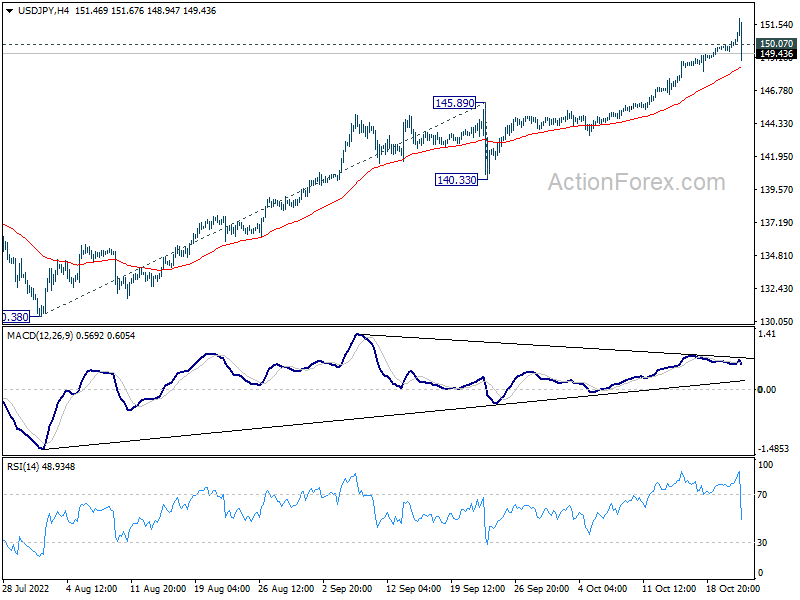
Well, timing is everything. While Japan was quiet most of the day as USD/JPY marched higher, intervention finally came in early US session and knocks USD/JPY back below 150. In the background, Dollar was already under some pressure as stocks rebound strongly from early loss and turn black. 10-year yield also open dips after hitting as high as 4.333 with a strong open.
Now, let's seen if there would be some support for USD/JPY as it approaches 4 hour 55 EMA at 148.39.
Time to Blink?
USD/JPY rallies as BoJ might stay dovish
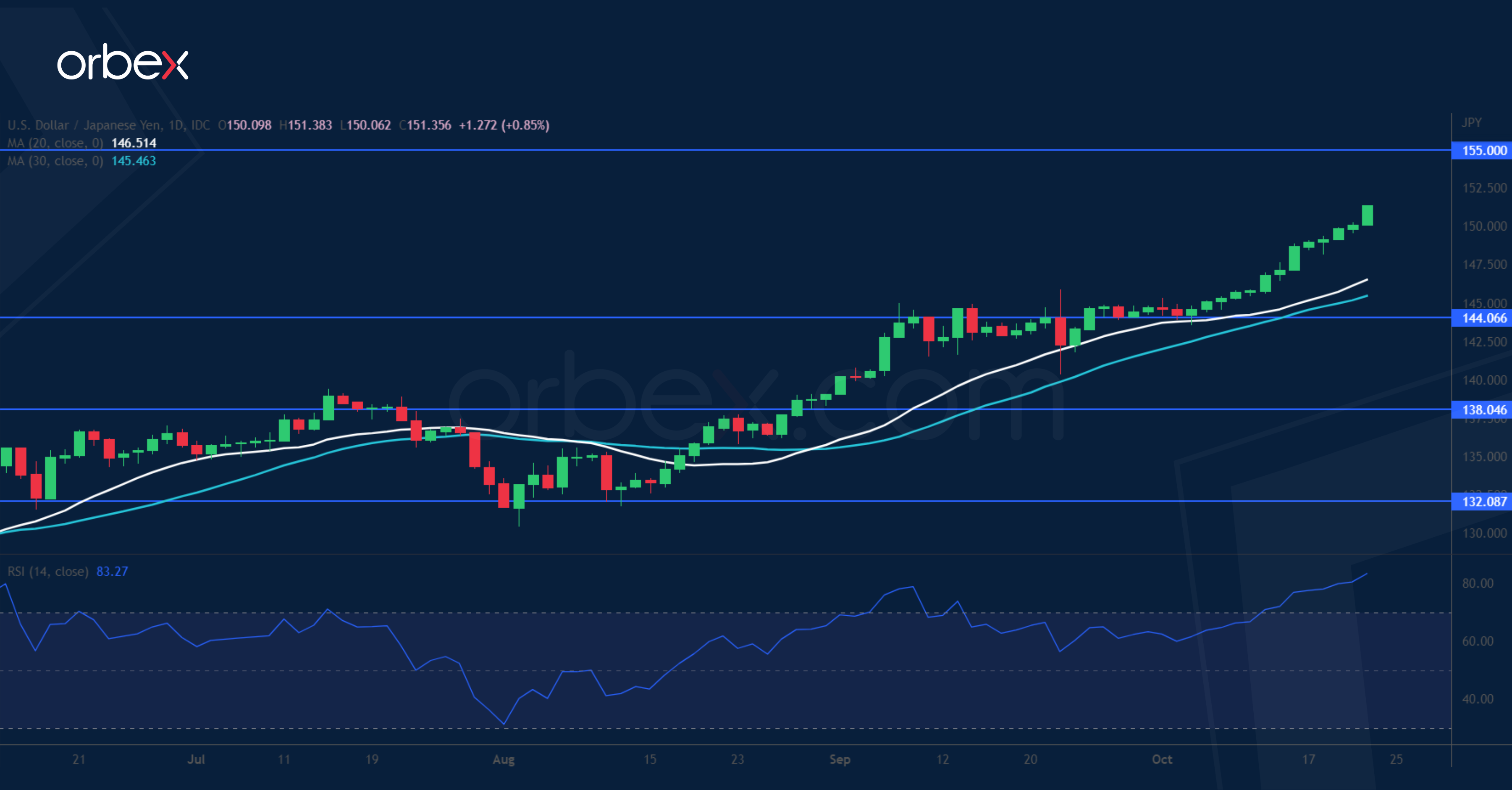
The Japanese yen weakens as quantitative tightening remains a remote prospect. As its currency sank to a 32-year low, the Bank of Japan’s ultra-loose monetary policy has become increasingly at odds with the finance ministry’s view. The central bank may still deem it premature to shift away from the status quo given heightened global uncertainties. The latter, however, concerned by the yen’s unidirectional slide and its negative impacts on corporations, may choose to intervene in the market again, popping up short-term market moves. The greenback is heading towards 155.00 with 144.00 as the closest support.
EUR/USD slips as energy crisis hinders inflation fight
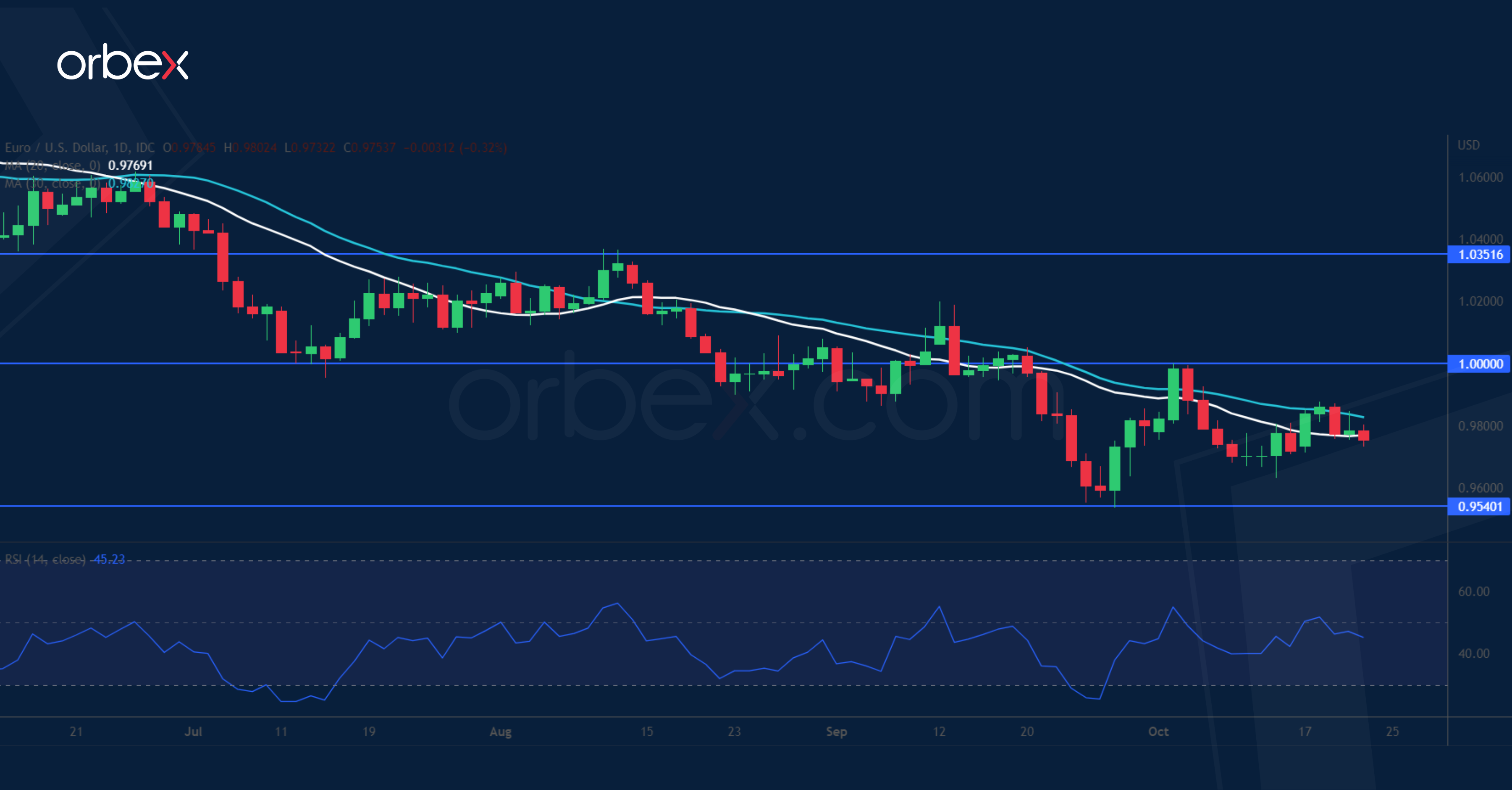
The euro remains under pressure as the ECB is expected to raise rates by 75bp. The energy price pressure in the euro zone has been a significant headache for policymakers. With inflation reaching five times the ECB’s target last month, the central bank may have little choice but to go down the path of rapid rate increases. However, unlike other major peers, the ECB will need to keep bond spreads in check or risk another debt crisis in peripheral countries. Needless to say, such a rock and hard place situation makes the euro hardly an attractive asset to hold onto. 0.9540 is a fresh support and parity (1.0000) is a psychological hurdle.
USD/CAD steadies ahead of BoC hike
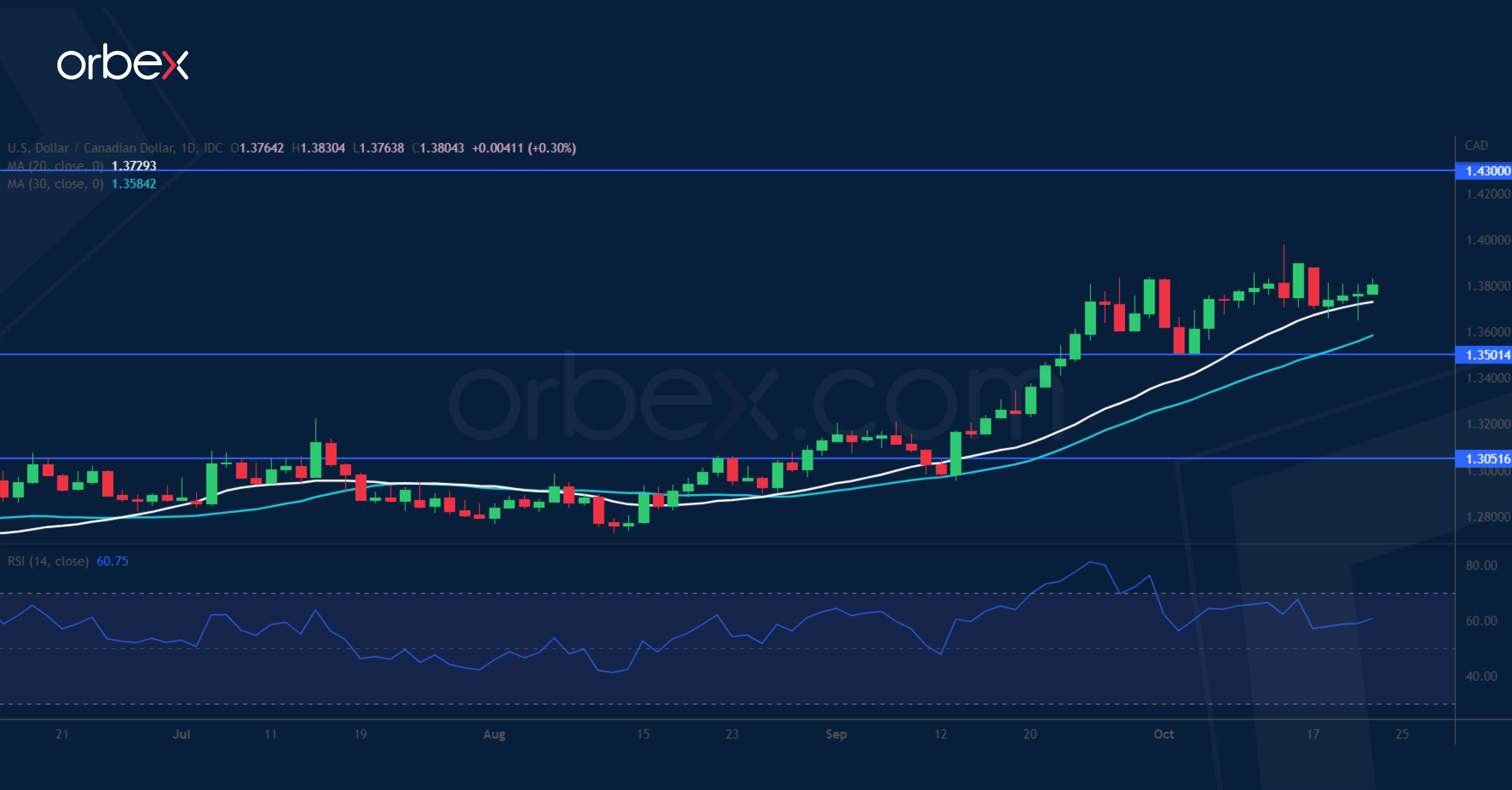
The Canadian dollar struggles as the risk appetite ebbs and flows. Consumer price pressures in Canada remain high and above forecasts despite a slight deceleration in September, which would call for another large-sized rate hike by the BoC this week. A 50-basis point hike would be the bare minimum while markets are leaning towards a 75bp move. Still the central bank’s hawkish stance might not be enough to shift overall sentiment. A recovery in oil prices temporarily offers the commodity-linked currency a little edge against the greenback. 1.3500 is the first support and 1.4300 could be the next target.
S&P 500 falls as Fed remains hawkish
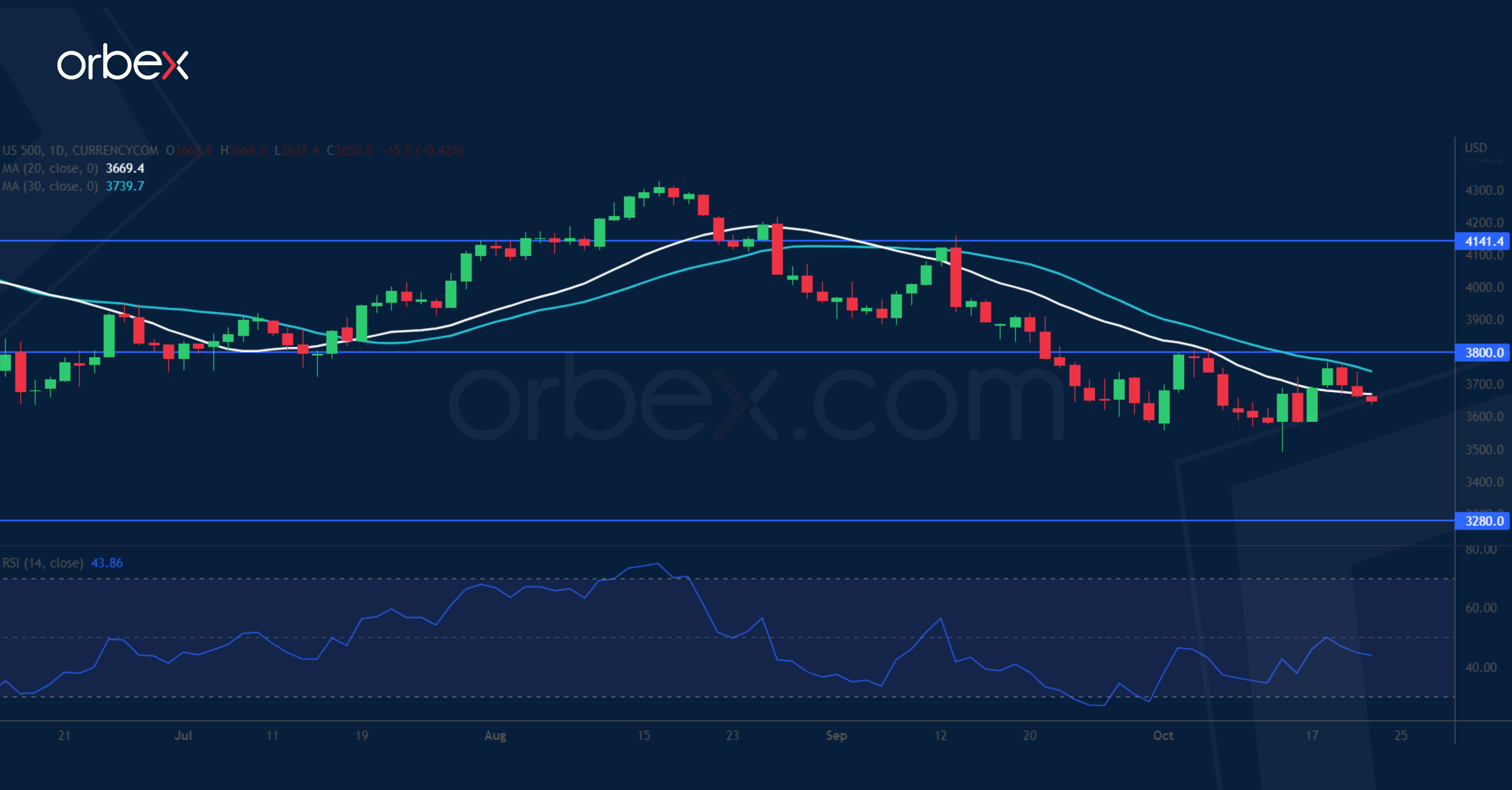
The S&P 500 slides as investors refrain from adding risk. Upbeat quarterly earnings offer stocks limited support as bearish sentiment continues to drive the price action. Hawkish comments from Fed officials mirror strong US job data and high inflation, reinforcing expectations the central bank will not divert from its aggressive path. With cash offering historic risk-free returns these days, most investors would like to see signs inflation is slowing down before jumping in with both feet. Until then, sporadic rallies would only feed the bears. The index may tank to a two-year low at 3280 with 3800 as the immediate resistance.
Weekly Focus – UK Political Turmoil Continues
UK Prime Minister Liz Truss stepped down this week after only 44 days in the office. The resignation follows heavy pushback on the 'mini-budget' presented in late September, which sparked fears of even more persistent inflation and much stronger rate hikes by the Bank of England. The new chancellor Jeremy Hunt has already overturned many of the spending measures introduced in the mini-budget, which has supported GBP and eased the pricing on BoE hikes. Going forward, the conservative party aims to find a new PM already next week, and the process begins by conservative MPs voting to select two final candidates on Monday. Then, the party members will cast the final deciding vote by Friday October 28 at the latest, or alternatively the less popular of two withdraws without a vote by the party members. At the time of writing, former chancellor Rishi Sunak is the most likely candidate followed by the former Prime Minister Boris Johnson.
The European Council agreed on joint measures to limit energy prices largely in line with the earlier proposal by the Commission. While details still remain uncertain, the measures include 'a dynamic price corridor' to limit further rises in gas prices despite the earlier pushback by Germany. In addition, EU will work to set up a mechanism to cap the price of gas used for electricity generation, to create a new benchmark for gas prices and to create a voluntary joint purchasing platform (see details here). Spot gas prices have eased to the lowest levels since the start of the war as inventory levels are now close to full in most EU countries, but long-term solutions to replacing Russian gas still remain uncertain.
Market sentiment has remained cautious not least on the back of the UK political uncertainty. US 10y bond yields have reached new cycle highs above 4.20%, but in contrast to the rise seen earlier this year, the most recent uptick has been driven largely by higher inflation expectations - a worrying development for the Fed in light of the persistent upside surprises in realized inflation. FOMC silent period begins on Saturday, this week's communication has supported our call for 2x75bp hikes in the last two meetings of the year.
Next week, we expect the ECB to hike its policy rates by 75bp. The move is fully priced in by the markets, so focus will be on communication. We expect Lagarde to acknowledge that the risk of the September's downside scenario materializing has increased (-0.9% growth in 2023). In addition, markets will focus on comments about ECB potentially ending APP reinvestments next year to complement the liquidity tightening from maturing TLTROs. See our full preview: ECB Preview - Focus on the technicalities, 19 October.
In contrast, Bank of Japan embarked on emergency bond buying this week, and we see no tightening indications ahead of next week's policy meeting. We will look out for further FX intervention to stem the yen slide, but as global yields continue to rise, so does the pressure on BoJ, which seems determined to defend its yield curve control.
On the data front, markets will focus on the October Flash PMIs on Monday. We expect further signs that euro area is sliding towards a recession already this year, while US growth remains modestly positive. On Thursday, we see upside risks to our forecast for the US Q3 Flash GDP at +1.1% q/q AR, as the recent sharp decline in imports could have boosted net exports more than anticipated.
Sunset Market Commentary
Markets
It’s rather unusual that US, German and UK yield curve all move in a different direction, yet this week it was the case. UK Gilts obviously outperformed US Treasuries and German Bunds. The UK yield curve bull flattened on a weekly basis with yields 13 bps (2-yr) to 75 bps (30-yr) lower. The end of the disastrous fiscal experiment by now ex-PM Truss and ex-Chancellor Kwarteng are the obvious triggers with markets less worried about the financial future across the Channel. The Bank of England pushed through its plans to actively start selling UK Gilts over the next 12 months, but will exclude very long maturities adding to the relief rally at the very long end. German Bunds and US Treasuries extended their slides this week, but curves moved differentially. The German Bund yield curve bear flattened with yields rising 20 bps at the shorter tenors and slightly less than 10 bps at the very long end. ECB members speaking ahead of the purdah stuck with their 75 bps rate hike intentions with rumours suggesting the debate on the future winddown of the APP portfolio intensifying. Official communication will follow at one of the two remaining policy meetings this year with the process to start early next. The US yield curve turned less inverse with yields rising 6.7 bps (2-yr) at the front end but up to 35 bps (30-yr) at the very long end. The US 10-yr yield in the process pierced through 4.3% for the first time since 2007. A breakdown shows an even split between higher real rates and higher inflation expectations. The latter is worth watching and telling given that recent FOMC speak all suggested that the September FOMC dot plot is already outdated. Fed members suggested that the policy rate peak will rather be 5% than 4.5%.
Zooming in on today, the sell-off in mainly US Treasuries spills into other markets. Stock markets end their umpteenth bear market rally looking at losses of up to 2% in Europe. US stock markets opened 0.25-0.5% softer. The dollar speeds ahead in FX space. The trade-weighted dollar tested the October high at 113.92. The Japanese yen extends its tail spin to a new multidecade low at USD/JPY 151.70. No FX intervention can stop this rot. EUR/USD drifted towards the 0.97 area, before rebounding somewhat going into the start of US trading. The dollar spiked lower as a WSJ article suggested that some Fed policy makers want to start preparing markets for a slower tightening pace after November (so 50 bps in December) without really questioning the need to potentially go further (not scaling down end goal). The article also caused bourses to cap (Europe) or reverse (US) losses.
News Headlines
Belgian consumer confidence as published by the National Bank of Belgium in October stabilized at the very low level of -27, after a very sharp dropped registered in September. Households remain extremely concerned, although somewhat less pessimistic about the general economic outlook for Belgium over the next twelve months (-42 from -49). At the personal level, consumer expectations of their financial situation marginally improved (-17 from -18) but remain at a low level. Households have again significantly lowered their savings intentions (-11 from -5), continuing last month’s sharp decline. Consumers also remained very worried on potential higher unemployment (36 unchanged).
Polish data indicated that activity in the economy slowed further in September. Construction output was only 0.3% higher compared to the same month last year versus 6.1% Y/Y in august. Retail sales also cooled. In real terms, sales declined -2.8% M/M slowing Y/Y sales growth to 4.1%. Due to higher prices, sales at current prices declined only 1.1% M/M with the Y/Y measure still slightly rising to 21.9% Y/Y. The Polish Finance Minister today also reported that YTD budget revenues rose 6.4% Y/Y to PLN 383,13bn. However expenditures of the same period jumped 13.9% Y/Y. This results in a YTD surplus of PLN 27.46bn, which is substantial lower compared to last year’s surplus of 47.59bn for the same period. The yield on the Polish 10-y government bond today touched 9%, reaching the highest level in more than two decades.
EU (Sort of) Agrees on Gas Price Cap, Now What?
Following the conclusion of the first day of the European Council meeting yesterday, it emerged that EU leaders had finally agreed on what could be called a price cap on Russian oil. It meant an about-face from Germany, which had opposed such action up until now. Italian PM Draghi delivered a speech chastising German leaders for preventing a price cap and continuing to support revenue for Russia. Many analysts expressed surprise that Germany would change its stance, and pointed to caveats and carve outs in the plan. But the explanation might be quite a bit simpler.
Germany was working on filling up its gas storage ahead of winter over the last several months, showing willingness to pay any price to secure supply. This is one of the reasons that gas prices have surged so much since summer. However, Germany has reached near storage capacity, and is ahead of schedule in filling its tanks. Meaning that now Germany is in a position to slow down buying, and can "afford" to concede to a price cap.
Fuel is piling up
Additionally, the high prices paid in Europe have attracted so much supply that there are dozens of LNG ships idling off-shore of Europe waiting to deliver cargo. What LNG terminals there are - mostly in Spain and Portugal - are running at capacity and are overwhelmed. This has made the price of LNG shipping skyrocket lately, as Europe is effectively storing gas offshore in tanker ships.
Does this mean that Europe has enough gas for the winter? Still an open debate. The storage capacity is meant to tide the continent through the winter assuming a steady supply of gas through pipelines. Supply from Russia has been drastically reduced following the shut-off and subsequent explosions on Nord Stream 1. Russia does continue to send gas through Ukraine into Slovakia, and from there to the rest of Europe. Assuming there are no interruptions of Russian supply or no terrorist attacks on the Norwegian-German pipeline, then it's likely Europe could make it through the winter. But that's not a good assumption to make in the middle of a war.
The carve outs
Germany wasn't the only country to secure concessions. Hungary got an agreement that the price cap wouldn't affect current contracts, and The Netherlands was worried about how the price cap would be financed. As a result, the final language is a bit vague. The price cap is "dynamic", and expected to be adjusted regularly at the discretion of EU authorities. Respecting financing, the language is even more vague, referring to things like "common European level solutions".
That doesn't mean that Germany's main initial argument is wrong, however. Interfering in the market changes the incentive structure. Germany's solution to higher prices was to pass costs to consumers in order to incentivize less consumption. Other countries argue that energy demand is inelastic because it's a vital resource needed to heat homes, and keep factories open. As mentioned previously, Germany's economic situation is different from other major countries, meaning the ideal solution for them is different.
Despite calling the price cap an agreement at this point, the vagueness of the proposal is likely to lead to another round of debate about price levels and financing. Which is once again likely to split the north-south divide.
Diminishing Great Britain Retail Sales
As if the political storm hitting the UK was not enough, macroeconomic data is also not encouraging markets, adding pressure to the country’s assets. GBPUSD is losing more than 1.4% since the start of the day on Friday, back below 1.1060, and 2.4% from Thursday’s peak news of Liz Truss stepping down as prime minister.
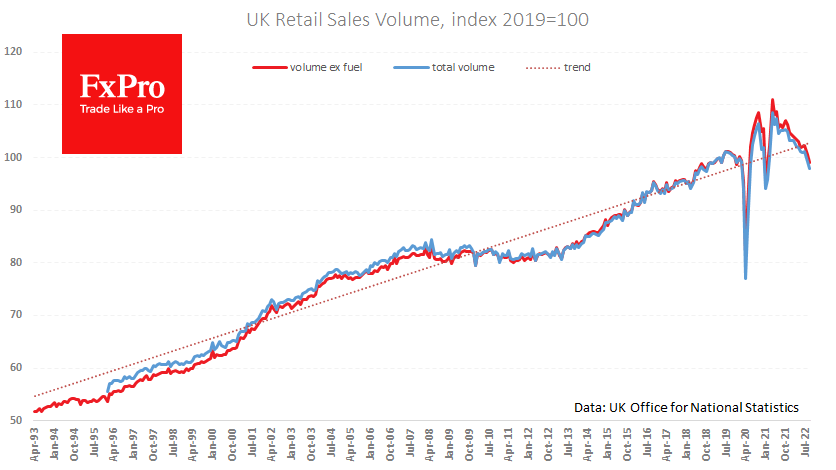
Great Britain retail sales for September were down 1.4%, and down 1.5% excluding fuel, after falling 1.7% a month earlier. Sales were down 10% from their April 2021 peak and 10.7% ex-fuel, having lost for almost the whole of the last year and a half.
Falling consumer activity makes it harder for the Bank of England to find a balance sheet. Today’s disappointing sales data is a strong case for the monetary dove camp. The weakness in the economy, as seen through the prism of falling sales and industrial production, can deter the Bank of England from raising its key rate more decisively, which is harmful to the Pound.
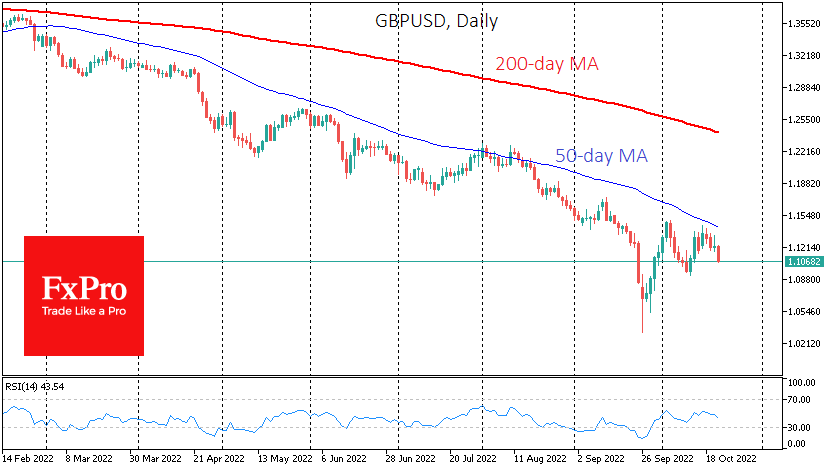
Should GBPUSD fall below 1.09 in the coming days, a retest of the 1.03-1.05 historic low area will be an issue, even though recently it seemed that the worst for the Pound is over.
EUR/USD Pair is Consolidating Losses Near 0.9780
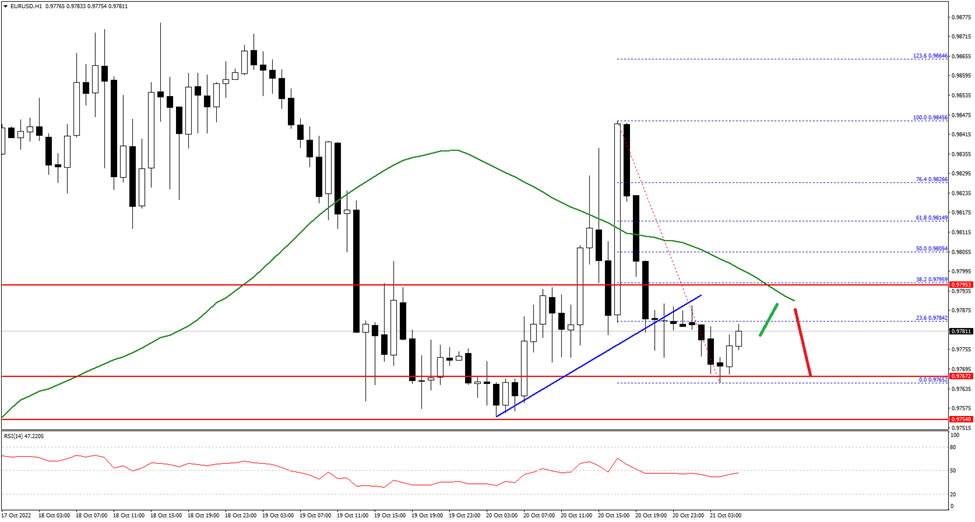
The Euro struggled to clear the 0.9880 and 0.9900 resistance levels against the US Dollar. The EUR/USD pair reacted to the downside and declined below the 0.9820 support.
There was close below the 0.9800 level and the 50 hourly simple moving average. The pair is now consolidating losses near the 0.9780 zone. An immediate resistance on the upside is near 0.9800 and the 50 hourly simple moving average. The first major resistance is near the 0.9820 level.
A break above the 0.9820 resistance level could start a decent upward move. In the stated case, it could even surpass 0.9850 on FXOpen.
Conversely, the pair might start another decline below 0.9770. The next key support is near 0.9755, below the pair could decline towards the 0.9710 level. Any more losses might send the pair towards the 0.9660 level.
Canada: Retail Sales Increase in August
Retail sales rose 0.7% month-on-month (m/m) in August, partially reversing July's large decline. Adjusting for the impact of inflation, the volume of sales was up 1.1% on the month.
Statistics Canada's flash estimate for September points to a 0.5% m/m decline.
Receipts at gasoline stations were marginally lower in August, reflecting lower prices at the pump (-0.2%). However, lower prices encouraged consumers to hit the road again, and demand for gasoline strengthened noticeably, with volume of sales up 7%. Sales of motor vehicle and parts also edged higher (+0.6% m/m).
Core sales, which exclude autos and gasoline, rose 0.9% - the largest increase since March. In real terms core sales were up 0.4% m/m.
- Higher sales at food and beverage stores led the increase (+2.4%), but much of the gain was due to higher prices, with the volume of sales up by 1.3% on the month. Sales at sporting goods, hobby and book stores rose 5.0% on the month. The release noted that this strength is due to many team sporting leagues resuming full capacity activities over summer.
- Housing-related categories also fared better in August despite the cooling housing market. Sales were up 1.5% at furniture & home furnishings store, and were also higher at building materials & garden equipment & supplies stores (+0.6%). Sales at electronics and appliance stores edged lower (-0.2%), but this was the smallest decline in the last four months.
- Sales at clothing and accessories stores were flat on the month (-0.1%) due to discounts as sales volumes were actually up. General merchandize stores (-0.7%) and miscellaneous retailers (-1.4%) saw sales decline.
- E-commerce sales were up by a whopping 5.7% and were up 8.1% from a year ago.
Key Implications
Following a large drop in July, retail sales improved in August. Lower gasoline prices put consumers in better spirits and back behind the wheels to savor those final days of summer. In volume terms gasoline sales rose for the first time since April.
While encouraging, today's increase only partially reverses the steep drop in retail sales in July, and the preliminary forecast calls for sales to weaken in September. This suggests that the overall trend in spending remains one of deceleration.
Indeed, household finances have taken a hit from the triple whammy of high inflation, rapidly rising interest rates and shrinking wealth. Thus it’s no surprise that consumers are becoming more cautious, and have been scaling back on discretionary items, such as dining out and entertainment, with monthly gains in sales at bars and restaurants fizzing out over the summer months. Our high-frequency data on TD debit and credit card spending reaffirms that this weakening trend remained in place in August and September. All in all, consumers will have to make some tough choices in the months ahead, all of which point to significantly weaker consumer spending in 2023.
EUR/USD Mid-Day Outlook
Daily Pivots: (S1) 0.9748; (P) 0.9797; (R1) 0.9838; More...
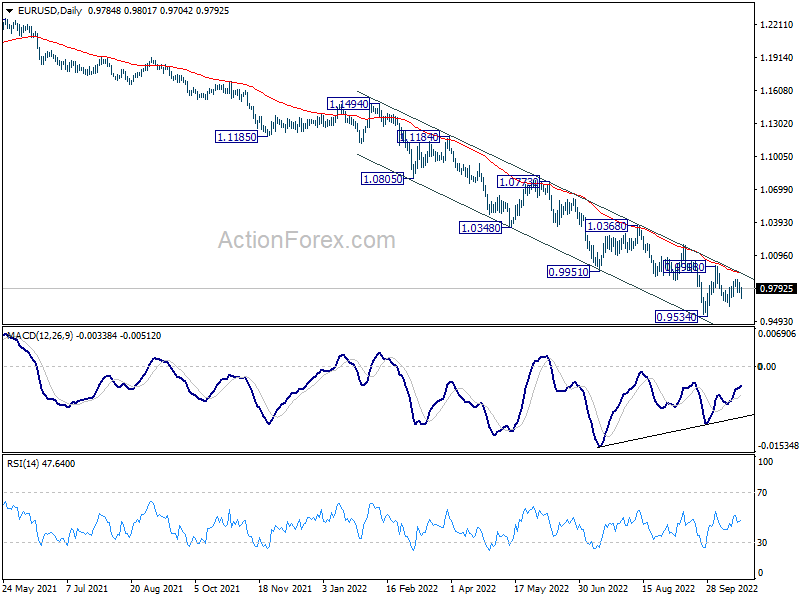
Intraday bias in EUR/USD remains neutral for the moment. Deeper decline is expected with 0.9998 resistance intact. Below 0.9630 will bring retest of 0.9534 low first. Firm break there will resume larger down trend. However, break of 0.9998 will confirm short term bottoming and turn bias back the upside for stronger rebound.
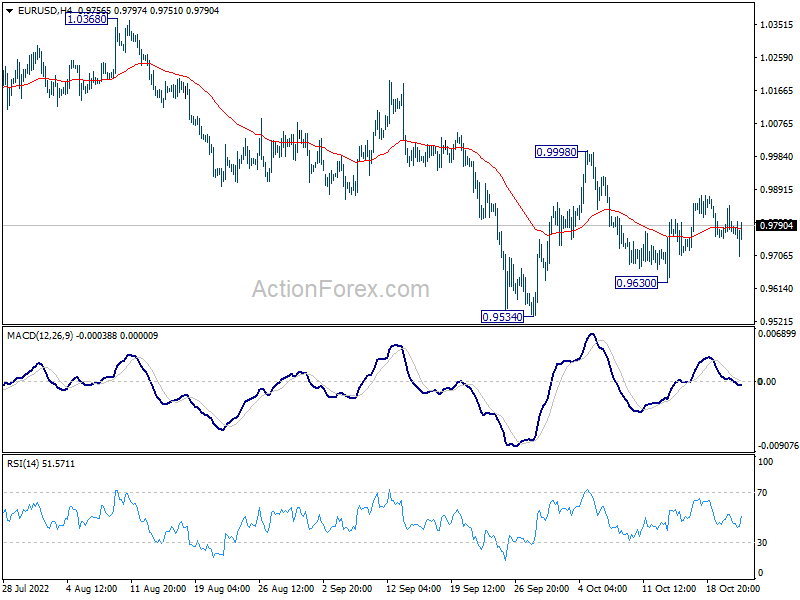
In the bigger picture, down trend from 1.6039 (2008 high) is still in progress. Next target is 100% projection of 1.3993 to 1.0339 from 1.2348 at 0.8694. In any case, break of 0.9998 resistance is needed to be the first sign of medium term bottoming. Otherwise, outlook will stay bearish even with strong rebound.