Sample Category Title
GBP/JPY Daily Outlook
Daily Pivots: (S1) 167.48; (P) 168.61; (R1) 169.78; More...
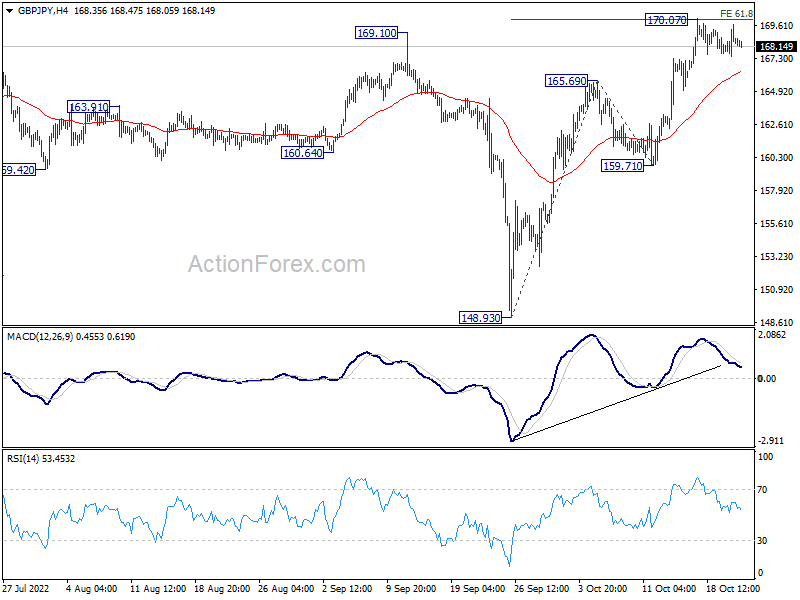
Intraday bias in GBP/JPY remains neutral as consolidation from 170.07 is still in progress. Downside of retreat should be contained above 159.71 support to bring another rally. Break of 170.07 will target 100% projection of 148.93 to 165.69 from 159.71 at 176.47.
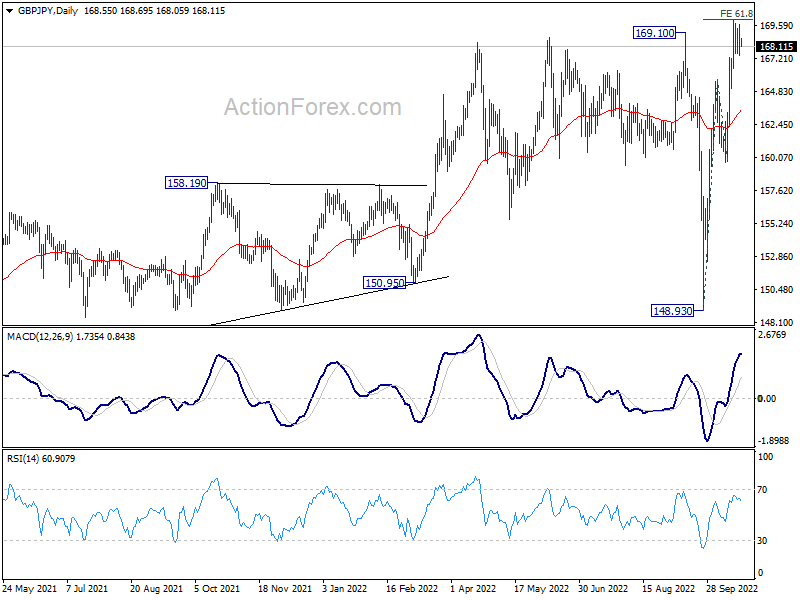
In the bigger picture, current development suggests that up trend from 123.94 (2020 low) is still in progress. Sustained break of 61.8% retracement of 195.86 (2015 high) to 122.75 (2016 low) at 167.93 will pave the way to retest 195.86 high. This will now remain the favored case as long as 148.93 support holds.
EUR/JPY Daily Outlook
Daily Pivots: (S1) 146.37; (P) 146.83; (R1) 147.43; More....
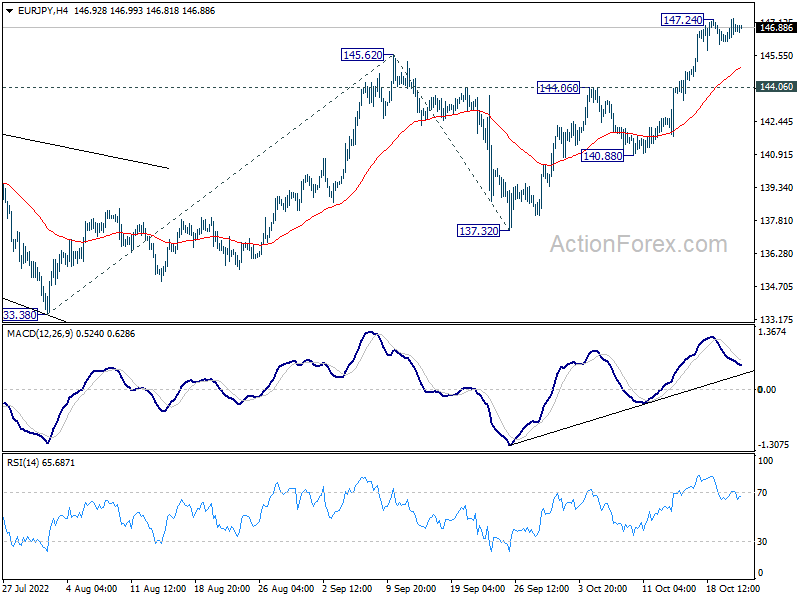
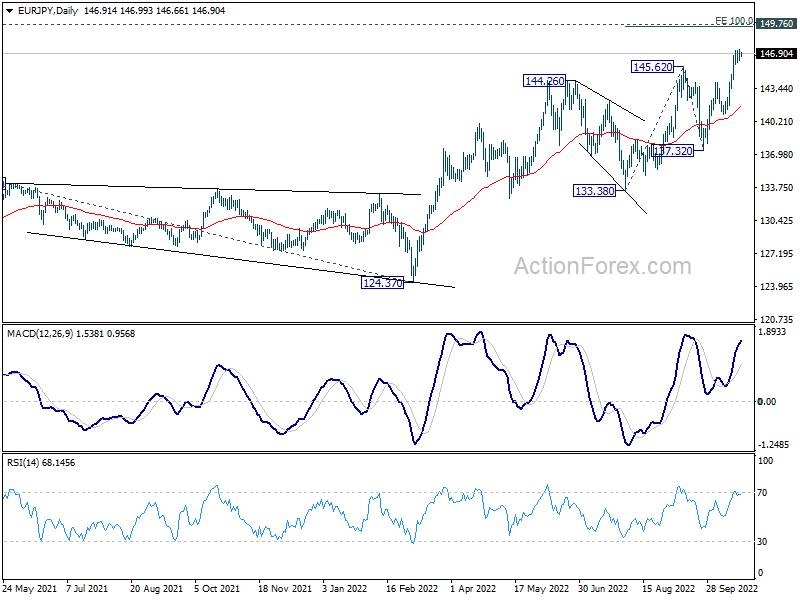
EUR/JPY is staying in consolidation from 147.24 and intraday bias remains neutral. Downside of retreat should be contained by 144.06 resistance turned support On the upside, break of 147.24 will resume larger up trend. Next target is 100% projection of 133.38 to 145.62 from 137.32 at 149.56, which is close to 149.76 long term resistance.
In the bigger picture, the up trend from 114.42 (2020 low) is still in progress for 149.75 (2014 high). Decisive break there will pave the way to 161.8% projection of 114.42 to 134.11 from 124.37 at 156.22. This will now remain the favored case as long as 137.32 support holds.
EUR/GBP Daily Outlook
Daily Pivots: (S1) 0.8685; (P) 0.8707; (R1) 0.8734; More...
EUR/GBP is extending the consolidation pattern from 0.8577 and intraday bias remains neutral. Further decline is expected with 0.8869 resistance intact. On the downside, break of 0.8577 will resume the fall from 0.9267, and target 61.8% projection of 0.9267 to 0.8647 from 0.8869 at 0.8486.
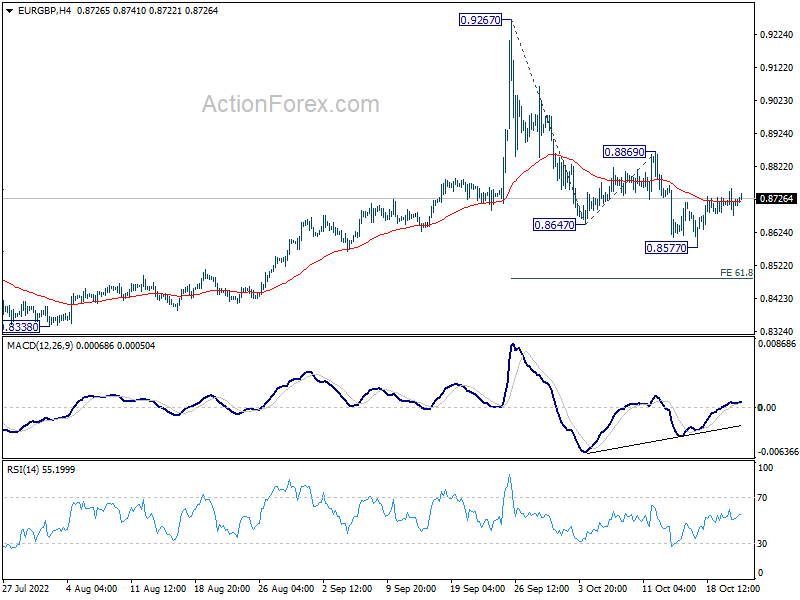
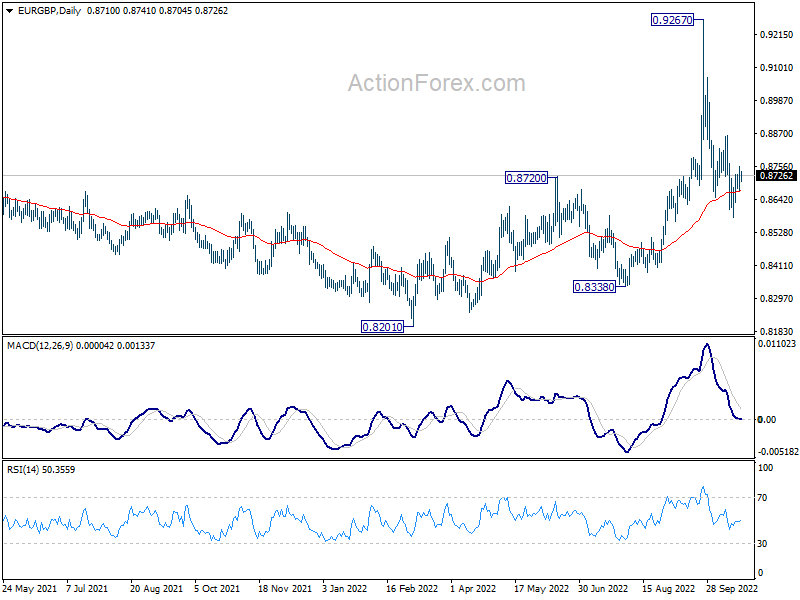
In the bigger picture, current development suggests that fall from 0.9267 is a down leg inside long term range pattern. Deeper fall could be seen towards 0.8201/8338 support zone. But strong support should be seen there to bring reversal.
EUR/AUD Daily Outlook
Daily Pivots: (S1) 1.5473; (P) 1.5572; (R1) 1.5677; More...
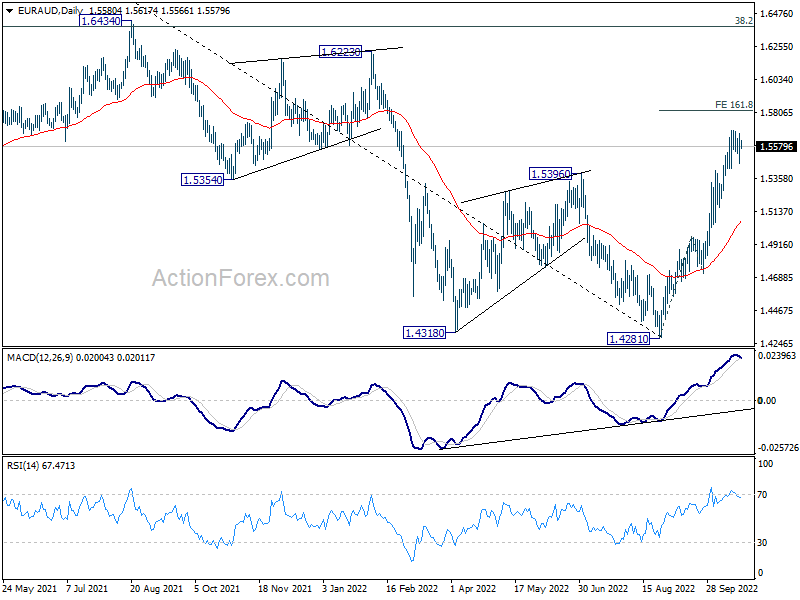
Intraday bias in EUR/AUD remains neutral with consolidation from 1.5685 in progress. Deeper retreat cannot be ruled out but downside should be contained by 1.5156 support. On the upside, break of 1.5685 will resume the rally from 1.4281 to 161.8% projection of 1.4281 to 1.4965 from 1.4716 at 1.5823.
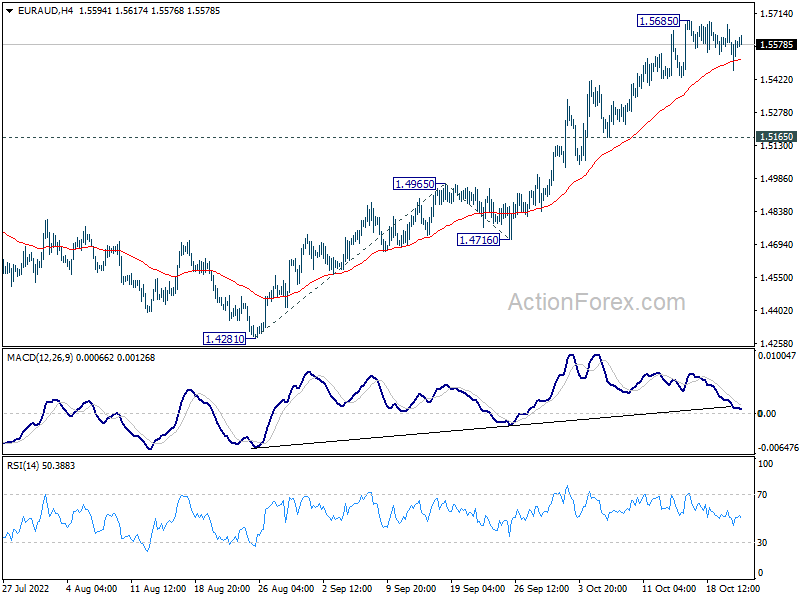
In the bigger picture, a medium term bottom should be in place at 1.4281, on bullish convergence condition in daily MACD. Further rise would be seen back to 1.6434 key resistance next. Break of 1.4965 resistance turned support is needed to indicate reversal. Otherwise, further rally will remain in favor.
EUR/CHF Daily Outlook
Daily Pivots: (S1) 0.9801; (P) 0.9826; (R1) 0.9842; More....
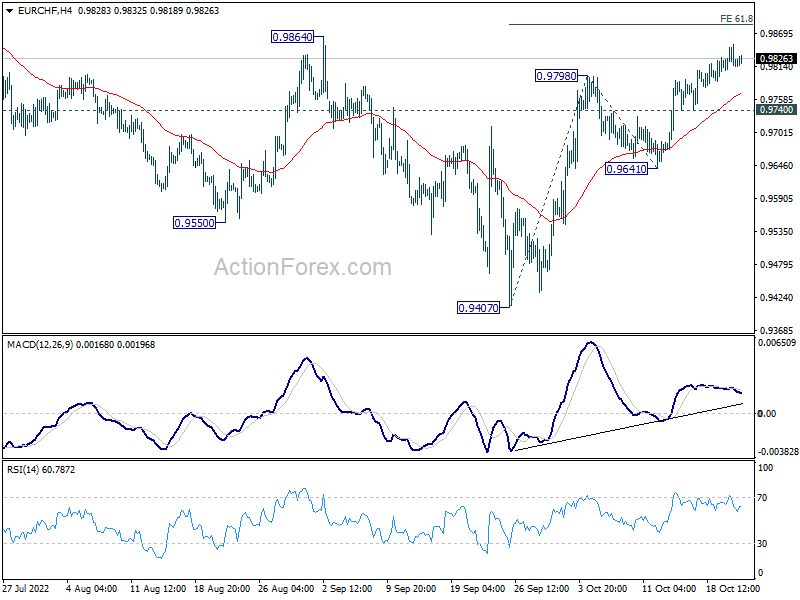
EUR/CHF continues to lose upside momentum as seen in 4 hour MACD but there is not sign of topping. Intraday bias stays on the upside for 61.8% projection of 0.9407 to 0.9798 from 0.9641 at 0.9883. Decisive break there will solidify the case of medium term bottoming and target 100% projection at 1.0032. On the downside, below 0.9740 minor support will turn intraday bias neutral first.
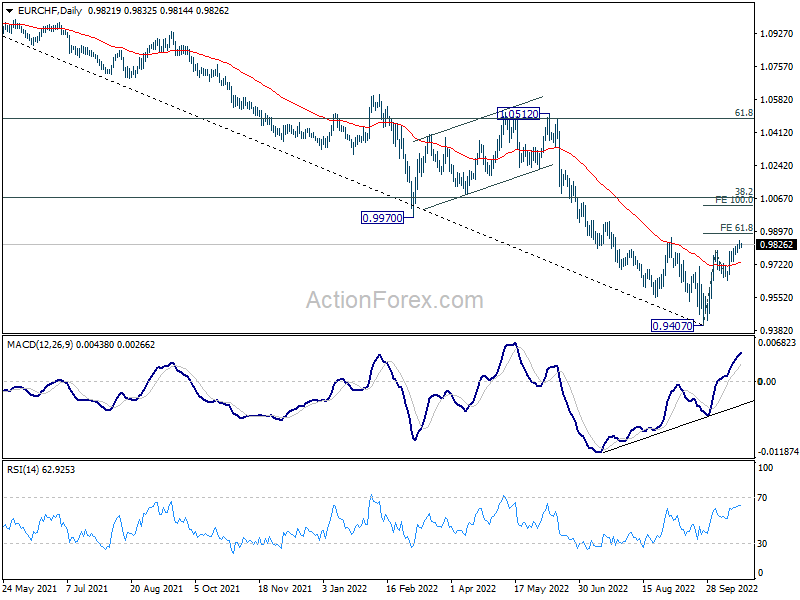
In the bigger picture, considering bullish condition in daily MACD, firm break of 0.9864 resistance will confirm medium term bottoming at 0.9407. Stronger rally should then be seen to 55 week EMA (now at 1.0138), even as a corrective rebound. Nevertheless, rejection by 0.9864 will bring down trend resumption through 0.9407 next.
UK Political Crisis has Demanded its Ultimate Sacrifice
Markets
The UK political crisis has demanded its ultimate sacrifice. Liz Truss was forced to resign after being just 44 days in office – the shortest tenor ever. The race for a new PM has already begun and it may be a short one. Contenders need the backing of 100 Tory lawmakers just to get on the ballot. A new leader may already be picked by Monday. Rishi Sunak and Penny Mordaunt are leading in the bookmaker odds with none other than Boris Johnson on the third place. Sterling briefly rallied on Truss’ resignation but closed the day unchanged eventually (EUR/GBP 0.871). Gilt yields rose 3.5 bps (10y) to 9.5 bps (5y), again with the exception of the 30y (-2.9 bps). It was part of the seemingly unstoppable broader trend though. US yields again added 5.3 bps to 9.4 bps to new cycle highs without concrete news other than Fed officials (Harker, Cooke) reiterating the need for additional tightening. US money markets fully price in a 5% terminal rate. German bonds outperformed (and for the first time in days also marginally vs swaps), gaining between 2-3.2 bps across the curve. Wall Street wavered opening gains as yields gained traction in US dealings. On currency markets, USD/JPY broke above 150 triggering nothing else but verbal interventions for now. EUR/USD stayed below 0.98.
The greenback is again better bid during Asian trading hours this morning, strengthening further against all G10 peers. USD/JPY rises further north of 150 and USD/CNY is attacking previous (intraday) cycle highs around 7.25. US Treasury yields drift higher. 3% headline inflation in Japan puts Japanese govies under pressure. The BoJ steps in with unscheduled buying. Interestingly, the spread between Japanese 10y swap and the government bond yield is at its highest since at least 2009. Asian equities trade mixed.
The economic calendar today contains EMU October consumer confidence and UK retail sales. But the latter will surely be overshadowed by the PM contest. The recent political developments also mean a delay of the fiscal statement beyond October 31. That implies the Bank of England will have its policy meeting without this input early November. Without clear market drivers for today, we expect the current market trends simply to continue: i.e. core bond yields grinding higher and a stronger dollar. Reports of a Russian troop buildup at Ukraine’s borders to the north won’t help equities, which already face difficult circumstances.
News Headlines
Both Japan’s headline inflation and core inflation ex fresh Food, in September rose to 3.0% Y/Y. It marked the sixth consecutive month that the ex-fresh food measure printed above the BOJ’s 2% target. Inflation excluding both fresh food and energy also rose to 1.8% y/y from 1.6%. Still the rise in inflation was mainly driven by higher goods prices (5.6% Y/Y). Services prices only gained 0.2% compared to the same month last year. The rise inflation occurs as the yen extends its protracted weakening. At USD/JPY 150.4, the yen is trading more than 30% weaker against the dollar YTD, putting further upward pressure on price of imported goods. However, BOJ governor Kuroda, who stays at the helm of the BOJ till April next year recently kept the assessment that inflation was mainly cost-driven and that the Bank wants to see higher wages as a sign that inflation is returning sustainably higher. The BOJ will hold its next policy meeting Friday next week.
At least two governors of the Czech national bank still keep the debate alive on further interest rate hikes at the next CNB meeting even as it stopped raising rates in June. According to a Reuters article referring to an interview with newspaper E15, CNB Vice governor Mora indicated that he still sees a case for the policy rate (currently 7.0%) to be raised by at least 50 bps as world central banks continue tightening, the domestic labour market remains tight and government fiscal policy stays expansionist. A more transparent policy of further rate hikes could also reduce the need for FX interventions. Yesterday, CNB’s Dedek also indicated that he would raising interest rates further if the koruna would come under pressure. However, for now he doesn’t see narrowing interest rate differentials putting additional pressure on the koruna.
Next! – Who Will Replace Liz Truss?
The biggest news of yesterday was the resignation of the UK PM Liz Truss, after having wreaked havoc across all British asset classes in just 44 days in office, as she aimed to spend BIG but without a serious plan on how and who would finance all that spending.
In just 44 days, the British pound lost up to 8% against the euro, more than 10% against the US dollar. The 10-year gilt yield rose 55%, while the 30-year gilt yield skyrocketed 60%. The Bank of England (BoE) had to intervene in emergency to save the country’s pension system.
Liz Truss’ depart wasn’t a surprise
Normally, a PM resignation means uncertainty and limited visibility; it’s not a preferred scenario for the market. But the little time Liz Truss stayed in power was so hectic that investors welcomed the news that she departs sooner rather than later.
Sterling and the British sovereigns gained although Cable is back below the 1.12 at time of writing
Of course, what happened in the UK over the past weeks is also a warning - for the new PM and his/her team - that there are limits that cannot be breached. Financial discipline is one of those. Britain learned it the hard way.
Who will replace Liz Truss?
Rishi Sunak seems like the best option. The previous Chancellor of Exchequer has a solid track record; he knows he can’t spend, or make tax decisions without justification. He knows that, despite the unideal economic environment, he can’t increase debt without increasing the cost of borrowing. And more importantly, he is supported by the market.
Penny Mordaunt is another candidate that could replace Liz Truss.
And finally, Boris Johnson could be back in the race! He quit because of scandals. But none of them seems as a big deal compared to Liz Truss who destroyed confidence in the UK government, and almost abated the British pension system.
Whoever it is, the main challenge for the next PM will be to reassure the markets! We expect to see some more bumpy trading for the British assets until the dust settles. In this respect, Cable will likely see a strong resistance around its 50-DMA, which stands near 1.1440, and the 1.15 psychological mark, and we could see the pair test the 1.10 mark yet again.
But the latest British turmoil could be an opportunity to return to British assets at interesting prices.
Zooming out
The US dollar continues extending its rally across the board, and there is nothing the other currencies can do.
The dollar-yen is now trading above the 150 level, with prospect of another Bank of Japan intervention. The Japanese inflation remained unchanged near 3% in September. The import prices due to the weakening yen is one of the reasons for the rising consumer prices in Japan, but the BoJ is not willing to hike the interest rates just yet. Any FX intervention sill likely offer interesting dip-buying opportunities.
Earnings
American Airlines’ revenue rose 13% last quarter compared to the same time in 2019, while they flew 10% less. Higher prices helped compensate rising fuel and labour costs. The company said they will get back to their full 2019 capacity next year.
United Airlines and Delta Air Lines also said that they would be profitable through the end of the year thanks to strong bookings and fares.
But American Airlines still fell 3.80% and remains under a decent selling pressure, as the S&P500 closed 0.80% lower.
Snap nosedived 27% in the afterhours trading, after reporting the lowest ever quarterly sales growth due to lower advertising spending.
On the macro front, the Philly Fed manufacturing index came in softer than expected, but the weekly jobless claims fell – which certainly fueled the hawkish Fed expectations.
UK Political Turmoil Continues
Market movers today
The EU Council meeting continues in Brussels with focus on Ukraine and foreign policy topics, after the first agreements on the energy front have been reached overnight (see more below). Markets will also keep an eye on the evolving political situation in the UK.
Euro area October flash consumer confidence will likely continue even lower. We are still some way off the financial crisis levels, though.
Giorgia Meloni might be appointed new Italian prime minister as early as this afternoon, but differences in the coalition's foreign policy stance on Ukraine first need to be ironed out.
In the Nordics, we get exiting news on the labour market with unemployment out of Sweden. We also get the number of Danish wage earners in August.
The 60 second overview
UK politics: Yesterday UK prime minister Liz Truss resigned after merely 44 days in office, making her the shortest serving prime minister in UK history. EUR/GBP moved back below 0.87 and 10Y gilt yields have dropped close to levels before Truss's contentious tax cut plan was announced. Her resignation follows political turmoil amidst a growing confidence crisis in the Conservative party triggered by the mini-budget presented in September. To find the next PM and leader of the Conservative Party a leadership election will be conducted in the coming week, with a prime minister to be elected by Friday 28 October at the latest. Conservative MPs will vote to select the two final candidates, after which party members will cast the final deciding vote. Alternatively, the less popular candidate of the final two withdraws and the remaining candidate will thus win the election without the vote of party members. At present, former chancellor Rishi Sunak, former Prime Minister Boris Johnson and leader of the House of Commons Penny Mordaunt are the frontrunners to replace Truss.
Energy crisis: EU leaders agreed to press ahead with emergency action to address the energy crisis, with Germany yielding to pressure for a temporary natural gas price cap, after finding itself increasingly isolated on the European stage. EU leaders agreed to endorse further work towards a 'temporary dynamic price corridor' that would "immediately limit episodes of excessive gas prices", but with heavy caveats to ally Berlin's fears that market interventions could endanger supply security. The agreement also foresees a mechanism to limit the price of gas used for electricity generation (as already used in Spain and Portugal), a voluntary joint gas purchasing platform, the creation of a new complementary gas price benchmark by early 2023 as well as stepped-up efforts to cut gas demand. Details of the measures will have to be worked out by the Commission in the coming weeks and at an EU energy minister meeting next Tuesday. Natural gas spot prices continue to trade around EUR/Mwh 60, close to the lowest levels since the start of the war.
EU politics: Despite the energy compromise reached at the EU summit, further signs of souring Franco-German ties emerged after a bilateral cabinet meeting scheduled for next Wednesday was cancelled (and postponed to January). France and Germany currently find themselves at loggerheads on a number of issues, including the MidCat pipeline project, Scholz' push for a European air defence system and the sudden announcement of the German energy package. For markets, souring Franco-German ties are bad news for the chance of another round of EU-backed borrowing, as big leaps in EU integration usually required the two pulling in the same direction.
Equities lower and the zig zag trading between sectors continued too. Yield sensitive sectors such as communication services and tech outperformed, while value cyclicals sold off and thereby reversing the prior session. Dow -0.3%, S&P -0.8%, Nasdaq -0.6% and Russell 2000 -1.2%. US futures are slightly lower this morning too.
FI: Another volatile session in the UK after PM Truss resigning. 10y Gilts traded in a 30bp range yesterday. 10y German Bunds traded in what has become usual volatility by now of a 10bp range, but ended the day just 2bp higher compared to Wednesday's close. BTPs outperformed peers likely on account of a BTP Italia sale in November and that the centre-right parties are going to the President today. Bund ASW ended unchanged on the day, while Schatz ASW rose 3bp through the day.
FX: HUF continues the move higher - following last week's surprise MNB rate hike - yesterday completing a 5% gain vs the EUR. Apart from this, moves have been fairly contained among FX majors in recent sessions, with V-shaped price action in most crosses including GBP following Truss' resignation.
Credit: There was a bit of divergence between credit indices yesterday where high-beta underperformed low-beta. iTraxx Xover widened slightly less than 1bp while Main tightened 1.3bp.
Nordic macro
The labour market survey will be out in Sweden today. The labour market continues to be strong, but we see some weakening signals in especially hiring plans. Regarding the unemployment rate, we think it is too early to see a rise and expect the unemployment rate to be unchanged at 6.9% s.a.
Danish wage earner employment figures for August are also due. July saw employment fall for the first time in 17 months on the back of a reduction in public sector workers. Private sector employment was largely unchanged in July - a sign of weakness in that companies had been hiring more staff every month since the beginning of 2021. The slowdown is presumably due to a combination of weaker demand and increasing uncertainty causing companies to hold back; and many industries continue to experience difficulty in finding labour. We expect the Danish economy to slow going forward, which will likely mean falling employment eventually.
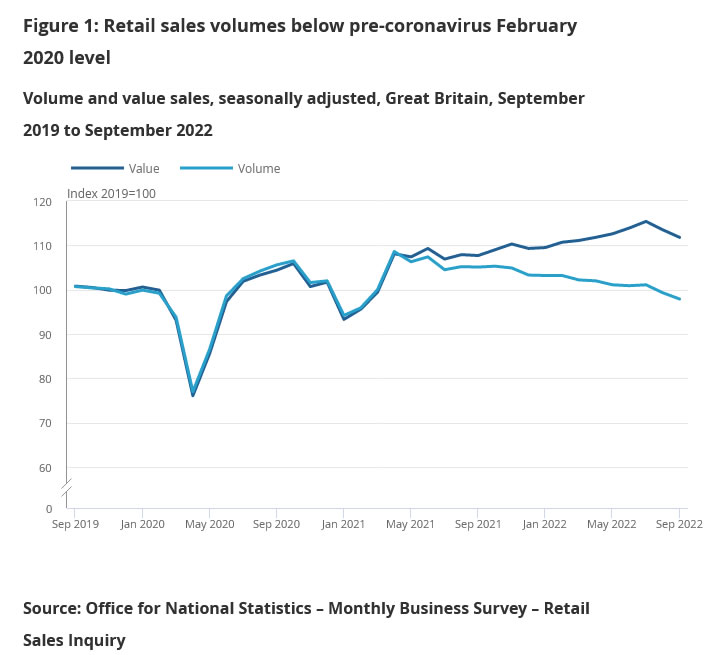
UK retail sales volume down -1.4% mom in Sep, value down -0.5% mom
UK retail sales volume dropped -1.4% mom in September, much worse than expectation of -0.5% mom. Sales values dropped -1.4% mom too. On a year earlier, sales volumes dropped -6.9% yoy while sales value rose 3.8% yoy.
Excluding fuel, sales volumes dropped -1.5% mom while sales values dropped -0.4% mom. On a year earlier, sales volume was down -6.2% yoy while sales value was up 3.3% yoy.
Comparing with pre-coronavirus level in February 2020, total retail sales were 12.0% higher in value terms but volumes were -1.3% lower.
USD/CAD Daily Outlook
Daily Pivots: (S1) 1.3675; (P) 1.3741; (R1) 1.3830; More...
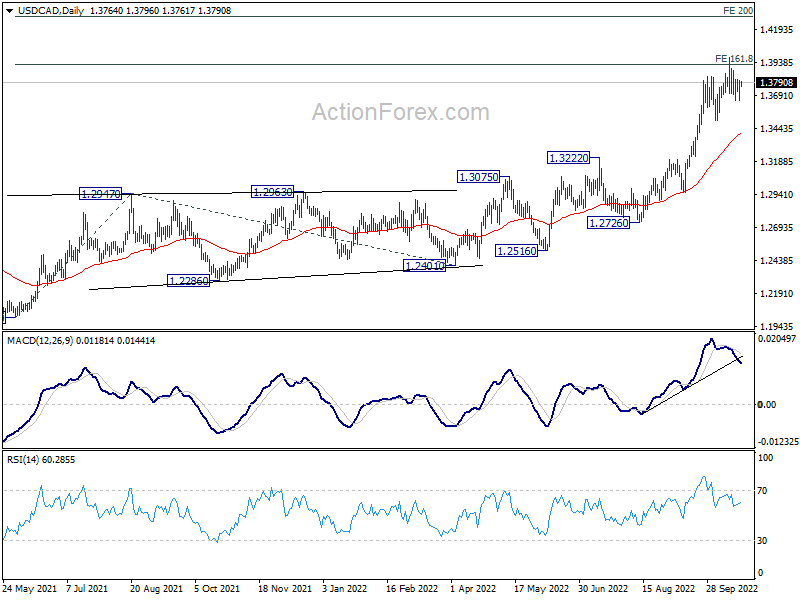
Intraday bias in USD/CAD stays neutral as consolidation continues. Outlook will stay bullish as long as 1.3501 support holds. Firm break of 1.3976 will resume larger up trend, and target 200% projection of 1.2005 to 1.2947 from 1.2401 at 1.4285.
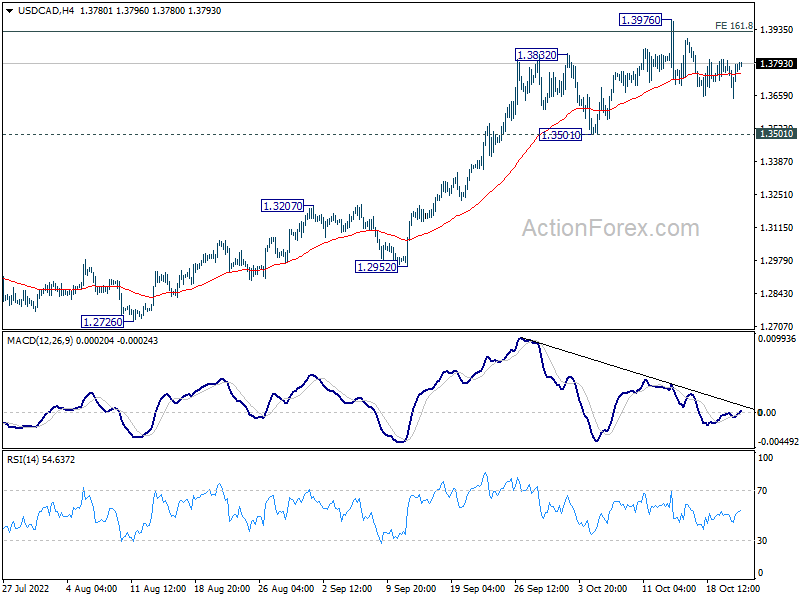
In the bigger picture, up trend from 1.2005 (2021 low) is still in progress. Based on current impulsive momentum, it could be resuming long term up trend from 0.9056 (2007 low). Whether it is or it isn't, retest of 1.4689 (2016 high) should be seen next. This will now remain the favored case as long as 1.3222 resistance turned support holds.