

Sample Category Title
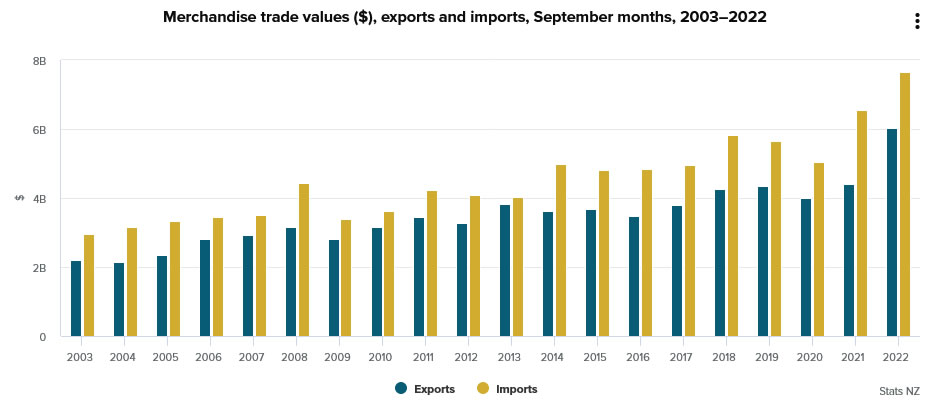
NZ exports rose 37.% yoy in Sep, imports rose 16% yoy
New Zealand good exports rose 37% yoy or NZD 1.6B to NZD 6B in September. Goods imports rose 16% yoy or NZD 1.1B to NZD 7.6B. Monthly trade balance reported a deficit of NZD -1.6B.
Exports to all major trading partners were up, including China (+31% yoy), Australia (+33% yoy), USA (+13% yoy), EU (+21% yoy), and Japan (+42% yoy).
Imports from all major trading partners rose, except EU, including China (+20% yoy), EU (-5.3% yoy), Australia (+11% yoy), USA (+26% yoy), and Japan (+14% yoy).
Japan CPI core rose to 3% yoy in Sep
Japan headline CPI was unchanged at 3.0% yoy in September, below expectation of 3.1% yoy. CPI core (all items ex-fresh food) accelerated from 2.8% yoy to 3.0% yoy, matched expectations. CPI core-core (all items ex-fresh food and energy) accelerated from 1.6% to 1.8% yoy, below expectation of 2.0% yoy.
CPI core has now exceeded BoJ's target for the 6th straight months, and hit the highest level since 1991 (excluding the effect of the 2014 sales tax hike). CPI core-core was also at the highest level since 2015. Yet, BoJ is seeing inflation as mostly driven by imports rather than domestic price pressures. This could be reflected in the 5.6% yoy rise in goods prices, and the sluggish 0.2% yoy rise in services prices.
Fed Cook: Ongoing rate hikes required to bring inflation down
Fed Governor Lisa Cook said, "Inflation is too high, it must come down and we will keep at it until the job is done. This likely will require ongoing rate hikes and then keeping policy restrictive for some time."
"Policy must be based on whether we see inflation actually falling in the data, rather than just in forecasts. Policy should remain focused on restoring price stability, which will also set the foundation for a sustainably strong labor market," she said.
Fed Harker: Interest will be well above 4% by year-end
Philadelphia Fed President Patrick Harker said yesterday, "We are going to keep raising rates for a while. Given our frankly disappointing lack of progress on curtailing inflation, I expect we will be well above 4% by the end of the year."
"Sometime next year, we are going to stop hiking rates. At that point, I think we should hold at a restrictive rate for a while to let monetary policy do its work," he said. "It will take a while for the higher cost of capital to work its way through the economy. After that, if we have to, we can tighten further, based on the data."
USD/JPY Climbs To 150, Bulls Losing Steam
Key Highlights
- USD/JPY started a major increase and tested the 150.0 barrier.
- A key bullish trend line is forming with support near 148.80 on the 4-hours chart.
- EUR/USD might attempt an upside break above the 0.9900 resistance.
- GBP/USD is showing positive signs and might clear 1.1400.
USD/JPY Technical Analysis
The US Dollar gained strength above the 145.00 resistance against the Japanese Yen. USD/JPY even cleared the 148.00 barrier to move further into a positive zone.
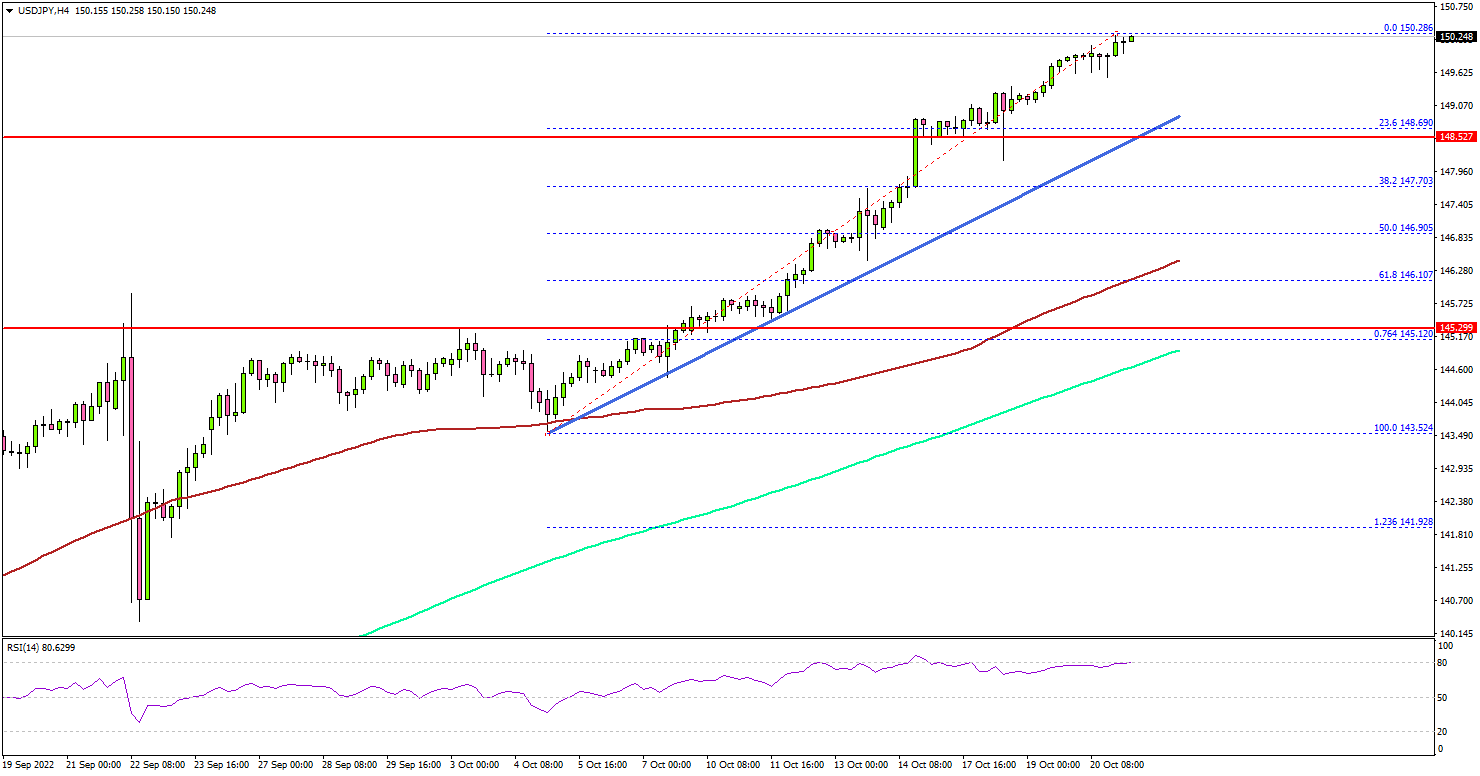
Looking at the 4-hours chart, the pair settled well above the 148.00 level, the 100 simple moving average (red, 4-hours), and the 200 simple moving average (green, 4-hours).
It opened the doors for more upsides and the pair tested the all-important 150.00 level. The pair traded to a new multi-year high and remains supported for more gains. The next major resistance on the upside may perhaps be near 152.00.
If there is a downside correction, the pair might test the 148.80 support. There is also a key bullish trend line forming with support near 148.80 on the same chart.
A downside break below the trend line support may perhaps send USD/JPY towards the 147.50 support. Any more gains could lead the pair towards 145.00 or the 100 simple moving average (red, 4-hours).
Looking at EUR/USD, the pair is consolidating and might soon attempt a key upside break above the 0.9900 resistance zone.
Economic Releases
- UK Retail Sales for Sep 2022 (MoM) - Forecast -0.5%, versus -1.6% previous.
- UK Retail Sales for Sep 2022 (YoY) - Forecast -5.0% versus -5.4% previous.
- Canadian Retail Sales for Aug 2022 (MoM) – Forecast +0.2%, versus -2.5% previous.
- Canadian Retail Sales ex Autos for Aug 2022 (MoM) – Forecast +0.4%, versus -3.1% previous.
Cliff Notes: Global Political Uncertainty Likely to Persist
Key insights from the week that was.
Global markets have remained cautious this week amid ongoing concern over inflation and interest rates, and as China’s National Party Congress has taken place.
In Australia, the October RBA meeting meetings kicked off the week’s information flow. As detailed by Chief Economist Bill Evans, the document gave a detailed assessment of the case for hiking 25bps (their eventual decision) and 50bps (the market’s prior expectation) at the October meeting. Arguing for 50bps were inflation and wage risks, particularly while the economy remains strong; the cash rate not being especially high; and the potential for the market and/or community to question the resolve of the Board. In favour of a 25bp hike however, was recognition that downside risks to activity growth are building; that inflation could subside quickly; and also the lag between the change in policy and its impact. Also clear from the minutes was that reducing the pace of hiking to 25bps per month is not a sign of a near-term pause, with “further increases in interest rates over the period ahead” expected.
The September labour force survey subsequently surprised to the downside, with only 900 jobs created in the month. The unemployment rate was unchanged to 1 decimal point, though to 2 decimal points it rose from 3.48% to 3.54% as participation remained unchanged but the size of the labour force grew. While we expect employment growth to remain robust into 2023, accelerating growth in the population will limit further downside for the unemployment rate, and help to better match labour supply and demand.
Next week for Australia, both the Q3 CPI and second Federal Budget 2022 are due. On the CPI, Westpac expects a strong 1.1% rise in headline inflation, taking the annual rate 0.4ppts higher to 6.5%yr. Notably, without state energy rebates, the Q3 forecast would have been higher still circa 1.8%, in line with the gain seen in Q2. The trimmed mean core measure is anticipated to gain another 1.5% in Q3, in line with Q1 and Q2 and enough to lift the annual rate to 5.6%yr. Our preview details our expectations for all the key components of the CPI. Note as well, this week’s New Zealand CPI highlights that risks related to inflation remain skewed to the upside, requiring central banks globally to slow their economies in an attempt to balance demand with supply. With NZ annual inflation now above 7% and showing continued momentum, Westpac expects the RBNZ to raise their cash rate to a peak of 5.0% (previously 4.5%).
For October’s Budget 2022, while the new Australian Government will have the benefit of an improved starting point, a weaker economy over the forecast horizon sets the scene for some tough discussions and, potentially, decisions next May in Budget 2023. In the interim, the updated Budget 2022 is expected to emphasise the priorities of the new Labor Government, with a particular focus on the policies they took to this year’s election. The key themes are discussed by Chief Economist Bill Evans in this week’s video update, while our written preview provides full detail on both our policy expectations and the Government’s forecasts.
Turning to China, the spotlight has remained on the National Party Congress and President Xi’s degree of control, particularly after this week’s data (including Q3 GDP) was delayed with little notice and no explanation. So far, President Xi and the Party have emphasised their desire for China’s position in the global economy to continue to strengthen while remaining resolute in their belief in the success of COVID-zero as well as their geopolitical views, particularly for Taiwan. As we have seen throughout the past year, China is pursuing the growth opportunities open to it through efficiency; productivity; and expansion into Asian markets. As this economic development is achieved, China’s position in the region and global economy will continue to strengthen. While this opens up opportunity for greater trade and growth for the region overall, it also raises the probability of geopolitical uncertainty and volatility continuing as the West (particularly the US) seeks to preserve its position and influence. The end of the 2022 Congress, particularly changes to the leadership, will be closely watched at the weekend.
For the US, data has been light this week, though that received has clearly highlighted the impact of higher interest rates on the economy, particularly housing. In September: existing home sales fell for an 8th consecutive month; the NAHB housing market index fell for a 10th consecutive month to be near its pandemic lows; and housing starts and permits remained volatile, well below their cycle highs. The Federal Reserve’s Beige Book more broadly pointed to a soft economy, with growing risks over the activity outlook and evidence of businesses beginning to question their staffing plans. These developments highlight that FOMC officials must give greater weight to downside risks for activity in 2023; although, until then, it seems Committee members hawkish resolve will remain.
Finally to the UK. After only 44 days in office, Liz Truss has officially resigned as Prime Minister and the Conservative Party leadership election is due to take place in the next week. This comes after weeks of financial market turmoil following the announcement of Truss’ economic plan, centred on significant and unfunded fiscal stimulus in the form of generous tax cuts at a time of historically elevated inflation. This was rightfully received poorly by many, even in Truss’ own government, resulting in most of the fiscal plan being scrapped in the week leading up to her resignation. Since Truss took over the Prime Ministership, the 11ppt difference in voting intentions (Labour 42%; Conservatives 31%) has now widened to a staggering 29ppts (Labour 52%; Conservatives 23%). A more responsible fiscal plan that is cognisant of the risks to inflation, but supportive to households and businesses over the tough period ahead, is necessary to avoid excessive financial tightening from the Bank of England.
Gold Wave Analysis
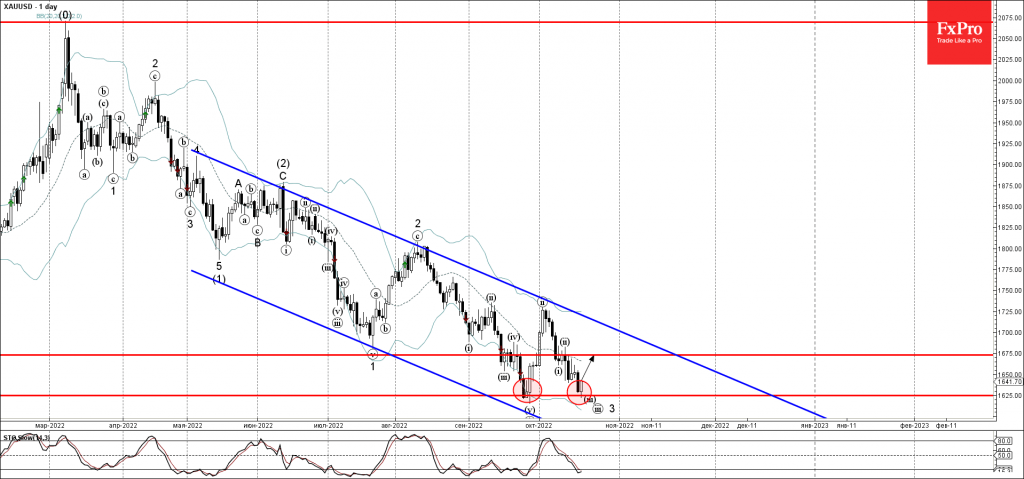
- Gold reversed from support level 1652.00
- Likely to rise to resistance level 1675.00
Gold recently reversed up from the key support level 1652.00 (which stopped the previous impulse wave (i) at the end of September), intersecting with the lower daily Bollinger Band.
The upward reversal from the support level 1652.00 stopped the earlier short-term impulse waves (iii) and 3.
Given the oversold reading on the daily Stochastic, Gold can be expected to rise further toward the next resistance level 1675.00.
USDCHF Wave Analysis
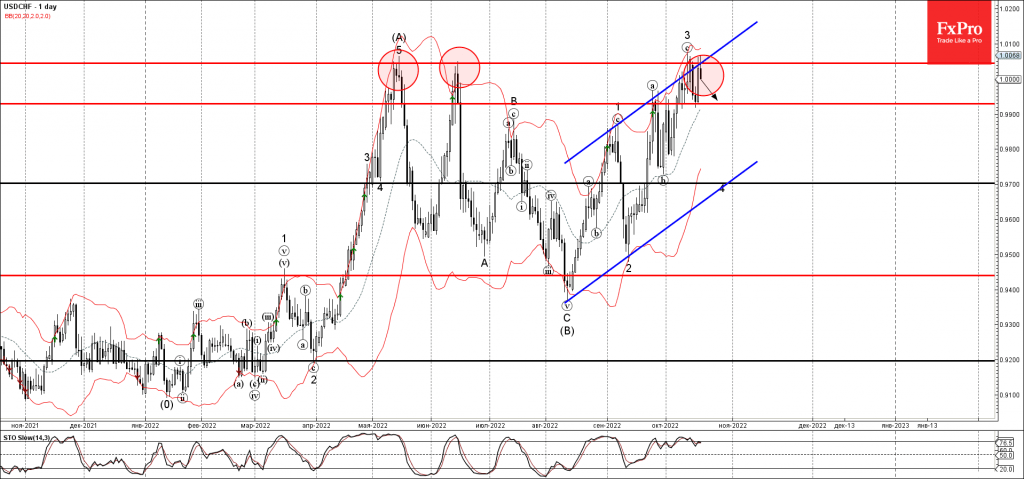
- USDCHF under bearish pressure
- Likely to fall to support level 0.9930
USDCHF under the bearish pressure after the price reversed down from the major resistance level 1.0050 (which stopped all upward impulses from the middle of May).
The resistance level 1.0050 was strengthened by the upper daily Bollinger Band and by the resistance trendline of the daily up channel from August.
USDCHF can be expected to fall further toward the next support level 0.9930 (which reversed the price earlier this month).
Another Day, Another Prime Minister
An absolute shambles
Another UK Prime Minister has resigned and I've now lost count of how many Chancellors we're going to be up to if Jeremy Hunt is also replaced next week.
Liz Truss' position was hanging by a thread and has been since the mini-budget but that unravelled at a remarkable pace. And now the UK is once again waiting to see who will be the next Prime Minister and how the process will be decided.
Truss has no doubt been an unmitigated disaster and I'm not sure who exactly will make the country feel at ease at this point. There will obviously be calls for a general election but that won't provide any certainty or leadership for the country in the midst of a crisis. It would appear there are only bad options on the table so we probably shouldn't expect a positive outcome.
Oh, and Boris is apparently entering the race.
Tesla on the right track?
Despite Elon Musk's best efforts to talk up Tesla's performance and outlook, shares are trading 4% lower and almost 50% from their high almost 12 months ago. No doubt the company has weathered the storm of the last few years relatively well but the global economic outlook has deteriorated significantly in that time, as Musk acknowledged, and the miss on revenue may be seen as a concern. Still, he remains very optimistic - to put it mildly - eyeing a path to the company being more valuable than Apple and Saudi Aramco combined. He never has been short of ambition.
China mulls easing Covid quarantine as LPRs left unchanged
Asian markets appear to have been boosted in the middle of the session by reports that the leadership is debating a reduction to Covid quarantine for inbound travellers. While a very small tweak and still desperately lagging behind the rest of the world where zero restrictions are now the norm, it is a step in the right direction. Although I don't think anyone should celebrate a grand economic revival just yet.
Meanwhile, the one and five-year LPRs were unchanged at 3.65% and 4.3%, respectively overnight. The decision was widely expected after the PBOC left the MLF unchanged at 2.75% earlier in the week. The economy still needs a boost over the coming year due to global economic headwinds, a struggling property market and Covid restrictions but some have likened rate cuts to pushing on a piece of string as demand simply isn't there. Support will have to come from elsewhere.
Yen under intense pressure
The yen breached 150 against the dollar for the first time in more than 30 years overnight as the BoJ was forced to conduct unscheduled JGB purchases in order to defend its yield curve control target. The intervention doom loop is alive and well but pressure on the upper threshold is mounting and something will need to give eventually. There are clearly nerves around 150 about the prospect of a sizeable FX intervention but it hasn't yet been forthcoming. With warnings now entirely falling on deaf ears, it's time for action as market pressures are not abating. If anything, they're intensifying.
CBRT pours more fuel on the fire
The theme of this note seems to inadvertently be fighting fires but the one difference in the case of the CBRT is that it either doesn't know the house is on fire or doesn't care. Rather than holding back the flames, it's pouring fuel on them which is a rather unconventional and expensive approach in this climate. It even exceeded expectations today, cutting by 1.5% and lining up another before the end of this cycle. With inflation officially above 83% and cuts still coming, you have to wonder what exactly has convinced them to bother stopping at all.
Oil settling into a range
Oil prices are higher on Thursday which comes after President Joe Biden confirmed the release of the final 15 million barrels from the SPR, as part of the 180 million previously agreed, and warned more could follow. That was already priced into the markets though and the price has fallen quite heavily over the last week and a half. Brent seems to now be settling into a new range, perhaps between $90 and $100, a level most may be relatively comfortable with.
A good day for gold
Gold is making decent gains after earlier testing the September lows around $1,620. The yellow metal is being lifted by a weaker dollar and lower yields but the question remains how sustainable is it? I'm sure there are many doubters considering the lingering concerns about inflation and interest rates and that may make any gains hard-fought. If it breaks below $1,620, we could quickly see $1,600 come under pressure.
Bitcoin edges higher
There isn't much to add on bitcoin. It continues to fluctuate around $20,000 and is currently sitting just below. It's making small gains on the day, alongside other risk assets but doesn't currently appear at risk of exploding in either direction.