

Sample Category Title
Sunset Market Commentary
Markets
Global markets painted somewhat of a mixed, indecisive picture today. This morning it looked that yesterday’s pattern of higher yields, lower equities and a strong dollar would continue. US yields at all maturities again touched new cycle peak levels (US 2-y 4.61%; 10-y 4.175%) as was the case for short term German yields. Oil prices (Brent $93 P/B) rising on headlines that China is considering easing its strict Covid approach added to some kind of inflationary narrative. German September PPI also again printed at an astonishing 45.8%. However, sentiment both on bond markets and on equity markets gradually turned a bit more benign. In technical trading, German yields currently gain about 3/5 bps across the curve in a mild steepening, with swaps again outperforming Bunds. US yields are trading slightly off the intra/cycle peak levels gaining a similar 2/3 bps. The headline index of the US Philadelphia Fed Business survey improved marginally, but especially forward looking indicators suggested more difficult times ahead. US weekly jobless claims at 214 000 stayed lower. The data didn’t bring a clear enough story for markets to react too. European equities are switching gains for losses andvice versa. US indices open modestly higher (0.25/50%).
On FX markets, the dollar couldn’t hold on to risk-off driven strength in Asia, joining an overall indecisive market pattern. DXY eased to currently trade near 112.6. EUR/USD again tries to regain the 0.98 barrier. Still the pair fails to recapture any technical relevant reference, not even this week’s top at 0.9876. The cat-and-mouse between markets and Japanese authorities on the fate of the USD/JPY 150 barrier simply continues. The pair this morning briefly jumped beyond, just to return back lower almost immediately. There is plenty of speculation on FX interventions, but the only interventions one currently can be sure of are verbal from Japanese government officials as they reiterated they won’t tolerate speculative moves or unwarranted volatility.
Evidently, we again have to dedicate a small sperate paragraph to the UK. Who dares drawing any conclusion on what Liz Truss’ resignation means for sterling or for gilts? Sterling gained from EUR/GBP 0.8740 to 0.8700 immediately after the announcement. Gilts outperform Bunds and Treasuries with the 30 y yield easing 4.0 bps. Maybe comments of BoE Deputy Governor Broadbent are more relevant as he questioned whether the BoE will have to raise interest rate as much as investors expect it to do. The BoE still balancing the weight it should give to both growth and inflation is no help for sterling, even not after the resignation of Liz Truss.
News Headlines
The Turkish central bank (CBRT), led by Kavcioglu (but not really), slashed rates by a bigger than expected 150 bps to 10.5%, following two consecutive 100 bps cuts in August and September (and 500 bps in 2021). Inflation rose to a staggering 83.45% in September with more in the pipeline as PPI soared above 150%. Yet, the CBRT focuses exclusively on growth and job creation. “In a period of increasing uncertainties regarding global growth as well as further escalation of geopolitical risks” it deemed today’s action necessary and even penciled in a similar move for November. This would then spell the end of the cutting cycle with the policy rate back into the single digit area Erdogan called for a few weeks ago. The Turkish lira is holding suspiciously steady against the USD at record lows of 18.574. EUR/TRY ekes out a small gain to 18.25.
Polish data were a mixed bag today. Employment eased marginally in September, declining 0.1% m/m following a same-sized decline in August. It may be a first sign of the labour market cooling down a tad. Still, employment is 2.3% higher compared to a year earlier. Wage growth is still going strong with 1.6% m/m and 14.5% y/y. Both measures surpassed expectations. PPI inflation undershot the bar. A 0.2% m/m rise ended up in a 24.6% y/y while stabilization at 25.5% was expected. This so-called factory inflation in June hit a 27-y high (25.6%) and is now tentatively topping out. Staying in the factory atmosphere, September industrial output rose 9.8% both m/m and y/y (surpassing 8.8% estimates for both). Manufacturing was the biggest contributor, jumping 11.2% m/m. The Polish zloty strengthens EUR/PLN 4.77 today but that has more to do with a better sentiment towards CE-currencies in general.
EURAUD in Bearish Corrective Move; Uptrend Intact
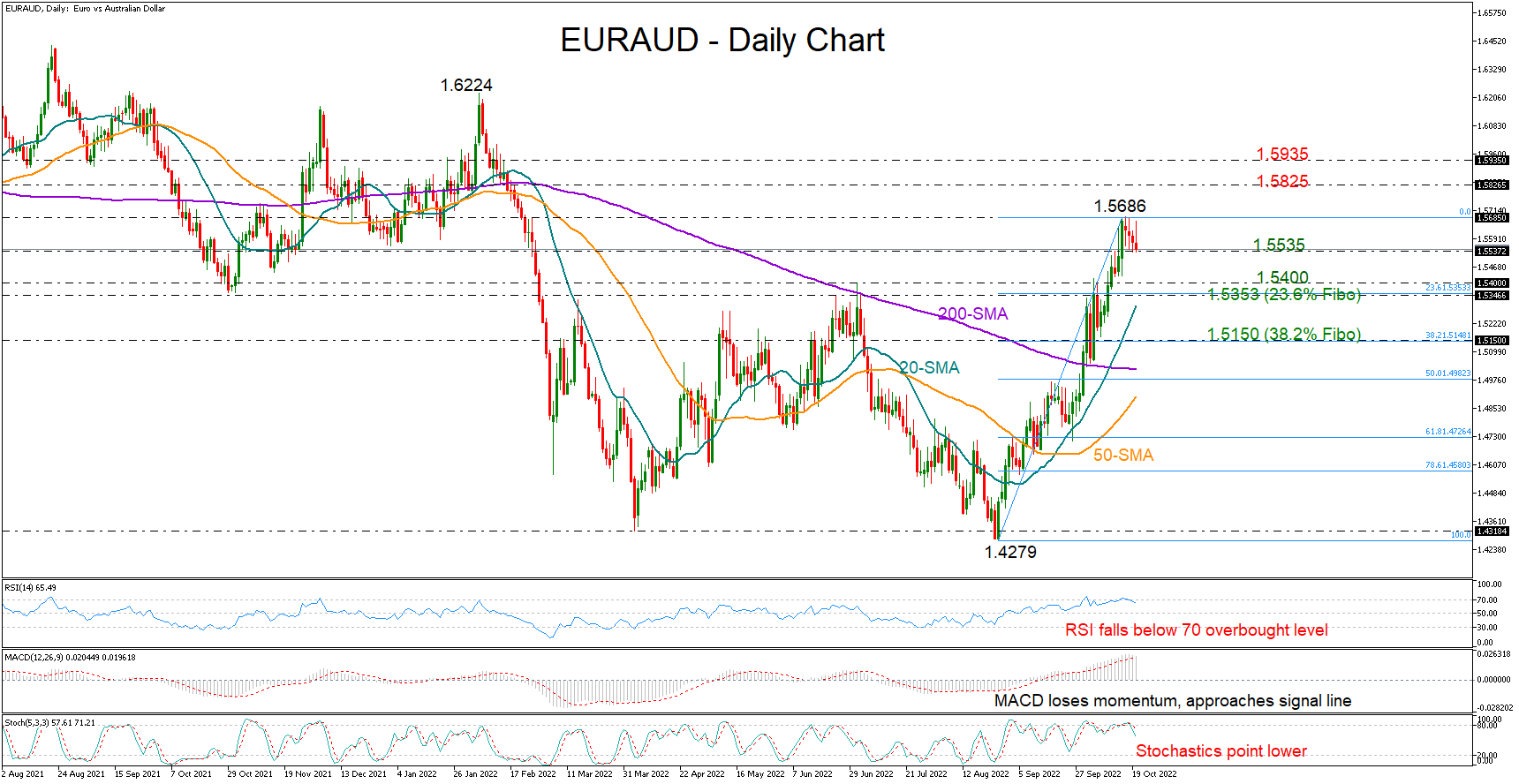
EURAUD took a soft bearish turn after its steep uptrend found strong resistance at an almost eight-month high of 1.5686.
Previously, the pair advanced above June’s high of 1.5396, adding more credence to the two-month-old bull run.
Yet, the technical oscillators currently warn that the ongoing bearish correction may get more legs before the focus shifts to the upside again. Particularly, with the RSI retreating below its 70 overbought mark and the stochastics shifting southwards, the bears may keep leading the market in the near term.
If the price slides below 1.5535, it could test the 1.5400-1.5355 area ahead of the 20-day simple moving average (SMA) around 1.5300. Failure to pivot here may intensify selling activities towards the 38.2% Fibonacci retracement of the 1.4279 -1.5686 upleg at 1.5150.
In the positive scenario, where the price recoups its recent losses and climbs above 1.5685, it could initially encounter the 1.5825 barrier and then challenge the 1.5935 handle.
Summarizing, EURAUD could extend its bearish corrective course in the short term, especially if the immediate 1.5535 constraining zone proves fragile.
EUR/USD Mid-Day Outlook
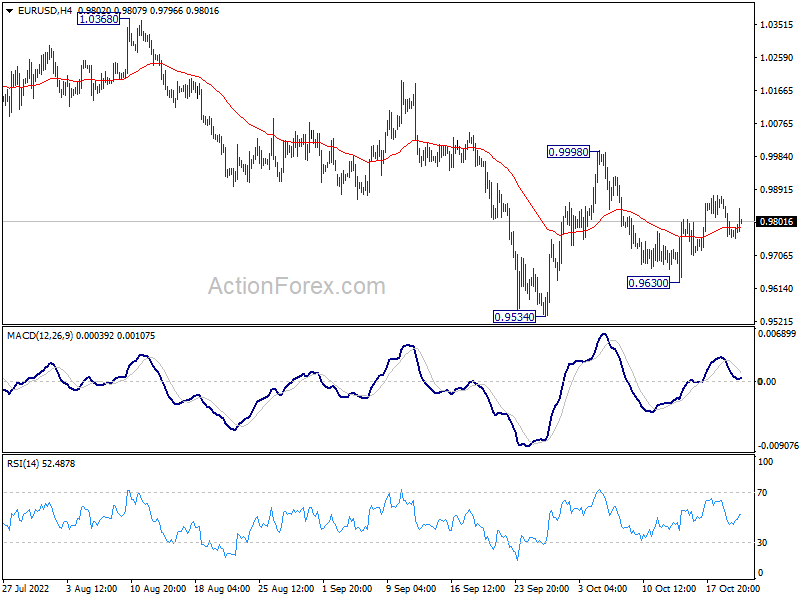
Daily Pivots: (S1) 0.9730; (P) 0.9801; (R1) 0.9844; More...
Intraday bias in EUR/USD stays neutral and outlook is unchanged. Deeper decline is expected with 0.9998 resistance intact. Below 0.9630 will bring retest of 0.9534 low first. Firm break there will resume larger down trend. However, break of 0.9998 will confirm short term bottoming and turn bias back the upside for stronger rebound.
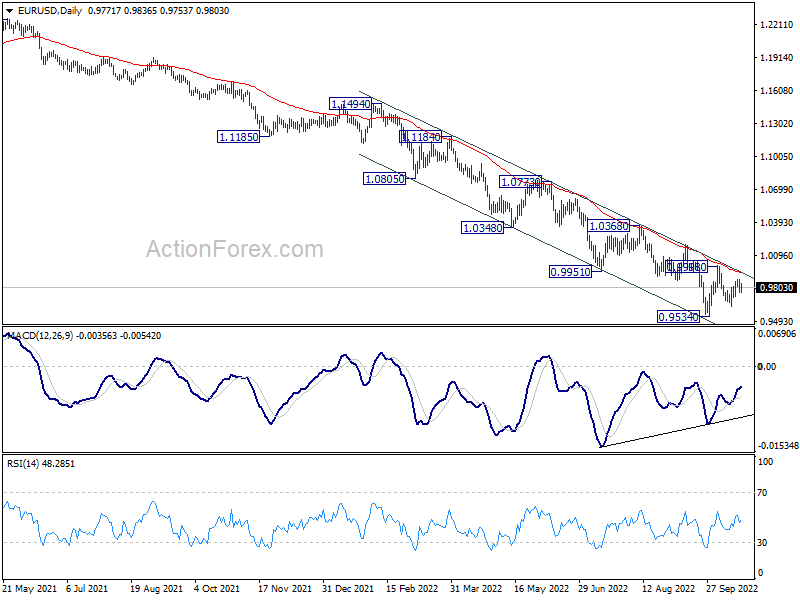
In the bigger picture, down trend from 1.6039 (2008 high) is still in progress. Next target is 100% projection of 1.3993 to 1.0339 from 1.2348 at 0.8694. In any case, break of 0.9998 resistance is needed to be the first sign of medium term bottoming. Otherwise, outlook will stay bearish even with strong rebound.
GBP/USD Mid-Day Outlook
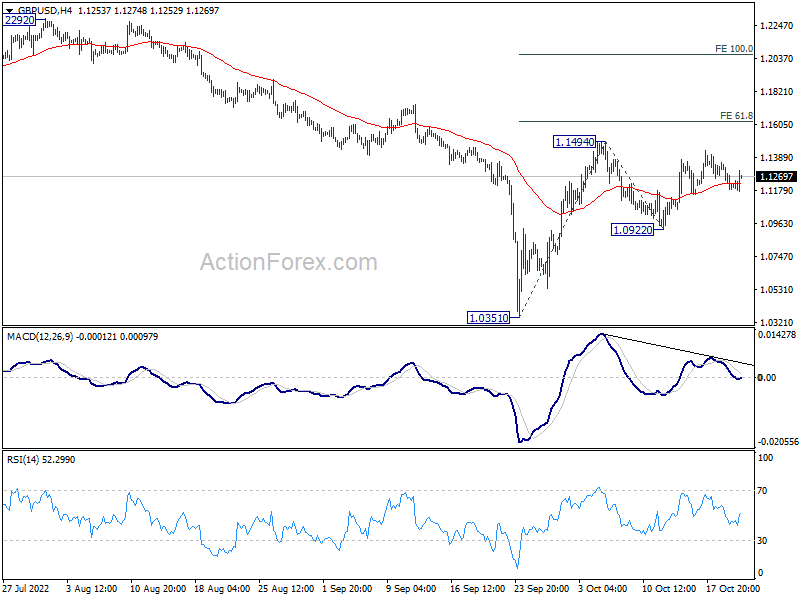
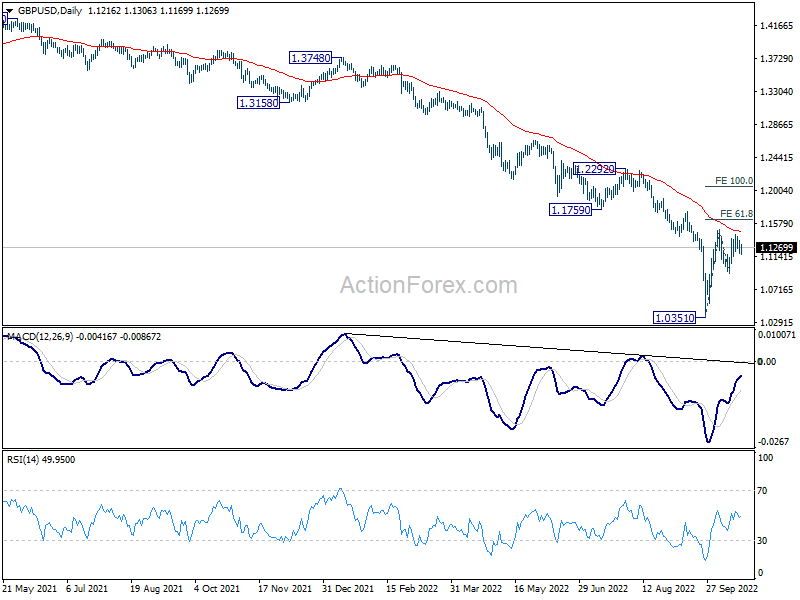
Daily Pivots: (S1) 1.1150; (P) 1.1254; (R1) 1.1322; More...
Range trading continues in GBP/USD and intraday bias remains neutral at this point. On the upside, break of 1.1494 will resume the rise from 1.0351 to 61.8% projection of 1.0351 to 1.1494 from 1.0922 at 1.1628. On the downside, below 1.0922 will turn bias back to the downside for 1.0351 low instead.
In the bigger picture, fall from 1.4248 (2018 high) is resuming long term down trend from 2.1161 (2007 high). Next target is 100% projection of 2.1161 to 1.3503 from 1.7190 at 0.9532. There is no scope of a medium term rebound as long as 1.1759 support turned resistance holds.
USD/CHF Mid-Day Outlook
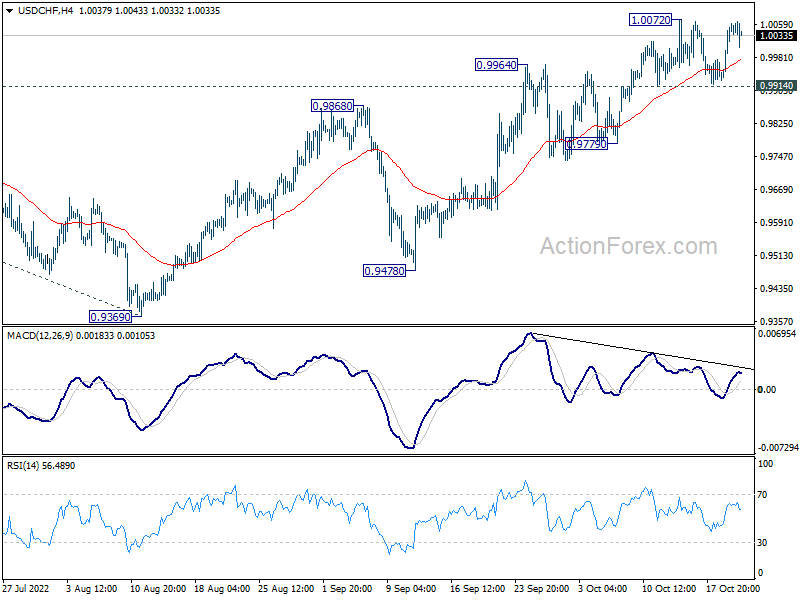
Daily Pivots: (S1) 0.9963; (P) 1.0013; (R1) 1.0097; More...
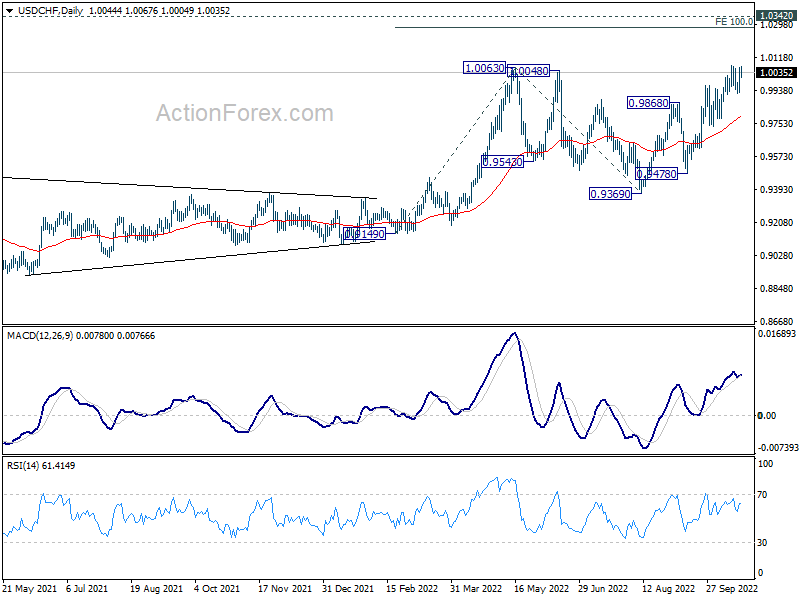
USD/CHF is staying in consolidation and intraday bas remains neutral. On the upside, break of 1.0072, and sustained trading above 1.0063, will confirm larger up trend resumption. Next target is 1.0283 projection level. However, break of 0.9914 support will indicate rejection by 1.0063, and turn bias back to the downside for 0.9779 support first.
In the bigger picture, current development suggests that up trend from 0.8756 (2021 low) is still in progress. Sustained break of 1.0063 will target 100% projection of 0.9149 to 1.0063 from 0.9369 at 1.0283, and then 1.0342 (2016 high). For now, this will remain the favored case as long as 0.9369 support holds, even in case of deep pull back.
USD/JPY Mid-Day Outlook
Daily Pivots: (S1) 149.38; (P) 149.64; (R1) 150.18; More...
Focus remains on USD/JPY's reaction to 150 psychological level, as Japan might intervene. Break of 148.11 support should confirm short term topping and turn bias back to the downside for deeper pull back. However, sustained break of 150 will extend larger up trend, and pave the way to 100% projection of 130.38 to 140.33 from 145.89 at 155.84 next.
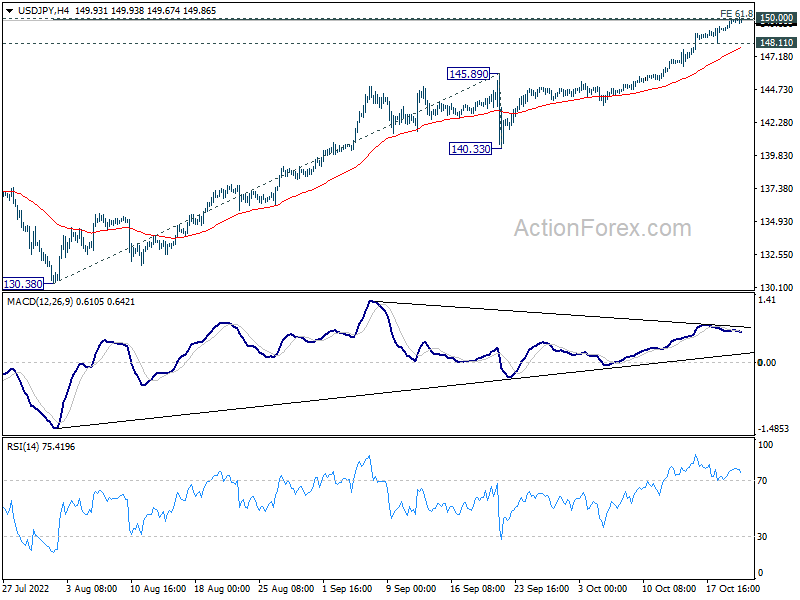
In the bigger picture, up trend from 101.18 is still in progress, as part of the whole up trend from 75.56 (2011 low). 147.68 (1998 high) was already met and there is not clearly sign of topping yet. In any case, break of 139.37 resistance turned support is needed to be the first sign of medium term topping. Otherwise, further rise is in favor to next target at 160.16 (1990 high).
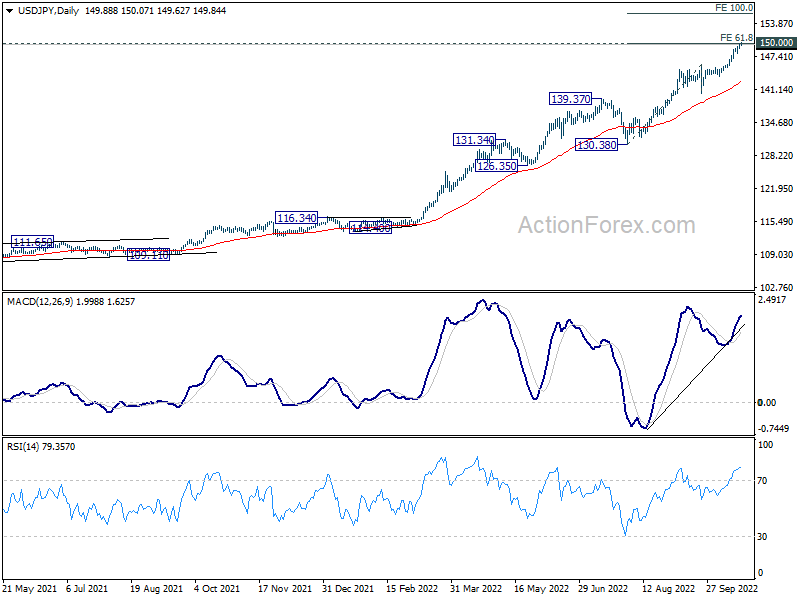
USD/JPY’s Battle for 150 Still On
Dollar softens slightly today after failing to have a decisive rally against Yen. Nevertheless, the battle for 150 is still on. Sterling is lifted slightly by news of UK Prime Minister Liz Truss's resignation, but there is no follow through buying. Commodity currencies are trading mildly higher as risk sentiment stabilized. Overall, there is no clear, committed direction entering into US session.
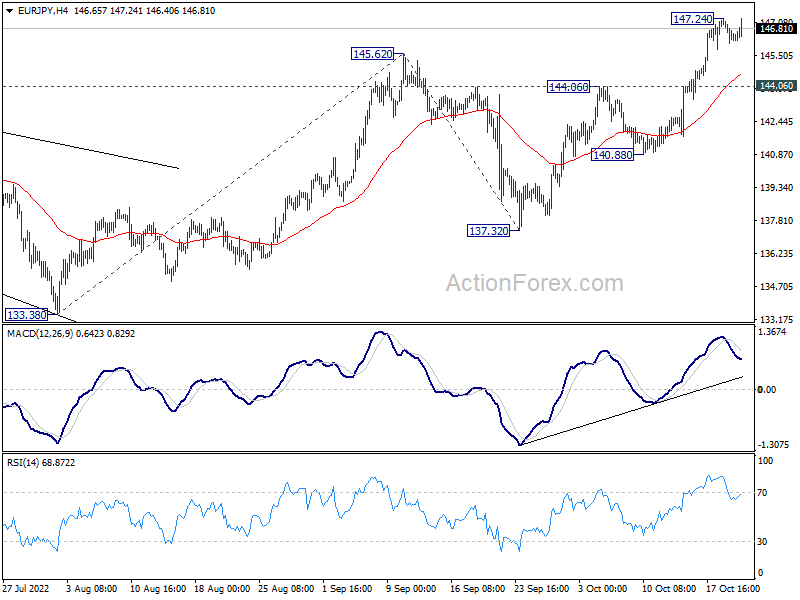
Technically, as USD/JPY is struggling around 150 for now, focus is back on 147.24 temporary top in EUR/JPY and 170.07 in GBP/JPY. Break of these levels will indicate completion of brief consolidation and recent up trends are ready to resume. That might give USD/JPY a hand on 150.
In Europe, at the time of writing, FTSE is down -0.01%. DAX is down -0.30%. CAC is up 0.32%. Germany 10-year yield is up 0.023 at 2.401. Earlier in Asia, Nikkei dropped -0.92%. Hong Kong HSI dropped -1.40%. China Shanghai SSE dropped -0.31%. Singapore Strait Times closed flat. Japan 10-year JGB yield dropped -0.0006 to 0.254.
US initial jobless claims dropped to 214k
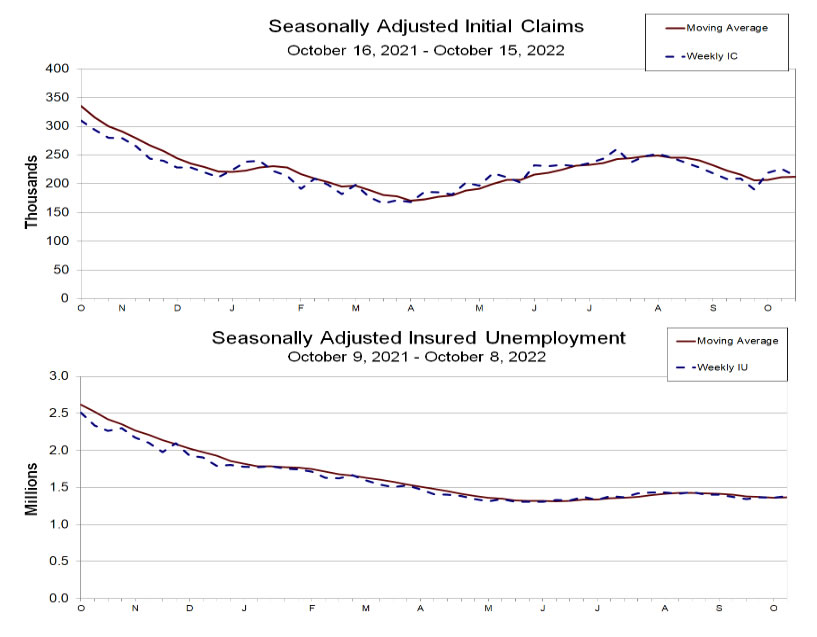
US initial jobless claims dropped -12k to 214k in the week ending October 15, lower than expectation of 235k. Four-week moving average of initial claims rose 1k to 212k.
Continuing claims rose 21k to 1385k in the week ending October 8. Four-week moving average of continuing claims rose 2k to 1365k.
Philly Fed manufacturing rose slightly from -9.9 to -8.7 in October, below expectation of -5.
BoE Broadbent: Energy price guarantee's inflationary effect outweighs limiting inflation
BoE Deputy Governor Ben Broadbent said in a speech that firstly, "for as long as it's in place, the government's Energy Price Guarantee has the effect of limiting headline inflation and, to that extent, any related strengthening of second-round (and more persistent) effects on domestic inflation."
Secondly, "by the same token, however, it mitigates the severity of the hit to household incomes and thereby supports domestic demand," he added. "As the Committee noted last month, this would – all else equal – add to inflation in the medium term."
"Compared with the forecast we had in August, the MPC has judged that the second effect is likely to outweigh the first," he said.
But Broadbent added, there is uncertainty about the "nature and duration" of the energy subsidies. "The MPC will take account of any fiscal news in the forthcoming Medium-Term Fiscal Plan, as well as any other news relevant for the medium-term inflation outlook, in its next set of forecasts," he said.
Australia employment grew 0.9k in Sep, unemployment rate unchanged at 3.5%
Australia employment rose 0.9k in September, below expectation of 25.0k. Full-time employment increased by 13.3k while part0time employment contracted -12.4k.
Unemployment rate was unchanged at 3.5%, matched expectations. Participation rate was unchanged at 66.6%. Monthly hours worked dropped -1m hours to 1853 hours.
"It is important to remember that the 1,000 employed people is a net figure – the difference between two large numbers. While employment growth has slowed in recent months, there are still close to half a million people entering employment each month, and around the same number leaving employment each month," Bjorn Jarvis, head of labour statistics at the ABS, said.
Japan exports rose 28.9% yoy in Sep, imports surged 45.2% yoy
Japan's exports rose 28.9% yoy to JPY 8189B in September. Exports to China grew 17.1% yoy while shipments to the US increased 45.2% yoy. Imports rose 45.9% yoy to JPY 10913B. However, the surge in import was unlikely a reflection of domestic demand, but sharp depreciation in Yen's exchanged rate. Trade deficit came in at JPY -2094B, down from August's record high of JPY -2817B
In seasonally adjusted term, exports rose 3.2% mom to JPY 8672B. Imports dropped -0.6% mom to JPY 10682B. Trade deficit narrowed to JPY -2010B, slightly smaller than expectation of JPY -2.06T.
USD/JPY Mid-Day Outlook
Daily Pivots: (S1) 149.38; (P) 149.64; (R1) 150.18; More...
Focus remains on USD/JPY's reaction to 150 psychological level, as Japan might intervene. Break of 148.11 support should confirm short term topping and turn bias back to the downside for deeper pull back. However, sustained break of 150 will extend larger up trend, and pave the way to 100% projection of 130.38 to 140.33 from 145.89 at 155.84 next.
In the bigger picture, up trend from 101.18 is still in progress, as part of the whole up trend from 75.56 (2011 low). 147.68 (1998 high) was already met and there is not clearly sign of topping yet. In any case, break of 139.37 resistance turned support is needed to be the first sign of medium term topping. Otherwise, further rise is in favor to next target at 160.16 (1990 high).
Economic Indicators Update
| GMT | Ccy | Events | Actual | Forecast | Previous | Revised |
|---|---|---|---|---|---|---|
| 23:50 | JPY | Trade Balance (JPY) Sep | -2.01T | -2.06T | -2.37T | -2.34T |
| 00:30 | AUD | NAB Business Confidence Q3 | 9 | 5 | ||
| 00:30 | AUD | Employment Change Sep | 0.9K | 25.0K | 33.5K | 36.3K |
| 00:30 | AUD | Unemployment Rate Sep | 3.50% | 3.50% | 3.50% | |
| 06:00 | CHF | Trade Balance (CHF) Sep | 4.00B | 4.23B | 3.42B | 3.32B |
| 06:00 | EUR | Germany PPI M/M Sep | 2.30% | 1.30% | 7.90% | |
| 06:00 | EUR | Germany PPI Y/Y Sep | 45.80% | 44.00% | 45.80% | |
| 08:00 | EUR | Eurozone Current Account (EUR) Aug | -26.3B | -20.3B | -19.9B | |
| 12:30 | USD | Initial Jobless Claims (Oct 14) | 214K | 235K | 228K | 226K |
| 12:30 | USD | Philadelphia Fed Manufacturing Oct | -8.7 | -5 | -9.9 | |
| 14:00 | USD | Existing Home Sales Sep | 4.69M | 4.80M | ||
| 14:30 | USD | Natural Gas Storage | -173.5B | 125B |
US initial jobless claims dropped to 214k
US initial jobless claims dropped -12k to 214k in the week ending October 15, lower than expectation of 235k. Four-week moving average of initial claims rose 1k to 212k.
Continuing claims rose 21k to 1385k in the week ending October 8. Four-week moving average of continuing claims rose 2k to 1365k.
Canadian Retail Sales and Future of Commodity Currencies
As fears of a recession start to settle in, commodity currencies have been on the backfoot despite offering comparably better real rates. Canada has been a particular example of this phenomenon, with its dollar weakening despite a more aggressive rate hiking path than the Fed. The most recent survey of businesses showed further deterioration in optimism, with the majority expecting and preparing for a recession in the coming quarters.
Industrial production prices and in particular raw material prices have been declining, a sign that inflation might be on the way down. At least, some time in the future. The most recent CPI unexpected increased, and the annual rate was above expectations. Nevertheless, the consensus among economists is that the BOC will be looking to slow down its rate hikes.
There is a generalized problem
The shift in expectations from the BOC comes fast on the heels of a similar shift in another commodity Commonwealth country: Australia. The RBA's softening move at the last meeting caught investors by surprise, and they seem determined to not be surprised by the BOC this time.
Investors are concerned about rising interest rates causing tightness in money markets, as market makers are unwilling to borrow in order to finance investments in falling stock markets. This is forcing central banks, particularly in commodity currencies, to reevaluate their stance on tightening.
Prices are slipping
Australia's exports have remained steady all year, but the price of commodities have been coming down. Canada is experiencing a similar situation, with the US buying as much crude as possible to make up for Russia being excluded from the market. But, despite OPEC+ cutting production targets a couple of weeks ago, crude prices have been falling.
With less remittances to Canada to pay for exports, the Canadian dollar is less attractive when compared to its neighbor's currency. Add to that the possibility the BOC might be pulling back on the tightening, there is reason to expect that the loonie will be weaker going forward.
Making things difficult
The problem is that a weaker currency means that imported products become more expensive and increase inflationary pressures. This is particularly relevant for countries like Canada and Australia, because they don't have the economies of scale to domestically produce a significant amount of consumer goods. It's even more relevant for smaller countries, such as New Zealand.
Higher inflation coupled with increased borrowing costs would be expected to undermine consumers, which would put the economy more at risk, further weakening the currency. Commodity currency traders, therefore, would do well to be particularly interested in retail sales figures from their respective countries.
Canada reports September retail sales tomorrow which are expected to drop to 6.5% growth compared to 8.0% prior. Reminder, Canada's annualized inflation in that period was 6.9%.
BoE Broadbent: Energy price guarantee’s inflationary effect outweighs limiting inflation
BoE Deputy Governor Ben Broadbent said in a speech that firstly, "for as long as it's in place, the government's Energy Price Guarantee has the effect of limiting headline inflation and, to that extent, any related strengthening of second-round (and more persistent) effects on domestic inflation."
Secondly, "by the same token, however, it mitigates the severity of the hit to household incomes and thereby supports domestic demand," he added. "As the Committee noted last month, this would – all else equal – add to inflation in the medium term."
"Compared with the forecast we had in August, the MPC has judged that the second effect is likely to outweigh the first," he said.
But Broadbent added, there is uncertainty about the "nature and duration" of the energy subsidies. "The MPC will take account of any fiscal news in the forthcoming Medium-Term Fiscal Plan, as well as any other news relevant for the medium-term inflation outlook, in its next set of forecasts," he said.