Sample Category Title
Sterling in Free Fall on Mini-Budget
Sterling is in free fall today as markets reacted negatively to the "mini-budget" of the new government. Selloff came after Finance Minister Kwasi Kwarteng announced to cancel and planned rise in corporation tax, reverse a recent rise in income tax, and cut taxes for businesses in designated investment zones. Swiss Franc is currently the biggest winner for the day, followed by Dollar.
In Europe, at the time of writing, FTSE is down -1.84%. DAX is down -1.47%. CAC is down -1.61%. Germany 10-year yield is up 0.0182 at 1.986. Earlier in Asia, Hong Kong HSI dropped -1.18%. China Shanghai SSE dropped -0.66%. Singapore Strait Times dropped -1.10%. Japan was on holiday.
Canada retail sales down -2.5% mom in Jul
Canada retail sales dropped -2.5% mom to CAD 61.3B in July, worse than expectation of -2.0% mom. That's also the first decline in seven months. Sales were down in 9 of 11 subsectors, representing 94.5% of retail trade. The contraction was driven by lower sales at gasoline stations and clothing and clothing accessories stores. Excluding gasoline, and motor vehicle and parts, sales dropped -0.9%.
Based on advance estimate, sales recovered by rising 0.4% mom in August.
Eurozone PMI composite dropped to 48.2, recession on the cards
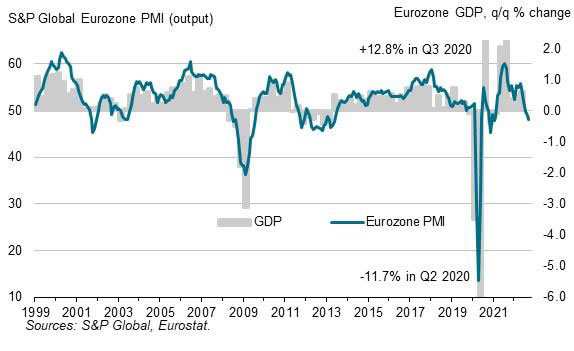
Eurozone PMI manufacturing dropped from 49.6 to 48.5 in September, a 27-month low. PMI services dropped form 49.8 to 48.9, a 19-month low. PMI composite dropped from 48.9 to 48.2, a 20-month low.
Chris Williamson, Chief Business Economist at S&P Global Market Intelligence said: "A eurozone recession is on the cards as companies report worsening business conditions and intensifying price pressures linked to soaring energy costs.
"The early PMI readings indicate an economic contraction of 0.1% in the third quarter, with the rate of decline having accelerated through the three months to September to signal the worst economic performance since 2013, excluding pandemic lockdown months."
Germany PMI Manufacturing dropped from 48.3 to 49.1 in September, a 27-month low. PMI Services dropped from 47.7 to 45.4, a 28-month low. PMI Composite dropped from 46.9 to 45.9, a 28-month low.
France PMI Manufacturing dropped from 50.6 to 47.8 in August, a 28-month low. PMI Services improved from 51.2 to 53.0. Overall, PMI Composite rose from 50.4 to 51.2.
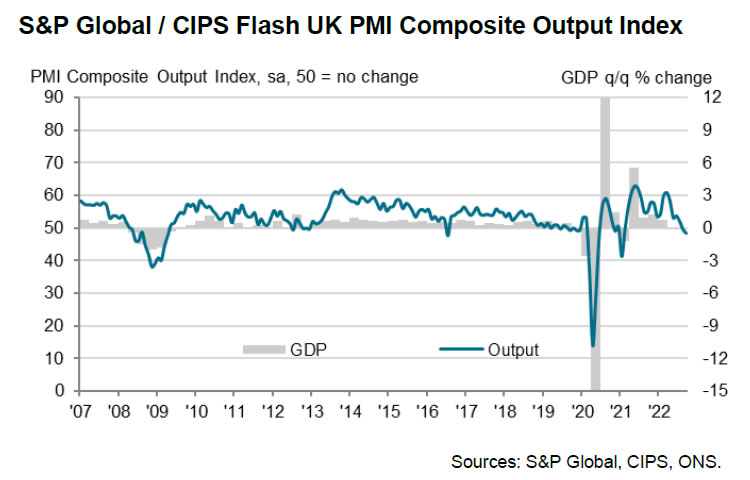
UK PMI composite dropped to 48.4, economic woes deepened
UK PMI manufacturing improved from 47.3 to 48.5 in September. But PMI services dropped from 50.9 to 49.2, a 20-month low. PMI Composite dropped from 49.6 to 48.4, a 20-month low.
Chris Williamson, Chief Business Economist at S&P Global Market Intelligence said:
"UK economic woes deepened in September as falling business activity indicates that the economy is likely in recession. Companies report that the rising cost of living, linked to the energy crisis, and growing concerns about the outlook are subduing demand and hitting output levels to an extent not seen since 2009, barring the pandemic lockdowns and initial 2016 Brexit referendum shock.
"Forward-looking indicators meanwhile deteriorated further in September. Both the new orders and future expectations gauges have descended to levels which have rarely been weaker in the past, and are consistent with a deepening downturn as we head into the fourth quarter.
"Inflationary pressures continue to run higher than at any time in over two decades of survey history prior to the pandemic. Renewed supply constraints, soaring energy prices and rising import costs associated with the weakened pound are adding to cost pressures, meaning the overall rate of inflation signalled will remain of great concern to policymakers at the Bank of England. However, the detrimental impact of tightening policy into a recession is becoming increasingly apparent, with the downturn likely to intensify as we head into winter."
UK Gfk consumer confidence dropped to new record low at -49
UK Gfk consumer confidence dropped further from -44 to -49 in September, hitting another record low since 1974. Personal financial situation over next 12 months dropped -9 pts to -40. General economic situation over next 12 months dropped -8 pts to -68. Major purchase index was unchanged at -38.
"Consumers are buckling under the pressure of the UK's growing cost-of-living crisis driven by rapidly rising food prices, domestic fuel bills and mortgage payments. They are asking themselves when and how the situation will improve." Joe Staton, client strategy director at GfK, said.
Australia PMI composite edged up to 50.8, at risk of heading into contraction territory
Australia PMI Manufacturing ticked up from 53.8 to 53.9 in September. PI Services also rose slightly from 50.2 to 50.4. PMI Composite Output rose from 50.2 to 50.8.
Laura Denman, Economist at S&P Global Market Intelligence said: "September data indicated that the recent interest rate hikes made by the RBA have begun to have the desired effect in terms of prices.... At the same time, the private sector has remained in expansion territory with the pace of growth even accelerating very slightly...
"On the negative side, the full effects of recent interest rate hikes will be lagged... Should the RBA continue to increase the base rate further, the private sector economy may be at risk of heading into contraction territory in the future as disposable incomes across the nation tighten and overall demand conditions remain subdued."
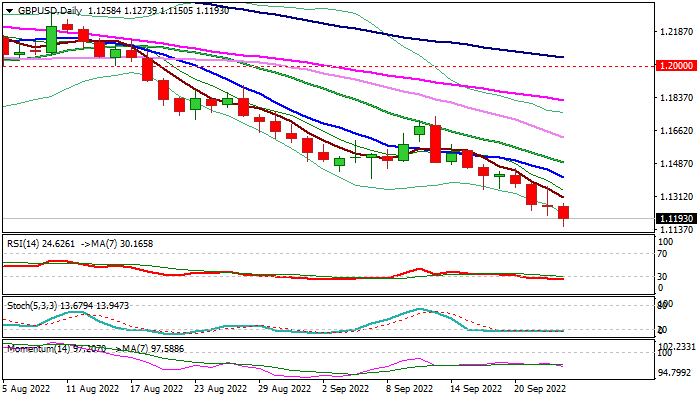
GBP/USD Mid-Day Outlook
Daily Pivots: (S1) 1.1190; (P) 1.1277; (R1) 1.1342; More...
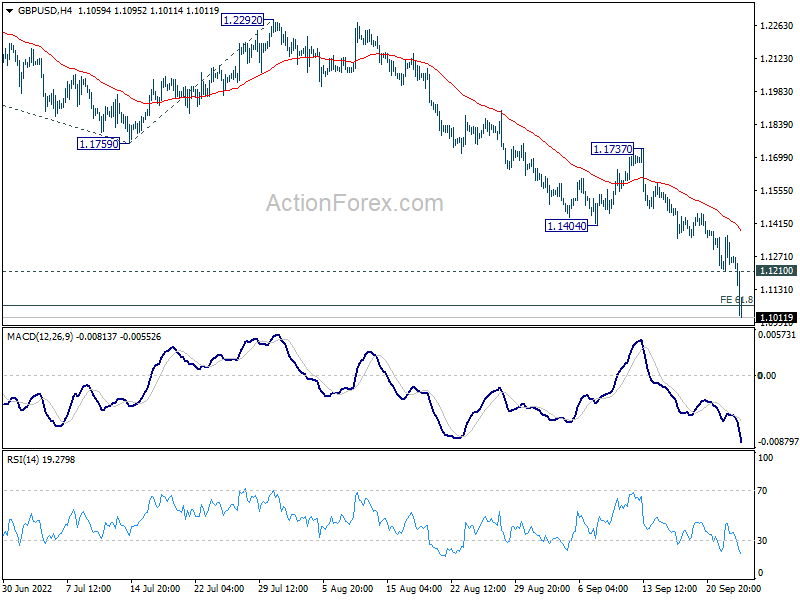
GBP/USD dives to as low as 1.1019 so far, meeting 61.8% projection of 1.3748 to 1.1759 from 1.2292 at 1.1063. there is no sign of bottoming yet. Intraday bias stays on the downside for 100% projection at 1.0303. On the upside, above 1.1210 minor resistance will turn intraday bias neutral and bring consolidations first, before staging another decline.
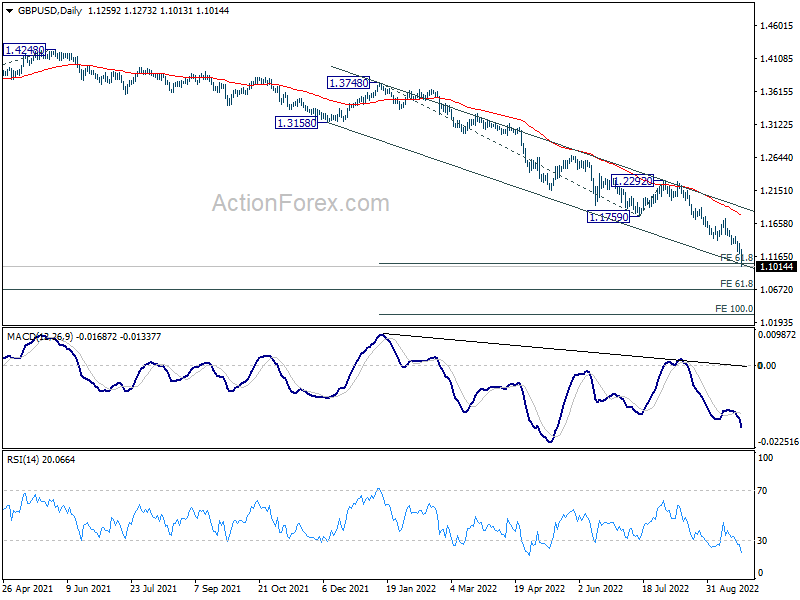
In the bigger picture, based on current momentum, fall from 1.4248 (2018 high) is probably resuming long term down trend from 2.1161 (2007 high). Sustained break of 1.1409 will target 61.8% projection of 1.7190 (2014 high) to 1.1409 (2020 low) from 1.4248 (2021 high) at 1.0675. This will remain the favored case for now as long as 1.2292 resistance holds.
Economic Indicators Update
| GMT | Ccy | Events | Actual | Forecast | Previous | Revised |
|---|---|---|---|---|---|---|
| 23:00 | AUD | Manufacturing PMI Sep P | 53.9 | 53.8 | ||
| 23:00 | AUD | Services PMI Sep P | 50.4 | 50.2 | ||
| 23:01 | GBP | GfK Consumer Confidence Sep | -49 | -42 | -44 | |
| 07:15 | EUR | France Manufacturing PMI Sep P | 47.8 | 49.9 | 50.6 | |
| 07:15 | EUR | France Services PMI Sep P | 53 | 50.4 | 51.2 | |
| 07:30 | EUR | Germany Manufacturing PMI Sep P | 48.3 | 48.3 | 49.1 | |
| 07:30 | EUR | Germany Services PMI Sep P | 45.4 | 47.2 | 47.7 | |
| 08:00 | EUR | Eurozone Manufacturing PMI Sep P | 48.5 | 48.8 | 49.6 | |
| 08:00 | EUR | Eurozone Services PMI Sep P | 48.9 | 49.1 | 49.8 | |
| 08:30 | GBP | Manufacturing PMI Sep P | 48.5 | 47.4 | 47.3 | |
| 08:30 | GBP | Services PMI Sep P | 49.2 | 50 | 50.9 | |
| 12:30 | CAD | Retail Sales M/M Jul | -2.50% | -2.00% | 1.10% | 0.60% |
| 12:30 | CAD | Retail Sales ex Autos M/M Jul | -3.10% | -1.00% | 0.80% | 0.60% |
| 13:45 | USD | Manufacturing PMI Sep P | 51.8 | 51.2 | 51.5 | |
| 13:45 | USD | Services PMI Sep P | 49.2 | 45 | 43.7 |
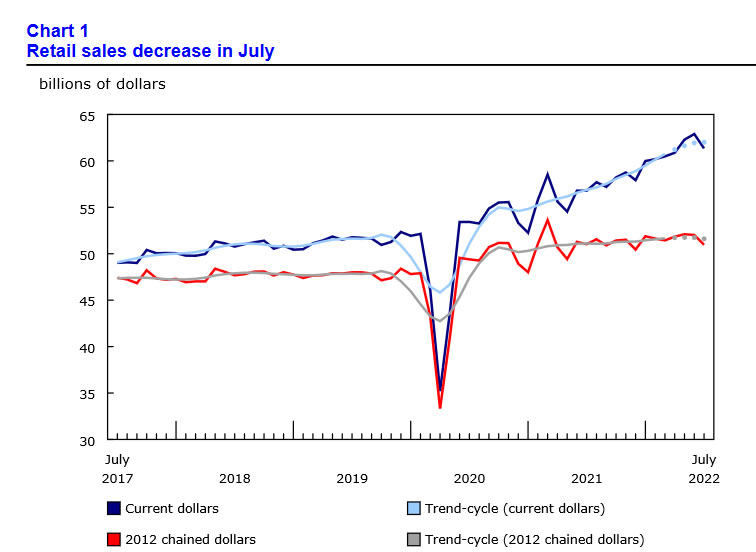
Canada retail sales down -2.5% mom in Jul
Canada retail sales dropped -2.5% mom to CAD 61.3B in July, worse than expectation of -2.0% mom. That's also the first decline in seven months. Sales were down in 9 of 11 subsectors, representing 94.5% of retail trade. The contraction was driven by lower sales at gasoline stations and clothing and clothing accessories stores. Excluding gasoline, and motor vehicle and parts, sales dropped -0.9%.
Based on advance estimate, sales recovered by rising 0.4% mom in August.
The Dollar is Creeping Up
The dollar is developing its FX offensive, leaving it at highs against a basket of the six major currencies. The main driver of this rise remains the monetary policy differential, where the US has had the most hawkish stance amongst the major central banks for over a year.
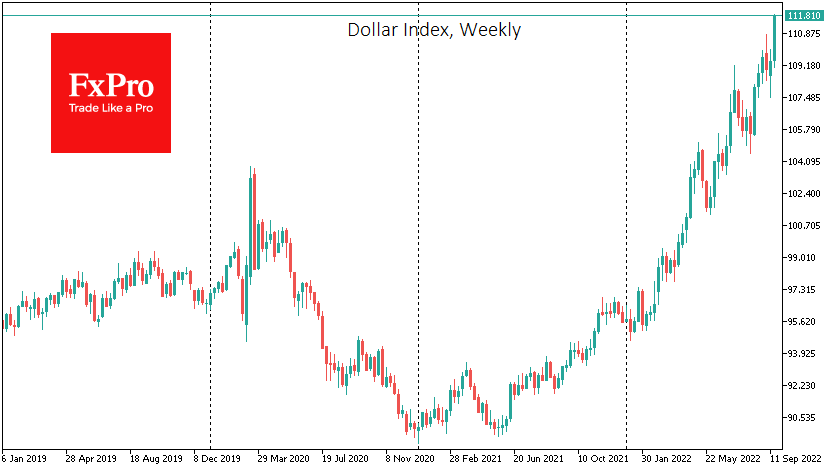
The Fed has raised the rate three times in three months by 75 points. Fed members’ expected rate path suggests one more 75-point hike in November, another 50 in December and 25 next February.
A couple of months ago, short-term investors were speculating about the point at which the Fed would slow the hike and when it would move to lower it. The sentiment is now shifting towards when other central banks will catch up with the flagship central bank. However, not everyone can do that.
On Thursday, the Bank of England and the Swiss National Bank raised their rates by 50 points. Several other smaller European central banks took earlier similar steps. Japan is not in a position to tighten its policy.
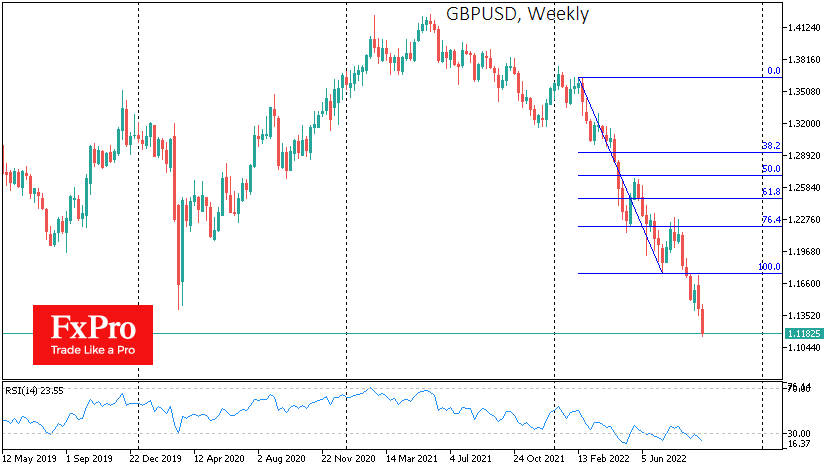
The reaction on the markets is eloquently showing that this is not enough. The Swiss franc and Japanese yen were sharply lower on Thursday after their central bank meetings. GBPUSD held up most of the day on Thursday but returned to rewrite lows from 1985 on Friday, hitting 1.1160. The BoJ’s first currency intervention in 24 years halted the yen’s gaining momentum yesterday.
The Chinese renminbi is also involved in massive selling against the American currency. The USDCNH offshore rate surpassed 7.11 on Friday morning, surviving an unprecedented 6% rally in just over a month. The pair had reversed down from 7.20 in 2019 and 2020, with the People’s Bank of China’s help, but the renminbi risks losing this final 1.2% from now without much resistance.
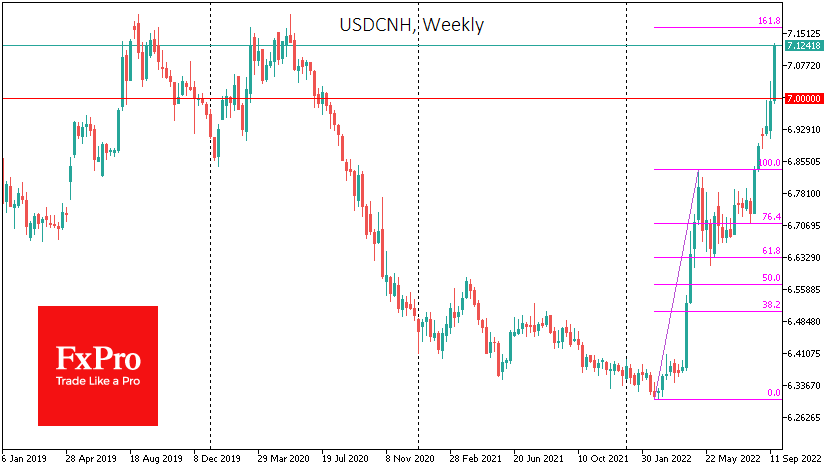
Despite more than 20-year highs for the dollar, it is hardly prudent to bet on a trend reversal as there are fundamental reasons behind this rally, which are unlikely to change today or tomorrow. It now seems more reasonable to expect the dollar rally to lose strength when the Fed slows the pace of rate hikes and stops announcing increasingly hawkish rate forecasts.
The technical view of market dynamics also does not give any hope of a reversal. We are seeing very orderly selloffs of the major currencies, whereas abnormally sharp moves and capitulations often characterize the end of the cycle. Perhaps the major currency pairs have not yet reached an inflexion point.
Euro Slides on Soft PMIs
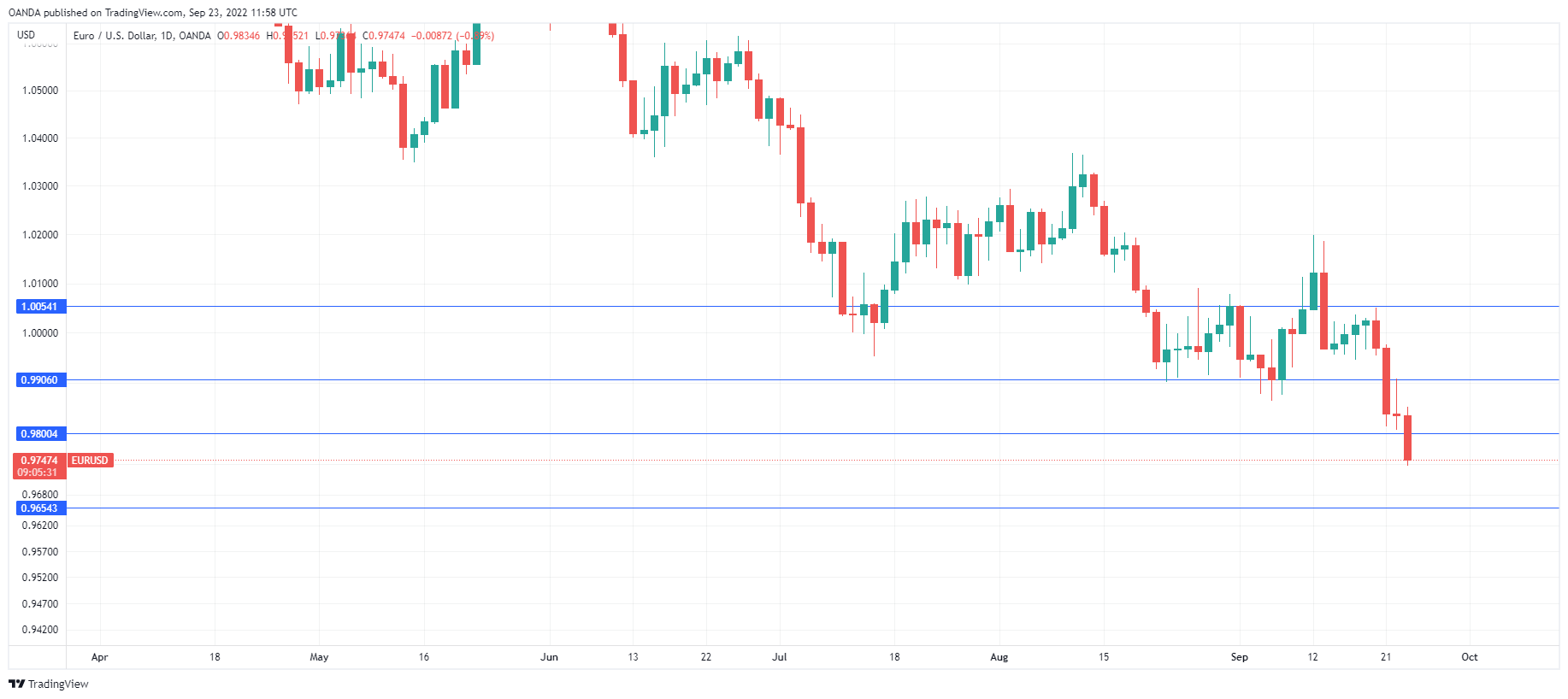
The euro is down sharply today, as the US dollar continues to post gains against the major currencies. In the European session, EUR/USD is trading at 0.9746, down 0.90%. It has been a dreadful week for the euro, which has declined by 2.6% and continues to set new 20-year lows.
German, eurozone PMIs continue to decline
The eurozone economy is in deep trouble, and today’s PMI releases only confirmed that grim fact. German Services and Manufacturing PMIs, already in contraction territory (below 50.0), fell even lower in August, with readings of 48.3 and 45.4, respectively. It was a similar story for eurozone PMIs, which also slowed in August. The one exception was the French Services PMI, which surprised with a reading of 53.0. Predictably, the euro has taken a tumble today and I expect the currency to remain under pressure come Monday.
The euro is also taking it on the chin as risk sentiment has eroded. Ukraine continues to press its counter-offensive, but an unpredictable Russian President Putin has escalated the conflict to a dangerous level. The regions occupied by Russia are currently holding a referendum about joining Russia, and the vote is clearly a sham. The danger is that Putin has said he will take all measures to defend “Russian territory” and has hinted at using nuclear weapons. This has drawn sharp condemnation from the West and shaken risk appetite. Meanwhile, the energy crisis in Europe is getting worse – the Nord Stream 1 pipeline has been out of service for several weeks, and the surge in energy prices in Europe, even before winter has arrived, could cause the bloc to fall into a recession. Given this economic landscape, the outlook for the euro is dim indeed.
EUR/USD Technical
- EUR/USD is testing support at 0.9800. Next, there is support at 0.9654
- There is resistance at 0.9907 and 1.0053
GBP/USD: Sterling Falls to New Multi-year Low after Disappointing Data
Cable accelerates below 1.12 mark on Friday and hit new lowest since 1985, in extension of steep bear-leg from 1.1738 (Sep 13 lower top), which is a part of larger downtrend from 1.4249 (June 2021 peak.
The action in Asian and early European trading has registered a fall of 0.8%, as the pair is on track for a second straight significant weekly loss (over 2% so far).
Persisting safe haven flows on fears of escalation geopolitical situation, weakening economy and signals that the Fed will remain aggressive regarding its monetary policy, continue to deflate pound.
The latest economic data from UK, further weakened the sentiment as services PMI fell below 50 threshold in September (49.2 vs 50.9 in Aug) with Sep figure being the lowest since January 2021, while manufacturing sector performed better than expected in September (48.5 vs 47.3 f/c) but stays in the territory that points to contraction.
Weak fundamentals complement to bearish technical studies, signaling further weakness, with psychological 1.10 support being in focus, with risk of acceleration towards Feb 1985 low at 1.0520.
Meanwhile, bears may take a breather on oversold conditions on daily and weekly chart, with upticks to be capped under strong barrier at 1.1410 (falling 10DMA / Mar 2020 low) to offer better selling opportunities.
Res: 1.1273; 1.1305; 1.1364; 1.1410.
Sup: 1.1150; 1.1100; 1.1072; 1.1000.
CAD Extends Losses, Retail Sales Next
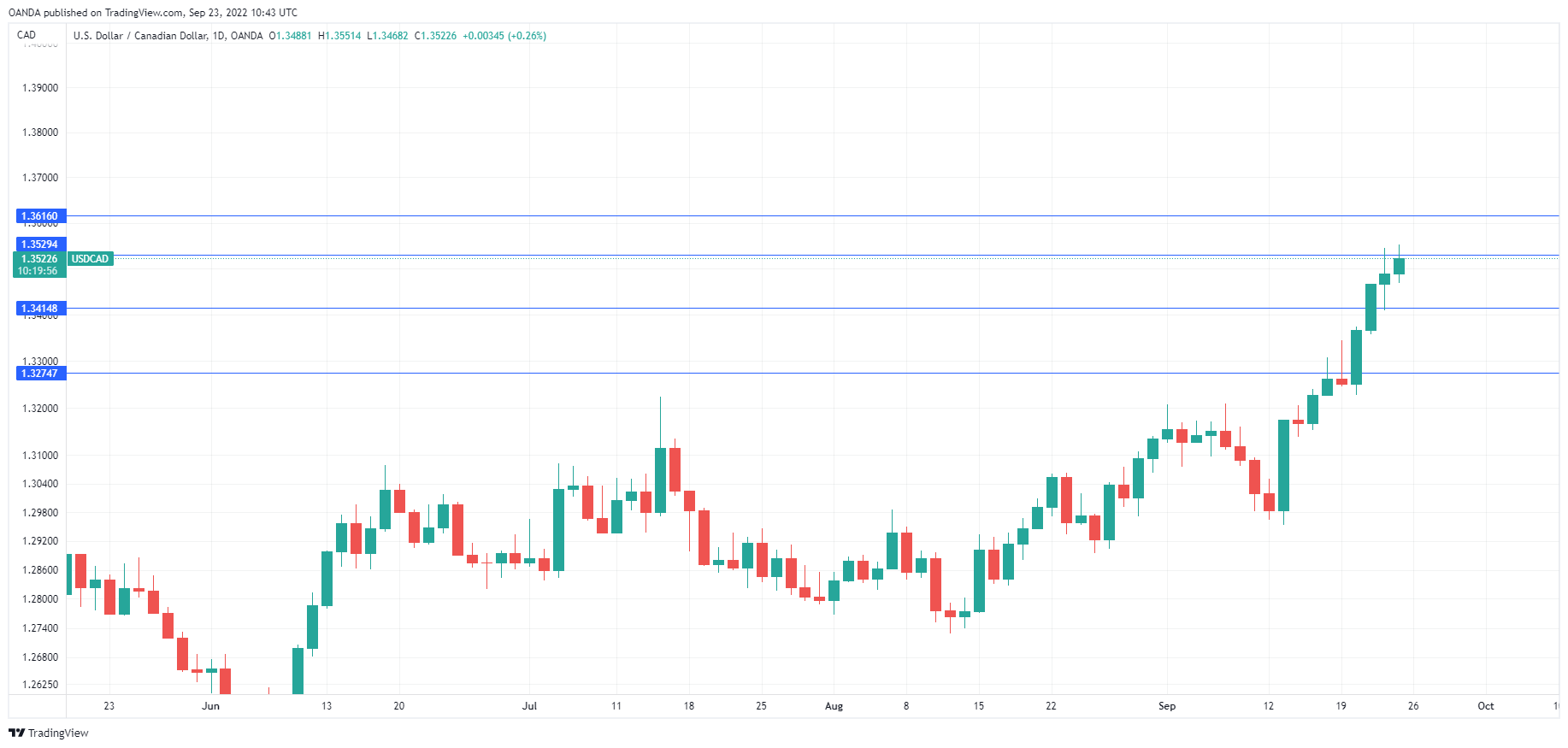
The Canadian dollar is in negative territory for a fourth straight day. In the European session, USD/CAD is trading at 1.3522, up 0.24% on the day.
The US dollar continues to shine, particularly against risk-sensitive currencies such as the Canadian dollar. USD/CAD has jumped 1.9% this week and the Canadian dollar has fallen to lows last seen in July 2020. Risk sentiment has eroded due to the escalation in the Ukraine war. The regions occupied by Russia are holding a referendum to join Russia, and no one has any doubt about the results. Russian President Putin has hinted that he could resort to nuclear weapons to defend “Russian territory” and he has also ordered a partial mobilization, as Ukraine presses on with an impressive counter-offensive. The energy crisis in Europe continues to brew – the Nordstream 1 pipeline has been out of service for several weeks, and Western European countries could face energy shortages, with winter only a few months away.
Markets brace for soft retail sales
Canada releases the July retail sales report later today. The markets are braced for a sharp downturn in consumer spending. The headline reading is expected at -2.0%, following a gain of 1.1% in June. Core retail sales is expected to fall by 1.8%, after a 0.8% gain in June. A sharp downturn could sour investors on Canada’s economic outlook and extend the Canadian dollar’s losses.
Canada’s headline and core inflation indicators fell in August and were lower than expected. It’s still early to declare that inflation has peaked, but the BoC can declare a job well done if inflation is indeed falling. The BoC has been aggressive, delivering a 75bp increase earlier this month and bringing the benchmark to 3.25%. The markets have priced in a 50bp at the October meeting, followed by a modest 25bp hike in December. That would lift rates to an even 4.00%, which would be the highest since 2008, during the GFC.
USD/CAD Technical
- USD is testing resistance at 1.3529. The next resistance line is 1.3615
- There is support at 1.3414 and 1.3274
GBP/USD Can’t Find its Footing
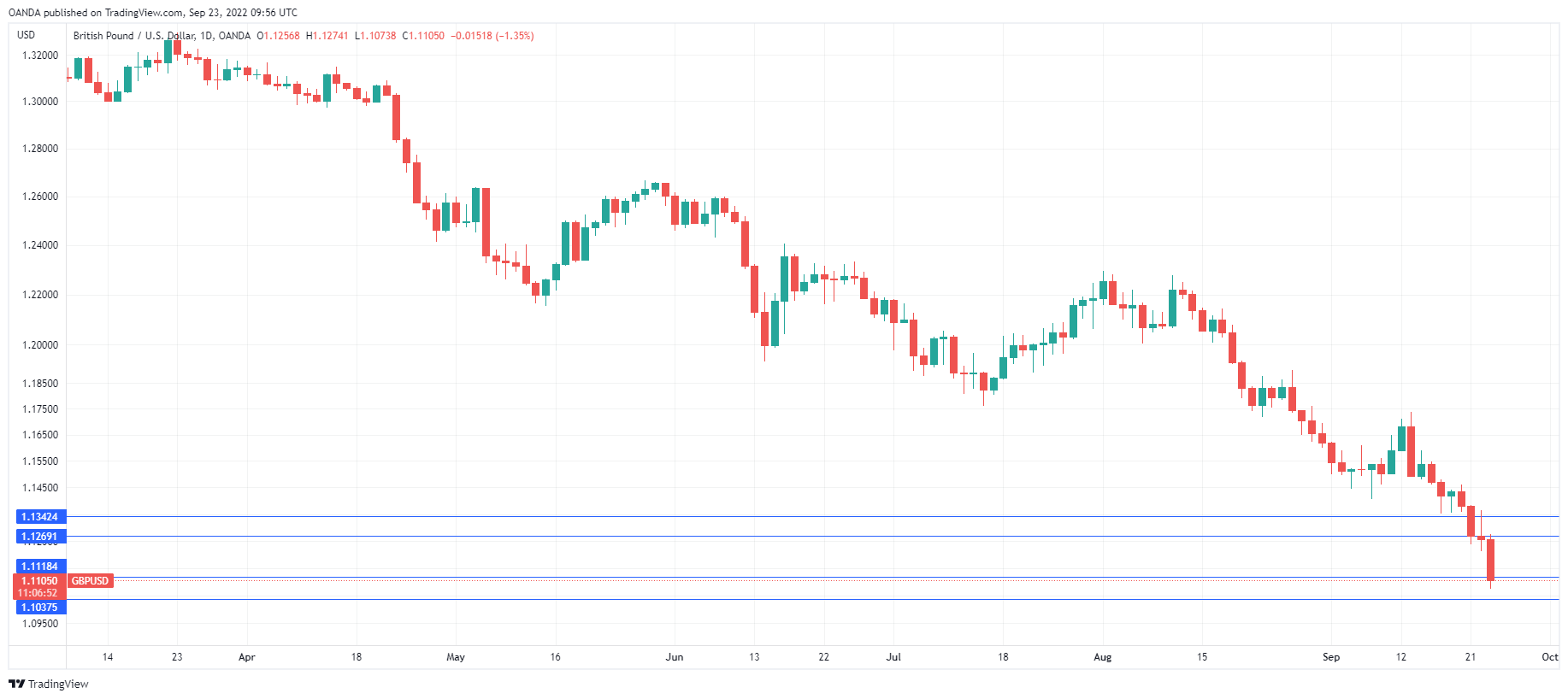
GBP/USD is down sharply today and has fallen below the 1.11 level for the first time since 1985. In the European session, GBP/USD is trading at 1.1125, down 1.16%.
The British pound can’t seem to find any love. GBP/USD is looking dreadful, down 2.1% this week and 3.8% in September. The currency hasn’t sunk to such levels since 1985 and the strong US dollar could extend the pound’s current downtrend.
The markets are focused on today’s mini-budget and UK releases. In the mini-budget, Chancellor Kwasi Kwarteng announced tax cuts and more spending. With no funding for the tax cuts and increased borrowing, gilt yields have jumped, but that has failed to boost the pound.
UK posts soft consumer confidence, PMIs
UK releases reiterated that the economy is in trouble, for anyone who needed reminding. GfK Consumer Confidence, which has been in a deep freeze, fell to -49, down from -44 and missing the forecast of -42 points. Manufacturing PMI rose to 48.5, up from 47.3 and above the estimate of 47.5, but remained in contraction territory for a second straight month. Services PMI slowed to 49.2, down from 50.9 and shy of the estimate of 50.0. With both manufacturing and services in decline, the outlook for the UK economy remains grim.
The Bank of England raised rates by 0.50% on Thursday. The pound did post some gains but couldn’t hold on and closed the day almost unchanged. The move brings the cash rate to 2.25%, its highest since 2008. Still, it’s fair to say that the 0.50% underwhelmed the markets, as there were some expectations for a more forceful hike of 0.75%. The BoE has been playing catch-up with inflation, which is running at 9.9% clip. The new Truss government has taken dramatic action to cap energy bills, which should help to curb soaring inflation. With the economy posting two consecutive quarters of negative growth and inflation still not under control, a recession appears unavoidable, which will likely add to the British pound’s misery.
GBP/USD Technical
- GBP/USD is testing support at 1.1117. Below, there is support at 1.1038
- There is resistance at 1.1269 and 1.1342
Yen Settles Down after Wild Ride
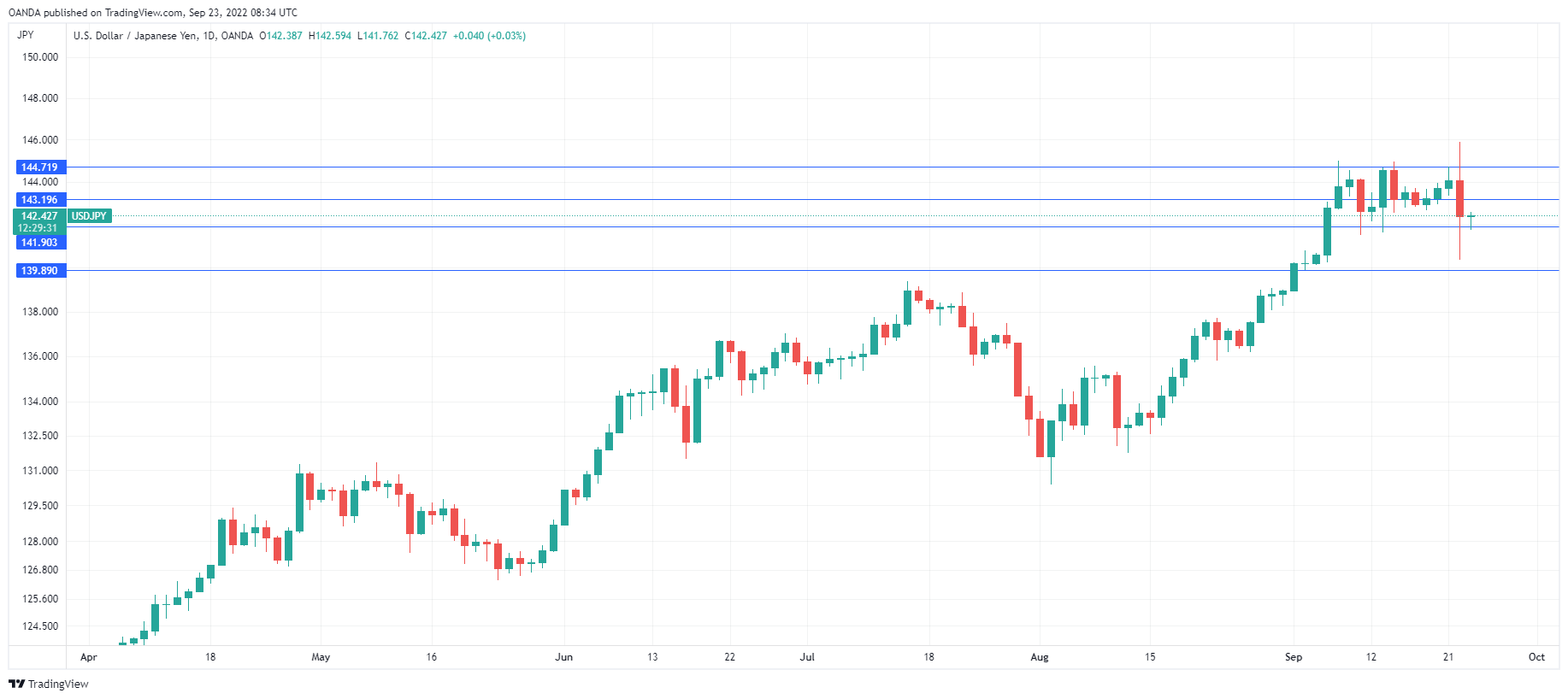
It was certainly a day to remember for the Japanese yen on Thursday. USD/JPY traded in a stunning 550-point range, as the yen fell sharply before reversing directions and closing the day up over 1 per cent. Things have calmed down today, as USD/JPY is trading quietly at 142.37.
Japan’s currency intervention sends yen flying
The yen has been on a dreadful slide, losing about 20% of its value against the US dollar this year. The markets had grown accustomed to verbal rhetoric from the Bank of Japan and the Ministry of Finance (MoF), which expressed their concerns about the yen’s depreciation and warned that all options were on the table, with no action to back up the comments. On Thursday, the yen breached the psychological level of 145, and this proved to be a line in the sand for Japanese officials.
The day started with a rather muted BoJ meeting, with policymakers maintaining its ultra-loose policy and declaring that the Bank would increase stimulus if needed. This pushed the yen to a low of 145.90, which triggered a stunning response from the MoF, as it intervened to prop up the yen for the first time since 1998.
The yen soared as much as 2.5% after the intervention, but the big question is whether such unilateral action will last, or will it only delay the yen’s downward trend. US Treasury yields are rising fast, and unless the BoJ tweaks policy, the US/Japan rate differential will continue to widen, which will send the battered yen even lower.
Another factor weighing on the yen is the contradictory policy between the BoJ and MoF, which was apparent yesterday and caused the yen’s wild ride. The MoF has intervened to prop up the yen, while at the same time the BoJ is keeping JGB rates at low levels, and Governor Kuroda has said more than once that a weak yen is not necessarily a bad thing. These conflicting signals invite speculation and yesterday’s currency intervention, although a bold move, may do little more than slow down the yen’s descent.
USD/JPY Technical
- USD/JPY tested resistance at 144.71 but then retreated. Above, there is resistance at 146.49
- USD/JPY is testing support 143.19. The next support line 141.88
UK PMI composite dropped to 48.4, economic woes deepened
UK PMI manufacturing improved from 47.3 to 48.5 in September. But PMI services dropped from 50.9 to 49.2, a 20-month low. PMI Composite dropped from 49.6 to 48.4, a 20-month low.
Chris Williamson, Chief Business Economist at S&P Global Market Intelligence said:
"UK economic woes deepened in September as falling business activity indicates that the economy is likely in recession. Companies report that the rising cost of living, linked to the energy crisis, and growing concerns about the outlook are subduing demand and hitting output levels to an extent not seen since 2009, barring the pandemic lockdowns and initial 2016 Brexit referendum shock.
"Forward-looking indicators meanwhile deteriorated further in September. Both the new orders and future expectations gauges have descended to levels which have rarely been weaker in the past, and are consistent with a deepening downturn as we head into the fourth quarter.
"Inflationary pressures continue to run higher than at any time in over two decades of survey history prior to the pandemic. Renewed supply constraints, soaring energy prices and rising import costs associated with the weakened pound are adding to cost pressures, meaning the overall rate of inflation signalled will remain of great concern to policymakers at the Bank of England. However, the detrimental impact of tightening policy into a recession is becoming increasingly apparent, with the downturn likely to intensify as we head into winter."
Eurozone PMI composite dropped to 48.2, recession on the cards
Eurozone PMI manufacturing dropped from 49.6 to 48.5 in September, a 27-month low. PMI services dropped form 49.8 to 48.9, a 19-month low. PMI composite dropped from 48.9 to 48.2, a 20-month low.
Chris Williamson, Chief Business Economist at S&P Global Market Intelligence said: "A eurozone recession is on the cards as companies report worsening business conditions and intensifying price pressures linked to soaring energy costs.
"The early PMI readings indicate an economic contraction of 0.1% in the third quarter, with the rate of decline having accelerated through the three months to September to signal the worst economic performance since 2013, excluding pandemic lockdown months."