Sample Category Title
EUR/JPY Weekly Outlook
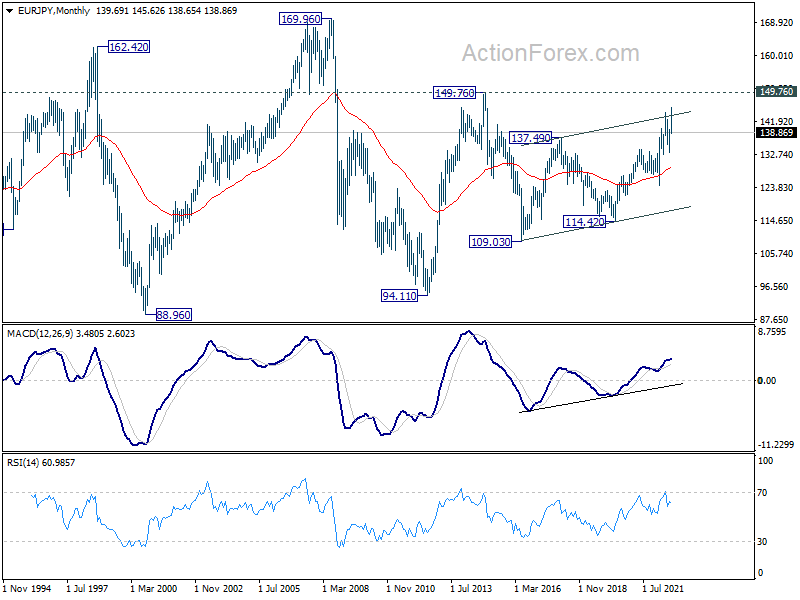
EUR/JPY's decline from 145.62 accelerated lower last week. Initial bias is mildly on the downside this week with focus on 138.38 support turned resistance. Firm break there will raise the chance of larger reversal and target 133.38 support next. On the upside, break of 142.28 will revive near term bullishness and bring retest of 145.62 high instead.
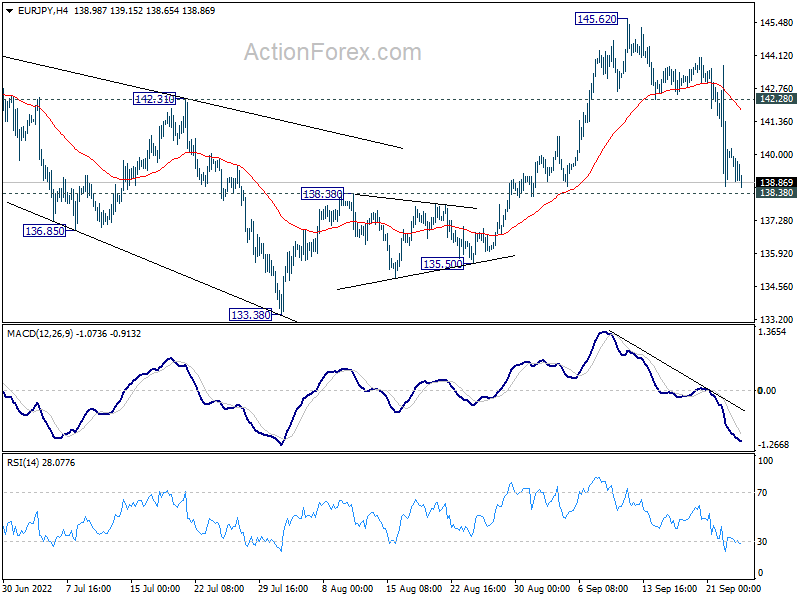
In the bigger picture, as long as 133.38 support holds, the up trend from 114.42 (2020 low) could still extend through 145.62 high. In that case, next target 149.76 (2015 high). However, sustained break of 133.38 will be a sign of medium term bearish reversal and bring deeper fall to 124.37 support first.
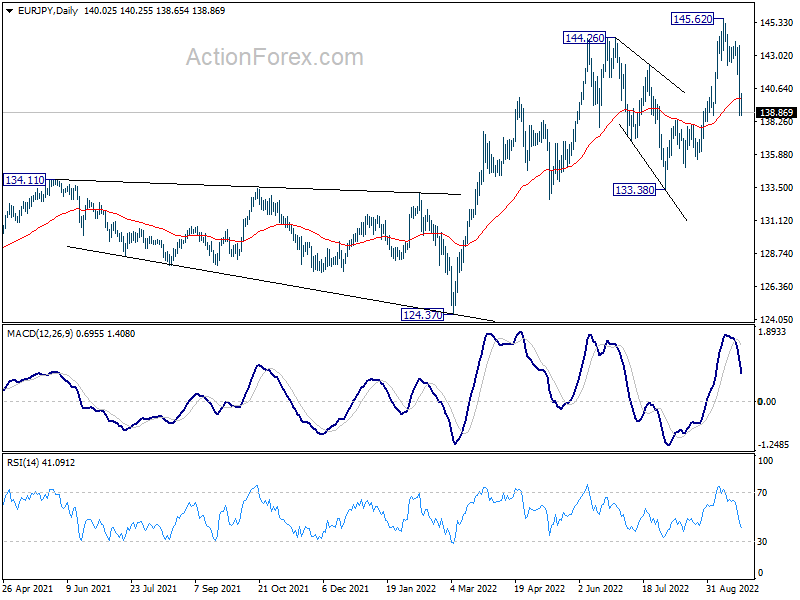
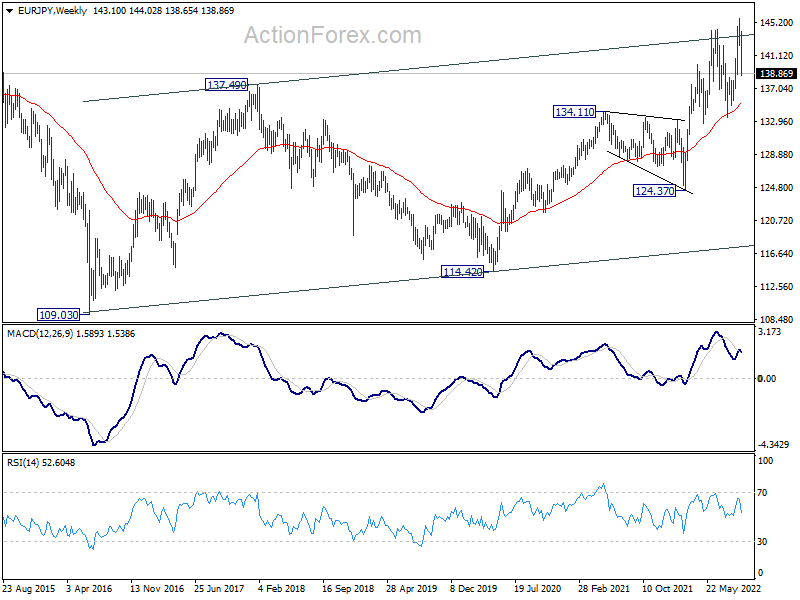
In the long term picture, as long as 55 month EMA (now at 129.30) holds, up trend 109.03 should still extend higher to 149.76 resistance (2014 high). However, sustained break of 55 month EMA will argue that the three wave pattern has completed, and bring deeper fall back to 109.03/114.42 support zone.
GBP/JPY Weekly Outlook
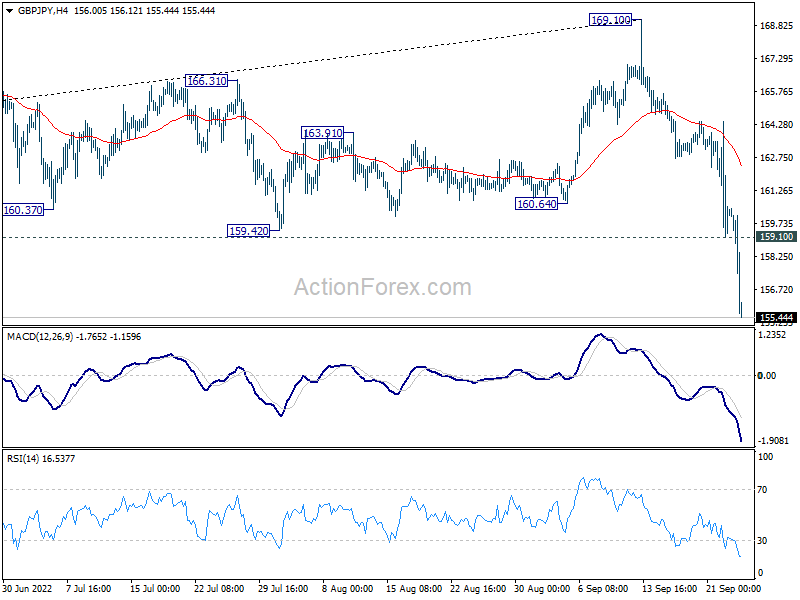
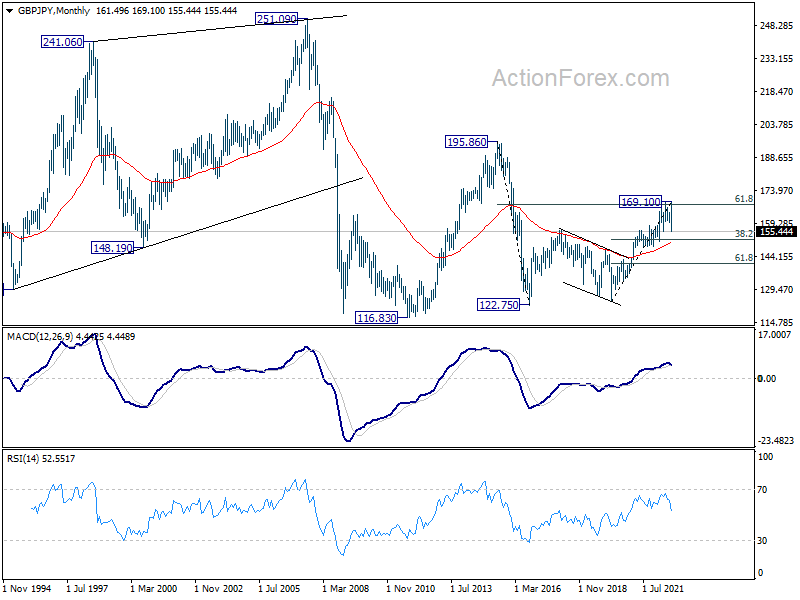
GBP/JPY's sharp decline and break of 155.57 support suggests medium term topping at 169.10. That came after multiple rejection by long term fibonacci level at 167.93. Initial bias remains on the downside this week for 150.95 support next. On the upside, above 159.10 minor resistance will turn intraday bias neutral and bring consolidations, before staging another fall.
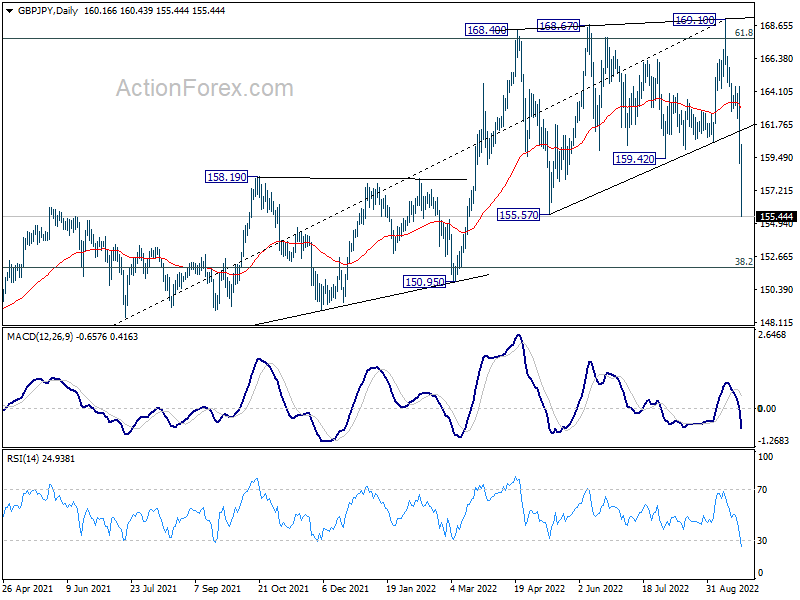
In the bigger picture, rejection by 61.8% retracement of 195.86 (2015 high) to 122.75 (2016 low) at 167.93 suggests that rise from 123.94 (2020 low) has completed. Deeper fall would be seen to 38.2% retracement of 123.94 to 169.10 at 151.84. Some support could be seen there to bring rebound. But risk will now stay on the downside as long as 169.10 resistance holds. Sustained trading below 151.84 will target 61.8% retracement at 141.19.
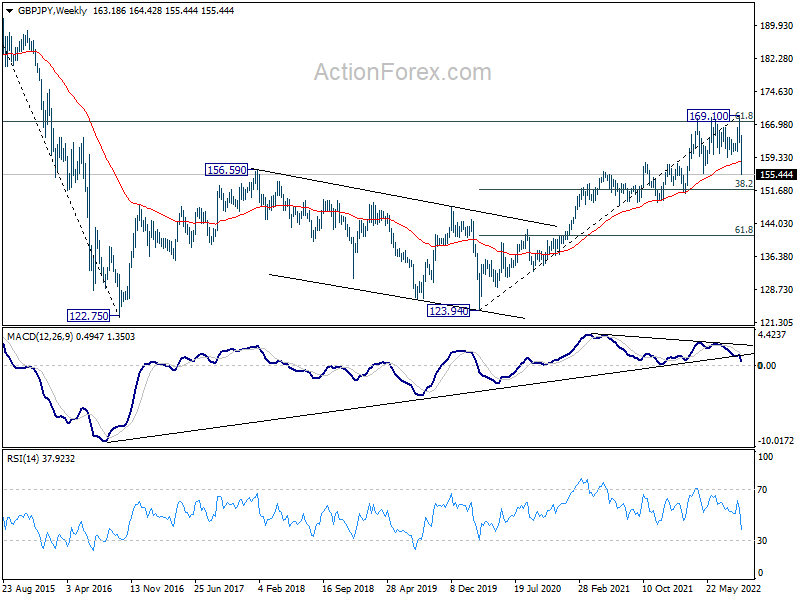
In the longer term picture, as long as 55 month EMA (now at 150.40) holds, rise from 122.75 could still extend higher at a later stage. However, sustained break of 55 month EMA will ague that whole rise has completed, and open up deeper fall back to 116.83/122.75 support zone.
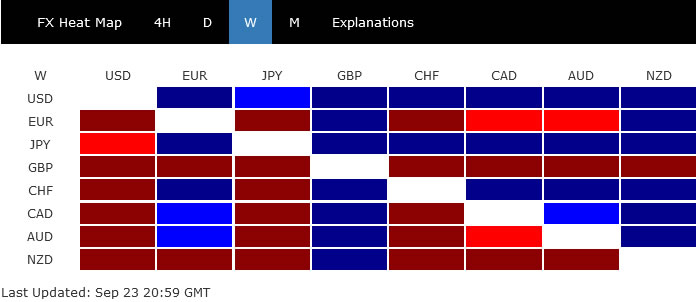
Sterling Nose-Dived, Dollar Skyrocketed, Yen Saved by Intervention
It's such a week of surprises. The biggest one was probably the free fall in Sterling, as markets reaction to the "mini-budget" of the new UK government was overwhelmingly negative. Commodity currencies and Euro were also pressured on risk aversion.
Dollar emerged as the strongest one after hawkish Fed hike, selloff in risk assets, and surging treasury yields. Yen just eked out a second place, with Japan's first intervention of the same kind since 1998 being unable to over turn the tide with the greenback. Swiss Franc was the third strongest, additionally supported by its rally against Euro and Sterling.
With a relatively light calendar ahead, and quarter end approaching, the markets might have a breather this week. But... never say never.
GBP/USD free falling to parity after radial mini-budget
Sterling was already under some pressure after Fed's hawkish rate hike. BoE's decision to raise Bank Rate by 50bps was not unanimous, with three MPC members voted for a 75bps and one voted for just 25bps. But the free fall only took off after Finance Minister Kwasi Kwateng's mini-budget, which was perceived by some as the most radical since 1972.
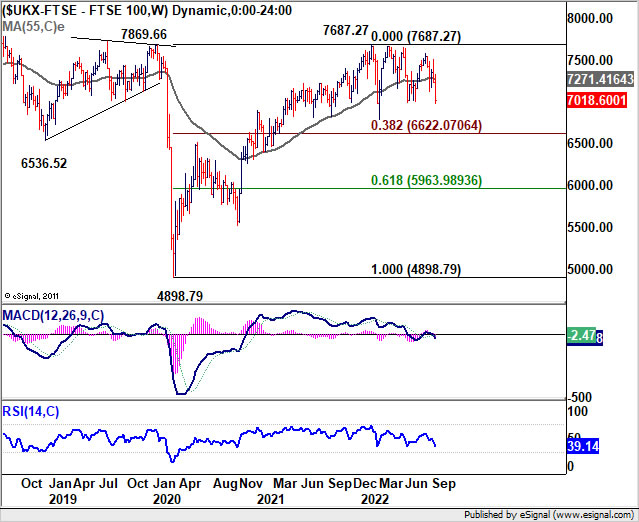
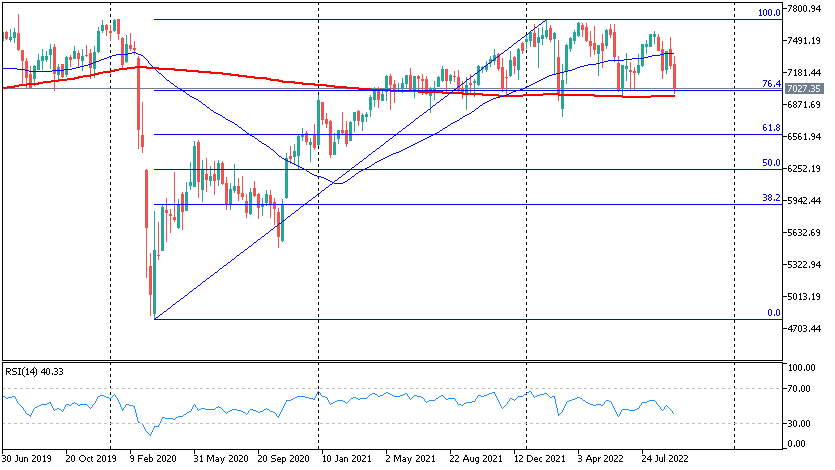
Market reactions were overwhelmingly negative to the plan. FTSE lost -1.97% on Friday and could barely defend 7000 handle. 10-year Gilt yield surged 0.3292 to 3.827, the biggest one-day jump on record since 1989, and hit the highest level since 2010. GBP/USD fell below 1.09 for the first time since 1985.
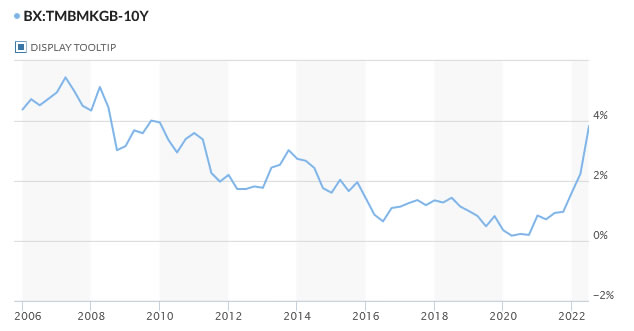
Investors believed the plan would push inflation even higher and BoE would be forced to raise interest rate further to 5.50% in the currency cycle, which adds additional weight to the economy. The combined reaction suggests the lack of confidence in the government's ability managing the ballooning debt.
While the decline in FTSE was deep, it's not the end of the world for the UK yet. The key medium term level to defend is 38.2% retracement of 4898.79 to 7687.27 at 6622.07. As long as this level holds, any ups-and-downs, while large, are seen as part of a medium term sideway pattern only.
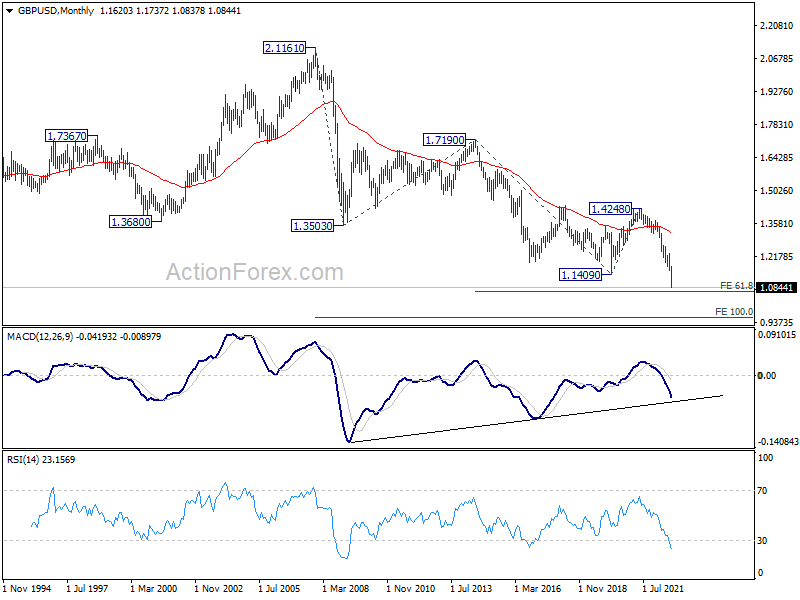
As for GBP/USD, it would hope to get some support between parity and 61.8% projection of 1.7190 (2014 high) to 1.1409 (2020 low) from 1.4248 (2021 high) at 1.0675. to stabilize, as least for the first attempt. It's way too early to judge how deep the current down trend would extend to. But if parity is taken out firmly, the next target could be 100% projection of 2.116 to 1.3503 from 1.7190 at 0.9532.
Japan intervened finally, but USD/JPY just range bound
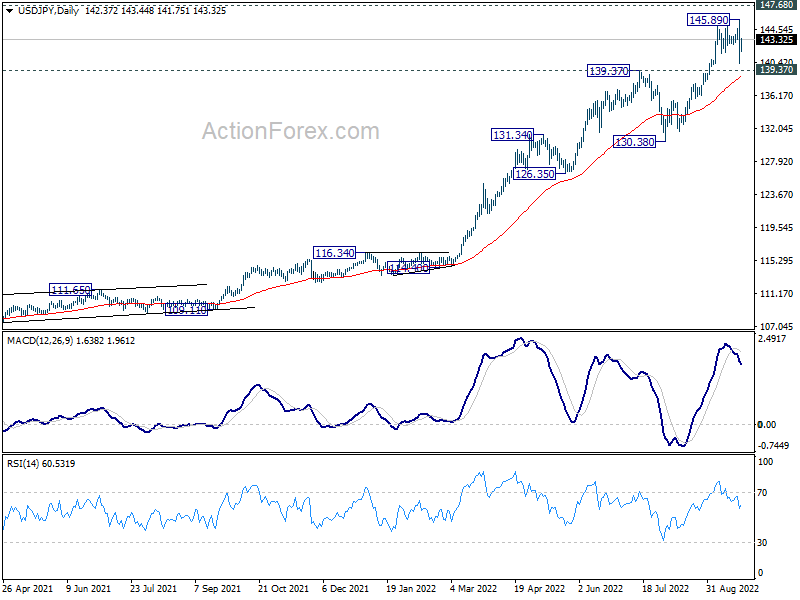
Another significant development last week was Japan's intervention in the currency markets, the first act to support Yen since 1997-98 Asian Financial crisis. Japan did intervene in the markets in between but those actions were for slowing the currency's advances. The move came after USD/JPY hit 24 year high and threatened to approach 1998 high at 147.68.
While Yen did rebound after intervention, there was no follow through buying against Dollar so far. The up trend in USD/JPY remains intact with 139.37 resistance turned support intact. That is, USD/JPY could still have another attempt on 147.68 to test Japan's determination.
Firm break of 139.37 will be an indication of medium term topping. But based on current market sentiment, and policy divergence between Fed and BoJ, there is little chance of breaking next support level at 130.38 in the foreseeable future.
Dollar and yields up, stocks down after FOMC
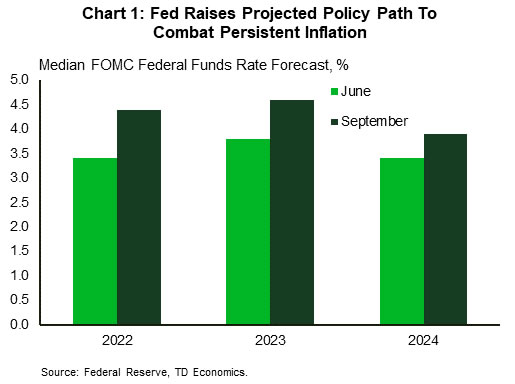
Moving on to the US, Fed raised interest rate by 75bps to 3.00-3.25% as widely expected. The bigger surprise was found in the new economic projections, which expect interest rate to hit 4.4% by the end of this year, and peak at 4.6% in 2023. But then, there is still room for further upward revision in the policy path in December's projection if high inflation persists.
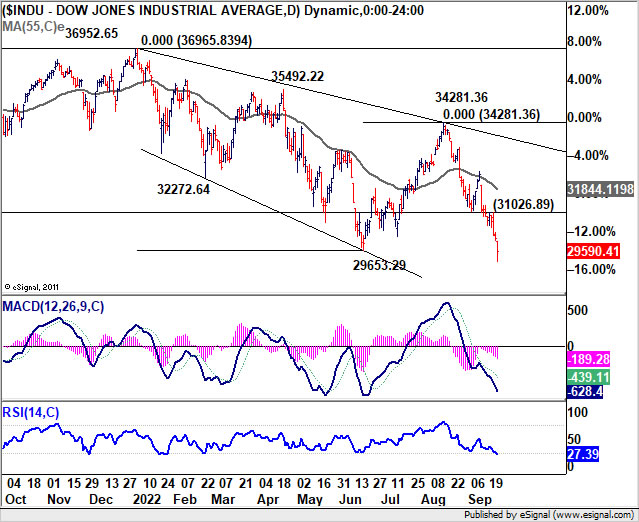
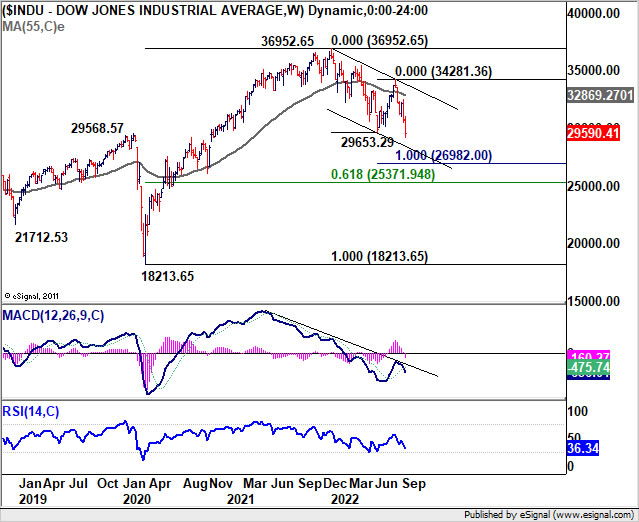
DOW break through prior low at 29653.29 to resume the medium term correction from 36952.65 high. For now, near term outlook will stay bearish as long as 31026.89 resistance holds, even in case of strong recovery. The correction could target 100% projection of 36952.65 to 26953.29 from 34281.36 at 26982.00, or even further to 61.8% retracement of 18213.65 to 36952.65 at 25371.94, before completion.
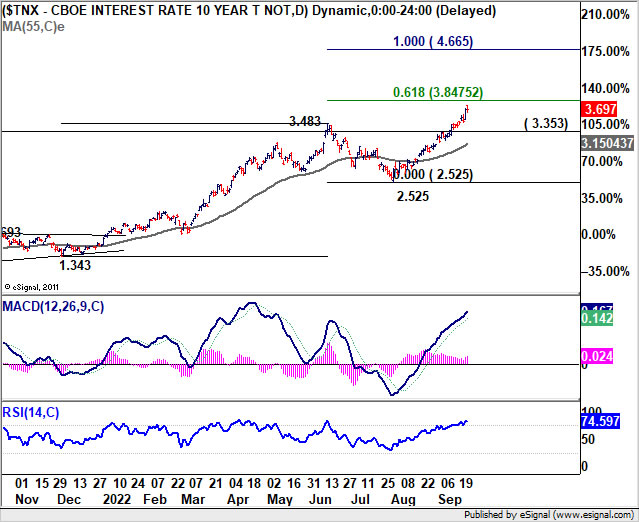
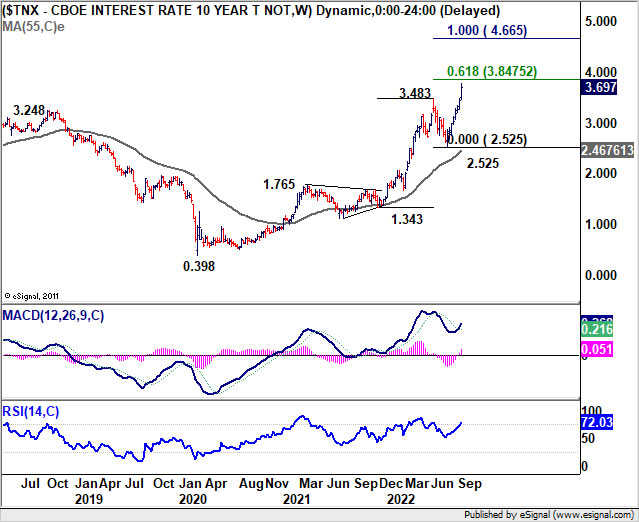
10-year yield surged through 3.483 to resume the long term up trend last week, and hit as high as 3.773. TNX is now in proximity to 61.8% projection of 1.343 to 3.483 from 2.525 at 3.847. There might be some consolidations below this projection level first. But in any case, further rally is in favor as long as 3.353 support holds. Firm break of 3.847 could prompt further up side acceleration to 100% projection at 4.665.
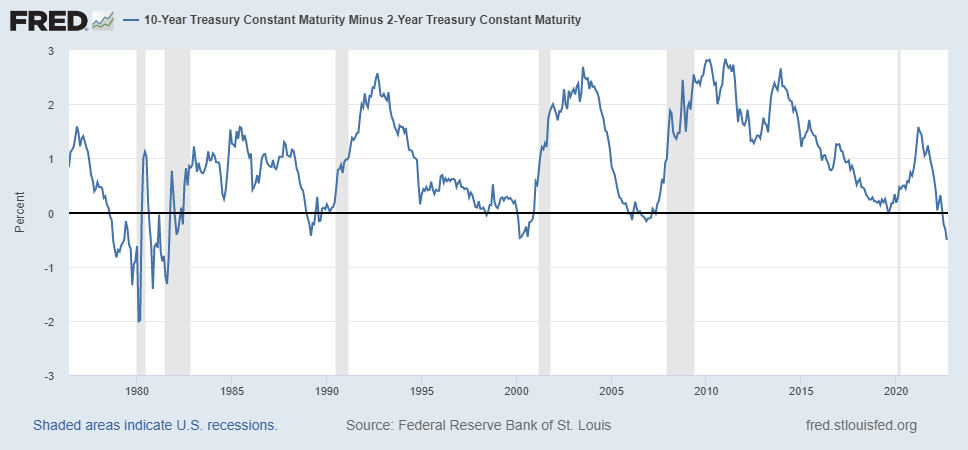
At same time, it should also be noted that 2-year yield rose 0.345 over the week to close at 4.212, hitting the highest level since 2007. Inversion of 2-yr and 10-yr yield, at -0.51, is now the deepest since 1981, surpassing -0.43 in 1989.
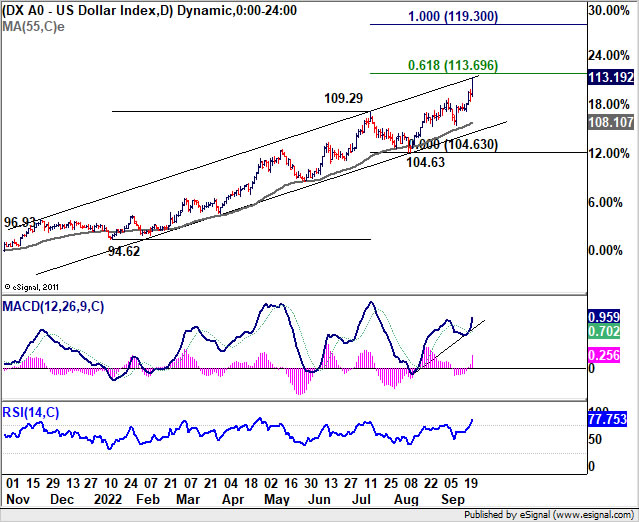
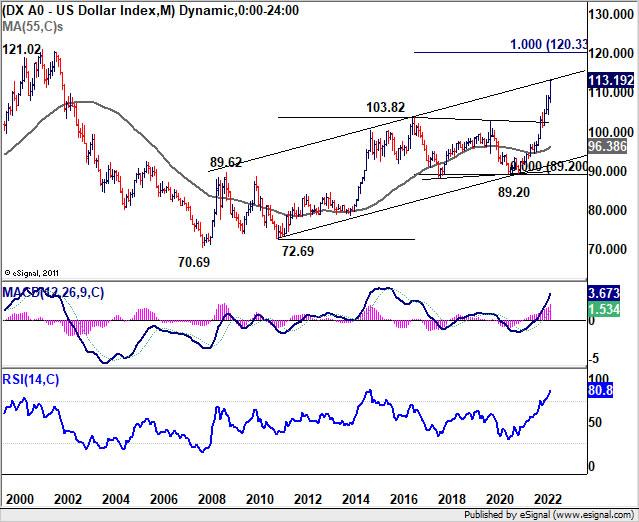
As for Dollar index, it accelerated to to close strongly at 113.19 as up trend resumed. DXY is now pressing a medium-term channel resistance, and the two-decade channel resistance. It's also in proximity to 61.8% projection of 94.62 to 109.29 from 104.63 at 113.69. Thus, there is prospect of further loss of upside momentum, and some consolidations.
But still, break of 109.29 resistance turned support is needed to confirm topping. Otherwise, further rally will remain in favor. Sustained break of 113.69 will pave the way to 100% projection of 119.30, which is close to 120 psychological level, and 2001 high.
GBP/JPY Weekly Outlook
GBP/JPY's sharp decline and break of 155.57 support suggests medium term topping at 169.10. That came after multiple rejection by long term fibonacci level at 167.93. Initial bias remains on the downside this week for 150.95 support next. On the upside, above 159.10 minor resistance will turn intraday bias neutral and bring consolidations, before staging another fall.
In the bigger picture, rejection by 61.8% retracement of 195.86 (2015 high) to 122.75 (2016 low) at 167.93 suggests that rise from 123.94 (2020 low) has completed. Deeper fall would be seen to 38.2% retracement of 123.94 to 169.10 at 151.84. Some support could be seen there to bring rebound. But risk will now stay on the downside as long as 169.10 resistance holds. Sustained trading below 151.84 will target 61.8% retracement at 141.19.
In the longer term picture, as long as 55 month EMA (now at 150.40) holds, rise from 122.75 could still extend higher at a later stage. However, sustained break of 55 month EMA will ague that whole rise has completed, and open up deeper fall back to 116.83/122.75 support zone.
Summary 9/26 – 9/30
Monday, Sep 26, 2022
[php_everywhere instance="1"]
Tuesday, Sep 27, 2022
[php_everywhere instance="2"]
Wednesday, Sep 28, 2022
[php_everywhere instance="3"]
Thursday, Sep 29, 2022
[php_everywhere instance="4"]
Friday, Sep 30, 2022
[php_everywhere instance="5"]
Week Ahead – Recession Fears Mounting
US
Now that Wall Street has had some time to digest the FOMC decision, the focus shifts to how quickly the economy is weakening and a wave of Fed speak. A wide range of economic releases includes more Fed regional surveys, durable goods orders, consumer confidence, new home sales, initial jobless claims, personal income & spending, and the PCE deflator.
An overwhelming amount of Fed speak include 16 appearances by policymakers. Monday is filled with comments from Fed’s Collins, Bostic, Logan, and Mester. On Tuesday, Chair Powell will participate in a panel on digital currencies. Evans, Bullard, and Daly will also speak. Wednesday has appearances from Bostic, Bullard, and Evans. Thursday’s speakers include Bullard, Mester, and Daly. On Friday, both Brainard and Williams speak at the Fed conference on Financial Stability.
EU
Next week is littered with appearances from ECB policymakers which comes at a good time following a raft of massive rate hikes around the world and as we get the latest flash inflation figures for September.
The Italian general election on Sunday will also be interesting, with it expected to end in victory for the far-right.
UK
There’s been a lot to process this week from the latest rate hike to the supposed “mini-budget” and subsequent sterling plunge. There’s a lot of heat on the UK economy and government at the moment and all of that tax cutting has added fuel to the fire rather than put it out. Next week will tell us if the UK could already be in recession as the final reading of second-quarter GDP is released. The last reading was -0.1% so a small positive revision could be enough to kick the technical recession down the road, not that it actually changes anything.
Apart from that, we have a few appearances from BoE policymakers to look forward to.
Russia
The focus next week will be on the “referendums” in Russian-controlled territories of eastern Ukraine and what the Kremlin will do next. The rhetoric has become far more aggressive recently amid constant reference to its nuclear might and ability to use it.
On the economy, unemployment data will be released which seems very insignificant in the grand scheme of things.
South Africa
PPI data is expected to show pressures slightly softening, albeit from 18% to 17.6%. This comes after CPI data last week fell at a slower pace than expected and the SARB hiked rates by 75 basis points to 6.25%. With two of the five members of the MPC voting for 100bps, further tightening looks likely at upcoming meetings.
Turkey
With inflation running above 80%, the CBRT obviously cut the repo rate by another 100bps to 12%. Which makes observing the data feel a bit pointless at times but only here will the cost of this monetary policy experiment show up. Next week has little to offer on that front, with the few releases being tier two and three.
Switzerland
The SNB opted for a 75bps rate hike this month and warned that it could intervene in the currency markets – despite referencing the benefits of the stronger franc – and hold an emergency meeting if necessary before the next scheduled quarterly gathering in December.
As far as next week is concerned, the quarterly bulletin on Tuesday will be of interest, as will the retail sales number and KOF and ZEW surveys.
China
On Friday, manufacturing and non-manufacturing PMIs will be released. As a result of the historically hot and dry weather extremes in 14 provinces and cities in China from July to August, many provinces are experiencing water and electricity shortages. At the same time, China’s house prices have been falling for 12 consecutive months, and the house price inflation rate has dropped to -2.1 % on an annual basis.
Real estate has always been the main component of Chinese household wealth and a pillar industry of the economy. The continuous decline of this data indicates that consumption is and will remain weak.
This may suggest further weakness in the data and could further weigh on the yuan as the PBOC continues to prop it up.
India
The RBI is expected to raise the repo rate again on Friday but by a smaller margin of just 35bps. There is scope for more though, with some suggesting 50 could be on the table.
Australia & New Zealand
The August retail sales are to be released next Wednesday. Data from China, Australia’s largest trading partner, could have an impact on the Australian dollar next week, as could risk appetite which has weighed on the currency in recent weeks.
A serious downturn in the New Zealand ANZ business outlook and confidence for September on Thursday could weigh on the kiwi in the short term and even get the attention of the central bank as it aggressively tightens monetary policy. The currency could also be sensitive to Chinse data and the risk environment.
Japan
The Ministry of Finance stole the spotlight on Thursday as it conducted its first FX intervention in 24 years. This came as the BoJ held firm on its monetary policy stance after the Fed hiked by 75 basis points, sending USD/JPY above 145. It was around this point that the BoJ carried out a rate check recently and just above here that the last intervention was conducted in 1998.
Next week brings a whole host of economic data as well as the BoJ minutes (from the July meeting, not September). Pressure could mount on the BoJ in the coming months as it can’t rely on the MoF to tame the decline in the currency longer term.
Singapore
Industrial production figures will be released on Monday.
Data last week showed inflation rising from 7% to 7.5% in August, far ahead of expectations of 7.2%. Singapore’s Minister of Finance, Lawrence Wong, has said that inflation in Singapore will peak by the end of this year.
Economic Calendar
Saturday, Sept. 24
Economic Events
- General debate continues at the UN General Assembly in New York. Sergei Lavron due to speak
- German Chancellor Scholz begins a trip to Saudi Arabia, Qatar and the UAE
- Russia’s invasion of Ukraine hits the seven-month mark
Sunday, Sept. 25
Economic Events
- Italian general election is expected to result in a far-right victory
- UK Labour Party conference takes place in Liverpool
- US Vice President Harris will travel to Japan and South Korea and lead the presidential delegation to the state funeral of former Japanese Prime Minister Shinzo Abe
Monday, Sept. 26
Economic Data/Events
- Germany IFO business climate
- Japan PMI
- Singapore industrial production
- Thailand trade, manufacturing production index, capacity utilization
- Boston Fed President Susan Collins speaks at the Greater Boston Chamber of Commerce event
- Atlanta Fed President Raphael Bostic discusses income and wealth inequality at a Washington Post event
- Cleveland Fed President Loretta Mester discusses the economic outlook at an MIT event
- ECB President Christine Lagarde appears before the Committee on Economic and Monetary Affairs of the European Parliament in Brussels
- ECB policymakers Joachim Nagel and Fabio Panetta speak at a Bundesbank’s symposium
- BOE’s Tenreyro speaks at the E-Axes Forum webinar
Tuesday, Sept. 27
Economic Data/Events
- US new home sales, Conference Board consumer confidence, durable goods
- China industrial profits
- Japan PPI services, machine tool orders
- Mexico international reserves, trade, unemployment
- South Korea consumer confidence
- Taiwan monitoring indicator
- ECB’s Villeroy and Panetta, Fed Chair Powell and BIS’s Carstens speak at the Bank of France Seminar on Tokenization of Finance
- Chicago Fed President Evans speaks at an event in London hosted by the Official Monetary and Financial Institutions Forum.
- Sweden’s Riksbank Governor Ingves speaks on the economic situation and current monetary policy at Nordea in London
- Bank of England chief economist Pill, St. Louis Fed President Bullard and ECB Vice President de Guindos speak at Barclays-CEPR International Monetary Policy Forum
- Japan holds a state funeral in Tokyo for former Prime Minister Shinzo Abe
Wednesday, Sept. 28
Economic Data/Events
- US wholesale inventories
- Australia retail sales
- Japan leading index, coincident index
- Russia industrial production, unemployment
- Thailand rate decision: Expected to raise rates by 25bp to 1.00%
- EIA crude oil inventory report
- San Francisco Fed President Daly speaks in a virtual moderated Q&A at an Asian banking symposium in Singapore
- Atlanta Fed President Bostic speaks in a moderated Q&A on leadership in banking hosted by the Atlanta Fed
- Chicago Fed President Evans to discuss the economic and monetary policy outlook at an event hosted by the London School of Economics
- The Milken Institute’s 9th annual Asian Summit kicks off in Singapore
- ECB President Lagarde gives opening remarks at the Frankfurt Forum on US-European geoeconomics
- Riksbank Deputy Governor Jansson speaks about current monetary policy at a breakfast meeting at Handelsbanken
- BOE Deputy Governor Cunliffe gives the keynote speech on payments systems at AFME’s innovation conference
Thursday, Sept. 29
Economic Data/Events
- US initial jobless claims, GDP
- Australia job vacancies
- Eurozone economic confidence, consumer confidence
- Germany CPI
- Mexico rate decision: Expected to raise Overnight Rate 75bp to 9.25%
- New Zealand business confidence
- Spain CPI
- ECB Governing Council members Simkus, Centeno, de Guindos, Kazaks and Muller speak at a central banking conference in Vilnius, Lithuania
- Cleveland Fed President Mester and ECB Executive Board member Lane take part in a policy panel during a Cleveland Fed conference on inflation
- ECB’s Villeroy, Knot and Elderson speak at a climate conference in Amsterdam. San Francisco Fed President Daly gives keynote speech at Boise Steve University
- ECB Governing Council member Rehn speaks on the euro area economic outlook and monetary policy at a Bank of Finland news conference in Helsinki
- Riksbank Deputy Governor Ohlsson to discuss the economic situation at Swedbank in Uppsala
- Deputy Governor Floden to speak on monetary policy at the Nordic Forum in Stockholm
- BOE’s executive director Hauser speaks at a Market News event on “The Bank of England’s balance sheet”
Friday, Sept. 30
Economic Data/Events
- US consumer income, University of Michigan consumer sentiment
- Fed Vice Chair Brainard and New York Fed President Williams speak at Fed conference on financial stability
- Deadline for the US government shutdown
- ECB Executive Board member Schnabel joins panel “Fight against inflation” at La Toja Forum 2022 in Pontevedra, Spain
- Riksbank Governor Ingves speaks about digital currencies and decentralized finance in Stockholm
- EU energy ministers meet in Brussels on the current crisis
- Australia private sector credit
- China PMI, Caixin PMI, BoP
- Czech Republic GDP
- Eurozone CPI, unemployment
- France CPI
- Germany unemployment
- Hong Kong retail sales, budget balance, money supply
- India rate decision: Expected to raise Repurchase Rate by 35 bps to 5.75%
- India fiscal deficit, eight infrastructure industries
- Italy CPI, unemployment
- Japan unemployment, industrial production, retail sales, consumer confidence
- New Zealand building permits, consumer confidence
- Poland CPI
- Singapore money supply
- South Africa trade balance
- Thailand trade, BoP, forward contracts, foreign reserves
- UK GDP
Sovereign Rating Updates
- Poland (S&P)
- Turkey (S&P)
- Italy (Moody’s)
- France (DBRS)
Weekly Economic & Financial Commentary: Shot Across the Bow, Japan Intervenes Against Surging Dollar
Summary
United States: Whatever It Takes
- As widely expected, the FOMC raised the target range for the fed funds rate by 75 bps for the third consecutive time. The housing market continues to buckle under the pressure of higher mortgage rates, while the Leading Economic Index has signaled a broader loss of momentum across the economy.
- Next week: Durable Goods (Tue), Consumer Confidence (Tue), Personal Income & Spending (Fri)
International: Bank of Japan's Policy Actions Offset Each Other
- Aside from the Fed, the central bank that caught the attention of market participants this week was the Bank of Japan (BoJ). As expected, the BoJ left monetary policy settings unchanged; however, the communication around the decision was widely interpreted as dovish.
- Next week: Central Bank Speakers (Mon-Fri), China PMIs (Thu), Eurozone Inflation (Fri)
Interest Rate Watch: Aggressive Fed Path Boosts Inflation-Fighting Credibility
- The FOMC delivered its third straight 75 bps hike and a hawkish message for rates going forward at its meeting this week. The FOMC now sees it likely the fed funds target range will rise to 4.4% by the of this year and 4.6% by the end of next year as inflation is expected to be more intractable than previously believed.
Credit Market Insights: Reading the Pulse of the Corporate Bond Market
- The Federal Reserve Bank of New York's Corporate Bond Market Distress Index (CMDI) tracks corporate bond market functioning using a variety of metrics from the market at large, including the investment grade and high yield markets. The latest release of the CMDI indicated that the corporate bond market was in good health through August.
Topic of the Week: Shot Across the Bow, Japan Intervenes Against Surging Dollar
- On Thursday, in a surprise move Japan's Ministry of Finance intervened in FX markets to strengthen the yen for the first time since 1998. The beleaguered yen has declined over 20% against the dollar this year, briefly hitting a 24-year low of JPY145.89 on Thursday after BoJ policymakers signaled they plan to keep monetary policy settings accommodative.
The Weekly Bottom Line: The FOMC Aims High
U.S. Highlights
- The Federal Reserve raised interest rates by 75bps for the third consecutive meeting, bringing the federal funds rate to its highest level in 14 years.
- FOMC Chair Powell reiterated his Jackson Hole speech, stating that the Fed is willing to tolerate slower growth and higher unemployment to bring inflation back to its 2% target.
- Interest rate sensitive sectors continue to feel the effects of past rate hikes, with existing home sales down 0.4% (m/m) in August, marking the seventh consecutive month of declines.
Canadian Highlights
- Market moves were driven by a hawkish message from Fed Chair Jay Powell, who emphasized the Fed’s resolve to bring down inflation in the U.S. – even if it causes a recession. This has sent the U.S. Dollar higher and punished the Loonie.
- Canadian economic data released this week showed that inflation remains high, and consumers are starting to cut back as they feel the pinch.
- Fortunately, Canadian inflation took a step in the right direction in August. Prices pressures eased up across a wide swath of goods and services, suggesting higher rates may be staring to do the trick.
U.S. - The FOMC Aims High
The last days of summer 2022 were centered around the FOMC meeting which ended Wednesday with another 75bps hike, bringing the federal funds rate to its highest level in 14 years. The announcement was largely expected by markets after last week’s CPI print came in hotter than expected, with core CPI rising to 0.6% month-over-month (m/m). However, the Fed’s updated projections underlined a narrative that was more hawkish than what markets had been expecting, resulting in a volatile reaction from equity and bond markets. The S&P 500 ended the day down by 1.7% and the two-year treasury yield, which briefly rose above 4.1%, closed back at its pre-meeting level of 4%. Further digestion of the decision has seen the two-year yield rise to 4.2% and the S&P 500 retreat further, ending the week down 4.1% as of the time of writing.
Chair Powell used his press conference to reiterate his Jackson Hole speech, emphasizing that the Fed would not shy away from its fight to bring inflation back to its 2% target. Powell noted that a restrictive policy stance would likely be required for some time and that this would likely result in a sustained period of below trend growth and softer labor market conditions. Progress on the inflation front has been mixed so far with headline inflation showing early signs of peaking (largely due to falling gas prices), but core inflation has remained stubbornly high which has prompted the Fed to hold the line on its aggressive policy stance.
According to the updated Fed projections, the median estimate for the federal funds rate (FFR) is now expected to reach 4.4% by year-end, a full percentage point above their previous estimate in June (Chart 1). FOMC members expect that further rate increases will be required in 2023, with the median projection for the terminal rate reaching 4.6%. This represents roughly 150bps of further rate increases from the current level of 3 – 3.25.
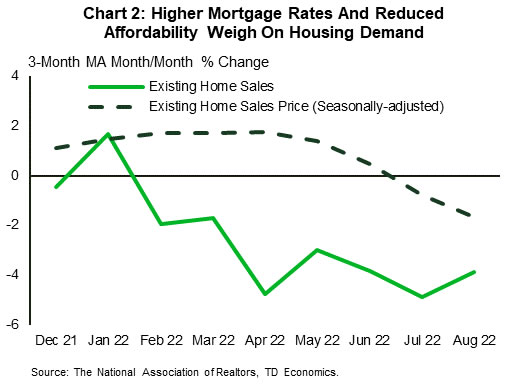
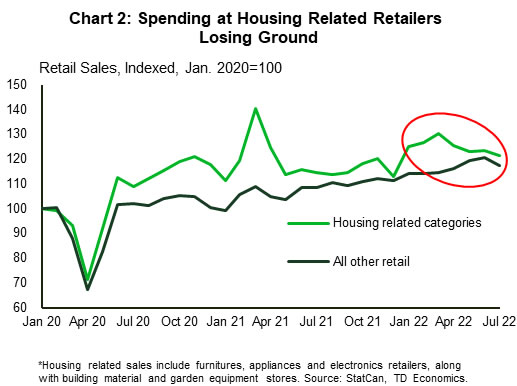
Elsewhere this week, the interest rate sensitive housing sector continued to show further signs of softening. Existing home sales declined by 0.4% m/m in August, marking its seventh consecutive month of declines. Seasonally adjusted median home prices also dipped deeper into negative territory, falling for the three straight months (Chart 2). Reduced affordability continues to act a headwind on consumer demand for housing, and with mortgage rates now well above 6%, that headwind is turning into a gale. Higher rates are not only affecting sales, but also residential construction. While housing starts rebounded in August (rising 12% m/m to 1.58M units), the 3-month moving average of year-over-year changes is still down 5.4%. Moreover, a pullback in August housing permits suggests more weakness in the months ahead. This lines up with recent readings of builder sentiment, which has now fallen for nine consecutive months and currently sits at a 28-month low.
None of this will sway the Federal Reserve to lift its foot off the pedal as they continue to drive interest rates higher to bring down inflation. With the FOMC charting a course that nearly inverts the 2007/2008 run-down in the policy rate, the current and expected future path of monetary policy will continue to act as an increasing weight on the economy moving forward.
Canada - Consumers Tighten Their Purse Strings
It was another tough week for equity markets, with the world's leading central bank driving home the message that it will fight inflation at all costs. Even after raising rates 300 basis points this year, the Fed still expects a heavy dose of tightening ahead. The Canadian dollar, alongside many other currencies, has suffered from this hawkishness stateside despite the Bank of Canada also being hawkish in its messaging.
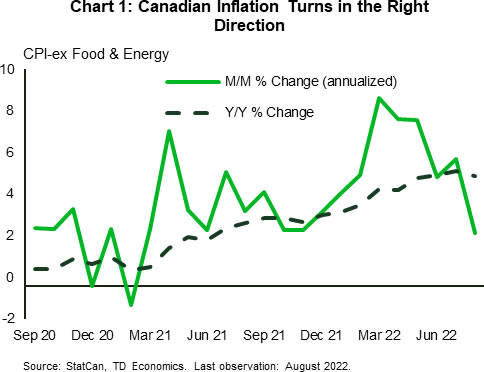
Canadian inflation did take a step in the right direction in August, but remained very high at 7% year-on-year (y/y). Lower prices at the pump helped the headline, but contrary to the situation in the U.S., core inflation pressures also eased slightly in August to 5.3% y/y (Chart 1). Perhaps even more encouraging, the one-month change in core CPI was a relatively benign 2.6% (on an annualized basis). We never like to read too much into one month's number, but it is reassuring to see the softest monthly increase in core inflation in over a year. That said, the average of the Bank of Canada's trio of core inflation measures was 5.2% y/y. That is a long way from the 1-3% range the Bank would like to see. So, while August's data was encouraging, the Bank is a long way from bringing inflation pressures to heel.
One particularly discouraging aspect of the report was the high food inflation – prices at grocery stores were up 10.8% versus a year ago, the fastest pace since 1981. Given groceries are some of the highest frequency purchases consumers make, this has been pinching household budgets, and no doubt causing Canadians to economize.
That frugality was seen in the retail sales data released on Friday, which fell by 2.5% m/m, after a jump up in June. The headline decline came as prices at the pump fell, bringing gasoline station receipts down 14.2% on the month. But the weakness went farther than that. Core retail sales, which exclude gasoline and auto sales, fell 0.9% – the first decline in seven months. Given the high inflation environment, this means core sales were down 2% m/m in real terms.
July retail data is quite backward looking at this point, so Statistics Canada also released a flash estimate for the August figures based on an incomplete sample. That measure rose 0.4% m/m, a very disappointing rebound. This suggests consumers are feeling the pinch from inflation, and higher borrowing costs. We expect this to drive much slower growth in consumer spending in the second half of the year, as outlined in our latest forecast, released this week. Retail sales are not the full picture of consumer spending, as they don't include spending on services, like movie tickets, restaurants and travel. Therefore, part of their weakness likely reflects the shift back towards greater spending on services that were curtailed during the pandemic. On travel, Statistics Canada released data for July that showed Canadian travel outside the country was up six fold in July from 2021, reaching about 64% of its pre-pandemic level – proof that this shift is occurring
The Great British Exodus
The sell-off in the British markets intensified on Friday. Traders seem to have held back from action until last in the run-up to the Bank of England rate decisions and the interim budget announcement. Both of these events failed to impress the markets.
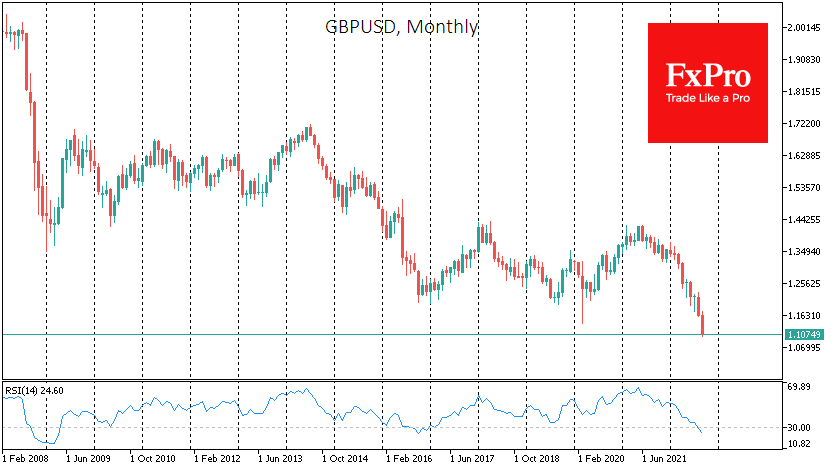
The Bank of England raised the rate by 50 points accumulating behind the Fed, while the new economic plan failed to alleviate fears over the threat of recession. GBPUSD has been losing around 2% since the start of the day on Friday, recording a low at 1.1020. Usually, the weakness in the GBP supports the British market, but today we see buyers capitulating with a loss of over 2.5% in the FTSE100. The index fell below 7000 for the first time in three months. In dollars, British assets were down 4.5% on Friday alone.
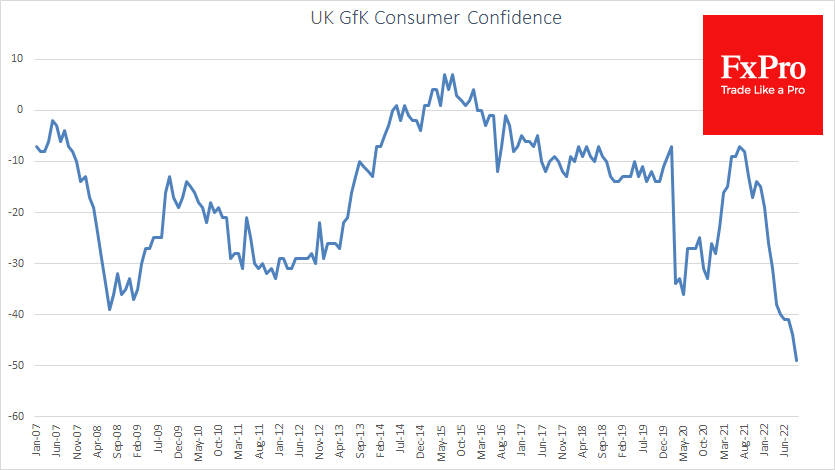
The economic indicators published today are adding to the sell-off in the markets. For example, the GfK consumer confidence indicator fell from -41 to -49, breaking a historical record since 1974. The CBI retail activity indicator fell from 37 in August to -20 in September against expectations of 9.
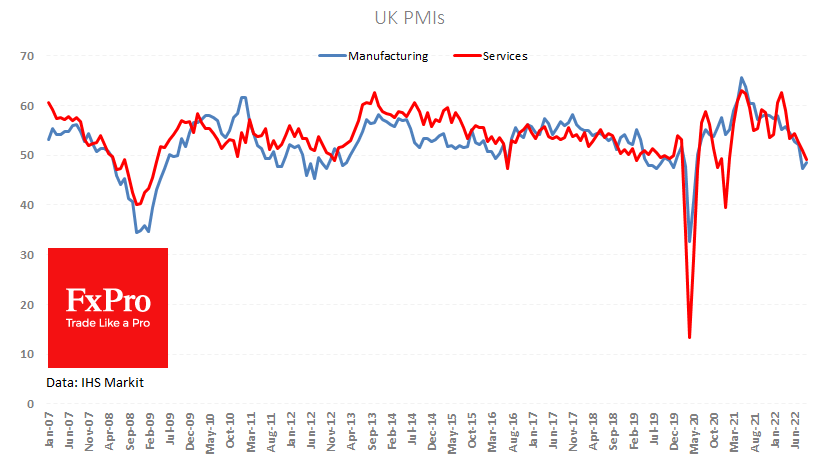
Preliminary PMI estimates also gave no reason to buy assets, noting a further fading of economic activity faster than expected. The Composite PMI fell from 49.6 to 48.4 against the expected 49.0 after the Services index collapsed from 50.9 to 49.2.
GBPUSD has lost 19% since the beginning of the year, which, combined with 10% inflation, should make the government and Bank of England more nervous. We should not be surprised if UK officials step up their efforts to maintain the pound, which could dramatically increase currency market volatility.
Week Ahead – Euro Eyes Italian Elections and Flash CPI, Dollar May Take a Backseat
With the Fed meeting out of the way, a quieter week is on the horizon, barring of course any flare up of tensions between Russia and Ukraine. Either way, the spotlight will probably fall on the euro as far-right parties are expected to gain ground in Italy’s parliamentary election on Sunday, while preliminary inflation readings will come to the fore at the end of the week. In the US, the highlight will be on the PCE inflation figures, though it’s doubtful whether it will change much regarding the Fed policy outlook.
Euro on election alert, flash CPI on the way too
The euro just can’t catch a break lately, whether it’s the energy crisis or the Fed out-hawking the ECB, there’s always trouble around the corner and next week, that could come in the form of political risks. Italians go to the polls on Sunday to elect a new government. It comes after the collapse of Mario Draghi’s technocratic government in July, which sparked a snap election.
Leading the opinion polls is the far-right Brothers of Italy party who look set to govern in a coalition along with the League and Forza Italia parties. Forty-five-year-old Giorgia Meloni, who founded Brothers of Italy, is on course to become the country’s first female prime minister. But markets are worried what this may mean for EU-Italy relations, how it may stoke fascism, and the risk it poses to the Draghi-formulated economic recovery.
However, the implications of a Meloni-led government may not be known immediately as she has pledged to be prudent with the country’s finances and avoid confrontation with the EU. Nonetheless, Italian government bond yields may spike higher next week if the right-wing alliance does indeed win a majority.
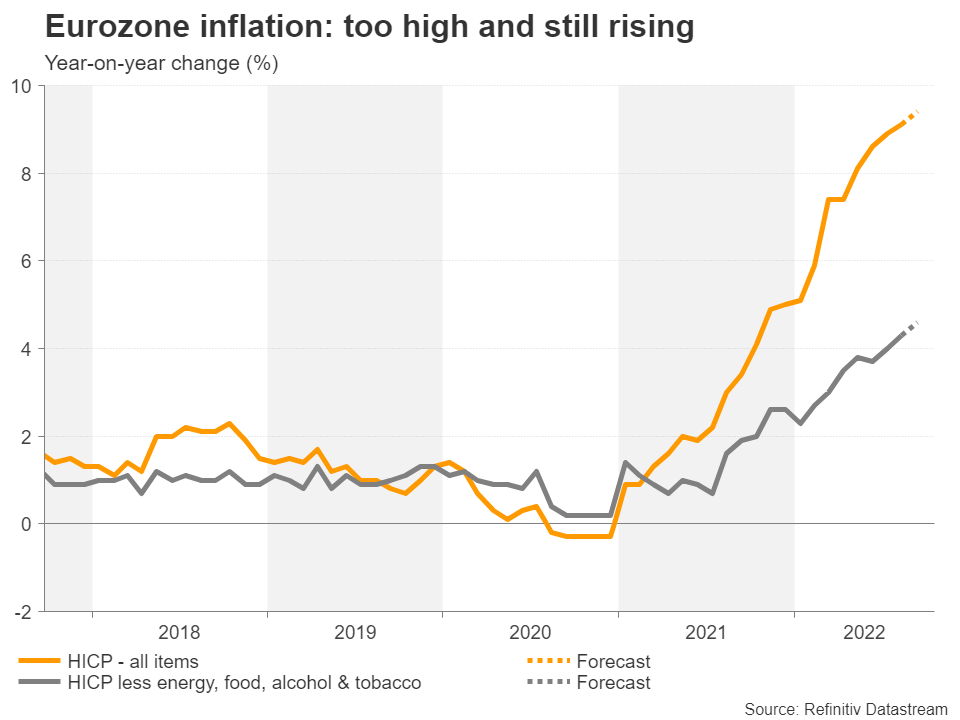
Any widening of peripheral yield spreads might weigh on the euro, though there could be some support for the single currency on Friday from the latest flash CPI estimates for the Eurozone. The headline rate of inflation is expected to have edged up to a new record of 9.4% in September. The hawkish soundbites from ECB policymakers have been gradually getting louder over the last few weeks and there could be more of that from President Lagarde when she testifies before the European Parliament on Monday. As long as policymakers maintain this rhetoric, it should prevent the euro from slumping too far below the parity level.
In other data, business surveys comprising the economic sentiment indicator (Thursday) and Germany’s Ifo business climate gauge (Monday) might also be watched for clues on how quickly the Eurozone economy is losing steam.
Will yen intervention keep the dollar bulls at bay?
Just as markets thought that the Fed couldn’t get more hawkish, it did just that. Although the Fed didn’t accelerate its tightening pace in September as some had expected and the terminal rate in the dot plot wasn’t that far off from the market’s, Jay Powell was at his most convincing yet in his press conference that the Fed will do whatever it takes to get inflation back down to 2%, even if it costs a hard landing to get there.
Both Treasury yields and the US dollar extended their gains in the aftermath, but the latter’s uptrend now faces some unexpected challenges. Japan’s government finally decided to intervene in the FX market after the yen breached the 145 level, ordering the Bank of Japan to conduct a yen-buying operation.
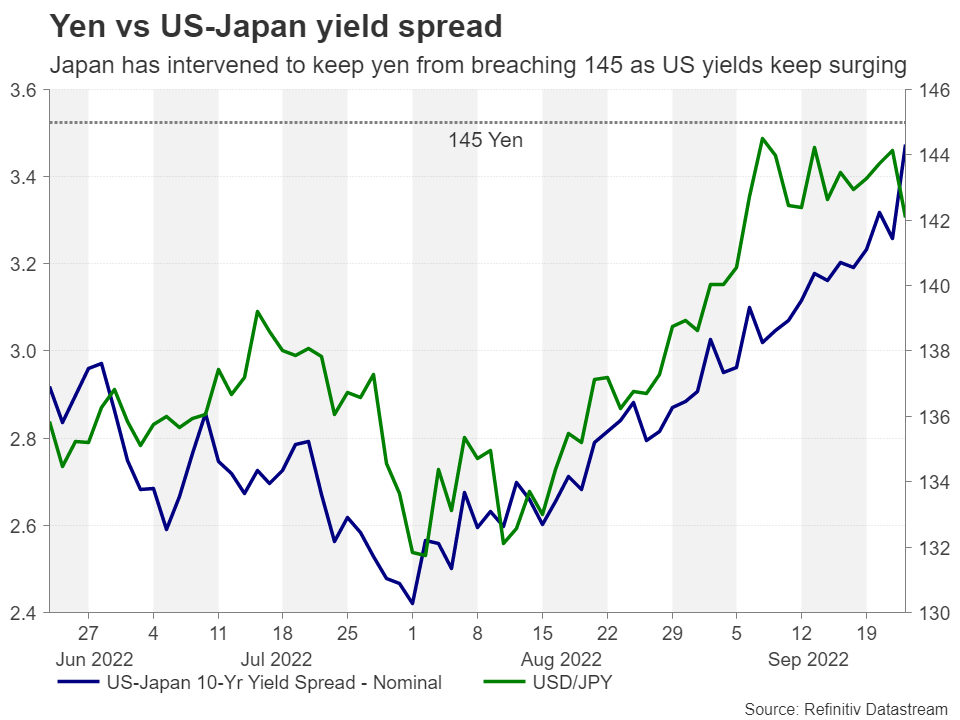
Yes, the move did trigger some broad profit-taking in the dollar, but the view on how successful such a policy of one-sided intervention can be until the day comes for the Fed to make its first dovish pivot hasn’t changed. It may only be a matter of time before speculators flood into dollar/yen again.
However, it’s possible that the BoJ will not be alone for much longer in defending its currency. Other Asian central banks such as the Bank of Korea and the Bank of Thailand have also been keeping a close eye on their currencies amid the rampant dollar. Should they step in too over the coming days, the collaborative effort may give Japan’s intervention more credibility.
And with not a lot of top-tier data on the agenda over the next seven days, further central bank intervention might just work in keeping a lid on the dollar’s gains for the time being.
PCE inflation may not excite this time
The US releases will kick off with durable goods orders and the closely watched consumer confidence gauge on Tuesday. There will also be a slew of housing data, including new home sales for August. Pending home sales will follow on Wednesday. Housing indicators have been somewhat mixed lately so next week’s numbers might help shed better light on how severe the slowdown actually is.
On Friday, the all-important personal income and outlays report, which contains the PCE inflation figures as well as spending and consumption data, is due. After the Fed sent a clear policy message at its meeting, it’s unlikely that this dataset will alter much as far as the outlook is concerned.
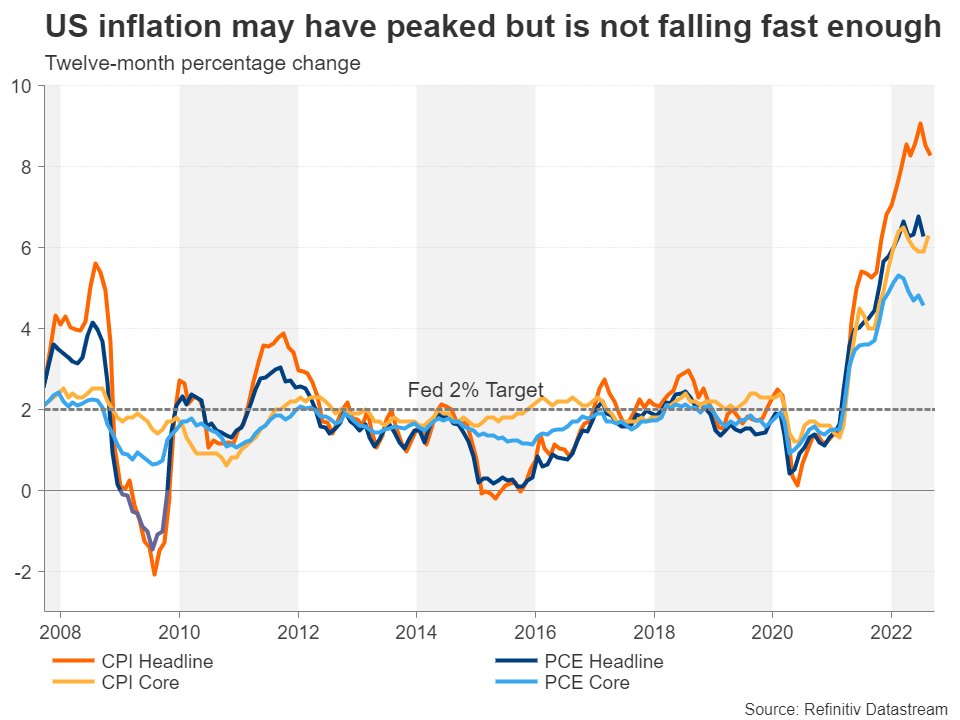
Nevertheless, a stronger-than-expected print in the core PCE price index would be positive for the dollar, while any worrying weakness in personal consumption could potentially weigh on Wall Street.
A light calendar all round
Elsewhere, it’s going to be even quieter for the pound and the commodity-linked currencies, which have taken quite a battering in recent weeks from the strengthening dollar and deterioration in risk sentiment. From domestic drivers, there could be some reverberations for the pound from Friday’s mini budget that could echo into the following week.
The UK government just unveiled the second biggest tax cutting budget in its history, which will be financed entirely by borrowing. UK bond yields surged on the announcement, in a sign that investors are more anxious about the implications of rising debt levels than the boost to growth. This leaves sterling even more exposed to risk-off episodes than it already is.
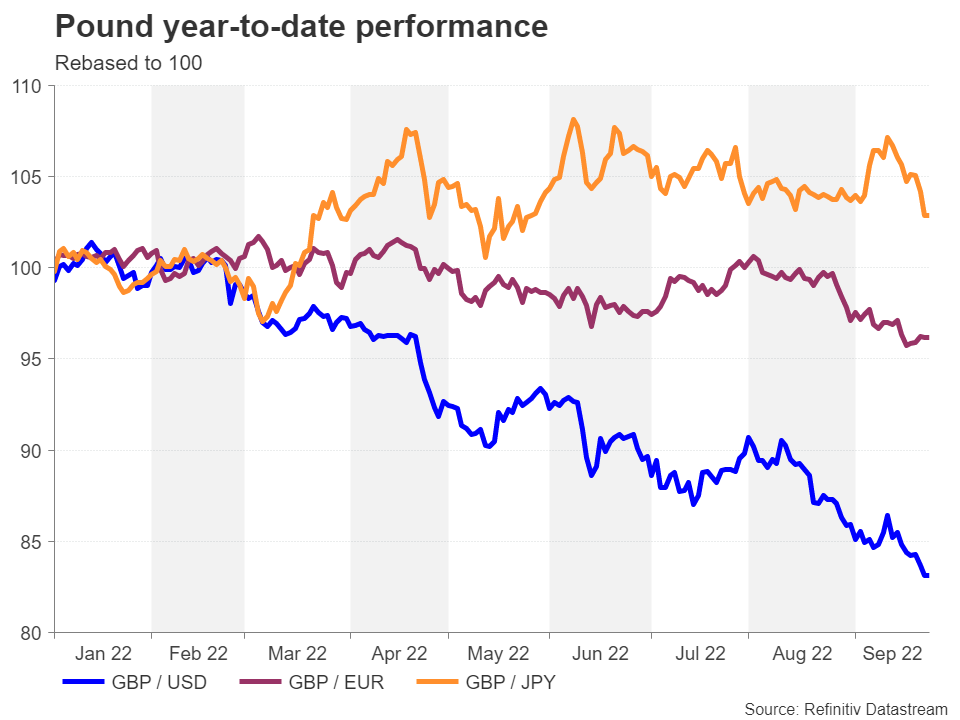
Final UK GDP readings for the second quarter due next Friday can be significant as well if there is an upward revision to the initial estimate of -0.1% q/q, which would ease fears that the UK economy is already in a technical recession.
For the Australian dollar, there may be some relief from the selloff if the manufacturing PMIs out of China on Friday point to improving economic momentum in September, while monthly GDP stats out Thursday in Canada might attract some attention for the loonie.
Forward Guidance: Post-lockdown Economic Momentum Fades with the Summer
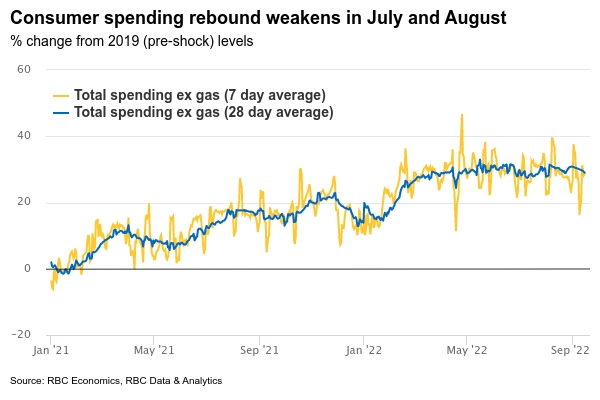
Canadian GDP likely remained flat through July—narrowly improving on Statistics Canada’s advance estimate for a 0.1% decline. It ticked up in August but not by much, gaining 0.1%. All three months point to a broader levelling out of economic activity as the post-pandemic rebound loses steam. Though the full impact of surging inflation and interest rates have yet to be felt, economic data has already been losing momentum. Employment outright declined in July and August alongside weaker readings in total hours worked. Both wholesale and retail sales saw activities flagging in July as well. And housing markets continued to retrench as interest rates rose. But offsetting those declines were higher oil production in Alberta as well as an increase in manufacturing sales volume (+0.6%).
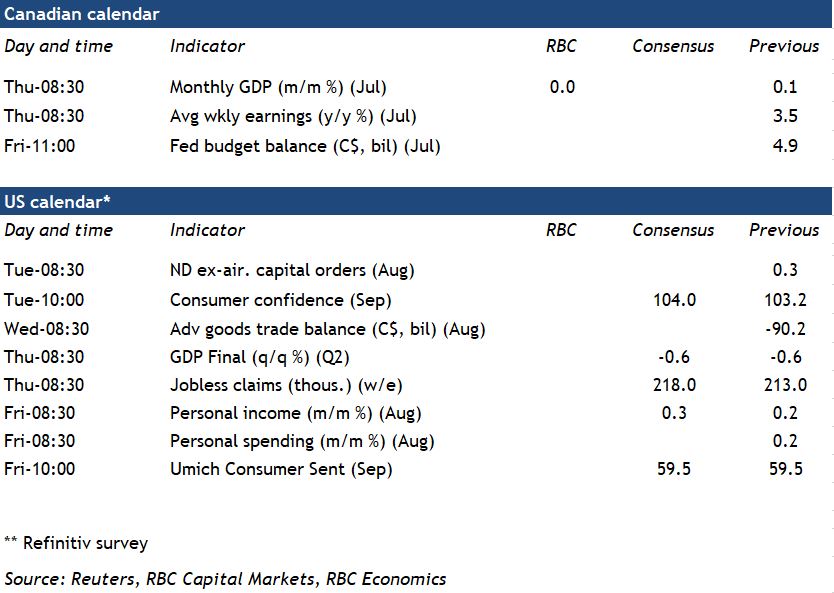
We expect headline Canadian CPI growth will also edge down in the months ahead on lower commodity prices and moderating global supply chain pressures. But inflation remains too high and too broad to prevent further aggressive Bank of Canada interest rate hikes. Those will continue to weigh on consumer demand as well as output growth into 2023. We expect the August flash GDP estimate to show only a small increase in output (+0.1%). And while spending is still strong, according to our own RBC cardholder data, it has levelled off slightly into the fall. Consumers will continue to feel the sting of surging inflation. And a higher cost of borrowing means debt servicing payments will consume a larger share of household disposable income. As the Bank of Canada continues on its hiking path, with another 50 basis point increase on the horizon in October, consumer purchasing power will continue to erode, steering the economy into a mild to moderate recession by next year.
Week ahead data watch:
- Next week’s job vacancy data will likely show an elevated level of available job postings in July. Job postings data still ran 60% above pre-pandemic levels during the same month.