Sample Category Title
A Timid Crypto Market Growth
Market picture
Bitcoin rose 2.6% to $22,300 in the past 24 hours amid rising stock indices and a weaker US dollar. Ethereum lags the market, losing 0.7% to $1715. Top altcoins performance ranged from -1.5% (Cardano) to +10% (Solana).
Total crypto market capitalisation, according to CoinMarketCap, rose 1% overnight to $1.06 trillion. The cryptocurrency Fear & Greed Index added 9 points to 34 by Tuesday, the highest since mid-August.
BTC is just a hair above its 50-day average, which should hardly be considered an encouraging bullish sign. The following intermediate stage of recovery that could revive the market is the 200-week average at $23.2K.
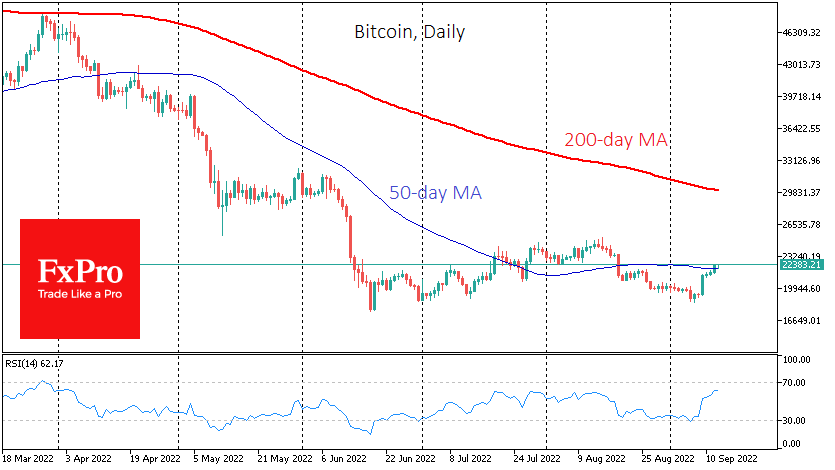
The latter dynamic suggests cautious market players, who are likely to shift their attention to global macro issues. The most critical of these today is the US inflation report, which could return optimism to the markets if price growth slows and sell-offs otherwise. TradingView shows a correlation between bitcoin and the S&P 500 index started to strengthen again last week.
Solana posted the highest daily gain among top coins. Despite the overall market decline, the number of NFTs issued on the Solana blockchain rose sharply, reaching 312K. The trading volumes of collectable assets on the network have also jumped.
News background
According to CoinShares, crypto funds saw a $63 million outflow last week, the highest in 12 weeks. Ethereum funds lost $62M, bitcoin funds – $13M, and short-BTC funds got an $11M inflow. These dynamics starkly contrast to the price behaviour and overall market capitalisation, showing that the institutions are not setting the prices here.
The bitcoin network’s hash rate has renewed its all-time high of 281.79 million TerraHash, shifting the projected date of the next halving from May 2024 to Q4 2023.
According to a Harris Poll survey, 70% of cryptocurrency investors are hoping to become billionaires, which is significantly above the number among traditional investors.
On September 19, due to increased regulatory pressure, Huobi will delist seven anonymous cryptocurrencies, including Dash (DSH), Monero (XMR) and Zcash (ZEC).
Bitcoin Skyrockets Ahead of ETH Merge and US CPI Release
Bitcoin is trading above $22 000 on Tuesday as it continues a week-long rally ahead of the US inflation data and a highly anticipated Ethereum network upgrade.
After falling below $19 000 on Wednesday to its lowest level since June, Bitcoin has rallied around 20%.
Bitcoin’s advance is also related to winning last week for US stocks. Bitcoin has been closely correlated to equity markets, particularly the Nasdaq (US100), and often follows the tech-heavy index.
Crypto investors are looking ahead to the August consumer price index report, scheduled to be released Tuesday. They want to see the direction inflation is going, which could give hints about the Fed’s future monetary policy decisions.
Meanwhile, the Ethereum network will complete a long-awaited upgrade called the Merge on September 15. The upgrade will transform the Ethereum blockchain from a proof-of-work to a proof-of-stake model. The update should significantly reduce the amount of energy required for the network to operate, decrease fees, and increase scalability.
Why should we concern?
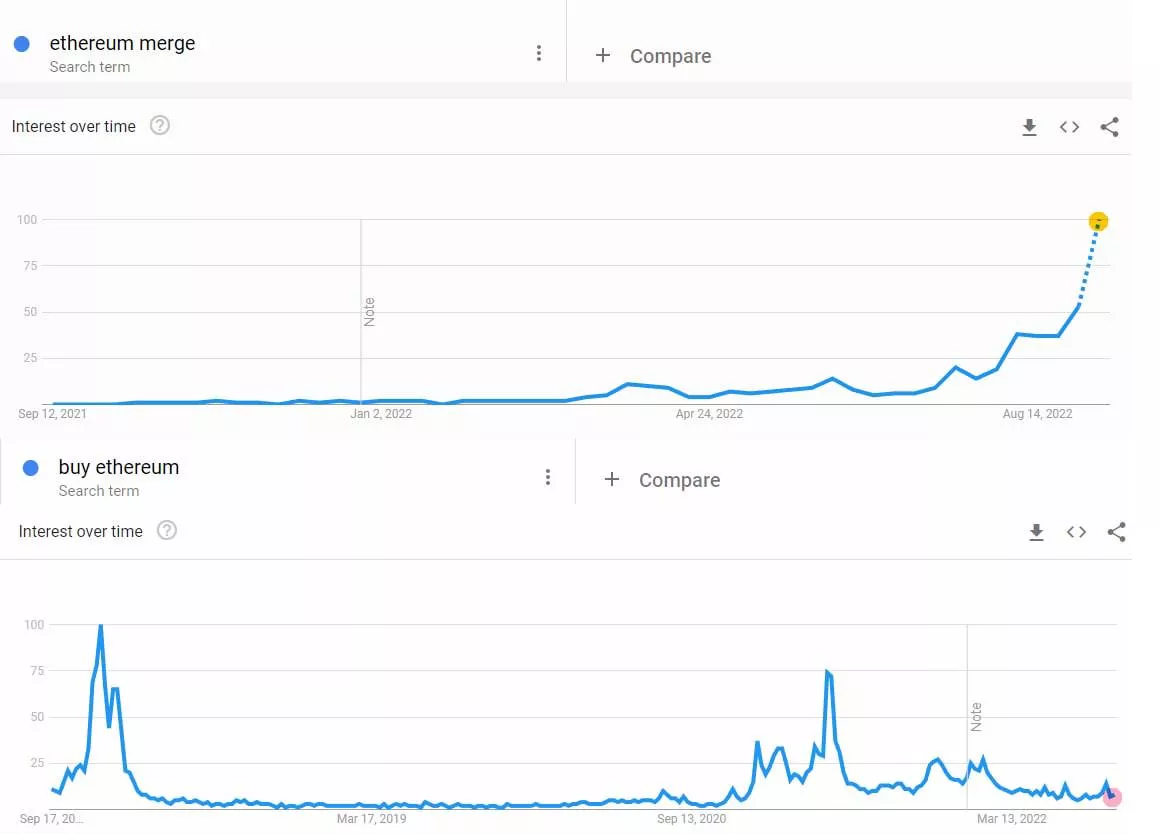
First, "ETH merge" Google requests are on the rise. At the same time, "buy ETH" requests are at their two-year lows, which is quite a negative factor ahead of the vast update. The community either doesn’t believe in the success, or they are following the "buy the rumors – sell the news" rule and waiting for the massive dump after the merge.
The second negative factor comes from history. Few people remember, but a similar event occurred in the bear market of November 2018, after which Bitcoin fell from $6000 to $3000. Back then, Bitcoin Cash split into Bitcoin Cash and Bitcoin SV networks.
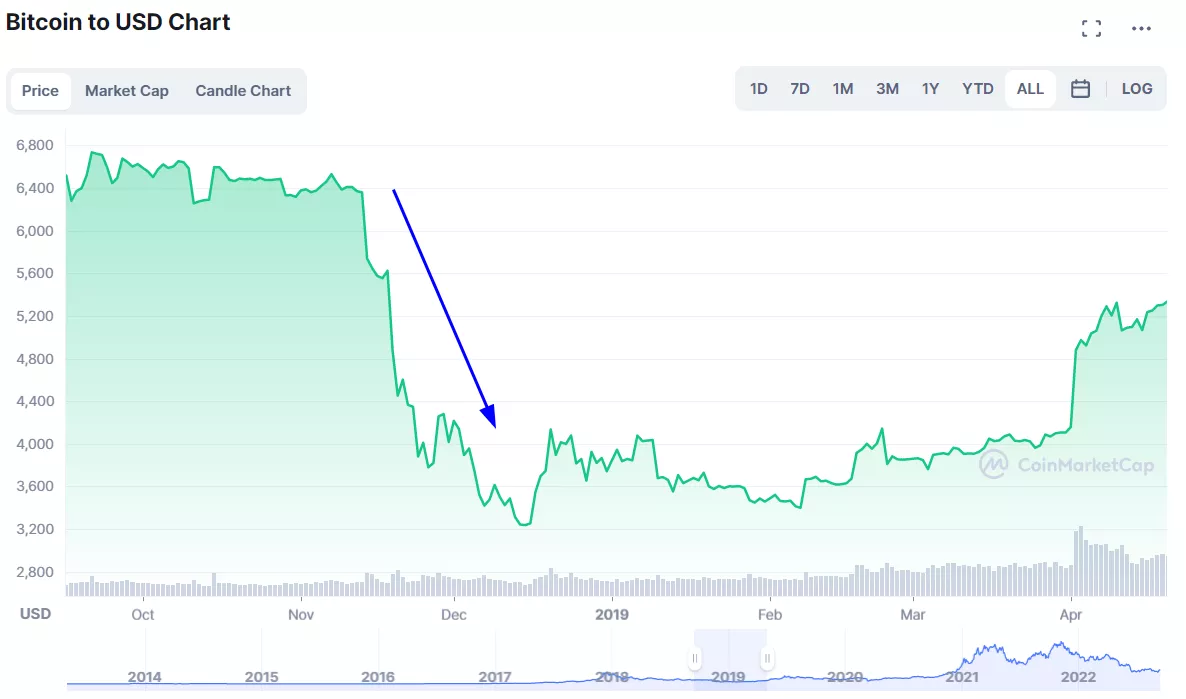
Nowadays, Ethereum is the most popular blockchain among developers. Therefore, ETH might drop if any issues appear during the merge, and many other projects built on the Ethereum blockchain might follow it. This dump may cause a wave of liquidations, and the whole market may crash.
However, we believe it isn’t what will happen, and a possible plunge will be just a correction ahead of the huge crypto market rally.
The crypto market always shows a great reaction to the US CPI release. If today's data is lower than expected -0.1%, the crypto market could take a breath of fresh air and increase. On the other hand, higher-than-expected CPI might return Bitcoin to under $20 000.Technical analysis
BTCUSD, Daily chart
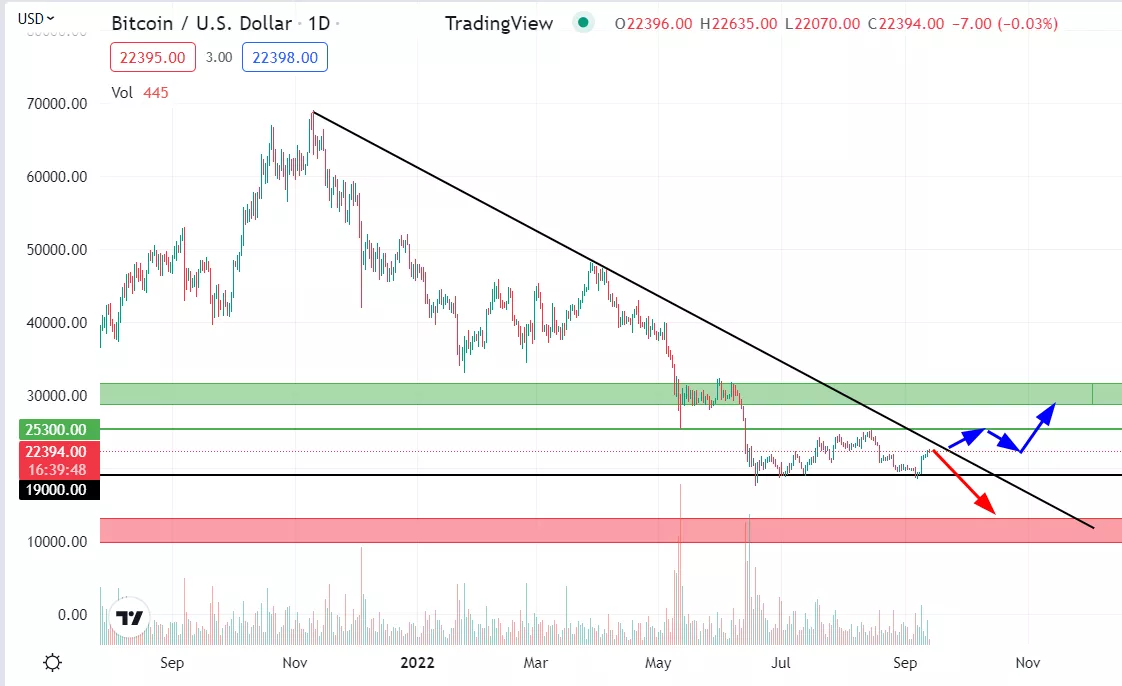
BTCUSD is trading close to the global descending trendline. If today’s CPI is lower than expected, the price might break above this resistance and keep moving towards $25 300 and the main target of $28 000.
However, if today’s CPI is higher than expected, BTCUSD might return to $19 000, and in this case, with a high probability, a breakdown of this level is possible and a further decline towards $12 000 after the Merge.
ETHUSD, Daily
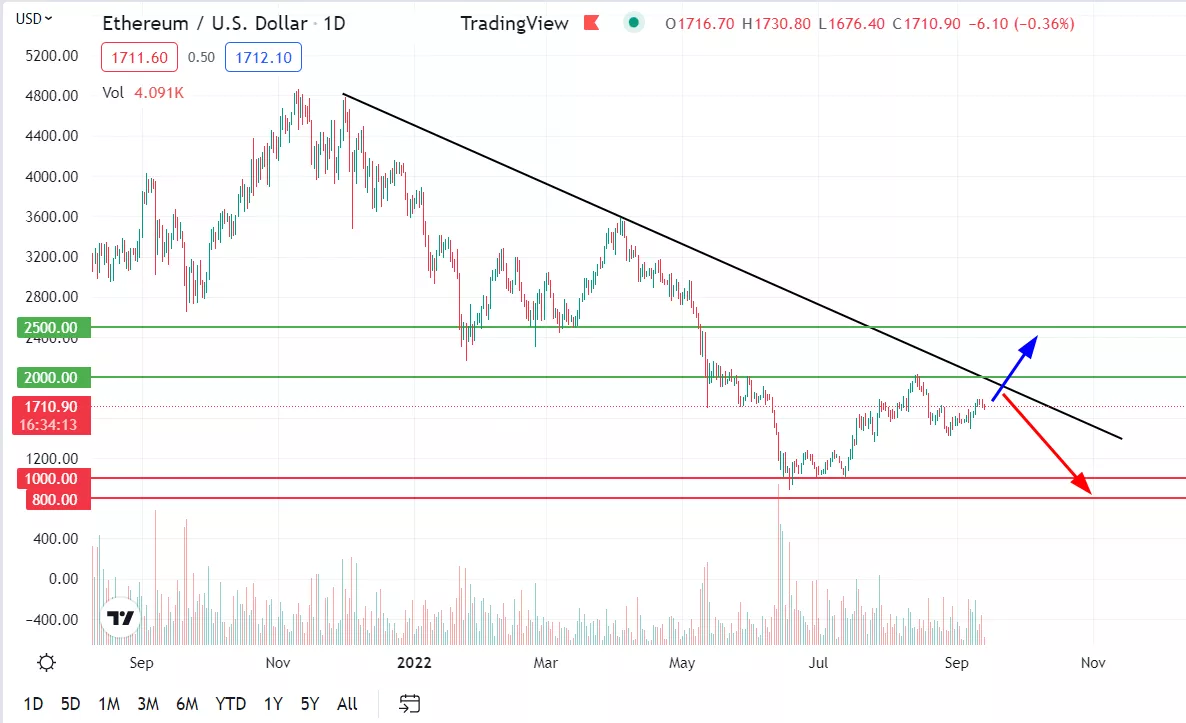
Ethereum is also trading close to the global descending trend line. If the price breaks above $2000, you might buy ETHUSD with the target at $2500.
In the pessimistic scenario, the price will bounce off the global descending trendline and decline to the $800 - $1000 support range.
Australian Dollar Extends Gains on Solid Data
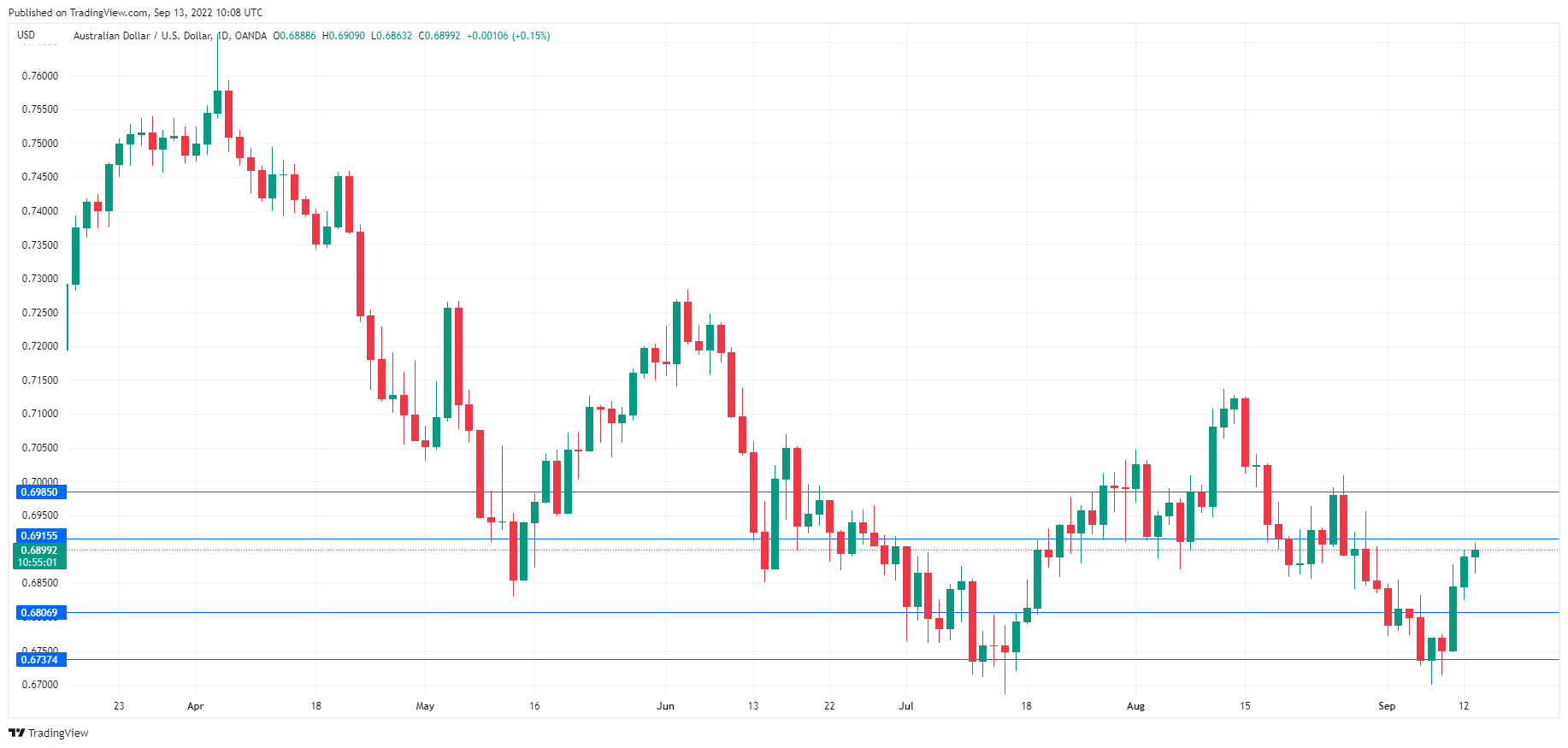
The Australian dollar continues to rally and has climbed above the 0.69 level for the first time in September. AUD/USD has gained 150 points since Thursday, as the US dollar continues to lose ground.
Australia released key confidence indicators earlier today, and the decent numbers gave the Aussie a slight push higher. NAB Business Confidence climbed to 10 in August, marking a 4-month high. This was up from 7 and above the forecast of 6 points. NAB Business Conditions remained steady at 20, shy of the estimate of 27 points. Westpac Consumer Sentiment for September bounced back with a strong 3.0% gain, crushing the forecast of -0.3% and recovering from the -3.0% read in August. The rebound is somewhat surprising, as it was the first gain since November 2021 and the RBA just raised interest rates. The survey noted that consumer confidence still remains low, at 84.4. Perhaps the drop in gasoline prices gave a jolt to consumer optimism.
Next up is the Australian employment report on Thursday. The market consensus stands at 35.0 thousand for August, which would be a huge rebound after the -40.9 thousand reading in July. A strong release will make it easier for the RBA to remain aggressive as it continues to battle inflation.
US inflation next
It could be a busy day for the markets, with the US releasing August inflation later today. Headline CPI is expected to drop for a second straight month, from 8.5% to 8.1%, driven by lower gas prices. Core CPI, however, is expected to rise to 6.1%, up from 5.9%. If headline CPI does fall, it would mark a second straight decline, and likely lead to some headlines proclaiming that inflation has peaked. However, Fed Chair Powell has said loud and clear that the Fed will pursue its aggressive stance, even if one or two inflation reports show declines. The markets were exuberant after the unexpected drop in July inflation, sending the US dollar sharply lower. Since then, investors appear to have internalized that the Fed is not about the reverse policy, and I don’t expect a repeat performance from the US dollar, even if inflation is lower than expected.
AUD/USD Technical
- AUD/USD has support at 0.6807 and 0.6737
- There is weak resistance at 0.6915, followed by resistance at 0.6985
EUR/USD: Euro Looks for Renewed Attack Underpinned by Expectations for Favorable US CPI Numbers
The Euro keeps firm tone in European trading on Tuesday, despite downbeat data from Germany (Aug CPI rose to 7.9% from 7.5% in July / economic sentiment weakened further into Sep and hit the lowest since 2008 recession) as traders expect good news from the US inflation report, due later today.
US inflation is expected to ease further (Aug f/c 8.1% vs July 8.5%) that may impact Fed’s rate hike trajectory, as further easing in price pressures would soften central bank’s current aggressive stance (on track for another 75 basis points hike in Sep meeting.
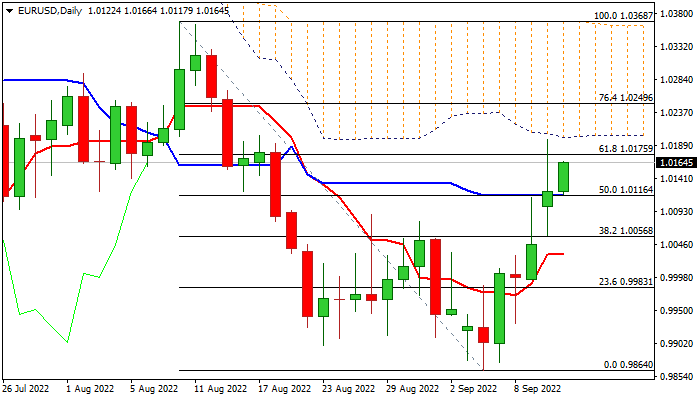
Technical picture shows bulls in play, despite signals of hesitations from long shadows of Monday’s daily candle, as the pair registered a marginal close above 1.0116 (daily Kijun-sen / 50% of 1.0368/0.9864) and looking for another probe through 1.0175 (Fibo 61.8%) that would open way for renewed attack at key barrier at 1.0201 (base of thick daily cloud).
Bullish momentum remains strong on daily chart, adding to positive near-term outlook, though the rally may again face headwinds from the cloud.
Bullish scenario sees penetration and close within the cloud that would unmask next key barriers at 1.0334/68 (falling 100DMA / daily cloud top / lower top of Aug 10).
The pair may hold in extended consolidation if bulls repeatedly stall at cloud base, but the action needs to stay above 1.0116 (reverted to solid support) to keep bullish bias.
Res: 1.0175; 1.0197; 1.0201; 1.0249.
Sup: 1.0116; 1.0089; 1.0056; 1.0023.
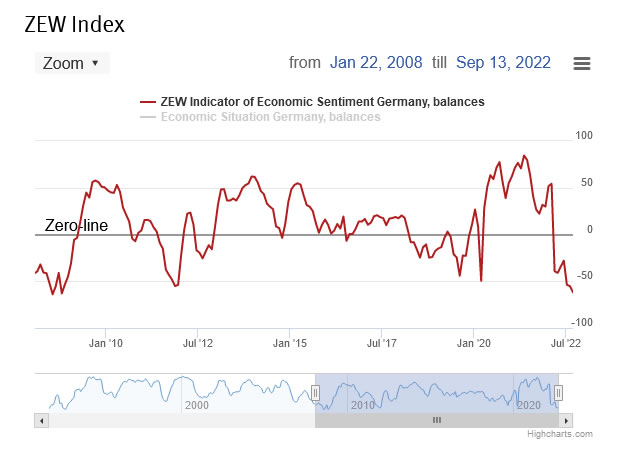
Germany ZEW dropped to -61.9, outlook worsened significantly
Germany ZEW Economist Sentiment dropped further from -55.3 to -61.9 in September, worse than expectation of -60. Current Situation index dropped from -47.6 to -60.5, below expectation of -50.5.
Eurozone ZEW Economic Sentiment dropped from -54.9 to -60.7, below expectation of -58.3. Current Situation index dropped -16.9 pts to -58.9.
"The ZEW Indicator of Economic Sentiment decreased again in September. Together with the more negative assessment of the current situation, the outlook for the next six months has deteriorated further. The prospect of energy shortages in winter has made expectations even more negative for large parts of the German industry. In addition, growth in China is assessed less favourably. The latest statistical figures already show a decline in incoming orders, production, and exports," comments ZEW President Professor Achim Wambach on current expectations.
GBPUSD Bounces off 37-Year Low, Downtrend Intact
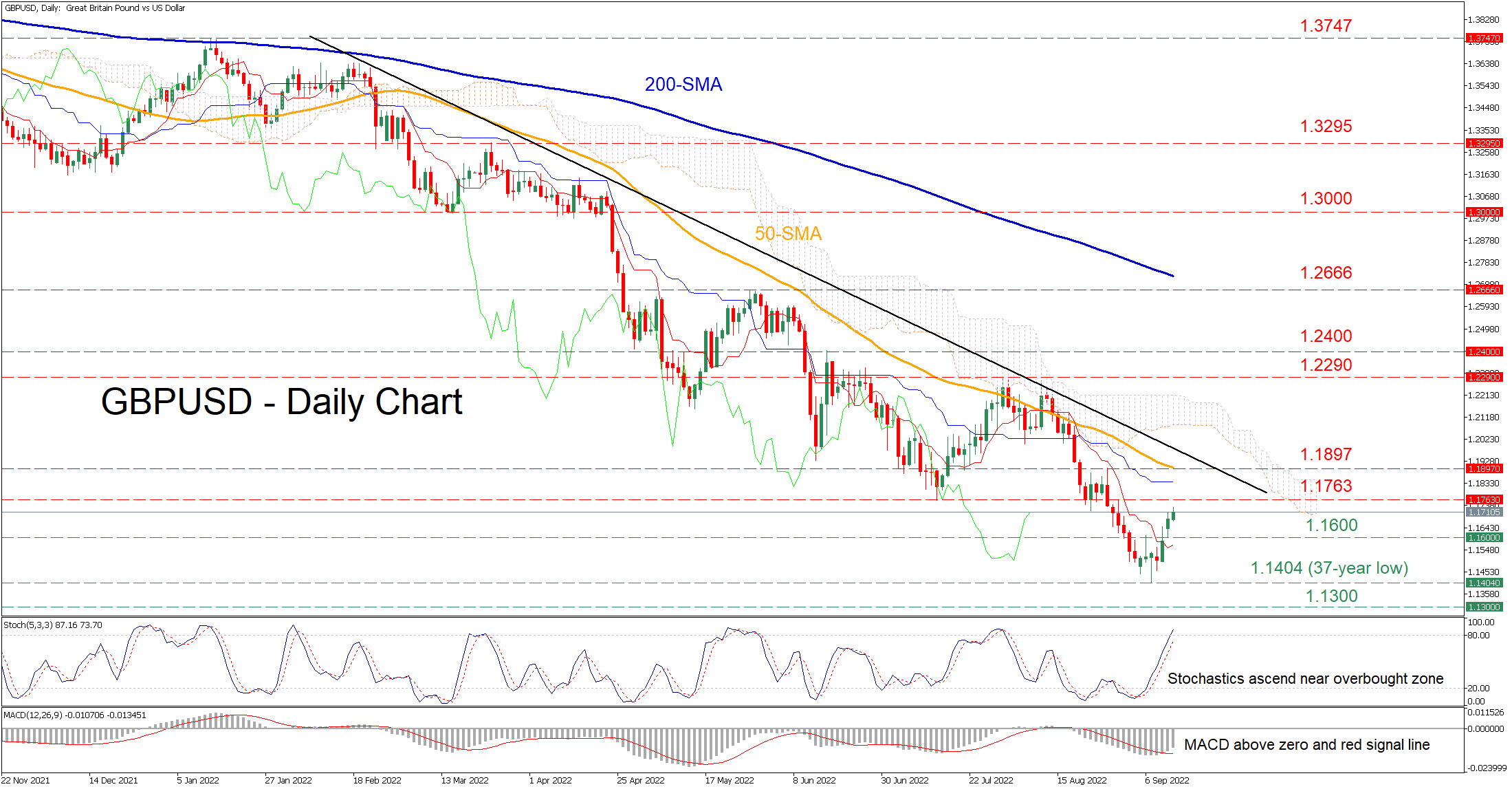
GBPUSD has been in a prolonged downtrend since the beginning of the year, generating a clear structure of lower highs and lower lows. Although the pair managed to find its feet at the 37-year low of 1.1404 and recoup some losses, it is a long path ahead until it reverses its bearish long-term structure.
The momentum indicators currently suggest a cautiously positive near-term tone. Specifically, the stochastic oscillator is ascending in the overbought area, while the MACD histogram has crossed above its red signal line but remains in the negative territory. Nevertheless, the price action remains way below the Ichimoku cloud, endorsing a broader bearish short-term picture.
Should buying interest persist, the price could challenge the recent support region of 1.1763. Conquering this barricade, the bulls might aim for the 1.1897 peak, which overlaps with the 50-day simple moving average (SMA). Crossing above the latter, the July high of 1.2290 could prove to be the next barrier for the pair to overcome.
To the downside, bearish actions may encounter initial support at the 1.1600 hurdle. Failing to halt there, the price could descend towards the 37-year low of 1.1404. A violation of the latter would send the pair to uncharted waters, where the 1.1300 psychological mark could act as the next support.
Overall, despite the latest rebound, GBPUSD is trading below its descending trendline and both the 50- and 200-day SMAs, indicating that the technical picture remains bearish on all time horizons. Nevertheless, a break above the 1.2290 zone could alter its short-term picture back to positive.
Sentiment Positive ahead of US Inflation Report
Asian shares rose on Tuesday, tracking the positive overnight cues from Wall Street as investors turned cautiously optimistic over the highly anticipated US inflation report. In Europe, stock futures point to a mixed open along with US markets, despite the recent positive market sentiment. Easing oil prices have injected financial markets with a sense of optimism that inflation may slow in the United States, resulting in less aggressive rate hikes from the Federal Reserve.
In the currency space, the dollar stumbled into the week despite the recent hawkish comments from Fed officials including Jerome Powell. Oil prices remained gripped by global demand concerns while gold drew inspiration from a weaker dollar but still found upside capped by rate hike bets.
Time for USD bulls to rest?
After kicking off the week in a depressed fashion, the dollar could find itself exposed to further losses.
Fed hawks are clearly in the building and strong US economic data continues to stimulate expectations around the Fed not slowing the pace of hikes anytime soon. However, US benchmark inflation likely slowed for a second month in August thanks to falling gas prices. Markets are forecasting headline CPI to have cooled in August to 8% compared with the 8.5% witnessed in July. The core reading may give a truer picture of where price pressures are heading and the risks ahead. This is expected to move higher with the annual rate rising to 6.1% from 5.9%. While the drop in the headline may not be enough to derail the Fed from raising rates by 75 basis points for the third time in 2022, it may impact future policy meetings. The peak in the Fed funds rate has hit 4% in early 2023, a cycle high.
Other key US reports that may influence the dollar this week will be the initial jobless claims, August retail sales, and industrial production figures among others. A strong set of figures may reinforce aggressive rate hike bets which could support the dollar, while a negative set of reports could dampen expectations around more super-sized hikes, dragging the greenback lower.
Currency spotlight – GBPUSD
The path ahead remains rocky and uncertain for the British Pound.
Uncertainty over the UK’s economic outlook, the Bank of England’s game plan, and direction from the Conservative government will most likely influence the currency’s outlook. Yesterday, there was a barrage of UK data including GDP and industrial production, which offered some insight into the UK economy.
The British economy expanded by 0.2% in July month-on-month, rebounding from a 0.6% fall in June, but this was still below the market forecast of 0.4%. Year-on-year, GDP grew by 2.3% in July which was higher than the 1.9% seen in June but still below the market forecast of 2.6%.
Today, jobs data released was largely in line with analyst estimates and continued to confirm that the UK jobs market remains tight. Unemployment fell to its lowest rate since the early 1970s this summer even as the economy stalled. Importantly, wage growth was buoyant pointing to more aggressive tightening by the Bank of England. Money markets are currently predicting a 73% probability of a 75-basis point rate hike by the bank at next week’s rearranged meeting.
Prices in GBPUSD remain under pressure on the daily charts despite the current bounce. Should 1.1750 prove to be reliable resistance, the major could resume its downtrend ahead of the bank’s policy meeting on Thursday 22 September.
Commodity spotlight – Gold
Gold’s near-term outlook will most likely be heavily influenced by the US inflation report this afternoon.
As highlighted earlier, US inflation is expected to cool for a second consecutive month. If such an outcome results in a weaker dollar and reduced hike bets, zero-yielding gold could shine back towards $1740 where the 50-day SMA resides. Alternatively, an upside surprise in US inflation could see gold tanking like a house of cards as aggressive rate hike expectations beyond September mount. There is strong support around $1700.
Daily Technical Analysis
EUR/USD
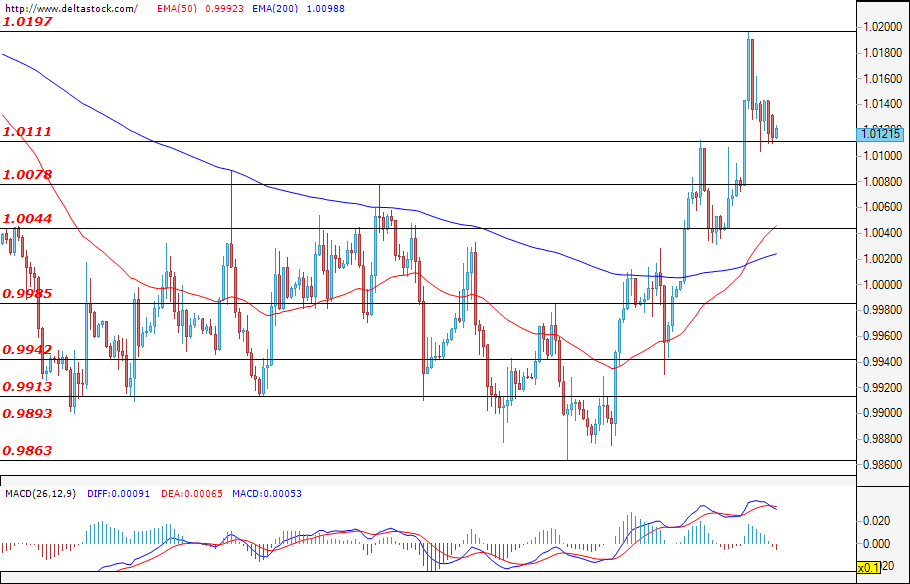
The single European currency continued to recover the losses it suffered after its aggressive decline since the beginning of summer. The day started off calmly, but after comments on further ECB policy tightening, we saw a break of the 1.0110 resistance and a new monthly high. Around 1.0197, the bears found a good entry price and pushed the EUR/USD back towards 1.0110 by the end of the trading session. Today at 09:00 GMT, we will see the ZEW economic research institute's assessment of the economic state of Germany. If the data comes out positive, then it could help the euro even more and we could see the rally reach higher peaks than yesterday. However, let's not also forget the strong pressure from the U.S. dollar, which could only intensify with a positive market reaction to the upcoming U.S. inflation data at 12:30 GMT.
USD/JPY
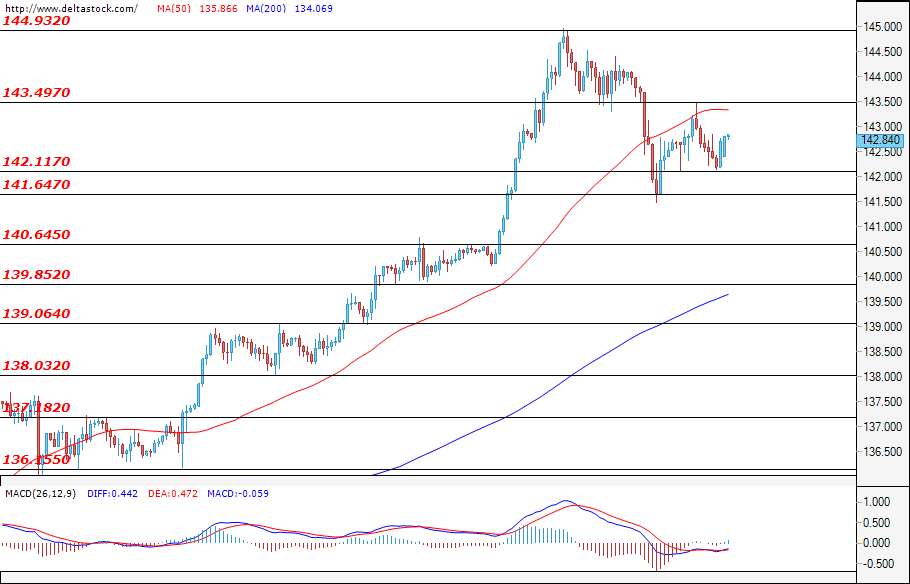
The dollar's weakness is also reflected in its scuffle against the yen. The consolidation here continues after hitting a new multi-year high last week. The day started with slight fluctuations in the rate and a bounce from the support at 142.11. However, the USD/JPY quickly rose towards the formed resistance at 143.49, where it closed the day. Today, however, the U.S. inflation data report at 12:30 GMT could strengthen the dollar and the market could look to reach a new high by the end of the week. Some surprises, however, should still not be excluded, as data suggesting increased inflation in the U.S., coupled with a declining dollar, could push the currency pair towards its next key support.
GBP/USD
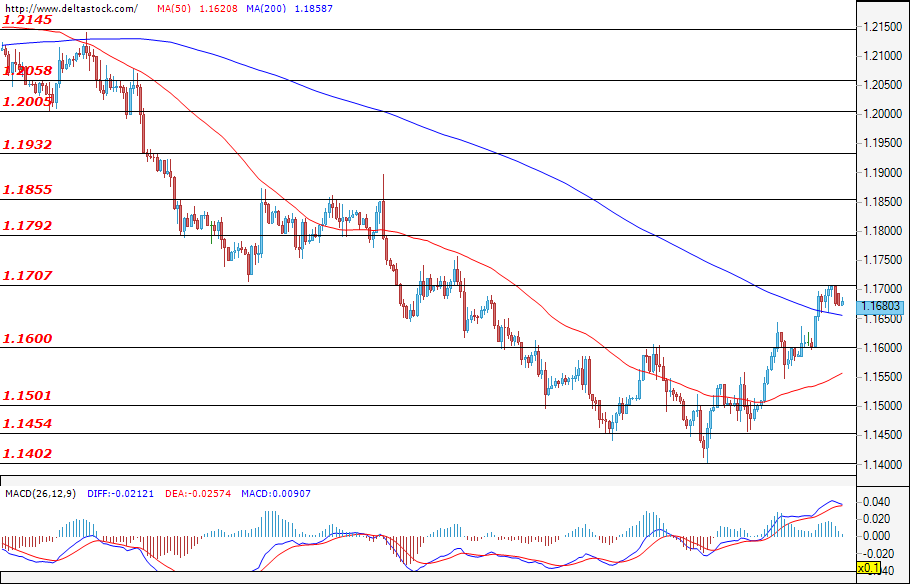
The Cable's first trading day this week was a successful one. The currency pair started its rise even before the opening of the London session, but after that, the gains accelerated even more. The negative data on the declining GDP and the weaker production did not move the GBP/USD one inch lower and it made a new monthly high of 1.1707. There, however, it found a resistance, which was not breached by the end of the day and so the GBP/USD managed to finish its trading session at around 1.1682. Today, it is important to monitor the data on the current unemployment and the average monthly income in the UK at 06:00 GMT, as well as the U.S. dollar market action following the next U.S. inflation release at 12:30 GMT. Whether the growth will continue or the dollar will regain its strength remains to be seen today.
EUGERMANY40
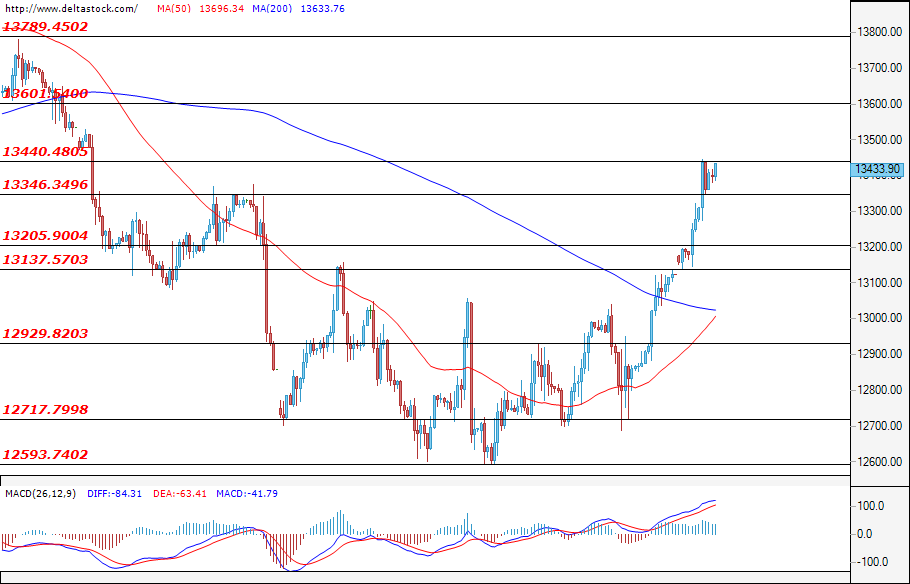
Monday was an extremely successful day for the German index. The instrument had low liquidity before the European session opened, but quickly managed to break through the 13205 resistance and shot up by nearly 250 points. A resistance then formed at 13440 at the U.S. market open. The mentioned key level was attacked again by the end of the day, but unsuccessfully so. Today at 09:00 GMT, we will expect the ZEW’s assessment of the economic state of Germany, and if we see positive data, then this may result in even higher prices. However, a scenario in which the index declines due to its correlation with the American indices should still not be excluded. Should the latter take a turn for the worse, they could potentially drag the EUGERMANY40 down with them, if the dollar eventually runs hot again.
US30
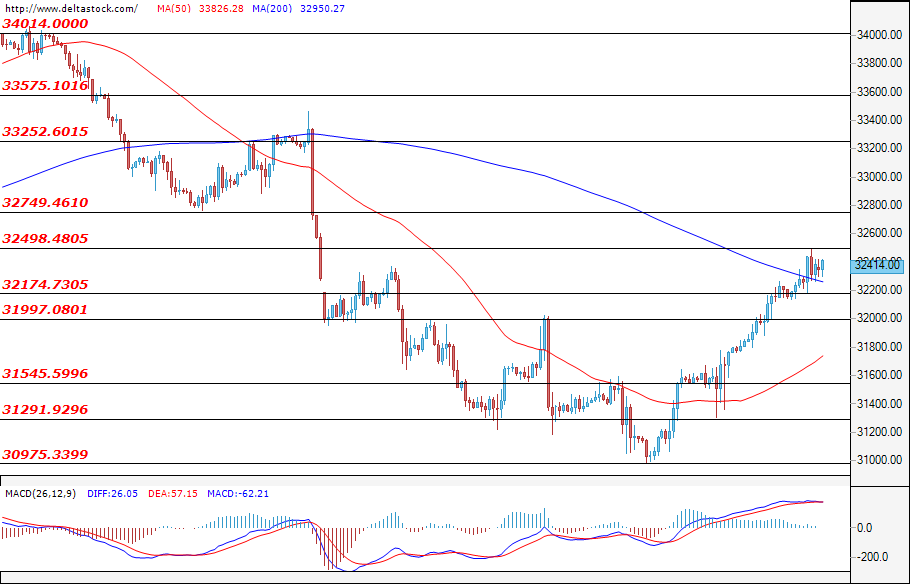
The blue-chip index also saw upward movements on the first day of the week. In the early hours of the day, liquidity was rather low, but after the opening of the European session, the US30 took off. Later, after the opening of Wall Street, we saw a resistance forming at around 32498, where the rally grinded to a halt. Of particular importance to the direction of the US30 is today's U.S. inflation data at 12:30 GMT. If inflation continues to be lower than expected, then the rise of the index may continue, but if a new wave of uncontrollable price growth is noticed, then a downward wave and a search for a new weekly bottom could be a very plausible scenario.
Italian Election: Will a Far-Rright Victory Hurt the Euro?
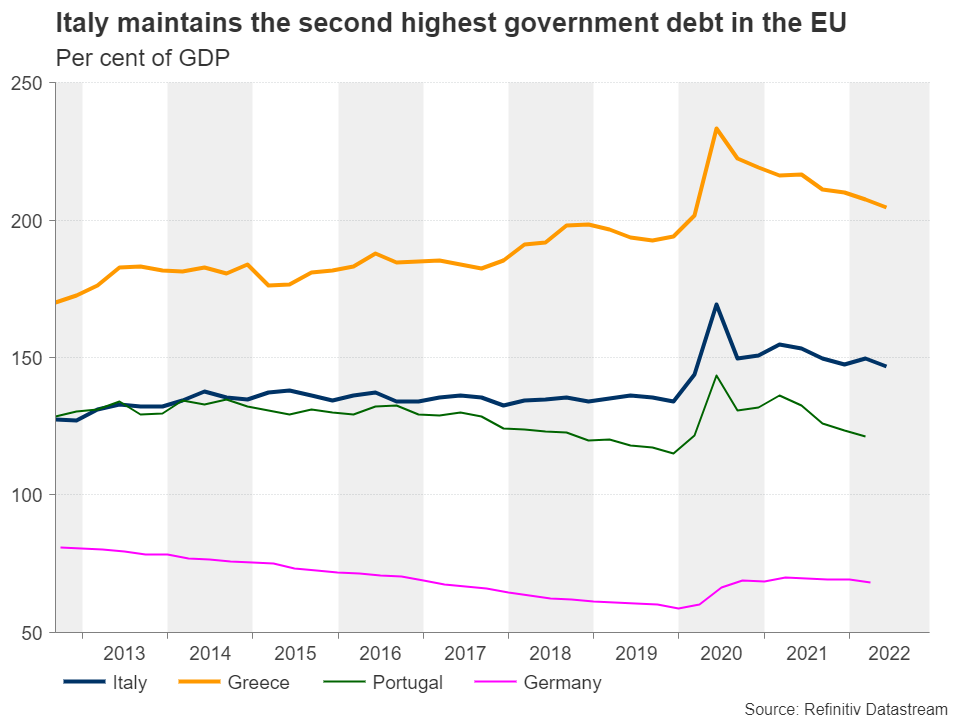
Italy will head to the polls on September 25 amid the painful energy crunch. The political landscape in the third largest EU economy has been notoriously unstable and it might enter a new era of uncertainty during the next few months, as the far right is largely expected to come into power for the first time after a century. The winning alliance, however, may find its hands tied in delivering an ambitious fiscal plan, keeping debt risks in the shadows, at least in the short term.
Right-wing parties lead the polls
The appointment of the popular and former ECB chair Mario Draghi as the new Italian prime minister raised a feeling of political stability back in 2020. That’s right, in Italy it is not strange to elect a prime minister who is not a leader of a party or a member of the parliament.
Leading a three-party coalition composed by the centre-right Forza Italia, the far-right League, and the populist Five Star Movement, the technocratic caretaker ‘super Mario’ managed to secure the largest slice of the EU recovery fund of around 200bln euros during the pandemic.
But like so many before, he could not preserve his crown for long despite the international respect for him. Skyrocketing consumer prices following the war in Ukraine saw the unity collapsing within the coalition, with the Five Star Movement opposing Draghi’s generous economic package and then snubbing him during a confidence vote along with the remaining coalition members.
Georgia Meloni, the leader of the hard-right and national-conservative party Brothers of Italy, is now the favorite candidate to replace Draghi and govern the country with Berlusconi’s Forza Italia and Salvini’s hardline League. Well, the truth is that despite her 20 years of experience in politics, her party, which is a postwar predecessor of the neo-fascist Social Movement, has only managed to boost its appeal after 2018, surging from 4.0% of the vote to top the Democratic party at 25% according to the polls. Also, her coalition wouldn’t have been successful in boosting its popularity to 48% of votes if the centre-left had not been fragmented in the first place.
National conservatism
The rise of the far right has been considered a threat to the European Union for some time now, especially after the migration flows started to ramp up a decade ago. Meloni is well known for her national and Eurosceptic ideologies, and although she has distanced herself from neofascism, her slogan of “Less Europe, but a better Europe” as well as her close relations with Hungary’s nationalist leader is feeding quite a bit of anxiety about renewed political tensions within the EU.
Particularly, investors are concerned whether Meloni and her partners will jeopardize the terms that Italy committed to undertake under the recovery fund after claiming that the plan is targeting areas that Italy is not competitive. She later tried to calm down those worries, expressing her support to European policies, though she will have to bring her coalition partners on her side too in order to be more convincing. Recall that Salvini attacked the deal too, citing the risks that reforms under the agreement could cause on pensions and welfare. His unstable relations with Meloni are already questioning the coalition's future, but he will probably prioritize an election win for now, providing his support in Parliament along with Berlusconi.
Note that a referendum in 2020 reduced the size of Parliament by a third to 400 deputies in the Chamber from 630 previously and 200 Senators from 315 before. Also, about 36% of members will be elected in the first-past-the-post vote, where only one MP will represent each party in a region. Hence, there is a risk that voters may either switch to a candidate they don’t like or to a party they don’t support, and that risk is larger for parties that don’t have previous experience in governing unless they create an alliance.
Fiscal budget may resurface debt crisis fears
Excluding support for NATO and Ukraine, the new fiscal budget could be another topic of controversy, but it won’t be the first time. Being new in the role, Meloni will probably pledge to go big on spending domestically with scope to gain public trust at a time when the energy crisis promises a tough winter ahead. But seeking channels of finance could be a complicated task.
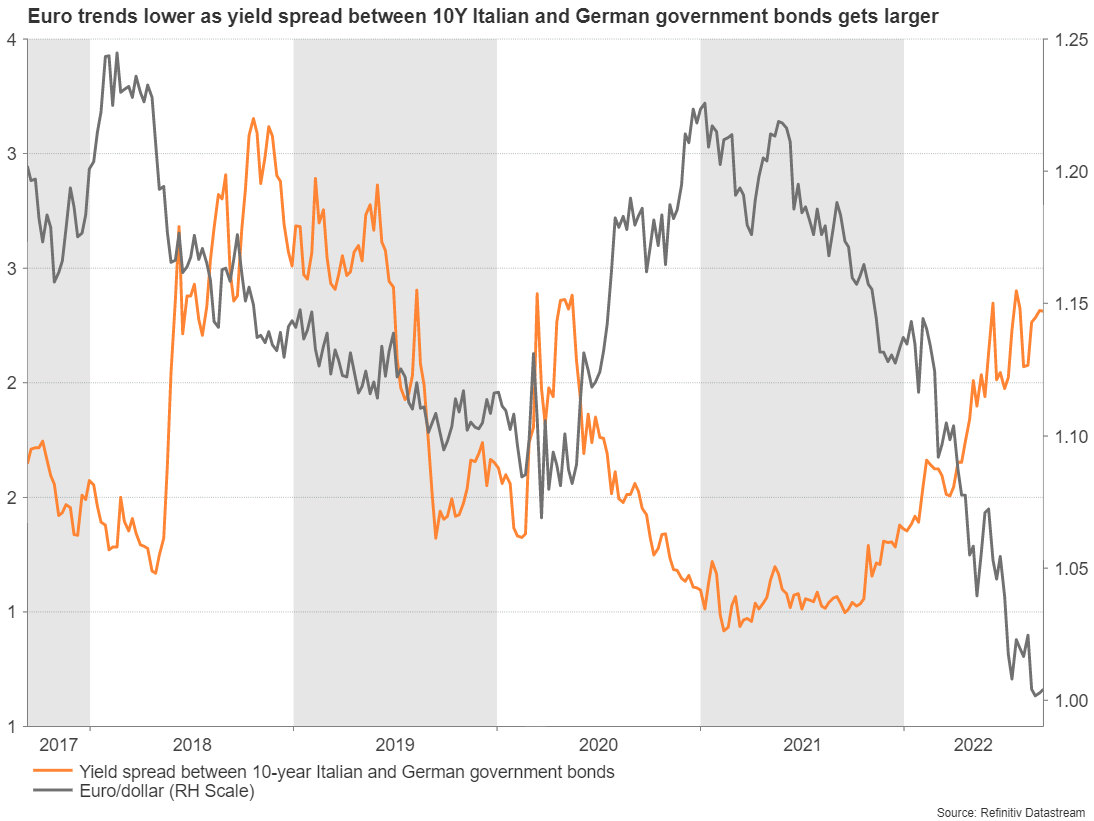
It’s clear that the EU’s recovery fund will not be used for offsetting energy bills. The ECB cannot be guaranteed as a bond buyer either following the termination of its 1.7tn euros pandemic scheme and its main 3.3tn euros asset purchasing program, unless there is a real risk of insolvency. Memories from the 2011 debt crisis, when the same coalition was in power, may also keep liquidity in Italian bond markets dry for longer, while reliance on economic growth will not be a wise thing to do given the growing recession risks in a country, whose debt is the second highest in the EU.
Therefore, with rising interest rates widening the spread between the 10-year Italian and German bond yields, making borrowing more expensive for the indebted Italy, the new prime minister may have limited options to finance any meaningful tax cuts and welfare reforms.
The above suggests she will probably comply with the EU budget rules – at least at the beginning – and pressure the union for more finance only if her party’s popularity gets damaged. Perhaps if the far right also gains power in other EU member states, she might have some backing.
Internally, some drama cannot be ruled out within the political elite if the alliance requests a change in the way the president is elected.
EUR/USD
Turning to FX markets, a right-wing dominance is considered negative for the eurozone’s unity and therefore for the euro. However, the cloudy economic and geopolitical circumstances in the region are currently leaving little room for rebellions in Italy as all attention remains on how the EU member states will secure enough energy supplies for the months ahead. That is somehow explaining the euro’s neutral reaction to Meloni’s rising chances of victory, while also foreseeing tensions to be moderate and not disruptive for the currency at least as long as public finances are manageable.
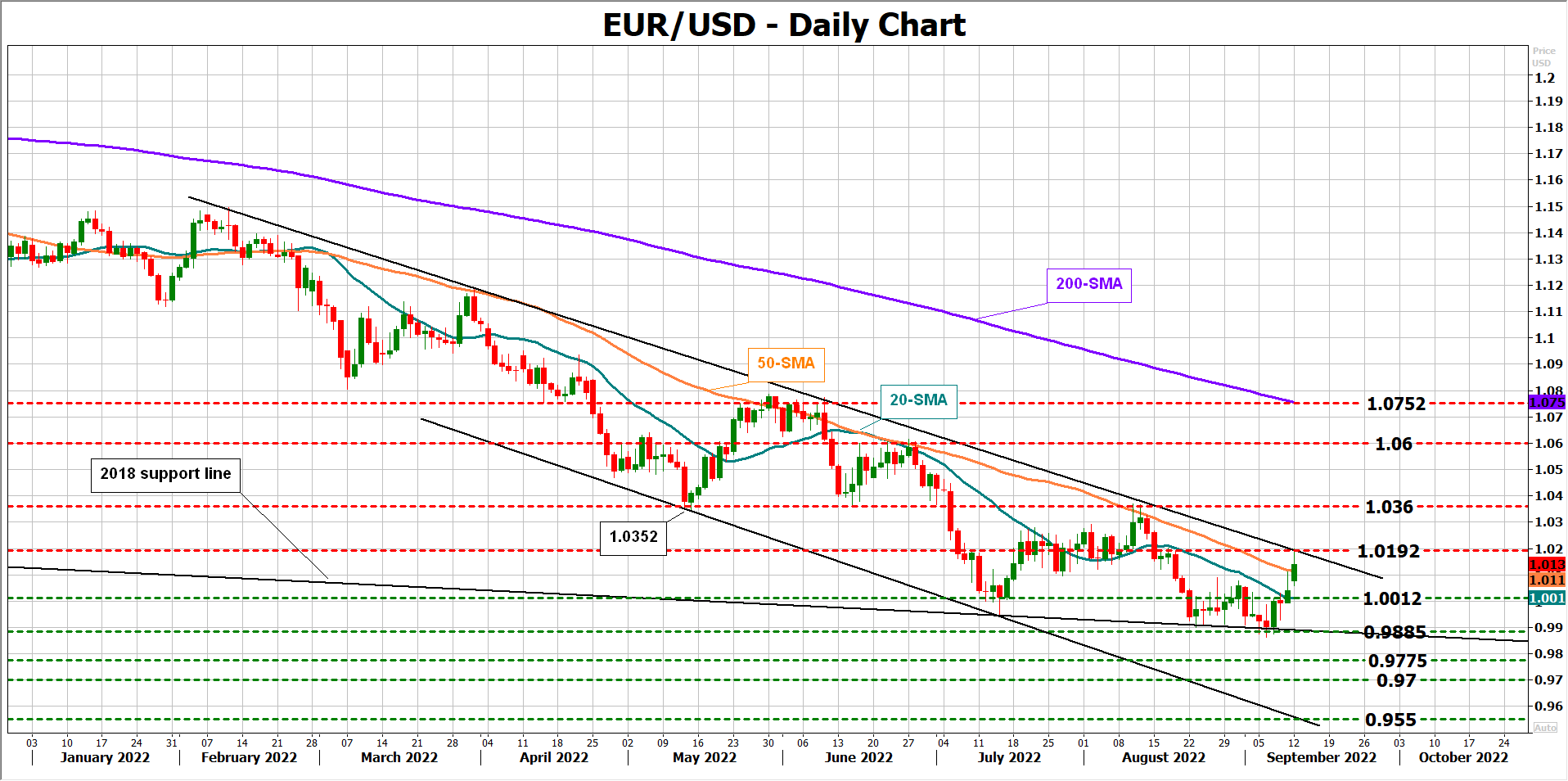
From a technical perspective, euro/dollar will need to stage a durable move above the bearish channel at 1.0192 to boost buying confidence and shift attention towards the August high of 1.0367. If the pair creates a higher high above it, violating the negative trend in the market, the bullish wave could gain another leg up to 1.0600.
Should the price start a new bearish round within the channel, some consolidation could commence around 1.0012 before the crucial support line, which connects the lows from August 2018, comes under the spotlight again around 0.9885. Failure to pivot here could print a new lower low somewhere between the 0.9775 and 0.9700 levels. If selling pressures intensify, the next stop could be around the channel's lower boundary at 0.9550.
EURJPY Eases after the Rally Towards 7½-Year High
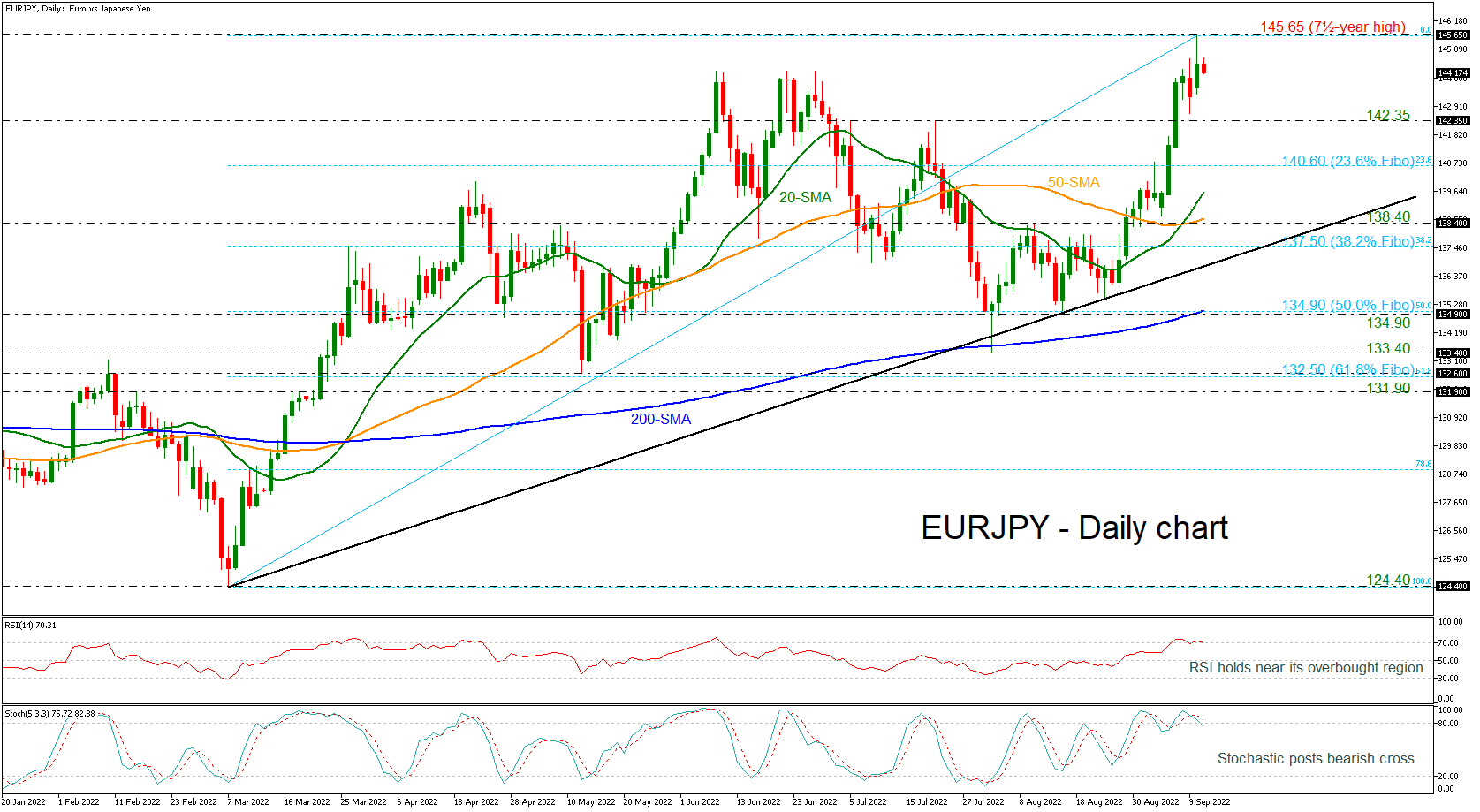
EURJPY skyrocketed to a fresh seven-and-a-half-year high of 145.65 on Monday’s sessions with the technical oscillator suggesting an overbought market.
The RSI indicator is turning lower near the 70 level, while the %K and the %D lines of the stochastic oscillator posted a bearish crossover, suggesting an extension to the downside in the short-term timeframe. However, the 20- and 50-day simple moving averages (SMAs) created a bullish cross and the price is still developing well above them and the uptrend line.
Should the price extend declines, the 142.35 support and the 23.6% Fibonacci retracement level of the up leg from 124.40 to 145.65 at 140.60 could be the next levels to have in mind. Below that, the focus could shift straight to the SMAs between 139.63-138.40. If the latter permits for further weakness, the next stop could be around the long-term ascending trend line and the 38.2% Fibonacci of 137.50.
On the other hand, a move back to the upside could retest the multi-year high at 145.65 before attention turns to 149.75, registered in December 2014.
Turning to the medium-term picture, the bullish outlook came back into play after the bridge of the previous highs. For a bull market though traders need to wait for a clear close above 145.65.
Overall, EURJPY holds a bullish profile both in the short and the medium-term.