Sample Category Title
USD/CHF Mid-Day Outlook
Daily Pivots: (S1) 0.9495; (P) 0.9553; (R1) 0.9596; More...
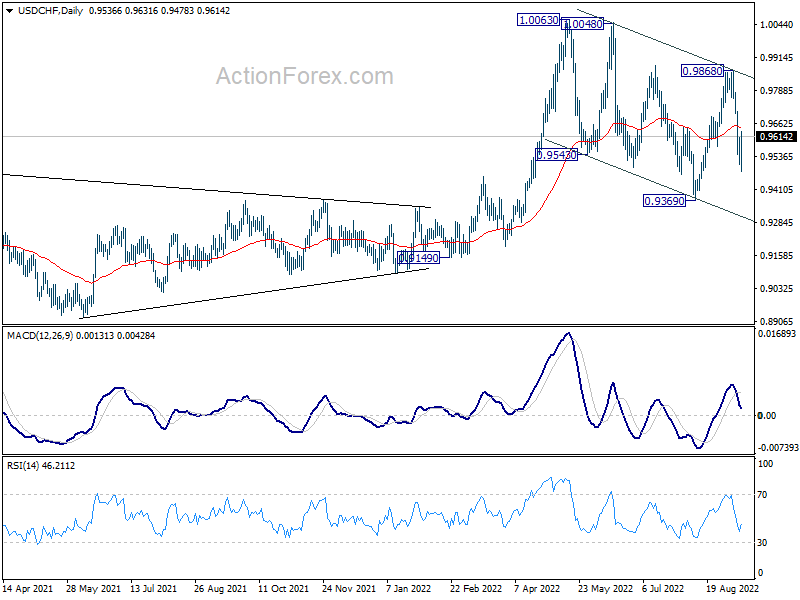
Intraday bias in USD/CHF is turned neutral with breach of 0.9625 minor resistance. Overall, it's still in corrective pattern from 1.0063. Below 0.9478 will extend the fall from 0.9868 towards 0.9369 support. On the upside, firm break of 0.9868 resistance will argue that larger up trend is ready to resume.
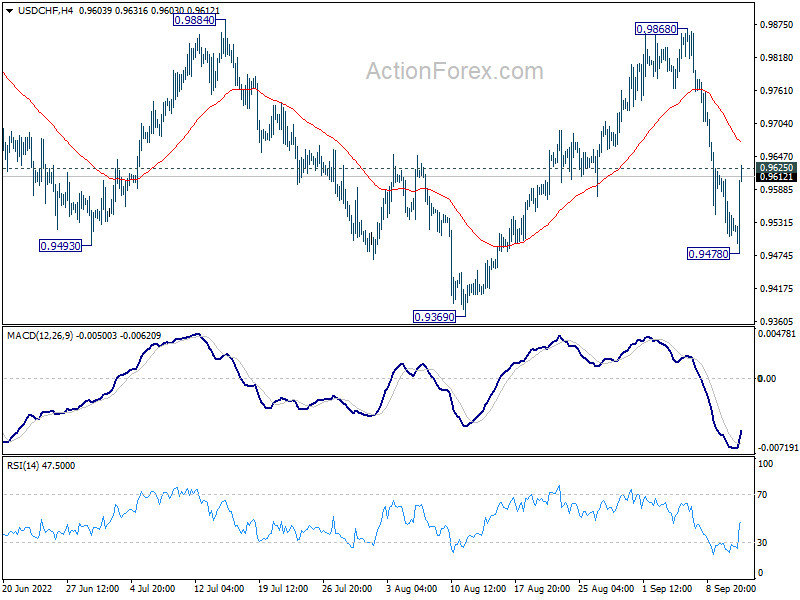
In the bigger picture, current development suggests that up trend from 0.8756 (2021 low) is still in progress. Sustained break of 1.0063 will target 100% projection of 0.9149 to 1.0063 from 0.9369 at 1.0283, and then 1.0342 (2016 high). For now, this will remain the favored case as long as 0.9369 support holds, even in case of deep pull back.
GBP/USD Mid-Day Outlook
Daily Pivots: (S1) 1.1618; (P) 1.1665; (R1) 1.1728; More...
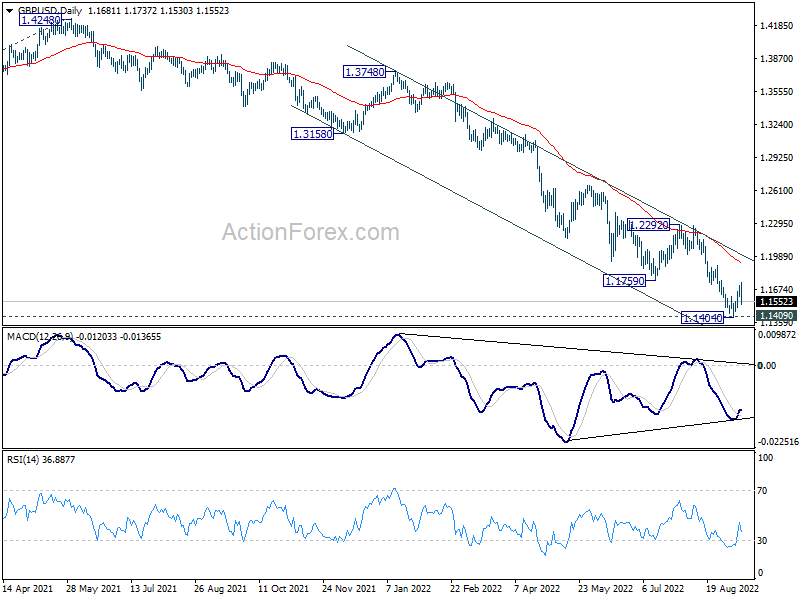
GBP/USD's break of 1.1550 minor support suggests that rebound from 1.1404 has completed at 1.1737. Intraday bias is back on the downside for retesting 1.1404/9 support zone. Decisive break there will resume larger down trend. On the upside, above 1.1737 minor resistance will resume the rebound from 1.1404 to 55 day EMA (now at 1.1933).
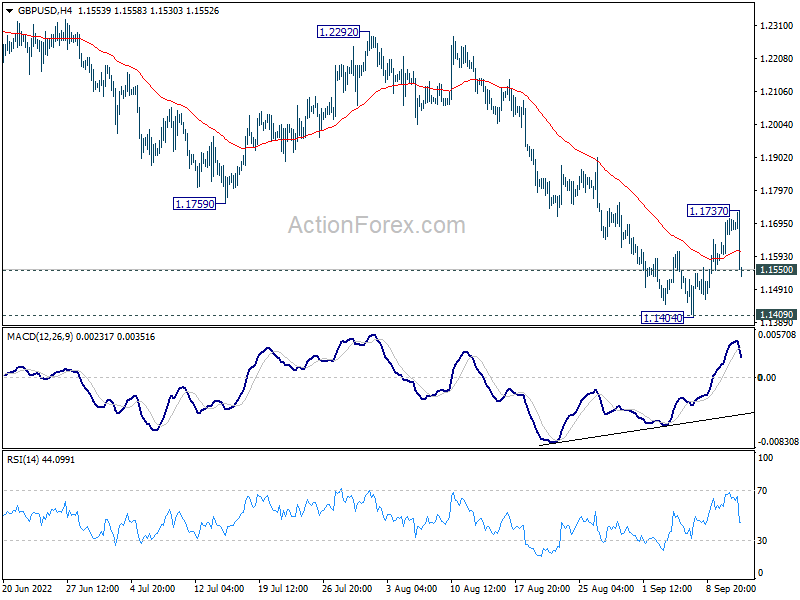
In the bigger picture, based on current momentum, fall from 1.4248 (2018 high) is probably resuming long term down trend from 2.1161 (2007 high). Sustained break of 1.1409 will target 61.8% projection of 1.7190 (2014 high) to 1.1409 (2020 low) from 1.4248 (2021 high) at 1.0675. This will remain the favored case for now as long as 1.2292 resistance holds.
US: Inflation Surprises to the Upside in August, Making a Clear Case for Another 75 bps Rate Hike
- Consumer price inflation increased by 0.1% month-on-month (m/m) in August, following July's flat reading. On a year-over-year (y/y) basis, headline inflation decelerated by 0.2 percentage points (pp) from July, slowing to 8.3%.
- Energy prices fell by 5.0% m/m, as gasoline prices declined by a meaningful -10.6% m/m, while energy services rose 2.1% m/m. Food prices decelerated to 0.8% m/m (following the 1.1% m/m gain in July), but are still up 11.4% y/y.
- Core inflation (excludes volatile items such as food & energy) rose 0.6% m/m – a marked acceleration from July's gain of 0.3% m/m. Relative to last August, core inflation sits at 6.3% – up 0.4pp from last month.
- Price growth across core services (+0.6% m/m) accelerated from last month's gain of 0.4% m/m. Shelter costs (+0.7% m/m) were again a meaningful contributor, with rent of primary residence (+0.7% m/m) and owner's equivalent rent (+0.7% m/m) each notching similar gains. Prices paid for lodging away from home (0.1% m/m) were up modestly, after recording sizeable declines in each of the two months prior. Other categories including medical (0.8% m/m), transportation (0.5% m/m) and education & communication services (0.2% m/m) were also higher on the month. Price growth across recreational services was flat in August.
- After showing recent signs of easing, core goods prices (0.5% m/m) accelerated in August. Gains were seen across household furnishings (+1.1% m/m), apparel (0.2% m/m), recreational (0.6% m/m), and transportation (0.4% m/m) goods. Price growth in transportation was entirely the result of new vehicle prices rising 0.8% m/m, while used prices fell a modest 0.1% m/m.
Key Implications
- There's no way around it, this was a disappointing reading on inflation. After showing some signs of easing in recent months, an acceleration in prices across most goods and services categories led to meaningful uptick in core inflation in August.
- While price growth across services is likely to show more staying power, the recent acceleration in goods prices is not sustainable. Inventory-to-sales ratios across department stores, home furnishing, electronic & appliance stores and building materials, garden equipment & supply stores all currently sit well above their respective pre-pandemic levels. With the holiday season upon us, retailers are likely to start offering some discounts to lean out existing inventory.
- We have heard from a number of FOMC officials over the past week, and it has been made clear that policymakers will need to see compelling evidence that inflation is slowing on a sustained basis before pivoting on its monetary policy stance. Today's report offered no evidence that inflation is even moderating. This suggests that another 75 basis point hike is all but a sure thing when the FOMC meets later this month.
EUR/USD Mid-Day Outlook
Daily Pivots: (S1) 1.0055; (P) 1.0127; (R1) 1.0193; More...
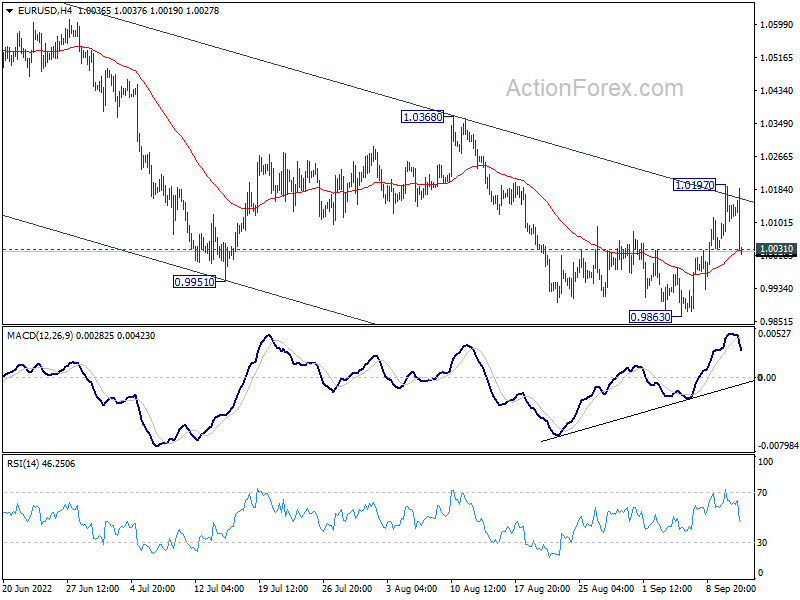
EUR/USD's break of 1.0031 minor support argues that rebound from 0.9863 has completed at 1.1097 already. Rejection by 55 day EMA and channel resistance retains near term bearishness. Intraday bias is back on the downside for retesting 0.9863 low first. Firm break there will resume larger down trend. On the upside, sustained trading above 55 day EMA (now at 1.0169) raise the chance of larger trend reversal, and target 1.0368 resistance.
In the bigger picture, down trend from 1.6039 (2008 high) is still in progress. Next target is 100% projection of 1.3993 to 1.0339 from 1.2348 at 0.8694. In any case, outlook will stay bearish as long as 1.0368 resistance holds, in case of strong rebound. However, firm break of 1.0368 will confirm medium term bottom at 0.9863 already.
Dollar Rebounds, Yields Up, Stocks Down on US CPI
Dollar rebounds strongly in early US session after stronger than expected consumer inflation reading. 10-year yield jumps sharply and breaks above 3.4% handle DOW futures are down over -300 pts at the time of writing. The case for a 75bps hike by Fed is pretty much sealed. The question is whether markets will bet on more. For now, Aussie and Kiwi are the worst performer for today, but Yen is not too far away.
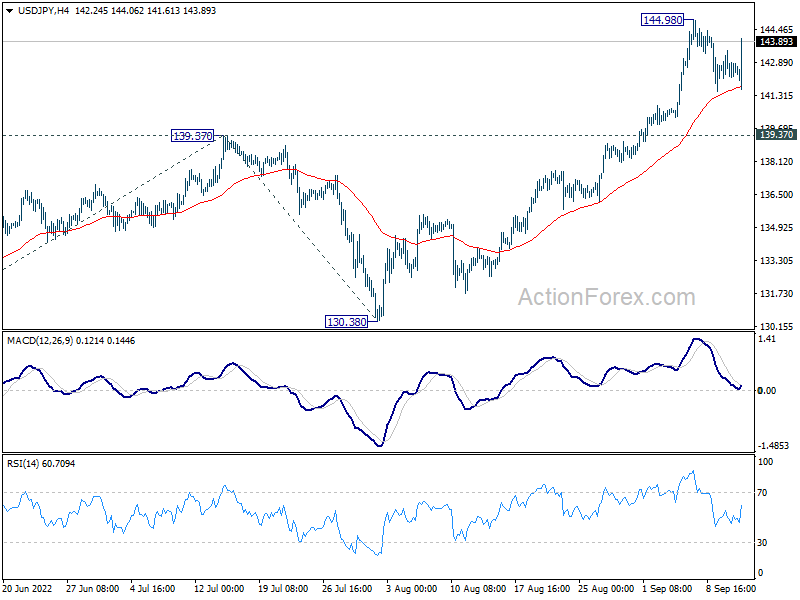
Technically, USD/JPY will come to spot light with a strong rebound. Firm break through 144.98 temporary top will resume larger up trend. But this time, it might not take other Yen crosses up. Instead, the upcoming session could be dominated by Dollar rally, in particular if risk aversion intensifies.
In Europe at the time of writing, FTSE is down -0.23%. DAX is up 0.01%. CAC is down -0.09%. Germany 10-year yield is up 0.052 at 1.706. Earlier in Asia, Nikkei rose 0.25%. Hong Kong HSI dropped -0.18%. China Shanghai SSE rose 0.05%. Singapore Strait Times rose 0.47%. Japan 10-year JGB yield dropped -0.0059 to 0.245.
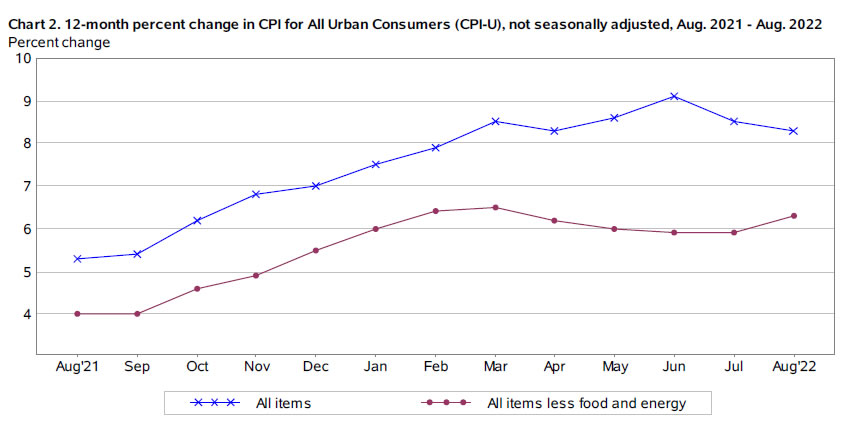
US CPI slowed to 8.3% yoy, core CPI rose to 6.3% yoy
US CPI rose 0.1% mom in August, after being flat in July, above expectation of -0.1% mom decline. Core CPI rose 0.6% mom, larger than prior month's 0.3% mom, and higher than expectation of 0.3% mom. Energy declined -5.0% mom while food index rose 0.8% mom.
For the 12 months ending August, CPI slowed from 8.5% yoy to 8.3% yoy, above expectation of 8.1% yoy. CPI core accelerated from 5.9% yoy to 6.3% yoy, above expectation of 6.0% yoy. Energy rose 23.8% yoy, slowed from 32.9% yoy. Food rose 11.4% yoy, largest 12-month increase since May 1979.
Germany ZEW dropped to -61.9, outlook worsened significantly
Germany ZEW Economist Sentiment dropped further from -55.3 to -61.9 in September, worse than expectation of -60. Current Situation index dropped from -47.6 to -60.5, below expectation of -50.5.
Eurozone ZEW Economic Sentiment dropped from -54.9 to -60.7, below expectation of -58.3. Current Situation index dropped -16.9 pts to -58.9.
"The ZEW Indicator of Economic Sentiment decreased again in September. Together with the more negative assessment of the current situation, the outlook for the next six months has deteriorated further. The prospect of energy shortages in winter has made expectations even more negative for large parts of the German industry. In addition, growth in China is assessed less favourably. The latest statistical figures already show a decline in incoming orders, production, and exports," comments ZEW President Professor Achim Wambach on current expectations.
UK payrolled employment rose 71k in Aug, unemployment rate down to 3.6% in Jul
UK payrolled employment rose 71k or 0.2% mom in August. Comparing with the same month a year ago, payrolled employees rose 803k to 2.8% yoy. Monthly pay rose 6.5% yoy. Claimant count rose 6.3k, versus expectation of -9.2k decline.
Unemployment rate dropped from 3.8% to 3.6% in the three months to July. Employment rate was estimated at 75.4% while economic inactivity rate was estimated at 21.7%. Average earnings including bonus rose 5.5% 3moy, versus expectation of 5.2%. Average earnings excluding bonus rose 5.2% 3moy, versus expectation of 5.0% 3moy.
Australia NAB business confidence rose to 10, conditions rose to 20
Australia NAB business confidence improved from 8 to 10 in August. Business conditions rose from 19 to 20. Trading conditions rose from 26 to 30. Profitability conditions dropped from 18 to 16. Employment conditions also dropped from 18 to 16.
"The recent strength in business conditions carried into August," said NAB Group Chief Economist Alan Oster. "Official data for retail sales in July confirmed spending remained robust, as suggested by the previous survey, and today's release shows little sign that August was much different. Conditions are strong across most industries other than construction, where profitability remains a challenge."
"Confidence rose again in August, as did other forward indicators in the survey," said Oster. "Confidence took a hit around June as interest rates first began to rise but it seems that firms' initial concerns about the impact have eased and a more positive outlook is prevailing, at least for the time being."
EUR/USD Mid-Day Outlook
Daily Pivots: (S1) 1.0055; (P) 1.0127; (R1) 1.0193; More...
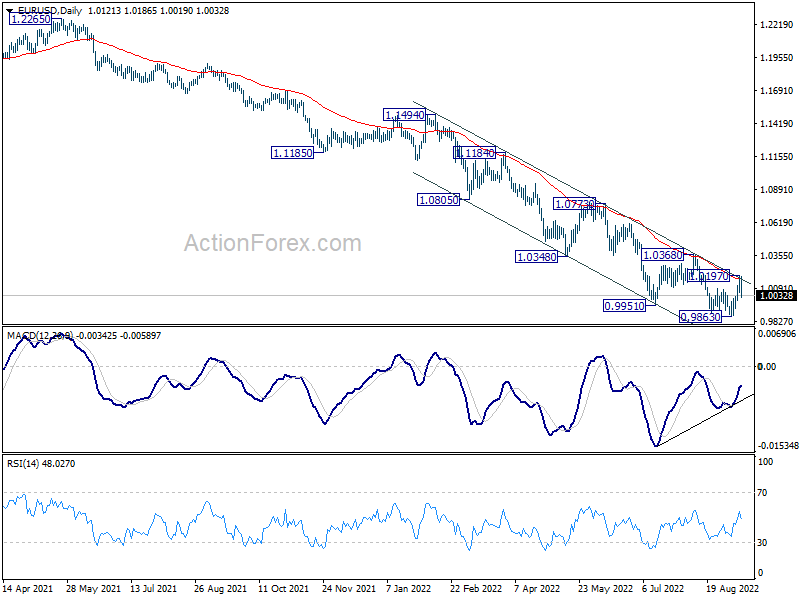
EUR/USD's break of 1.0031 minor support argues that rebound from 0.9863 has completed at 1.1097 already. Rejection by 55 day EMA and channel resistance retains near term bearishness. Intraday bias is back on the downside for retesting 0.9863 low first. Firm break there will resume larger down trend. On the upside, sustained trading above 55 day EMA (now at 1.0169) raise the chance of larger trend reversal, and target 1.0368 resistance.
In the bigger picture, down trend from 1.6039 (2008 high) is still in progress. Next target is 100% projection of 1.3993 to 1.0339 from 1.2348 at 0.8694. In any case, outlook will stay bearish as long as 1.0368 resistance holds, in case of strong rebound. However, firm break of 1.0368 will confirm medium term bottom at 0.9863 already.
Economic Indicators Update
| GMT | Ccy | Events | Actual | Forecast | Previous | Revised |
|---|---|---|---|---|---|---|
| 23:50 | JPY | PPI Y/Y Aug | 9.00% | 8.90% | 8.60% | 9.00% |
| 23:50 | JPY | BSI Large Manufacturing Index Q3 | 1.7 | -8.1 | -9.9 | |
| 01:30 | AUD | NAB Business Confidence Aug | 10 | 7 | 8 | |
| 01:30 | AUD | NAB Business Conditions Aug | 20 | 20 | 19 | |
| 06:00 | GBP | Claimant Count Change Aug | 6.3K | -9.2K | -10.5K | |
| 06:00 | GBP | ILO Unemployment Rate (3M) Jul | 3.60% | 3.80% | 3.80% | |
| 06:00 | GBP | Average Earnings Including Bonus 3M/Y Jul | 5.50% | 5.20% | 5.10% | |
| 06:00 | GBP | Average Earnings Excluding Bonus 3M/Y Jul | 5.20% | 5.00% | 4.70% | |
| 06:00 | EUR | Germany CPI M/M Aug F | 0.30% | 0.30% | 0.30% | |
| 06:00 | EUR | Germany CPI Y/Y Aug F | 7.90% | 7.90% | 7.90% | |
| 06:30 | CHF | Producer and Import Prices M/M Aug | -0.10% | 0.10% | -0.10% | |
| 06:30 | CHF | Producer and Import Prices Y/Y Aug | 5.50% | 5.70% | 6.30% | |
| 09:00 | EUR | Germany ZEW Economic Sentiment Sep | -61.9 | -60 | -55.3 | |
| 09:00 | EUR | Germany ZEW Current Situation Sep | -60.5 | -50.5 | -47.6 | |
| 09:00 | EUR | Eurozone ZEW Economic Sentiment Sep | -60.7 | -58.3 | -54.9 | |
| 10:00 | USD | NFIB Business Optimism Index Aug | 91.8 | 90.6 | 89.9 | |
| 12:30 | USD | CPI M/M Aug | 0.10% | -0.10% | 0.00% | |
| 12:30 | USD | CPI Y/Y Aug | 8.30% | 8.10% | 8.50% | |
| 12:30 | USD | CPI Core M/M Aug | 0.60% | 0.30% | 0.30% | |
| 12:30 | USD | CPI Core Y/Y Aug | 6.30% | 6.00% | 5.90% |
US CPI slowed to 8.3% yoy, core CPI rose to 6.3% yoy
US CPI rose 0.1% mom in August, after being flat in July, above expectation of -0.1% mom decline. Core CPI rose 0.6% mom, larger than prior month's 0.3% mom, and higher than expectation of 0.3% mom. Energy declined -5.0% mom while food index rose 0.8% mom.
For the 12 months ending August, CPI slowed from 8.5% yoy to 8.3% yoy, above expectation of 8.1% yoy. CPI core accelerated from 5.9% yoy to 6.3% yoy, above expectation of 6.0% yoy. Energy rose 23.8% yoy, slowed from 32.9% yoy. Food rose 11.4% yoy, largest 12-month increase since May 1979.
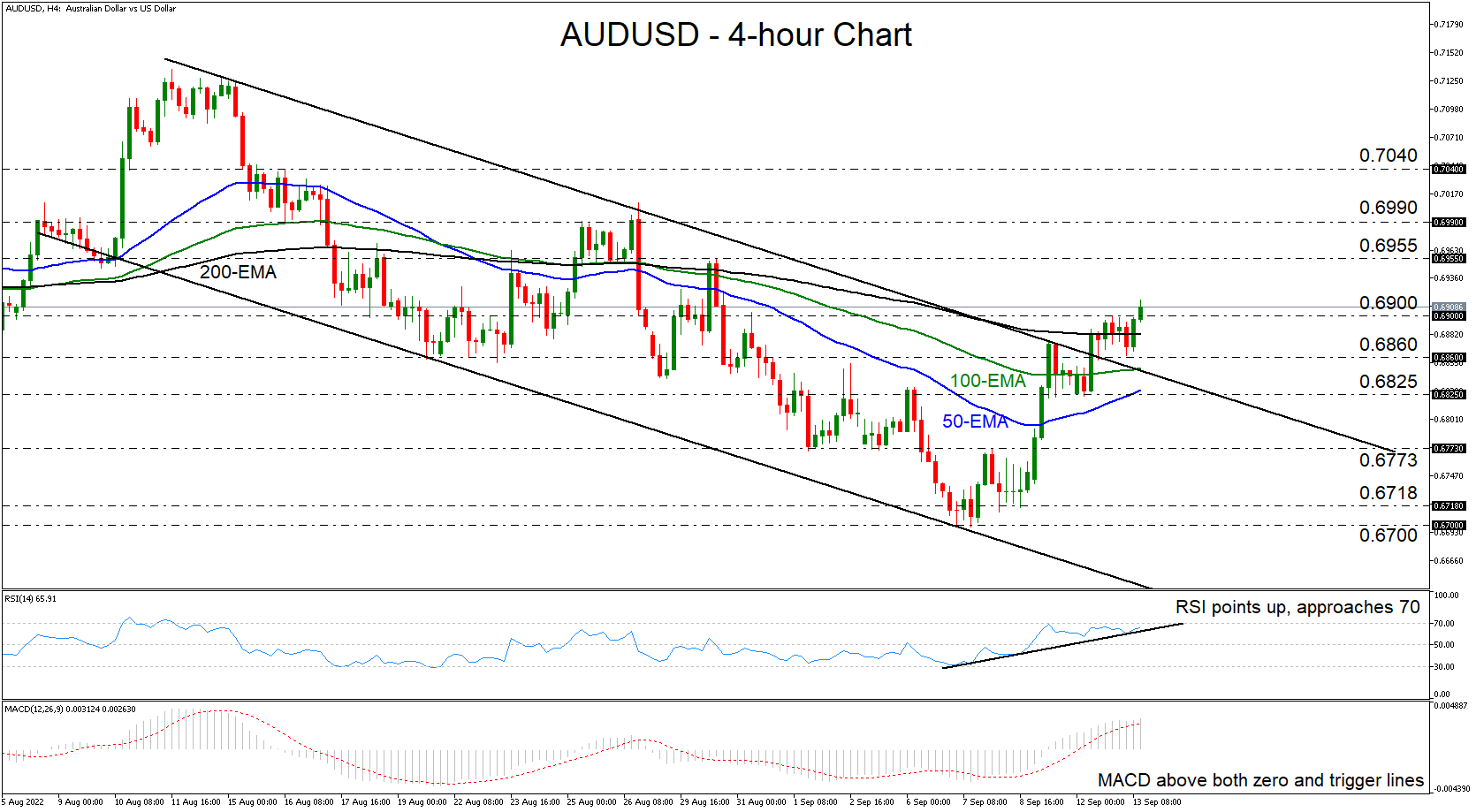
AUDUSD Breaks the Upper Bound of a Downside Channel
AUDUSD traded higher on Tuesday, after hitting support near the 0.6860 zone, with the advance taking the pair above 0.6900, thereby confirming a higher high on the 4-hour chart. Of more importance though, is yesterday’s break above the upper bound of the downside channel that had been containing the price action since August 10. All this suggests that the short-term picture may have turned to somewhat positive for now.
The RSI and the MACD oscillators detect strong upside speed, supporting the narrative for further advances. The former is approaching its 70 line, still pointing up, while the latter remains above both its zero and trigger lines.
The break above 0.6900 may have invited more bulls into the game, who could initially aim for the 0.6955 barrier, marked by the high of August 30. If they don’t stop there, they could continue up to the 0.6990 zone, the break of which could carry extensions towards the 0.7040 hurdle, defined as a resistance by the high of August 16.
On the downside, a break back below 0.6825 may confirm the pair’s return within the aforementioned channel and could allow declines to the 0.6773 obstacle, marked by the inside swing high of September 8. Should the bulls stay indifferent near that zone as well, then the tumble may extend towards the 0.6718 or 0.6700 barriers, defined as support levels by the lows of September 8 and 7 respectively.
Putting everything in a nutshell, AUDUSD has broken above the upper bound of a downside channel yesterday, and today, it confirmed a higher high on the 4-hour chart. From a technical standpoint, this implies that the bulls are in the driver’s seat for now.
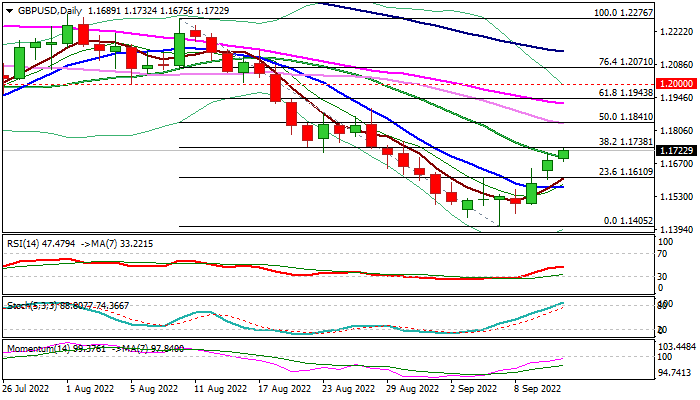
GBP/USD: Sterling Keeps Firm Tone Ahead of Inflation Data
Cable remains at the front foot and rises to two-week high, during European session on Tuesday, underpinned by the data from the UK labor sector which showed unemployment falling to a multi-decade low, though positive impact was tempered by slightly higher than expected earnings numbers.
Daily studies improved but still lack positive momentum, offering some support to the action which rose above 20DMA (1.1693) and pressures another pivotal barrier at 1.31738 (Fibo 38.2% of 1.2276/1.1405), close above which is needed to add to bullish stance and open way for further gains.
All eyes are on today’s US and Wednesday’s UK inflation data, which are expected to generate fresh direction signals, especially if releases beat or undershot expectations.
Res: 1.1738; 1.1760; 1.1800; 1.1841.
Sup: 1.1675; 1.1610; 1.1573; 1.1497.
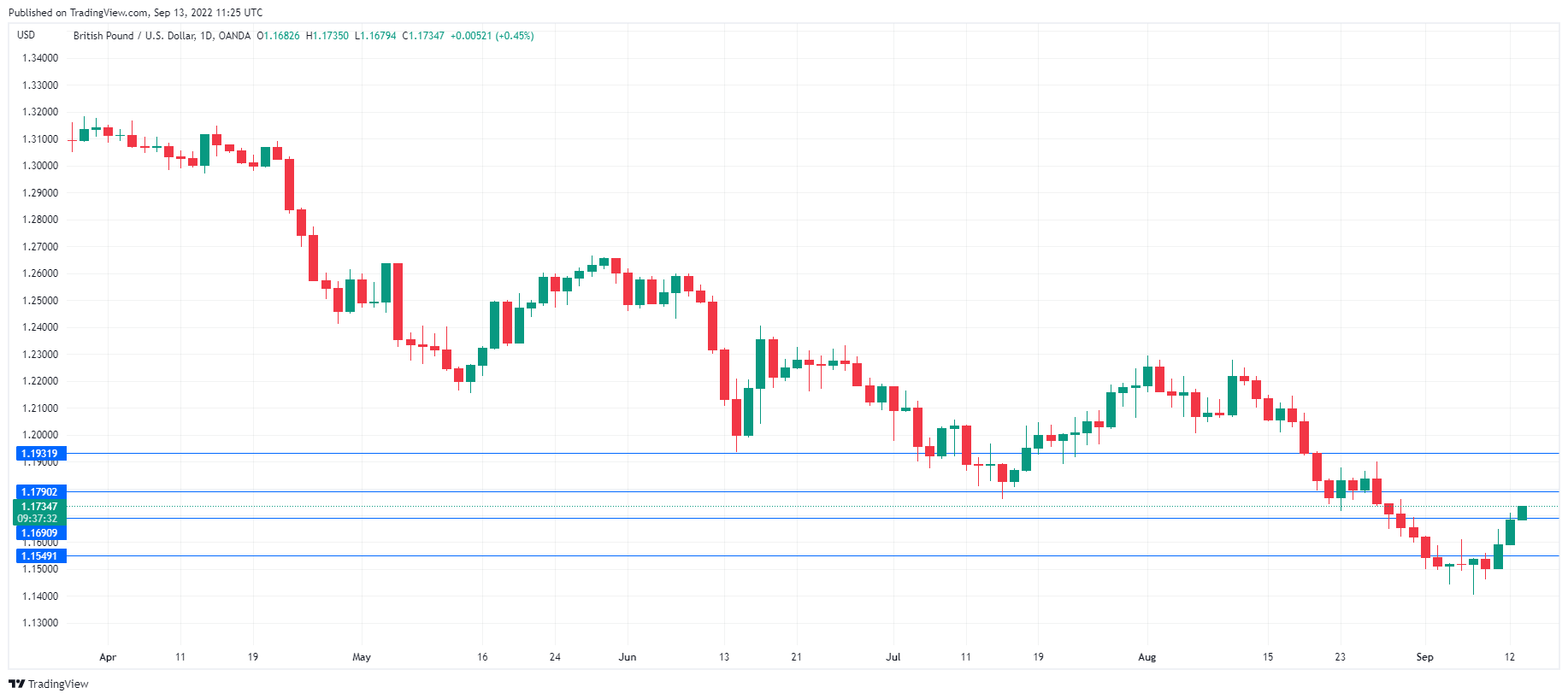
GBP/USD Steady after Solid UK Job Data
GBP/USD is in positive territory today. In the European session, the pound is trading at 1.1731, up 0.42%. GBP/USD continues to take advantage of US dollar weakness and has gained 240 points since Thursday.
Inflation has hit a staggering 10.1% and the Bank of England is projecting that inflation may not peak until 13%, with some analysts predicting an even higher peak. The manufacturing, services and construction sectors are either in contraction or stagnation and Brits now have to contend with a new prime minister and a new monarch after the death of Queen Elizabeth. The UK has phased out energy imports from the UK, but the weak EU economy is taking a toll on the UK, as the two are close trading partners.
The UK labour market remains robust, one of the few bright lights in a grim economic landscape. Unemployment has fallen to 3.5%, a 50-year low, but wage growth in the three months to July rose 5.5% YoY, up from 5.2%. Employment rose by 40 thousand, down from 160 thousand prior and well below the forecast of 128 thousand.
For the Bank of England, the job numbers actually increase the odds of a supersize 75 basis point hike next week, as wage growth continues to rise and the labour market continues to tighten. The BoE, which has failed to show until now that it can curb spiralling inflation, may regain some credibility with a 75bp move.
US CPI expected to fall
All eyes are on the US inflation report, which will be released later today. The markets could be treated to mixed results – headline inflation is expected to drop to 8.1% (8.5% prior), while core CPI is forecast to rise to 6.1% (5.9% prior). With the Fed intent on remaining aggressive in order to tame inflation, the markets have priced in a 75bp increase at the September 21st meeting. The inflation release should be treated as a market-mover for the US dollar and has additional importance as it is the final key release before the Fed meeting.
GBP/USD Technical
- GBP/USD faces resistance at 1.1790. Above, there is resistance at 1.1931
- There is support at 1.1689 and 1.1548
The UK Economy Slowdown has Lowered the Trade Deficit
Monthly estimates showed that the UK economy added 2.5% over the three months to July vs the same period a year earlier. The negative surprise was a 0.3% decline in Industrial Production in July compared to expectations of a 0.4% gain after a 0.9% slip in June. Production added a modest 1.1% compared to July last year.
Construction and industrial production indices are back in the 2019 range after a quick dip and subsequent recovery due to the pandemic. And they are stagnating for some time around these levels. Manufacturing and construction are at the forefront of the economic cycle, and their message is not optimistic.
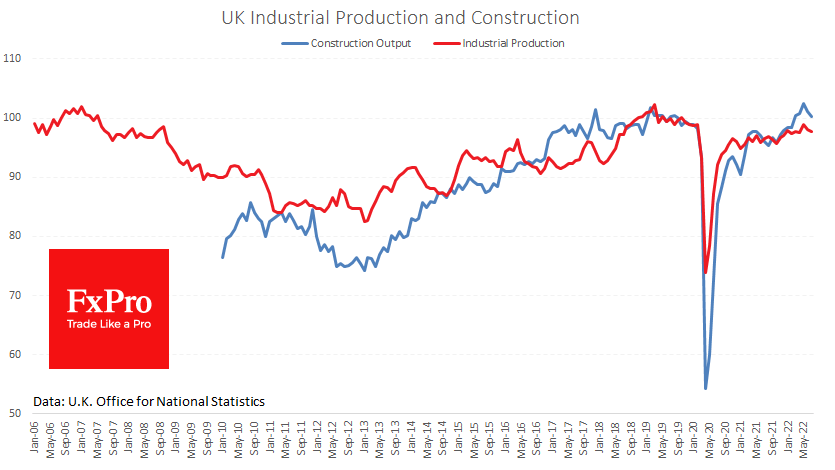
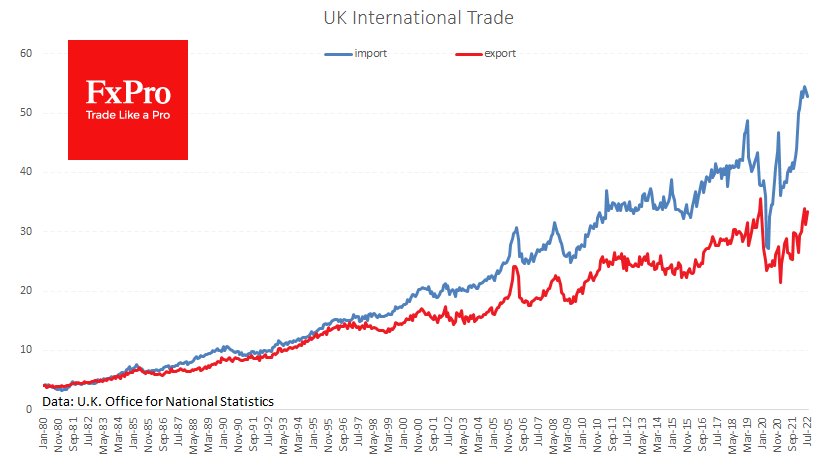
Foreign trade is much more dynamic. Import values have fallen for two months after ballooning during the year’s first five months, while exports have remained close to the highs. These local dynamics have reduced the foreign trade deficit to its lowest level since December 2021.
The narrowing of the foreign trade deficit is positive for Sterling as it reduces capital outflows from the country. On the other hand, if the weakness in imports is linked to stagnant domestic demand and production, it does not carry anything good in the medium term. GBPUSD seems to have pushed back from the bottom in the middle of last week, but this dynamic is more attributed to the USD profit-taking after the rally rather than investments in the pound.