Sample Category Title
USD/CHF: A Bullish Primary Zigzag May Start a New Trend
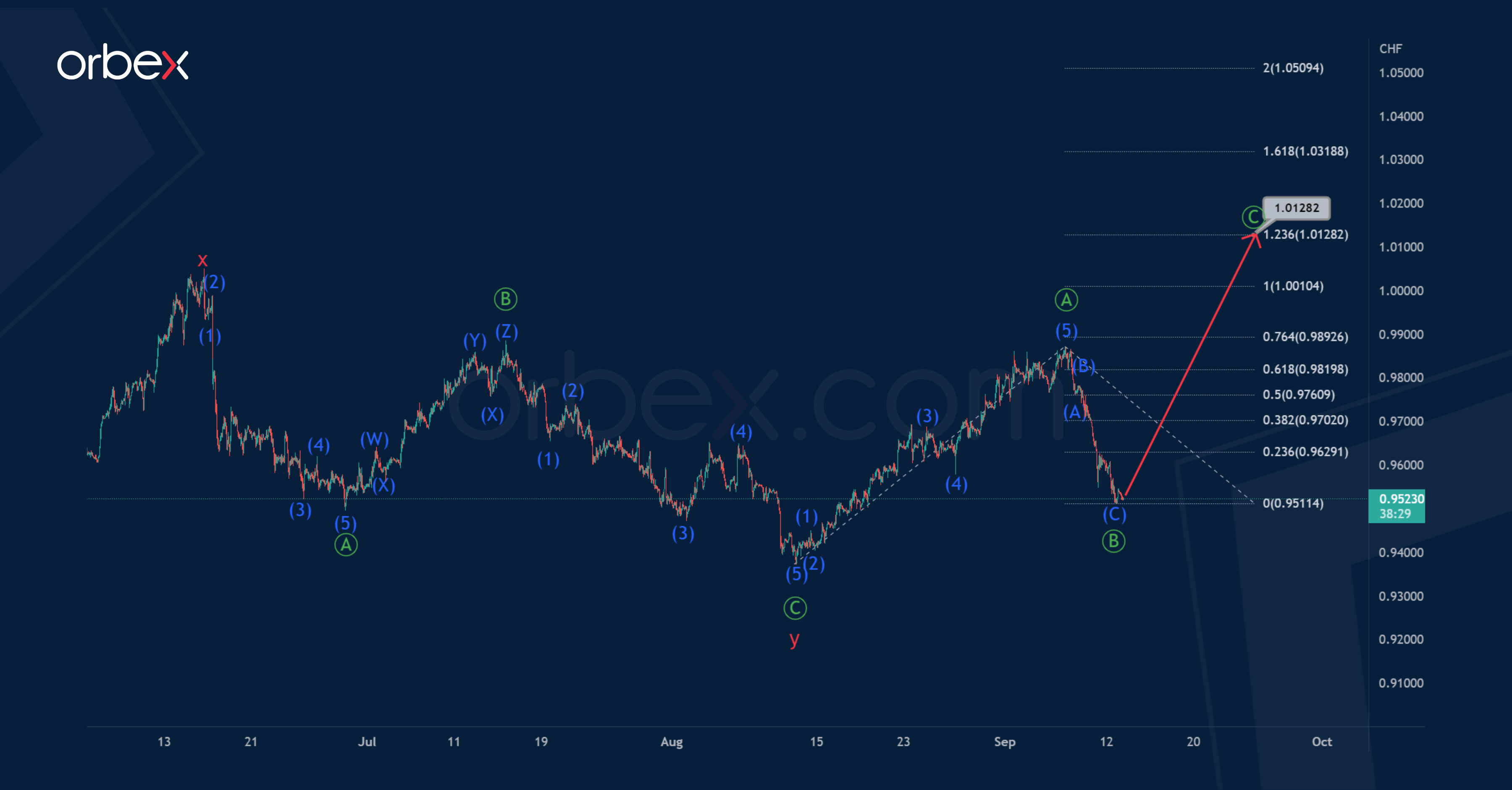
The structure of the USDCHF currency shows the final part of a large double zigzag consisting of cycle sub-waves w-x-y. This pattern looks fully completed.
It is possible that the price reduction in the intervening wave x, which represents the primary standard zigzag, has recently come to an end. Currently, there is a development of the initial part of a new corrective trend.
It is assumed that a standard 3-wave zigzag Ⓐ-Ⓑ-Ⓒ of the primary degree is being constructed.
The first two sub-waves Ⓐ-Ⓑ are probably fully completed, so growth in impulse Ⓒ is expected, as shown on the chart, towards 1.0128.
At that level, wave Ⓒ will be at 123.6% of impulse Ⓐ.
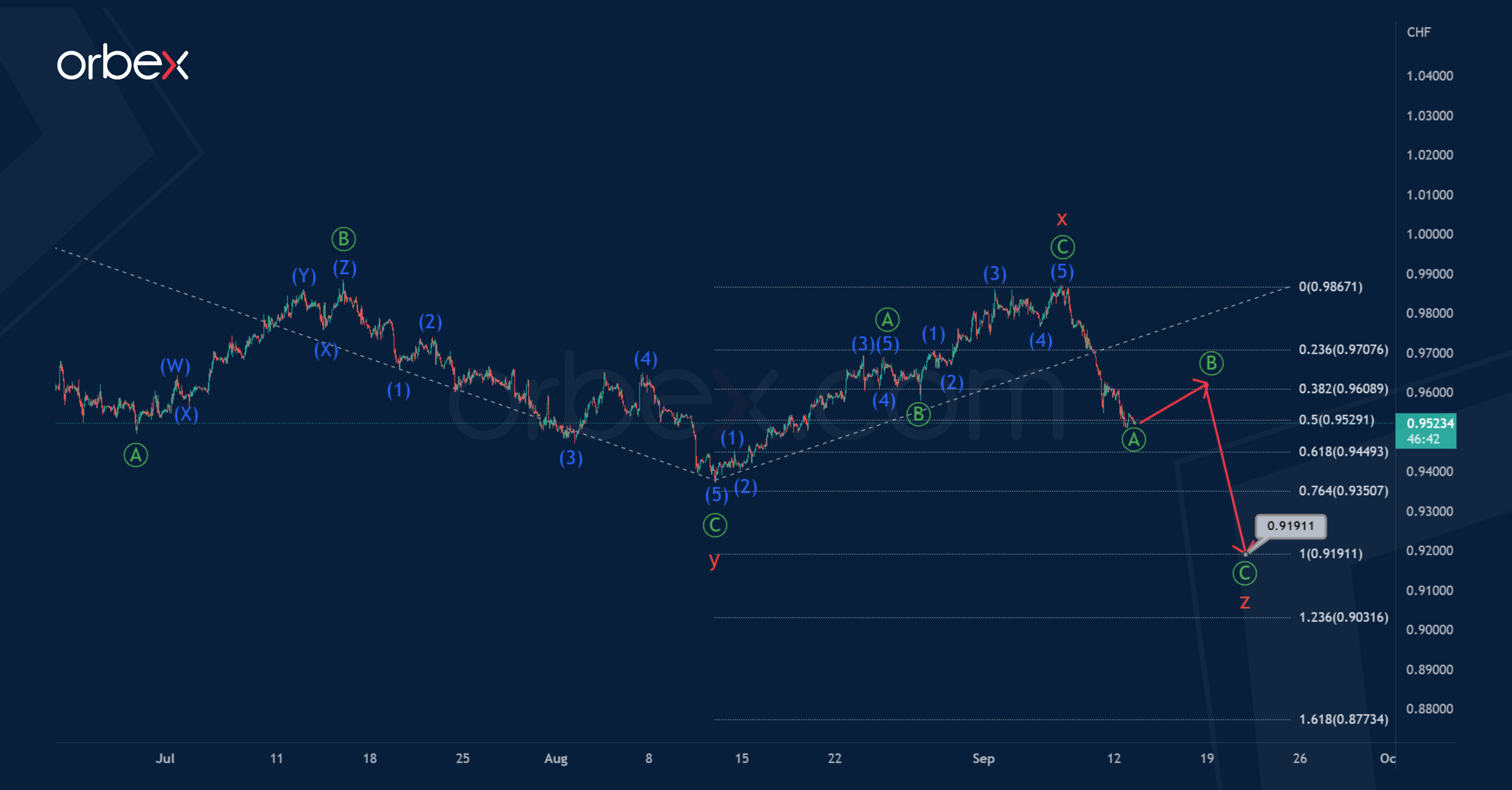
Alternatively, the cycle pattern may take a more complex form, that is, not a double, but a triple zigzag w-x-y-x-z.
Thus, the confirmation of this option will be the reduction of the price and the construction of the final sub-wave z.
Wave z will probably strive for equality with the previous actionary wave y, and therefore its end is possible near 0.917.
The probability of achieving this coefficient is high.
Dow Jones 30 Grinds Towards Key Resistance
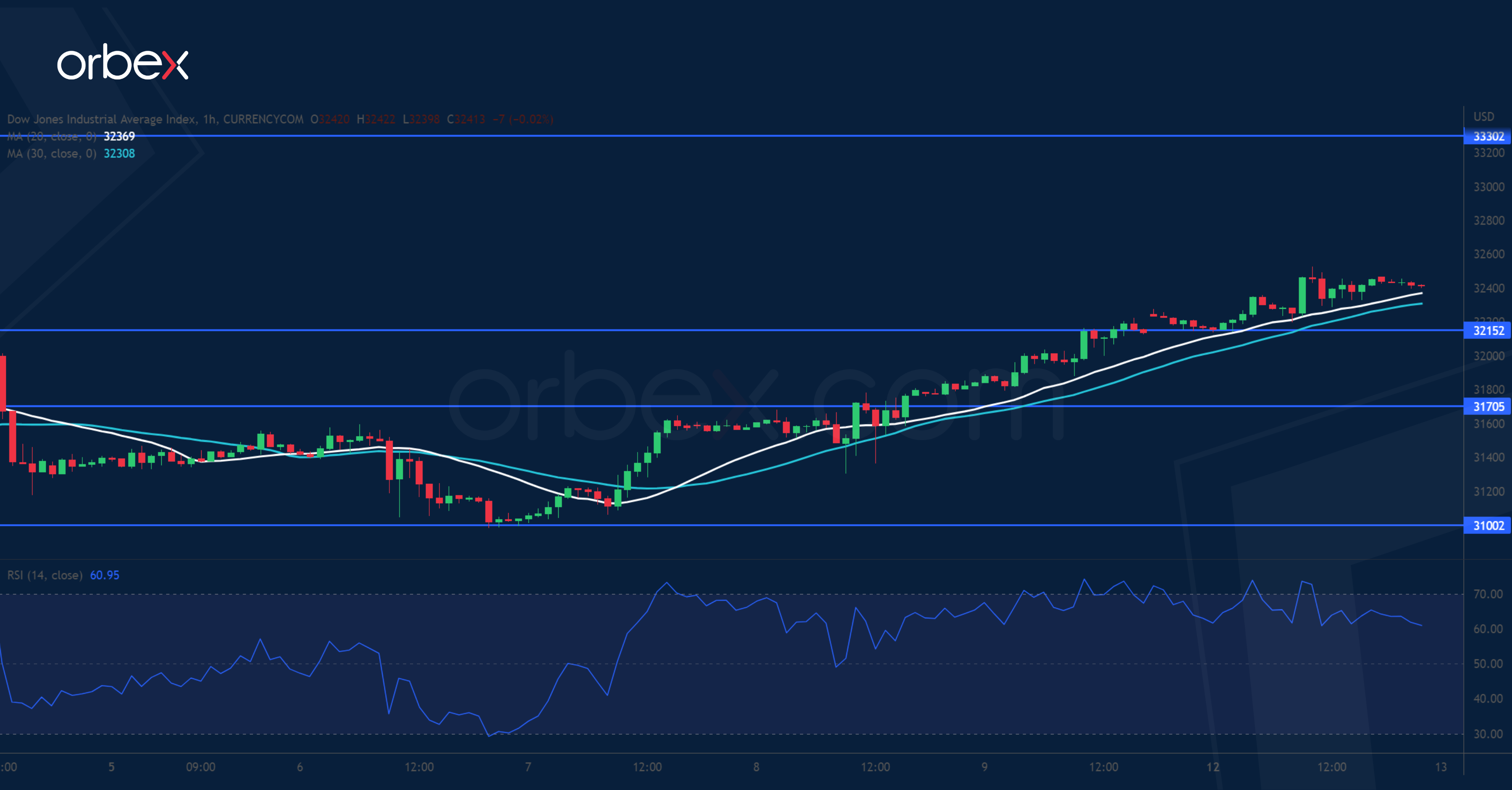
The Dow Jones 30 rallies ahead of a new set of US inflation data. The current recovery has gained traction once above 32000, sending the index towards the key supply zone around 33300 at the origin of a sharp sell-off back in late August. Strong selling pressure could be expected from trend followers as the market mood remains fragile. The RSI’s repeated overbought condition may limit the upside range in the resistance area. 32150 is the closest support and a bullish breakout would lift offers to the previous peak at 34300.
EUR/GBP Attempts to Break Out
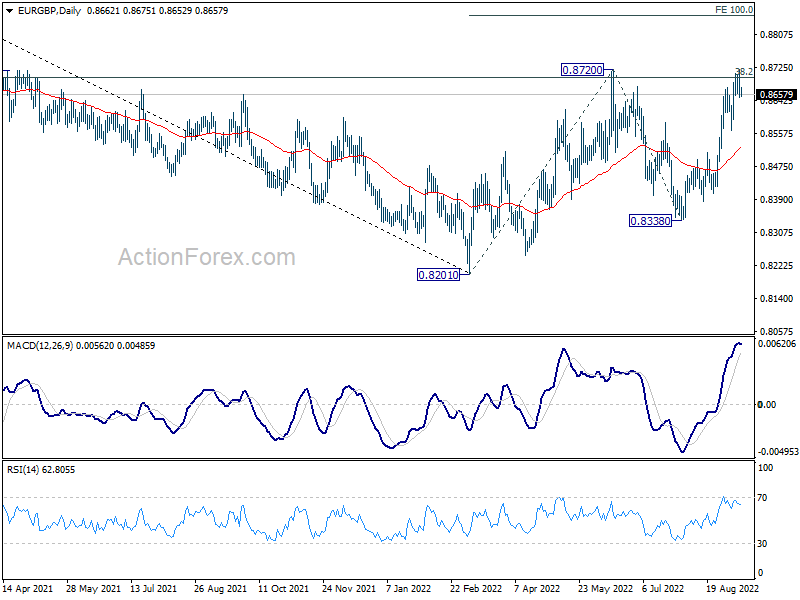
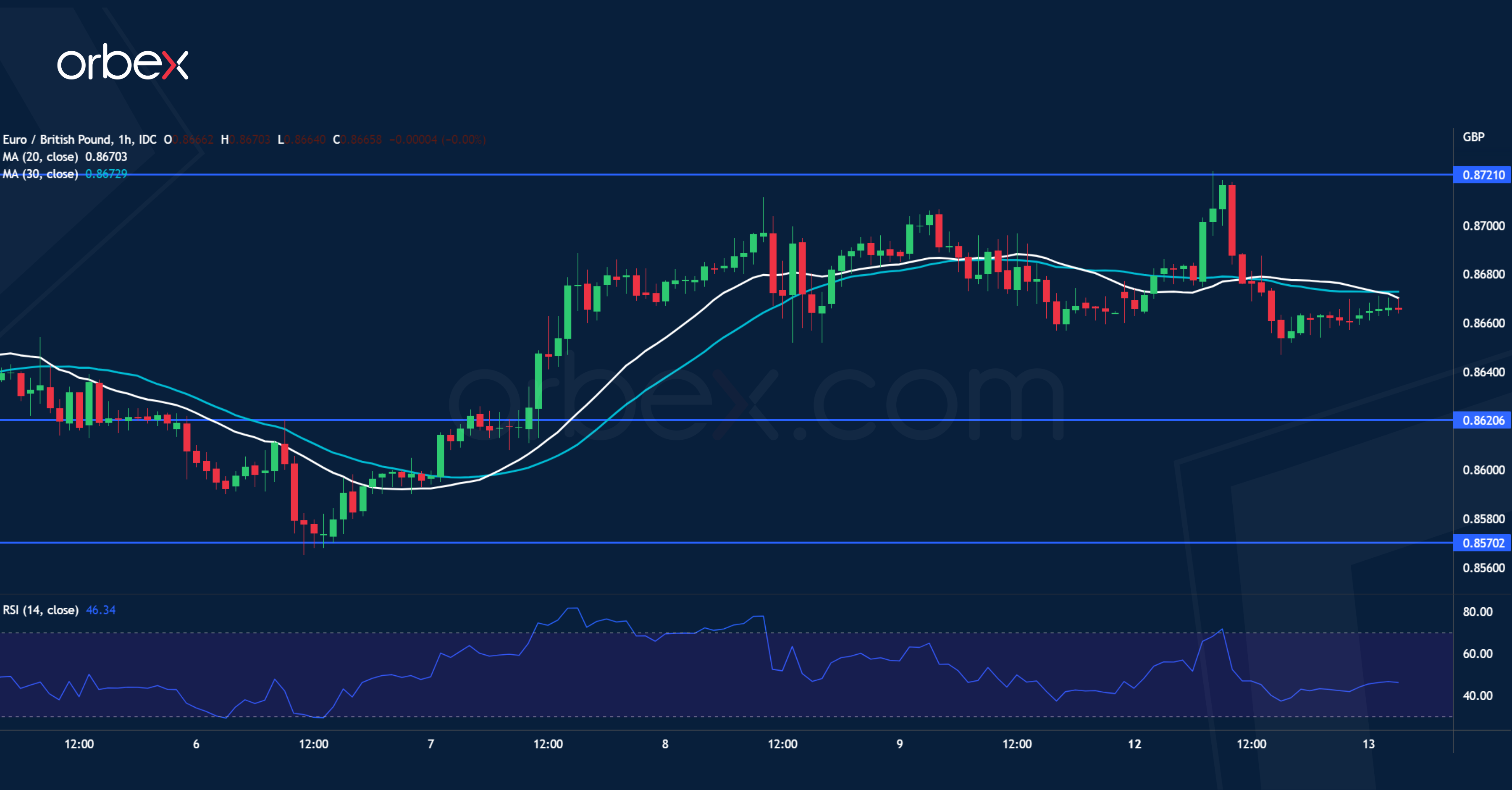
The euro strengthens as the ECB would reportedly accelerate its rate hikes to bring down inflation. The pair is at a crossroads under June’s high at 0.8720. A combination of profit-taking and fresh selling could weigh on the price action after a fall below 0.8660. The area between 0.8620 and 0.8570 next to the 20-day moving average is a major level to test the bulls’ resolve. A series of higher lows indicates a build-up in buying pressure and a breakout could let off steam and trigger a full-fledged rally towards 0.8900.
USD/JPY Consolidates Gains
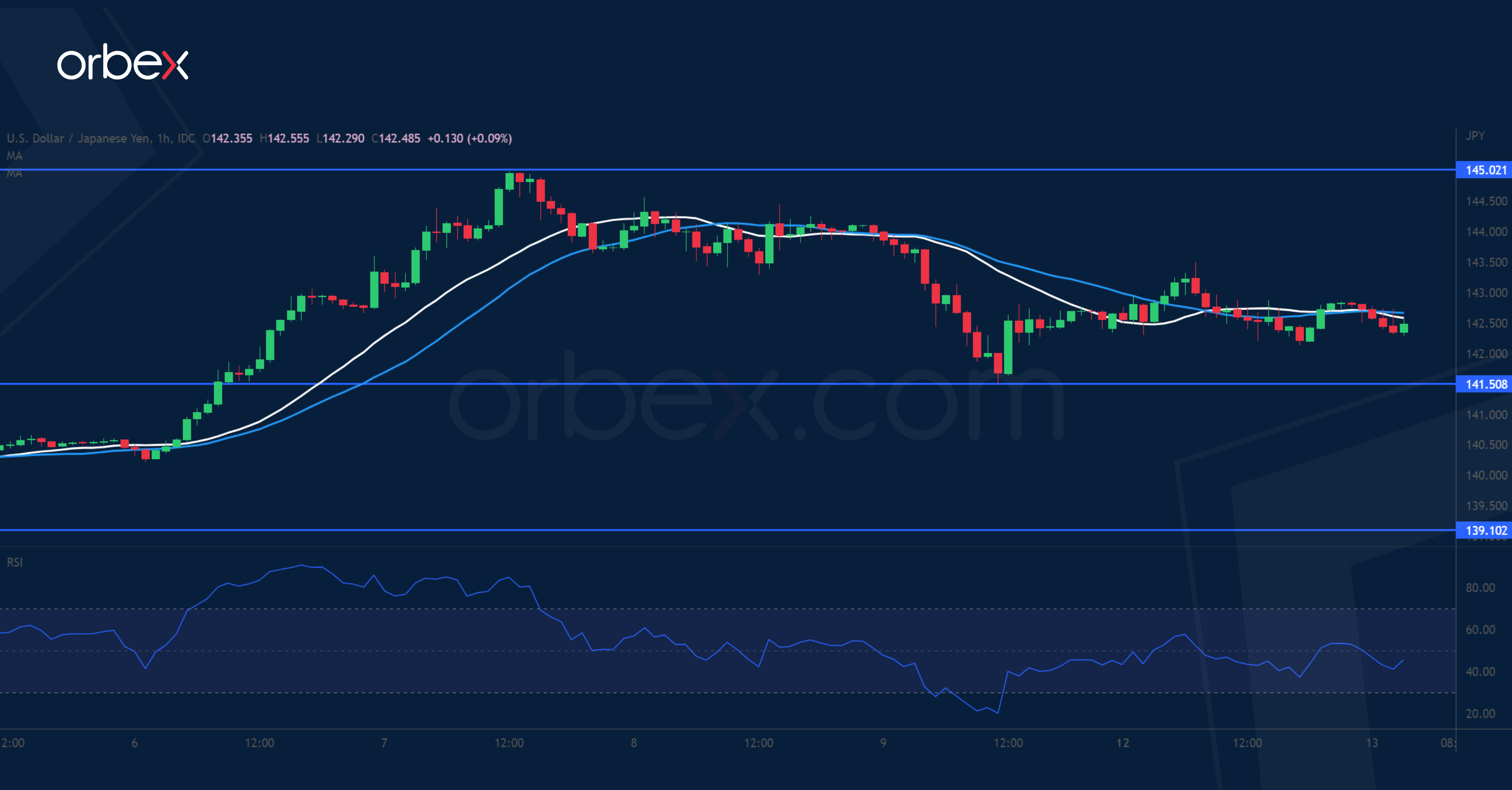
The Japanese yen bounced after the government hinted at intervention to support its currency. The dollar gained momentum after it cleared the previous top at 139.30. However, it soon came under pressure at the psychological level of 145.00 and may take a breather. After the RSI soared into overbought territory, a drop below 143.00 led to a round of profit-taking with 141.50 as an intermediate support. Further down, 139.10 is a major level from a bullish breakout and sits on the 20-day moving average, making it an area of interest.
US CPI Inflation is Today’s Main Dish
Markets
US Treasuries underperformed German Bunds yesterday. US yields added 1.4 bps to 6.5 bps with the 10-30yr bucket being worse off. The main move occurred in the wake of a very weak $32bn 10-yr Note auction which stopped nearly 3 bps through the WI bid with a below-average bid cover. The $41bn 3-yr Note auction tailed as well, but only 1.4 bps while the bid cover was in line with average. The auction results are telling about medium-term risks for a continuation of the sell-off given that weak demand comes at a time when we’ve arrived at the highest (absolute) US yield levels in over 15 years at the front end of the curve and as we’re nearing YTD highs (which are multi-year highs as well) at the longer tenors.
The German yield curve bull flattened. German yields fell by 0.6 bps (2-yr) to 5.8 bps (30-yr). The prolonged correction of gas prices, advances made by the Ukrainian army and the accompanying risk rebound (>+2%) all contributed to the move. It added to the single currency’s revival which intraday tried to escape the downward trend channel against the dollar in place since February. EUR/USD set an intraday top at 1.02 but closed 1.0122. EUR/GBP tested the multiyear top at 0.8721 before closing at 0.8664.
US CPI inflation is today’s main dish. Consensus expects a second consecutive decline in the headline Y/Y number, from 8.5% to 8.1%. A double digit decline in fuel prices is the main culprit. The same effect will likely play in September as well. Core inflation on the other hand is set to increase further in coming months with owners’ equivalent rent being one of the strongest drivers. Consensus expects an increase from 5.9% Y/Y to 6.1% Y/Y. The dynamic in services inflation isn’t going to slowdown neither. From a market point of view, we might arrive at the point where the decelerating headline number could be sufficient to square some positions on bond markets. FX and stock markets already started correcting on ruling trends over the past sessions. Yesterday’s NY Fed’s monthly survey (see below) could be interpreted in the same way. The Fed’s blackout period kicked in, creating a vacuum going into next week’s policy meeting. Another 75 bps rate hike is granted, but how will the Fed’s new inflation forecasts look like and even more importantly their plans for next year (in the new dot plot)? Money markets currently discount a policy rate peak of 4% which we still believe to be too conservative, strengthening our medium bias of more weakness in core bonds despite the possibility of some short term relief.
News Headlines
US consumer three-year ahead inflation expectations eased for a fourth straight month, the NY Fed’s monthly survey revealed. The outlook for price gains fell from 3.2% in July to 2.8% in August. This compares to the peak seen in September and October last year of 4.2%. One-year ahead expectations declined to 5.7% from 6.2% in July while those for a five-year horizon eased to 2% (down from 2.3%). Gas prices are seen unchanged next year. Food and rents are still expected to rise, though at a slightly lesser pace of 5.8% (-0.8 ppts) and 9.6% (-0.3 ppts). Consumers think home prices will still increase but with no more than 2.1% - a sharp drop of 1.4 ppts from the month before and the slowest rate since July 2020.
The Czech government yesterday approved a plan at a special meeting to cap prices of electricity and natural gas for households and small businesses. Finance minister Stanjura said the government was planning to do so during a debate on public TV on Sunday. The price limit is set at CZK 6/MWh for electricity and half that for gas. Public institutions including hospitals and schools will enjoy the new legislation too while the government is preparing a solution for large enterprises, prime minister Fiala said. The estimated budget impact amounts to CZK 130bn, to be paid for by a windfall tax, dividends from state-owned or state-controlled companies and revenue from carbon credits. The draft law approved on Monday must now be passed by both chambers of parliament.
US Inflation
Global indices made a solid start to the week. The EuroStoxx 600 closed yesterday 1.76% higher on news that the Ukrainians are doing well pushing back the Russians in territories they launched a counteroffensive, while the S&P500 and Nasdaq advanced more than 1%. The S&P500 even registered its strongest four-day rally since June, and recovered half of the August-September losses and that, even with the chatter that a rail strike in the US could put pressure on supply chains in the US in the coming days, and cost around $2 billion to the US economy, per day.
An eventual strike would disrupt the retail industry and weigh on the US retail giants and logistics companies profit expectations. But most US retailer & logistics stocks gained yesterday, as hope of seeing another soft inflation data in the US seems to be the major catalyzer of gains for the last couple of sessions. Add to that Janet Yellen’s words that the US could avoid recession, with ‘some good luck’. There is nothing to stop the bulls!
Today is the US inflation day
US inflation day is the new NFP day, as inflation is the data which has the biggest influence on Federal Reserve (Fed) expectations since the Fed declared war against inflation last year.
According to market estimates, the US inflation is seen easing toward 8.1% in August versus 8.5% printed a month earlier, and 9.1% peak printed the month before. A second month of soft inflation read has the power to soften the Fed hawks, and increase the bets of softer rate hikes beyond September.
Odds for September won’t change even with a significantly soft inflation read. The Fed is almost fully expected to raise the rates by another 75bp at next week’s FOMC meeting. What will happen after is, however, up to the data.
Therefore, as I said, a sufficiently soft, and ideally softer-than-expected inflation read today should keep the Fed hawks at bay, and give further support to the bullish action in equity markets, whereas a figure above expectations, or worse, a figure above last month’s read could snap the latest rally and send the stocks tumbling.
We are tilted toward a softer read than not, as the US house prices, and rents started falling, the wages stagnate, the Chinese producer prices pointed at a sharp retreat recently, the used car prices are down, and gasoline prices continue softening.
More importantly, inflation expectations in the US continue their steep fall. The New York Fed’s survey of consumer expectations showed about half a percentage point decline in August, the second biggest decline after July's record-breaking drop.
Softer dollar, stronger euro
Hope of a soft inflation data is also what’s pulling the US dollar lower across the board. The dollar index tipped a toe below the 108 mark yesterday, while the EURUSD made an attempt above its 50-DMA, as news that Ukrainian troops are being successful in their counteroffensive attack, and chatter that voices are rising in Russia against the regime’s strategy in Ukraine, brought forward the possibility of Russia being defeated in Ukraine. This morning, the EURUSD consolidates above the critical 50-DMA, which stands at 1.010 mark. A softer inflation read in the US could cement gains above the 50-DMA. This is all we hope.
Likewise, Cable flirts with the 1.17 level, despite a softer-than-expected GDP read yesterday. The British economy grew just 0.2% last month, as industrial production shrank despite expectations of a slight expansion. And the outlook for the Q3 is rather dull. It’s said that just another day off for Queen Elizabeth’s funeral on September 19th is enough to tip the economy into recession.
We could still see sterling gain some territory against a broadly softer US dollar, if the dollar continues softening, but we now expect the euro to extend its advance against the pound toward the 0.88 level, last seen on February last year.
Elsewhere, the dollar-swissy retreated to 0.95 and the USDCAD slipped below 1.30, the Loonie being also boosted by firmer crude oil prices.
The American crude rallied more than 2% yesterday on improved market sentiment, and flirted with the $90 offers, without however being able to clear them. It’s possible we see an attempt above the $90 level in the next few sessions, if the risk rally persists across the broader markets.
Demand Destruction Push Energy Prices Lower
Market movers today
All eyes will be on the US CPI for August, which is one of the last key inputs for the Fed's decision to hike either 50bp or 75bp at their meeting next week. We look for another print of -0.1% m/m in the headline CPI bringing the y/y rate down to 8.0% from 8.5% in July (in line with consensus). But focus will be on the core CPI where consensus looks for a rise of 0.3% m/m, same as in July. We see some upside risks to this estimate.
German ZEW expectations will probably show that the recession risk further increased in September in light of the worsening energy crisis.
In Norway, Norges Bank releases the Regional Network survey.
The 60 second overview
Energy markets: Yesterday, we wrote in our morning mail about the five proposals discussed by the EU energy ministers on Friday. Bloomberg reported yesterday that the EU Commission is now working on a mandatory target to cut power use and a plan for windfall taxes. The whole package is expected to be presented this week though it will still need to be signed off by member states. EU Commission President von der Leyen is expected to unveil more details tomorrow when she holds her annual State of the Union Speech.
Demand destruction: Yesterday, we saw that the Dutch TFF gas future for the first time in a month traded below EUR 200 MWh down more than 33% from the peak. The EU proposals to introduce mandatory demand cuts by member states might have helped push prices lower. However, we would argue that we are currently seeing what commodity analysts call "demand destruction". Corporates and households in the EU are simply cutting back on gas and power consumption due to the high prices. An indication of this is that the price of carbon emission (EUA) in the EU has dropped more than 25% from the peak in August. The drop comes despite the switch from natural gas to other fossil fuels which boost the demand for carbon emission as natural gas has a significantly lower CO2 content. That said, the market might also speculate that the EU would delay the proposed tightening of the EU carbon market. Demand destruction and recession fears are also seen in metal markets, crude oil prices and freight markets where prices have seen steep declines over the last month.
Risk appetite: Yesterday, the lower energy prices and expectations that US inflation in August - released later today - would drop m/m for the first time since May 2020 supported risk appetite. The same did New York Fed's survey of consumer expectations that showed a marked decline in one- and three-year inflation expectations from 6.2 percent and 3.2 percent to 5.7 percent and 2.8 percent. European yields where pushed lower, EU and US equites performed and EUR/USD moved higher. Global equity futures trade flat this morning and EUR/USD has been stable around 101.30 overnight.
FI: European bond yields declined yesterday from the long end of the curve and there was decent curve flattening between 2Y and 10Y as well as 2Y and 30Y. The Schatz ASW-spread widened once again, while the Bobl and Bund ASW-spread tightened. Part of this tightening could be due to solid issuance in the primary market.
FX: Yesterday's session was characterised by another leg of USD weakness while SEK stood out as the big winner. EUR/USD broke above 1.01, tested 1.02 before settling lower during the US session. Central European currencies continue to benefit from the drop in natural gas prices while USD/JPY has settled close to 143. EUR/NOK is trading just below 10.00 while EUR/SEK has reached the low 10.60s.
Credit: Credit markets started the week in risk-on mode. Itrax Main tightened 4.3bp to close at 103bp, while Itrax Xover tightened 20.2bp to close at 503.7bp. Monday also saw good new issue flow in European corporate bond markets, with both Investment grade financials and corporates, making use of the good sentiment to print new debt.
Nordic macro
In Norway, the Norges Bank's regional survey is expected to show moderate growth prospects, thanks to a combination of capacity problems and weaker demand. Given the risk that high capacity utilisation and a tight labour market pose to wage and price formation, and hence to rates, attention will centre on the indicators for capacity constraints and labour shortages. These indicators were at their highest since 2007 in the previous round in May and well above normal levels. We reckon that growth slowed in several sectors over the summer, including construction, retail and parts of manufacturing. We therefore believe that the economy is under slightly less pressure now than it was in May.
GBP/JPY Daily Outlook
Daily Pivots: (S1) 165.71; (P) 166.38; (R1) 167.53; More...
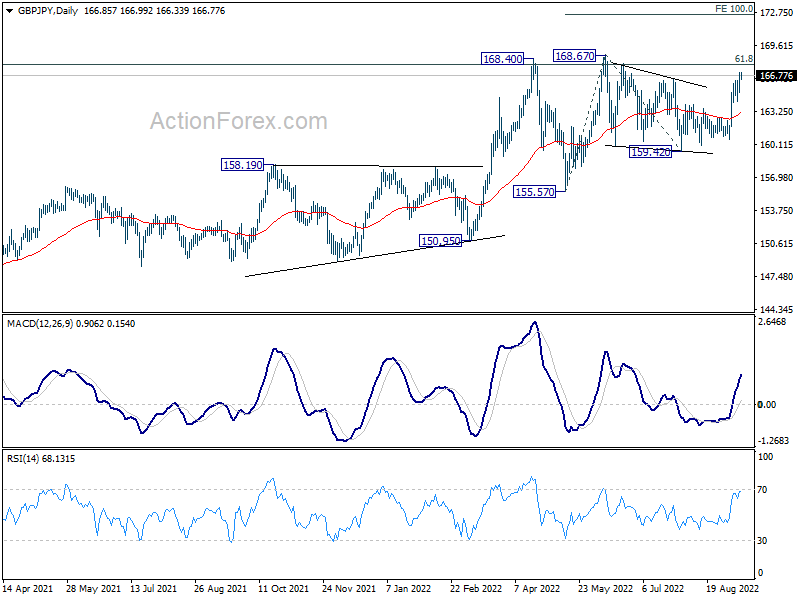
Intraday bias in GBP/JPY remains on the upside for retesting 168.67 high first. Decisive break there will confirm and target 100% projection of 155.57 to 168.67 from 159.42 at 172.42. On the downside, below 164.28 minor support will mix up the outlook and turn bias neutral first.
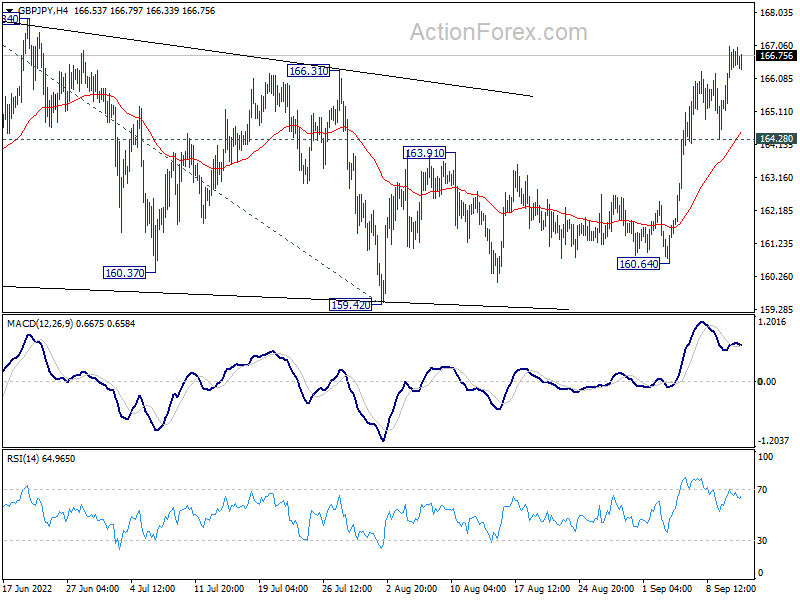
In the bigger picture, up trend from 123.94 (2020 low) is still in progress. Sustained break of 61.8% retracement of 195.86 (2015 high) to 122.75 (2016 low) at 167.93 will be a long term bullish signal, and could pave the way back to 195.86 high. This will remain the favored case as long as 155.57 support holds, even in case of deep pull back.
EUR/JPY Daily Outlook
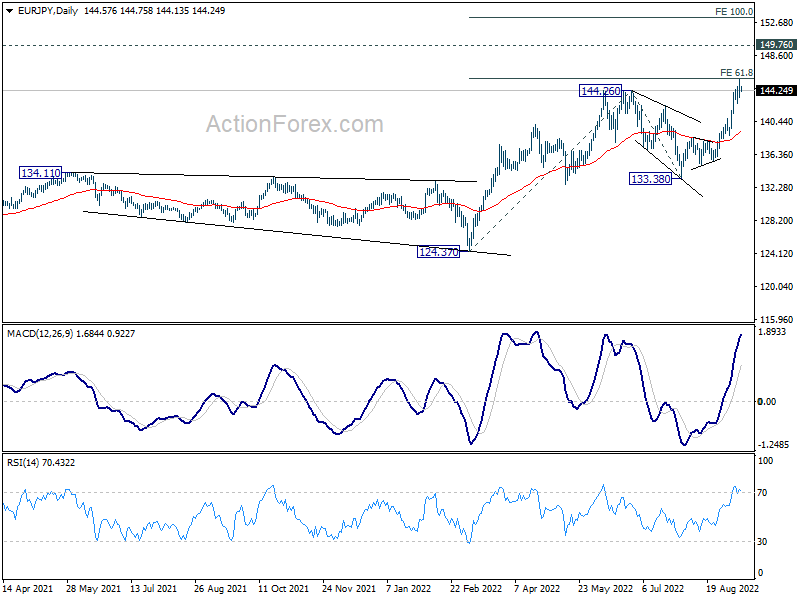
Daily Pivots: (S1) 143.45; (P) 144.54; (R1) 145.70; More....
EUR/JPY is losing some upside momentum, but intraday bias stays on the upside. Decisive break of 61.8% projection of 124.37 to 144.26 from 133.38 at 145.67 will pave the way to 149.76 long term resistance, and then 100% projection at 153.27. On the downside, below 142.62 minor support will turn intraday bias neutral and bring consolidations, before staging another rally.
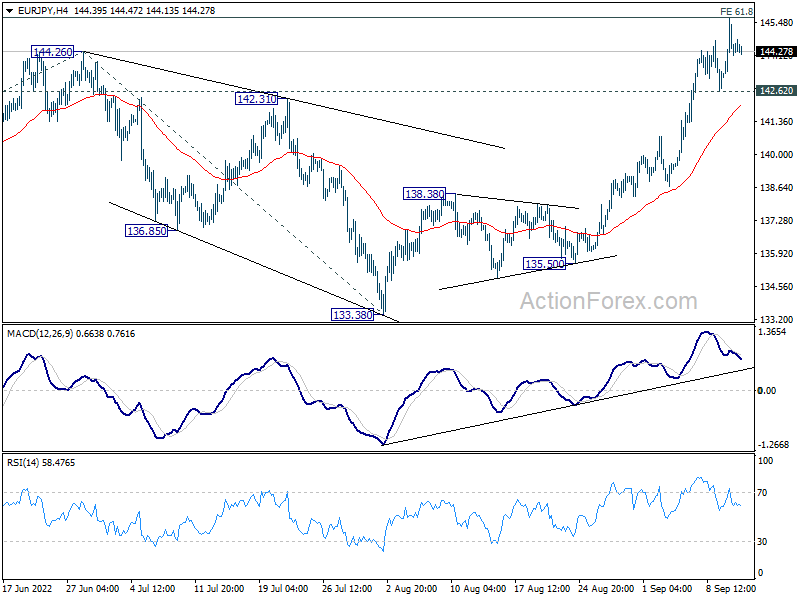
In the bigger picture, up trend from 114.42 (2020 low) is seen as the third leg of the pattern from 109.30 (2016 low). Next target is 149.76 (2015 high). For now, outlook will remain bullish as long as 133.38 support holds, even in case of deep pull back.
EUR/GBP Daily Outlook
Daily Pivots: (S1) 0.8636; (P) 0.8679; (R1) 0.8708; More...
EUR/GBP retreated quickly after edging higher to 0.8721, and intraday bias is turned neutral first. On the upside, firm break of 0.8720 resistance will indicate resumption of whole rise from 0.8201. Intraday bias will be back on the upside for 100% projection of 0.8201 to 0.8720 from 0.8338 at 0.8857. On the downside, however, break of 0.8565 support will indicate rejection by 0.8720 and turn bias back to the downside.
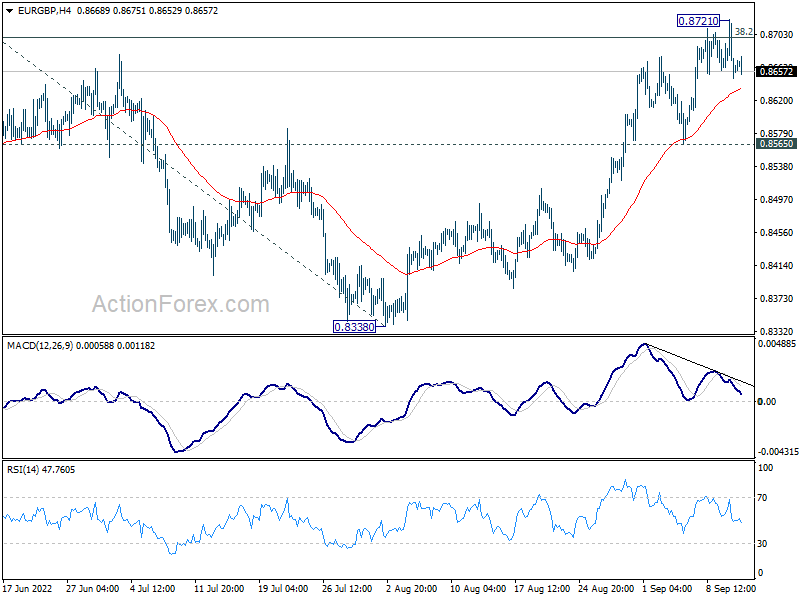
In the bigger picture, focus is back on 38.2% retracement of 0.9499 to 0.8201 at 0.8697. Sustained break there will argue that rise from 0.8201 is a medium term up trend, rather than a correction. Next target is 61.8% retracement at 0.9003. Rejection by 0.8697 again will maintain medium term bearishness, for extending the down trend from 0.9499 (2020 high) at a later stage.