

Sample Category Title
USD/CHF Daily Outlook
Daily Pivots: (S1) 0.9686; (P) 0.9724; (R1) 0.9782; More...
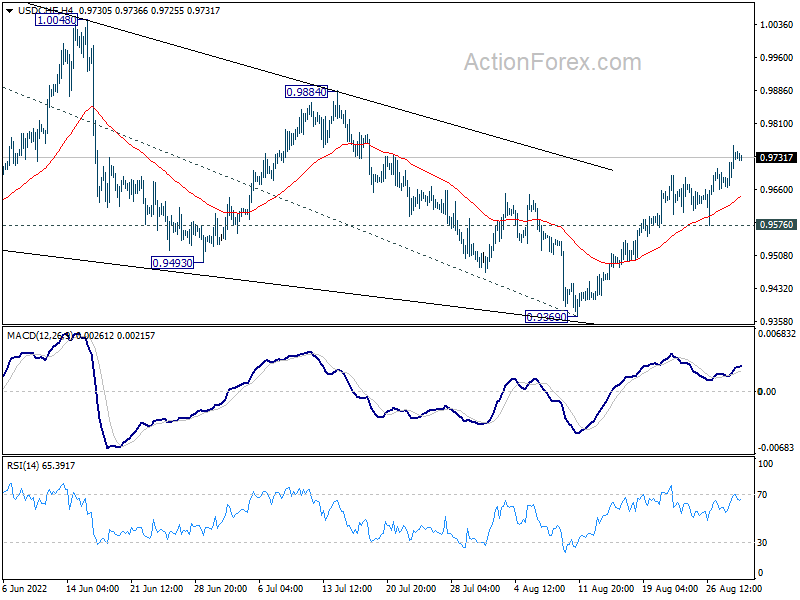
USD/CHF's rally from 0.9369 is still in progress and intraday bias stays on the upside for 0.9884 resistance. Break there will argue that larger up trend is ready for resumption through 1.0063. On the downside, below 0.9576 minor support will dampen this view and turn bias back to the downside for 0.9369 support instead.
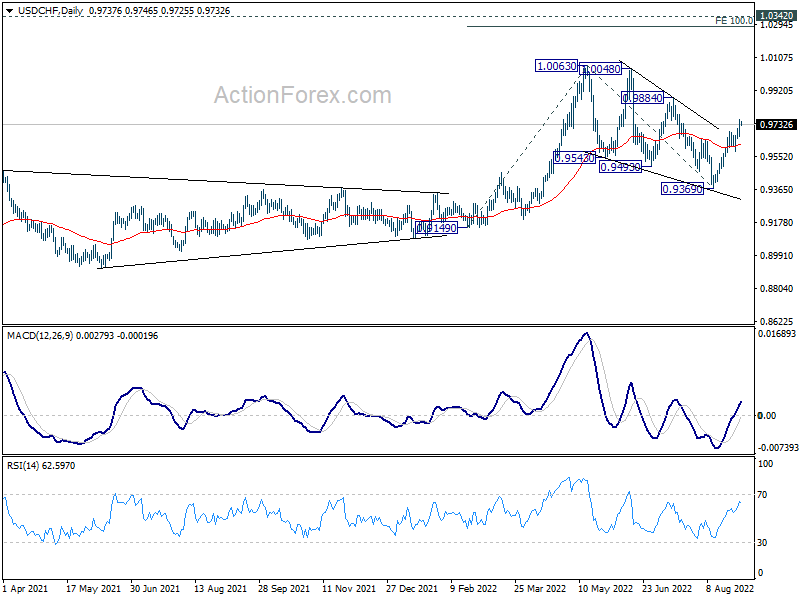
In the bigger picture, current development suggests that up trend from 0.8756 (2021 low) is still in progress. Sustained break of 1.0063 will target 100% projection of 0.9149 to 1.0063 from 0.9369 at 1.0283, and then 1.0342 (2016 high). For now, this will remain the favored case as long as 0.9369 support holds, even in case of deep pull back.
USD/JPY Daily Outlook
Daily Pivots: (S1) 138.21; (P) 138.64; (R1) 139.23; More...
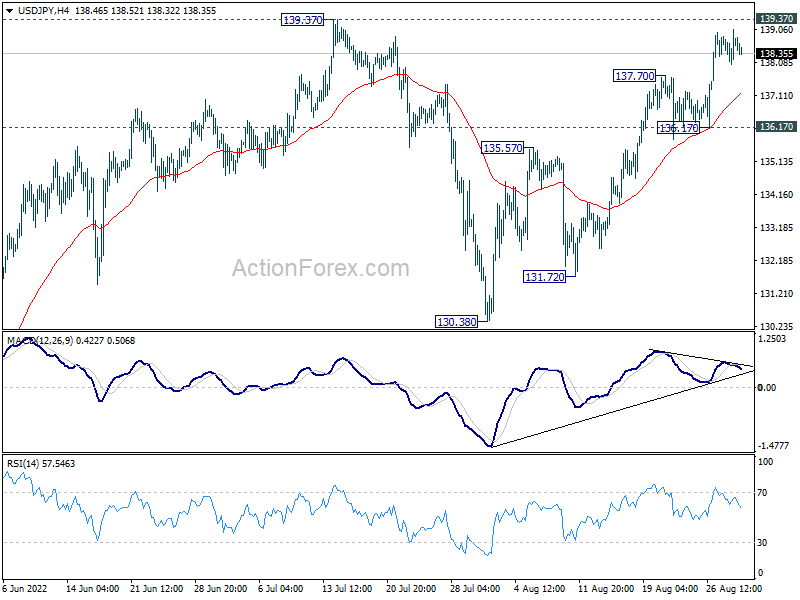
Intraday bias in USD/JPY remains neutral for the moment. Strong resistance could be seen from 139.37 to limit upside, to start the third leg of the corrective pattern from 139.37. Break of 136.17 minor support will turn bias back to the downside for 130.38 support. Nevertheless, decisive break of 139.37 will confirm up trend resumption for 147.68 long term resistance.
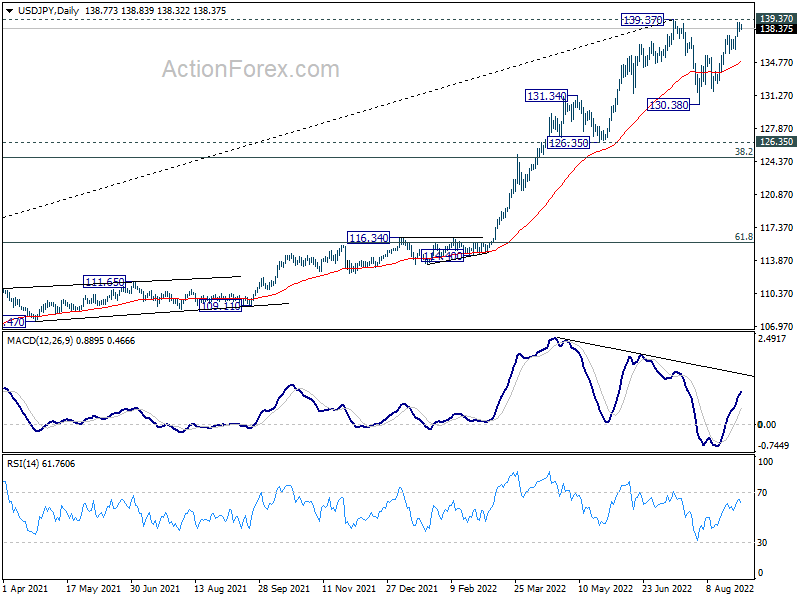
In the bigger picture, price actions from 139.37 medium term top are seen as a corrective pattern to up trend from 101.18 (2020 low). While deeper decline cannot be ruled out, outlook will stays bullish as long as 55 week EMA (now at 123.72) holds. Long term up trend is expected to resume through 139.37 at a later stage, after the correction finishes. Next target is 147.68 (1998 high).
AUD/USD Daily Report
Daily Pivots: (S1) 0.6853; (P) 0.6890; (R1) 0.6938; More...
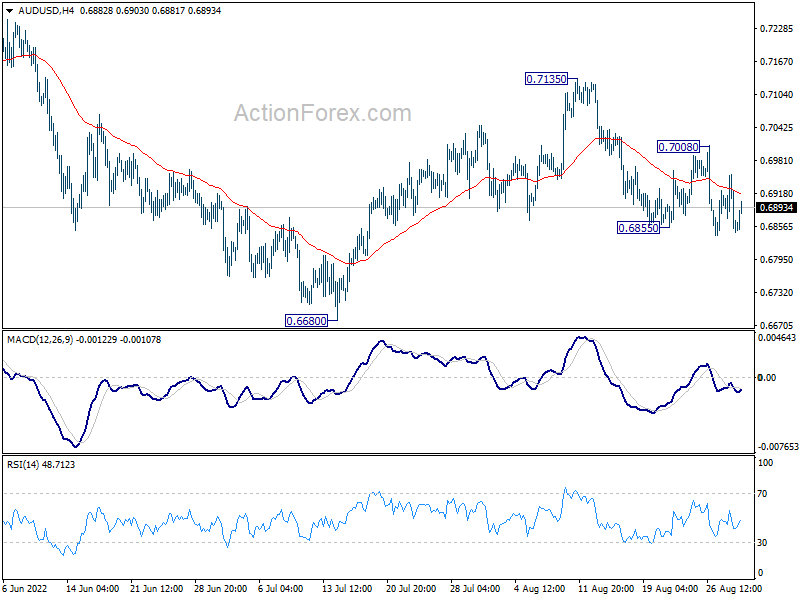
Outlook in AUD/USD remains unchanged and further decline is expected with 0.7008 resistance intact. As noted before, corrective rebound from 0.6680 could have completed with three waves up to 0.7135. Retest of 0.6680 should be seen next. Firm break there will resume larger down trend. However, break of 0.7008 will turn bias back to the upside for 0.7135 resistance instead.
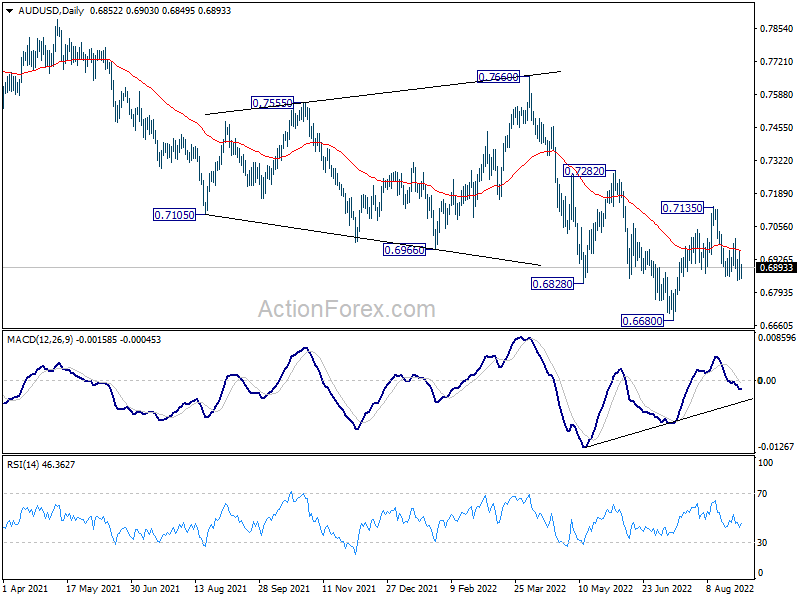
In the bigger picture, price actions from 0.8006 (2021 high) is seen more as a corrective pattern to rise from 0.5506 (2020 low). Or it could also be a bearish impulsive move. In either case, outlook will remain bearish as long as 0.7282 resistance holds. Next target is 61.8% retracement of 0.5506 to 0.8006 at 0.6461.
USD/CAD Daily Outlook
Daily Pivots: (S1) 1.3007; (P) 1.3058; (R1) 1.3143; More...
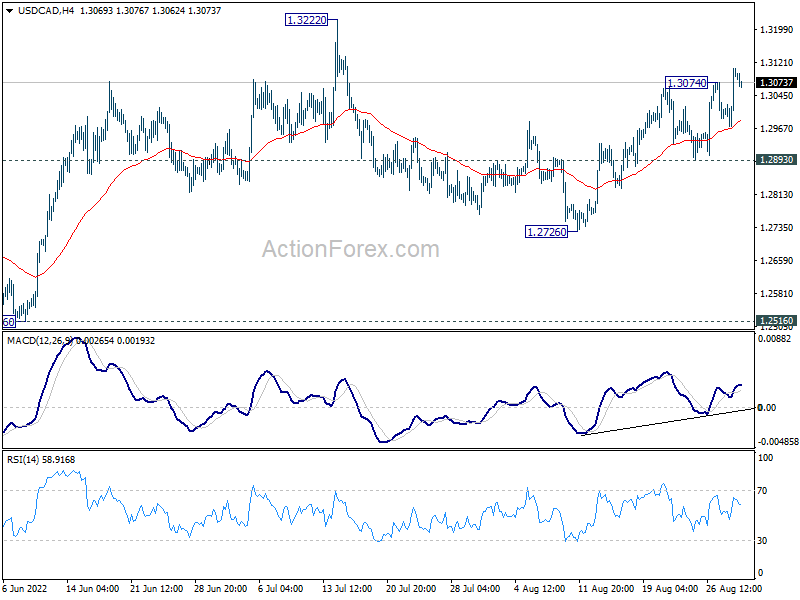
Intraday bias in USD/CAD is back on the upside as rebound from 1.2726 resumes after brief retreat. Current rally should be seen to retest 1.3222 high next. Decisive break there will resume larger up trend. However, break of 1.2893 will turn bias back to the downside for 1.2726 support instead.
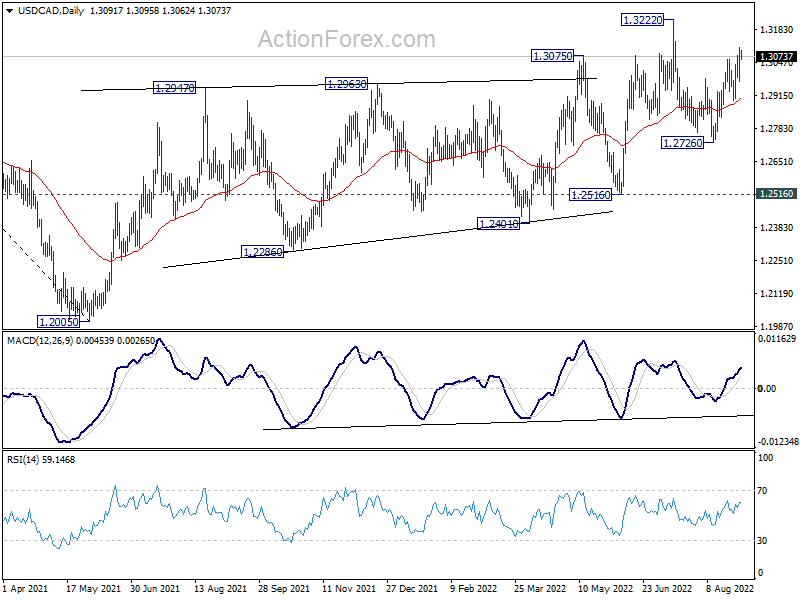
In the bigger picture, down trend from 1.4667 (2020 high) should have completed at 1.2005, after defending 1.2061 long term cluster support. Rise from there should target 61.8% retracement of 1.4667 to 1.2005 (2021 low) at 1.3650. This will remain the favored case now as long as 1.2516 support holds.
EUR/CHF Daily Outlook
Daily Pivots: (S1) 0.9692; (P) 0.9733; (R1) 0.9799; More....
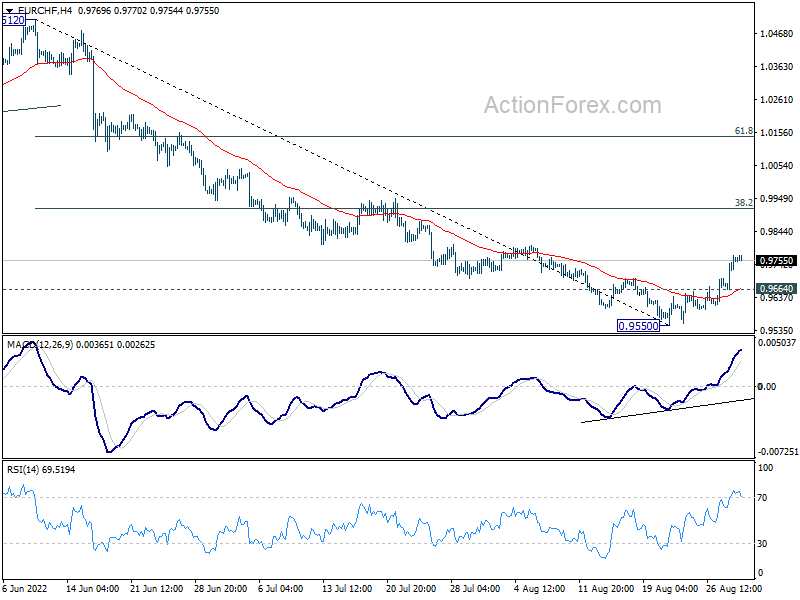
Intraday bias in EUR/CHF remains on the upside at this point. Rebound from 0.9550 short term bottom should target 55 day EMA (now at 0.9838) and above. But upside should be limited by 38.2% retracement of 1.0512 to 0.9550 at 0.9917 to bring down trend resumption. On the downside, below 0.9664 minor support will turn bias back to the downside for retesting 0.9950 low.
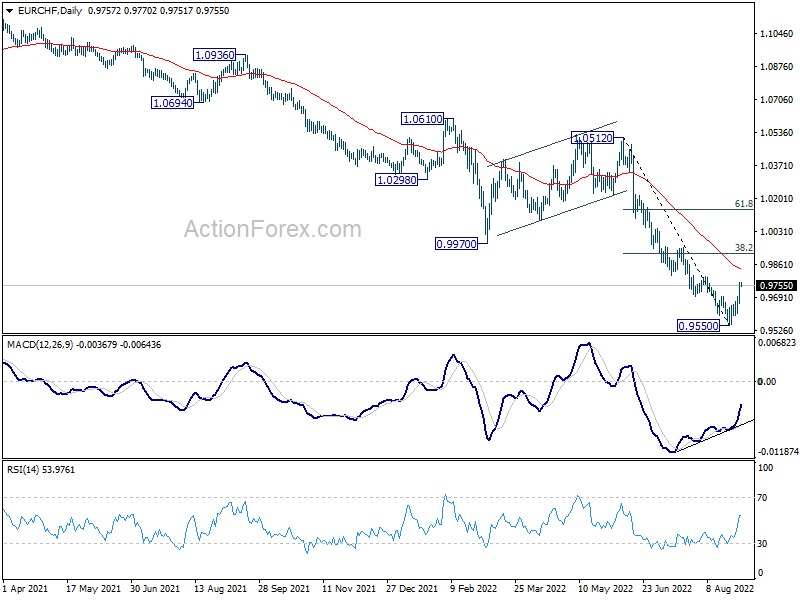
In the bigger picture, long term down trend from 1.2004 (2018 high) is still in progress. Next target is 138.2% projection of 1.2004 to 1.0505 to 1.1149 at 0.9033. On the upside, break of 0.9970 support turned resistance is needed to be the first sign of medium term bottoming. Otherwise, outlook will stay bearish in case of strong rebound.
EUR/GBP Daily Outlook
Daily Pivots: (S1) 0.8543; (P) 0.8574; (R1) 0.8625; More...
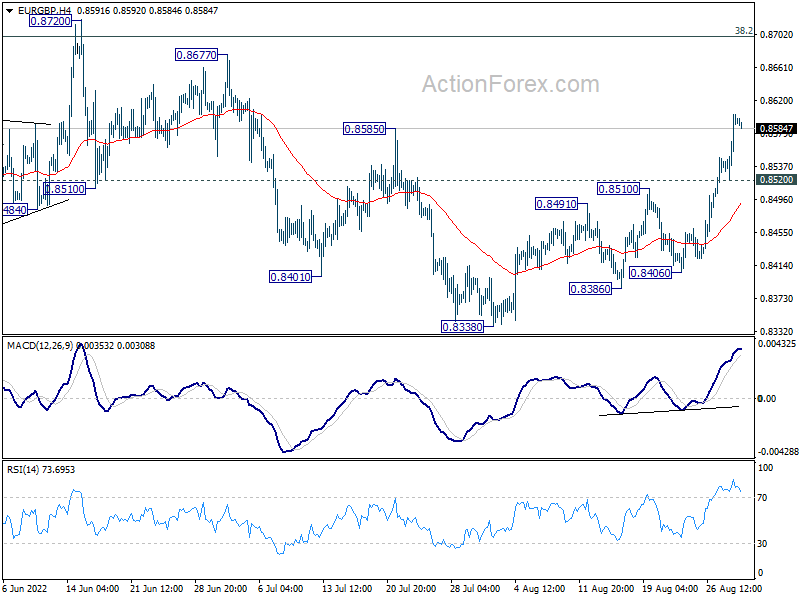
Intraday bias in EUR/GBP stays on the upside as rise from 0.8338 is in progress. Corrective fall from 0.8720 should have completed at 0.8338 already. Further rally should be seen back to retest 0.8720. Decisive break there will carry larger bullish implications. On the downside, below 0.8520 minor support will mix up the outlook and turn intraday bias neutral first.
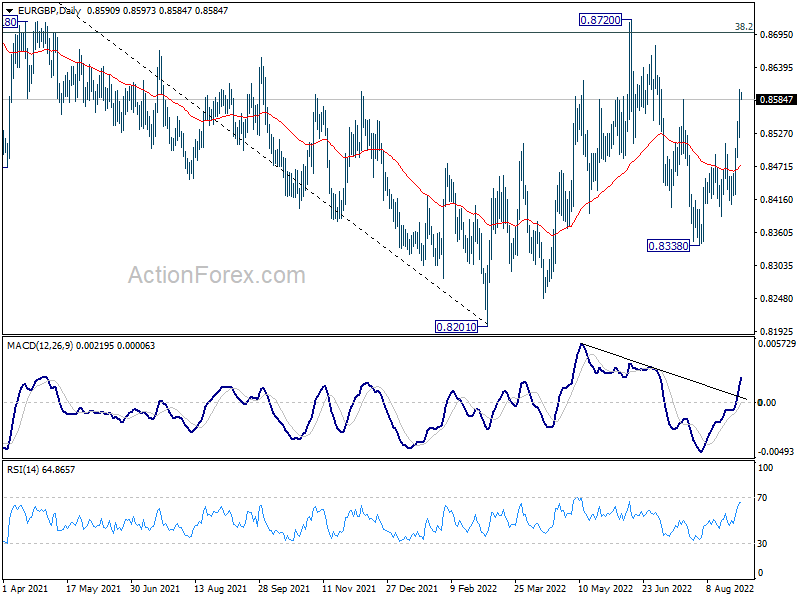
In the bigger picture, medium term bearishness is maintained with prior rejection by 38.2% retracement of 0.9499 to 0.8201 at 0.8697. Break of 0.8201 will resume larger down trend from 0.9499 (2020 high). Nevertheless, sustained break of 0.8697 will affirm the case that rise from 0.8201 is a medium term up trend itself.
EUR/AUD Daily Outlook
Daily Pivots: (S1) 1.4479; (P) 1.4555; (R1) 1.4692; More...
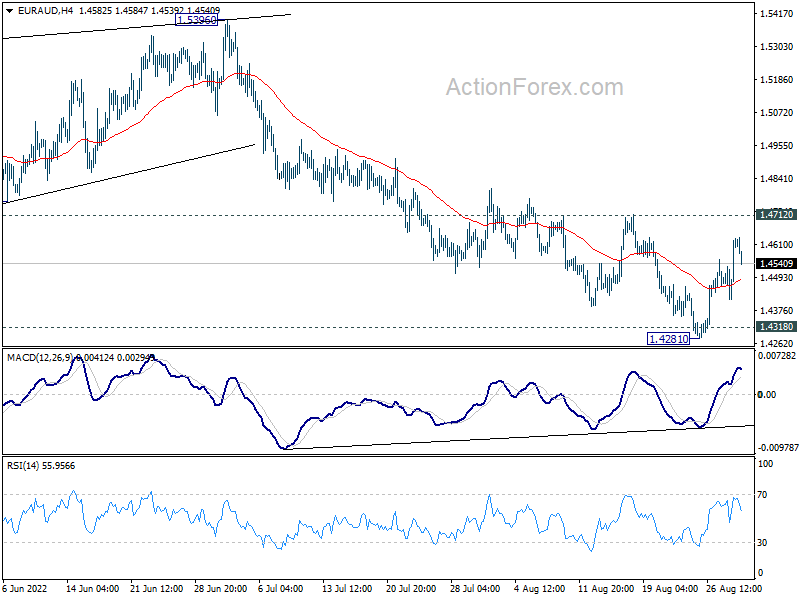
EUR/AUD is staying in range below 1.4712 resistance. Intraday bias remains neutral and further decline is still expected. On the downside, firm break of 1.4318 low will resume larger down trend to medium term projection level at 1.3623. On the upside, break of 1.4712 resistance will turn bias back to the upside for stronger rebound, towards 1.5396 resistance.
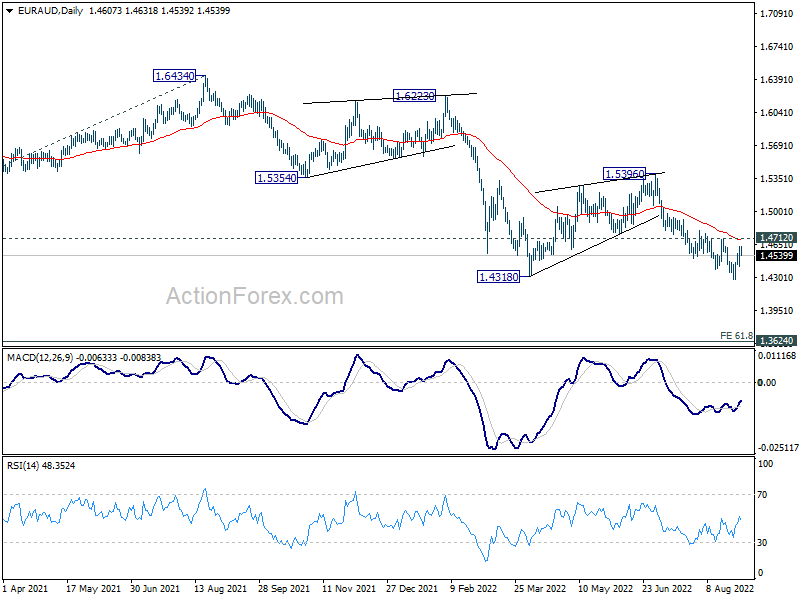
In the bigger picture, down trend from 1.9799 is still in progress. Break of 1.4318 low will target 61.8% projection of 1.9799 to 1.5250 from 1.6434 at 1.3623, which is close to 1.3624 long term support (2017 low). This will remain the favored case now as long as 1.5396 resistance holds.
GBP/JPY Daily Outlook
Daily Pivots: (S1) 161.63; (P) 162.14; (R1) 162.88; More...
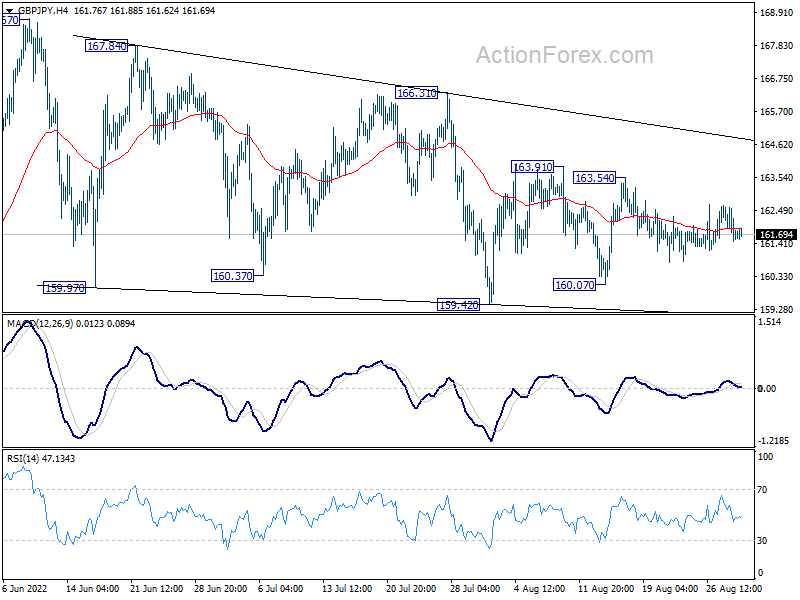
Intraday bias in GBP/JPY remains neutral for the moment as sideway trading continues. Corrective pattern from 168.67 would extend for a while. On the upside, break of 163.91 will bring stronger rise to 166.31 resistance. On the downside, below 160.07 will turn bias to the downside for 159.42 and below.
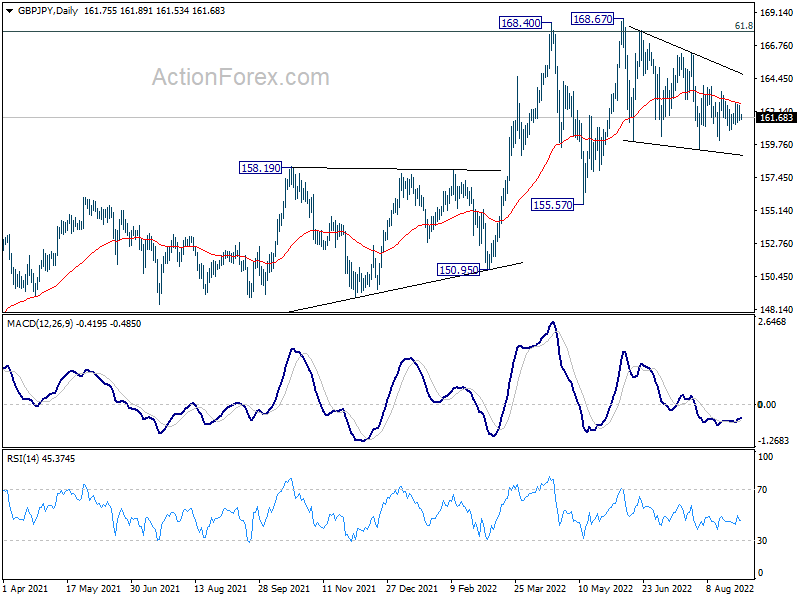
In the bigger picture, up trend from 123.94 (2020 low) is still in progress. Sustained break of 61.8% retracement of 195.86 (2015 high) to 122.75 (2016 low) at 167.93 will be a long term bullish signal, and could pave the way back to 195.86 high. This will remain the favored case as long as 155.57 support holds, even in case of deep pull back.
High Inflation Not Peaking Yet
Market movers today
The data highlight today will be the euro area HICP figures for August. Headline inflation will likely rise above the 9% mark, despite policy measures to stem the rise in prices. With underlying inflation pressures still broadening and the latest increase in energy commodity still to feed through, an inflation peak in the euro area is not yet in sight, keeping the pressure on ECB to front-load monetary tightening (see Research: New ECB call - We expect 75bp at the meeting next week, 29 August).
In the US, the ADP employment report will give some early hints for non-farm payrolls released on Friday.
Russia's Gazprom plans to halt gas flows through the Nord Stream1 pipeline today for maintenance. With lingering uncertainty whether gas flows will resume after three days, volatility in European energy markets will likely stay high.
A speech from Riksbank's Breman is scheduled for 8:30 CET.
The 60 second overview
European inflation: German CPI inflation ticked higher yet again with 7.9% in August, and inflation would be even higher if it was not for the "Tankrabatt" and the fact that the full impact of electricity and natural gas price rises has not nearly fed through to consumers yet. The numbers will increase again in September when the "tankrabatt" runs out.
US labour market: The US July JOLTs report provided further evidence of strong labour markets, as job openings rose against expectations to 11.2 million, while June figures were also revised higher. Labour demand remains very high relative to the persistent drop in labour supply, and the decline in Conference Board's August jobs 'hard to get' index suggests that overall labour market conditions have likely remained tight over the past month as well. Consumer confidence rebounded, while near-term inflation expectations eased slightly, likely reflecting the recovery in consumers' purchasing power amid lower gasoline prices. So far we see little signs of US economy being near recession despite the weakness in leading indicators, and another strong jobs report on Friday could tilt the balance further towards a 75bp hike in September (market prices around 70% probability). Atlanta Fed's Bostic emphasized yesterday, that the exact hiking pace will depend on incoming data, but broadly we continue to expect that Fed will have to keep financial conditions restrictive well into the next year in order to ensure that US economy avoids a more persistent period of stagflation - a message which has been echoed by several FOMC members since Powell's speech last Friday.
China: Official manufacturing PMIs increased to 49.4 in August from 49.0 in July and thus beat expectations slightly but remains in contractionary territory. The reopening boost is waning and weaker export orders and a continued weak property market weigh on Chinese activity.
Japan: Both industrial production and retail sales beat expectations in July. The former is down 1.0% while the latter is up 2.4% yoy. The Japanese economy still has not recovered fully from the pandemic and a surge in Covid cases is threatening to put a break on particularly the service sector once again in Q3.
Equities: Global equities lower yesterday after a roller-coaster session in Europe. Very positive sentiment at mid-day on the back of lower energy prices. However, this was ruined after too strong data from the US. Although equites were down for the third day in a row, the drivers were not the same and hence rotations very different compared to the Friday and Monday sessions. Materials and energy underperformed together with value while defensive and cyclicals much more balanced. In US Dow -1.0%, S&P 500 -1.1%, Nasdaq -1.1% and Russell 2000 -1.5%. Asian markets mixed this morning after their outperformance yesterday. Both European and US futures are about 0.5% higher this morning.
FI: Peripheral spreads underperformed on a day where core yields ended broadly unchanged in the 10y point. However, yields started lower on the day and it was only after the German CPI figure and hawkish tunes from the ECB governing council members, such as Knot (at our Danske Talks), Wunsch, Muller, Vasle leaning for a quick tightening of likely 75bp next week, that rates rose. Nagel said that recession fears should not delay rate hikes.
FX: EUR rose vis-à-vis USD, GBP and Scandies yesterday as market affirmed ECB pricing after recent hawkish comments and drop in natural gas prices. EUR/USD trades close to parity, EUR/SEK around 10.70 and EUR/NOK 9.80.
Credit: Sentiment in credit markets mirrored other risky assets and also had some catching up from Monday (where CDS indices were closed) to do. iTraxx Xover and Main ended the day 21bp and 5bp wider, respectively.
Nordic macro
In Sweden there is a scheduled Riksbank speech at 08:30 CET where we will hear Anna Breman discuss interest rates under the title "From 500% to -0.5% interest rate - and then what?". The money market is pricing in a lot of hikes with 75bp for the September meeting and 100bp for November followed by another 85bp in the first part of 2023. Even though we lean toward substantial frontloading, we think this is probably too much.
Encouraging US Data Sends Equities Lower, ADP and EZ CPI in Focus
All was going well yesterday; equities were in the green, when suddenly the dark clouds gathered and it started raining in the markets. The biggest catalyzer of yesterday’s sentiment reversal was the stronger-than-expected US economic data, which revived the Federal Reserve (Fed) hawks and sent the equity indices lower.
First, the JOLTS data showed that the job opening in the US spiked above 11 million, reminding investors that the US jobs market remains extremely tight, and there are about two jobs waiting for each unemployed worker. That means that the companies should pay higher salaries to get people to work for them, and well, that has an undesirable positive impact on inflation, hence revives the Fed hawks.
Second, the US consumer confidence index jumped in August, that was higher than the most optimistic of the forecasts on a Reuters survey. Improved confidence also means that households could be tempted to spend more money, which goes against the Fed’s will to cool down demand, and ease inflation. So, the latter also boosted the Fed hawks.
And as a result, the S&P500 slumped more than 1%. The 50-DMA, and the 50% Fibonacci level on the summer rally have been pulled out and the index closed the session below the 4000 psychological mark for the first time in more than a month.
Nasdaq slid another 1%, as well. It also cleared the 50-DMA support to the downside, and pulled out the major 61.8% retracement on the summer rally, signaling a stronger bearish momentum for the tech-heavy Nasdaq index.
For both Nasdaq and the S&P500, the tech indicators don’t point at oversold market conditions, hinting that the selloff has perhaps more to deepen in the next few hours.
Although the US futures are again in the positive this morning, we saw yesterday that the winds could rapidly change direction, and the volatility is picking up.
Due today, the ADP report will be one of the key data that investors will be watching in the US. The US economy is expected to have added 200’000 new private jobs in August. A stronger-than-expected figure has power to boost the Fed hawks - as we saw at yesterday’s session, and increase the bearish pressure on equities. A softer-than-expected figure will, however, do little to bring in the Fed doves, given that the Fed wants a tighter jobs market, and it will only be happy to see the number of job additions cool down.
And sorry to say this but
As long as the jobs market remains tight and inflation remains the predominant concern, the Fed will welcome any further slump in equity prices.
Minneapolis Fed President Kashkari couldn’t be clearer when he said on Bloomberg’s Odd Lots that he was ‘not excited to see the stock market rallying after the last FOMC meeting’ , because he ‘knows how committed they all are to getting inflation down’. And somehow, ‘the markets were misunderstanding that’.
Rising inflation also revives ECB & BoE hawks, in vain…?
The German inflation hit an almost 50-year high of 8.8% yesterday, the Spanish inflation was slightly off but still above the 10% mark. The French and Italian will also release their latest update, and we will get the flash CPI estimate in the Eurozone this morning. The number is expected to be around 9%.
European Central Bank’s (ECB) Muller said yesterday that the ECB should discuss 75 bp hike at the September policy meeting , as inflation outlook has failed to improve.
And he is right. There is more pain before relief in Europe. In Germany, the latest CPI figure was relatively softish thanks to government aid, including fuel rebate, and the measures will end soon. The nat gas prices continue spiking as Russia turns off the Nordstream 1 for three-day maintenance, and we doubt that the gas flow will ever be restored again. On the other hand, Gazprom warned the French utility Engie that it would halt deliveries from Thursday because of a disagreement over payments.
If that’s not enough, the euro keeps weakening against the US dollar, making the European imports more expensive. And the EURUSD is struggling to keep its head above water, as the hawkish ECB expectations are being troubled by the recession fears.
Across the Channel, the situation is not more brilliant. If you think that 10% inflation in Europe is excessive, read this: Goldman Sachs warned that inflation in Britain could hit 22% next year if the natural gas prices remain high. Other big banks are not as pessimistic, but their forecasts are not encouraging either. Citi for example sees the British inflation advance past 18%, while the Bank of England itself sees inflation trend to 13%. The BoE hawks are not sleeping in their corner, but Cable is headed toward the 1.15 mark, despite the expectation that the BoE will more than double its policy rate to 4.25% next year! If that’s not capable of giving some strength to the pound, I don’t know what can!