

Sample Category Title
Fed Williams: Going to take some time before downward adjustments of rates
New York Fed President John Williams said, "we need to have somewhat restrictive policy to slow demand and we're not there yet." Nevertheless, the size of the rate hike at the September meeting will depend on the "totality" of data.
Going forward, "from my perspective right now, I see us needing to kind of hold a policy stance - pushing inflation down, bringing demand and supply into alignment - it's going to take longer, will continue through next year," he said.
"Based on what I'm seeing in the inflation data, and what I'm seeing in the economy, it's going to take some time before I would expect to see adjustments of rates downward."
Fed Bostic: We can dial back from 75bps if inflation is clearly slowing
In a blog post, Atlanta Fed President Raphael Bostic said, "I don't think we are done tightening". As inflation remains "too high", Fed's policy stance " will need to move into restrictive territory if inflation is to come down expeditiously."
However, he added, "incoming data—if they clearly show that inflation has begun slowing—might give us reason to dial back from the hikes of 75 basis points that the Committee implemented in recent meetings. We will have to see how those data come in."
ECB Muller: 75bps hike should be an option for Sep meeting
ECB Governing Council member Madis Muller said, "I think 75 basis points should be among the options for September given that the inflation outlook has not improved."
"Still, I'm going into the meeting with an open mind and I want to both see the new projections and hear my colleague's arguments," he added.
"We should not be too timid with policy moves as inflation has been too high for too long and we are still far below the neutral rate," he said.
Dollar Fires Up ahead of Nonfarm Payrolls
The latest US employment report will be released at 12:30 GMT Friday and will test the notion that the economy is in solid shape. Business surveys point to some softness in jobs growth, but nothing dramatic yet. As for the dollar, it is enjoying the best of all worlds – widening interest rate differentials, a lack of alternatives, and safe-haven flows.
Optimism vs pessimism
There is a raging debate going on about the strength of the US economy. Pessimists cite a range of leading indicators such as new business orders, consumer confidence, housing data, and the yield curve, all of which point to a sharp slowdown in economic activity just around the corner.
Optimists like Fed Chairman Powell point to a labor market that is essentially at full employment and argue the economy is still in good shape. It is difficult to have a recession when the unemployment rate is at its lowest level in five decades.
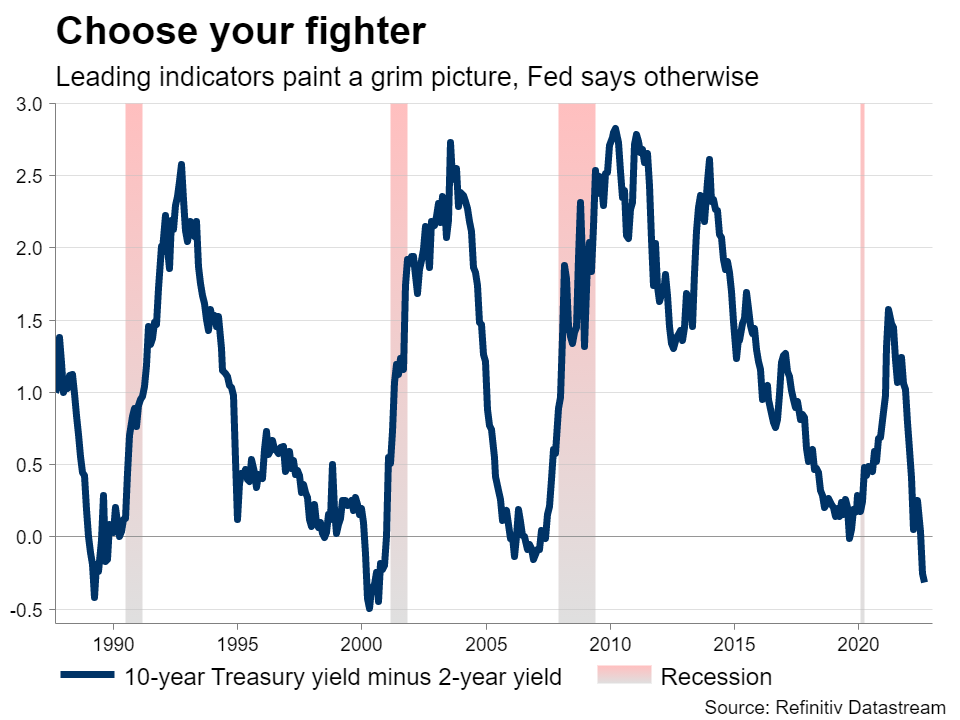
The problem with this logic is that employment is a lagging indicator. When investors look at jobs data, they are looking into the past. The labor market always looks to be at its strongest right before a recession hits. It is the last domino to fall.
Another problem is that the job numbers aren’t so strong once you dig beneath the surface. The nonfarm payrolls print comes from the ‘establishment’ survey while the unemployment rate comes from the ‘household’ survey, and there has been a dramatic divergence between the two lately.
Nonfarm payrolls suggest the US economy added almost 2 million jobs since March, whereas the household survey suggests no jobs growth at all. One key difference is that people working two jobs are counted twice in nonfarm payrolls, but only once in the household survey.
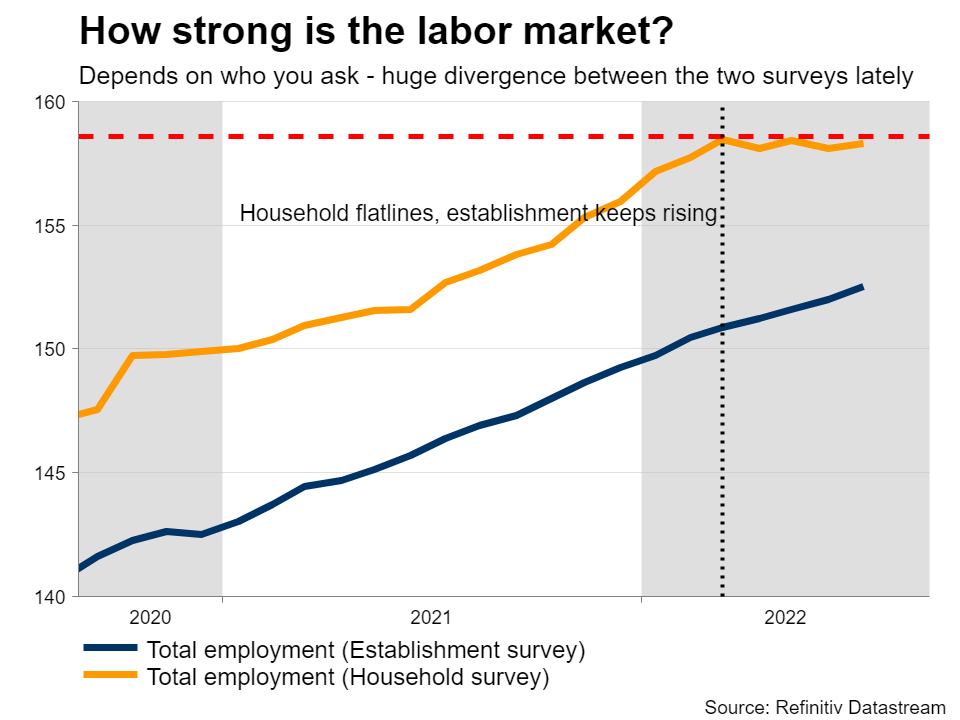
Therefore, the ‘stellar’ employment gains in recent months might have simply been people taking on another job, because they were struggling to make ends meet.
Solid report?
Of course, traders care mostly about the nonfarm payrolls print. The US economy is projected to have added another 300k jobs in August outside of farms, which would keep the unemployment rate steady at 3.5%. Wage growth is expected to have cooled a little, both in monthly and yearly terms.
As for the risks, business surveys suggest a disappointment is more likely than a positive surprise in this report. The S&P Global PMI revealed the slowest increase in employment for almost a year, as companies facing uncertain demand and rising costs delayed the replacement of staff that left voluntarily.
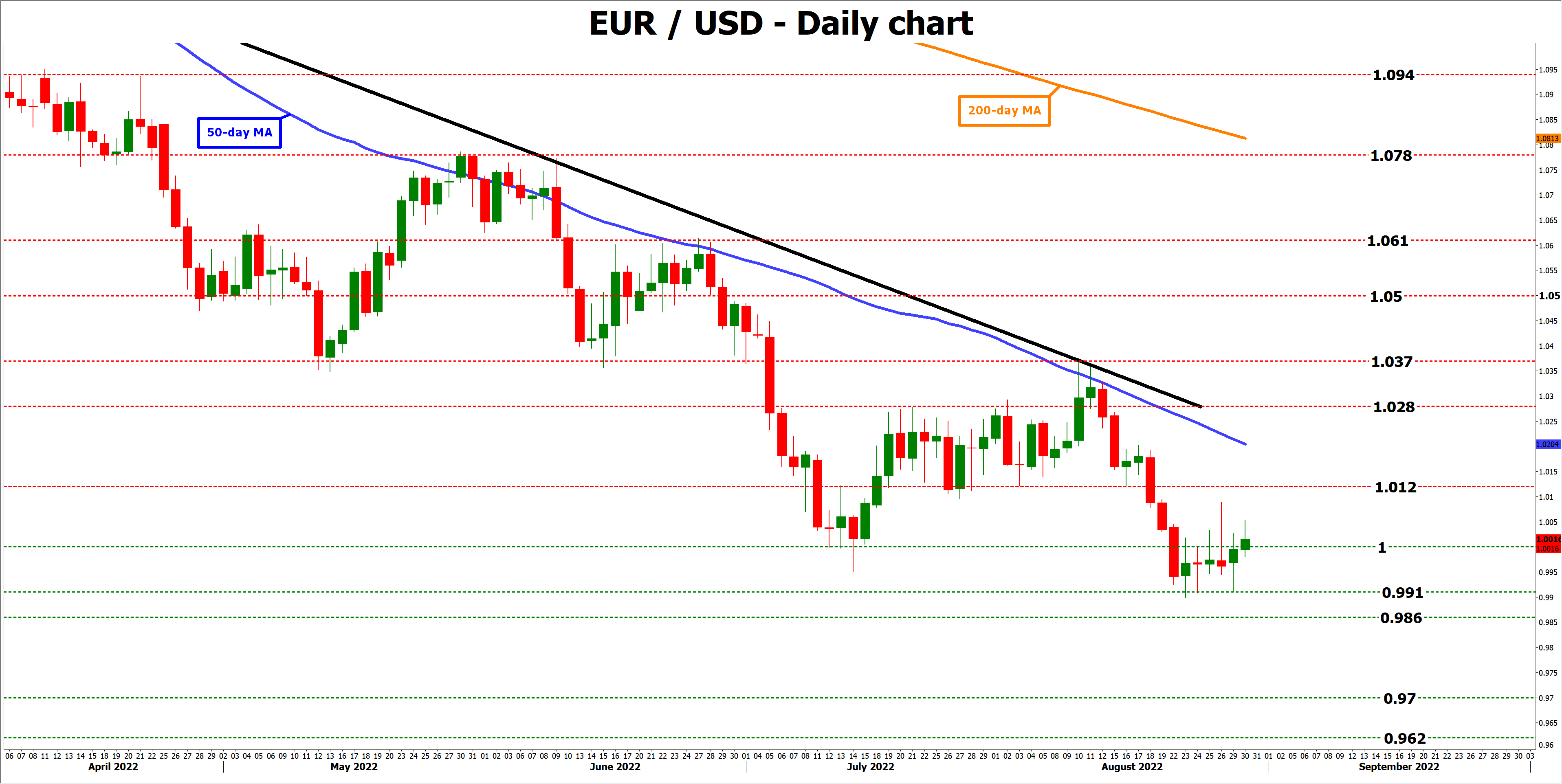
In case of disappointment, the US dollar could take a step back, pushing euro/dollar higher for another test of the 1.0120 region. That said, even if the pair rallies all the way up to 1.0370, it would still be stuck in a downtrend.
On the flipside, if the data surpasses expectations, that could hammer the pair back below parity, opening the door towards the 0.9910 zone.
Heading into the event, investors will get more labor market indicators to digest, starting with the revamped ADP employment report on Wednesday. Then on Thursday, the ISM manufacturing survey is due out.
Best of all worlds
In the bigger picture, even if the dollar takes a hit this week, it is still difficult to argue for any trend reversal. With an energy shortage tormenting Europe, a deepening property crisis in China, and the Fed committed to keeping interest rates high as long as it takes to crush inflation, the dollar is enjoying the best of all worlds.
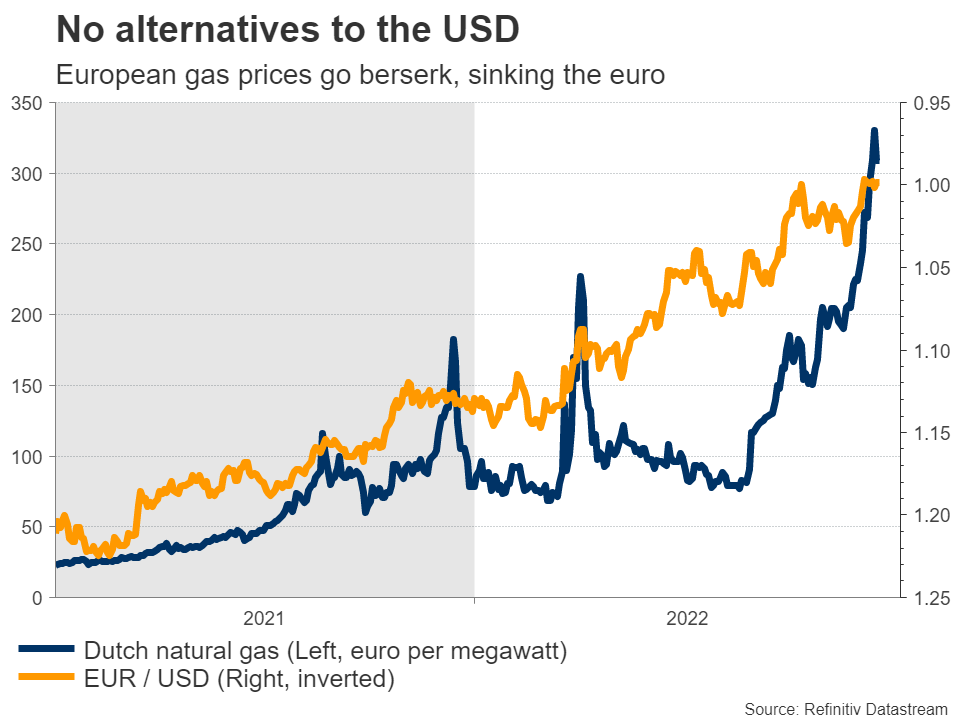
There is a lack of alternatives to replace it, safe-haven demand is booming, and widening interest rate differentials with other economies allow it to attract capital flows. It essentially offers a combination of safety and attractive returns that no other currency can replicate.
Until something changes in this narrative, king dollar is unlikely to lose its crown.
Euro Steady as German Inflation Accelerates
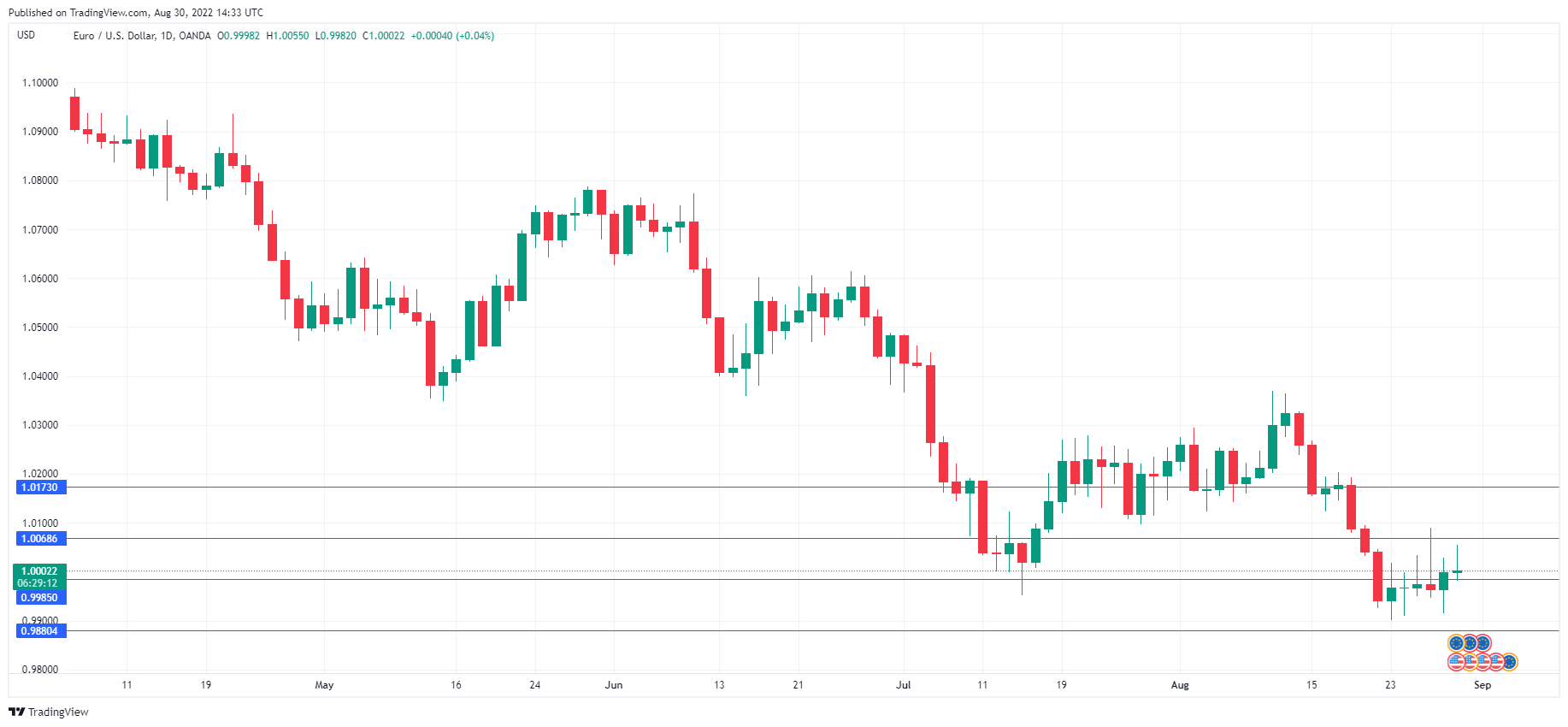
EUR/USD has edged higher for a second straight day, but has pared today’s gains. In the North American session, EUR/USD is trading at 1.007, up 0.09%.
German inflation rises to 7.9%
German CPI is estimated to have climbed to 7.9% YoY in August, up from 7.5% in July and above the forecast of 7.8%. The jump in inflation was driven by the usual suspects, energy and food prices. Energy prices jumped 35.6% and food prices rose 16.6% compared to a year earlier. With the war in Ukraine raging on and Europe facing a possible energy shortage in the winter, it’s hard to envision inflation in the bloc easing anytime soon. The ECB raised interest rates in July but inflation will not be curbed by the current benchmark rate of 0.50%, well below the neutral rate of around 1.5%.
The US dollar has showed some strength since Fed Chair Powell’s no-nonsense, hawkish speech at Jackson Hole. Powell’s message to the markets remained consistent with the Fed’s pledge to continue raising rates until inflation is brought down, but this time the markets paid attention, as equity markets fell and the dollar gained ground against the major currencies. The glaring exception was the euro, which has managed to hold its own against the greenback. The euro has received support as expectations rise that the ECB could deliver a supersize 75bp increase at its September meeting.
On Friday, ECB officials attending the Jackson Hole Symposium noted that inflation levels remained high and urged the ECB to deliver a September rate hike of 50 or even 75 basis points. Today’s German inflation report will put added pressure on the ECB to consider a 75bp move, as inflation continues to accelerate. On Wednesday, the eurozone releases CPI for August, with an estimate of 9.0% YoY, which would be a notch higher than the 8.9% gain in July. If inflation hits 9.0% or higher, the euro could gain ground as expectations for a 75bp hike will increase.
EUR/USD Technical
- EUR/USD has support at 0.9985 and 0.9880
- There is resistance at 1.0068 and 1.0173
Sunset Market Commentary
Markets
National European August inflation readings today printed in line with forecasts. Spanish inflation was slightly lower compared with July (10.3% Y/Y from 10.7% Y/Y), but remains in double digit territory. German inflation accelerated as forecast by 0.4% M/M, from 8.5% Y/Y to 8.8% Y/Y. Next month could see a leap towards 10%+ with one-off cheap transport prices and a reduction in road fuel taxes set to end. Belgian inflation accelerated to its highest level since 1976 (9.94% Y/Y; see below). These national numbers suggest that tomorrow’s EMU reading will be near/at consensus as well. Economists put forward a monthly dynamic of 0.4% M/M, with the Y/Y reading slightly rising from 8.9% to 9% for the headline number and from 4% to 4.1% for the core gauge. Core bonds initially traded volatile. It’s actually the kind of number which could pave the way for some consolidation near sell-off lows with next week’s ECB meeting in mind. However, going into US dealings, core bonds gradually face more selling pressure again. The move likely coincides with an intraday U-turn of gas prices. They initially extended yesterday’s correction in anticipation of EC president von der Leyen’s announcement of structural reforms to the power market and on temporary short term fixes to relief some pressure on household and enterprise budgets. Headlines that Gazprom will cut deliveries even more to French utility Engie after a disagreement over contracts were at first overruled. German yields rise by 0.7 bps (10-yr) to 2.6 bps (2-yr) at the moment with the wings of the curve underperforming the belly. The US yield curve turns more inverse with yields rising by 0.6 bps (30-yr) to 2.3 bps (2-yr). The single currency mirrored the move in gas prices (and core bond yields for that matter). EUR/USD moved from parity to 1.0050 before drifting south again to 1.0025. Stock markets joined the journey with main indices returning half of today’s max gain of 1.5%. The technical break higher in EUR/GBP yesterday (> 0.8512) met with follow-up action today. The pair reaches above 0.8550 with intermediate resistance at 0.8585 in sight. It’s the final hurdle ahead of the YTD top of 0.8721.
News Headlines
Belgian inflation accelerated from 9.62% to 9.94% y/y (0.81% m/m) in August. The near-double digit print is the fastest since 1976. Energy prices remain the key driver, jumping 49.81% y/y and adding 4.43 ppts to the headline figure. Natural gas unsurprisingly shows the sharpest increase (106.9% y/y, 12.3% m/m). Electricity came in second (57.2% y/y, 11.5% m/m). Food prices rose 9.71% y/y, delivering a 1.92 ppts contribution. Core inflation also quickened, from 5.49% to 5.74% amidst rising prices for services (5.36% y/y). The top three in biggest declines were seen in television equipment (-12.4% y/y), smartphones (-8.8% y/y) and mobile phone services (-4.9% y/y).
Hungary’s central bank (MNB) lifted policy rates by 100 bps to 11.75%, surpassing the peak seen prior to the 2008 recession (11.50%). Interest rates on the one-week deposit instrument will be raised similarly on Thursday. The MNB held an outright hawkish tone even as it mentioned a clear slowdown in economic growth since the beginning of June. Inflation at 13.7% (16.7% even for core inflation) remains far too high and widespread, keeping inflation expectations at an elevated level as well. In achieving the 3% (+/- 1 ppt) target, second-round effects need to be avoided and inflation expectations anchored. Aside from the rate hike and to enhance monetary transmission further, the MNB introduced three additional measures: an increase in the required reserve ratio, central bank discount bill auctions and a long-term, liquidity-sterilizing deposit instrument. The Hungarian forint, though still very weak, reacted positively by strengthening from EUR/HUF 408 to 403.9 currently. Hungarian swap rates add as much as 25 bps, parting ways with other CE swap rates.
US consumer confidence rose to 103.2, but recession risks continue
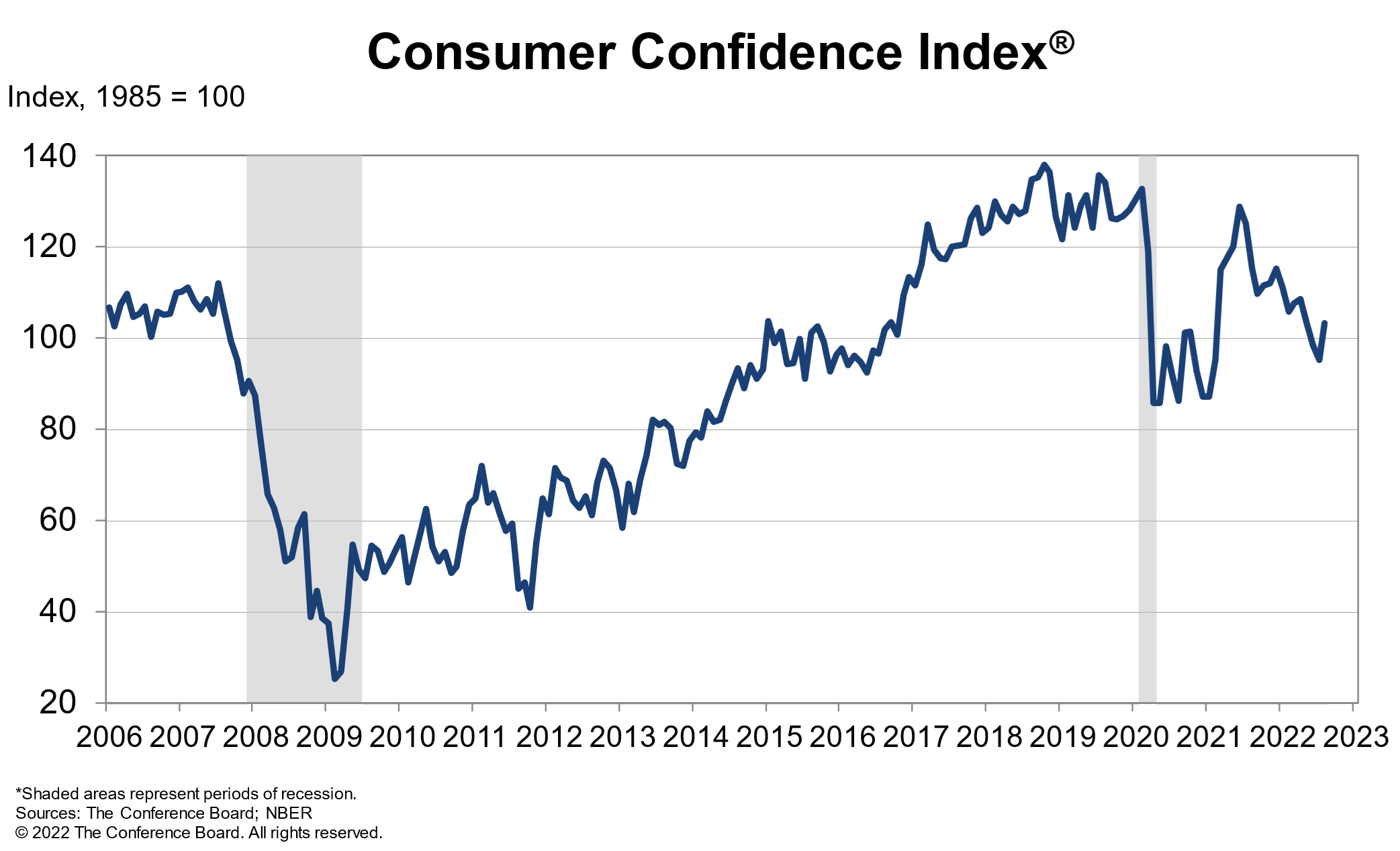
US Conference Board Consumer Confidence rose notably from 95.3 to 103.2 in August, above expectation of 97.6. Present Situation Index rose from 139.7 to 145.4. Expectations Index rose from 65.6 to 75.1.
"Consumer confidence increased in August after falling for three straight months," said Lynn Franco, Senior Director of Economic Indicators at The Conference Board. "The Present Situation Index recorded a gain for the first time since March. The Expectations Index likewise improved from July's 9-year low, but remains below a reading of 80, suggesting recession risks continue. Concerns about inflation continued their retreat but remained elevated."
"Meanwhile, purchasing intentions increased after a July pullback, and vacation intentions reached an 8-month high. Looking ahead, August's improvement in confidence may help support spending, but inflation and additional rate hikes still pose risks to economic growth in the short term."
AUDUSD Edges Higher Within Symmetrical Triangle; Neutral in Medium-Term
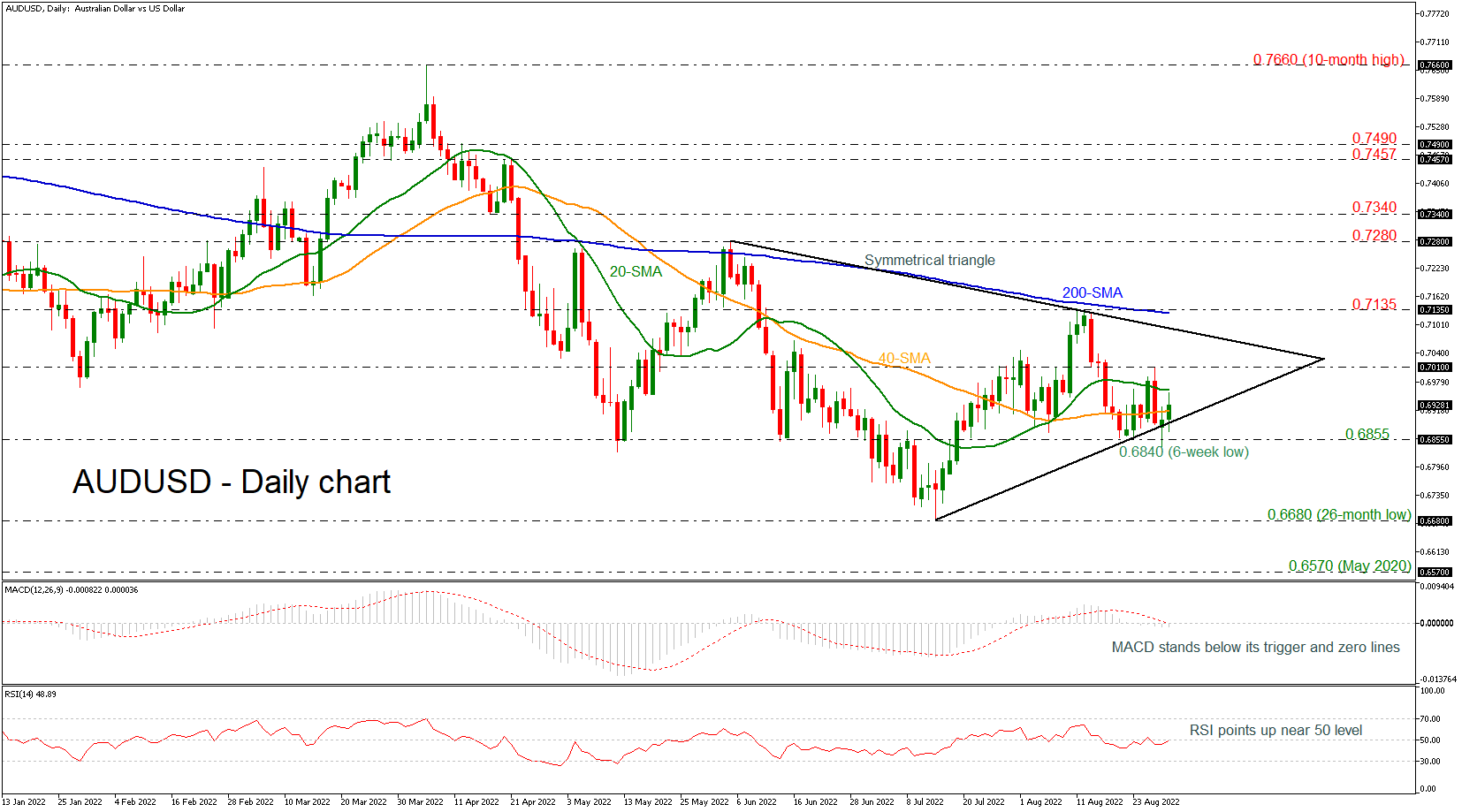
AUDUSD is finding strong support near the short-term ascending trend line and the 0.6855 barrier, after it spiked towards a new six-week low at 0.6840. The RSI indicator is gaining some momentum, mirroring the market’s bullish behavior over the past couple of days, flagging that a recovery could reemerge in the short-term. The MACD is also moving with weak momentum near its trigger and zero lines.
In case the pair changes its short-term direction to the upside, the bulls will probably challenge the previous top at 0.7010. A break higher, could carry the pair until the upper boundary of the symmetrical triangle near the 200-day SMA and the 0.7135 resistance level. Further up, the area around 0.7280 could be another potential obstacle for upward movements.
Alternatively, more declines may drive the price towards the 0.6855 barrier again before the 26-month low of 0.6680 comes into view. Beneath the latter, the trough of May 2020 at 0.6570 could be another level in focus.
Turning to the medium-term picture, the pair switched to neutral mode after the drop off 0.7280. The 200-day SMA continues to head south, and the market’s outlook might improve further in the medium-term. Yet there is still some way to go for the lines of the symmetrical triangle to meet each other.
Summarizing, AUDUSD maintains a bullish bias in the short-term picture, whereas in the medium-term it holds a neutral profile.
Swiss Franc Falls to 5-Week Low
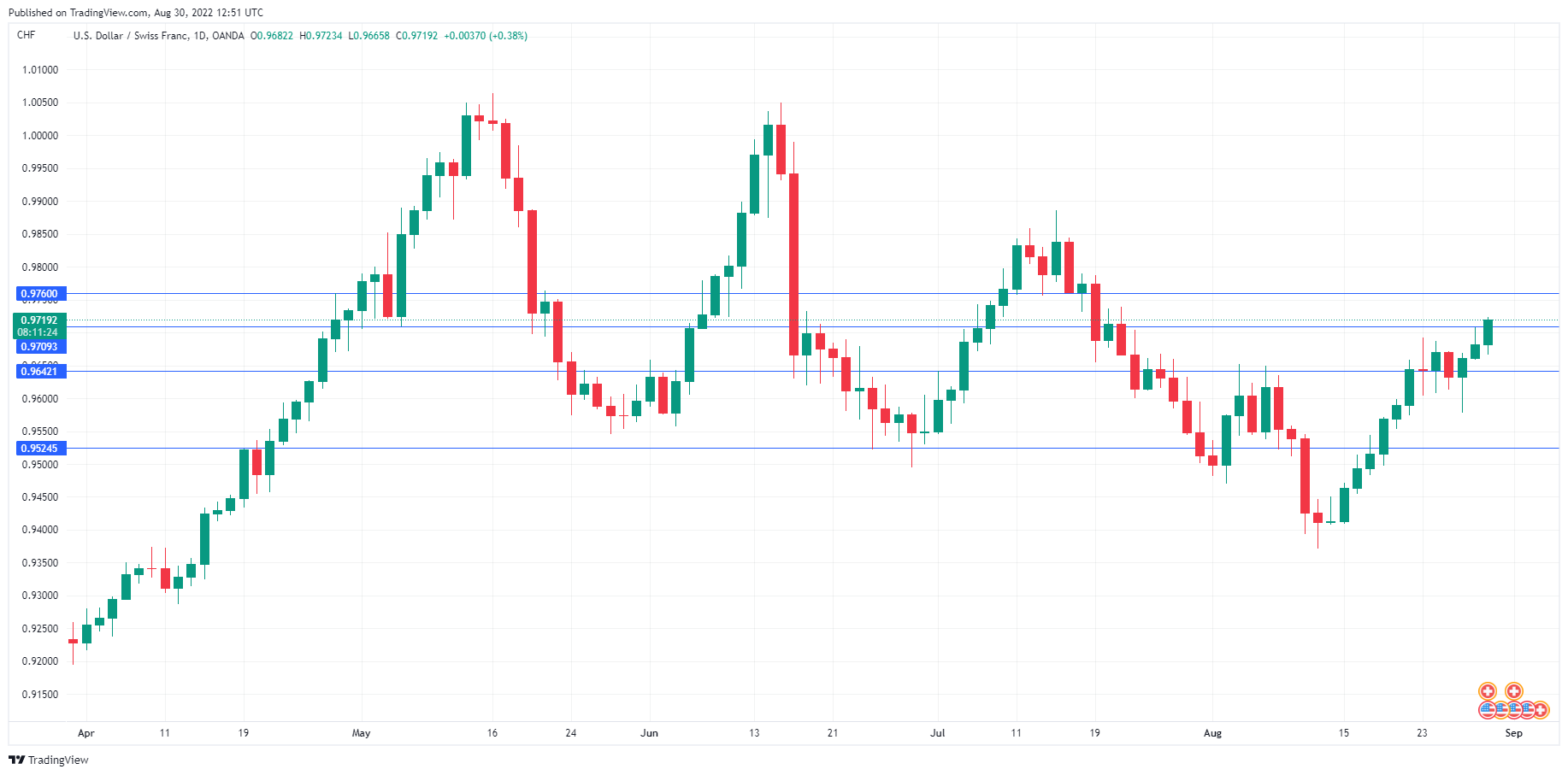
USD/CHF is up for a third straight day. In the European session, the pair is trading at 0.9717, up 0.36%. The US dollar continues to show strength against most of the majors. The Swiss franc has fallen sharply, with USD/CHF climbing 360 points since August 16th.
KOF Economic Barometer falls again
The KOF Economic Barometer continued its downward trend, declining for a fourth straight month in August. The index dropped to 86.5, down from 90.1 in July and shy of the estimate of 89.0. Much of the August decline was related to consumer consumption, but the manufacturing sector is also showing weakness. Similar to the situation in other major economies, manufacturing activity has been hurt by supply chain disruptions and a lack of employees.
Switzerland will release the August inflation report on Thursday. The estimate for August CPI is 0.2% MoM, after a 0.0% reading in July. The Swiss central bank (SNB), which is not shy about intervening in currency markets, will be watching carefully. Higher inflation means the Swissie has less purchasing power, which suits the SNB as it has a paramount interest in the Swiss currency remaining weak so that Swiss exports are competitive.
In the US, the markets continue to digest Fed Chair Powell’s hawkish speech on Friday. The “read my lips” speech in which Powell firmly stated that there would be no pivot in policy appeared to have hit its mark, as equity markets took a tumble on Friday and again on Monday, although we are seeing a rebound today.
The Federal Reserve holds its next policy meeting on September 21st and we can expect plenty of discussions as to whether the Fed will hike by 50 or 75 basis points. CME’s FedWatch has pegged the likelihood of a 75bp move at 66.5%, with a 33.5% likelihood of a 50bp move. These numbers are sure to change in the coming weeks, as the markets hunt for clues as to the Fed’s plans.
USD/CHF Technical
- USD/CHF is testing resistance at 0.9720. Next, there is resistance at 0.9760
- There is support at 0.9642 and 0.9524
Fed Barkin: Recession is obviously a risk in bringing inflation down
Richmond Fed President Thomas Barkin said, "we're committed to returning inflation to our 2% target and we'll do what it takes to get there. I'd expect inflation to bounce around on the way back to our target." He didn't expect inflation to "come down immediately".
"A recession is obviously a risk in the process," Barkin said. But, "it doesn't have to be like a 2008 recession, it doesn't have to be calamitous. We're out of balance today...returning to normal might actually mean products on shelves, cars on lots and restaurants fully staffed."