Sample Category Title
USD/CHF Mid-Day Outlook
Daily Pivots: (S1) 0.9686; (P) 0.9724; (R1) 0.9782; More...
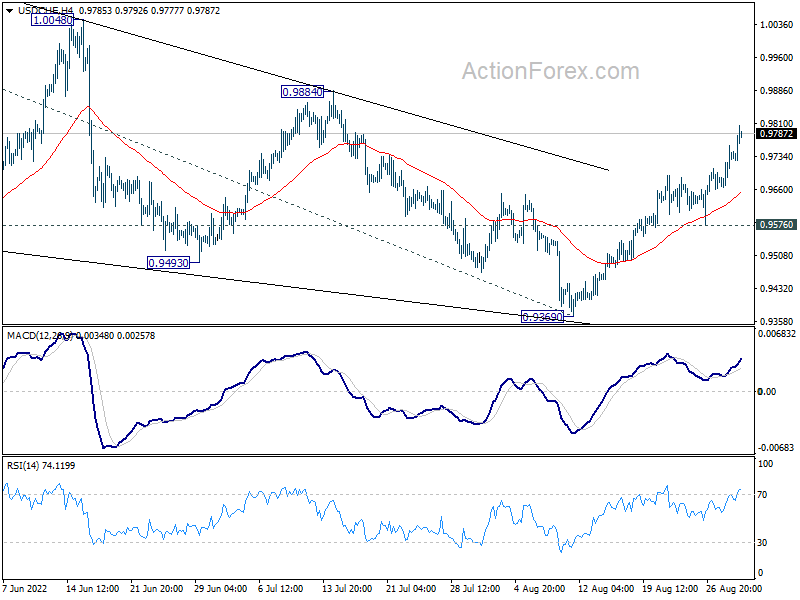
Intraday bias in USD/CHF remains on the upside for the moment. Current rise from 0.9369 should target 0.9884 resistance first. Break there will argue that larger up trend is ready for resumption through 1.0063. On the downside, break of 0.9576 support is needed to indicate completion of the rebound. Otherwise, further rise will remain in favor in case of retreat.
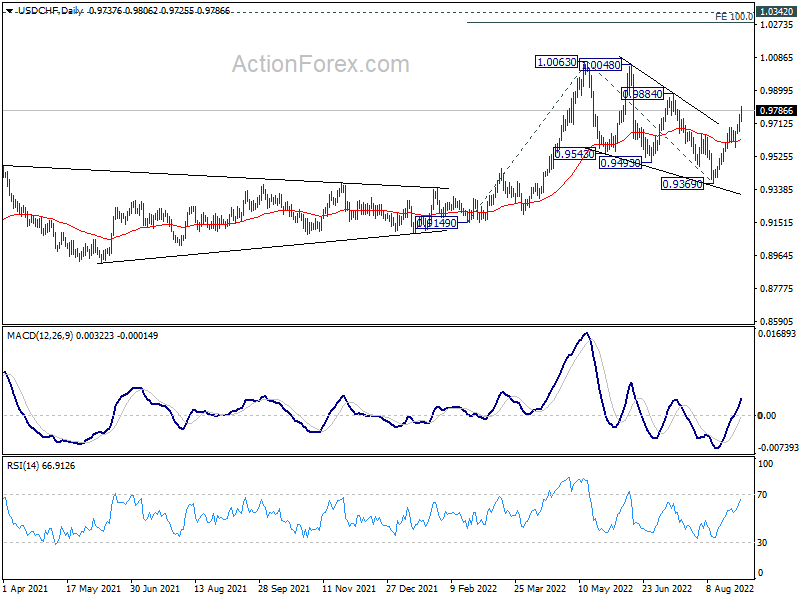
In the bigger picture, current development suggests that up trend from 0.8756 (2021 low) is still in progress. Sustained break of 1.0063 will target 100% projection of 0.9149 to 1.0063 from 0.9369 at 1.0283, and then 1.0342 (2016 high). For now, this will remain the favored case as long as 0.9369 support holds, even in case of deep pull back.
GBP/USD Mid-Day Outlook
Daily Pivots: (S1) 1.1597; (P) 1.1679; (R1) 1.1736; More...
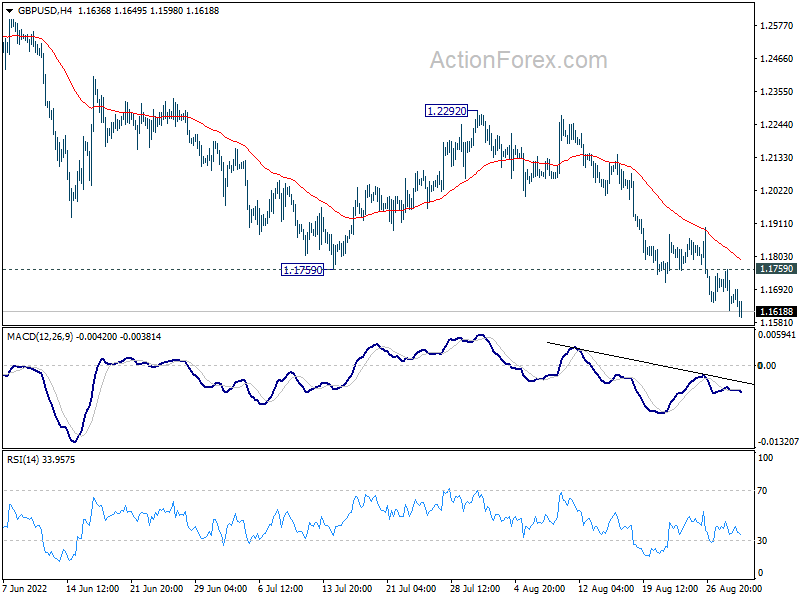
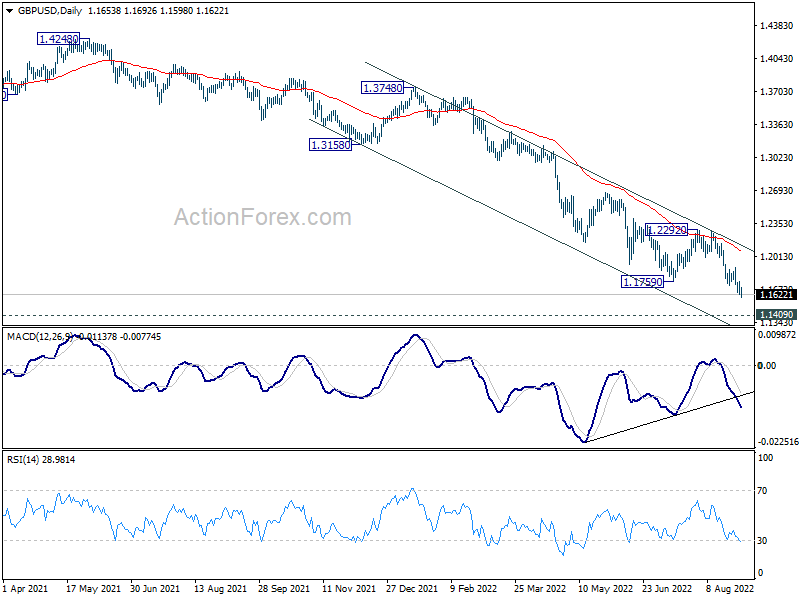
GBP/USD's down trend is still in progress and intraday bias stays on the downside for 1.1409 long term support. On the upside, above 1.1759 minor resistance will turn intraday bias neutral for consolidations. But outlook will stay bearish as long as 1.2292 resistance holds, in case of recovery.
In the bigger picture, fall from 1.4248 (2018 high) could be a leg inside the pattern from 1.1409 (2020 low), or resuming the longer term down trend. Deeper decline is expected as long as 1.2292 resistance holds. Next target is 1.1409 low. However, firm break of 1.2292 will bring stronger rise back to 55 week EMA (now at 1.2859).
EUR/USD Mid-Day Outlook
Daily Pivots: (S1) 0.9980; (P) 1.0018; (R1) 1.0053; More...
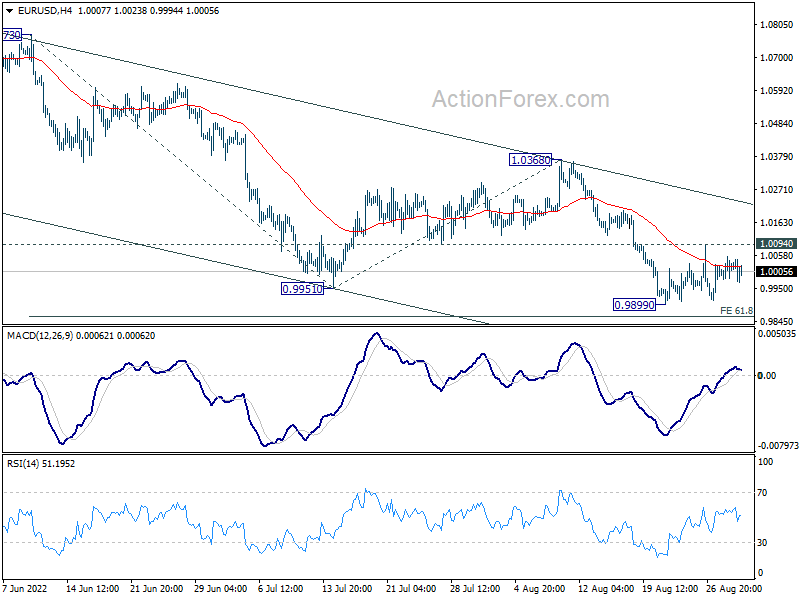
Intraday bias in EUR/USD stays neutral as range trading continues, and further decline is expected with 1.0094 resistance intact. On the downside, break of 0.9899 will resume larger down trend to 61.8% projection of 1.0773 to 0.9951 from 1.0368 at 0.9860. Firm break there should prompt downside acceleration to 100% projection at 0.9546. However, firm break of 1.0094 minor resistance will dampen this bearish view, and turn bias back to the upside for 1.0368 resistance instead.
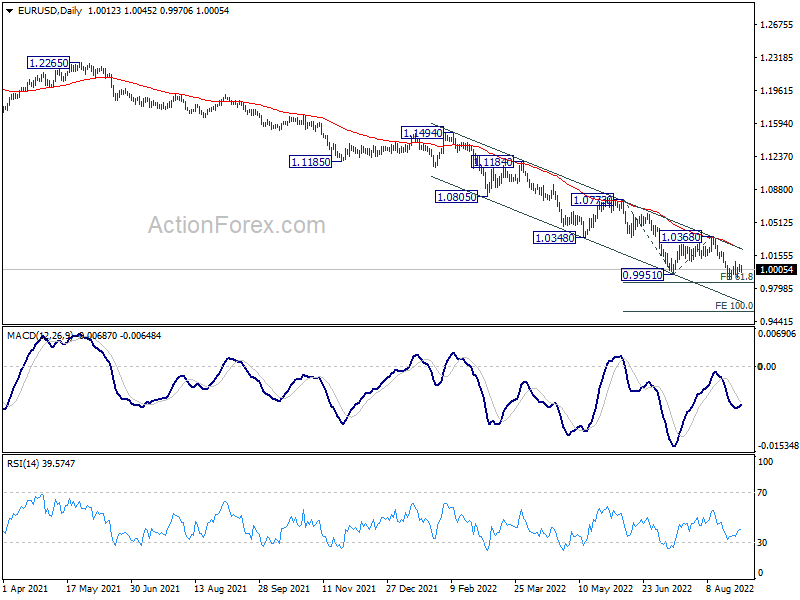
In the bigger picture, down trend from 1.6039 (2008 high) is still in progress. Next target is 100% projection of 1.3993 to 1.0339 from 1.2348 at 0.8694. In any case, outlook will stay bearish as long as 1.0368 resistance holds, in case of strong rebound.
Euro Up Against Europeans after CPI, Dollar Sluggish after ADP Miss
Euro is extending near term rally against Swiss Franc and Sterling after even higher than expected record inflation. But it's struggling to gain against most other currencies. Dollar is also sluggish after ADP employment disappointment, while Yen's is recovering. Commodity currencies are mixed for now. It seems like traders would continue to hold their bets until US non-farm payroll employment data.
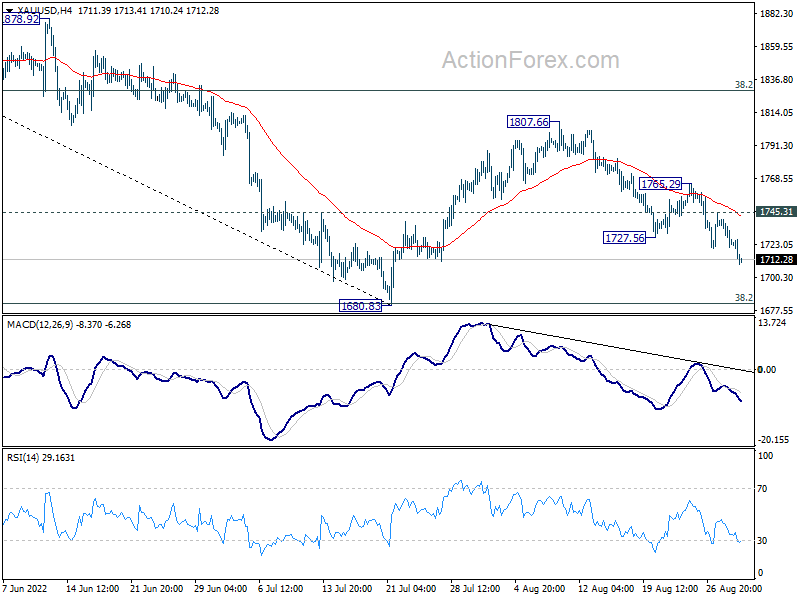
Technically, Gold's decline continues after brief recovery and it's on track to retest 1680.83 support holds. The question remains on whether this long term cluster support level would hold. Or, this level would be taken out decisively to complete confirm a long term trend reversal. In the latter case, it could be used as a confirmation for Dollar's up trend resumption, in particular against Euro.
In Europe, at the time of writing, FTSE is down -0.86%. DAX is up 0.02%. CAC is down -0.24%. Germany 10-year yield is up 0.049 at 1.557. Earlier in Asia, Nikkei dropped -0.37%. Hong Kong HSI rose 0.03%. China Shanghai SSE dropped -0.78%. Singapore Strait Times dropped -0.55%. Japan 10-year JGB yield rose 0.0027 to 0.230.
US ADP employment grew 132k, a shift towards more conservative hiring pace
US ADP private employment grew 132k in August, well below expectation of 300k. By sector, goods-producing jobs grew 23k. Services-providing jobs grew 110k. By company size, small businesses added 25k jobs, medium added 53k, large added 54k. Annual pay was up 7.6%.
"Our data suggests a shift toward a more conservative pace of hiring, possibly as companies try to decipher the economy's conflicting signals," said Nela Richardson, chief economist, ADP. "We could be at an inflection point, from super-charged job gains to something more normal."
Fed Mester expects rates above 4% by early next year, and hold it there
Cleveland Fed President Loretta Mester said, "my current view is that it will be necessary to move the fed funds rate up to somewhat above 4 percent by early next year and hold it there; I do not anticipate the Fed cutting the fed funds rate target next year." "It would be a mistake to declare victory over the inflation beast too soon. Doing so would put us back in the stop-and-go monetary policy world of the 1970s, which was very costly to households and businesses," she added.
Canada GDP grew 0.1% mom in Jun, but to contract -0.1% mom in Jul
Canada GDP grew 0.1% mom in June, matched expectations. Services-producing industries grew 0.2% mom while goods- producing industries rose 0.1% mom. 14 of 20 industrial sectors expanded in the month.
Advance information indicates that real GDP edged down by -0.1% mom in July. Output was down in the manufacturing, wholesale, retail trade and utilities sectors. Declines were partly offset by increases in the mining, quarrying, oil and gas sector and the agriculture, forestry, fishing and hunting sector.
Eurozone CPI rose to 9.1% yoy in Aug, core CPI up to 4.3% yoy
Eurozone CPI accelerated further from 8.9% yoy to 9.1% yoy in August, above expectation of 9.0%. CPI core (all items excluding energy, food, alcohol, and tobacco) rose from 4.0% yoy to 4.3% yoy, above expectation of 4.0% yoy.
Looking at the main components, energy is expected to have the highest annual rate in August (38.3%, compared with 39.6% in July), followed by food, alcohol & tobacco (10.6%, compared with 9.8% in July), non-energy industrial goods (5.0%, compared with 4.5% in July) and services (3.8%, compared with 3.7% in July).
France goods consumption volume dropped -0.8% mom in Jul, CPI slowed to 5.8% yoy in Aug
France household consumption in goods, in volume, dropped -0.8% mom in July. The decline was mainly due to further decrease of consumption of manufactured goods (–1.4% after –0.7%). Food consumption also decreased further (–0.4% after –0.3%). Energy consumption fell back (–0.4% after +2.7% in June).
All item CPI slowed from 6.1% yoy to 5.8% yoy in August. Food inflation rose from 6.8% yoy to 7.7% yoy. Energy inflation slowed from 28.5% yoy to 22.2% yoy. Manufactured products inflation rose from 2.7% yoy to 3.5% yoy. Services inflation was unchanged at 3.9% yoy.
BoJ Nakagawa: laid out three reasons for continuing powerful monetary easing
BoJ board member Junko Nakagawa said in a speech that it's "necessary for the Bank of Japan to persistently continue with the current powerful monetary easing," and she laid out three reasons for that.
Firstly, Japan is "still on its way to recovery" from the pandemic. "As demand remains insufficient compared with supply capacity, a shift in the direction of monetary policy toward tightening would likely drag down the economy and put significant downward pressure on the economic activity of firms and households."
Secondly, current inflation in Japan "differ considerably in terms of degree and the number of items" comparing to those in the US and Europe. The difference is "likely due to the disparity in wage inflation".
Thirdly, the 2% inflation target "needs to be achieved in a sustainable and stable manner". "Even if the higher price of some items pushes up the overall price level to 2 percent, unless household disposable income increases, spending on products and services will decline due to budget constraints." Japan is only "halfway to achieve the price stability target.
Japan industrial production rose 1.0% mom in Jul, auto jumped 12%
Japan industrial production grew 1.0% mom in July, way better than expectation of -0.5% mom decline. The Ministry of Economy, Trade and Industry maintained its output assessment, "fluctuates indecisively" reflecting the ups and downs in production in recent months.
Six of the 15 industries reported output increases while eight declined. The auto industry saw the biggest increase by sector, by 12.0% mom.
Based on a poll of manufacturers, the ministry expects industrial output to grow 5.5 percent in August and rise 0.8 percent in September.
Also released, retail trade rose 2.4% yoy in July, above expectation of 1.9% yoy. Housing starts dropped -5.4% yoy in July, worse than expectation of -3.4% yoy. Consumer confidence improved from 30.2 to 32.5 in August.
NZ ANZ business confidence improved to -47.8 in Aug
New Zealand ANZ Business Confidence rose from -56.7 to -47.8 in August. Own Activity Outlook rose from -8.7 to -4.0. Export intentions rose from -2.7 to 3.9. Investment intentions rose from -2.6 to -2.0. Employment intentions rose from 1.1 to 3.4. Pricing intentions dropped from 74.0 to 70.1. Cost expectations dropped from 91.3 to 90.9. Inflation expectations dropped slightly from 6.23 to 6.13.
ANZ said: "It would make sense that with inflation and wage inflation running so high, the neutral Official Cash Rate is creeping higher, meaning the sting of a given interest rate wears off. Risks are tilted towards the RBNZ having to continue on with OCR hikes next year to cool the economy sufficiently to feel comfortable they're getting on top of the inflation problem.
China PMI manufacturing rose to 49.4 in Aug, contraction continued
China's official PMI Manufacturing rose slightly from 49.0 to 49.4 in August, above expectation of 49.2. New orders ticked up from 48.5 to 49.2. Production was flat at 49.8. PMI Non-Manufacturing dropped from 53.8 to 52.6, above expectation of 52.2. PMI Composite dropped from 52.5 to 51.7.
The data showed manufacturing activity contracted for the second straight month. Also, the sector has been in contraction for five out of the past six months, briefly hitting 50.2 in June.
EUR/USD Mid-Day Outlook
Daily Pivots: (S1) 0.9980; (P) 1.0018; (R1) 1.0053; More...
Intraday bias in EUR/USD stays neutral as range trading continues, and further decline is expected with 1.0094 resistance intact. On the downside, break of 0.9899 will resume larger down trend to 61.8% projection of 1.0773 to 0.9951 from 1.0368 at 0.9860. Firm break there should prompt downside acceleration to 100% projection at 0.9546. However, firm break of 1.0094 minor resistance will dampen this bearish view, and turn bias back to the upside for 1.0368 resistance instead.
In the bigger picture, down trend from 1.6039 (2008 high) is still in progress. Next target is 100% projection of 1.3993 to 1.0339 from 1.2348 at 0.8694. In any case, outlook will stay bearish as long as 1.0368 resistance holds, in case of strong rebound.
Economic Indicators Update
| GMT | Ccy | Events | Actual | Forecast | Previous | Revised |
|---|---|---|---|---|---|---|
| 22:45 | NZD | Building Permits M/M Jul | 5.00% | -2.30% | -2.20% | |
| 23:01 | GBP | BRC Shop Price Index Y/Y Jul | 5.10% | 4.40% | ||
| 23:50 | JPY | Industrial Production M/M Jul P | 1.00% | -0.50% | 9.20% | 9.20% |
| 23:50 | JPY | Retail Trade Y/Y Jul | 2.40% | 1.90% | 1.50% | |
| 01:00 | NZD | ANZ Business Confidence Aug | -47.8 | -56.7 | ||
| 01:30 | CNY | NBS Manufacturing PMI Aug | 49.4 | 49.2 | 49 | |
| 01:30 | CNY | Non-Manufacturing PMI Aug | 52.6 | 52.2 | 53.8 | |
| 01:30 | AUD | Private Sector Credit M/M Jul | 0.70% | 0.70% | 0.90% | |
| 01:30 | AUD | Construction Work Done Q2 | -3.80% | 0.80% | -0.90% | -0.30% |
| 05:00 | JPY | Housing Starts Y/Y Jul | -5.40% | -3.40% | -2.20% | |
| 05:00 | JPY | Consumer Confidence Index Aug | 32.5 | 29.4 | 30.2 | |
| 06:00 | EUR | Germany Import Price Index M/M Jul | 1.40% | 1.60% | 1.00% | |
| 06:45 | EUR | France Consumer Spending M/M Jul | -0.80% | -0.30% | 0.10% | |
| 06:45 | EUR | France GDP Q/Q Q2 | 0.50% | 0.50% | 0.50% | |
| 07:55 | EUR | Germany Unemployment Change Aug | 28K | 27K | 48K | |
| 07:55 | EUR | Germany Unemployment Rate Aug | 5.50% | 5.50% | 5.40% | |
| 08:00 | CHF | Credit Suisse Economic Expectations Aug | -56.3 | -57.2 | ||
| 09:00 | EUR | Eurozone CPI Y/Y Aug P | 9.10% | 9.00% | 8.90% | |
| 09:00 | EUR | Eurozone CPI Core Y/Y Aug P | 4.30% | 4.00% | 4.00% | |
| 12:15 | USD | ADP Employment Change Aug | 132K | 300K | 128K | |
| 12:30 | CAD | GDP M/M Jun | 0.10% | 0.10% | 0.00% | |
| 13:45 | USD | Chicago PMI Aug | 53.2 | 52.1 | ||
| 14:30 | USD | Crude Oil Inventories | -0.4M | -3.3M |
Fed Mester expects rates above 4% by early next year, and hold it there
Cleveland Fed President Loretta Mester said, "my current view is that it will be necessary to move the fed funds rate up to somewhat above 4 percent by early next year and hold it there; I do not anticipate the Fed cutting the fed funds rate target next year."
"It would be a mistake to declare victory over the inflation beast too soon. Doing so would put us back in the stop-and-go monetary policy world of the 1970s, which was very costly to households and businesses," she added.
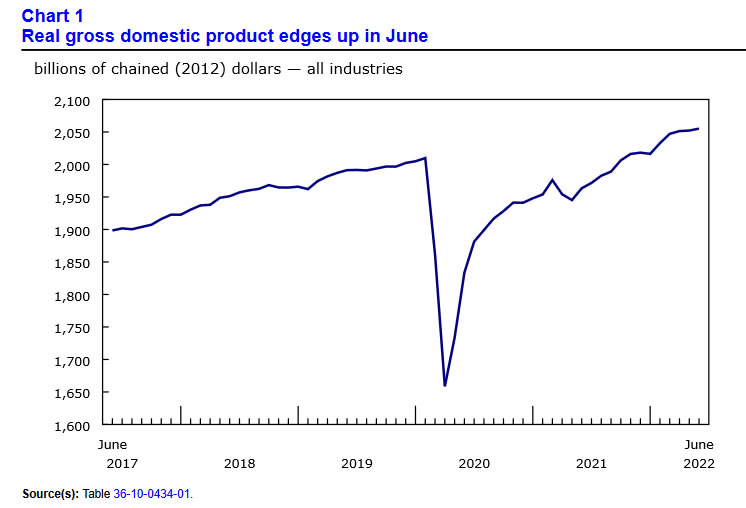
Canada GDP grew 0.1% mom in Jun, but to contract -0.1% mom in Jul
Canada GDP grew 0.1% mom in June, matched expectations. Services-producing industries grew 0.2% mom while goods- producing industries rose 0.1% mom. 14 of 20 industrial sectors expanded in the month.
Advance information indicates that real GDP edged down by -0.1% mom in July. Output was down in the manufacturing, wholesale, retail trade and utilities sectors. Declines were partly offset by increases in the mining, quarrying, oil and gas sector and the agriculture, forestry, fishing and hunting sector.
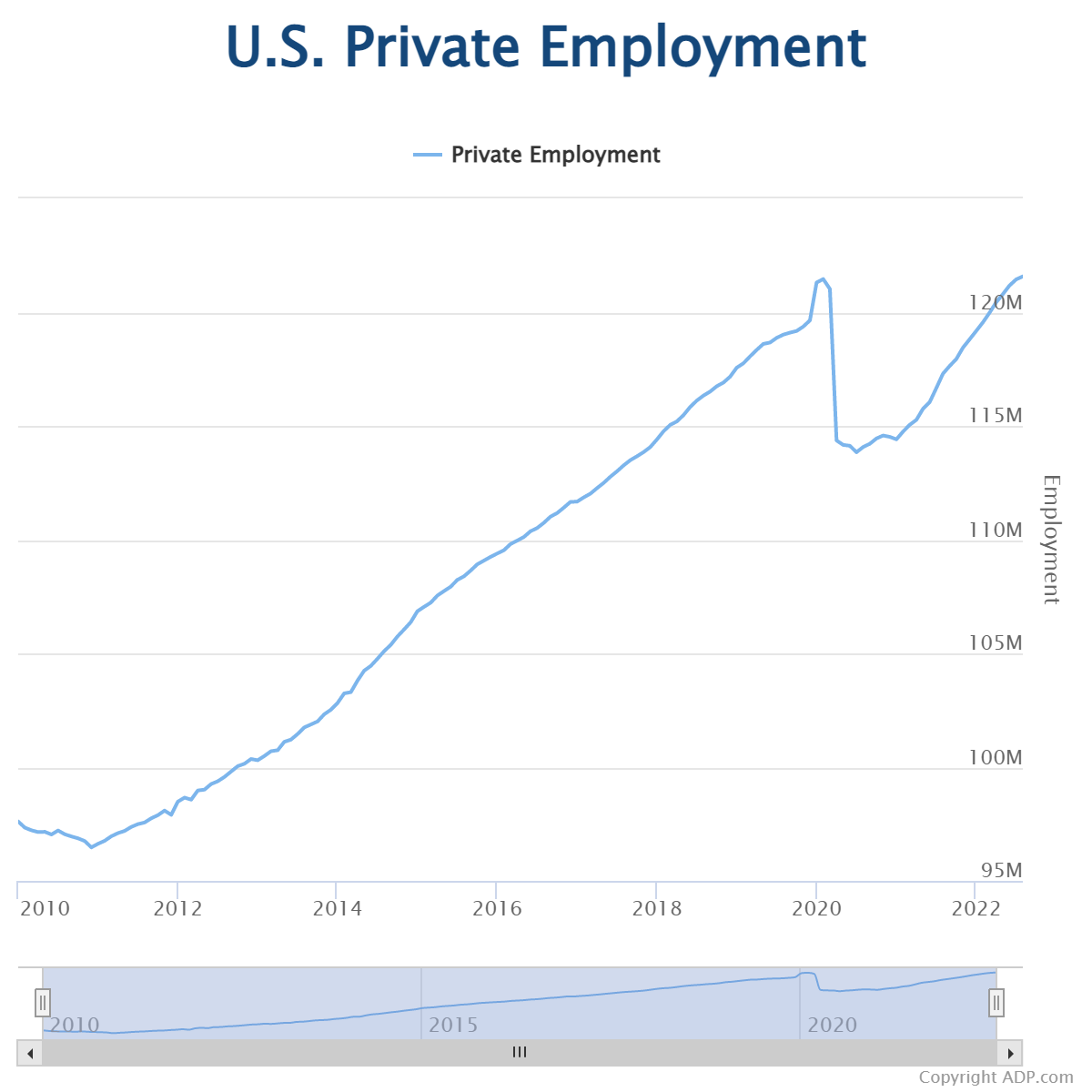
US ADP employment grew 132k, a shift towards more conservative hiring pace
US ADP private employment grew 132k in August, well below expectation of 300k. By sector, goods-producing jobs grew 23k. Services-providing jobs grew 110k. By company size, small businesses added 25k jobs, medium added 53k, large added 54k. Annual pay was up 7.6%.
"Our data suggests a shift toward a more conservative pace of hiring, possibly as companies try to decipher the economy's conflicting signals," said Nela Richardson, chief economist, ADP. "We could be at an inflection point, from super-charged job gains to something more normal."
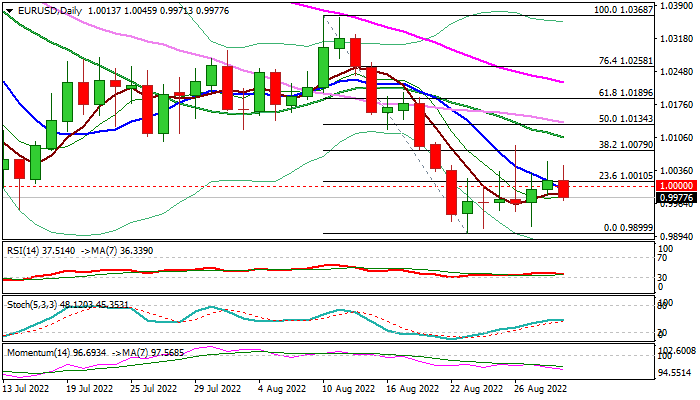
EUR/USD: Euro Returns Below Parity Despite Positive Signals from Record High EU Inflation
The Euro eases below parity on Wednesday, weighed by fresh strength of the US dollar and failure to benefit from growing expectations for more aggressive action from the ECB next week, after the latest data showed that inflation in the EU bloc surged to new record high in August
The single currency remains depressed by mounting concerns of further economic slowdown due to surging energy and food prices, with fears that inflation is getting entrenched that would make the job of the central bank in restoring price stability more difficult.
Daily technical studies show rising negative momentum and moving averages in bearish setup that adds to weakening outlook.
Fresh weakness brings the price back within the range that extends into the second straight week, after attempts to break the upper range boundary were short-lived, increasing risk of fresh attack at the range floor at 0.9900.
Near-term action is still lacking direction, with break of either boundary (1.0100 / 0.9900) needed to generate initial direction signal.
Res: 1.0050; 1.0089; 1.0111; 1.0137.
Sup: 0.9949; 0.9900; 0.9853; 0.9793.
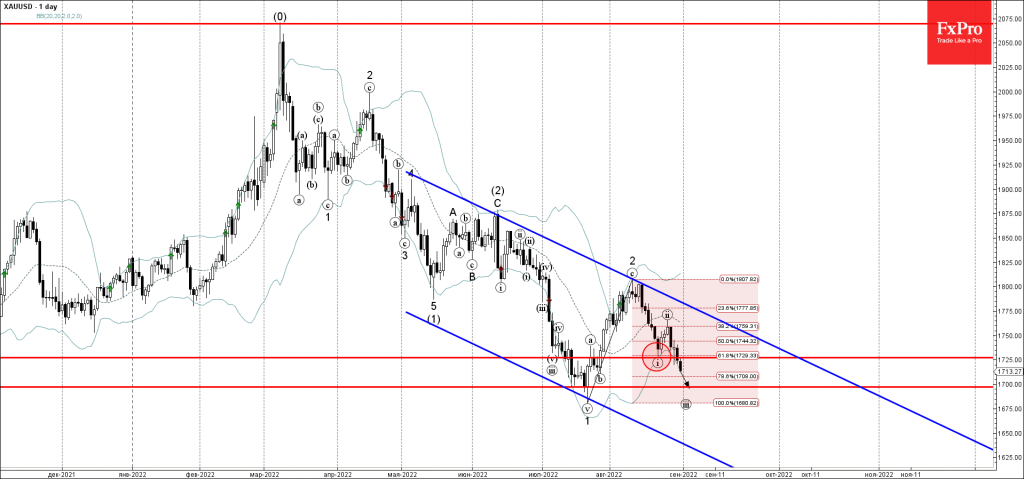
Gold Wave Analysis
- Gold broke support level 1725.00
- Likely to fall to support level 1700.00
Gold recently broke the support level 1725.00 intersecting with the 61.8% Fibonacci correction of the upward correction 2 from July.
The breakout of the support level 1725.00 accelerated the active short-term impulse waves (iii) and 3, which belong to the intermediate impulse wave (3) from June.
Gold can be expected to fall further toward the next round support level 1700.00 (which stopped the previous impulse wave 1 in July).
WTI Wave Analysis
- WTI reversed from resistance level 95.00
- Likely to fall to support level 141.35
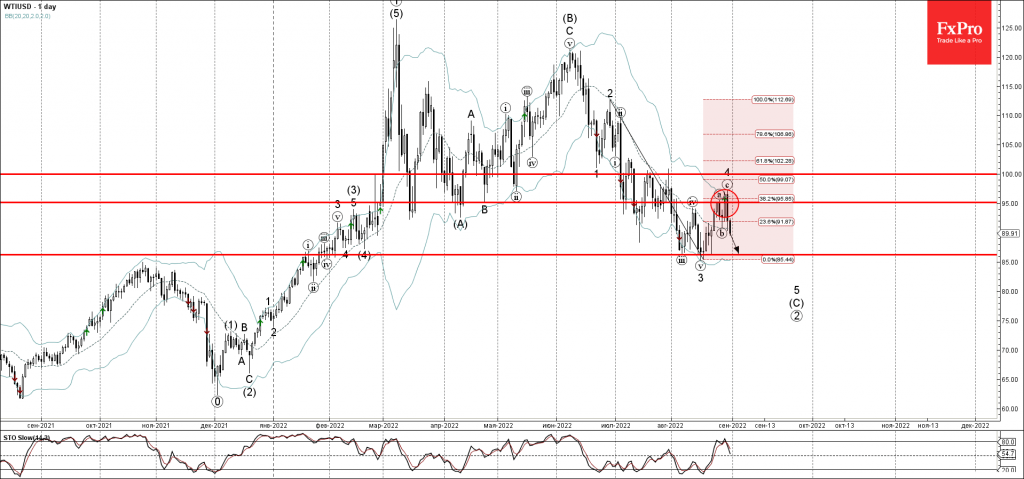
WTI crude oil recently reversed down with the Bearish Engulfing from the resistance level 95.00 (which has been reversing the pair from the start of August) intersecting with the upper daily Bollinger Band and the 38.2% Fibonacci correction of the downward impulse from June.
The downward reversal from the resistance level 143.00 started the active short-term impulse wave 5.
WTI crude oil can be expected to fall further toward the next support level 86.25 (low of the previous impulse wave 3).