Sample Category Title
USD/CHF Daily Outlook
Daily Pivots: (S1) 0.9425; (P) 0.9448; (R1) 0.9486; More...
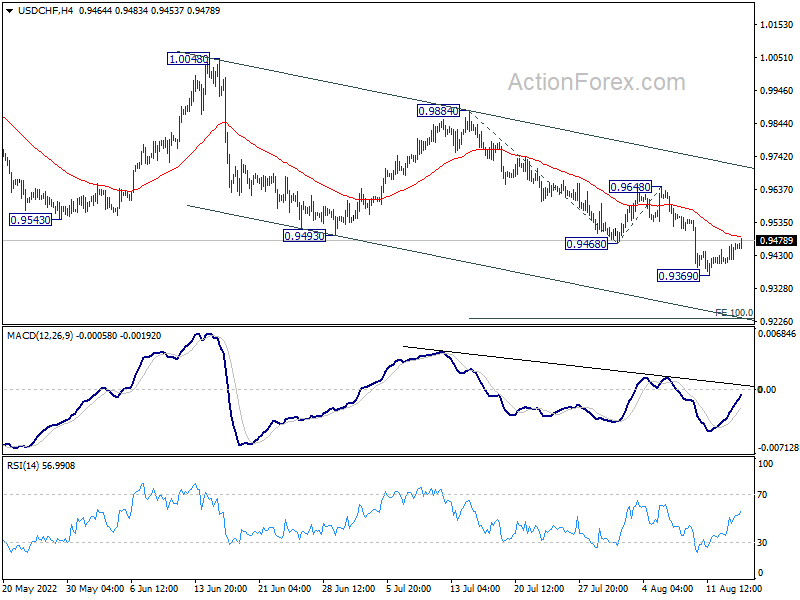
Intraday bias in USD/CHF remains neutral as consolidation from 0.9369 is extending. Upside should be limited well below 0.9648 resistance to bring another fall. Break of 0.9369 will resume larger fall to 100% projection of 0.9884 to 0.9468 from 0.9648 at 0.9232.
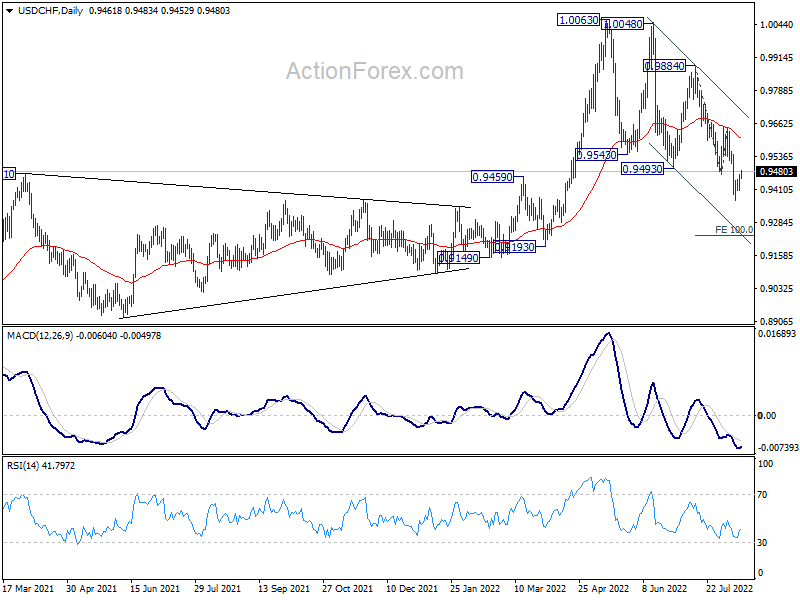
In the bigger picture, break of 0.9471 support turned resistance argues that medium term up trend from 0.8756 has completed with three waves up to 1.0063. Long term sideway pattern might have started another falling leg. Deeper decline would now be in favor as long as 0.9648 resistance holds, to 0.9149 structural support. Sustained break there could pave the way back to 0.8756.
GBP/USD Daily Outlook
Daily Pivots: (S1) 1.2020; (P) 1.2084; (R1) 1.2118; More...
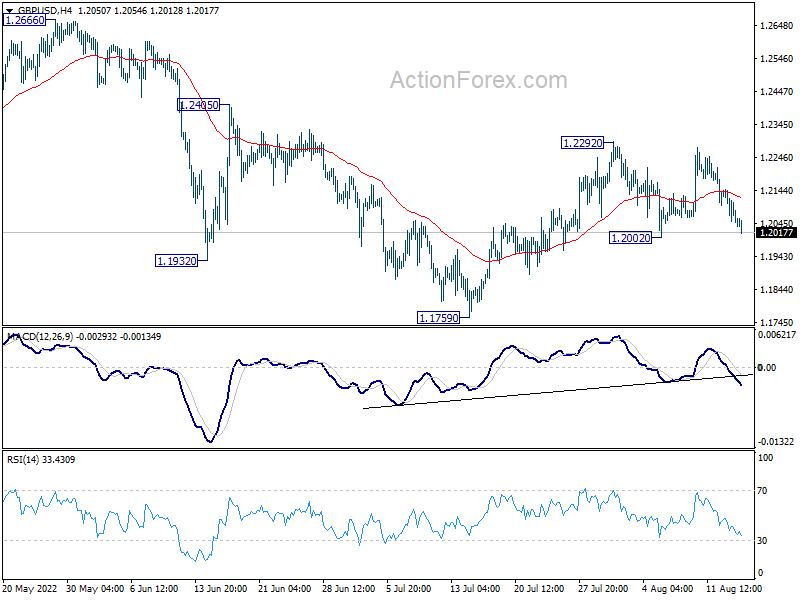
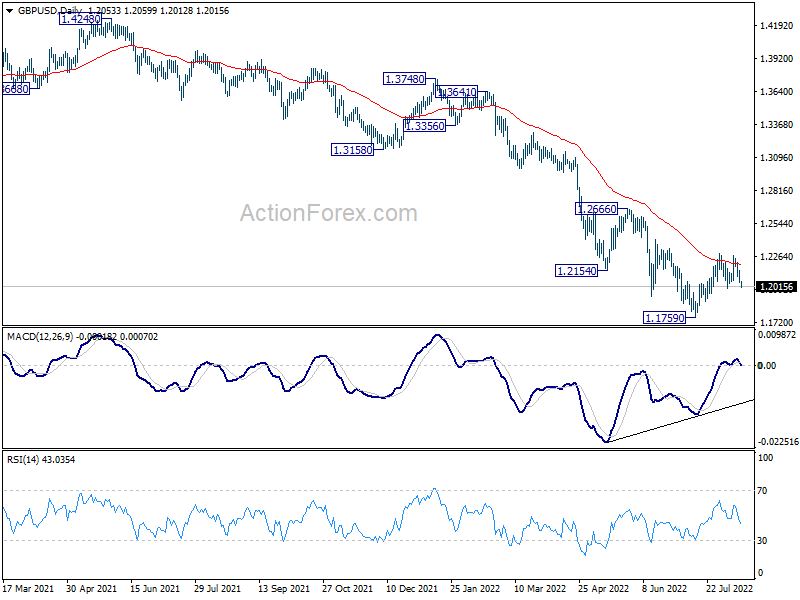
Intraday bias in GBP/USD stays neutral for the moment. On the downside, break of 1.2002 minor support will argue that rebound from 1.1759 has completed, after rejection by 55 day EMA. Intraday bias will be back on the downside for retesting 1.1759 low first. Break there will resume larger down trend. On the upside, above 1.2922 will resume the rebound from 1.1759 towards 1.2666 resistance.
In the bigger picture, fall from 1.4248 (2018 high) could be a leg inside the pattern from 1.1409 (2020 low), or resuming the longer term down trend. Deeper decline is expected as long as 1.2666 resistance holds. Next target is 1.1409 low. However, firm break of 1.2666 will bring stronger rise back to 55 week EMA (now at 1.2897).
EUR/USD Daily Outlook
Daily Pivots: (S1) 1.0120; (P) 1.0194; (R1) 1.0233; More...
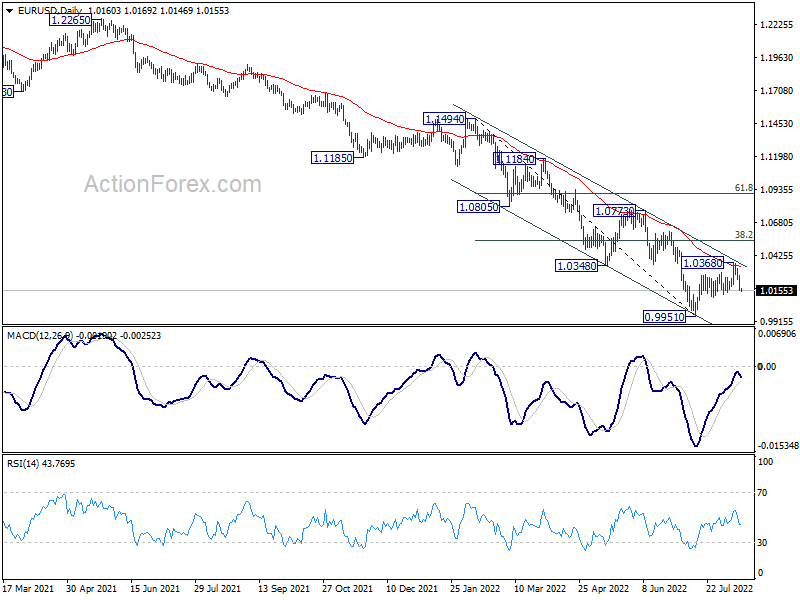
EUR/USD's break of 1.0201 minor support suggests that rebound from 0.9951 has completed at 1.0368 already. That came after rejection by 55 day EMA, as well as falling channel resistance. Intraday bias is back on the downside for retesting 0.9951 low. Firm break there will resume larger down trend. For now, risk will stay on the downside as long as 1.0368 resistance holds, in case of recovery.
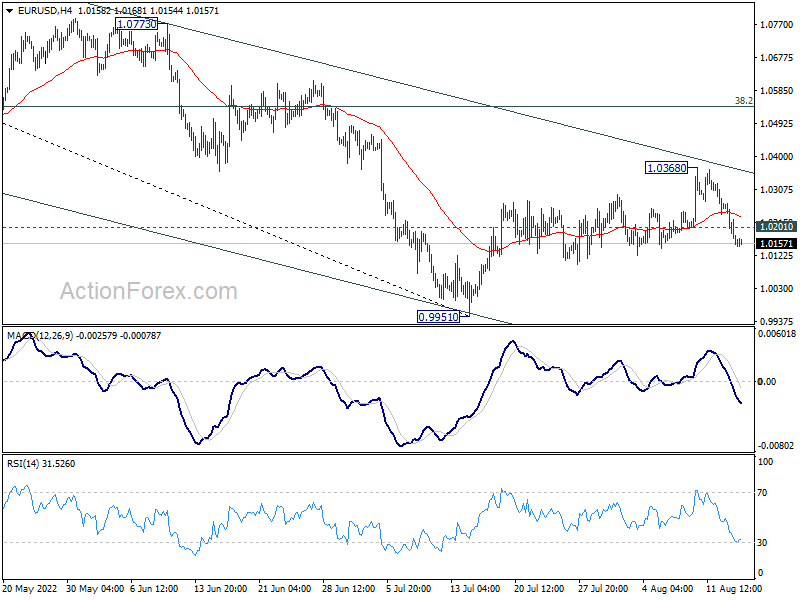
In the bigger picture, down trend from 1.6039 (2008 high) is still in progress. Next target is 100% projection of 1.3993 to 1.0339 from 1.2348 at 0.8694. In any case, outlook will stay bearish as long as 1.0773 resistance holds, in case of strong rebound.
Dollar and Yen Firmer on Recession Talks
Yen and Dollar are so far stronger for the week, with recession as a main theme in the markets. Yet, their upside is relatively limited, as US stocks managed to extend near term rally overnight. Commodity currencies are generally on the softer side, but Aussie, Kiwi and Loonie are all staying inside last week's ranges. Euro and Sterling are mixed for now, while Swiss Franc is firm.
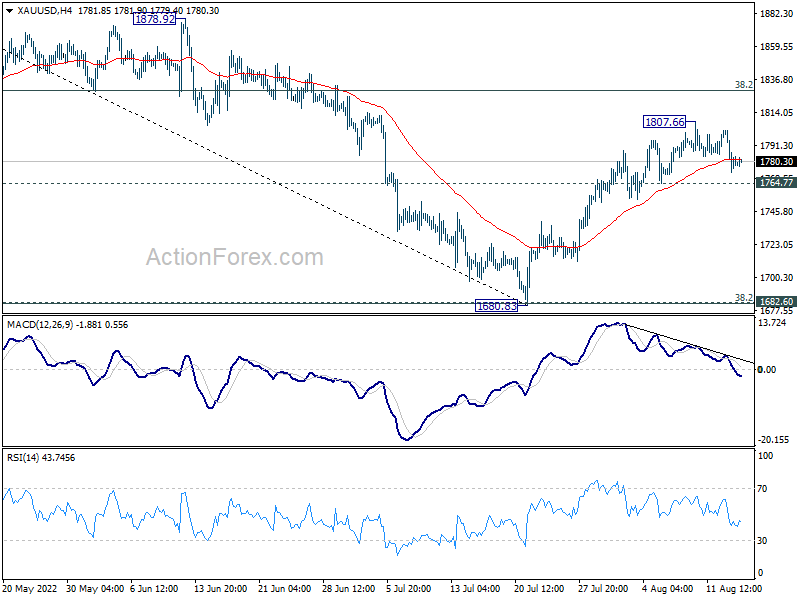
Technically, EUR/USD's break of 1.0201 minor support argues that rebound from 0.9951 has already completed at 1.0368. Deeper fall is in favor back to retest 0.9951 low. Some attention will also be on Gold, which lost much upside momentum after hitting 1807.66. Break of 1764.77 support will also argue that rebound from 1680.83 has completed, and bring retest of this low. Developments in EUR/USD and Gold could reinforce each other.
In Asia, Nikkei dropped -0.01%. Hong Kong HSI is down -0.99%. China Shanghai SSE is up 0.12%. Singapore Strait Times is down -0.18%. Japan 10-year JGB yield is down -0.016 at 0.171. Overnight, DOW rose 0.45%. S&P 50 rose 0.40%. NASDAQ rose 0.62%. 10-year yield dropped -0.058 to 2.791.
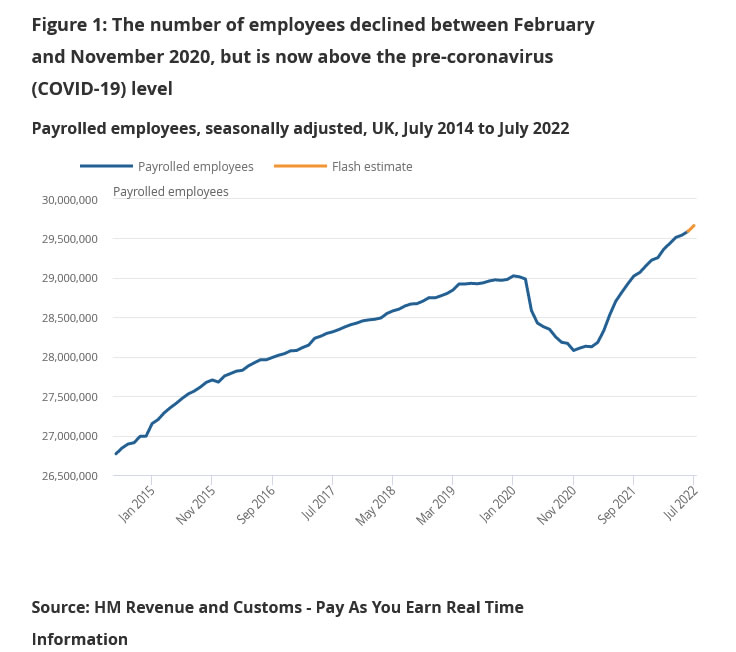
UK payrolled employment rose 73k in Jul, unemployment rate unchanged at 3.8% in Jun
UK payrolled employment increased by 73k, or 0.2% mom, in July. Comparing with the same month a year ago, payrolled employees rose 29.7m, or 2.9% yoy. Claimant count dropped -10.5k, smaller than expectation of -32.9k. Median monthly pay rose 6.6% yoy to GBP 2108.
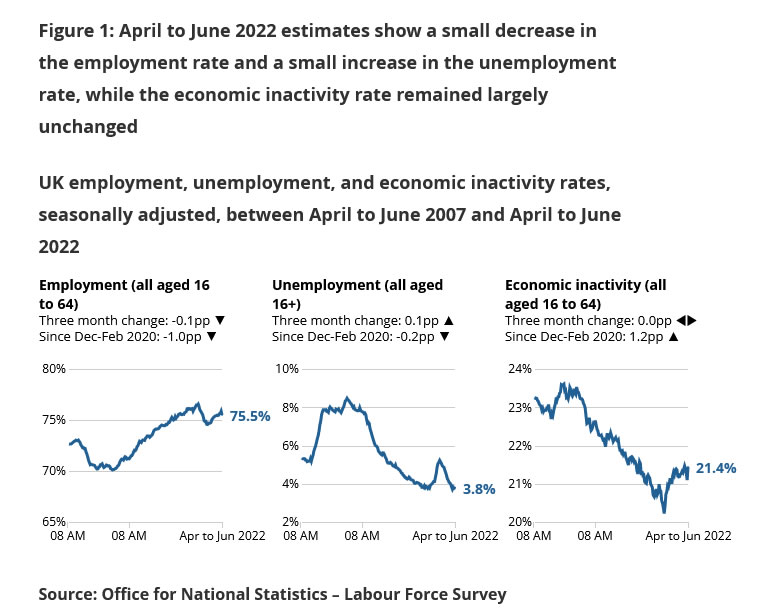
In the three months to June, unemployment rate was unchanged at 3.8%, matched expectations. Average earnings excluding bonus rose 4.7% 3moy, above expectation of 4.4%. Average earnings including bonus rose 5.1% 3moy, below expectation of 5.2%.
RBA Minutes: Further monetary policy normalization expected
In the minutes of the August 2 meeting, RBA expects to "take further steps in the process of normalizing monetary conditions over the months ahead". However, it is "not on a pre-set path." The path is a "narrow one" and "subject to considerable uncertainty". The size of timing of future rate hikes will be guided by incoming data and the assessment of the outlook for inflation and labor market, including the risks.
RBA said that inflation is expected to "peak later in 2022", then decline to top of 2-3% target range by the end of 2024. The expected moderation reflected "the ongoing resolution of global supply-side problems, the stabilization of commodity prices and the impact of rising interest rates in Australia and overseas". Medium-term inflation expectation remained "well anchored".
The Australian economy was "growing strongly" with resilient consumer spending and positive investment outlook. National income was boosted by rise in terms of trade to record high". Outlook is expected to "remain strong" for the rest of 2022, then slow in 2023 and 2024. Employment was "growing strongly" and further declines in unemployment rate were expected over the months ahead.
Looking ahead
Germany ZEW economic sentiment will be the main feature in European session. Eurozone will release trade balance. Later in the day, Canada CPI will take center stage. US will publish housing starts and building permits, and industrial production.
EUR/USD Daily Outlook
Daily Pivots: (S1) 1.0120; (P) 1.0194; (R1) 1.0233; More...
EUR/USD's break of 1.0201 minor support suggests that rebound from 0.9951 has completed at 1.0368 already. That came after rejection by 55 day EMA, as well as falling channel resistance. Intraday bias is back on the downside for retesting 0.9951 low. Firm break there will resume larger down trend. For now, risk will stay on the downside as long as 1.0368 resistance holds, in case of recovery.
In the bigger picture, down trend from 1.6039 (2008 high) is still in progress. Next target is 100% projection of 1.3993 to 1.0339 from 1.2348 at 0.8694. In any case, outlook will stay bearish as long as 1.0773 resistance holds, in case of strong rebound.
Economic Indicators Update
| GMT | Ccy | Events | Actual | Forecast | Previous | Revised |
|---|---|---|---|---|---|---|
| 01:30 | AUD | RBA Meeting Minutes | ||||
| 04:30 | JPY | Tertiary Industry Index M/M Jun | -0.20% | 0.50% | 0.80% | 1.10% |
| 06:00 | GBP | Claimant Count Change Jul | -10.5K | -32.0K | -20.0K | -26.8K |
| 06:00 | GBP | ILO Unemployment Rate (3M) Jun | 3.80% | 3.80% | 3.80% | |
| 06:00 | GBP | Average Earnings Excluding Bonus 3M/Y Jun | 4.70% | 4.40% | 4.30% | |
| 06:00 | GBP | Average Earnings Including Bonus 3M/Y Jun | 5.10% | 5.20% | 6.20% | |
| 09:00 | EUR | Eurozone Trade Balance (EUR) Jun | -20.0B | -26.0B | ||
| 09:00 | EUR | Germany ZEW Economic Sentiment Aug | -59.9 | -53.8 | ||
| 09:00 | EUR | Germany ZEW Current Situation Aug | -48 | -45.8 | ||
| 09:00 | EUR | Eurozone ZEW Economic Sentiment Aug | -57 | -51.1 | ||
| 12:15 | CAD | Housing Starts Jul | 265K | 274K | ||
| 12:30 | CAD | CPI M/M Jul | 0.10% | 0.70% | ||
| 12:30 | CAD | CPI Y/Y Jul | 7.60% | 8.10% | ||
| 12:30 | CAD | CPI Common Y/Y Jul | 4.70% | 4.60% | ||
| 12:30 | CAD | CPI Median Y/Y Jul | 4.90% | 4.90% | ||
| 12:30 | CAD | CPI Trimmed Y/Y Jul | 5.40% | 5.50% | ||
| 12:30 | USD | Building Permits Jul | 1.65M | 1.70M | ||
| 12:30 | USD | Housing Starts Jul | 1.35M | 1.56M | ||
| 13:15 | USD | Industrial Production M/M Jul | 0.20% | -0.20% | ||
| 13:15 | USD | Capacity Utilization Jul | 80.10% | 80.00% |
Weak Data Revives Dovish Expectations, Oil Slumps
Lack of direction is what investors will be suffering until we see clearer signs of inflation abating. And that will take time, as we must see a couple of encouraging data points to call the central banks’ inflation fight successful.
The lack of clear direction is driving the markets up and down. Yesterday, the weak economic data from China and the US killed joy, but equity bulls still took the upper hand, and maintained the major stock indices above zero. The S&P500 gapped lower at the open but closed the session 0.40% up despite, or thanks, to a sharp fall in the latest Empire Manufacturing index that printed a scary -31 versus +5 expected by analysts and +11 printed a month earlier.
The weak data again made its magic: revived the expectation that the Federal Reserve (Fed) could not raise the rates at full speed, if economy starts crumbling. Nasdaq gained 0.62% as big technology names, including Apple, Tesla and Microsoft extended their July rally.
Could the stock recovery extend?
July recovery could extend, but we need a series of persistently encouraging economic data to support the stock recovery – and a -30 print on Empire Manufacturing is not what I call encouraging. Yesterday’s data softens the case for the continuation of the steep recovery, and throws the foundation of a period of consolidation, and perhaps a downside correction.
Is crude below $90 sustainable?
Crude oil fell 5% on Monday. The selloff was triggered by weak economic data and encouraging geopolitical news.
Aramco said on Sunday that they could raise their output to the maximum capacity of 12 million barrels per day, if the Saudi government orders to. And the growing prospect of Iranian oil is playing in favour of the downside, as the latest news revealed that Iran responded to the EU’s proposal for reviving the 2015 nuclear deal between the US and Iran, and European politicians now push the US to adopt a’ realistic approach and flexibility’ to resolve the couple of remaining issues. A nuclear deal between the US and Iran should unlock up to 4 million barrels of Iranian oil per day and help easing the supply crisis.
The barrel of American crude trades below the $90 mark, but the downside potential seems limited near the current levels, as the global energy crisis, and tight supply, are the now-hidden factors to which the market rhetoric could rapidly shift to.
In the FX
The dollar index rebounded, and the stronger greenback sent the EURUSD below the 1.02 mark on Monday. The euro bears bring parity back to their target range, thinking that the European Central Bank (ECB) can’t become too aggressive on its rate hikes, when the energy crisis deepens and threatens to send the Eurozone economy into a deep recession.
The dollar-CAD is, on the other hand, swinging between the Canadian dollar bulls’ hope of seeing a recovery in oil prices, and the persistently strong US dollar. Canada will reveal its latest inflation data today. Inflation in Canada is expected to have slowed to 7.6% in July, from 8.1% printed a month earlier. A soft-enough read could soften the Bank of Canada (BoC) hawks, but a single month easing in inflation won’t mean that the BoC would weaken its policy stance when inflation remains near multi-decade peak.
Recession Risks Weigh on the Market
Market movers today
The German ZEW index should give more insights into the severity of the downturn in the euro area. It has proven a good leading indicator in this cycle as PMI's have tended to follow it with a short lag. The expectations index in July hit the lowest level since 2011 highlighting the risk of recession and with the recent further headwind from higher electricity prices it may not improve in August.
UK releases its labour report with data on unemployment and wage growth. Especially the latter is a key input to the inflation picture.
US housing starts probably dropped further in July as home sales has declined sharply and inventories of new homes have moved a lot higher lately. US industrial production figures are also due today.
The 60 second overview
The risk of recession continues to weigh on the markets as yields and commodity prices decline. Central banks apart for from that of China continue to focus on bringing down inflation, while more indicators show a risk of a recession. More and more forecasters are seeing a risk of a hard landing rather than a soft landing for the US economy, and in Europe the risk of stagflation is increasing.
The oil price has dipped below USD 90 and this is likely to be related to Iran and US getting closer to deal a deal on oil exports. A deal which should be supportive for lower oil prices.
We have several key numbers today, first the German ZEW indicator and later the UK labour market report as well as US housing market data and industrial production.
Equities: Global equities higher yesterday in a defensive growth and quality rotation. The stagflation winners are energy, materials and financials underperforming and hence everything at first glance looking okay and in line with our strategy. However, the rotation came on the back of plunging macro data, increasing the risk of recession significantly. Hence, we would have argued this rotation should happen with sharply negative equity markets and increasing volatility. Yes, Min Vol outperformed yesterday but to no extent as much as expected given the set of data we got yesterday. There is still a lot of buying on the back of lower inflation expectations and the dropping volatility. However, it is a matter of time before that ends if key figures continue to deteriorate at yesterday's pace. In US yesterday, Dow +0.5%, S&P 500 +0.4%, Nasdaq +0.6% and Russell 2000 +0.2%. Asian markets are higher this morning and the same goes for European futures. US futures are slightly lower.
FI: Global bond yields decline as the risk of a hard landing is increasing in both the US and Europe. Yesterday, 10Y German government bond yields fell almost 10bp. The US market also saw declines in the bond yields and modest bullish steepening between 2Y and 10Y.
FX: USD strengthened broadly yesterday as US economic data hints at a further slump in manufacturing.
Credit: Yesterday, credit markets were relatively uneventful with one primary deal in GBP leaving ITraxx Main unchanged (+0.3bp) to close at 92.2bp, while Xover widened 1.4bp to close at 464bp.
UK payrolled employment rose 73k in Jul, unemployment rate unchanged at 3.8% in Jun
UK payrolled employment increased by 73k, or 0.2% mom, in July. Comparing with the same month a year ago, payrolled employees rose 29.7m, or 2.9% yoy. Claimant count dropped -10.5k, smaller than expectation of -32.9k. Median monthly pay rose 6.6% yoy to GBP 2108.
In the three months to June, unemployment rate was unchanged at 3.8%, matched expectations. Average earnings excluding bonus rose 4.7% 3moy, above expectation of 4.4%. Average earnings including bonus rose 5.1% 3moy, below expectation of 5.2%.
RBA Minutes: Further monetary policy normalization expected
In the minutes of the August 2 meeting, RBA expects to "take further steps in the process of normalizing monetary conditions over the months ahead". However, it is "not on a pre-set path." The path is a "narrow one" and "subject to considerable uncertainty". The size of timing of future rate hikes will be guided by incoming data and the assessment of the outlook for inflation and labor market, including the risks.
RBA said that inflation is expected to "peak later in 2022", then decline to top of 2-3% target range by the end of 2024. The expected moderation reflected "the ongoing resolution of global supply-side problems, the stabilization of commodity prices and the impact of rising interest rates in Australia and overseas". Medium-term inflation expectation remained "well anchored".
The Australian economy was "growing strongly" with resilient consumer spending and positive investment outlook. National income was boosted by rise in terms of trade to record high". Outlook is expected to "remain strong" for the rest of 2022, then slow in 2023 and 2024. Employment was "growing strongly" and further declines in unemployment rate were expected over the months ahead.
(RBA) Minutes of the Monetary Policy Meeting of the Reserve Bank Board
Hybrid – 2 August 2022
Members participating
Philip Lowe (Governor and Chair), Michele Bullock (Deputy Governor), Mark Barnaba AM, Wendy Craik AM, Ian Harper AO, Carolyn Hewson AO, Steven Kennedy PSM, Carol Schwartz AO, Alison Watkins AM
Others participating
Luci Ellis (Assistant Governor, Economic), Christopher Kent (Assistant Governor, Financial Markets), Alexandra Heath (International Department)
Anthony Dickman (Secretary), Penelope Smith (Deputy Secretary)
Matt Boge (Acting Head, International Department), Marion Kohler (Head, Economic Analysis Department), Carl Schwartz (Acting Head, Domestic Markets Department)
International economic developments
Members commenced their discussion of international developments by noting that, in many countries, inflation had risen over preceding months and was around 7–10 per cent. Inflation was now expected to peak later and higher than previously thought, but measures of longer term inflation expectations had declined. The rapid increase in the cost of living was weighing on real household incomes. It had also led central banks to increase interest rates quite quickly. Together, these developments were weighing on the outlook for global growth. The largest downward revisions for growth among advanced economies were for the United States, where many forecasters expected a shallow recession. Growth in China was also expected to be weaker than previously forecast. The outlook for growth in the global economy in 2022 had been revised lower to 3¼ per cent, while expected growth in 2023 was unchanged at 3¾ per cent.
In advanced economies, the expected slowing in growth was largely accounted for by an anticipated slowing in growth in consumption. Members observed that spending was currently being supported by strong labour markets, targeted fiscal support and a reduction in saving rates. However, the rising cost of living, falling housing prices and higher interest rates were expected to weigh on consumption over time. Consumer confidence had already fallen significantly. More generally, timely indicators of growth suggested that economic activity was beginning to soften in a number of economies. Unemployment rates remained around generational lows.
Growth in China in 2022 was expected to be around 3¼ per cent, well short of the authorities' target of 5½ per cent. Members noted that the Chinese economy had contracted by 2½ per cent in the June quarter, which was much more than anticipated, with COVID-19 restrictions reducing activity significantly. As restrictions eased, activity had begun to recover; exports had picked up and global trade and other data suggested that global supply chains had not been materially disrupted by the lockdowns. By contrast, the Chinese real estate sector remained weak, despite some recent policy support. More broadly, policy remained accommodative and fiscal support had increased, with infrastructure investment expected to be a key driver of growth in 2022.
Members noted that there were signs that some global supply chain pressures were easing, as capacity expanded, COVID-19-related restrictions were relaxed and global demand rebalanced back towards services. Supplier delivery times had started to shorten and global input prices were easing, while shipping costs appeared to have peaked. Pressures on supply would ease further as higher interest rates dampened demand.
Members observed that many non-energy commodity prices had declined as the global growth outlook was revised lower, and were back around their levels at the beginning of the year. Iron ore and coking coal prices had fallen since mid-June, reflecting increased concerns about the outlook for the Chinese property market. Oil prices had also been lower over this period. By contrast, gas and thermal coal prices had risen owing to developments in Europe. Australia's terms of trade were likely to have reached a new historical high in the June quarter; the terms of trade were projected to decline from then but to follow a higher trajectory than expected three months earlier.
Risks to the global economic outlook were skewed to the downside. Members observed that inflation in many countries was increasingly driven by domestic demand pressures, and that the longer high inflation persists, the more central banks might need to tighten monetary policy to rein in inflation and contain inflation expectations. It was uncertain how much high inflation and increases in interest rates might weigh on consumption, especially given the robust state of the labour market and accumulated savings. Additional risks could stem from further supply shocks; Europe was particularly exposed to the possibility of escalating disruptions to gas supply following Russia's invasion of Ukraine, while China might experience ongoing disruptions from COVID-19-related restrictions.
Domestic economic developments
Turning to domestic economic conditions, members discussed an updated set of economic forecasts. Compared with three months earlier, the outlook for GDP growth in Australia in 2022 had been revised lower, while inflation had been revised higher. Headline inflation was expected to be around 7¾ per cent at the end of the year. Recent economic data continued to suggest that the economy had grown strongly over the first half of the year, and pointed to an increasingly tight labour market. Recent information from liaison and survey measures provided further evidence that wages growth had started to pick up from the low rates of recent years.
The domestic economy had grown strongly over the first half of 2022, showing resilience to disruptions caused by the Omicron outbreak and the floods on the east coast. Timely indicators suggested that domestic demand had grown strongly in the June quarter, supported by consumer spending. Spending on discretionary services had continued to recover, while spending on goods had held up. Growth in consumption was expected to remain strong over the second half of the year, reflecting current strong labour income, still-high saving rates and strengthened household balance sheets. Over time, however, real incomes would be affected by higher prices and rises in interest rates; falling housing prices would dampen consumption as well as dwelling investment. Given these developments, growth in output was expected to be 3¼ per cent over 2022, underpinned by growth in consumption and a recovery in investment and service exports. Growth was then expected to slow to around 1¾ per cent over both 2023 and 2024. Members noted that the competing forces of a tight labour market (and therefore strong labour incomes) and cost-of-living pressures on real household incomes created significant uncertainty for the outlook for consumption.
The outlook for business investment remained positive, but capacity constraints were evident in some areas. The pipeline of residential and non-residential projects was expected to sustain construction activity for at least the coming year, although progress was being hampered by capacity constraints and increasing costs. Recent disruptions from heavy rainfall, illness among workers and other constraints could see this timeline extended further. Investment in non-mining machinery and equipment was also expected to grow over the forecast period, supported by positive business sentiment. Mining investment was forecast to increase a little over coming years, although supply shortages and difficulties accessing skilled labour had been binding constraints in some cases. Recent high levels of commodity prices were not expected to lead to additional investment, in contrast to the 2010–2012 period.
The outlook for residential investment had softened, particularly for detached dwellings, given recent declines in housing prices and high construction costs, and the closure of the HomeBuilder pandemic support package in April. Members noted that housing prices had been falling for some months in Sydney and Melbourne, and more recently in a wider range of cities and regions. On the other hand, prospects for higher density residential projects had improved following the recent declines in rental vacancy rates and strong growth in advertised rents in some states over the first half of the year.
The labour market had tightened significantly over preceding months and leading indicators suggested demand for labour remained strong. Members observed that the unemployment rate had declined more quickly than expected, to 3.5 per cent in June – its lowest level in almost 50 years. Measures of labour underutilisation had also fallen further as firms had increased the hours of existing workers in response to strong demand. Hiring intentions and job vacancies remained very high in a number of industries and finding suitable labour continued to be a significant constraint on activity for many firms. As a result, the unemployment rate was expected to decline a little further, to 3¼ per cent in late 2022, lower than the previous forecast, before picking up gradually in the second half of the forecast period as output growth slowed. The participation rate was expected to edge a little higher from its already historically high level. Immigration could start to alleviate some areas of labour shortages over the forecast period, although the pace of the recovery in the arrival of students and working holidaymakers had been gradual so far.
Members noted that firms continued to expect wages growth to be higher in the period ahead. In liaison, over 60 per cent of private sector firms indicated that they expected to raise wages by more than 3 per cent over the year ahead. Recent high inflation outcomes were a factor in current wage negotiations, but to date most firms expected to raise wages by less than inflation. Multi-year enterprise bargaining agreements, which are common in the public sector and also used by some private sector firms, were expected to restrain the pace of the pick-up in wages growth in Australia. That said, a number of state governments had offered lump-sum payments to some of their public sector employees, in part to offset higher living costs.
By the end of 2024, growth in the Wage Price Index (WPI) was expected to be around 3¾ per cent, which would be its fastest pace since 2012. Broader measures of labour costs were expected to run at a faster pace than growth in the WPI, as employers use bonus payments and other non-base wage measures to attract and retain staff, employees work more hours at overtime rates and workers gain higher pay by switching jobs.
Headline inflation was 1.7 per cent (seasonally adjusted) in the June quarter and 6.1 per cent in year-ended terms. Petrol prices had risen further in the quarter, reflecting global developments in oil prices and refining margins in that period; the disruptions in domestic energy markets would not be reflected in retail utilities prices until the second half of the year. Members noted that trimmed mean inflation had also remained high, at 1.5 per cent in the June quarter, taking the year-ended rate to 4.9 per cent and implying that inflation had been broadly based. Upstream price pressures and capacity constraints had resulted in rapid inflation in new dwelling construction prices and consumer durables inflation remaining well above historical averages. Supermarkets had continued to pass on upstream cost pressures from suppliers. Fruit and vegetables prices had risen because of bad weather and the recent floods, and grocery price inflation had increased more broadly. Market services inflation had also picked up strongly, especially for restaurants and takeaway, where food and other input prices had risen rapidly. By contrast, rent inflation had increased modestly, reflecting a relatively slow turnaround from earlier declines in rents in Sydney and Melbourne.
Headline inflation was forecast to pick up further over the second half of the year. The upward revisions to the outlook reflected further pass-through of upstream cost pressures and expectations of 10–15 per cent increases in retail gas and electricity prices in the second half of 2022. Underlying inflation was also expected to pick up further, to peak around 6 per cent at the end of the year. Inflation was then forecast to start to decline in 2023. While supply constraints were expected to ease further over time, growth in labour costs was expected to rise in response to tight labour market conditions and become the main driver of inflation over the second half of the forecast period. Inflation was expected to be around the top of the target band at the end of 2024. Members noted that the forecasts were conditioned on a path for the cash rate derived from surveys of professional economists and financial market pricing, with the cash rate assumed to increase to around 3 per cent by the end of 2022, and then decline a little by the end of 2024.
Members discussed the uncertainties around the forecasts, which presented a central scenario where higher interest rates moderated demand pressures, resulting in a gradual increase in the unemployment rate and growth in labour costs remaining consistent with inflation returning to target. These forecasts reflected the recent strength in the labour market and the significant financial buffers held by households, which suggested households in aggregate could weather a period of high inflation, even if real wages were lower as a result.
The effect of high inflation on wage- and price-setting behaviour presented a material risk to the inflation outlook. Members noted that, if inflation expectations and the general inflation psychology shifted, higher inflation would be more persistent. Members observed that the key source of uncertainty for the domestic growth outlook related to the competing forces affecting household spending. Household incomes were currently being sustained by strong labour demand, which was feeding into strong growth in employment and hours worked, and would ultimately lead to stronger wages growth. It was possible that labour market conditions continued to surprise on the upside, especially given that declining real wages made hiring more labour attractive for some employers. Working in the other direction, high inflation and rising interest rates were raising the cost of living and impinging on households' capacity to consume out of current income. So far the strength of labour incomes had been the more important driver, but the balance between these two opposing forces could shift over time and it was difficult to predict how this balance would be resolved. Some of the other uncertainties that could weigh on consumption included the possibility that housing prices could decline further or induce more of a wealth effect on consumption than expected. Further supply shocks, including global shocks to energy prices and further waves of COVID-19, could also constrain growth in activity more broadly.
International financial markets
Members observed that participants in financial markets were focused on the speed and extent of additional monetary policy tightening and the prospects for a significant slowdown in global growth. Over the preceding month, many advanced economy central banks had tightened policy noticeably, some by more than previously expected. A range of central banks now had their policy rates around 2½ per cent, close to their estimates of a neutral rate, and some had indicated that their policy rates may need to be increased beyond this. Rapid increases in policy rates were intended to reduce the risk of high inflation becoming entrenched and a more costly tightening of policy being required later on.
Members noted that long-term government bond yields had declined noticeably since mid-June in most advanced economies. This followed a weakening in the global growth outlook, partly because of weaker-than-expected indicators of economic activity as well as stronger-than-expected monetary policy responses to high and persistent inflationary pressures.
Private sector financing conditions had tightened considerably, with corporate bond yields and credit spreads now well above their levels immediately prior to the pandemic. Equity prices were significantly below their peaks from earlier in the year, although members observed that there had been some recovery over the preceding month in most of the major markets, including Australia.
The Australian dollar had appreciated recently, largely retracing the depreciation over prior months. Members noted that this had occurred amid lower commodity prices.
In China, financial conditions remained accommodative, supported by fiscal and monetary policies. Chinese equity prices had declined over July, reflecting a deterioration in the COVID-19 situation and concerns about growth prospects. Funding conditions for Chinese property developers had deteriorated further. Some developers had suspended construction, leading to a number of home buyers withholding payments on the related mortgages. In many emerging markets, central banks had tightened policy further amid high inflation and capital outflows.
Domestic financial markets
Members noted that, in line with global developments, a decline in Australian longer term bond yields had reflected concerns about global growth. Market pricing implied that the cash rate target was expected to be increased by 50 basis points in August, reaching around 3 per cent by the end of the year. This expectation for the end of 2022 was broadly consistent with the median expectation of market economists.
Members noted that lenders had passed on the policy rate increases from the preceding months in full to existing housing borrowers on variable rates and to most small business borrowers on variable rates. Pass-through to existing housing borrowers on fixed rates, which account for around 35 per cent of outstanding housing borrowing, would occur progressively over the subsequent couple of years. Net payments by households into offset and redraw accounts had eased in the June quarter relative to the levels seen in prior quarters, but remained well above pre-pandemic levels. Average interest rates on deposits had increased in prior months, but by less than the cash rate.
Members noted that growth in total credit had been around its fastest pace in more than a decade. Lending to medium- and large-sized businesses had been strong, with demand supported by robust economic conditions and more mergers and acquisitions activity. Demand for housing finance remained high, although commitments for housing loans had declined from their recent peaks for owner-occupiers and investors. This was consistent with signs of some easing in activity in the housing market and in housing prices.
Members were briefed on the Bank's 30th annual Small Business Finance Advisory Panel. Economic conditions for small and medium enterprises (SMEs) had improved over the preceding year in line with the broader economic recovery. Lending to SMEs had also increased, although this had been driven entirely by an increase in lending to medium-sized businesses. Through the Panel and other sources, SMEs had reported that challenges remained in accessing finance from banks, due to rigid collateral requirements and onerous application processes. Members noted reports that some SMEs were turning to non-traditional sources of finance, such as private equity and non-bank finance, although these sources of funds remained modest compared with bank lending.
Members discussed recent developments in the management of climate-related financial risks. They observed that climate change and other sustainability considerations have become more prominent in the decisions of investors and that there is potential for climate-risk considerations to influence the cost and availability of financing for Australian entities. There is a global push to improve the consistency, comparability and quality of climate-related financial disclosures to ensure that investors have the information needed to assess their climate-related financial risks adequately. Domestically, the Bank is working closely with other agencies of the Council of Financial Regulators to consider how new international disclosure standards affect Australian entities, as well as how the disclosures of Australian firms can be of a high and comparable standard.
The Bank is also undertaking analysis to understand the risks to the economy and financial system arising from climate change and will continue to collaborate on these topics with international peers, including via the Financial Stability Board and the Network for Greening the Financial System. Members observed that some central banks are considering the implications of the financial risks associated with climate change for their own monetary policy operations (such as domestic asset purchases and foreign exchange reserves) and collateral frameworks.
Considerations for monetary policy
In considering the policy decision, members observed that inflation in Australia was at its highest level since the early 1990s, and well above the target. Global factors, including COVID-19-related disruptions to supply chains and the war in Ukraine, explained much of the increase in inflation, but domestic factors were increasingly playing a role. There were widespread upward pressures on prices from strong demand, a tight labour market and capacity constraints in some sectors of the economy. The east coast floods this year were also affecting some prices.
Members noted that inflation was expected to peak later in 2022 and then decline back to the top of the 2 to 3 per cent target range by the end of 2024. The expected moderation in inflation reflected the ongoing resolution of global supply-side problems, the stabilisation of commodity prices and the impact of rising interest rates in Australia and overseas. Medium-term inflation expectations in Australia remained well anchored, and members agreed that it was important that this remains the case.
The Australian economy was growing strongly. Consumer spending had been resilient and the outlook for investment remained positive. National income was also being boosted by a rise in the terms of trade, which were at a record high. Growth in output was expected to remain strong for the remainder of 2022, before slowing in 2023 and 2024.
The resilience of the economy continued to be most evident in the labour market. Employment was growing strongly and the unemployment rate was at its lowest level in almost 50 years. Job vacancies and job ads were both at very high levels. Information from the Bank's liaison program and business surveys continued to point to a lift in wages growth from the low rates of recent years as firms compete for employees in the tight labour market. Members noted that further declines in the unemployment rate were expected over the months ahead, but that some increase in unemployment was expected as economic growth slowed.
The behaviour of household spending continued to present a key source of uncertainty for the outlook. Higher inflation and higher interest rates were putting pressure on household budgets. Consumer confidence had fallen and housing prices were generally declining following the large increases in recent years. At the same time, household income was being supported by people finding jobs and obtaining more hours of work. Many households had also built up large financial buffers and the saving rate remained higher than prior to the pandemic. However, some households will face financial pressures in the period ahead, particularly those with low savings buffers and high debt. Members will be paying close attention to how the balance of these various factors affects the outlook for spending in their assessment of the appropriate setting of monetary policy.
Members also considered the risks to the global outlook, which were skewed to the downside. The outlook for global economic growth had been downgraded to reflect pressures on real incomes from higher inflation, the tightening of monetary policy in most countries, Russia's invasion of Ukraine and the COVID-19 containment measures in China.
Given high inflation, the resilient economy and the tight labour market, and taking into account the risks, members agreed it was appropriate to continue the process of normalising monetary conditions. The Board decided to increase the cash rate by a further 50 basis points. The increase in interest rates over recent months has been required to bring inflation back to target by ensuring that inflation expectations remain anchored and establishing a more sustainable balance of demand and supply in the Australian economy.
The Board expects to take further steps in the process of normalising monetary conditions over the months ahead, but it is not on a pre-set path. It is seeking to do this in a way that keeps the economy on an even keel. The path to achieve this balance is a narrow one and subject to considerable uncertainty. The size and timing of future interest rate increases will be guided by the incoming data and the Board's assessment of the outlook for inflation and the labour market, including the risks to the outlook. The Board is committed to doing what is necessary to ensure that inflation in Australia returns to the 2 to 3 per cent target range over time.
The decision
The Board decided to increase the cash rate target by 50 basis points to 1.85 per cent. It also increased the interest rate on Exchange Settlement balances by 50 basis points to 1.75 per cent.
Technical Outlook and Review
USD/JPY:
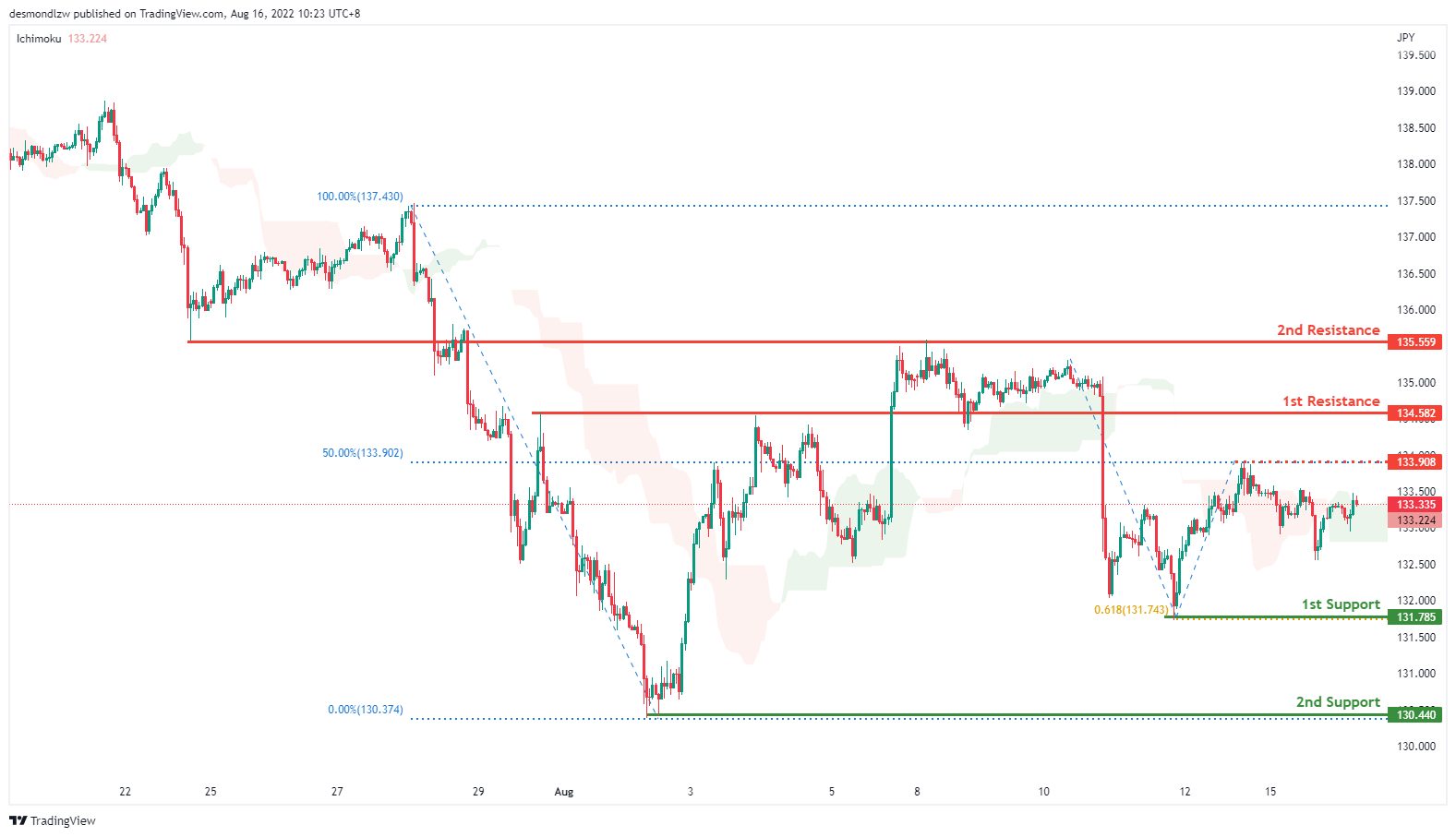
On the H4 chart, prices seem to have pulled back a little but the overall trend is still bearish biased. Price is moving toward the intermediate resistance at 133.908 which is the 50% Fibonacci retracement. If prices break the intermediate resistance, it will test the first resistance at 134.582 where the previous swing high sits. Alternatively, it the bearish momentum continues it will pull back to test the first support at 131.785
Areas of consideration:
- H4 time frame, 1st resistance at 134.582
- H4 time frame, 1st support at 131.785
DXY:
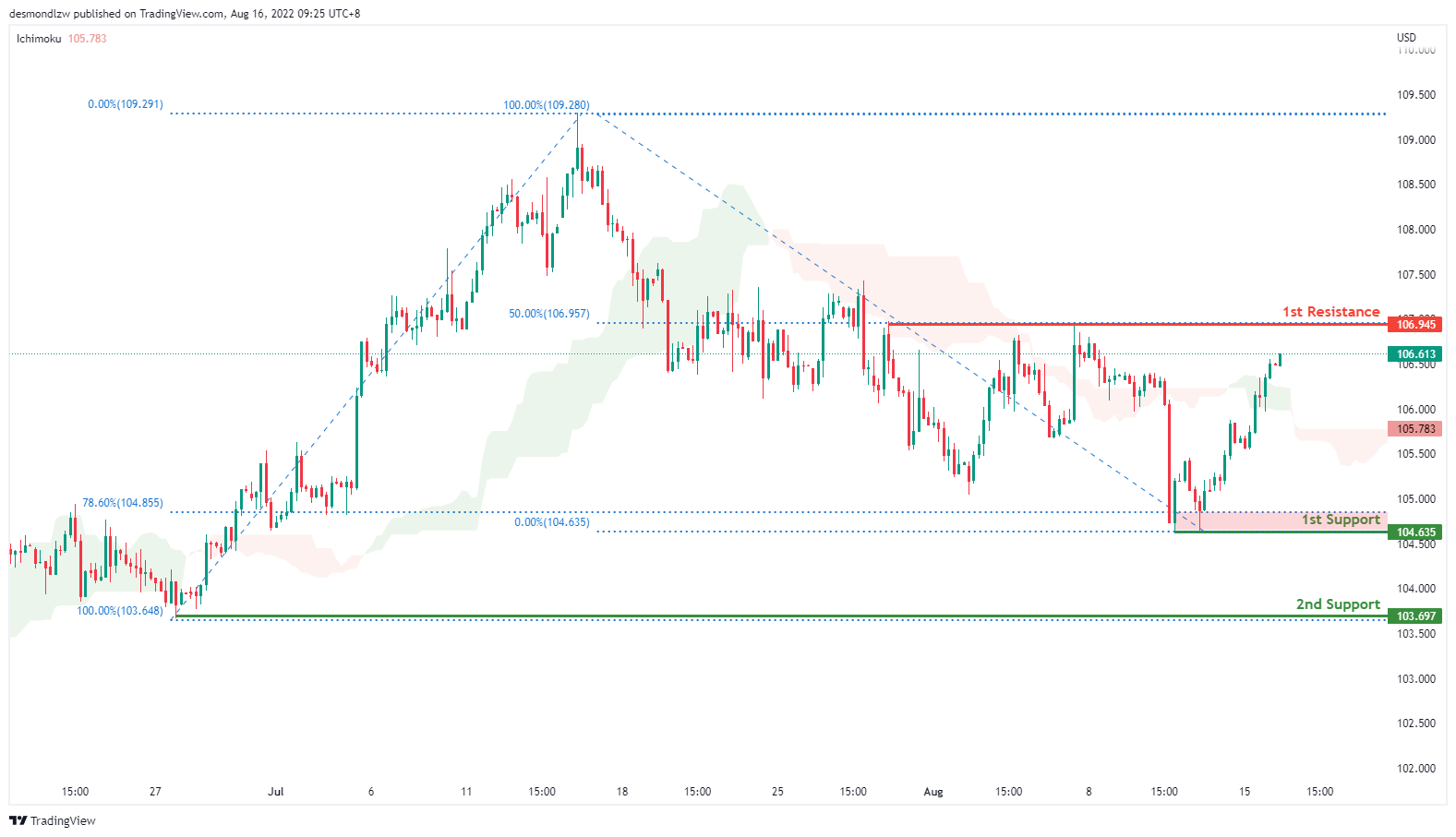
On the H4, prices seem to be moving in an ascending trend and is in a bullish momentum. Prices look like it’s going toward the first resistance at 106.945 where the 50% Fibonacci retracement and the previous swing high sits. If price fails to break the first resistance, it will pull back to test the first support at 104.635 where the 78.6% retracement is and subsequently the second support at 103.697 which is the previous swing low
Areas of consideration:
- H4 time frame, 1st resistance at 106.945
- H4 time frame, 1st support at 104.635
EUR/USD :
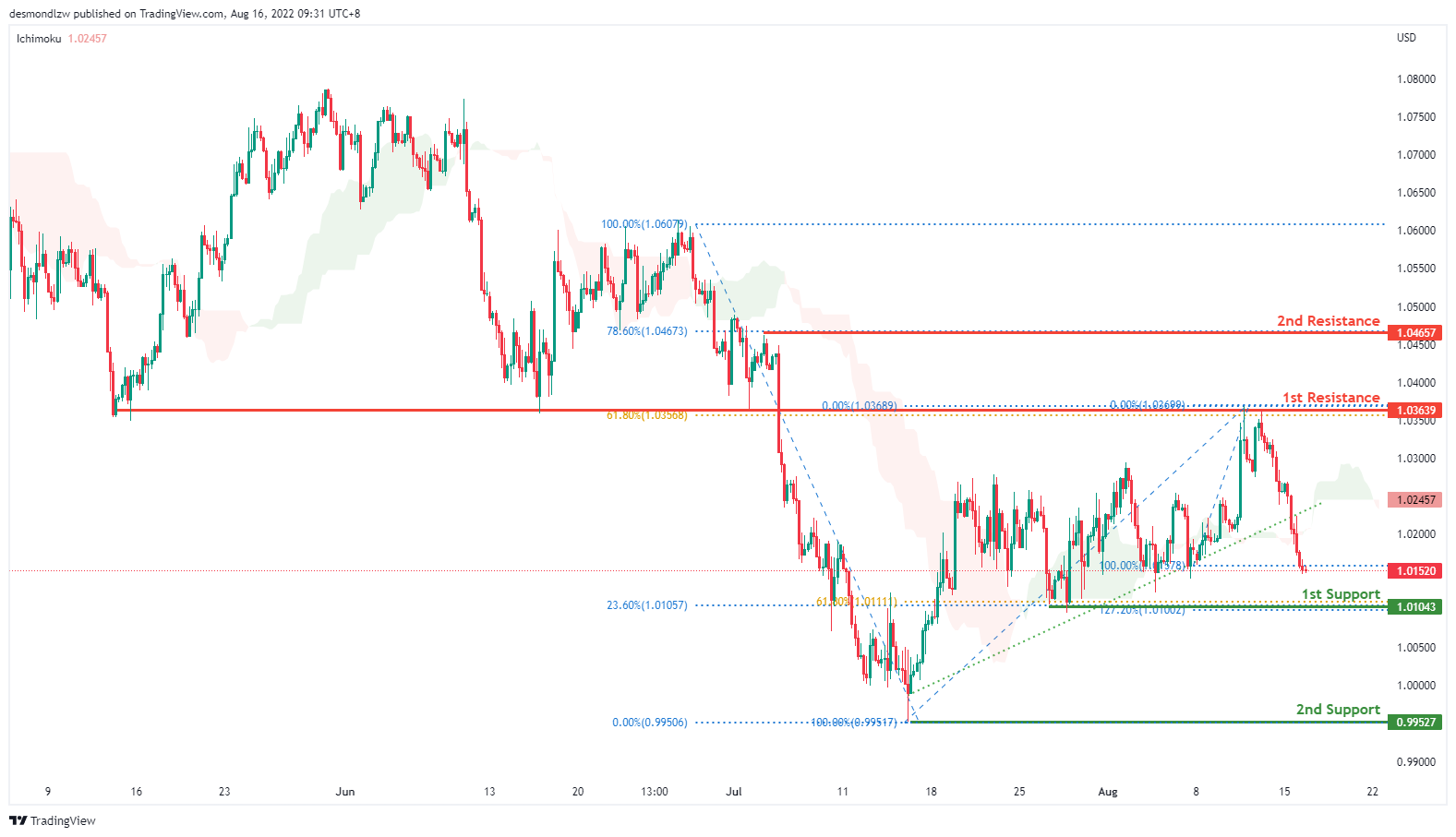
On the H4, prices have broken the ascending trend and are below the ichimoku indicator, we are bearish bias. Prices are pulling back to test the first support at 1.0104 where the 61.8% Fibonacci retracement and 127.2% extension sits. If prices continue in the bearish momentum, it will test the second support at 0.9952. Alternatively price could go back to test the first resistance at 1.0363 where the 61.8% Fibonacci retracement sits and then the second resistance at 1.0465
Areas of consideration :
- H4 1st resistance at 1.0363
- H4 1st support at 1.0104
GBP/USD:
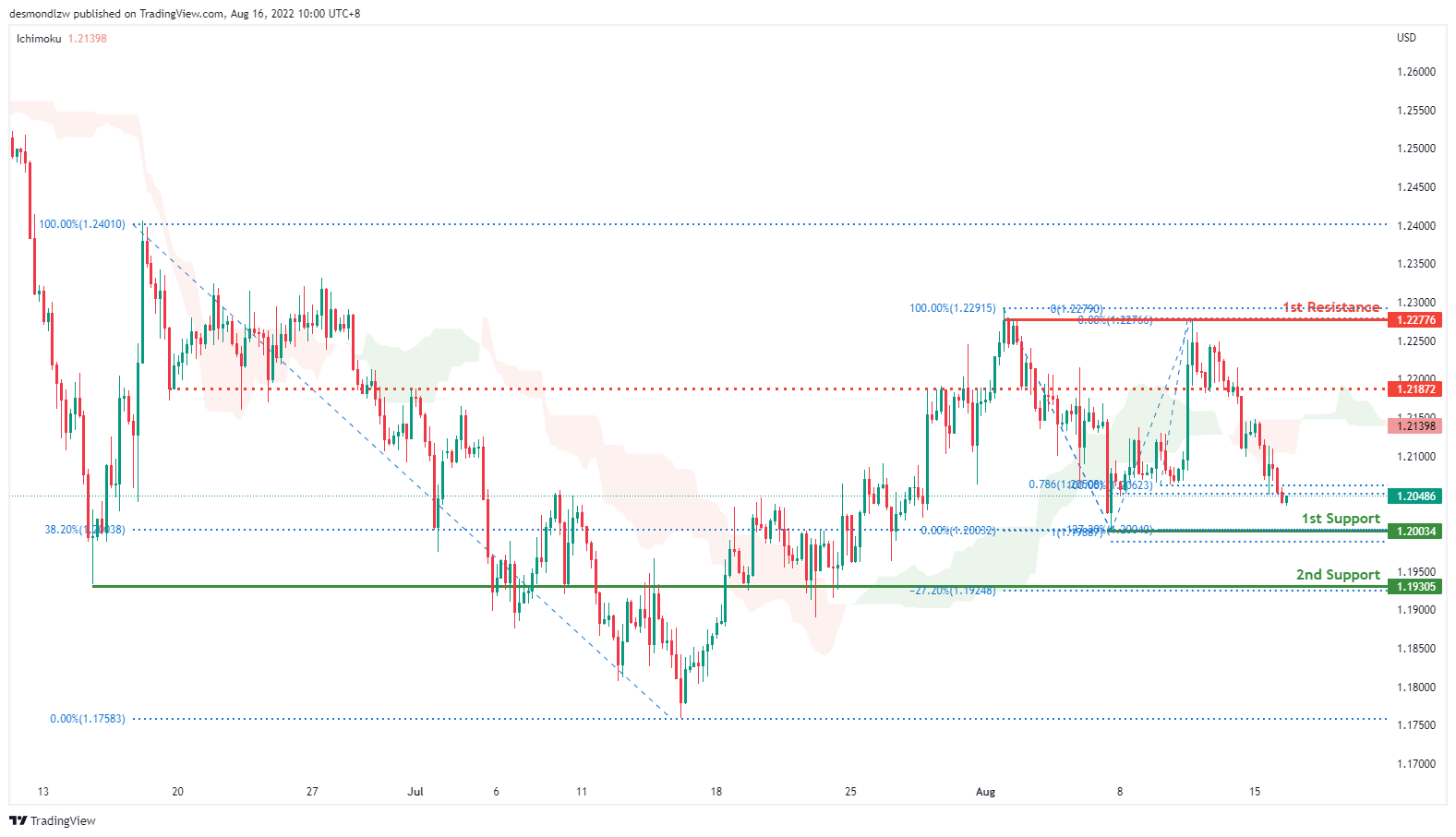
On the H4, prices seem to be in a bearish momentum. It is currently testing the 78.6% Fibonacci projection and if the bearish momentum continues, it will pull prices to our first support 1.2003 where our 100% Fibonacci projection, 127.2% extension and 38.2% retracement sits. If prices pull back further it will test the second support at 1.1930. Alternatively price could hit our intermediate resistance at 1.2187 and the first resistance at 1.2277
Areas of consideration:
- H4 1st resistance at 1.2277
- H4 1st support at 1.2003
USD/CHF:
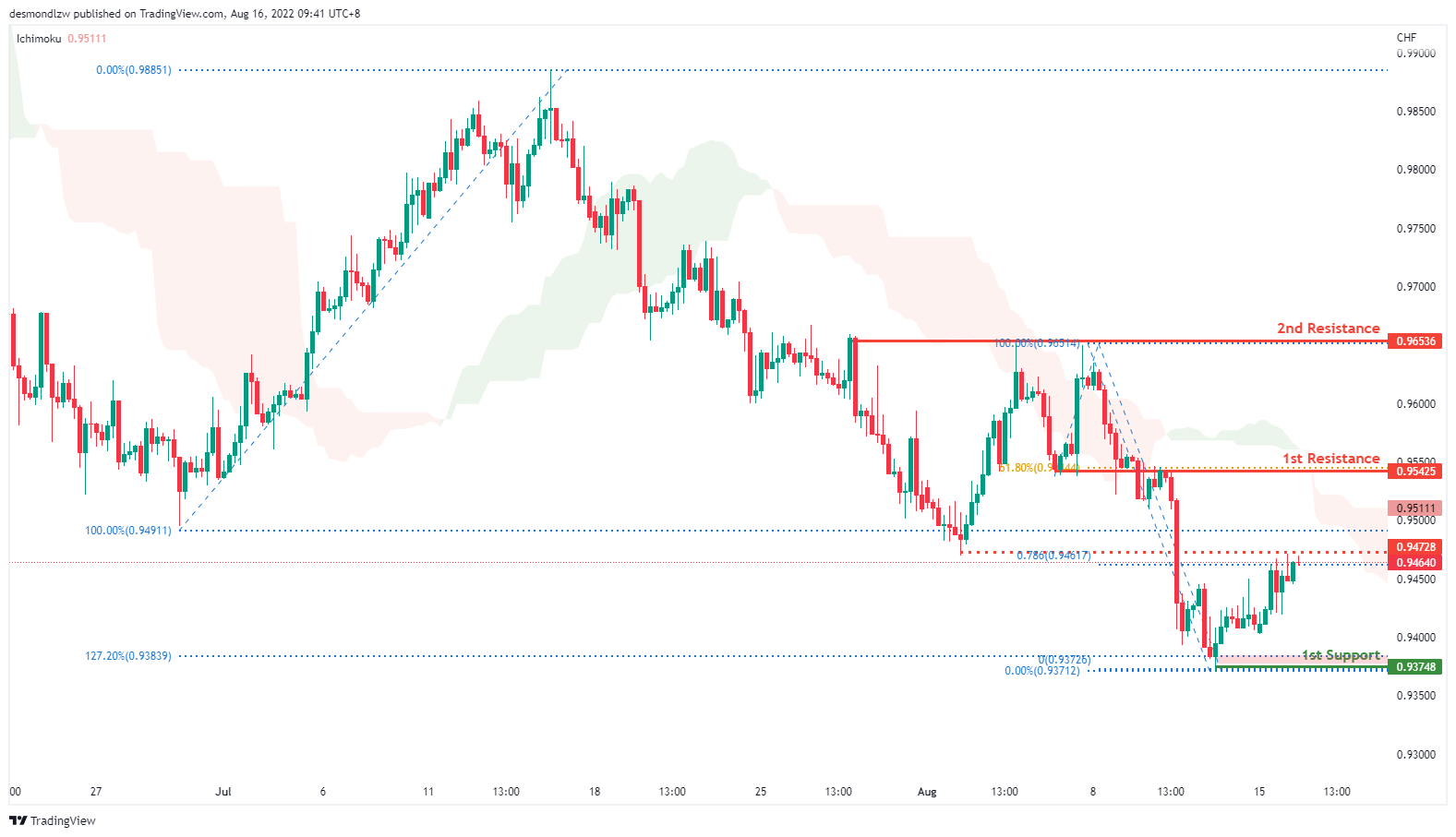
On the H4, with prices moving below the ichimoku cloud hence we have a bearish bias that the price will continue with the bearish momentum. Price is now testing at the 78.6% Fibonacci projection as well as the previous swing low. If bearish momentum continues, it should pull back to test at the first support 0.937 which also coincides with the Fibonacci 127.2% extension. If prices fail to break first support, it may test the first resistance at 0.954 where the 61.8% fibonacci retracement and previous swing low sits. If prices continues with bullish momentum, it will then pull back further to test at the second resistance 0.965
Areas of consideration
- H4 1st support at 0.937
- H4 1st resistance at 0.954
XAU/USD (GOLD):
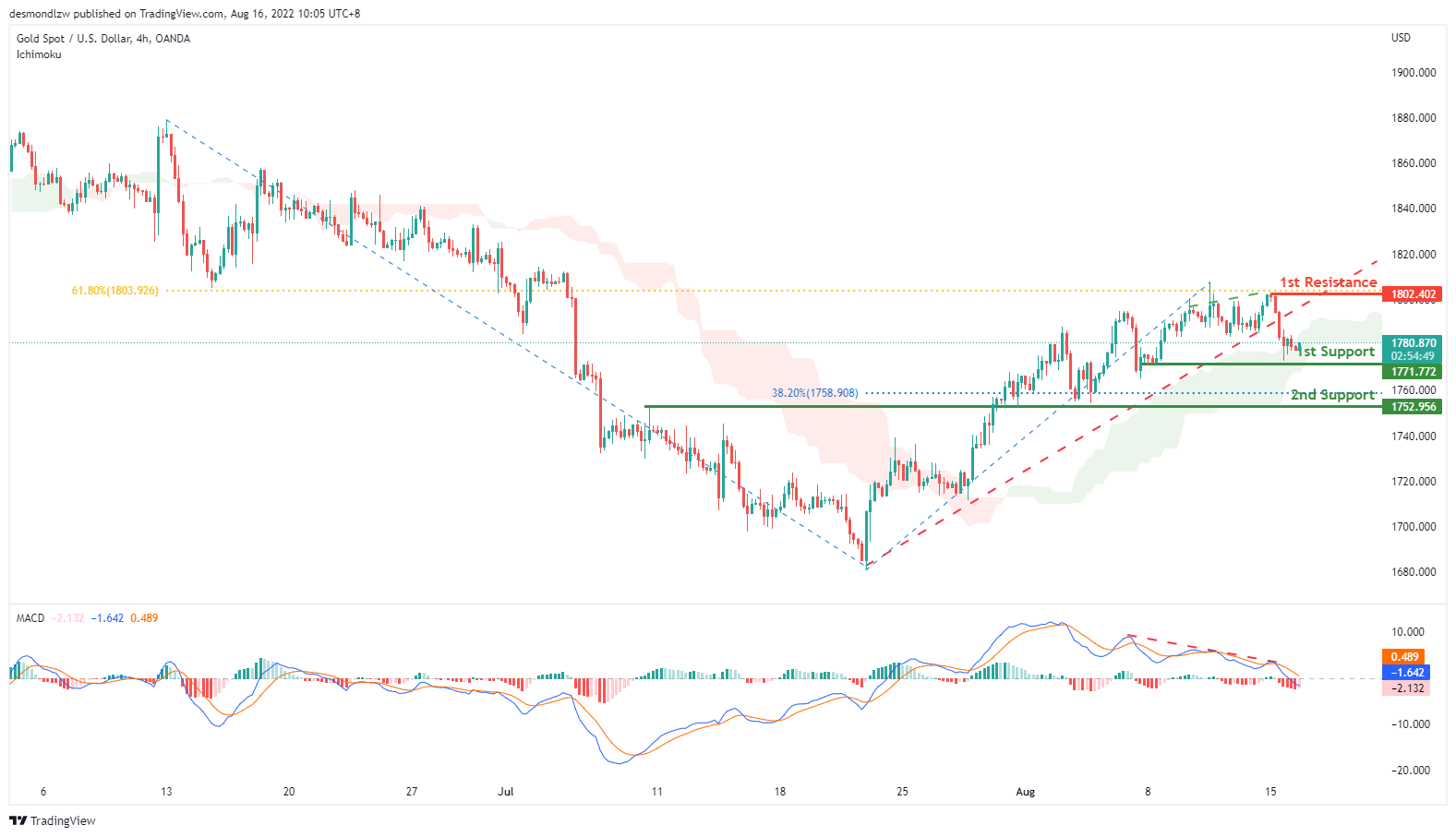
On the H4, with prices breaking along the ascending channel and there is a bearish divergence of price and MACD, we have a bearish bias that the price may drop from the 1st support at 1771.772, which is in line with the pullback support to the 2nd support at 1752.956, which is in line with the pullback support and 38.2% fibonacci retracement. Alternatively, the price may rise to the 1st resistance at 1802.402, which is in line with the 61.8% fibonacci retracement and swing high.
Areas of consideration:
- H4 time frame, 1st support at 1771.772
- H4 time frame, 2nd support at 1752.956
AUD/USD:
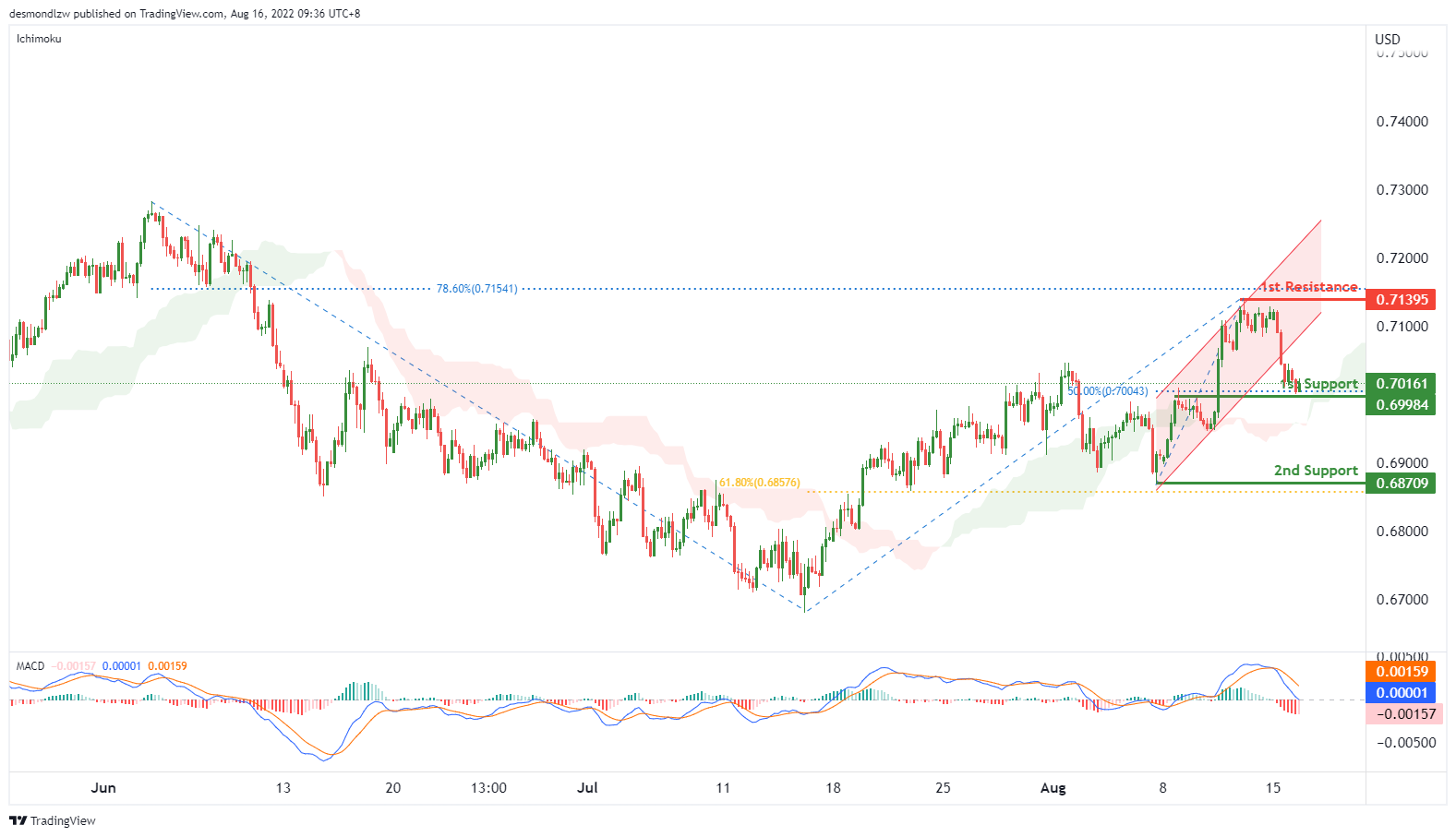
On the H4, with the price breaking the ascending channel, MACD histograms are under zero, and DIF is almost crossing the signal line, we have a bearish bias that price may drop from the 1st support at 0.69984, where the 50% fibonacci retracement and pullback support are to the 2nd support at 0.68709, which is in line with the swing low and 61.8% fibonacci retracement. Alternatively,the price may drop to the 1st resistance at 0.71395 which is in line with 78.6% fibonacci retracement and swing high.
Areas of consideration
- H4 1st support at 0.69984
- H4 2nd support at 0.68709
NZD/USD:
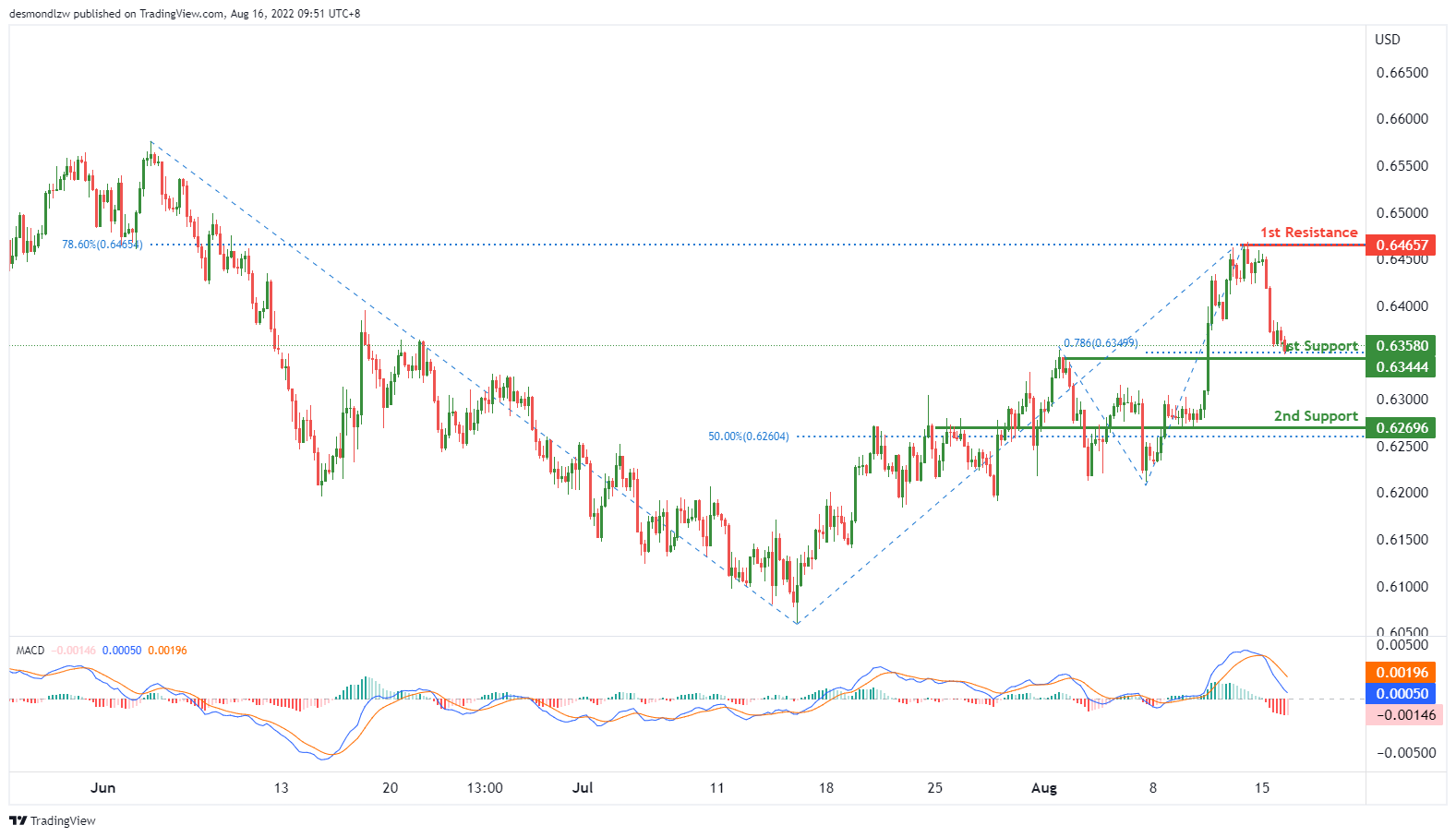
On the H4, with the MACD histograms are under zero and DIF crossing below the signal line, we have a bearish bias that the price may drop from the 1st support at 0.63444, which is in line with the 78.6% fibonacci retracement and pullback support to the 2nd support at 0.62696, which is in line with the 50% fibonacci retracement. Alternatively, the price may rise to the 1st resistance at 0.64657, which is in line with the swing high and 78.6% fibonacci retracement.
Areas of consideration:
- H4 time frame, 1st support at 0.63444
- H4 time frame, 2nd support at 0.62696
USD/CAD:
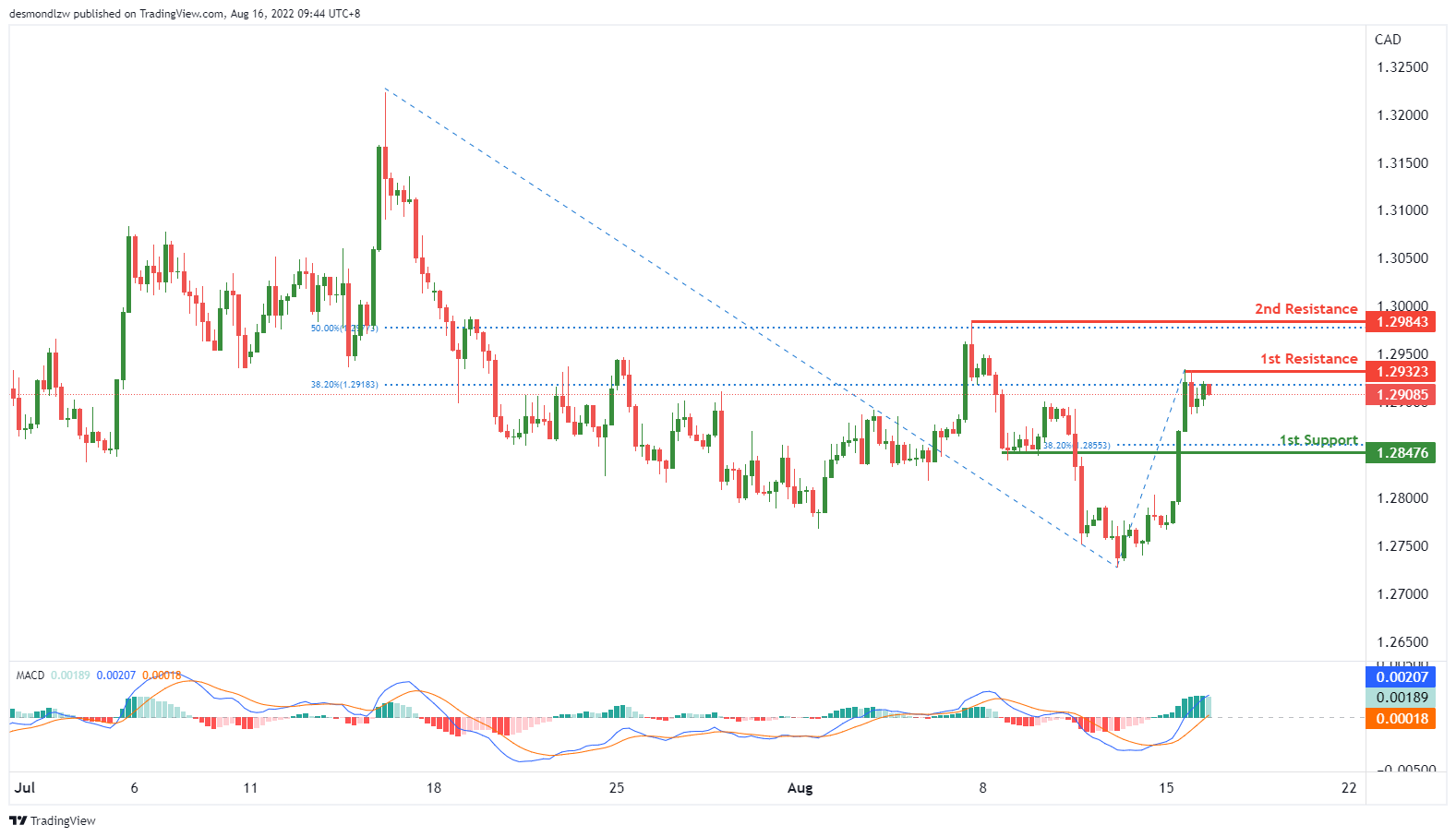
On the H4, with MACD indicators are above the zero, we have a bullish bias that the price may rise from the 1st resistance at 1.29323, which is in line with the38.2% fibonacci retracement to the 2nd resistance at 1.29843, which is in line with the 50% fibonacci retracement and swing high. Alternatively, the price may drop to the 1st support at 1.28476, which is in line with the 38.2% fibonacci retracement and overlap support.
Areas of consideration:
- H4 time frame, 1st resistance at 1.29323
- H4 time frame, 2nd resistance at 1.29843
OIL:
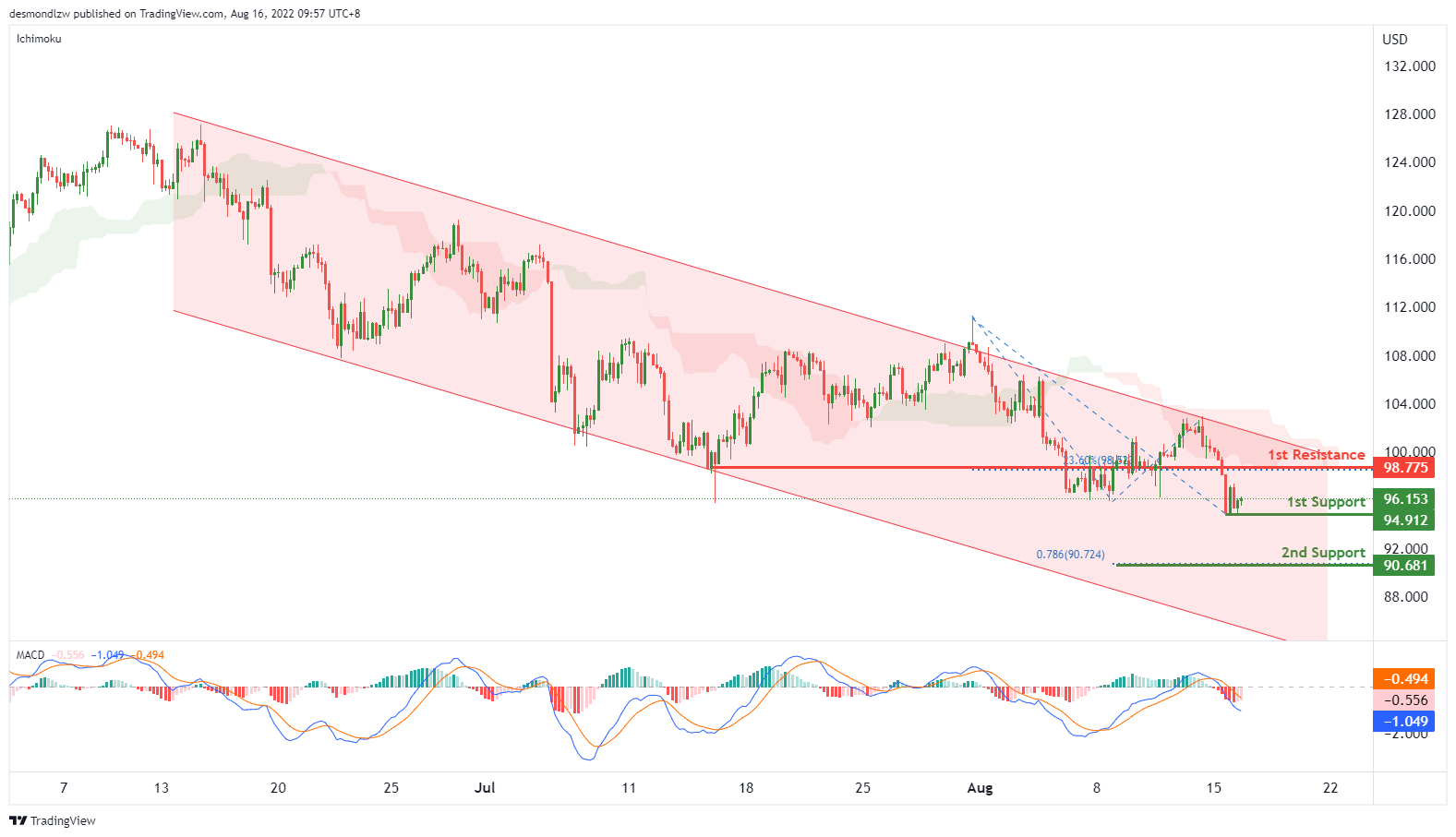
On the H4, with price moving within the descending channel, below ichimoku cloud and the DIF is crossing below signal line, we have a bearish bias that the price may drop from our 1st support at 94.91, which is in line with the swing low to the 2nd support at 90.681, which is in line with the 78.6% fibonacci projection. Otherwise, the price may rise to our 1st resistance at 98.775, which is in line with the overlap resistance and 23.6% fibonacci retracement.
Areas of consideration:
- H4 time frame, 1st support at 94.91
- H4 time frame, 2nd support at 90.681
Dow Jones Industrial Average:
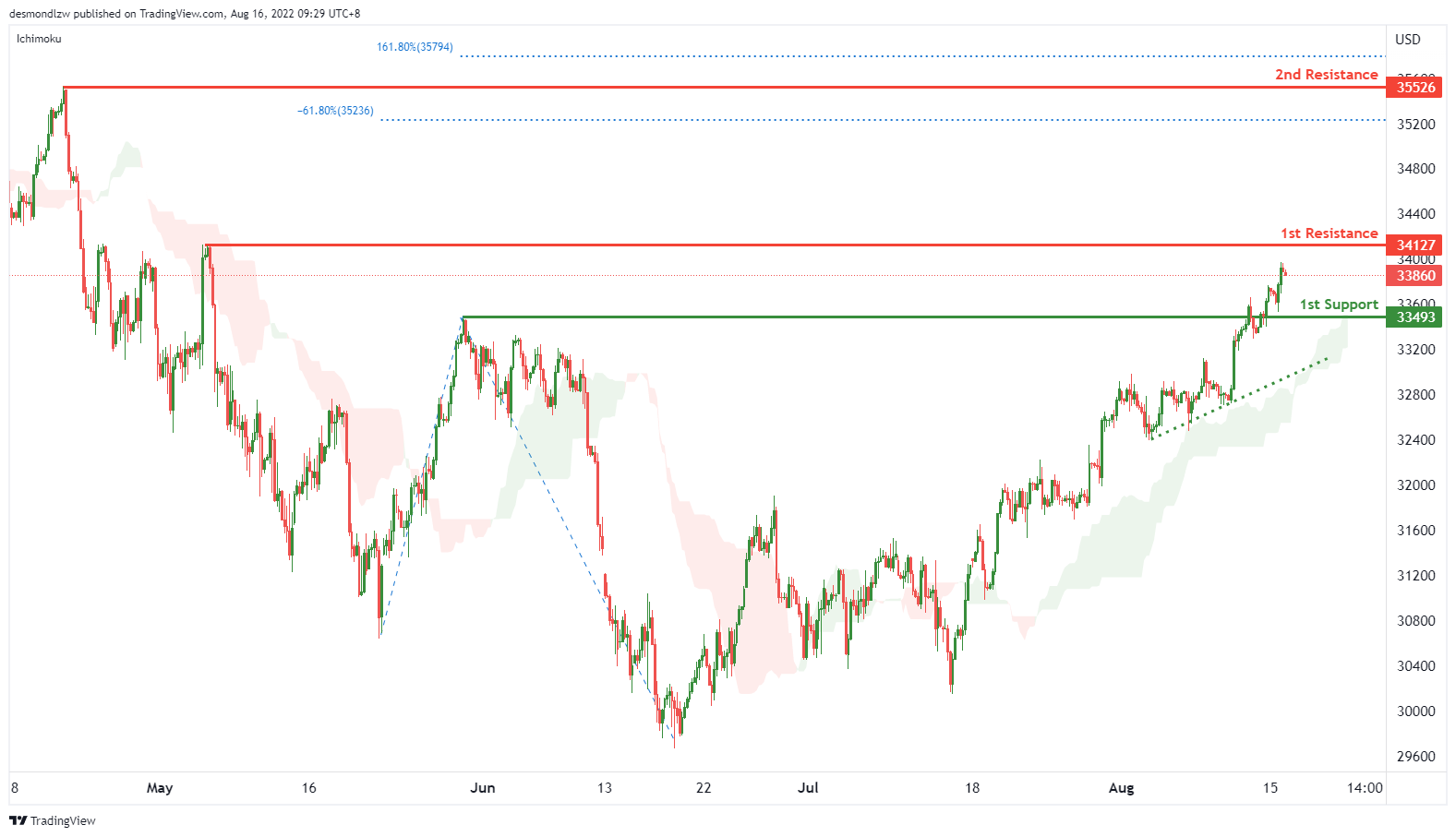
On the H4, with price moving above the ichimoku indicator and along an ascending trendline, we have a bullish bias that price will rise to our 1st resistance at 34127 where the swing high resistance is. Once there is upside confirmation that price has broken 1st resistance structure, we would expect bullish momentum to carry price to 2nd resistance at 35526 where the swing high resistance, 161.8% fibonacci extension and -61.8% fibonacci expansion are. Alternatively, price could drop to 1st support at 33493 where the pullback support is.
Areas of consideration:
- H4 time frame, 1st resistance of 34127
- H4 time frame, 1st support at 33493
DAX:
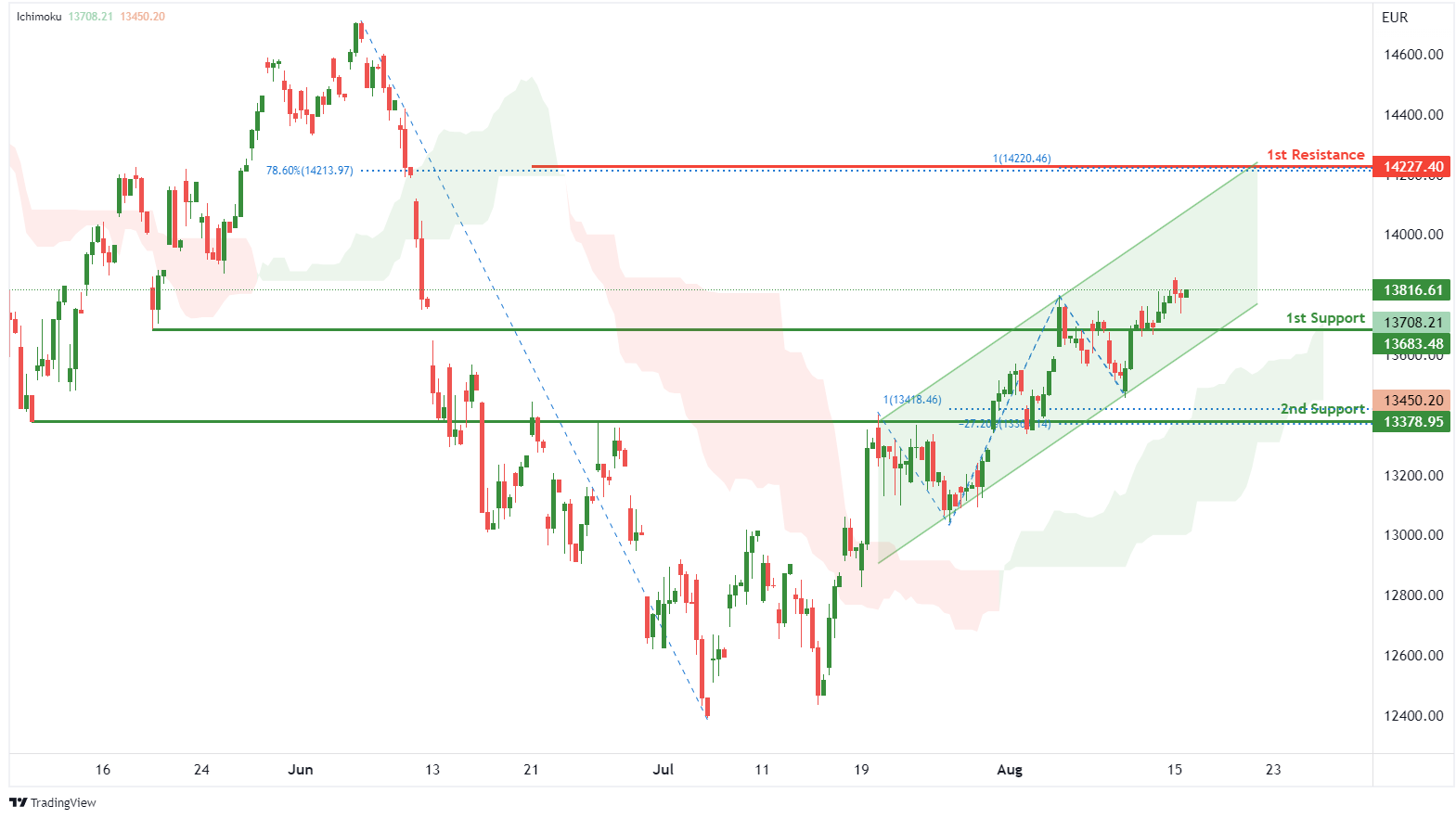
On the H4, with price moving above the ichimoku indicator and within the ascending channel, we have a bullish bias that price will rise from 1st support at 13683.48 where the pullback support is to the 1st resistance at 14227.40 in line with 100% fibonacci projection and 78.6% fibonacci retracement. Alternatively, price could break 1st support and drop to 2nd support at 13378.95 where the overlap support, -27.2% fibonacci expansion and 100% fibonacci projection are.
Areas of consideration:
- H4 time frame, 1st resistance of 14227.40
- H4 time frame, 1st support at 13683.48
ETHUSD:
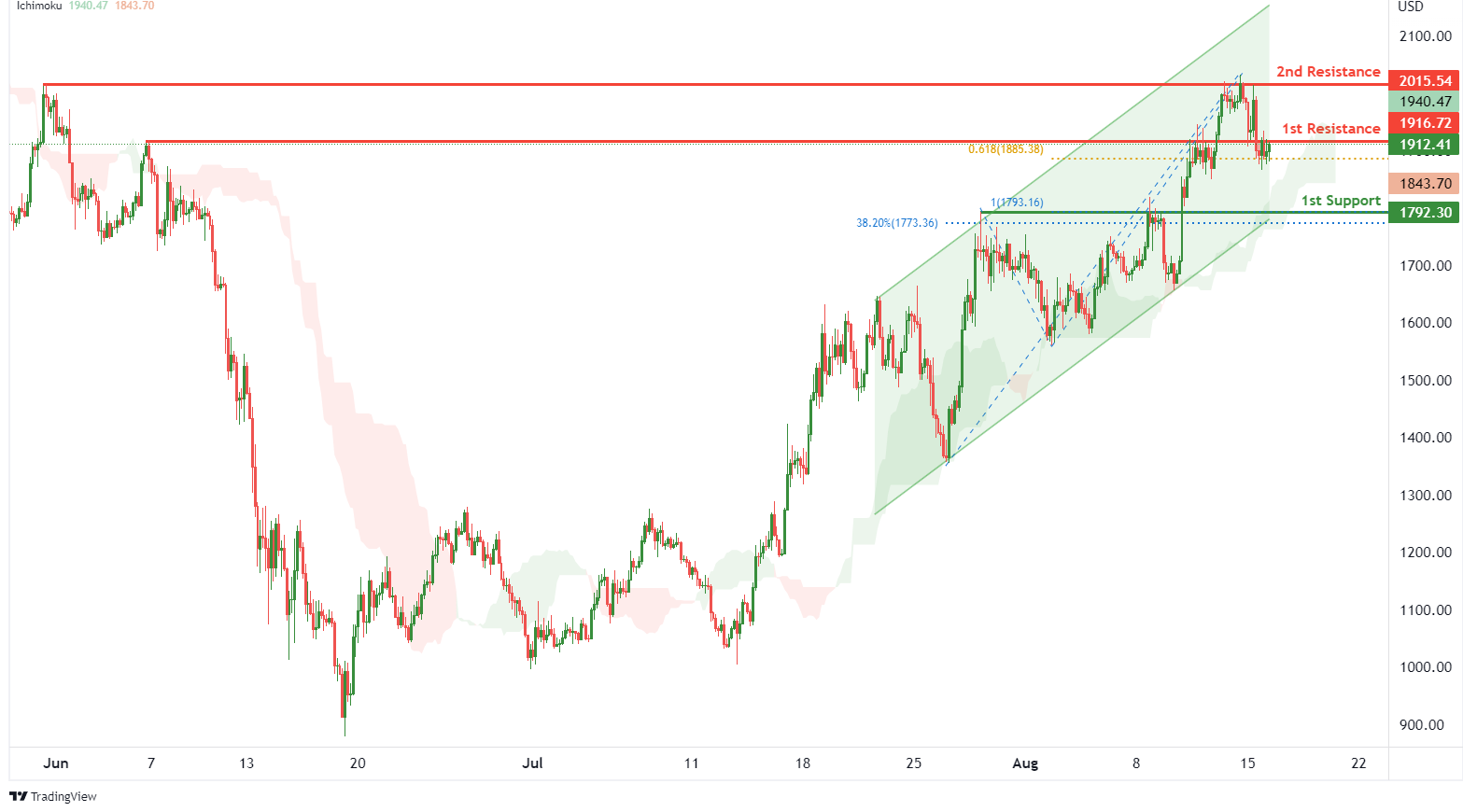
On the H4, with price moving within an ascending channel and above the ichimoku indicator, we have a bullish bias that price will rise to the 1st resistance at 1916.72 where the pullback support and 61.8% fibonacci projection are. Once there is upside confirmation that price has broken 1st resistance structure, we would expect bullish momentum to carry price to 2nd resistance at 2015.54 where the swing high resistance is. Alternatively, price could drop to 1st support at 1792.30 where the overlap support, 38.2% fibonacci retracement and 100% fibonacci projection are.
Areas of consideration:
- H4 time frame, 1st resistance of 1916.72
- H4 time frame, 1st support at 1792.30
BTCUSD:
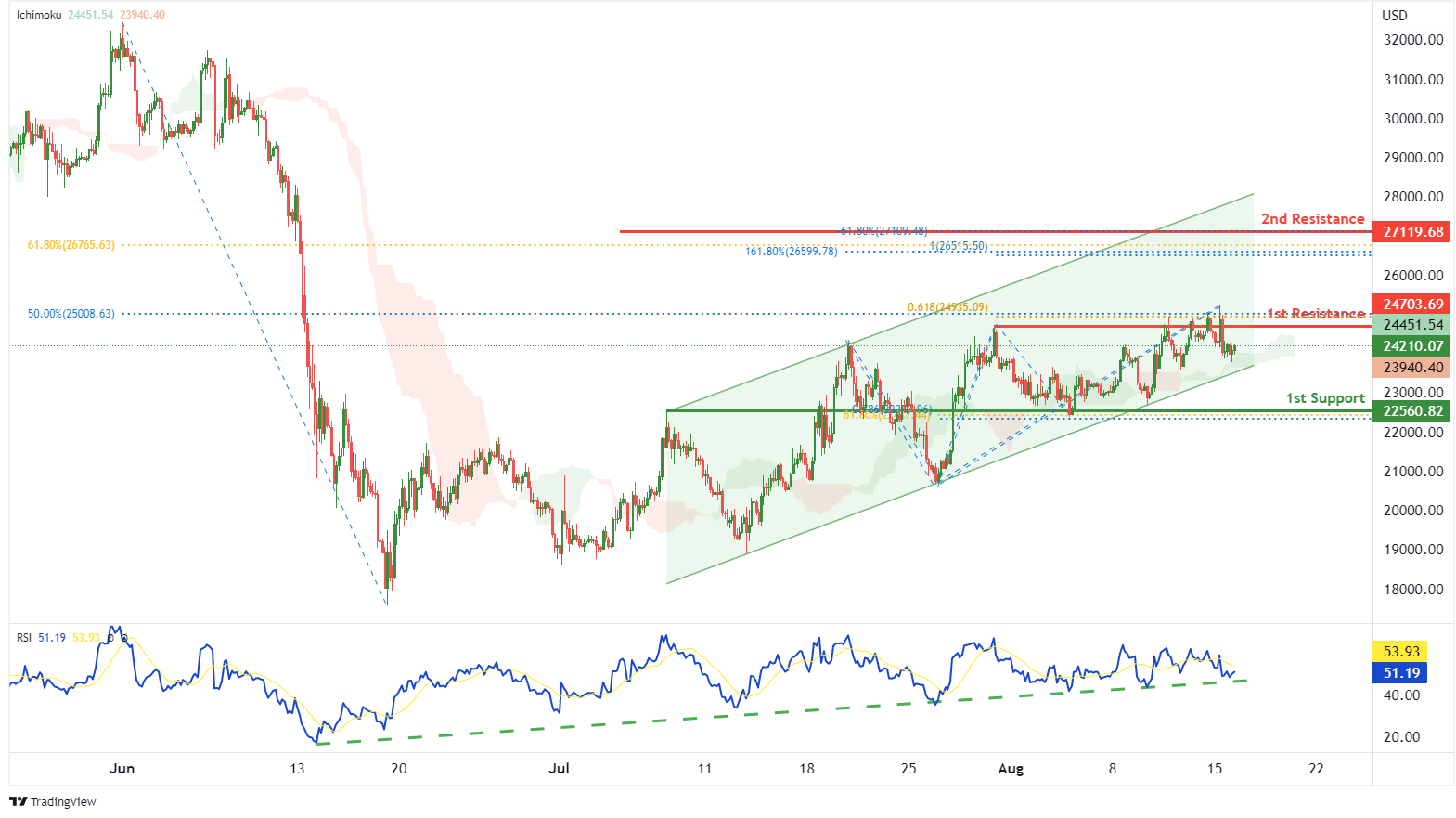
On the H4, with price moving within a bullish channel as well as above the ichimoku indicator and RSI moving along an ascending trendline, we have a bullish bias that price will rise to our 1st resistance at 24703.69 where the pullback resistance, 50% fibonacci retracement and 61.8% fibonacci projection are. Once there is upside confirmation that price has broken 1st resistance structure, we would expect bullish momentum to carry price to 2nd resistance at 27119.68 where the 61.8% fibonacci retracement, -61.8% fibonacci expansion, 161.8% fibonacci extension and 100% fibonacci projection are. Alternatively, price could drop to 1st support at 22560.82 where the pullback support, 61.8% fibonacci retracement and 78.6% fibonacci projection are.
Areas of consideration:
- H4 time frame, 1st resistance of 24703.69
- H4 time frame, 1st support at 22560.82
S&P 500:
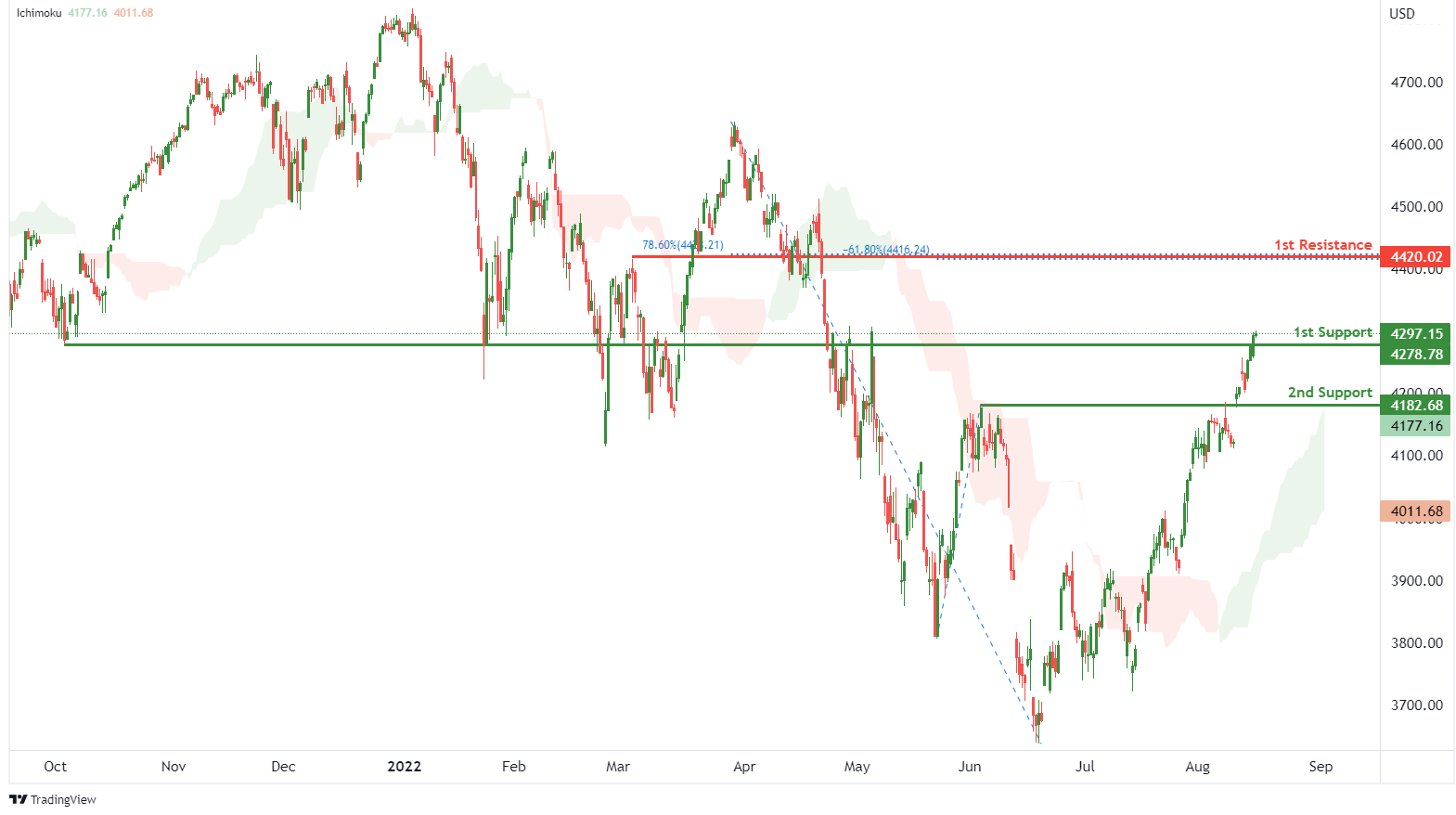
On the H4, with prices moving above the ichimoku indicator, we have a bullish bias that price will rise from 1st support at 4278.78 where the overlap support is to the 1st resistance at 4420.02 where the pullback resistance, 78.6% fibonacci retracement and -61.8% fibonacci expansion are. Alternatively, price could break 1st support structure and drop to 2nd support at 4182.68 where the pullback support is.
Areas of consideration:
- H4 time frame, 1st resistance of 4420.02
- H4 time frame, 1st support at 4278.78