

Sample Category Title
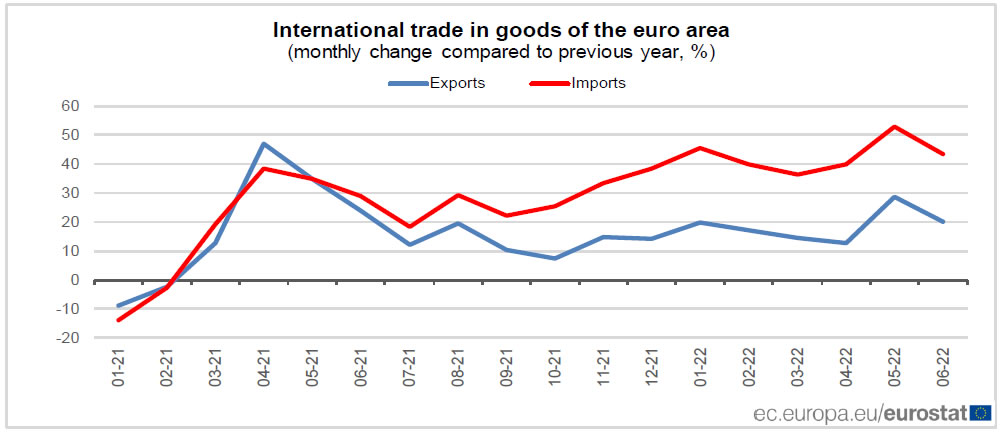
Eurozone exports rose 20.1% yoy in Jun, imports rose 43.5% yoy
Eurozone exports of goods to the rest of the world rose 20.1% yoy to EUR 252.2B in June. Imports rose 43.5% yoy to EUR 276.8B. Trade balance came in at EUR -24.6B deficit. Intra-eurozone trade rose 24.2% yoy to EUR 236.4B.
In seasonally adjusted term, exports dropped -0.1% mom to EUR 241.8B. Imports rose 1.3% mom to EUR 272.7B. Trade deficit widened from EUR -27.2B to EUR -30.8B, versus expectation of EUR -20.0B. Intra-eurozone trade was unchanged at EUR 224.1B.
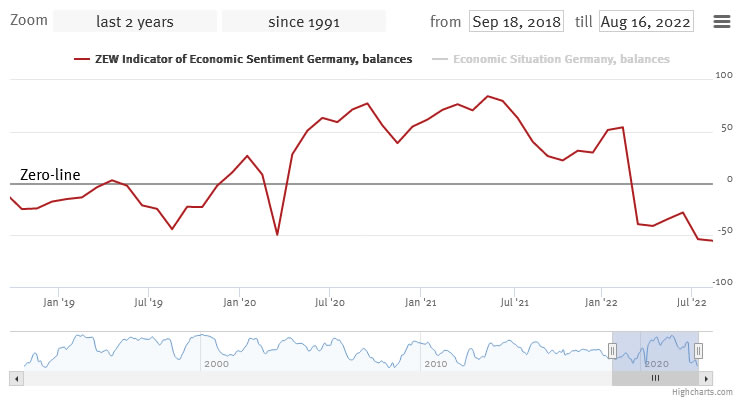
Germany ZEW dropped to -55.3, further decline in already weak economic growth
Germany ZEW Economic Sentiment dropped slightly from -53.8 to -55.3 in August, below expectation of -52.7. Current Situation index dropped from -45.8 to -47.6, above expectation of -48.0.
Eurozone ZEW Economic Sentiment dropped from -51.1 to -54.9, below expectation of -52.0. Current Situation Index rose 2.5 pts to -42.0. Eurozone inflation expectations rose 2.1 pts to -23.5, indicating a reduction of the high inflation rates within the next six months.
"The ZEW Economic Expectations decrease again slightly in August after a sharp drop in the previous month. The financial market experts therefore expect a further decline in the already weak economic growth in Germany. The still high inflation rates and the expected additional costs for heating and energy lead to a decrease in profit expectations for the private consumption sector. In contrast, the expectations for the financial sector are improving due to the supposed further increase in short-term interest rates", comments Michael Schröder, researcher at ZEW and head of the ZEW financial market survey, on current results.
Markets Remain Worried by Global Recession Fears
Asian shares edged cautiously higher on Tuesday, tracking a rebound in Wall Street overnight despite disappointing economic data from China and the US fuelling recessionary fears. Stocks in the region were supported by expectations over China unleashing more stimulus to support economic growth. In Europe, futures pointed to a steady start, borrowing momentum from Asian markets ahead of the German ZEW survey for August. This has proved to be a leading indicator for the Eurozone and may give more insight into the severity of the downturn in the wider region. With recent economic data showing US inflation cooling, this has offered equity bulls some room to breathe and may translate to further short-term gains across stock markets.
In the currency arena, the safe-haven dollar drew ample strength from global recession fears while oil prices tumbled to levels not seen in six months on growing signs of an economic downturn and prospects of rising supply on an Iran deal. Gold has struggled for direction this morning after tumbling more than one per cent in the previous session. Prices are trading back within a range and could be waiting for a fresh directional catalyst this week.
Fed minutes and Fed speakers in focus
This could be a volatile week for the dollar due to the FOMC meeting minutes, key economic reports as well as scheduled speeches from Fed officials.
All eyes will be on the Federal Reserve meeting minutes released on Wednesday. This will be closely scrutinised by investors for any fresh clues into what policymakers were thinking when rates were hiked by 75 basis points for a second straight meeting. If the minutes strike a hawkish tone, this could inject dollar bulls with fresh inspiration as rate hike bets jump towards another jumbo-sized September move. Alternatively, any dovish hints or caution may encourage some dollar weakness. It will also be wise to keep an eye on the US retail sales report for July published mid-week and speeches by Kansas City Fed President Esther George and Minneapolis Fed President Neel Kashkari on Thursday.
Oil prices crumble
Oil prices collapsed like a house of cards on Monday as China's growth fears and prospects of rising supply empowered bears. Given how Libya is pumping more oil and Iran is moving closer to restoring a nuclear deal, this could result in higher flows at a time when demand remains shaky. Both WTI and Brent remain under pressure on the daily charts with a stronger dollar seen enforcing downside pressures. The benchmarks have shed roughly six per cent this month with the current fundamental drivers opening the doors to further losses this week.
Commodity spotlight – Gold
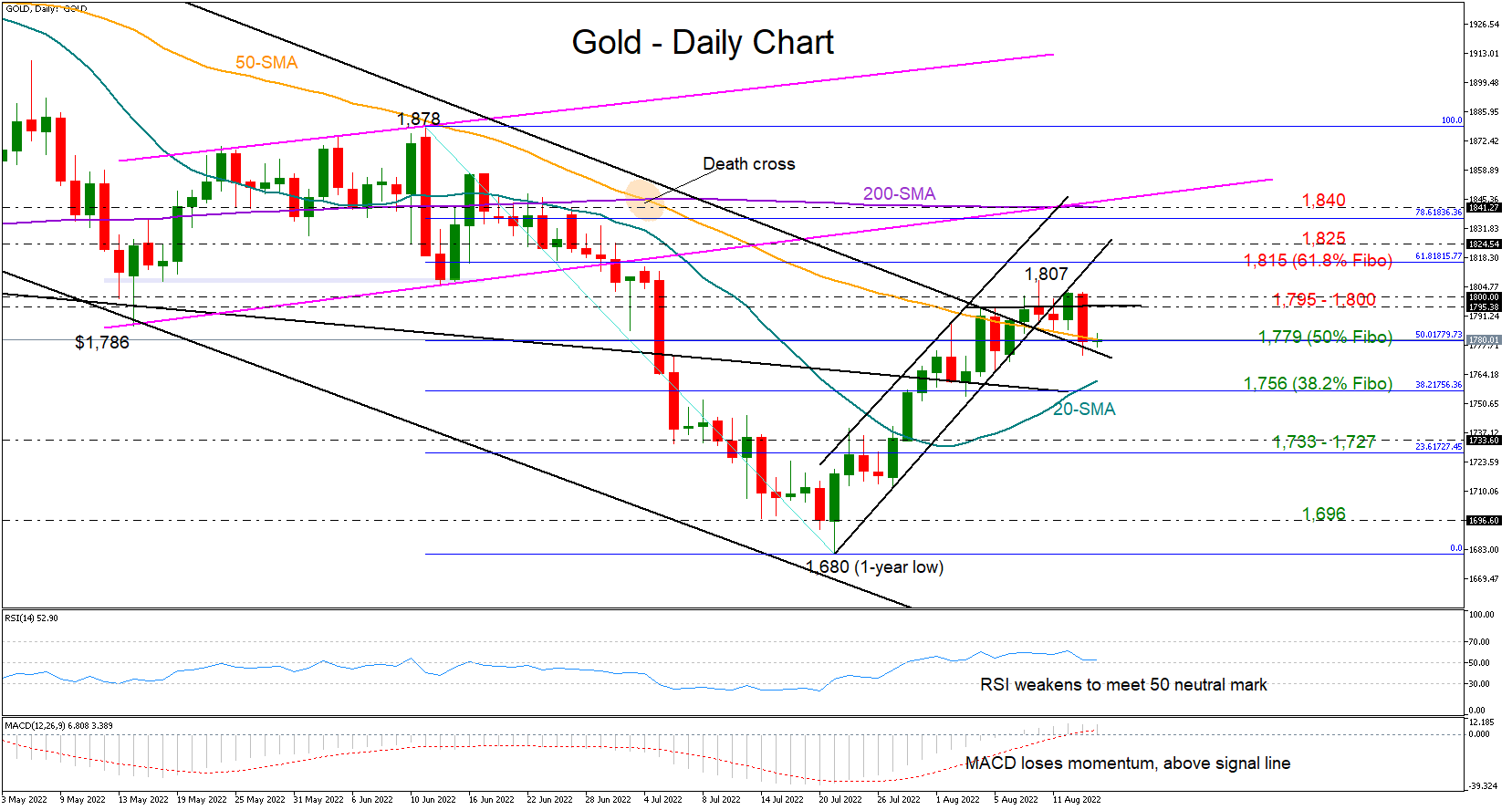
Gold remains stuck in a range with support at $1770 and resistance at $1800. A breakout could be on the horizon triggered by the pending Fed minutes, US economic data, or even speeches by Fed officials. A move above $1800 would open the doors towards $1825. Alternatively, a selloff below $1770 is seen triggering a steeper move back towards $1740.
Bitcoin is Lowering But Not Yet Falling
Market picture
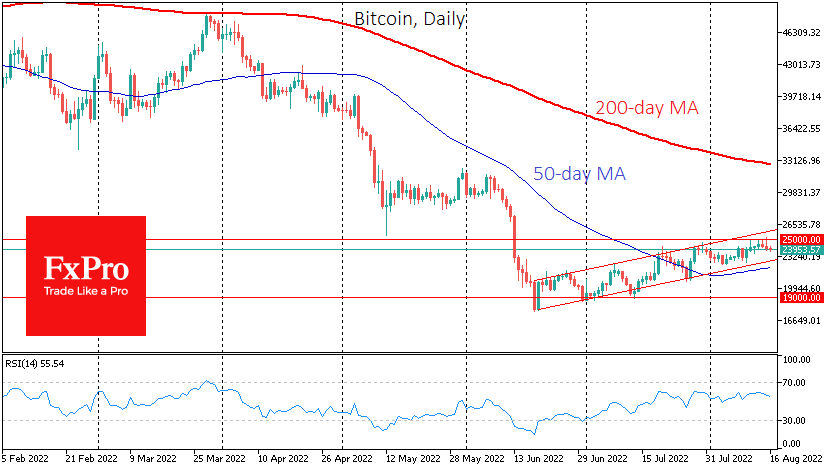
Bitcoin is losing 3.7% in the past 24 hours, falling to $23.9K%. Ethereum is down 5.2% to $1870. Other top altcoins are down 2% (BNB) to 6.4% (Solana).
The total capitalisation of the crypto market, according to CoinMarketCap, fell 3.6% to $1.14 trillion overnight.
Bitcoin on Monday failed to claw its way above $25K, after which short-term buyers rushed to lock in profits and returned the price to the $24K area. The pressure on BTC was exerted by the rising US dollar amid weak data from China, indicating a slowdown in the economy.
However, so far, Bitcoin’s decline is more appropriately seen as a corrective pullback within an uptrend. It would only be appropriate to discuss a break in this trend if it moves below $22.5K-23.0K. Sluggish and uncertain growth at the first stages is typical after a strong sell-off that prevailed since last October.
News background
Notably, the positive dynamics of the crypto market last week coincided with a net $17 million outflow, the first net withdrawal in seven weeks, of which $21 million came from investments in BTC. At the same time, investments in bitcoin short funds increased by $2.6 million.
The Wall Street Journal reports that US pension funds remain optimistic about investing in cryptocurrencies, despite a significant pullback in prices and a wave of defaults by crypto companies.
Raul Pal — Real Vision CEO — believes that Ethereum remains highly attractive for investors, and interest in it will grow even more after the move to PoS. Michael Saylor, former head of MicroStrategy, called the company’s decision to buy bitcoin a good one. He said, BTC is not suitable for everyone, “you should invest for at least four years. Ideally, it’s an intergenerational transfer of wealth.”
EURUSD Retreats Below 1.0200 and Short-Term SMAs
EURUSD has reversed back down again after finding resistance at the 1.0360 barrier and the descending trend line. Also, the pair retreated beneath the 20- and 40-day simple moving averages (SMAs) with the technical indicators suggesting a neutral to negative bias in the short-term. The RSI is holding just below the neutral threshold of 50, while the MACD is trying to strengthen its negative momentum below the zero level.
Further losses should see the 1.0095 level, acting as a major support ahead of the parity level and the 20-year low of 0.9950. A drop below these lines would reinforce the bearish structure in the long-term and open the way towards the next key support of 0.9608, registered in August 2002.
In the event of an upside reversal, the 20- and 40-day SMAs at 1.0210 and 1.0255 respectively could be the next resistance levels to have in mind ahead of the downtrend line and the 1.0360 hurdle. A break above this level would shift the short-term view to a more bullish one as it would take the pair towards the 1.0635 resistance.
All in all, EURUSD has been developing within a downward sloping channel since February and only an advance beyond the 1.0360 barrier may change the outlook to neutral. Currently, the pair is still in a strong negative mode in the long-term.

Gold Pulls Below 1,800; Bias Still Neutral
Gold started the week on the wrong foot, sliding to a low of 1,772 on Monday after two days of unsuccessful efforts to claim the 1,800 psychological mark.
The bearish correction, however, has not raised alarms yet, as the price seems to be setting a foothold around the broken bearish channel from March and the 50-day simple moving average (SMA) at 1,779. The 50% Fibonacci retracement of the 1,878 – 1,680 is also cementing that base. Moreover, the RSI, although weaker, is marginally above its 50 neutral mark and the MACD keeps fluctuating above its red signal line despite recently losing momentum, suggesting a neutral bias instead.
If that floor cracks, the precious metal may seek support somewhere between the 20-day SMA and the 38.2% Fibonacci of 1,756. Lower, the sell-off could accelerate towards the 1,733 – 1,727 constraining zone, a break of which could trigger another significant decline towards the bottom of $1,696 - $1,680.
Otherwise, a bounce on 1,779 may again push for a close above the nearby ceiling of 1,795 - 1,800. Should the bulls succeed this time, the next obstacle could develop within the 1,815 - 1,825 region, while not far above, the flattening 200-day SMA around 1,840 could be a more important resistance.
In brief, gold has not flipped back to a bearish bias despite its latest pullback. For that to happen, the price will need to breach the 1,779 base.
Oil Prices Slipping and Went into Tailspin
Markets
Disappointing July Chinese eco data and some PBOC monetary policy easing were the main talking point at the start of the new trading week. The Chinese central bank cut its 1-yr medium term lending facility rate unexpectedly by 10 bps, from 2.85% to 2.75%. It was the first cut since January. The decision came just before the release of July economic data which pointed to decelerating growth in production (3.8% Y/Y; 3.5% YTD YoY), retail sales (2.7% Y/Y; -0.2% YTD YoY) and investments (5.7% YTD YoY). New Covid-outbreaks and the governments zero-Covid policy dampened growth at the start of Q3 while also clouding the outlook. The country last month toned down its guidance for this year’s growth target from around 5.5% to “trying to achieve the best possible outcome”. The monthly eco data amplified global growth worries and provided an early bid for core bonds.
Oil prices were slipping and went into tailspin once Iran’s foreign minister Amirabdollahian signaled that a new nuclear deal is near. The country sent its official response to reviving the 2015 the Joint Comprehensive Plan of Action (JCPOA) to the EU while it’s already nearer to a deal with the US. Relancing JCPOA implies a return of Iranian oil to the market. Brent crude yesterday fell from around $98/b to $93/b.
An empty European eco calendar meant that Chinese growth and the Iranian nuclear deal remained the key trading input up until the release of the August Empire Manufacturing index. NY business sentiment unexpectedly crashed from 11.10 to -31.3, by far the weakest reading since May 2020. Details offered no relief. New orders slumped from 6.2 to -29.6 with shipments collapsing from 25.3 to -24.1. Employment and average workweek indicators fell as well with producer input prices showing a second month of steep decline following over 12 months (April 2021 – June 2022) at sky-high levels. All these sub-indicators are a warning signal for H2 growth. We’ll look for more regional confirmation in this week’s Philly Fed Business Outlook and next week’s Richmond Fed Manufacturing index.
US Treasuries spiked higher after the Empire Manufacturing Survey with the front end of the curve outperforming. The curve turned less inverse with yields ceding 6.2 bps (2-yr) to 0.9 bps (30-yr). German yields lost around 8 bps across the curve. The dollar extended Friday’s gains. EUR/USD’s failure to regain first resistance around 1.0350 (May & June lows / topside downward trend channel) prompted rebound action lower with the pair currently changing hands at 1.0165.
EUR/GBP copied that move south with the pair closing at 0.8428 from an 0.8453 open. This morning’s decent labour market figures don’t spark a market reaction. UK employment rose by 160k in the 3 months ending June, below 268k consensus with the unemployment rate stabilizing at 3.8% over that same period. Average weekly earnings accelerated to 4.7% Y/Y ex. Bonuses. Monthly (July) data showed a 73k net job gains with jobless claims falling by 10.6k.
News Headlines
The German government decided that consumers will have to pay and extra 2.419 euro cents per kilowatt hour for natural gas from October onwards. Economic minister Habeck said that the levy is a consequence of Russian President Putin’s illegal war of aggression against Ukraine and the artificial energy shortage caused by Russia. The levy will be imposed through April 1 2024 and suggests an annual cost of about €290 for a 4-person household. Some households will be granted some subsidies to dampen the impact of the price rise. The latter will deteriorate German inflation dynamics (already at 8.5% Y/Y in July) further. The Reserve Bank of Australia published Minutes of its early August policy meeting, when it hiked the policy rate by 50 bps from 1.35% to 1.85%. The board expects to take further steps in the process of normalizing monetary conditions over the months ahead, but it is not on a pre-set path. The central bank hinted to get (at least) towards a neutral level of around 2.5% with money markets expecting a 3.25% policy rate by the end of the year.
Daily Technical Analysis
EUR/USD
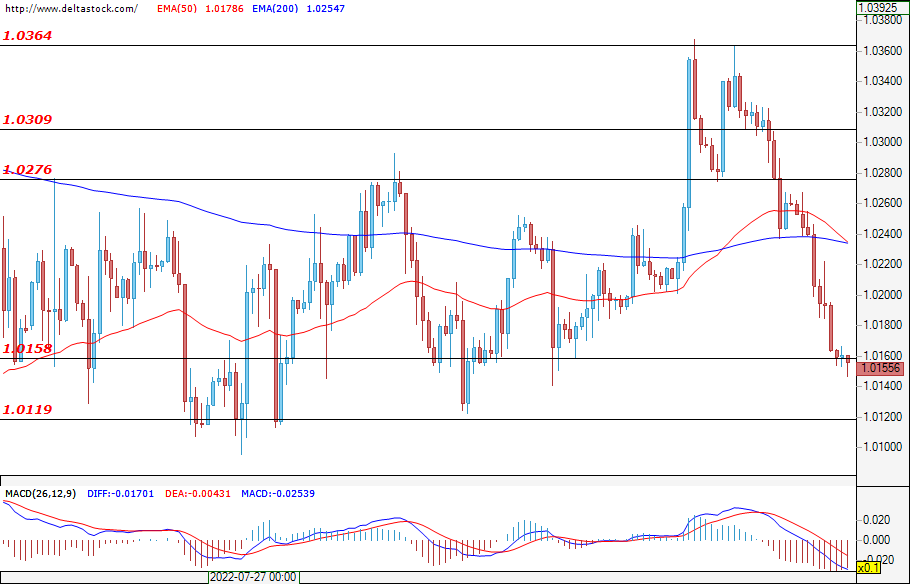
The European common currency lost quite a bit of ground against the U.S. dollar, and during the early hours of today`s trading, the price tested the support at 1.0158. A confirmed breach for the bears could easily deepen the decline towards the next target at 1.0119, where a violation could lead to new losses and could strengthen the negative expectations for the future path of the pair. If the buyers enter the market instead, then their first resistance can be found at 1.0276, followed by the upper zone at 1.0309.
USD/JPY
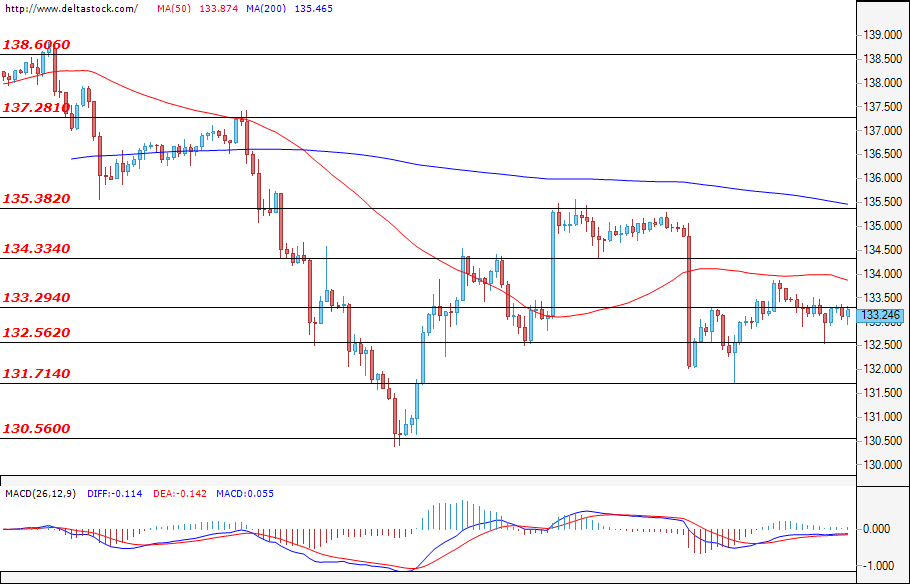
Neither the bulls nor the bears managed to gain enough momentum and trading remained in the zone between 132.56 and 133.29. A breach of the lower border, followed by a violation of the next target at 131.71, could easily mark the current move as corrective and could pave the way for a test of the low at 130.56. If the buyers prevail instead, then a new successful attack on the zone at 133.29 and a breach of the resistance at 134.33 could result in a continuous recovery towards the important level at 135.38.
GBP/USD
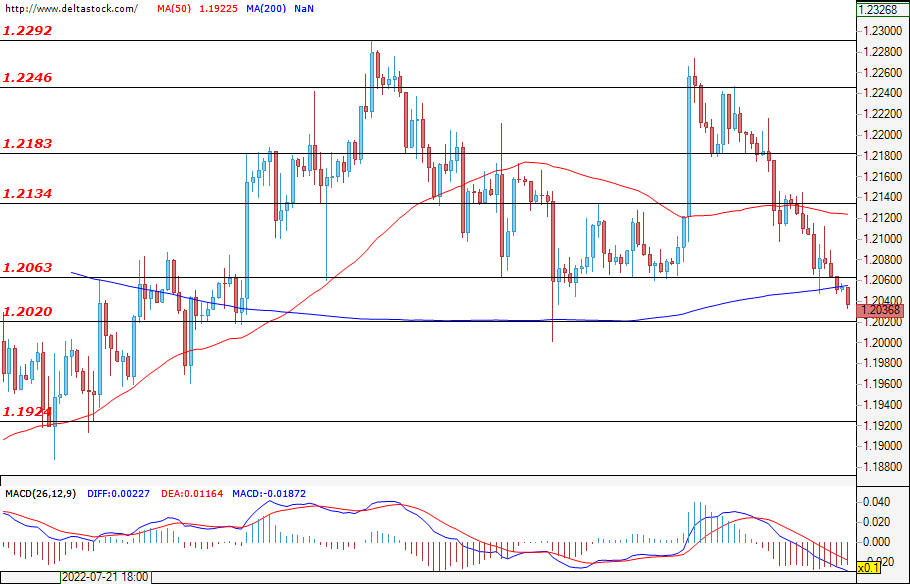
The Sterling continued to lose ground against the dollar, and after the breach of the support at 1.2063, the pair consolidated around the current price at 1.2036. The current expectations are for a test of the level at 1.2020, and if successful, a deepening of the decline could easily head the price towards the support at 1.1924. If the bearish momentum fades and buyers take control instead, then a violation of the mentioned zone at 1.2063, which is now acting as resistance, could lead to an appreciation towards the next target at 1.2134. A violation of the upper zone at 1.2183 could result in a change in the current sentiment and could prime the Cable for a new attack on the local high at 1.2246.
EUGERMANY40
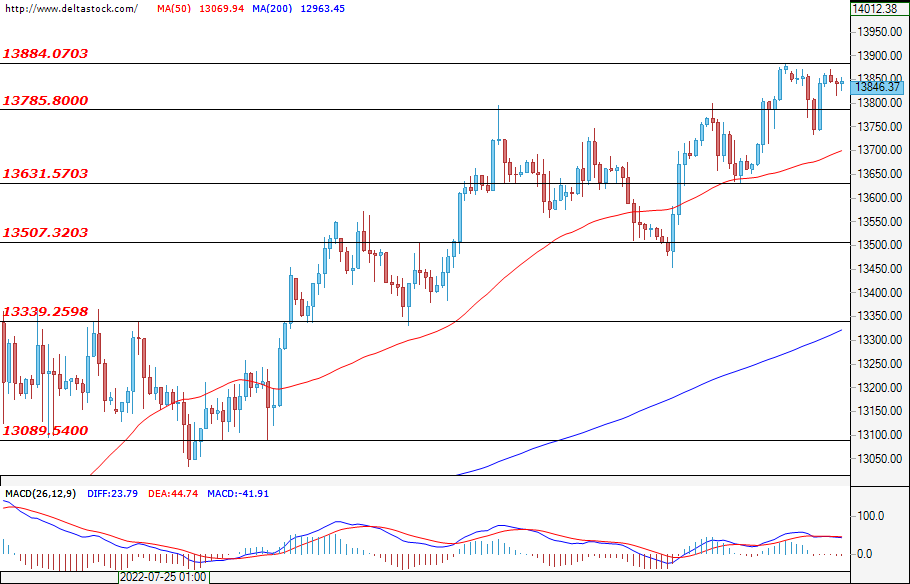
The German index recovered some of its recent losses, and at the time of writing the analysis, the price is hovering just under the resistance at 13884. If the bulls manage to gain enough momentum and breach the mentioned zone, then the expectations would be for new gains and a further rally towards 13400. Worse-than-expected data on the ZEW economic sentiment in Germany (today; 09:00 GMT) could help the bears prevail. А potential correction here could be limited to the support zone at 13785, followed by the lower level at 13631.
US30
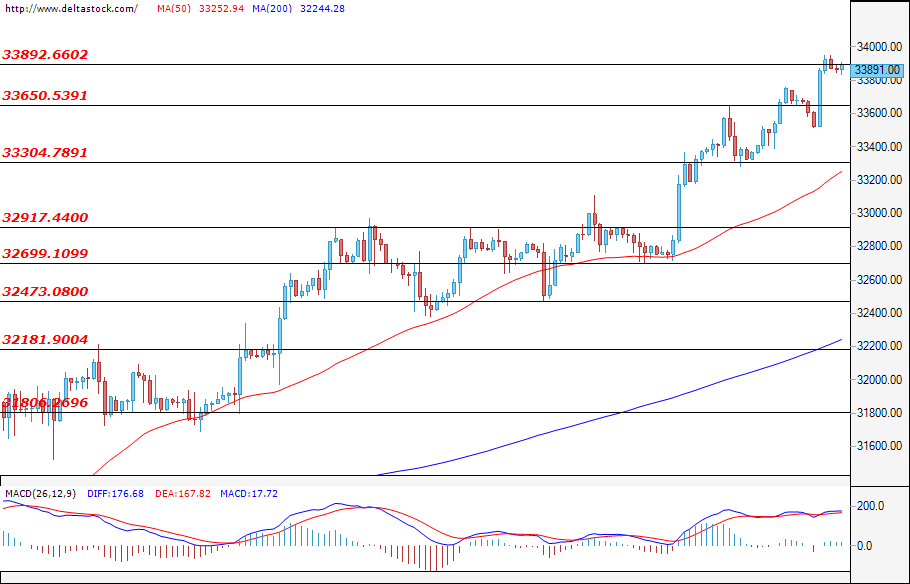
The positive sentiments remained unchanged and the American index appreciated and tested the resistance at 33892. If the bullish attack continues, then a successful violation could easily lead to new gains towards the levels from March 2021 at around 34800. Оn the flipside, if the bears enter the market and violate the support at 33650, then a potential deeper correction could be limited to the lower zone at 33304, followed by the major level at 32917.
FTSE 100 Inches Up
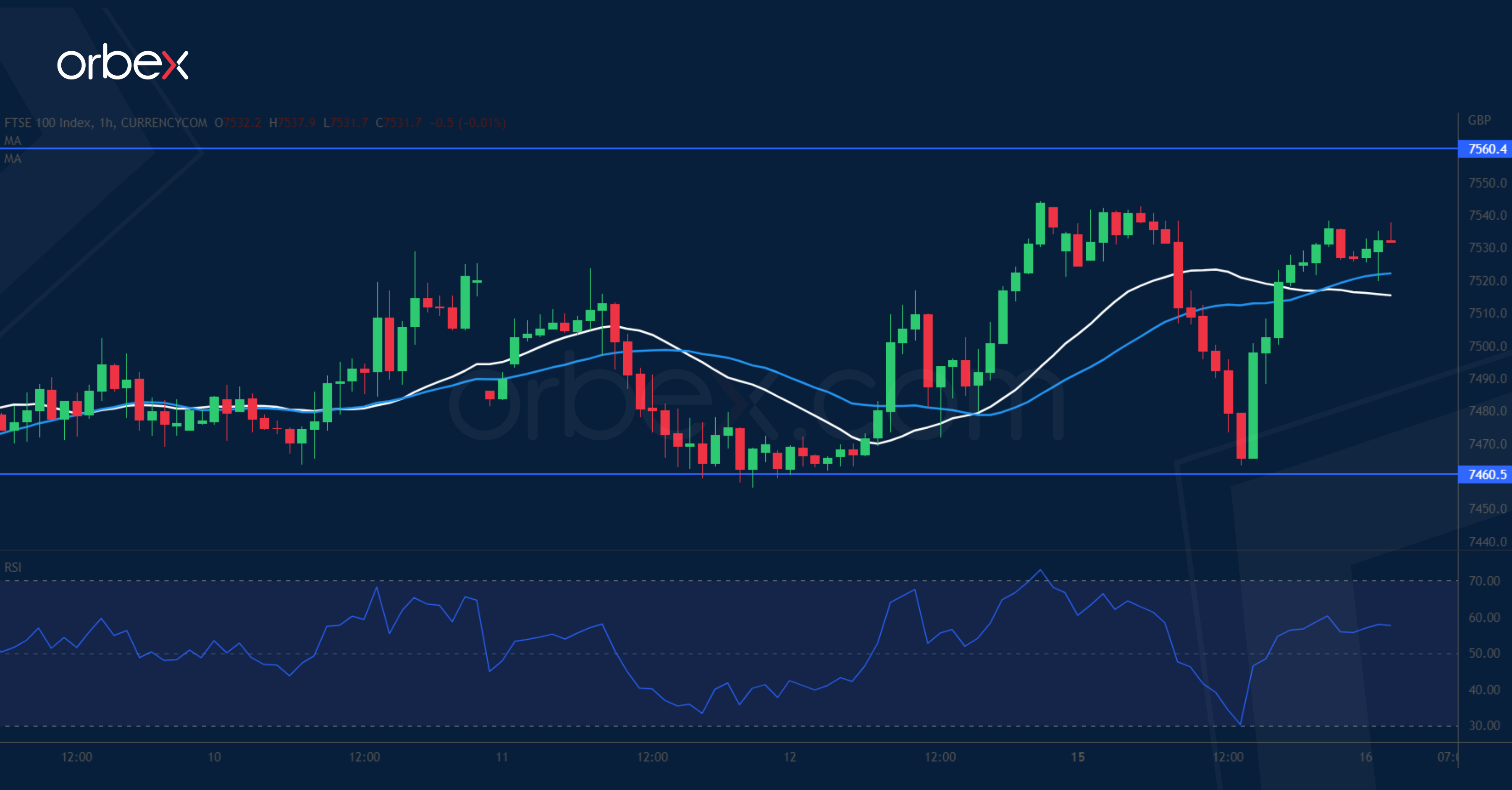
Equities rally as investors find some relief in China cutting interest rates. The FTSE is looking to hold onto its gains as it grinds its way towards a new high. 7560 at the origin of June’s liquidation is a major hurdle and strong selling interest could be expected from those who believe in a bear market in the medium-term. The RSI’s repeated overbought condition may make buyers wary of chasing after the rally. 7460 is the immediate support and 7370 over the 30-day moving average an important level to prevent a correction.
US Oil Breaks Support
WTI slides as weak Chinese economic data raise concerns over demand. The bulls’ struggle to keep higher lows indicates that sentiment remains downbeat. A short-lived rebound to 95.00 which sits on the 20-day moving average is another sign that the bears have firm control of the direction. A fall below 87.50 would invalidate the bounce and attract more selling. 82.00 near a seven-month lows would be the next target. As the RSI recovers from oversold territory, 92.00 is the resistance and sellers may continue to fade rebounds.
