Sample Category Title
GBPJPY Wave Analysis
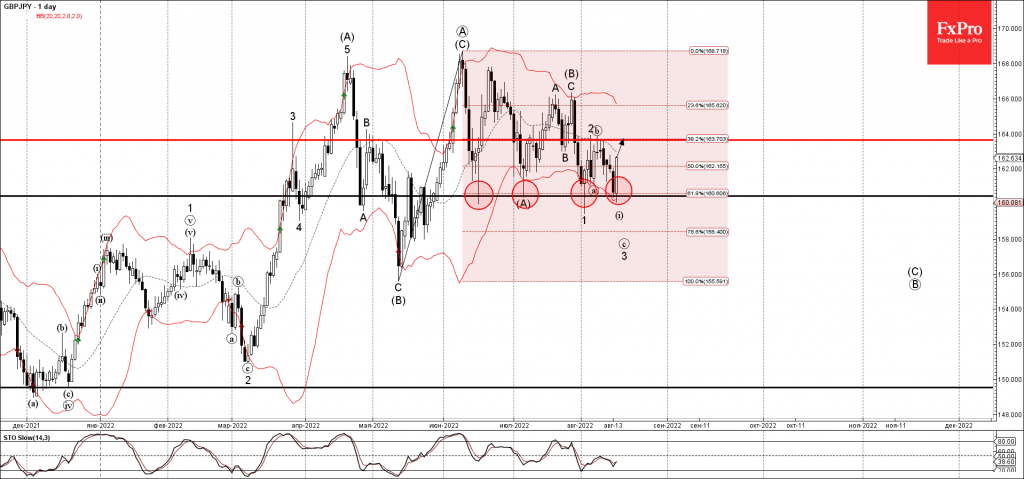
- GBPJPY reversed from support area
- Likely to rise to resistance level 163.65
GBPJPY currency pair recently reversed up from the support area lying between the key support level 160.50 (which has been reversing the price from the middle of June), lower daily Bollinger Band and the 61.8% Fibonacci correction of the sharp upward impulse wave (C) from the middle of May.
The upward reversal from this support area will most likely form the daily candlesticks reversal pattern Bullish Engulfing.
GBPJPY can be expected to rise further toward the next resistance level 163.65 (which stopped the previous waves 2 and (b)).
Eco Data 8/17/22
[php_everywhere instance="1"]
Refreshed US Dollar Awaits Fed Minutes and Retail Sales
The US dollar rally has picked up a second wind, despite some signs that the US economy is losing steam. Investors seem much more concerned about Europe and China, which is helping the reserve currency attract safe-haven flows. Retail sales data and the minutes of the latest Fed meeting will hit the markets on Wednesday, providing fresh clues around how far interest rates might be raised in this cycle.
No alternative
With the Fed opening the door for a slowdown in the pace of tightening and the latest batch of CPI readings signaling that inflationary pressures have started to lose power, it seemed like the relentless rally in the dollar was finally running out of juice. But that weakness didn’t last long.
As soon as the outlook for other major economies turned darker, traders rushed back into the reserve currency’s safety. China’s property sector is melting down and the latest data reflect the unfolding crisis, pushing investors away from currencies like the Australian or New Zealand dollars, whose economic models rely on China absorbing their commodity exports.
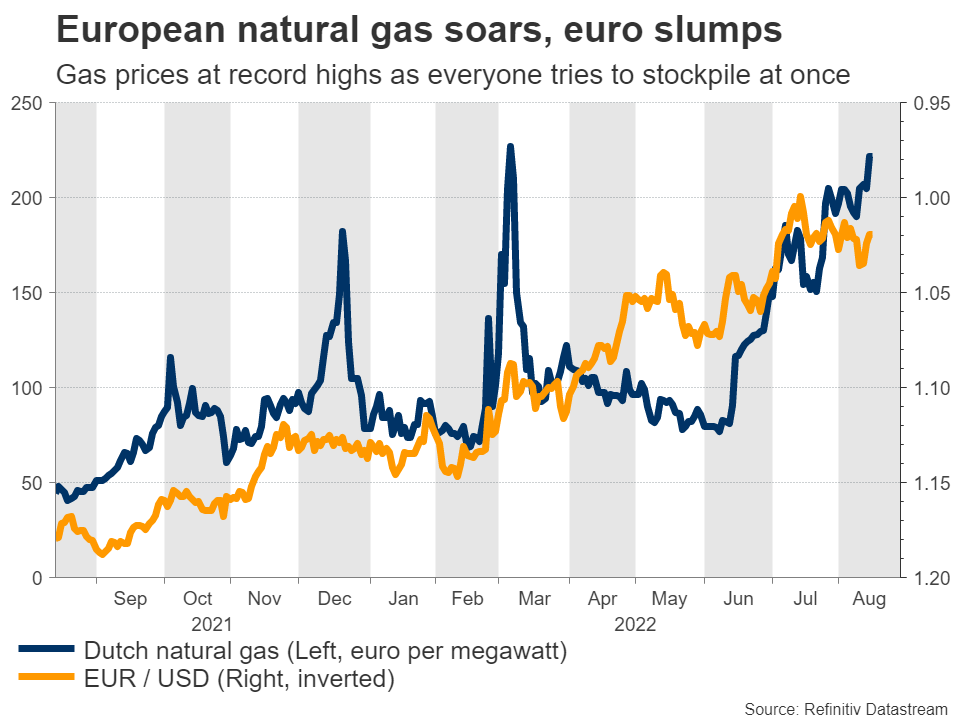
Meanwhile, Europe is still grappling with an energy shortage. Natural gas prices on the continent have pushed higher to challenge record highs as every country tries to stockpile for winter, keeping the squeeze on consumers and ravaging the euro.
In contrast, the US economy doesn’t look so fragile. While leading indicators like business surveys point to slower growth ahead, the labor market remains at full employment, calming some nerves about a deep recession. Currency trading is a relative game after all, so when other major economies struggle, the dollar naturally shines.
Fed minutes
This week, the show will get started on Wednesday with the latest retail sales. Expectations are mixed, with the headline print anticipated to have ticked up in July while the core figure is seen slightly lower from last month.
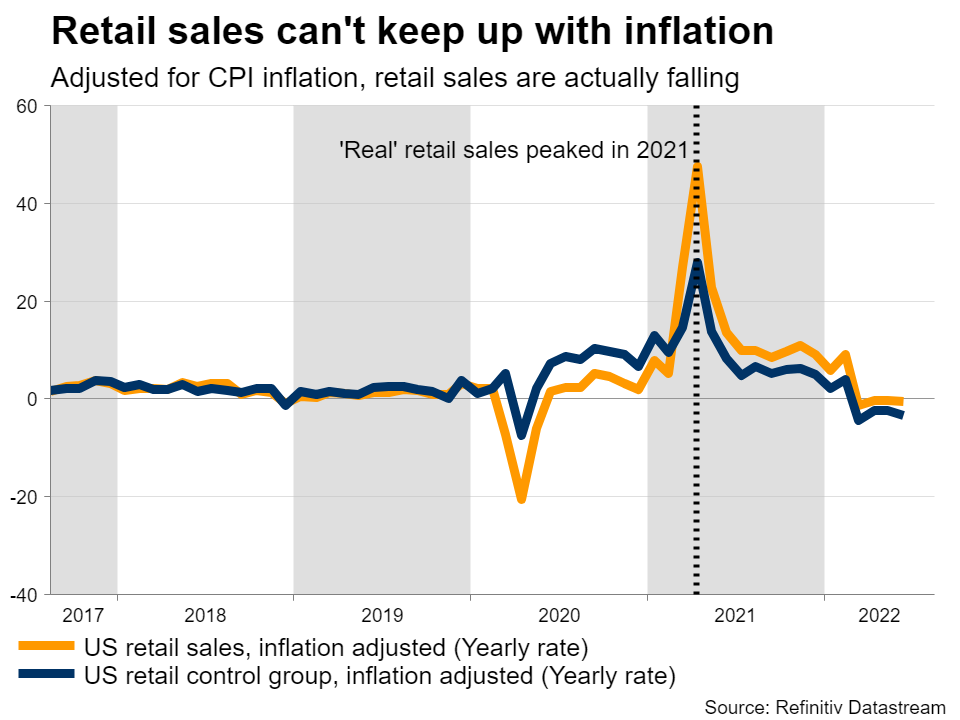
Most importantly, the retail control group that is used in GDP calculations is projected to have risen at a solid clip, something supported by credit card spending data from Mastercard and JPMorgan Chase. The catch is that these prints are not adjusted for inflation. Once CPI inflation has been accounted for, real retail sales are negative for the year.
A few hours later, the minutes of the latest Fed decision will be released. This was when the FOMC raised rates by three-quarters of a percent but hinted that future moves won’t be quite so forceful. Market pricing for September is currently split, with traders assigning almost equal chances for a half-point or three-quarter point rate hike, so any fresh signals could swing the pendulum.
Fed Board Governor Bowman will speak right afterwards. Financial conditions have loosened lately with bond yields retreating and stock markets rallying, which is counterproductive for a Fed trying to slay inflation. Bowman might push back against this phenomenon and ‘massage’ market expectations after the minutes.
In case she talks a big game about future rate increases and financial conditions tighten, that could boost the dollar, helping euro/dollar pierce below the 1.0100 region and aim for another test of parity.
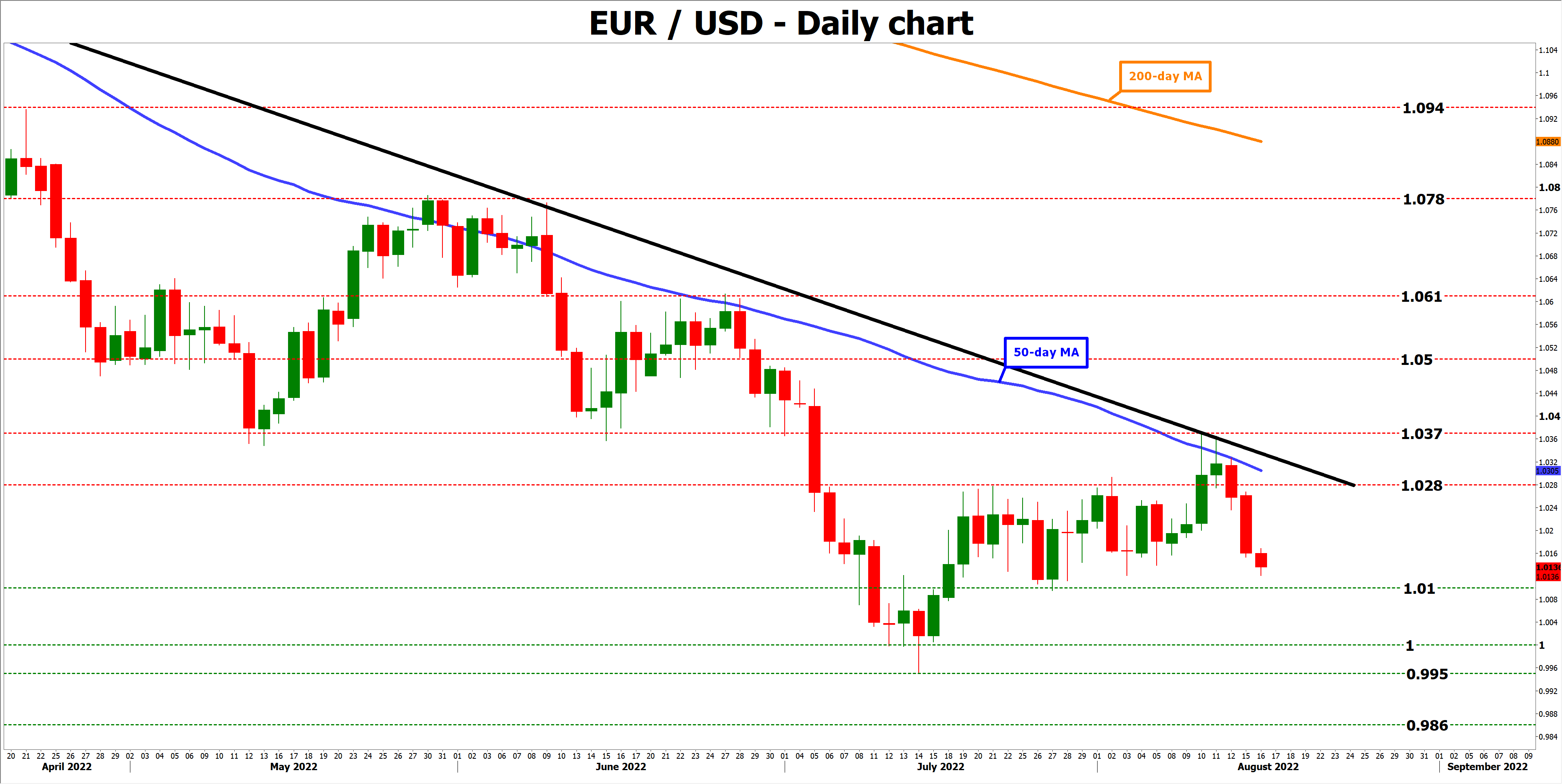
On the flipside, a disappointing batch of data or cautious signal from the minutes could enable a relief rally in the pair, with the first barrier to the upside likely to be the 1.0280 zone. That said, even if euro/dollar trades up to 1.0350, some 200 pips away, it would still be stuck in a clear downtrend.
Bigger picture
Looking beyond this week, it is still difficult to envision any trend reversal in the dollar. For this ‘strong dollar’ dynamic to change, the landscape for the rest of the world needs to improve first.
A nuclear deal with Iran that sinks oil prices would be a good start, but the real game-changer would be a ceasefire in Ukraine. China abandoning its zero-covid strategy could also be pivotal. Until then, ‘king dollar’ is unlikely to lose its crown.
Canadian Inflation Loses a Bit of Steam in July
Consumer price inflation lost a bit of steam in July, but was still high – up 7.6% year-on-year (y/y). It was a step in the right direction though, losing a bit of steam from an 8.1% y/y pace in June.
Lower gasoline prices held down inflation in July, with prices falling 9.2% on the month – the largest such decline since April 2020. Gasoline prices are still 35.6% higher than a year ago.
Energy is not the whole story on inflation. Prices ex-energy were still up 6.6% y/y in July on broad based price pressures. Food inflation in particular heated up last month, with prices up 9.9% y/y, accelerating from 9.4% in June.
Prices for various travel-related services continued to increase as Canadians take long delayed vacations. Airfares rose 25.5% month-over-month (m/m), traveller accommodation prices were up 47.7% y/y in July and restaurant meals were up 7.3% y/y.
In contrast, shelter inflation slowed marginally to 7.0% y/y from 7.1% y/y in June. Overall services inflation is running at 5.7% y/y.
Seasonally adjusted, month-on-month headline CPI rose 0.3% following a 0.6% gain in June – and the smallest monthly gain since December 2021. CPI ex-food and energy was up 0.5% m/m, a relatively hot reading.
The Bank of Canada's core inflation metrics were mixed in July. CPI-trim decelerated by 0.1 percentage points (pps) to 5.4%, however CPI-common accelerated by 0.2 pps to 5.5%, and CPI-median picked up two ticks to 5.0%. Averaging the three measures core inflation was 5.3% y/y, up a tenth from 5.2% y/y in June.
Key Implications
It is encouraging that headline inflation moved in the right direction in July, but underlying measures of inflation actually gained a step in July, and running above a 5% pace suggests the Bank of Canada (BoC) still has some work to do in bringing down inflationary pressures in the economy.
We expect the BoC to continue hiking its policy rate at an aggressive clip at it's next announcement in three weeks. We currently expect a 50 basis point hike, but it appears market odds tipped a bit more towards a larger 75 basis point move, likely focusing on the lack of progress in core inflation measures.
Sunset Market Commentary
Markets:
Core bonds started slipping going into the US session following a rather dull European encounter. There is no clear driver, though earnings by Wall Mart and by Home Depot offered a sigh of relief to investors. Earnings topped (lowered) estimates with retailers showing more resilience than feared. The results at least temporary put aside very grim growth forecasts. Tomorrow’s US retail sales could confirm this narrative. Brent crude also recovered somewhat after yesterday’s beating (Brent back above $95/b). US yields add 5.2 bps to 6.8 bps with the belly of the curve underperforming the wings. The German yield curve bear steepens with yields adding 6 bps (2-yr) to 9.3 bps (30-yr). The German 10-yr yield tests 1% resistance (August high and topside of corrective downward trend channel) Today’s eco calendar contained US housing data (especially housing starts) which continue to point to a pullback in demand (growth fears and high mortgage rates) and a pickup in inventory and German ZEW investor sentiment which more or less stabilized near July levels. In FX space, EUR/USD temporary dipped below 1.0150 but the pair broadly holds near yesterday’s lows. Sterling marginally outperformed (EUR/GBP 0.8422), but UK labour market didn’t really have some to do with it. UK employment rose by 160k in the 3 months ending June, below 268k consensus with the unemployment rate stabilizing at 3.8% over that same period. Average weekly earnings accelerated to 4.7% Y/Y ex. Bonuses. Monthly (July) data showed a 73k net job gains with jobless claims falling by 10.6k. UK job vacancies fell from the first time since August 2020. The UK eco calendar remains interesting with inflation numbers (tomorrow) and retail sales (Friday). News Headlines:
Canadian CPI rose by 7.6% Y/Y in July, down from 8.1% Y/Y in August and in line with consensus. A deceleration in gas prices was the main culprit. Excluding gasoline, prices rose by 6.6% Y/Y, up from 6.5% Y/Y in June. The monthly price dynamic slowed to 0.1% in July with a fall in gasoline prices (-9.2% M/M) being offset by price increases for other non-durable goods and in-person services. Inflation continues to exceed Y/Y wage growth (5.2% in July) though the gap in purchasing power decreased compared to June. The persistent broad-bases inflation pressure suggests that the Bank of Canada will continue its aggressive tightening cycle early September. Governor Macklem and co started frontloading rate hikes in July with a surprise 100 bps move. Canadian money markets are at odds whether the next move will be a 50 bps or 75 bps one. The loonie briefly ticked higher on the inflation release, but couldn’t recover yesterday’s losses. Dollar strength and the crashing oil price yesterday propelled USD/CAD from 1.278 towards 1.29, where it is still trading at the moment. The Canadian swap rate curve becomes more inverse today, with yields adding 8.5 bps (2-yr) to 3.9 bps (30-yr).
The new trading week saw back-to-back dovish comments by Czech National Bank board member Frait (yesterday) and vice governor Zamrazilova (today). According to Frait, the current level of Czech interest rates is creating restrictive monetary conditions. He points to significantly slowing growth in new loans and first signs of cooling down in the housing market. More tightening by global central banks will weaken global demand further with is something he wants to take into account when setting Czech monetary policy. Zamrazilova said that a large part of domestic demand-driven, local, factors won’t be the main inflation driver anymore. She points out that high food and energy prices are curbing household spending on non-essential goods. A wage-price spiral remains a risk though. The Czech koruna trades in the defensive for a second session straight with fighting in Crimea adding to weakness in CEE currencies in general. EUR/CZK rose from 24.44 to 24.54. Back in June, the CNB stepped in the FX market to prevent CZK from weakening beyond EUR/CZK 24.75. The forint is the local underperformer, with EUR/HUF rising from 392 to 405 this week. The zloty outperforms regional peers with EUR/PLN only a tad weaker near 4.70 (from 4.65).
Pound Recovers Losses after Jobs Report
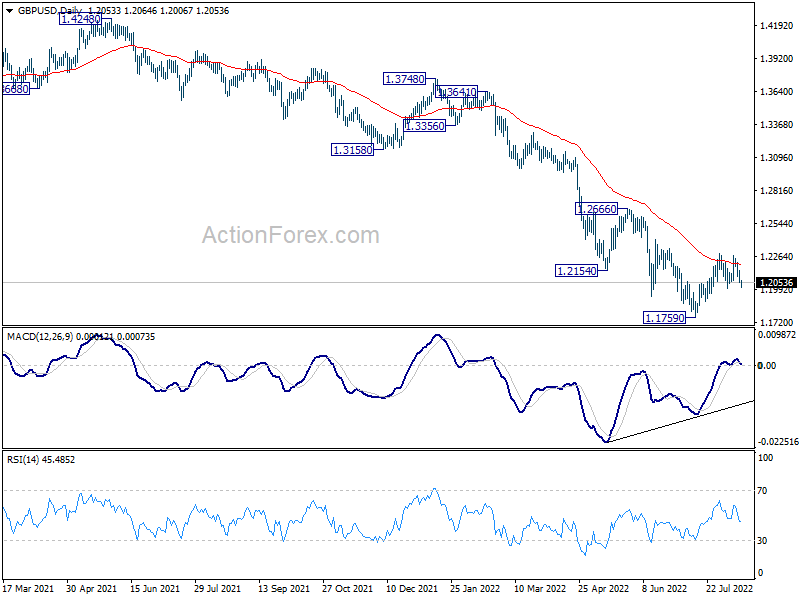
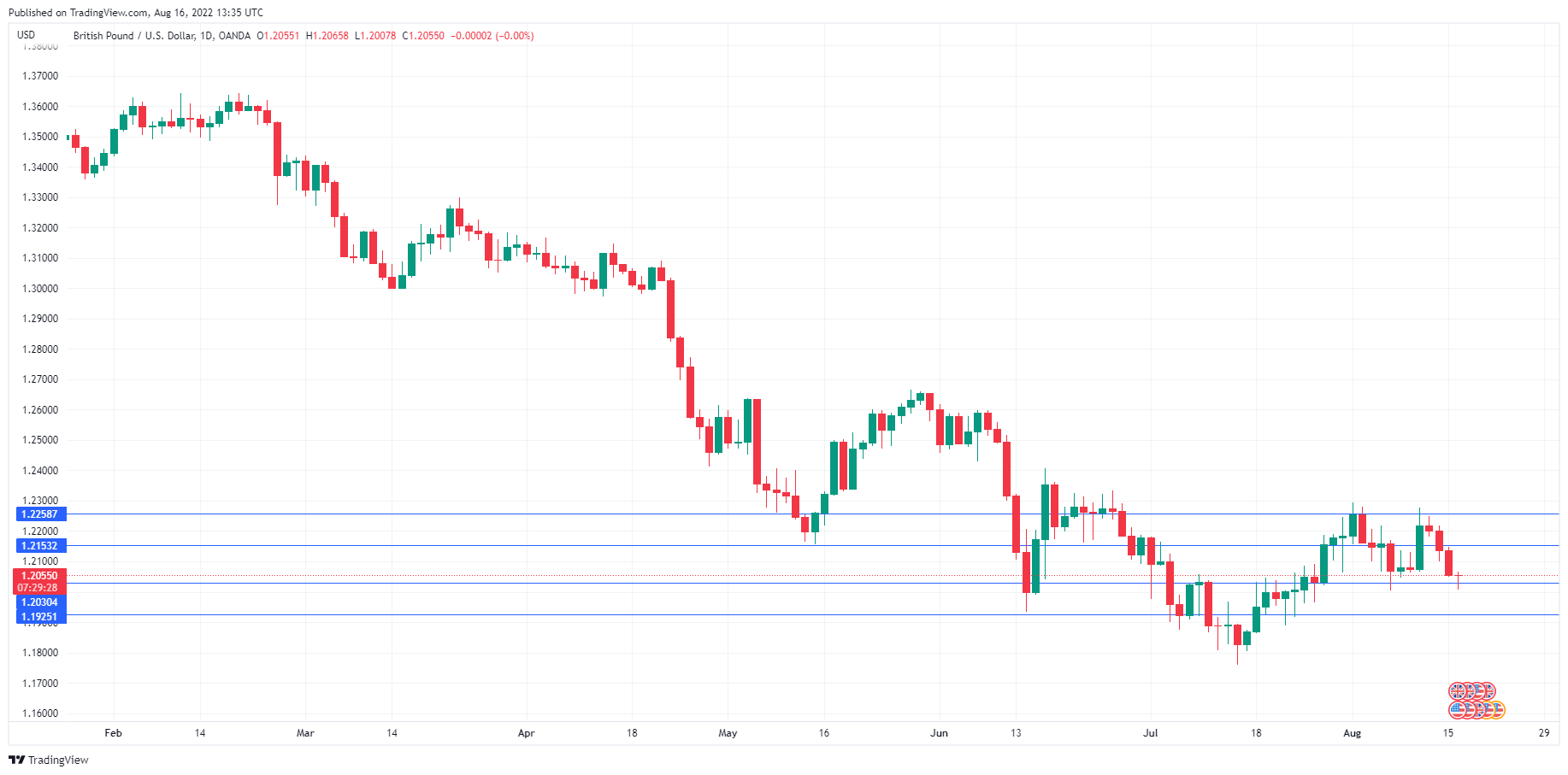
The British pound remains under pressure. In the North American session, GBP/USD is trading at 1.2055, unchanged the day. The pound fell as low as 1.2007 in the Asian session, just above the symbolic 1.20 line.
UK wage growth remains high
The economic outlook in the UK is grim and today’s employment report didn’t bring any cheer. Unemployment claims continue to fall and the labour market remains strong, but wage growth indicates trouble. Wages dropped to 5.1% in June, down from 6.4% in May. However, real wages (adjusted for inflation) actually fell by 3% in Q2 on an annualized basis, a new record. The cost of living is thus increasing at an even faster rate and is far outpacing wage growth.
The headline wage growth reading of 5.1%, which is not adjusted for inflation, may have fallen, but still remains high and will likely force the BoE to continue hiking aggressively. The BoE has forecast that inflation will hit a staggering 13% this year, and the last thing it needs to contend with is a wage-price spiral, which could entrench inflation.
The markets won’t have much time to dwell on the employment numbers, with the inflation report being released on Wednesday. Headline CPI is expected to accelerate to 9.8% in July, up from 9.4% in June. If inflation pushes higher than the estimate, it could be a nasty day for the pound.
The Federal Reserve continues to send out the message that its rate hikes are far from over as the battle against inflation will continue for some time yet. The markets expect the Fed to raise rates to a peak in a range of 3.50% – 3.75%, well above the current benchmark rate of 2.50%. Despite this hawkish stance, the financial markets don’t seem to be listening. US equity markets have been rising, while the US dollar, which should be benefitting from a hawkish Fed, is struggling. The lower-than-expected July inflation report of 8.5% raised risk sentiment and sent the dollar tumbling. If inflation resumes its upward trend in August, risk appetite could evaporate and the dollar might have the last laugh.
GBP/USD Technical
- GBP/USD is testing support at 1.2030. Below, there is support at 1.1925
- There is resistance at 1.2153 and 1.2258
EUR/JPY Mid-Day Outlook
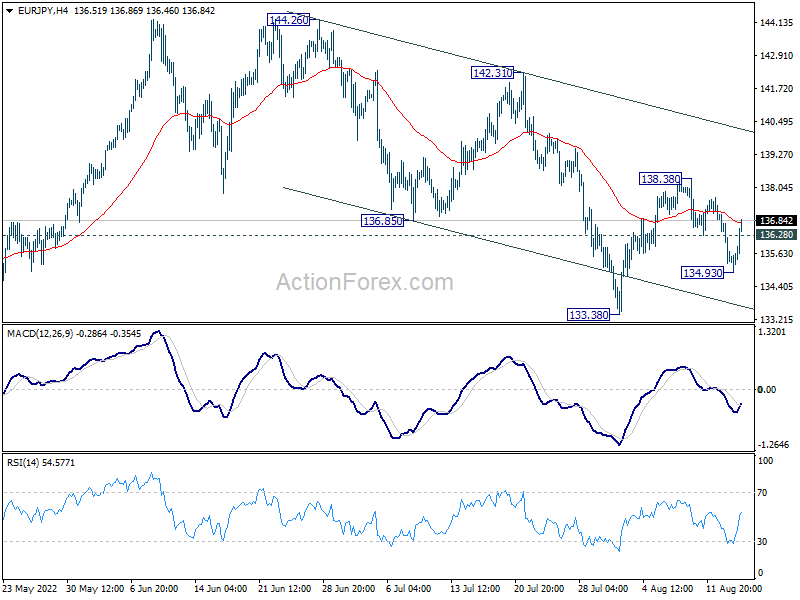
Daily Pivots: (S1) 134.78; (P) 135.92; (R1) 136.57; More....
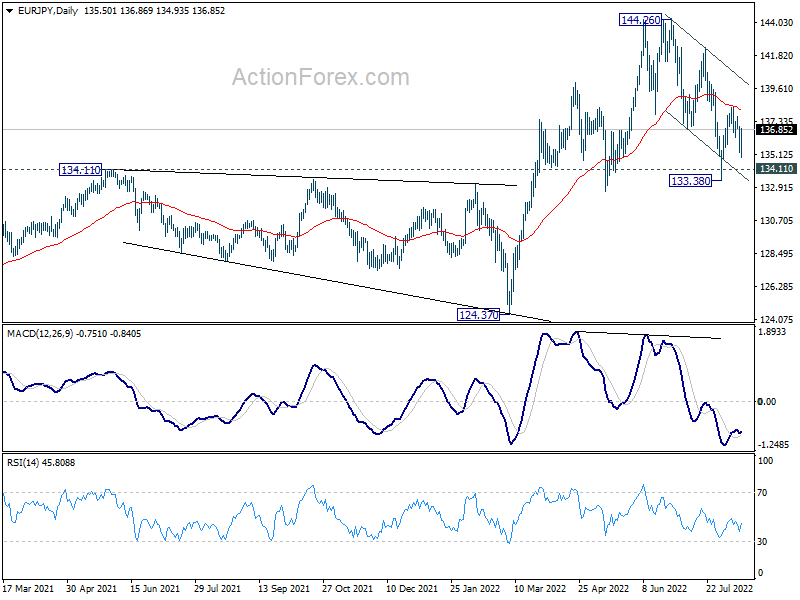
Intraday bias in EUR/JPY is turned neutral with current recovery. Overall, it's staying in the corrective pattern from 144.26. On the upside, above 138.38 will resume the rebound from 138.38. On the downside, below 134.93 will turn bias back to the downside for 133.38 support.
In the bigger picture, up trend from 114.42 (2020 low) is seen as the third leg of the pattern from 109.30 (2016 low). Further rally is in favor as long as 134.11 resistance turned support holds, even in case of deep pull back. Next target is 149.76 (2015 high). However, sustained break of 134.11 will be a sign of medium term bearish reversal and turn focus to 124.37 support for confirmation.
GBP/JPY Mid-Day Outlook
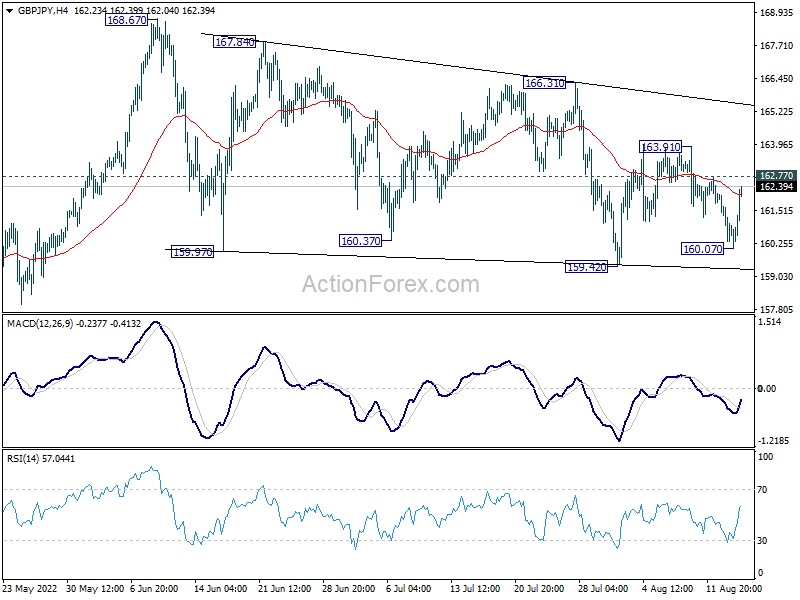
Daily Pivots: (S1) 160.00; (P) 161.05; (R1) 161.73; More...
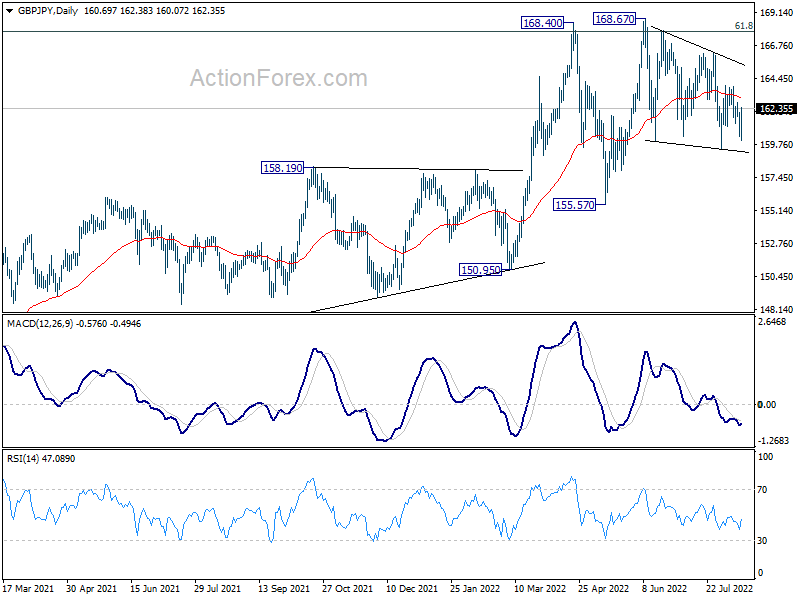
Intraday bias in GBP/JPY is turned neutral with current recovery. Overall, corrective pattern from 168.67 is still extending. On the upside, above 162.77 minor resistance will turn bias back to the upside for 163.91 resistance. Break there will target 166.31. On the downside, below 160.07 will turn bias to the downside for 159.42 and below.
In the bigger picture, up trend from 123.94 (2020 low) is still in progress. Sustained break of 61.8% retracement of 195.86 (2015 high) to 122.75 (2016 low) at 167.93 will be a long term bullish signal, and could pave the way back to 195.86 high. This will remain the favored case as long as 155.57 support holds, even in case of deep pull back.
EUR/USD Mid-Day Outlook
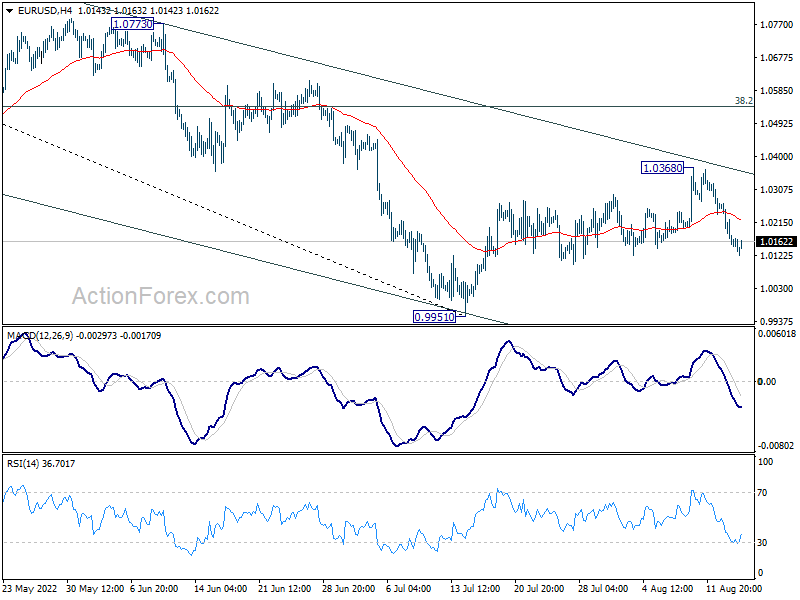
Daily Pivots: (S1) 1.0120; (P) 1.0194; (R1) 1.0233; More...
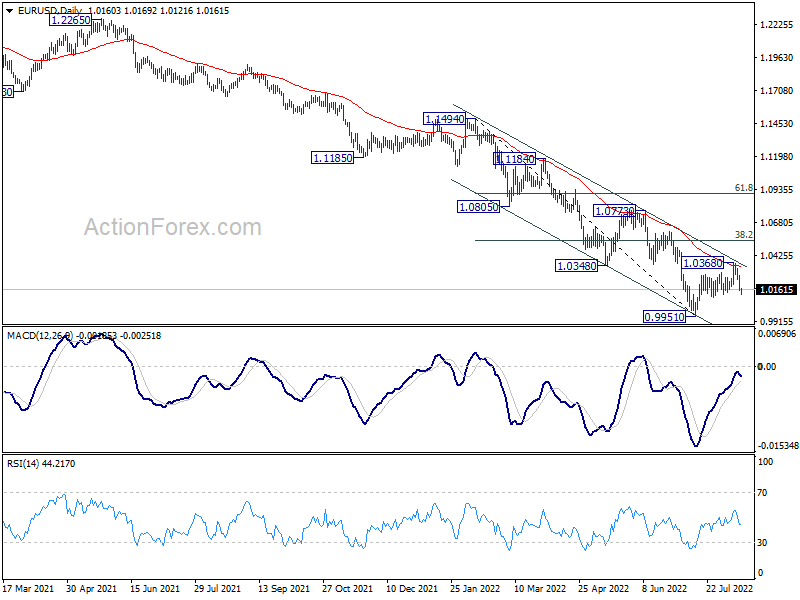
Intraday bias in EUR/USD remain son the downside at this point. Rebound from 0.9951 should have completed at 1.0368 after rejection by 55 day EMA, as well as falling channel resistance. Deeper fall would be seen to retest 0.9951 low. Firm break there will resume larger down trend. For now, risk will stay on the downside as long as 1.0368 resistance holds, in case of recovery.
In the bigger picture, down trend from 1.6039 (2008 high) is still in progress. Next target is 100% projection of 1.3993 to 1.0339 from 1.2348 at 0.8694. In any case, outlook will stay bearish as long as 1.0773 resistance holds, in case of strong rebound.
GBP/USD Mid-Day Outlook
Daily Pivots: (S1) 1.2020; (P) 1.2084; (R1) 1.2118; More...
Range trading continues in GBP/USD and intraday bias remains neutral. On the downside, break of 1.2002 minor support will argue that rebound from 1.1759 has completed, after rejection by 55 day EMA. Intraday bias will be back on the downside for retesting 1.1759 low first. Break there will resume larger down trend. On the upside, above 1.2922 will resume the rebound from 1.1759 towards 1.2666 resistance.
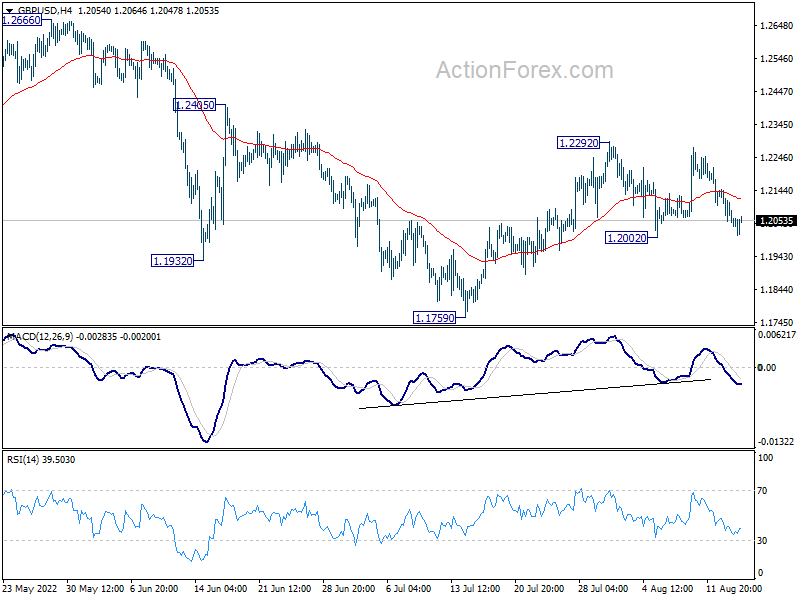
In the bigger picture, fall from 1.4248 (2018 high) could be a leg inside the pattern from 1.1409 (2020 low), or resuming the longer term down trend. Deeper decline is expected as long as 1.2666 resistance holds. Next target is 1.1409 low. However, firm break of 1.2666 will bring stronger rise back to 55 week EMA (now at 1.2897).