Sample Category Title
USD/CHF Mid-Day Outlook
Daily Pivots: (S1) 0.9425; (P) 0.9448; (R1) 0.9486; More...
Intraday bias in USD/CHF stays neutral at this point. Recovery from 0.9369 should be limited well below 0.9648 resistance to bring another fall. On the downside, break of 0.9369 will resume larger decline from 1.0063 towards 0.9149 support next.
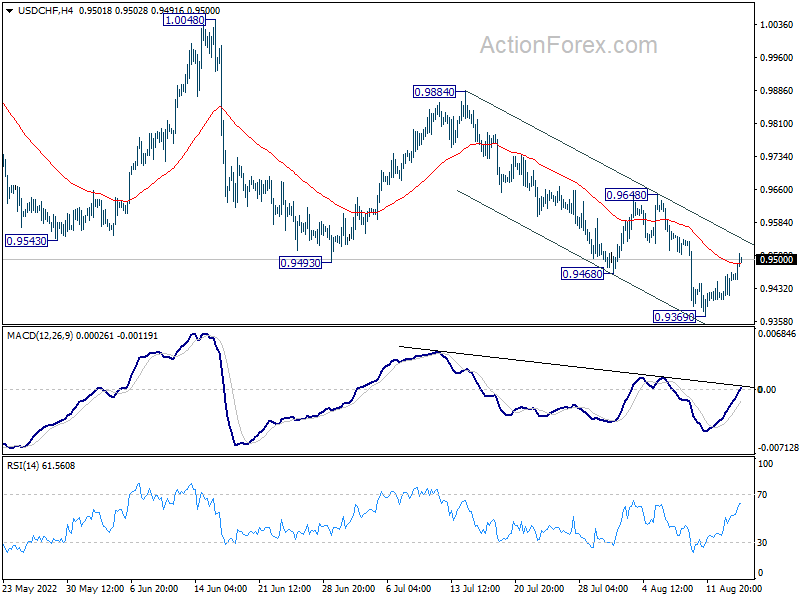
In the bigger picture, break of 0.9471 support turned resistance argues that medium term up trend from 0.8756 has completed with three waves up to 1.0063. Long term sideway pattern might have started another falling leg. Deeper decline would now be in favor as long as 0.9648 resistance holds, to 0.9149 structural support. Sustained break there could pave the way back to 0.8756.
USD/JPY Mid-Day Outlook
Daily Pivots: (S1) 132.71; (P) 133.16; (R1) 133.75; More...
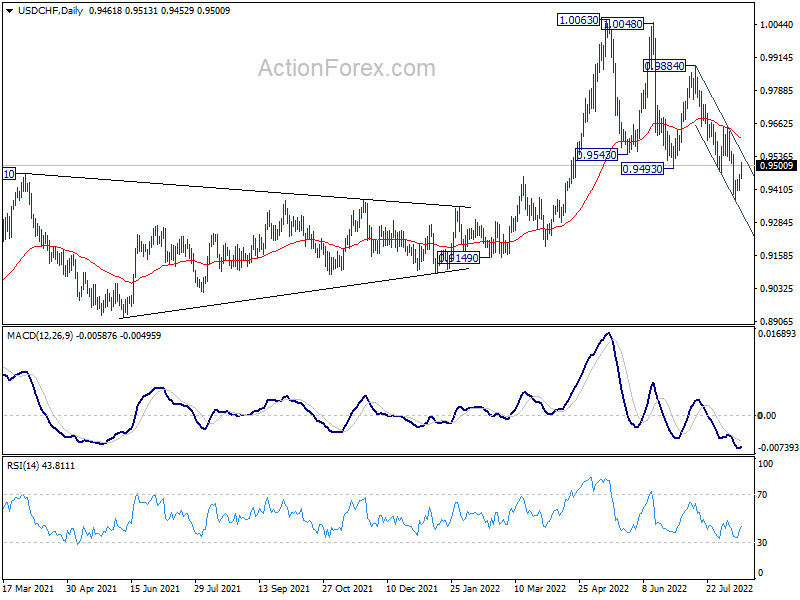
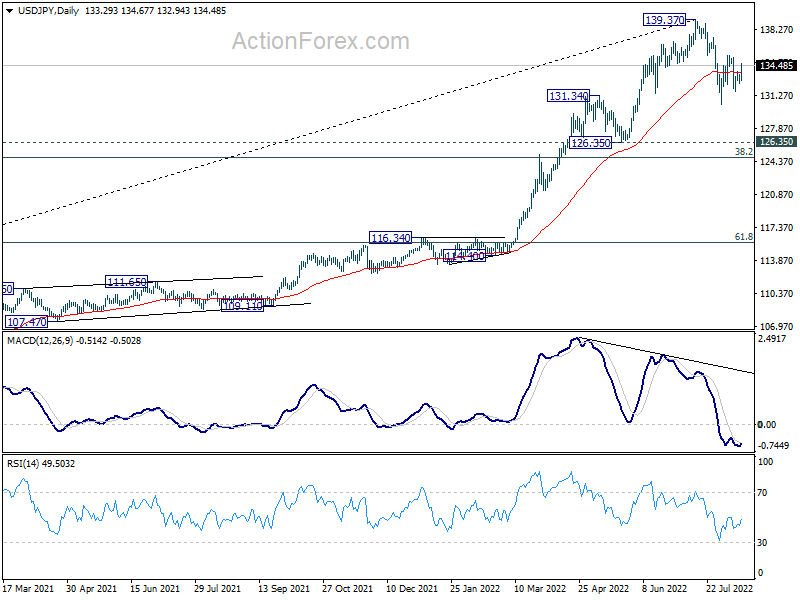
Intraday bias in USD/JPY remains neutral at this point. Overall, corrective pattern from 139.37 will extend further. On the upside, above 135.57 will resume the rebound to retest 139.37 high. On the downside, below 131.72 will resume the fall from 139.37 through 130.38 support.
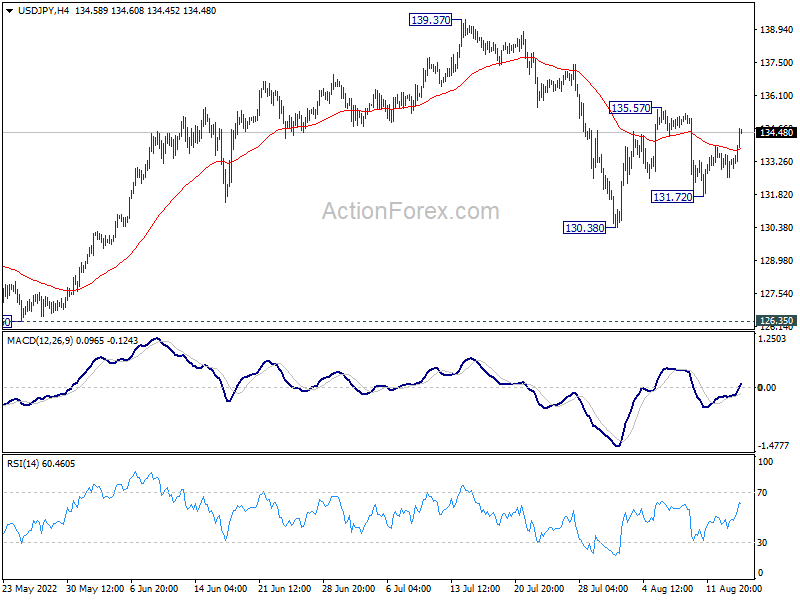
In the bigger picture, fall from 139.37 medium term top is seen as correcting whole up trend from 101.18 (2020 low). While deeper decline cannot be ruled out, outlook will stays bullish as long as 55 week EMA (now at 122.70) holds. Long term up trend is expected to resume through 139.37 at a later stage, after the correction finishes.
Dollar Remains Firm, But Yen Reversing
While Dollar remains generally firm, Yen is reversing much of this week's gain. The moves come as European benchmark yields are trading generally higher. Major European stock indexes are also in slight positive position. Canadian Dollar is rebounding, responding more to rising core inflation reading. European majors and other commodity currencies are mixed for now.
Technically, one focus is on whether USD/JPY would break through 135.57 minor resistance to resume the rebound from 130.38. If happens, such move could be accompanied by break of 138.38 minor resistance in EUR/JPY and 163.91 minor resistance in GBP/JPY. Such development might come in tandem with stronger rally in US stocks and benchmark yields.
In Europe, at the time of writing, FTSE is up 0.56%. DAX is up 0.15%. CAC is up 0.06%. Germany 10-year yield is up 0.060 at 0.960. Earlier in Asia, Nikkei dropped -0.01%. Hong Kong HSI dropped -1.05%. China Shanghai SSE rose 0.05%. Singapore Strait Times dropped -0.09%. Japan 10-year JGB yield dropped -0.0168 to 0.170.
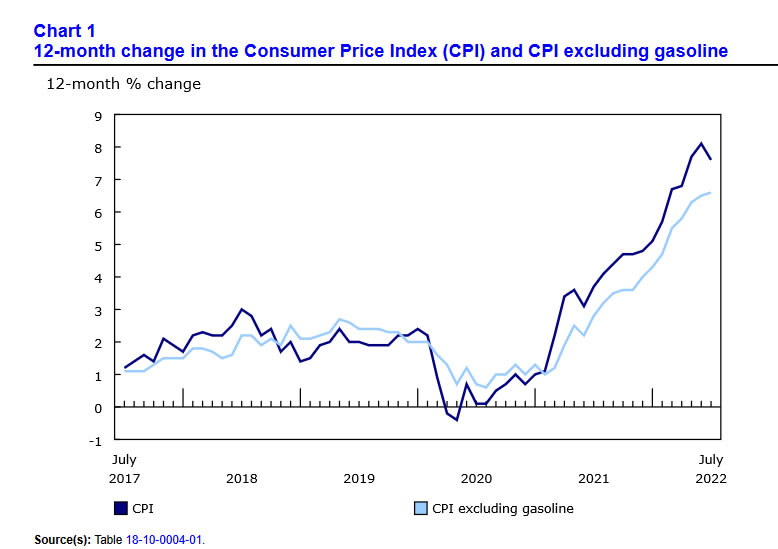
Canada CPI slowed to 7.6% yoy in Jul, as gasoline prices fell
Canada CPI slowed from 8.1% yoy to 7.6% yoy in July, matched expectations. Excluding gasoline, prices accelerated from 6.5% yoy to 6.6% yoy. Gasoline prices slowed sharply from 54.6% yoy to 35.6% yoy.
For the month, CPI rose 0.1% mom, lowest since December. Gasoline prices dropped -9.2% mom, largest monthly decline since April 2020.
CPI common rose from 4.6% yoy to 5.5% yoy, above expectation of 4.7% yoy. CPI median rose from 4.9% yoy to 5.0% yoy, above expectation of 4.9% yoy. CPI trimmed slowed from 5.5% yoy to 5.4% yoy, matched expectations.
Germany ZEW dropped to -55.3, further decline in already weak economic growth
Germany ZEW Economic Sentiment dropped slightly from -53.8 to -55.3 in August, below expectation of -52.7. Current Situation index dropped from -45.8 to -47.6, above expectation of -48.0.
Eurozone ZEW Economic Sentiment dropped from -51.1 to -54.9, below expectation of -52.0. Current Situation Index rose 2.5 pts to -42.0. Eurozone inflation expectations rose 2.1 pts to -23.5, indicating a reduction of the high inflation rates within the next six months.
"The ZEW Economic Expectations decrease again slightly in August after a sharp drop in the previous month. The financial market experts therefore expect a further decline in the already weak economic growth in Germany. The still high inflation rates and the expected additional costs for heating and energy lead to a decrease in profit expectations for the private consumption sector. In contrast, the expectations for the financial sector are improving due to the supposed further increase in short-term interest rates", comments Michael Schröder, researcher at ZEW and head of the ZEW financial market survey, on current results.
Eurozone exports rose 20.1% yoy in Jun, imports rose 43.5% yoy
Eurozone exports of goods to the rest of the world rose 20.1% yoy to EUR 252.2B in June. Imports rose 43.5% yoy to EUR 276.8B. Trade balance came in at EUR -24.6B deficit. Intra-eurozone trade rose 24.2% yoy to EUR 236.4B.
In seasonally adjusted term, exports dropped -0.1% mom to EUR 241.8B. Imports rose 1.3% mom to EUR 272.7B. Trade deficit widened from EUR -27.2B to EUR -30.8B, versus expectation of EUR -20.0B. Intra-eurozone trade was unchanged at EUR 224.1B.
UK payrolled employment rose 73k in Jul, unemployment rate unchanged at 3.8% in Jun
UK payrolled employment increased by 73k, or 0.2% mom, in July. Comparing with the same month a year ago, payrolled employees rose 29.7m, or 2.9% yoy. Claimant count dropped -10.5k, smaller than expectation of -32.9k. Median monthly pay rose 6.6% yoy to GBP 2108.
In the three months to June, unemployment rate was unchanged at 3.8%, matched expectations. Average earnings excluding bonus rose 4.7% 3moy, above expectation of 4.4%. Average earnings including bonus rose 5.1% 3moy, below expectation of 5.2%.
RBA Minutes: Further monetary policy normalization expected
In the minutes of the August 2 meeting, RBA expects to "take further steps in the process of normalizing monetary conditions over the months ahead". However, it is "not on a pre-set path." The path is a "narrow one" and "subject to considerable uncertainty". The size of timing of future rate hikes will be guided by incoming data and the assessment of the outlook for inflation and labor market, including the risks.
RBA said that inflation is expected to "peak later in 2022", then decline to top of 2-3% target range by the end of 2024. The expected moderation reflected "the ongoing resolution of global supply-side problems, the stabilization of commodity prices and the impact of rising interest rates in Australia and overseas". Medium-term inflation expectation remained "well anchored".
The Australian economy was "growing strongly" with resilient consumer spending and positive investment outlook. National income was boosted by rise in terms of trade to record high". Outlook is expected to "remain strong" for the rest of 2022, then slow in 2023 and 2024. Employment was "growing strongly" and further declines in unemployment rate were expected over the months ahead.
USD/JPY Mid-Day Outlook
Daily Pivots: (S1) 132.71; (P) 133.16; (R1) 133.75; More...
Intraday bias in USD/JPY remains neutral at this point. Overall, corrective pattern from 139.37 will extend further. On the upside, above 135.57 will resume the rebound to retest 139.37 high. On the downside, below 131.72 will resume the fall from 139.37 through 130.38 support.
In the bigger picture, fall from 139.37 medium term top is seen as correcting whole up trend from 101.18 (2020 low). While deeper decline cannot be ruled out, outlook will stays bullish as long as 55 week EMA (now at 122.70) holds. Long term up trend is expected to resume through 139.37 at a later stage, after the correction finishes.
Economic Indicators Update
| GMT | Ccy | Events | Actual | Forecast | Previous | Revised |
|---|---|---|---|---|---|---|
| 01:30 | AUD | RBA Meeting Minutes | ||||
| 04:30 | JPY | Tertiary Industry Index M/M Jun | -0.20% | 0.50% | 0.80% | 1.10% |
| 06:00 | GBP | Claimant Count Change Jul | -10.5K | -32.0K | -20.0K | -26.8K |
| 06:00 | GBP | ILO Unemployment Rate (3M) Jun | 3.80% | 3.80% | 3.80% | |
| 06:00 | GBP | Average Earnings Excluding Bonus 3M/Y Jun | 4.70% | 4.40% | 4.30% | |
| 06:00 | GBP | Average Earnings Including Bonus 3M/Y Jun | 5.10% | 5.20% | 6.20% | |
| 09:00 | EUR | Eurozone Trade Balance (EUR) Jun | -30.8B | -20.0B | -26.0B | -27.2B |
| 09:00 | EUR | Germany ZEW Economic Sentiment Aug | -55.3 | -52.7 | -53.8 | |
| 09:00 | EUR | Germany ZEW Current Situation Aug | -47.6 | -48 | -45.8 | |
| 09:00 | EUR | Eurozone ZEW Economic Sentiment Aug | -54.9 | -52 | -51.1 | |
| 12:15 | CAD | Housing Starts Jul | 275K | 265K | 274K | 272K |
| 12:30 | CAD | CPI M/M Jul | 0.10% | 0.10% | 0.70% | |
| 12:30 | CAD | CPI Y/Y Jul | 7.60% | 7.60% | 8.10% | |
| 12:30 | CAD | CPI Common Y/Y Jul | 5.50% | 4.70% | 4.60% | |
| 12:30 | CAD | CPI Median Y/Y Jul | 5.00% | 4.90% | 4.90% | |
| 12:30 | CAD | CPI Trimmed Y/Y Jul | 5.40% | 5.40% | 5.50% | |
| 12:30 | USD | Building Permits Jul | 1.67M | 1.65M | 1.70M | |
| 12:30 | USD | Housing Starts Jul | 1.45M | 1.35M | 1.56M | |
| 13:15 | USD | Industrial Production M/M Jul | 0.20% | -0.20% | ||
| 13:15 | USD | Capacity Utilization Jul | 80.10% | 80.00% |
Canada CPI slowed to 7.6% yoy in Jul, as gasoline prices fell
Canada CPI slowed from 8.1% yoy to 7.6% yoy in July, matched expectations. Excluding gasoline, prices accelerated from 6.5% yoy to 6.6% yoy. Gasoline prices slowed sharply from 54.6% yoy to 35.6% yoy.
For the month, CPI rose 0.1% mom, lowest since December. Gasoline prices dropped -9.2% mom, largest monthly decline since April 2020.
CPI common rose from 4.6% yoy to 5.5% yoy, above expectation of 4.7% yoy. CPI median rose from 4.9% yoy to 5.0% yoy, above expectation of 4.9% yoy. CPI trimmed slowed from 5.5% yoy to 5.4% yoy, matched expectations.
The Last Stage of the Gas Bubble
Oil experienced intense pressure on Monday, but the price of natural gas continued its upward trend. This contrast is due to an under-supply of Russian gas to the European market and more speculation around Iranian oil, which could quickly add more than 1m BPD. That said, macroeconomics is now on the side of the energy bears, with only geopolitics temporarily feeding the bulls.
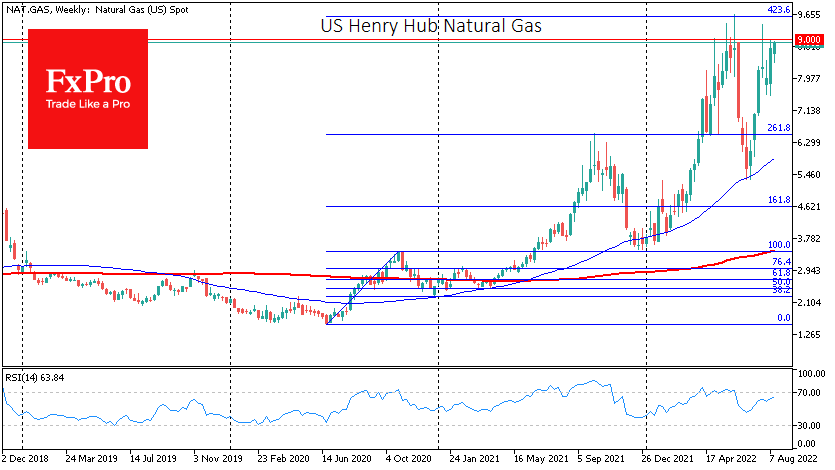
Gas prices in New York are approaching $9 per million British thermal units (1M BTU). This is the area of the May-June highs. A steadily higher price was last seen in 2008. But these high prices have little to do with what Europe now faces.
Gas prices in Europe have surpassed $2,500 per 1,000 cubic metres, the highest since March 8. Europe and America are different markets, and it is not correct to compare prices directly. For example, converted to US standards, current prices at the Dutch hub are close to $70 per 1M BTU. That is 7.8 times higher than in New York. By comparison, in mid-2018, when there was a lull in this market, the difference was 2.6 times.
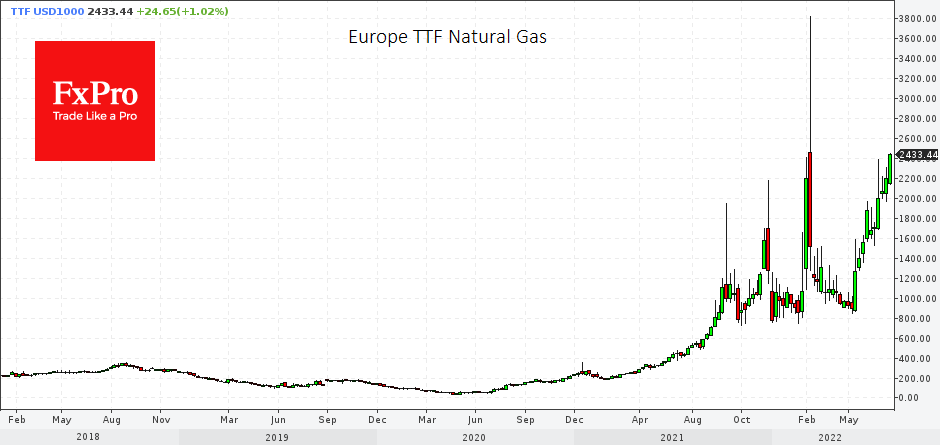
It is logical to expect that the price difference between Europe and the USA will narrow on both sides, which implies an increase in the USA and a decrease in Europe. But it is worth looking at the first and easiest substitute for gas – crude oil.
Europe is working hard to increase the world’s oil supply, with efforts to conclude the Iran nuclear deal. Yesterday’s news on the subject sent Brent nearly 5% down to $92.2 and WTI to $86.30, its lowest level since the end of February, reflecting a market surplus.
The downtrend in oil prices, which has lasted for more than two months, suggests that right now, we may be witnessing nothing more than a speculative attack on gas, inflating a bubble in its final stages. Experience suggests that in such cases, we see a sharp acceleration before the bubble bursts with a bang. With the Gas case, we should be prepared for prices in Europe to surpass $3000 and in the US to break through $10 before the final downward reversal.
The UK Job Market Did Not Help Pound
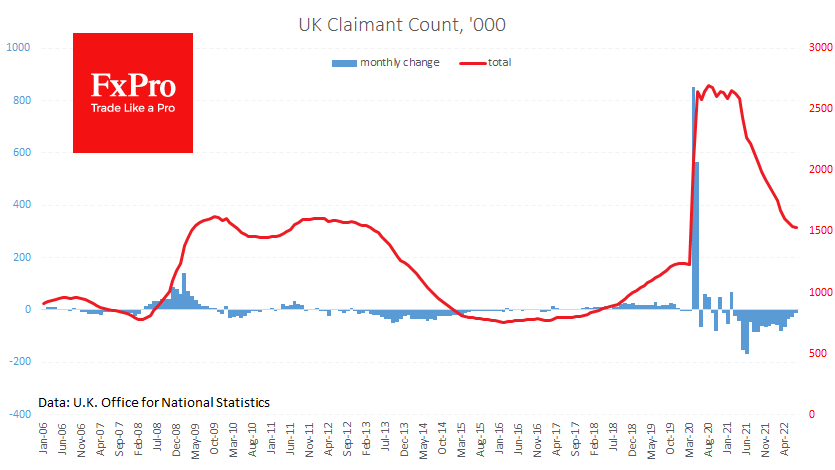
The UK employment statistics package failed to inspire the currency market to buy the Pound. The released data showed a slowdown in the labour market, which is still far from recovering to pre-coronavirus levels.
Analysts were tuning in for acceleration, as in the US, but didn’t get it. The number of jobless claims in July decreased by 10.5 thousand against 26.8 thousand a month earlier and the expected 32 thousand. The number of people receiving benefits amounted to 1.53 million, 0.3 million more than before the first lockdowns. That said, the pace of recovery has slowed sharply in recent months.
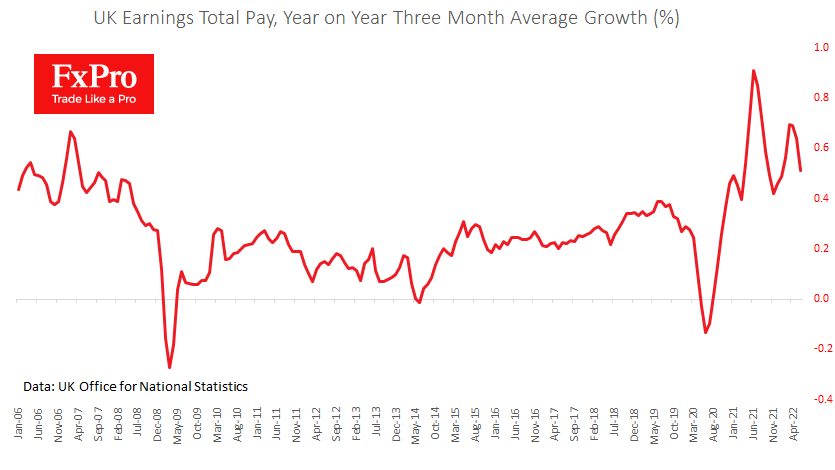
The negative backdrop has been somewhat diluted by a slightly less dramatic than expected slowdown in wage growth. The increase, including bonuses, has slowed from 6.4% to 5.1% over the past three months to the same period a year earlier. Even beating analysts’ expectations, wage growth has not kept pace with inflation, which is not good news for the Pound.
The waning economic growth will deter the Bank of England from taking more decisive steps in tightening monetary policy, widening the gap between interest rates in pounds and dollars, and attracting more capital to the latter.
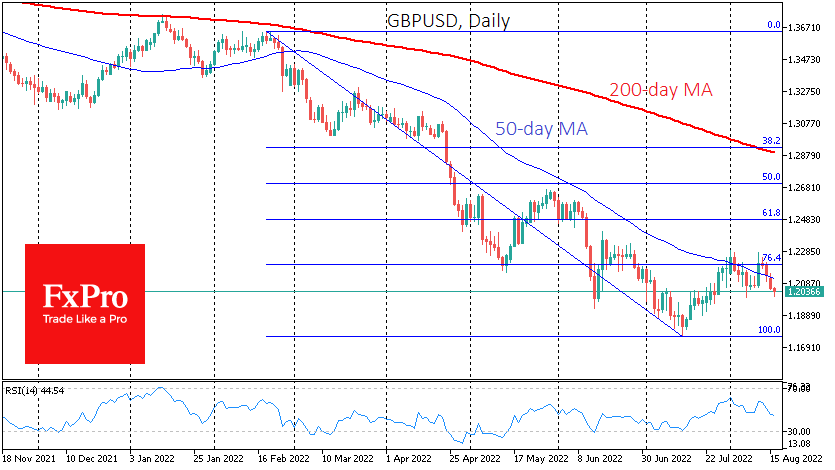
The statistics package did not help the British currency, which is losing ground against the dollar for the fourth consecutive trading session. GBPUSD has now rolled back to 1.2015 after a second failed attempt to develop gains above 1.2250. The Pound has again been under increased pressure after the corrective rebound in the second half of July. We should be prepared for bears rather than rested bulls now returning to the trading desks from their summer holidays. In this case, the second half of August could manifest and intensify negative market trends, returning GBPUSD to another test of the July lows at 1.1750.
Will Canada’s CPIs Impact BoC Rate Expectations?
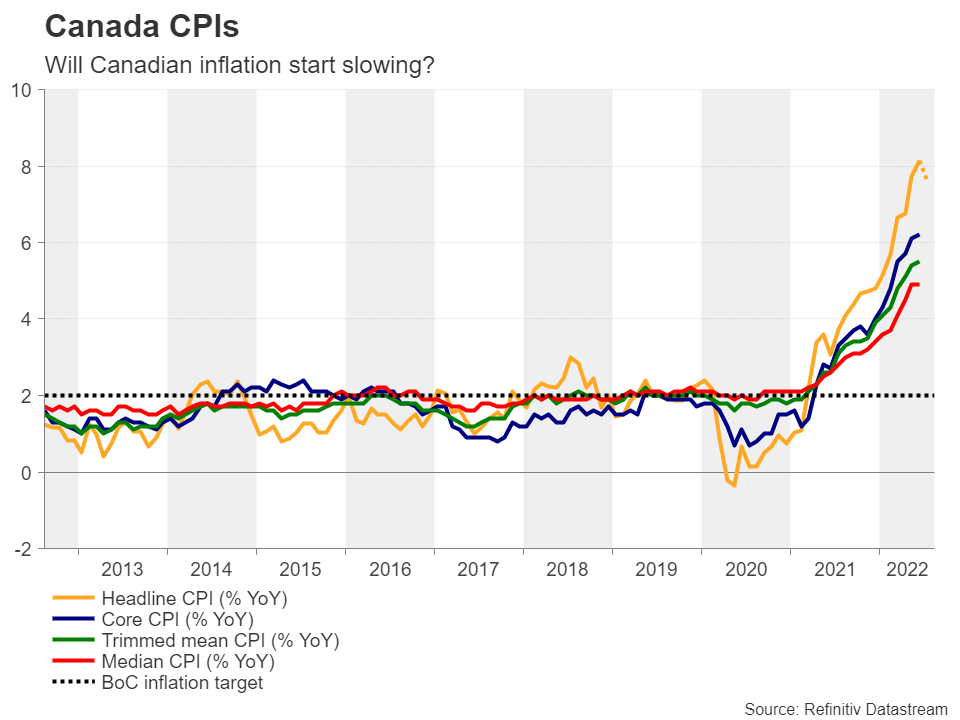
The Bank of Canada is the only G7 central bank to deliver a whole percentage-point rate increase in this post-pandemic hike race, and it did so just at its latest gathering, in July. However, the aftermath revealed another month of job losses for Canada, and with that in mind, market participants may keep a close eye on the CPIs today, due out at 12:30 GMT, as they try to figure out how the Bank is likely to move forward with this tightening cycle.
Language and projections accompanying the BoC’s July hike
When it last met, the BoC decided to raise its main interest rate by 100bps to 2.50%, its biggest increase since 1998, signaling that more rate hikes were on the way. The Bank forecast inflation to remain at around 8% YoY during the end of this quarter, and to finish the year at 7.5% YoY, while seeing a strong slowdown to 3.2% in Q4 2023, and eventually touching its target in 2024. It also cut its economic growth forecasts, dragging the YoY rates of this year and the next down to 2.6% and 1.8%, from 3.8% and 2.9% respectively.
Having said that though, officials noted that the slower growth is “largely due to the impact of high inflation and tighter financial conditions on consumption and household spending,” which justifies their view with regards to taking rates higher to tame extremely high inflation.
What does market pricing suggest for the next gathering?
Since then, data showed that inflation continued to accelerate in June, to 8.1% YoY from 7.7%, but also that the economy lost jobs for the second consecutive month in July, despite the unemployment rate staying at a record low of 4.9%.
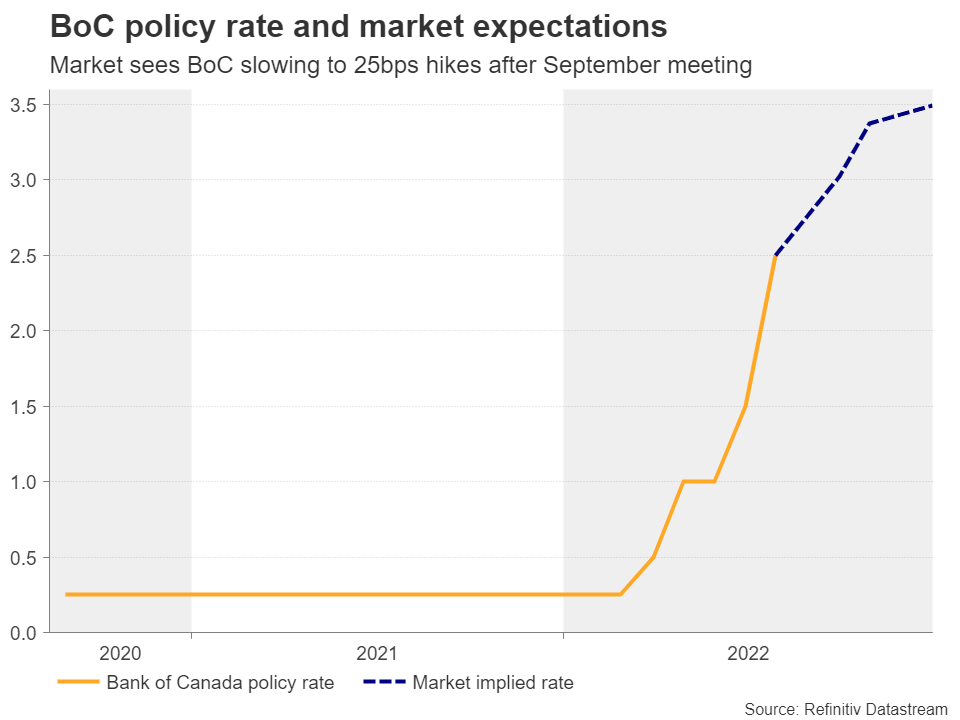
Although the former may have encouraged some to bet on another bold move at the September gathering, perhaps a 75bps rate increase, the labor-market data gave them second thoughts. Indeed, market participants are now assigning only a 10% chance for a 75bps hike, while the remaining 90% is for 50bps. As for the rest of the year, the implied rate points to 50bps higher, which means a quarter-point increase at each of the October and December meetings.
Inflation to slow, but how much can it impact the loonie?
As for today’s data, the forecast for the headline rate points to a slowdown to 7.6% YoY from 8.1%, something that could add credence to the view for slower hikes moving forward. There is no consensus neither for the core rate nor for the trimmed-mean and median ones. That said, with the market already expecting the BoC to shift back to a half-point hike, and even smaller increases thereafter, the Canadian dollar may not feel much heat.
For the loonie to come under selling interest, the inflation rate may need to miss its own forecast, which could raise speculation over a quicker slowdown in consumer prices, and thereby smaller rate increases by the BoC at the upcoming meetings. It may even prompt some participants to shift their bets for the upcoming gathering to a 25bps increase. A miss in today’s data could result in an extension of yesterday’s rally in dollar/loonie, and perhaps a break above the 1.2985 barrier, marked by the high of August 5. Such a break could carry larger bullish implications, perhaps sending the pair to the peak of July 14, at 1.3225.
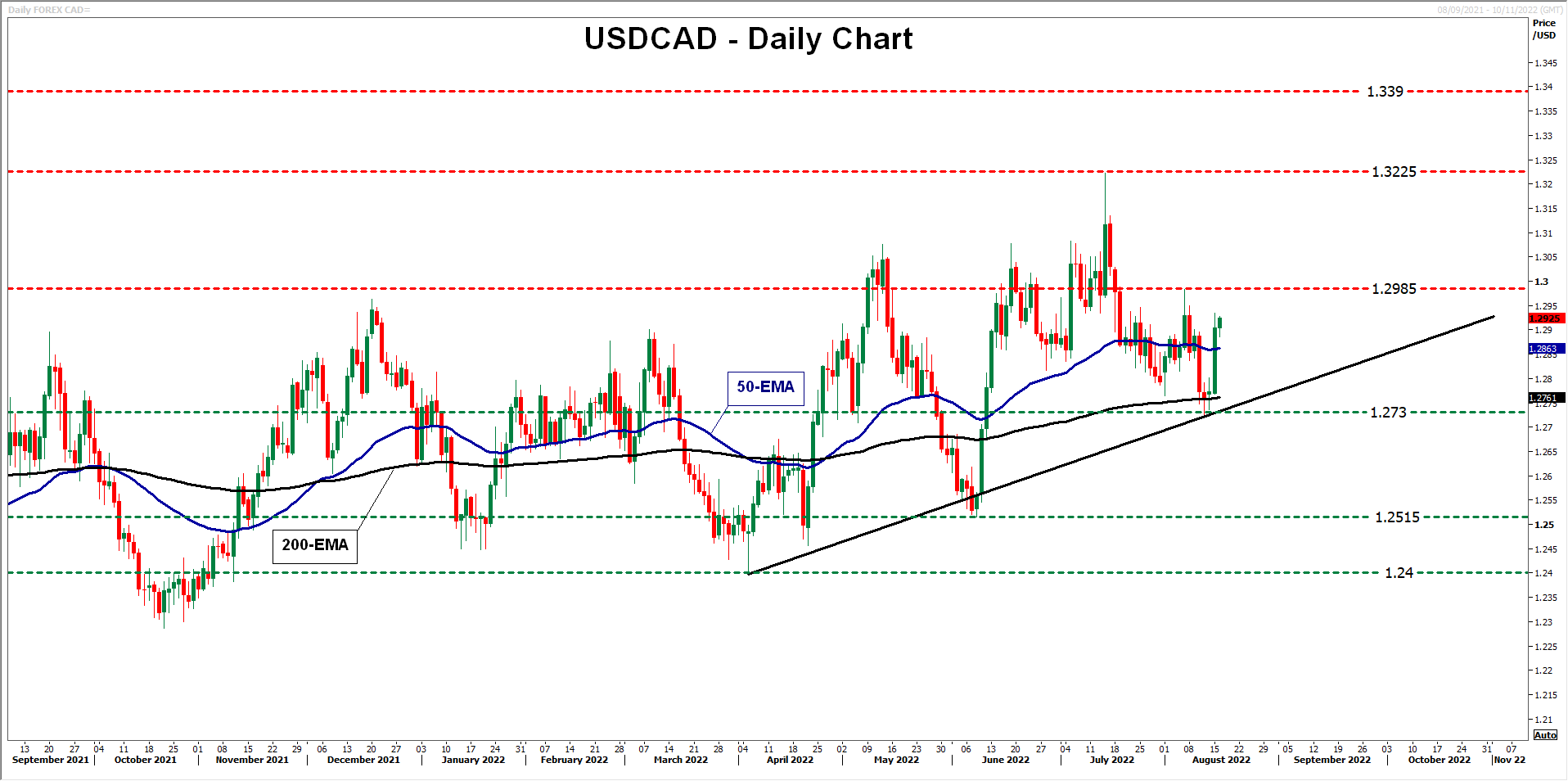
Alternatively, for loonie traders to get excited and start adding long positions, inflation may need to come in higher than the consensus. This could solidify the notion for a double hike at the BoC’s upcoming gathering, and if we do get further acceleration, bets over a triple hike may increase. Dollar/loonie may slide to the upside support line drawn from the April 5 low, or near the 1.2730 zone, marked as a support by the low of August 11. That said, the move signaling that the bears have taken full control may be a dip below that key territory. Such a break may unlock and open the door for declines towards the low of June 8, at 1.2515.
USD/JPY: Dollar Edges Higher But Still Holding Within a Triangle
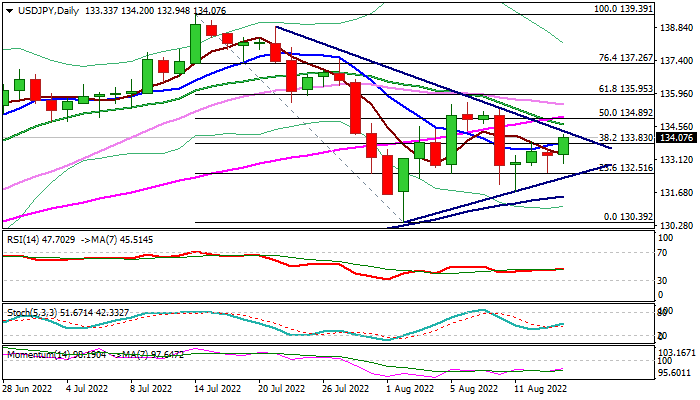
The USDJPY regained traction on Tuesday and resumed the upleg from Aug 11 trough (131.73).
Fresh bullish acceleration broke through important Fibo barrier at 133.83 (38.2% of 139.39/130.39) and pressuring the triangle resistance trendline (134.37).
Break of these obstacles would improve near-term structure and open way for further advance, though daily studies are mixed and the action is likely to lack clearer direction while holding within the triangle, with stronger signals expected on break of boundaries of rising thick daily cloud (132.05/135.17).
Res: 134.37; 134.61; 134.89; 135.17.
Sup: 133.83; 132.94; 132.36; 132.05.
GBP/USD: Cable Stands at the Back Foot ahead of Key UK Inflation Data
Bears extend into fourth consecutive day and probe through important support at 1.2026 (50% of 1.1760/1.2293 upleg / daily Kijun-sen), pressuring psychological 1.20 support.
Technical structure on daily chart is negative (MA’s in bearish setup / 14-d momentum extending lower in negative territory), supporting scenario of break below pivotal 1.20 zone that would complete a double-top pattern on daily chart (1.2293/76) and signal an end corrective phase from 1.1760 (July 14 low, the lowest since March 2020).
Bears are expected to remain in play as long as the action stays below pivotal 1.21 resistance zone (broken Fibo 38.2%/20DMA).
Data released today show that UK labor market shows more signs of cooling, while investors shift focus to UK inflation data, due to be released tomorrow.
According to forecasts, July consumer prices are expected to hit new multi-decade high at 9.8% that raises probability for a second consecutive 0.5% rate hike by BOE, in attempts to battle soaring inflation, which the central bank expects to exceed 13% in October.
Despite expectations that higher interest rates would inflate pound, the currency may fail to benefit as higher borrowing cost is likely to hurt economic growth.
Res: 1.2060; 1.2089; 1.2106; 1.2148.
Sup: 1.2026; 1.2000; 1.1963; 1.1916.

EUR/USD: Euro Remains Under Pressure on Global Growth Worries
The Euro remains under increased pressure for the third straight day, driven by risk aversion on renewed worries about slower global growth.
Downbeat China’s industrial production and retail sales data, PBOC rate cut and unexpected strong fall in the US Empire State manufacturing index (the index hit the lowest since May 2020) boosted uncertainty and prompted investors into safety that lifted dollar.
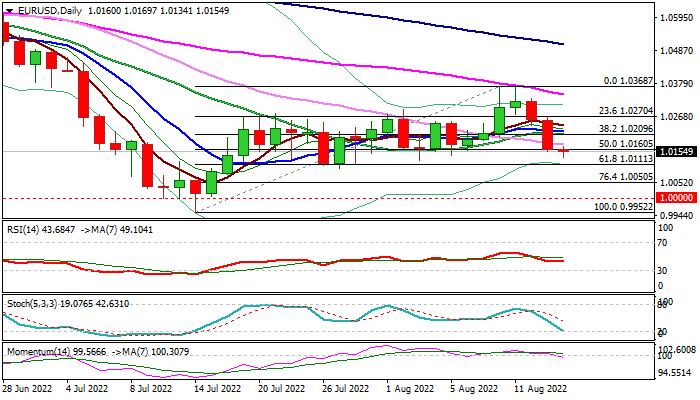
Fresh extension lower on Tuesday probes again through pivotal Fibo support at 1.0160 (50% retracement of 0.9952/1.0368 upleg) which limited downside action in past three weeks. Daily studies turned to bearish setup following Monday’s close below converged 10/20DMA’s at 1.01218/10, as 14-d momentum broke into negative territory.
Bears need clear break of 1.0160 Fibo level to generate fresh negative signal, which will look for confirmation on extension and close below 1.01 zone (Fibo 61.8% of 0.9952/1.0368) and signal an end of corrective phase after rejection at parity level.
On the other side, repeated failure to clearly break 1.0160 pivot would sideline immediate downside risk, but near-term tone will remain weak while the action stays below 10/20DMA’s.
Res: 1.0177; 1.0218; 1.0270; 1.0307.
Sup: 1.0111; 1.0096; 1.0050; 1.0000.