Sample Category Title
Week Ahead – Pressure Mounts on ECB and BoJ After Latest Dollar Surge
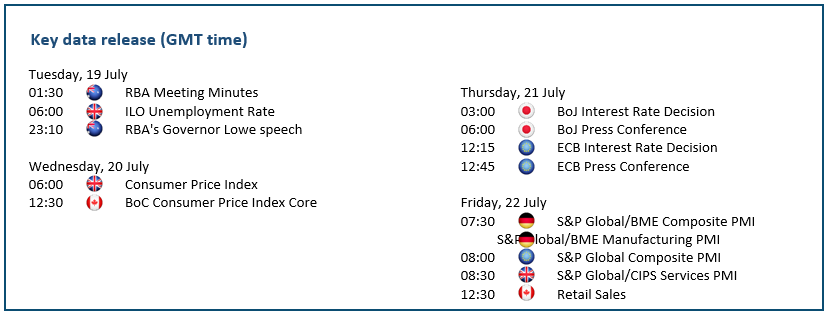
After another sizzling-hot inflation report out of the United States, the European Central Bank and Bank of Japan will meet against the worrisome setting of their currencies plunging. The former is expected to launch its tightening cycle, but the latter may make a surprise policy move even though it has not signalled any action. It’s looking to be an eventful week on the data front as well, as the flash PMI estimates for July and inflation numbers are due in several countries.
ECB to hike by 25 bps but what will follow?
There can be no doubt that the ECB is late to the game when it comes to the tightening race, but policymakers will be hoping to send the right message when they hike rates for the first time in more than a decade on Thursday, by 25 basis point.
Eurozone inflation reached 8.6% y/y in June according to the flash reading and that figure is expected to be confirmed on Tuesday. The ECB’s decision to outline its plan for a series of rate increases rather than just a couple at the last meeting was seen as very hawkish and the bank will want to underscore its intentions by possibly flagging a 50-bps hike for September.
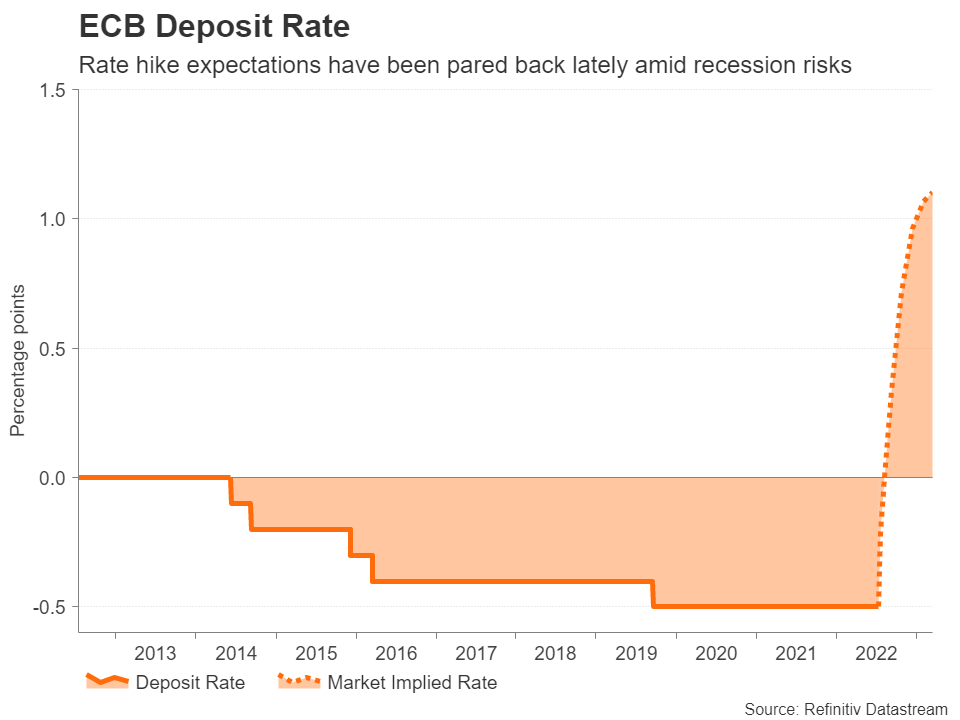
But the euro, which has been flirting with parity with the dollar all week, is unlikely to get much of a lift even if policymakers make another hawkish pivot as worries about the growth outlook are weighing on the currency, while the US dollar is being jointly boosted by an even more hawkish Fed and safe-haven flows.
If the ECB finalizes the details on how it intends to tackle fragmentation risks in Eurozone bond markets, that could turn out to be a bigger positive driver for the euro than hints that large rate hikes are on the way.
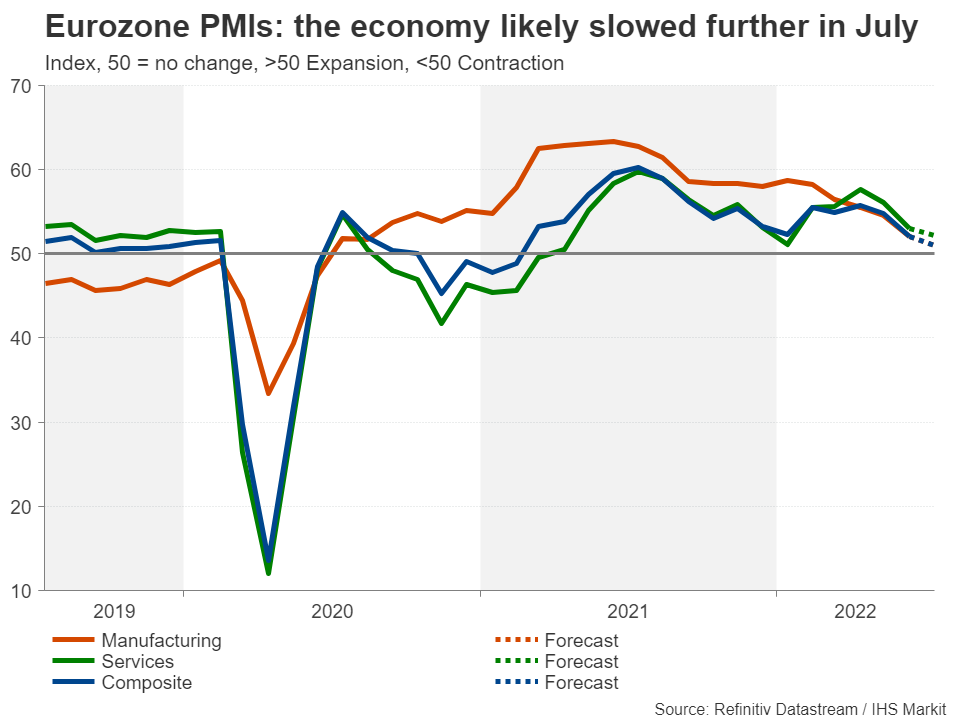
However, the euro will face more danger on Friday from S&P Global’s flash PMI data for July. Economic activity slowed markedly in June as businesses were impacted from soaring input costs and energy prices, as well as easing demand. A further slowdown is expected in July, with the composite PMI forecast to edge down from 52.0 to 51.0.
Bank of Japan is a wildcard
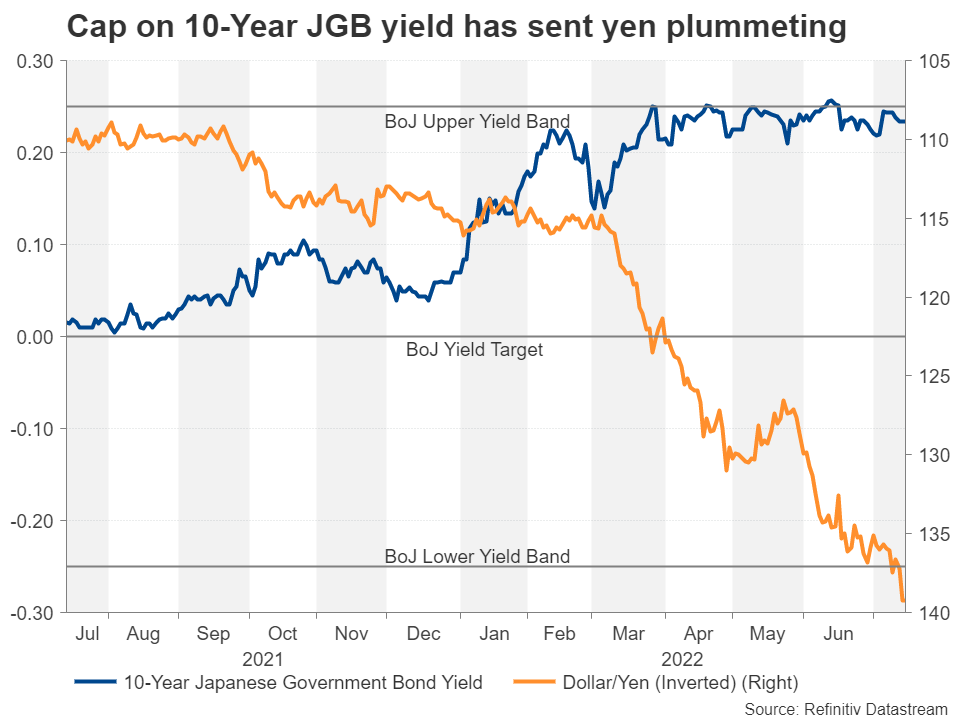
Another currency that has come under the wrath of the mighty dollar is the Japanese yen. The Bank of Japan’s refusal to abandon its controversial yield curve control policy at a time when all other central banks are aggressively raising interest rates has pushed the yen on the verge of hitting the 140 per dollar barrier for the first time in 24 years.
It can be argued that under the circumstances, the BoJ has been fairly successful in defending the 0.25% upper limit of its zero percent target on the 10-year yield. However, it may only be a matter of time before market forces take over and the BoJ suffers a humiliating U-turn. Hence, policymakers might decide that tweaking the policy now of their own accord when they meet on Thursday would save them a lot of headache later on.
On Friday, policymakers will be keeping a close eye on the June CPI figures. The core consumer price index, which only excludes food prices and is targeted by the BoJ, stood at 2.1% y/y in May and is projected to edge up to 2.2% in June. But other underlying measures that additionally strip out energy prices remain below 1%. This is why Governor Haruhiko Kuroda has stuck to his guns, insisting that there is no sign yet of inflation meeting the 2% goal sustainably.
Pound doesn’t have a lot to cheer about
Over in the UK, the pound could hit some turbulence amid a flurry of data releases. Kicking things off on Tuesday is the employment report, followed by CPI numbers on Wednesday and retail sales and the flash PMIs on Friday.
The British economy eked out a surprise growth in May and GDP was revised higher in the prior two months. This puts the Bank of England in a much more comfortable position to speed up its rate increases in August. Yet, sterling has kept on slipping against the dollar.
Like the euro area, the UK is highly exposed to the energy crisis and the latest political developments in Westminster have cast a further shadow over the country’s economic prospects.
Headline inflation jumped to 9.1% y/y in May and another acceleration would boost the odds of the Bank of England raising rates by 50 bps at its next meeting.
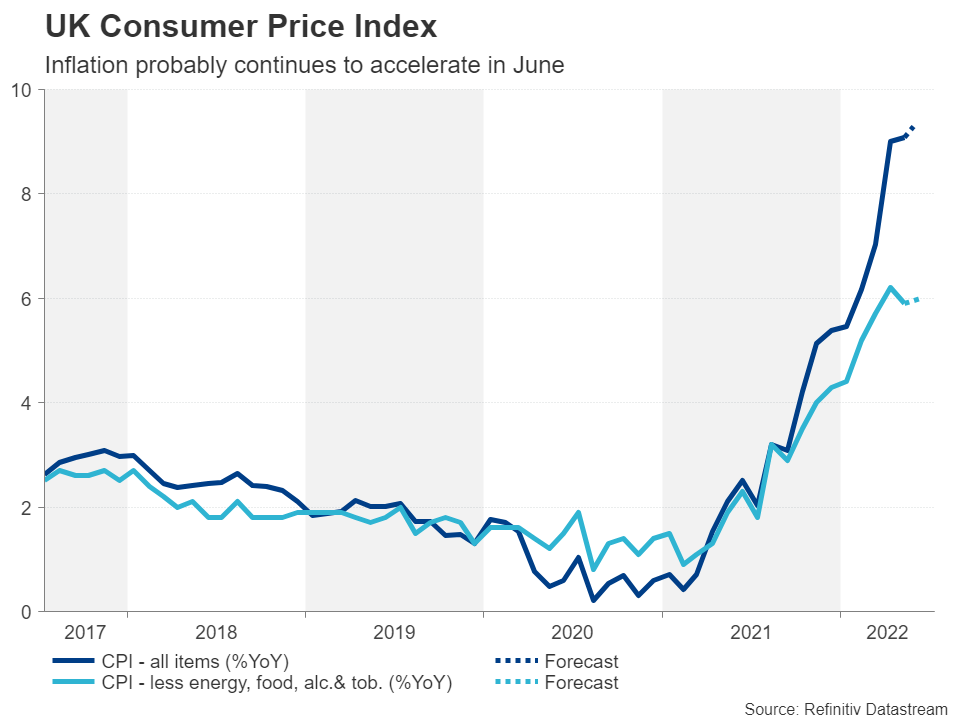
However, it’s unlikely that this would halt the pound’s slide as it may only add to stagflation fears. But there could be some support from any upbeat readings in the other data points.
Rising inflation is adding to recession bets
CPI and retail sales numbers are due in Canada too next week and the loonie may similarly not benefit from a further rise in inflation. The Bank of Canada shocked markets when it hiked rates by a whopping 100 bps. But the Canadian dollar has instead nosedived to the lowest since November 2020 versus the greenback.
Investors are clearly nervous that frontloading rate increases will only heighten the risk of a recession, even in Canada whose economy currently is among the strongest in the G20.
In Australia, the minutes of the Reserve Bank of Australia’s June meeting will be monitored on Tuesday for any clues that policymakers down under are considering going down the Fed and BoC route after two successive 50-bps hikes.
The Reserve Bank of New Zealand is in the same predicament and Q2 CPI data out on Monday might guide markets as to whether the pace of tightening is more likely to slow down or speed up.
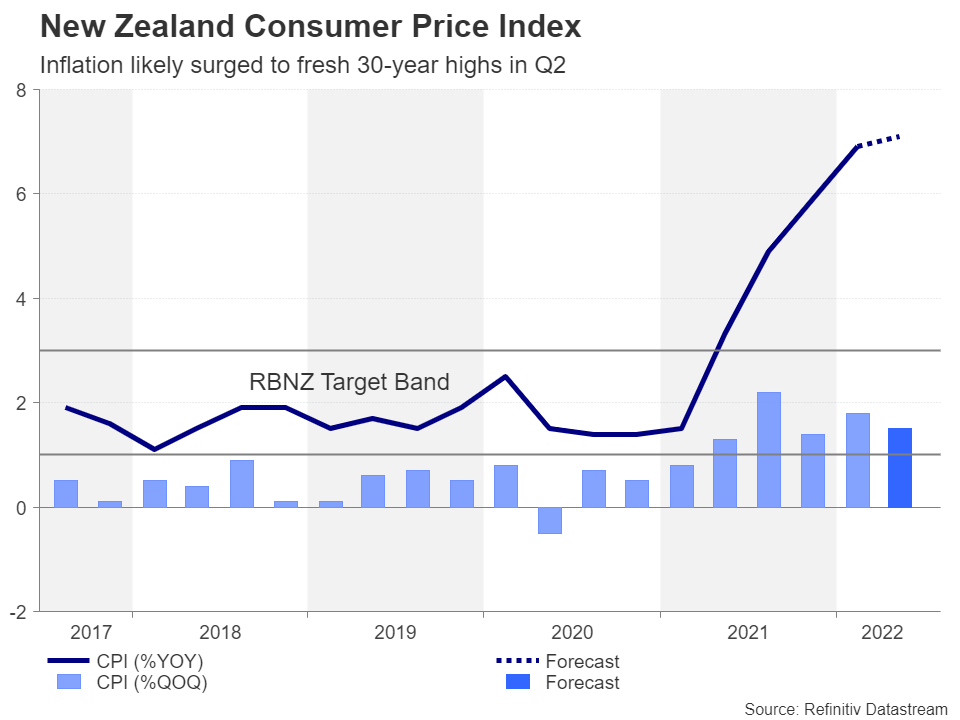
Overall, however, domestic tightening speculation will play second fiddle to bets about the Fed and general risk sentiment as far as the commodity-linked dollars are concerned.
Some downtime for USD bulls?
Expectations that the Fed could raise rates by 100 bps skyrocketed after US inflation hit a fresh four-decade high of 9.1% y/y in June, fuelling the dollar rally. The dollar index soared to 20-year highs above the 109 level in the aftermath.
But a batch of housing data for June next week pose some downside risks. Building permits are due on Tuesday along with housing starts, and existing home sales follow on Wednesday.
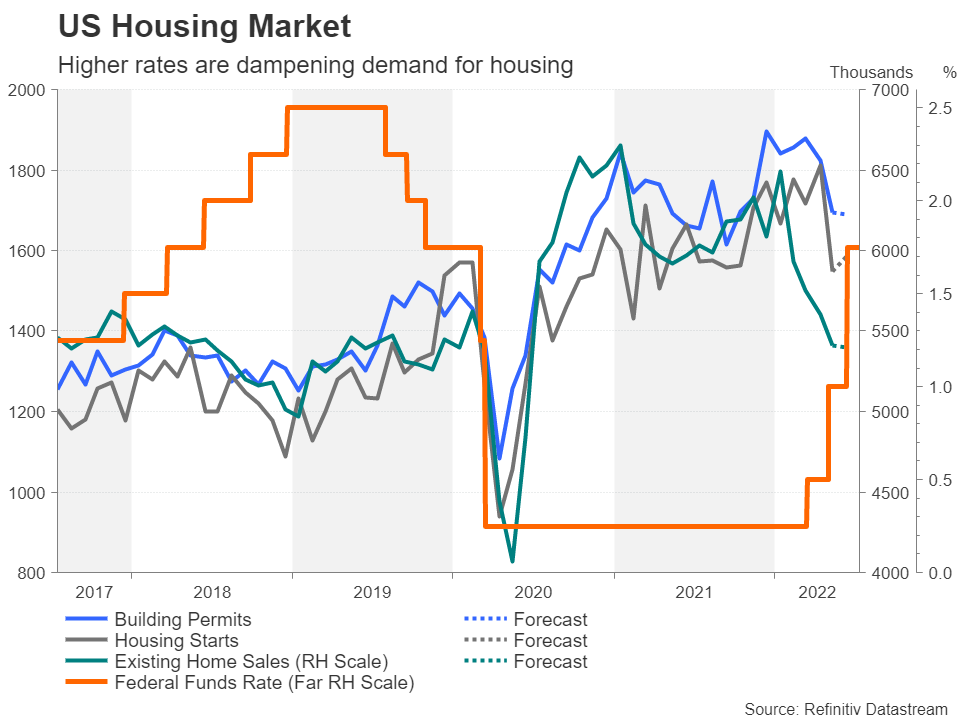
Also important will be the Philly Fed manufacturing index on Thursday and the flash July PMIs on Friday.
In a relatively quieter week, investors may sit on the sidelines as they await the next FOMC decision on July 27, unless of course there are fresh risk-off episodes that drive more funds into the world’s number one reserve currency.
One such episode to watch out for is whether Russia will turn the taps back on when scheduled maintenance on Europe’s Nord Stream 1 gas pipeline is completed on July 21.
With Signs of US Price Pressure Decline, Will Fed Soften its Approach?
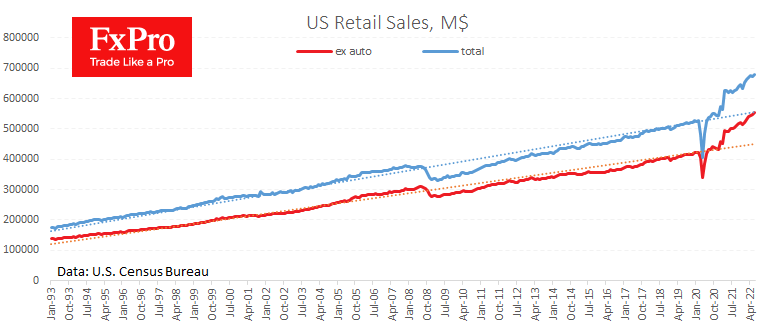
Although US retail sales figures are often the more important news, their slight overshooting relative to expectations has, in our view, less impact on markets than the import price index.
According to preliminary estimates, US sales rose by 1% in June against expectations of 0.9% and a 0.1% contraction a month earlier. Not too much better than expected, given that volume is not price-adjusted, which was higher than expected earlier in the week.
The good news for market participants is the cooling of import price increases. For the month, the index added 0.2% vs 0.7% expected and to 10.7% y/y versus 11.6% a month earlier, with 12.1% forecasted.
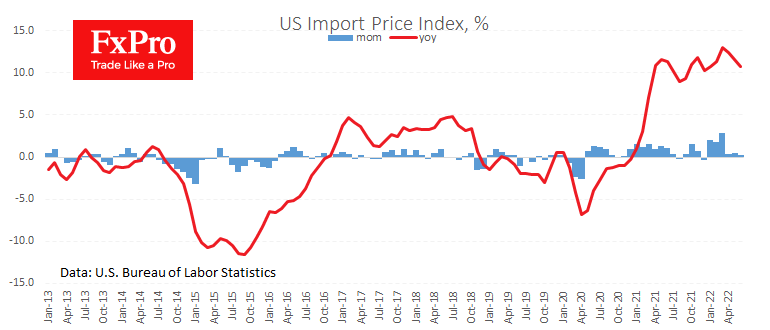
This deceleration results from the correction in commodity prices and the strengthening of the dollar in previous weeks. But most importantly, this index indicates that the peak of the rate of price increases is over.
More signs of a bullish trend reversal in prices might ease the Fed’s pressure on the key rate. Market participants are now trying to weigh the chances of a one percentage point hike in a week and a half. A softening of their expectations could trigger a corrective pullback in the dollar and an attempted equity market recovery.
Will the Euro Continue to Fall Below Parity?
EURUSD hit the so-called parity level of 1.0000 and dipped below it. Why there's so much talk about this? First, the euro dropping below the $1 level is rare. Still, what does the euro/dollar parity even mean? It means that the European and American currencies equal the same amount. One euro equals one dollar.
Why is the euro's parity with the dollar a big deal?
Since the birth of the single European currency in 1999, it has fallen below parity only once. That occurred between 1999 and 2002 when the euro plunged to a record low of $0.82 in October 2000. During the euro's relatively short history of about 20 years, it was the second most widely held currency in foreign exchange reserves after the US dollar.
What does drive the Euro's weakness?
1. The US Federal Reserve raised interest rates to fight the highest inflation in 40 years, which reached 9.1%. That boosted the dollar's attractiveness and strength, in addition to the growing global recession fears that pushed markets to the US dollar as a safe haven.
2. The ECB is not following the Fed-led tightening cycle. The European Central Bank is expected to raise rates at its next meeting on July 21. However, it won't be enough to keep pace with the Fed's fast speed, which is considering raising rates by 75 points, or a full 100 points (1%), at its next meeting on July 28.
3. Fears are growing that rising gas prices will make the Eurozone more vulnerable to recession risks. That explains why the euro is taking a heavy hit now. Some global banks expect a recession in the Eurozone in the third quarter of this year.
4. High energy prices and the highest inflation in the history of the Eurozone. Energy prices in Europe rose due to the war in Ukraine, the loss of Russian oil from world markets, and Russia's cutting off gas supplies to Europe. Europe relies more on Russian oil and natural gas than the US to maintain production, industry, and electricity generation. That drove inflation in the Eurozone to a record high of 8.6% in June, making everything from groceries to electricity and utility bills more expensive while the Euro's value has weakened.
5. The US economy is stronger than the European economy. The US is on the path to economic recovery faster than the Eurozone, which is on the verge of falling into recession.
The Euro is not the only one affected by the dollar's strength, but everything is weak against the US currency. This year, the British pound and the Japanese yen have fallen strongly against the dollar.
What does this mean for the ECB?
The current fall of the euro is a big headache and a terrifying challenge for the European Central Bank because the euro has weakened not only against the dollar but also against other currencies such as the Swiss franc and the Japanese yen.
The ongoing euro weakness will push already high inflation rates higher, increasing the risk of prices rooting above the ECB's 2% target. It requires more rapid rate hikes to stop the euro from bleeding against the dollar, which could add to the misery in Europe, which is already facing a possible recession.
If Europe enters recession, especially Germany, this might stop the ECB's rate hikes, as it will worsen the situation. In the meantime, the dollar and the US economy will grow stronger, widening the gap between USD and EUR.
Will the euro continue to fall below parity?
Unfortunately, the EUR's decline against the USD is expected to continue. It may drop to $0.97-$0.95 in the near term. The euro will remain stagnant as Europe's energy crisis worsens. Even if the ECB raises rates, the Fed is faster and more aggressive.
Dollar Strength Was the One Constant
Markets
Dollar strength was the one constant in a week where inflation angst traded for recession worries and vice versa. That subsided somewhat as markets headed into the weekend. The greenback consolidated after surging to multidecade highs in a range of crosses over the previous days. On a trade-weighted basis, DXY retreated slightly from 108.54 to 108.25. USD/JPY punched through recent cycle highs around 137/138 yesterday to close just shy of 139. The pair is changing hands at levels that are barely lower (138.69). “Third time’s a charm” only applied partially for EUR/USD. The currency cross yesterday indeed finally dipped below parity in a convincing manner (0.995) after three attempts but the psychological forces opposing gravity are strong. EUR/USD today even ekes out a small gain to 1.005. Perhaps things would have been a bit different if US retail sales surprised materially to the upside. Fed’s Waller referred to them as being key input whether to back a 100 bps hike at the July meeting or not. Instead, the amount of money spent by Joe Sixpack in June came in close to expectations. Headline sales showed a 1% m/m increase (0.9% expected) with 9 out of the 13 categories gaining. The control group – a proxy for private consumption in GDP calculations – rose by 0.8% m/m. Consumer confidence from the Michigan University due later today still has the potential to rock markets though. Other data today included the NY Manufacturing index, which unexpectedly rebounded from -1.2 to 11.1. Yet the outlook tumbled to a 21-year low. Prices paid continued to ease, reaching the lowest level since March 2021 and even October 2020 for the 6m ahead gauge, suggesting easing price pressures. New orders recovered slightly but the flow is expected to dry up in the near future.
US Treasuries strengthened today though left intraday highs behind during a speech by Fed’s Bullard and the slightly better-than-expected data. Bullard stepped up his end-of-year target from 3.5% to 3.75%/4.0%. He sticks to a 75 bps hike in July nonetheless, fearing hiking by 100 bps would create a false perception of panic. Yields pared declines still and are now up 1.9 bps at the front and less than 1 bp lower at the long end of the curve. German Bunds outperform slightly. Yield changes vary between -1 bps to -3.9 bps. Losses were bigger during early European dealings though. The 10y yield briefly lost 1.12% support (2012/2013 interim lows) before recovering as the session evolved. EMU swap yields decline 0.8 to 1.4 bps, the wings (+1.3/1.9 bps) underperforming. Peripheral spreads vs. Germany’s 10y are mixed. Italy again underperforms, adding 5 bps as political uncertainty lingers. Risky assets including equities bounce between 1.2-1.7% in Europe and the US. Brent oil (+2.4%) inches further north of $100 again.
News Headlines
The Polish statistical office slightly downgraded its final inflation number for June from 15.6% Y/Y to 15.5% Y/Y. That’s still a significant rise from 13.9% Y/Y in May. Details showed that the biggest monthly contributions came from transport prices, dwelling, food and recreation and culture. While the headline Polish inflation number could stabilize somewhat over the next months thanks to the correction in energy prices and seasonal effects on food prices, the peak might still not be in sight with regulated prices set to rise again by the end of this year and early next. This suggests that the Polish national bank’s efforts to slow the tightening cycle (“only” 50 bps in July) might prove premature. The Polish zloty profits from the risk rebound today with EUR/PLN sliding from 4.82 to 4.77.The European Automobile Manufacturers’ Association reported that EU passenger car registrations continued their downward trend in June (-15.4%) as supply chain issues continue to limit vehicle output. Simultaneously, record high inflation rates impact the demand side of the equation. In terms of volumes (886 510), June was the lowest month on record since 1996. During H1 2022, new car registrations in the EU fell by 14% compared to one year earlier, totaling around 4.6 million units.
USDCAD Wave Analysis
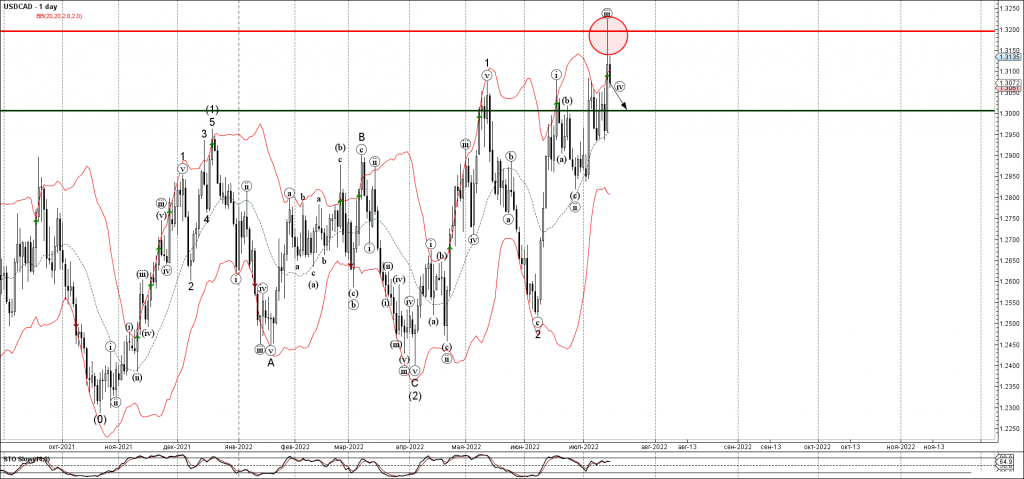
- USDCAD reversed from resistance level 1.3200
- Likely to fall to support level 1.3000
USDCAD currency pair recently reversed down from the key resistance level 1.3200, standing far above the upper Bollinger Band.
The downward reversal from the resistance level 1.3200 started the active minor correction (iv) – which belongs to wave 3 from the start of June.
Given the strongly bullish CAD sentiment seen today, USDCAD can be expected to fall further toward the next round support level 1.3000.
EURJPY Wave Analysis
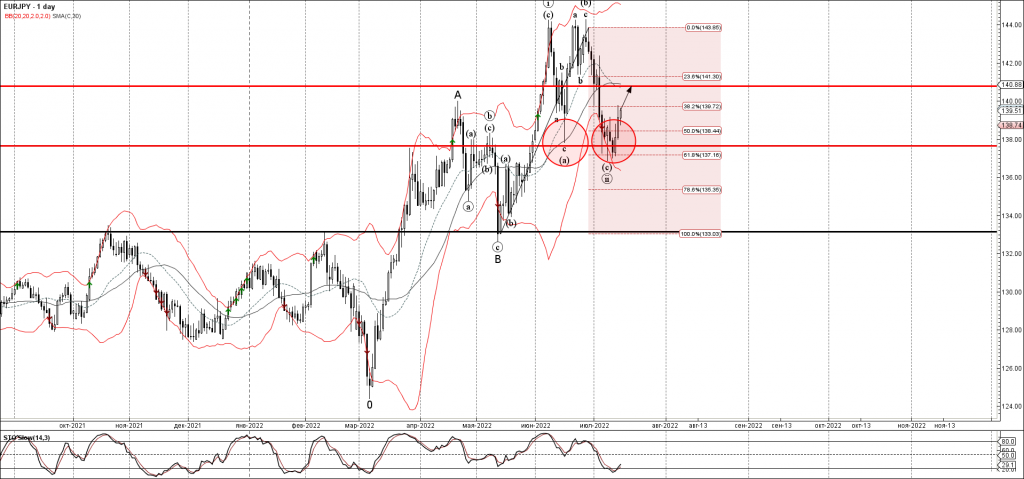
- EURJPY reversed from support level 138.00
- Likely to rise to resistance level 140.00
EURJPY currency pair recently reversed up with the Bullish Engulfing from the key support level 138.00, standing near the lower daily Bollinger Band and the 61.8% Fibonacci correction of the upward impulse from May.
The upward reversal from the support level 138.00 started the active minor impulse wave (iii) – which belongs to wave C from May.
Given the clear daily uptrend, EURJPY can be expected to rise further toward the next resistance level 140.00.
ECB to Deliver Modest Rate Hike
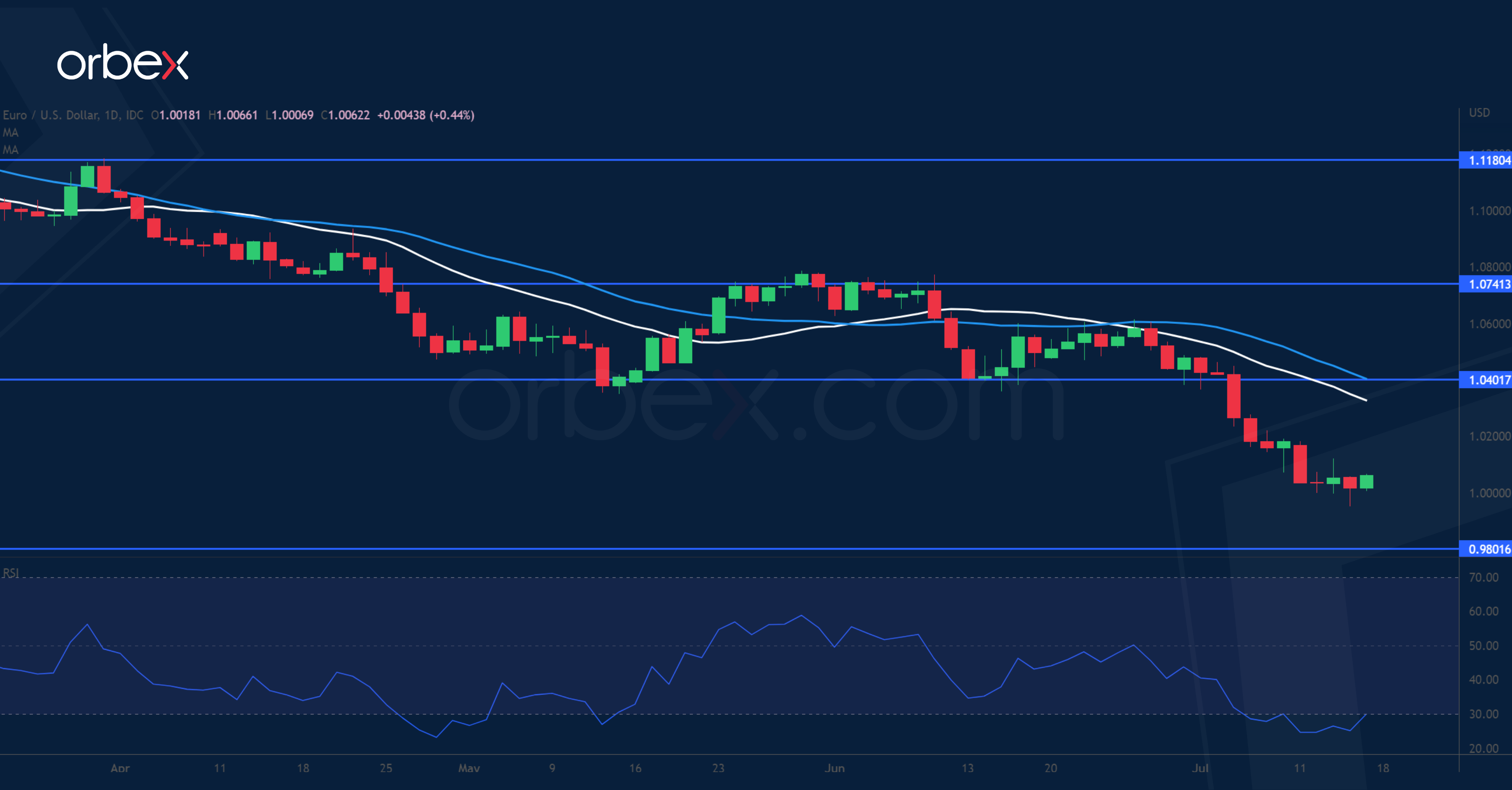
EUR/USD softens as ECB hikes lag behind
The euro hovers over parity as the ECB is expected to kick off its tightening cycle this week. The ECB will likely deliver a 25 bp increase next week but may have limited impact on the single currency. The modest hike is more of a concession that policymakers’ hands are tied given the energy price shock and the fragmentation risk. Traders might focus on how the central bank would support peripheral bonds to avert another debt crisis as borrowing costs rise. The euro may struggle to maintain the parity milestone as the ECB cannot afford to normalise in a decisive manner. 0.9800 could be next with 1.0400 as a fresh resistance.
USD/JPY soars as BoJ sits on sidelines
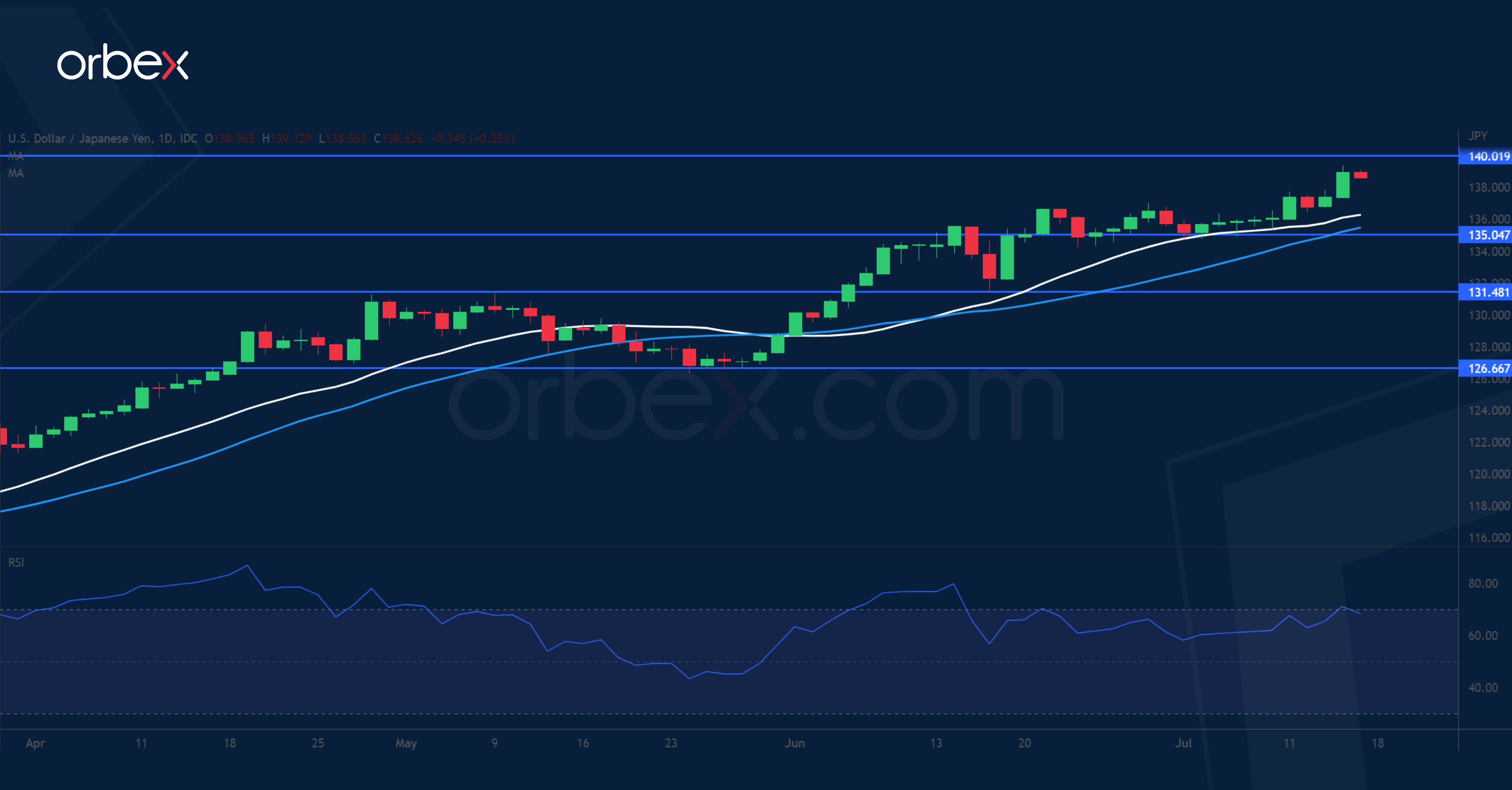
The Japanese yen fell to a 24-year low against the US dollar as the Bank of Japan vowed to stay dovish. Governor Kuroda has repeatedly shrugged off the idea of tightening and gone contrarian instead. The BoJ may even consider further easing to support the recovery. Inflation shot above 2% mainly due to soaring fuel costs, and unless wage growth gains a foothold, the central bank has leeway to leave its policy loose. After the SNB raised its interest rate for the first time in 15 years, the BOJ is the last major central bank still kicking the stimulus can down the road. The pair is climbing towards 140.00. 135.00 is a fresh support.
GBP/USD weighed by growth concerns
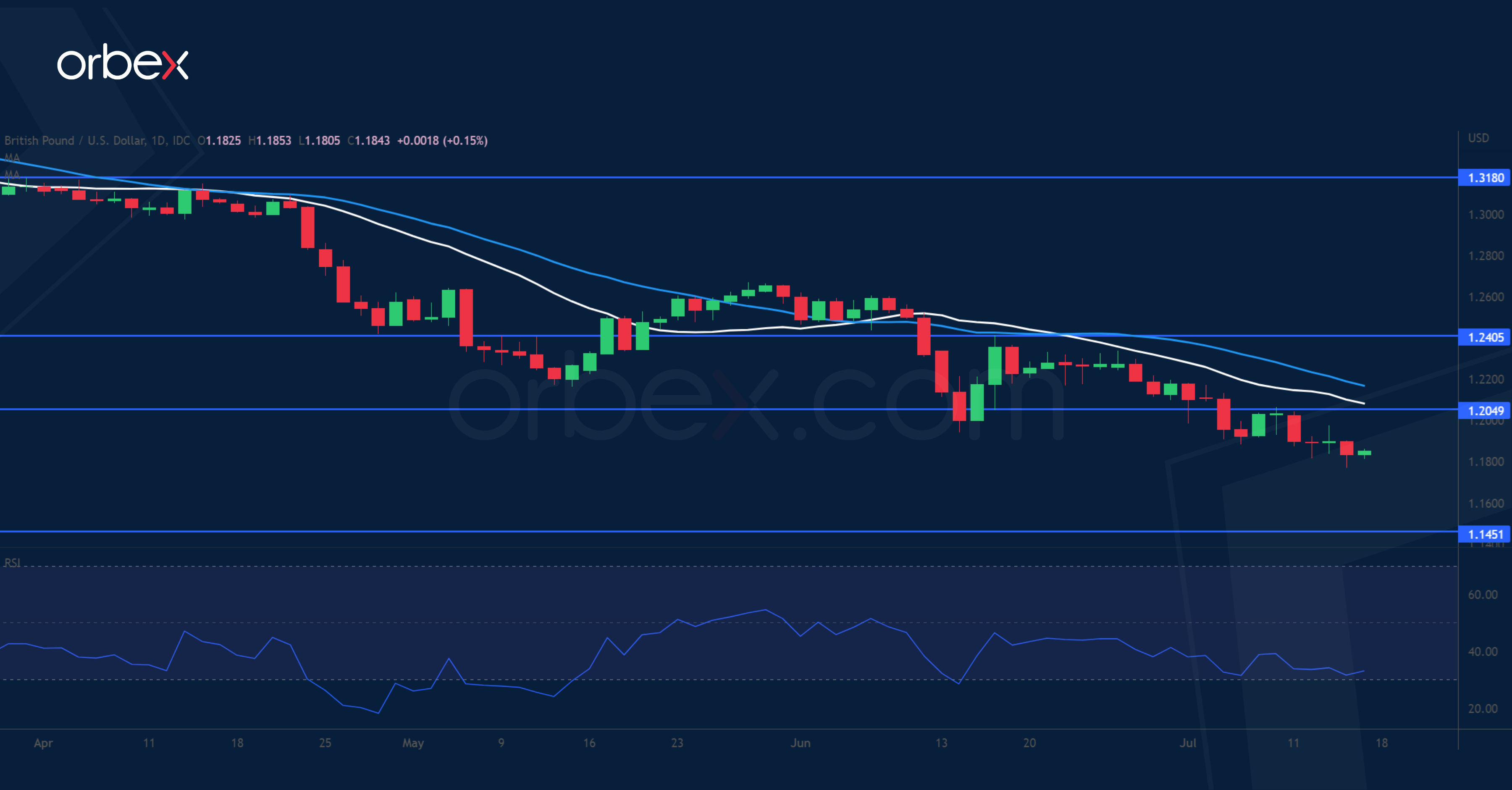
The pound weakens as Britain faces multiple economic and political headwinds. Hawkish signals from the Bank of England have had little effect as the market frets that inflation compounded by Brexit trade frictions could be persistent in the UK. Higher consumer price data this week would underpin the inflationary spiral and a strong economic slowdown in the country. To rub salt into the wounds, an uncertain political outlook may continue to cast a cloud on the currency. Volatility could be expected as the leadership race for a new prime minister goes on. The pair is heading to March 2020’s low at 1.1450. 1.2050 is the closest resistance.
XAU/USD falls as dollar surges amid record inflation
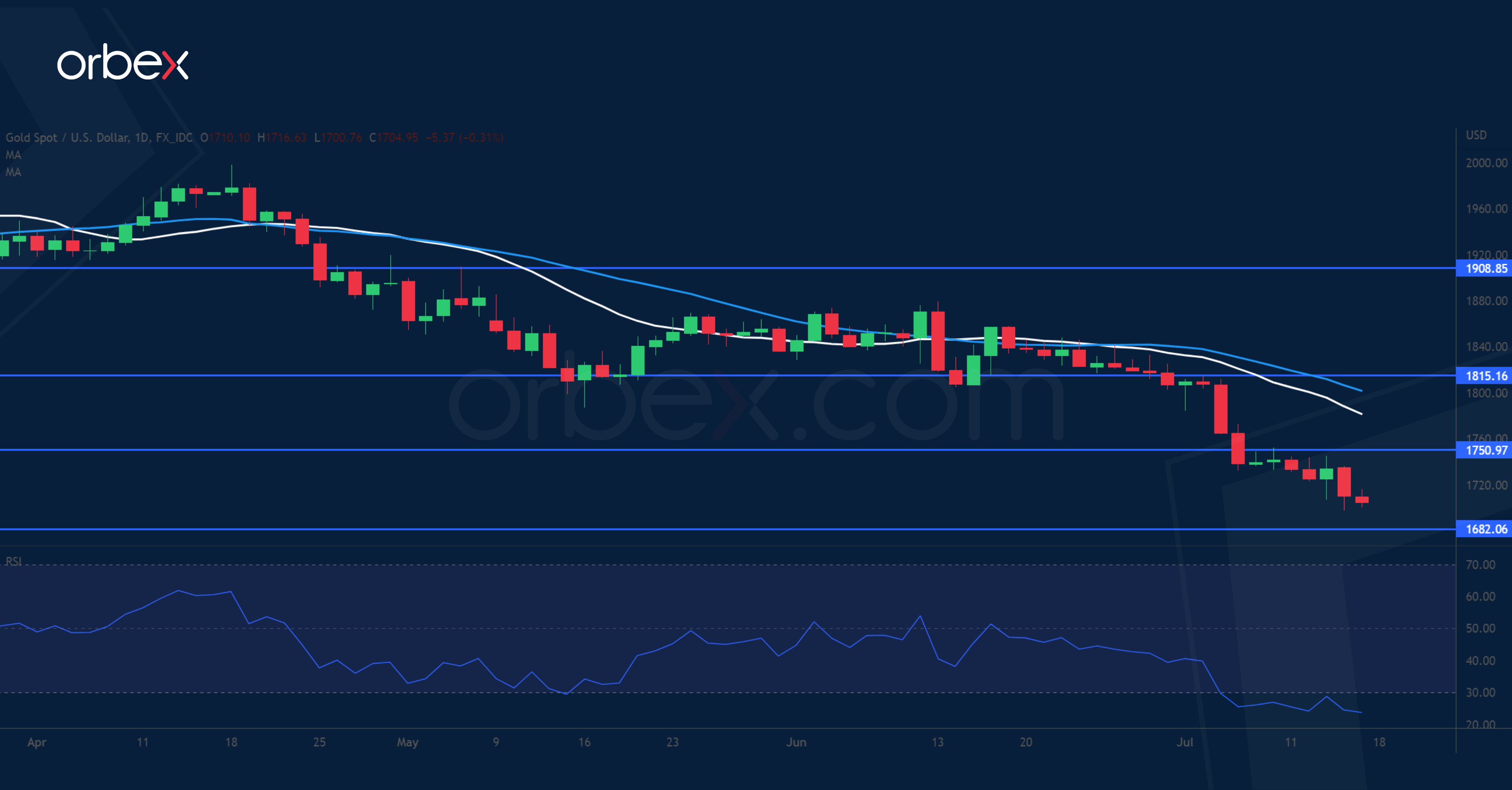
The gold market remains under pressure as record high US inflation sends the dollar index to a 20-year high. Consumer prices surged 9.1% in June to a four-decade high, cementing expectations of more aggressive moves from the central bank. A 75bp hike has become the base scenario, but speculations grow that the Fed may follow in the footsteps of the Bank of Canada and deliver a supersized 100 bps rate hike later this month. As traders pile into the greenback, roaring volatility may continue to take a toll on the precious metal. The price is ab August 2021’s low near 1682. 1750 has turned into a supply area.
US: Retail Sales Gain Momentum in June
Retail sales gained 1.0% month-on-month (m/m) in June – slightly above the consensus forecast (+0.8% m/m) – and accelerating from May's reading, which was revised up to -0.1% m/m from -0.3% m/m reported earlier.
Sales at autos & parts dealers rose by 0.8% m/m even after May's upward revision to -3.0% from a decline of 3.5% previously reported. Excluding autos, retail sales were up 1.0% m/m in June, above the consensus forecast of 0.6% m/m.
Sales at gasoline stations continued to rise in June, gaining 3.6% m/m. However, gas prices were up 11% m/m last month, implying price adjusted sales were down sharply. Building materials reported a modest pullback of -0.9% m/m.
Excluding the above categories, sales in the "control group" that are used in calculating personal consumption expenditure (and GDP), were up 0.8% m/m. Within the group, the biggest contributors to growth were sales at non-store retailers (+2.2% m/m), miscellaneous stores retailers (+1.4% m/m), furniture & electronics/appliance stores (+1.0% m/m), and food services & drinking places (+ 1.0% m/m).
Within categories that reported losses, the largest drag came from clothing & accessory stores (-0.4% m/m), while department stores and health & personal care also reported losses.
Key Implications
Retail sales reversed some of May's losses, finishing the quarter 2.3% higher. Yet, most of this gain comes from higher prices which continue to have an outsized impact on the headline reading. As their purchasing power continues to dwindle, consumers are clearly cutting back on their shopping . Our estimates of real activity point to depressed sales at gas stations, food stores, auto dealerships and apparel stores. Even sales at restaurants – the only services category in today's report – pulled back in real terms in June.
Still, we think that spending on experiences at the expense of discretionary goods will continue to support consumption expenditures. We now expect PCE to grow somewhere close to 1% (annualized) in the second quarter, roughly 2 percentage below our earlier estimates.
Taken alongside June's CPI reading, today's release suggests that the Fed will continue to move more forcefully on raising rates at their next meeting on July 27th. The question is whether 75 basis points will be considered enough. Today's stronger-than-expected report may give the Fed more reason to hike by a full percentage point. At present, market pricing is split down the middle on whether the Fed will move by 75bps or 100bps.
USD/JPY Mid-Day Outlook
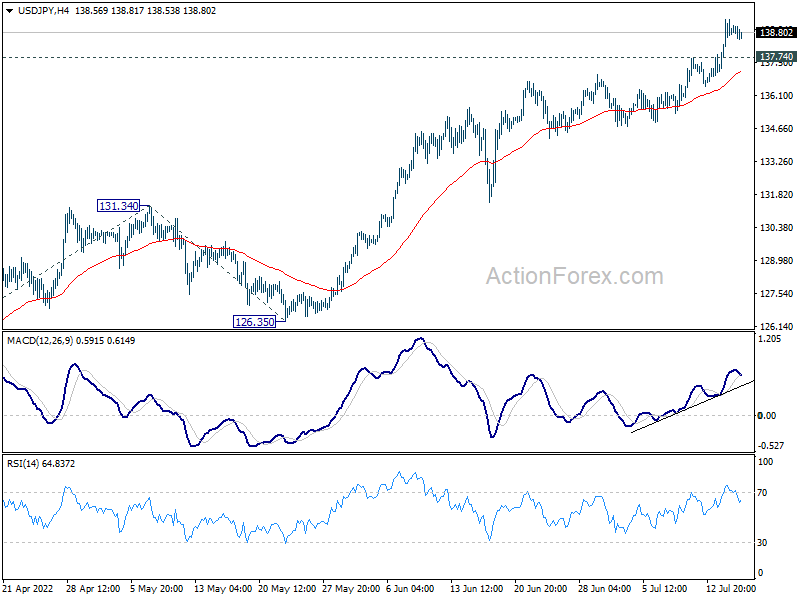
Daily Pivots: (S1) 137.70; (P) 138.54; (R1) 139.81; More...
USD/JPY's rally is still in progress and intraday bias stays on the upside. Current up trend should target 100% projection of 114.40 to 131.34 from 126.35 at 143.29. On the downside, below 137.74 minor support will turn intraday bias neutral and bring consolidations first, before staging another rally.
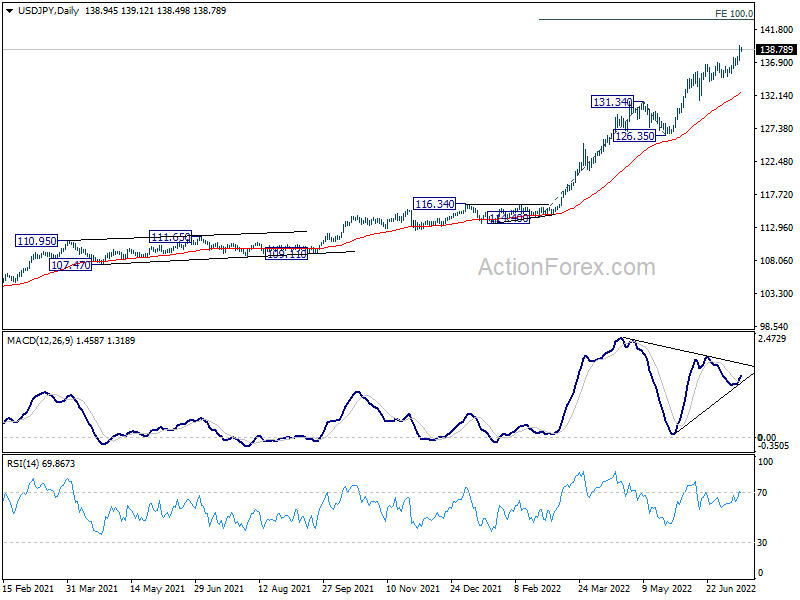
In the bigger picture, current rally is seen as part of the long term up trend from 75.56 (2011 low). Next target is 100% projection of 75.56 (2011 low) to 125.85 (2015 high) from 98.97 at 149.26, which is close to 147.68 (1998 high). This will remain the favored case as long as 126.35 support holds.
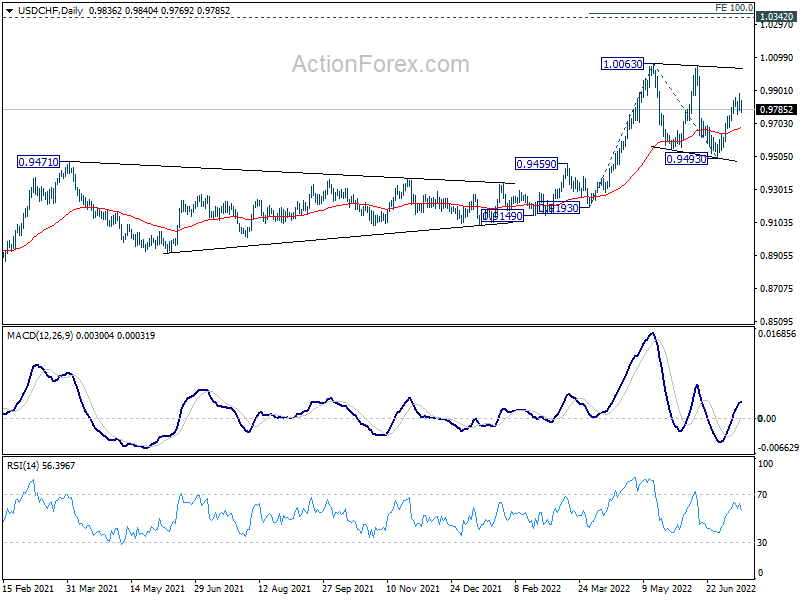
USD/CHF Mid-Day Outlook
Daily Pivots: (S1) 0.9783; (P) 0.9834; (R1) 0.9891; More...
Intraday bias in USD/CHF is turned neutral with current retreat. Some consolidations could be seen first. On the upside, above 0.9884 will extend the rise from 0.9493 to t 1.0063 high. Decisive break there will resume larger up trend. On the downside, break of 0.9754 will turn bias back to the downside for 0.9493 support.
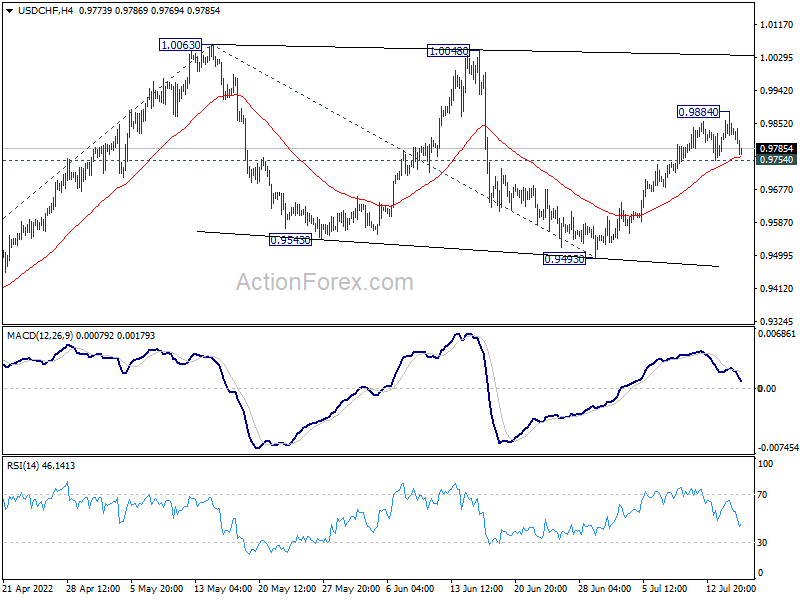
In the bigger picture, medium term up trend from 0.8756 (2021 low) is still in progress. Next target is 1.0342 (2016 high). Sustained break there will resume long term up trend from 0.7065 (2011 low). This will remain the favored case as long as 0.9471 resistance turned support holds.