Sample Category Title
GBPJPY Fails to Decline Below the Ascending Triangle
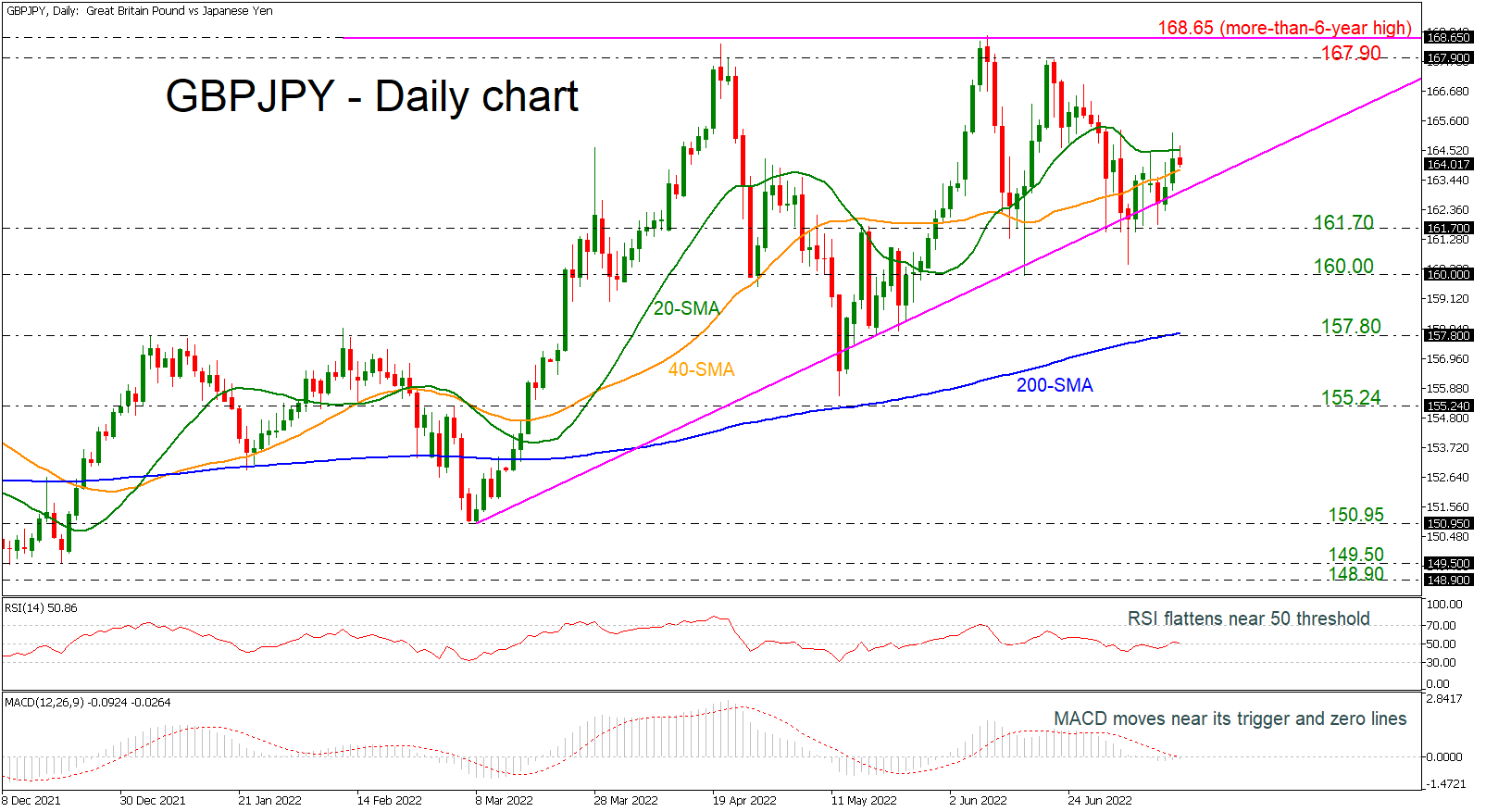
GBPJPY is remaining within an ascending triangle pattern, as it rebounded several times in the previous sessions on the uptrend line.
The pair is hovering within the short-term simple moving averages (SMAs), suggesting some weakening bias as the technical indicators are also failing to show some clear directional movement. The RSI is flattening near the neutral threshold of 50, while the MACD is moving sideways near its trigger and zero lines.
If the bulls manage to take charge and drive the market above the 20-day SMA, then the expectation is a test of the 167.90 barrier ahead of the more-than-six-year high of 168.65. Such a break would confirm a forthcoming higher high and may pave the way towards the next obstacle of 175.00, registered in April 2015.
A clear dip below the uptrend line would bring the pair within the 161.70 support and may set the stage for declines towards the 160.00 psychological mark. More declines may shift the outlook to bearish if the market penetrates the 200-day SMA at 157.80 as well.
All in all, GBPJPY has been developing within a triangle pattern since March and only a jump above 168.65 or below the rising trend line may change the current outlook.
Why Everyone Is Talking About Yield Curve Inversion
There has been quite a shift in the markets over the last couple of days. Understanding that will help us understand why we should be paying very close attention to the yield curve right about now.
On Wednesday, the US reported higher than expected inflation, the highest rate going back to 1981. To make matters worse, the core rate was higher than expected and showed an acceleration in June. The Fed has been hitting inflation hard, both aggressively raising rates and rolling off the balance sheet. Yet inflation hasn't peaked.
What's going on?
As mentioned in our NFP podcasts at the start of the year, the Fed is facing a problem that the underlying causes of inflation are supply chain problems with additionally high crude prices due to undersupply and war disruption. These are two factors the Fed has no control over. Raising rates is meant to drain liquidity from the economy, which reduces the amount of available credit. This pinches the consumer on both ends, as Americans have been taking out increasing debt on credit cards.
Following the unexpected rise in inflation, bets that the Fed would hike rates by 100 basis points at the next meeting shot up. Investors are expecting the Fed to pull out all the stops to head off higher inflation, like they did the last time inflation was this high. But, after that aggressive move by the Fed (and this is the fastest rate hike since then as well), there was a pretty harsh recession.
So, what about the yield curve inversion?
As explained previously, the yield curve basically represents where the biggest investors expect interest rates to be in the future. An inversion happens when the market expects interest rates to be higher in the near term than in the future. In other words, there is an expectation that the Fed will cut rates in the future, because they are fighting a recession.
It means that the largest traders in the market are betting billions of dollars that there will be a recession in the very near future. Typically, that happens within a period of six months to a year. The thing is, the yield curve inverted for the first time in April of last year, more than six months ago. In other words, we're in the exact timeline for when the theory would predict a recession.
What to do about it?
Yesterday, the inversion was the biggest it's been since 2000. That is, when the Fed was also tightening policy quite hard, and just ahead of the dot-com burst. The yield curve has been successful in predicting 10 out of the last 10 recessions. But, it's not necessarily perfect; after all, past performance is no guarantee of future results.
The Fed isn't going to change its policy based on a predictive theory, and will likely stick to its data-driven analysis. With inflation rising once again, the Fed is likely to keep raising rates. Now the question is whether the Fed is going to follow its 1981 game plan, and keep pushing until inflation is under control. Or will it back off and try to save the economy? Perhaps after Q2 GDP figures are released at the end of the month, we will know.
Two FOMC Hawks Poured Cold Water Over a 100 Bps Hike in July
Markets
European bond yields started off with a massive surge yesterday. We view it as a belated catch-up move with their US counterparts following the CPI release on Wednesday. Both German yields and European swap yields rose almost 20 bps intraday at the short tenors. But doubts soon emerged once again with an unfolding Italian political crisis (cf. infra) obviously not helping sentiment. Germany’s curve bear flattened with changes ranging from +0.3 bps (30y) to 6.5 bps (2). Europe’s 10y swap yield tried to settle north of 2% again but missed it by an inch (1.998%). Peripheral spreads widened up to 7 bps in Italy and 8 bps in Spain. US Treasuries outperformed Bunds. Two FOMC hawks poured cold water over a 100 bps hike in July. Waller said markets were getting a bit ahead of themselves. 75 bps is still his base case without ruling out a 1ppt hike depending on the upcoming retail sales and housing data. Bullard also favours a back-to-back 75 bps move that would bring the Fed in neutral territory. He argues for a 3.5% policy rate by end 2022 and is “not really looking to do more in 2023” unless the data forces otherwise. The wings of the US yield curve outperformed (-1.4 to -2.3 bps) the belly (up to 3.8 bps higher). In FX markets, dollar dominance continued though momentum faded slightly in early US dealings. The trade-weighted index nevertheless hit a new cycle high of 108.54. USD/JPY rallied to 138.96. EUR/USD dipped below 1 as far as 0.9955 before rebounding and closing above parity still. The (dollar) turnaround coincided with a bottoming in oil prices. Brent lost support from the 200dMA to go as low as $94.5/b but then staged a comeback to close the day at $99.10. Stocks in Europe lost more than 1.6%. WS ended 0.5% lower (DJI) to flat (Nasdaq).Asian-Pacific stocks trade mixed. Chinese Q2 growth disappointed (see below) but leaves no material traces on markets. The dollar consolidates near recent highs and core bonds gain a few ticks. Today’s economic calendar got even more interesting after Waller’s comments yesterday. We therefore keep a close eye at US retail sales but also at the Michigan consumer confidence. In June, the inflation expectations questionnaire made the Fed step up its game. Bond markets would definitely notice a further increase, especially if the retail sales don’t disappoint. Barring such a scenario, we think both bond yields and the dollar could take a breather going into the weekend. The US 10y yield hovers around the 3% mark. Some USD consolidation at the current strong levels is possible with a lingering risk for EUR/USD 1 to snap. More Fed governors speak ahead of the black-out period.
News Headlines
The political crisis in Italy continues. Italian President Mattarella rejected Prime minister Draghi’s resignation and asked the PM to address Parliament next week. PM Draghi decided to resign as he concluded that the government of national unity didn’t exist anymore after the 5-Star Movement didn’t participate in a vote on a package to support the population from rising prices which it considered as not sufficient. The coalition still has a majority in Parliament but Draghi indicated that he didn’t want to continue the government if it wasn’t supported by 5SM, which was the biggest group in Parliament. The coalition also has divergent views on how to react to the Russian invasion in Ukraine. President Mattarella not accepting Draghi’s resignation buys time, but the risk of early elections persists. The crisis comes at difficult time, both for Italy and Europe. The Italian 10-y bond spread versus Germany yesterday widened an additional 7 bps and the crisis in Italy probably was a factor for EUR/USD to (temporarily) drop below parity
Growth in China in the second quarter contracted a bigger-than-expected 2.6% Q/Q as covid restrictions in April and May reduced demand and weighed on production. Activity in China was only 0.4% above the level of the same quarter last year. YTD growth printed a 2.5% and suggests that it will be difficult to reach the government target of 5.5% this year. At the same time, production (3.9% Y/Y) and retail sales (3.1%) data for the month of June indicated a better economic performance in the last month of the quarter. The picture for the Chinese property market continues to look bleak with investment in the sector declining 5.4% YTD, more than anticipated.
The Draghi Drama
The Italian Prime Minister Mario Draghi wanted to resign yesterday, after the Five Star party, which is the second biggest party in Draghi’s coalition government, boycotted a confidence vote in the senate; they didn’t quite like Mario’s response to the economic crisis. Draghi said that the loyalty agreement, which was the foundation of this government ‘was gone’, and said he wants to quit. The news sent a shockwave to the market, but his resignation was refused by the President, to avoid a political crisis in Italy and wreak havoc across the European markets, and the euro.
Draghi’s resignation sent the Italian 10-year yield 5% higher yesterday. The EURUSD, on the other hand, broke the 1.00 support on the back of a broadly stronger US dollar, fell to 0.9952, then rebounded back above parity,
The dollar retreated after advancing to a fresh high of 109.30, after two FOMC members, Waller and Bullard said that they are willing to support a 75bp hike at this month’s FOMC meeting rather than a 100bp hike as suggested by the market reaction to this week’s scary inflation report.
Activity on Fed funds futures scaled back the post-CPI hawkishness and presently price in a 50-50 chance for a 75, or a 100bp hike this month.
The dovish correction on Federal Reserve (Fed) expectations helps tempering the pressure on the EURUSD, but it doesn’t change the fact that the Italian political turmoil will add a layer of stress that the European Central Bank (ECB) will have to deal with, as it prepares to raise the interest rates next week for the first time in a long time.
With the Italian crisis, and Draghi’s caca-nerveux, we are almost certain that there is little-to-no chance the ECB hikes the rates by more than 25bp. The Eurozone is too fragile, both from economic and political perspectives, to allow the ECB to take a more significant step.
The single currency should continue softening against many majors, as the divergence between the handcuffed ECB, and the other central banks should continue weighing on single currency. The selloff in the EURCAD, for example, accelerated this week after the Bank of Canada (BoC) surprised with a 100bp hike. The euro-pound is under a renewed negative pressure as the Bank of England (BoE) is expected roll out a 50bp hike at August meeting, while the euro-swissy tests the 98 cents mark, as the Swiss National Bank (SNB) also raised its rates by 50bp in the latest meeting and said it would do more if needed.
Eclipsed by the dollar
Bloomberg’s dollar index hit an all-time high.
Gold remains under a decent selling pressure against the US dollar, as the dollar strength eclipses the gold’s strength. We shall see a positive correction in gold’s price, if investors let go of their dollars.
The dollar-yen prepares to test the 140 level, and the dollar-franc is back to 99 cents.
First earnings disappoint
Market attention finally shifts to the earnings from the economic data, and depending on what we will see, it’s maybe a good thing, or not.
Many analysts have been lowering their earnings estimates for the 2Q but the S&P500 companies’ earnings are expected to have risen by 4.3% over the year. Though this is the slowest pace of growth since the fourth quarter of 2020, the net profit margins are expected to grow by more than 12%, which is higher than the 5y average, and more importantly, it’s higher than the previous quarter. That optimism carries the risk of disappointment, because the latest quarter was heavily marked by the Ukrainian war, the spike in energy and commodity prices, the Chinese lockdown, that came along with supply chain issues. Therefore, it’s possible that some of the S&P500 companies have felt the pinch of the global headwinds a bit heavier than what’s in the forecasts.
And indeed, the first results were not enchanting. JP Morgan and Morgan Stanley were the first big US banks to release earnings yesterday, and their results rather disappointed.
When a Plan Doesn’t Come Together
I only have some egg dripping from my face this morning, instead of a full dozen including shells. My view that the price action post the US inflation numbers across asset classes suggested an albeit temporary, risk sentiment rally was on the way, was in serious doubt yesterday. Markets in Europe and early New York went “hold my beer” and went into “the Fed is going to hike by one percent, we’re all doomed” mode. The negativity was compounded by soft quarterly earnings from JP Morgan and Morgan Stanley. Equities, oil, commodities, and precious metals were pummelled, while the US Dollar soared on currency markets with the Euro falling close to 0.9950 before regaining 1.0000 later in the day.
Admittedly Europe had reason to be nervous. Statements out of Russia about whether Nord Stream 1 would restart after maintenance finishes on 21st July didn’t fill the market with confidence. Ructions in Italian politics (there’s something completely different…), added to the woes with Prime Minister Draghi offering to resign. Something the Italian President thankfully declined. Although the Euro managed to unwind most of its losses, European equities were thrown on the ground, kicked a lot, and stayed there. Its hard to see them recovering until the 21st of July “gas-mageddon” day passes. You can throw Europe’s illegitimate love child, the United Kingdom, into that fray as well.
Thankfully, it was two Federal Reserve officials who rode to the rescue. Fed Governor Waller and St Louis Fed President Bullard both indicated they were erring towards a 0.75% hike at the July FOMC meeting, and not the dreaded 1.0%. Lost in the small print for both was that both qualified that on “incoming data.” Oil finished where it started, the US Dollar gave back a goodly portion of its gains, and Wall Street finished a bit lower, while the Nasdaq actually closed flat. US bonds saw yields rise in the longer-dated tenors, while the 2-year remained unchanged, narrowing the curve inversion, and boosting risk sentiment at the periphery.
In Asia, all eyes are on China today. The mortgage payment strike by Chinese consumers seems to be gathering more headlines, highlighting a millstone around China’s neck that had been forgotten recently, the slow-moving trainwreck of the private developer sector, where debt issues appear to be spreading to the domestic market from being an offshore problem. Alibaba Cloud executives have also been invited for tea and biscuits with the police apparently, who are keen to know how a 1 billion name database of theirs stored on Ali Cloud was stolen by hackers. China equity markets won't like that as the words “common prosperity” ring like a bad Christmas song that returns from the dead each year in December, or mid-October if you live in Singapore.
Mostly, attention will be on the tier-1 data dump that has just been released. The House Price Index for June YoY has slumped to -0.50%, and GDP for Q2 YoY rose by only 0.40%. That is likely tied to Industrial production, which missed estimates, rising by 3.90% YoY for June. Offsetting that was a very strong performance by Retail Sales, which leapt higher by 3.10% YoY for June, well above estimates. Assuming that Q3 is not marked by more lockdowns in key urban centres like Shanghai, the data is expected to rebound. With the Chinese consumer seemingly in better shape than thought, markets will concentrate on the Retail Sales number and the data dump is probably a modest positive on balance.
Attention will now swivel to tonight’s US Retail Sales numbers, which are expected to rise by 0.80% MoM for June. Given both Fed officials overnight qualified their rate hike remarks as depending on incoming data, we can expect some volatility over the release. Higher Retail Sales will put the 1.0% hike front and centre again, and I would expect we will see another rerun of the early Wall Street price action of yesterday, i.e., sell everything, buy dollars. Softer Retail Sales data could allow that risk sentiment rebound I talked about yesterday to gather some steam, as the markets seem to have priced in a 0.75% rate hike from the FOMC now.
Asian equities are in positive territory
Wall Street threatened to melt down overnight as markets hit the panic button over a potential 1.0% Fed rate hike at the end of this month, and soft earnings from JP Morgan and Morgan Stanley raised recession fears. Soothing comments on the former by two Fed officials allowed very skittish equity markets to rally later in the session, with Wall Street making back much of its losses.
The S&P 500 fell by 0.30%, while the Nasdaq managed to close in positive territory, rising 0.03%. Meanwhile, the Dow Jones closed 0.46% lower. In Asia, markets have reacted positively to the China data, allowing US futures to power higher. S&P 500 futures are 0.35% higher, Nasdaq futures have leapt 0.60% higher, while Dow futures have gained 0.20%.
With markets focusing on improved China retail sales data, Asian markets are moving higher as well today, helped along by the steady rally in US futures. Japan’s Nikkei 225 has risen by 0.45%, with South Korea’s Kospi adding 0.25%. In China, the Shanghai Composite is unchanged, but the narrower large-cap Shanghai 50 has jumped by 0.80%. The CSI 300 has added 0.15%. However, Hong Kong has fallen by 1.10% as China property worries, and the Alibaba summons weigh on sentiment.
In regional markets, Singapore has risen by 0.30%, while Taipei has rallied 0.70% higher. Jakarta is 0.20% higher, with Kuala Lumpur easing by 0.15%, and Bangkok remaining unchanged. With pressure still on the Peso, and markets reeling from the unscheduled rate hike yesterday, Manila has dropped by 1.10% today.
In Australia, the slump in China's iron ore prices and copper overnight has continued today and seems to be weighing on resource stocks. Additionally, the very impressive employment data yesterday has raised concerns the RBA will have to tighten faster and harder. Those headwinds have seen Australia underperforming today. The All Ordinaries and ASX 200 dropped by 0.85%.
With European markets on edge over Russian natural gas supplies, recessions, and Italian political instability, it is hard to see the losses of yesterday being reversed ahead of the weekend. In the US, stock markets are likely to have a very binary outcome to US Retail Sales. Strong data will lift rate hike fears. Additionally, we have earnings from Citibank and Wells Fargo today, and if the JPM/MS earnings yesterday are a guide, there won't be much good news today either.
Risk aversion lifts the US Dollar
Currency markets had a roller-coaster session with European and US investors piling into haven US Dollars from the get-go on recession fears. Weak bank earnings were another headwind and at one stage EUR/USD had fallen nearly 100 points to 0.9950. Only soothing comments from two Fed officials placing their markers in team 0.75% allowed some calm to return. The US Dollar gave back some of its gains but still finished broadly higher. Asian markets are notable for the complete lack of volatility today, and seem content to ride out the week ahead of US retail sales data this evening.
The dollar index finished 0.57% higher at 108.55, where it remains in Asia today. Resistance is at 109,30, the overnight highs, and 110.00. Support is at 107.50 and then the 1.0585 breakout point, followed by 1.0500. The relative strength index indicator (RSI) is overbought, signalling a potential correction lower by the US Dollar.
EUR/USD collapsed to ear 0.9950 overnight, with stop-losses kicking in after a clean break of 1.0000. However, rate hike comments from Fed officials allowed the single currency to claw back most of those losses, finishing 0.37% lower for the session at 1.0020, an impressive result. It has managed to edge higher to 1.0030 in Asia. The oversold RSI and underwhelming post-inflation performance by the US Dollar suggests Euro could be tracing out a low for now and a correction back towards 1.0200 is possible. EUR/USD has support at 0.9900/25. It has resistance at 1.1020, the overnight high, and then 1.0200.
GBP/USD followed the Euro overnight, finishing 0.55% lower at 1.1830, where it remains in Asia. It has support at 1.1760 and resistance it at 1.1965, followed by 1.2060 and 1.2200.
USD/JPY continued rallying overnight as US short-dated yields rose, finishing 1.40% higher at 138.95, where it remains in Asia. Having traded as high as 139.30 overnight the yen is the most obvious loser in the forex space of the combination of recession fears and interest rate differentials. USD/JPY’s next resistance is at 140.00, with support at 137.40 and 136.00. A soft US retail sales number could be the catalyst for a long overdue downside correction.
Asian currencies retreated overnight, led once again by the Korean Won and Thai Baht. Ominously, both the Singapore Dollar and Philippine Peso gave back almost all of their gains from yesterday after their central banks unexpectedly tightened monetary policy. USD/MYR has risen through 4.4500 today, and USD/CNY rose back above 6.7600 as well. It looks like central banks in India and Indonesia are capping gains on USD/INR and USD/IDR for now. The inability of Asian FX to rally on US Dollar weakness like the DM-space overnight suggests that more downside lies ahead, especially if strong retail sales in the US tonight put a 1.0% Fed hike back on the agenda. Next week, the onus will be on Bank Indonesia to raise policy rates or 15,000.00 may become its new starting handle.
Oil prices are steady
Both Brent crude and WTI were caught up in recession fears overnight, plummeting by four dollars a barrel at one stage in panicked New York trading. Once again, both contracts found their feet as the US Dollar retreated after the Fed officials’ comments, finishing the day nearly unchanged after a torrid session.
Brent crude finished almost unchanged at $99.55, adding 0.30% to $99.90 a barrel in Asian trading. WTI was almost unchanged at $96.45 overnight, slipping 0.30% to $96.20 a barrel in Asia today. How oil finishes the week will be reliant on how the US data comes out tonight, and after this week’s volatility, I won’t try to second-guess the gnomes of Wall Street.
Brent crude has resistance at $101.00, and then 104.00 a barrel, followed by a now distant $106.00 a barrel. It has support at 97.00, the 200-day moving average (DMA), and then $95.50 a barrel. WTI has support at $94.15, the 200 DMA, and then $90.60 a barrel. Resistance is at $98.00, followed by 101.00 a barrel.
Gold’s recovery was over before it started
Gold had another near $40 dollar range overnight, but this time, it could not recoup those losses, and its incipient recovery looks over before it started. Gold fell by 1.50% to $1710.00 overnight, where it remains treading water in Asian trading. Gold’s fate is entirely in the hands of US data tonight, and whether that can spark losses for the US Dollar, otherwise the technical picture has flipped in one day to looking very ominous once again.
Failure of $1675.00 will signal a much deeper move lower targeting the $1450.00 to $1500.00 an ounce regions in the weeks ahead. Gold has resistance at $1745.00, now a double top. That is followed by $1780.00, $1800.00, its June downward trendline.
Daily Technical Analysis
EUR/USD
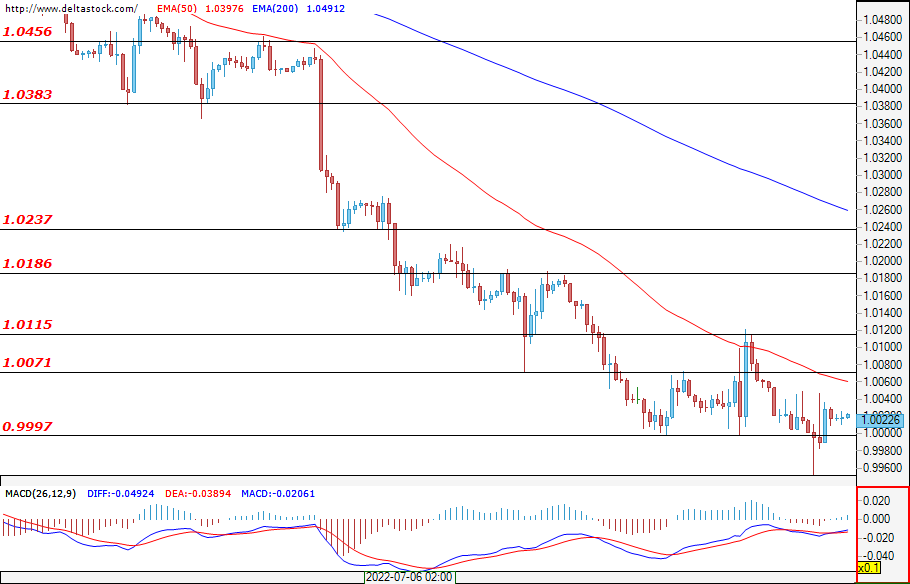
Today's trading session for the single European currency got off to a shaky start as the euro continues to trade near parity with the greenback. The one to one ratio with the dollar, however, proved to be a serious psychological support that stopped the powerful attack of the bears in recent days. Тoday, some of the macroeconomic news that would cause a strong movement for the currency pair, is the data on the import price index (12:30 GMT) and the retail price index (12:30 GMT). If the news is negative for the U.S. market and the bulls manage to turn the market in their favour, then the pair will most likely face resistance at 1.0071.
USD/JPY
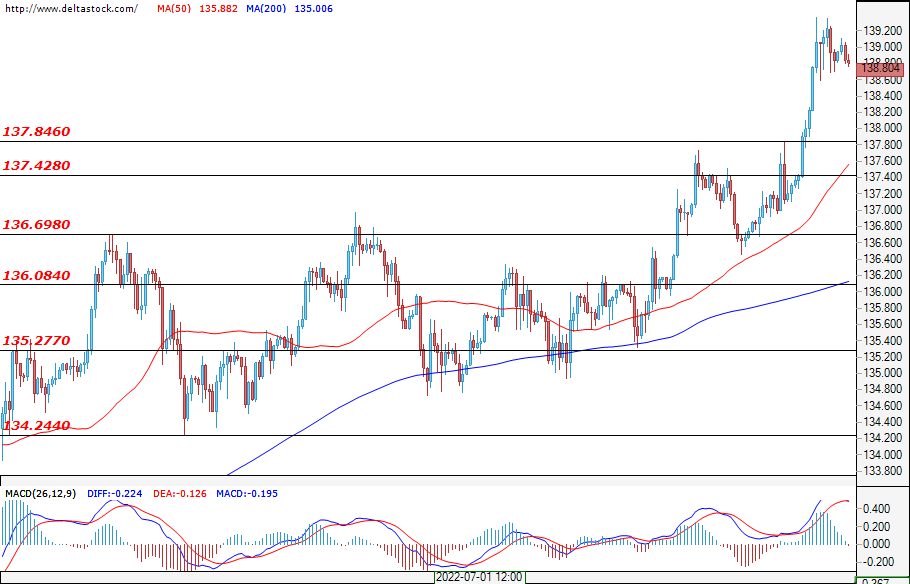
The trading session for the Ninja started with a slight correction in favour of the bears, but they are still far away from the nearest key support at 137.84. To find which resistance the bulls could face next, we would have to look at the historic market data from the past century. Today, no news from the country of the rising sun is expected to have a strong effect on the currency pair.
GBP/USD
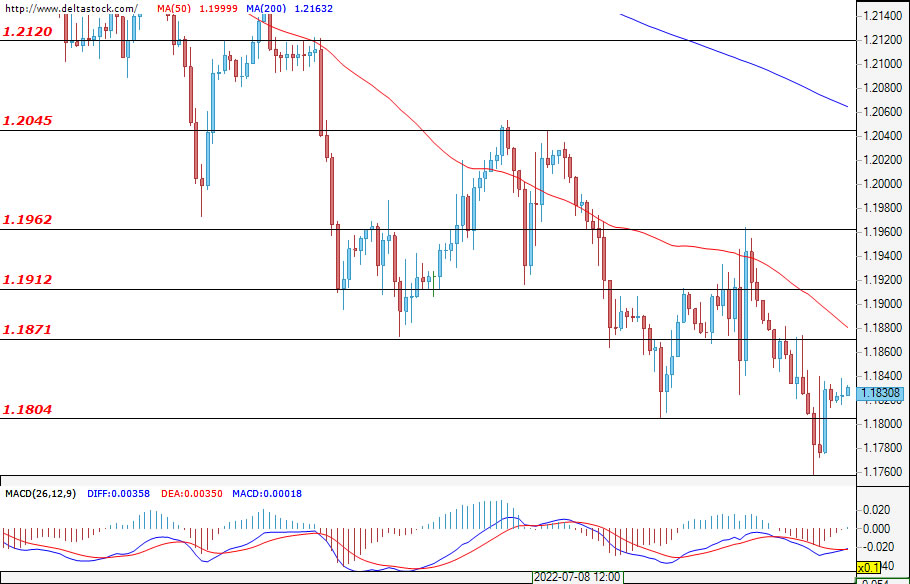
With the sterling, the trading session started with a move in favour of the bulls, but they still have a long way to go before facing their first key resistance at 1.1871. The next one is found at the level of 1.1912. If the bears manage to increase the selling pressure and continue their attack from the last few days, then they would need to breach the support at 1.1804. No news from the UK is expected to cause strong movements in the currency pair today.
EUGERMANY40
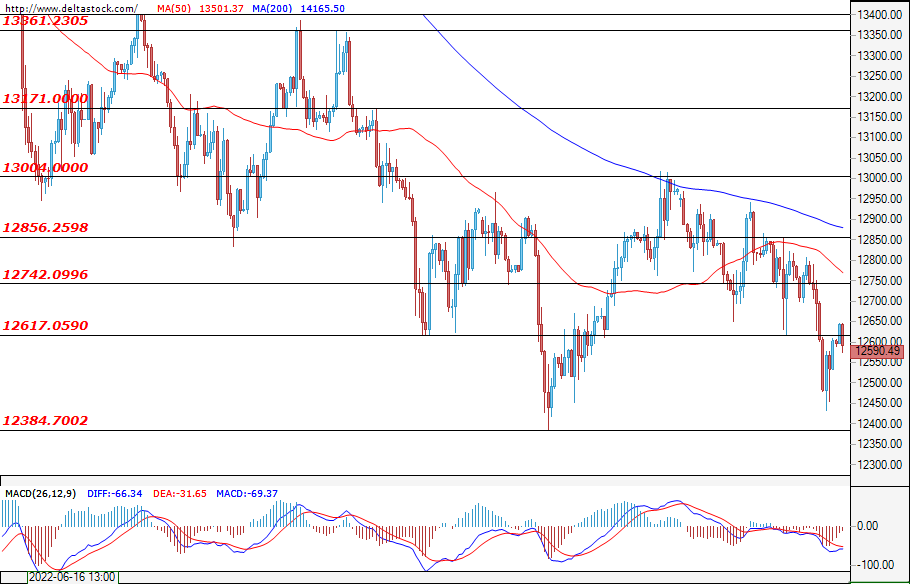
Today's sentiment is rather mixed when looking at the German index. The trading session started with a test of the key level at 12620. A success for the bulls would take them towards the resistance at 12740 and then towards that of 12850. If the bears manage to prevail, then they will most likely need to breach the support at 12380 as well. The events, which are expected to drive price action throughout the session, are the complicated political situation in Italy and the growing recession and inflation fears.
US30
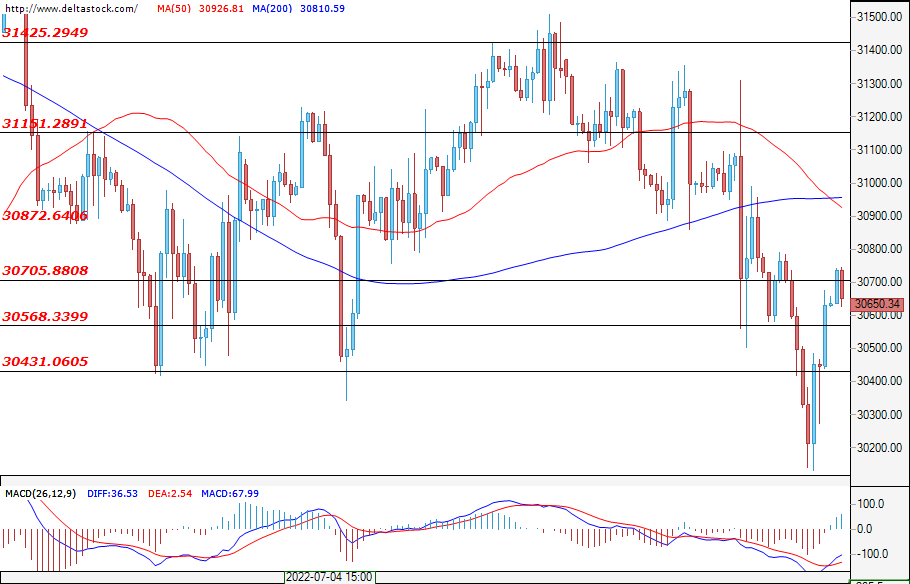
Yesterday, the U.S. blue-chip index successfully regained some of its lost positions. If the bulls manage to maintain this trend today and deal with the resistance level at 30705 in front of them, then they can try to test the next one at 30870 as well. If the bears manage to keep their weekly attitude and gain momentum, they will most likely have to overcome the support at 30570. The news, mentioned in the EUR/USD analysis, will be the main factors which could lead to increased volatility today.
US Dollar Rallies on Hopes of a 1% Rate Hike
The Dow Jones, Nasdaq 100, and S&P 500 indices declined after weak bank earnings. JP Morgan, the biggest American bank, saw its earnings decline by more than 20% after it added provisions for credit losses. Its total loans at the end of quarter were over $1.10 trillion, down from the previous $1.07 trillion. Meanwhile, Morgan Stanley said that its net revenue dropped to $13.1 billion while its net profit rose to $2.5 billion. These results show that the American economy is slowing dramatically as inflation rises. Other banks that will publish their results on Friday are Citigroup and Goldman Sachs.
The US dollar moved sideways after the US published more strong inflation data. According to the Bureau of Labor Statistics, the producer price index (PPI) rose from 10.9% to 11,3% in June. It also rose at a faster pace than expected on a month-on-month basis (from 0.9% to 1.1%). Excluding the volatile food and energy prices, the PPI rose by 8.2%. These numbers came a day after the US published strong consumer inflation data. Therefore, analysts expect that the Federal Reserve will embrace a more hawkish tone. In a statement, Fed’s Christopher Waller said that he supported a larger hike than it did in June. He said:
“If that data - retail sales - comes in materially stronger than expected, it would make me lean towards a larger hike at the July meeting to the extent it shows demand is not slowing down fast enough to get inflation down.”
The Australian dollar declined slightly after the latest economic data from China. The numbers revealed that the economy contracted in the second quarter as the country continued with its Covid zero strategy. Sadly, some cities have restarted lockdowns in a bid to fight the decease. The next key data to watch will be the upcoming US retail sales. Economists expect the data to show that the total sales rose by 0.8% in June after falling by 0.3% in the previous month.
EURUSD
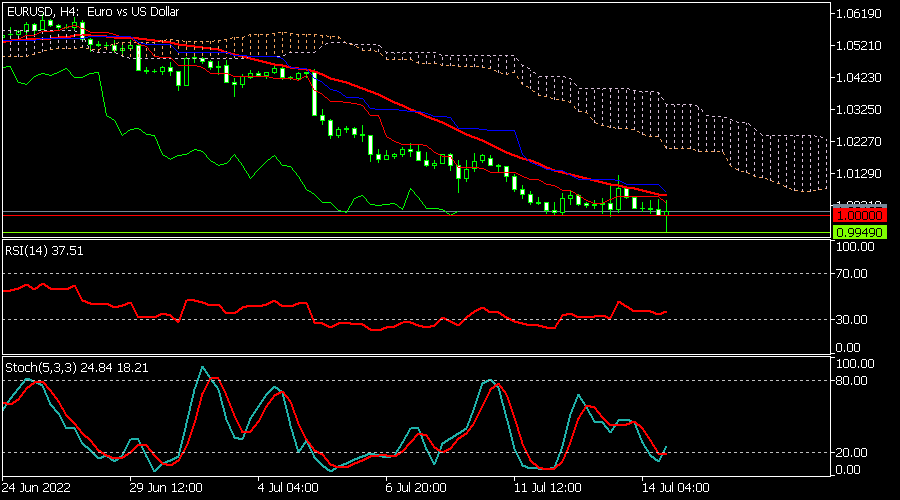
The EURUSD pair declined to a multi-decade low of 0.9950. It is now trading slightly above the parity level. On the four-hour chart, the pair moved below the 25-day and 50-day moving averages. It also moved below the Ichimoku cloud while the Stochastic Oscillator has moved below the oversold level. Therefore, the pair will likely continue falling as sellers target the next key support at 0.9900.
XBRUSD
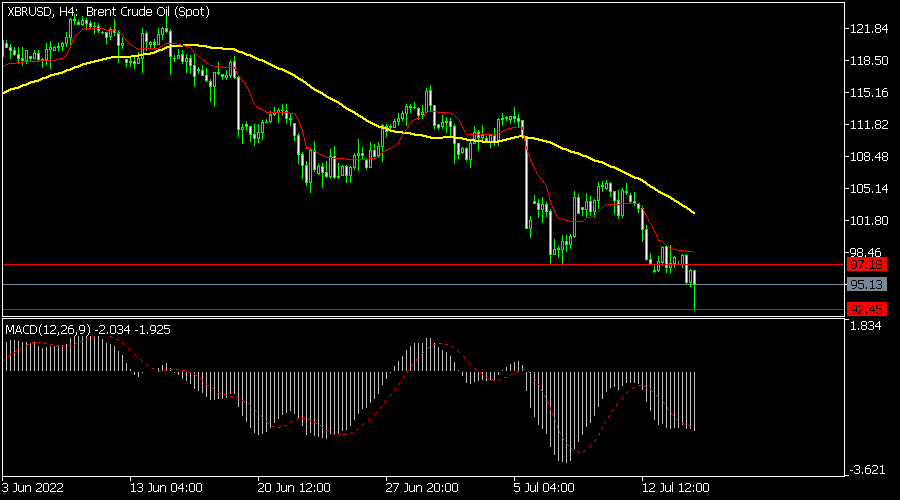
The XBRUSD pair declined to a low of 92.45 ahead of Biden’s meeting with Saudi’s crown prince and other Middle East leaders. The pair is now trading at 95.24, which is below the important support level at 97.18. It has moved below the 25-day and 50-day moving averages while the MACD has moved below the neutral point. The pair will likely keep falling as sellers target the support at 90.
USDCAD
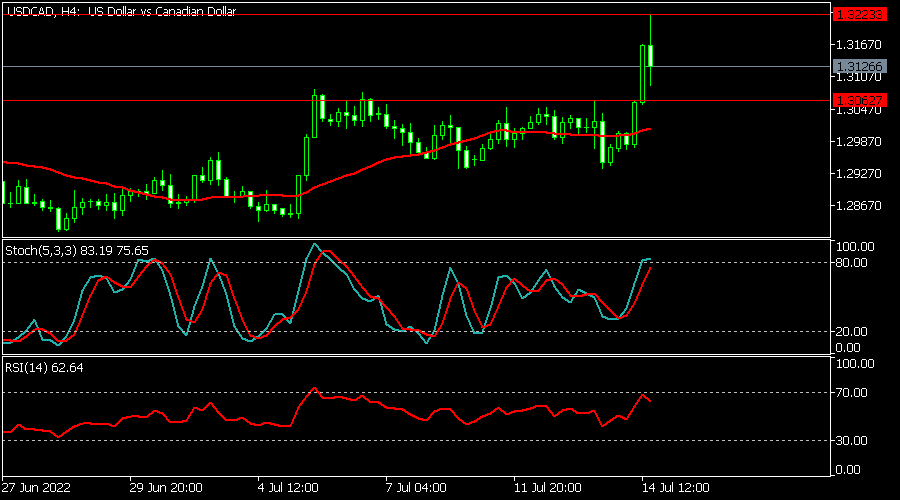
The USDCAD pair jumped sharply as the dollar strength continued. The pair rose to 1.3223, which was the highest point in years. It rose above the 25-day and 50-day moving averages while the Relative Strength Index and Stochastic Oscillator are pointing upwards. The pair will likely keep soaring ahead of the latest US retail sales data.
Nasdaq 100 Tests Key Support
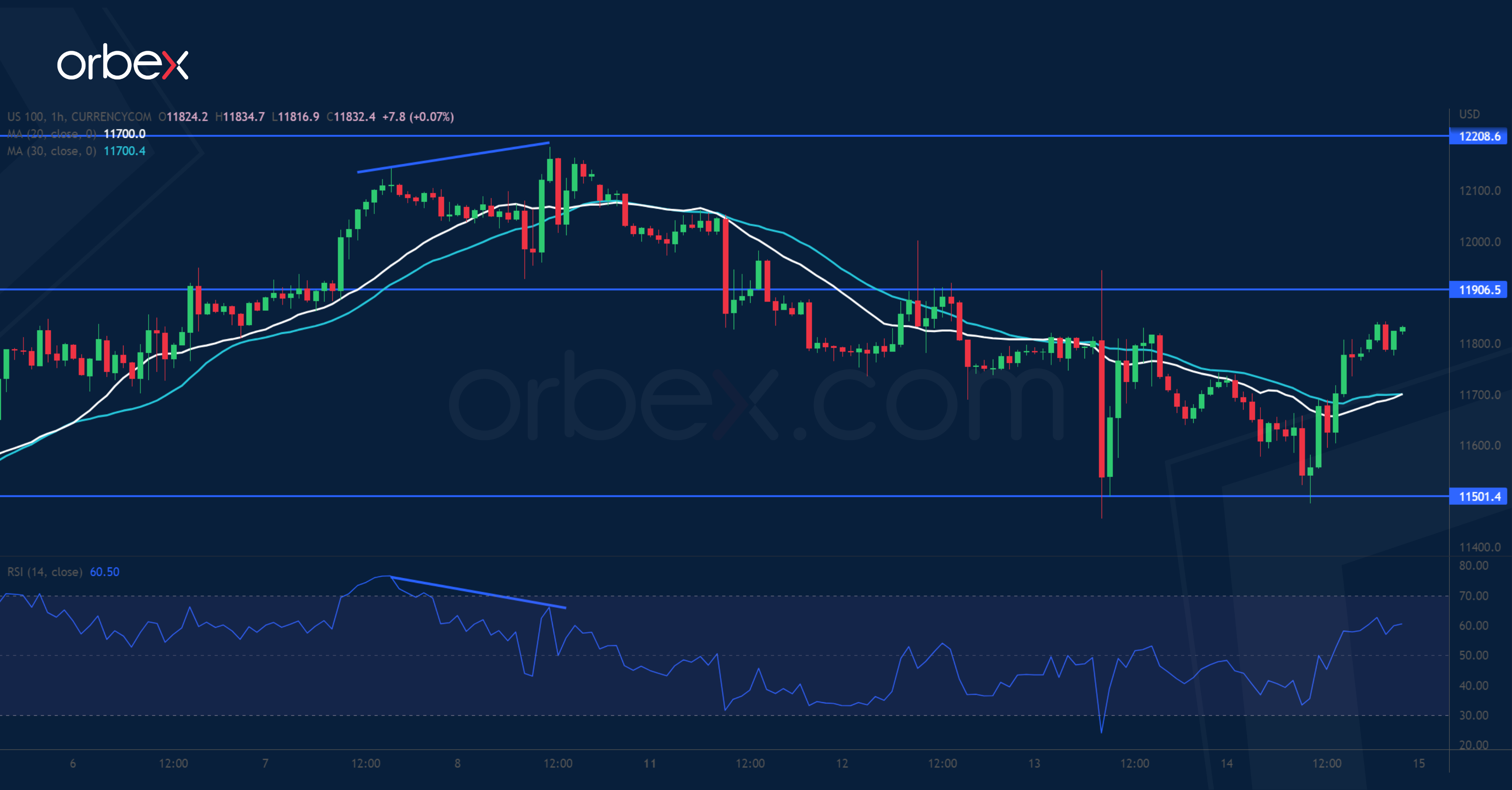
The Nasdaq 100 consolidates as investors assess second-quarter earnings. The index came to a halt at 12200 and a bearish RSI divergence showed a loss of momentum in that key supply zone. A drop below 11700 could be a confirmation that the bias remains down, putting buyers on the defensive. 11500 is a key level to keep the price action afloat. Its breach may send it to the daily support at 10500, where it could be vulnerable to a new round of sell-off. 11900 is a key hurdle to lift before a rebound could gain a foothold.
AUD/USD Stays in Downtrend
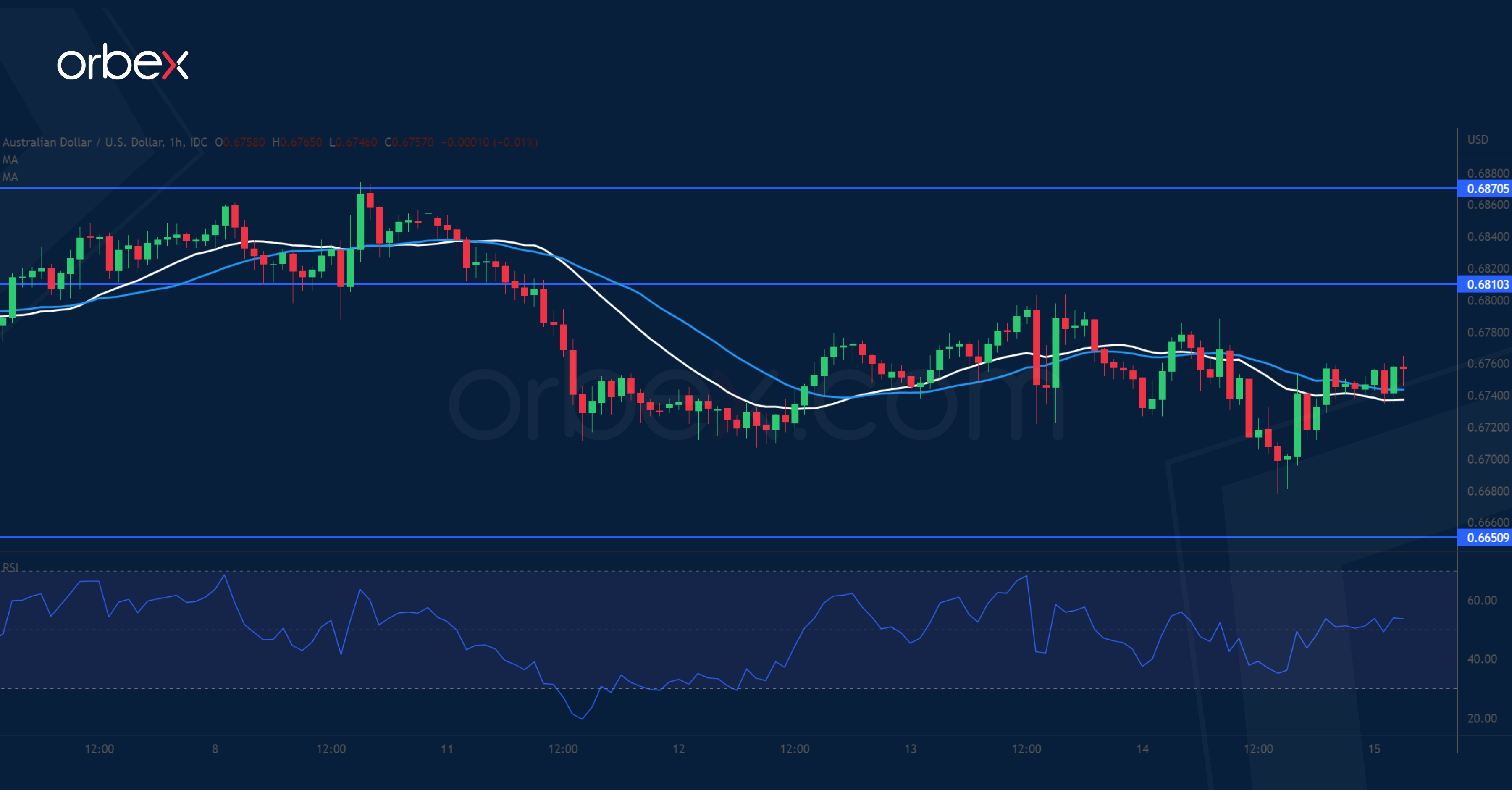
The Australian dollar found some support after the unemployment rate dropped to 3.5% in June. The RSI’s oversold situation caused a brief rebound but the price action remains under pressure after it failed to hold onto 0.6770. The bearish inertia may continue to attract trend followers and 0.6650 would be the next target after momentum pushed below 0.6710. On the upside, the support-turned-resistance at 0.6810 is the first to clear to ease the pressure and 0.6870 a major hurdle before a recovery could take place.
USD/CHF Seeks Support
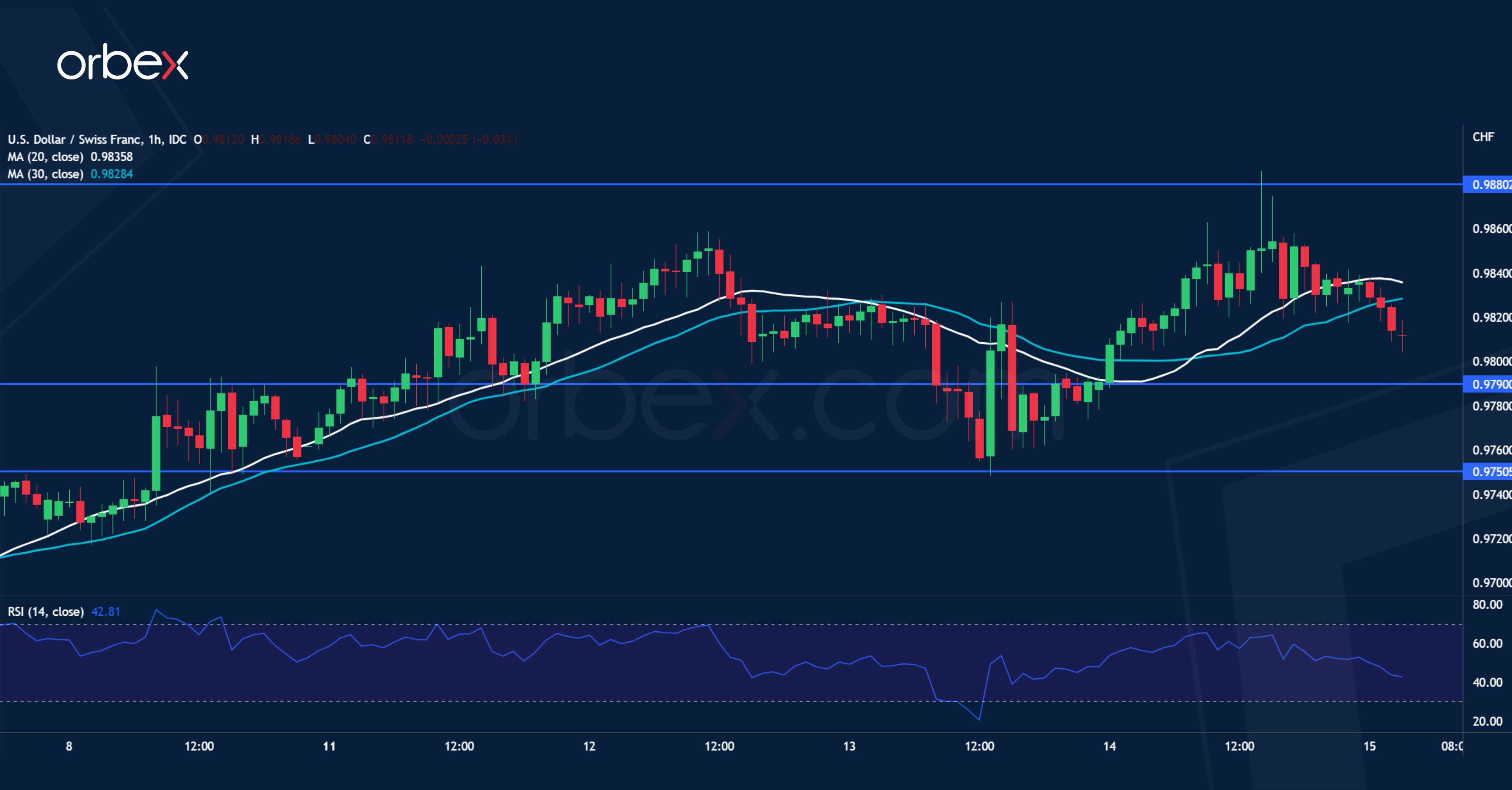
The US dollar bounces higher fuelled by expectations of a supersized rate hike after record high inflation. A short-lived pullback has met solid buying interest over 0.9750. A pop back above the recent high at 0.9850 confirms that the bulls are still in control of the direction. A bullish MA cross suggests an acceleration to the upside and could attract more bids in the process. Above 0.9880, the origin of the June liquidation at 0.9950 could be next, which would complete the W-pattern on the daily chart. 0.9790 is the first support.