Sample Category Title
Sunset Market Commentary
Markets
There’s no letting-up in the euro sell-off. Yesterday’s steep decline met with follow-through losses today, even as risk sentiment, for example on equities, turned for the better. The likes of the EuroStoxx50 are adding 2% though most indices are off intraday highs. Stocks in the US open with gains of 0.5%. In a way, the euro is even performing worse than yesterday since it’s losing against every G10 peer whereas on Tuesday the common currency still held the upper hand against Scandinavian currencies. The move originated from EUR/JPY, which fell through the 139 support zone (neckline double top formation) and shortly thereafter gave up on 137.85 (June correction low). EUR/USD is losing another 1% to trade around 1.017 and thus confirming Tuesday’s break. The pair is developing further lower in the downward trend channel with parity the first technical support zone. Same story for the Swiss franc. EUR/CHF is deepening losses to 0.989. Sterling shrugs at the political turmoil after two key ministers and a series of junior officials resigned yesterday. It didn’t even budge on reports that Tories are discussing to change the bylaws in order to have another leadership ballot. After the vote of no-confidence end June, the Tory party under the current rules cannot call for another one until next year. Instead, sterling even started to strengthen during a speech by the new minister of Finance Zahawi. In an echo to his predecessor Sunak, he said it is important to have fiscal discipline and his priority is to bear down on inflation. The latter also goes for the Bank of England. Chief economist Pill and deputy governor Cunliffe both expressed willingness to act more forcefully against inflation and said a 50 bps hike is on the table as soon as next month. Both previously expressed doubts for such a move. EUR/GBP for a third time (‘s a charm?) in less than a week dips below the upward sloping trend channel. It is currently trading in the 0.856 area. Central European currencies get whacked too, being at least as vulnerable to the energy crunch and its economic implications as the rest of Europe. The Hungarian forint extends a dramatic slide to EUR/HUF 415! The zloty touched EUR/PLN 4.80 before paring some losses to 4.78 at the time of writing.
The hefty repositioning on bond markets continued as well. Markets price out central bank action, believing they will start prioritizing growth, especially next year. Bunds again outperform US Treasuries with yield changes ranging from -3 bps (10y) to -12.6 bps (5y). The 10y yield quickly reversed an initial bump at the open and is currently testing critical support at around 1.15% extensively. US yields lose between 1.3 and 3 bps. The 10y yield over there is just a few bps away from similarly important support at 2.72%. Tonight’s hawkish Fed meeting minutes may be interesting to dive into but we doubt they will reroute market focus from growth currently back to inflation. Oil prices fail to recover from a sudden and sharp drop yesterday. Brent (-0.7%) dips to $102/barrel.
News Headlines
The Romanian central bank accelerated its tightening cycle again with a larger-than-expected 100 bps rate hike today, from 3.75% to 4.75%. They started in October last year with three 25 bps moves, followed by two 50 bps hikes in February and April and 75 bps in May. Romanian annual inflation rose faster than forecast in Q2, to 14.49% Y/Y in May. Core inflation hit 9.1% Y/Y. Q1 GDP was stronger than forecast at 6.5% annually, but high-frequency indicators point to a quasi-standstill of economic activity in Q2. The NBR closely monitors developments in the domestic and international environment and will continue to use the tools at its disposal to achieve the fundamental objective of price stability in the medium term (2.5% +-1 ppt).
The Belgian treaty of enterprises (Verbond van Belgische Ondernemingen) published its bi-annual economic dashboard. They signal out spiraling costs as the number one problem for companies. Belgian inflation exceeds 9% implying that wage costs will rise by around 11% (5 ppts more than neighboring countries) because of the automatic wage indexation system. Economic growth is expected to grind to a halt next year because of decreasing investments and a negative contribution of net exports. An upward wage-price spiral even risks triggering a recession in 2023.
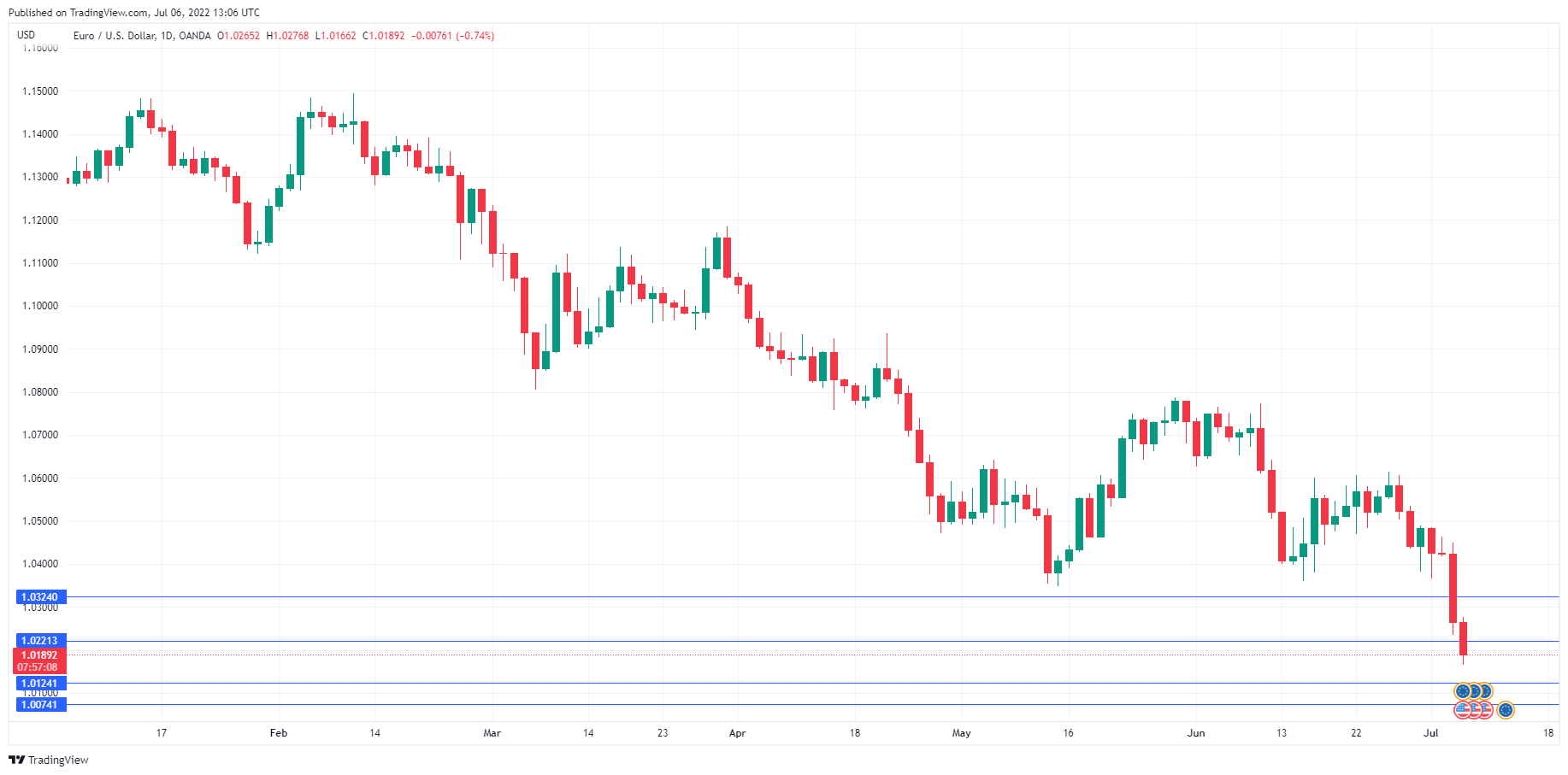
Euro Tumbles Below 1.02
The month of July has been an unmitigated disaster for the euro – with only three trading sessions in the books, EUR/USD has declined a staggering 2.73%. Earlier in the day, the euro dropped to 1.0186, its lowest level since December 2002. The euro appears headed for parity with the US dollar, a psychologically significant level.
The economic outlook in the eurozone is not an encouraging one. Inflation surged to 8.1% in May, surpassing the April record of 7.4%. A peak in inflation remains elusive, and the ECB is way behind the inflation curve – the central bank hasn’t raised interest rates yet, which are in negative territory. Even so, a lukewarm eurozone economy means that raising rates poses the risk of a recession. The energy situation has been deteriorating, as sanctions against Russia have led to counter moves in which Moscow has reduced its gas exports to Europe, which could result in an energy shortage this winter. If Russia reduces oil or gas exports to Europe, prices will soar and this could cause a severe economic downturn.
A strike by Norwegian oil and gas workers on Tuesday threatened to exacerbate the situation. The Norwegian government has stepped in and ended the strike, but investors remain nervous as the eurozone’s energy situation could become precarious.
Today’s data out of the eurozone showed some improvement but did little to raise risk sentiment. Germany’s Factory Orders rose 0.1% in May, up from -1.6% in April but still a negligible gain. It was a similar story for eurozone retail sales, which came in at 0.2% in May after a -1.4% read in April. On Thursday, Germany releases Industrial Production for May, which is expected to slow to 0.7%, down from 0.4%.
EUR/USD Technical
- EUR/USD faces resistance at 1.0124. Below, there is support at 1.0075
- There is resistance at 1.0221 and 1.0324
USD/JPY Outlook: Larger Bulls Likely to Resume after Extended Consolidation
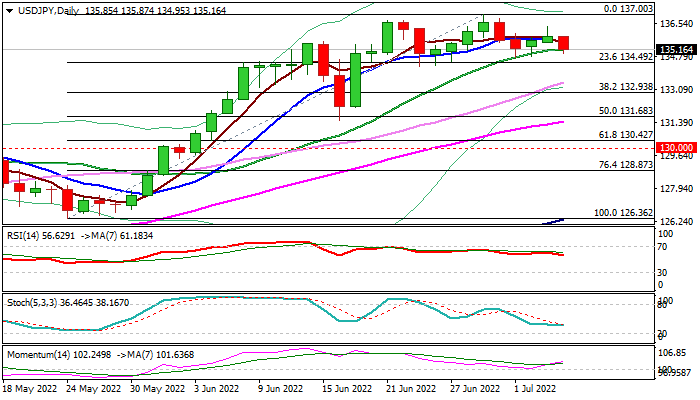
The USDJPY extends range trading into third consecutive week, as Doji candles in past two weeks signal strong indecision.
Repeated weekly upside rejection points to strong headwinds that bulls face, but the downside was so far well protected by Fibo support at 134.49 (23.6% of 126.36/137.00) where a higher base is forming.
The dollar remains well supported against the basket of its major counterparts, by risk aversion on strong migration into safety, due to darkening global economic outlook, suggesting that larger bulls are likely to resume after extended consolidation.
The near-term price action needs to hold above 134.49 to keep bias with bulls for fresh push towards new 24-year high at 137.00, violation of which would signal resumption of steep uptrend from 102.59 (Jan 2021 trough) towards targets at 139.92/140.00 (Sep 1998 high/psychological).
Only sustained break of 134.49 base would put bulls on hold and risk deeper correction.
Res: 135.87; 136.36; 136.70; 137.00.
Sup: 134.74; 134.49; 133.43; 132.93.
EUR/USD: Euro Falls Further after Break of Critical Supports, Eyes Targets at 1.0069/00
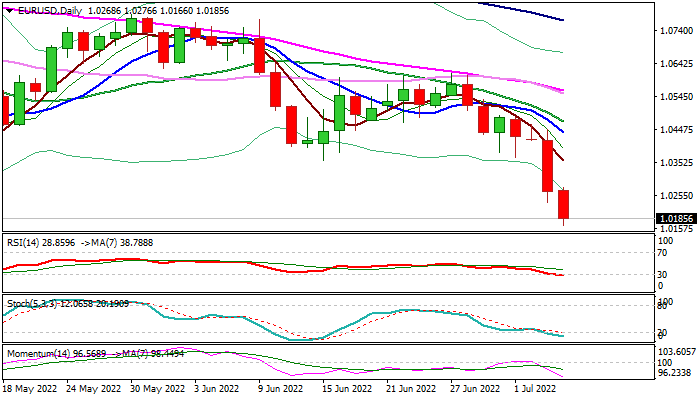
The Euro extends steep fall, sparked by strong risk aversion on growing recession worries and boosted by a break of critical technical supports that signaled a continuation of larger downtrend from 2008 peak (1.6039).
Fresh weakness pushed the price to new lowest levels since 2002, with increasingly negative fundamentals offsetting signals from oversold daily studies, though price adjustment can be expected in coming sessions, mainly to offer better selling opportunities for final push towards targets at 1.0069/1.0000 (Fibo 76.4% of 0.8225/1.6039 / psychological support).
Res: 1.0235; 1.0276; 1.0298; 1.0340.
Sup: 1.0166; 1.0100; 1.0069; 1.0100.
USD/JPY Mid-Day Outlook
Daily Pivots: (S1) 135.48; (P) 135.92; (R1) 136.31; More...
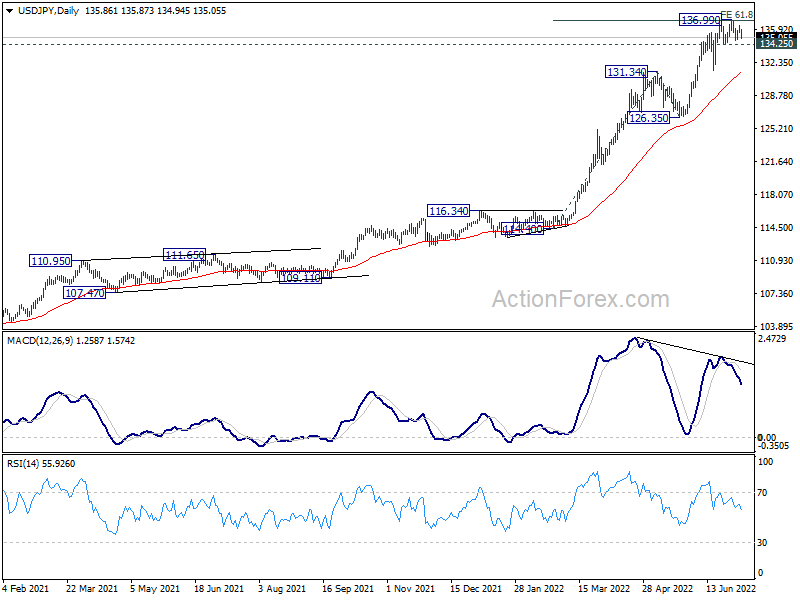
Range trading continues in USD/JPY and intraday bias remains neutral. On the downside, break of 134.25 support will confirm short term topping at 136.99. Considering bearish divergence condition in daily MACD, 136.99 might be a medium term top too. Intraday bias will be back on the downside for 131.34 support resistance turned support. Nevertheless, firm break of 136.99 will resume larger up trend to 100% projection of 114.40 to 131.34 from 126.35 at 143.29.
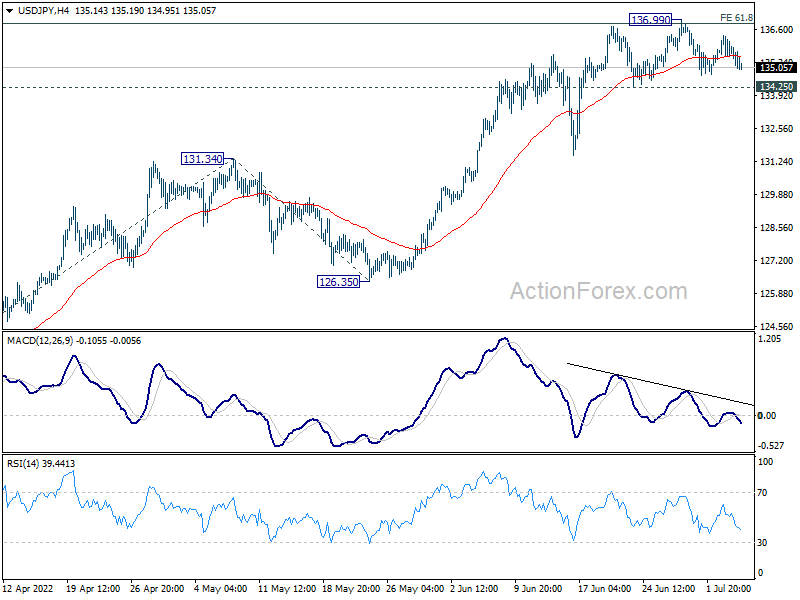
In the bigger picture, current rally is seen as part of the long term up trend from 75.56 (2011 low). Next target is 100% projection of 75.56 (2011 low) to 125.85 (2015 high) from 98.97 at 149.26, which is close to 147.68 (1998 high). This will remain the favored case as long as 126.35 support holds.
USD/CHF Mid-Day Outlook
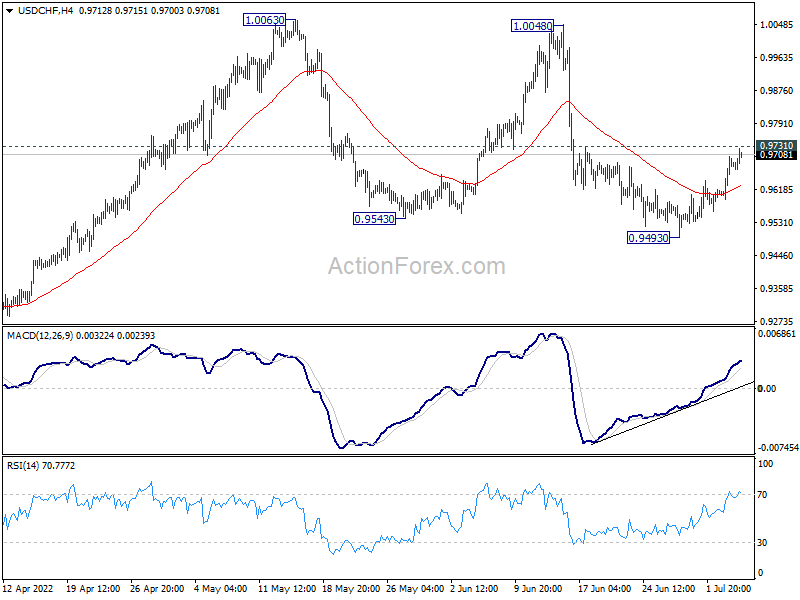
Daily Pivots: (S1) 0.9618; (P) 0.9662; (R1) 0.9730; More...
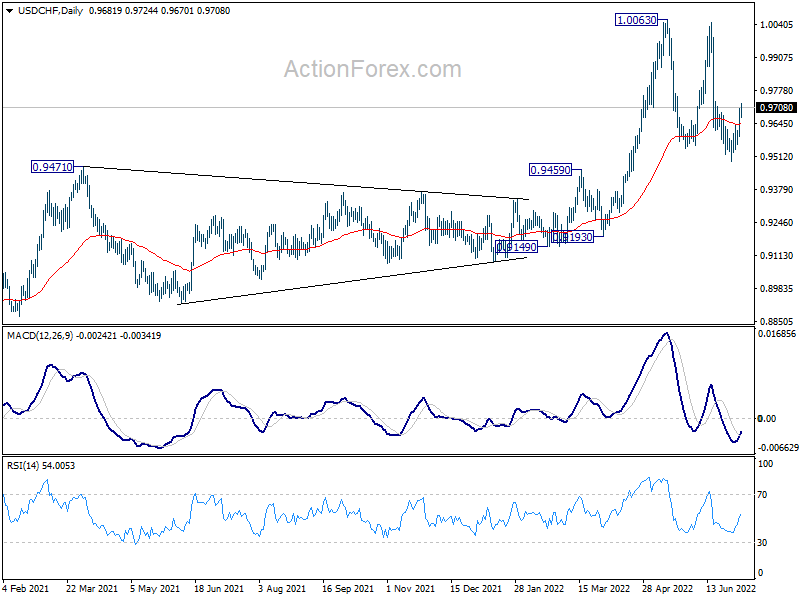
Immediate focus is now on 0.9731 resistance in USD/CHF. Firm break there will argue that the consolidation from 1.0063 has completed and bring stronger rally back to retest 1.0063 high. However, another fall below 0.9493 will dampen this view and target 0.9459 resistance turned support.
In the bigger picture, down trend from 1.0342 (2016 high) should have completed with three waves down to 0.8756 (2021 low) already. Rise from 0.8756 is likely a medium term up trend of its own. Next target is 1.0237/0342 resistance zone. This will remain the favored case as long as 0.9471 resistance turned support holds. However, sustained break of 0.9471 will extend long term range trading with another falling leg.
GBP/USD Mid-Day Outlook
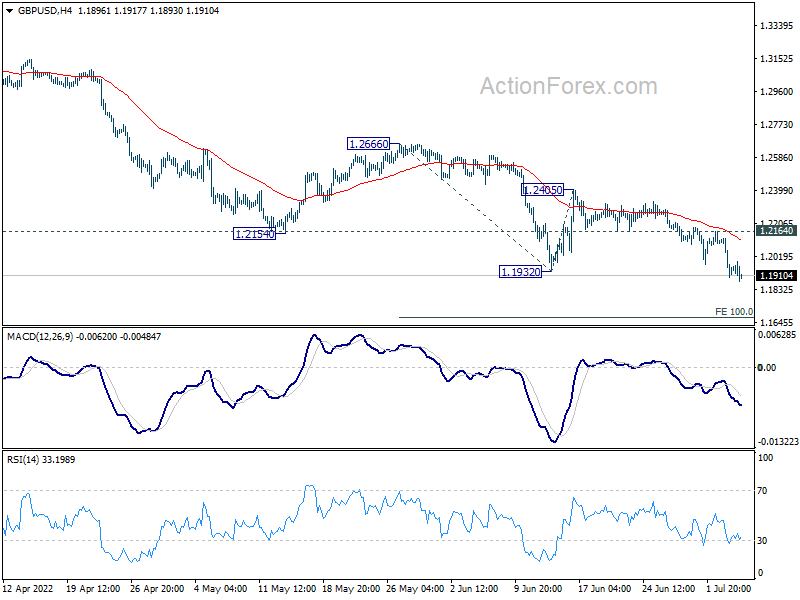
Daily Pivots: (S1) 1.1862; (P) 1.1993; (R1) 1.2088; More...
GBP/USD's down trend is still in progress and intraday bias stays on the downside. Next near term target is 100% projection of 1.2666 to 1.1932 from 1.2405 at 1.1671. Break could prompt further downside acceleration to 161.8% projection at 1.1217. On the upside, break of 1.2164 minor resistance will delay the bearish case and turn intraday bias neutral first.
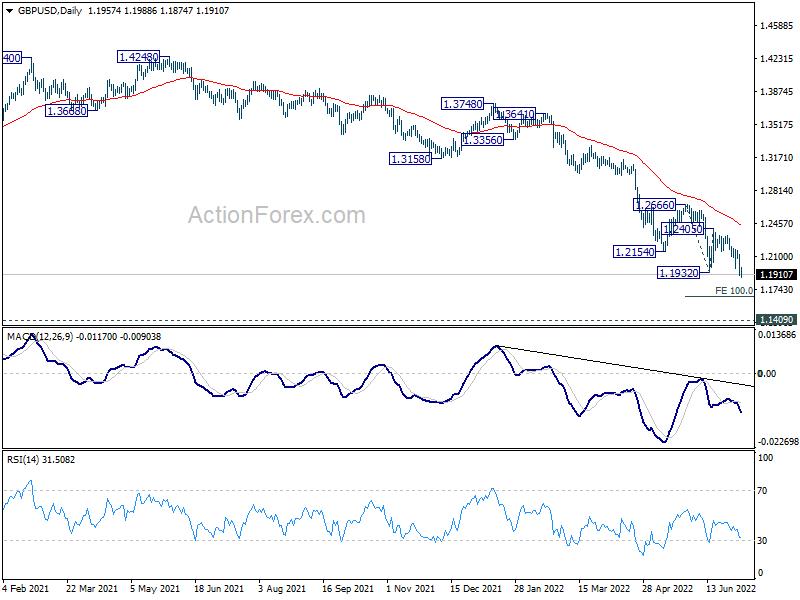
In the bigger picture, fall from 1.4248 (2018 high) could be a leg inside the pattern from 1.1409 (2020 low), or resuming the longer term down trend. Deeper decline is expected as long as 1.2666 resistance holds. Next target is 1.1409 low. However, firm break of 1.2666 will bring stronger rise back to 55 week EMA (now at 1.3103).
EUR/USD Mid-Day Outlook
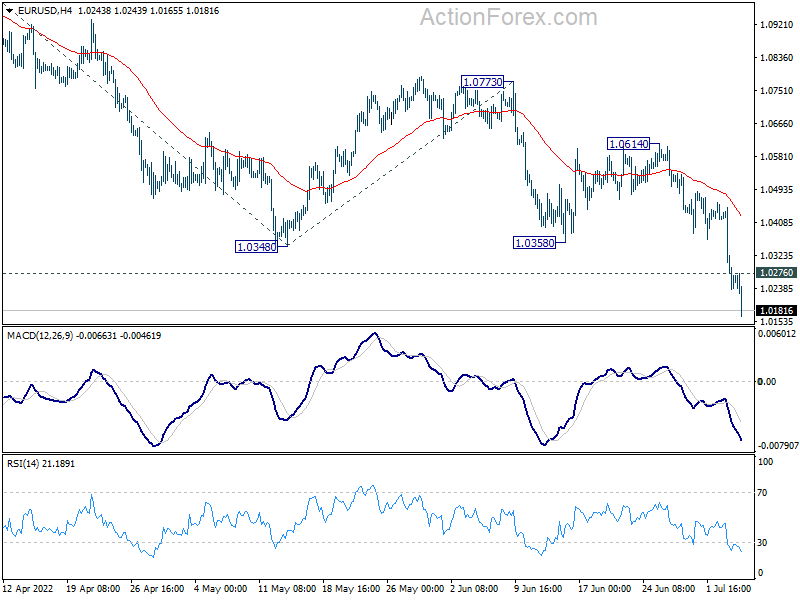
Daily Pivots: (S1) 1.0406; (P) 1.0435 (R1) 1.0452; More...
EUR/USD's down trend continues today and intraday bias stays on the downside for 1.0090 long term projection level. Break there will target 100% projection of 1.1184 to 1.0348 from 1.0773 at 0.9937, which is close to parity. On the upside, above 1.0276 minor resistance will turn intraday bias neutral and bring consolidations first. But recovery should be limited below 1.0614 resistance to bring another fall.
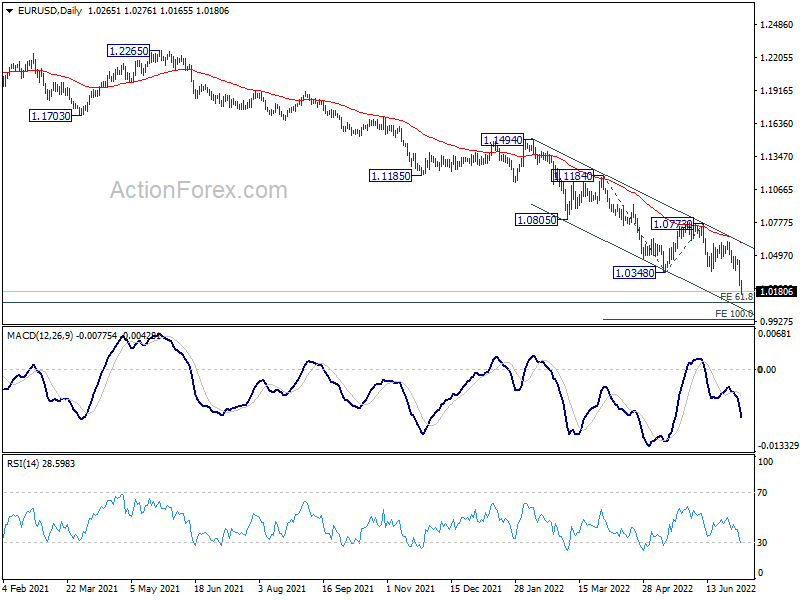
In the bigger picture, the break of 1.0339 long term support (2017 low) indicates resumption of whole down trend from 1.6039 (2008 high). Next target is 61.8% projection of 1.3993 to 1.0339 from 1.2348 at 1.0090. Sustained break there will pave the way to 100% projection at 0.8694. In any case, outlook will stay bearish as long as 1.0786 resistance holds, in case of recovery.
EUR/USD Marching To Parity as Selloff Continues
Selloff in Euro continues today, as it's marching towards parity against the greenback. Some noted that it's a perfect storm for the common currency, with stagflation risks, gas crisis, a prolonged war and fragmentation. Sterling is not too far behind with political uncertainties over Prime Minister Boris Johnson again, while Swiss Franc is also weak. Yen is staying is the strongest one, but Dollar is losing momentum to Aussie and Kiwi.
Technically, there are a couple of developments to watch. USD/JPY is still range bound but risk is growing for a break through 134.25 support to start a short to medium term correction. USD/CAD, on the other hand, is on the verge of breaking through 1.3077 to extend the medium term up trend. However, AUD/USD is resiliently holding on to 0.6762 support, and could stage a strong rebound through 0.6918 resistance to confirm near term reversal. It's unsure which ways these pairs could go and shape the next move in general.
In Europe, at the time of writing, FTSE is up 1.66%. DAX is up 1.35%. CAC is up 1.59%. Germany 10-yaer yield is down -0.113 at 1.071, heading back to 1%. Earlier in Asia, Nikkei dropped -1.20%. Hong Kong HSI dropped -1.22%. China Shanghai SSE dropped -1.43%. Singapore Strait Times dropped -0.01%. Japan 10-year JGB yield rose 0.0316 to 0.250.
BoE Pill unpacks MPC's most recent communications
In a speech, BoE Chief Economist Huw Pill unpacked the MPC's most recent communication about the outlook for monetary policy decisions.
The latest statement widened the discussions beyond the interest rate decision at August meeting. It reflected the "uncertainties" and "likelihood that we will have to take finely-balanced decisions over rates not just in August but also beyond that, in the face of two-sided risks to the economic outlook into next year."
By referring to "'any further increases in Bank Rate", the BoE talked about rate increases, not decreases. But at the same time, the reference to "any" increases "allows for the possibility of remaining on hold".
The focus on "indications of more persistent inflationary pressures" places emphasis on " identifying potential second-round effects in price and wage setting behavior". Thar prioritizes "the more persistent component of inflation developments over the headline spot measure."
By signaling preparedness to 'if necessary act forcefully in response' to indications of greater persistence in inflation, the statement reflected "both my willingness to adopt a faster pace of tightening than implemented thus far in this tightening cycle".
BoE Cunliffe sees signs UK economy is already slowing
BoE Deputy Governor Jon Cunliffe told BBC Radio today, "What we expect is, the cost of living squeeze will hit people's spending, and that will start to cool the economy. We can see signs that the economy is already slowing."
"We forecast over the next year or so that economic growth will be essentially flat," he said. "That's a very different picture to the picture we saw from 2009 to 2011. It's a picture of a slowing economy where people cut back on spending."
"It's our job to make sure that as this inflationary shock passes through the economy, at a time when we have also have a tight labor market, we don't find that a combination of a strong shock from abroad and energy prices combines with domestic factors and leaves us inflation being the new normal," he said. "People can have confidence that we will act to make sure that doesn't happen."
UK PMI construction dropped to 52.6, gloomy business outlook and worsening consumer demand
UK PMI Construction dropped from 56.4 to 52.6 in June, below expectation of 55.2. S&P Global noted that it's the weakest rise in construction output since September 2021. House building declined for the first time since May 2020. Business optimism dropped for the fifth month running.
Tim Moore, Economics Director at S&P Global Market Intelligence, said: "The gloomy UK business outlook and worsening consumer demand due to the cost of living crisis combined to put the brakes on construction growth in June. Commercial construction saw a considerable loss of momentum as clients exercised greater caution on new spending, while long-term infrastructure projects ensured a relatively resilient trend for civil engineering activity."
Eurozone retail sales rose 0.2% mom in May, EU flat
Eurozone retail sales rose 0.2% mom in May, below expectation of 0.4% mom. Volume of retail trade increased by 1.2% for non-food products, while it decreased by -0.2% for automotive fuels and by -0.3% for food, drinks and tobacco.
EU retail sales was unchanged for the moment. Among Member States for which data are available, the highest monthly increases in the total retail trade volume were registered in Cyprus (+9.0%), Croatia (+1.7%) and Portugal (+1.5%). The largest decreases were observed in Ireland (-6.5%), Finland (-2.8%) and Austria (-2.2%).
EUR/USD Mid-Day Outlook
Daily Pivots: (S1) 1.0406; (P) 1.0435 (R1) 1.0452; More...
EUR/USD's down trend continues today and intraday bias stays on the downside for 1.0090 long term projection level. Break there will target 100% projection of 1.1184 to 1.0348 from 1.0773 at 0.9937, which is close to parity. On the upside, above 1.0276 minor resistance will turn intraday bias neutral and bring consolidations first. But recovery should be limited below 1.0614 resistance to bring another fall.
In the bigger picture, the break of 1.0339 long term support (2017 low) indicates resumption of whole down trend from 1.6039 (2008 high). Next target is 61.8% projection of 1.3993 to 1.0339 from 1.2348 at 1.0090. Sustained break there will pave the way to 100% projection at 0.8694. In any case, outlook will stay bearish as long as 1.0786 resistance holds, in case of recovery.
Economic Indicators Update
| GMT | Ccy | Events | Actual | Forecast | Previous | Revised |
|---|---|---|---|---|---|---|
| 06:00 | EUR | Germany Factory Orders M/M May | 0.10% | -0.60% | -2.70% | |
| 08:30 | GBP | Construction PMI Jun | 52.6 | 55.2 | 56.4 | |
| 09:00 | EUR | Eurozone Retail Sales M/M May | 0.20% | 0.40% | -1.30% | |
| 13:45 | USD | Services PMI Jun F | 51.6 | 51.6 | ||
| 14:00 | USD | ISM Services PMI Jun | 54.5 | 55.9 | ||
| 18:00 | USD | FOMC Minutes |
GBP/USD Pair Climbed above the 1.1935 Resistance
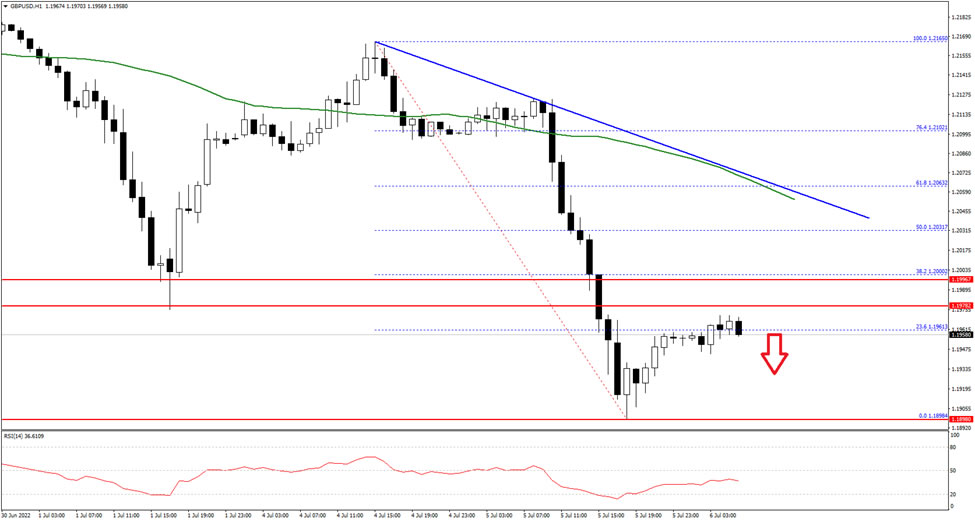
The British Pound started a fresh decline from the 1.2165 resistance against the US Dollar. The GBP/USD pair traded below the 1.2100 support zone to enter a bearish zone.
The pair even declined below 1.2000 and the 50 hourly simple moving average. A low was formed near 1.1898 and the pair is now correcting losses. It climbed above the 1.1935 resistance level.
The first major resistance sits near the 1.2000 zone. If there is a clear upside break above the 1.2000 resistance, the pair could rise steadily towards the 1.2030 level in the near term. The next major resistance sits near the 1.2050 level.
On the downside, an initial support is near 1.1920 on FXOpen. The main support is forming near the 1.1900 level. A break below the 1.1900 support could even push the pair below the 1.1850 support.