

Sample Category Title
EURCHF Targets Parity Amid Hawkish ECB and SNB
American stocks erased earlier gains after mixed economic data from the United States. According to the Conference Board, the country’s consumer confidence dropped from 103.2 to 98.7 in June. This was the lowest confidence data in over 9 years. Consumers are worried about the soaring inflation and slow wage growth. Additional data revealed that the country’s house prices continued rising amid a supply and demand imbalance. The house price index rose by 18% year-over-year. Meanwhile, data by the Commerce Department revealed that the trade deficit narrowed by $104.3 billion. Nike shares dropped even after the company published strong results.
The euro made a strong bearish breakout ahead of important economic data from the euro area. The European Commission will publish the latest consumer and business confidence data. Like in the United States, the expectation is that the bloc’s confidence continued dropping as the cost of living continued escalating. The euro also declined even after the hawkish statement by Christine Lagarde. In a statement on Tuesday, the ECB chair said that the bank will start hiking interest rates as inflation remained at elevated levels. The ECB meetings in Portugal will continue. Some of the speeches to watch will be Christine Lagarde’s and De Guindos.
The economic calendar will have some important events on Wednesday. The US statistics agency will publish the latest GDP and personal consumer expenditure (PCE) data. Economists expect the data to show that the economy contracted by 1.5% in the first quarter. This being the third estimate, the data will likely not have a major impact on the US dollar and American equities. The US will also publish the latest oil inventories data. Expectation is that inventories dropped again last week. The other key catalysts will be speeches by key central bank officials like Christine Lagarde, Jerome Powell, and Andrew Bailey.
EURUSD
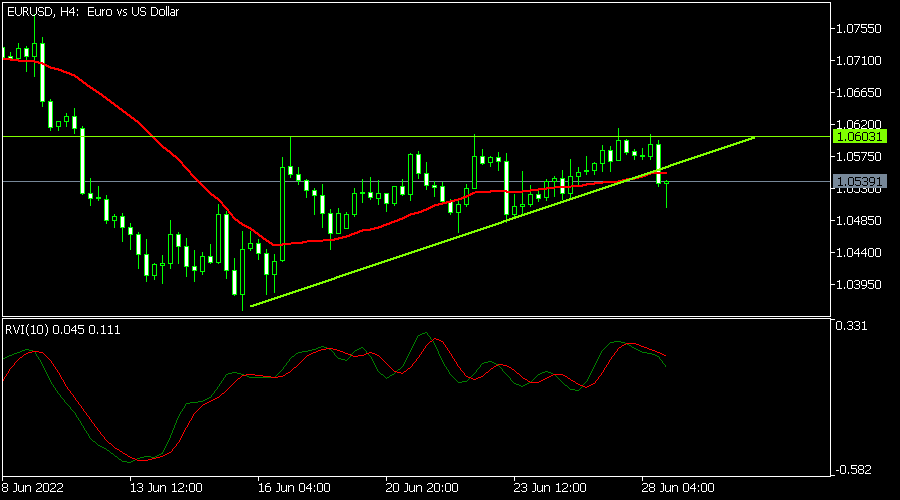
The EURUSD pair dropped to a low of 1.0500, which was the lowest level since June 23. On the four-hour chart, the pair managed to invalidate the ascending triangle pattern that has been forming. Now, the pattern resembles a triple-top, which is usually a bearish sign. The pair moved slightly below the 25-day moving average while the Relative Vigor Index (RVI) tilted lower. Therefore, the pair will likely continue falling as bears target the key support at 1.0450.
GBPUSD
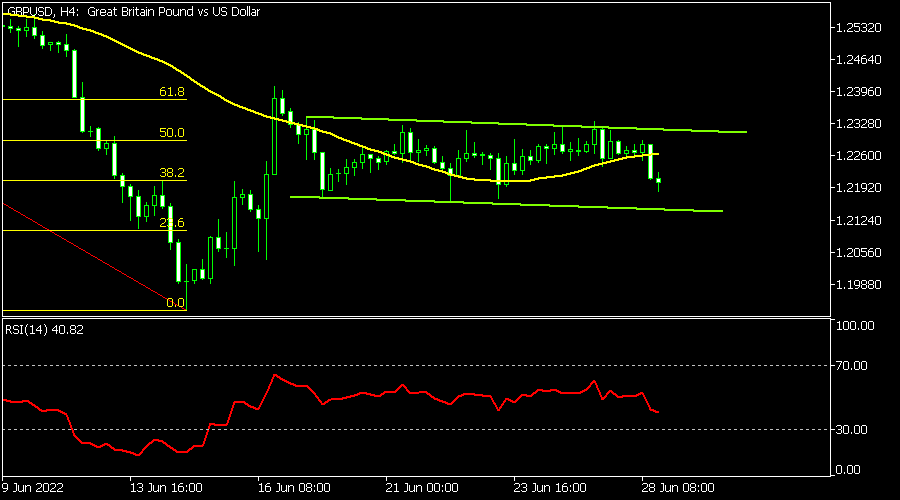
The GBPUSD pair dropped slightly after the weak US consumer confidence data. It fell to a low of 1.2178, which was the lowest level since Thursday last week. The pair has moved slightly below the upper side of the descending channel pattern. It has also dropped to the 38.2% Fibonacci Retracement level while the RSI has tilted lower. The pair will likely continue falling as bears target the lower side of the channel.
EURCHF
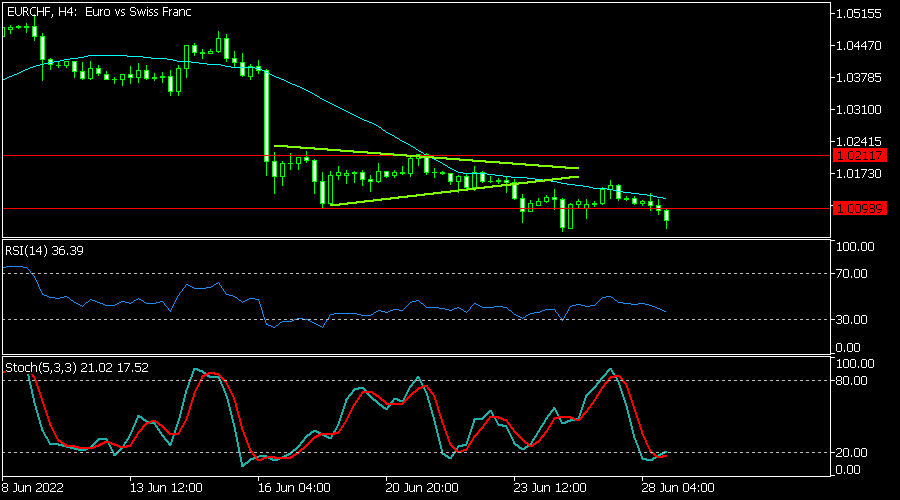
The EURCHF pair dropped to a low of 1.007 as the Swiss franc strength continued. The pair dropped below the 25-day and 50-day moving averages. The RSI and the Stochastic Oscillator have tilted lower. It also dropped below the key support level at 1.009, which was the lowest level on June 17. The pair will likely continue falling as bears target the parity level.
ECB Simkus: We should move decisively toward monetary-policy normalization
ECB Governing Council member Gediminas Simkus said that by July meeting, "should see some change in the data, some change in relation to what we have seen at the beginning of June". He added, "if we see this change in data that points to the persistence of inflation, to its acceleration, 50 basis points should be a policy option for July."
"With these levels of inflation and inflation being more and more broad-based, with wages growing in the euro area, we should move decisively toward monetary-policy normalization," said Simkus,
ECB has pre-committed to a 25bps rate hike in July. Another hike is also pre-committed for September, but the size would be dependent on incoming data.
USD/JPY Technical Analysis 29th June 2022
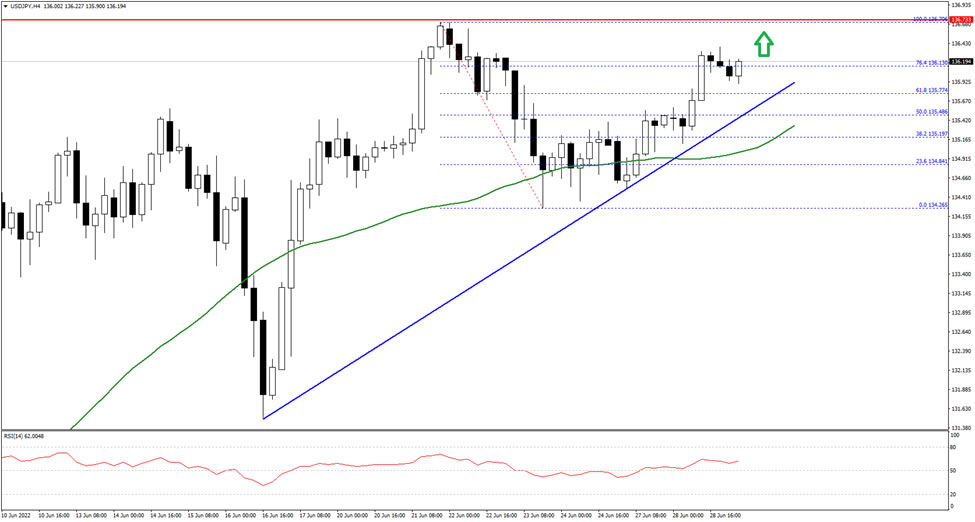
The US Dollar started a fresh increase from well below the 132.00 level against the Japanese Yen. The USD/JPY pair traded above the 134.50 resistance zone to start a fresh surge.
The pair even climbed above the 136.00 level and the 50 hourly simple moving average. The pair traded to a new multi-year high at 136.70 before there was a minor downside correction. USD/JPY is again rising and trading above 136.20 on FXOpen.
The first major resistance is near the 136.50 zone. A clear break above the 136.50 resistance could push the price towards 137.00. The next major resistance is near the 138.00 level.
On the downside, an initial support is near the 135.80 zone and a trend line on the hourly chart. The next major support sits near the 135.40 level, below which there is a risk of more downsides towards the 133.80 level.
NZDUSD Back to Multi-Month Lows; Negative Momentum Prevails
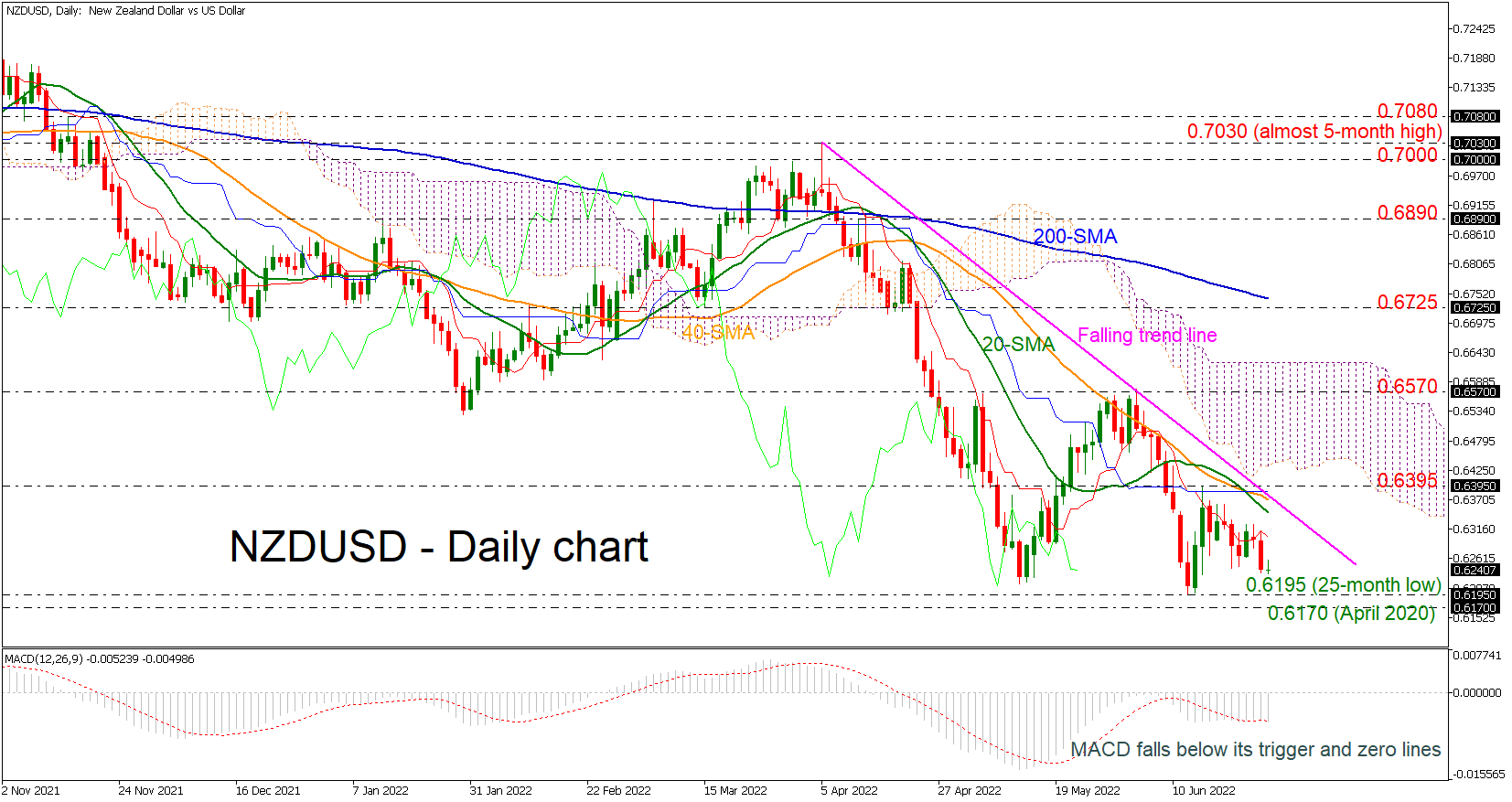
NZDUSD is recording another day of losses after a failed attempt to break significantly above the 0.6395 resistance level and the short-term descending trend line.
Chances for a reversal, however, are decreasing as the 20-day simple moving average (SMA) dropped below the 40-day SMA, while the red Tenkan-sen line has a steeper negative slope now, suggesting that the next move in the price is more likely to be down. The MACD continues to strengthen to the downside and below its red signal line, supporting this view as well.
Another step lower may reach a key support at the 25-month low of 0.6195, where the price stopped on June 15. Should this prove a weak obstacle, the selling could pick up speed until the April 2020 inside swing high at 0.6170, where any violation would bring more pressure to the market with the price probably stretching further down to test the 0.5920 mark, taken from the bottom on May 2020.
Alternatively, in case of a rebound, immediate resistance could come from the 20- and the 40-day SMAs at 0.6345 and 0.6370 respectively, which stands around the downtrend line and the 0.6395 resistance. Higher, the Ichimoku cloud and the 0.6570 barrier could also restrict upside movements, though only a close above the 0.6725 line and the 200-day SMA at 0.6740 would confirm the start of an uptrend.
In the longer-term picture the pair is still increasingly bearish as long as it holds below the falling trend line and more importantly well below the 200-day SMA.
Daily Technical Analysis
EUR/USD
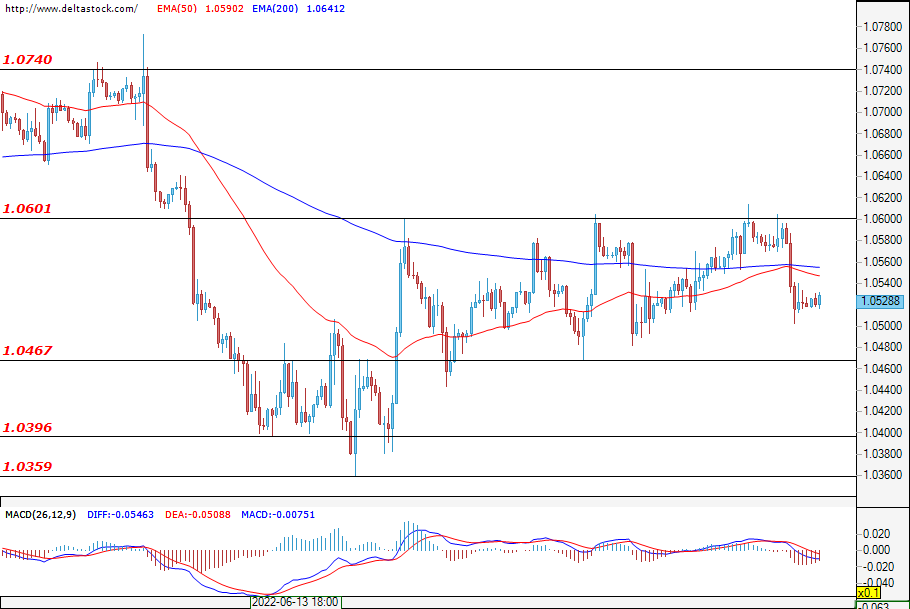
Just as expected, the disappointing data on consumer confidence for the United States sank the euro towards 1.0500. In the early hours of today, the bulls are trying to hold onto the zone, and the trading range of the pair remains locked between 1.0467 and 1.0601. The zone at 1.0467 was tested several times and immediately provided reliable support. If there is a new attack of the bulls on the resistance at 1.0601, it is likely that it will be breached and the pair will continue the rally towards 1.0740. At the moment, bad macroeconomic data supports a strong dollar and this hinders the appearance of sustainable rallies. The mood is therefore rather mixed and the market is waiting for a catalyst to start a trend movement. Today is expected to be a busy day in terms of calendar events, the most significant being a series of business and consumer confidence data for the euro area at 09:00 GMT, the GDP data for the U.S. at 12:30 GMT, and speeches by Christine Lagarde and Jerome Powell at 13:00 GMT.
USD/JPY
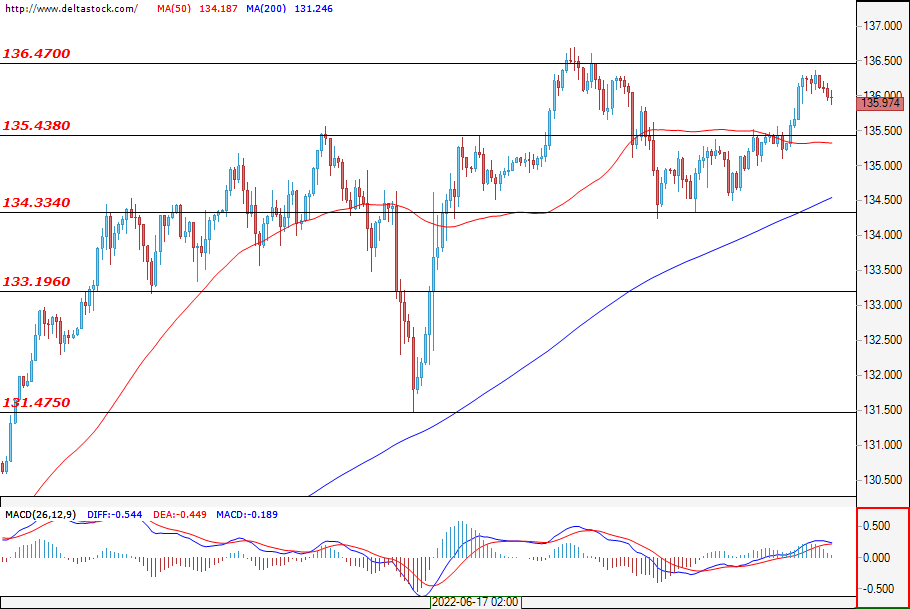
The pair marked another day of gains, but the bulls still failed to reach the resistance at around 136.50. If their pressure continues today as well, it is likely that the zone will be breached and the pair will mark new peaks. The uptrend remains strong, and at the moment, the price action does not show signals for a reversal of the trend. The first daily support is the zone at 135.43, and the most significant one is found at 134.33. As long as the extremely different monetary policies of the central banks of the United States and Japan are being maintained, this may allow the pair to reach levels as high as 141.00 in the long run.
GBP/USD
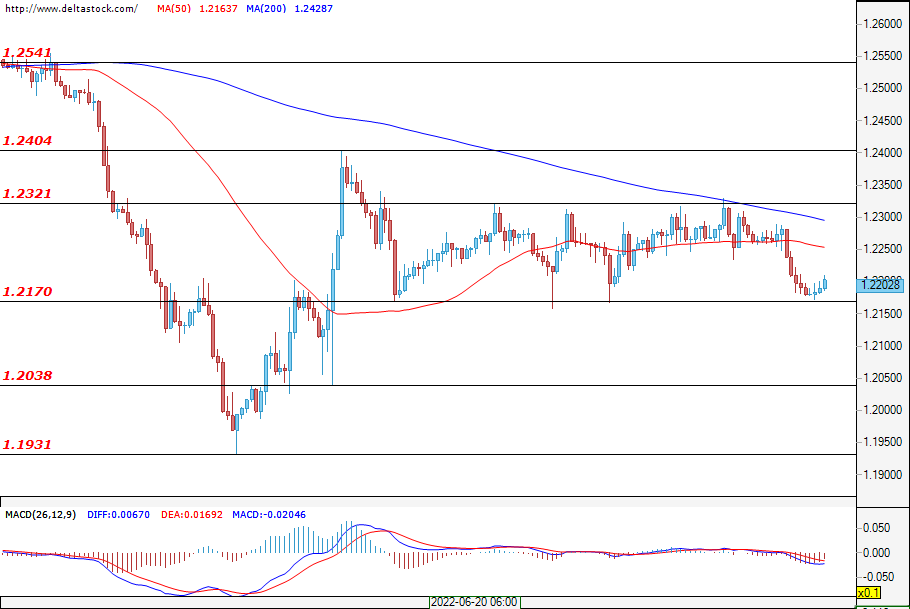
The sterling continues to trade in the range between the support at 1.2170 and the resistance at 1.2320 for a second week in a row. The duration of the range implies the accumulation of a large volume of positions, and therefore the creation of a strong movement upon its exit. The support at 1.2170 has proven to be reliable in the past, but the optimal scenario for the pair could be a false breach of 1.2170 in order to activate liquidity and a strong follow-up attack on 1.2320. At the moment, the market remains indecisive, and a rise in activity can be expected below 1.2170 or with a confirmed breach of 1.2320.
EUGERMANY40
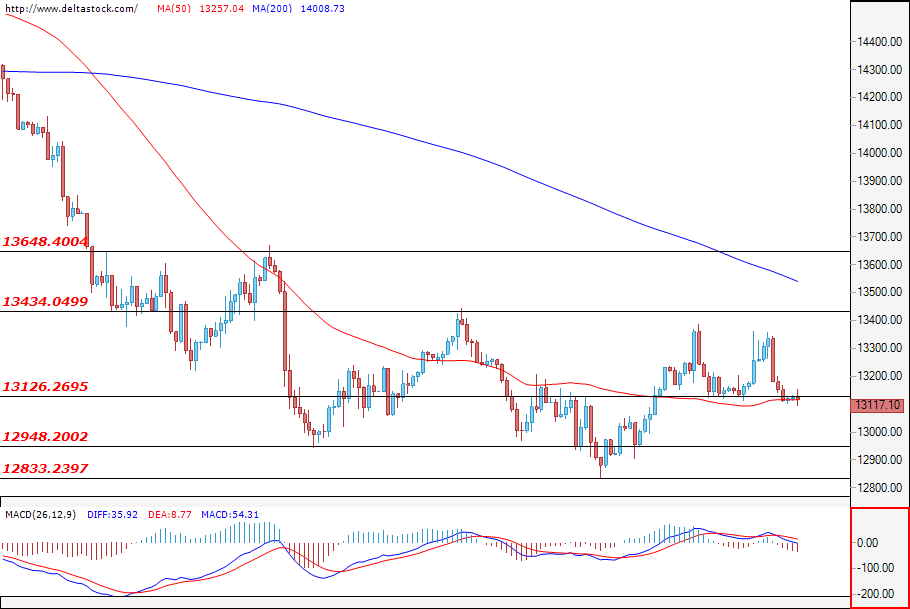
The German index failed to hold onto its gains during the day, and after the bad data from the United States, it was completely hammered. The bulls failed to reach the top at 13434 for a second day in a row. In the early hours of today, the support at 13126 was briefly violated, but the lack of new lows could renew bullish optimism. It is possible that the market will try to pressure the bears into liquidating their positions with a rally towards 13434 and even 13650. The first support is 13126, followed by the more significant levels of 12950 and 12830.
US30
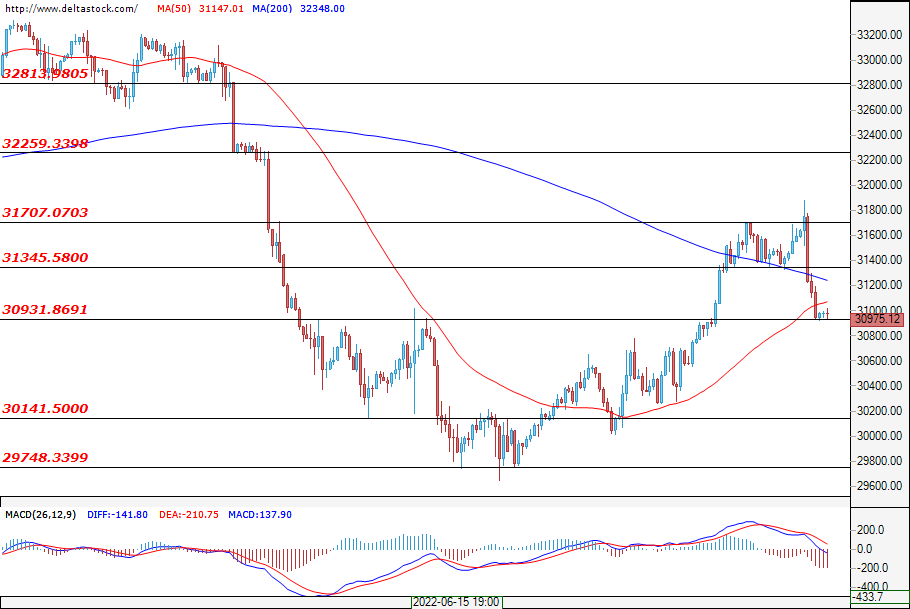
After a false breach of the 31700 resistance, the U.S. blue chips were aggressively sold out due to disappointing data on consumer confidence. The decline is currently limited by the 30930 support, but if the negative mood carries over today as well, then a new plunge can be expected towards the area at around 30500 and even 30140. The bulls still have a fighting chance due to the positive expectations linked to the books rebalancing of large funds at the end of the quarter. Fresh cash flows could raise prices, with the first resistances being 31345 and 31700. Today, markets will also expect the statement of the Fed chairman Jerome Powell at 13:00 GMT.
European Yields and Euro Took a Hit this Morning
Markets
European bonds continued to underperform their US peers yesterday. ECB Lagarde sharpened the central bank’s communication at the Sintra symposium. If necessary, the ECB would act in a determined and sustained manner to tackle inflation. Conditions under which gradualism would not be appropriate include a de-anchoring of inflation expectations or a more permanent loss of economic potential that limits resource availability (eg cut-off of Russian energy supplies). The German yield curve bear steepened slightly with yields rising by 6.1 bps (2-yr) to 8.3 bps (20-yr). Weak US eco data at the start of US trading triggered a turnaround in risk sentiment and supported US Treasuries. US stock markets eventually ceded 1.5% (Dow) to 3% (Nasdaq). The US yield curve bull flattened with yields ending the day up to 3.7 bps (20-yr) lower. June US consumer confidence and Richmond Fed Manufacturing Index started the rot in equities. Consumer confidence fell from a downwardly revised 103.2 to 98.7, the lowest level since February 2021. Details showed especially the expectations component responsible for the setback, both with regard to business conditions as with inflation developments. The Richmond Fed stands at its lowest since May 2020 with shipments (new orders and order backlogs) and employment taking a big hit while price pressure remains elevated. Forward looking indicators don’t make the most happy reading neither. The US Treasury concluded its end-of-month refinancing operation with a $40bn 7-yr Note deal. While it fared better than Monday’s 2-yr and 5-yr deals, metrics still couldn’t convince. The auction tailed with a setback in the bid cover. EUR/USD again failed to recapture the 1.06 handle despite the relative interest rate support with the dollar even clawing back. The pair eventually fell back to the low 1.05 area, both because of some upside fatigue as because of the U-turn in risk sentiment. EUR/GBP went nowhere around 0.8630. European yields and the euro took a hit this morning following the earliest German regional CPI reading for June. North Rhine Westphalia CPI printed at -0.1% M/M and 7.5% Y/Y which is softer than the expectations for the national gauge (0.4% M/M and 7.9% Y/Y). Apart from German numbers, also Spanish and Belgian CPI are due today. If they effectively fend off the worst case scenario of a CPI acceleration tomorrow, it adds to our Summer consolidation/correction phase on bond markets. It also implies that EUR/USD could be restricted to 1.0350/1.0642 rather than 1.0350/1.08. Especially in the sell-on-upticks risk environment. Other factors to watch today are June EC economic confidence numbers and a panel discussion with ECB president Lagarde, Fed Chair Powell, BoE governor Bailey and BIS chief Carstens. More technical factors, like end-of-month and end-of-quarter extension buying could have an influence as well.
News Headlines
The Hungarian central bank (MNB) yesterday delivered a monster-hike of 185 bps to bring the base rate from 5.9% to 7.75%. It’s a sharp U-turn compared to just one meeting ago, when it slowed the tightening pace to 50 bps as it entered a period more gradual tightening. The MNB announced that with the move it intends to close the gap with the one-week deposit rate, which will be increased on Thursday from 7.25% currently. Doing so makes policy more transparent and sends a clear signal to markets who got increasingly worried that the MNB lifted the foot off the brake too soon. Inflation continued to rise into the double digits in May, is expected to increase further and won’t be in line with the target before 2024. The Hungarian forint went in a tailspin in recent months (EUR/HUF north of 400), amplifying inflation dynamics. It strengthened to EUR/HUF 397.15 in the wake of the decision. The MNB said the tightening cycle will continue until the outlook for inflation stabilizes around the central bank target in a sustainable manner and risks become evenly balanced.
Elliott Wave View: Silver (XAGUSD) Has Resumed Lower
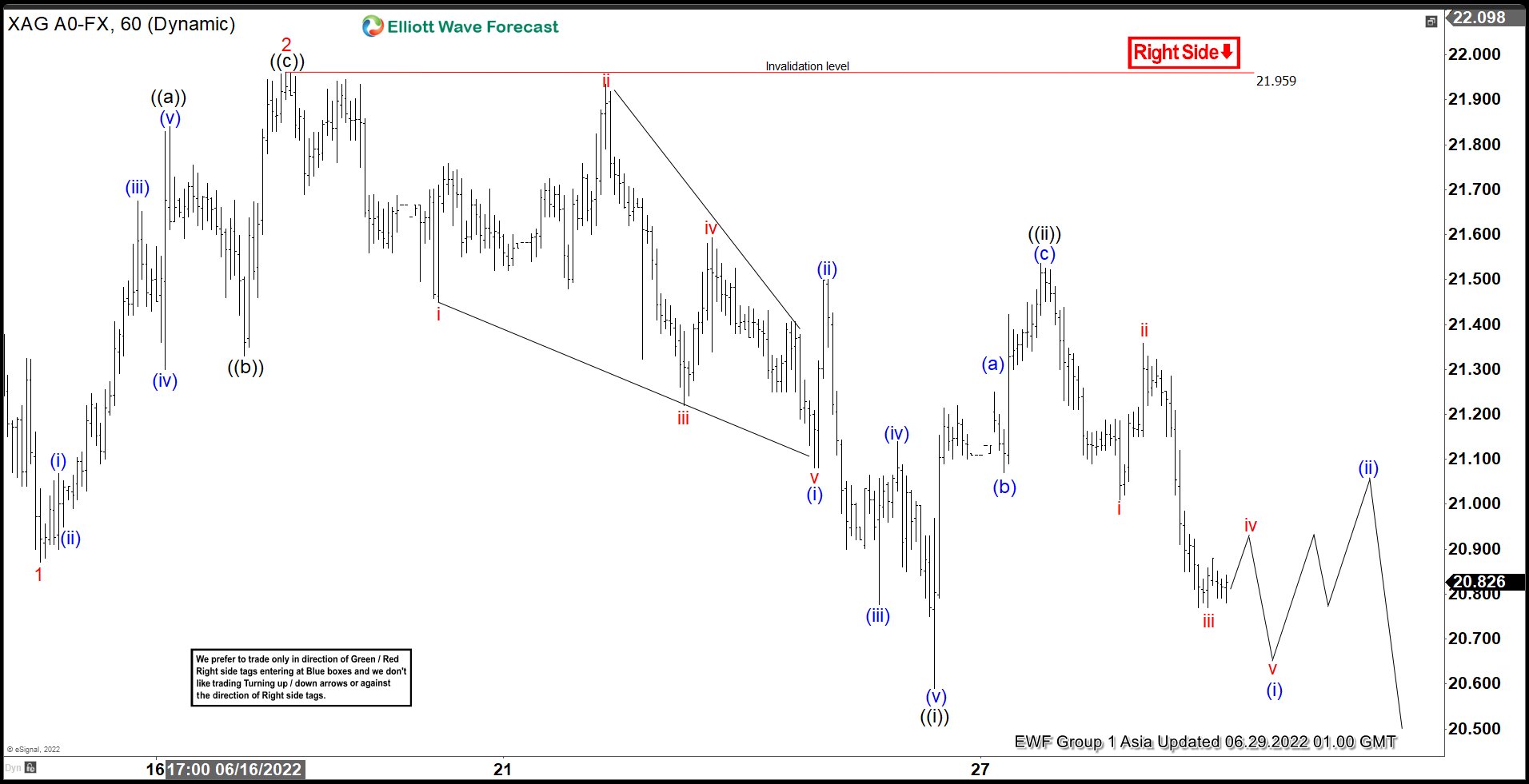
Short term Elliott Wave view in Silver (XAGUSD) suggests the decline from 6/6/2022 high is in progress as a 5 waves impulse Elliott Wave structure. Down from 6/6/2022 high, wave 1 ended at 20.87 and rally in wave 2 ended at 21.96. Wave 3 lower is now in progress and subdivides as another 5 waves impulse in lesser degree. Down from wave 2, wave (i) ended at 21.08 and rally in wave (ii) ended at 21.50. The metal then extends lower in wave (iii) towards 20.77, wave (iv) rally ended at 21.14, and final wave (v) lower ended at 20.59. This completed wave ((i)).
Wave ((ii)) correction ended at 21.536 with internal subdivision as a zigzag. Up from wave ((i)), wave (a) ended at 21.25, pullback in wave (b) ended at 21.07, and wave (c) higher ended at 21.536. This completed wave ((ii)). The metal has since turned lower in wave ((iii)). However, it still needs to break below wave ((i)) at 20.59 to rule out a double correction. Near term, as far as pivot at 21.959 high stays intact, expect rally to fail and the metal to extend lower.
Silver (XAGUSD) 60 Minutes Elliott Wave Chart
Bad Data, No Doves
Ugly economic data was responsible for a decent plunge in US equities on Tuesday.
The S&P500 slid 2% yesterday and Nasdaq took another 3% hit following a soft CB consumer confidence index and sharp fall in Richmond manufacturing index, hinting at softer economic activity as a result of tighter Federal Reserve (Fed) policy.
European futures hint at a bearish start today, though the firm oil and commodity prices should help FTSE tempering losses.
Oil up
The latest API data showed an almost 4-million-barrel decline in US oil inventories, versus 110’000-barrel fall predicted by analysts. The barrel of American crude extended to $113.50, and Brent jumped above $118 per barrel.
Sentiment remains comfortably bullish with the rising tensions between G7 and Russia. We still don’t have details regarding the price cap on Russian oil, yet a wrong move from G7 could upset Russians and lead them to cut the oil supply to Europe and worsen the energy crisis.
As a result, risks remain tilted to the upside, and traders see the price pullbacks as opportunities to strengthen long positions. There is a solid support between the 100-DMA, near $107pb, and the $100 psychological mark.
And, there is little chance OPEC does anything to give relief to the market.
Euro bulls lose steam
We have a plenty of central bankers speak today at a European Central Bank (ECB) event, including the Fed Chair Jerome Powell and the Bank of England (BoE) Governor Andrew Bailey. But all eyes are on Christine Lagarde.
Investors are craving for more details about the ECB’s mysterious antifragmentation tool, which should give the ECB a green light to get more hawkish on its rate policy, but the euro bulls are increasingly unconvinced that the new tool would magically solve the fragmentation problems.
The EURUSD should remain capped below its 50-DMA, unless the US dollar retreats suddenly. But softer dollar is not on the cards, as even bad economic data doesn’t help the Fed doves show up their beaks.
Risk-off Returns, Inflation Data in Focus
Market movers today
We look forward to the panel discussion between Bank of England's Bailey, Fed's Powell and ECB's Lagarde today at 15:00 CET and any clues of how policymakers plan to tackle global inflation pressures.
German and Spanish inflation figures for June will give important clues ahead of Friday's euro area HICP release. We expect that German HICP inflation will continue to rise, closing in on the 9% level, as government tax rebates on fuel are more than offset by continued rises in food and core inflation.
In Sweden, we get May figures for lending to households. In the NIER confidence survey we anticipate another weak(er) reading for consumers (indeed, the May retail sales was a real disappointment), construction (higher rates, lower housing prices) and possibly manufacturing (cf. the negative April PVI production print). We also look for signs of stabilisation in the so far simultaneous rise in manufacturing, services and retail selling price expectations that could signal a peak in price pressures.
The 60 second overview
Risk sentiment: Markets returned in a risk-off mode on Tuesday as recession fears took centre stage again. With month-, quarter- and half-year end approaching, portfolio rebalancing may explain some of the moves. Recently, it seems markets have been caught in between positioning for a 'peak inflation' and fine-tuning expectations of the necessary magnitude of central bank tightening vs. a 'stagflation scenario' where growth would slow down markedly but central banks would be forced to continue to hike aggressively as inflation remains high.
NATO summit: Finland and Sweden took historical steps on their path towards NATO membership yesterday as Turkey dropped its objection to the membership bids. In an MOU document signed on Tuesday, the three countries agreed on how to address Turkey's security concerns that have blocked Finland and Sweden's accession talks thus far. Already on Tuesday evening, there seemed to be different interpretations of what the text actually means as the Turkish Presidential Office announced Finland and Sweden would make changes in their legislation while the interpretation in Finland was that no such changes were required. Nevertheless, the MOU removes a key obstacle at this point and clears the way for the next steps in the accession process. We still expect it to take months until each member state has ratified the new Treaty after which the two countries will officially become members of the alliance.
G7: Yesterday, the G7 leaders agreed to explore further ways to prevent Russia from profiting from its warfare. For oil, they will consider options for a possible comprehensive prohibition of all services which enable transportation of Russian seaborne crude oil and petroleum products globally unless the oil would be purchased at discount. The leaders also committed to end new direct public support for the international unabated fossil fuel energy sector by the end of 2022, except in limited circumstances. According to G7, investments in LNG sector are necessary and can be promoted with public investments.
Equities slid lower over the session, ending in a sharp US sell-off after recession signals from macro data. The US underperformance was enhanced by big tech selling off again, with growth underperforming 170bp vs value which enhanced the US underperformance. All sectors dived except energy, led by tech, consumer discretionary and communication services. Interestingly, the recessionary trade, such as underperformance of banks and industrials, or for that matter small caps, did not materialize. Again, an illustration that markets have taken height of a lot of negativity. S&P 500 -2.1%, Nasdaq -3% Dow -1.6% and Russell 2000 -1.9%. Futures are higher this morning.
FI: After an initial sell-off from the morning, likely supported by improving COVID situation in China (shorter isolation period) as well as hawkish Kazaks saying that it is worth looking at 50bp in July, rates markets traded virtually sideways through the rest of the day. For Germany it was essentially a parallel shift on the day of the curves higher by 6-7bp across the maturities. With ECB month-, quarter- and half-year end, and absence of significant data releases, it has mostly been sideways trading this week, despite TLTRO early repayment set to settle today and last net purchases under the APP is to take place. Inflation data today will be closely watched.
FX: Amid risk appetite re-souring during the US session yesterday cyclically sensitive currencies such as SEK and GBP weakened while the USD gained. EUR/USD is now back towards the 1.05 threshold.
Credit: Credit markets went back into risk-off mode on Tuesday along with some of the major equity indices in Europe and the US. Itrax Main widened 3.1bp to close at 112.3bp, while Xover widened 14.4bp to close at 550.6bp. The Nordic real estate sector was especially hard hit on Tuesday, with hybrid capital on some of the stronger investment grade rated names, widening more than 100bp.
Dumb and Dumber
Readers should probably stop watching US stock markets for economic wisdom, as the price action overnight confirmed that part of the financial world has as little future insight as anywhere else. Last week, US equity markets rallied on the back of the arcane logic that a US recession would mean a lower terminal Fed funds rates and thus, was bullish for stocks, especially bombed-out tech stocks. That premise was boosted by weak Michigan Consumer Sentiment data last week.
Overnight, even weaker US Conference Board Consumer Confidence data provoked the opposite reaction, with US stocks plummeting. The nervous outlook was helped along by the Richmond Fed Manufacturing Index plummeting to -19 overnight, joining the ugly numbers from the Dallas Fed the night before. Both the Richmond and Dallas Services Indexes also fell heavily overnight. Equity investors continue to conjure up excuses to buy the dip, and I’m sure China cutting hotel quarantine to one week yesterday will elicit a similar reaction over there. Just remember, the virus only has to only get lucky once in China’s covid-zero world.
If the equity market's hope versus reality keeps revealing itself to be a paper tiger, currency markets appear to be something resembling the adult in the room. With the stock market rallies last week boosting risk sentiment across asset classes, the US Dollar traced out a modest retreat as Fed hiking zeal was downgraded. As equity markets decided that a recession isn’t good for stocks, after all, the US Dollar index managed to unwind almost all of last week’s retreat in just one session. USD/JPY is back above 136.00 this morning, and the Indian Rupee took a pasting to a new all-time low. Notably, US yields barely moved overnight so the Yen and INR have no excuse on that front. It seems that markets are far more comfortable rushing into the apparent safety of the US Dollar at the first sign of trouble, and I suspect that it was only a few Asian central banks' offers around that stopped the rest of USD/Asia from rallying.
The G7 Summit continues to be very busy with most attention focused on a mechanism to cap the price of Russian oil on international markets. Reuters is reporting that talks with China and India, about participating in the measures were “positive.” I’m still unsure about how such a mechanism would work, it seems to involve ramping up insurance premiums for seaborne cargoes so high that it drops the net price Russia would receive. It would need to be high enough to keep Russia pumping, but low enough to entice China and India to sign on, and not open arbitrage opportunities that would upset the other OPEC+ members. Game theory supercomputers will be burning the midnight oil, me thinks. I’m not sure how that plays with Russia and China’s “unlimited” partnership mind you?
For you and I, it would mean very little price-wise, and that’s certainly what the oil market thinks as well, as Brent and WTI futures rose once again overnight. The sell-off early last week looks increasingly like a culling of speculative positioning and I won’t buy a material fall in oil prices until the backwardation in the Brent and WTI futures curves shrinks markedly. That didn’t happen last week. OPEC and OPEC+ meet today and tomorrow, but we should expect a rubber stamp. Given that OPEC+ can’t even meet its present targets, and hasn’t for a long time, I expect no bearish surprises.
Today has been a mixed bag for Asia data-wise. South Korean Consumer Confidence fell sharply to 96.4, although local markets are likely more focused on reports that the Bank of Korea may enact a large interest rate hike if this month’s inflation data is above 6.0%. In contrast, Japan’s Retail Sales climbed to 3.60% YoY in May, with April’s number revised up slightly to 3.10%. The gradual reopening of the economy still seems to be playing out well domestically. However, Bank of Japan Governor Kuroda stated today that the increase in Core CPI above the targeted 2.0% was almost entirely due to the rise in energy prices. With that in mind, hold off on taking on the BOJ in the JGB market I say.
Elsewhere, Australian consumers are refusing to go quietly. Despite sharp cost-of-living increases, Australian Retail Sales unexpectedly rose by 0.90% this morning for May, the same as last month's number. I suspect this might be as good as it gets though, and with the Australian Dollar barely reacting to the data, the markets seem to think so as well.
Vietnam Industrial Production has outperformed today, and if Thailand Industrial Production does the same, as expected, this afternoon, that bodes well for the Asian ex-China PMI releases on Friday, although China’s PMI releases tomorrow and Friday have downside risks. Equity markets are holding up fairly well in Asia today, so either Asia is getting fed up following Wall Street’s histrionics, or the easing of inbound covid quarantine restrictions announced by China yesterday, is providing support.
This afternoon sees a slew of European business and consumer confidence data releases, as well as German Inflation for June. But all eyes and ears will be on the ECB summit in Portugal. ECB Chair Christine Lagarde will be speaking again after hawkish remarks yesterday. The main event will be Federal Reserve Chair, Jerome Powell, who is also speaking at the summit. As ever, markets will be dissecting his every word, looking for hints in this case, that the Fed is wavering on its hawkish bias as recessionary fears rise. They are likely to be disappointed, but it should be good for some intraday vol.
Asian equities resilient after Wall Street retreat
As mentioned above, Wall Street retreated sharply overnight as the FOMO gnomes decided that weak consumer confidence numbers and forward expectation sub-indices were perhaps not good for stock prices after all. The S&P 500 fell by 2.01%, the Nasdaq slumped by 2.98%, while the Dow Jones slipped by 1.58%. In Asia, the usual dip-buyers have appeared, lifting Nasdaq futures by 0.50%, and S&P and Dow futures by 0.20%.
Asian markets are mostly steady today, except for the Nasdaq correlated, retail-dominated ones such as Japan, South Korea, and Australia. China’s shortening of hotel quarantine requirements to a week announced yesterday is proving a supportive factor in the region today, although I can’t imagine it will result in a sharp increase in inbound visitors. Overall, although Asian markets are fairly much flat to lower, the falls are nowhere near reflecting the scale of the retreat by Wall Street overnight.
Japan’s Nikkei 225 has fallen by 1.05%, with South Korea’s Kospi slumping by 1.77%. the latter perhaps comminated by Bank of Korea rate hike fears. Mainland China markets have retreated more modestly, with the Shanghai Composite and CSI 300 are 0.50% lower. Hong Kong’s Hang Seng, meanwhile, has fallen by 1.0%.
In regional markets, Singapore, Kuala Lumpur and Manila have edged 0.15% higher, with Jakarta unchanged. Taipei has fallen by 0.80%. Australian markets have coat-tailed Wall Street south, the All Ordinaries falling by 1.25%, while the ASX 200 has lost 1.05%.
European markets appear set for a soft opening this afternoon after the Wall Street tumble overnight, although a move sensible response from Asia may take the edge off the negativity. Scandinavian markets could outperform once again after Turkey’s President Erdogan dropped his objections to NATO membership for Sweden and Finland overnight. Higher than expected German inflation could increase hiking fears by the ECB and weigh on equities, but realistically, it will all come down to the comments this afternoon by Ms Lagarde and Mr Powell at the ECB summit.
US Dollar stages impressive rally
The US Dollar rallied overnight, with the dollar index unwinding much of the last week's retreat in just one session. A slump by US equities sparked a rush to safety in the greenback, even as US yields were almost unchanged. The price action suggests that bounces in risk sentiment lack conviction at this stage. The dollar index rose by 0.50% to 1.0450 overnight, easing to 104.41 in Asia. Support remains at 1.0350 and 102.50, with resistance at 105.00 and 1.0570
EUR/USD fell by 0.575 to 1.0503 overnight, rising to 1.0525 in Asia with US equity futures. Resistance at 1.0600 and 1.0650 has once again proved insurmountable and failure of 1.0500 sets up a test of support at 1.0450 and 1.0400. The single currency still looks rangebound overall and volatility will be driven by comments from Lagarde and Powell this afternoon.
Sterling fell 0.67% to 1.2185 overnight, rising to 1.2200 in Asia. It has shown surprisingly little response to Scotland’s court challenge to hold another separation referendum, with the fall overnight mostly due to US Dollar strength. GBP/USD has initial resistance at 1.2300, 1.2360 and 1.2400, with support at 1.2175 and 1.2160. Failure of 1.2160 on a closing basis suggests a renewed move lower towards 1.1950.
USD/JPY is back above 136.00 this morning, a notable signal of further Yen weakness ahead after US yields were unmoved overnight. USD/JPY climbed 0.50% to 136.15 overnight, where it remains in Asia, seeing none of the slight US Dollar weakness in other parts of the currency space in Asia today. USD/JPY has support at 134.25 and 132.00, with resistance at 136.65 and 138.00.
Asian currencies were surprisingly resilient overnight, hardly moving as the US Dollar strengthened in the DM space. The exception was the Indian Rupee, with USD/INR climbing 0.75% to 78.922 overnight, another record low. US Dollar long-covering in Asia has pushed USD/INR lower to 78.676 today but it remains well above its previous day's close at 78.338. An easing of inward quarantine restrictions by China yesterday seems to be providing some support to regional currencies, as it is equities, and central banks have likely been smoothing via US Dollar sales. If the US Dollar rally continues this week, Asian currencies are likely to start buckling again.
Oil’s rally continues
Oil’s march higher continued unhindered overnight, with Brent and WTI posting another set of impressive gains. A surprise drop by US API Crude Inventories by 3.8 million barrels helped the bullish momentum, with markets ignoring the rise in refined product stocks. Disruptions to Libyan and Ecuadorian production were supportive, but the Macron's remarks yesterday around Saudi Arabia and the UAE’s limited production capacity seems to have been the main driver.
OPEC meets today and tomorrow, but the meeting is likely going to be just a rubber stamp exercise this month. More important will be tonight’s US official Crude Inventory data from the EIA, which is a double header release, including last week's delayed release due to technical issues. With two weeks of data coming out, it will be a bit of a turkey shoot tonight and we can expect plenty of volatility around the release. I am not going to predict the outcome on this one, but I believe the oil price downside remains limited.
Brent crude rose by 2.40% to $118.15 overnight but has retreated by 1.30% to $116.70 a barrel in Asia today. WTI rose by 1.90% to $111.90 overnight, falling 0.90% to $111.00 a barrel in Asia. The price action seems to be in line with the general correction lower by the US Dollar in Asia today.
Notably, Brent crude tested and held its rising longer-term support line, today at $108.00, and its 100-day moving average (DMA) last week. That is a technical development that should be respected. Brent crude has support at 115.75, and then 111.50. Resistance here at $118.50, and then $120.00 a barrel.
WTI’s technical picture has improved markedly overnight after regaining its rising 2022 support line at $108.00 a barrel. It has resistance at $112.50 which clears the way for a retest of $116.00. Support is at $109.75 and then $108.00 a barrel.
Gold is sleepless in Singapore
Gold remains the forgotten asset class, finishing 0.15% lower at $1820.00 overnight, before creeping up to $1821.00 an ounce in Asia today. A series of lower daily highs suggests that downside risks are increasing for gold prices, although it still lacks momentum to break out of the $1800 to $1900.00 range. Bring a good book until we see a large directional move by the US Dollar.
Gold has resistance at $1840.00, $1860.00, and $1880.00, the latter appearing an insurmountable obstacle for now. Support is at $1805.00 and then $1780.00 an ounce. Failure of the latter sets in motion a much deeper correction, potentially reaching $1700.00 an ounce. On the topside, I would need to see a couple of daily closes above $1900.00 to get excited about a reinvigorated rally.