Sample Category Title
China PMI manufacturing rose to 50.2 in Jun, non-manufacturing up to 54.7
China official PMI Manufacturing rose from 49.6 to 50.2 in June., above expectation of 49.6. Sub-index for production rose to 52.8, highest since March 2021. PMI Non-Manufacturing rose from 47.8 to 54.7, above expectation of 52.5. That's also the highest level in 13 months.
"Even though the manufacturing sector continued to recover this month, 49.3 percent of the companies reported orders were insufficient," said Zhu Hong, senior statistician at NBS. "Soft market demand is still the main problem facing the manufacturing industry."
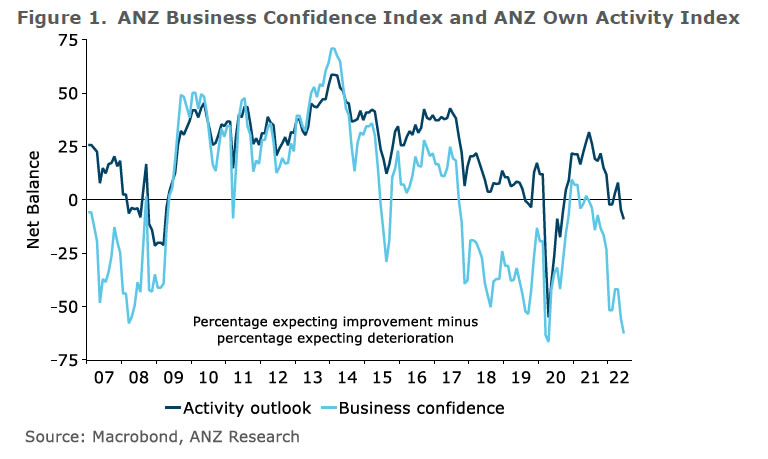
New Zealand ANZ business confidence dropped to -62.6, supply-side issues remain firms’ biggest problems
New Zealand ANZ Business Confidence dropped from -55.6 to -62.6 in June. Own activity outlook dropped from -4.7 to -9.1. Investment intentions dropped from 8.6 to -3.2. Employment intentions dropped form 6.1 to 0.7. Cost expectations eased from 95.5. to 93.5. Pricing intentions rose from 71.0 to 73.7. Inflation expectations eased from 6.18 to 6.02.
ANZ said: " For now, supply-side issues remain firms' biggest problems: finding skilled labour, costs, and wages being the top three. The RBNZ needs those problems to ease, and weakening demand to move up the charts. That's what's required to bring inflation pressure down.
"Of course, weaker demand might ease the overtime, but it's unlikely to enhance profitability. That moment of happy equilibrium between demand and supply may prove fleeting, with the RBNZ entirely willing to incur the risk of a hard landing to ensure the long-term structural health of the economy in terms of well-anchored inflation expectations."
Japan industrial production dropped -7.2% mom in may, worst in two years
Japan industrial production dropped -7.2% mom in May, much worse than expectation of -0.3% mom. That was also the worst contraction in two years, since the -10.5% mom decline in May 2020.
The index of production at factories and mines stood at 88.3 against the 2015 base of 100. Index of industrial shipments dropped -4.3% mom to 89.0. Inventories dropped -0.1% mom to 98.5.
Nevertheless, manufacturers surveyed by the Ministry of Economy, Trade and Industry (METI) expected output to rebound 12.0% in June, followed by a 2.5% expansion in July.
Local Data Releases Dominate Asia
US equities struggled for direction overnight, with the S&P 500 and Nasdaq almost unchanged, while the Dow Jones eked out a small gain. The outcome is hardly surprising with Wall Street tying itself up in knots and whipsawing itself over the last week under the deluge of inputs from the geopolitical, central bank and data space. The emerging theme seems to be that higher-for-longer inflation will see central banks continuing to tighten economies into a recession, before having to reverse course again into 2023. Something seemingly hinted at by both Jerome Powell and Christine Lagarde at the ECB forum overnight.
US Bond markets are certainly seeing it that way, with short-dated yields holding steady while yields in the longer part of the curve headed downwards once again. It might also be that longer-duration bonds are seeing haven inflows as investors give up on the histrionics of the equity market and lock in some semi-decent long-duration yields.
Amongst all of this, the US Dollar rallied overnight, a somewhat counterintuitive move given that longer-dated rate expectations are being tempered on recession fears. Notably, the greenback rallied not only versus the G-20 space, but it also did well versus the Asian currency space ex-China, and even USD/JPY continued its rally. That suggests to me that we are seeing a broader move to safety, benefiting both the US Dollar and depressing US yields. Having said that, it does look like a few regional central banks are selling a few more US Dollars into the market today to smooth the Asian FX selloff.
One caveat today though is we are at the month and quarter-end. We are likely to see some chunky rebalancing flows from institutional investors across multiple asset classes. That may distort price movements and throw up a few false positives in markets today.
With Wall Street sitting on the fence, Asia has been left to its own devices today with local data appearing to dominate price moves, especially in the equity space. China equities had a negative start today but have since bounced. China’s President Xi reiterated the government's commitment to covid-zero yesterday, a risk I have been telegraphing constantly. However, both the official Manufacturing and Services PMIs have staged a handsome reopening bounce today. June Manufacturing PMI climbed to 50.5, while the Non-Manufacturing PMI leapt to 54.7 from 47.8 in May. The climb above 50 into expansionary territory has put a floor under Mainland equity markets for now. Just remember, the virus only has to get lucky once.
South Korean data has also been pretty impressive. Construction YoY for May jumped by 8.20%, Industrial Production rose by 7.30%, and Manufacturing also rose by 7.30%. All were well above forecast. Business Confidence slipped to 83.0 though, suggesting clouds ahead, while Retail Sales YoY for May rose only 0.70%, with the MoM slipping by -0.10%. Overall, it suggests that demand remains robust for South Korean products internationally with the sub-sectors also broadly recovering, but the South Korean consumer continues to grapple with cost-of-living increases. A reopening by China should boost this data in the coming months and partly explains the Korean Won unwinding some of its overnight losses today.
In contrast, Japanese data was a mixed bag. Industrial Production MoM in June slumped by 7.20%, but the YoY number fell by -2.80%, still better than May’s -4.90% tumble. Once again, China's restrictions continued to impact the numbers but assuming they stay covid-zero, could provide a positive tailwind for Japan’s exporters and manufacturers in the quarter ahead.
It is early days yet, but if the pattern in US bond markets continues, i.e., a rotation to an inverse yield curve as a US recession and Fed rate cute in 2023 are priced in, and Japan’s modest recovery continues, I believe the end is in sight for the USD/JPY rally. The 140.00 to 145.00 zone should remain intact. I will be watching this closely over the coming weeks.
Elsewhere, the Philippine PPI for May rose by 6.90% YoY, above expectations. The Peso has been one of the worst performers in the Asian FX space of late, partially due to the central bank’s reluctance to aggressively hike into surging inflation. The new head of the BSP appeared to concede on this point yesterday, suggesting harsher hikes could be on the way if currency weakness persists. He might not be the last one in the region to have to concede on this point. Malaysian and Indonesian inflation is benign and may be saved at the bell from accelerating if recessions in key export markets occur. India may be a different story and the Rupee has also been struggling.
Australian equity markets are lower today, with the Australian and New Zealand Dollars pummelled by negative sentiment overnight. The Euro also had a torrid night after high German and Spanish inflation and a hawkish Lagarde. Although the Chinese PMI data should be a positive for Australian markets, I do note that Singapore's iron ore futures on China contracts have gapped lower by 6.0% today. That could be a knock-on impact from President Xi’s covid-zero affirmation yesterday, but resource-heavy Australian markets don’t seem to like it.
In the crypto space, Bitcoin is flirting with the $20,000.00 level once again as small exchange delays reopening to withdrawals, and credit concerns in the sector rise once again. Although the $20,000.00 level may have some psychological impact, I believe the 18th of June lows just ahead of $17.500.00 is the real level now. The charts have resistance at $22,000.00 but it really needs to regain $28,000.00 to move out of the danger zone. Failure of $17,500.00 signals another moves lower to around $12,500.00. In an industry that conjures up 17.0% returns out of nothing, this weekend’s trading session looms as potentially emotional.
This afternoon, German Retail Sales are released, as well as Import Prices. Retail Sales are expected to rebound with Import Prices remaining above 31.0% YoY. Yesterday’s lower inflation numbers were distorted lower by the government’s temporary energy subsidy so don’t be fooled, currency markets weren’t. The Retail Sales data has downside risks and could keep the pressure up on the Euro. French inflation data and UK GDP Growth today could keep the bad news flowing.
The evening's most closely watched data point will be May’s US Personal Spending and Personal Income, along with the Core PCE Price Index. May data almost seems like old news at the moment, but it is closely watched by the Fed. Income growth is expected to hold steady, while spending is expected to fall. That would give the lower Fed terminal rate club a reason to buy equities I suppose but there are plenty of combinations of the three data points that could drive direction either way. I’ll not second guess the data or the market’s reaction, all I know is that Wall Street is unlikely to have another inconclusive close like the one overnight. And don’t forget the month and quarter-end rebalancing flows.
On the subject of rebalancing, it is Mrs Halley’s and my wedding anniversary tomorrow. We are flying on an airline I’ve never heard of from Jakarta to a place on the giant island of Kalimantan (Borneo), that I’ve never heard of. We will be river boating and trekking through the jungle, to visit jungle men (Orangutang's in Bahasa Indonesia), and Baby Yoda’s (tarsier primates), where they should be, in the wild, unmolested, and happy. Apparently, there is no internet or mobile signals in the national park so a long weekend of “communicating” with Mrs Halley lies ahead. I shall return on Tuesday the 5th of July. Stay funky.
Asian equities a real mixed bag of lollies today.
US markets took a breather overnight after tying themselves up in knots for the last week. The S&P 500 closed just 0.07% lower, the Nasdaq was almost unchanged, edging down 0.03%, while the Dow Jones rose by 0.27%. In Asia, US futures are mixed again. S&P 500 and Dow futures have slipped by 0.15%, while Nasdaq futures have gained 0.10%. Personal Income and Expenditure data, and month and quarter-end rebalancing flows are likely to make for a messy Wall Street session this evening.
The inconclusive Wall Street close has left Asia to its own devices today, leading to a very messy mixed session so far, and month and quarter-end flows could be playing their part, along with local data releases. Weak industrial production data and rising covid infections in Tokyo see the Nikkei 225 down by 0.90% today. In South Korea, the Kospi has suffered from weak MoM Industrial Production data, falling by 0.60%.
In Mainland China, markets had reacted negatively to President Xi’s reiteration of covid-zero yesterday, but early selling was reversed after strong PMI data this morning. The Shanghai Composite has rallied by 1.15%, with the CSI 300 jumping 1.35% higher. Hong Kong’s Hang Seng is up just 0.50% in comparison.
In regional markets, Singapore is down 0.40%, with Taipei slumping by 2.05%. Kuala Lumpur has risen by 0.55%, Jakarta by 0.35% and Bangkok by 0.15%. Manila has fallen by 0.40% after the BSP Governor raised the prospect of harsher rate hikes. China Iron ore futures are now down 7.20% as I write, and that seems to be weighing on Australian markets. The All Ordinaries and ASX 200 have fallen by 0.75%.
European markets fell heavily overnight as a hawkish Lagarde and increasing recession fears eroded confidence. Nothing has happened overnight to materially change that outlook and they are set for another weak opening this afternoon. US markets will be a turkey shoot over US data and month and quarter-end rebalancing flows.
US Dollar stages impressive rally.
The US Dollar staged another impressive rally overnight, this one much broader-based than the day before. with the dollar index unwinding much of the last week's retreat in just one session. Notably, US yields actually eased overnight, particularly at the long end and it looks like currency markets were positioning for both recessions, and haven inflows in UK bonds. The dollar index rose by 0.59% to 1.0510 overnight, easing to 105.01 in Asia. Support remains at 1.0350 and 102.50. With resistance at 105.00 now eroded, the index’s next resistance is at 1.0585.
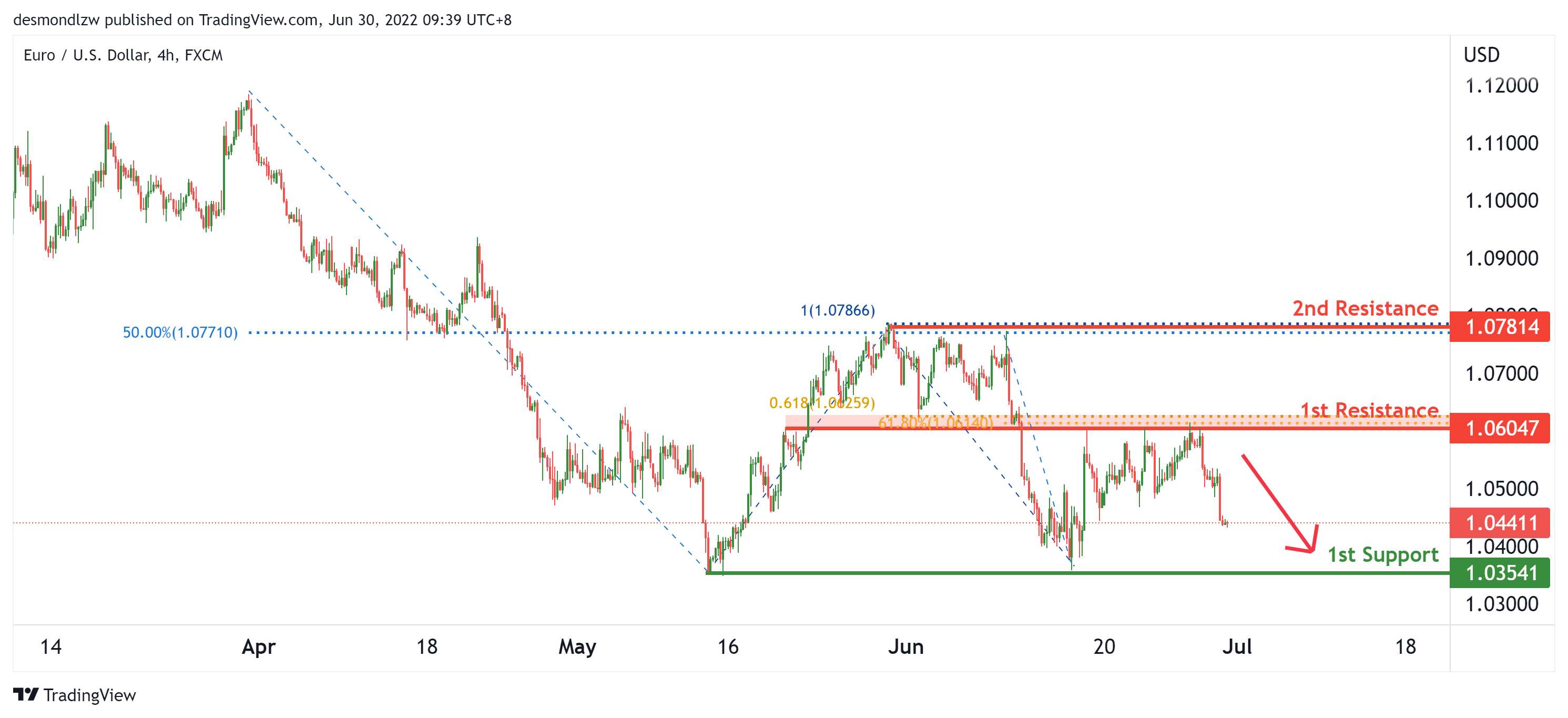
EUR/USD slumped by 0.77% to 1.0440 overnight on Eurozone recession fears, rising to 1.0450 in Asia. Resistance is well and truly in place at 1.0600, followed by 1.0650. The failure of 1.0500 and 1.0450 overnight bring the critical 1.0350 regions into focus again. Failure signals further losses to 1.0200 initially and potentially to parity in the weeks ahead.
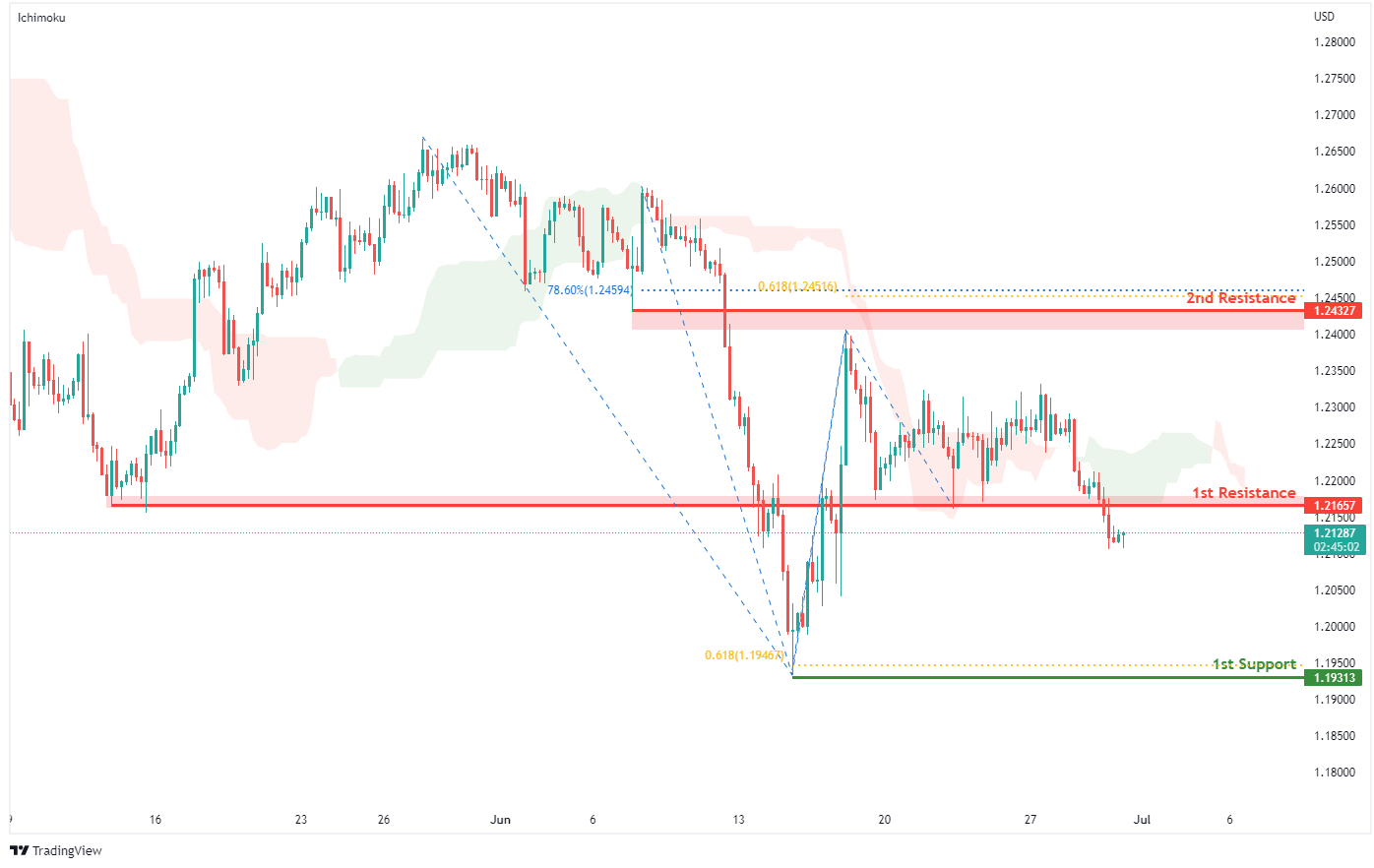
Sterling fell 0.50% to 1.2125 overnight, being unchanged in Asia. GBP/USD has initial resistance at 1.2300, 1.2360 and 1.2400, with support at 1.2175 and 1.2160. Failure of 1.2160 on a closing basis suggests a renewed move lower towards 1.1950.
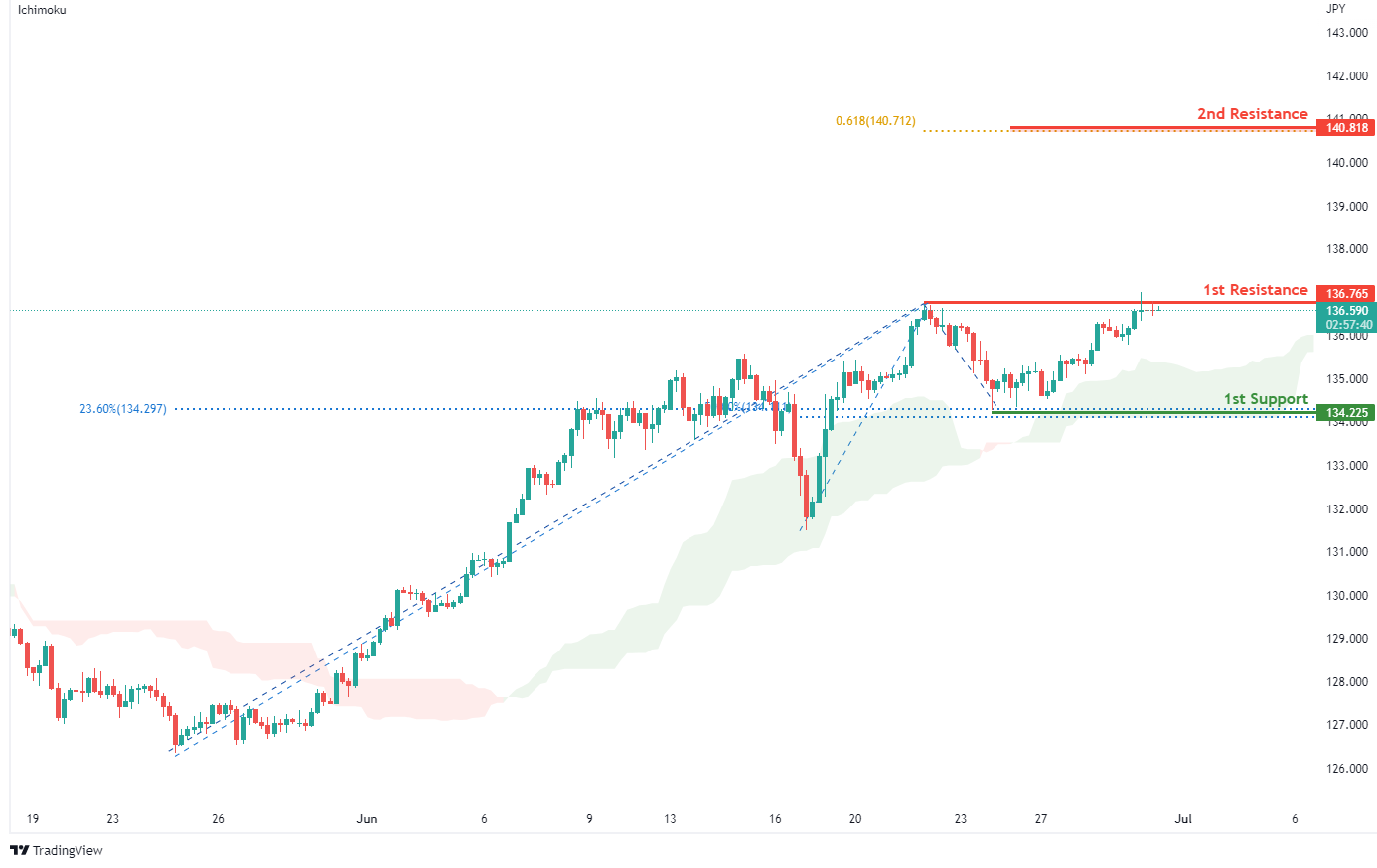
USD/JPY climbed again overnight, and given US yields eased lower, I can only assume risk aversion drove part of the rally. USD/JPY climbed 0.33% to 136.60 overnight, where it remains in Asia, seeing none of the slight US Dollar weakness in other parts of the currency space in Asia today. USD/JPY has support at 134.25 and 132.00, with resistance at 136.65 and 138.00. If the US yield curve is about to pivot to an inverse shape, the end of the USD/JPY rally could be in sight and a move above 140.00 could be a bridge too far.
Asian currencies also buckled overnight, led by the Korean Won, and Philippine Peso, with USD/KRW and USD/PHP rising above 1300.00 and 55.000 respectively. The Indian Rupee remains near record lows with USD/INR at 78.764 this morning. In contrast, the Chinese Yuan remained unmoved thanks to offsetting moves in its fixing basket. Asian currencies have rallied somewhat this morning and the price action in USD/KRW, USD/INR, USD/THB, and USD/PHP hints there are a few central banks around today selling US Dollars. Asian foreign currency reserves remain ample, but the region’s central banks will not be trying to draw lines in the sand, choosing their battles carefully. With risk aversion around recessionary forces finally spilling into the Asian currency space more broadly, further weakness into next week seems likely.
Oil retreats on delayed EIA data.
Oil prices reversed course overnight as the delayed US official EIA crude inventory data was released. With two weeks of data released at once, net crude inventories fell by 3.15 million barrels, but gasoline inventories rose by 4.13 million barrels for the fortnight. Brent crude had tested $120.00 intraday but fell back to finish 2.15% lower at $115.60 a barrel. WTI tested $114.00 intraday but also slumped to finish 2.15% lower at $109.55 a barrel. In Asia. Both contracts have added 0.40% to $116.05 and $110.00 a barrel.
Although OPEC+ meets today, the meeting is likely going to be just a rubber stamp exercise this month. Looking under the bonnet of the two-week EIA release, some of the headline numbers flatter to deceive. The net drop in crude oil inventories was flattered by SPR releases, while the gasoline stock jump is because US refineries are running at over 95.0% capacity. This is an unsustainable run rate in the medium-term and the underlying numbers suggest the supply situation is as challenging as ever. With Ecuadorian and Libya production plummeting and no progress in Europe/Iran nuclear talks, any downside in oil prices should be limited.
Brent crude has support here at 116.00, followed by 111.30, the 100-day moving average (DMA) at 109.80 and then the rising 2022 support line, today at 108.30 a barrel. It has resistance at $120.00 and $121.25 a barrel.
WTI has support at $109.25, then its rising 2022 support line at $108.00, followed by the 100-DMA at 106.50 a barrel. It has resistance at $112.50, $114.00, and then$116.00 a barrel.
Gold underwhelms again.
Gold staged an intraday rally towards $1833.00 overnight, but it once again ran out of steam as US Dollar strength swept the markets on haven inflows. That reversed the weak rally and sent gold to a weak close, falling 0.12% to $1818.00 an ounce. Gold continues to trace out lower highs which suggests that risks are increasing of a large downside move. Gold has seen no haven inflows, which seem to all be heading into US Dollars and the US bond market.
Gold has resistance at $1840.00, $1860.00, and $1880.00, the latter appearing an insurmountable obstacle for now. Support is at $1805.00 and then $1780.00 an ounce. Failure of the latter sets in motion a much deeper correction, potentially reaching $1700.00 an ounce. On the topside, I would need to see a couple of daily closes above $1900.00 to get excited about a reinvigorated rally.
Technical Outlook and Review
DXY:
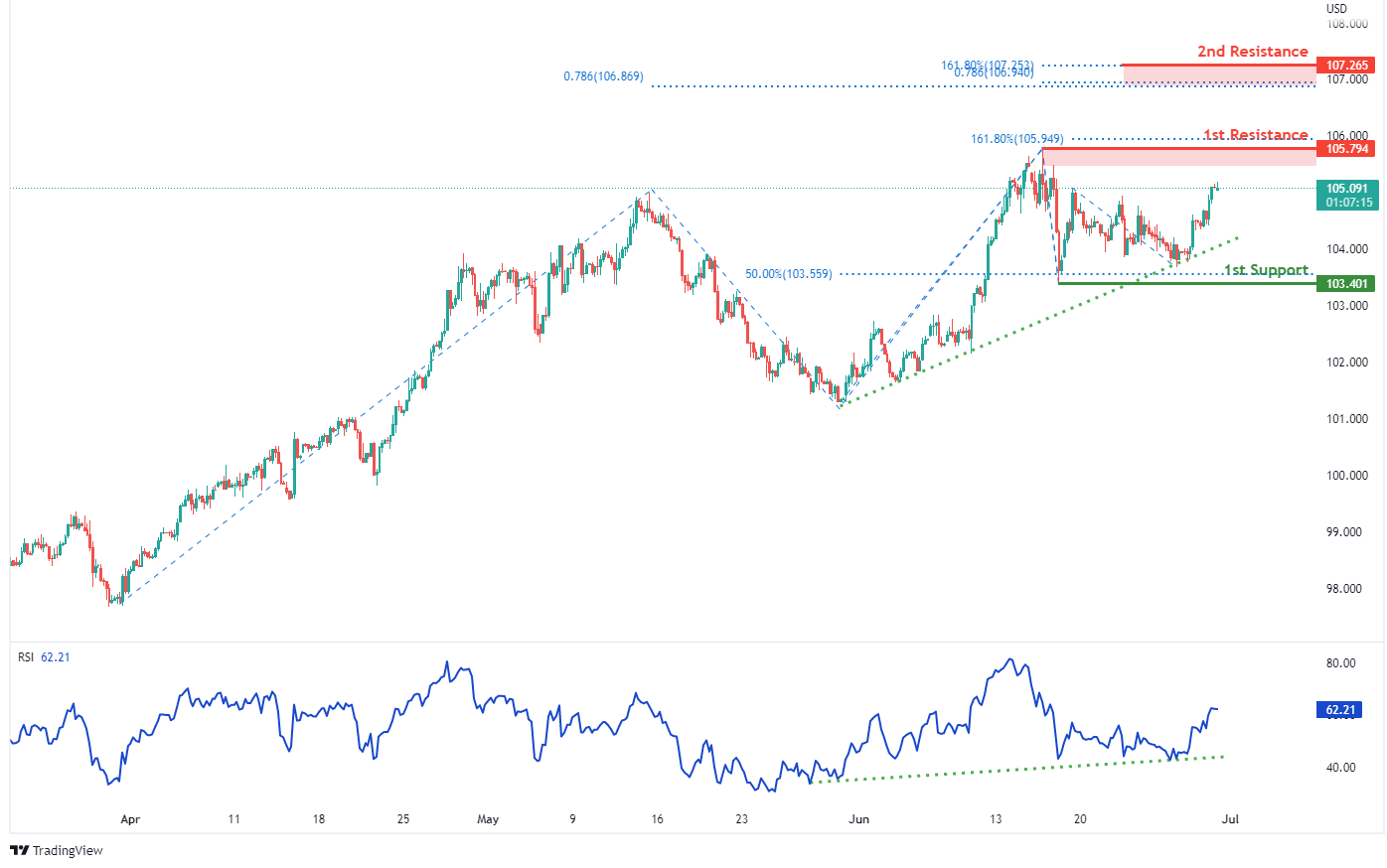
On the H4, with RSI moving along an ascending trendline and prices moving along the ascending trendline, we have a bullish bias that bullish momentum will carry prices to 1st resistance at 105.794 where the swing high resistance and 161.8% fibonacci extension are. Once we have upside confirmation, we would expect bullish momentum to carry prices to 2nd resistance at 107.265 in line with 161.8% fibonacci extension, 78.6% fibonacci projection and 78.6% fibonacci projection. Alternatively, price may drop to 1st support at 103.401 where the horizontal swing low support and 50% fibonacci retracement are.
Areas of consideration:
- H4 time frame, 1st resistance at 105.794
- H4 time frame, 1st support at 103.401
XAU/USD (GOLD):
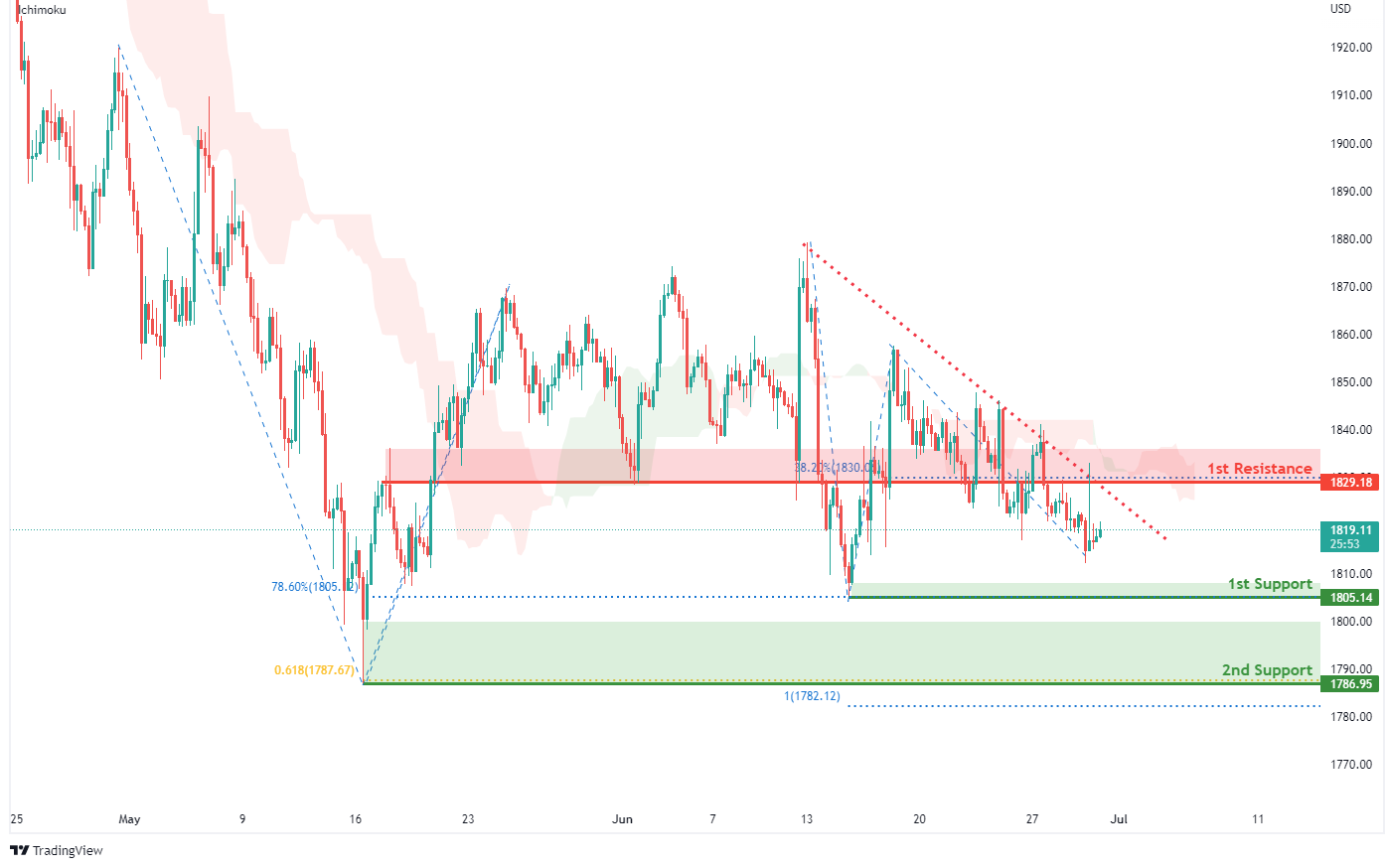
On the H4, with prices moving below the ichimoku indicator and along a descending trendline, we have a bearish bias that prices will drop to our 1st support at 1805.14 where the horizontal swing low support and 78.6% fibonacci retracement are. Once we have downside confirmation, we would expect bearish momentum to carry price to 2nd support at 1786.95 in line with swing low support, 61.8% fibonacci projection and 100% fibonacci projection. Alternatively, price could rise to our 1st resistance at 1829.18 in line with overlap resistance and 38.2% fibonacci retracement.
Areas of consideration:
- H4 time frame, 1st Resistance at 1829.18
- H4 time frame, 1st Support at 1805.14
GBP/USD:
On the H4, with prices moving below the ichimoku indicator, we have a bearish bias that price will rise and drop from our 1st resistance at 1.21657 where the horizontal overlap resistance is to our 1st support at 1.19313 where the horizontal swing low support and 61.8% fibonacci projection are. Alternatively, price could break 1st resistance structure and rise to 2nd resistance at 1.24327 in line with the 61.8% fibonacci projection, 78.6% fibonacci retracement and pullback resistance.
Areas of consideration:
- H4 1st resistance at 1.21657
- H4 1st support at 1.19313
USD/CHF:
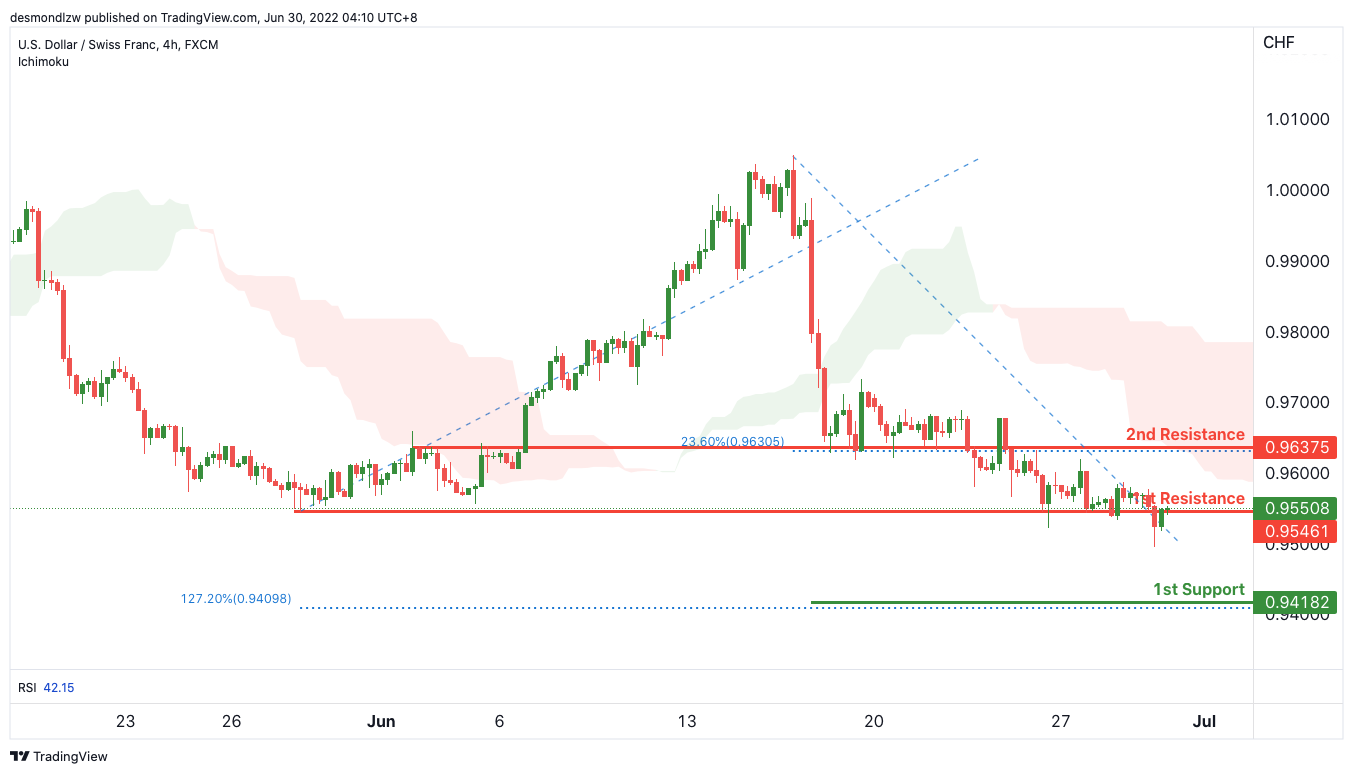
On the H4, with price moving below the ichimoku cloud , we have a bearish bias that price will continue to drop from the 1st resistance at 0.95461 in line with the horizontal pullback resistance to the 1st support at 0.94182 in line with the 127.2% Fibonacci extension. Alternatively, price may reverse off the 1st resistance and rise to the 2nd resistance where the 23.6% Fibonacci retracement and pullback resistance is.
Areas of consideration
- 1st support level at 0.94182
- 1st resistance level at 0.95461
EUR/USD :
On H4, with price recently breaking the ascending trendline, we have a bearish bias that price will continue to drop from the 1st resistance at 1.06047 at the pullback resistance in line with the 61.8% fibonacci projection and 61.8% fibonacci retracement to the 1st support at 1.03541 in line with the multiple horizontal swing lows. Alternatively, price may reverse off the 1st resistance and rise to the 2nd resistance at 1.07814 at the horizontal swing high in line with the 50% fibonacci retracement and 100% Fibonacci projection.
Areas of consideration :
- H4 1st resistance at 1.06047
- H4 1st support at 1.03541
USD/JPY:
On the H4, with price moving above the ichimoku indicator, we have a bullish bias that price will rise to our 1st resistance at 136.765 where the swing high resistance is. Once there is upside confirmation, we would expect bullish momentum to carry price to our 2nd resistance at 140.818 where the 100% fibonacci 61.8% fibonacci projection is . Alternatively, price may drop to 1st support at 134.225 in line with the swing low support, 50% fibonacci retracement and 23.6% fibonacci retracement.
Areas of consideration:
- H4 time frame, 1st resistance at 136.765
- H4 time frame, 1st support at 134.225
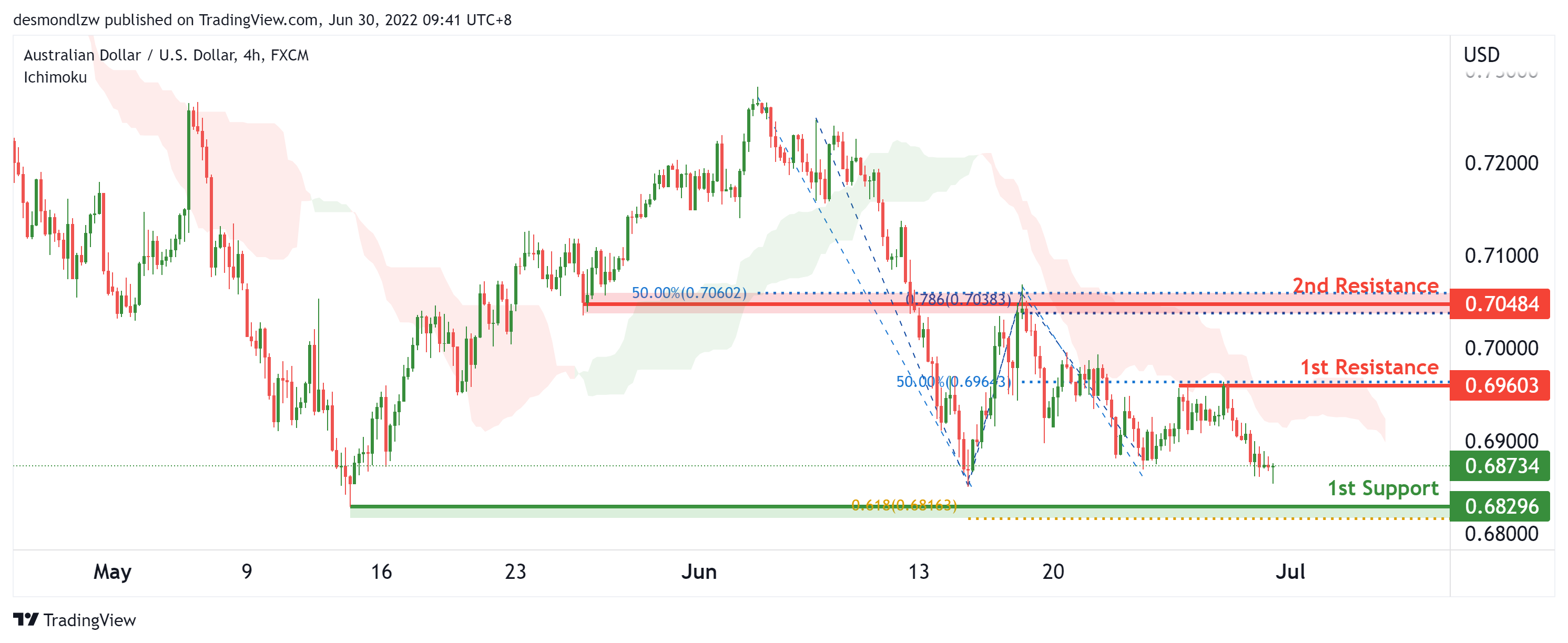
AUD/USD:
On the H4, with price moving below the ichimoku cloud , we have a bearish bias that price will continue to drop from the 1st resistance at 0.69303 in line with the 50% fibonacci retracement to the 1st support at 0.68296 in line with the horizontal swing low and 61.8% Fibonacci projection .Alternatively, price may reverse off the 1st resistance and rise to the 2nd resistance at 0.70484 in line with the overlap resistance, 78.6% Fibonacci projection and 50% Fibonacci retracement .
Areas of consideration
- H4 1st resistance at 0.68296
- H4 1st support at 0.69303
NZD/USD:
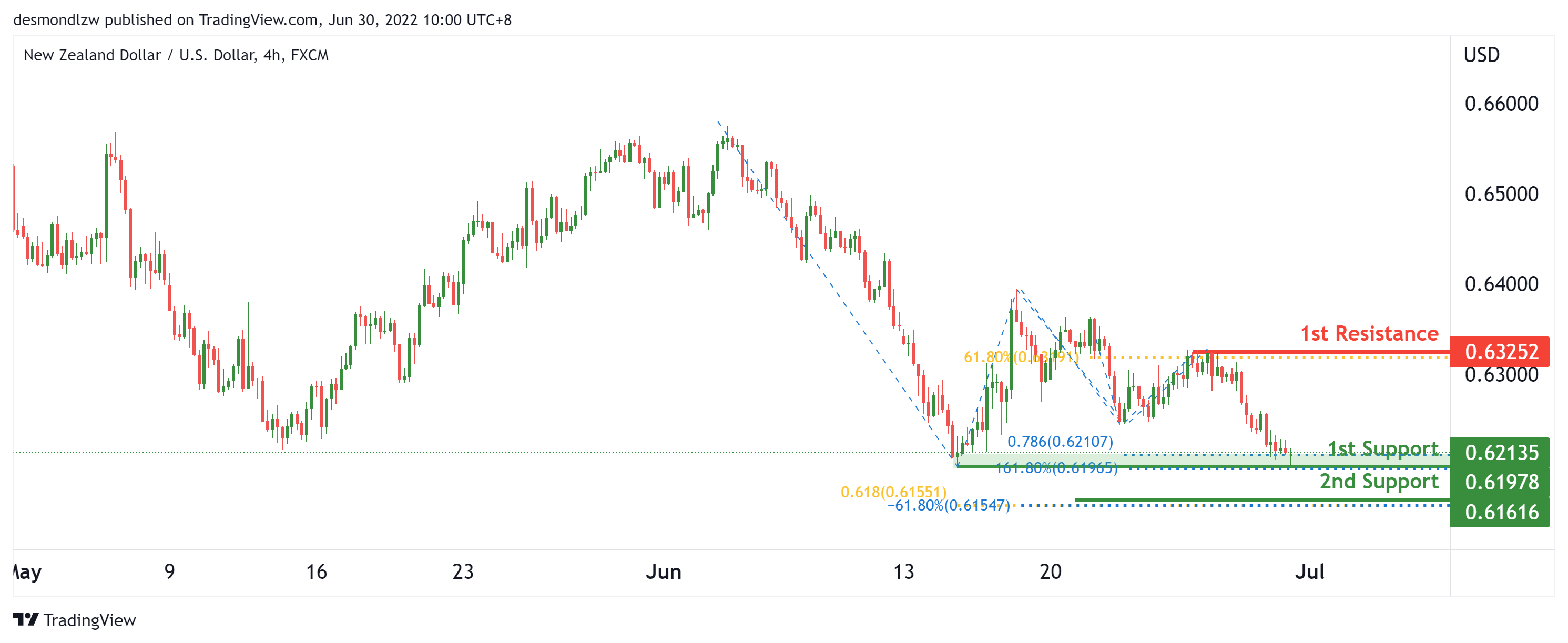
On the H4, with price bouncing off the confluence area at the 1st support, we have a bullish bias that price will rise from the 1st support at 0.61978 at the multiple swing lows in line with the 161.8% fibonacci extension and 78.6% fibonacci projection to the 1st resistance at 0.63252 in line with the swing high and 61.8% fibonacci retracement. Alternatively, price may break the support structure at 1st support and drop to the 2nd support at 0.61616 in line with the -61.8% fibonacci expansion and 61.8% fibonacci projection.
Areas of consideration:
- H4 time frame, 1st support at 0.61978
- H4 time frame, 1st resistance at 0.63252
USD/CAD:
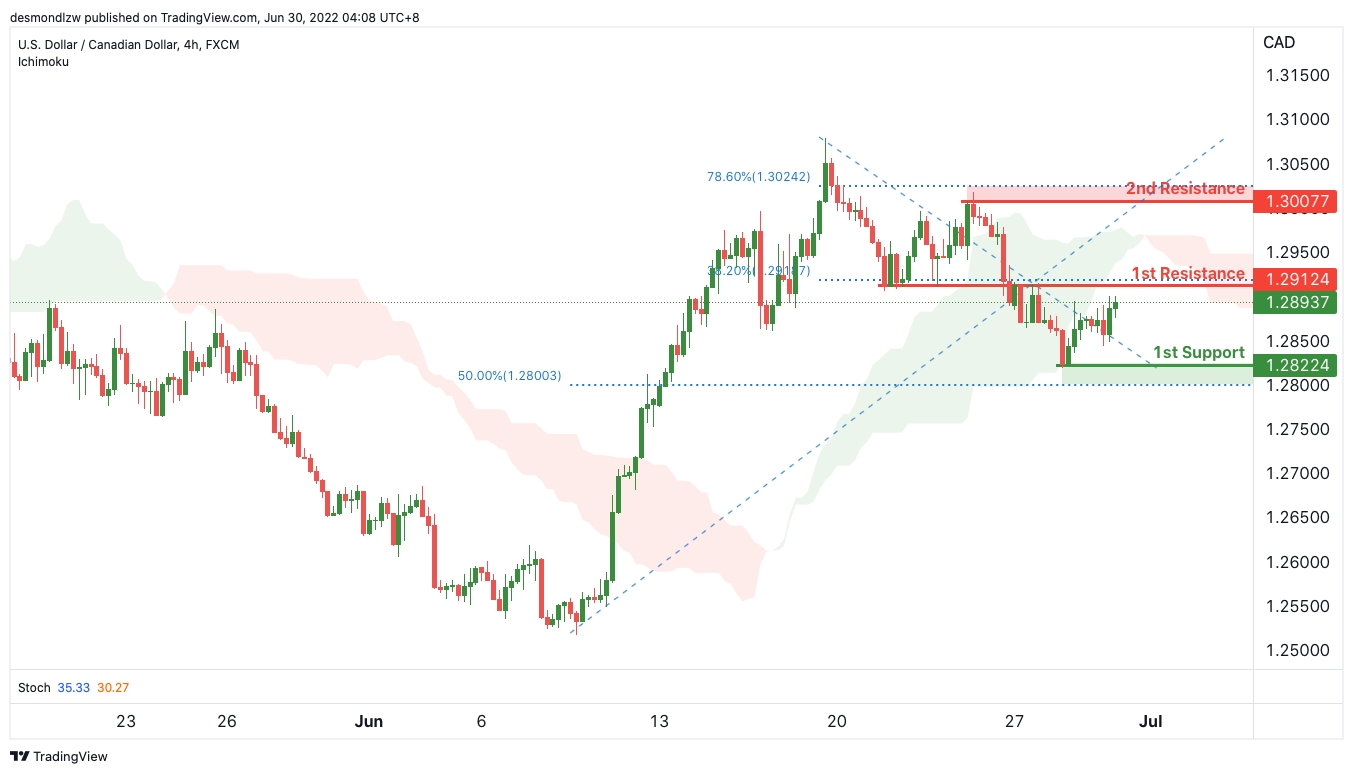
On the H4, with price recent break of the ichimoku cloud , we have a bearish bias that price will continue to drop from the 1st resistance at 1.29124 in line with the horizontal pullback resistance and 38.2% Fibonacci retracement to the 1st support at 1.28224 in line with the 50% Fibonacci retracement and horizontal swing low support. Alternatively, price may reverse off the 1st resistance and rise to the 2nd resistance at 1.30077 where the 78.6% Fibonacci retracement and horizontal swing high resistance is.
Areas of consideration:
- H4 time frame, 1st resistance at 1.29124
- H4 time frame, 1st support at 1.28224
OIL:
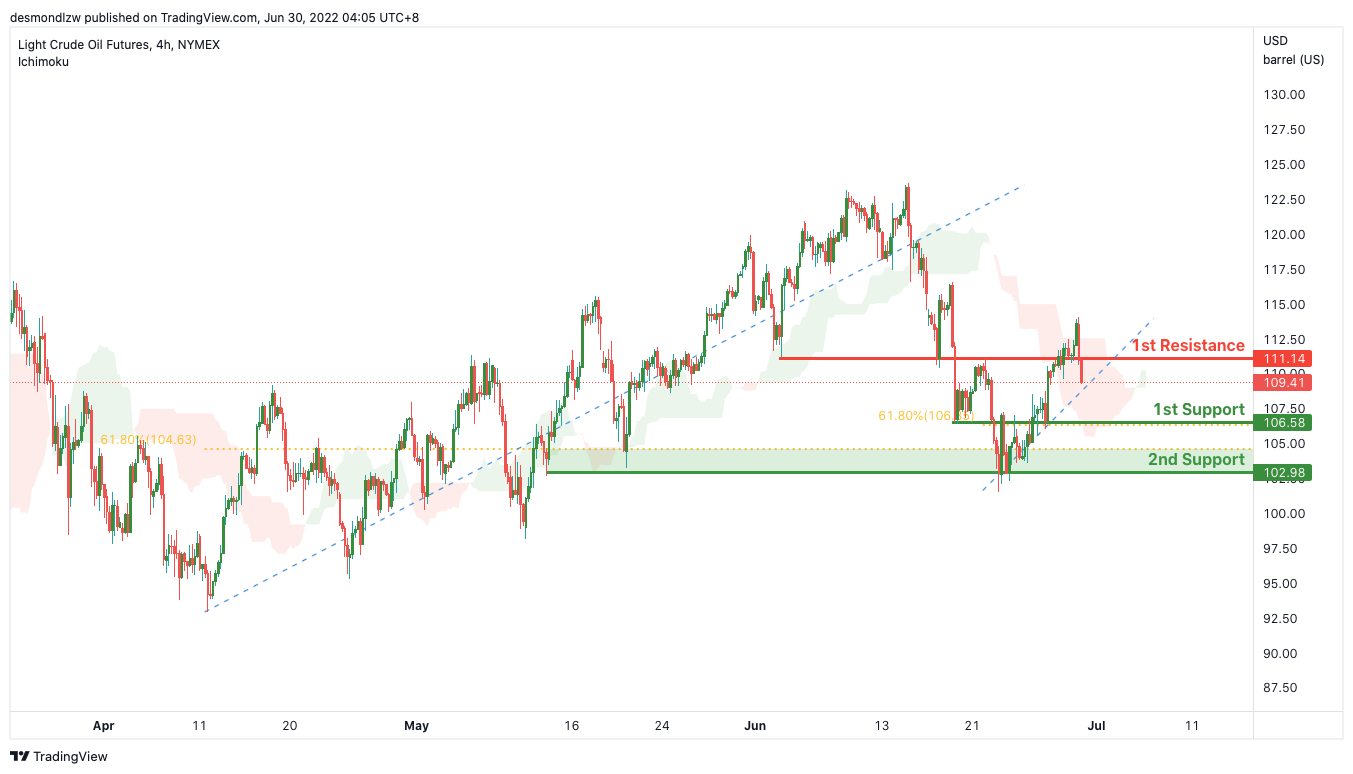
On the H4, with price expected to bounce off ichimoku cloud, we have a bullish bias that price will continue to rise from the 1st support at 106.58 in line with the pullback support and 61.8% Fibonacci retracement to the 1st resistance at 114.14 at the horizontal pullback resistance. Alternatively, price may reverse off the 1st support and drop to the 2nd support at horizontal swing low support and 61.8% Fibonacci retracement.
Areas of consideration:
- H4 time frame, 1st resistance of 114.14
- H4 time frame, 1st support of 106.58
Dow Jones Industrial Average:
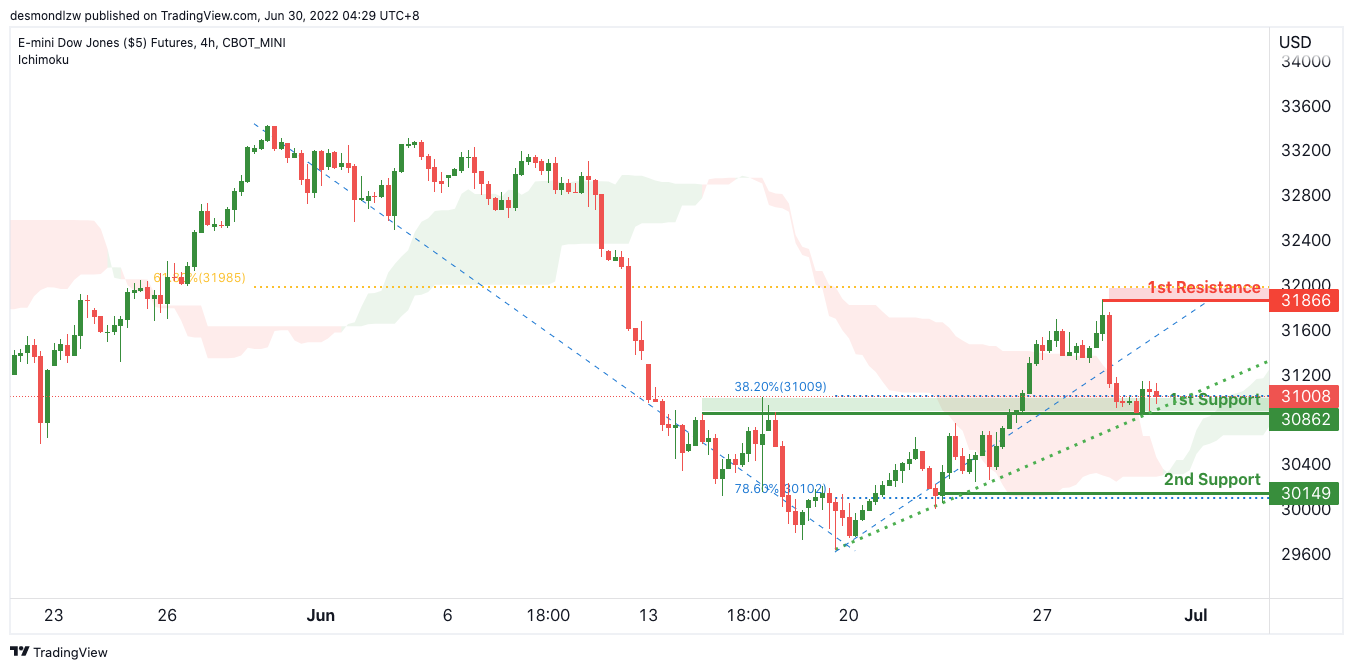
On the H4, with price moving along an ascending trendline and ichimoku cloud, we have a bullish bias that price will rise from our 1st support at 30862 where the horizontal pullback support and 38.2% Fibonacci retracement are to our 1st resistance at 31866 in line with the horizontal swing high resistance and 61.8% fibonacci retracement. Alternatively, price may break 1st support and head for 2nd support at 30149 where the horizontal swing low support and 78.6% fibonacci retracement are.
Areas of consideration:
- H4 time frame, 1st resistance of 31866
- H4 time frame, 1st support of 30862
GBP/USD Wave Analysis
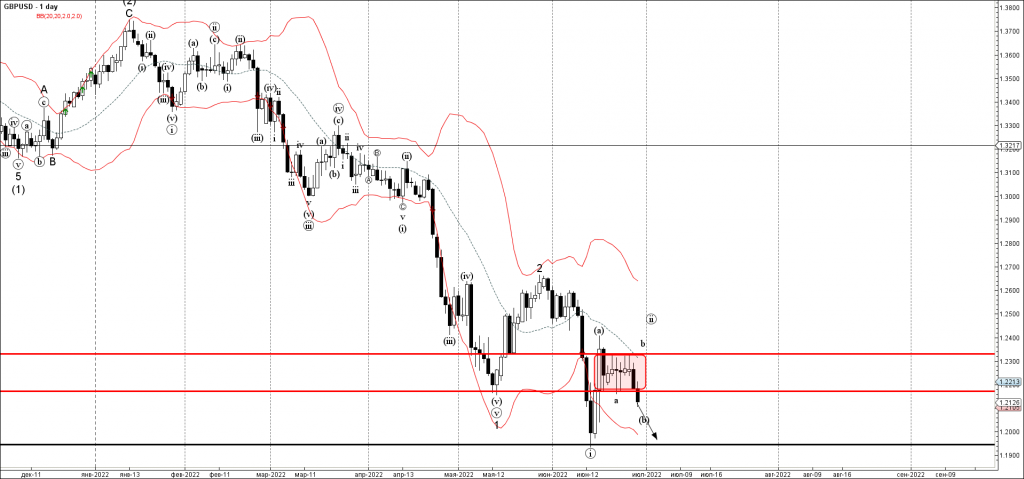
- Sterling broke support level 1.2170
- Likely to fall to support level 1.1945
Sterling continues to fall after the earlier breakout of the support level 1.2170 (lower boundary of the narrow sideways price range inside which the pair has been trading from the middle of June).
The breakout of the support level 1.2170 continues the active minor wave (b) of wave (ii) from the start of this month.
Given the clear daily downtrend, the Sterling can be expected to fall further toward the next support level 1.1945 (low of the previous minor wave (i)).
Eco Data 6/30/22
[php_everywhere instance="1"]
BoE Bailey: Acting forcefully is not the only thing on the table
BoE Governor Andrew Bailey said the central bank has options to act "forcefully" to tackle inflation if needed. "There will be circumstances in which we will have to do more. We're not there yet in terms of the next meeting. We're still a month away, but that's on the table," Bailey said. "But, you shouldn't assume its the only thing on the table."
Bailey also noted that the UK economy was "very clear" at a turning point and starting to slow. As inflation is shifting from goods and into energy and food prices, BoE would watch the development "very, very carefully".
Fed Powell: US economy well positioned to withstand tighter monetary policy
Fed Chair Jerome Powell said in a panel discussion at the ECB forum that the "the clock is kind of running on how long will you remain in a low-inflation regime … The risk is that because of the multiplicity of shocks you start to transition into a higher inflation regime and our job is to literally prevent that from happening and we will prevent that from happening,"
Fed's "aim" now is to raise interest rates without trigger a recession. And, " we believe there are pathways to achieve that".
"We hope that growth will remain positive," Powell. "Overall the US economy is well positioned to withstand tighter monetary policy."
Eurozone CPI Inflation Likely to Roar Again
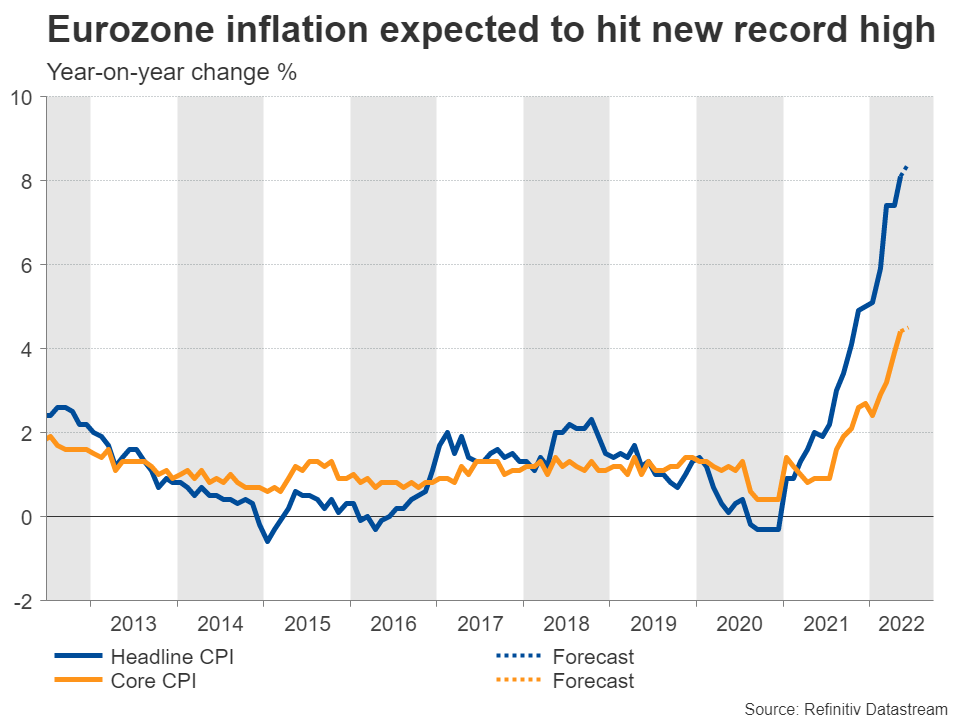
The era of subzero interest rates will conclude in the eurozone next month after a decade, but what is less certain is how fast the monetary tightening phase will develop in the year ahead as recession risks build up in investors’ mind. Flash CPI inflation figures will provide some clues on Friday at 10:00 GMT, with forecasts pointing to a new record high.
Inflation to hit a new all-time high
The headline CPI inflation figure is expected to unlock a new record high at 8.4% y/y in June compared to 8.1% in the previous month, while the core measure, which excludes volatile food and energy prices, could see a moderate increase to 4.5% y/y from 4.4% previously. Growth in consumer prices is already quadruple the central bank’s 2.0% symmetrical target and twice as high the level when the euro currency was first launched in 1999. Therefore, policymakers have no other choice than to catch up with other major central banks and rush to raise interest rates after the regular asset purchase program (APP) ends on July 1.
Perhaps, accumulated inventories due to retailers' overspending to restock shelves during the pandemic period, may motivate some discounting in prices, though that may not be enough to cool inflation metrics towards the target in the near term. Hence, even though consumer confidence has plummeted to the all-time low reached in April 2020, the ECB will likely listen to market expectations and gear up its rate hike cycle by delivering two aggressive 50-bps rate increases in September and October; something Lagarde could not exclude during her latest speech in Portugal.
Soft landing in doubt
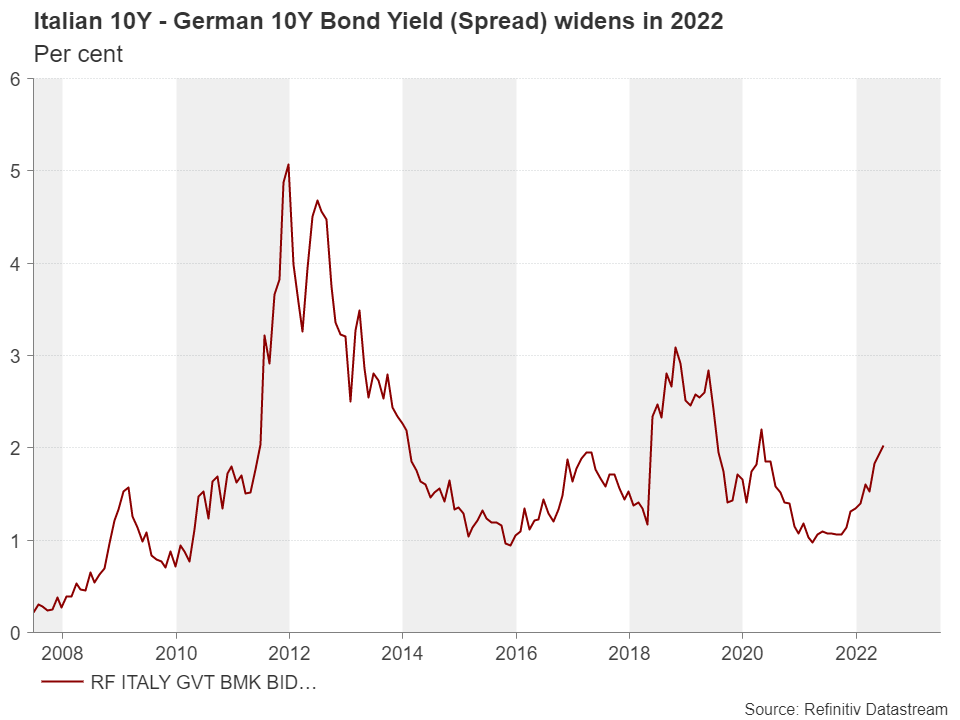
However, the problem that arises at this point is that eurozone member states all have a different economic background and the unavoidable path of higher borrowing costs may raise fresh sovereign risk in indebted economies such as Italy, which is the third largest economy in the bloc.
The spread between the Italian and German 10-year bond yields that is considered a measure of financial stress in the euro area, has widened to the largest since the start of the pandemic, forcing the central bank to start studies on a new bond-buying anti-fragmentation tool. Investors anticipate a compromise to be reached on July 21, though the program may require participation in the European Stability Mechanism conditionality, which some member states may not be willing to undertake. The old issue of how fiscal policy is implemented across the union might be another challenge, while the Italian national election on June 1, 2023 could also cause some delay.
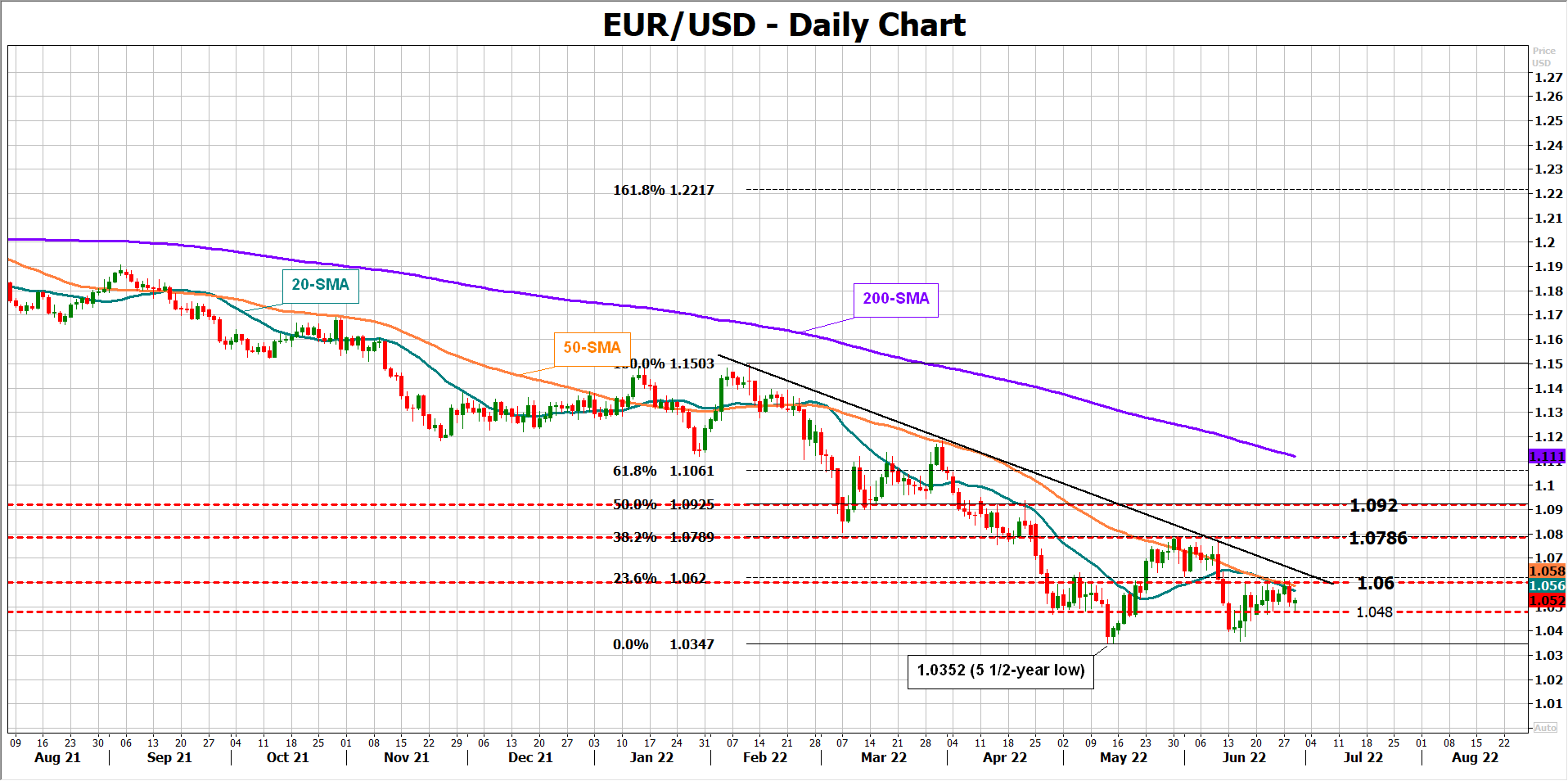
EUR/USD
The eurozone’s uncertain economic outlook explains the short-lived upside reversals in euro/dollar and this may remain a headwind in the near term. New peaks in inflation may barely move the euro unless the data calls for even aggressive rate hikes beyond July. In this case, it would be interesting to see whether recession fears can offset any inflation-driven bullish corrections in the euro.
Technically, a step below the nearby support of 1.0480 could squeeze the price directly towards the double bottom area of 1.0352. Alternatively, a close above the descending trendline and the shorter-term simple moving averages (SMAs) seen around 1.0600 are required to bring the previous high at 1.0786 back under examination.