Sample Category Title
Gold Storms to Fresh Lows as Negative Momentum Strengthens
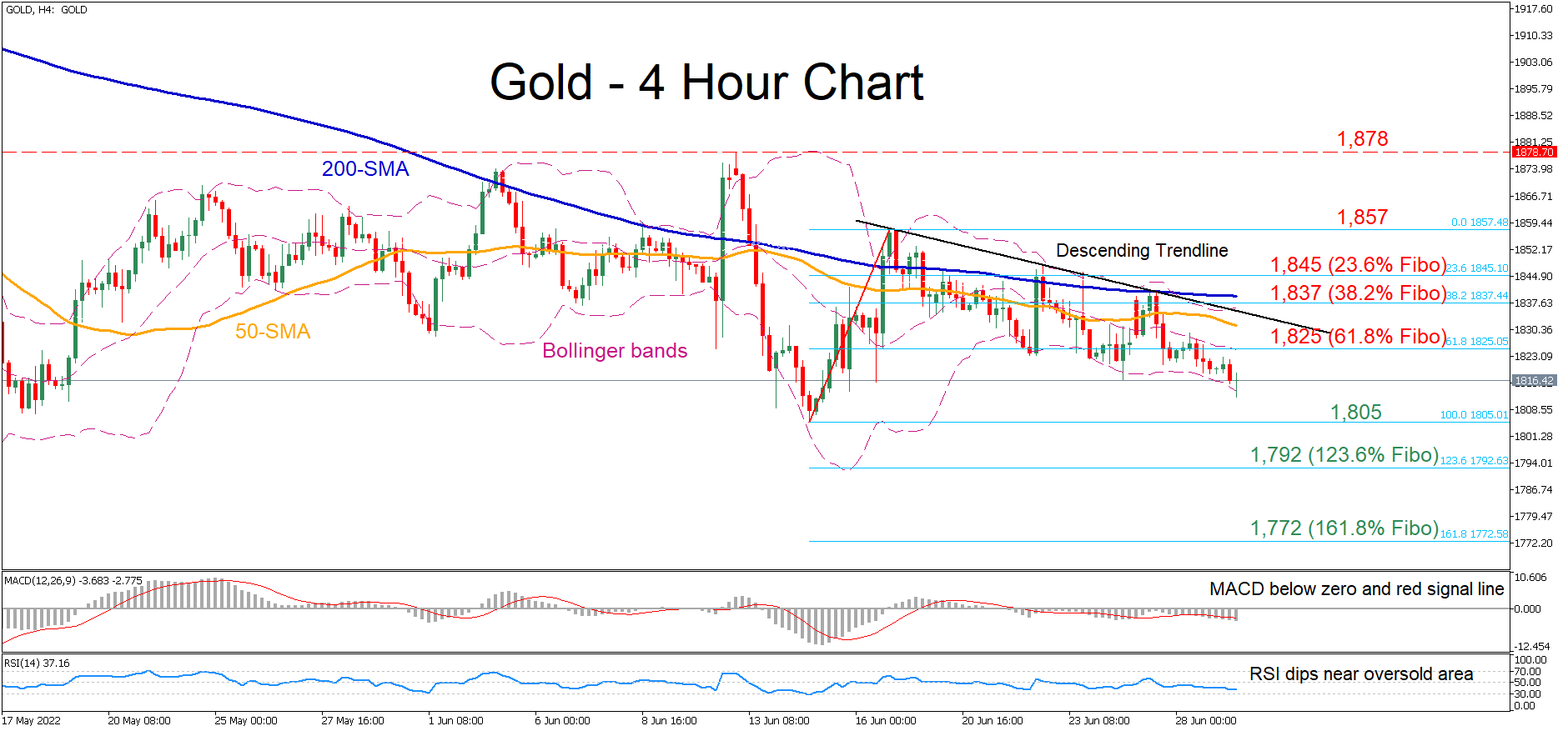
Gold has been in a sustained downtrend after it failed to cross beyond the 1,857 region. Moreover, in the past few four-hour sessions, the price has dived beneath both 50- and 200-period simple moving averages (SMAs) and is currently battling with its lower Bollinger band, painting a gloomy short-term technical picture for bullion.
The momentum indicators are endorsing a bearish near-term bias. Specifically, the stochastic oscillator is descending in the oversold zone, while the MACD histogram is currently below both zero and its red signal line.
Should selling interest intensify further, the 1,805 crucial support could act as the first line of defence. Dipping beneath that region, the price may descend towards 1,792, which is the 123.6% Fibonacci extension of the 1,805-1,857 upleg. A violation of the latter could pave the way for the 161.8% Fibo of 1,772.
On the flipside, bullish actions might encounter initial resistance at the 61.8% Fibo of 1,825. Piercing through that ceiling, the bulls could then aim for the 38.2% Fibo of 1,837 before the 23.6% Fibo of 1,845 appears on the radar. Higher, the 1,857 peak could prove a tough obstacle for the price to overcome.
In brief, gold’s short-term picture appears to be deteriorating as the precious metal is trading below both its SMAs, while continuously marking fresh lower lows. For that tone to reverse, the price needs to profoundly jump beyond the 1,857 ceiling.
Research Global – Natural Rates – Regime Change or Low for Longer?
Despite high inflation and rapidly increasing interest rates right now, we in this paper argue that many of the structural factors that explain the decline in natural interest rates since the 1970s are still in place.
The natural rate is a theoretical concept and is defined as the real interest rate consistent with maintaining economic growth at its trend rate/full employment with stable inflation.
Key structural factors that have pushed down the natural interest are: Increasing life expectancy, slowly growing or decreasing working age population, lower productivity growth, higher mark-ups and risk premia, a shock from the financial crisis and higher inequality.
These structural drivers have led to a situation where an increase in savings and a decrease in investments have been driving lower natural rates for a long time now, also leading to lower trend growth.
The Nordics are mainly natural rate takers; what constitutes a natural real rate in the Nordics is primarily driven by international factors.
What could change the natural rate? Increased fiscal spending and investments in defence, the green transition and digitalisation could raise potential growth and exert upward pressure on neutral rates going forward.
In net, we expect the desire to save still to dominate the desire to invest going forward. We do not see any of the significant structural drivers reverting during the coming years, but think that higher and increasing public debt and possibly higher productivity growth could add some upwards pressure on natural rates.
If we are right, this would imply that rates decline again after the current period of high inflation ends, although not all the way back to pre-pandemic levels.
EURAUD Remains Below 200-Day SMA and Within Ascending Channel
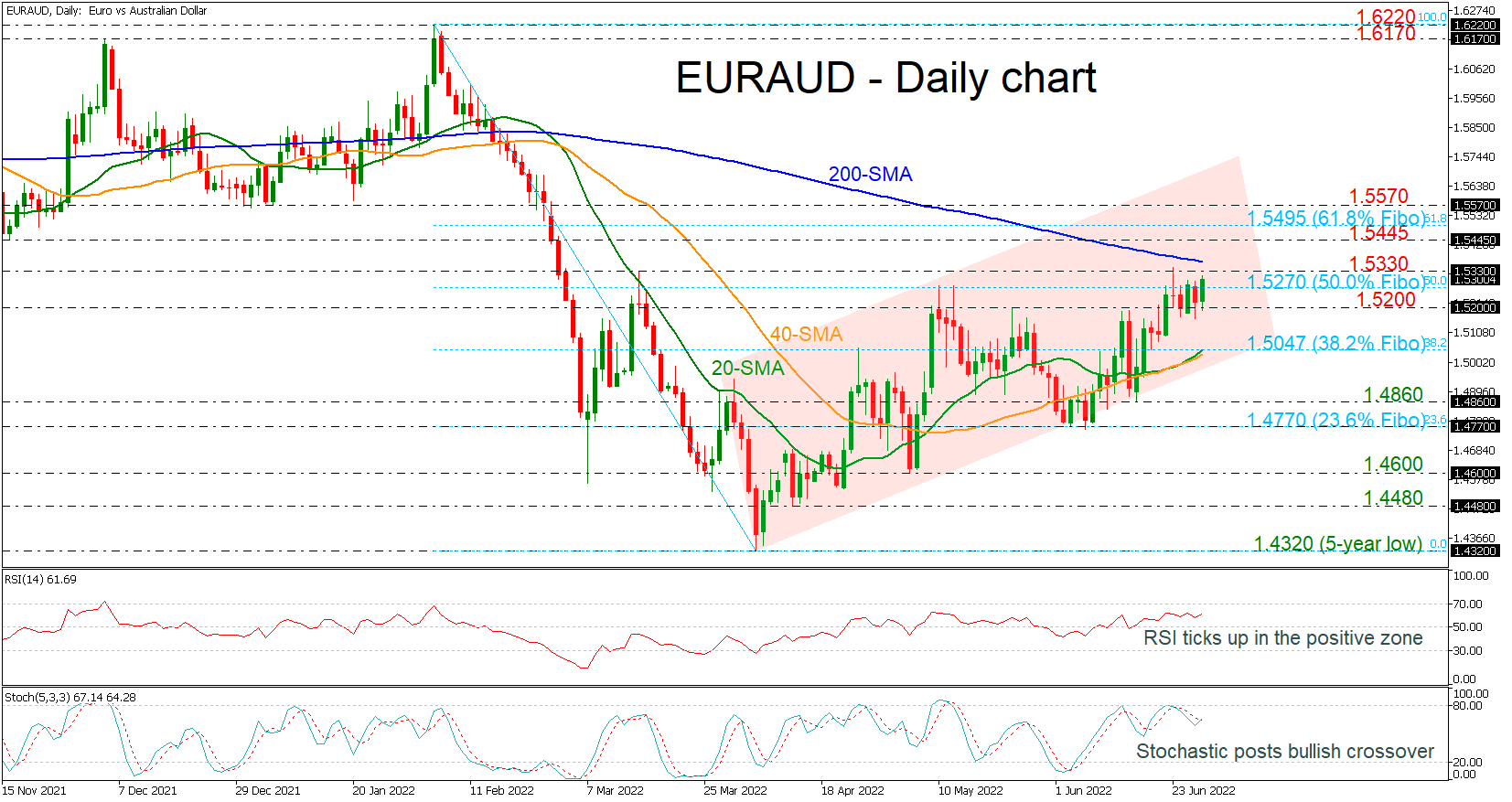
EURAUD is trying to overcome the 50.0% Fibonacci retracement level of the down leg from 1.6220 to 1.4320 at 1.5270 which halted the bullish movement several times in the preceding sessions. The RSI indicators is heading north above the 50 level, while the stochastic oscillator posted a bullish crossover within its %K and %D lines. In trend indicators, the 20- and 40-day simple moving averages (SMAs) are pointing upwards around the 38.2% Fibonacci.
If the price overcomes the 1.5330 resistance, one immediate barrier could come from the 200-day SMA at 1.5370 ahead of the 1.5445 level. Slightly higher, the 61.8% Fibonacci of 1.5495 and 1.5570 could add optimism for more bullish actions, while a climb above the return line of the ascending channel could endorse the short-term positive bias.
On the other hand, a drop back below the 1.5200 round number would take the market until the short-term SMAs at the 38.2% Fibonacci of 1.5047. More declines could open the way for a bearish correction at 1.5860 and the 23.6% Fibonacci of 1.4770.
All in all, EURAUD is showing positive sings but a jump above the 200-day SMA is expected to confirm the current view.
EUR/USD: Bears Start to Regain Control after Repeated Upside Rejections But Still Need a Confirmation
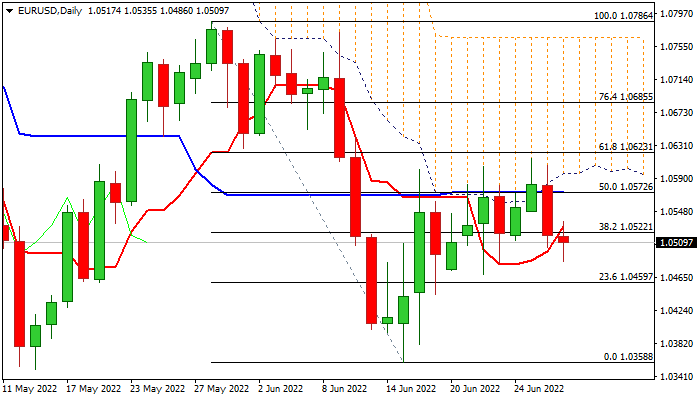
Repeated failure at the base of a daily cloud and subsequent drop on Tuesday (0.6%) that registered a marginal close below 10DMA (1.0537) generated initial signal of recovery stall, though the action on Wednesday is again without direction.
Fresh bears were partially offset by mixed, but with prevailing optimism EU member countries data that kept the single currency afloat for now, though the downside is expected to remain at risk if the pair makes another daily close below 10DMA.
The Euro is additionally weighed by increased month-end demand for dollar, while negative daily studies add to bearishly aligned near-term outlook.
Repeated close below 10DMA would require extension and close below 1.0486 (50% retracement of 1.0358/1.0614) to confirm negative signal and open way for further easing.
Conversely, bounce above 10DMA would ease immediate downside risk, however the action is to remain directionless while below 1.0596 (the base of narrowing daily cloud.
Res: 1.0537; 1.0554; 1.0565; 1.0596
Sup: 1.0486; 1.0456; 1.0419; 1.0358
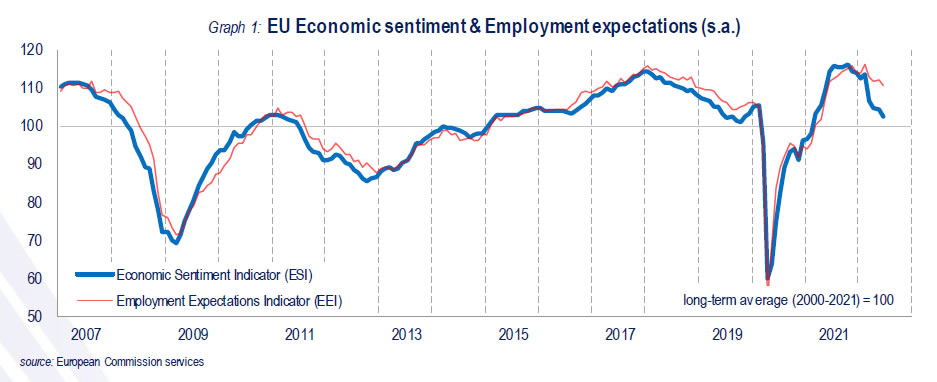
Eurozone economic sentiment dropped to 104 in Jun, EU down to 102.5
Eurozone Economic Sentiment Indicator dropped from 105.0 to 104.0 in June. Employment Expectation Indicator dropped from 112.6 to 110.9. Economic Uncertainty Indicator rose from 23.4 to 24.8. Industry confidence rose from 6.5 to 7.4. Services confidence rose from 14.1 to 14.8. Consumer confidence dropped from -21.2 to -23.6. Retail trade confidence dropped from -4.2 to -5.1. Construction confidence dropped from 6.3 to 3.7.
EU Economic Sentiment Indicator dropped from 104.2 to 102.5. Employment Expectation Indicator dropped from 112.2 to 110.6. Economic Uncertainty Indicator rose from 22.6 to 23.9. The ESI fell across the six largest EU economies: confidence dropped most markedly in the Netherlands (-3.6), but also in Germany (-1.9), Spain (-1.9), Poland (-1.5), France (-1.0) and Italy (-1.0).
Fed Mester: Getting interest rates up to 3-3.5% expeditiously is really important
Cleveland Fed President Loretta Mester told CNBC today, "if conditions were exactly the way they were today going into that meeting (in July) — if the meeting were today — I would be advocating for 75 because I haven't seen the kind of numbers on the inflation side that I need to see in order to think that we can go back to a 50 increase."
"I think getting interest rates up to that 3-3.5%, it's really important that we do that, and do it expeditiously and do it consistently as we go forward, so it's after that point where I think there is more uncertainty about how far we'll need to go in order to rein in inflation," she said.
"At the Fed, we're on a path now to bring our interest rates up to a more normal level and then probably a little bit higher into restrictive territory, so that we can get those inflation rates down so that we can sustain a good economy going forward," she said. "Job one for us now is to get inflation rates under control, and I think right now that's coloring how consumers are feeling about the economy and where it's going."
EUR/CHF Approaches Parity Level
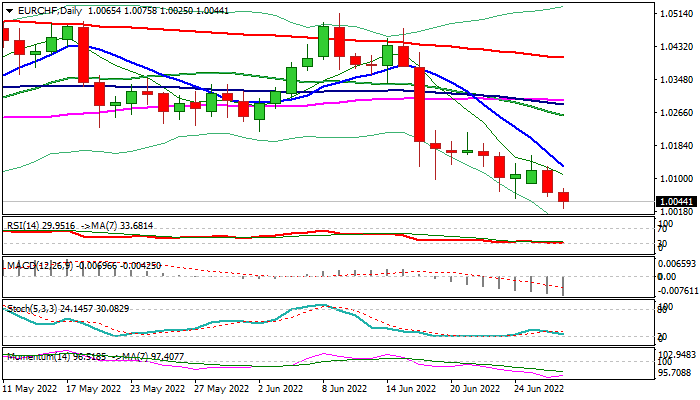
The EURCHF remains in firmly red and hits the lowest since March 7 on Wednesday, with parity level being in focus.
The Swiss franc continues to benefit from the recent shift in the Swiss National Bank’s monetary policy as the central bank raised interest rates last week by 50% basis points from -0.75% to -0.25%, in its first hike since 2007, surprising the wide expectations for unchanged policy.
The SNB argued its decision that inflation in Switzerland edged above their 0% - 2% target and also following the other central banks which further tightened their policies as inflation continues to rise and hurt the economies.
The SNB also signaled that further hikes cannot be ruled out that would keep the franc supported.
Bears broke again below pivotal Fibo support at 1.0146 (61.8% of 0.8977/1.2004, 2015/2018 rally) and look for a monthly close below this level to confirm bearish stance for an eventual attack at parity level and possible retest of Jan 2015 spike low at 0.8997.
Daily studies remain bearish but stretched that signals bears may face headwinds on approach to psychological parity support, with upticks to stay below falling 10DMA (1.0131) to keep bears intact and offer better selling opportunities.
Res: 1.0087; 1.0110; 1.0131; 1.0157.
Sup: 1.0025; 1.0000; 0.9706; 0.9500.
EURGBP Rangebound after Advance Pauses
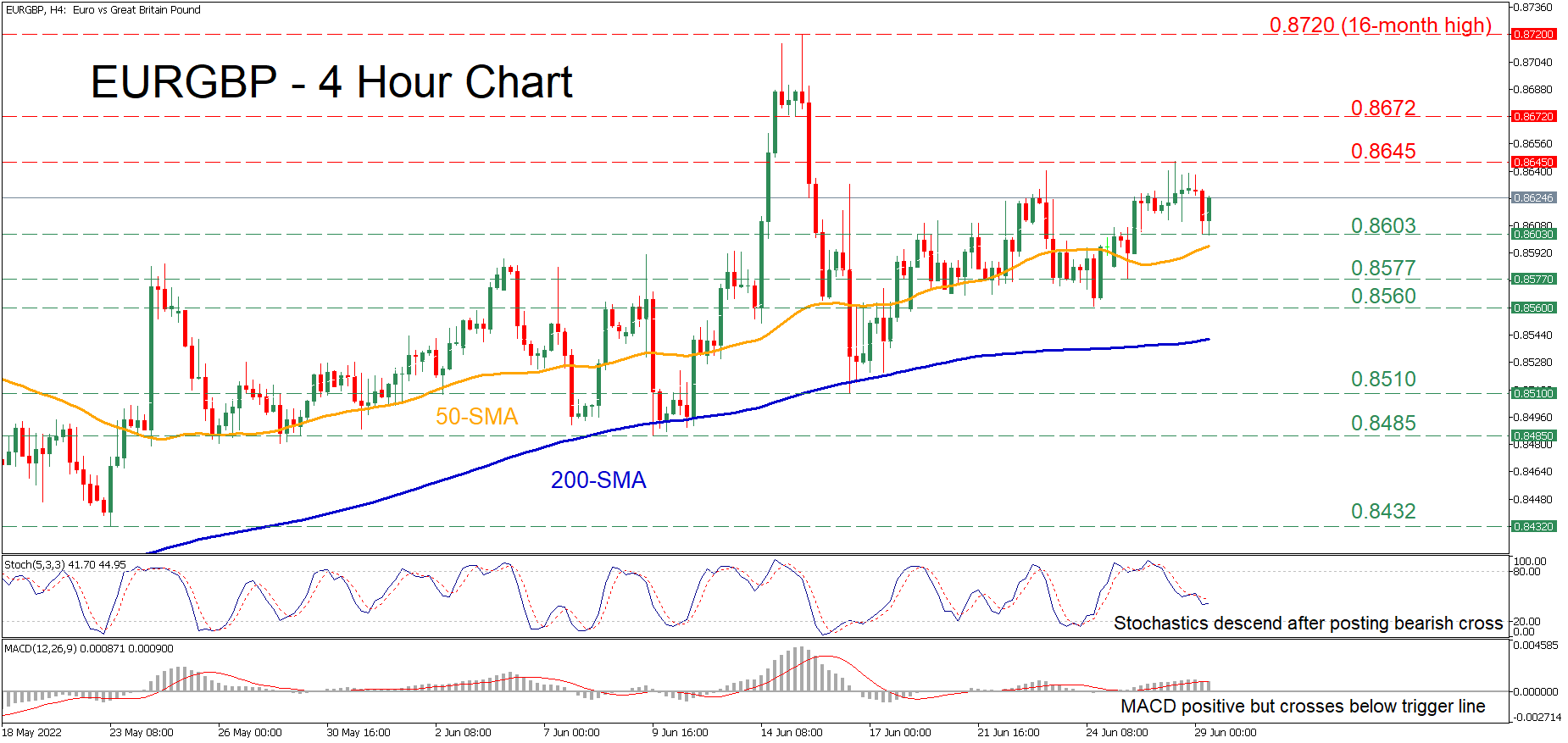
EURGBP has been marching higher since its downtrend ceased at the 0.8510 region, generating a profound structure of higher highs and higher lows. Nevertheless, in the last few four-hour sessions, the pair has been trading sideways after its upside move got capped at 0.8645.
The momentum indicators are reflecting a loss of momentum for the pair. The stochastic oscillator is descending after posting a bearish cross, while the MACD has dived beneath its red signal line but remains in the positive region.
Should selling pressure intensify, the price could test its most recent low of 0.8603. Dipping beneath that region, the bears could aim for 0.8577 before the spotlight turns to the 0.8560 barrier. Failing to halt there, 0.8510 could prove a tough obstacle for the price to overcome.
To the upside, bullish forces may propel the pair towards its recent reversal point of 0.8645. Conquering this barricade, the price might ascend to challenge the inside swing low of 0.8672. An upside violation of the latter could open the door for the 16-month high of 0.8720.
Overall, EURGBP has been exhibiting signs of strength lately but has not yet managed to totally erase its short-term decline. For that scenario to materialize, the price needs to initially jump above the 0.8645 ceiling.
GBP/USD: Signals of an End of Extended Directionless Mode Still Require a Confirmation
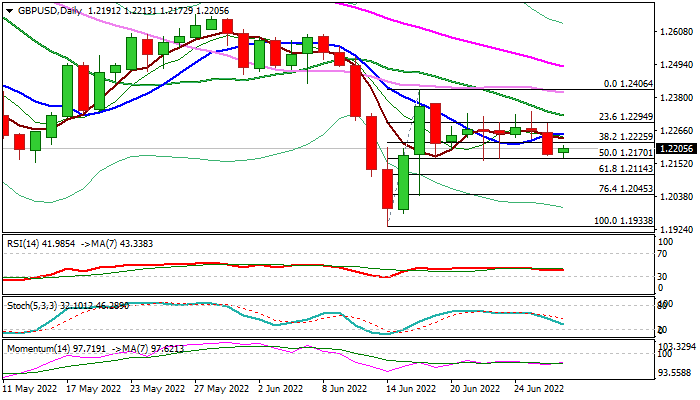
Cable is holding within a narrow consolidation in European trading on Wednesday, following Tuesday’s 0.64% drop, which generated an initial signal of an end of a multi-day directionless mode.
Fresh weakness touched strong supports at 1.2170 zone (50% retracement of 1.1933/1.2406 / lows of June 22/23), but so far lacking strength for a clear break, which would confirm bearish signal and shift near-term focus lower.
Daily technical picture is bearish with strong negative momentum and MA’s in bearish setup, keeping near-term bias with bears, as sterling is weighed by month-end dollar buying.
However, risk of extended range-trading is expected to persist as long as the price action stays above 1.2170 zone pivots, but the downside will remain vulnerable while daily Kijun-sen (1.2300) caps.
Res: 1.2213; 1.2235; 1.2260; 1.2300
Sup: 1.2170; 1.2114; 1.2045; 1.2000
BoJ Reaffirms Policy, Yen at 136
Kuroda pledges to maintain easy policy
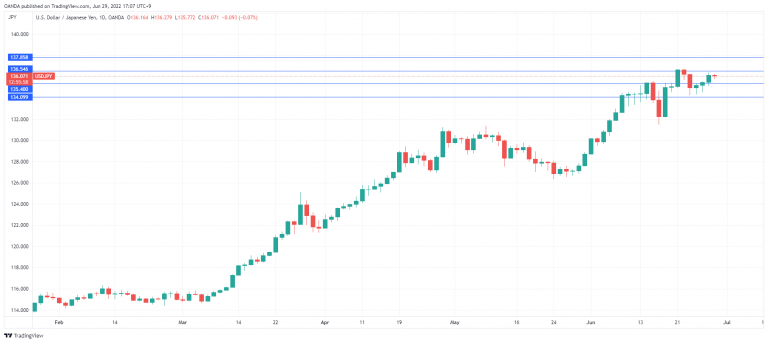
The Japanese yen is one of those currencies that keeps investors on its toes, and it has certainly lived up to its billing in recent weeks. USD/JPY has shot up 5.79% in the month of June and is back above the 136.00 line. BoJ Core CPI, the central bank’s preferred inflation gauge, ticked upwards to 1.5% in May, up from 1.4% prior and matching the forecast.
There is no mystery behind the yen’s sharp depreciation of some 17% in 2022. The currency has been at the mercy of the US/Japan rate differential, which has continued to widen. The Federal Reserve is in the midst of an aggressive rate-tightening cycle, with the Fed delivering a massive 0.75% increase at its last meeting. The Bank of Japan continues to take an opposite approach, that of an ultra-accommodative policy. The BoJ has maintained this stance at a time when other central banks are tightening, in order to boost the fragile Japanese economy. While other major economies are struggling with surging inflation, Japan’s inflation is around 2% – quite low but nonetheless on the rise after some 15 years of deflation.
Governor Kuroda reiterated on Wednesday that the BoJ would maintain accommodative policy, insisting that the increase was mostly a result of higher energy prices. Kuroda has said in the past that the present bout of inflation is temporary and that the BoJ would not change policy until inflation was anchored by higher domestic demand and an acceleration in wage growth. With neither of those criteria likely to occur anytime soon, we can expect the BoJ to continue to tenaciously defend its yield curve control and do little more than jawbone about the exchange rate. This does not bode well for the yen, which could continue its sharp slide and fall below the 140.00 line.
USD/JPY Technical
- USD/JPY faces resistance at 1.3654 and 1.3785
- There is support at 1.3540 and 1.3409