

Sample Category Title
Broader USD Strength Finally Pushed EUR/USD Off a Cliff
Markets
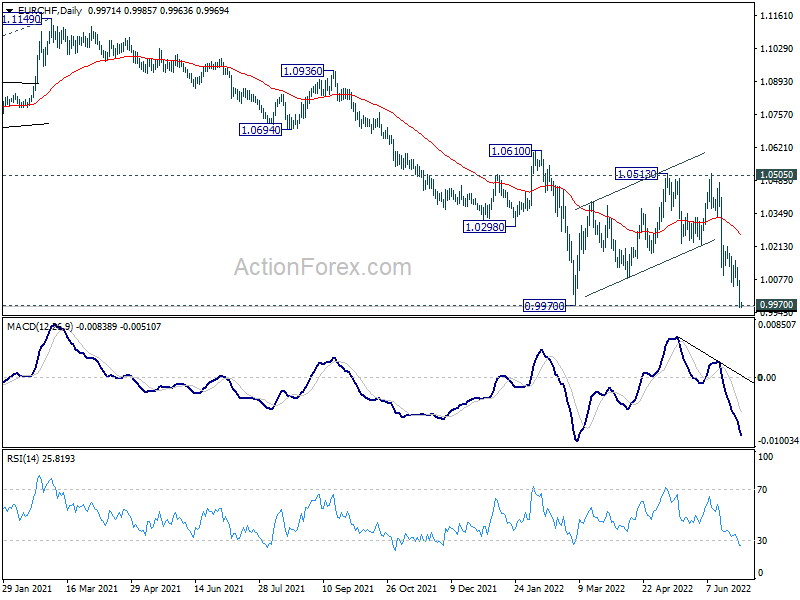
Markets yesterday still showed highly sensitive to any headline on inflation. Even the CPI release from the German state of North-Rhine Westphalia triggered a nervous start on (European) bond markets. The lower than expected inflation print (-0.1% M/M) later was conformed in the overall German figure (HICP -0.1% M/M, 8.2% Y/Y in May, from 8.7% in April). The slowdown was at least partially due to a one-off reduction in the cost of public transport. Later, Spanish HICP (10% Y/Y) and Belgian (9.65 % Y/Y) CPI showed no sign of easing at all. European yields temporarily reversed the initial decline. However, markets one way or another still pondered the idea that inflation might be nearing a peak momentum. Financial inflation expectations both in EMU and the US eased further. At a panel debate, Fed’s Powell, ECB Lagarde and BoE governor Bailey all reiterated that preventing a de-anchoring of inflation expectations should be avoided at any price. Investors apparently conclude that the ‘inevitable’ slowdown in growth might allow CB’s to slow the pace of hiking in 2023. A further topping out in (some) commodities also gives some comfort. Whatever the driver, core bonds rebounded. The belly of the curve outperformed the wings. The US 2-y eased 7.1 bps. Yields in the 5/10-y sector declined 9/8 bps. Similar reaction in Bunds the 5y outperforming (-15 bps) despite mixed regional inflation data. The euro initially tried to resist the decline in EMU yields, but broader USD strength finally pushed EUR/USD off a cliff (close at 1.0442 VS open 1.052). DXY finished north of 105. The Hawkish Sintra Powell comments pushed USD/JPY for a multi-year high test of the 137-level. Sterling hardly gained against a soft euro (close EUR/GBP¨0.8616). The Swiss franc strengthened below parity against the euro (close EUR/CHF 0.997). US equities showed no clear directional trend (S&P -0.07%).Risk sentiment in Asia stays fragile with China outperforming on better PMI’s (cf infra). The dollar eases (DXY 104.98; USD/JPY 136.4; EUR/USD 1.045). Later today, investors will keep a close eye at the US PCE deflators (May). A further substantial rise is expected (headline 0.7% M/M and 6.4% Y/Y). Or will markets give more weight to a potentially softer core reading (0.4% M/M expected)? The Chicago PMI, US jobless claims might give some further insights in the growth part of the equation. OPEC+ meets in Vienna, but no amendment of the approved production hike for August looks to be on the cards. The Riksbank is expected to hike rates by 50 bp today. On interest rate markets, recent consolidation pattern looks firmly in pace with the topside in yields capped for now as investors look out for the impact of (anticipated and already implemented) policy tightening and slower growth on inflation. 3.00% and 2.13% are first intermediate support of the US 10-y and the 10-y EMU swap respectively. In EUR/USD even the 1.0600/27 area proved a too high hurdle for now. 1.06/1.0341 serves as the ST trading range short-term.
News Headlines
Senate Democrats are working on shrinking the amount of tax increases planned in president Biden’s economic package. The $2.2tn deal approved by the House last year would be paid for by $1.5tn in tax increases but met fierce resistance from Democratic Senator Manchin. His vote is crucial in the 50-50 split Senate to get Biden’s Build Back Better deal through. Manchin and Senate Majority leader Schumer are close to agreeing that the overall tax increase amount would be roughly $1tn and that half of that needs to go to deficit reduction over 10 years. Time is ticking for Biden and the Democrats. By the end of September, the budget resolution that allows them to pass the bill with a simple majority, expires. Many believe the bill probably needs approval already next month, before August recess.
Riksbank to Hike Rates by 50bp
Market movers today
The main event today will be the Riksbank meeting at 9.30 CET (followed by the press conference at 11.00 CET). Consensus expects a hike of 50bp, including Danske. We expect the alternative repo rate path from April to become the new main scenario, with a steeper front and ending at 2.5%. This would be in the middle of market pricing (another 300bp) and our own view (3x50bp plus 25bp in February ending at 2.0%). Market prices 56bp for today, hence, only a significant deviation from a 50bp hike will cause high volatility. As for QE, the Riksbank in April decided to cut the reinvestment volumes in half for H2. We see a chance of another downward adjustment, but it is not our base case.
US personal spending data and German retail sales for May might bring more evidence that higher prices are taking their toll on consumers' willingness to spend and in turn stoke markets' recession fears.
French inflation will likely take another jump higher during June with rising fuel costs. Markets will also keep an eye on US PCE inflation, after CPI again surprised on the upside for May.
The 60 second overview
China PMIs: China Services PMI came in much better than expected at 54.7 in June compared to consensus 50.5 and prior 47.8, an obvious reflection of the easing of local Covid outbreaks and restrictions. Manufacturing activity disappointed slightly despite the index returning to expansionary territory with a reading at 50.2 compared to consensus 50.5 and prior 49.6. Asian stocks are mixed in the morning with Nikkei down but Hong Kong and Shanghai stocks in green as investors weigh recession concerns in Western markets against the ongoing recovery in Chinese economy.
Natural rates: Yesterday, we published a piece discussing natural rates: Research Global - Natural rates - regime change or low for longer? 29 June. The key message is that rates are likely to decline again after the current period of high inflation ends, although not all the way back to pre-pandemic lows. This is because the key structural factors that have pushed down the natural interest rate remain in place: increasing life expectancy, slowly growing or decreasing working age population, lower productivity growth, higher mark-ups and risk premia, a shock from the financial crisis and higher inequality all together push neutral rates lower. The key upside risks to natural rates are related to the increased fiscal spending and investments in defence, green transition and digitalisation which could drive higher potential growth going forward, but in net, we expect the desire to save still to dominate the desire to invest.
NATO and Russia: In a widely expected move, NATO called Russia the 'most significant and direct threat to the allies' security' in its updated Strategic Concept document published yesterday. As a response to Russian invasion of Ukraine, NATO leaders committed to increasing the alliance's combat forces in high alert seven-fold and to modernising Ukraine's military. Finland and Sweden have now been officially invited to join NATO and the actual ratification process (by member states) may begin next. President Putin said Russia would respond in kind if NATO sets up infrastructure in Finland and Sweden after they join. Over the last few days, Russia has clearly stepped up its attacks in Ukraine. We maintain our view that a frozen conflict in Ukraine is the most likely scenario and consider any escalation unlikely, yet possible (as Kremlin's actions remain unpredictable). While sanctions have weakened Russia's economy and its capacity to maintain or develop its artillery, high energy prices ensure sufficient income for Russia to continue its aggression against Ukraine.
FI: Yields ended lower (Bund yields 11bp lower), peripheral spreads tighter and sem-icore spreads wider with the belly of the curve as the biggest performer. German inflation failing to meet estimates was likely the main driver, however, we do not believe the peak inflation has been reached. This view is also confirmed with Spanish and Belgian inflation surprising on the upside. The government initiatives (transport of 9EUR/m during summer and the 'tankrabatt') gave cause for lower inflation print in Germany than otherwise expected. The peak in euro inflation is still set for September this year. With stagflation fears in markets, credit spreads generally widened.
FX: With the EUR trading heavy and both USD and CHF staying bid EUR/USD has moved below 1.05 while EUR/CHF has broken below the psychologically important parity level. SEK continues to trade poorly and has been one of the key losers over the last week while NOK has range traded.
Credit: On Wednesday, Credit markets were hit by a further spread widening, amidst risk-off mode in major equity indices. With recession fears creeping back into markets, Itrax main widened 3.3bp to close at 117.7bp, while Xover widened 22.3 to close at 582.4bp. There was no sign of relief for Nordic Real Estate credits, which were once again hit by sell-offs in what has so far been an extremely tough week for the sector.
Nordic macro
Riksbank decision is released 09.30 CET today, followed by a press conference at 11.00 CET. All respondents in BBG expect a hike of 50 bps including Danske. We expect the April alternative repo rate path to become the new main scenario with a steeper front and ending at 2.5 %. This would be in the middle of market pricing (another 300 bps) and our own view for 3*50bp plus 25 in Feb ending at 2.0 %. Market prices 56bp for today, hence, only a significant deviation from 50bp hike causes high volatility. As for QE, the Riksbank in April decided to cut the reinvestment volumes in half for H2. We see a chance of another downward adjustment, but it is not our base case.
Not So Transitory
Jerome Powell, Christine Lagarde and Andrew Bailey blamed pandemic and the war for sending inflation off the chart at a European Central Bank (ECB) event yesterday. We blame them for having called inflation transitory, and having been left behind the curve for too long.
The EURUSD slid to 1.0430, and the euro bulls are gently leaving the market, increasingly less convinced that Christine Lagarde doesn’t have a magic tool to address the fragmentation issue in Europe. At this point, no one knows how the ECB will raise the interest rates and avoid the peripheral yields from spiking to crisis levels. But inflation in Spain and Belgium spiked above 10% in June, while the ECB is not expected to raise the rates by more than 25bp at its next meeting. Seems insignificant to you? To us, too.
No wonder the euro-swissy is below the 1.00 mark. If the fall continues, the Swiss National Bank will likely intervene.
More inflation
The US will release the latest PCE figure today, which will likely show no pleasant surprise in the US, either. But happily for the Federal Reserve, investors don’t care much about the PCE index, even though the latter is what the Fed is watching to determine whether inflation is in line with its policy.
The PCE index was at 6.3% last month, much lower than the CPI index as the PCE gives a lower weight to gasoline and rents, which sent CPI inflation skyrocketing. Therefore, even if the Fed could bring the PCE down to 2%, it won’t solve the problem of high energy, high rents.
US rents for example hit another record high in June, up 14% over the last year.
Anyway, the chances are that we won’t see PCE hinting at lower inflation anytime soon.
Russia isn’t happy
The tensions between Russia and the West continue rising as NATO decided to welcome Finland and Sweden in the alliance. Putin threatened that if NATO infrastructure is deployed in these countries, Russia will have to respond in kind. Oil prices remained fairly contained however, as the European Union agreed on a framework to eliminate carbon emissions for new cars and vans by 2035. And they better respect their deadline, because the oil giants will not invest in extra refining capacities knowing that they will be out of business in many key markets in less than 15 years.
US crude consolidates above the $110pb this morning after having advanced to $115 yesterday. Sentiment remains comfortably bullish as OPEC will unlikely surprise for a second month at today’s decision. OPEC countries have struggled to meet their production targets last month, pumping around 3 million barrels less per day than their 42 million target. This means that the supply problems will remain the major headline in oil, and the prices will likely push higher unless the recession fears take the upper hand.
USD/CAD Daily Outlook
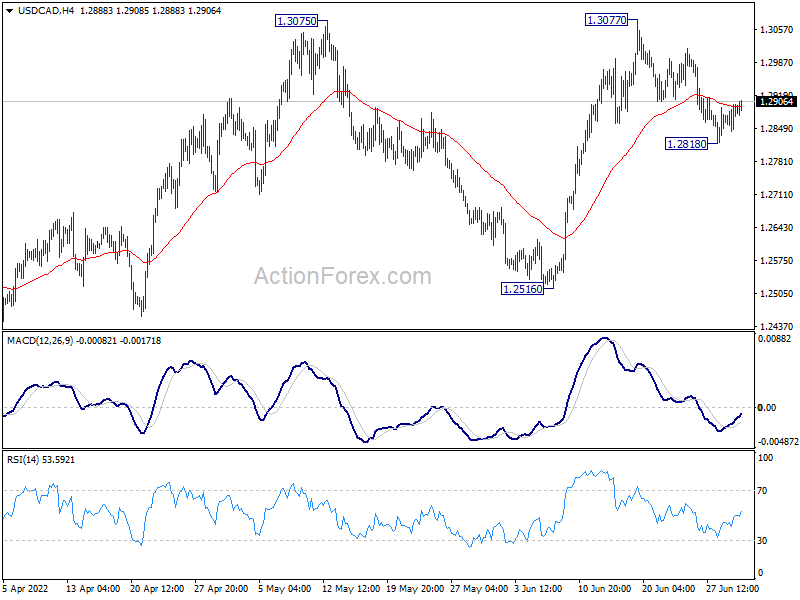
Daily Pivots: (S1) 1.2860; (P) 1.2880; (R1) 1.2916; More...
Intraday bias in USD/CAD remains neutral for the moment. On the downside, below 1.2818 will extend the fall from 1.3077 to 55 day EMA (now at 1.2800). Sustained break there will target 1.2516 support next. On the upside, break of 1.3077 and sustained trading above 1.3022 fibonacci level will carry larger bullish implications, and bring up trend resumption.
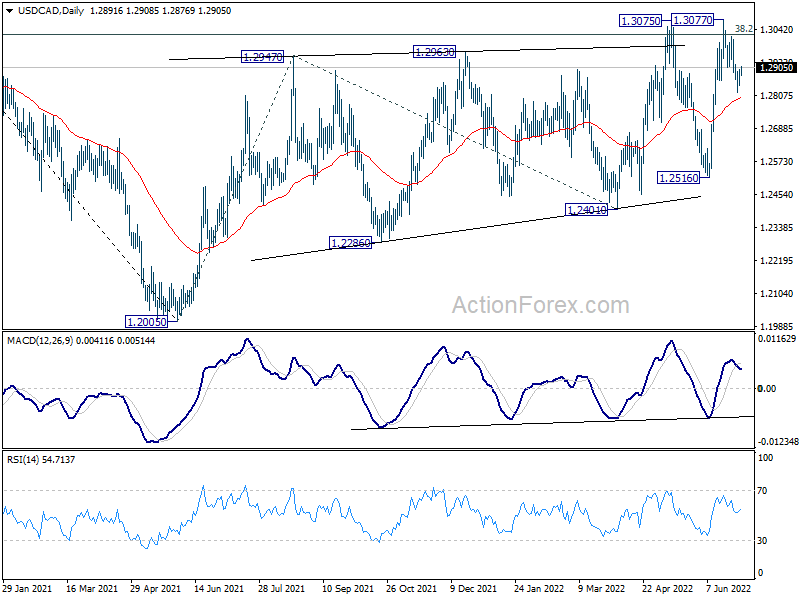
In the bigger picture, focus stays on 38.2% retracement of 1.4667 (2020 high) to 1.2005 (2021 low) at 1.3022. Sustained break there should confirm that the down trend from 1.4667 has completed after defending 1.2061 long term cluster support. Further rise would then be seen towards 61.8% retracement at 1.3650. However, rejection by 1.3022 will maintain medium term bearishness.
AUD/USD Daily Report
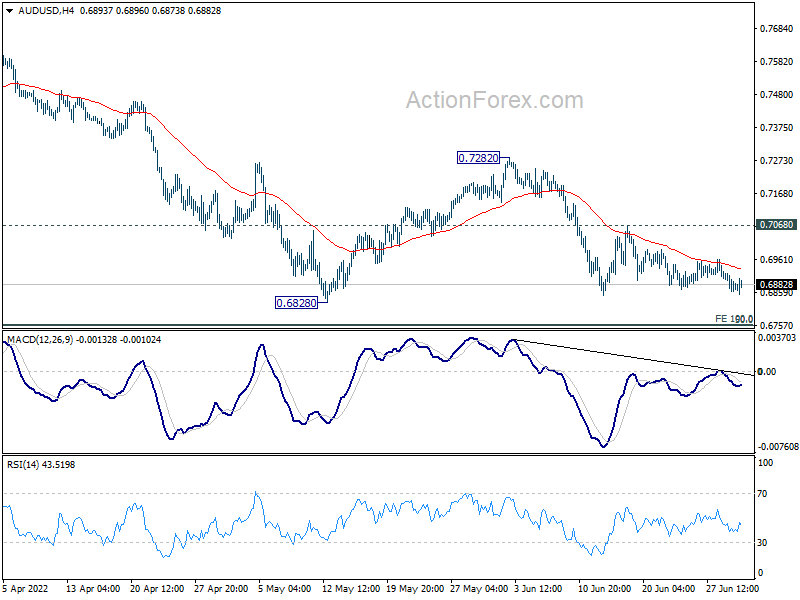
Daily Pivots: (S1) 0.6854; (P) 0.6887; (R1) 0.6912; More...
Intraday bias in AUD/USD remains neutral for the moment. On the downside, firm break of 0.6828 support will resume larger fall from 0.8006. Next target is 0.6756/60 cluster support. On the upside, above 0.7068 minor resistance will bring stronger rebound to 0.7282 resistance first. Firm break there will be a sign of bullish reversal and bring stronger rebound to 0.7666 resistance.
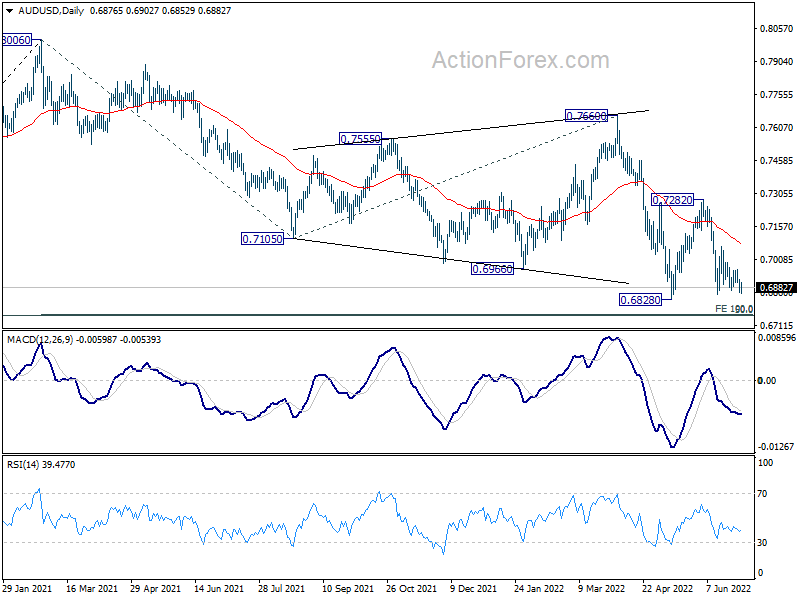
In the bigger picture, price actions from 0.8006 are seen as a corrective pattern to rise from 0.5506 (2020 low). Deeper fall could still be seen to 50% retracement of 0.5506 to 0.8006 at 0.6756. This coincides with 100% projection of 0.8006 to 0.7105 from 0.7660 at 0.6760. Strong support is expected from 0.6756/60 cluster to contain downside to complete the correction. Meanwhile, firm break of 0.7660 resistance will confirm that such corrective pattern has completed, and larger up trend is ready to resume.
USD/JPY Daily Outlook
Daily Pivots: (S1) 135.93; (P) 136.46; (R1) 137.14; More...
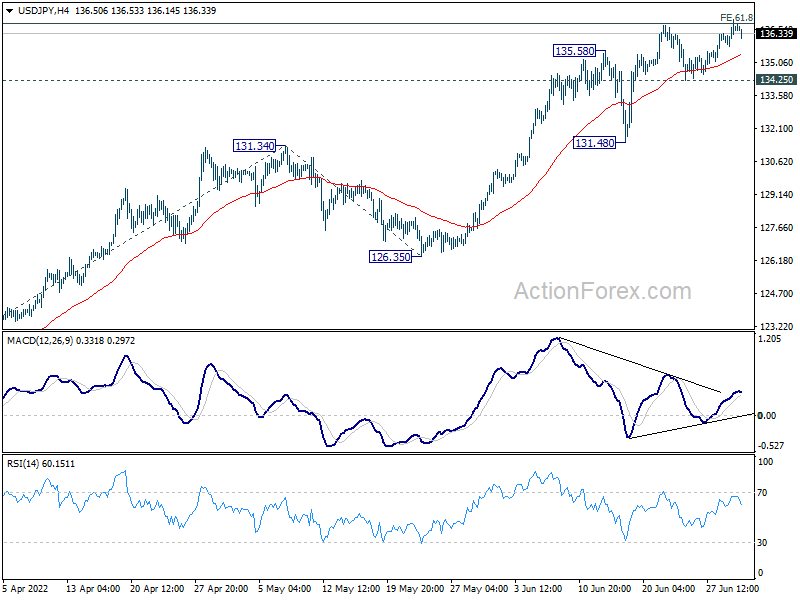
Further rise is expected in USD/JPY with 134.25 support intact. Current up trend would target 100% projection of 114.40 to 131.34 from 126.35 at 143.29. However, break of 134.25 will turn bias back to the downside for 131.48 support instead.
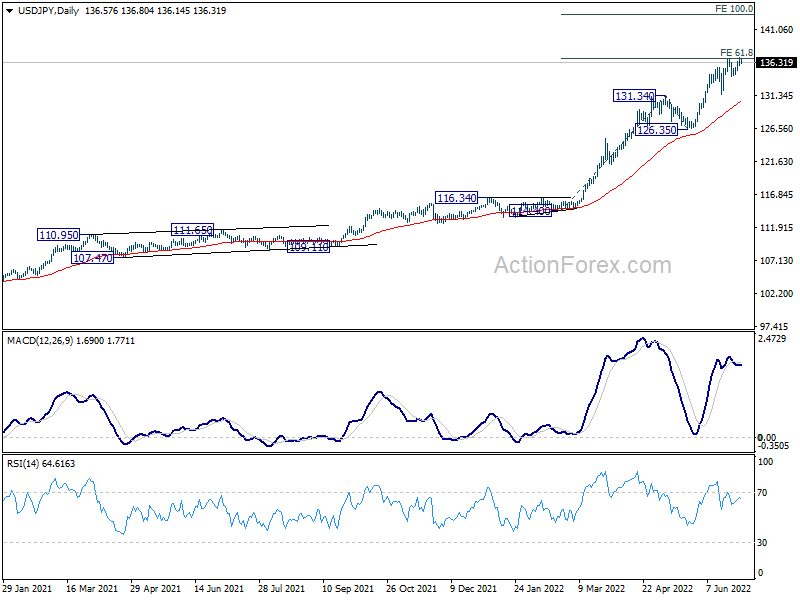
In the bigger picture, current rally is seen as part of the long term up trend from 75.56 (2011 low). Next target is 100% projection of 75.56 (2011 low) to 125.85 (2015 high) from 98.97 at 149.26, which is close to 147.68 (1998 high). This will remain the favored case as long as 126.35 support holds.
USD/CHF Daily Outlook
Daily Pivots: (S1) 0.9504; (P) 0.9542; (R1) 0.9588; More...
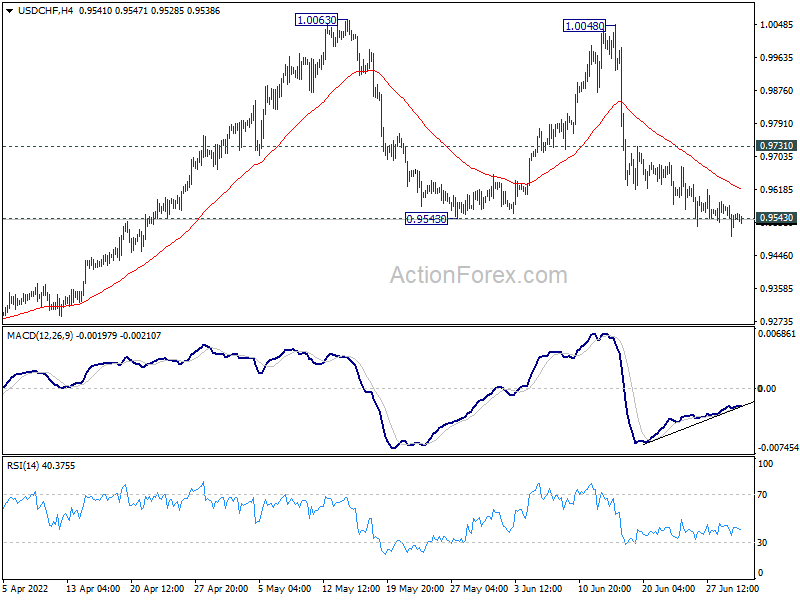
USD/CHF continues to lose downside momentum as seen in 4 hour MACD, and intraday bias stays neutral. Fall from 1.0048 is still seen as the third leg of the consolidation pattern from 1.0063. Strong support should be seen around 0.9543 to bring rebound. On the upside, above 0.9731 minor resistance will turn bias back to the upside for retesting 1.0063 resistance. However, sustained break of 0.9543 will bring deeper fall back to 0.9459 resistance turned support.
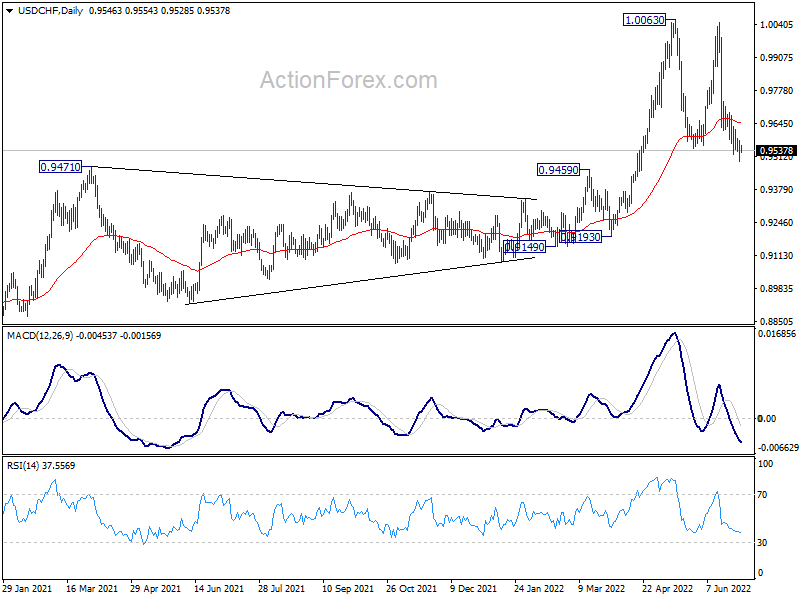
In the bigger picture, down trend from 1.0342 (2016 high) should have completed with three waves down to 0.8756 (2021 low) already. Rise from 0.8756 is likely a medium term up trend of its own. Next target is 1.0237/0342 resistance zone. This will remain the favored case as long as 0.9471 resistance turned support holds. However, sustained break of 0.9471 will extend long term range trading with another falling leg.
EUR/USD Daily Outlook
Daily Pivots: (S1) 1.0406; (P) 1.0471 (R1) 1.0506; More...
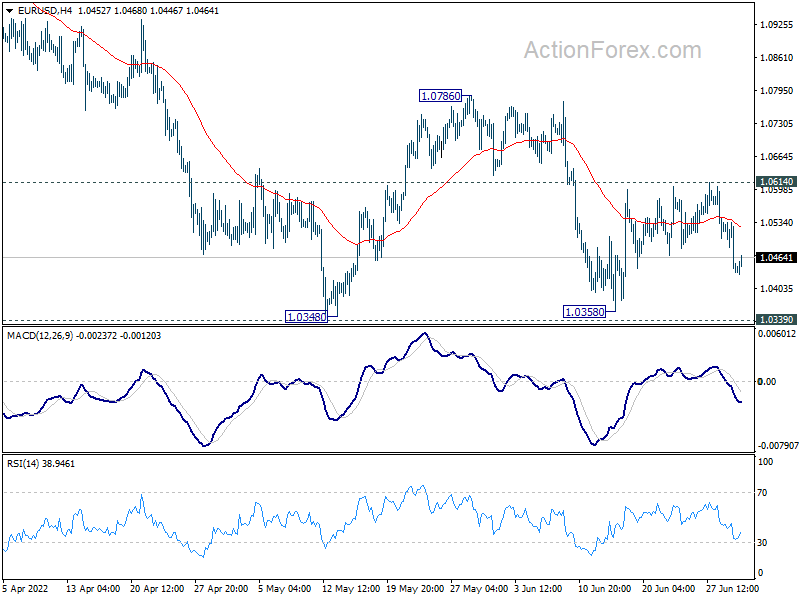
Range trading continues in EUR/USD and intraday bias remains neutral first. Further decline is in favor with 1.0614 minor resistance intact. On the downside, sustained break of 1.0339/48 will resume larger down trend. Next target is long term projection level at 1.0090. On the upside, above 1.0614 will turn bias back to the upside for 1.0786 resistance instead.
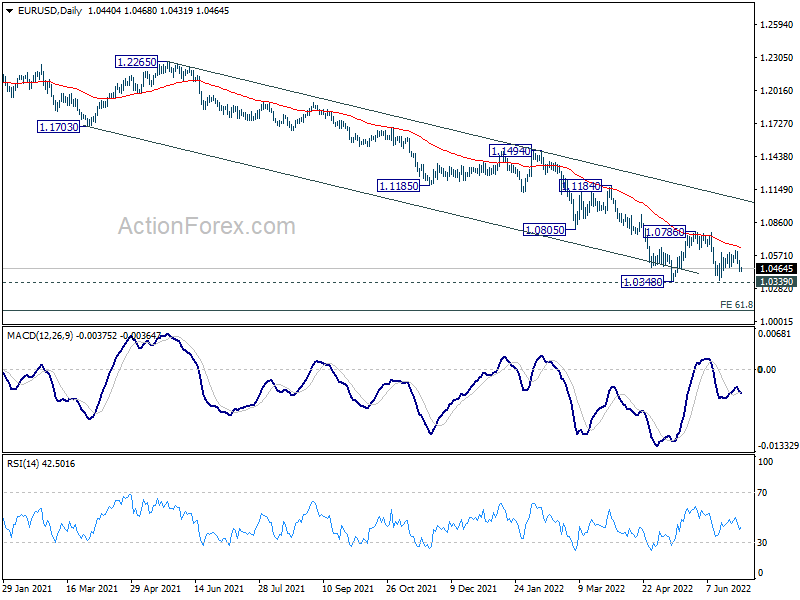
In the bigger picture, focus stays on 1.0339 long term support (2017 low). Decisive break there will resume whole down trend from 1.6039 (2008 high). Next target is 61.8% projection of 1.3993 to 1.0339 from 1.2348 at 1.0090. However, firm break of 1.0805 support turned resistance will delay this bearish case, and bring stronger rebound first.
GBP/USD Daily Outlook
Daily Pivots: (S1) 1.2081; (P) 1.2147; (R1) 1.2188; More...
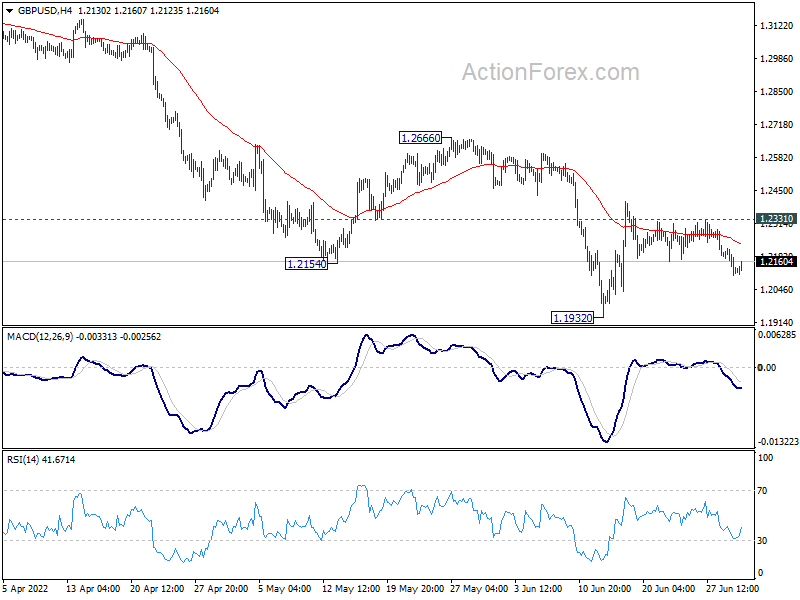
GBP/USD is still bounded in range above 1.1932 and intraday bias remains neutral. Further fall is in favor as long as 1.2331 minor resistance holds. Firm break of 1.1932 will resume larger down trend from 1.4248. On the upside, above 1.2331 will resume the rebound from 1.1932 to 1.2666 resistance. Firm break there will indicate medium term bottoming.
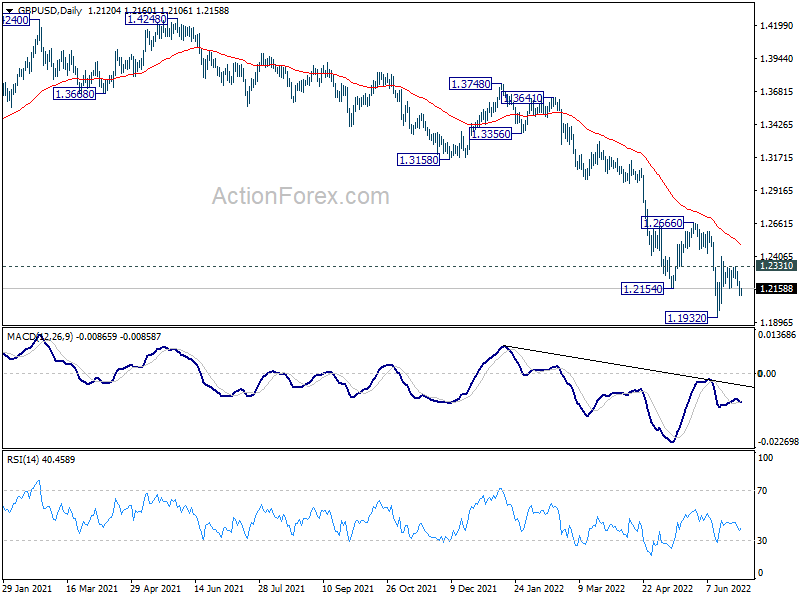
In the bigger picture, fall from 1.4248 (2018 high) could be a leg inside the pattern from 1.1409 (2020 low), or resuming the longer term down trend. Deeper decline is expected as long as 1.2666 resistance holds. Next target is 1.1409 low. However, firm break of 1.2666 will bring stronger rise back to 55 week EMA (now at 1.3140).
Swiss Franc Staying the Strongest, Dollar and Loonie Competing for Second
Swiss Franc remains the runaway leader for the week so far. Dollar and Canadian are competing for the second place. On the other hand, New Zealand Dollar is the worst, followed by Sterling and then Euro. Yen is mixed for now. Overall market sentiment is indecisive with stocks lacking follow through buying to the near term rebound. Treasury yields are also extending sideway trading. Gold turns softer but stays bounded in familiar range.
Technically, EUR/CHF's breach of 0.9970 low suggests long term down trend resumption. GBP/CHF is in downside acceleration. The first question is, whether that would eventually translate into break of 1.0358 support in EUR/USD, or 1.1932 support in GBP/USD, or both. The second question is, whether EUR/GBP will stay range bound or find a way to breakout. The interplays are worth a watch.
In Asia, Nikkei dropped -1.67%. Hong Kong HSI is down -0.18%. China Shanghai SSE is up 1.35%. Singapore Strait Times is down -0.46%. Japan 10-year JGB yield is down -0.0046 at 0.228. Overnight, DOW rose 0.27%. S&P 500 dropped -0.07%. NASDAQ dropped -0.03%. 10-year yield dropped -0.113 to 3.093.
Japan industrial production dropped -7.2% mom in may, worst in two years
Japan industrial production dropped -7.2% mom in May, much worse than expectation of -0.3% mom. That was also the worst contraction in two years, since the -10.5% mom decline in May 2020.
The index of production at factories and mines stood at 88.3 against the 2015 base of 100. Index of industrial shipments dropped -4.3% mom to 89.0. Inventories dropped -0.1% mom to 98.5.
Nevertheless, manufacturers surveyed by the Ministry of Economy, Trade and Industry (METI) expected output to rebound 12.0% in June, followed by a 2.5% expansion in July.
China PMI manufacturing rose to 50.2 in Jun, non-manufacturing up to 54.7
China official PMI Manufacturing rose from 49.6 to 50.2 in June., above expectation of 49.6. Sub-index for production rose to 52.8, highest since March 2021. PMI Non-Manufacturing rose from 47.8 to 54.7, above expectation of 52.5. That's also the highest level in 13 months.
"Even though the manufacturing sector continued to recover this month, 49.3 percent of the companies reported orders were insufficient," said Zhu Hong, senior statistician at NBS. "Soft market demand is still the main problem facing the manufacturing industry."
New Zealand ANZ business confidence dropped to -62.6, supply-side issues remain firms' biggest problems
New Zealand ANZ Business Confidence dropped from -55.6 to -62.6 in June. Own activity outlook dropped from -4.7 to -9.1. Investment intentions dropped from 8.6 to -3.2. Employment intentions dropped form 6.1 to 0.7. Cost expectations eased from 95.5. to 93.5. Pricing intentions rose from 71.0 to 73.7. Inflation expectations eased from 6.18 to 6.02.
ANZ said: " For now, supply-side issues remain firms' biggest problems: finding skilled labour, costs, and wages being the top three. The RBNZ needs those problems to ease, and weakening demand to move up the charts. That's what's required to bring inflation pressure down.
"Of course, weaker demand might ease the overtime, but it's unlikely to enhance profitability. That moment of happy equilibrium between demand and supply may prove fleeting, with the RBNZ entirely willing to incur the risk of a hard landing to ensure the long-term structural health of the economy in terms of well-anchored inflation expectations."
Looking ahead
Germany retail sales, import price, unemployment will be released in European session. UK will release Q1 GDP final and current account. Swiss will release retail sales and KOF economic barometer. Eurozone will release unemployment rate.
Later in the day, Canada will publish GDP. US will release jobless claims, personal income and spending with PCE inflation, and Chicago PMI.
GBP/USD Daily Outlook
Daily Pivots: (S1) 1.2081; (P) 1.2147; (R1) 1.2188; More...
GBP/USD is still bounded in range above 1.1932 and intraday bias remains neutral. Further fall is in favor as long as 1.2331 minor resistance holds. Firm break of 1.1932 will resume larger down trend from 1.4248. On the upside, above 1.2331 will resume the rebound from 1.1932 to 1.2666 resistance. Firm break there will indicate medium term bottoming.
In the bigger picture, fall from 1.4248 (2018 high) could be a leg inside the pattern from 1.1409 (2020 low), or resuming the longer term down trend. Deeper decline is expected as long as 1.2666 resistance holds. Next target is 1.1409 low. However, firm break of 1.2666 will bring stronger rise back to 55 week EMA (now at 1.3140).
Economic Indicators Update
| GMT | Ccy | Events | Actual | Forecast | Previous | Revised |
|---|---|---|---|---|---|---|
| 23:50 | JPY | Industrial Production M/M May P | -7.20% | -0.30% | -1.50% | |
| 01:00 | NZD | ANZ Business Confidence Jun | -62.6 | -55.6 | ||
| 01:30 | AUD | Private Sector Credit M/M May | 0.80% | 0.60% | 0.80% | 0.90% |
| 01:30 | CNY | Manufacturing PMI Jun | 50.2 | 49.6 | 49.6 | |
| 01:30 | CNY | Non-Manufacturing PMI Jun | 54.7 | 52.5 | 47.8 | |
| 05:00 | JPY | Housing Starts Y/Y May | -4.30% | 3.00% | 2.20% | |
| 06:00 | EUR | Germany Retail Sales M/M May | 0.60% | 0.80% | -5.40% | |
| 06:00 | EUR | Germany Import Price Index M/M May | 0.90% | 1.60% | 1.80% | |
| 06:00 | GBP | GDP Q/Q Q1 F | 0 | 0.80% | 0.80% | |
| 06:00 | GBP | Current Account (GBP) Q1 | -51.7B | -39.7B | -7.3B | |
| 06:30 | CHF | Real Retail Sales Y/Y May | 3.80% | -6.00% | ||
| 06:45 | EUR | France Consumer Spending M/M May | 0.60% | -0.40% | ||
| 07:00 | CHF | KOF Leading Indicator Jun | 96.8 | 96.8 | ||
| 07:55 | EUR | Germany Unemployment Change Jun | -6K | -4K | ||
| 07:55 | EUR | Germany Unemployment Rate Jun | 5% | 5% | ||
| 08:00 | EUR | Italy Unemployment Rate May | 8.50% | 8.40% | ||
| 09:00 | EUR | Eurozone Unemployment Rate May | 6.80% | 6.80% | ||
| 12:30 | CAD | GDP M/M Apr | 0.20% | 0.70% | ||
| 12:30 | USD | Initial Jobless Claims (Jun 24) | 229K | 229K | ||
| 12:30 | USD | Personal Income M/M May | 0.50% | 0.40% | ||
| 12:30 | USD | Personal Spending May | 0.50% | 0.90% | ||
| 12:30 | USD | PCE Price Index M/M May | 0.20% | |||
| 12:30 | USD | PCE Price Index Y/Y May | 6.30% | |||
| 12:30 | USD | Core PCE Price Index M/M May | 0.40% | 0.30% | ||
| 12:30 | USD | Core PCE Price Index Y/Y May | 4.70% | 4.90% | ||
| 13:45 | USD | Chicago PMI Jun | 55 | 60.3 |