Sample Category Title
Fed Williams: It’s a slowdown that we need, not a recession
New York Fed President John Williams told CNBC today, "A recession is not my base case right now. I think the economy is strong. Clearly financial conditions have tightened and I'm expecting growth to slow this year quite a bit relative to what we had last year."
"But that's not a recession," he noted. "It's a slowdown that we need to see in the economy to really reduce the inflationary pressures that we have and bring inflation down."
On interest rate, Williams said, "we're far from where we need to be". Rate can rise from current 1.50-1.75% to 3-3.5%. "My own baseline projection is we do need to get into somewhat restrictive territory next year given the high inflation, the need to bring inflation down and really to achieve our goals," he said. "But that projection is about a year from now. Of course, we need to be data dependent."
Sunset Market Commentary
Markets
Recent underperformance of EMU bond/interest rate markets versus the US continues. European investors kept a close eye at comments and speeches at the ECB forum in Sintra. Before and at the June 9 policy meeting, the ECB already provided quite a detailed roadmap signalling a 25 bps rate lift-off in July and (several) >25 bps steps later this year if inflation doesn’t substantially improve by then. If the consensus on Friday’s CPI release (0.7% M/M, 8.5% Y/Y) comes true, this improvement won’t materialize anytime soon. In this respect, ECB’s Lagarde reiterated the benefits of gradualism, but at the same time highlighted ‘the option to act decisively on any deterioration in medium-term inflation, especially if there are signs of a de-anchoring of inflation expectations’. Latvian ECB member Kazaks even defended the merits of frontloading a bigger rate hike already at the July meeting, but there are few signs that his view has a majority within the MPC. President Lagarde and other governors also elaborated on steps to avoid fragmentation of policy across countries. This now even is considered a necessary condition to be able to raise rates enough to address elevated inflation. A first line of defense with flexible reinvestments of proceeds from maturing bonds of the PEPP portfolio, will start as soon as July 1. On the new tool that is in the making to handle unwarranted spread widening, the ECB president said:’ The new instrument will have to be effective, while being proportionate and containing sufficient safeguards to preserve the impetus of Member States towards a sound fiscal policy’. So, some, albeit soft, conditionality will apparently be included. Some ECB members also aired the idea to sterilize the liquidity created via the new tool. The news from Sintra shouldn’t come as a big surprise for markets. Still, the idea that the new ECB toolkit makes it easier to raise rates without market fragmentation might fuel expectations for more bold ECB action if the inflation outlook worsens further. German yields are rising between 5.5 bps (2-y) and 8.5 bps (10-y). The sharp rise in the 5-y yield (+14 bps) is partially due to a benchmark change. The bottoming in EMU yields after last week’s correction clearly is taking shape. The narrowing of intra-EMU spreads versus Germany also continues (10-y Greece -7 bps, Italy -4 bps). Moves in the US bond market were again much more modest with the 2-y yield little changed while yields for longer maturities rose about 2 bps. European equites are extending a cautious rebound (Eurostoxx + 0.75%/1.0%), but the LT picture remains fragile. US equities show similar gains after the open. Oil also gains further ground (brent $ 117/b).
On FX markets, the forint rebounded to EUR/HUF 398.75 after the MNB unexpectedly raised the its policy bas rate by 185 bps to 7.75%. It will bring the 1 week deposit rate to the same level at its next week weekly tender. EUR/USD tried to regain the 1.06 handle this morning. However, additional interest rate support failed to trigger a break higher. Profit taking even brings EUR/USD back to the 1.0540 area. EUR/GBP also trades off the intraday peak levels, but is little changed in a daily perspective (0.862). USD/JPY (136.15) again near the multi-year top.
News Headlines
Polish Monetary Policy Council member Kotecki argued in favour of a rate hike of at least 100 bps at its July 7 policy meeting as he expects another sharp rise in inflation in early 2023 due to higher electricity and gas prices. Kotecki in amongst the more hawkish members on the board with governor Glapinski earlier hinting that the tightening cycle might be drawing to an end. Polish inflation numbers are on due on Friday and expected to rise by 1.5% M/M and 15.5% Y/Y. The National Bank of Poland this year applied monthly 75 bps rate hikes from March with even an 100 bps rate move in April. The base rate currently stands at 6%. Accelerating inflation and more drastic June action by the CNB (+125 bps to 6%) and MNB today (+185 bp to 7.75%) suggest that risks are clearly tilted to more aggressive action. Polish money markets discount a policy rate in excess of 8% by the end of the year and peaking at 8.5% by mid next year. The Polish zloty could use the additional support. At EUR/PLN 4.7, it remains in the danger zone of slipping back to weakest levels on record. The NBP holds a view that a strong(er) currency should be part of the equation in the current market setting (high inflation & aggressive tightening cycle)...
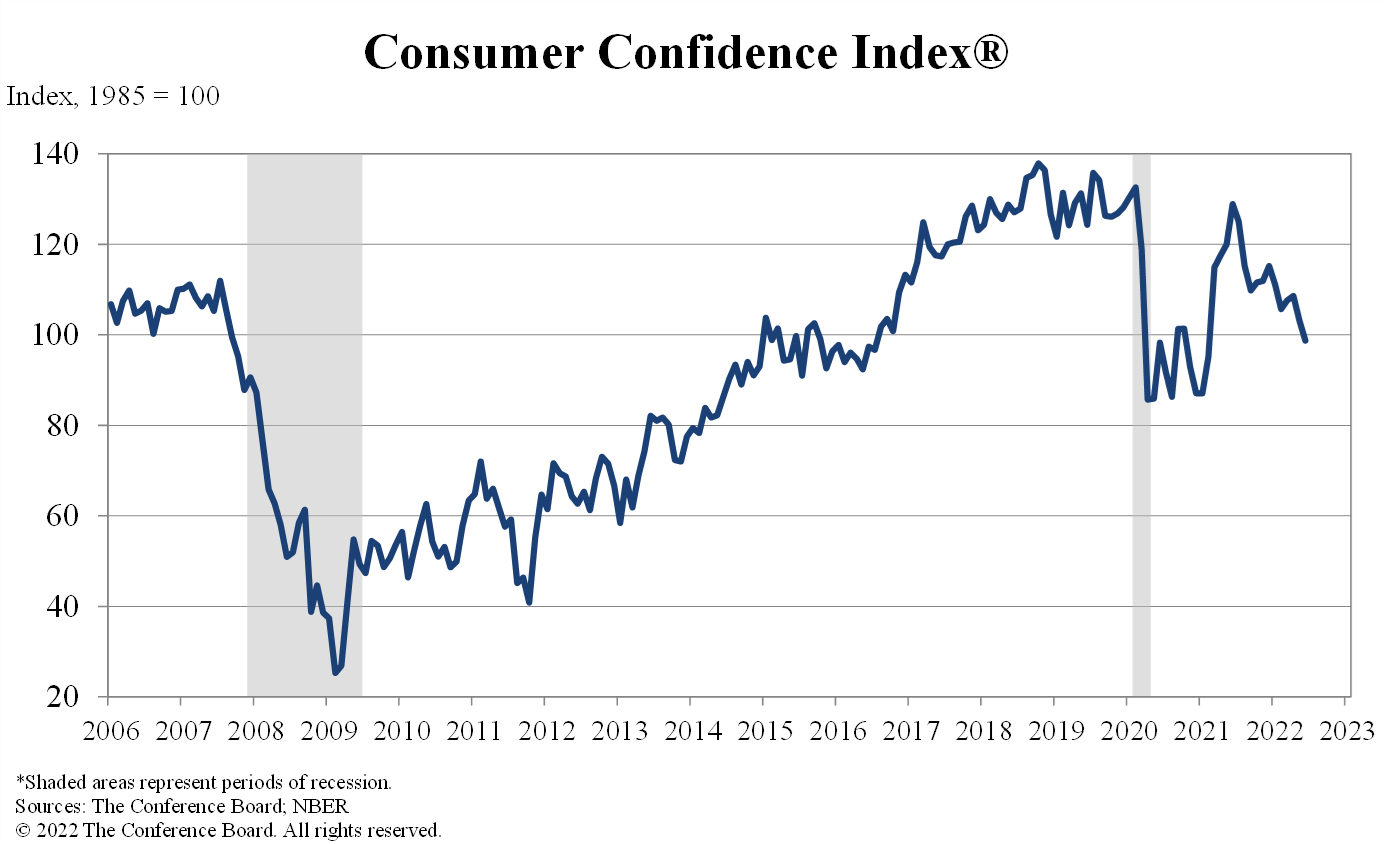
US consumer confidence dropped to 98.7 Jun, expectations tumbled to lowest since 2013
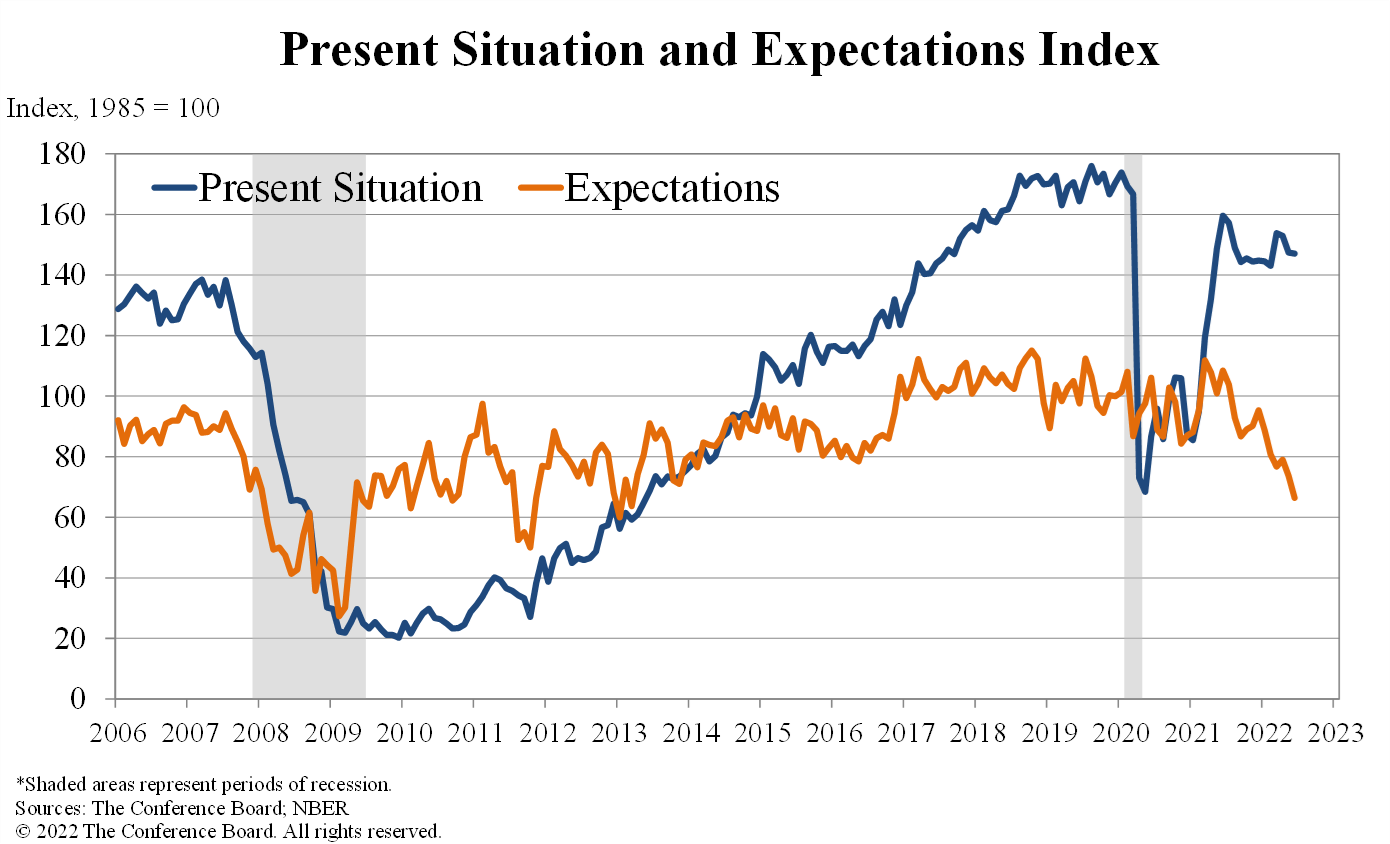
US Conference Board Consumer Confidence Index dropped from 103.2 to 98.7 in June, below expectation of 100. That's also the lowest level since February 2021 (95.2). Present Situation Index dropped slightly from 147.4 to 147.1. But Expectations Index dropped sharply from 73.7 to 66.3, lowest since March 2013.
Lynn Franco, Senior Director of Economic Indicators at The Conference Board: "Consumers' grimmer outlook was driven by increasing concerns about inflation, in particular rising gas and food prices. Expectations have now fallen well below a reading of 80, suggesting weaker growth in the second half of 2022 as well as growing risk of recession by year-end."
Bitcoin Exhibits Weakness But Holds above the 20,000 Mark
Bitcoin and other major altcoins have merely bounced back and remain comfortably above their recent lows on signs that inflation in the US is indeed cooling and the Fed might be able to scale down its monetary tightening later in the year. However, cryptocurrencies have started the week on the wrong foot as idiosyncratic risks stemming from within the crypto industry alongside the broader unfavorable macroeconomic conditions for risky assets continue to weigh on digital coins. The latest rangebound pattern observed in most cryptocurrencies is probably hinting that investors are scrutinizing the current complex market conditions and await significant macroeconomic developments to determine the direction of the next breakout.
Bitcoin’s fortunes closely aligned with stocks
The major US indices witnessed a sharp comeback last week, with the Nasdaq 100 gaining 7.5%, while the S&P 500 was up about 6.5% for the week, experiencing its biggest single-day gain in two years on Friday. This relief rally was attributed to the University of Michigan’s monthly consumer sentiment index (CSI), which was revised lower.
Cryptocurrency prices quickly caught up with the stock market’s advance, demonstrating once more the increasing correlation between cryptos and equities and shattering the idea that digital assets can act as inflation hedging tools.
Systemic risks keep popping up
Bitcoin’s year-to-date decline has come in tandem with the stock market's downfall, which has been triggered by fears over global inflation and growth outlooks. Nevertheless, the former was exacerbated by regulatory woes, idiosyncratic risks of the digital asset universe and operational crackdowns among crypto financial service providers. On Friday, hackers stole the equivalent of $100 million in crypto assets from Harmony, a California-based cryptocurrency firm. After this latest theft, a blockchain analytics firm called Elliptic estimates that over $1 billion have been stolen so far in 2022.
Additionally, the Australian crypto exchange Banxa announced that it plans to cut over 70 jobs in anticipation of a steep market downturn, joining the gang of crypto firms that have already started reducing their headcount such as Coinbase, Crypto.com, Gemini and BlockFi. To make matters worse, numerous crypto companies are slashing their marketing and advertising budgets, even though the need to regain investors’ confidence in blockchain technology is more essential than ever.
Mining activity remains a catalyst
At the current price levels, crypto mining is not attractive, and miners have started offloading their holdings on exchanges to cover rising costs in anticipation of lower prices. According to a Reuters report, the number of miners selling coins to crypto exchanges has been steadily climbing since June 7, which combined with the increasing liquidation of leveraged positions has accelerated the latest sell-off.
Furthermore, the amount of electricity consumed by the largest cryptocurrency networks has fallen by nearly 50% according to Digiconomist’s estimates as the crypto winter continues to erode miners' income and financial contagion spreads further throughout the sector. On the one hand, less supply could boost prices, but investors watching miners go out of business could also harm their sentiment toward cryptos’ growth prospects.
Technical picture remains worrisome
Although Bitcoin's price managed to recover from its fresh 18-month low of 17,588, it remains below the 200-week simple moving average (SMA), which is essentially the bottom of all its previous bear market cycles.
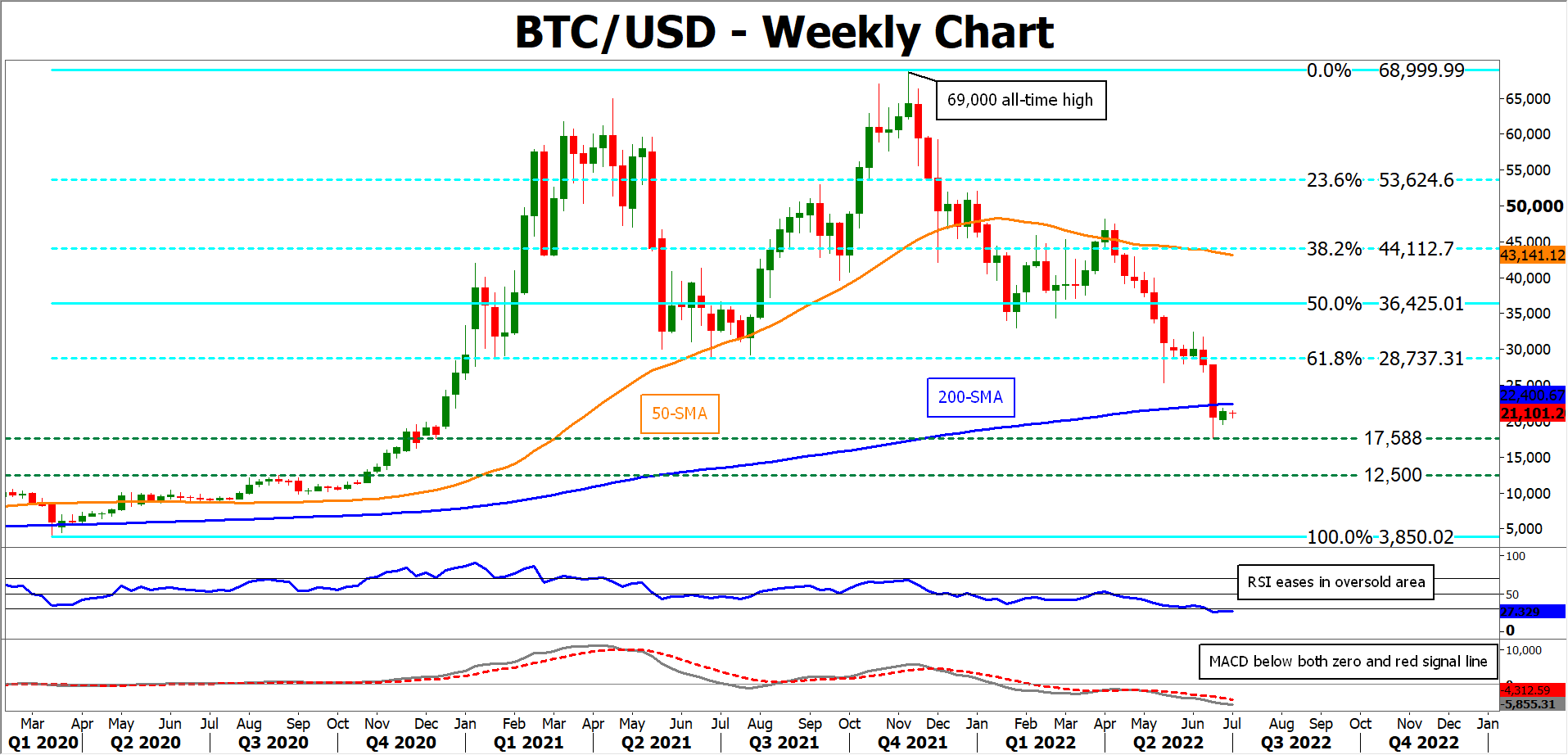
Should selling pressure intensify, the 2022 low of $17,588 may act as the first line of defense. Failing to halt there, the price would descend to form fresh multi-year lows and the next crucial barrier could be found at the August 2020 resistance of $12,500.
To the upside, bullish actions might encounter initial resistance at the 200-week SMA, currently at $22,400. An upside violation of the latter may open the door for the $28,737 level, which is the 61.8% Fibonacci retracement of the 3,850-68,999 upleg.
AUD/USD: Aussie Remains Capped by 10DMA, Keeping Bearish Bias
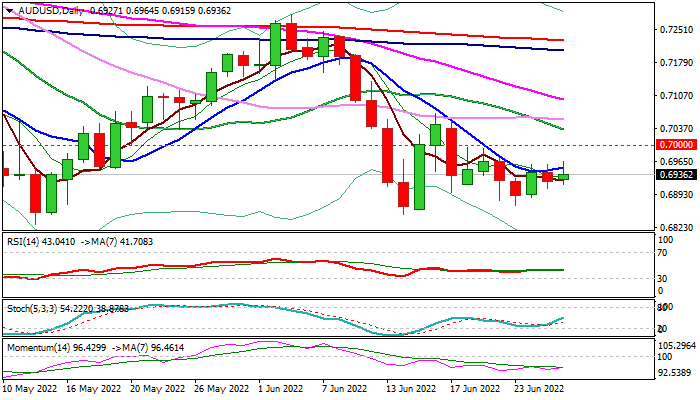
The Aussie dollar eases from one-week high on Tuesday after failing to benefit more from positive news that China slashed Covid quarantine for international travelers.
The price action fell back below 10DMA (0.6951) which caps the price since June 9 and maintains negative bias, with repeated daily close below to add to fragile near-term structure.
Daily technical studies remain in full bearish setup and keep negative outlook for retest of key supports at 0.6850/28 (June 14 / May 12 lows).
The upside is expected to remain well protected by 10DMA and psychological 0.70 barriers.
Res: 0.6951; 0.7000; 0.7035; 0.7055
Sup: 0.6907; 0.6869; 0.6850; 0.6828
USD/JPY: Bulls Look for a Break Through Multi-Year Highs
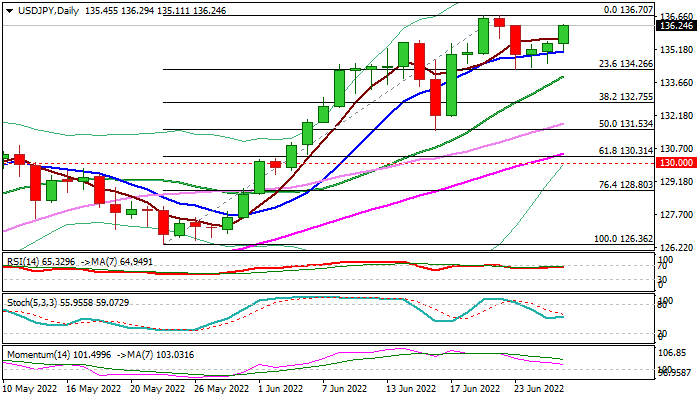
Shallow pullback from new multi-year high (136.70) found solid ground at 134.26 (Fibo 23.6% of 126.36/136.70) and subsequent bounce accelerated on Tuesday, retracing over 76.4% of 136.70/134.26 pullback, and confirming that bulls regained full control.
Overall picture remains firmly bullish as rally strongly accelerated in March and is on track for strong monthly gains in June.
The rally was boosted by strong safe-haven demand on migration from riskier assets into safety on growing uncertainty over the consequences of the conflict in Ukraine.
Bulls pressure strong barriers at 136.70/90 (2022 / 1998 peaks) with break here to unmask psychological 140 resistance.
Despite fresh bullish acceleration, daily chart shows weakening bullish momentum that warns of headwinds bulls may face and possibly hold in extended consolidation before final push higher. Rising 10DMA (currently at 135.06) which keeps the downside protected since June 17, is expected to contain dips again and keep bulls intact.
Res: 136.70; 136.90; 137.28; 137.63.
Sup: 135.67; 135.06; 134.26; 133.93.
Swiss Franc Continues to Rise
June rollercoaster ride for Swissie
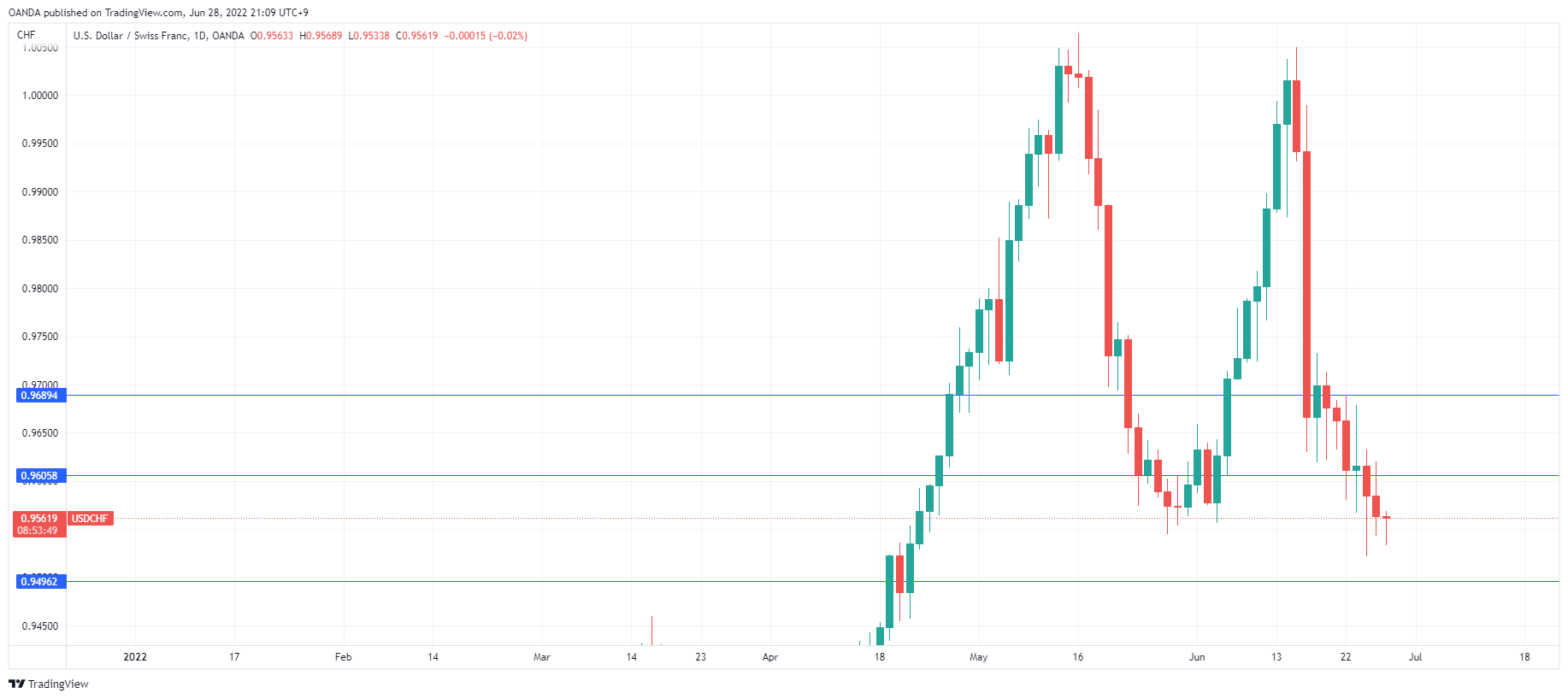
It has been a tale of two Junes for the Swiss franc. USD/CHF rose about 400 points in the first half of the month and breached above the parity line. Since then, it has surrendered almost all of those gains. The highlight was the SNB shocker on June 16th, when the central bank raised rates from -0.75% to -0.25%, a huge move that was totally unexpected. The rate hike predictably sent the Swiss franc sharply higher, and the currency has continued to strengthen in the second half of June. On Friday, USD/CHF fell as low as 0.9521, its lowest level since April 21st.
The reason that the SNB raised rates in such dramatic fashion was to keep inflation at bay. Inflation rose to 2.9% YoY in May. This is much lower compared to the US or UK, but marked Switzerland’s highest inflation rate since 1993. The Bank’s rate statement said that further hikes could be implemented in order to stabilize inflation.
The SNB, unlike most major central banks, intervenes in currency markets as it sees fit. The SNB carefully monitors the exchange rate and has intervened in the past when it deemed the Swiss franc’s value as too high, which is detrimental to Switzerland’s export-reliant economy. The SNB decided that the priority was to curb rising inflation, knowing that a sharp rise in interest rates would cause the Swiss franc to dramatically appreciate.
SNB President Thomas Jordan said last week that economic data indicated a need to continue to tighten monetary policy, but said it was unclear when this would occur. The SNB may not be embarking a rate-hike cycle anytime soon, but with a potential rate hike on the table, the Swiss franc has upside risk.
USD/CHF Technical
- USD/CHF has support at 0.9496 and 0.9412
- There is resistance at 0.9605 and 0.9689
EUR/USD Mid-Day Outlook
Daily Pivots: (S1) 1.0550; (P) 1.0583 (R1) 1.0614; More...
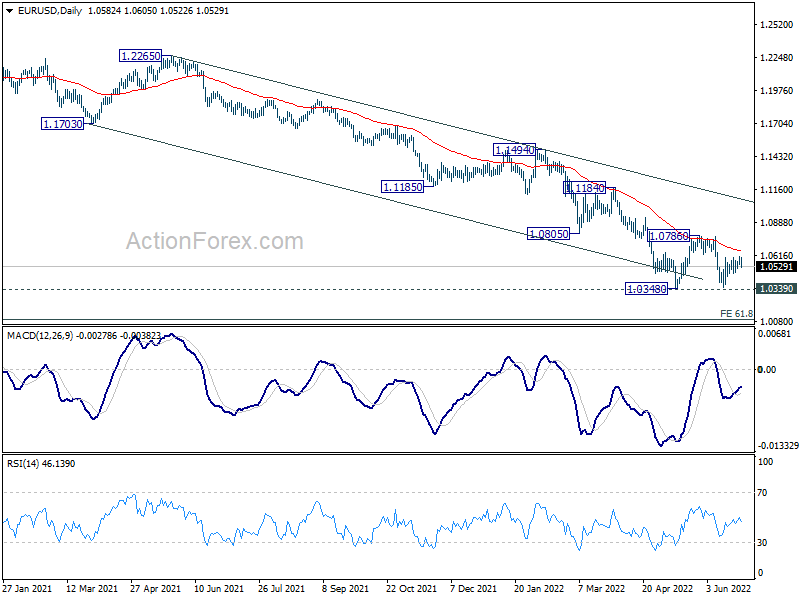
Intraday bias in EUR/USD remains neutral as consolidation continues. Further fall is in favor with 1.0786 resistance intact. On the downside, sustained break of 1.0339/48 will resume larger down trend. Next target is long term projection level at 1.0090.
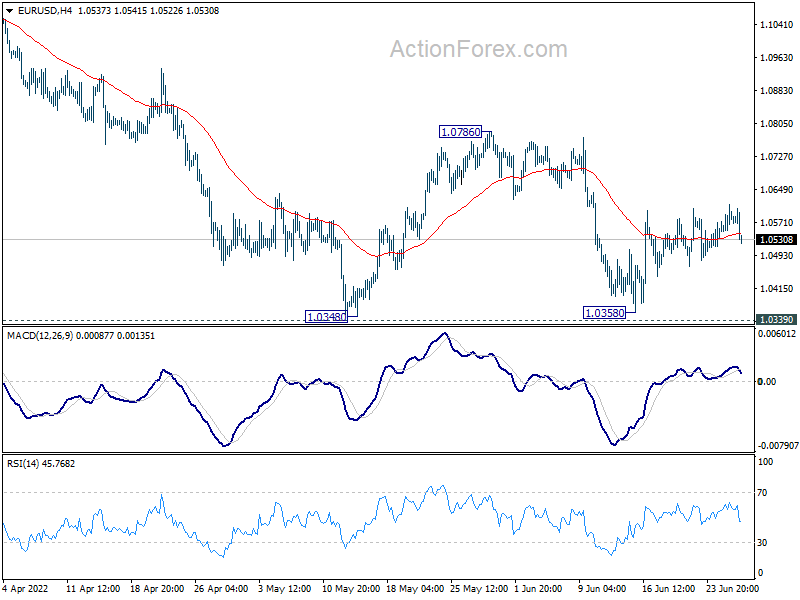
In the bigger picture, focus stays on 1.0339 long term support (2017 low). Decisive break there will resume whole down trend from 1.6039 (2008 high). Next target is 61.8% projection of 1.3993 to 1.0339 from 1.2348 at 1.0090. However, firm break of 1.0805 support turned resistance will delay this bearish case, and bring stronger rebound first.
GBP/USD Mid-Day Outlook
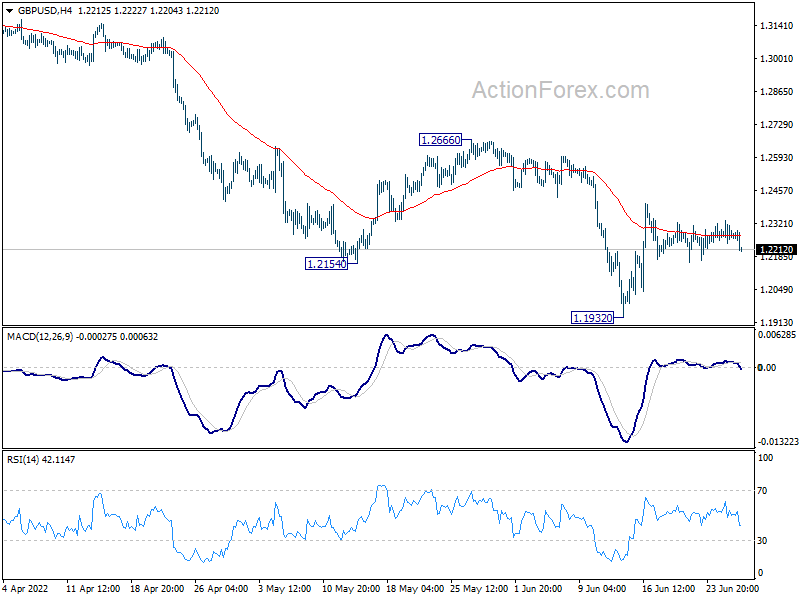
Daily Pivots: (S1) 1.2225; (P) 1.2279; (R1) 1.2320; More...
Intraday bias in GBP/USD stays neutral as sideway trading continues. Outlook stays bearish as long as 1.2666 resistance holds. On the downside, break of 1.1932 will resume larger down trend from 1.4248. However, firm break of 1.2666 will suggest medium term bottoming and bring stronger rebound back towards 1.3158 support turned resistance.
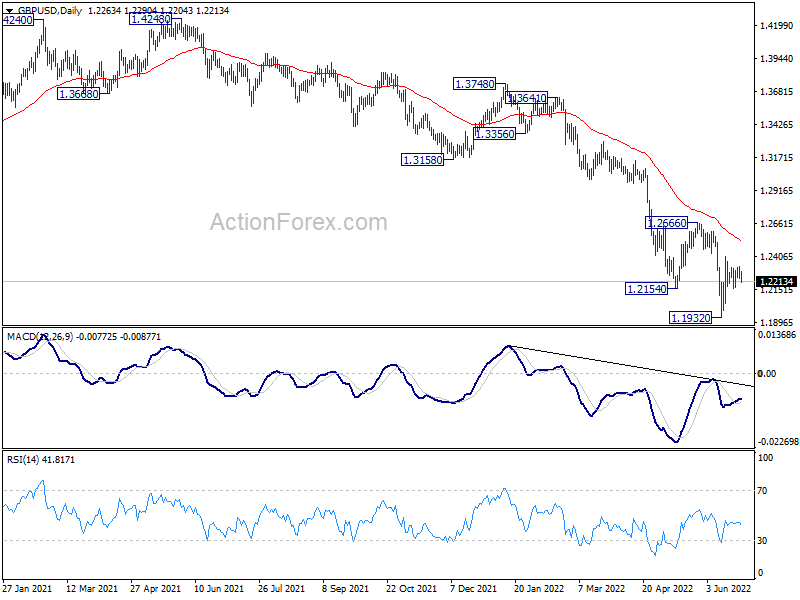
In the bigger picture, fall from 1.4248 (2018 high) could be a leg inside the pattern from 1.1409 (2020 low), or resuming the longer term down trend. Deeper decline is expected as long as 1.2666 resistance holds. Next target is 1.1409 low. However, firm break of 1.2666 will bring stronger rise back to 55 week EMA (now at 1.3140).
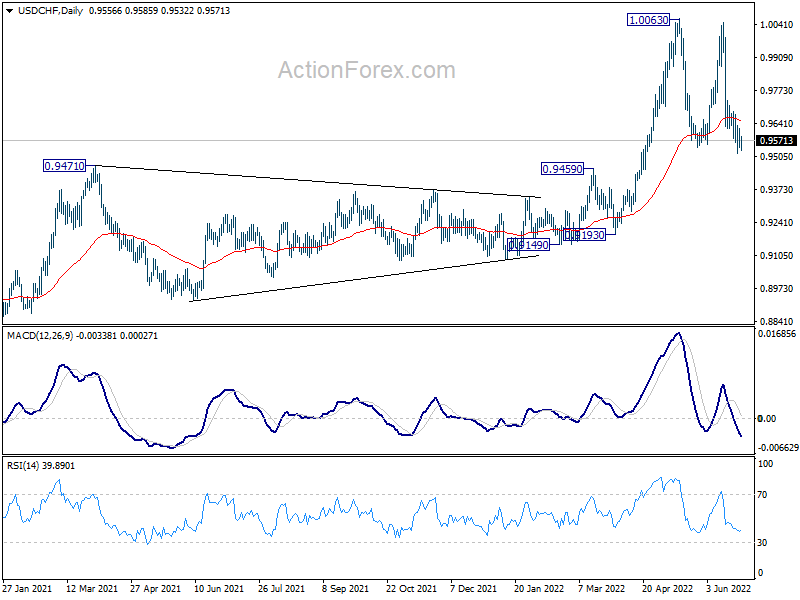
USD/CHF Mid-Day Outlook
Daily Pivots: (S1) 0.9531; (P) 0.9575; (R1) 0.9608; More...
Intraday bias in USD/CHF remains neutral and outlook is unchanged. Fall from 1.0048 is still seen as the third leg of the consolidation pattern from 1.0063. Strong support should be seen around 0.9543 to bring rebound. On the upside, above 0.9731 minor resistance will turn bias back to the upside for retesting 1.0063 resistance. However, sustained break of 0.9543 will bring deeper fall back to 0.9459 resistance turned support.
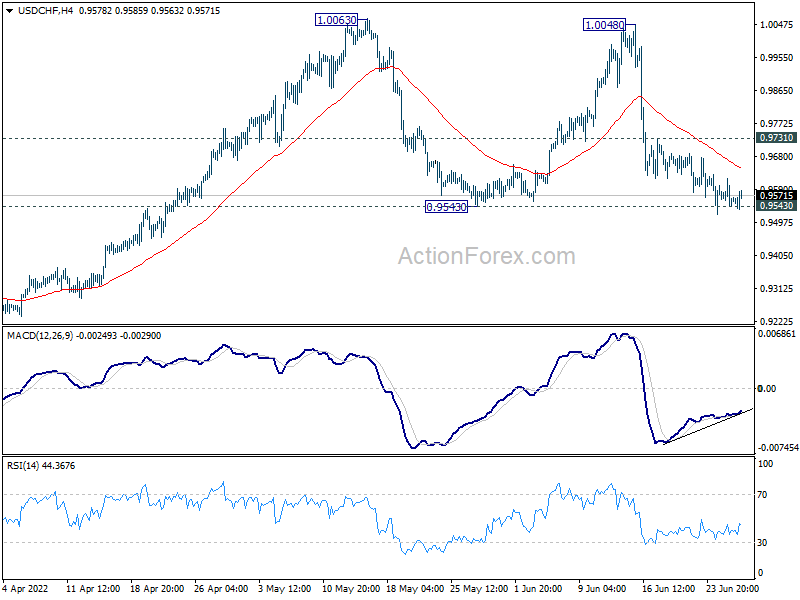
In the bigger picture, down trend from 1.0342 (2016 high) should have completed with three waves down to 0.8756 (2021 low) already. Rise from 0.8756 is likely a medium term up trend of its own. Next target is 1.0237/0342 resistance zone. This will remain the favored case as long as 0.9471 resistance turned support holds. However, sustained break of 0.9471 will extend long term range trading with another falling leg.