Sample Category Title
GBP/USD Daily Outlook
Daily Pivots: (S1) 1.2225; (P) 1.2279; (R1) 1.2320; More...
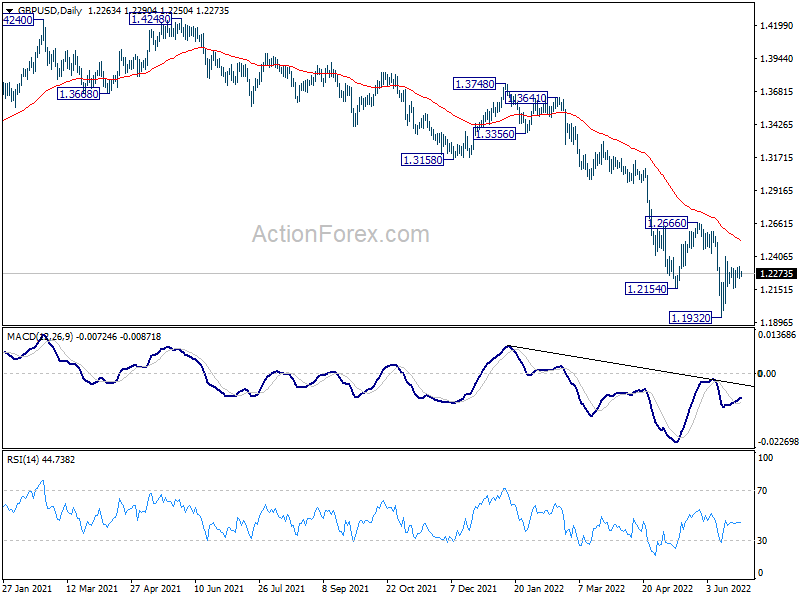
Range trading continues in GBP/USD and intraday bias remains neutral. Outlook stays bearish as long as 1.2666 resistance holds. On the downside, break of 1.1932 will resume larger down trend from 1.4248. However, firm break of 1.2666 will suggest medium term bottoming and bring stronger rebound back towards 1.3158 support turned resistance.
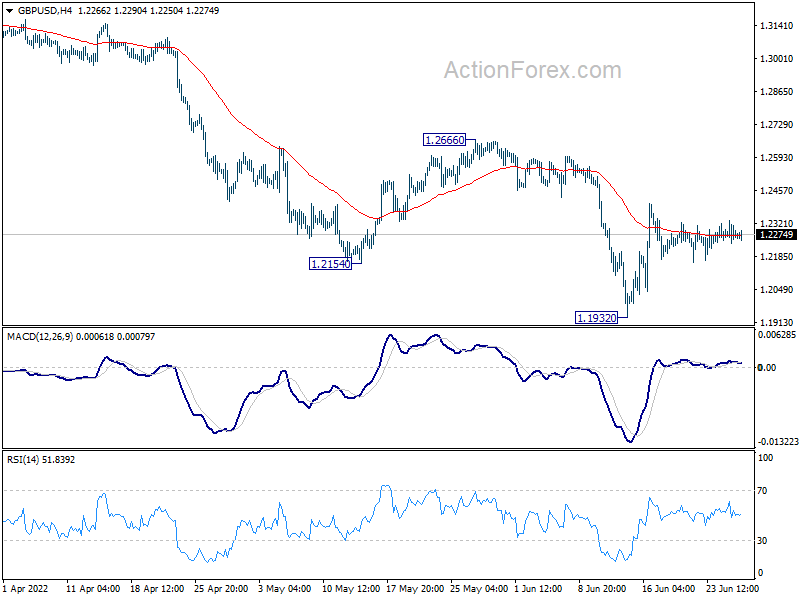
In the bigger picture, fall from 1.4248 (2018 high) could be a leg inside the pattern from 1.1409 (2020 low), or resuming the longer term down trend. Deeper decline is expected as long as 1.2666 resistance holds. Next target is 1.1409 low. However, firm break of 1.2666 will bring stronger rise back to 55 week EMA (now at 1.3140).
USD/CHF Daily Outlook
Daily Pivots: (S1) 0.9531; (P) 0.9575; (R1) 0.9608; More...
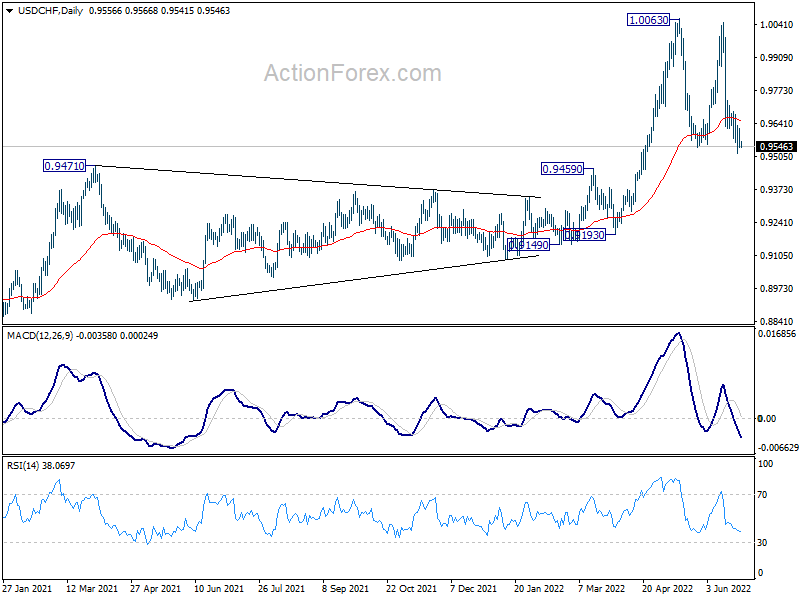
Intraday bias in USD/CHF stays neutral first. Fall from 1.0048 is still seen as the third leg of the consolidation pattern from 1.0063. Strong support should be seen around 0.9543 to bring rebound. On the upside, above 0.9731 minor resistance will turn bias back to the upside for retesting 1.0063 resistance. However, sustained break of 0.9543 will bring deeper fall back to 0.9459 resistance turned support.
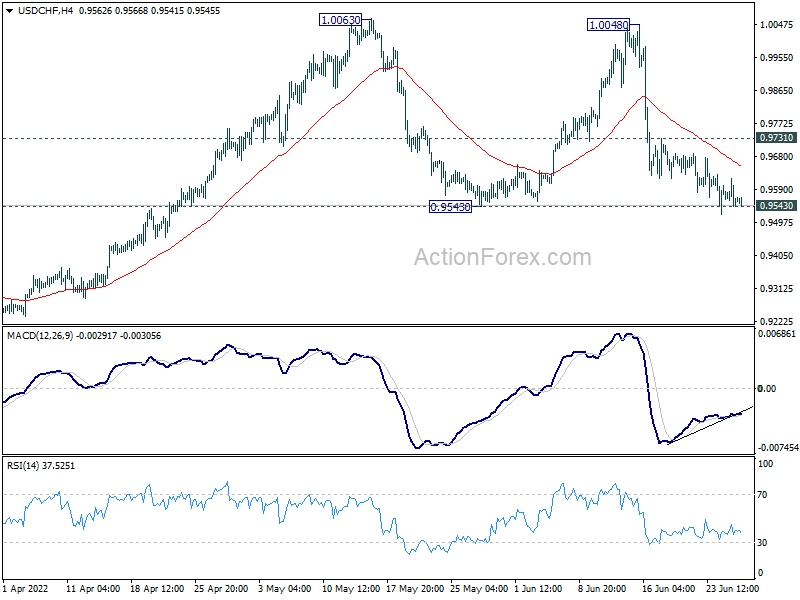
In the bigger picture, down trend from 1.0342 (2016 high) should have completed with three waves down to 0.8756 (2021 low) already. Rise from 0.8756 is likely a medium term up trend of its own. Next target is 1.0237/0342 resistance zone. This will remain the favored case as long as 0.9471 resistance turned support holds. However, sustained break of 0.9471 will extend long term range trading with another falling leg.
USD/JPY Daily Outlook
Daily Pivots: (S1) 134.82; (P) 135.18; (R1) 135.85; More...
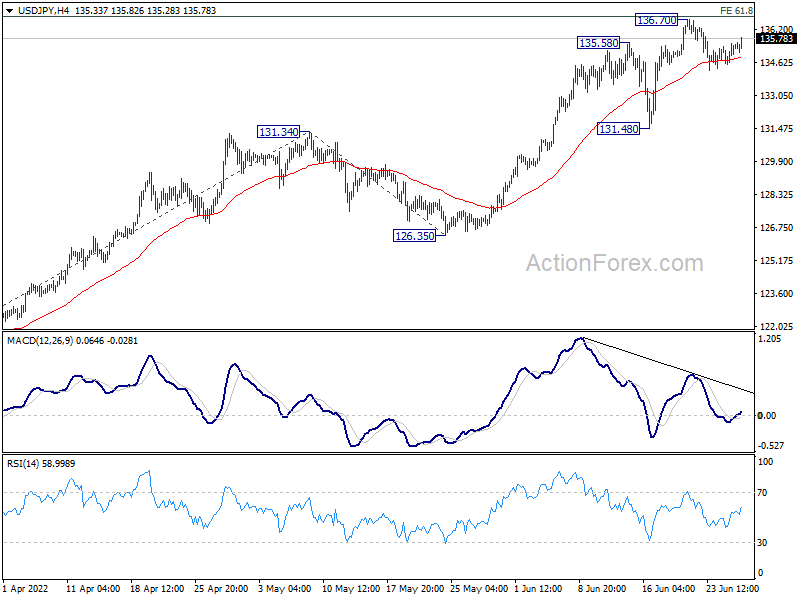
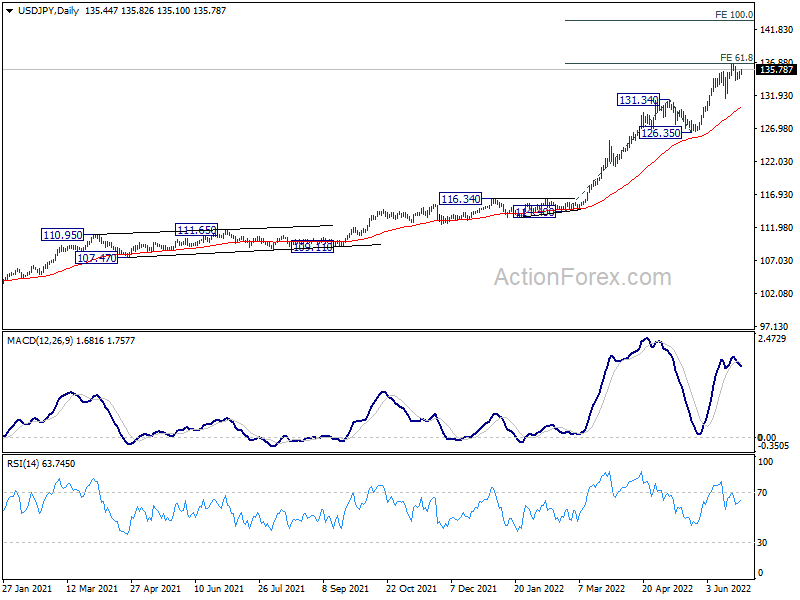
USD/JPY is still extending the consolidation from 136.70 and intraday bias remains neutral. Another dip cannot be ruled out, but downside should be contained above 131.48 support to bring rebound. On the upside, break of 61.8% projection of 114.40 to 131.34 from 126.35 at 136.81 will target 100% projection at 143.29.
In the bigger picture, current rally is seen as part of the long term up trend from 75.56 (2011 low). Next target is 100% projection of 75.56 (2011 low) to 125.85 (2015 high) from 98.97 at 149.26, which is close to 147.68 (1998 high). This will remain the favored case as long as 126.35 support holds.
AUD/USD Daily Report
Daily Pivots: (S1) 0.6902; (P) 0.6930; (R1) 0.6953; More...
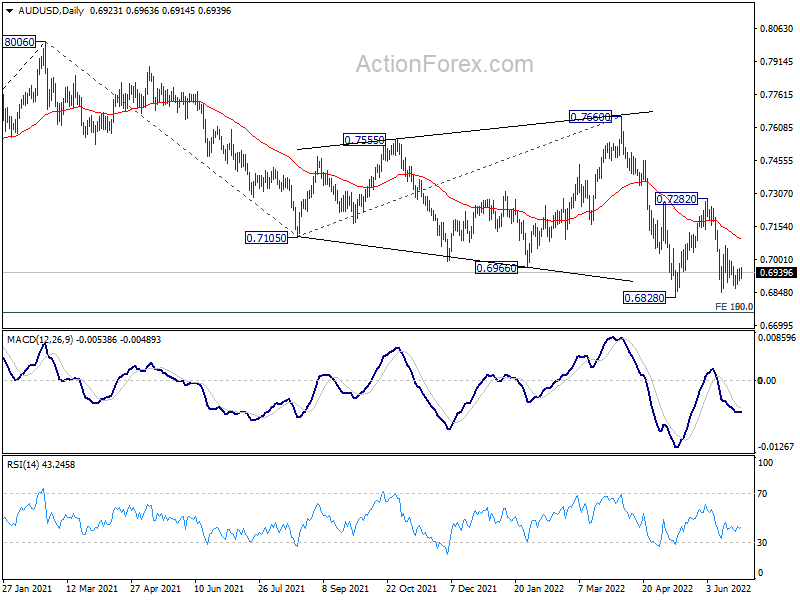
Intraday bias in AUD/USD remains neutral as sideway consolidation continues. On the downside, firm break of 0.6828 support will resume larger fall from 0.8006. Next target is 0.6756/60 cluster support. On the upside, above 0.7068 minor resistance will bring stronger rebound to 0.7282 resistance first. Firm break there will be a sign of bullish reversal and bring stronger rebound to 0.7666 resistance.
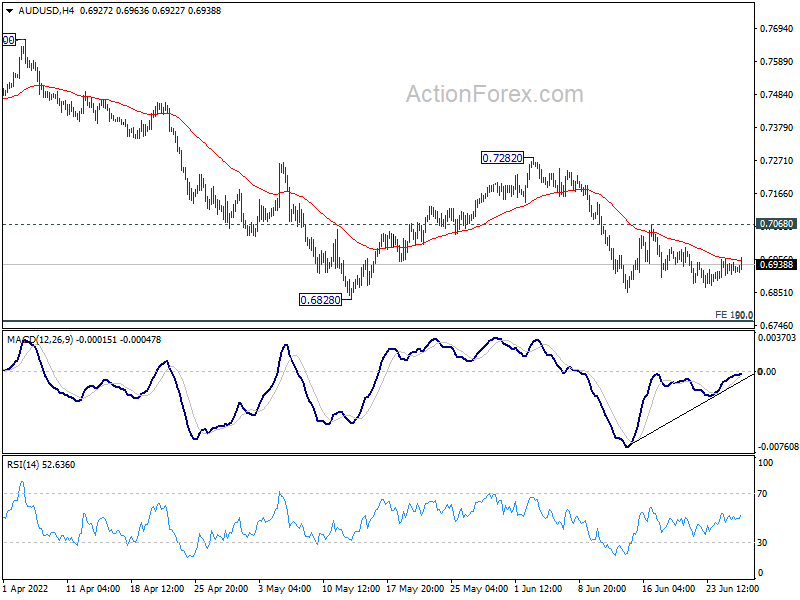
In the bigger picture, price actions from 0.8006 are seen as a corrective pattern to rise from 0.5506 (2020 low). Deeper fall could still be seen to 50% retracement of 0.5506 to 0.8006 at 0.6756. This coincides with 100% projection of 0.8006 to 0.7105 from 0.7660 at 0.6760. Strong support is expected from 0.6756/60 cluster to contain downside to complete the correction. Meanwhile, firm break of 0.7660 resistance will confirm that such corrective pattern has completed, and larger up trend is ready to resume.
EUR/USD Briefly Explored >1.06 Levels
Markets
European stock markets still opened strong, but gradually lost last week’s vigor as the trading session got going. US stocks eventually closed 0.2% (Dow) to 0.7% (Nasdaq) lower. The same gravity law applied again for core bonds coming on the heels of a short squeeze. German Bunds underperformed US Treasuries with Friday’s June EMU CPI numbers in the back of investors’ minds. The monthly inflation dynamic doesn’t look like slowing, almost cementing >25 bps rate hikes by the ECB from September onwards. Daily German yield changes ranged between +6.2 bps (30-yr) and +12.7 bps (5-yr) with the belly of the curve underperforming the wings. US yields added 5.3 bps (30-yr) to 7.1 bps (7-yr) with the curve dynamics showing similarities to Europe. US eco data included firm US durable goods orders for May (0.8% M/M for key series), a monthly stabilization in pending home sales (though down 12% Y/Y) and feeble Dallas Fed Manufacturing activity (lowest since May 2020). The US Treasury started its end-of-month refinancing operation with a $46bn 2-yr Note and a $47bn 5-yr Note sale. Both tailed quite significantly which shouldn’t surprise given high uncertainty surrounding the Fed’s tightening path and the global central bank tendency to err on the hawkish side of expectations. EUR/USD briefly explored >1.06 levels, but eventually closed at 1.0584 up from 1.0551. The single currency holds a small advantage over the dollar since mid-June, but lacks the real momentum to take out important first support in the low 1.06-area. EUR/GBP closed at 0.8628 from an open at 0.8595. The UK House of Commons yesterday voted in favour to unilaterally changing the Northern Ireland Protocol from the withdrawal agreement (295-221). Unless the government uses some shortcuts, the bill isn’t expected to reach the House of Lords for months. Nevertheless, in the meantime the UK risks entering a trade war with the EU which restarted legal proceedings. Today’s eco calendar contains US consumer confidence and Richmond Fed Manufacturing index. Several central bank heavyweights speak at the ECB’s Sintra event. The US Treasury ends its refinancing with a $40bn 7-yr Note auction. US consumer confidence might be key. We’re eager to see the market reaction in case of disappointment as high inflation starts eating into consumers’ wallets. We don’t expect it to really derail Fed tightening expectations but the outperformance of US Treasuries vs Bunds could be prolonged. Risk sentiment could in such scenario take a new hit, coming nevertheless to the dollar’s rescue short term.
News Headlines
The Indian rupee hit a new all-time low this morning. USD/INR gapped higher to 78.49 this morning and extends gains to 78.63 currently. The Indian currency together with many other emerging market currencies are feeling pressure from persistent foreign funds outflows. India’s central bank has raised interest rates by 90 bps in two moves since May. But the Federal Reserve jacks up interest rates this year so far by even more, reducing the attractiveness of higher-yielding but inherently more risky assets. High(er) energy/commodity prices also increasingly pose economic risks and could put further pressure on emerging market currencies. Incoming Czech National Bank governor Ales Michl suggested in his weekly column that the central bank alone cannot prop up the Czech koruna. The currency will be strong when public finances are balanced over the long-term, foreign trade is at a surplus and the current account isn’t worsening. But Michl said the Czech Republic isn’t meeting any of these conditions, pointing at a switch from exports and inflows of foreign direct investment to consumption and debt. The country needs to change that, he added. Michl takes over from Rusnok in July and has opposed every rate hike since June last year. His appointment sent shivers in the CZK market. The CNB is intervening since then to stabilize the currency at no weaker than EUR/CZK 24.75.
Daily Technical Analysis
EUR/USD
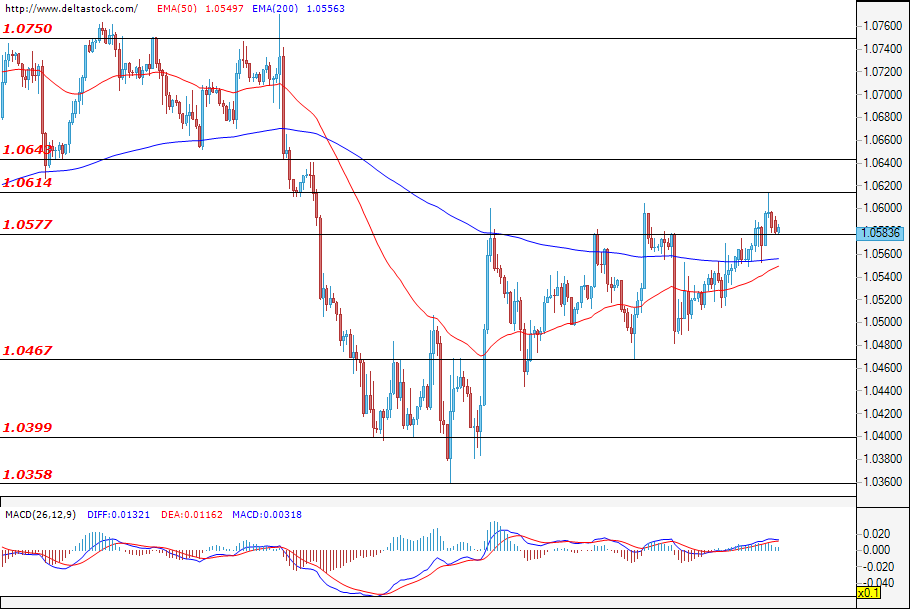
On the first day of the trading week, the euro managed to extend the uptrend, which started in the middle of this month. With the opening of the European session, the bulls managed to shape their attack and breach through the resistance of 1.0577. The upward movement also gained momentum after the G7 said that they will continue to aid Ukraine for as long as needed. The EUR/USD managed to reach 1.0614 – a higher peak than last week’s results, which encourages the bulls to continue to apply pressure throughout this week. Today, there is no data in the macroeconomic calendar that is expected to affect the euro, but if the U.S. consumer confidence аt 14:00 GMT comes out extremely low again, then the dollar may continue to fall and the probability of the uptrend extending its monthly highs towards levels at around 1.0750 could rise significantly. Of course, if we see a bounce in the dollar due to positive data, a bearish correction towards 1.0500 is also not excluded.
USD/JPY
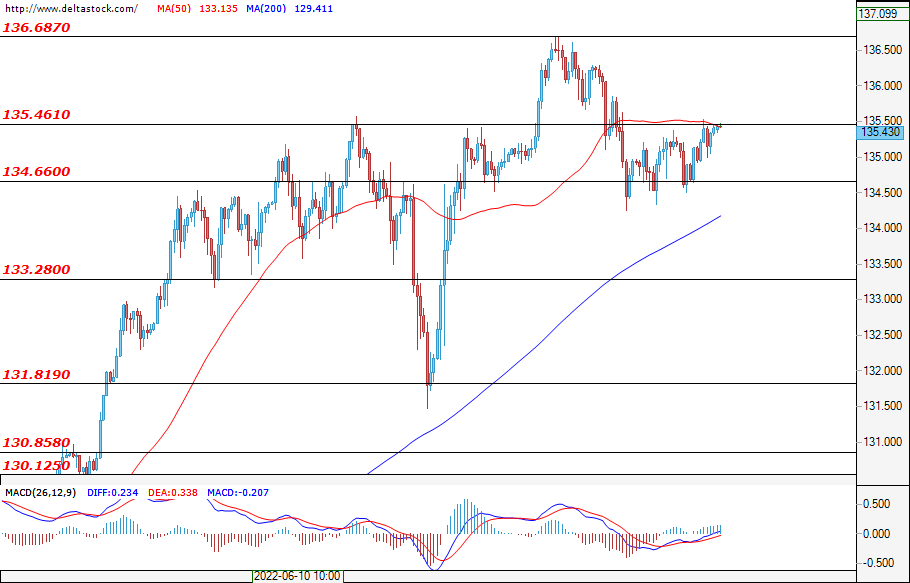
The strong upward move seems to have been a false breach of the resistance, and although it reached a new annual high of 136.68, the Ninja is yet again trading in a range that was formed in June. At the beginning of the day, we saw a rebound from the lower end of the range at 134.66, but the bulls failed to breach the upper end of the range at 135.46. For now, the currency pair is locked between these two values and the future of the trend will depend on the breach and confirmation of one of the mentioned levels. If 134.66 is breached, then we can expect to reach the annual peak again in addition to a possible extention of the uptrend, but if the lower end does not support the USD/JPY, then the corrective move will most likely reach the level of support at 133.28.
GBP/USD
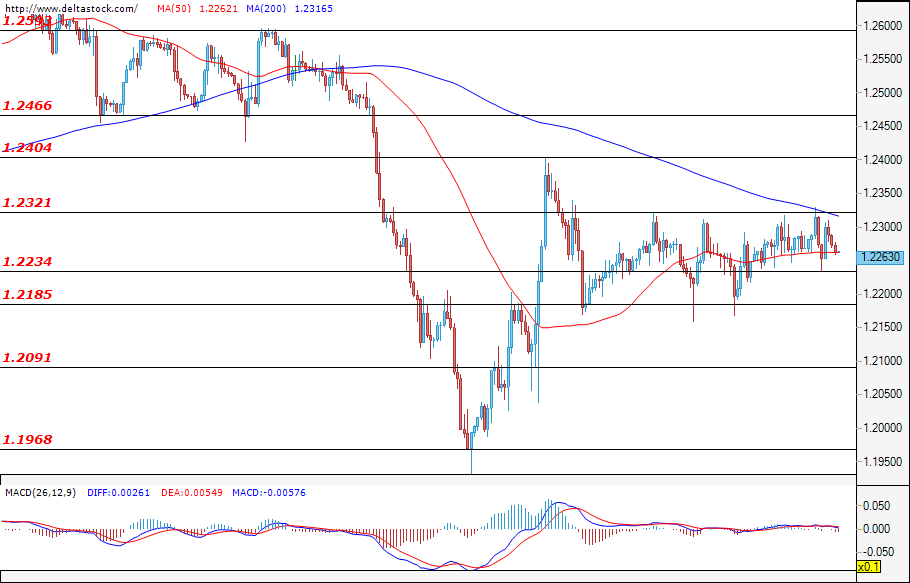
It seems that the sterling is also locked in a range. With the opening of the London Stock Exhange on Monday, it went up slightly, reaching the resistance of 1.2321, which stayed true to its role yet again. For now, the bears can't breach the support of 1.2234 and the GBP/USD market is moving sideways. Today’s macroeconomic calendar is devoid of data that is expected to push traders into pound trading territory, but volatility is expected to increase around the consumer confidence data for the United States, which wll be released at 14:00 GMT. If the dollar continues to fall due to the data being as negative as it was before, then the resistance could be breached and we could see the pound rise again to levels of around 1.2400. If, however, the data ends up being surprisingly good, then a rise in the dollar could help the bears step up their attack on 1.2185.
EUGERMANY40
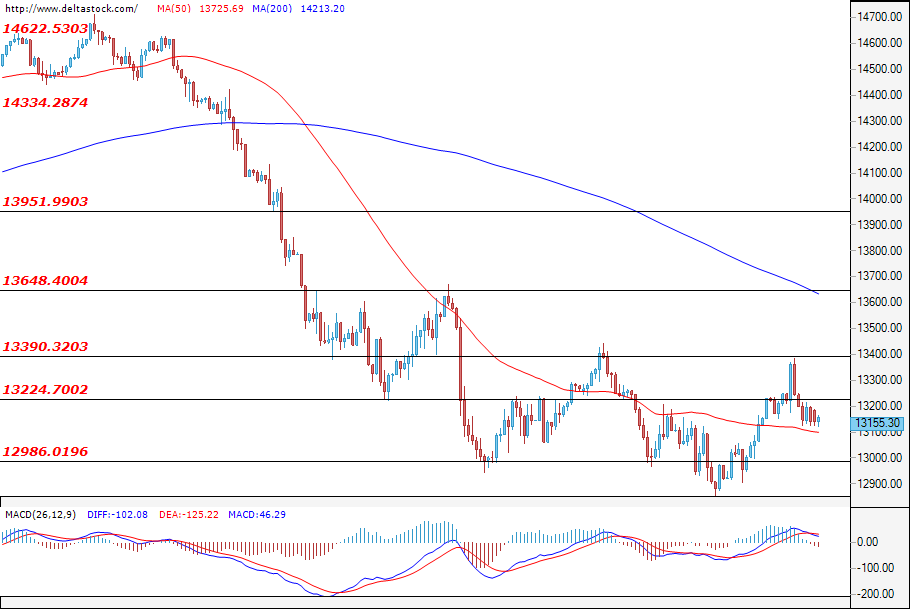
With the opening of the stock exchange in Europe on Monday, we saw some good uptrend movements, which even managed to breach the resistance at 13224 and pushed the German index into a lower than last week's peak of 13390. As noon approached, however, the bulls met serious resistance and the whole movement was corrected. The German index ended at levels around its new daily low of 13115. However, whether there will be another wave of bearish attacks remains to be seen later this week after the release of the data on the preliminary inflation count in Germany this Wednesday. However, if inflation turns out to be low, then the EUGERMANY40 might try to attack the new weekly highs.
US30
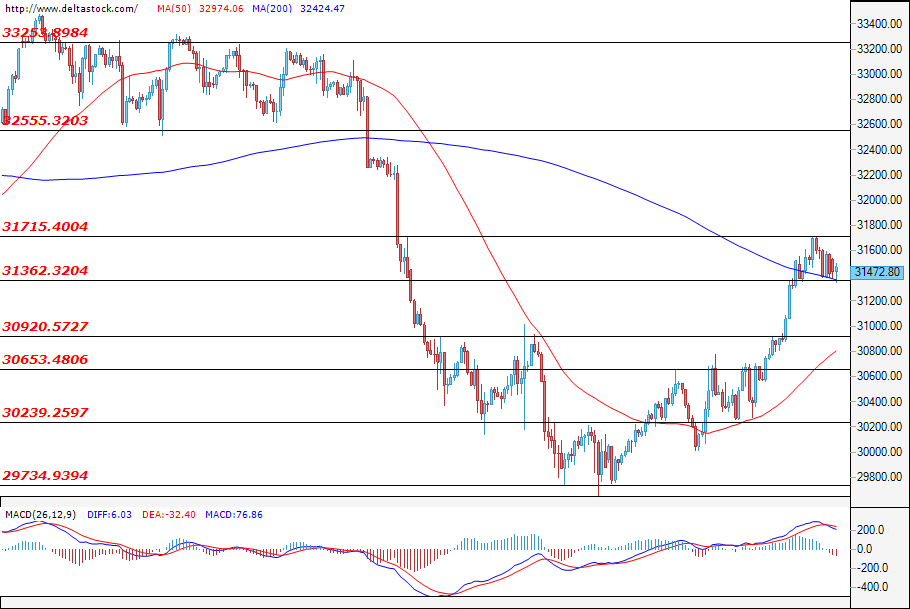
On Monday, the largest U.S. index was also feeling quite hesitant. Despite the strong uptrends that started last week, the bulls do not seem to be able to find solid support to push the index back towards 32500. As a result of this, trading activity currently remains locked between the recent local high of 31715 and the support at 31362, which has so far managed to hold off the bears' attacks. However, whether this scenario will perservere will depend on the reaction to the U.S. consumer confidence data at 14:00 GMT today. While positive data could lead to a renewed bullish attack, if it is negative, then at least half of the price movements on Friday can end up being corrected.
EURJPY Posts Double Top Near 7-Year High
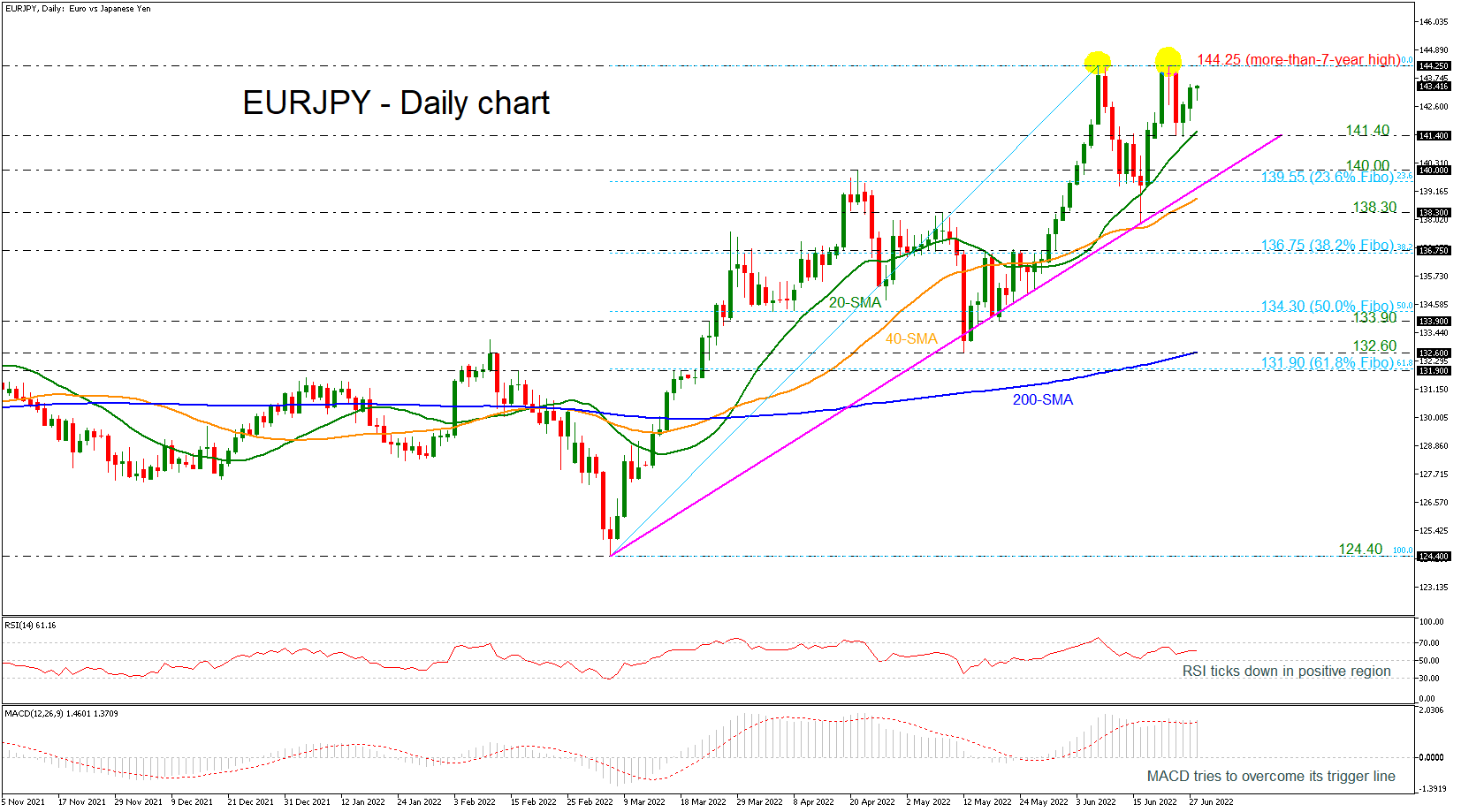
EURJPY has posted a double top around the more-than-seven-year high of 144.25 over the last couple of weeks. The MACD oscillator is extending its positive momentum above its trigger and zero lines; however, the RSI indicator is pointing slightly lower in the positive region. The 20- and 40-day simple moving averages (SMAs) are still developing above the bullish crossover, suggesting that the bull market is still on the cards.
On the upside, resistance could occur around the multi-year high of 144.25 that may be a strong resistance level for traders. Higher still, the peak from December 2014 at 149.75 would increasingly come into scope.
A reversal to the downside could stall at the latest bottom at 141.40, which overlaps with the 20-day SMA ahead of the medium-term ascending trend line near the 140.00 round number. Further below, the 23.6% Fibonacci retracement level of the upward movement from 124.40 to 144.25 at 139.55 could also provide support, while any violation at this point could potentially trigger further sell-off in the market, probably leading the price down to 138.30.
The medium-term picture continues to look predominantly bullish, with trading activity taking place above the 200-day SMA.
Overall, EURJPY has been completing a double top formation and any declines below the 138.30 support may shift the outlook to bearish.
Lagarde’s Speech in the Spotlight
Market movers today
The highlight for markets today will be ECB President Lagarde's speech at the Sintra Forum at 10:00 CET and focus will be on any hints about the new anti-fragmentation tool.
Conclusions from the G7 summit will also be in focus, especially any concrete proposals how to resolve the global food crisis and implement a possible "price cap" on Russian oil.
We will get more insights into how German consumers are faring, with consumer confidence for July and retail sales figures for May, which showed a sharp decline in the previous month. Another weak reading would give more evidence that higher prices are taking their toll on consumers' willingness to spend.
In the US, we also get Conference board consumer confidence and it will be interesting to see whether optimism about the labour market still offsets concerns about inflation.
The 60 second overview
Oil: Oil prices have extended gains ahead of the OPEC meeting tomorrow with Brent climbing above USD 116 per barrel on the back of supply disruptions in two producer countries. Libya, whose production has halved since mid-April to 600,000 barrels a day announced it may suspend exports in the next three days amid protests that have forced oil fields and ports to shut down. Ecuador's oil production is also being disrupted due to anti-government protests. These events are the latest signal of how rising risk of social unrest across emerging markets as a response to e.g. higher food and fuel prices could disrupt commodity markets.
Russia steps up its offensive in Ukraine: Yesterday, a Russian missile strike hit a crowded shopping mall in Kremenchuk, in central Ukraine, killing at least 16 people. Kremenchuk is located southeast of Kyiv, far from the current hotspot of the war in East. Over the last two weeks, Russia seems to have stepped up its aggression both in terms of warfare but also rhetoric, particularly against the Baltics. Meanwhile, the G7 nations are discussing price caps for Russian oil and gas. We see a clear risk of a war fatigue in the West as the war drags on and as its indirect costs become ever more tangible for the European consumer. This is a key threat to European unity in short to medium term and to overall security in longer term.
NATO summit: NATO leaders will convene for a summit starting today and ending on 30 June. Over the next three days, NATO leaders will define NATO's strategic direction for the next decade and in the context of the recent, dramatic changes in the global security environment, substantial modifications are expected to its key Strategic Concept document. Whereas the previous version of the document, published in 2010, made no mention of China and referred to Russia as a partner, this time the alliance is expected to label China as a 'systemic challenge' while calling Russia a 'direct threat'. Another key thing to watch over the coming days is whether Finland and Sweden's accession talks with NATO show any progress. Hopes for a quick accession were quickly dashed in May after Turkey said it would reject membership bids by the two countries that it deems to support terrorist organisations. The Finnish and Swedish delegations met with their Turkish counterparts yesterday, but despite both sides expressing some optimism after the talks we do not expect any major breakthrough over the coming days.
Equities: Equity markets calmed on Monday. Europe inched slightly higher and US somewhat lower for the day. Growth outperformance continues to be the big story despite somewhat higher yields yesterday. Interestingly, the defensive outperformance paused for another day, with both industrials and health care among the better sectors. However, energy the big standout, rebounding almost 3% globally. Dow -0.2%, S&P 500 -0.3%, Nasdaq -0.7% but Russell 20000 0.3%.
FI: European curves bear flattened yesterday, with the belly of the curve being the pivoting point. Bund yields gradually rose through the day and ended 11bp higher on the day. With no particular data release triggering the move, and intra-euro area spreads ended broadly unchanged on the day. Today's highlight is Lagarde's speech at the Sintra Forum at 10:00 CET and focus will be on any hints about the new anti-fragmentation tool. Follow the entire conference here.
FX: It has been a fairly slow start to the week in FX markets albeit with Scandies outperforming most FX Majors. EUR/USD temporarily moved above 1.06 yesterday but closed back below the same threshold level.
Credit: Credit indices exhibited relative calm on Monday despite a slight bullish tone in other risk markets. Itraxx main was unchanged closing at 109.2 while crossover widened only 2.1bp to close at 535.8bp.
Optimism Didn’t Last Long
Optimism didn’t last long yesterday, and the market mood turned rapidly sour, as the news flow was not pointing at sustained gains anyway! Oil and commodity prices rebounded with the escalation of tensions in Ukraine. Plus, UAE Energy Minister said yesterday that they are pumping near maximum capacity based on its quota of around 3 million barrels per day under the agreement with OPEC+, confirming Macron’s worry that UAE and Saudi Arabia, which were perceived as the only two countries in the OPEC that have spare capacity, can barely increase oil production. In addition, the unrest in Libya and Ecuador hint that they may not pump to meet their quotas, which could further tighten supply. And the US strategic petroleum reserves fell to the lowest levels since April 1986.
On the political front, the G7 leaders now want to put a price cap on Russian oil to limit the Russian profits from surging oil prices. On the other hand, the discussions between Iran and the US resume this week, giving some people hope that this time, we could see a material progress in nuclear talks, which could then lead to the end of sanctions against the Iranian oil. That would unlock additional barrels for the global supply, and help easing pressure on oil prices – and Biden clearly must gain by moving forward with a nuclear deal. But it’s complicated. The last time the two countries have come this close to a deal, the talks had stalled.
All in all, the barrel of American crude trades past the $112 level this morning, and firmer oil keeps the concerns of high inflation tight, again. The US 10-year yield jumped more than 2% yesterday to 3.20%, and the US indices, which started the session in the positive, ended up in the red. The S&P500 slid 0.30%, and closed the session at 3900, while Nasdaq was the most heavily hit.
In the FX
The dollar index consolidates a touch below the 104 mark, as the EURUSD is again testing the 50-DMA to the upside. The European Central Bank meets this week, and investors will be looking for hints of how the Europeans are planning to fight inflation without triggering a fresh debt crisis in the Eurozone. We will certainly hear hawkish comments from the ECB, but what investors really want to know is more details about the upcoming anti-fragmentation tool, which is crucial if the ECB wants to catch up its major peers in raising the interest rates.
The Bank of Japan (BoJ) on the other hand bought an incredible amount of JGBs last week to maintain their yields steady as the pressure on US and European yields puts pressure on Japanese yields as well. As a result, the BoJ now holds more than 50% of the Japanese government debt on its balance sheet. We believe that the BoJ could soon be unable to control its yield curve and let the yields move higher. If this is the case, we could finally see some material easing in the USDJPY. A rapid correction to the downside could immediately send the pair to and below the 50-DMA which stands near 130 at the moment.
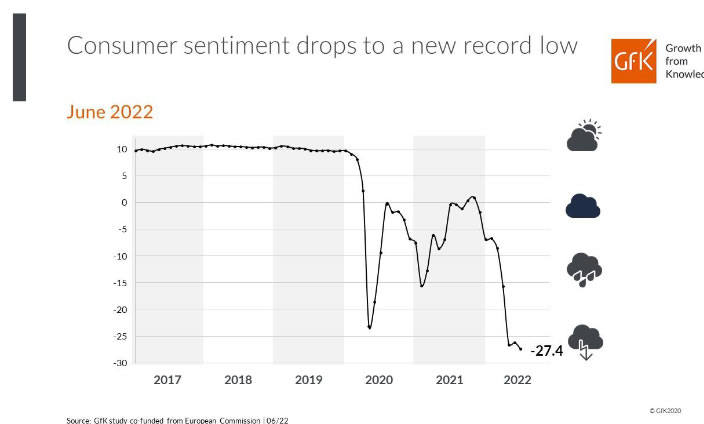
Germany Gfk consumer sentiment dropped to new record low, in a downward spiral
Germany Gfk consumer sentiment. for July dropped from -26.2 to -27.4, better than expectation of -27.7. But that's nonetheless another record low since 1991.
In June, economic expectations dropped from -9.3 to -11.7. Consumers continue to see a significant risk of recession in Germany. Income expectations dropped from -23.7 to -33.5, worst reading in almost 20 years. Propensity to buy dropped from -11.1 to -13.7, worst since 2008.
"The ongoing war in Ukraine and disruptions in supply chains are causing energy and food prices in particular to skyrocket, resulting in a gloomier consumer climate than ever before", explains Rolf Bürkl, GfK consumer expert. "Above all, the increase in the cost of living, which is almost eight percent at present, is weighing heavily on consumer sentiment and sending it into a downward spiral."