Sample Category Title
AUD/USD Daily Report
Daily Pivots: (S1) 0.6866; (P) 0.6897; (R1) 0.6925; More...
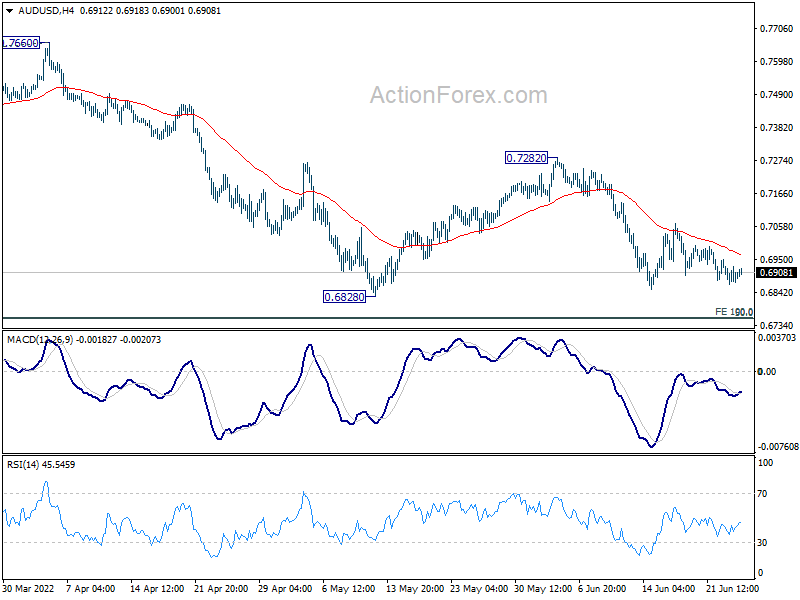
AUD/USD is still bounded in range of 0.6828/7282 and intraday bias remains neutral. On the downside, firm break of 0.6828 support will resume larger fall from 0.8006. Next target is 0.6756/60 cluster support. However, firm break of 0.7282 will be a sign of bullish reversal and bring stronger rebound to 0.7666 resistance.
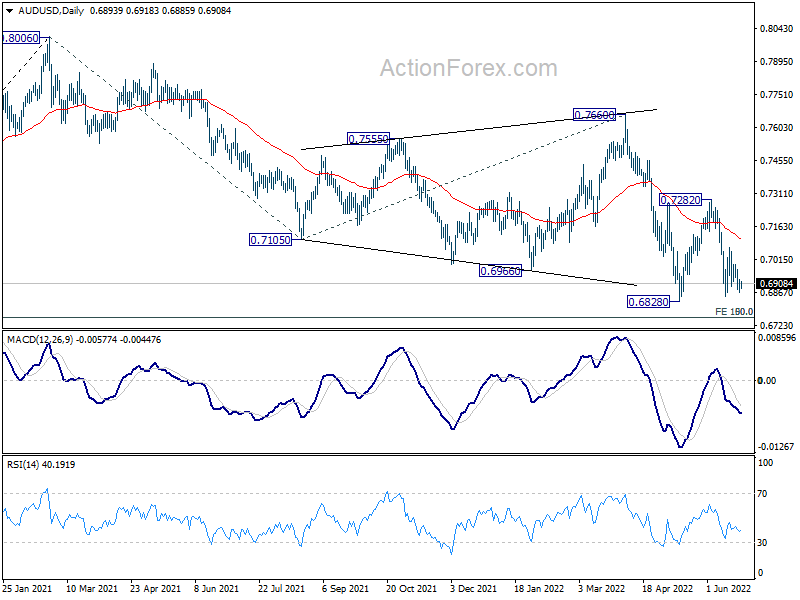
In the bigger picture, price actions from 0.8006 are seen as a corrective pattern to rise from 0.5506 (2020 low). Deeper fall could still be seen to 50% retracement of 0.5506 to 0.8006 at 0.6756. This coincides with 100% projection of 0.8006 to 0.7105 from 0.7660 at 0.6760. Strong support is expected from 0.6756/60 cluster to contain downside to complete the correction. Meanwhile, firm break of 0.7660 resistance will confirm that such corrective pattern has completed, and larger up trend is ready to resume.
BoJ Amamiya: Will continue to support the economy with monetary easing
BoJ Deputy Governor Masayoshi Amamiya said, "the BOJ will continue to support the economy with monetary easing to achieve its inflation target in a sustained, stable manner accompanied by wage rises."
Amamiya also said the economy is picking up as a trend, but it's facing "extremely high" uncertainty". "Against this background, we must closely watch the impact financial and currency market moves could have on Japan's economy and price," he added.
UK retail sales dropped -0.5% mom, linked to impact of food prices and cost of living
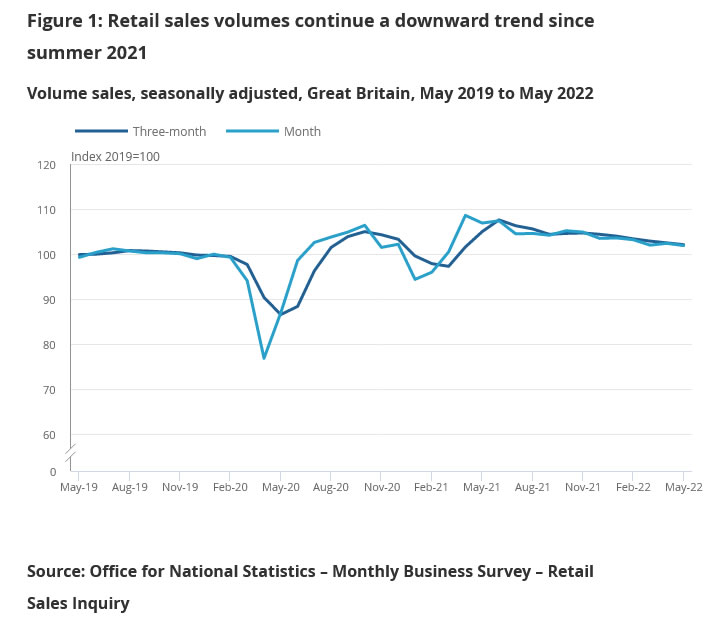
UK retail sales volume dropped -0.5% mom in May, better than expectation of -0.9% mom. Ex-fuel sales dropped -0.7% mom, better than expectation of -1.4% mom.
Over the 12-month period, retail sales dropped -4.7% yoy, versus expectation of -4.5% yoy. Ex-fuel sales dropped -5.7% yoy, versus expectation of -5.1% yoy.
ONS said: "The fall in sales volumes over the month was because of food stores, which fell by 1.6%; reduced spending in food stores seems to be linked to the impact of rising food prices and the cost of living."
Daily Technical Analysis
EUR/USD
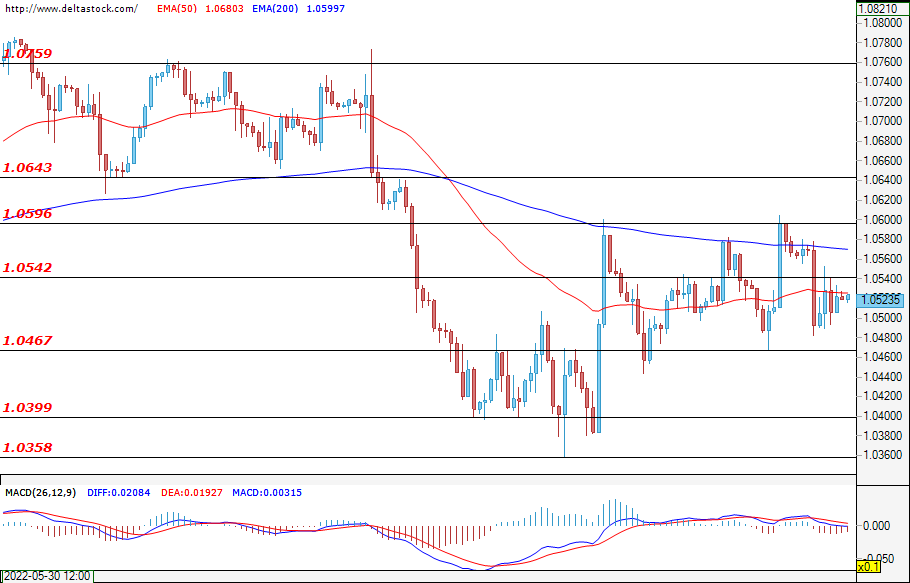
Neither the bears nor the bulls managed to gain enough momentum and the pair remained in the zone between 1.0467 and 1.0542. During the early hours of today`s trading session, volatility has subsided and the expectations are for a new attack on the upper border at 1.0542. A successful breach, followed by a violation of the next target at 1.0596, could easily continue the recovery for the European common currency against the dollar and could lead to a move towards the important resistance at 1.0643. If the bears prevail, then a follow-up attack and a breach of the support at 1.0467 could deepen the decline and would pave the way for a test of the major zone at 1.0399, where a violation would strengthen the negative expectations for the future path of the EUR/USD.
USD/JPY
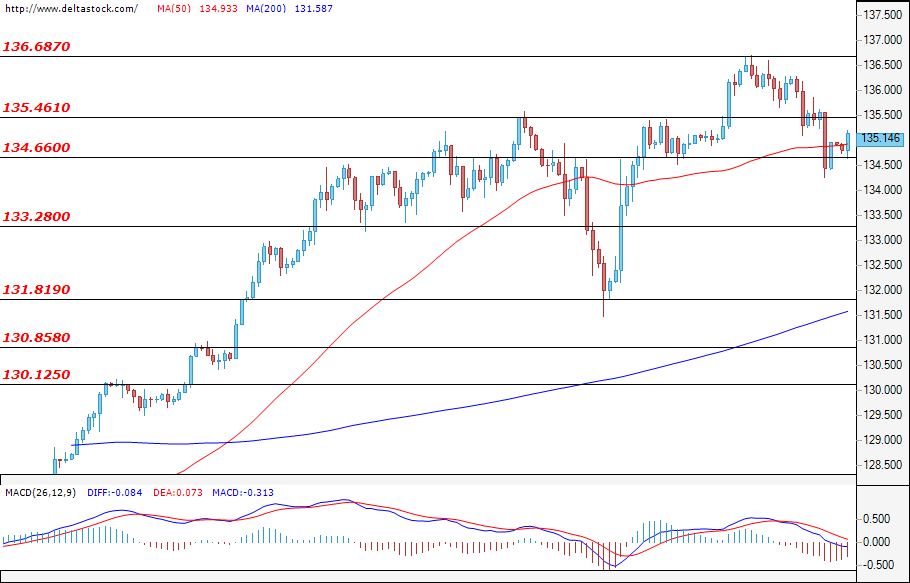
After the violation of the support at 135.46, the dollar continued to lose ground against the yen and the pair tested the zone at 134.66. At the time of writing, the pair is trading above the mentioned level, but if the bearish attack continues, then a successful breach here could easily deepen the sell-off and head the Ninja for a test of the lower zone at 133.28. If the bulls re-enter the market, then their first target would be the level at 135.46, which is currently acting as resistance. A violation of the upper zone at 136.68 would mark the current move as corrective and could easily continue the rally for the USD/JPY.
GBP/USD
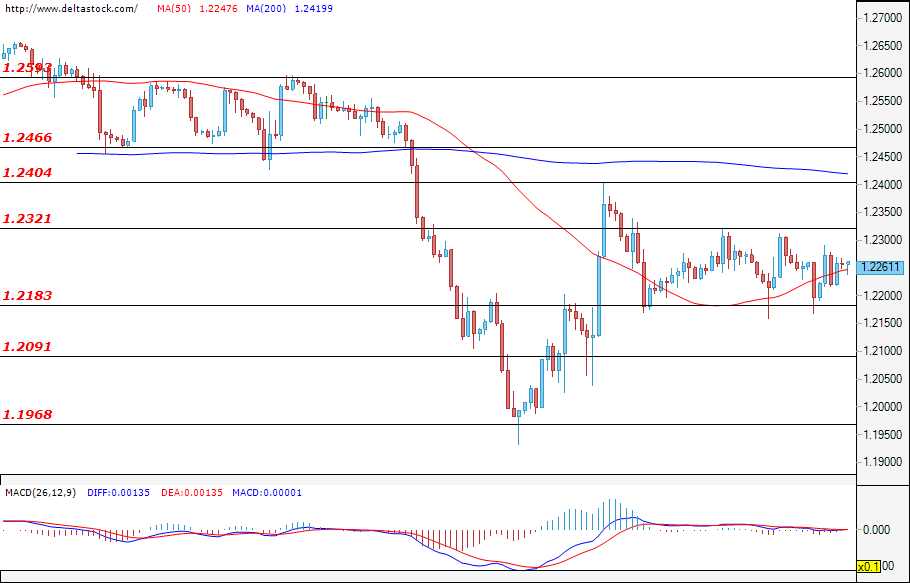
The Cable remains locked in the range between 1.2183 and 1.2321, and during the early hours of today, the pair is trading at 1.2260. A breach for the bulls at the upper border at 1.2321 could lead to a test of the next target at 1.2404 and a violation here would easily continue the recovery and increase the odds of a push towards the major resistance at 1.2466. If the bears prevail, then a successful attack on the support at 1.2183, followed by a breach of the lower zone at 1.2091, could deepen the sell-off and head the pair towards the lows at around 1.1968.
EUGERMANY40
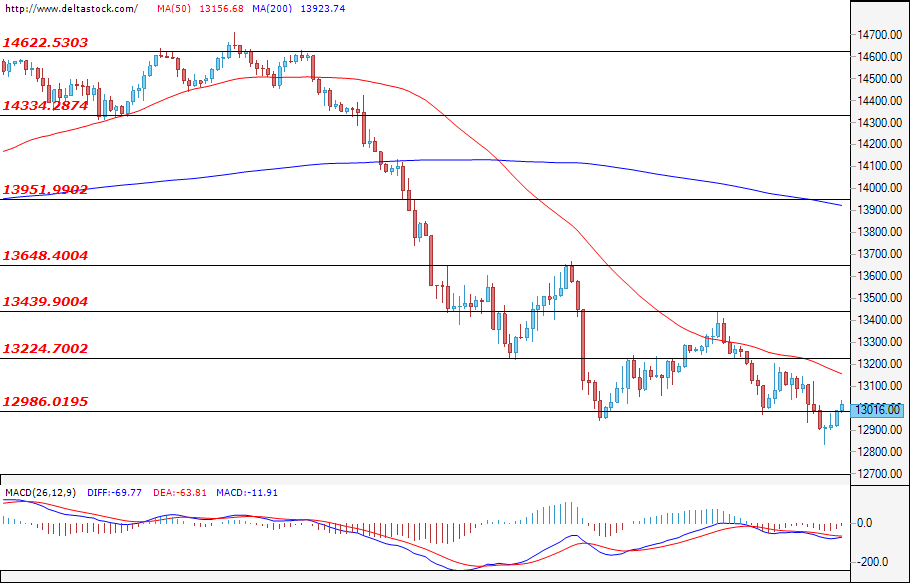
The test of the support zone at 12986 was not successful and the German index consolidated above the mentioned level. If the bearish momentum fades, then the first target for the bulls can be found at 13224, followed by the resistance at 13439. Worse-than-expected data for Germany’s IFO Business Climate (today; 07:00 GMT) could help the bears prevail. However, a confirmed breach of 12986 could easily lead to new losses and could strengthen the negative expectations for the future path of the EUGERMANY40.
US30
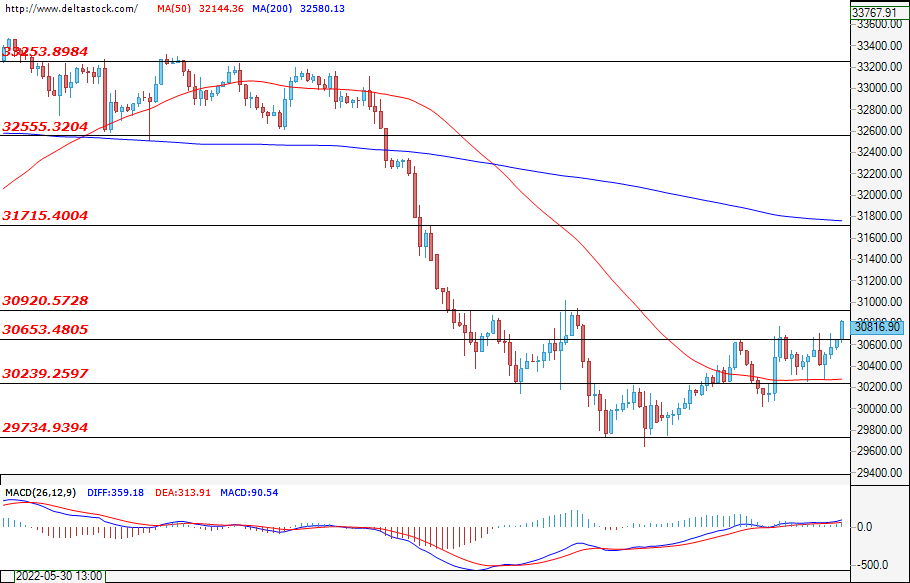
After the breach of the resistance level at 30653, the US30 recovered some of its recent losses and the price headed for a test of the next target at 30920. If the bullish attack continues, then a violation of the mentioned zone would easily lead to a more sustained rally and a move towards the resistance at 31715. If the bears re-enter the market instead, then a breach of the major support at 30239 could easily deepen the decline and could lead to a new test of the low at 29734.
EUR/USD Held Up Pretty Well
Markets
The German Bund excelled yesterday. European PMIs showed momentum weakening rapidly and more than expected. High inflation, ongoing supply snarls, uncertainty related to the war in Ukraine and tighter financial conditions heavily weigh on activity, demand and optimism going forward. Money markets adjusted the expected terminal ECB policy rate from 2.5% to 2%. The front-end of the German yield curve outperformed as a result, seeing declines between 24.9 (2y) and 26.1 bps (5y). The 10y lost 21 bps. It forfeited interim support around 1.6%. The key 1.19% level is still some distance away. European swap yields lost between 16.1 (30y) to 27 bps (3y) with key technical support levels remaining intact too. US yields were under pressure too. But thanks to an intraday rebound during US dealings, losses stayed limited to just 3.9-8.5 bps, the belly outperforming. Despite huge interest rate differentials in favour of the dollar, EUR/USD held up pretty well. The pair found support at 1.047 and closed at 1.052 (down from 1.057). The Japanese yen did good, strengthening 1% in a daily perspective but continues to be in the USD/JPY 135 danger zone. UK PMIs stabilized around the 53+ May levels but UK Gilt yields tanked up to 20 bps nevertheless. Sterling withstood the loss in yield support well, appreciating even against the euro. EUR/GBP again dipped sub 0.86. Commodity prices extended a decline with a basket dropping to the lowest level since early April.Asian-Pacific markets put comfort from yesterday’s green finish on Wall Street (up to +1.62%). South Korea outperforms. Core bonds stabilize near Thursday’s closing levels. Japanese headline inflation stabilized at 2.5% in May, providing the Bank of Japan no relieve as it continues its sole journey through monetary easing. The yen trades little changed though. The dollar is being sold across the board. EUR/USD inches towards 1.0545.
Sentiment will be key for trading today given the lack of economic data. The dust on core bond markets may settle a bit after the recent correction higher. Looking further ahead, we don’t believe the yield uptrend has ended. An article ran by the Financial Times strengthens our view on this. Consumer and company surveys by Banque de France and the Bundesbank showed rising inflation expectations, also over the medium term. It raises the risk of high(er) inflation staying with us for long(er). Taking into account yesterday’s performance, we think the downside in EUR/USD is better protected now. First meaningful resistance is located at 1.064 (May top, upper bound downward trend channel) but is challenging going into the weekend. UK consumer confidence slumped to a new record low and retail sales disappointed this morning. Especially last month’s sharp downward revision (from 1.4% m/m to a mere 0.2%) catching the eye. EUR/GBP nudges north.
News Headlines
The Bank of Mexico raised its policy rate by 75 bps to 7.75%. The decision was unanimous and as expectated. Inflation in the first halve of June printed at 7.88% and 7.47% for headline and core inflation respectively. The Bank of Mexico targets an inflation rate of 3.0% +/- 1ppt. The bank also upwardly revised the path for core and headline inflation which are both forecast to stay slightly above the 3.0% target at the end of the policy horizon (3.1% in Q2 2024). Regarding the next steps the communiqué reads: ‘The board intends to continue raising the reference rate and will evaluate taking the same force full measures of conditions so require’. On the Mexican peso, the Bank assessed recent developments as orderly. The peso yesterday gained marginally to and is testing USD/MXN 20.00.The UK conservative Party in two parliamentary by-elections lost two seats in Parliament. One seat in Southwest England was already held by the conservative party since 1977. Another one in North England was won from labour at the last election. The loss further raises questions on the leadership position of UK prime Minister Johnson after he survived a vote of confidence within his party earlier this week. At the same time, the government also faces a further loss of confidence from consumers as the cost of living crisis spreads further. GFK consumer confidence this morning was reported at the weakest level since the start of the series for the second consecutive month (-41 from -40).
Markets are Betting the Fed Has it Wrong Again
The second day of Jerome Powell’s semi-annual testimony on Capitol Hill passed without incident, in contrast with the frenzy on Wednesday. He reiterated an unconditional commitment to fight inflation by the Federal Reserve, but markets instead, continued to price in a recession stopping rate hikes in their tracks much sooner. US yields fell once again, equities firmed once again, cryptos crept higher, while currency markets did almost nothing unless we are talking about USD/JPY.
Assuming that the Fed will have to change course sooner than late 2023 isn’t an unreasonable assumption. The Fed and a procession of central banks around the world got inflation completely wrong and have been scrambling to reverse the mistake. Given their track record, assuming they are going to be wrong the other way is completely reasonable in that context.
The commodity space is also pricing in the recession outcome. Copper prices plummeted overnight, and that has been the case recently with most industrial metals. Even soft commodity prices have fallen, and I’ve even seen a few headlines here in Indonesia about small palm oil farmers' incomes taking a hit. Oil has taken a bath this week as well, and the increase in natural gas inventories overnight from the EIA data saw US natural gas prices fall as well.
Still, I remain unconvinced that inflation will magically just stop in its tracks just because Mr Powell mentioned the word recession. Oil futures curves on both Brent crude and WTI remain in backwardation, which tells us prompt supplies are tight. The curves moved down in totality but didn’t really change shape. We are getting plenty of headlines from around the world about potential blackouts as energy supplies and power generation capacity remain under stress. Russian oil and gas production will decrease as well as they run out of western parts to maintain production. Most significantly, Germany activated phase two of its emergency energy plan overnight, as Russian gas flows continued slowing. If Europe is heading to international markets at short notice to hunt for supplies, energy prices aren’t going to fall much further.
The moves this week, could still turn out to be the result of a financial market genetically pre-programmed to buy dips in equity and bond prices, thanks to two decades of central bank largesse. It could also be a bear market correction as the stampede for the exit door got overdone in the short term, leading to a short-squeeze. Maybe next week’s PMIs will give markets a better clue, or perhaps the July Non-Farm Payrolls and JOLTS data. It would be foolish to price out geopolitical stresses related to Ukraine/Russia conflict either, particularly in relation to European energy or Ukrainian food exports. The FOMC meeting on the 26-27th of July may as well be next year at present, we can expect a lot more volatility between now and then.
Yesterday, the central banks of Indonesia and the Philippines sprung no surprises. BI kept policy rates unchanged thanks to a benign inflation landscape for now. BSP hiked by 0.25% as expected. The Indonesian Rupiah eased overnight, but overall volatility in the Asian FX space was flatlined.
Today has a Friday feel to it with an extremely light data calendar in Asia. Japan Inflation is already out, with the headline for May unchanged at 2.50%, and core unchanged at 2.1% YoY. That is the second month above the BOJ’s 2.0 target for headline inflation. But before we all get excited, that’s two months after trying to achieve it for over 20 years. Nobody should expect it to prompt a sudden change of direction in monetary policy, especially as much of the increase is due to higher imported PPI inflation, and a weaker yen.
Malaysian Inflation is expected to remain benign at 2.60% YoY, while Singapore Industrial Production should remain steady at 6.0% YoY. Neither will move the needle in volatility terms today in Asia. China’s Final Current Account for Q1 this afternoon is already old news. This afternoon's UK Retail Sales and German IFO Business Climate survey both have downside risks. And given the escalation of the energy situation in Germany, both Euro and Sterling could go into the weekend looking shaky once again. US New Home Sales and Michigan Consumer Sentiment also have downside risks. Weaker than expected numbers do not provide a fertile ground for stock market exuberance, lower interest rates or not. If the data is disappointing, US equities could unwind some of this week’s gains.
Asian equities are content to follow Wall Street’s rally
Wall Street booked another session of decent overnight gains as somewhat counteractively, lower US yields on recession fears, prompted more equity buying. The S&P 500 rose by 0.95%, the Nasdaq jumped 1.62% higher, while the Dow Jones gained 0.66%. The rally continues unabated in Asia, with US futures booking more gains in Asia, suggesting the overnight rally in the OTC markets still has legs. S&P 500 futures are 0.50% higher, the Nasdaq is loving lower US yields and Nasdaq futures are 1.0% higher in Asia. Dow futures have added a respectable 0.30%.
Asian markets are content to follow the leader, with the overnight rally on Wall Street lifting Asian markets higher into the end of the week. Japan’s Nikkei 225 is 0.95% higher, while South Korea’s Kospi has leapt 1.70% higher thanks to Nasdaq’s outperformance.
In Mainland China, the Shanghai Composite has climbed by 0.45%, with the CSI 300 gaining 0.55%. Hong Kong’s Hang Seng has jumped by 1.50%. In regional markets, Singapore is 0.35% higher, with Taipei rising by 0.85%. Kuala Lumpur has gained 0.45%, Jakarta 0.80%, Bangkok 0.55%, and Manila 1.30% after a dovish rate hike yesterday. Australian markets are showing no ill effects from the resource price retreat. The All Ordinaries has risen by 0.55%, and the ASX 200 by 0.35%.
European markets took fright at the German activation of its phase two emergency energy plan and reducing Russian gas flows is bad news for Europe as a whole. As a result of this, it is unlikely that European markets will find any reason for cheer into the weekend.
Currency markets continue their sideways trading
Currency markets remained steady once again overnight and seem to be finding the back-and-forth histrionics in the stock and bond markets a bit tiresome. Currency markets seem to be adopting a step out of the noise, wait-and-see approach into the end of the week. Thanks to a rise by the Yen, and a fall by the Euro cancelling each other out, the dollar index remains almost unchanged on a 24-hour basis at 104.29 today. The dollar index has support at 1.0350 with resistance now distant at 1.0570.
EUR/USD fell by 0.45% to 1.0520, creeping up to 1.0530 in slow Asian trading. It is showing surprising resilience as the Russian natural gas exports to Europe situation deteriorates. Because of this, risks have shifted to the downside for the single currency. It has initial resistance at 1.0600, with challenging resistance at 1.0650. Support is at 1.0450 and 1.0400. Sterling probed the 1.2200 downside once again overnight but is almost unchanged over the past 48 hours at 1.2275 in Asia. GBP/USD has initial resistance at 1.2360 and 1.2400, with support at 1.2200, 1.2160, and then 1.1950.
USD/JPY mechanically fell by 0.93% to 134.95 overnight in lockstep with lower US yields. In Asia, it has eased to 134.70. If bond yields ease again tonight, a deeper correction by USD/JPY is possible, potentially targeting the 132.00 regions. USD/JPY has support at 134.25 and 132.00, with resistance at 136.65 and 138.00.
AUD/USD and NZD/USD were mostly unmoved overnight. Overnight, AUD/USD has eased by around 0.40% overnight to 0.6900, while NZD/USD is unmoved at 0.6295 thanks to a local holiday. Both are finishing the week near their lows and risk more losses in New York time if sentiment remains negative. Support is at 0.6850 and 0.6200 respectively.
Asian currencies finished almost unchanged overnight, but with USD/Asia remaining near to recent highs. That reflects fears that a US recession will have an immediate knock-on impact on Asian growth and notably, lower US yields and a stock market recovery this week have given no support to local currencies. Looking at the price action overnight and today, I wouldn’t be at all surprised if quite a few of the region’s central banks are quietly on the offer, capping the USD/Asia upside.
Oil prices are noisy but unchanged
Oil prices had another noisy overnight session, trading in wide intraday ranges. Ultimately, as the dust settled, both Brent and WTI finished almost unchanged for the second day in a row. The unexpected postponement of the official US Crude Inventory data set due to technical issues likely played a major role in the neutral close, as the data set is one of the most closely monitored in the global energy sphere.
Brent crude fell 0.30% to $109.65 overnight, gaining 0.40% to $110.10 a barrel in Asia. WTI fell 0.45% to $103.95 overnight, before rising 0.55% to 4104.55 a barrel in Asia. The net result is that oil prices are almost unchanged on a 24-hour basis.
Looking at the respective futures curves, both Brent and WTI are still heavily in backwardation, suggesting that prompt oil supplies remain as tight as ever, even as prices across the curves fall. Increasing recession fears appear to be prompting a culling of heavy speculative long positioning in both contracts, even as in the real world, energy tightness is as real as ever.
The technical picture is interesting. Brent crude has tested its 100-day moving average, and the 2022 support line at $107.30, but managed to bounce back to $110.00 a barrel. A daily close under $107.30 implies a deeper move potentially reaching $100.00 initially.
WTI’s technical picture is much softer, having closed below its 2022 support line at $106.30, and its 100-DMA, today at $105.50 a barrel. Failure of its weekly low at $101.50 could trigger a capitulation by speculative longs that moves WTI under $100.00 a barrel, although I suspect a lot of the damage has already been done.
Gold falls overnight
Gold bugs once again appear to have lost patience, as gold fell by 0.82% to $1822.50 overnight, edging slightly higher to $1824.00 an ounce in Asia. Probably most concerning, was that gold fell as the US Dollar remained mostly unchanged and US yields had another big move lower. Even cryptos managed to move slightly higher overnight. With that in mind, it appears that gold is going into the end of the week looking vulnerable, although I am not betting against the $1800.00 to $1870.00 range trade continuing.
Gold has resistance at $1860.00 and $1880.00, the latter appearing an insurmountable obstacle for now. Support is at $1805.00 and then $1780.00 an ounce. Failure of the latter sets in motion a much deeper correction, potentially reaching $1700.00 an ounce. On the topside, I would need to see a couple of daily closes above $1900.00 to get excited about a reinvigorated rally.
Sentiment is Better, News is Not
The market sentiment is better, but the news is not. The latest flash PMI readings from Japan to Europe and to the US showed a slowing global activity in June. Almost all regions missed the analyst expectations. High energy prices, the Ukraine war and the pandemic disruptions, the tighter monetary policies and the rising borrowing costs are weighing on the global economic activity, and we now start seeing it through the PMI figures.
The slowing activity, and the major call for a global recession started pressuring oil and commodity prices to the downside. The barrel of US crude trades a touch above the $106pb at the time of writing. Oil bears get ready to test the $100pb support for a deeper medium-term correction, and iShares diversified commodity index is down by 12% since the June 8 peak.
Tightening tightening tightening
Norway delivered a bigger than expected 50bp hike, and Banxico rose by 75bp hike, the country’s biggest rate hike ever, and said it will continue doing so if conditions require.
Only the eccentric Turkey kept it policy rate at 14%.
From bad to worse
Moscow cuts the gas supply to Germany via Nord Stream 1, leading to another spike in the European natural gas futures. Germany warned that cutting Germany’s energy supplies would spark a collapse in energy markets, comparing itself to Lehman Brothers which fell and triggered the terrible subprime crisis back in 2007/2008.
The higher gas prices should keep the pressure high for oil, as although the prospects of demand are being cut, the production remains limited to the refining capacity.
A calm session ahead?
European and US futures hint at a hopefully calm session before the weekly closing bell. We don’t have much on today’s economic calendar besides the University of Michigan’s sentiment index, which we know will look morose. But other than that, we will probably wrap up the week with Powell’s warning that the US economy will certainly not have a soft landing as a result of the Federal Reserve’s (Fed) aggressive fight against inflation.
In the FX, the US dollar hasn’t recorded a fresh high since about ten days, and the prospects of slowing US growth, the rising probability of recession and the increasingly hawkish policy stance from other major central banks should prevent the greenback from gaining a fresh positive momentum.
US 100 Attempts to Bounce Back
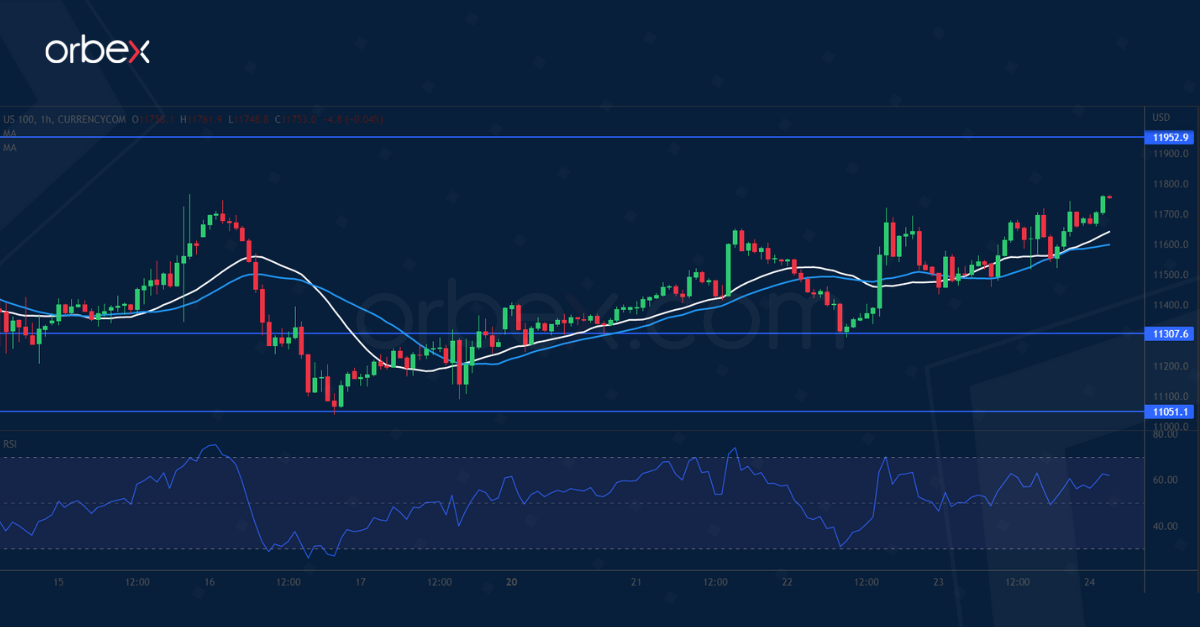
The Nasdaq 100 recovers as recession worries may temper the Fed’s eagerness to raise rates later this year. The index is hovering above November 2020’s lows at 11050. Profit-taking and fresh buying have stabilised the price action for now. 11950 is the next resistance and its breach could open the door for a rally towards 12500 where selling pressure could be expected. Sentiment would remain bearish in the medium-term unless the bulls succeed in lifting that hurdle. 11300 is the immediate support if the index struggles.
NZD/USD Breaks Support
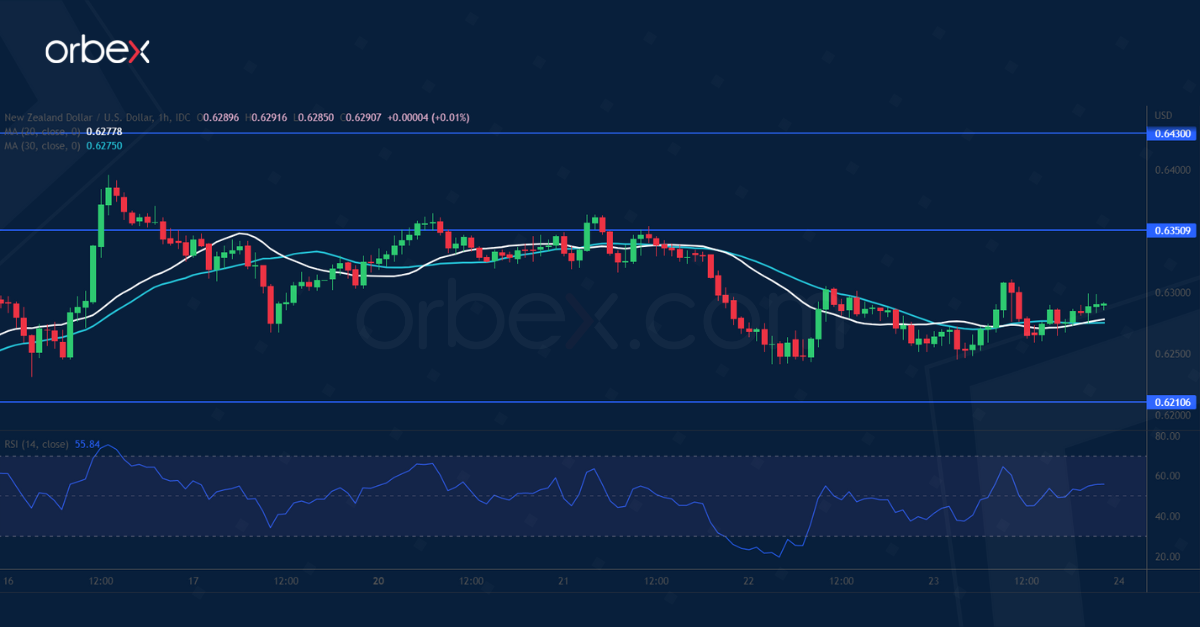
The New Zealand dollar weakens as commodity prices fall amid fears of recession. A bearish MA cross on the daily chart points to an acceleration to the downside, further weighing on overall sentiment. A fall below 0.6250 has put early bulls on the defensive, invalidating the latest rebound in the process. 0.6210 is the last stronghold and its breach would signal further weakness. The bears may look to sell into strength as the kiwi inches back into its downtrend. 0.6350 is a key hurdle in case of a bounce.
USD/CHF Grinds Key Support
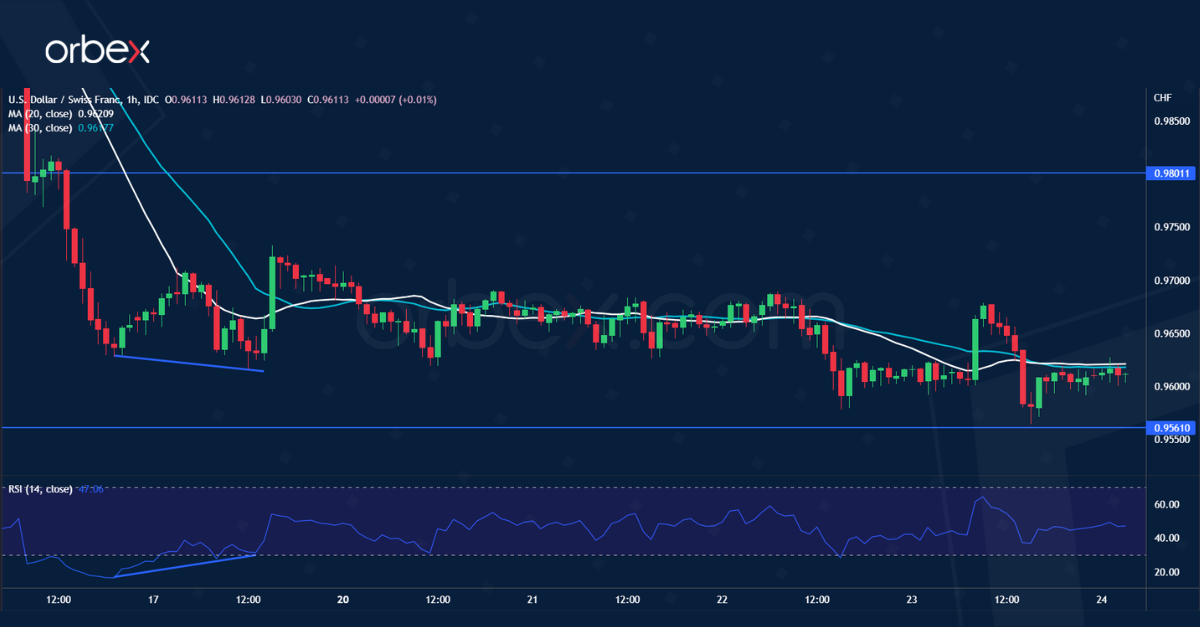
The US dollar treads water as initial jobless claims disappoint. After forming a double top at 1.0050 on the daily chart, the pair is struggling to hold above June’s lows (0.9560). A bullish RSI divergence showed a slowdown in the sell-off, which might prompt intraday sellers to cover in the demand zone. The bulls will need to push above the support-turned-resistance at 0.9800 to trigger a broader rally and ease the pressure. Otherwise, a drop below 0.9560 may cause another round of sell-off and send the pair to 0.9400.