Sample Category Title
Bitcoin’s Performance Points to a Weak Risk Appetite
Bitcoin rose 2.9% in the past 24 hours to $20.9K. Ethereum added 5.5% to $1140, while the top 10 altcoins growth ranged from 1.1% (Doge) to 11.5% (XRP).
Total crypto market capitalisation, according to CoinMarketCap, rose 3.1% to $929bn over 24 hours. Bitcoin’s dominance index lost 0.2 points to 42.9%. The cryptocurrency fear and greed index remained at 11 points (“extreme fear”) for the third day.
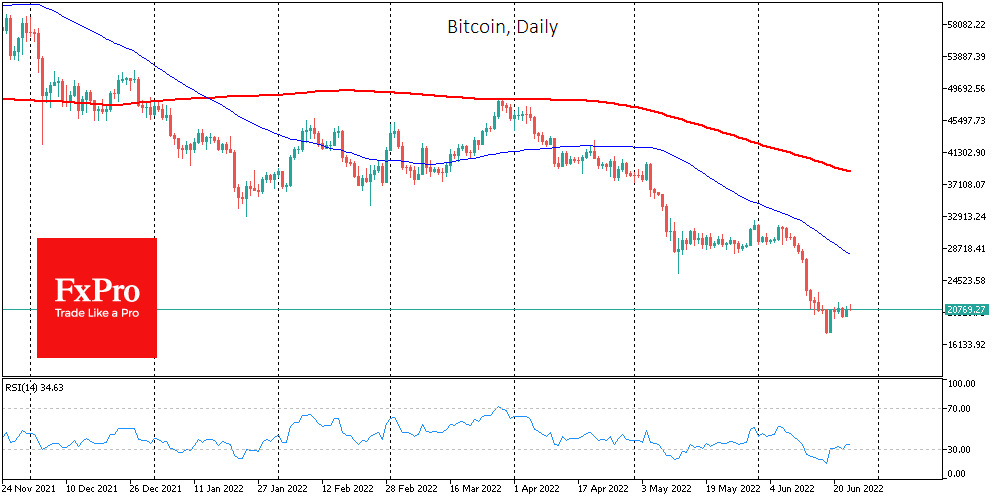
Bitcoin rebounded from the previous day’s decline on Thursday amid rising US stock indices. The first cryptocurrency has not yet managed to advance above $21K. Markets must guess whether we see crypto market weakness compared to equities or whether BTC works as a leading indicator, indicating that the rebound in equities is false.
Famous investor Mark Mobius called bitcoin a leading indicator of stock market sentiment. In his view, now is the time to buy stocks as bitcoin investors are still talking about buying it on the downside.
China’s Economic Daily warned local investors that in the future, when market confidence collapses or when sovereign countries declare BTC illegal, it will return to its original value, which is zero.
Changpeng Zhao, CEO of cryptocurrency exchange Binance, believes that after the current collapse, bitcoin may not surpass its previous high of $69,000 until 2024. Crypto winter could last until the next bitcoin halving in 2024, the “Dvision Network” believes.
According to KPMG, institutional investors show significant interest in asset tokenisation, NFTs and meta-currencies. Citibank and Switzerland-based METACO are launching a storage service for cryptocurrencies amid the growing digitalisation of traditional investment assets.
GBP/USD: Quiet and Directionless Phase Likely to Precede Fresh Weakness
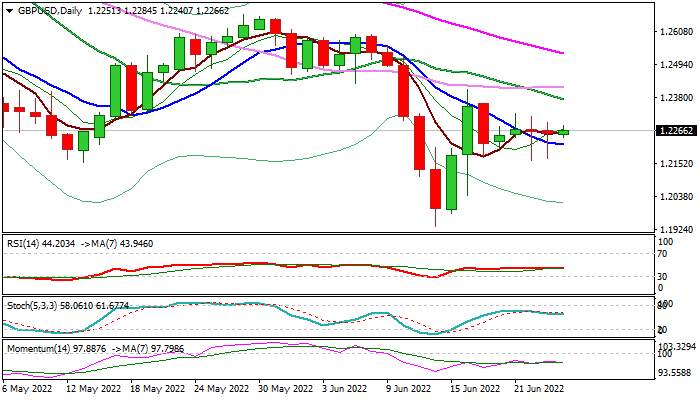
Cable trades in a quiet and narrow-range mode in European session on Friday, with directionless action (long-legged Doji candles in past two days) extending into fourth consecutive day.
Friday’s action remained unchanged on negative news as PM Johnson’s Conservatives lost two parliamentary seats, though the news are likely to add to existing problems with Johnson’s Partygate scandal, strike on UK railway and the red-hot problem with surging cost of living that resulted in a record low consumer confidence and prompted British consumers to cut back on shopping.
Technical picture on daily and weekly charts remains very bearish, adding to limited prospect for stronger recovery and keeping the risk shifted to the downside.
Bears look for a break of pivotal supports at 1.1933/30 (last week’s low / Oct 2016 low) which would open way for retest of pandemic spike low at 1.1409 (Mar 2020) and risk deeper fall on violation of the latter.
Daily Kijun-sen, which capped the action in past four days, offers strong resistance at 1.2300 and immediate bias is expected to remain bearish while the action continues to hold below this level, however, stronger signal of recovery would require acceleration and close above 1.2386/1.2406 (Fibo 61.8% of 1.2666/1.1933 bear-leg / June 16 lower top).
Res: 1.2300; 1.2386; 1.2406; 1.2493
Sup: 1.2210; 1.2160; 1.2114; 1.2045
Sterling Rises Despite Weak UK Data
UK retail sales decline again
The pound has edged higher today, shrugging off soft UK releases. Retail sales for May fell 0.5%, and declined 4.7% YoY, below the estimate of -4.5% (-5.7% prior). It was a similar story for core retail sales, which came in at -5.7% YoY, worse than the forecast of -5.1% (-6.1% prior).
The sharp declines in consumer spending should not come as a surprise, given the inflation squeeze which continues to drag down the UK economy. Consumer confidence numbers remain in deep-freeze, as GfK consumer confidence for May notched lower to -41 in June, down from -40 in May. The continuing rise in the cost of living has become a crisis for UK households, and the predictable result has been weaker consumer confidence and spending.
Inflation in the UK shows no signs of peaking, as headline CPI rose to 9.1% in May, up a notch from 9.0% in April. Inflation expectations are rising, and this week’s major rail strike could be an initial response from organized labour, which will not be satisfied with 3% wage hikes when inflation is closing in on double digits. The BoE hasn’t had succeeded in curbing inflation and expects inflation to top 11% later this year before finally easing. Unlike the Federal Reserve, the BoE has been reluctant to aggressively raise rates, with the BoE’s most recent hike of 0.25% paling in comparison to the Fed’s salvo of 0.75%.
Fed Chair Powell’s appearance on Capitol Hill this week was keenly watched by nervous markets. Powell didn’t hold back any punches, acknowledging that a recession was “certainly a possibility”, adding that a soft landing would be “very challenging”. Powell mentioned the usual suspects beyond the Fed’s control, namely, high commodity prices, supply chain issues and the Ukraine war. The Fed has not ruled out further 0.75% hikes, which will help curb inflation but could tip the economy into a recession.
GBP/USD Technical
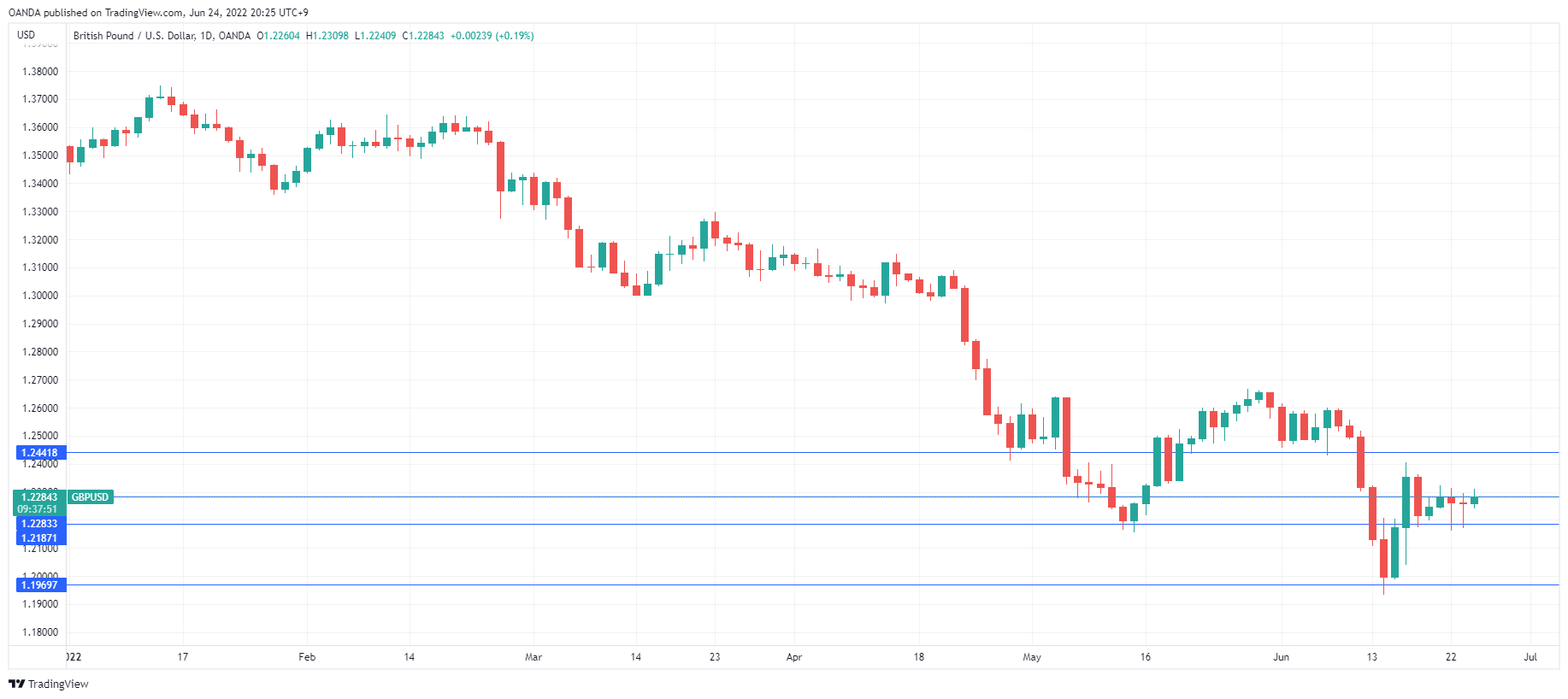
- 1.2187 is providing support, followed by 1.1969
- GBP/USD continues to test resistance at 1.2283. Above, there is resistance at 1.2441
Japanese Yen’s Rally Takes Pause
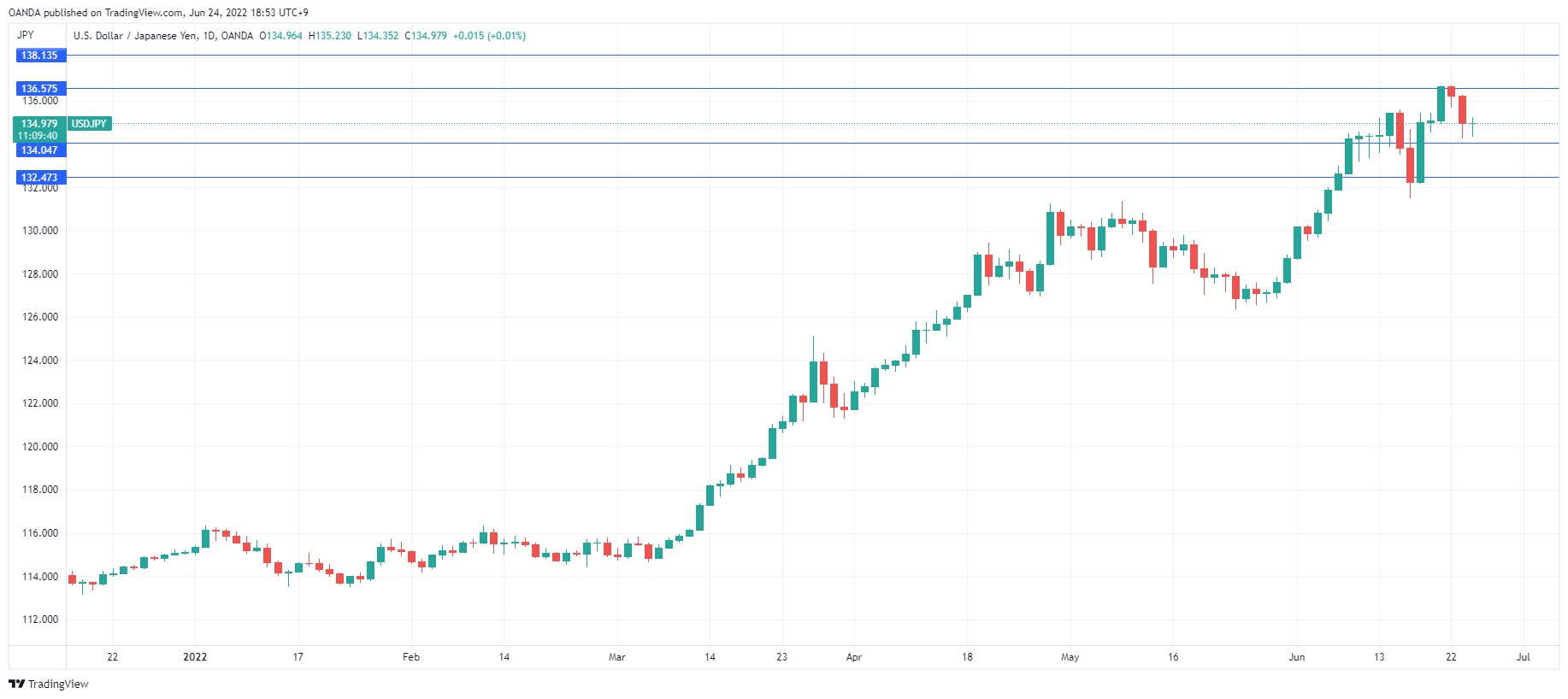
The Japanese yen is almost unchanged on Friday, trading at the 135.00 line.
Lower US yields boost yen
The Japanese yen showed some strength yesterday, gaining around 1% against the dollar. The yen’s improvement was a mechanical response to lower US yields rather than any positive factors related to the yen. Higher US yields have been the driver behind the yen’s sharp descent of around 17% this year. With the Federal Reserve delivering aggressive rate hikes and the BoJ capping the yields on JGBs, the math is simple – as the US/Japan rate differential has widened, USD/JPY has moved higher.
The Bank of Japan is sticking with its ultra-loose policy, insisting that the fragile economy is in need of substantial monetary easing. The BoJ has tenaciously defended its yield curve control, keeping 10% JGB yields capped at 0.25%. This uncompromising stance has sent the yen to its lowest levels since September 1998, raising speculation that the BoJ or Ministry of Finance would intervene to defend the yen. USD/JPY broke above 125.00, then 130.00 and finally 135.00 without any intervention other than some ineffective jawboning expressing Tokyo’s discontent with the rapid deprecation of the yen.
Investors would love to know if there is a “line in the sand” for the yen, which if crossed would trigger currency intervention. There are voices warning that 140.00 is that line in the sand, but I would question that view. USD/JPY has been at much higher levels in the past, and the BoJ has shown that the exchange rate is not a policy target. With the BoJ focused on keeping interest rates at rock-bottom levels, it would be a huge surprise if the BoJ radically changed policy just because the yen fell slightly from its current levels.
USD/JPY Technical
- There is resistance at 1.3657 and 1.3814
- USD/JPY has support at 1.3404 and 1.3247
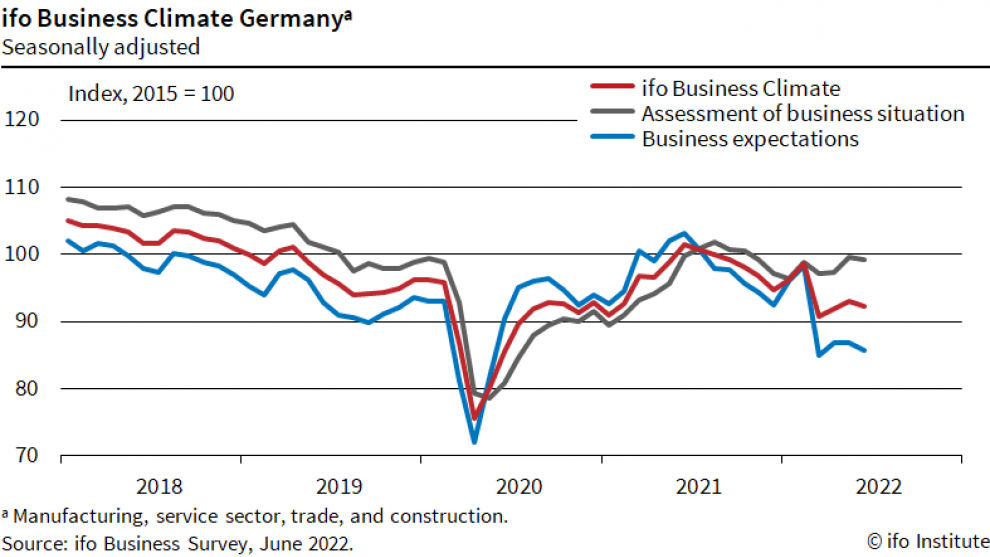
Germany Ifo business climate ticked down to 92.3
Germany Ifo business climate dropped slightly from 93.0 to 92.3 in June, below expectation of 92.9. Current assessment index dropped from 99.6 to 99.3, above expectation of 99.0. Expectations index dropped 86.9 to 85.8, below expectation of 87.4.
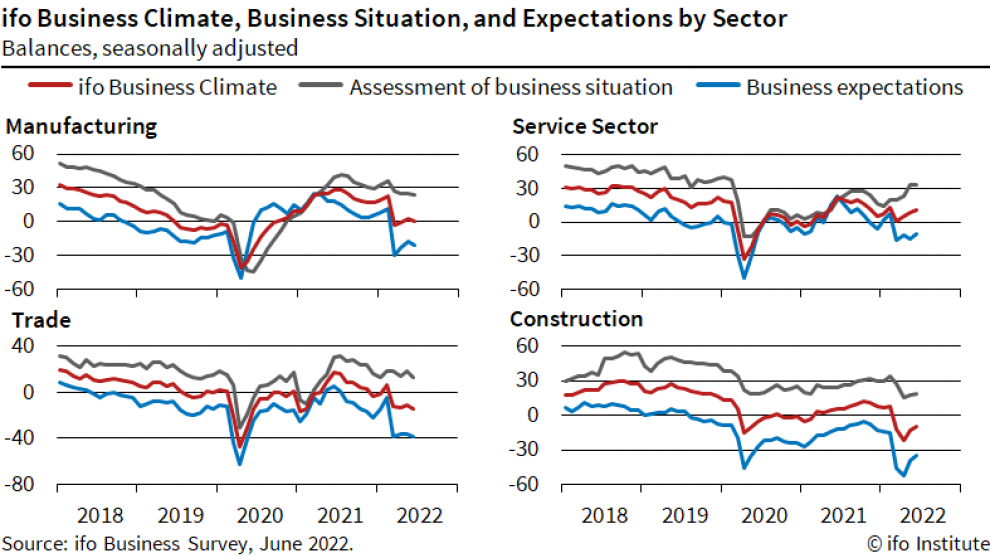
By sector, manufacturing dropped from 2.7 to 0.3. Service rose from 8.2 to 10.8. Trade dropped from -10.7 to -14.8. Construction rose from -13.4 to -9.7.
Ifo said: "Companies were somewhat less satisfied with their current business situation. Their expectations turned markedly more pessimistic. The threat of gas shortages is of great concern to the German economy."
GBPJPY Bullish Trend Dims; 20-SMA in Focus
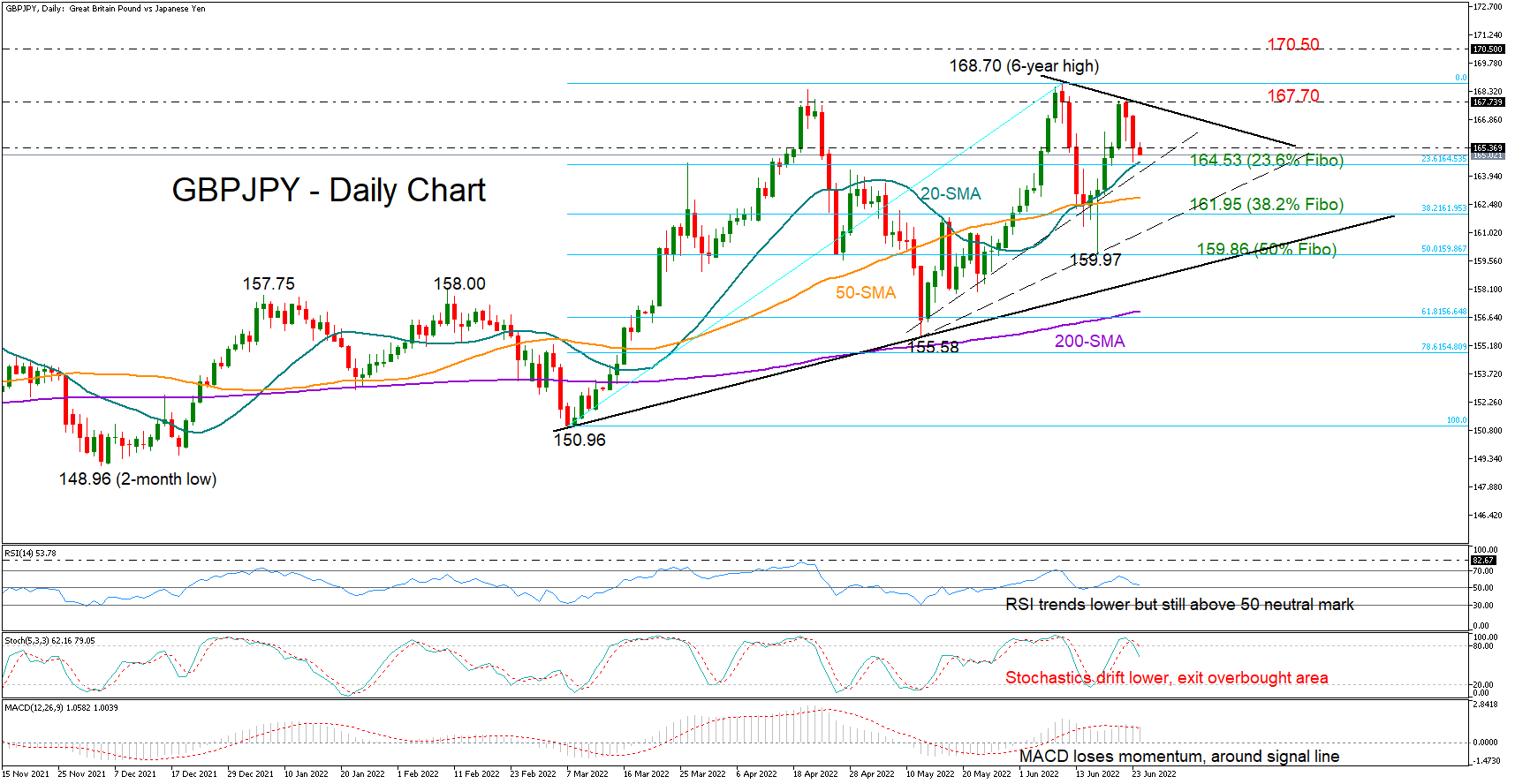
GBPJPY is mirroring fading buying interest as negative momentum escalated on Thursday, confirming a lower high at 167.82.
Similarly, the RSI seems to be following a negative trajectory after failing to reach its previous high, while the negative turn in the Stochastics and the MACD is also reflecting some discomfort among traders.
Optimism, however, has not completely vanished as the 20-day simple moving average (SMA), which has been a crucial support region over the past week, is still intact. The 23.6% Fibonacci retracement of the 150.96 – 168.70 upleg is also in the same neighborhood at 164.53 along with a dashed ascending trendline. If selling tendencies, however, break that floor, the 50-day SMA currently at 162.11 may immediately come under the spotlight ahead of the 50% Fibonacci of 161.95. Slightly lower, a tentative upward-sloping trendline may attract some attention around 161.00 before traders target the 61.8% Fibonacci of 159.86.
Alternatively, should the 20-day SMA cease downside pressures, the pair may push for a close above the short-term tentative resistance trendline and the 167.70 former restrictive zone. In case the bulls accelerate above the six-year high of 168.70 too, the next barricade may pop up somewhere near 170.50 taken from January-February 2016.
In brief, the positive trend in GBPJPY seems to be losing steam, though the bulls may not give up the battle yet unless the base at 164.53 collapses.
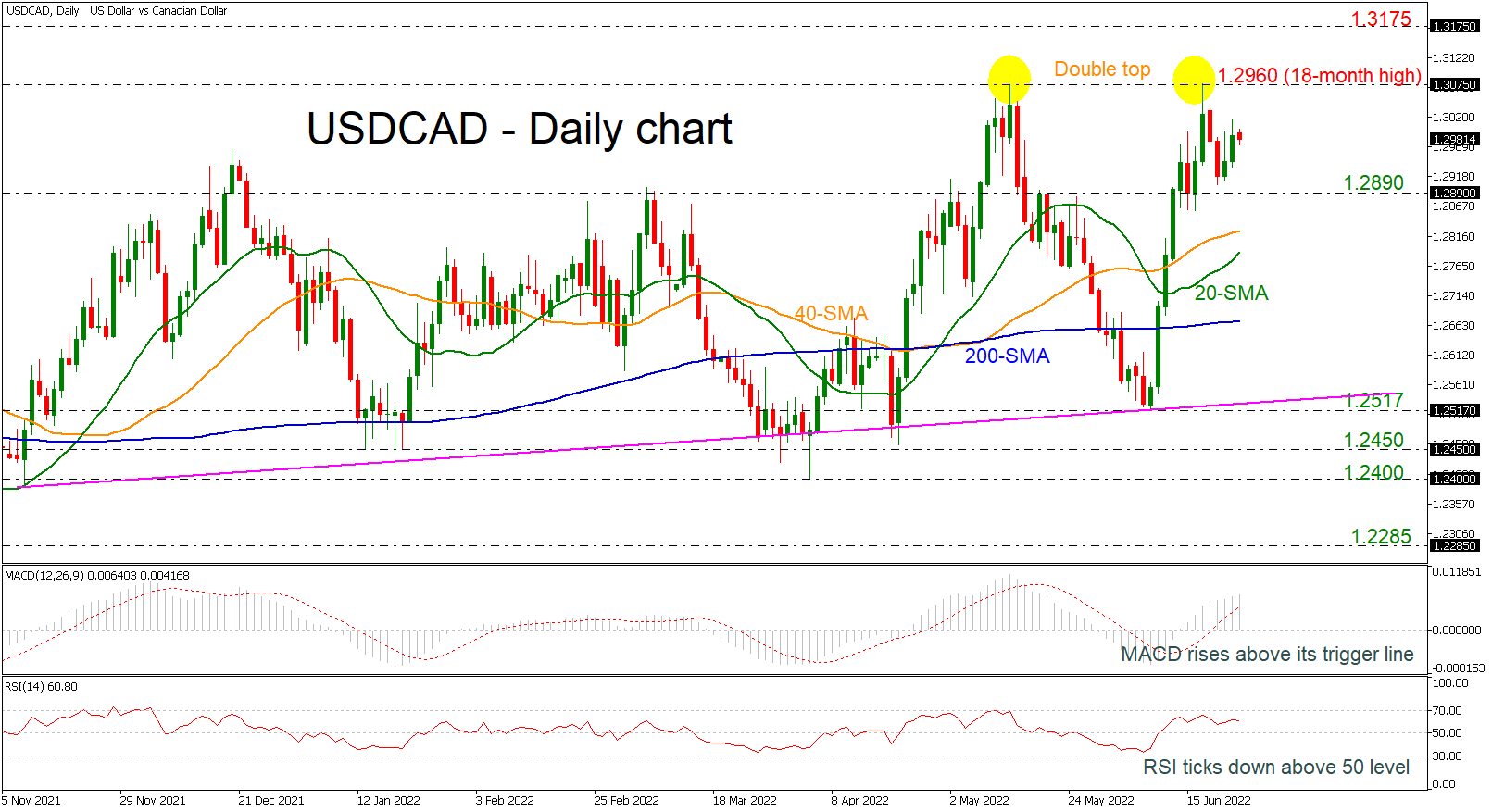
USDCAD Shows Weak Signs Below Double Top at 1.2960
USDCAD is showing some weak signs today with the technical indicators confirming this view. The RSI indicator is moving south in the positive region, while the MACD oscillator is holding above its trigger and zero lines, but with softer momentum than before.
The price posted a double top around the 18-month high of 1.2960 in the previous weeks and any moves higher could boost the long-term bullish outlook. Moving up, the price may meet the 1.3175 barrier, taken from the peak of November 2020, ahead of the 1.3420 level, registered in September 2020.
On the other hand, if the price heads down, immediate support could come from the 1.2980 support and the 40- and 20-day simple moving averages (SMAs) at 1.2825 and 1.2785, respectively. A drop lower may drive the bears until the flat 200-day SMA at 1.2660 before tumbling to 1.2517.
All in all, USDCAD has been in an advancing mode over the last seven months, though only a significant climb above the double top may endorse this positive outlook.
EUR/USD: Thick Daily Cloud Continues to Limit Recovery Attempts
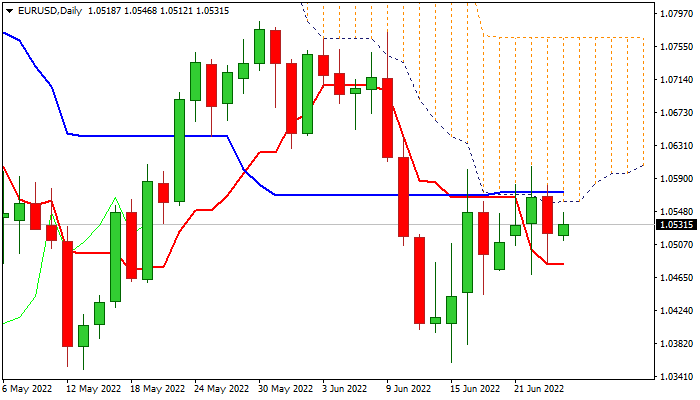
The Euro kept slightly positive stance in a quiet early Friday’s trading, as stocks edged higher, but lacking direction as near-term action holds within a range, defined by 10 and 20DMA’s, for the third straight day and capped by thick daily cloud.
Technical studies are bearishly aligned on a daily chart as momentum remains negative and stochastic turns south, though recovery from June 15 low at 1.0358 remains alive while the price stays above 10DMA (1.0495), but with limited upside prospects for now.
Traders eye German Ifo business climate data (June 92.9 f/c vs May 93.0) for fresh signals, if the figure significantly diverges from expectations, with end-of-week position liquidations to possibly further move the price.
Look for signals on break of 10DMA which could soften near-term tone and shift focus towards key supports at 1.0358/49/40, loss of which would signal bearish continuation.
This so far looks as preferred scenario as the action remains heavily weighed by a massive daily cloud ( 1.0560/1.0767) and negative fundamentals, driven by weak economic data that raise recession fears.
Only sustained penetration of daily cloud and close above 20DMA (1.0591) would ease downside pressure and allow for stronger rebound, although, overall bias is expected to remain with bears while the action stays below 1.0767/86 (daily cloud top/May 30 lower top).
Res: 1.0560; 1.0591; 1.0621; 1.0685.
Sup: 1.0495; 1.0459; 1.0380; 1.0358.
European Stocks Slip as Dalio Unveils a $10 Billion Short Position
European futures turned lower on Friday morning as worries about the bloc’s energy situation continued. The main concern is that Russia could continue reducing its natural gas to European Union in his bid to punish the members for their support of Ukraine. Germany, the most industrialized economy in the region, could move to rationing, which will affect its growth. In a statement, the country’s economy minister warned that a complete embargo would have a similar impact to the collapse of Lehman Brothers. Stocks also declined after Ray Dalio unveiled a $10 billion short on European stocks like ASML, TotalEnergies, and Sanofi. Dalio runs the biggest hedge fund in the world with over $150 billion in assets.
The British pound moved slightly ahead of the upcoming UK retail sales numbers. Analysts expect the data to show that sales dropped by 0.7% in May after rising by 1.4% in the previous month. This will translate to a 4.5% year-on-year decline. Excluding the volatile food and energy products, analysts expect the data to show that sales fell by 1.0% and by 5.1% on a MoM and YoY basis. The main cause for this decline will be the soaring inflation. Data published on Wednesday showed that the country’s consumer inflation surged to the lowest level in over four decades.
US stocks were relatively mixed after the final day of Jerome Powell’s testimony in Congress. The Fed chair reiterated that the American economy was doing well although inflation was a major challenge. As a result, he said that the bank will do whatever it can to lower inflation. This will include high interest rates and the ongoing balance sheet reduction policy. These stocks will react to the upcoming new home sales data that will come out in the American session. Analysts expect the data to show that new home sales declined from 591k to 588k. Earlier this week, data showed that the country’s existing home sales dropped sharply in May.
GBPUSD
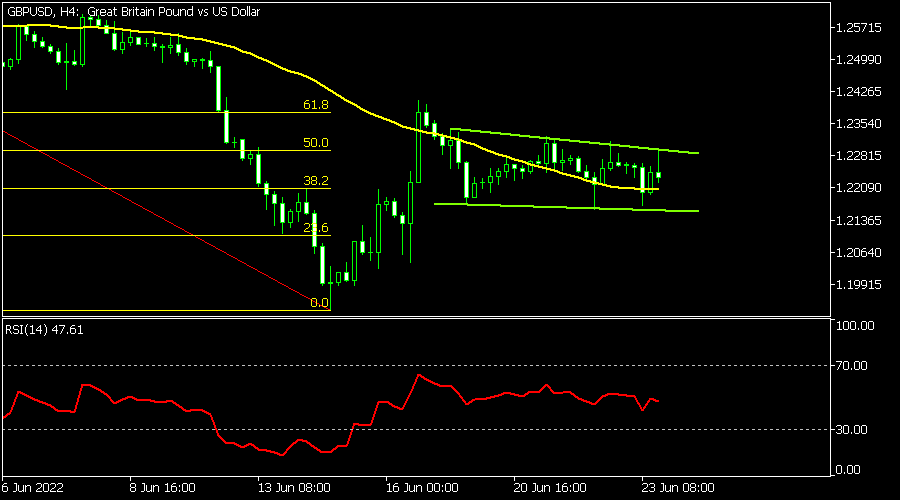
The GBPUSD pair moved sideways ahead of the upcoming UK retail sales numbers. It is trading at 1.2230, which is slightly above this week’s low of 1.2140. The pair has also moved between the 38.2% and 50% Fibonacci retracement level. It is above the 25-day moving average while the Relative Strength Index (RSI) has moved to the neutral point. It has formed a descending channel that is shown in green. Therefore, the pair will likely remain in this range today.
USDCHF
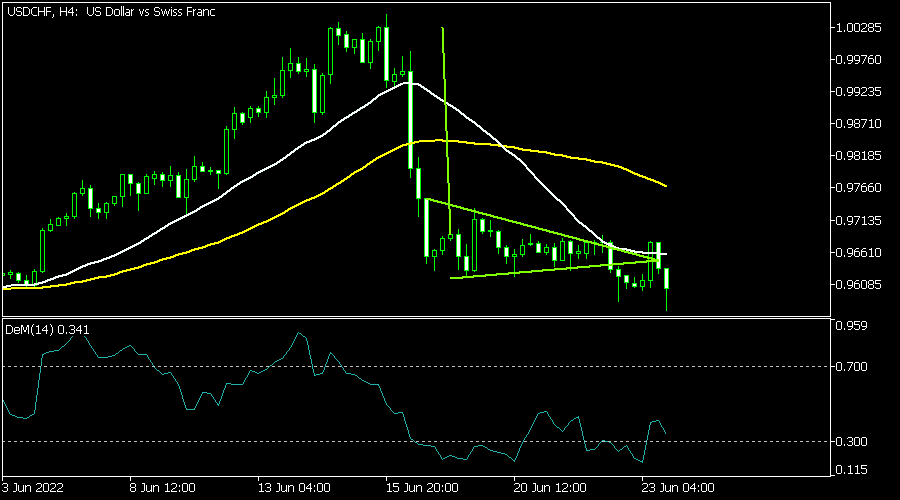
The USDCHF pair has been in a strong bearish trend after the Swiss National Bank (SNB) delivered a hawkish interest rate decision. The pair dropped to a low of 0.9567, which was the lowest level since early June. It has moved below the bearish pennant pattern shown in green. At the same time, it has fallen below the 25-day and 50-day moving average while the DeMarker indicator has moved slightly above the oversold level. The pair will likely continue falling as bears target the key support at 0.9500.
EURUSD
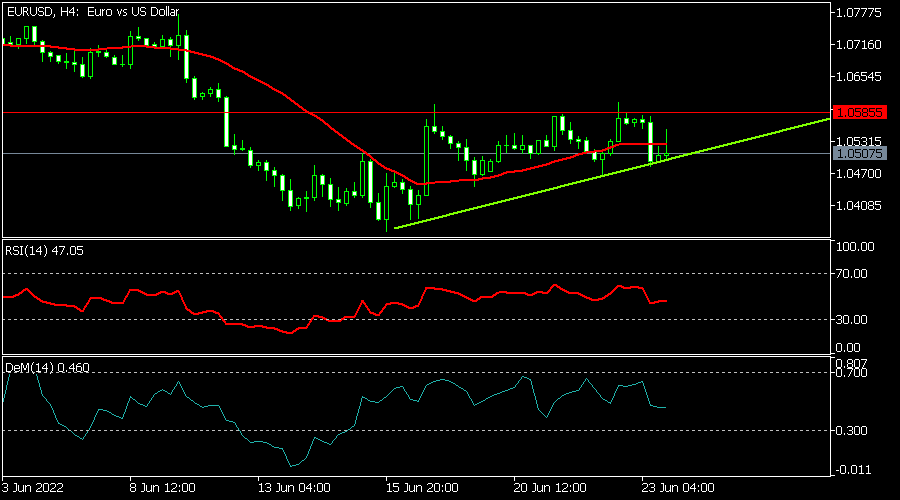
The EURUSD pair moved sideways as investors reflected on the statement by Jerome Powell. It is trading at 1.0500, which is along the ascending trendline shown in green. The pair has moved slightly below the 25-day moving average while the Relative Strength Index has moved to the neutral point at 50. The DeMarker is pointing lower. The pair will likely continue falling now it has found a strong resistance at 1.0585.
GBP/JPY Daily Outlook
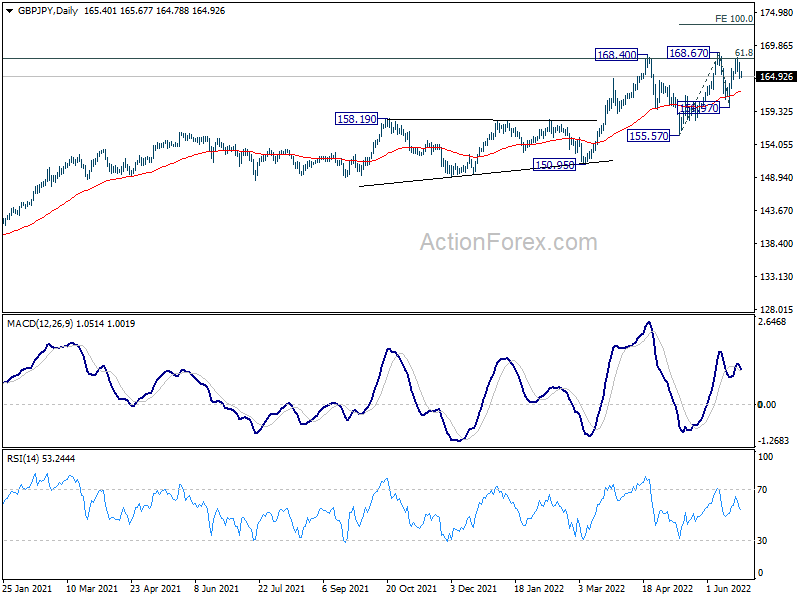
Daily Pivots: (S1) 164.40; (P) 165.75; (R1) 166.83; More...
Intraday bias in GBP/JPY stays neutral at this point. On the upside, decisive break of 168.67 resistance will resume larger up trend. Next near term target is 100% projection of 155.57 to 168.67 from 159.97 at 173.07. On the downside, below 164.45 minor support will turn bias back to the downside for 159.97 support instead.
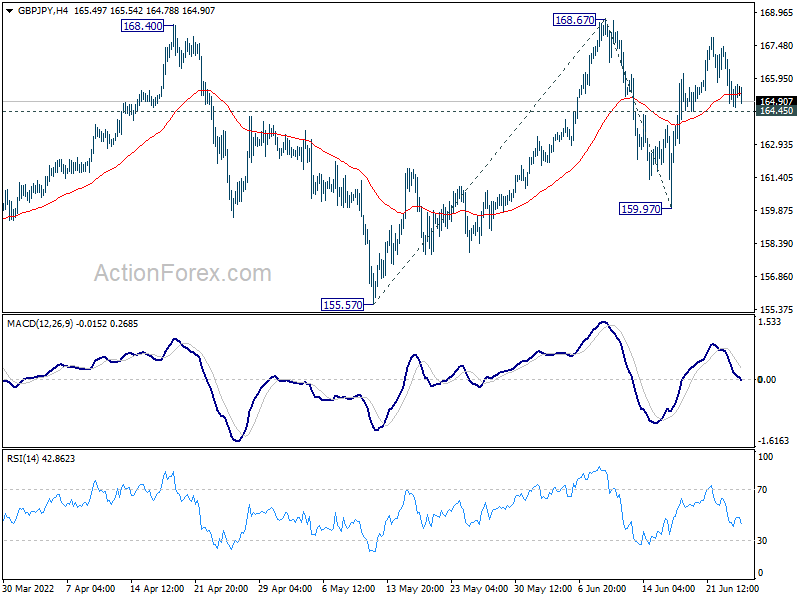
In the bigger picture, up trend from 123.94 (2020 low) is still in progress. Sustained break of 61.8% retracement of 195.86 (2015 high) to 122.75 (2016 low) at 167.93 will be a long term bullish signal, and could pave the way back to 195.86 high. This will now remain the favored case as long as 155.57 support holds, even in case of deep pull back.