Sample Category Title
Summary 6/27 – 7/1
Monday, Jun 27, 2022
[php_everywhere instance="1"]
Tuesday, Jun 28, 2022
[php_everywhere instance="2"]
Wednesday, Jun 29, 2022
[php_everywhere instance="3"]
Thursday, Jun 30, 2022
[php_everywhere instance="4"]
Friday, Jul 1, 2022
[php_everywhere instance="5"]
Weekly Economic & Financial Commentary: The Housing Market Begins to “Reset”
Summary
United States: The Housing Market Begins to "Reset"
- Fed Chair Powell presented the Federal Reserve's semiannual Monetary Policy report to Congress this week. In his testimony, he acknowledged that tightening monetary policy in order to reduce inflation may result in a recession. Higher mortgage rates are weighing on home sales. During May, existing home sales fell 3.4%, the fourth straight decline. New home sales rose 10.7% in May, although are down 5.9% year-to-year.
- Next week: Durable Goods (Mon), Personal Income & Spending (Thu), ISM Manufacturing (Fri)
International: Global Trends of Slowing Growth, Elevated Inflation and Rising Rates Continue
- The Eurozone services PMI fell noticeably in June, signaling slower growth ahead. However, as inflation pressures intensify, we still expect the European Central Bank to raise interest rates in July. The Norges Bank delivered a hawkish surprise, raising its policy rate by 50 bps to 1.25% this week. Meanwhile, in Canada, solid retail sales and rapid inflation mean we now expect the Bank of Canada to hike rates 75 bps at its July monetary policy meeting.
- Next week: China PMIs (Thu), Japan Tankan Survey (Fri), Eurozone CPI (Fri)
Interest Rate Watch: SOMA Starts Up Quantitative Tightening
- This month, the Federal Reserve officially began implementing its balance sheet normalization plan as billions of principal payments on Treasury securities and agency mortgage-backed securities were not reinvested in the New York Fed's System of Open Market Accounts (SOMA).
Credit Market Insights: True Impact of Rising Mortgage Rates Remains to Be Seen
- Mortgage rates climbed again this week as Freddie Mac reported the average 30-year fixed-rate mortgage rose to 5.81%. The upshift in mortgage rates has fueled a rapid shift in the recently red-hot housing market.
Topic of the Week: Stanley Cup Finals: Colorado vs. Tampa Bay
- The Colorado Avalanche and Tampa Bay Lightning are facing off in the 2022 Stanley Cup Finals. The Avalanche lead the series 3-1 and have home-ice advantage in Game 5 where they will take on the Lightning at Ball Arena in downtown Denver.
Forward Guidance: Canadian Economic Growth to Lose Steam Over the Summer
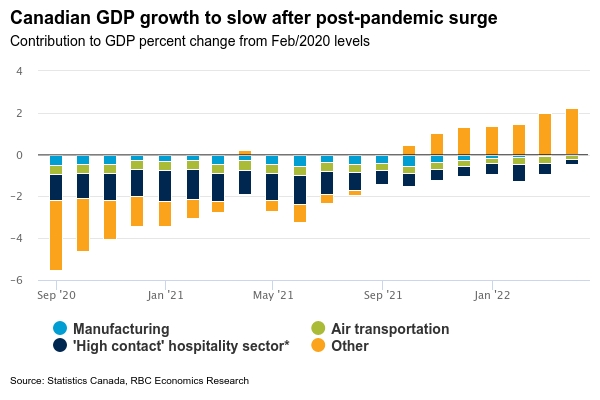
Canadian GDP likely continued its upward climb in April. We expect output to have risen 0.3% in the month, slightly more than Statcan’s initial 0.2% estimate a month ago. We look for a similar gain in May. This is despite a sharp pullback in housing markets. Home resales have slowed substantially following Bank of Canada rate hikes. But oil and gas drilling and extraction activity has risen alongside the surge in global energy prices, with production in Alberta up 3% year-to-date. And the travel and hospitality sector continues to surge back from the winter wave of COVID-19.
But while the current economic backdrop looks very strong (the unemployment rate is the lowest since at least the late 1970s) rising interest rates are pushing up Canadians’ debt servicing costs. This increase will eventually cause demand erosion. Labour shortages are still keeping a cap on production capacity and employment increases have slowed. The surge in the consumer price index to 7.7% in May is cutting into household purchasing power but also putting further pressure on the Bank of Canada to hike interest rates more aggressively. The odds have been tilting towards the BoC following the U.S. Fed with a 75 basis point hike at its next policy decision in July.
Against that backdrop, growth is clearly set to slow further.
Week ahead data watch:
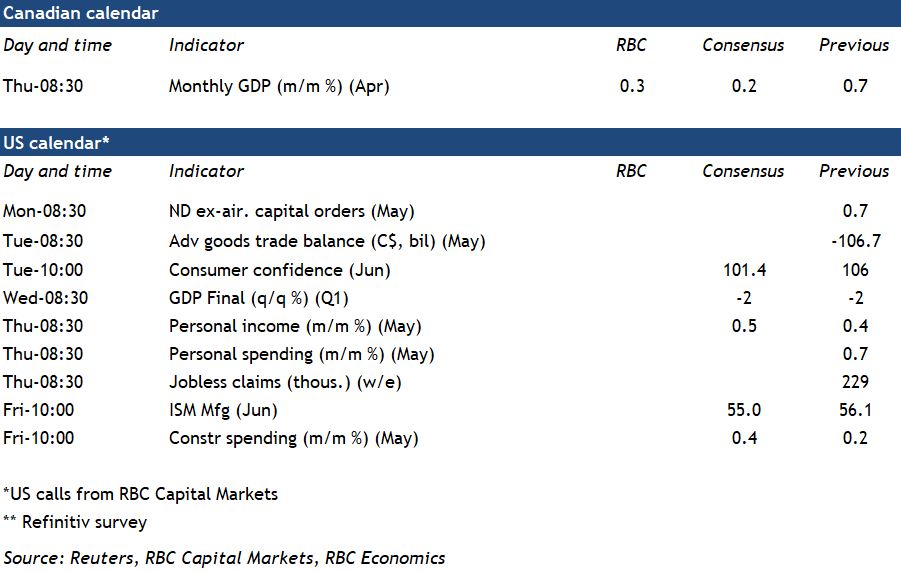
U.S. household incomes likely continued to increase in May on improving employment counts and higher wages. But spending growth is expected to soften, holding in positive territory only thanks to higher prices (notably for gasoline) alongside continued (albeit softening) services sector growth. Spending excluding price effects likely declined, led by lower auto sales.
The Weekly Bottom Line: Canada Inflation Rises to 40-Year High
U.S. Highlights
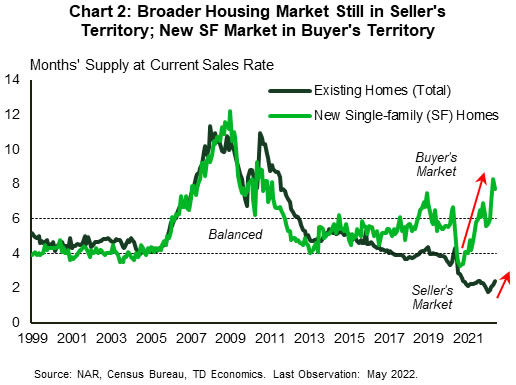
- Existing home sales fell 3.4% in May, extending the losing streak to four months. The months’ supply of inventory recorded an uptick, rising to 2.6. This was up from 2.2 months in April and 2.5 months in May of last year.
- New single-family home sales rose 10.7% in May but are still down 17% from the recent cyclical peak in December 2021.
- With little else on the data front, attention focused on Fed Chair Powell’s testimony in Congress. Powell characterized the Fed’s inflation fight as “unconditional”. Pressed on the likelihood of a recession, Powell reiterated that this was not the intended outcome, but that it was “certainly a possibility”.
Canadian Highlights
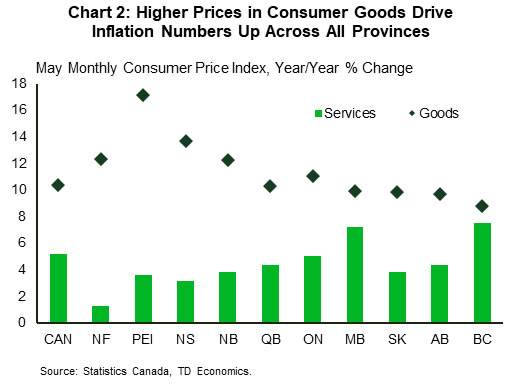
- May inflation numbers surprised to the upside, reaching a 40-year high, as price pressures broadened across categories and regions.
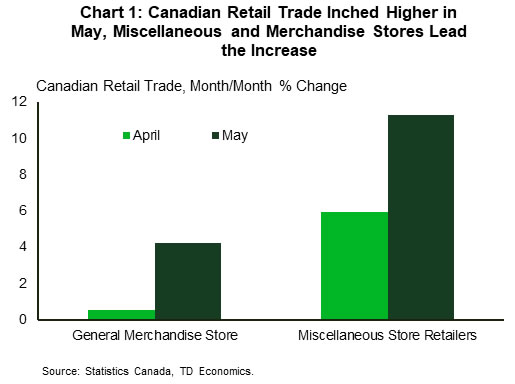
- Retail sales remained robust in April, driven by spending on gasoline, general merchandise stores, and miscellaneous retailers.
- High inflation numbers increase the urgency for rate hikes. We expect 75 bps hikes by the Bank of Canada in July and September to help curb demand.
U.S. - Changing Seasons
Fresh economic data was limited this short week, with financial markets closed on Monday for Juneteenth. Attention was focused on Powell’s testimony where he notably acknowledged the risk of recession, sending longer-term bond yields lower. So while summer may have officially kicked off this week, the economy may be a bit ahead of the curve, with the backdrop already featuring some falling leaves.
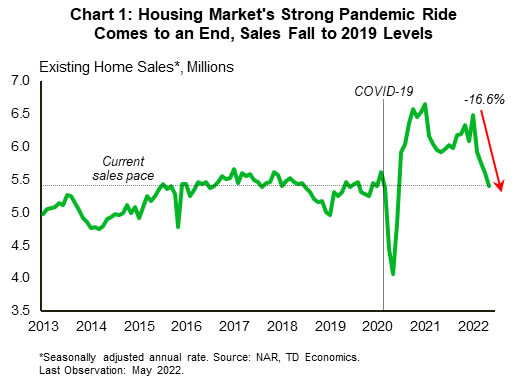
We did get an update on how the housing market was faring in the face of higher rates as of May. Existing home sales fell by 3.4%, stretching the string of declines to four months. After a solid ride during the pandemic, activity has fallen back to 2019 levels (Chart 1). With sales falling and inventories recording a small uptick, the months’ supply of inventory at the current sales rate has been edging higher. We’re not in balanced market territory yet, but the trend is slowly tilting toward it (Chart 2). Sales in the much smaller and more volatile new single-family home market regained some ground in May, but are still down 17% from their cyclical peak at the end of 2021. Led by gains in the South, new single-family housing inventory is piling up, rising to 444 thousand – the highest level outside of the 2005-06 housing boom period. This has brought this smaller segment of the housing market well into buyer’s territory (Chart 2).
 The slump in housing demand is in large part a response to deteriorating affordability from the sharp increase in interest rates. Thirty-year mortgage rates are already near 6% – almost double their level at the start of the year, and a level not seen since 2008. The Fed is focused on bringing inflation down from its 40-year high with aggressive interest rate hikes. So it is unlikely that we’ll see any respite on the rates side anytime soon. As a result, we expect home sales to trend lower in the quarters ahead, while prices also likely to give back some of the recent gains starting later this year. A tight inventory backdrop will help limit some of the downside. Our latest home price forecast for East Coast States can be found here.
Fed Chair Powell testified before Congress this week and shared a similar view of the housing market: “Rate rises should impact house prices fairly quickly”. Powell’s testimony reconfirmed the Fed’s resolve to tackle inflation, calling the inflation fight “unconditional”. When pressed on the likelihood of a recession, Powell reiterated that this was not the intended outcome, but that it was “certainly a possibility”.
Recent Fed reports (see here and here) confirm that recession odds in the 1-2 years ahead have increased. What’s more, the Atlanta Fed’s GDP tracker (not an official forecast) points to 0% growth for a second quarter of this year, which would imply that that we may already be close to a technical recession. Our latest forecast also expects a sharp deceleration in economic activity and a modest increase in the unemployment rate in the year ahead, but it still points to decent growth of a little over 2% this year and 1.4% next. Still, there is indeed a very ‘Thin Margin for Error’. Whatever the outcome, autumn or a mild winter, one thing is for sure, the economy’s hot summer days have already passed.
Canada - Inflation Rises to 40-Year High
Inflation was the name of the game this week, as consumer prices in May came in above expectations. Equity markets sold off on the day in response as the upside surprise in inflation as increased the risk of more aggressive rate hikes from the Bank of Canada (BoC) dampened sentiment. On a year-on-year basis (y/y), inflation climbed to 7.7%, higher than our forecast for 7.3%. Price pressures were widespread, both across the CPI basket and on a regional basis. This suggests that inflationary pressures are becoming even more entrenched. Our Quarterly Economic Forecast published earlier this week, had increased our forecast for inflation through the end of this year and into 2023.
Retail sales numbers for April also came in above expectations, rising by 0.9% month-on-month. Core sales which exclude automobiles, gasoline, building materials, and food services, were primarily driven by increases in general merchandise stores (4.2% m/m) and miscellaneous retail stores – which includes a diverse range of specialty retailers including florists, souvenir shops, office and pet supplies (11.3% m/m). Retail sales data suggest continued strength of the Canadian consumer (Chart 1). Statistics Canada also put out a preliminary flash estimate for May retail sales of 1.6% m/m, driving home our view that strong domestic demand will continue to keep inflation elevated.
Though retail spending data was strong for goods, we expect households to rotate spending towards services over the summer months in a return to pre-pandemic spending patterns. This rotation will hopefully mitigate some inflationary pressures stemming from goods, which were up 10.4% y/y in May. But the anticipated acceleration in services inflation (Chart 2) means that domestically driven price pressures will cause the BoC to speed up its rate hiking cycle.
On upcoming interest rate moves, former BoC Governor Stephen Poloz once said, "No one ever blames a firefighter for using too much water if, at the end of the day, you save the house". Though this was a popular strategy at the beginning of the pandemic, time has shown that the bank may have used too much water, and now it needs to be quick to turn off the taps. This week's inflation numbers for May and retail sales data for April further reinforce our view that the BoC will continue to hike aggressively, raising its policy rate by 75 basis points in July and September in order to save the house from flooding.
Looking ahead to next week, monthly GDP numbers will be a crucial indicator to see how far into excess demand Canada's economy is. Our latest forecast noted that we expect high inflation and rising interest rates to cause a slowdown in GDP growth in the latter half of this year. However, near-term GDP data are not likely to show much let up in the second quarter, especially as preliminary retail sales numbers continue to point to growth.
Week Ahead – Welcome Relief
Further turbulence ahead?
Financial markets enjoyed a little reprieve last week following a raft of central bank announcements the week before. Next week sees the focus remain on policymakers, with many set to appear at the ECB Forum on Central Banking in Portugal.
Recessions have gone from being a potential consequence of high inflation and rapid monetary tightening to an increasingly likely scenario. Central banks are pushing back less and less against a period of negative growth, with Fed Chair Powell last week acknowledging it is “certainly a possibility”.
Investors are looking for any indication that inflation has peaked and is on a quick and sustainable path lower, enabling central banks to take the foot off the gas and avert too much damage to the economy. We may have to wait a while longer yet.
US
Wall Street will continue to focus on the strength of the US consumer and pay close attention to personal income/spending data, another set of inflation readings, and a few key corporate earnings from the major retailers. A wrath of economic indicators are expected to confirm the trend of weakening business activity. US consumer confidence is expected to post a sharp decline, as personal incomes struggle to keep up with inflation. Earnings from Nike, H&M, Bed Bath & Beyond, and Wall Greens could give further insight as to how sharp of deceleration we are seeing with consumer spending.
Fed watchers will get more comments from Chair Powell as he attends the ECB Forum on Central Banking. Fed’s Daly, Mester and Bullard also have scheduled appearances.
President Biden will also attend the G-7 summit, which could contain new measures aimed at easing the global food and energy crisis.
EU
A busy week for Christine Lagarde as she welcomes peers to the ECB Forum on Central Banking in Portugal. President Lagarde will make appearances throughout the week and traders will no doubt be clinging to her every word.
Flash inflation data on Friday is another highlight. Traders are already pricing in a 25 basis point hike in July then at least a couple of 50 basis points thereafter. There’s clearly room for more after a late start by the ECB and the June inflation data could be the catalyst for a super-sized lift-off next month.
The gas stand-off with Russia isn’t easing up, ramping up the possibility of rationing this winter as the bloc struggles to refill reserves.
UK
BoE Governor Andrew Bailey’s appearance at the ECB Forum on Wednesday, alongside ECB President Christine Lagarde and Fed Chairman Jerome Powell is clearly the highlight. The BoE has been reluctant to super-size its rate hikes for fear of deepening the economic slump. But with more and more central banks moving in that direction, the MPC could be tempted soon. Perhaps Bailey will drop such hints on Wednesday.
Data is mostly tier two and three with revised GDP and manufacturing PMI the highlight. Pressure is ramping up on Boris Johnson after the Conservatives’ double by-election defeat and the resignation of the Tory Party Chair, Oliver Dowden.
Russia
There are various data releases next week that may shed some light on how the economy is holding up against the backdrop of severe Western sanctions and major shifts in interest rates and the currency. Unemployment is expected to jump to 4.5% from 4% in May, with retail sales slipping 5.5% at the same time. Real wages are also expected to have slipped 6% year on year.
No doubt the Kremlin will be focused on events in the Bavarian Alps and Madrid next week, with Russia’s invasion of Ukraine top of the agenda of the G7 and NATO summits.
South Africa
Only tier two and three data next week, with PPI inflation probably the highlight as the SARB races to get control of inflation.
Turkey
The CBRT remains committed to its monetary policy experiment no matter the cost. It kept interest rates unchanged at 14% on Thursday despite inflation running at 73.5%. Next week offers mostly tier two and three data including the manufacturing PMI and retail prices on Friday.
Switzerland
SNB Chairman Thomas Jordan suggested this week that inflation data highlights the need to tighten monetary policy further after last week’s surprise 50 basis point hike. He said it’s unclear when that would be though so traders will be on alert at all future meetings. Considering the SNBs history of surprises, we can’t ignore the possibility of an inter-meeting hike. Retail sales and manufacturing PMI are also on offer next week.
China
China releases industrial profits on Monday but most attention will be on official PMIs on Thursday, and Caixin PMIs on Friday. The data should show a rebound in both manufacturing and services following the Shanghai and Beijing reopenings. Weaker numbers will prompt slowdown fears and prompt the selling of China equities.
India
India’s balance of payments and PMIs on Friday have downside risks thanks to the wheat export ban, droughts, stress in the electricity sector and a weak rupee. That could prompt more INR selling with it remaining near record lows this week despite US dollar strength fading internationally.
Australia
Australian retail sales on Wednesday has downside risks which could prompt slowdown fears. That could cause short-term weakness in the Australian dollar. Otherwise, local equities continue to track US markets although if resource price weakness persists next week, that could start to weigh on local equities.
The Australian dollar has downside risk as it finishes at weekly lows. Its movements continue to reflect its role as a proxy for global investor sentiment by traders.
New Zealand
New Zealand releases ANZ business confidence on Thursday and ANZ consumer confidence on Friday. Both have downside risks as interest rate rises and cost-of-living increases continue to bite, and weak data could spur local equity selling.
Poor numbers could weigh on the New Zealand dollar as well, which like the Australian dollar, is finishing the week near recent lows. Like AUD, NZD’s overall direction continues to be dictated by swings in risk/recession sentiment among international investors.
Japan
Japan retail sales should improve on Wednesday as it continues its reopening phase, and industrial production Thursday should benefit from a weaker yen. However, the Nikkei 225’s direction has been highly correlated with the Nasdaq of late and that could continue. Friday’s Tankan survey may cause some short-term volatility.
USD/JPY remains highly volatile and entirely correlated to the US/Japan interest rate differential. We may still be a long way from Bank of Japan intervention.
Singapore
Singapore PPI should remain near 30% YoY next week but appears mostly priced into the market. Slowdown concerns, reflecting the situation in China and the US will continue to weigh on local equities. Inflation readings this week appear to have removed the immediate risk of the MAS tightening policy before its scheduled October meeting
Economic Calendar
Saturday, June 25
Economic Events
- Spain’s government holds an extraordinary cabinet meeting to address inflation concerns
Sunday, June 26
Economic Events
- G-7 summit two-day event takes place in the Bavarian Alps
Monday, June 27
Economic Data/Events
- US durable goods
- ECB Forum on Central Banking; speakers include ECB President Lagarde, Fed Chair Powell, BOE Gov Bailey
- UK Chancellor Sunak takes questions from MPs
- Mexico trade
- China industrial profits
- Japan leading index
Tuesday, June 28
Economic Data/Events
- US wholesale inventories, US Conference Board consumer confidence
- Mexico international reserves, unemployment
- Primary elections in the US states of Colorado, Illinois, New York, Utah, Mississippi, South Carolina, Oklahoma and Nebraska.
- BOE Deputy Governor Cunliffe speaks
- Fed’s Daly speaks to LinkedIn’s chief economist
Wednesday, June 29
Economic Data/Events
- US Q1 GDP (third reading)
- NATO Summit
- Fed’s Mester speaks on a panel at the ECB Forum
- Fed’s Bullard speaks at a virtual community development event
- Germany CPI
- Russia unemployment
- Australia retail sales
- Thailand capacity utilization, production index
- Russia industrial production
- Eurozone economic confidence, consumer confidence
- Japan retail sales, consumer confidence index
- EIA crude oil inventory report
Thursday, June 30
Economic Data/Events
- US personal income and spending data, PCE readings, initial jobless claims
- France CPI
- UK GDP
- Czech Republic GDP
- Sweden (Riksbank) central bank rate decision: Expected to raise rates 50bps to 0.75%
- South Africa trade
- Thailand trade
- Eurozone and German unemployment
- Australia job vacancies
- Japan industrial production, housing starts
- Thailand BoP
- China PMI
- India fiscal deficit, eight infrastructure industries
- New Zealand business confidence, activity outlook
- Singapore money supply
Friday, July 1
Economic Data/Events
- US construction spending, ISM Manufacturing, light vehicle sales
- Susan Collins takes office as president of the Boston Fed
- Eurozone CPI, manufacturing PMI
- Poland CPI
- Eurozone manufacturing PMI
- Germany manufacturing PMI
- UK manufacturing PMI
- Australia manufacturing PMI
- Thailand manufacturing PMI
- India manufacturing PMI
- New Zealand building permits, house prices, consumer confidence
- Australia house prices, commodity index
- Singapore home prices
- Thailand forward contracts, foreign reserves
- Japan vehicle sales, Tokyo CPI, unemployment, PMI
- China Caixin manufacturing PMI
- Russia GDP
Sovereign Rating Updates
- France (S&P)
- Finland (S&P)
Week Ahead – Energy Politics and a Barrage of Data Releases
There are no central bank meetings next week but there is an avalanche of economic data from America, Europe, and Japan to keep traders entertained. Politics will also be in the spotlight with a G7 meeting over the weekend. Global leaders are expected to outline steps to stabilize energy markets, which could have tremendous implications for central banks.
Politicians scramble
The spike in energy prices and their impact on consumers has turned into the most important political issue across the world, sending global leaders scrambling to come up with solutions or suffer the wrath of angry voters. With midterm elections coming up in the United States, the White House is in the eye of the storm.
It’s not only politicians feeling the burn. Energy prices are one of the main drivers of inflation expectations in markets, which in turn drive central bank decisions. The Fed won’t need to be as aggressive with rate increases if oil prices finally cool down.
With this in mind, the meeting of G7 leaders in Germany this weekend could be crucial. Stabilizing energy prices is high on the agenda, amid whispers that even drastic measures like price controls are under consideration. These summits rarely produce any real action, but then again, markets only need to sense something is on the horizon to move.
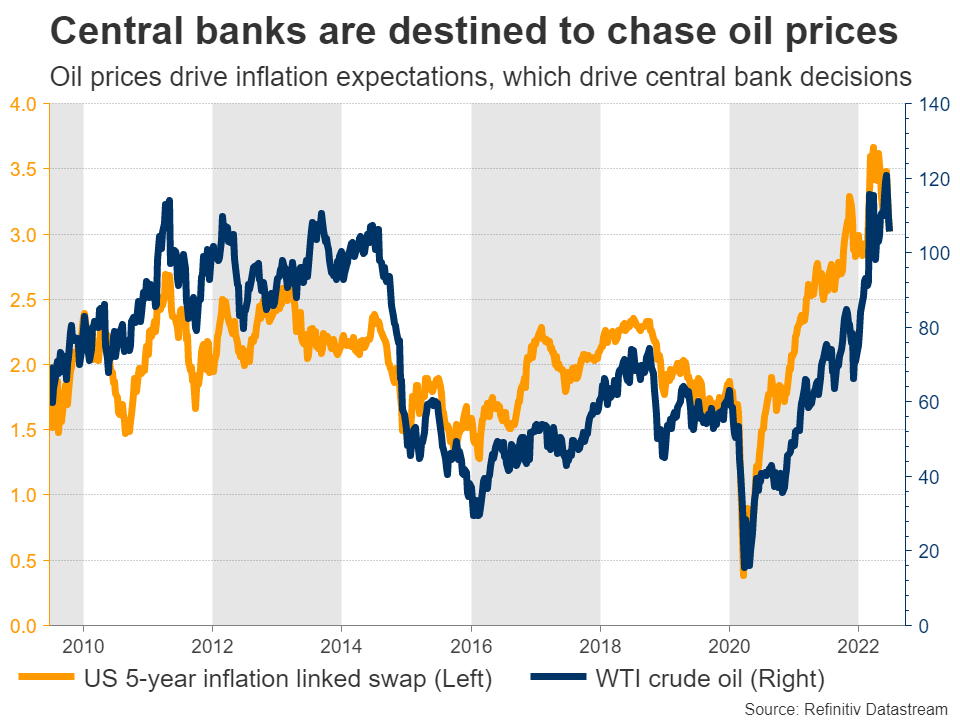
If oil prices extend their latest retreat, that could have repercussions in the FX arena too. The devastated Japanese yen and to a lesser extent the euro would likely get some valuable breathing room and might even stage a relief rally, as both economies are major importers of energy.
Beyond that, there is also a forum on central banking organized by the ECB. This event is usually academic in nature but market participants will still tune in for any signals from the ‘big 3’ on Wednesday - Fed Chairman Powell, ECB President Lagarde, and BoE Governor Bailey.
Eurozone inflation - still hot
In Europe, there’s both good and bad news. The good news is that inflationary pressures finally seem to be losing steam according to the latest business surveys. The bad news is that this is happening because consumers have started to cut back on spending.
Business confidence has fallen sharply and new orders have stalled, which suggests the economy is slowing rapidly and the time window for the ECB to raise interest rates is closing. Market pricing suggests interest rates will end the year at 1% from -0.5% currently, which seems unrealistic considering the weakening data pulse.
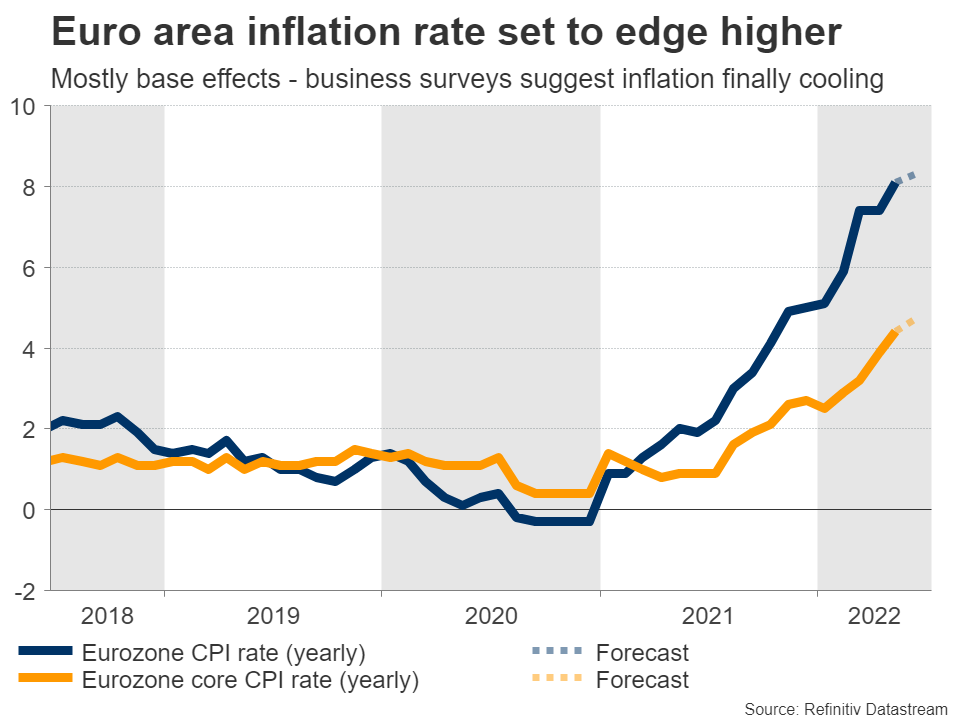
The next clue in this puzzle will come on Friday, with the Eurozone’s latest inflation report. Even though there are some early signs inflation has started to cool, the yearly CPI rate is still likely to edge higher as some very soft monthly prints from last year now drop out of the 12-month calculation.
As for the euro, it’s difficult to envision any trend reversal while energy prices are so high and recession indicators are flashing red. Historically, the euro’s advantage had always been the Eurozone’s trade surplus. This has now flipped into a trade deficit because of soaring oil prices. Hence, any relief rallies are likely to remain shallow until energy prices calm down.
Japan - data matter again?
Over in Japan, economic data have not moved the yen for half a decade now, but that might be about to change. The yen did not care about data releases because there was no prospect that the Bank of Japan would change its policy settings. Now there is.
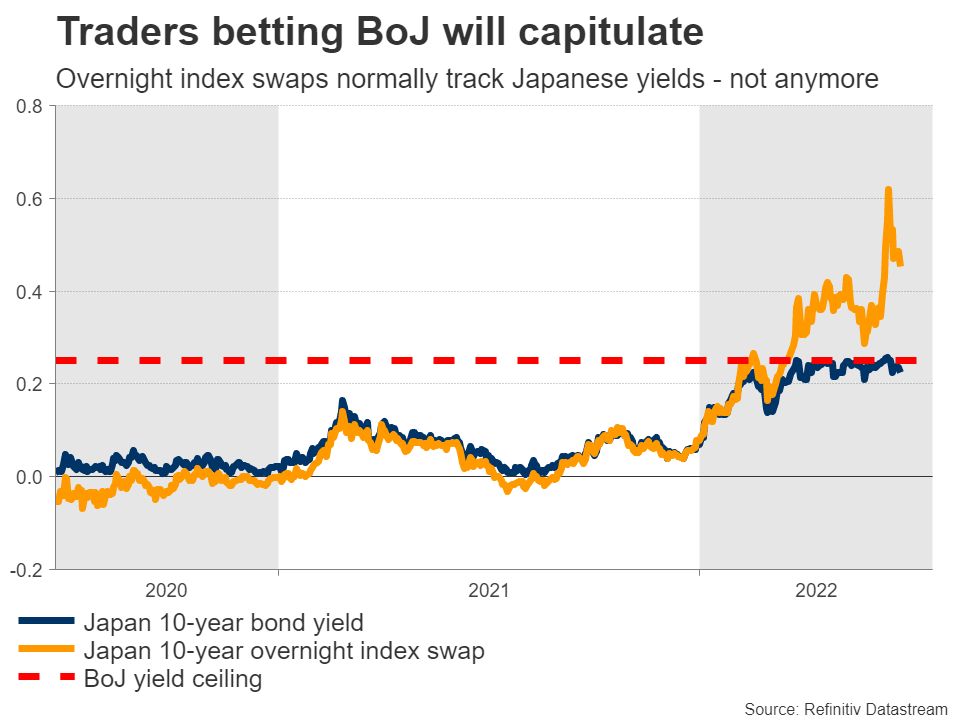
Traders can smell blood in the water, betting that the BoJ will capitulate soon and raise the ceiling it has imposed on Japanese yields - the strategy that has killed the yen. The yen’s collapse has turned into a political mess, with the government facing public outrage about the rising cost of living.
This suggests that FX intervention - even if only to flush out speculators - is on the table if the depreciation continues. Some strategists point to the 145 region in dollar/yen as the line in the sand. It boils down to this - either inflation will fire up enough and the BoJ will pivot by itself or the currency crisis will become unbearable politically and force intervention.
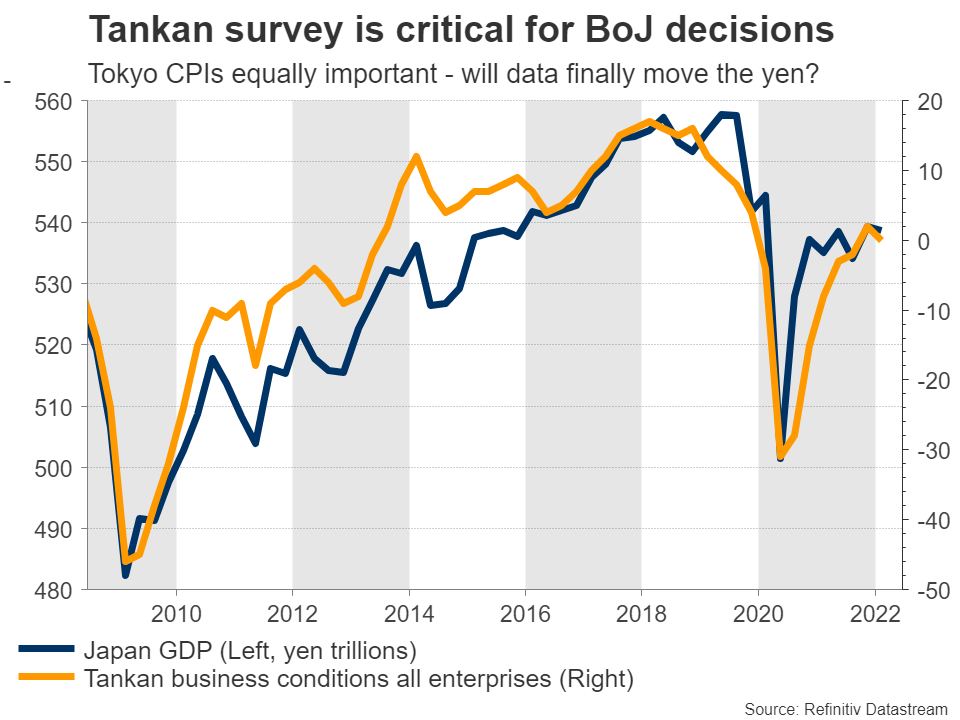
Either way, there is some light at the end of the tunnel. Investors will pay close attention to the summary of opinions from the BoJ’s latest meeting early on Monday, for any hints that policymakers are starting to get cold feet. But the main event will be on Friday, when the BoJ’s Tankan business survey is released alongside the forward-looking inflation stats for Tokyo.
Any signs that inflation is finally gaining some steam might add fuel to speculation about the BoJ changing course in July or September, helping to stop the yen’s bleeding.
King dollar still reigns
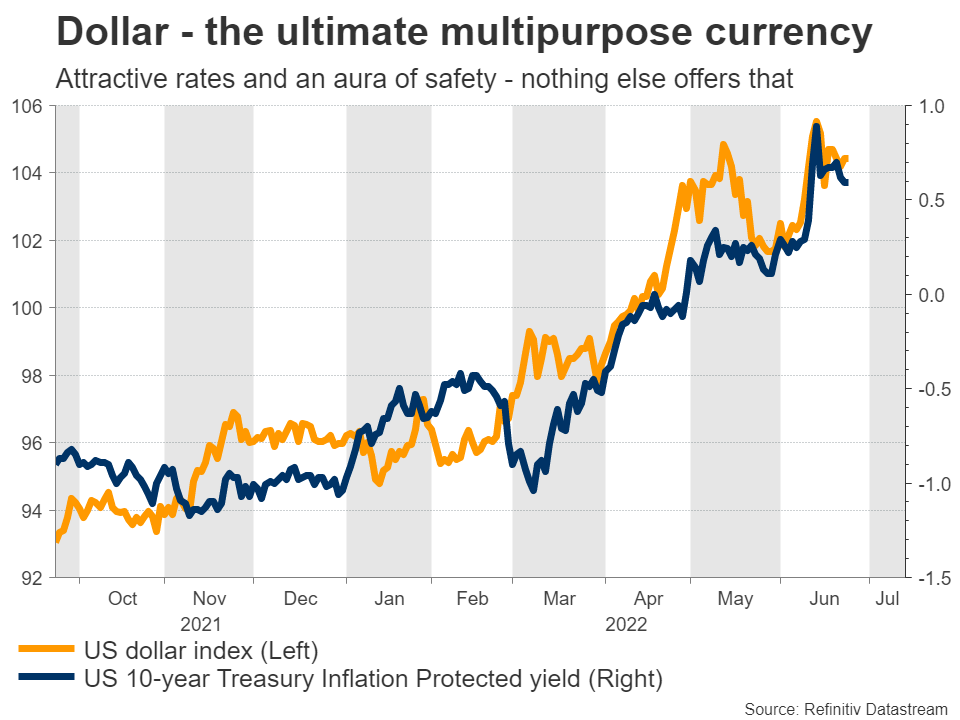
Crossing into America, the dollar continues to party. It has turned into the ultimate ‘all weather’ currency, offering a combination of attractive yields as the Fed beats other central banks to the punch and an aura of safety thanks to its reserve currency status.
There are several signs that the US economy is also losing momentum, but the dollar is unlikely to lose its crown while every other major currency grapples with its own demons - euro with energy, yen with the BoJ, and sterling with unstable risk sentiment.
In terms of data releases, the coming week will feature durable goods orders on Monday, ahead of the core PCE price index on Thursday and the latest ISM manufacturing PMI on Friday.
In neighboring Canada, GDP numbers for April are out on Thursday but are likely to be seen as outdated by traders.
Finally in China, investors will get the first glimpse into how the economy performed in June when the official PMIs are released on Thursday.
Weekly Focus – Recession Fears Dominate
After a constructive start to the week, risk sentiment soured again as recession fears crept back into markets, with equities trading heavy and global yields moving lower. However, the discussion regarding the ECB anti-fragmentation tool has brought some stability to the closely-watched 10Y Italian-German government bond spread, which has fallen back below 200bp. After surprising resilience during the spring, rising global growth concerns took their toll on oil prices this week and Brent Crude has fallen back to 111 USD/bbl. The broad USD strengthened and cyclically sensitive currencies like NOK and SEK traded on the back-foot, despite Norges Bank surprising with a hawkish 50bp hike at the June meeting (read more in Reading the Markets Norway, 23 June). The JPY slide has also resumed this week, after Prime Minister Kishida confirmed his backing of Bank of Japan's continued yield curve control.
Markets' recession fears were further stoked by gloomy PMIs reports for June. The euro area economy registered a noticeable slowdown in the growth pace at the end of Q2, as the tailwind to services from pent-up demand is already fading amid the cost of living squeeze to consumers and manufacturing production fell for the first time in two years amid ongoing supply chain disruptions and weakening demand prospects. But the slowdown was not contained to Europe, as also US PMIs fell well short of expectations, with a noticeable drop in demand for goods and services compared to prior months and deteriorating forward-looking indicators. A positive side-effect of weaker demand are easing pressure on prices, with input and output cost measures increasingly pointing to an approaching peak in inflation on both sides of the Atlantic and supplier delivery times also continuing to normalize.
French President Macron's party and allies lost their absolute majority in parliament, while hard left and far right parties gained. Weeks of negotiations will now follow, as Macron has to seek allies from rival parties, but he will face difficulties in implementing his ambitious reform agenda. The election result points towards an increasingly divided France and political uncertainty is just returning at a time when the economy has lost steam and fiscal vulnerabilities have resurfaced with rising public borrowing costs. While he retains significant powers over foreign and defence policy, a challenging second term awaits Macron on the domestic front.
Next week, markets will keep a close watch on the ECB's Sintra forum. Focus is on any discussions of the new anti-fragmentation tool and we particularly look forward to Lagarde's speech on Tuesday at 9:00 CET, and on Wednesday at 14:30 CET, Bank of England's Bailey, BIS' Carstens and Fed's Powell will join Lagarde for a policy panel. We also keep an eye on headlines from the G7 meeting ending on Tuesday, where leaders will discuss solutions to the global food crisis and a possible "price cap" on Russian oil. Euro area HICP inflation (Friday) will likely show a further increase in headline and core inflation (Danske forecast: 8.6% and 4.0%, respectively), keeping the pressure high on ECB to hike policy rates. In China focus will be on the PMI's for June (Thursday), which we expect to show a further rebound after the Shanghai lockdown ended, which could help calming global recession fears somewhat.
Sunset Market Commentary
Markets
German bond yields rebounded a few bps after an outright implosion yesterday but the move clearly lacked dash. Gains get capped to a mere 2 bps at the front-end as US dealings get going. That still leaves yields down almost 40 bps in some, mostly shorter tenors compared to the start of this week as markets adjusted expectations for the peak ECB policy rate. That’s now seen at 2% end 2023 vs 2.5% earlier this week. The trigger were of course yesterday’s PMIs, which showed a variety of factors including inflation biting into confidence, demand and activity. The German Ifo indicator also edged lower today from 93 to 92.3 but at least didn’t bring an outsized negative surprise similar to yesterday. Anyway, the perhaps most important takeaway from this week is that key technical levels that would change the market narrative if broken, survived instead. Peripheral spreads vs. Germany’s 10y yield have widened again somewhat since yesterday. Italy underperforms today by adding 6 bps and trades again 200 bps above Germany. Yesterday’s fallout on US Treasury yields was much more modest and they trade unchanged today going into the weekend. US money markets have shifted expectations for the Fed policy peak to 3.5% for which Fed’s Bullard gave his blessing today. The steep yield drop this week wasn’t confined to core bonds. The likes of Australia fell up to 50 (!) bps (3y). Growth/recession fears clearly were this week’s trading theme. Let’s see if that changes with next week’s European inflation figures due on Friday. The ECB is also holding its Forum on Central Banking in Sintra next week. Commodity markets had a lesser week too. A basket of them extended a decline that started two weeks ago, bringing total losses from the cycle high at 10%. Copper’s rout accelerated and is now trading at its lowest since early 2021.Currency markets were an ocean of calm compared to the violent bond market swings this week. EUR/USD tested the 1.06 big figure on Wednesday but called off the attempt for the time being after yesterday. The pair is going nowhere in the low 1.053 area currently. The trade-weighted DXY was looking for direction all week north of 104. There were some interesting data that highlighted the stretch the UK economy is in (high inflation but weakening activity data including retail sales) but that didn’t really come as a surprise to sterling. 0.8561-0.8641 was EUR/GBP’s playground this week. In a broader perspective, the pair is developing nicely in an upward trend channel. Gilt yields on the other hand keenly joined moves on broader bond markets, having fallen between 24 and 35 bps this week. As calm returned to markets, the Norwegian krone seizes the opportunity to strengthen and outperform today after the Norges Bank raised rates by a bigger-than-expected 50 bps hikes yesterday. At EUR/NOK 10.43, gains could have been bigger though.
News Headlines
Bulgarian parliament voted to drop the country’s veto on the start of EU accession talks with North Macedonia. There are four conditions attached: recognizing the Bulgarian minority in the country’s constitution, no automatic recognition of the Macedonian language, inclusion of protocols in the EU negotiation framework regarding the two countries’ relations and EC monitoring of the deal. North Macedonia didn’t indicate whether or not they agree with these conditions. If so, it could be a potential breakthrough of EU accession of the western Balkans. EU talks with Albania had also been frozen since the Bulgarian veto in 2019 as the bloc treats the two countries together.
Hungarian PM Orban’s chief political advisor said that they made a proposal to the EU to tap the pandemic recovery fund, but convert the funding for energy assistance. It seems like a long shot given that the EC is still withholding some €37bn in aid, consisting from €22bn in the 2021-2027 EU budget and €15.5bn in pandemic support over concerns of rule of law and graft within Orban’s administration. Hungary needs an agreement with EU by the end of the year or risk losing part of the subsidies for good.
CHFJPY – Taking Advantage of Weakening Yen
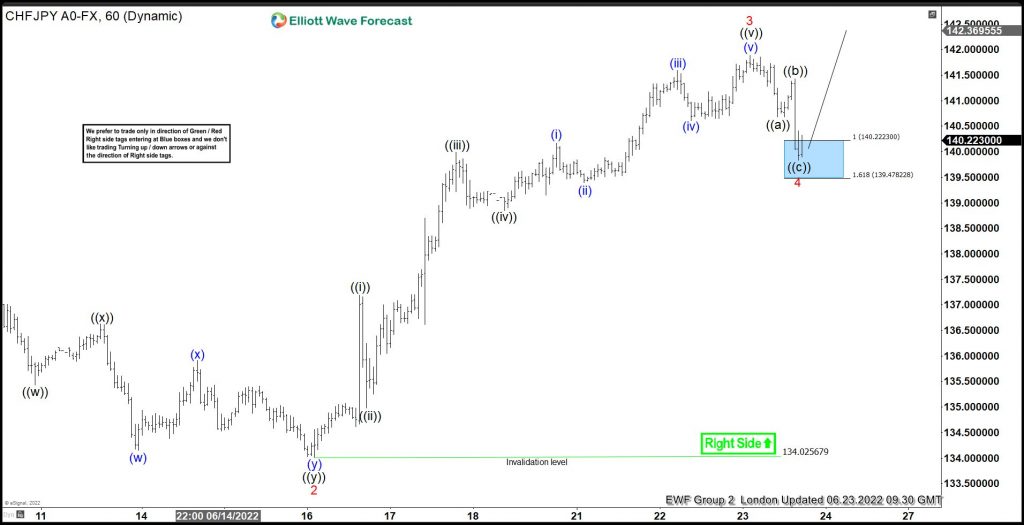
First time since 2007, SNB have increased their interest rate by 50 basis points. This occured as soon as the FED raised their interest rates. We saw a surge in the market one that day in CHFJPY. Therefore, the next step was us to wait for a 3 or a 7 swing correction. A good way to take advantage of the weak yen.
The opportunity we spotted – 1 Hour – 23th June 2022
Wave 4 is unfolding in a zigzag. Also met the minimum Fibonacci Retracement requirement of wave 4 of up to 23.6%. As you can see from the above we entered into the BlueBox zone. The BlueBox zone is wave ((c)) = ((a)) at the extreme of wave ((b)).
How is it looking now? – 1 hour – 24th June 2022
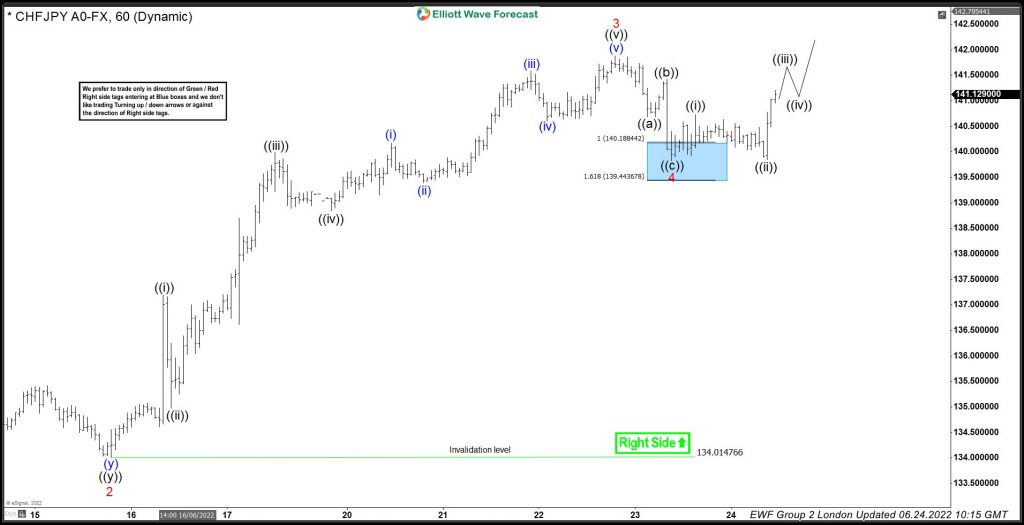
We quickly responded to this by taking 50 profits off the table, as soon we reached 50% back from wave ((b)). And then we moved the stoploss at the extreme of wave 4.
Now that we are risk-free, we will immediately wait for wave 3 extreme to break. Our target is Fibonacci Inversion of 1.236% of wave 4 at 142.37 – minimum target of wave 5.
Alternative this can turn into a double correction – either way – we will buy again then considering that we are now risk free.
EUR/USD Mid-Day Outlook
Daily Pivots: (S1) 1.0476; (P) 1.0528 (R1) 1.0574; More...
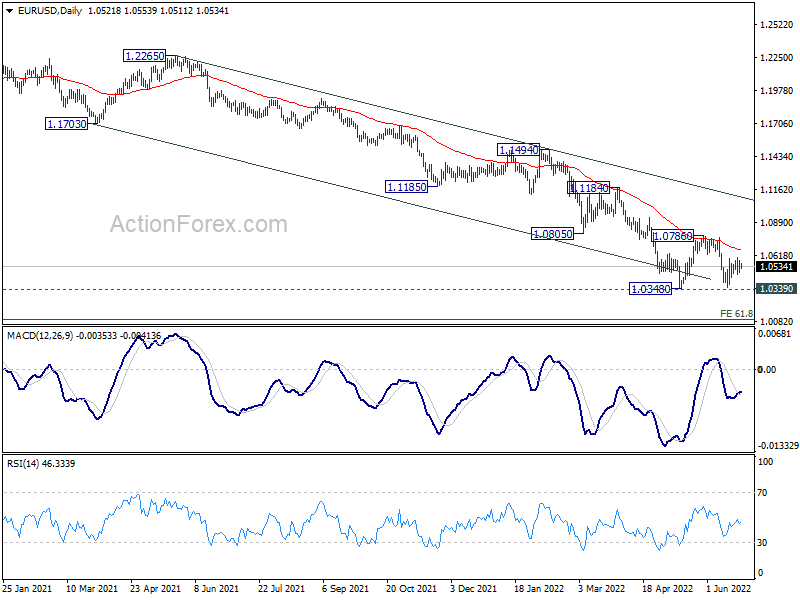
Intraday bias in EUR/USD remains neutral as range trading continues. Further fall is in favor with 1.0786 resistance intact. On the downside, sustained break of 1.0339/48 will resume larger down trend. Next target is long term projection level at 1.0090.
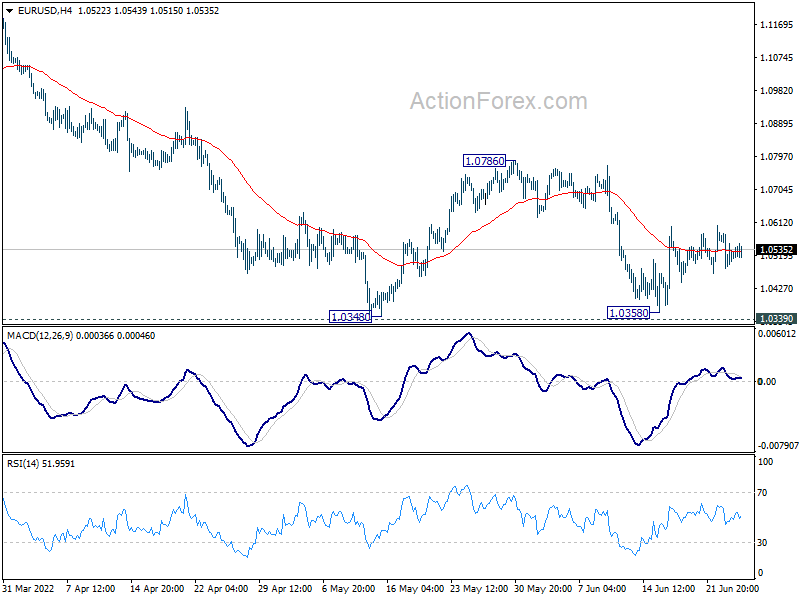
In the bigger picture, focus stays on 1.0339 long term support (2017 low). Decisive break there will resume whole down trend from 1.6039 (2008 high). Next target is 61.8% projection of 1.3993 to 1.0339 from 1.2348 at 1.0090. However, firm break of 1.0805 support turned resistance will delay this bearish case, and bring stronger rebound first.