Sample Category Title
GBP/USD Mid-Day Outlook
Daily Pivots: (S1) 1.2190; (P) 1.2242; (R1) 1.2315; More...
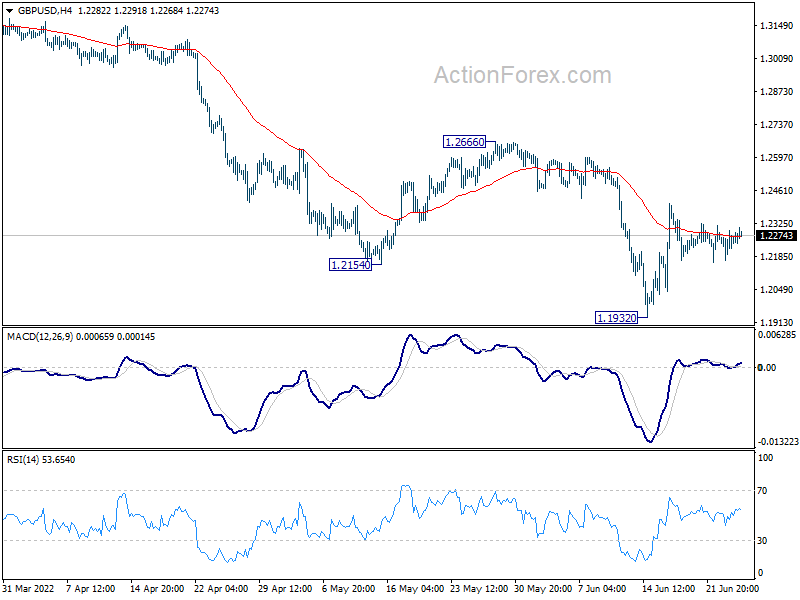
Range trading continues in GBP/USD and intraday bias remains neutral. Outlook stays bearish as long as 1.2666 resistance holds. On the downside, break of 1.1932 will resume larger down trend from 1.4248. However, firm break of 1.2666 will suggest medium term bottoming and bring stronger rebound back towards 1.3158 support turned resistance.
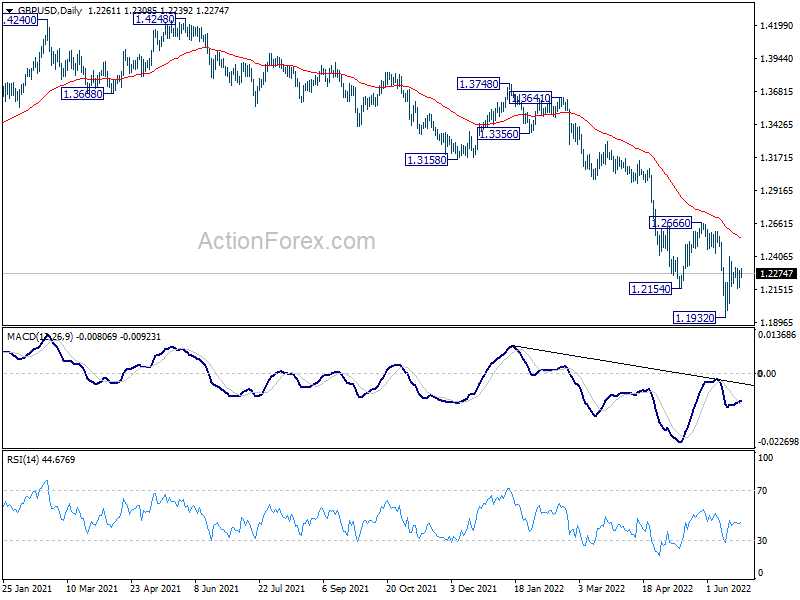
In the bigger picture, fall from 1.4248 (2018 high) could be a leg inside the pattern from 1.1409 (2020 low), or resuming the longer term down trend. Deeper decline is expected as long as 1.2666 resistance holds. Next target is 1.1409 low. However, firm break of 1.2666 will bring stronger rise back to 55 week EMA (now at 1.3175).
USD/JPY Mid-Day Outlook
Daily Pivots: (S1) 134.06; (P) 135.18; (R1) 136.09; More...
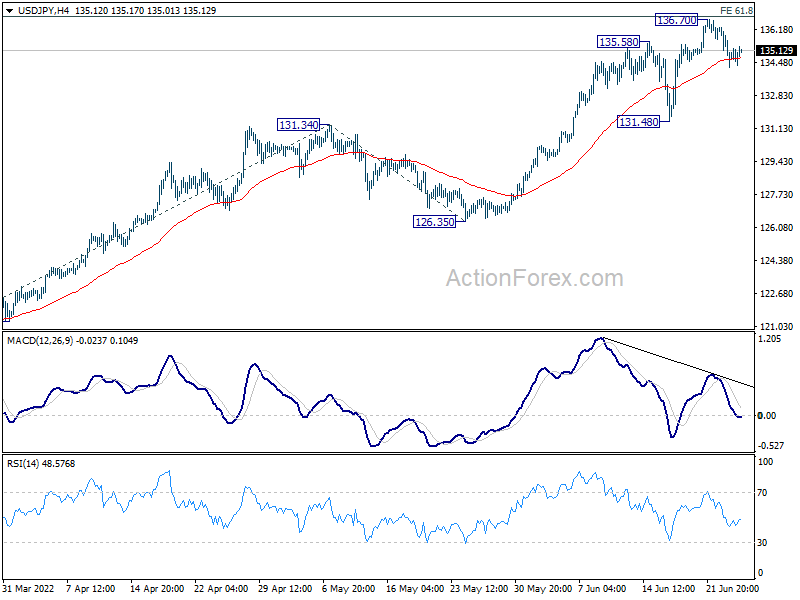
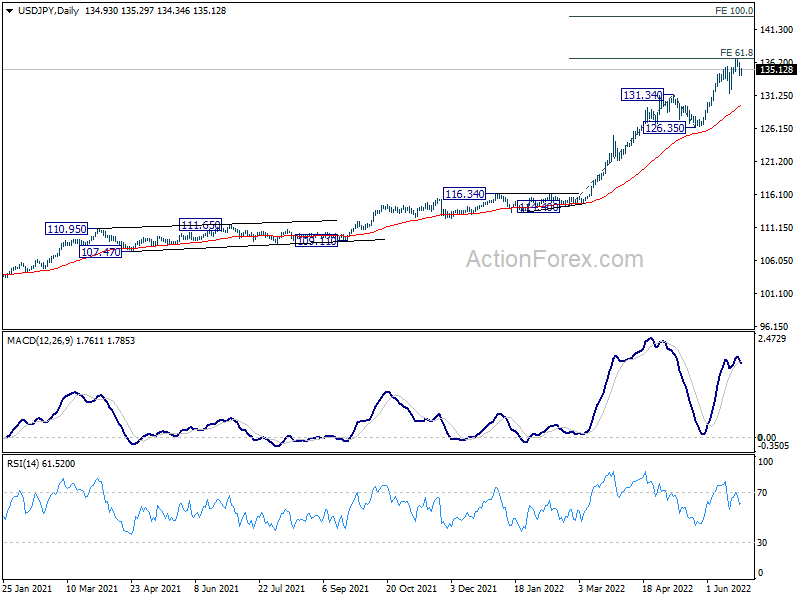
USD/JPY is staying in consolidation from 136.70 and intraday bias remains neutral. Downside of retreat should be contained above 131.48 support to bring rebound. On the upside, break of 61.8% projection of 114.40 to 131.34 from 126.35 at 136.81 will target 100% projection at 143.29.
In the bigger picture, current rally is seen as part of the long term up trend from 75.56 (2011 low). Next target is 100% projection of 75.56 (2011 low) to 125.85 (2015 high) from 98.97 at 149.26, which is close to 147.68 (1998 high). This will remain the favored case as long as 126.35 support holds.
USD/CHF Mid-Day Outlook
Daily Pivots: (S1) 0.9567; (P) 0.9629; (R1) 0.9676; More...
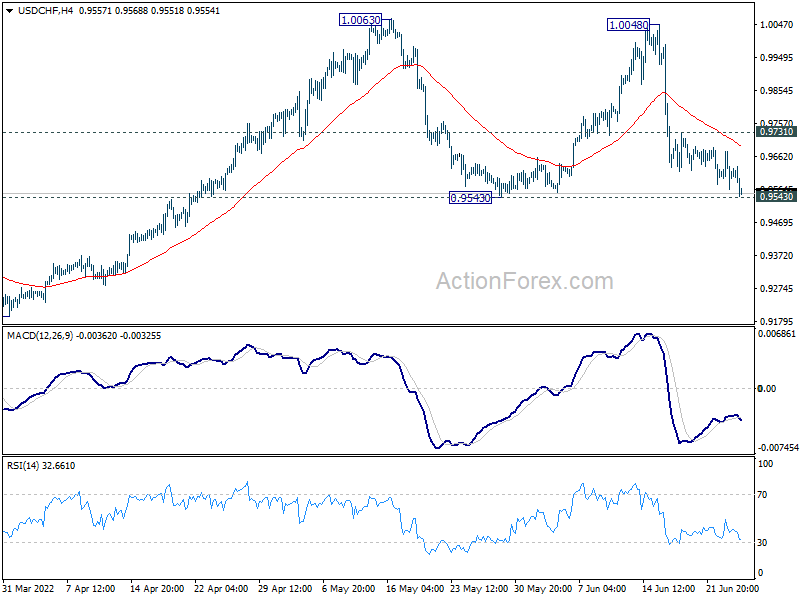
USD/CHF's fall from 1.0048 is seen as the third leg of the corrective pattern from 1.0063. Strong support should be seen at around 0.9543 to contain downside to bring rebound. On the upside, above 0.9731 minor resistance will turn bias back to the upside for retesting 1.0063 resistance. However, break of 0.9543 will bring deeper fall back to 0.9459 resistance turned support.
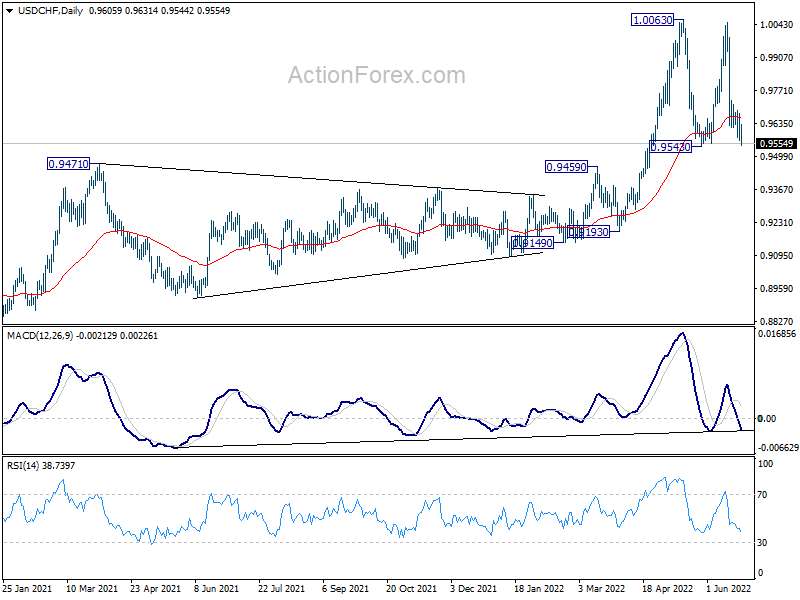
In the bigger picture, down trend from 1.0342 (2016 high) should have completed with three waves down to 0.8756 (2021 low) already. Rise from 0.8756 is likely a medium term up trend of its own. Next target is 1.0237/0342 resistance zone. This will remain the favored case as long as 0.9471 resistance turned support holds. However, sustained break of 0.9471 will extend long term range trading with another falling leg.
Swiss Franc Extending Rally, Yen Softens as Yields Recover
Swiss Franc is staying as the strongest one for today while markets are rather quiet elsewhere. Yen turns slightly weaker and US and European yields recover. But Dollar is also weak on overall steady sentiment. As for the week, however, Aussie and Kiwi are the worst performers, followed by Yen and Dollar. Swiss Franc and Sterling are the strongest ones.
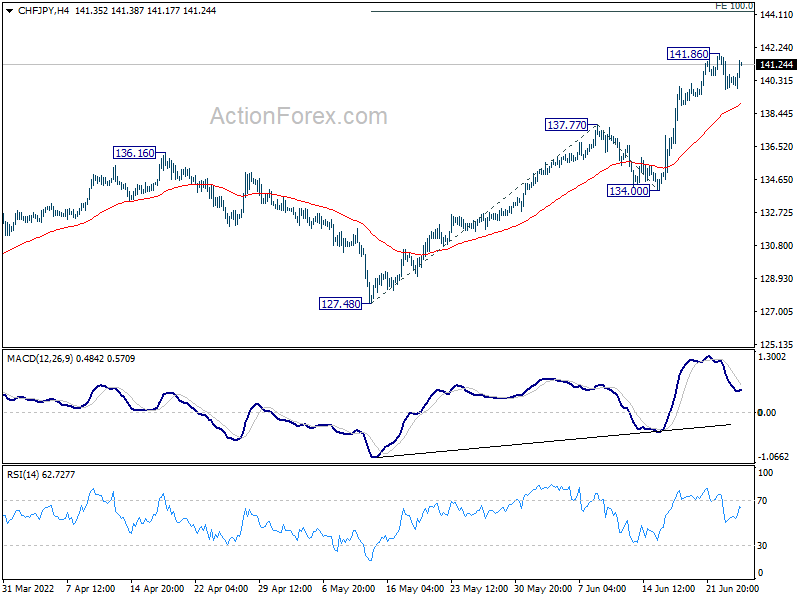
Technically, CHF/JPY may be ready to resume recent up trend too. Focus is now on 141.86 temporary top. Break will confirm bullishness and target 100% projection of 127.48 to 137.77 from 134.00 at 144.29 next. Meanwhile, USD/CHF's pressing 0.9543 support. Strong support is expected there to complete the three wave consolidation from 1.0063, and bring rebound. But firm break of 0.9543 will bring deeper fall to 0.9459 resistance turned support.
In Europe, at the time of writing, FTSE is up 1.68%. DAX is up 0.81%. CAC is up 2.04%. Germany 10-year yield is up 0.043 at 1.471. Earlier in Asia, Nikkei rose 1.23%. Hong Kong HSI rose 2.09%. China Shanghai SSE rose 0.89%. Singapore Strait Times rose 0.61%. Japan 10-year JGB yield dropped -0.0015 to 0.234.
ECB Centeno: Fragmentation has to be dealt with in their genesis
ECB Governing Council member Mario Centeno said the new instrument will "fight the risks of fragmentation" as monetary policy is gradually normalized. He emphasized that fragmentation has to be dealt with "in their genesis and not afterwards".
The instrument "will certainly demonstrate the determination of the euro system and the council of governors in containing these risks".
"There is no single typology of indicators to measure the materialization of fragmentation," he added. "There is no goal regarding specific yield spread values".
Germany Ifo business climate ticked down to 92.3
Germany Ifo business climate dropped slightly from 93.0 to 92.3 in June, below expectation of 92.9. Current assessment index dropped from 99.6 to 99.3, above expectation of 99.0. Expectations index dropped 86.9 to 85.8, below expectation of 87.4.
By sector, manufacturing dropped from 2.7 to 0.3. Service rose from 8.2 to 10.8. Trade dropped from -10.7 to -14.8. Construction rose from -13.4 to -9.7.
Ifo said: "Companies were somewhat less satisfied with their current business situation. Their expectations turned markedly more pessimistic. The threat of gas shortages is of great concern to the German economy."
UK retail sales dropped -0.5% mom, linked to impact of food prices and cost of living
UK retail sales volume dropped -0.5% mom in May, better than expectation of -0.9% mom. Ex-fuel sales dropped -0.7% mom, better than expectation of -1.4% mom.
Over the 12-month period, retail sales dropped -4.7% yoy, versus expectation of -4.5% yoy. Ex-fuel sales dropped -5.7% yoy, versus expectation of -5.1% yoy.
ONS said: "The fall in sales volumes over the month was because of food stores, which fell by 1.6%; reduced spending in food stores seems to be linked to the impact of rising food prices and the cost of living."
UK Gfk consumer confidence dropped to -41 in Jun, another record low
UK Gfk consumer confidence dropped from -40 to -41 in June, matched expectations, and set a new record low. Personal financial situation over the next 12 months dropped from -25 to -28. General economic situation for the next 12 months dropped from -56 to -57.
Joe Staton, Client Strategy Director, GfK says: "With a headline score of -41 for June, the GfK Consumer Confidence Barometer has set a record low for the second successive month.... The consumer mood is currently darker than in the early stages of the Covid pandemic, the result of the 2016 Brexit referendum, and even the shock of the 2008 global financial crisis, and now there's talk of a looming recession."
BoJ Amamiya: Will continue to support the economy with monetary easing
BoJ Deputy Governor Masayoshi Amamiya said, "the BOJ will continue to support the economy with monetary easing to achieve its inflation target in a sustained, stable manner accompanied by wage rises."
Amamiya also said the economy is picking up as a trend, but it's facing "extremely high" uncertainty". "Against this background, we must closely watch the impact financial and currency market moves could have on Japan's economy and price," he added.
Japan CPI core unchanged at 2.1% yoy, above target for second month
Japan CPI core (all item ex-fresh food) was unchanged at 2.1% yoy in May, matched expectations. That's the second month that core consumer inflation tops BoJ's 2% target. All item CPI was unchanged at 2.5% yoy, below expectation of 2.9% yoy. CPI core-core (all item ex-food, energy) was unchanged at 0.8% yoy, above expectation of 0.4% yoy.
But Deputy Chief Cabinet Secretary Seiji Kihara warned in the press conference, "we think it is necessary to pay close attention to the downside risks of the economy such as pushing down private consumption and corporate activities."
USD/CHF Mid-Day Outlook
Daily Pivots: (S1) 0.9567; (P) 0.9629; (R1) 0.9676; More...
USD/CHF's fall from 1.0048 is seen as the third leg of the corrective pattern from 1.0063. Strong support should be seen at around 0.9543 to contain downside to bring rebound. On the upside, above 0.9731 minor resistance will turn bias back to the upside for retesting 1.0063 resistance. However, break of 0.9543 will bring deeper fall back to 0.9459 resistance turned support.
In the bigger picture, down trend from 1.0342 (2016 high) should have completed with three waves down to 0.8756 (2021 low) already. Rise from 0.8756 is likely a medium term up trend of its own. Next target is 1.0237/0342 resistance zone. This will remain the favored case as long as 0.9471 resistance turned support holds. However, sustained break of 0.9471 will extend long term range trading with another falling leg.
Economic Indicators Update
| GMT | Ccy | Events | Actual | Forecast | Previous | Revised |
|---|---|---|---|---|---|---|
| 23:01 | GBP | GfK Consumer Confidence Jun | -41 | -41 | -40 | |
| 23:30 | JPY | National CPI Core Y/Y May | 2.10% | 2.10% | 2.10% | |
| 23:50 | JPY | Corporate Service Price Index Y/Y May | 1.80% | 1.50% | 1.70% | |
| 06:00 | GBP | Retail Sales M/M May | -0.50% | -0.90% | 1.40% | 0.40% |
| 06:00 | GBP | Retail Sales Y/Y May | -4.70% | -4.50% | -4.90% | -5.70% |
| 06:00 | GBP | Retail Sales ex-Fuel M/M May | -0.70% | -1.40% | 1.40% | 0.20% |
| 06:00 | GBP | Retail Sales ex-Fuel Y/Y May | -5.70% | -5.10% | -6.10% | -6.90% |
| 08:00 | EUR | Germany IFO Business Climate Jun | 92.3 | 92.9 | 93 | |
| 08:00 | EUR | Germany IFO Current Assessment Jun | 99.3 | 99 | 99.5 | 99.6 |
| 08:00 | EUR | Germany IFO Expectations Jun | 85.8 | 87.4 | 86.9 | |
| 14:00 | USD | New Home Sales May | 605K | 591K | ||
| 14:00 | USD | Michigan Consumer Sentiment Index Jun F | 50.2 | 50.2 |
Euro Drifting as German Confidence Dips
It has been a relatively quiet week in the currency markets, and the limited activity has continued today, with the euro unchanged.
German consumer confidence drops
Germany, the bellwether for the eurozone, continues to churn out weak numbers, raising concerns that the bloc could be headed toward a recession. German ifo Business Climate dipped to 92.3 in June, down from 93.0 in May (92.8 est.) Germany and the rest of the eurozone remain vulnerable to negative economic factors which, unfortunately, do not show signs of improving anytime soon. These are the war in Ukraine, supply chain disruptions due to lockdowns in China, and spiralling inflation. The ECB has been slow to respond to higher inflation and the danger of stagflation is a serious risk.
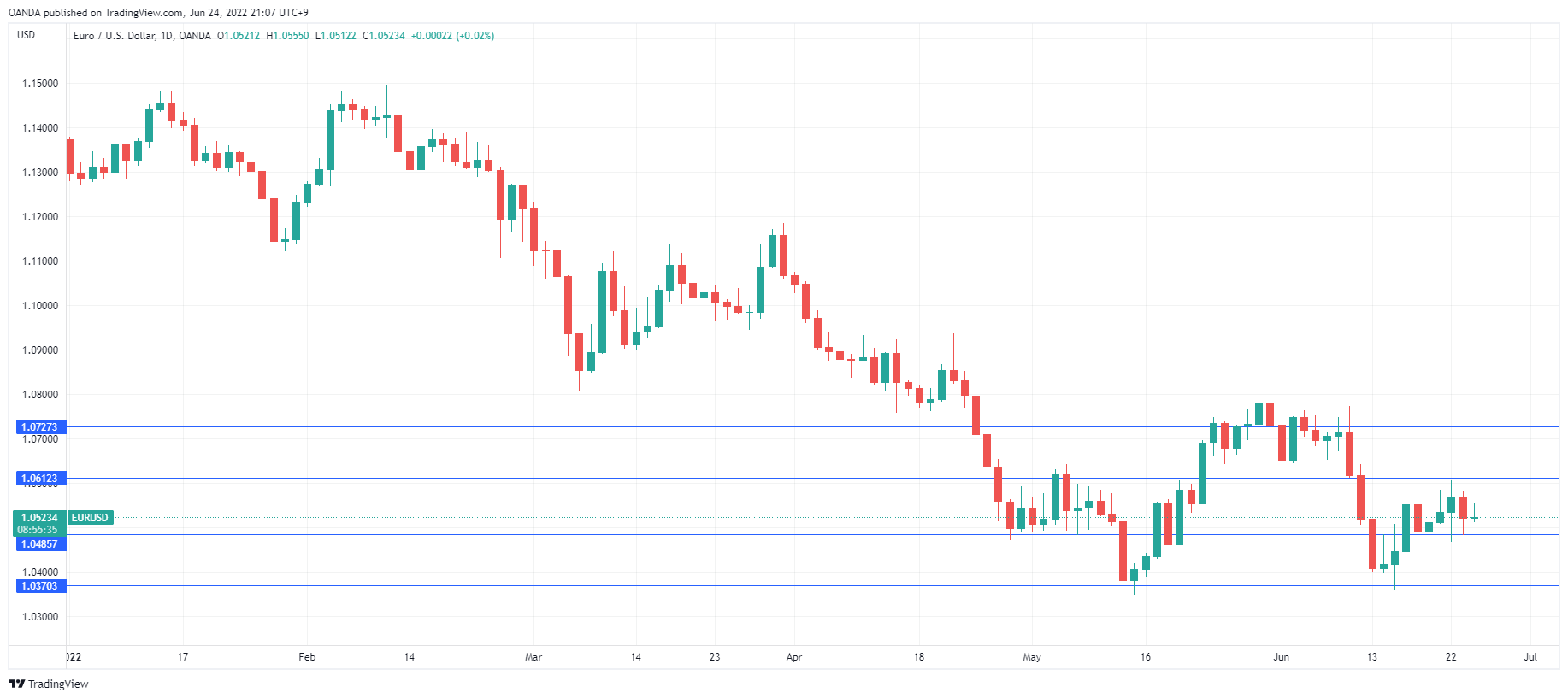
Germany has been slowly trying to wean itself off of Russian energy exports, but Moscow has decided to retaliate by decreasing its natural gas exports to Germany. This prompted Berlin to implement phase two of its emergency energy plan earlier this week. The energy crisis is getting worse and could result in the euro losing ground. The currency slipped below the 1.0500 line last week, and the risk is tilted to the downside for the euro due to the deteriorating situation with regard to Russian energy exports.
Fed Chair Powell’s appearance on Capitol Hill this week was keenly watched by nervous markets. Powell didn’t hold back any punches, acknowledging that a recession was possible and a soft landing for the economy would be a challenge. At the same time, Powell sounded relatively optimistic about the strength of the US economy, and this message appeared to calm the financial markets, for the time being at least.
EUR/USD Technical
- EUR/USD has initial resistance at 1.0612, followed by resistance at 1.0727
- EUR/USD has support at 1.0485 and 1.0370
ECB Centeno: Fragmentation has to be dealt with in their genesis
ECB Governing Council member Mario Centeno said the new instrument will "fight the risks of fragmentation" as monetary policy is gradually normalized. He emphasized that fragmentation has to be dealt with "in their genesis and not afterwards".
The instrument "will certainly demonstrate the determination of the euro system and the council of governors in containing these risks".
"There is no single typology of indicators to measure the materialization of fragmentation," he added. "There is no goal regarding specific yield spread values".
Oil Uptrend Broken, Potential Bears Target at $60-80
Brent crude oil is trading 14% below the highs set on June 9, showing declines almost every day since then. The sharp decline, more than 3.5% on Tuesday, has secured a break of the 50-day average and a break of the trend support line since December. Yesterday, we saw an attempt to get back above that level, following the rally in the stock indices.
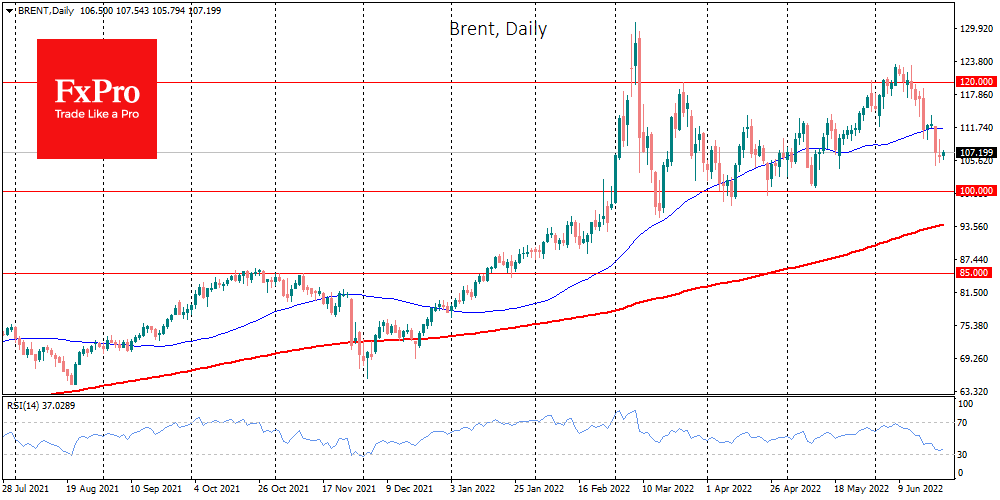
Although the formal break of the uptrend is only after a drop below the previous lows, near $101, we believe that the oil uptrend is already broken.
Interestingly, it was not Biden’s measures to curb prices through tax cuts and a sell-off from reserves that played into the hands of the bears. Oil was among the first to react to signs of slowing economic activity as a pro-cyclical commodity.
An increased chance of a recession in the US and the world has caused a sustained sell-off. It happens despite a parallel weakening of the dollar and a decline in bond yields, which often fuel the oil price.
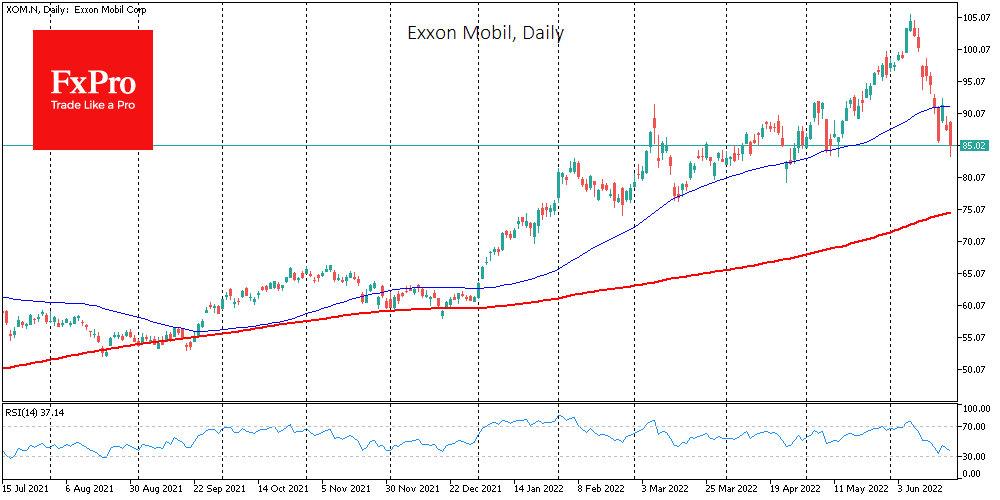
A major part of the story is the market sentiment for energy stocks. The giants, Chevron and Exxon Mobil, lost more than 3% yesterday against a 1% rise in the S&P500. Both stocks peaked on June 9, but now they are on the verge of a bear market, losing around 20% from the peak, coming at elevated trading volumes. This is a significant indicator that the oil uptrend has played out.
It is becoming clear that the world is not facing a catastrophic supply collapse as oil from Russia trickles into Asia. In parallel, OPEC and the US are increasing their production. At the same time, the energy price has become too high for buyers, leading to a drop in demand.
If we are right, the initial correction in oil prices may not have any meaningful stops until a pullback to around $100 against the current $107 in the next couple of weeks. Stabilisation near $100 would be an optimistic scenario. The world saw similar swings in the $100-130 range from 2011 to 2014, shifting more and more towards the lower end of that range over time.
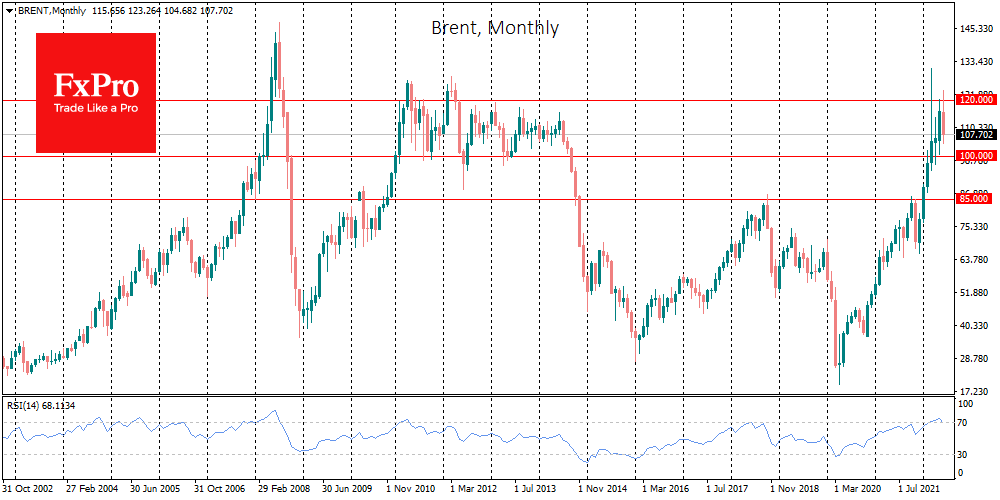
However, we see a more pessimistic scenario as the baseline. The 2011-2014 sideways trend is partly since monetary policy has remained extremely loose all this time. And it is essential to remember that at that time, the Fed raised rates by 25 points every two meetings versus 150 points in the last three meetings. In other words, oil went straight from a turbulent phase (akin to 2009-2011) into a situation like the end of 2014.
However, we exclude a scenario of more than a threefold collapse, as was the case from 2014 to 2016, as OPEC+ has become more coordinated over the past eight years. This coordination is likely to prevent the oil price from falling below $60 in a pessimistic scenario for the economy, allowing it to quickly bounce back to $80-85.
Bitcoin’s Performance Points to a Weak Risk Appetite
Bitcoin rose 2.9% in the past 24 hours to $20.9K. Ethereum added 5.5% to $1140, while the top 10 altcoins growth ranged from 1.1% (Doge) to 11.5% (XRP).
Total crypto market capitalisation, according to CoinMarketCap, rose 3.1% to $929bn over 24 hours. Bitcoin’s dominance index lost 0.2 points to 42.9%. The cryptocurrency fear and greed index remained at 11 points (“extreme fear”) for the third day.
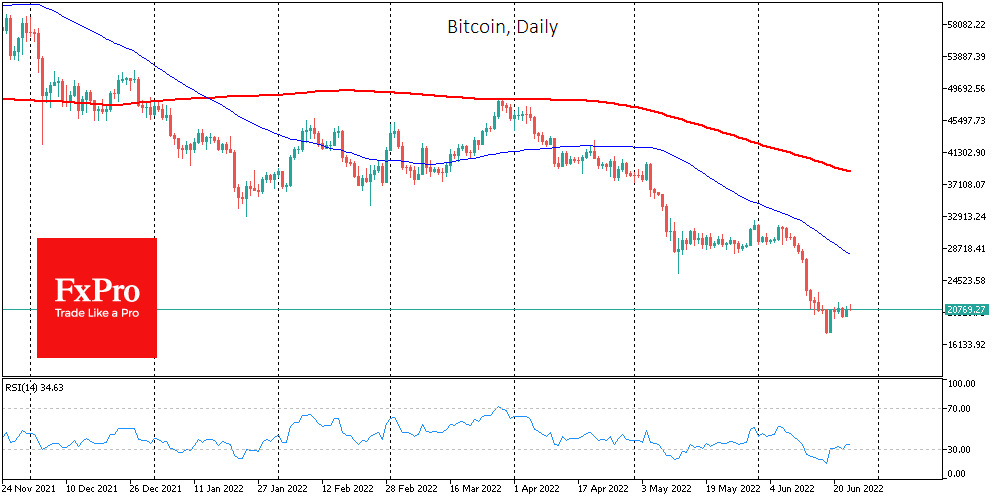
Bitcoin rebounded from the previous day’s decline on Thursday amid rising US stock indices. The first cryptocurrency has not yet managed to advance above $21K. Markets must guess whether we see crypto market weakness compared to equities or whether BTC works as a leading indicator, indicating that the rebound in equities is false.
Famous investor Mark Mobius called bitcoin a leading indicator of stock market sentiment. In his view, now is the time to buy stocks as bitcoin investors are still talking about buying it on the downside.
China’s Economic Daily warned local investors that in the future, when market confidence collapses or when sovereign countries declare BTC illegal, it will return to its original value, which is zero.
Changpeng Zhao, CEO of cryptocurrency exchange Binance, believes that after the current collapse, bitcoin may not surpass its previous high of $69,000 until 2024. Crypto winter could last until the next bitcoin halving in 2024, the “Dvision Network” believes.
According to KPMG, institutional investors show significant interest in asset tokenisation, NFTs and meta-currencies. Citibank and Switzerland-based METACO are launching a storage service for cryptocurrencies amid the growing digitalisation of traditional investment assets.
GBP/USD: Quiet and Directionless Phase Likely to Precede Fresh Weakness
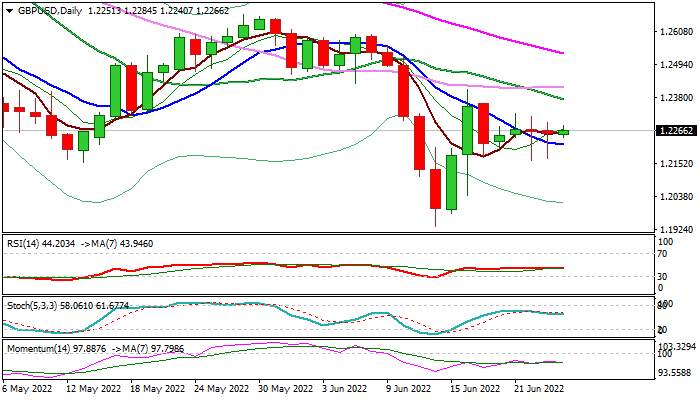
Cable trades in a quiet and narrow-range mode in European session on Friday, with directionless action (long-legged Doji candles in past two days) extending into fourth consecutive day.
Friday’s action remained unchanged on negative news as PM Johnson’s Conservatives lost two parliamentary seats, though the news are likely to add to existing problems with Johnson’s Partygate scandal, strike on UK railway and the red-hot problem with surging cost of living that resulted in a record low consumer confidence and prompted British consumers to cut back on shopping.
Technical picture on daily and weekly charts remains very bearish, adding to limited prospect for stronger recovery and keeping the risk shifted to the downside.
Bears look for a break of pivotal supports at 1.1933/30 (last week’s low / Oct 2016 low) which would open way for retest of pandemic spike low at 1.1409 (Mar 2020) and risk deeper fall on violation of the latter.
Daily Kijun-sen, which capped the action in past four days, offers strong resistance at 1.2300 and immediate bias is expected to remain bearish while the action continues to hold below this level, however, stronger signal of recovery would require acceleration and close above 1.2386/1.2406 (Fibo 61.8% of 1.2666/1.1933 bear-leg / June 16 lower top).
Res: 1.2300; 1.2386; 1.2406; 1.2493
Sup: 1.2210; 1.2160; 1.2114; 1.2045
Sterling Rises Despite Weak UK Data
UK retail sales decline again
The pound has edged higher today, shrugging off soft UK releases. Retail sales for May fell 0.5%, and declined 4.7% YoY, below the estimate of -4.5% (-5.7% prior). It was a similar story for core retail sales, which came in at -5.7% YoY, worse than the forecast of -5.1% (-6.1% prior).
The sharp declines in consumer spending should not come as a surprise, given the inflation squeeze which continues to drag down the UK economy. Consumer confidence numbers remain in deep-freeze, as GfK consumer confidence for May notched lower to -41 in June, down from -40 in May. The continuing rise in the cost of living has become a crisis for UK households, and the predictable result has been weaker consumer confidence and spending.
Inflation in the UK shows no signs of peaking, as headline CPI rose to 9.1% in May, up a notch from 9.0% in April. Inflation expectations are rising, and this week’s major rail strike could be an initial response from organized labour, which will not be satisfied with 3% wage hikes when inflation is closing in on double digits. The BoE hasn’t had succeeded in curbing inflation and expects inflation to top 11% later this year before finally easing. Unlike the Federal Reserve, the BoE has been reluctant to aggressively raise rates, with the BoE’s most recent hike of 0.25% paling in comparison to the Fed’s salvo of 0.75%.
Fed Chair Powell’s appearance on Capitol Hill this week was keenly watched by nervous markets. Powell didn’t hold back any punches, acknowledging that a recession was “certainly a possibility”, adding that a soft landing would be “very challenging”. Powell mentioned the usual suspects beyond the Fed’s control, namely, high commodity prices, supply chain issues and the Ukraine war. The Fed has not ruled out further 0.75% hikes, which will help curb inflation but could tip the economy into a recession.
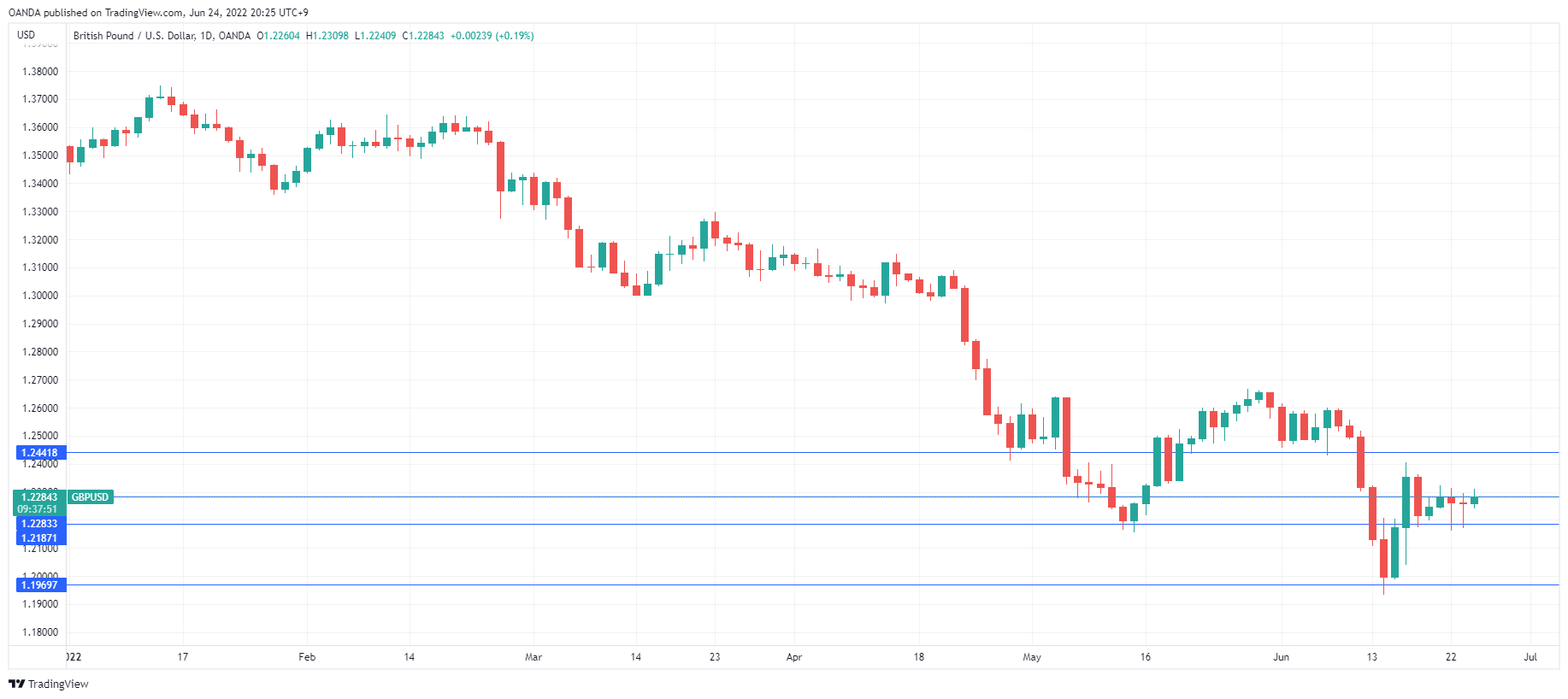
GBP/USD Technical
- 1.2187 is providing support, followed by 1.1969
- GBP/USD continues to test resistance at 1.2283. Above, there is resistance at 1.2441