Sample Category Title
EUR/JPY Mid-Day Outlook
Daily Pivots: (S1) 143.00; (P) 143.63; (R1) 144.57; More....
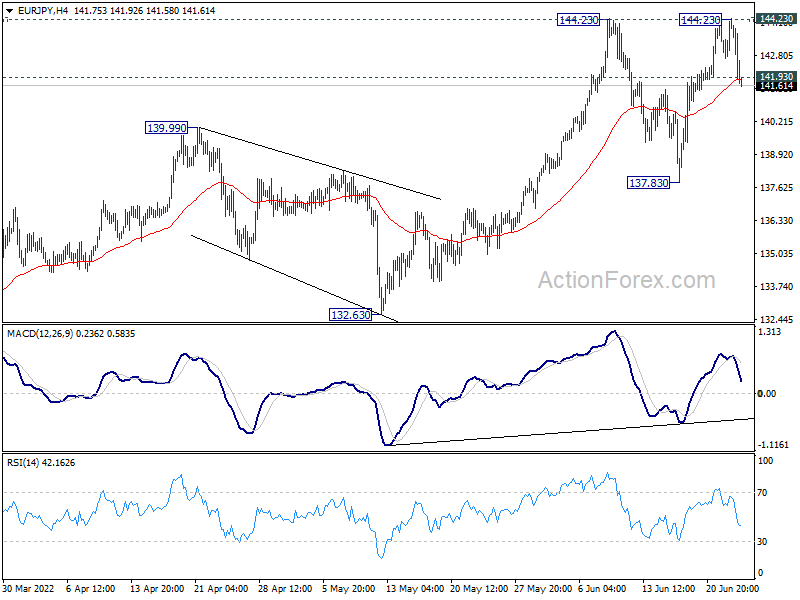
Intraday bias in EUR/JPY is back on the downside with break of 141.93 minor support. Current fall is viewed as the third leg of the consolidation from 144.23. Deeper decline could be seen to 137.83 support. On the upside, decisive break of 144.23 will resume larger up trend.
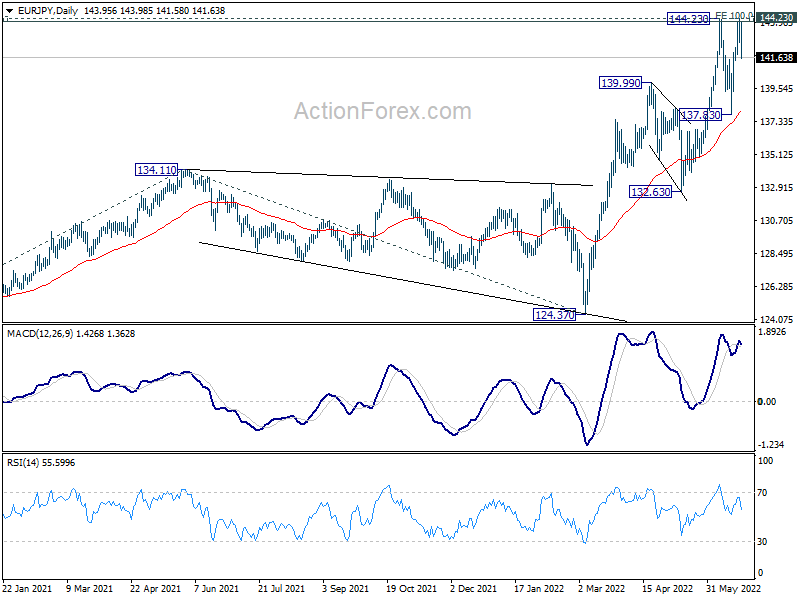
In the bigger picture, up trend from 114.42 (2020 low) is in progress. Such rise is seen as the third leg of the pattern from 109.30 (2016 low). Sustained trading above 100% projection of 114.42 to 134.11 from 124.37 at 144.06 will indicate upside acceleration and target 149.76 long term resistance (2014 high). In any case, outlook will now remain bullish as long as 132.63 support holds, in case of deep pull back.
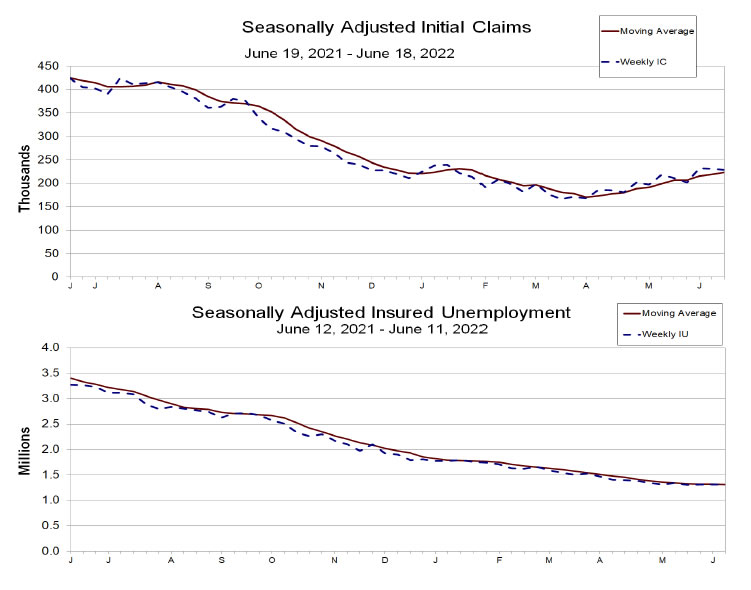
US initial jobless claims dropped slightly to 229k
US initial jobless claims dropped -2k to 229k in the week ending June 18, matched expectations. Four-week moving average of initial claims rose 4.5k to 223.5k.
Continuing claims rose 5k to 1315k in the week ending June 11. Four-week moving average of continuing claims dropped -7k to 1310k, lowest since January 3, 1970.
Japanese Yen Eyes Inflation Report
The Japanese yen is in positive territory today, extending its gains from yesterday. USD/JPY is trading at 135.46 in the European session, down 0.56% on the day.
Yen rises as US yields dip
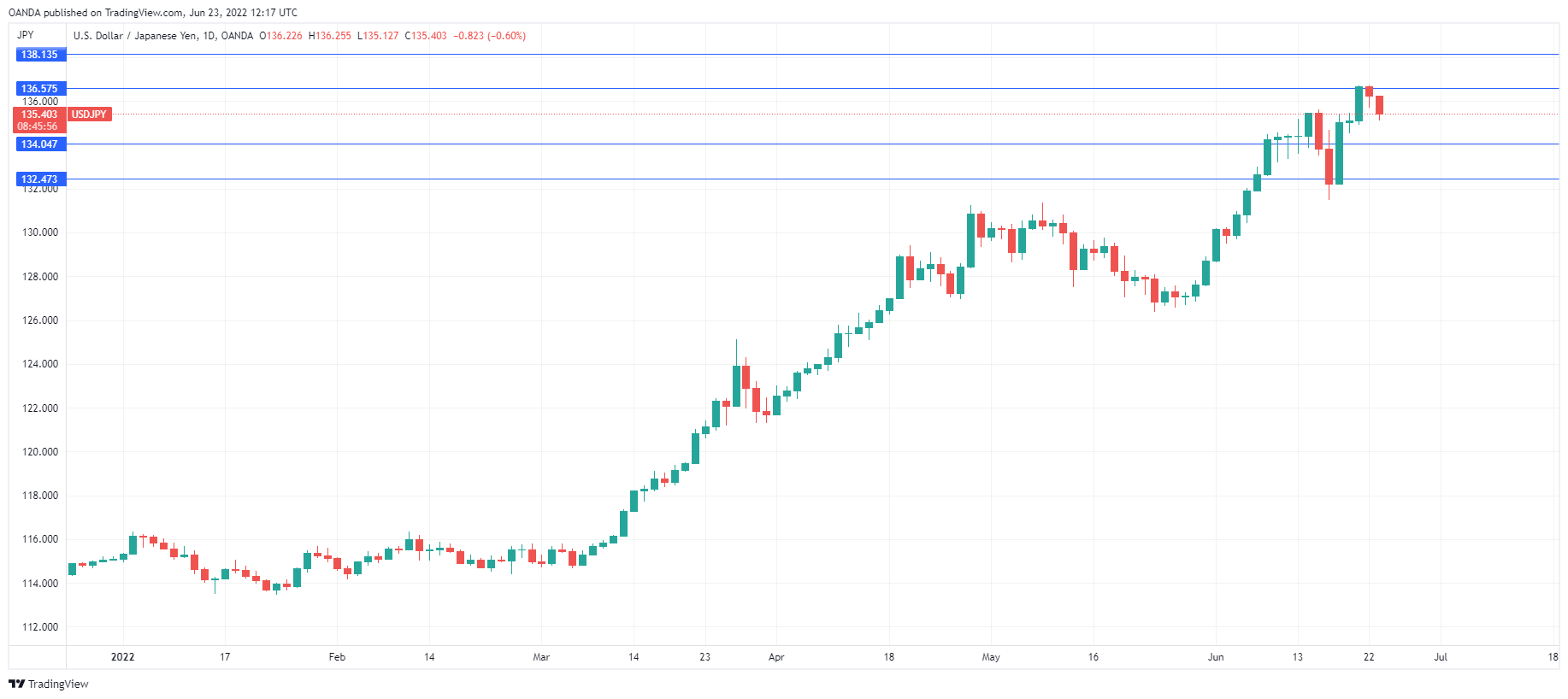
The yen has gained a bit of strength as USD/JPY is back below 136.00, after rising close to 136.71 earlier in the week, its highest level since September 1998. The yen received a reprieve from its recent slide due to a drop yesterday in US Treasury yields, rather than any newfound strength related to the yen. This is another indication that USD/JPY movement is at the mercy of the US/Japan rate differential, with the Bank of Japan holding firm on its yield cap for JGBs.
The BoJ is not showing any signs of adjusting its ultra-accommodative policy, leaving the yen to bear the brunt of this inflexible stance. As a result, the yen has been pummelled by the US dollar, with the yen plunging some 17% in 2022. The BoJ and Japan’s Ministry of Finance have jawboned about the exchange rate, noting their concern. The verbal intervention has clearly not worked, raising the question as to whether Tokyo has a ‘line in the sand’, which if crossed, would trigger intervention in the currency markets to support the ailing yen. There had been speculation that a move above 125.00 or 130.00 could result in a response, but that failed to happen. Currently, there are voices stating that the 140 level is that line in the sand.
BoJ Governor Kuroda has insisted that the Bank needs to support Japan’s fragile economy with monetary easing, and has said that the exchange rate is not a policy target. Kuroda has even said that a weak yen has benefits for the economy, such as making exports more attractive. Given this stance, I question whether a 140.00 yen will trigger currency intervention. True, the yen is at 24-year highs, but let’s not forget that USD/JPY has been above 200.00 and even 300.00 in the past, and the BoJ has indicated that the exchange rate is not a priority.
USD/JPY Technical
- There is resistance at 1.3657 and 1.3814
- USD/JPY has support at 1.3404 and 1.3247
Markets Fell Back to Key Support Levels, Looking for New Lows
The stock market failed to remain positive for the day, closing Wednesday with a slight decline. Stocks, commodities, and currencies dynamics since the start of the day on Thursday indicate the potential for further downside.
Investors are getting more signs of economic contraction, which increases the chance of a recession in the coming months. Among the commodities, we note a spike in cotton and a fall in copper.
Copper, sensitive to production cycles, has lost 15% in the last two and a half weeks, falling back to its lowest level since February 2021.
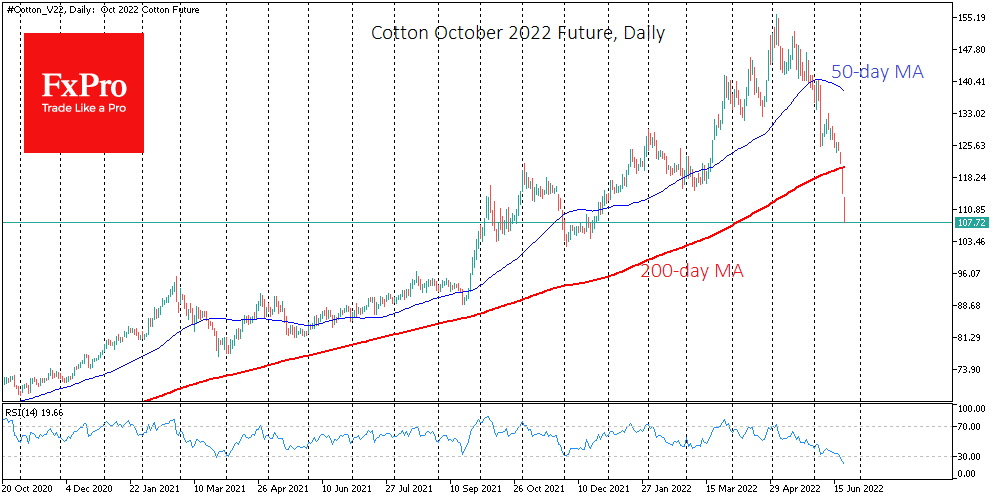
Cotton, which has a tight correlation with consumer activity cycles, is trading down about 30% from its peak in early May, 22% of which has been down from early June. The fall accelerated two days ago when the price dipped below its 200-day moving average, underscoring the serious intentions of the sellers.
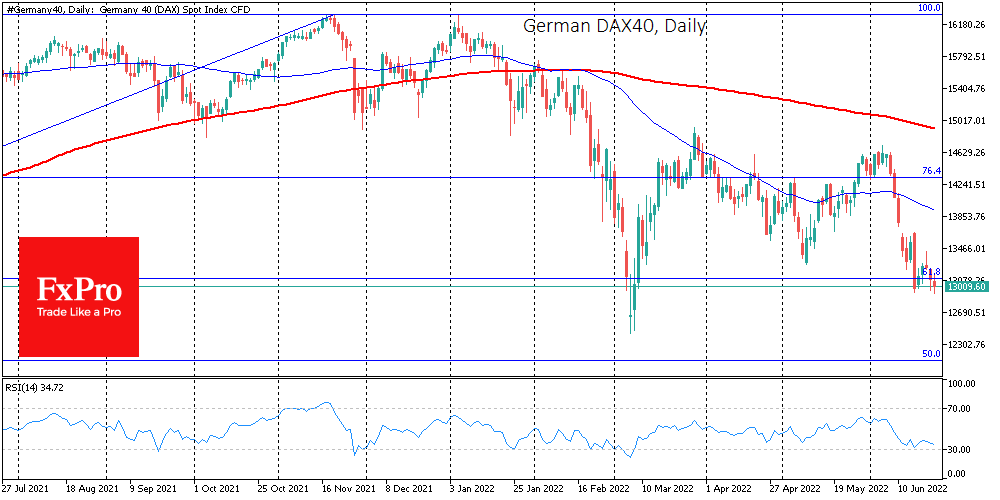
The German DAX40 is again testing the support at 13,000 as the bounce on Friday and Monday proved unsustainable. The FTSE100, meanwhile, is back near the 7000 level, also returning to significant technical and psychological support.
The US index futures also showed a loss of recovery momentum on Thursday.
At the same time, the currency market is showing a pull into defensive instruments. USDJPY pulled back to 135.35 after touching 136.70 earlier in the week. That said, the dollar is doing better than most developed country competitors today.
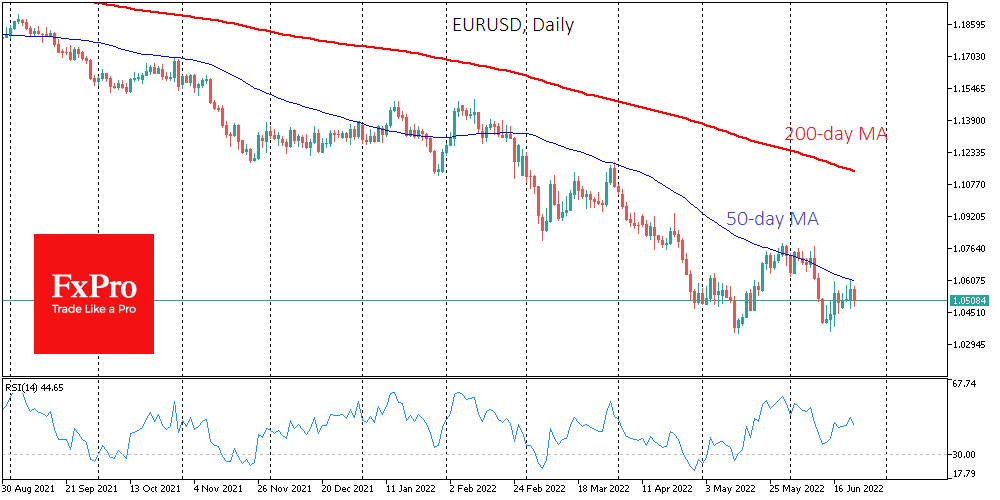
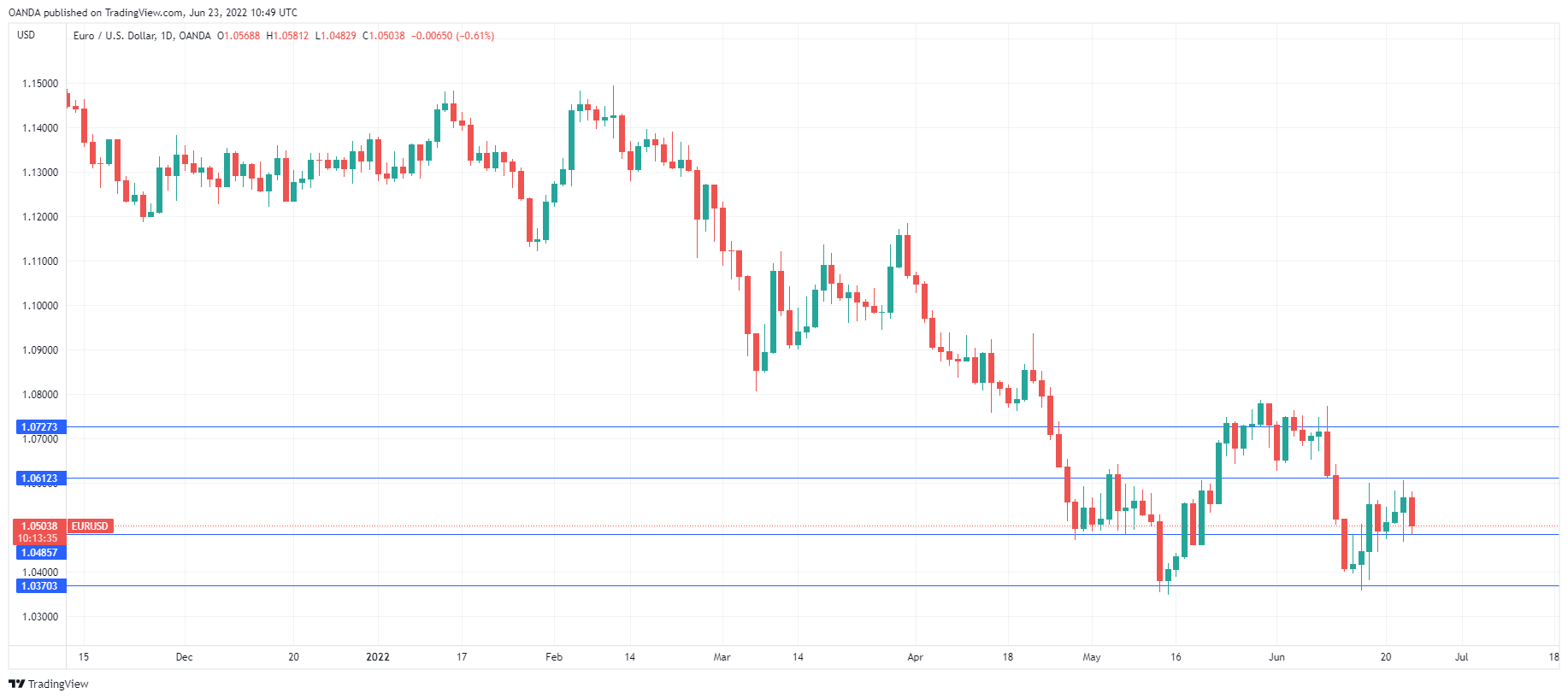
The euro is trading below $1.05 again after a failed attempt to bounce above $1.06 during Wednesday’s trading. Once again, the bears took the upper hand on EURUSD’s approach to the 50-day moving average.
AUDUSD is trading at 0.6880 for the third time in the last two months. A move lower would take the Aussie back to where it last changed hands in July 2020, and it is not helped by expectations that the Reserve Bank of Australia will hike the 50-point rate twice, in July and August.
Recent dynamics in various markets indicate that the reduced demand for risky assets comes from a broad front. Some markets are close to their red lines, which could accelerate the sell-off and return volatility to levels of the previous couple of weeks.
Euro Slips on Weak PMIs
The euro is in negative territory on Thursday and has pared most of this week’s gains. EUR/USD is trading just above the 1.05 line in the European session, down 0.58% on the day.
German, eurozone PMIs soften
Today’s German and eurozone PMIs indicated slower activity in May, which reflects weaker economic activity. Manufacturing and Services PMIs in both Germany and the eurozone weakened, although they still pointed to expansion, with readings above the neutral 50.0 level. Nevertheless, the releases are a cause for concern. As the largest economy in the eurozone, Germany is a bellwether for the bloc. With the outlook for the German economy looking gloomier, it’s a bad sign for the rest of the eurozone.
The German economy has been hit by a fall in exports, and high inflation and economic uncertainty have hurt domestic demand. Businesses are more pessimistic about the economic outlook, pointing to the war in Ukraine, supply disruptions in China and higher prices. The latest setback is that Russia is decreasing its supply of natural gas to Germany, raising fears that Germany may run short of natural gas in the winter. This has prompted German to enter Phase 2 of its three-stage emergency gas plan.
The euro has taken a tumble and EUR/USD is down over 550 points since April 1st. The slow response of the ECB to spiralling inflation hasn’t helped, as the ECB is yet to embark on a rate-tightening cycle, while the Fed has been raising rates and delivered a mammoth 75-bps hike last week. This has widened the US/Europe rate differential and sent the euro lower. Unless US yields fall, the euro is likely to continue losing ground.
EUR/USD Technical
- EUR/USD has initial resistance at 1.0612, followed by resistance at 1.0727
- EUR/USD tested support at 1.0485 in the Asian session. Below, there is support at 1.0370
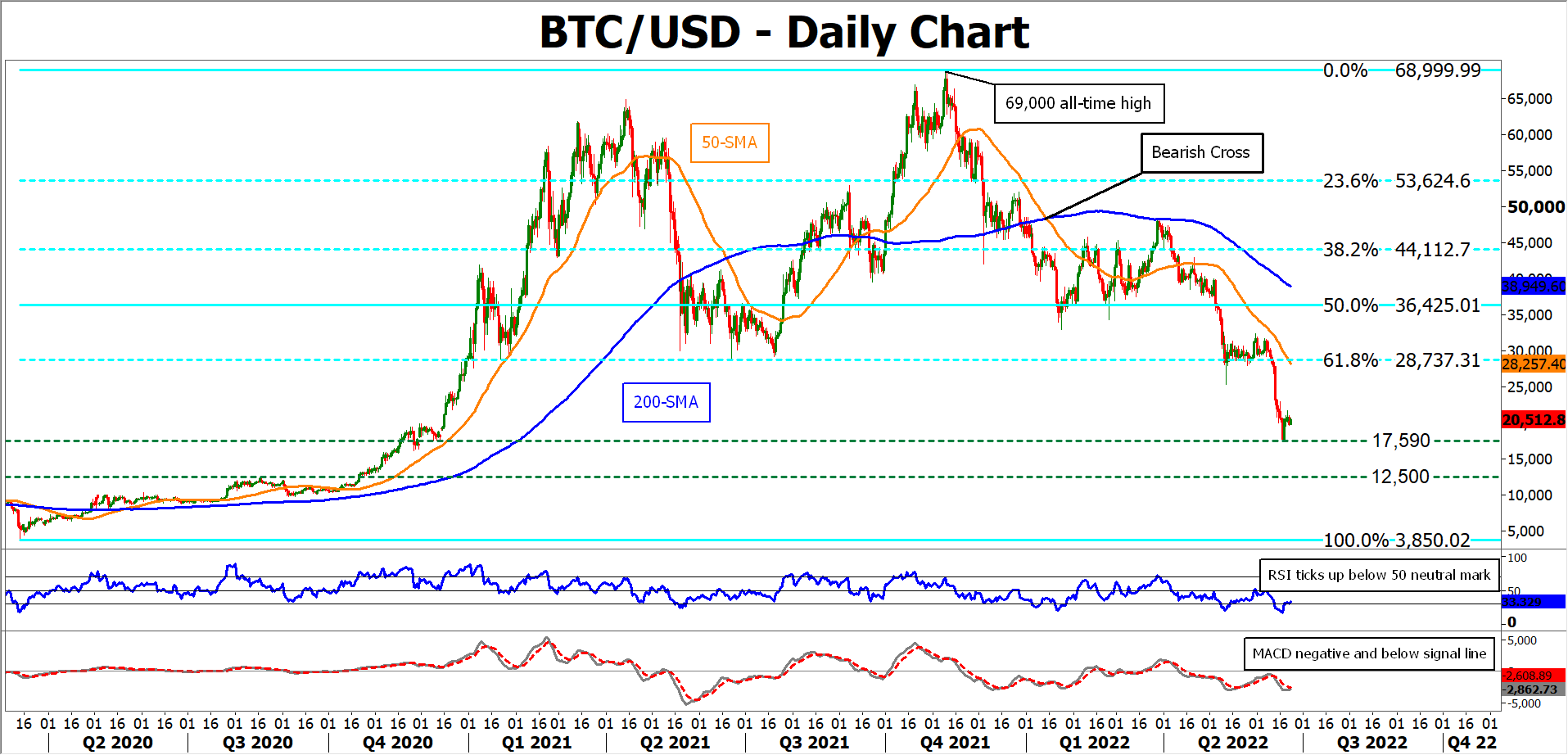
BTCUSD Rangebound above 20,000 after Decline Halts
BTCUSD (Bitcoin) has experienced a sharp sell-off since early June after its long-lasting sideways pattern was breached to the downside. Nevertheless, the king of cryptocurrencies has managed to bounce back slightly after it ceased its downfall at the 18-month low of 17,590.
The short-term oscillators are indicating a bearish near-term bias. The MACD histogram is currently below both zero and its red signal line, while the RSI has just escaped from the oversold territory.
Should the negative momentum strengthen, the recent low of 17,590 could act as the first line of defense. Further downside moves may then stall at the August 2020 resistance of 12,500. A violation of the latter could open the door for the pandemic low of 3,850.
On the flipside, bullish actions could propel the price towards the 28,737 level, which is the 61.8% Fibonacci retracement of the 3,850-68,999 upleg. Conquering this barricade, the bulls might aim for the 50% Fibo of 36,425 before the 38.2% Fibo of 44,112 appears on the radar. Higher, the 23.6% Fibo of 53,624 could prove to be a tough obstacle for the price to overcome.
Overall, BTCUSD appears to have entered a new consolidation phase, while near-term risks remain tilted to the downside. Therefore, a break beneath the 17,590 floor could signal the resumption of Bitcoin’s recent downside trajectory.
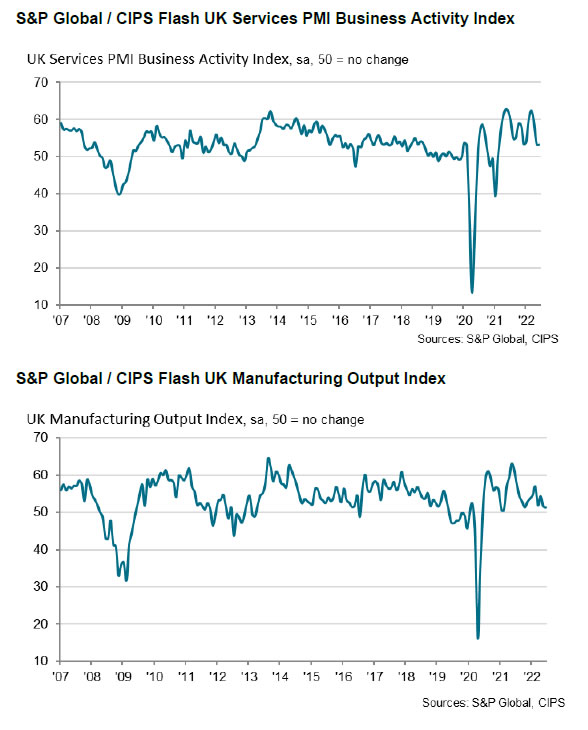
UK PMI composite unchanged at 53.1, troubling combination of recession and inflation into H2
UK PMI Manufacturing dropped from 54.6 to 53.4 in June, below expectation of 53.8. That's the lowest level in 23 months. PMI Services was unchanged at 53.4, above expectation of 53.0. PMI Composite was unchanged at 53.1.
Chris Williamson, Chief Business Economist at S&P Global Market Intelligence said: "The weakness of the broad flow of economic data so far in the second quarter points to a drop in GDP which the forward-looking PMI numbers suggest will gather momentum in the third quarter. While there are some signs that the inflation could soon peak, the survey data suggest the rate of inflation will meanwhile remain historically high for some time to come, indicating that the UK looks set for a troubling combination of recession and elevated inflation as we move into the second half of the year."
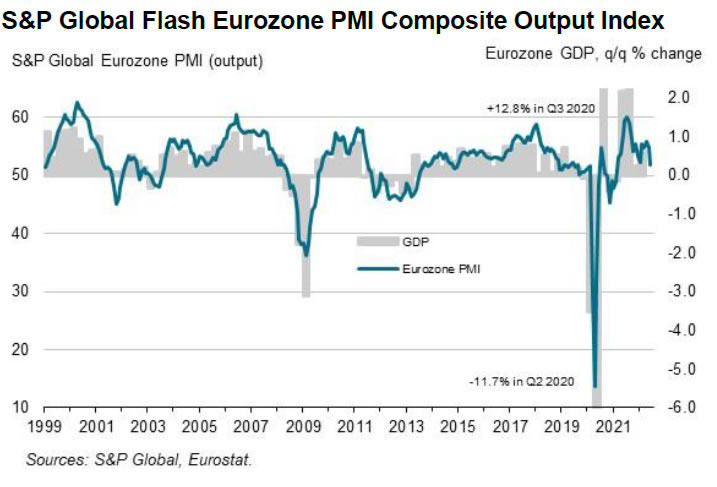
Eurozone PMI composite dropped to 16-mth low, just 0.2% GDP growth and worse to come
Eurozone PMI Manufacturing dropped from 54.6 to 52.0 in June, below expectation of 53.0. That's the lowest level in 22 months. PMI Services dropped from 56.1 to 52.8, below expectation of 55.5, a 5-month low. PMI Composite dropped from 54.8 to 51.9, lowest in 16-months.
Chris Williamson, Chief Business Economist at S&P Global Market Intelligence said: "Eurozone economic growth is showing signs of faltering ... Excluding pandemic lockdown months, June's slowdown was the most abrupt recorded by the survey since the height of the global financial crisis in November 2008.... The slowdown means the latest data signal a rate of GDP growth of just 0.2% at the end of the second quarter, down sharply from 0.6% at the end of the first quarter, with worse likely to come in the second half of the year."
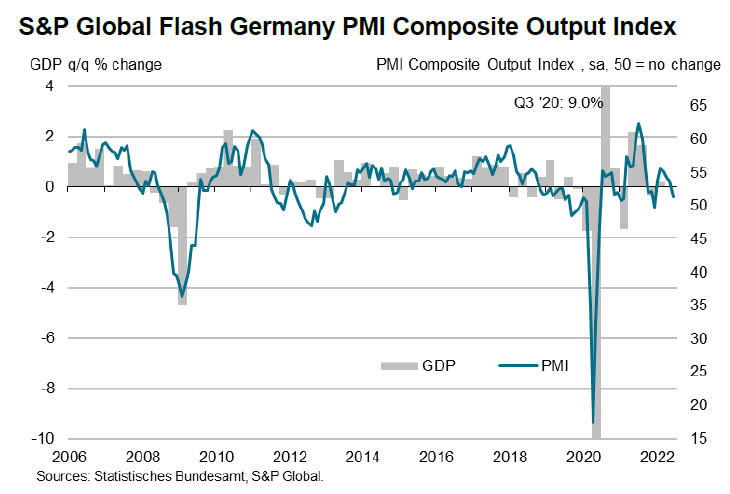
Germany PMI manufacturing dropped to 52 in Jun, services down to 52.4
Germany PMI Manufacturing dropped from 54.8 to 52.0 in June, below expectation of 54.0. That's the lowest level in 23 months. PMI Services dropped from 55.0 to 52.4, below expectation of 54.5, a 5-month low. PMI Composite dropped from 53.7 to 51.3, a 6-month low.
Phil Smith, Economics Associate Director at S&P Global Market Intelligence said:
"June's flash PMI data show that Germany's economy has lost virtually all the momentum gained from the easing of virus related restrictions, with growth in the service sector cooling sharply for the second month in a row in June.
"But perhaps the biggest cause for concern is a broad-based decline in demand, with a deepening downturn in manufacturing new orders coinciding with a first fall in service sector new business for six months, as rising prices and elevated levels of uncertainty take a toll. Activity is still being supported to some extent by workloads built up earlier in the year, however.
"Price pressures remain historically elevated. However, there are signs that businesses might be finding it increasingly difficult to pass on higher costs to customers, with average prices charged for goods and services rising at the slowest rate for three months despite a quicker increase in input costs that the survey in part linked to rising wage pressures.
"Thanks to a particularly grim outlook for the manufacturing sector, business confidence towards future activity is now at its lowest since the first wave of the pandemic two years ago, and we're seeing this translate into a broad-based slowdown in job creation as companies start to reassess their staffing needs going forward."
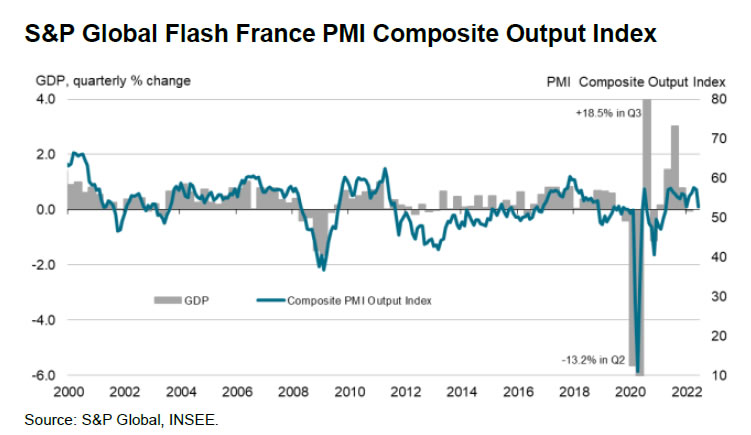
France PMI manufacturing dropped to 51 in Jun, services to 54.4
France PMI Manufacturing dropped sharply from 54.6 to 51.0 in June, well below expectation of 53.8. That's the lowest level in 19 months. PMI Services dropped from 58.3 to 54.4, below expectation of 57.5, lowest in 5 months. PMI Composite dropped from 57.0 to 52.8, also a 5-month low.
Joe Hayes, Senior Economist at S&P Global Market Intelligence said:
"France endured a particularly sharp slowdown in growth during June, as well as a further bifurcation between the manufacturing and services economies. Nonetheless, trends deteriorated in a broad-based fashion over the month as high inflation begins to bite harder. Overall growth was at its slowest since the Omicron disruption was at its peak in January. Barring this though, the 'flash' PMI for June is at its lowest level since April 2021.
"While a loss of momentum was to be expected as the resumption of economic activities post-lockdown boosted growth, the slowdown has been aggravated by substantial price pressures. This has been particularly aggressive in the manufacturing sector, where output and new orders both declined strongly and for the first time since October last year, serving as a worrying sign for what could be to come for the service sector.
"The slowing economic trend in France is also compounded by a fresh bout of political uncertainty due to the hung parliament result in the national elections. Business confidence slid to a 19-month low in June. Overall, June 'flash' PMI data add to tangible recession risks for France."