Sample Category Title
Powell Uses the “R-word”
Federal Reserve Chairman Jerome Powell’s semi-annual testimony on Capitol Hill was the centre of attention overnight. Mr Powell finally dispensed with soft landings, describing them as challenging, and instead said that a recession is “certainly a possibility.” That should have been enough to spark a somewhat counterintuitive risk sentiment rally as Fed hiking expectations were dialled back, but instead, we got a mixed response as Mr Powell asserted, quite forcefully, that soaring inflation had to be brought back to earth.
That left markets in somewhat of a no man’s land. US equities were clearly dying for any excuse to hit the buy button, such is their genetically pre-programmed disposition. But while Mr Powell was talking recession possibilities and being “nimble” from FOMC meeting to FOMC meeting, the reality that a recession probably isn’t great for stocks tempered animal spirits. US yields flopped overnight on the recession words, notably at the long end, which is a bit of a concern, given the market's infatuation with inverse yield curves. The fall in yields was enough to stop the rot in equities, leaving them roughly unchanged, but the US Dollar fell slightly versus the Euro and Yen.
The Bank of Japan would have been breathing a sigh of relief as lower US yields took USD/JPY back below 136.00, but in the Asian EM space, regional currencies generally weakened. Notably the Korean Won, with a high beta to the health of the US economy, had a tough day at the office. Notably, the Australian and New Zealand Dollar, both global sentiment indicators like the Won, both finished the day lower as well.
Gold, of course, did nothing, while in the crypto space, Bitcoin had another almost unchanged day, hovering once again, just above $20,000.00. Depending on your point of view, Bitcoin is tracing out a major bottom in prices before the new dawn, or it is consolidating a dead cat bounce before heading lower. To help readers understand my point of view, here is a story from Thailand overnight. Basically a chap in Bangkok robbed a gold store to cover his crypto losses. I’m humming “Ironic” by Alanis Morissette.
We have another day of Powell testimony on the Hill this evening, so stand by for more intraday choppiness and analysis paralysis of his every word. In Asia, we have a busy day ahead. South Korean PPI YoY for May held steady at 9.70%, although the MoM number fell to 0.50%. Australian Manufacturing and Services Flash PMIs for June were steady at 55.8 and 52.6 respectively. Japan Jibun Bank June Flash Manufacturing PMI edged lower to 52.7, but the Services PMI rose from 52.6 to 54.2, quite the surprise. I am putting that down to a gradual reopening of borders and government stimulus.
Taiwan’s Industrial Production and Retail Sales come out late today, at 1600SGT, and will likely be lost in the noise of the S&P Manufacturing and Services PMI releases from France, Germany, and the Eurozone. Both numbers should hold steady, or increase slightly, from April, due to the knock-on effects of China’s covid-zero reopening. Singapore’s Core and headline Inflation for May are expected to increase slightly to 5.50% and 5.5% YoY respectively. That won’t be enough to tip the MAS’ hand for an out-of-sequence tightening announcement, especially with recession fears rising among key export markets.
Of most interest will be the monetary policy decisions out of the Philippines and Indonesia today. Both the Philippines Peso and Indonesian Rupiah have been under the cosh lately. The Bangko Sentral ng Pilipinas (BSP) has already indicated a 0.25% hike, with the incoming governor stating he isn’t a fan of large hikes. Bank Indonesia (BI) is murkier. Core inflation remains comfortably within the BI’s target range, but with USD/IDR approaching 15,000.00, BI may spring a surprise on markets and hike by 0.25%. Both central banks will likely be forced to hike at each policy meeting going forward now to offset currency pressures.
European and US S&P PMIs aside, the calendar is pretty light this evening. Powell’s testimony aside, Initial Jobless Claims could be interesting is the weekly number jumps sharply higher tonight. That will reinforce recession fears although frankly, I would need to see the monthly JOLTS number plummet from 11.50 jobs to confirm that. US API Crude Inventories leapt higher to 5.60 million barrels overnight, quite a surprise. More surprising is that oil didn’t move lower because of it, having plummeted in Asia. If tonight’s official US Crude Inventory data shows a huge increase as well, instead of the forecast modest drawdown, we could see some more short-term pressure on prices, especially WTI.
Asian equities are very mixed today
Wall Street had an inconclusive session overnight with the major indexes closing barely changed after being sandwiched by Powell’s recession comments on one side and falling US yields on the other. The S&P 500 eased 0.13% lower, the Nasdaq slipped just 0.15%, while the Dow Jones was down just 0.18%. With a slow news day post-Powell, US index futures have continued their modest pullback. S&P 500 futures are 0.25% lower, Nasdaq futures are unchanged, and Dow futures are 0.25% lower.
With little to pick from the bones of the overnight session, Asian markets have gone their own way today. Japan’s Nikkei 225 is unchanged, but both South Korea and Taipei are sharply lower again and seem to be becoming a proxy in Asia for the health of the US economy, having a high beta to that region. The Kospi is down by 0.55%, while Taipei is sharply lower by 1.10%.
In Mainland China, sentiment appears to have been boosted by hopes that Ant Financial will soon be given the regulatory all-clear, and President Xi reiterating his commitment to this year’s growth targets. That sees the Shanghai Composite and CSI 300 adding 0.55% today, while Hong Kong’s Hang Seng is 0.95% higher.
In regional markets, Singapore has gained 0.55%, while Kuala Lumpur is just 0.10% higher. Jakarta has retreated by 0.75% ahead of today's BI policy meeting, with Manila losing 1.10% ahead of the BSP policy meeting. Bangkok is just 0.10% higher. Australian markets have booked modest gains after a steady Wall Street session. The All Ordinaries are 0.05% higher, while the ASX 200 has risen by 0.30%.
As expected, the music stopped for European equities overnight, which endured a torrid session. A lack of direction from the US and Asian markets is likely to spur a soft opening once again from Europe as its energy security, inflation and growth problems reassert themselves.
Currency markets continue their sideways trading
With the notable exception of the Japanese Yen once again, currency markets in the DM space continued to range trade. The overnight move lower by US yields after Powell’s recession remarks saw the US Dollar most falling versus the G-20 space, the notable exception being the Australasian sentiment currencies. The dollar index finished 0.23% lower at 104.18, edging lower to 104.14 in Asia. The dollar index has support at 1.0350 with resistance now distant at 1.0570.
EUR/USD rose just 0.32% to 1.0570 overnight, an intraday rally fading ahead of 1.0600 once again. It is unchanged in slow Asian trading. It has initial resistance at 1.0600, with challenging resistance at 1.0650. Support is at 1.0450 and 1.0400. Sterling is almost unchanged over the past 24 hours at 1.2250 in Asia. GBP/USD has initial resistance at 1.2360 and 1.2400, with support at 1.2200 and then 1.1950.
USD/JPY fell 0.32% to 136.22 overnight as US yields moved lower. In Asia, the selloff continues, USD/JPY falling another 0.53% to 135.50 today, helped along by a 0.91% yield at the just-announced 20-year JGB auction. I don’t rule out some nasty downside corrections, but they are likely to be short-lived in the current environment. Only a sharp fall in US yields is likely to stop the USD/JPY rally. Notably, a move by US 10 years back below 3.0%. USD/JPY has support at 135.00 and 134.50, with resistance at 136.65 and 138.00.
AUD/USD and NZD/USD both fell on US recession comments overnight, and both remain default ways to express sentiment by global currency traders. Overnight, AUD/USD fell 0.67% to 0.6925, losing another 0.57% to 0.6885 in Asia. NZD/USD slumped 0.72% to 0.6288 yesterday, losing another 0.50% to 0.6255 this morning. While supports at 0.6850 and 0.6200 hold respectively, further gains to 0.7150 and 0.6450 cannot be ruled out, but that prospect is looking increasingly remote as recession noise rises globally. The risks have skewed towards another sizeable move lower.
Asian currencies took no solace from US weakness in the G-20 space overnight, with their export-driven economies having a far greater correlation to slowdowns in major export markets. i.e., The US and Europe. The THB, SGD, IDR, PHP, and KRW were the worst performers, with USD/KRW notably, climbing over 1300.00 overnight, trading at 1301.70 this morning. That may raise the ire of the Bank of Korea and I expect to see them a likely a few other regional central banks selling a few US Dollars this week. In particular, the Won seems to be becoming a regional substitute, like the Aussie and Kiwi, for investors to express risk sentiment. With another round of Powell testimony tonight, any more retreats by US yields are going to be offset by recession comments by the big man, leaving Asian currencies under pressure. Hikes by BSP and BI, with hawkish outlooks, could relieve near-term pressures on the PHP and IDR.
Oil prices edge lower in Asia
Oil prices tumbled in Asia yesterday morning but managed to recover some of their losses throughout the rest of the day. Nevertheless, oil still recorded a substantial loss for the session. Brent crude finished 4.0% lower at $110.00 a barrel, while WTI finished 4.75% lower at 104.40 a barrel, with the Brent premium over WTI widening substantially. In Asia, oil prices have started moving lower once again, Brent crude and WTI losing 1.10% to $108.90 and $103.20 a barrel respectively.
Looking at the respective futures curves, both Brent and WTI are still heavily in backwardation, suggesting that prompt oil supplies remain as tight as ever, even as prices across the curves fall. Increasing recession fears appear to be prompting a culling of heavy speculative long positioning in both contracts, even as in the real world, energy tightness is as real as ever. WTI's underperformance can be laid at Powell’s overnight comments, President Biden calling for a suspension of federal fuel taxes, and the surprise jump to 5.6 million barrels by the overnight US API Crude Inventories.
Still, even the US API number didn’t provoke a heavy negative response. Part of this could be that the US issue isn’t enough crude, it is enough crude refining capacity, which is running at an unsustainable 96.0% across the country already. If the official US Crude Inventory number jumps like the API one tonight, WTI may come under more sustained selling pressure than Brent crude, though.
The technical picture is interesting. Brent crude tested its 100-day moving average at $108.45, and the 2022 support line at $107.30 overnight but managed to bounce back to $110.00 a barrel. It may only be a reprieve though as oil prices start moving lower in Asia once again. A daily close under $107.30 implies a deeper move potentially reaching $100.00 initially.
WTI’s technical picture is much softer, having closed below its 2022 support line at $106.30, and its 100-DMA at $105.50 a barrel overnight. Failure of its overnight low at $101.50 could trigger a capitulation by speculative longs that moves WTI under $100.00 a barrel, although I suspect a lot of the damage has already been done.
How well oil performs tonight likely relies on how many times Jerome Powell says recession, and what the headline and gasoline stocks numbers are from the US Crude Inventories data set. I still can’t get past the heavy backwardation in both Brent and WTI futures contracts, which imply tight supplies in physical markets, something that makes complete sense when you look at its drivers around the world. Although I have never subscribed to the panic-mongering predictions of $150.00 and $200.00 a barrel of oil, I remain sceptical as to whether this is a structural turn in oil prices or just a culling of massive speculative positioning. As such, I believe for now, that oil will behave much like inflation, topping out as the year goes on, but not really falling by that much. A $100.00 to $120.00 a barrel medium-term range seems as sensible an outlook as ever.
Gold range continues
There isn’t much to say with gold, a slightly softer US Dollar saw gold edge higher by 0.26% to $1838.00, while Asia has seen it drift 0.26% lower to $1833.00 an ounce, leaving gold in its usual nil-all draw. Admittedly, gold did trade in a $22.00 range overnight, but it is telling that it failed ahead of $1850.00 and finished almost unchanged once again. Until we get a material directional move by the US Dollar, it seems unlikely that gold will sail out of the equatorial doldrums.
Gold has resistance at $1860.00 and $1880.00, the latter appearing an insurmountable obstacle for now. Support is at $1805.00 and then $1780.00 an ounce. Failure of the latter sets in motion a much deeper correction, potentially reaching $1700.00 an ounce. On the topside, I would need to see a couple of daily closes above $1900.00 to get excited about a reinvigorated rally.
Recession Fears Dominate
Market movers today
Today's key event in the Scandis is the Norges Bank meeting. Everything points to a further increase in interest rates, so the question is simply how aggressive Norges Bank will be, as most important data have surprised to the upside (higher oil prices, higher global interest rates, higher core inflation and weaker NOK). Our call is that Norges Bank will raise its policy rate by 25bp and open the door to a further hike in August but without referring to this as "most likely". We expect the policy rate path in the monetary policy report to signal about a 50/50 chance of a further three hikes this year after the June meeting, and slightly more than four more next year.
We receive preliminary PMIs for the euro area (including country-specific indices for Germany and France), the UK and the US during the day. Numbers are likely to show that growth is slowing but that price pressures remain high.
US initial jobless claims have climbed slightly higher since the end of March, although they remain at low levels. As labour demand remains extremely strong, we do not yet consider this a sign of US weakness. Also keep in mind that labour market indicators are usually lagging the business cycle, so it is probably not here we should look for recession signs initially.
Fed Chair Jerome Powell testifies before the House Financial Services Panel today. We do not expect this to be a market mover as such, not least since the two-day testimony started yesterday.
The 60 second overview
Powell and recession fears: Fed Chairman Powell acknowledged yesterday testifying before the Senate Banking Committee, that there is a clear risk that the quick tightening of US monetary policy could tip the US economy into recession and that the narrative of a 'soft landing' will be 'very challenging'. Powell was quite outspoken that the Fed cannot fail the task of getting back to 2%. This is probably the most explicit warning from Powell that the current tightening cycle could end in tears. The market continues to price a high probability of a 75bp hike by the Fed July 27.
Bonds: The global bond market rallied strongly on the renewed recession fears, which pushed global yield curves lower. However, it was noteworthy that the curve 2s10s in UST actually bull-steepened a few bp despite the recession fears. The rally in 2Y UST yields reflects that the market is now pricing in more than 50bp of Fed rate cuts in 2023/24 after the expected close to 200bp tightening in H2 this year.
Commodities: The fear of recession has weighed on oil this week and yesterday WTI dropped below USD 102 a barrel for the first time since early May with prices down close to 20 USD a barrel in just two weeks. WTO is trading marginally higher this morning at USD 103.4 a barrel. Brent is trading at USD 109 a barrel. The lower energy prices would be supportive for the global consumer ahead of 'driving season' on the Northern hemisphere, where demand for gasoline is at a seasonal peak. The price drop has probably arrived a bit too late to materially impact June inflation prints as June prices in most countries have been collected now by the various statistical offices. In respect of energy inflation note that European natural gas prices are up 60% since June 7th as Russia continues to restrict gas flows to the European continent through Nord Stream 1 pipeline by more than 50%. Growth sensitive copper also came under renewed pressure yesterday and is now trading at a 15 month low.
Equities: Global equities lower yesterday but both European and US markets ending above day lows. Despite the drop in equities, the implied vol measured by VIX ticked a bit lower yesterday. Interesting to see the shift from stagflation fear into more classic recession fear playing out yesterday. This risk of recession taking both oil and metals prices lower, leading to massive underperformance in energy and materials sector yesterday. As we argue the peak stagflation fear is behind us and recession fear has taken over, the energy and materials sectors will no longer act as a hedge. In case of recession, we argue both energy and materials will be among the worst performers. In US yesterday Dow -0.2%, S&P500 -0.1%, Nasdaq -0.2% and Russell 2000 -0.2%. Sentiment in Asia slightly positive this morning while European and US futures are lower.
FI: The increasing recession fear was the predominant theme yesterday with Bunds ending 13bp lower in a bullish flattener move. With ECB cap on fragmentation, BTPs seem to have found a bid with BTPs-Bund spread tightening 2bp yesterday up until the 10y point, however the longer end of the BTPs underperformed peers (and Buxl) somewhat. Powell's testimony was mainly a repetition of hikes communication last week, such as a decision meeting by meeting on rate hike size and will continue until they see compelling evidence that inflation is moving down.
FX: In Scandi markets, today's Norges Bank meeting will take centre stage and our base case is for a triple disappointment in terms of market pricing. For EUR/USD, markets will be more interested in how fast manufacturing PMIs are coming down than the mere fact they likely drop further from still-high levels.
Credit: After a couple of positive days the European Credit markets turned slightly sour with iTraxx main widening 3bp to 110bp and Xover widening by 9bp to 547bp.
Nordic macro
Today we expect Norges Bank to hike policy rates for the fourth time in this cycle by 25bp. We expect NB to stick to its 'gradual' strategy but also open the door to an August hike. We expect a forward guidance signal of close to a 50/50 split between August and September as the timing for the next 25bp hike but still with verbal guidance towards September. We expect the top point of the rate path to fall in the 2.50-2.75% range by end-2023 and that the subsequent inversion will prove steeper than in the March Monetary Policy Report leaving a close to unchanged end-point of around 2.3% in Q4 2025. The steeper inversion reflects a much worse employment-inflation trade-off than expected in the last monetary policy report. If this call proves right it would be a disappointment to markets and lead to lower short-end rates. Admittedly, the balance of risk to our call is skewed towards a more aggressive NB.
GBP/JPY Daily Outlook
Daily Pivots: (S1) 165.92; (P) 166.89; (R1) 168.00; More...
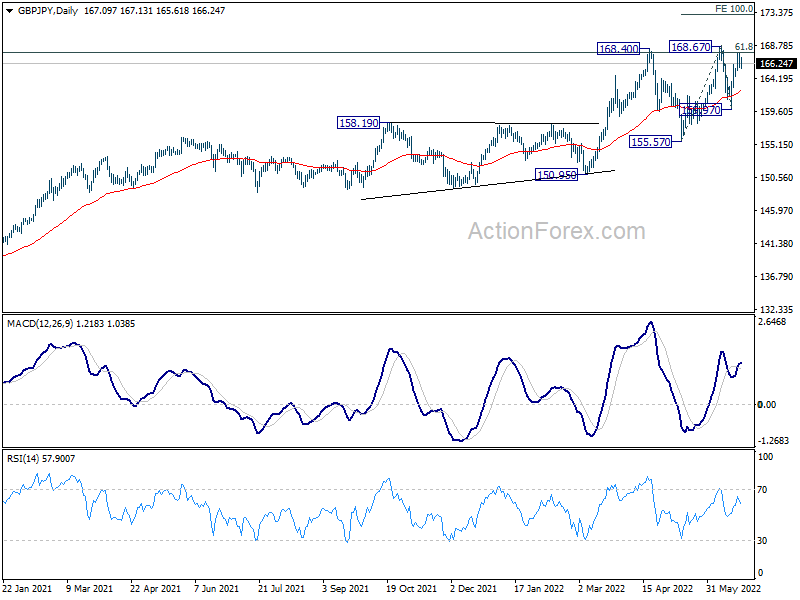
Intraday bias in GBP/JPY is turned neutral with current retreat. On the upside, decisive break of 168.67 resistance will resume larger up trend. Next near term target is 100% projection of 155.57 to 168.67 from 159.97 at 173.07. On the downside, below 164.45 minor support will turn bias back to the downside for 159.97 support instead.
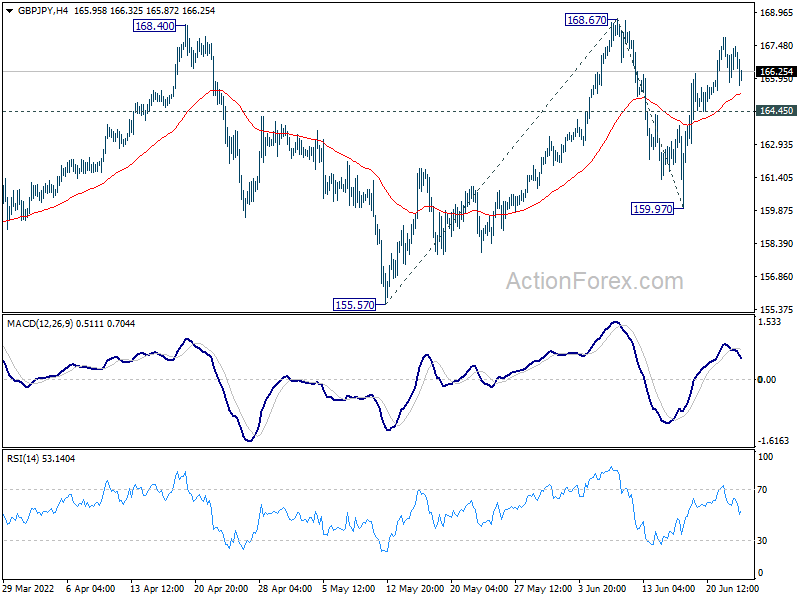
In the bigger picture, up trend from 123.94 (2020 low) is still in progress. Sustained break of 61.8% retracement of 195.86 (2015 high) to 122.75 (2016 low) at 167.93 will be a long term bullish signal, and could pave the way back to 195.86 high. This will now remain the favored case as long as 155.57 support holds, even in case of deep pull back.
EUR/JPY Daily Outlook
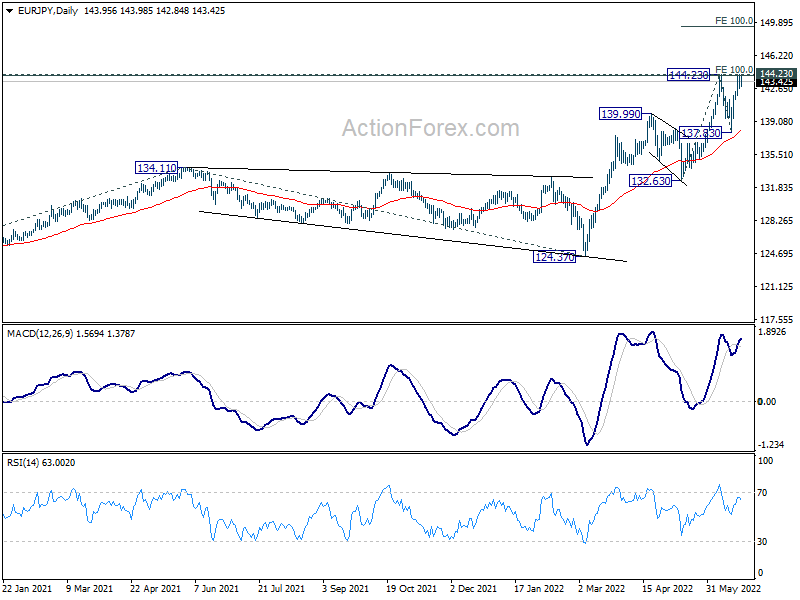
Daily Pivots: (S1) 143.00; (P) 143.63; (R1) 144.57; More....
Intraday bias in EUR/JPY is turned neutral with current retreat. On the upside, firm break of 144.23 resistance will resume larger up trend. Next near term target is 100% projection of 132.63 to 144.23 from 137.83 at 149.43. On the downside, below 141.93 minor support will turn bias to the downside for 137.83 support instead.
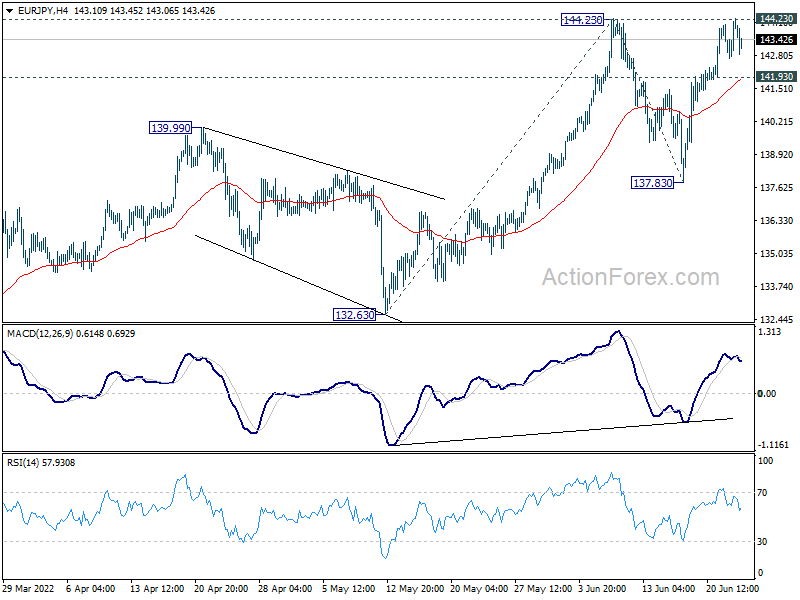
In the bigger picture, up trend from 114.42 (2020 low) is in progress. Such rise is seen as the third leg of the pattern from 109.30 (2016 low). Sustained trading above 100% projection of 114.42 to 134.11 from 124.37 at 144.06 will indicate upside acceleration and target 149.76 long term resistance (2014 high). In any case, outlook will now remain bullish as long as 132.63 support holds, in case of deep pull back.
EUR/GBP Daily Outlook
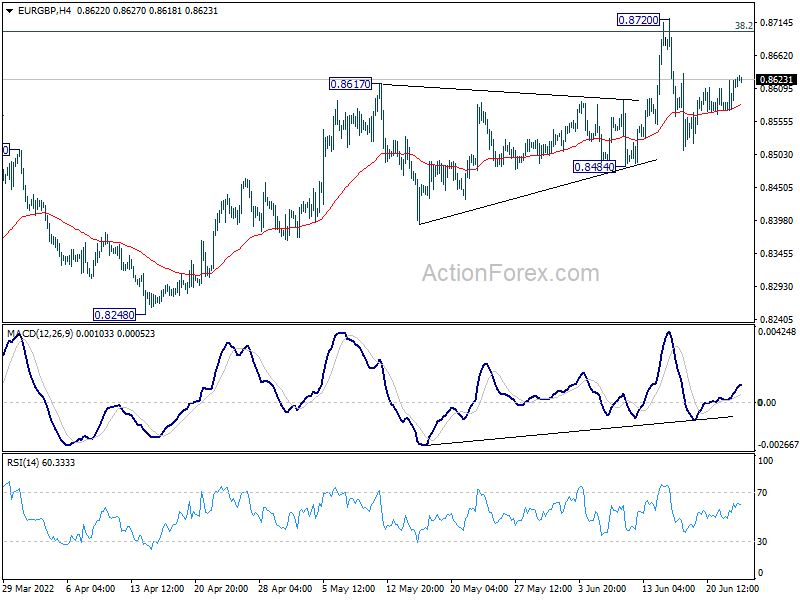
Daily Pivots: (S1) 0.8587; (P) 0.8606; (R1) 0.8637; More...
Range trading continues in EUR/GBP and intraday bias remains neutral. Further rally is expected with 0.8484 support intact. On the upside, break of 0.8720 and sustained trading above 0.8697 medium term fibonacci level will carry larger bullish implication. Next target is 0.9003 fibonacci level. However, break of 0.8484 will indicate rejection by 0.8697 and turn near term outlook bearish.
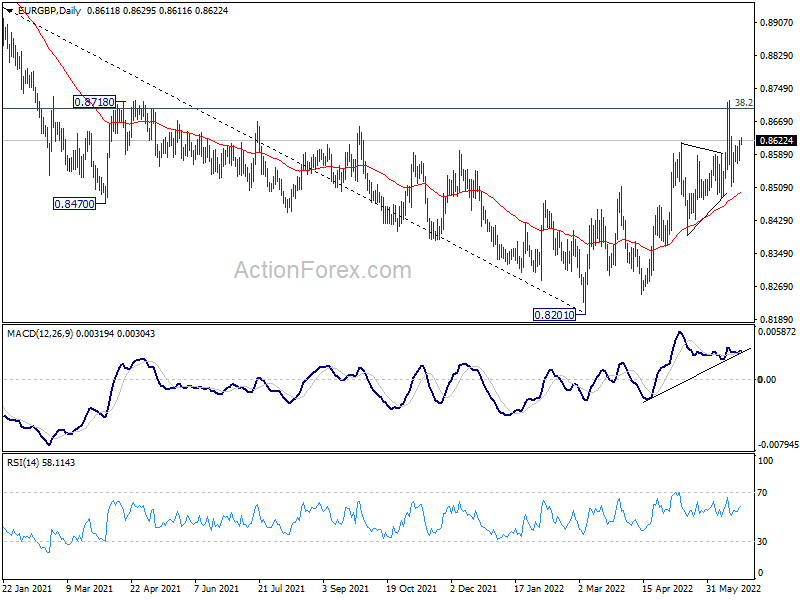
In the bigger picture, rise from 0.8201 medium term bottom could could either be a correction to the down trend from 0.9499 (2020 high), or a medium term up trend itself. Sustained break of 38.2% retracement of 0.9499 to 0.8201 at 0.8697 will affirm the latter case, and pave the way to 61.8% retracement at 0.9003. However, rejection by 0.8697 will maintain medium term bearishness.
EUR/AUD Daily Outlook
Daily Pivots: (S1) 1.5152; (P) 1.5216; (R1) 1.5324; More...
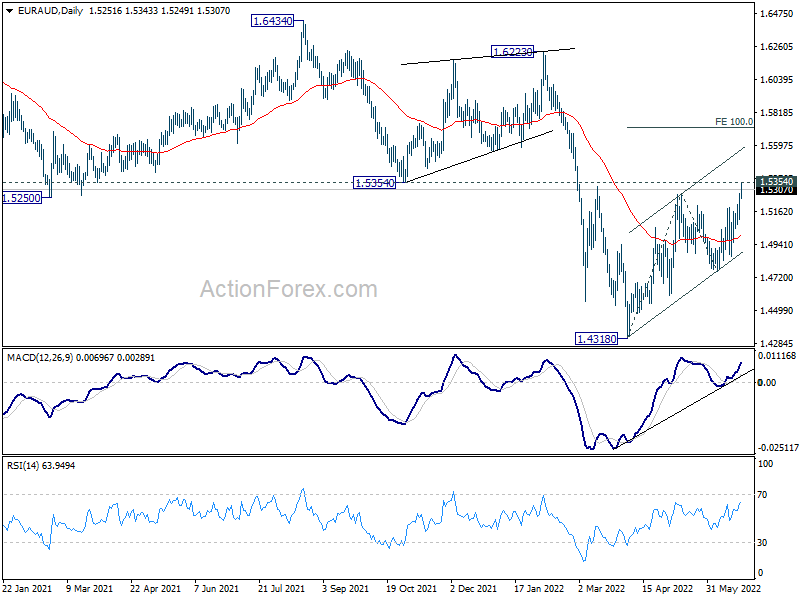
Intraday bias in EUR/AUD stays on the upside with focus on 1.5354 support turned resistance. Sustained break there will indicate medium term bottoming at 1.4318. Stronger rally would be seen back to 100% projection of 1.4318 to 1.5277 from 1.4759 at 1.5718. On the downside, however, break of 1.5083 minor support will turn intraday bias neutral first.
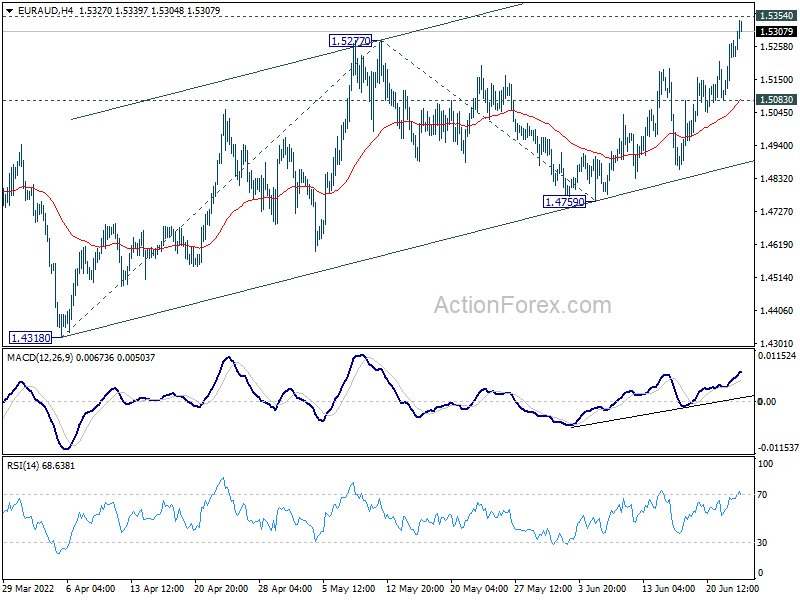
In the bigger picture, as long as 1.5354 support turned resistance holds, larger down trend from 1.9799 (2020 high) is still expected to continue. On resumption, next target is 61.8% projection of 1.9799 to 1.5250 from 1.6434 at 1.3623, which is close to 1.3624 long term support (2017 low). However, firm break of 1.5354 will indicate medium term bottoming and bring stronger rally back to 1.6434 key resistance.
EUR/CHF Daily Outlook
Daily Pivots: (S1) 1.0132; (P) 1.0160; (R1) 1.0188; More....
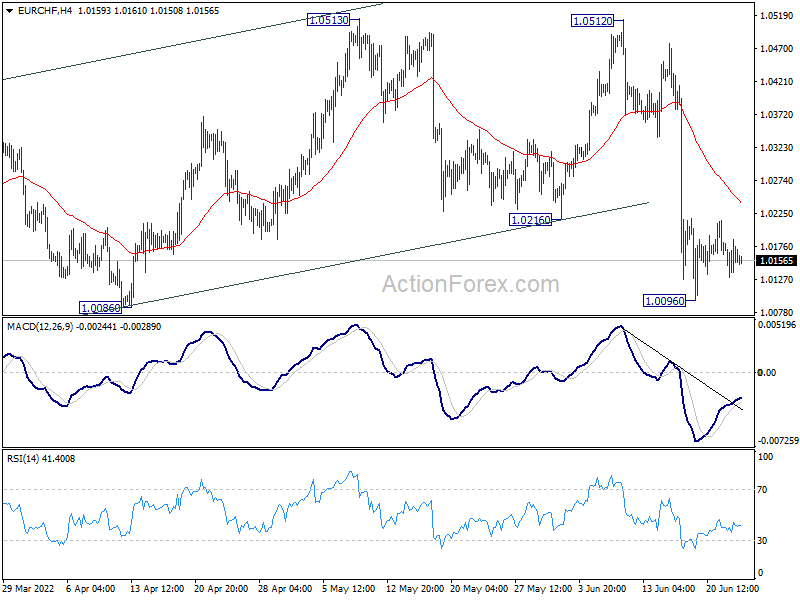
EUR/CHF is staying in consolidation above 1.0096 and intraday bias remains neutral first. Outlook is unchanged that corrective rebound from 0.9970 should have completed after failing 1.0505 long term resistance. Risk stays on the downside as long as 1.0513 resistance holds. On the downside, below 1.0096 will target a retest on 0.9970 low.
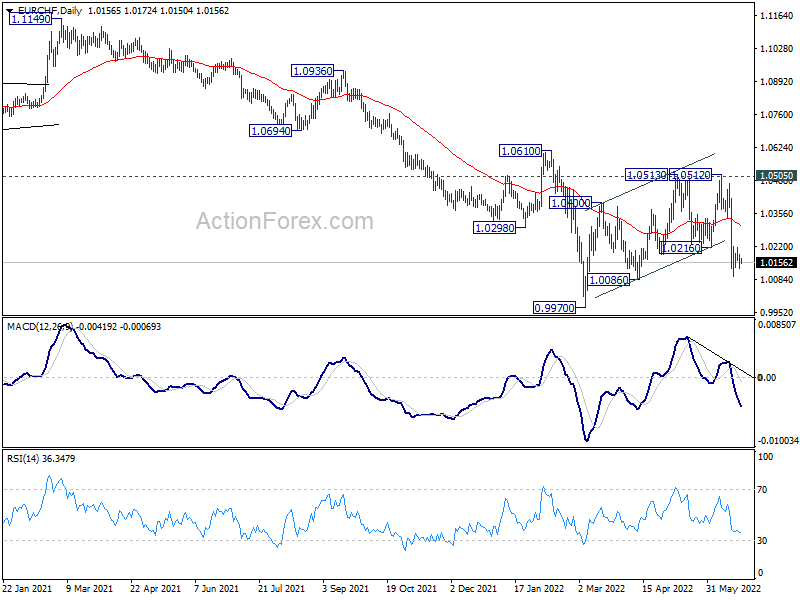
In the bigger picture, as long as 1.0505 support turned resistance (2020 low) holds, long term down trend from 1.2004 (2018 high) is expected to continue. Next target is 100% projection of 1.2004 to 1.0505 to 1.1149 at 0.9650. However, firm break of 1.0505 will suggest medium term bottoming, and bring stronger rebound towards 1.1149 structural resistance.
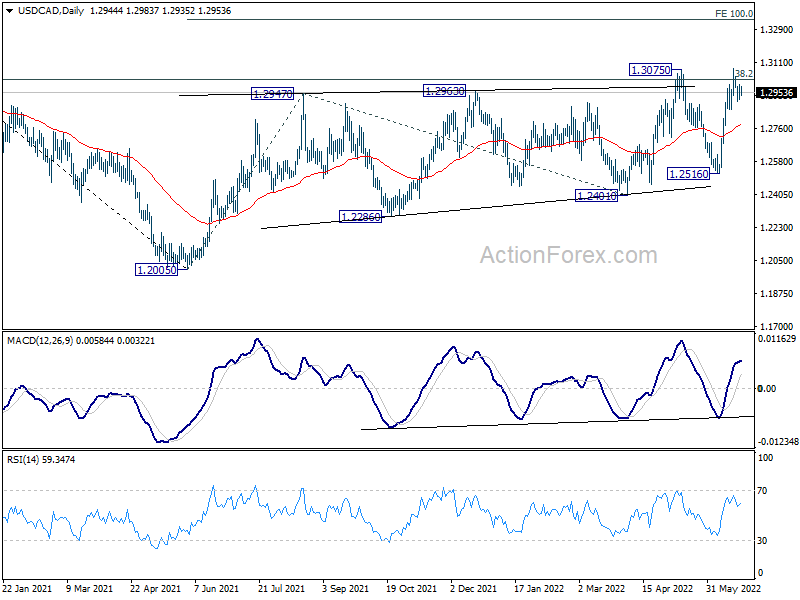
USD/CAD Daily Outlook
Daily Pivots: (S1) 1.2908; (P) 1.2952; (R1) 1.2992; More...
USD/CAD is staying in consolidation from 1.3077 and intraday bias remains neutral. Further rise will remain in favor as long as 1.2859 support holds. On the upside, break of 1.3077 and sustained trading above 1.3022 fibonacci level will carry larger bullish implications. Next target is 100% projection of 1.2005 to 1.2947 from 1.2401 at 1.3343.
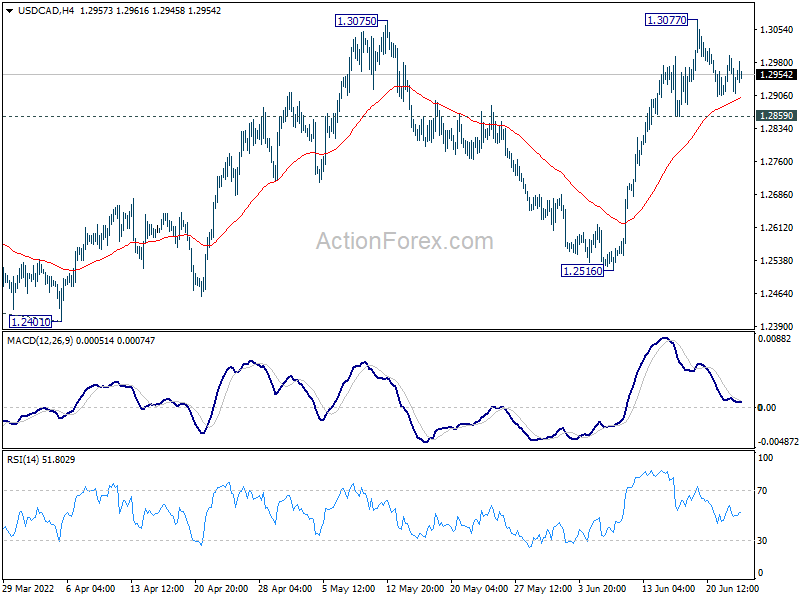
In the bigger picture, focus stays on 38.2% retracement of 1.4667 (2020 high) to 1.2005 (2021 low) at 1.3022. Sustained break there should confirm that the down trend from 1.4667 has completed after defending 1.2061 long term cluster support. Further rise would then be seen towards 61.8% retracement at 1.3650. However, rejection by 1.3022 will maintain medium term bearishness.
AUD/USD Daily Report
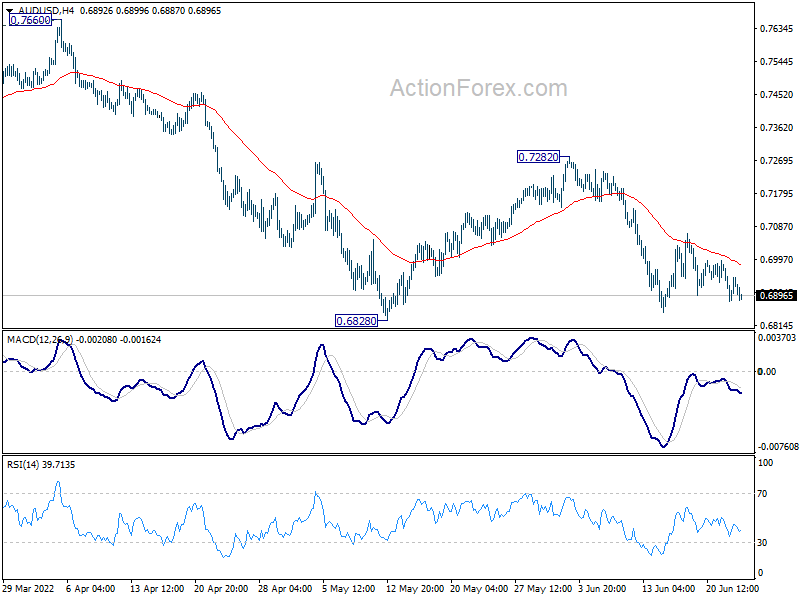
Daily Pivots: (S1) 0.6941; (P) 0.6967; (R1) 0.7000; More...
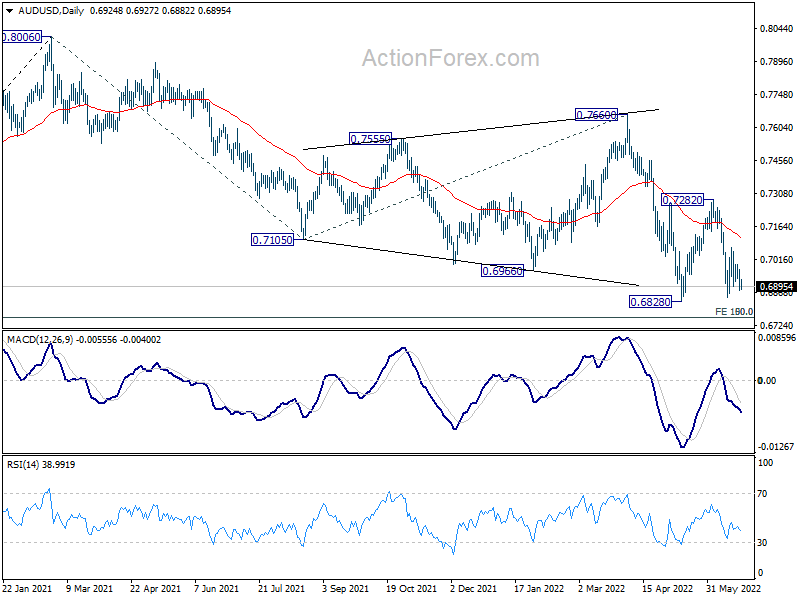
Range trading continues in AUD/USD and intraday bias remains neutral for the moment. On the downside, firm break of 0.6828 support will resume larger fall from 0.8006. Next target is 0.6756/60 cluster support. However, firm break of 0.7282 will be a sign of bullish reversal and bring stronger rebound to 0.7666 resistance.
In the bigger picture, price actions from 0.8006 are seen as a corrective pattern to rise from 0.5506 (2020 low). Deeper fall could still be seen to 50% retracement of 0.5506 to 0.8006 at 0.6756. This coincides with 100% projection of 0.8006 to 0.7105 from 0.7660 at 0.6760. Strong support is expected from 0.6756/60 cluster to contain downside to complete the correction. Meanwhile, firm break of 0.7660 resistance will confirm that such corrective pattern has completed, and larger up trend is ready to resume.
EUR/USD Daily Outlook
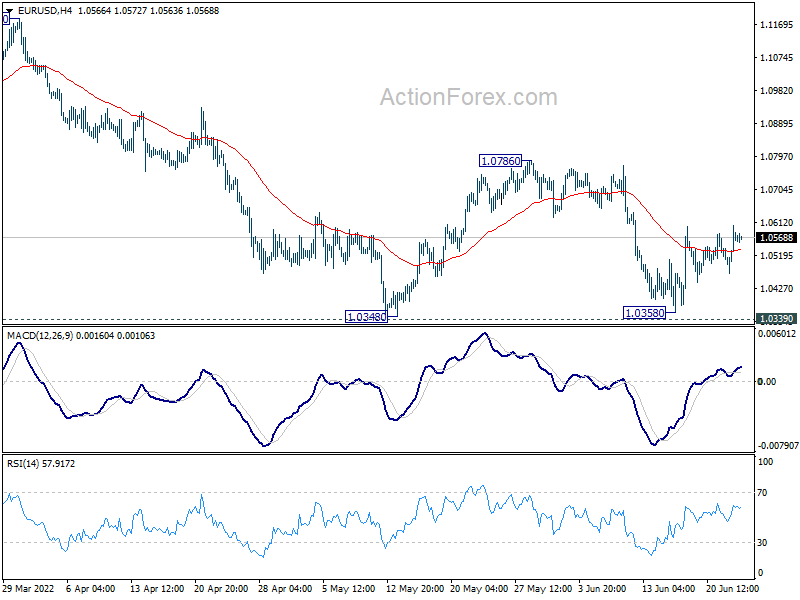
Daily Pivots: (S1) 1.0491; (P) 1.0548 (R1) 1.0627; More...
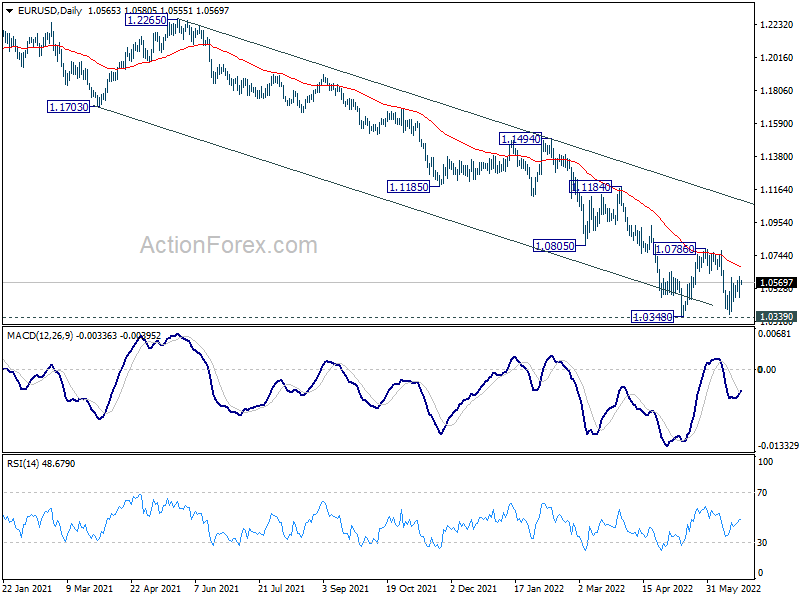
EUR/USD is bounded in range of 1.0358/0786 and intraday bias remains neutral. Further fall is in favor with 1.0786 resistance intact. On the downside, sustained break of 1.0339/48 will resume larger down trend. Next target is long term projection level at 1.0090.
In the bigger picture, focus stays on 1.0339 long term support (2017 low). Decisive break there will resume whole down trend from 1.6039 (2008 high). Next target is 61.8% projection of 1.3993 to 1.0339 from 1.2348 at 1.0090. However, firm break of 1.0805 support turned resistance will delay this bearish case, and bring stronger rebound first.