

Sample Category Title
ECB Leaves EUR/USD Traders Disappointed
Thursday’s ECB meeting ultimately left EUR/USD trading lower as traders questioned the near-term path for euro area rates. Granted, policymakers were crystal clear of a 25-bps interest rate hike in July, but they failed to specify the size of the hike indicated for September. Based on current assessment, the ECB anticipates a gradual but sustained path of further increases post the September meeting. In addition to today’s guidance on interest rates, the ECB announced an end to asset purchases from 1 July.
What’s clear from the decision and accompanying press conference is the ECB did not feel comfortable starting its tightening cycle with a 50 bps hike. When asked why, ECB President Lagarde stated that it was good practice to start with an incremental increase that is sizeable, not excessive, and that indicates a path. That felt like central bank speak for we’d rather not raise by 50 bps unless necessary.
President Lagarde, in her press conference comments, conditioned a larger than 25 bps hike in September on 2024 inflation projects being at or higher than 2.1%. She, however, also indicated that the Governing Council did not discuss the neutral rate at this meeting but conceded that it had likely gone down. Whether that is a hint that rates won’t rise by 50bps is not clear, nor did it indicate an unwillingness for the ECB to go above the neutral rate to tame inflation if necessary.
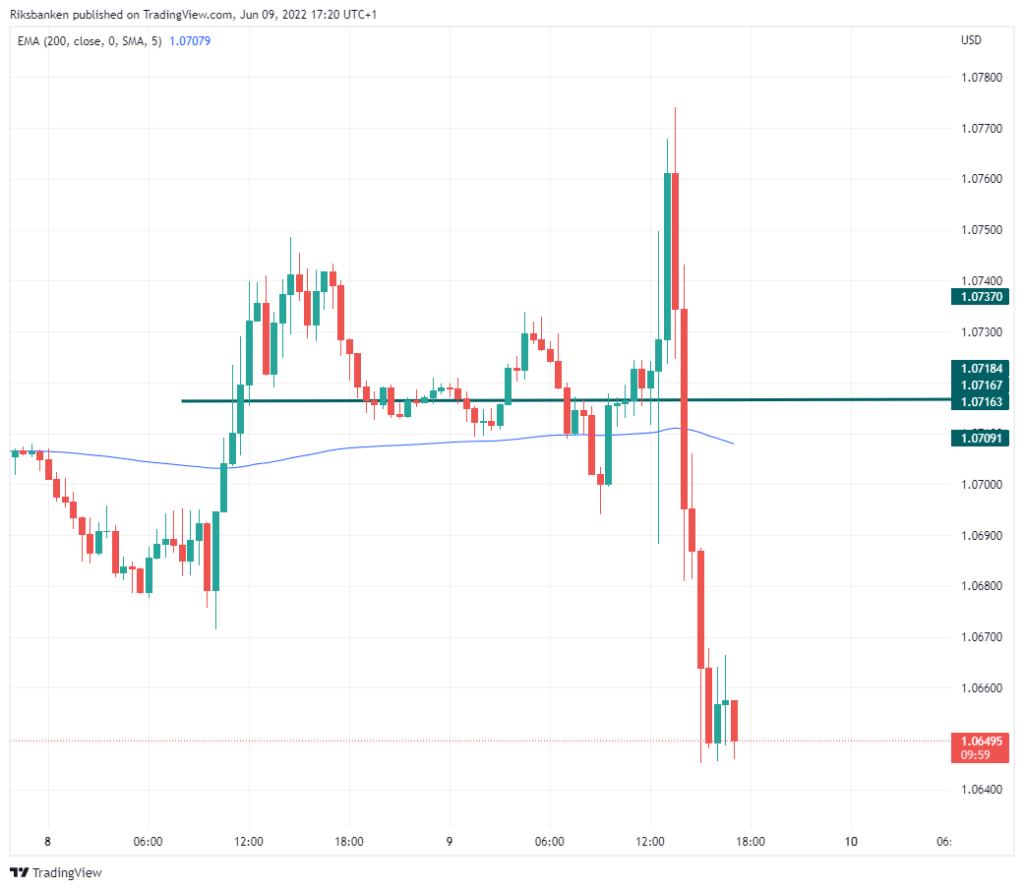
In today’s volatile markets, it’s difficult to extrapolate too much from forex market movements. But EUR/USD’s reaction to today’s announcement suggests currency traders were expecting more from the ECB in terms of the outlook for interest rates or found the downgrade to the ECB's euro area growth forecasts disconcerting. Why else would have EUR/USD ultimately fallen so sharply below its pre-decision pivot price. Looking ahead, it’s up to ECB speakers other than Lagarde to clarify the ECB’s position and potentially the EUR/USD’s direction.
Eco Data 6/10/22
[php_everywhere instance="1"]
ECB Review – Ready for Lift-off – Confirmed!
At today's ECB meeting today, the ECB decided to end the net purchases under the APP programme on 1 July and announce that they 'intend' to hike policy rates by 25bp in July. For September they remain data dependent, but they essentially communicated that they will have to see an improvement of the inflation dynamics in order not to hike 50bp rate hike. Beyond that a sequence of gradual hikes will follow.
As a result of ECB's guidance, we change our expectation for the size of the September rate hike to 50bp, but otherwise our call remains unchanged of 25bp in the other meetings between July this year and March 2023.
Risks are still skewed for more than one 50bp rate hikes, but with the current very uncertain outlook we expect the economic outlook will dampen the medium inflation pressure, paving the way for 'only' 25bp hike.
EURCAD Wave Analysis
- EURCAD reversed from support level 1.3400
- Likely to rise to resistance level 1.3600
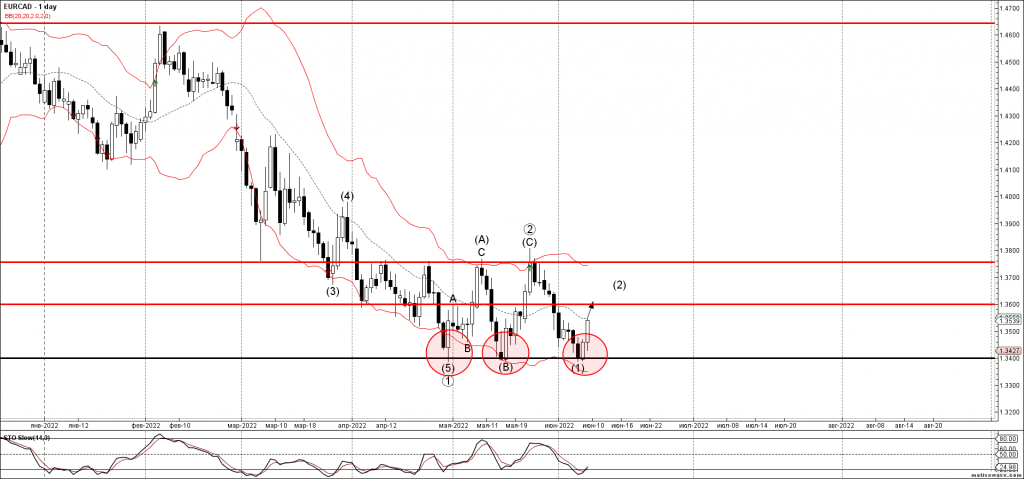
EURCAD continues to rise after the earlier upward reversal from the key support level 1.3400 (which stopped the previous waves (5) and (B) in April and May).
The upward reversal from the support level 1.3400 created the daily Bullish Engulfing – which started the active wave (2).
Given the strength of the support level 1.3400, EURCAD can be expected to rise further toward the next resistance level 1.3600.
Natural Gas Wave Analysis
- Natural gas reversed from resistance level 9.500
- Likely to fall to support level 7.95
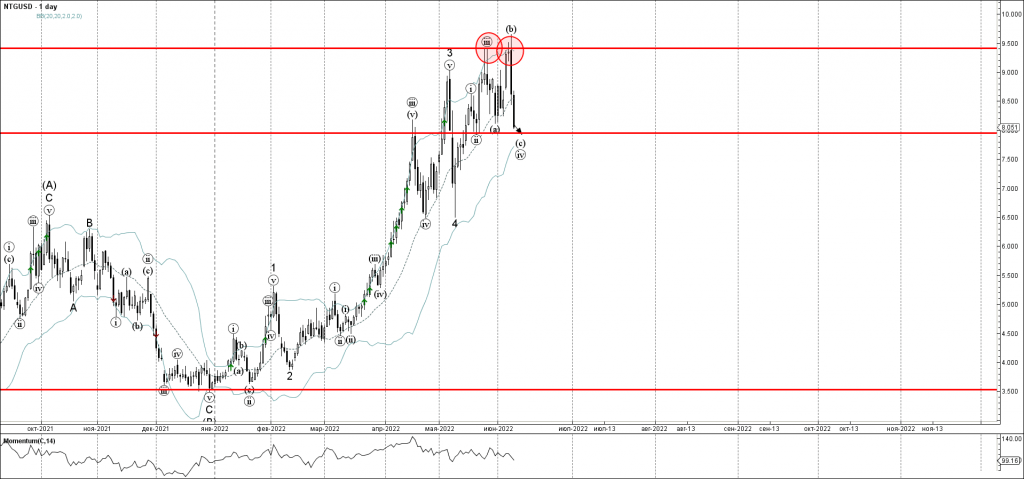
Natural gas recently reversed down with the dialy Evenign Star Doji from the key resistance level 9.500 (top of wave (iii) from May).
The downward reversal from the resistance level 9.500 created started the active minor impulse wave (c).
Given the bearish divergmnev on the daiuly Moemtnum indicator, Natural gas can be expected to fall further toward the next support level 7.95 (low of wave (ii)).
We Expect Back-to-Back 50 bps Rate Hikes by ECB in Sep and Oct
Markets
“High inflation is a major challenge for all of us. The Governing Council will make sure that inflation returns to its 2% target over the medium term.” The short opening paragraph of today’s ECB monetary policy decisions says it all. The central bank finally acknowledges the global inflation problem and embarks on a journey to normalize monetary policy from next month onwards. Net asset purchases under APP will end as of July 1st with the Governing Council intending to raise key interest rates by 25 bps at its July meeting. Looking further ahead, the ECB also expects to increase rates in September, but it doesn’t commit to an exact number yet. The calibration will depend on the updated medium-term inflation outlook. New estimates today pencil in 6.8% inflation this year (from 5.1% in March), 3.5% in 2023 (from 2.1%) and 2.1% in 2024 (from 1.9%). If this outlook persists or deteriorates, a larger increment (50 bps) will be appropriate. Beyond September, the central bank commits to a gradual, but sustained path of further interest rate hikes with the pace depending on incoming data and the medium term inflation assessment at that time. Ceteris paribus, we expect back-to-back 50 bps rate hikes in September and October with December forecasts the earliest opportunity to revert to 25 bps moves. Our preferred scenario suggests a third consecutive 50 bps move. As some kind of back-up plan, the ECB said that it can adjust reinvestments (from its PEPP-portfolio (which will run at least until the end of 2024) if necessary to counter potential market fragmentation stemming from the policy normalization. This could include purchasing Greek bonds over and above rollovers of redemptions. The consequences of the Russian war against Ukraine weigh on growth, but these worries are overshadowed by the need to tackle inflation and revert inflation expectations towards the 2% target. The economy is nevertheless expected to continue to grow on account of the ongoing reopening of the economy, a strong labour market, fiscal support and savings built up during the pandemic. The ECB downgraded growth forecasts significantly for this year and next, respectively from 3.7% to 2.8% and from 2.8% to 2.1%, while beefing up the 2024 forecast from 1.6% to 2.1%. Interest rate markets reacted to the strong ECB signal and hints on >25 bps rate hikes in September and perhaps even beyond. German Bunds significantly underperform US Treasuries. The German yield curve bear flattens with yields rising by 13-14 bps (2 to 5-yr) to 4.6 bps (30-yr). European money market now discount almost 150 bps of cumulative rate hikes by the end of 2023. US yields add 2.7 bps (30-yr) to 4.6 bps (5-yr). The single currency trades volatile, but stronger. Gains could have been larger though. EUR/USD is changing hands around 1.0750, falling short of really testing key support at 1.0806. Taking out that mark would turn the technical picture in the pair neutral. The fierce sell-off on bond markets spills into equity weakness with European bourses losing over 1%. News Headlines
Dutch gas futures spiked more than 16% in early trading before paring gains to about 10% today after a fire erupted at a large LNG export terminal in the US. With the US exporting almost 75% of all LNG to Europe in the first four months of the year, the news sparked renewed supply worries. Energy companies may have to turn to inventories again just as European storage levels have just improved closer to historic averages. The Texan gas facility involved in the fire makes up about 20% of all US exports of the fuel and will remain closed for at least three weeks. It comes at a time when supplies from other top gas providers, including Norway, are capped too for annual maintenance this week. Gas prices currently hover around €86/MWh.
The Odd EUR Growth after ECB Meeting
The European Central Bank has kept its key rate unchanged and officially announced that it will stop buying as part of its asset purchase programme from July 1. In an accompanying commentary, the ECB explicitly indicated that it intends to raise the rate by 25 points at its next meeting, depriving the markets of intrigue for the coming weeks.
However, the ECB also indicated that it intends to tighten policy in September and could raise the rate by 50 points.
Quite expectedly, the ECB’s stance looks much softer – dovish – compared with that of the central banks in the USA, UK, Canada, Australia, and several others that are many months ahead of the European Central Bank in their policy reversal.
Moreover, the ECB has lowered its GDP forecasts for this year and the next, from 3.7% to 2.8% in 2022 and from 2.8% to 2.1% in 2023.
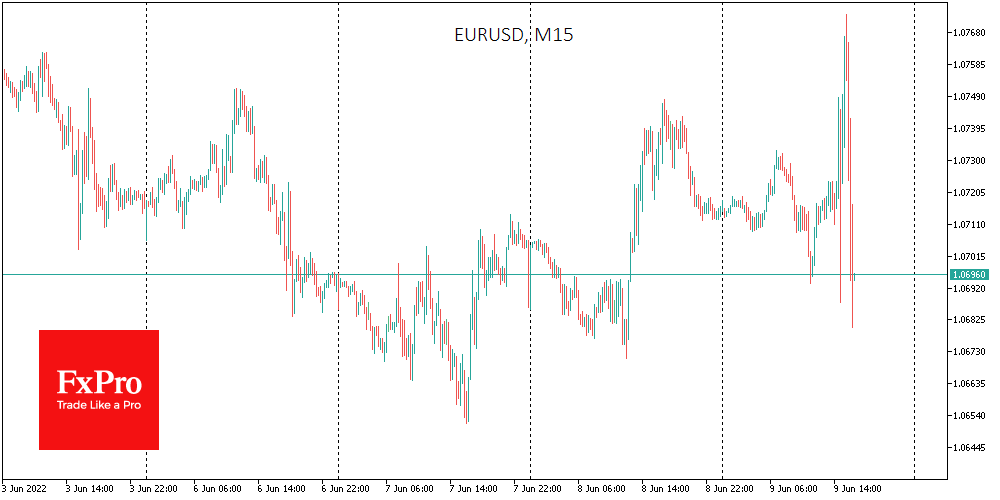
With such a clear difference in policy and worsening forecasts, it was unexpected to see a positive reaction from the single currency. In our view, this assessment by the market could reflect short-term speculative buying on the policy reversal, similar to how the Pound and Dollar strengthened before respective rate uplifts.
Nevertheless, with a comparable rate of inflation, the ECB has a lag in policy normalisation, and this gap promises only to widen in the coming months. This is terrible news for the single currency, so we should not be surprised if we continue to see the euro selling off on intraday growth attempts.
New Zealand Dollar Drifting
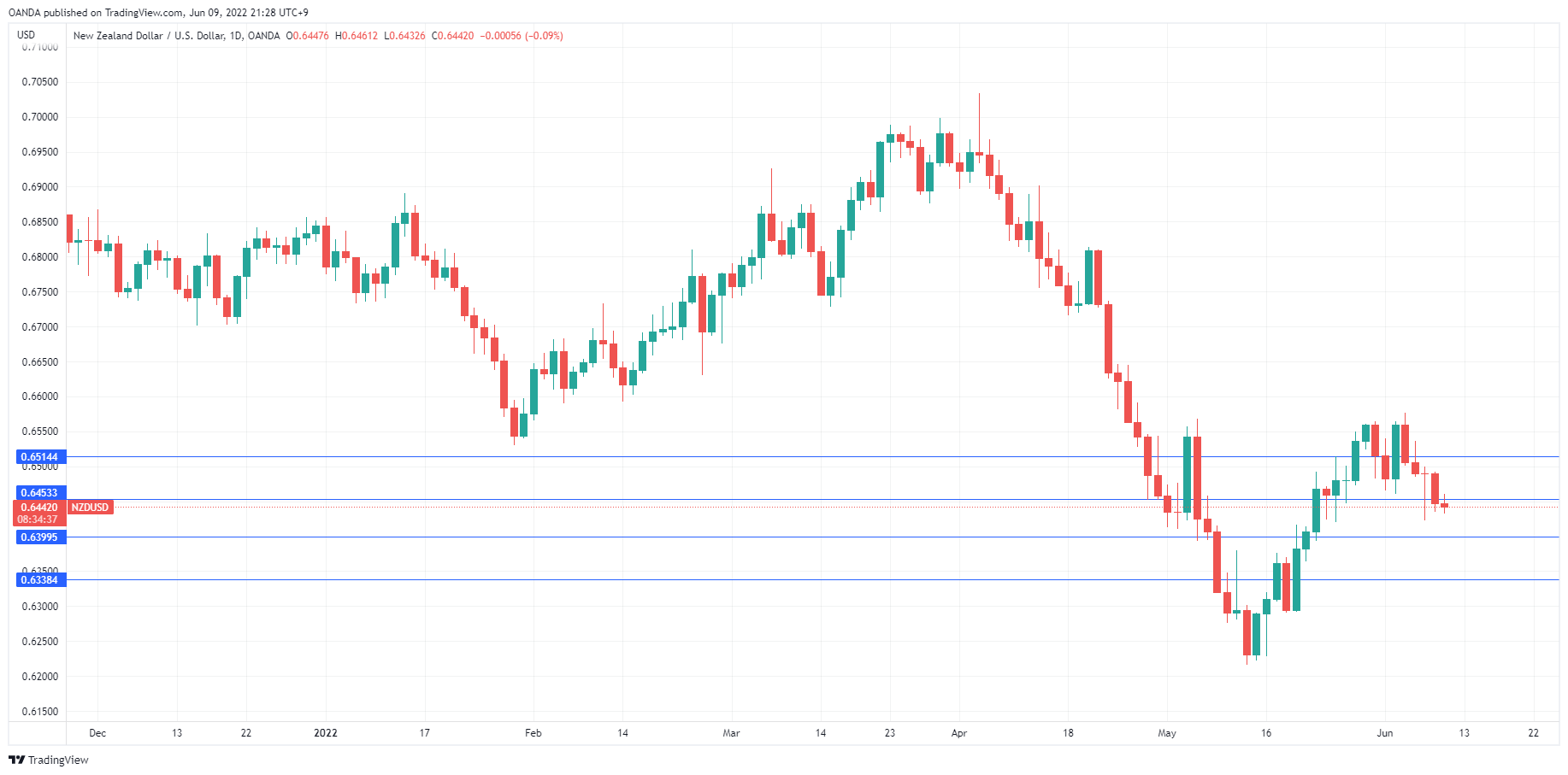
NZD/USD has been on a downswing this week, falling close to 1%. The currency is almost unchanged today, ahead of the release of New Zealand Manufacturing Sales later today.
US core CPI expected to fall
One of this week’s highlights is the US inflation report for May, which will be released on Friday. Headline CPI is expected to remain unchanged at 8.3%, while core CPI is forecast to fall to 5.9%, down from 6.2%. A drop in the core reading will raise speculation that we’ve hit an inflation peak, although I would caution against any sweeping conclusions based on a decline in one month.
The RBNZ finds itself in the middle of its aggressive rate-tightening cycle. The Bank raised the cash rate to 2.0% in late May, up from 1.50%. Governor Orr has stated that he is looking to raise rates to 4% by mid-2023, which means that investors can expect plenty of tightening, which could mean additional 50-bps hikes. The RBNZ’s chief economist, Paul Conway, has acknowledged that a soft landing amidst aggressive rate hikes is “difficult to engineer” but said the economy was strong enough to handle a downturn due to the strong labour market. The RBNZ is carefully monitoring inflation expectations, which like CPI, are yet to show any signs of easing. Inflation is running at 6.9%, its highest level in 30 years, while unemployment is at a record low of 3.2%.
As is the case with other major central banks which are tightening policy, the RBNZ will have a tough challenge in ensuring that the economy has a soft landing as higher rates result in slower economic activity. A recession is a constant worry for the central bank, which could emanate from the housing sector, as higher mortgage rates could have a crushing effect on highly indebted households.
NZD/USD Technical
- NZD is testing resistance at 0.6453. Above, there is resistance at 0.6514
- 0.6399 and 0.6338 are providing support
USD/JPY Mid-Day Outlook
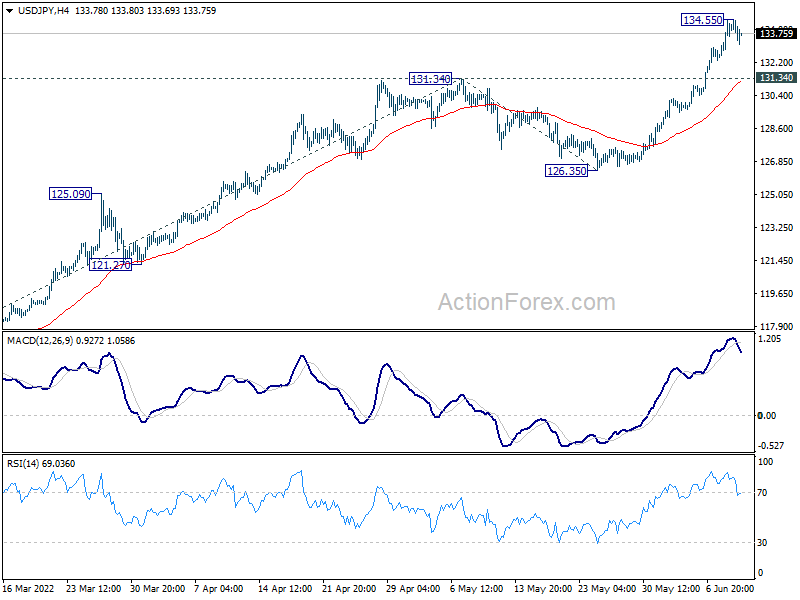
Daily Pivots: (S1) 133.05; (P) 133.76; (R1) 134.97; More...
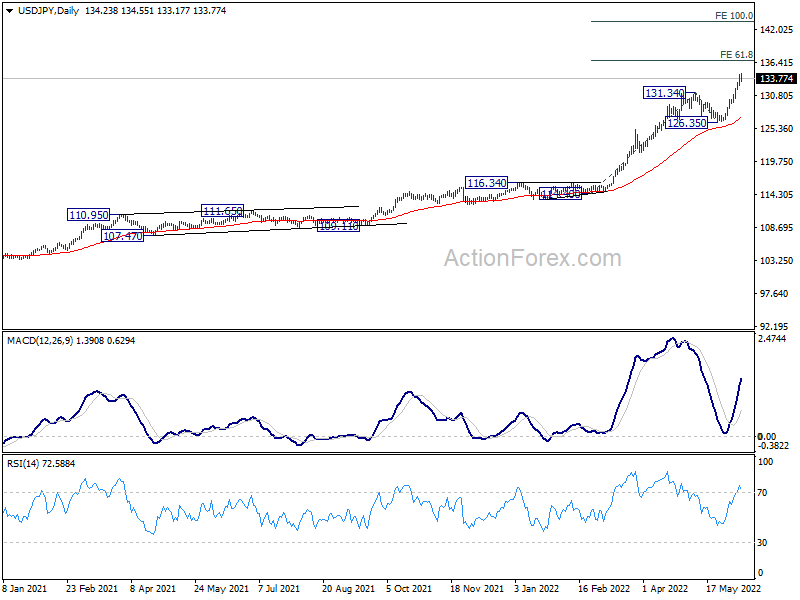
Intraday bias in USD/JPY is turned neutral with a temporary top formed at 134.55. Some consolidations could b seen but downside should be limited by 131.34 resistance turned support. Break of 134.55 will resume larger up trend to 61.8% projection of 114.40 to 131.34 from 126.35 at 136.81. Firm break there will target 100% projection at 143.29.
In the bigger picture, current rally is seen as part of the long term up trend form 75.56 (2011 low). Next target is 100% projection of 75.56 (2011 low) to 125.85 (2015 high) from 98.97 at 149.26, which is close to 147.68 (1998 high). This will remain the favored case as long as 126.35 support holds.
USD/CHF Mid-Day Outlook
Daily Pivots: (S1) 0.9733; (P) 0.9761; (R1) 0.9814; More...
A temporary top is in place at 0.9799 and intraday bias in USD/CHF is turned neutral first. Further rally is in favor as long as 0.9657 minor support holds. Above 0.9799 will resume the rise from 0.9543 to retest 1.0063 high. Firm break there will resume larger up trend. However, break of 0.9567 will extend the correction from 1.0063 with another leg, and turn bias to the downside for 61.8% retracement of 0.9193 to 1.0063 at 0.9525.

In the bigger picture, down trend from 1.0342 (2016 high) should have completed with three waves down to 0.8756 (2021 low) already. Rise from 0.8756 is likely a medium term up trend of its own. Next target is 1.0237/0342 resistance zone. This will remain the favored case as long as 0.9471 resistance turned support holds. However, sustained break of 0.9471 will extend long term range trading with another falling leg.
