

Sample Category Title
EUR/CHF Daily Outlook
Daily Pivots: (S1) 1.0429; (P) 1.0460; (R1) 1.0518; More....
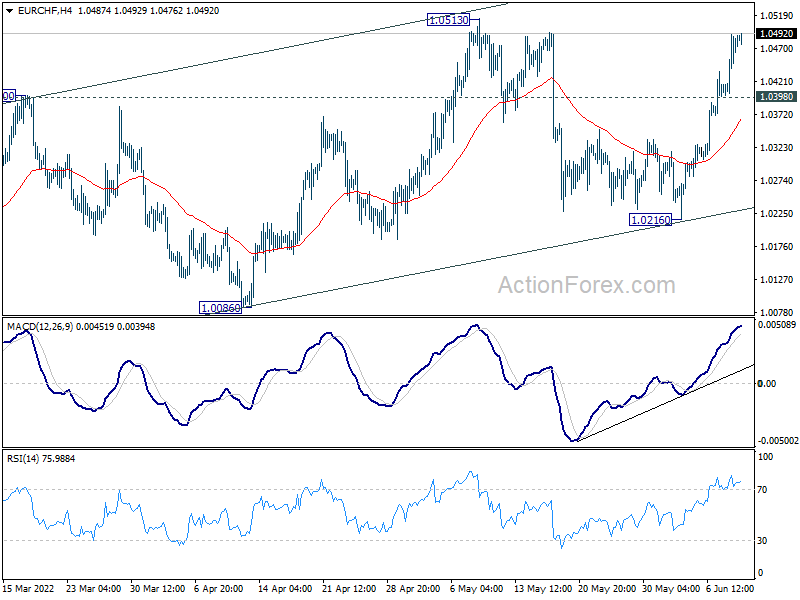
Intraday bias in EUR/CHF remains on the upside for 1.0513 resistance. Decisive break there will resume whole rebound from 0.9970, for 1.0610 structural resistance. On the downside, below 1.0398 minor support will turn intraday bias neutral again.
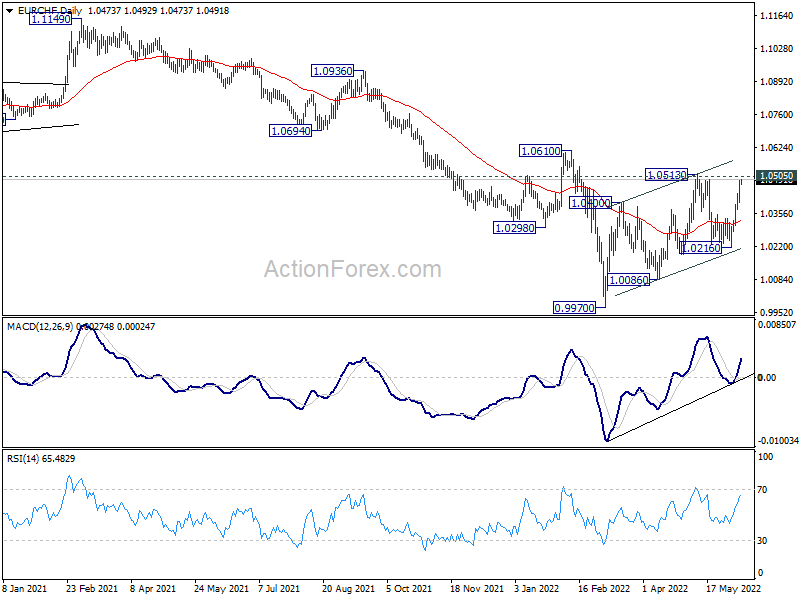
In the bigger picture, as long as 1.0505 support turned resistance (2020 low) holds, long term down trend from 1.2004 (2018 high) is expected to continue. Next target is 100% projection of 1.2004 to 1.0505 to 1.1149 at 0.9650. However, firm break of 1.0505 will suggest medium term bottoming, and bring stronger rebound towards 1.1149 structural resistance.
USD/CAD Daily Outlook
Daily Pivots: (S1) 1.2529; (P) 1.2547; (R1) 1.2576; More...
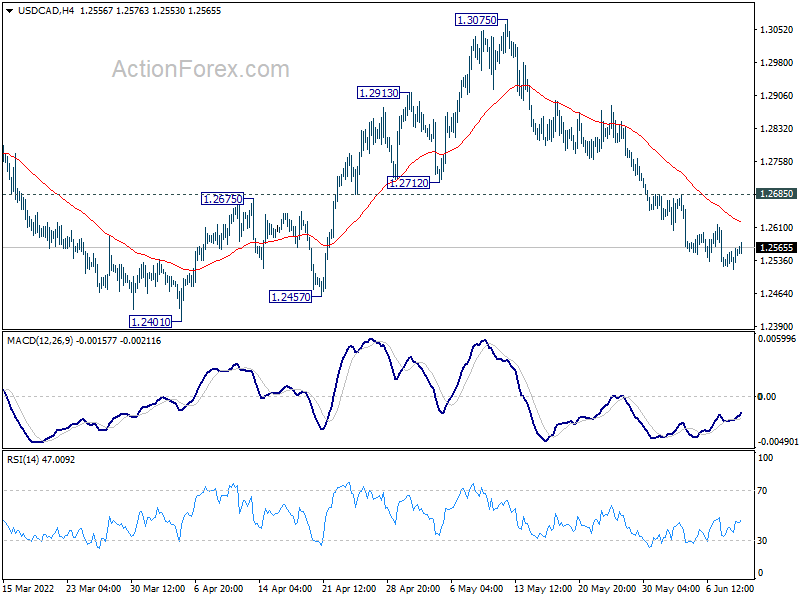
Further decline is still expected in USD/CAD with 1.2685 minor resistance. Fall from 1.3075 should target 1.2401 support first. Decisive break of 1.2401 support will argue that whole rebound from 1.2005 has completed, after rejection by 1.3022 fibonacci resistance. Deeper fall would then be seen to retest this low. On the upside, above 1.2685 minor resistance will turn bias back to the upside for stronger recovery.
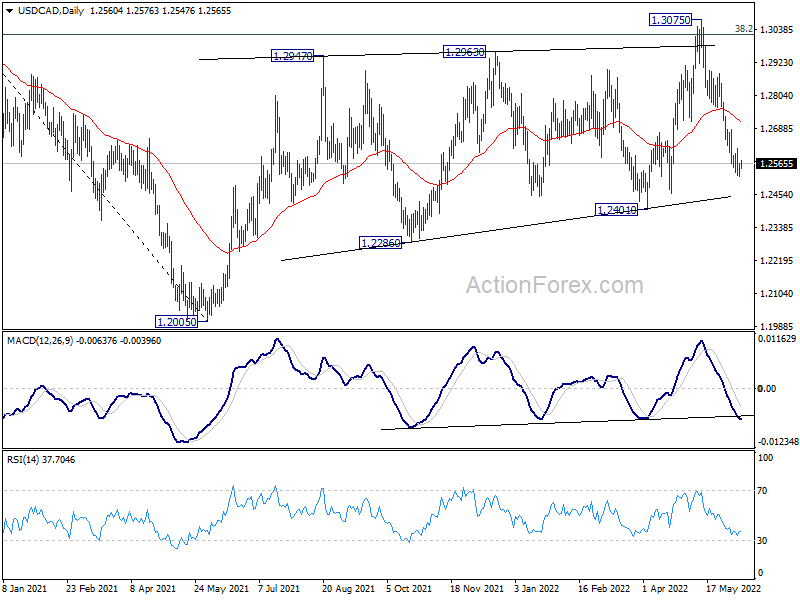
In the bigger picture, focus stays on 38.2% retracement of 1.4667 (2020 high) to 1.2005 (2021 low) at 1.3022. Sustained break there should confirm that the down trend from 1.4667 has completed after defending 1.2061 long term cluster support. Further rise would then be seen towards 61.8% retracement at 1.3650. However, rejection by 1.3022 will maintain medium term bearishness. Break of 1.2005 will resume the down trend from 1.4667 and that carries larger bearish implications too.
AUD/USD Daily Report
Daily Pivots: (S1) 0.7165; (P) 0.7201; (R1) 0.7226; More...
Intraday bias in AUD/USD remains neutral and outlook is unchanged. Further rise will remain in favor as long as 0.7034 support holds. Current development raised the chance that whole fall corrective fall from 0.8005 has completed at 0.6828. Above 0.7282 will extend the rebound to 0.7660 resistance for confirmation. However, break of 0.7034 will dampen this bullish view and bring retest of 0.6828 low instead.

In the bigger picture, price actions from 0.8006 are seen as a corrective pattern to rise from 0.5506 (2020 low). Deeper fall could be seen to 50% retracement of 0.5506 to 0.8006 at 0.6756. This coincides with 100% projection of 0.8006 to 0.7105 from 0.7660 at 0.6760. Strong support is expected from 0.6756/60 cluster to contain downside to complete the correction. Meanwhile, firm break of 0.7660 resistance will confirm that such corrective pattern has completed, and larger up trend is ready to resume.

EUR/USD Daily Outlook
Daily Pivots: (S1) 1.0676; (P) 1.0712 (R1) 1.0752; More...
Intraday bias in EUR/USD remains neutral for the moment. On the upside, break of 1.0786 will resume the rebound from 1.0348. Sustained trading above 55 day EMA (now at 1.0745) and 1.0805 support turned resistance will carry larger bullish implication. Intraday bias will be back on the upside for 1.1112 fibonacci resistance. On the downside, break of 1.0626 minor support will indicate rejection by 55 day EMA, and turn bias back to the downside for retesting 1.0348.
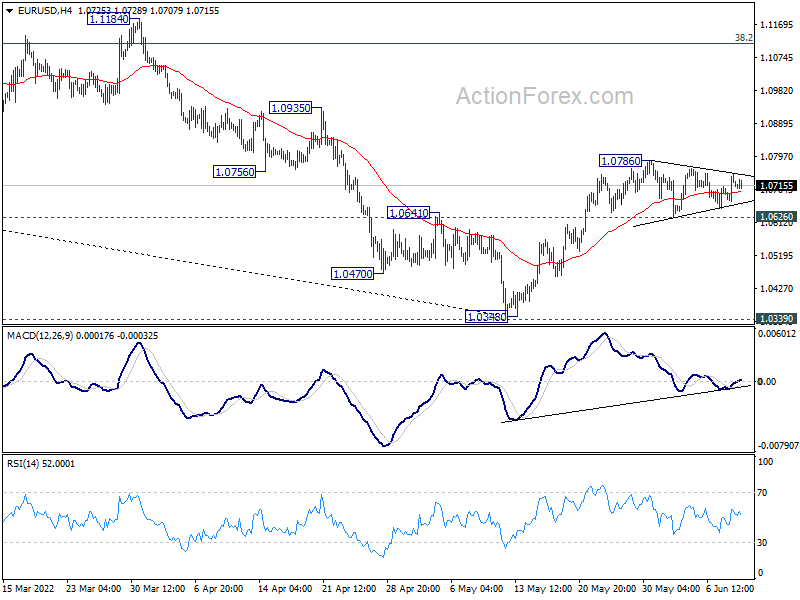
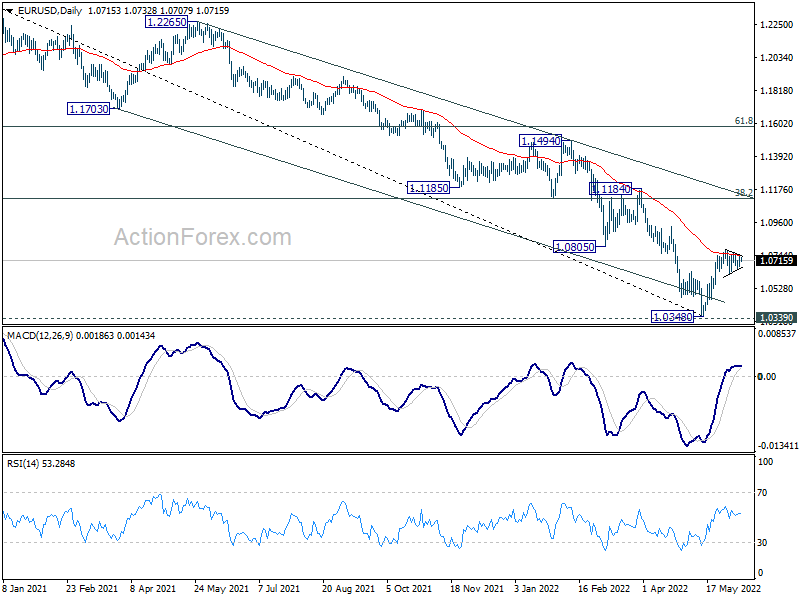
In the bigger picture, focus stays on 1.0339 long term support (2017 low). Decisive break there will resume whole down trend from 1.6039 (2008 high). Next target is 61.8% projection of 1.3993 to 1.0339 from 1.2348 at 1.0090. However, firm break of 1.0805 support turned resistance will delay this bearish case. Rise from 1.0348 is at least a correction to the down trend from 1.2348. Stronger rebound would be seen to 38.2% retracement of 1.2348 to 1.0348 at 1.1112.
GBP/USD Daily Outlook
Daily Pivots: (S1) 1.2500; (P) 1.2549; (R1) 1.2585; More...
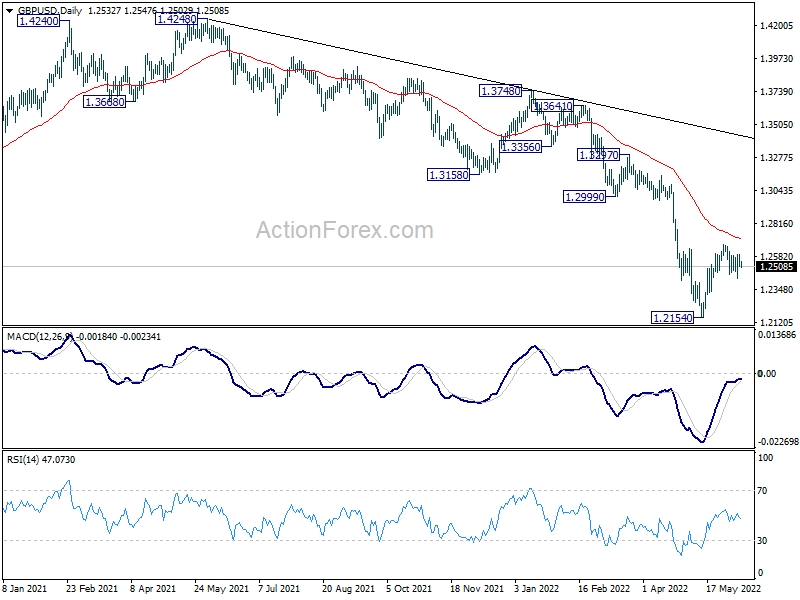
Range trading continues in GBP/USD and intraday bias remains neutral first. On the downside, break of 1.2429 support suggest that rebound from 1.2154 has completed. Intraday bias will be back on the downside for resting this low. On the upside, above 1.2666 will target 55 day EMA (now at 1.2698) and above.

In the bigger picture, fall from 1.4248 (2018 high) could be a leg inside the pattern from 1.1409 (2020 low), or resuming the longer term down trend. Deeper decline is expected as long as 1.2999 support turned resistance holds. On resumption, next target is 1.1409 low.
USD/CHF Daily Outlook
Daily Pivots: (S1) 0.9733; (P) 0.9761; (R1) 0.9814; More...
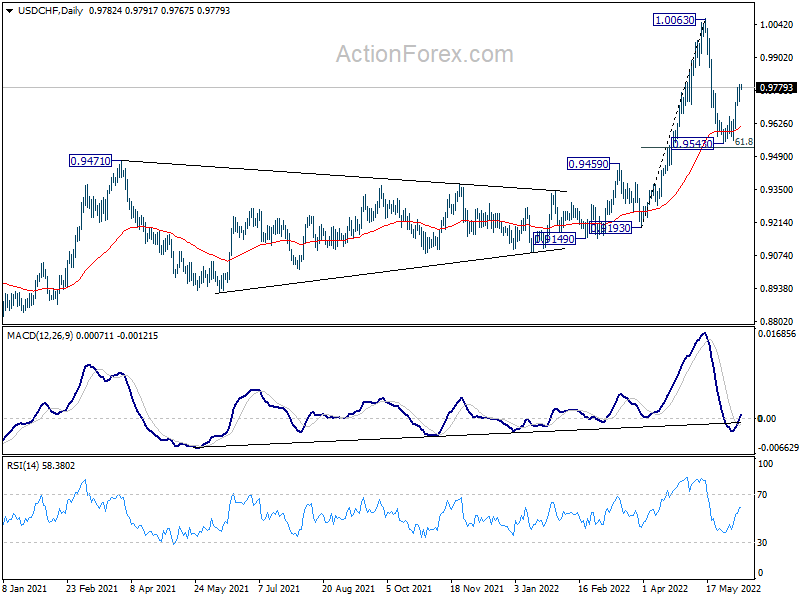
Intraday bias in USD/CHF stays on the upside and outlook is unchanged. Further rally is in favor to retest 1.0063 high first. Firm break there will resume larger up trend. However, break of 0.9567 will extend the correction from 1.0063 with another leg, and turn bias to the downside for 61.8% retracement of 0.9193 to 1.0063 at 0.9525.

In the bigger picture, down trend from 1.0342 (2016 high) should have completed with three waves down to 0.8756 (2021 low) already. Rise from 0.8756 is likely a medium term up trend of its own. Next target is 1.0237/0342 resistance zone. This will remain the favored case as long as 0.9471 resistance turned support holds. However, sustained break of 0.9471 will extend long term range trading with another falling leg.
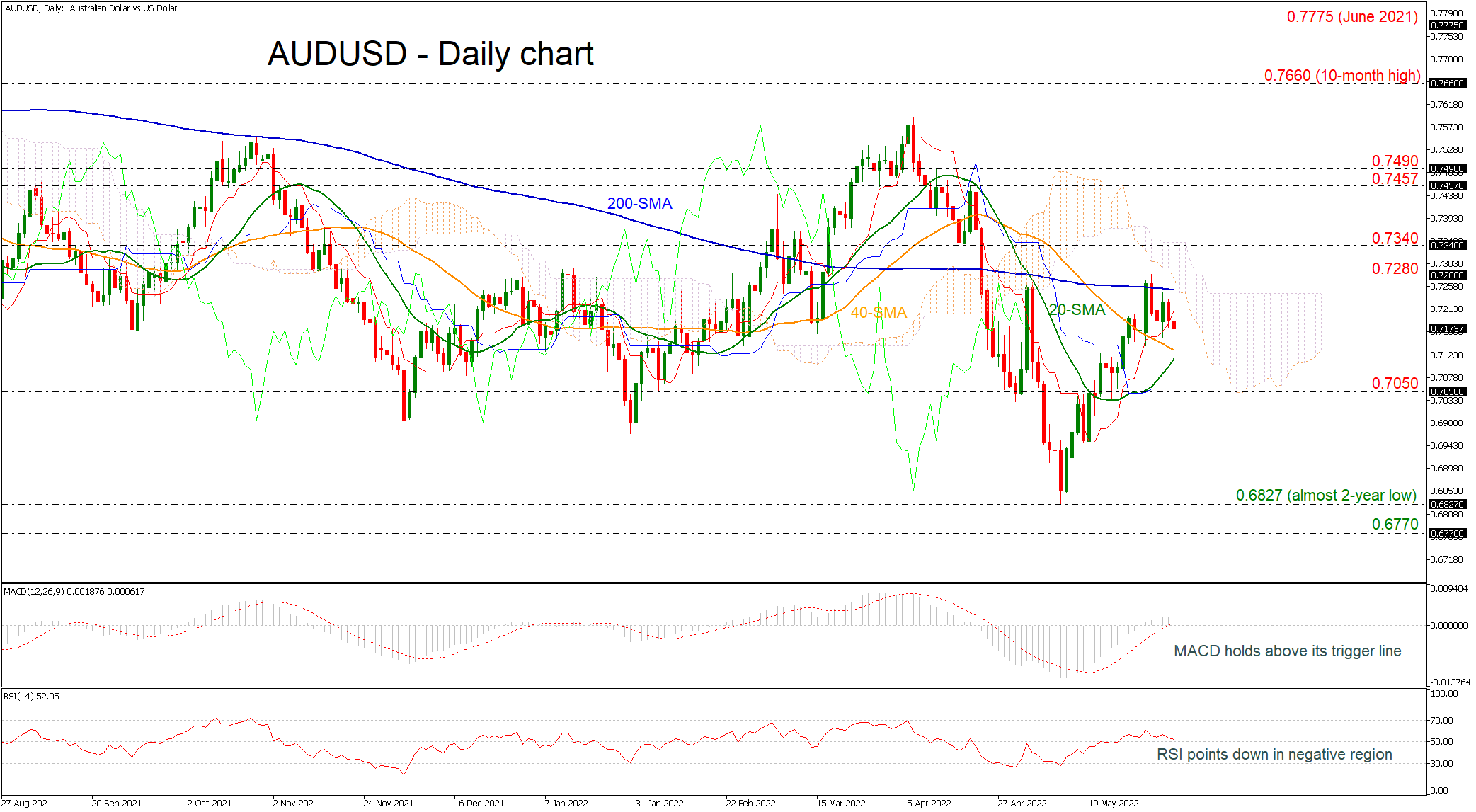
AUDUSD Underperforms Below the 200-Day SMA and 0.7200
AUDUSD has been underperforming over the last few sessions after it found a strong obstacle to surpass the 200-day simple moving average (SMA) and the 0.7200 round number.
However, the 20- and 40-day SMAs are in the process of posting a bullish crossover, while the MACD is still standing in the positive region. But the RSI indicator is losing momentum in the bullish area, suggesting that the next movements may be to the downside.
If price action remains above the short-term SMAs, there is scope to test the 200-day SMA at 0.7250 again, marginally below the 0.7280 resistance. Clearing this key level would see additional gains towards the 0.7340 inside swing low on April 18. Rising above, it would see prices re-test the 0.7457-0.7490 barrier and then from there would touch the ten-month high of 0.7660.
If the short-term SMAs fail to halt the decline, then the focus would shift to the downside towards 0.7050. More selling interest could open the way for the almost two-year low of 0.6827 which, if breached, would increase downside pressure and bring about a new low near 0.6770 ahead of a dive towards 0.6570, taken from the inside swing high of April 2020.
Overall, AUDUSD has been negative since peaking at 0.7280. Near-term weakness is expected to remain as long as price action take place below the 200-day SMA. Though, a climb beyond the latter may increase the speculation for a bullish bias.
A Rising Likelihood ECB Starts with Back-to-Back 50 bps Rate Hikes in Jul and Sep
Markets
Core bonds and stocks sold off in lockstep again yesterday as a new surge in oil prices stings. Brent crude rallied from $120.50/b to $124/b, testing the highest level since mid-March. The post-invasion top stands at $139/b. The same factors remain at play: resurging Chinese demand following months of very strict lockdowns and reduced supply via the European embargo against Russia (which more than outweighs the small scaling up of OPEC-supply). The German yield curve bear steepened with yields rising by 3.4 bps (2-yr) to 6.8 bps (30-yr). US yields added 4.5 bps to 5.3 bps across the curve. The US 10-yr Note auction was on the soft side as it tailed 1.2 bps with a below average bid cover (2.41 vs 2.5). The trade weighted dollar for a second straight session attempted to take out first resistance at 102.73, but the test failed again. EUR/USD 1.0627/42 support remained out of reach with the single currency even outperforming in the run-up to today’s ECB meeting (see below). USD/JPY surged from 132.59 to 134.50. Focus turns to Amsterdam today, where the ECB convenes. ECB President Lagarde’s contribution to “The ECB Blog” (May 23) serves as a good guide for what to expect from the central bank in the new inflation landscape. The ECB finally deems it appropriate to return to more normal settings to slash current high inflation and to prevent higher inflation expectations from becoming entrenched in the mindsets of economic agents. The uncertain growth outlook plays second fiddle in this story. New inflation forecasts are about to show upward revisions for 2023 (2.1%) and 2024 (1.9%) as well, underlining the need to act. More specifically, net purchases under APP are to end very early in the third quarter, allowing for a rate lift-off in July and an exit of negative interest rates to the end of the third quarter. Lagarde didn’t specify the magnitude of coming rate hikes, but left the door open to larger-than-usual ones. We attach a rising likelihood to a scenario in which the ECB starts with back-to-back 50 bps rate hikes in July and September. 50 bps rate hikes are turning into the new normal on a global level, while the ECB understands that the window of opportunity to normalize policy in rapidly closing given the clouded eco outlook. On top, there’s already a strong sense of being behind the curve and having misinterpreted the true nature of the inflationary winds. The ECB is also rumoured to strengthen its commitment on preventing fragmentation during its normalization cycle by announcing a new bond buying programme if needed to counter borrowing costs for the likes of Italy should they spiral out of control. From a market point of view, we hold our bearish views on core bonds with the EMU curve likely to turn into bear flattening mode. A test of key resistance in EUR/USD at 1.0806 is likely, with the probability of a break high. It would make the technical picture in the FX cross neutral.
News Headlines
The Polish central bank raised policy rates by an expected 75 bps to 6%, equaling the peak seen before the global financial crisis erupted in 2008. The NBP judged that risks of inflation (expectations) running above the NBP 2.5 (+/- 1 ppt) persist, suggesting more tightening is underway. Prices continued to rise to 13.9% in May in part resulting from commodity prices as well as prolonged global supply chains and international transport, amplified by the effects of war. At the same time, a still-strong Polish economy (8.5% y/y growth in Q1) and tight labour market accompanied by falling unemployment and a marked rise in wages means companies can easily pass increased costs to final prices. The Polish zloty traded stoic around EUR/PLN 4.58. Poland’s swap yield curve bear steepened, adding a little over 5 bps at the long end. That followed more the general market trend rather than being a reaction to the meeting.
Euro Needs a Coup
It may be The Day of the year for the European Central Bank (ECB). The ECB will reveal its latest economic projections, which will show the implications of the Ukrainian war on the economy, and the mounting pressure on consumer prices, especially due to soaring food and energy prices.
The ECB will likely announce a July rate hike at today’s meeting. But the hint of a July rate hike is not enough to boost the euro, as it is almost fully priced in. What’s left to price is whether the ECB would choose to raise the rates by 50bps to stop the euro depreciation, or whether it will opt for back-to-back interest rate hikes. The latter is more likely, based on Lagarde’s gradual approach to policy tightening.
The problem is, if the ECB decided to start tightening gradually, even back-to-back interest rate hikes may not do the job. The Bank of England (BoE) has been raising its policy rate sharply since the end of last year, but the back-to-back rate hikes didn’t prevent sterling from falling against the US dollar, and the pound barely gained against the single currency.
Euro needs a bold action
What the euro needs is a coup, a bold action from the ECB, to reverse its course, especially against the US dollar. And a stronger euro is the first step in controlling the soaring inflation in Europe. If nothing, the energy purchases, which are negotiated in USD terms, would be ‘cheaper’ for the Europeans and have a cooling effect on consumer prices.
Unless the ECB’s almost certain July rate hike hint isn’t complemented with a whole bunch of super hawkish comments - that would overshadow the ugly economic indicators and the fear of a significantly slowing economic activity, it won’t do much to boost the euro from the actual levels.
Nobody said it was easy
Unfortunately, Christine Lagarde won’t go down in history as the saviour of the Europeans as Mario Draghi did. Mario Draghi ordered free drinks for everyone, and Christine Lagarde needs to pay the bill.
If the ECB doesn’t get seriously hawkish, the EURUSD will certainly hang around the actual levels, a touch lower than the minor 23.6% Fibonacci retracement on last year’s depreciation. But If Christine Lagarde decides to take the reins of the market in her hands, we should see the EURUSD continue pushing toward the 1.10 level in the medium run.
It all depends on the ECB’s next move. It won’t be easy to withstand the fearless Federal Reserve (Fed) that throws fearless hawkish comments to the market now and walks the talk. Activity on Fed funds futures price in nearly 95% chance for a 50bp hike by the Fed at next week’s meeting.
Relentless oil rally boosts Fed hawks
The US dollar remains strong as the US 10-year yield is again above the 3% mark as the relentless rally in oil prices revive inflation fears and the Fed hawks before Friday’s inflation read. The barrel of US crude advanced to $123.50 yesterday.
OECD Downgrades Growth Outlook
Market movers today
Today's highlight is the ECB meeting where we expect a formal end to the APP programme. Discussion will focus on the possibility of ECB could move by 50bp at a later stage. Markets are pricing in around 40% of a 50bp hike in July. We also focus on potential fragmentation tools. ECB's new staff projections is expected to see upward revision of inflation and downward revision on growth.
In Sweden, we get the household consumption and April GDP-indicator and Riksbank's Breman will attend a seminar to discuss inflation, monetary policy and sustainability (for more details, see the Nordic section).
The 60 second overview
ECB today: The main event today is the ECB meeting and the expected wind-down of the QE as well as preparing for rate hikes. The inflation outlook is expected to be revised upwards and the growth outlook downwards. The discussion on the policy path centres around a 50bp rate hike already in July. Markets are pricing in around 40% of a 50bp hike in July. Hence, even though there is a lot priced in, the risk is still on the upside for rates and spreads between Italy and Germany. Lagarde will most likely be asked about market fragmentation, but we do not expect much action on this from the ECB at this meeting. Hence, the risk is more pressure on the periphery and especially Italy after the meeting despite the widespread BTPS-Bund spread.
OECD revise growth forecasts lower: Yesterday, OECD published its new global forecast, downgrading significantly their growth forecast for the global economy in 2022 by 1.5pp to 3% compared to their last update in December 2021. They expect economic growth to remain subdued in 2023. The reason for the meagre growth outlook is the war in Ukraine and the impact of higher oil and other commodity prices along with the COVID-related lockdowns in China. In general their forecast for 2022 squares well with ours, also seeing near-term economic growth holding up fairly well. However, in 2023, we are significantly more downbeat on the growth prospects in the US, fearing a mild recession, while OECD expects positive growth. On the other hand, we see a bigger rebound in China than OECD as we think the policy stimulus will support domestic demand. Our forecasts for the euro area in 2023 are fairly identical expecting about 1.6%-1.8% in real GDP growth. Market reactions to the release of the OECD forecasts were muted.
Equities: Equities were lower yesterday as the stagflation fear dominated and slowly but steadily took risk appetite lower during the day. No single event or data point behind the move yesterday but yields across the curve and on both sides of the Atlantic moved higher. This could sound like the stagflation trade coming back but that was not the case. With higher yields, one could have expected value to outperform growth but that was not the case yesterday. Hence, investors are struggling to find out whether to fear stagflation or central bank tightening led recession. Moves in US more less the reverse of Tuesday with Dow -0.81%, S&P 500 -1.1%, Nasdaq -0.7% and Russell 2000 -1.5%. Asian markets are mostly lower this morning with Japan going against the trend as the yen keeps weakening against most other currencies. Futures in Europe and US are lower this morning.
FI: Global yields once again rose after the decline on Tuesday. 10Y Treasuries is back above 3%, while 10Y Germany is again above 1.30%. The curve steepened from the long end. The rise in yields also lead to a modestly wider Bund ASW-spread despite the solid activity in the primary market with plenty of new bond deals. The rise in yields comes despite the focus on risk of a recession and negative sentiment in the bond market.
FX: JPY weakness continues to be the dominant theme as we head into the ECB meeting. USD/JPY has now broken above 134. EUR/USD continues to trade around 1.07 while the Scandies did little in yesterday's session.
Credit: Sentiment in the secondary market remained downbeat yesterday where iTraxx Xover widened more than 8bp and Main 1.5bp. However, recent days' widening should also be seen in light of the string of new issues that have come to the market ahead of tomorrow's ECB meeting.
Nordic macro
Riksbank's Breman will attend a seminar to discuss inflation, monetary policy and sustainability. Published on the website at 09.15. Any hints about coming hikes (50bps?) will be in focus. Our call is for 50bp hike at the next meeting but inflation and inflation expectations released next week will be more or less crucial.
We expect that the weak demand shown in GDP for Q1 released last week will also be reflected in the monthly indicator out today (household consumption and April GDP-indicator). Non-essential consumption is usually the first one to decrease which we also expect to see in today's figures. Especially clothing and restaurants and hotels have had a tough time since the start of the pandemic so far. However, we see no rise in bankruptcies.
Also, production data is out today. During March, production numbers came out flat compared to February while the order inflow came out strong in contrast to the order inflow in PMI. If PMI is correct, new orders in hard data should decrease from here, which seems reasonable given the weaker global demand.