Sample Category Title
Lira’s Fall Accelerates for Likely Retest of All-time Low
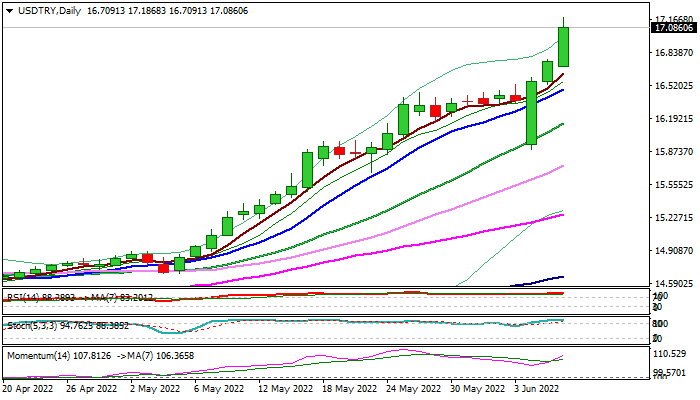
The USDTRY is in strong bullish acceleration for the third straight day (advancing 2.2% only today, as lira came under fresh and increased pressure on worries about skyrocketing inflation (73.5% in May), exhausted country’s reserves and persisting initiative by President Erdogan on further rate cuts.
Turkish lira lost around 27% of its value in the five months of 2022, as larger lira’s downtrend against the dollar since 2013, accelerated in early 2121 and hit a record low in December.
Bulls rose above pivotal Fibo resistance at 16.4182 (76.4% of 18.3387/10.2021 pullback) and on track for weekly close above this level that will confirm bullish signal and open way for retest of all-time high, with possibilities of further advance on break, as fundamental outlook in light of a record inflation, surging energy prices and a number of negative impacts from the conflict in Ukraine.
Overextended studies on all larger timeframes suggest bulls should take a breather, but these signals have so far been ignored, though the price action is very likely to face strong headwinds on approach to new record high.
Res: 17.1868; 17.2204; 17.3520; 175650
Sup: 17.0074; 16.7944; 16.7286; 16.6628
Australia Dollar Dips as Rate Rally Fizzles
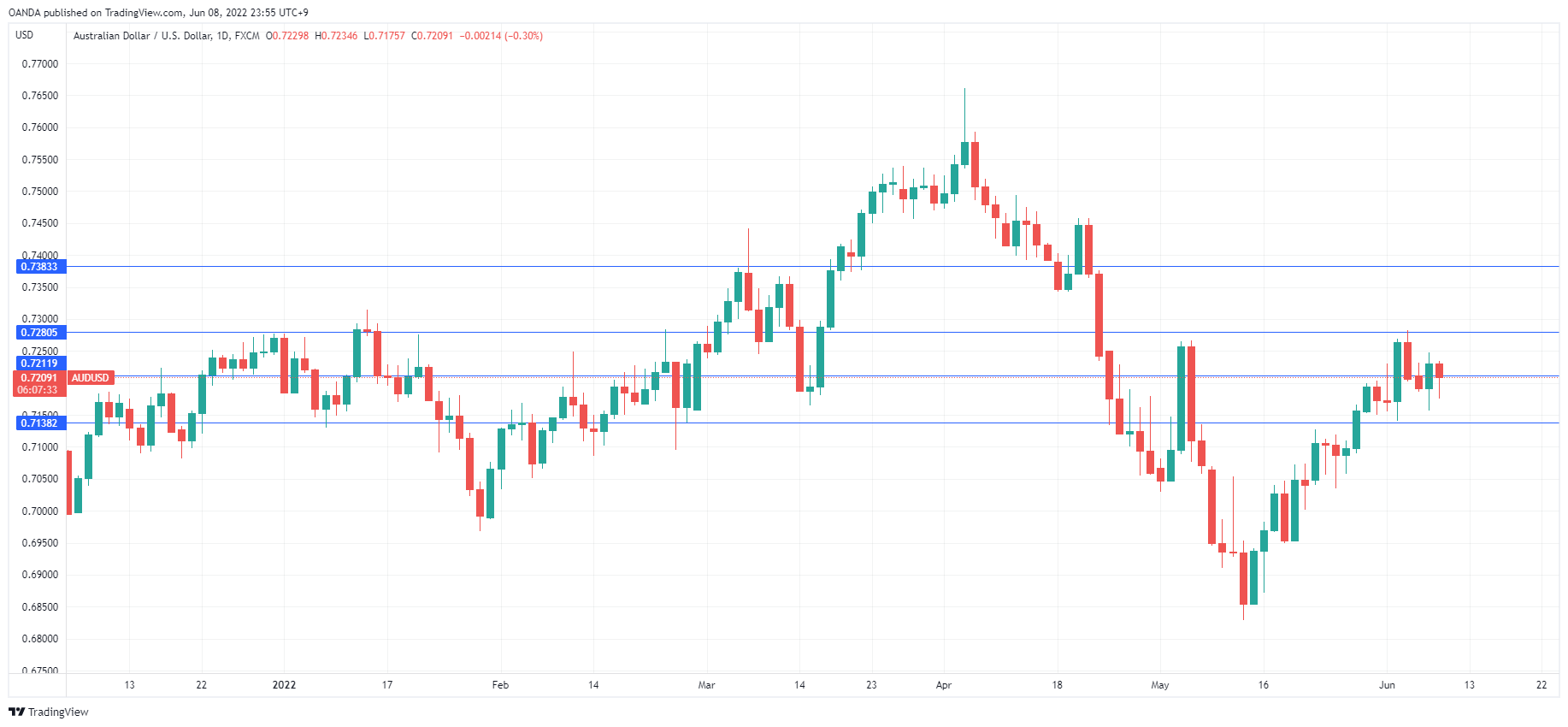
The Australian dollar has reversed directions on Wednesday and is slightly lower. AUD/USD is trading at 0.7209, down 0.28% on the day.
Aussie runs out of steam
The RBA surprised the markets with a supersize rate hike of 50bp yesterday, double what most analysts had predicted. The Australian dollar responded with a swing of close to 100 points and held onto half of those gains. However, any hopes of a sustained post-RBA rally proved to be short-lived, as the Aussie has dipped lower today. The RBA left no doubt that it plans to be aggressive in its battle to curb soaring inflation, and we could see further 50bp hikes down the road if inflation remains stubbornly high. However, the central bank does run the risk of appearing to be in panic mode with such a large hike and runs the risk of losing credibility if inflation doesn’t peak soon.
The RBA’s aggressive hike shows that it “means business”, but the rate statement didn’t come across as particularly hawkish. Policy makers noted that inflation was higher than expected and was projected to accelerate before declining in 2023. The statement said that the rate hike would contribute to inflation falling “over time”, which certainly doesn’t provide much insight – perhaps the RBA is playing a wait-and-see game when it comes to forecasting when inflation will peak.
Yesterday’s massive hike was the RBA’s largest increase since 2000. Still, it’s worth noting that the cash rate is only at 0.85%, which means that the RBA’s rate-tightening cycle is in an early stage and has plenty more room to run. Unless inflation dips dramatically, we can expect the RBA to tighten by around another 100 points by year’s end and continue into 2023. This aggressive tightening scheme will help maintain the US/Australia rate differential, with the Fed also in the midst of a rate-tightening cycle.
AUD/USD Technical
- AUD/USD is testing support at 0.7211, followed by support at 0.7138
- There is resistance at 0.7280 and 0.7353
Sunset Market Commentary
Markets
The scoreboard today doesn’t suggest we’re headed for a pivotal moment in (Europe’s) monetary history. Markets were not particularly sidelined with core bond yields shooting higher. German Bunds even underperform US Treasuries. Yields in America add 2.6 bps (2y) to 3.8 bps (30y) in a move that mainly occurred in Asian dealings. German yields rose throughout the European session to add 4.7 bps (2y) to 6.5 bps (10y). European swap yields rise up to 7.2 bps with the 10y on track for a decisive close above the 2% mark. Growth on the continent in the first quarter underwent a sharp upward revision, doubling from 0.3% q/q to 0.6% q/q or 5.4% y/y (was 5.1% in the preliminary reading). It went unnoticed on markets but may provide some comfort to the ECB in the sense that the economy heads into the normalization cycle on a stronger footing than expected. Equities are once again impressed by the sharp yield increases, shedding half a percent in Europe. The US opens mixed. The euro outperforms peers on FX markets. EUR/USD rose from 1.07 to 1.075 currently even as the dollar is in decent shape too. The trade-weighted greenback (DXY) ekes out a small gain from 102.31 to 102.44. Japan’s yen just keeps on sliding. BoJ governor Kuroda is keeping its hands of the currency, saying that it is a matter of the government. He did say a rapid slump is not desirable but those verbal warnings miss every effect. At 134.26 (up from 132.59), USD/JPY is nearing the 135.15 2002 top. EUR/JPY jumps more than two full big figures to 144.14.
At tomorrow’s policy meeting, the ECB will bid farewell to an era of one-sided monetary policy. Inflation has long undershot the 2% inflation target, calling for an ever-easy monetary policy. But this won’t be the case any more in the new inflation forecast. Price pressures will surpass the 2% mark across the policy horizon, up to 2024, serving as the rationale for removing stimulus as soon as July. Early next month, net purchases under APP will end, followed by a first rate hike later that month (25 bps). As already highlighted in Lagarde’s blog post last month, negative deposit rates end by September. We’ll be looking for clues in the Q&A session whether that means zero (meaning another 25 hike in September) or positive interest rates. Rumours circulate the ECB may also announce a new bond buying programme (oh, the irony), designed officially to “secure monetary policy transmission” across countries. In practice, it is to prevent (peripheral) yields of highly indebted countries rising too much, too fast.
News Headlines
Czech President Zeman named three new members to the governing board. He picked economic professor and previous (dovish) CNB-member Jan Frait, the head of the National Budget Council Eva Zamrazilova and analyst of the Chamber of Commerce Karin Kubelkova. Last month, he promoted Alex Michl from CNB board member to governor in a dovish rotation which will take place at the August 4 meeting. Apart from the actual nominations, it’s telling that none of the outgoing (hawkish) board members were renominated for a second term. It helps explaining why Czech rates extended this week’s increase today, in anticipation of one final hawkish adieu at the June 22 meeting. Money markets discount at least another 100-125 bps move (from 5.75%) currently. Czech swap rates add 15 to 20 bps across the curve today. The Czech koruna ends a fortnight of dull trading with EUR/CZK falling from 24.75 to 24.60.
Hungarian headline inflation accelerated by 1.7% M/M in May, to a 20-yr high of 10.7% Y/Y. Price increases were broad-based, ranging from 3.5% M/M (18.6% Y/Y) for food over 0.9% M/M (18.4% Y/Y) for consumer durables to 0.7% M/M (6.8% Y/Y) for services. The Hungarian central bank (MNB) simultaneously published its own underlying inflation indicators. Core inflation and core inflation excluding indirect tax effects both stand at 12.2% Y/Y. Indicators measuring households’ inflation expectations remain significantly above the central bank’s target range (2%-4%). Today’s inflation print strengthens our believe that the MNB slowed down its tightening cycle too soon. The forint trades back in the defensive after a surprisingly bright run since the start of the month. EUR/HUF rises to 391.50 from 388. The Hungarian swap yield curve bear flattens with yields 5.5 bps (30-yr) to 9 bps (2-yr) higher.
USDJPY Could Climb as High as 150 as BoJ’s Hands are Tied
The USDJPY has added for the sixth trading session out of the last seven, this week renewing 20-year highs. The pair reached 134, getting very close to the extremes of January 2001, near 135.
We see that this new momentum is as strong, if not stronger, than what we found in March-April. The first impulse was a 14% weakening of the yen against the dollar for two months. The central bank and finance ministers started to talk down the yen, indicating that a sharp deterioration was undesirable.
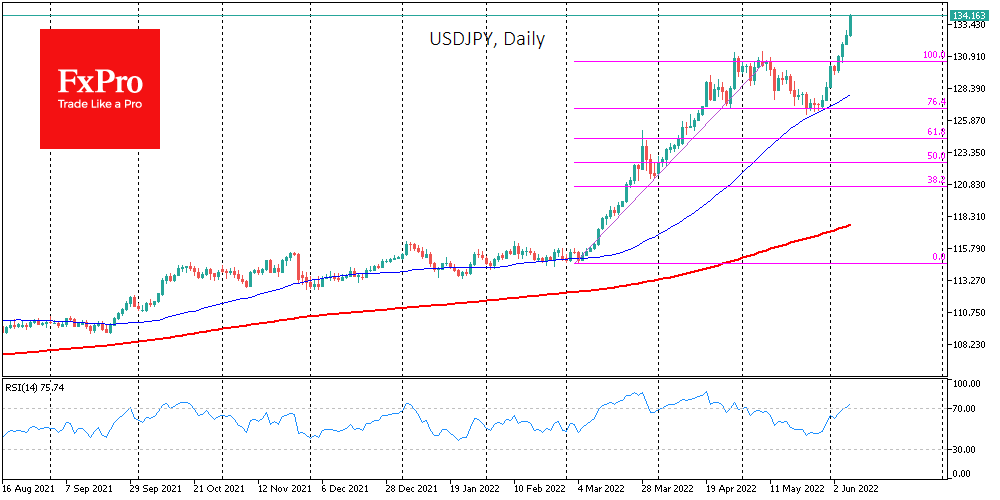
The pullback, triggered by verbal interventions and speculation that the BoJ might reduce QE to tighten policy and protect the yen, only bought time but turned the market around.
In the last days of May, it was clear that the monetary watchdogs favoured continued stimulus and did not change their policy. This mood contrasts sharply with the active policy tightening moves in the USA in many other developed countries and is a fundamental reason for using the yen as a funding currency.
If the Bank of Japan manages to conduct a controlled landing of the yen at another, fundamentally lower level, it would restore competitiveness to Japanese exports and provide a driver to turn on the industrial engine, which has often stalled in recent years.
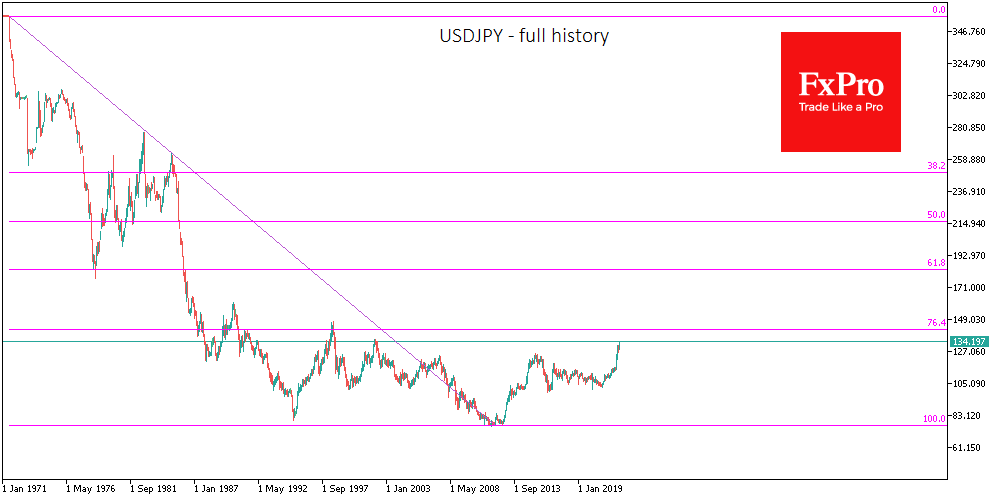
In the meantime, investors and traders should be prepared for a permanent yen decline over this year or the first half of the next one if we now see Europe and the US abandoning their zero-interest-rate policy, as policymakers there hinted recently. For its part, Japan will likely remain tied up in an anaemic economy riddled with sovereign debt, which will not allow for an adequate increase in government stimulus to spur growth.
All that sets the stage for USDJPY to move up towards 140 in the coming weeks and 150 before the end of the year. However, the tight correlation between the yield on 10-year US Treasuries and the USDJPY dynamics suggests that without an economic disaster in Japan or the global economy, a fixation above 150 is unlikely.
EURJPY Accelerates to the Highest in Seven Years
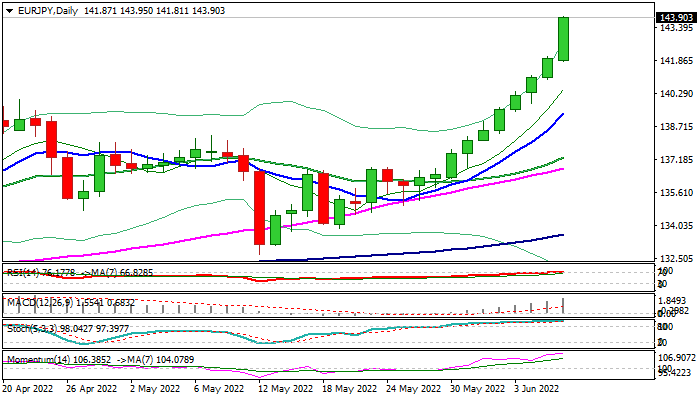
The EURJPY cross accelerated steep rally on Wednesday, hitting the highest levels since January 2015 and on track for the biggest daily gains since Feb 3.
Yen remains strongly pressured by BoJ’s ultra-easy monetary policy, compared to hawkish Fed, with the ECB expected to lay the groundwork for rate hikes on Thursday’s policy meeting.
Solid Eurozone GDP data (annualized GDP grew by 5.4% in Q1 from 4.7% in the previous three-months and beat forecast at 5.1%) added to positive signals for the single currency.
Bullish daily techs support the action which eyes initial targets at 145.30 / 67 (2015 / 2013 highs respectively) and could extend towards 149.76/150.00 (2014 peak / psychological) on break.
Bulls so far ignore overbought conditions, but some price adjustment should be expected in coming sessions.
Former top at 140.00 (Apr 21( and rising 10DMA (139.33) offer solid supports.
Res: 144.54; 145.30; 145.67; 147.34
Sup: 141.81; 140.93; 140.00; 139.33
GBP/JPY Mid-Day Outlook
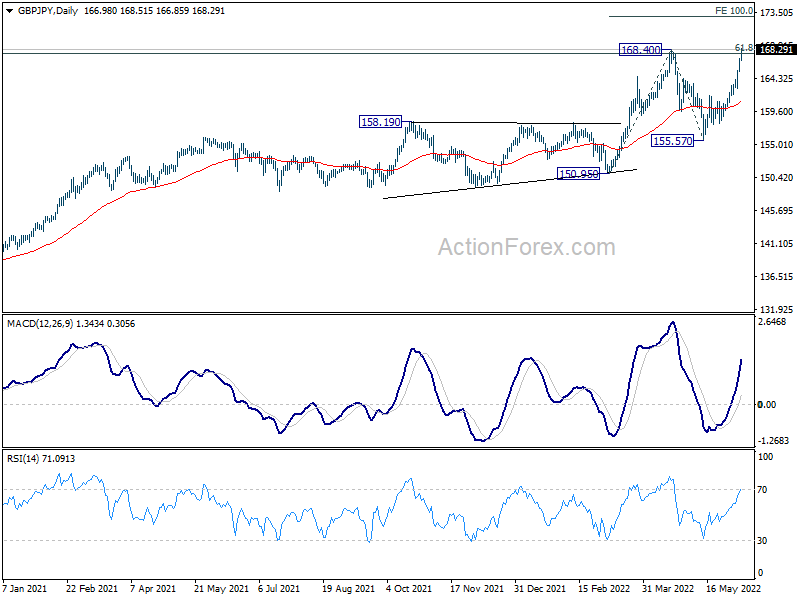
Daily Pivots: (S1) 165.80; (P) 166.45; (R1) 167.66; More...
GBP/JPY's break of 168.40 resistance suggests resumption of larger up trend. Sustained trading above 167.93 fibonacci level will carry larger bullish implication. Next near term target is 100% projection of 150.95 to 168.40 from 155.57 at 173.02. On the downside, below 165.26 minor support will delay the bullish case and turn intraday bias neutral first.

In the bigger picture, up trend from 123.94 (2020 low) is still in progress. Sustained break of 61.8% retracement of 195.86 (2015 high) to 122.75 (2016 low) at 167.93 will be a long term bullish signal, and could pave the way back to 195.86 high. This will now remain the favored case as long as 155.57 support holds, even in case of deep pull back.
USD/JPY Mid-Day Outlook
Daily Pivots: (S1) 132.00; (P) 132.50; (R1) 133.13; More...
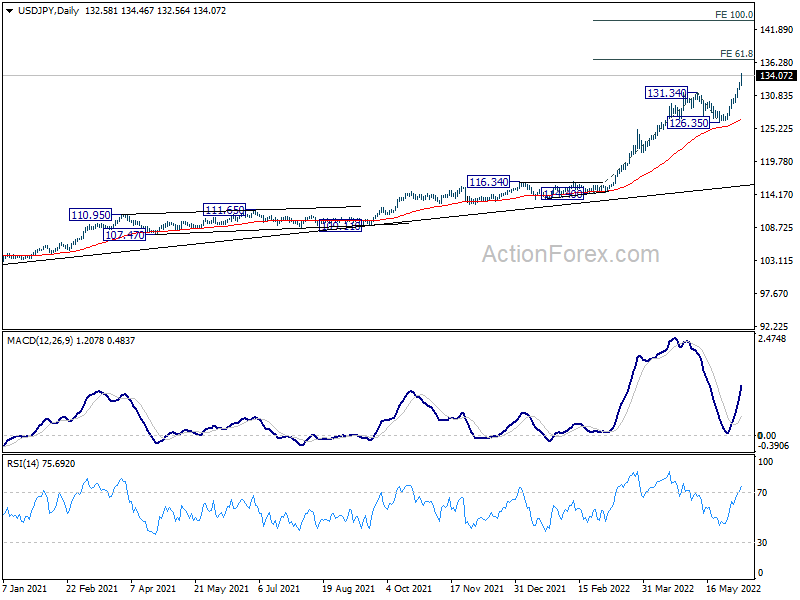
USD/JPY's rally is still in progress and intraday bias remains on the upside. Next target is 61.8% projection of 114.40 to 131.34 from 126.35 at 136.81. Firm break there will target 100% projection at 143.29. On the downside, below 130.97 minor support will turn intraday bias neutral to bring consolidations first, before staging another rally.
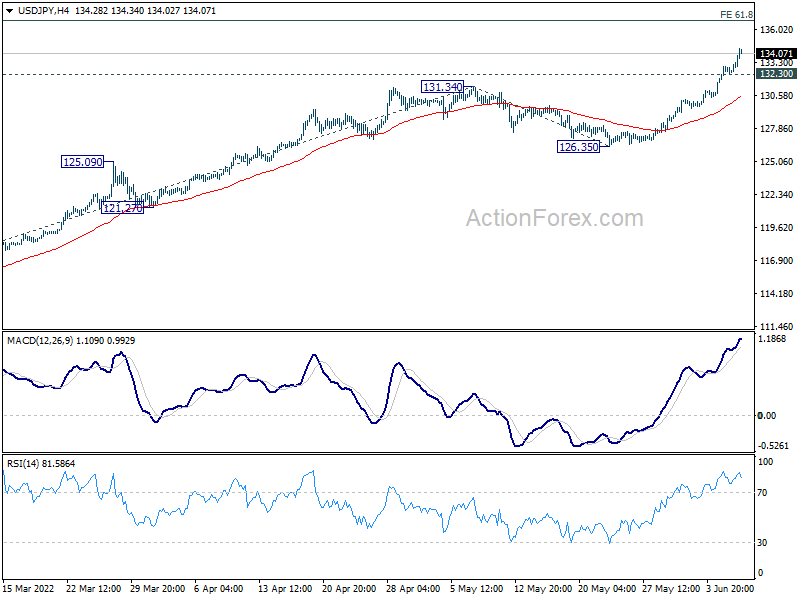
In the bigger picture, current rally is seen as part of the long term up trend form 75.56 (2011 low). Next target is 100% projection of 75.56 (2011 low) to 125.85 (2015 high) from 98.97 at 149.26, which is close to 147.68 (1998 high). This will remain the favored case as long as 126.35 support holds.
EUR/USD Mid-Day Outlook
Daily Pivots: (S1) 1.0665; (P) 1.0689 (R1) 1.0727; More...
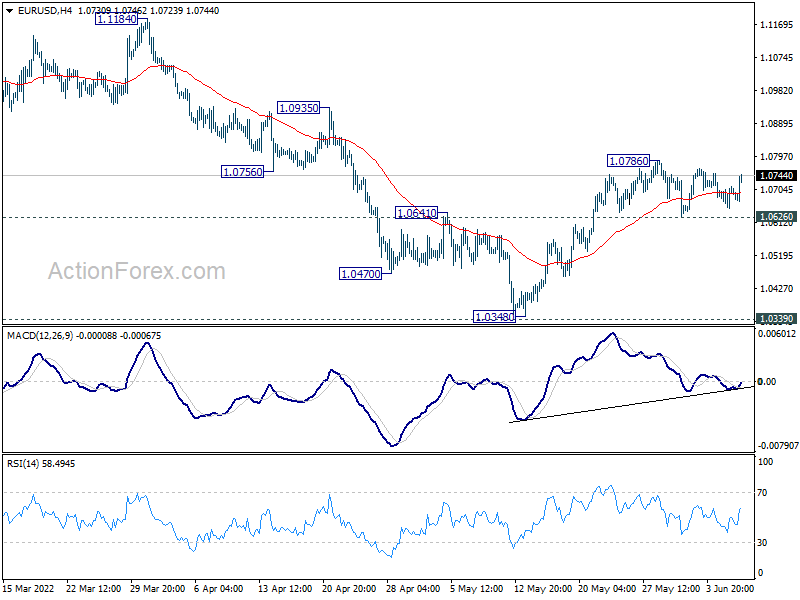
Intraday bias in EUR/USD remains neutral for the moment. On the downside, break of 1.0626 minor support will indicate rejection by 55 day EMA, and turn bias back to the downside for retesting 1.0348. On the upside, break of 1.0786, and sustained trading above 55 day EMA (now at 1.0757) will target 1.0935 resistance next.
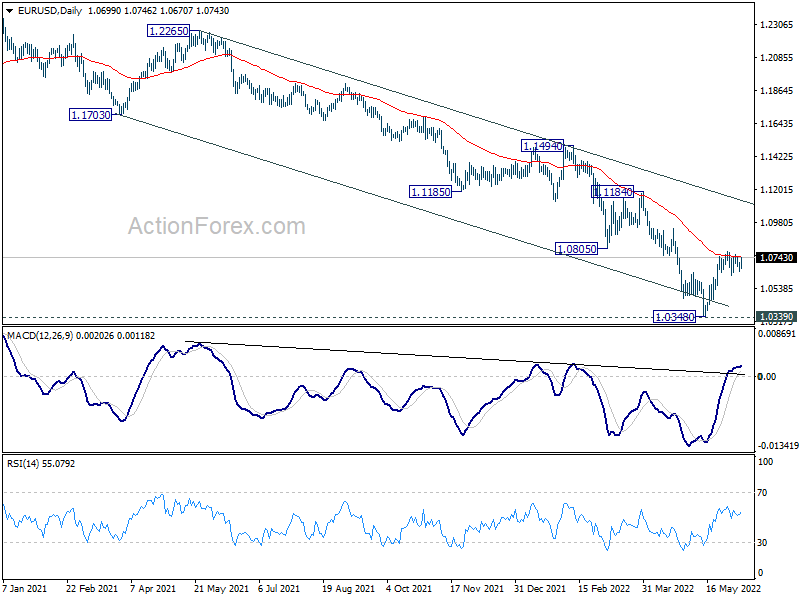
In the bigger picture, focus stays on 1.0339 long term support (2017 low). Decisive break there will resume whole down trend from 1.6039 (2008 high). Next target is 61.8% projection of 1.3993 to 1.0339 from 1.2348 at 1.0090. However, firm break of 1.0805 support turned resistance will delay this bearish case and bring medium term corrective rebound first.
GBP/USD Mid-Day Outlook
Daily Pivots: (S1) 1.2483; (P) 1.2541; (R1) 1.2652; More...
Intraday bias in GBP/USD remains neutral for the moment. On the downside, break of 1.2429 support suggest that rebound from 1.2154 has completed. Intraday bias will be back on the downside for resting this low. On the upside, above 1.2666 will target 55 day EMA (now at 1.2706) and above.

In the bigger picture, fall from 1.4248 (2018 high) could be a leg inside the pattern from 1.1409 (2020 low), or resuming the longer term down trend. Deeper decline is expected as long as 1.2999 support turned resistance holds. On resumption, next target is 1.1409 low.

USD/CHF Mid-Day Outlook
Daily Pivots: (S1) 0.9637; (P) 0.9675; (R1) 0.9745; More...
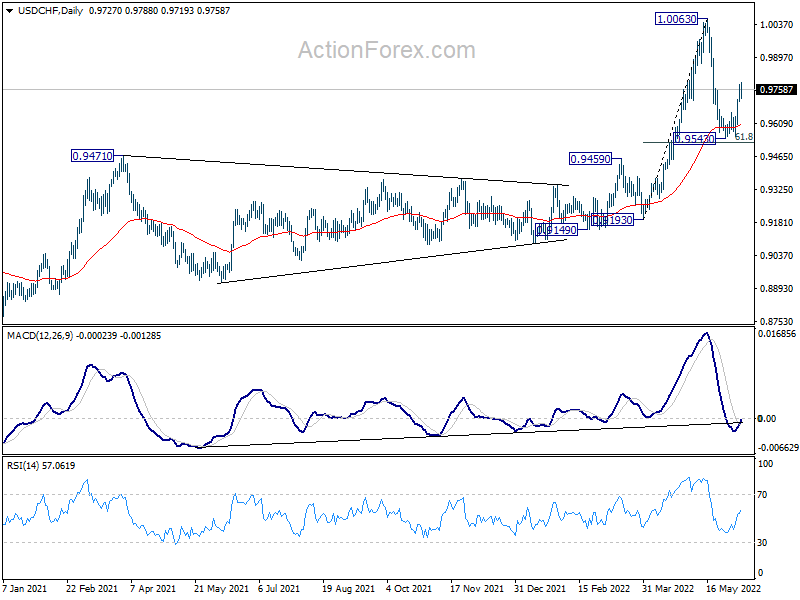
Intraday bias in USD/CHF stays mildly on the upside for retesting 1.0063 high. Firm break there will resume larger up trend. However, break of 0.9567 will extend the correction from 1.0063 with another leg, and turn bias to the downside for 61.8% retracement of 0.9193 to 1.0063 at 0.9525.

In the bigger picture, down trend from 1.0342 (2016 high) should have completed with three waves down to 0.8756 (2021 low) already. Rise from 0.8756 is likely a medium term up trend of its own. Next target is 1.0237/0342 resistance zone. This will remain the favored case as long as 0.9471 resistance turned support holds. However, sustained break of 0.9471 will extend long term range trading with another falling leg.