Sample Category Title
Daily Technical Analysis
EUR/USD
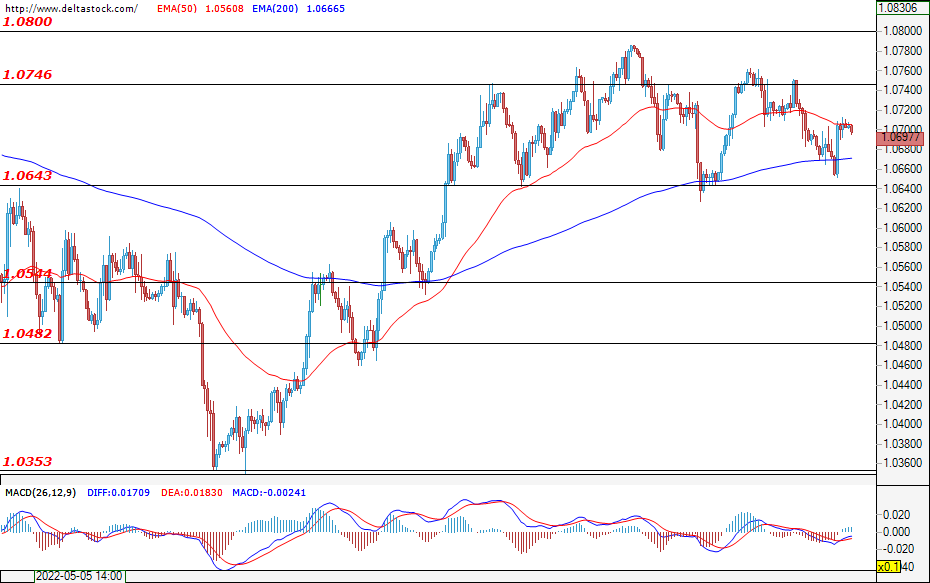
The U.S. dollar recovered part of its losses during yesterday's trading session, but the attack of the bulls was thwarted around the local resistance level at 1.0713. In the early hours of today's session, the bulls seem to be losing momentum and the expectations going forward are for the pair to enter a corrective phase and head towards a test of the support at 1.0643. Only a confirmed breach of the mentioned level, however, would pave the way for the EUR/USD towards the critical support at 1.0544. If the bulls regain control over the market, then an upward movement can be expected and the pair would most probably head towards the resistance at 1.0746.
USD/JPY
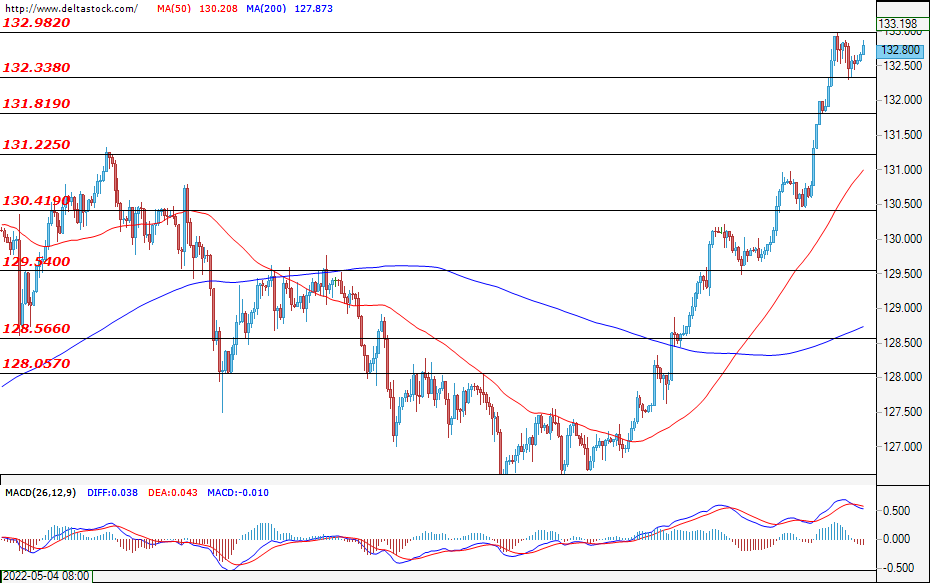
The bears managed to limit the strong rally of the U.S. dollar around the resistance zone at 133.00 and the pair is currently consolidating in the range of 132.33 – 133.00. The forecasts are for the pair to bounce back from the resistance at 133.00 and to enter a corrective phase targeting the support at 131.80. However, the market sentiments remain positive – for a continuation of the uptrend. That being said, only a confirmed breach of the psychological level at 133.00 would pave the way for the pair towards the highs at around 134.00 – 135.00, which were last recorded back in 2002.
GBP/USD
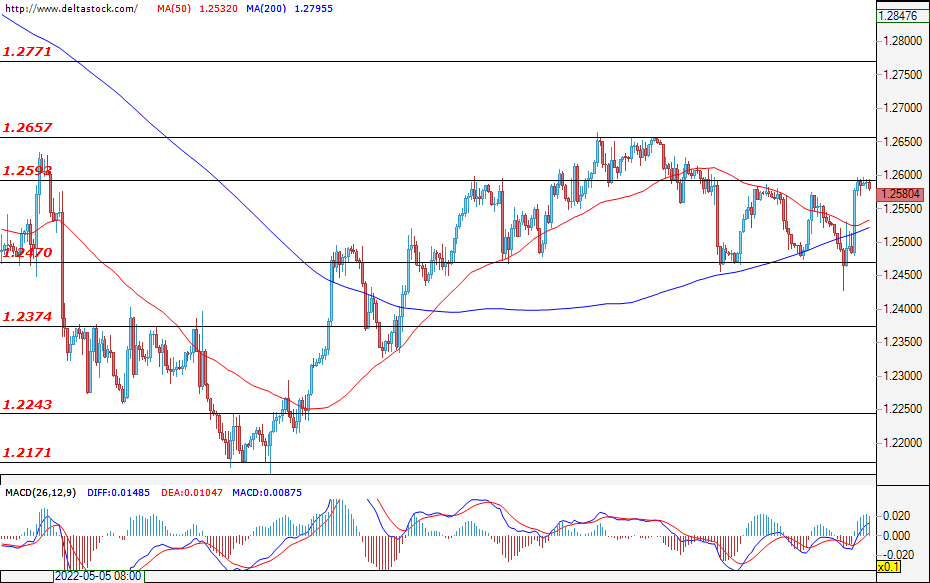
The sterling gained ground against the U.S. dollar and tested the psychological resistance at 1.2600, but the bulls couldn’t gain enough momentum to overcome it. At the time of writing, the pair is hovering just below the mentioned level and therefore a corrective move towards the support at 1.2470 is a highly probable scenario for today’s trading session. However, a breach of the mentioned resistance may lead the pair towards a test of the next level at 1.2657.
EUGERMANY40
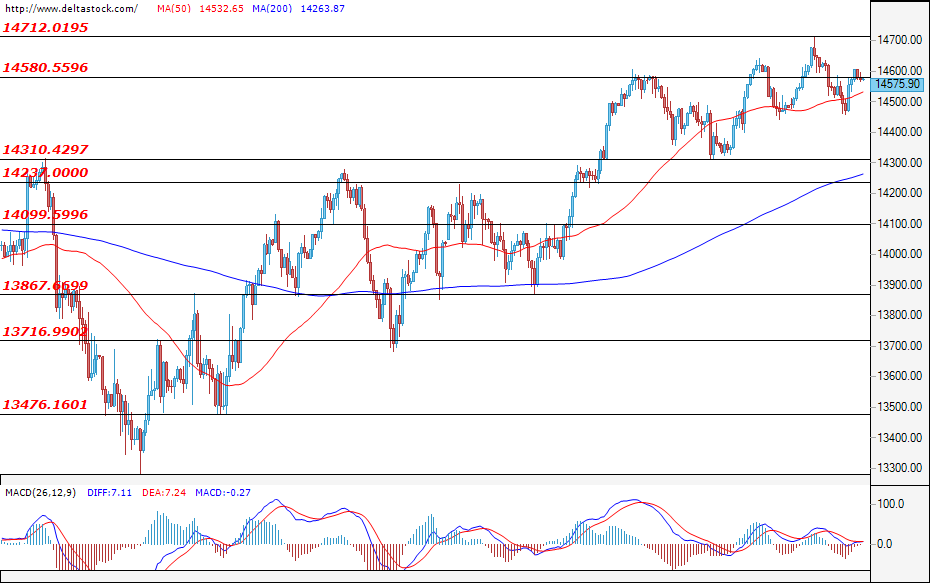
The German index returned above the resistance at 14580 and the bulls would probably try to keep control over the market and attempt to lead the price towards a test of the resistance at 14700. If this level is violated, then we may witness further appreciation towards the key resistance at 14800. In the opposite direction, in case the sellers overcome the local support at 14500, then a decline and a test of the support at 14310 is a highly possible scenario.
US30
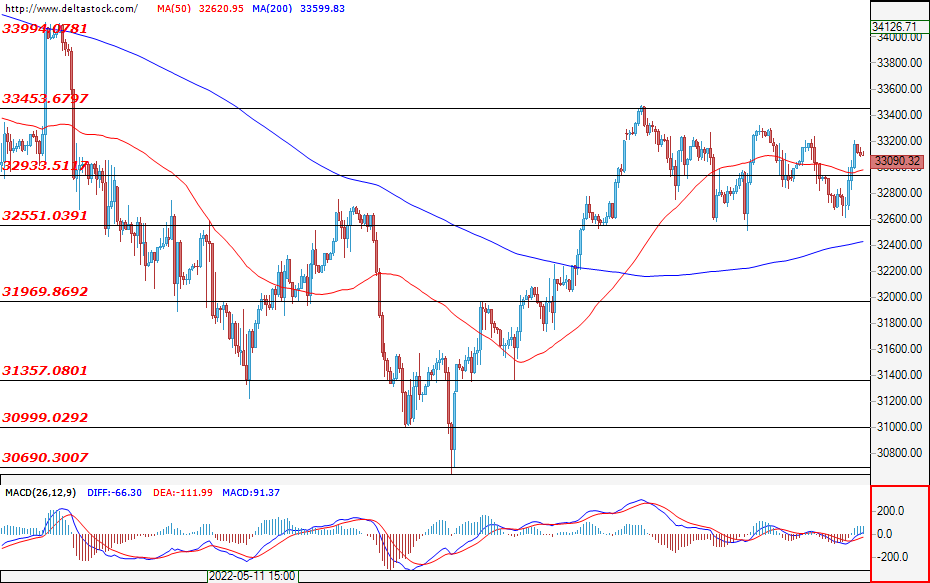
The U.S. blue-chip index increased its value by approximately 600 points during yesterday’s trading session and the expectations are for the price to head towards a test of the resistance at 33453. A successful breach of this level would strengthen the positive sentiments for a further appreciation towards the psychological level at 34000. In an alternative scenario, where the resistance at 33453 resists the bearish pressure, we may instead expect a downward movement towards the support at 32550.
World Bank Slashed Global Growth Estimates Further
Markets
Stock markets guided global trading yesterday in an emotionless session. European stock markets opened rather weak in line with WS’s performance on Tuesday and failed to overturn those losses throughout the day. They eventually closed around 0.75% weaker. The EuroStoxx50’s revival since early May is showing more and more signs of fatigue.
The downbeat mood in Europe caused risk aversion, benefiting core bonds and the dollar. The German yield curve bull flattened with yields losing 1.6 bps (2-yr) to 4.9 bps (30-yr). US yield changes ranged from flat (2-yr) to -7.2 bps (30-yr). The intraday rebound in core bonds topped out during US dealings as risk sentiment improved after opening losses for WS. Main US indices eventually gained almost 1%.
A similar dynamic was at play for dollar crosses. The trade-weighted greenback (DXY) tested first resistance at 102.73 during European hours, but improved risk appetite prevented a break during US trading hours. EUR/USD approached, but didn’t really test similar support at 1.0627/42.
JPY is exception to the rule and remains in dire straits as the BoJ doesn’t want to leave its ultra-dovish line while the Finance Ministry doesn’t put its money where its mouth is. USD/JPY this morning changes hands above 133 for the first time since 2002. Resistance stands at 135.04 (2002 top).
Sterling showed some erratic trading. EUR/GBP at first tested the recent tops near 0.858 following UK PM Johnson’s pyrrhic confidence vote victory, but eventually dived towards EUR/USD 0.85 by the end of European trading as risk sentiment started improving. Today’s eco calendar is uninspiring. The OECD updates its economic outlook in what will be an echo to yesterday’s views by the World Bank (see headlines). Asian stock markets this morning are upbeat with China underperforming. Core bonds and the dollar lose some ticks.
Overall, it will be a plain and simple countdown to tomorrow’s ECB meeting. Updated inflation forecasts will give the formal backing to the verbal turn made over the past couple of weeks, even if they are accompanied by softer growth prospects. ECB Lagarde in a blog post indicated that net asset purchases will end this month, setting the stage for a first rate hike in July and an end to negative policy rates by the end of the third quarter. That wording leaves open the option of accelerating the tightening cycle from an inaugural 25 bps rate hike to 50 bps hikes from September. Markets discount a cumulative 125 bps rate hikes for the four policy meetings in H2 2022. The ECB is also rumoured to strengthen its commitment on preventing fragmentation during its normalization cycle by announce a new bond buying programme if needed to counter borrowing costs for the likes of Italy should they spiral out of control.
News Headlines
The World Bank slashed global growth estimates further, from April’s 3.2% estimate to 2.9%. At the start of the year, the institution had penciled in 4.1%. It warned for several years of above-average inflation and below-average growth, with potentially destabilizing consequences for low- and middle-income economies. Many countries will find it hard to avoid a recession and even if a global one is avoided now, stagflation pain could persist for years, President Malpass said. The World Bank is concerned that such a scenario may require an even steeper-than-anticipated monetary policy tightening to bring inflation back to target. It compared the situation to the 70s and 80s, where rising global borrowing costs and exchange-rate depreciations in turn triggered financial crises. Hungarian finance minister Varga submitted the government’s 2023 budget bill to lawmakers yesterday. The goal is to strengthen military defence and protect the regulated price scheme for households, he said. Expenditures of HUF 842bn are earmarked for the former and HUF 670bn for the latter. Part of that will be offset by revenues from a windfall tax on the energy sector, mining royalties, and sectoral taxes on telecommunication companies, insurers and payments by financial institutions. The budget targets a deficit of 3.5% and a year-end debt ratio of 73.8%. Growth and inflation are assumed at 4.1% and 5.2% respectively. Any extra budget revenue generated by GDP growth over the 4.1% assumption must be used to reduce the deficit.
The 3% Speed Bump
US equities ended Tuesday session in the positive as the US 10-year yield stretching above the 3% mark acted like a speed bump. That’s relatively good news for the market, because it clearly shows that, even when the news is not great, the Federal Reserve (Fed) pricing doesn’t get much uglier when the 10-year yield goes above that 3% mark.
Yet, high energy prices and World Bank cutting the global growth forecast from 3.2% to 2.9% weigh on sentiment and could rapidly reverse gains.
Oil rally is here to stay
The barrel of American crude is above the $120 this morning, and the pressure remains comfortably to the upside
The supply side is hard to fix in the short run, as even pumping more oil doesn’t necessarily mean that the refineries have the capacity to process enough oil to ease the supply crisis.
The only thing that could slow the oil rally is a decreased demand. But Goldman says that Brent needs to extend the rally to $135 per barrel over the next year to solve the market deficit.
Due today, the US oil inventories will be closely watched by oil traders. While the oil inventories in the US fell sharply at last week’s data, adding to the positive pressure in oil prices, the API data this week hinted at a surprise 1.8-million-barrel build for this week’s data release. If that’s the case, we could see a short relief on oil prices, but the medium term direction remains bullish, unfortunately.
Unavoidable recession
World Bank cut its 2022 growth forecast for the second time this year, from 4.1% in January to 3.2% in April and to 2.9% this week on the back of several-years-long of above-average-inflation and below average growth, that will especially hit low to middle income economies.
The probability of US recession is also being pulled higher by several big banks. Morgan Stanley, for example, recently said that the probability of recession in the US jumped from 5% to 35% since the start of the year.
USD/JPY off the chart
Despite easing US yields, the US dollar remains relatively strong before Friday’s inflation read, meaning that many investors are preparing to see a bad surprise.
The EURUSD is gently following its 50-DMA toward the downside, but the downside should remain limited before Thursday’s European Central Bank (ECB) meeting, which could be a hawkish turning point for the ECB as the new economic forecasts will likely ring the alarm bell on surging, and sticky inflation.
The dollar-yen, on the other hand, is surging off chart. The pair surpassed the 133 level, on the back of a strong divergence between the hawkish Fed and supportive BoJ policies. But at the current levels, the technical indicators hint at overbought market conditions in USDJPY. A downside correction below the $130 level would be healthy.
JPY Weakness Resumes
Market movers today
In the US, we get crude oil inventories, where the change may signal how big the demand-supply imbalances are and how much of the inventories is being fed to the market amid rising oil prices.
Poland's central bank is expected to raise its policy rate by 75bp to 6% as the country struggles with inflation around 14%.
Overnight, Chinese trade data for May will give some indication about the strength of domestic demand (through imports) as well as global demand (through exports). The trade balance surplus is expected to increase as export growth is expected to be quite high amid resilient private consumption in Western economies while imports should grow less given the lockdowns in China.
The 60 second overview
JPY weakness resumes: As US interest rates have recently ticked higher amid a similar rise in oil prices, the energy importer Japan has seen renewed weakness in the JPY against the USD and peers. As USD/JPY has moved through 133 new (weaker JPY) from 127 about two weeks ago, the amount of market reports on the weakness of JPY has increased. Also, this move is at odds with a part of the market that has argued for a stronger JPY and a peak in the rise of global interest rates. Indeed, the monetary policy of holding their ground amid everyone else moving to hike is causing JPY to weaken. In macro, this is likely to add upwards pressure on inflation as import prices rise further. However, FX weakness also erodes the consumer purchasing power while boosting overseas profits and there will thus be some balancing between a potentially off-setting growth effect and upwards pressure on CPI. We expect no relieve from the Bank of Japan, which continues to view a weak JPY as mainly positive for the economy (and their inflation mandate).
Equities rally: Equities were higher yesterday as US markets turned around and ended very close to day-high. The energy sector stood out as the best performer driven by oil price ticking higher. The volatility index VIX yesterday took another step lower to just north of 24. A move lower in vol and implied vol opens up for more risk taking in funds risk budgets based on vol measures and hence lower vol is often associated with higher equities. The positive sentiment has carried over to Asia this morning where most markets are in green led by the Hang Seng index up almost 2%. Futures in Europe catching up while US futures are slightly lower.
FI: Yesterday, global bond yields declined with 10Y Treasuries back trading below 3% ahead of the ECB meeting on Thursday and US CPI data on Friday. European yields also declined and the spread between the periphery and core-EU tightened although the 10Y BTPS-Bund spread is still above 200bp.
FX: So far, it has been a quiet start to the week in FX markets where the most notable moves have been a continued set-back to JPY while the USD has gained modest ground in trade weighted terms. EUR/NOK rallied during the European session yesterday but came sharply lower during US hours erasing most of the rise. EUR/SEK is little changed.
Credit: Credit markets were soft yesterday where both the high- and low-beta segments were under pressure. Hence, iTraxx Xover widened almost 10bp and Main 1.5bp.
A Target on Your Back
I warned yesterday that with a dearth of heavyweight data this week until Friday’s US CPI, we were likely to experience choppy trading, driven by swings in sentiment and headlines hitting the news ticker. Sure enough, that is what occurred overnight after US retailer, Target, gave a soft outlook and announced it had too much inventory and would cut prices to shift it.
If that headline had come out on another day or week, it may well have been subsumed in the day. But, with little else to go on, and a genetic predisposition to pick the low in the equity markets, investors in New York immediately interpreted that as the high in US inflation was nigh. US yields duly fell, US 10-years moving back below 3.0%. That saw some US Dollar weakness, gold rally a little and of course, lower inflation means buying equities, which is what happened. To be fair, consumer discretionary got a pasting, but other sectors such as big-tech roared higher.
Tonight, it may well be another headline that the FOMO gnomes of Wall Street don’t like, and markets could well unwind all the overnight moves, or not. Roll on Friday.
In Asia today, we have had a few data releases already ahead of today’s main event, the Reserve Bank of India’s policy decision. Circling back to yesterday briefly, the Reserve Bank of Australia surprised both markets, and the author, by announcing a 0.50% rate hike. Local equities got clubbed, and the Australian Dollar traded in a near 100 point range and managed to hold onto most of them as the RBA becomes the latest central bank to climb off the fence on inflation. Interestingly, the incoming Philippines Central Bank Governor also signalled rate hikes ahead, and after a slow start, Asia-Pacific central banks are playing catchup to the Federal Reserve. That should partially insulate Asian currencies from further weakness for now.
This morning, Japan’s final Q1 GDP Growth received a tiny upward revision to -0.10% as reopening saw strength in the consumer segment, if -0.10% could be called strength. The data is now historical and has been ignored by markets which remained laser-focused on the rapid ascent of USD/JPY, hitting 133.00 today, as the US Fed continues to signal more tightening, while the Bank of Japan signals it has no intention of adjusting its ultra-easy monetary policy. There has been an increase in verbal intervention from Tokyo officialdom, but not massively. I do not believe we are anywhere close to intervention in the Japanese Yen by the Ministry of Finance yet. Japanese equities are enjoying a weakening Yen though.
South Korean Q1 GDP got a slight downward revision from 0.70% to 0.60%. Again, in the context of recent events, the data is old news now and will be mostly ignored by markets. Cost of living and potentially softening consumer and export demand are far more pertinent and will probably keep the pressure up on the Won, even though the Bank of Korea has itself, started raising interest rates.
Today’s main event is the Reserve Bank of India interest rate decision due shortly. Markets have priced in a 0.40% hike after the unscheduled rate hike previously and a sharp swing in hawkish rhetoric by the RBI. With possum-in-the-headlight uber-doves, the RBA, hiking 0.50% yesterday, I’m not ruling out more aggressive action by the RBI today either, with inflation far above 6.0%, the top of their inflation band. Notably, the Indian Rupee continues to weaken, despite recent US Dollar weakness lifting other currencies across the world. USD/INR is trading at 77.6450 today, not far from recent highs around 77.80. That may factor into the RBI’s equations. A 0.75% hike would probably see the Sensex take a hit, but provide much-needed support for the currency, although India’s imported energy bill and wheat export bans will continue to erode the current account.
The data releases across Europe and the US today are strictly second-tier. Probably the most interesting will be the US official crude inventory data after last week’s surprise 5 million-barrel drop. With Brent crude and WTI both around $120.00 a barrel, sharp falls in headline crude inventories or refined products could spur another rally in oil prices. Otherwise, it is as I said earlier, markets swinging on sentiment shifts and headline risks.
Asian equities follow Wall Street higher
US markets seized on Target’s softened outlook to price in peak US inflation on a slow news day overnight, sending Wall Street sharply higher. The S&P 500 rose by 0.95%, the Nasdaq rallied by 0.94%, and the Dow Jones gained 0.80%. In Asia, US futures have dropped sharply. Nasdaq and S&P 500 futures have fallen by 0.45%, with Dow futures easing by 0.30%. The price action reinforces the theory that it is tail-chasing fast-money dominating moves on Wall Street this week.
Asia is ignoring the US futures moves today, as they often do, choosing to follow the overnight US main boards rally instead after a few very mixed sessions. The Nikkei 225 has risen by 0.85%, helped along by a weaker Yen this morning. South Korea’s Kospi has added just 0.20%, perhaps held back by the downward Q1 GDP revision this morning.
In Mainland China, markets appear to be suffering a bout of profit-taking after a strong performance this week. China’s Vice Commerce Minister said today that foreign trade faced huge pressures and uncertainty, which certainly won’t have helped sentiment. The Shanghai Composite is 0.70% lower, while the CSI 300 has lost 0.40%. Hong Kong is ignoring the mainland noise, however, remaining laser-focused on the overnight Wall Street gains as the Hang Seng rallies 1.65% higher today.
In regional markets, Taipei has rallied by 0.90%, with Singapore remaining a laggard, easing by 0.20%. Kuala Lumpur has added 0.20%, Jakarta has risen by 0.45%, Bangkok by 0.10%, and Manila by 0.30%. Australian markets have also posted modest gains after yesterday's post-RBA selloff. The All Ordinaries has risen by 0.30%, with the ASX 200 edging 0.15% higher.
European markets gave back some of Monday’s gain overnight but will probably use the price action from late in New York and Asia today as an excuse to open slightly higher this afternoon.
US Dollar eases with lower US yields
US yields eased overnight, pushing the US Dollar lower as the choppy range trading in currency markets continues this week. The dollar index finished just 0.08% lower at 102.33, although the Yen weakness probably flattered the final result. US Dollar strength has returned in Asia, lifting the dollar index by 0.23% to 102.56 as the Japanese Yen selloff spills into other currency pairs. Support/resistance remains at 101.30 and 102.70.
EUR/USD probed 1.0650 overnight, before rallying to close 0.10% higher at 1.0705. The USD/JPY strength has spread to the broader FX market in Asia today and sees EUR/USD falling by 0.20% to 1.0683. Resistance between 1.0770 and 1.0830 remains a formidable barrier, while support remains at 1.0650. With the ECB expected to swing to a tightening bias this week, losses should be limited unless US yields continue to march higher from here.
Sterling got a BoJo glow overnight, finishing 0.50% higher at 1.2590 overnight, before easing 0.1% to 1.2565 in Asia. Resistance remains at 1.2670, allowing a potentially larger rally to 1.2800 and 1.3000. Support is at 1.2460 and 1.2400.
USD/JPY has been the big mover over the last 24 hours, rising 0.55% to 132.65 overnight, before adding another 0.36% to 133.05 this morning. There has been little noise from Japanese officials today, emboldening the fast-money momentum traders into adding to long positions. Notably, US yields fell overnight, but USD/JPY still rallied. That could be an ominous development for Tokyo, and I would expect to see more “watching closely” noise in the days ahead. USD/JPY has immediate support at 132.00, with 135.00 its next upside target.
AUD/USD finished 0.50% higher at 0.7230 overnight, holding onto most of its post-RBA gains. Ostensibly a bullish technical development, that picture has quickly muddied with both AUD/USD and NZD/USD sharply falling by 0.45% to 0.7200 and 0.6460 today. There seems no obvious reason other than the US Dollar strength seen elsewhere and the negative comments on trade by the China Vice Commerce Minister. AUD/USD has support at 0.7150, with resistance between its 100 and 200-day moving averages (DMAs) at 0.7230 and 0.7255.
USD/Asia continues to range trade, with some US Dollar strength lifting USD/Asia slightly higher today. The INR and MYR continue to be the worst performers in the region, Japanese Yen aside. Today’s RBI meeting could strengthen the INR if a 0.70% rate hike is enacted, otherwise, with 0.40% priced in, INR weakness will persist.
Oil is steady in Asia
Oil prices rose slightly overnight as tight refined supplies persist in the US, and industrial action in Norway and a shutting down of a Libyan oil field continued supporting prices at recent highs. Brent crude finished 0.75% higher at $120.75 a barrel, and WTI rose 0.30% to $119.75 a barrel. Asia is once again adopting a wait-and-see position, with Brent and WTI unchanged in regional trading.
Oil prices remain at post-Ukraine invasion highs if you strip out the days when tanks rolled across the borders. Returning Venezuelan and Libyan production to Europe and North America, should it occur, will not be material enough in the shorter term to force prices lower. Refining margins globally suggest that demand for petrol and diesel remain in heavy demand, with the refining logjam in refined products backstopping crude prices. A reopening China is also supportive of oil prices.
Brent crude has resistance at $122.00, and $124.00, with support at $116.00 and $112.50 a barrel. WTI has resistance at $121.00, with now support at $115.00 and $111.25 a barrel.
Gold’s flip-flop ranging continues
A weaker US Dollar into the end of the New York session saw yet another mechanical response by gold, which rose 0.56% to $1852.50 an ounce in another snooze-fest session. In Asia, some US Dollar strength had sent it 0.25% lower to $1848.00 an ounce in an automatic response. Until we get a material move one way or the other by the greenback, gold’s range trading looks set to persist.
Gold has resistance at $1870.00, followed by the 100-DMA at $1889.00, and then $1900.00. Support is at $1837, $1830.00, and then $1780.00 an ounce. I do not discount a disorderly retreat if the latter fails. The wider $1830.00 to $1870.00 range seems set to continue until Friday.
GBP/JPY Daily Outlook
Daily Pivots: (S1) 165.80; (P) 166.45; (R1) 167.66; More...
Intraday bias in GBP/JPY remains on the upside for 168.40 resistance. Decisive break there will resume larger up trend. Next target is 100% projection of 150.95 to 168.40 from 155.57 at 173.02. On the downside, below 165.26 minor support will delay the bullish case and turn intraday bias neutral first.

In the bigger picture, up trend from 123.94 (2020 low) is still in progress. Sustained break of 61.8% retracement of 195.86 (2015 high) to 122.75 (2016 low) at 167.93 will be a long term bullish signal, and could pave the way back to 195.86 high. This will now remain the favored case as long as 150.95 support holds, even in case of deep pull back. However, firm break of 150.95 will indicate rejection by 167.93, and bearish trend reversal.

EUR/JPY Daily Outlook
Daily Pivots: (S1) 141.31; (P) 141.69; (R1) 142.38; More....
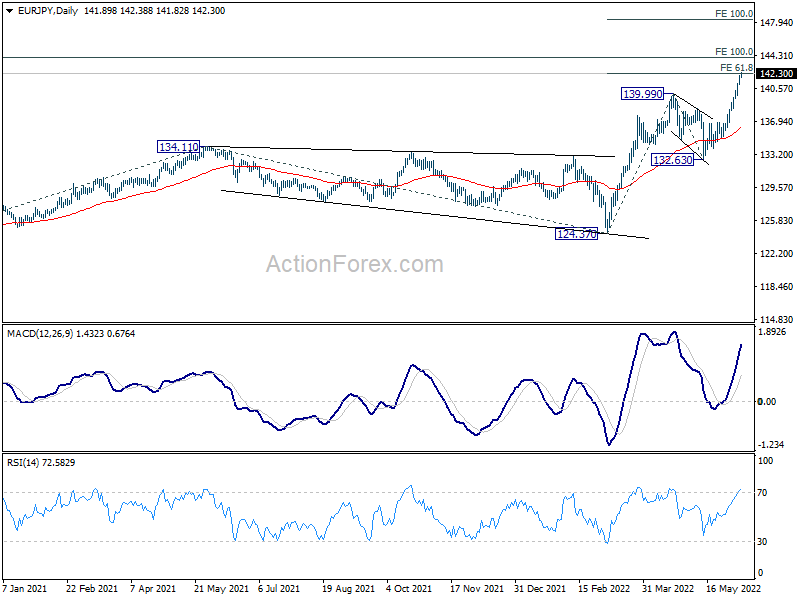
Intraday bias in EUR/JPY remains on the upside. Firm break of 61.8% projection of 124.37 to 139.99 from 132.63 at 142.28 will extend the current up trend to 100% projection at 148.25 next. On the downside, below 139.82 minor support will turn intraday bias neutral and bring consolidations first, before staging another rally.
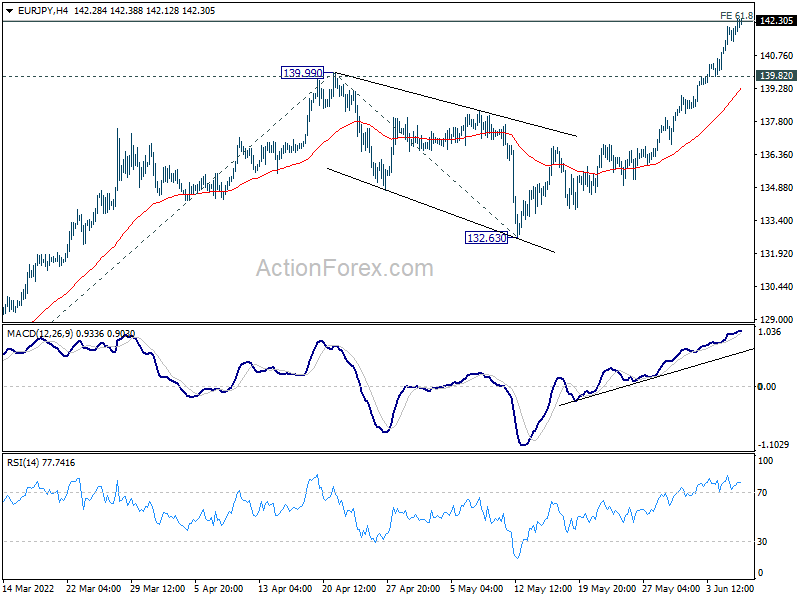
In the bigger picture, up trend from 114.42 (2020 low) is in progress. Such rise is seen as the third leg of the pattern from 109.30 (2016 low). Next target will be 100% projection of 114.42 to 134.11 from 124.37 at 144.06. Firm break there will indicate upside acceleration and target 149.76 long term resistance (2014 high). In any case, outlook will now remain bullish as long as 132.63 support holds, in case of deep pull back.
EUR/GBP Daily Outlook
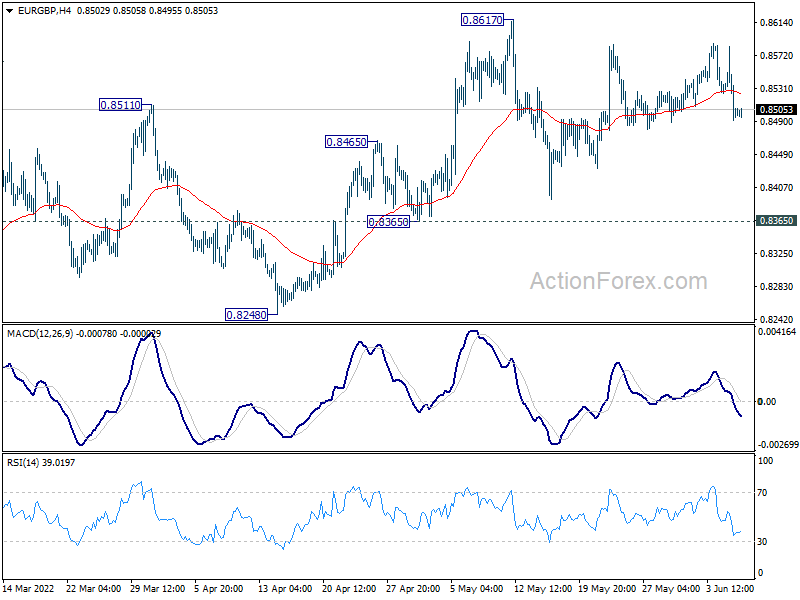
Daily Pivots: (S1) 0.8468; (P) 0.8527; (R1) 0.8561; More...
Range trading continues in EUR/GBP and intraday bias remains neutral. With 0.8365 support intact, further rise is in favor. On the upside, break of 0.8617 will resume rise from 0.8201 medium term bottom to 0.8697 medium term fibonacci level. However, break of 0.8365 will dampen this bullish view, and turn bias back to the downside instead.
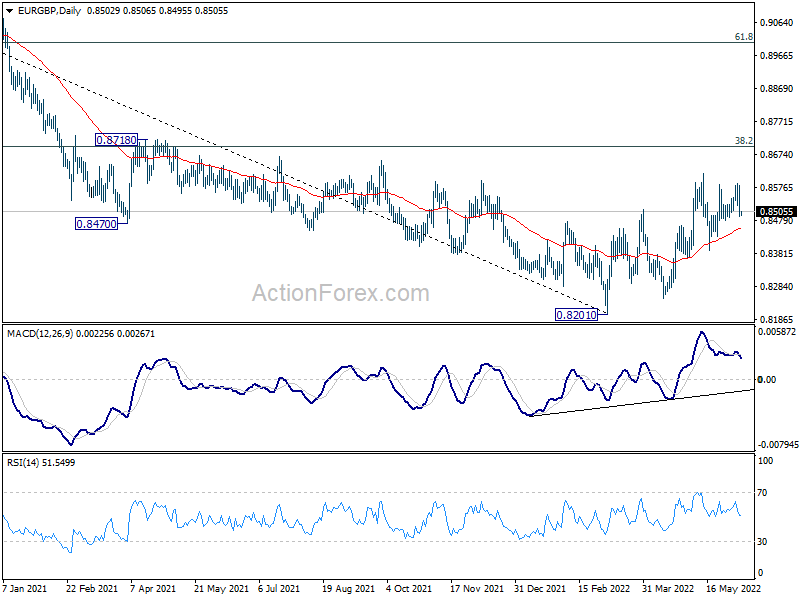
In the bigger picture, a medium term bottom could be in place at 0.8201, on bullish convergence condition in daily and weekly MACD. Rise from there could either be a correction to the down trend from 0.9499 (2020 high), or a medium term up trend itself. In either case, further rise should be seen to 38.2% retracement of 0.9499 to 0.8201 at 0.8697. Sustained break there will target 61.8% retracement at 0.9003.
EUR/AUD Daily Outlook
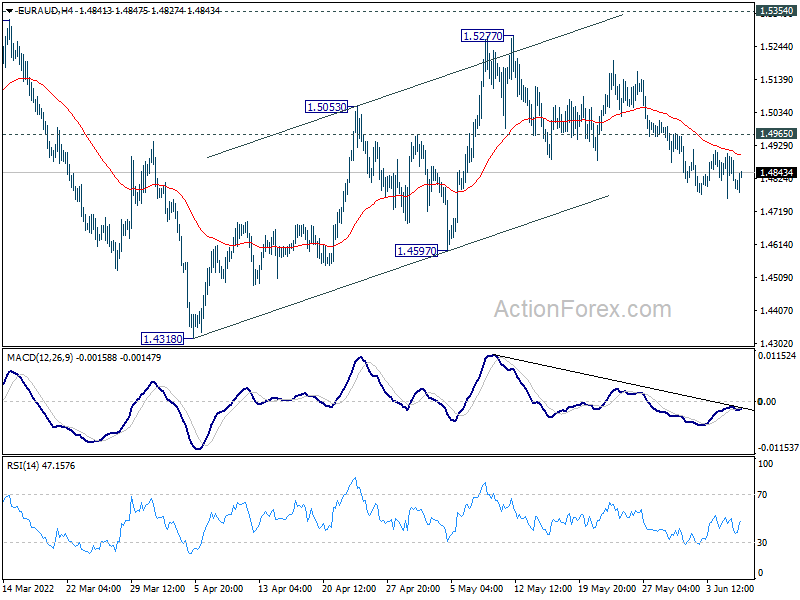
Daily Pivots: (S1) 1.4741; (P) 1.4823; (R1) 1.4885; More...
Further fall is expected in EUR/AUD with 1.4965 minor resistance intact. Deeper decline should be seen to 1.4597 support. Firm break there should confirm that rebound from 1.4318 has completed at 1.5277. Next target is a retest on 1.4318 low. However, on the upside, break of 1.4965 will dampen this bearish view and turn bias back to the upside for 1.5277 resistance instead.
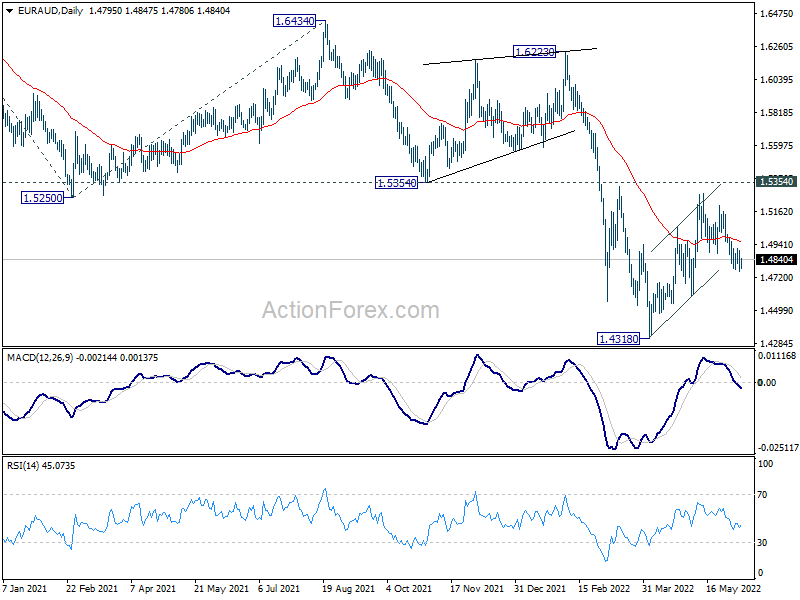
In the bigger picture, as long as 1.5354 support turned resistance holds, larger down trend from 1.9799 (2020 high) is still expected to continue. On resumption, next target is 61.8% projection of 1.9799 to 1.5250 from 1.6434 at 1.3623, which is close to 1.3624 long term support (2017 low). However, firm break of 1.5354 will indicate medium term bottoming and bring stronger rally back to 1.6434 key resistance.
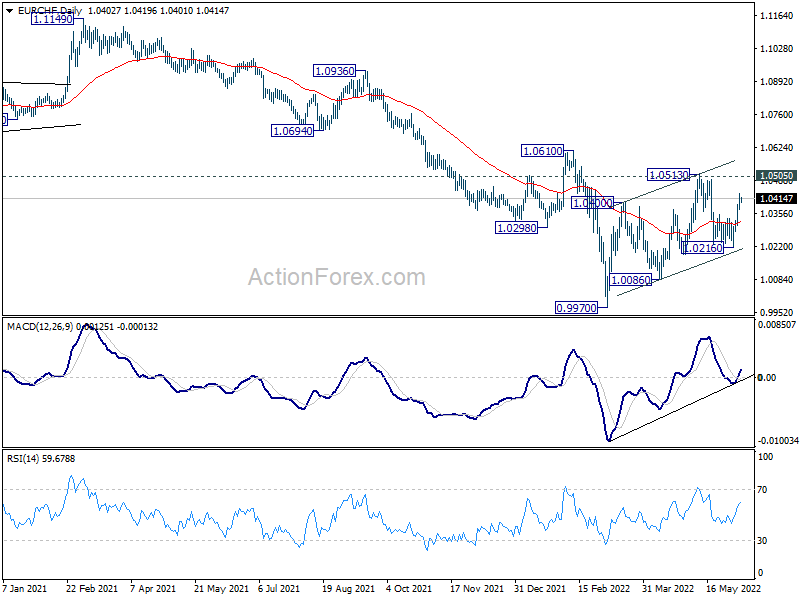
EUR/CHF Daily Outlook
Daily Pivots: (S1) 1.0379; (P) 1.0408; (R1) 1.0443; More....
Intraday bias in EUR/CHF remains on the upside for 1.0413 resistance. Firm break there will resume whole rebound from 0.9970, for 1.0610 structural resistance. On the downside, below 1.0327 minor support will turn intraday bias neutral again.
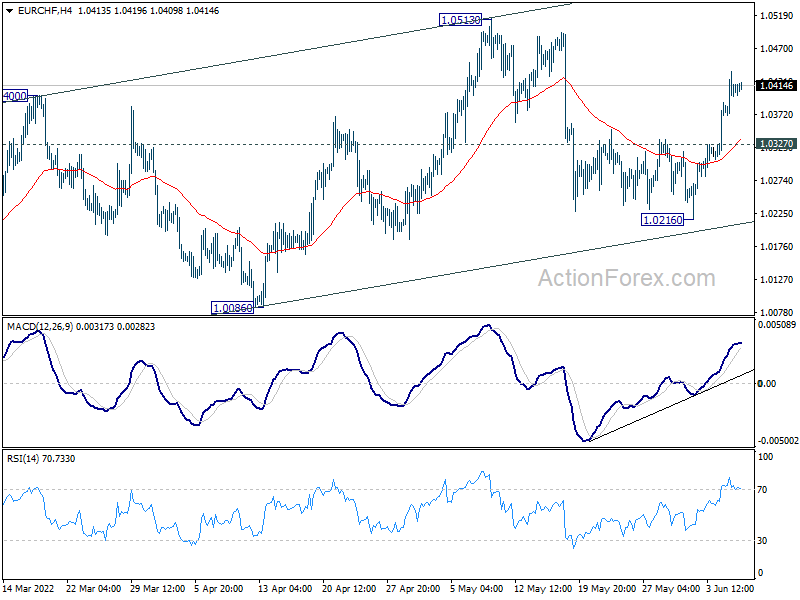
In the bigger picture, as long as 1.0505 support turned resistance (2020 low) holds, long term down trend from 1.2004 (2018 high) is expected to continue. Next target is 100% projection of 1.2004 to 1.0505 to 1.1149 at 0.9650. However, firm break of 1.0505 will suggest medium term bottoming, and bring stronger rebound towards 1.1149 structural resistance.