Sample Category Title
Euro Edges Higher as Markets Eye ECB
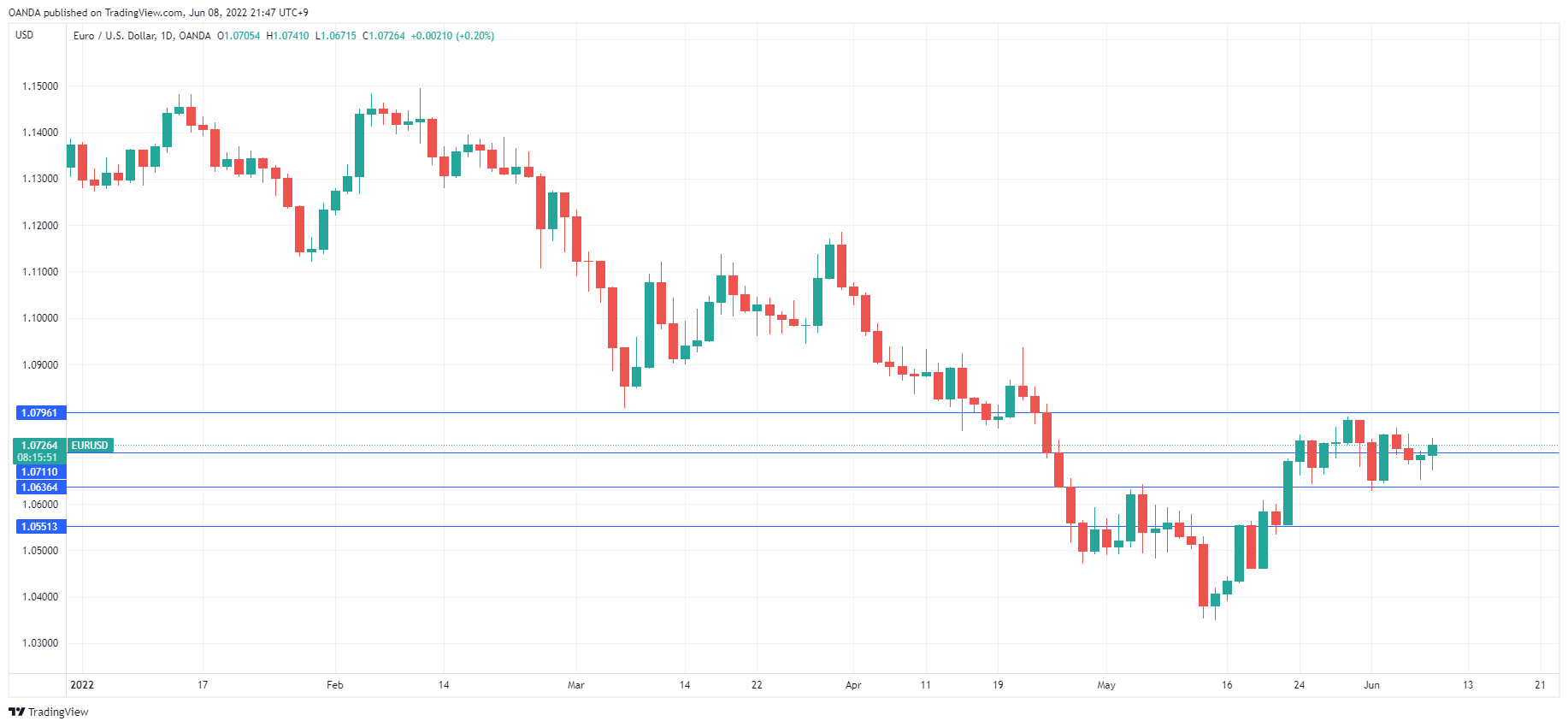
The euro is in positive territory on Wednesday. In the European session, EUR/USD is trading at 1.0727, up 0.20% on the day.
ECB to terminate QE, start rate-hike cycle
It has been a calm week for the euro thus far, but that could change on Thursday, as the ECB holds a key policy meeting. It is widely expected that the Lagarde & Co. will pivot to a tightening bias, which in itself is a dramatic development as the ECB has maintained an accommodative monetary stance for years.
The ECB has been signalling a more hawkish stance for months, as policy makers have scrambled to battle surging inflation in the eurozone, which has hit 8.1% in May. At tomorrow’s meeting, ECB President Lagarde is expected to take the formal step of announcing that the QE programme will wind up early in Q3, with the interest rate liftoff to continue in July. The markets will be looking for guidance with regard to the size of upcoming rate hikes. Any hints of a supersize 50bp increase would be bullish for the euro. The ECB will also release updated inflation and GDP forecasts, with inflation likely to be revised upwards and GDP downwards. This would indicate that the risk for eurozone growth remains tilted to the downside, which means the euro will have a tough time gaining on the dollar in the short to medium term.
The eurozone released employment and GDP data for Q1 earlier in the day, and the numbers were nothing to write home about. Employment and GDP both rose by 0.6%. Consumers are holding their purse strings tight, as household final consumption expenditure in Q1 came in at -0.7%, weaker than the -0.3% reading in Q4 2021. Weak consumer demand hurt GDP and with the ECB poised to hike rates, consumer spending could continue to decline which would be bad news for the fragile eurozone economy.
EUR/USD Technical
- EUR/USD is testing resistance at 1.0711. Above, there is resistance at 1.0796
- There is support at 1.0636 and 1.0551
EUR/JPY Mid-Day Outlook
Daily Pivots: (S1) 141.31; (P) 141.69; (R1) 142.38; More....
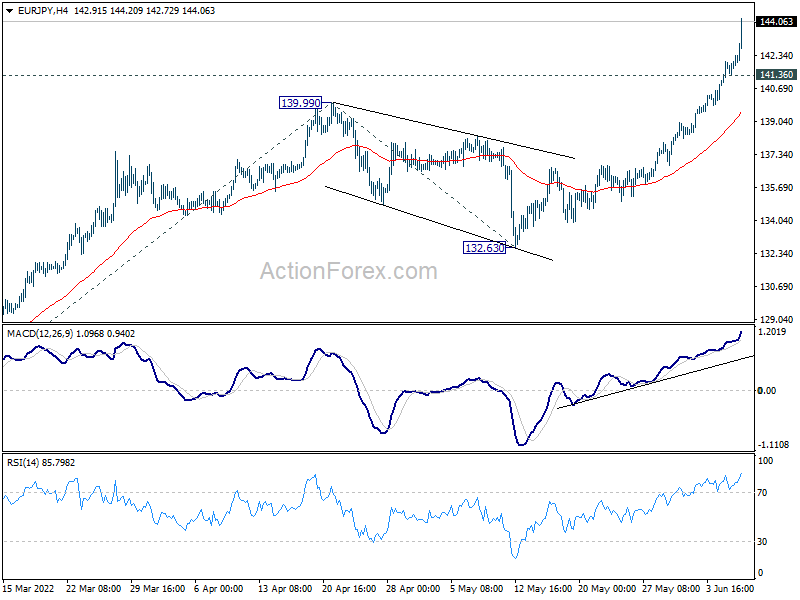
EUR/JPY roses to as high as 144.20 so far today. Sustained break of 144.06 could bring even further medium term upside acceleration. Next near term target is 100% projection of 124.37 to 139.99 from 132.63 at 148.25. On the downside, below 141.36 minor support will turn intraday bias neutral and bring consolidations first.
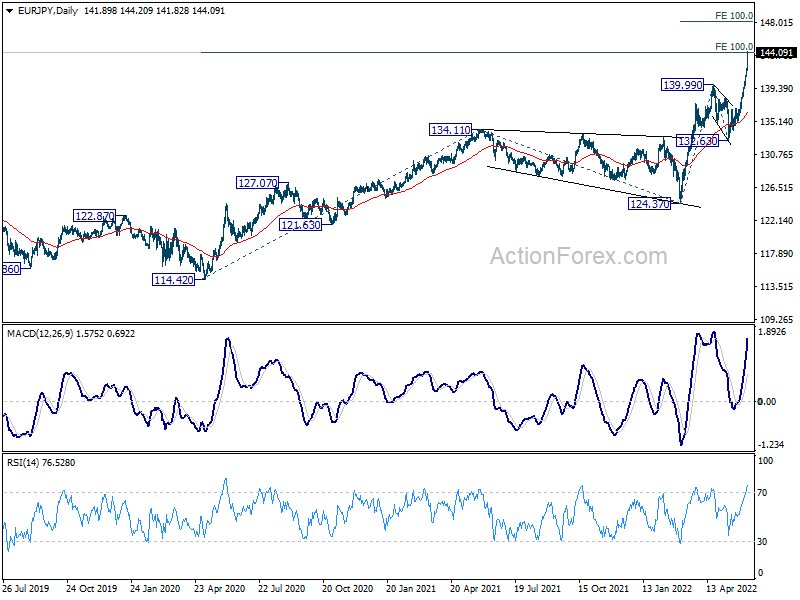
In the bigger picture, up trend from 114.42 (2020 low) is in progress. Such rise is seen as the third leg of the pattern from 109.30 (2016 low). Next target will be 100% projection of 114.42 to 134.11 from 124.37 at 144.06. Firm break there will indicate upside acceleration and target 149.76 long term resistance (2014 high). In any case, outlook will now remain bullish as long as 132.63 support holds, in case of deep pull back.
Euro Rises ahead of Tomorrow’s ECB, Yen Selloff Continues
The main focus remains on Yen's selloff today, on the back of widening yield spread between Japan JGB and other major benchmark treasuries. Meanwhile, Euro appears to be strengthening in general too. Traders are probably buying up the Euro in anticipation on a hawkish ECB policy decision and press conference tomorrow. The central should without a doubt announce the end of asset purchases after June. The question is whether President Christine Lagarde would hint on a larger rate hike in July, or a conservative one.
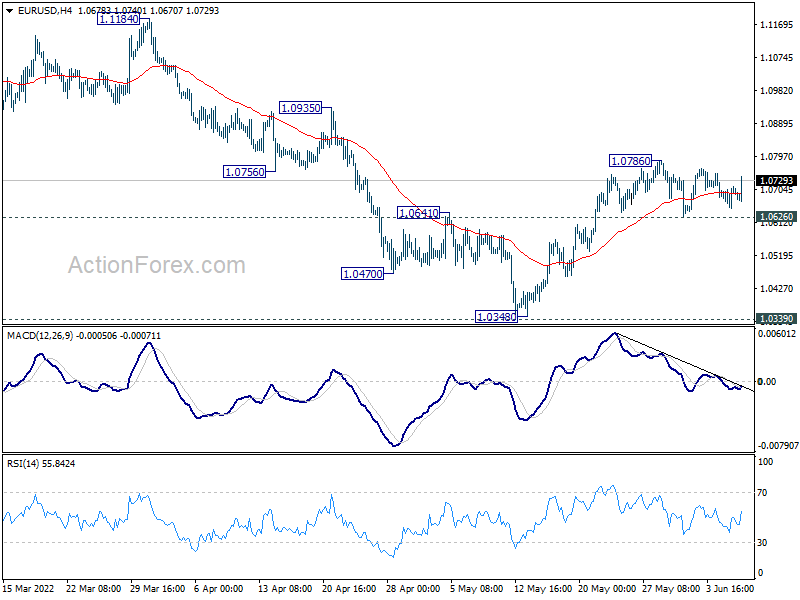
Technically, however, Euro still has a lot to proof as it's range bound against most except Yen and Swiss Franc. Levels to watch include 1.0788 minor resistance in EUR/USD, 0.8617 resistance in EUR/GBP, 1.4965 minor resistance in EUR/AUD, and 1.3538 minor resistance in EUR/CAD. Break of these levels is needed to confirm underlying momentum in Euro.
In Europe, at the time of writing, FTSE is down-0.60%. DAX is down -0.73%. CAC is down -1.00%. Germany 10-year yield is up 0.061 at 1.357. Earlier in Asia, Nikkei rose 1.04%. Hong Kong HSI rose 2.24%. Chinas Shanghai SSE rose 0.68%. Singapore Strait Times dropped -0.18%. Japan 10-year JGB yield dropped -0.0019 to 0.248.
Eurozone GDP finalized at 0.6% qoq in Q1, EU at 0.7% qoq
Eurozone GDP grew 0.6% qoq in Q1, revised up from prior estimate of 0.3% qoq. EU GDP grew 0.7% qoq. Ireland (+10.8%) recorded the highest increase of GDP compared to the previous quarter, followed by Romania (+5.2%) and Latvia (+3.6%). Decreases were observed in Sweden (-0.8%), France (-0.2%) and Denmark (-0.1%).
Eurozone employment grew 0.6% qoq while EU employment grew 0.5% qoq. In the first quarter of 2022, Estonia (+3.5%), Latvia (+2.1%) and Portugal (+1.7%) recorded the highest growth of employment in persons compared with the previous quarter. Employment declined in Poland (-0.6%) and Croatia (-0.1%).
Also released, Germany industrial production rose 0.7% mom in April, below expectation of 1.0% mom. France trade deficit was at EUR -12.2B in April, versus expectation of EUR -11.1B. Italy retail sales was unchanged, below expectation of 0.3% mom. Swiss unemployment rate was unchanged at 2.2% in May.
UK PMI construction dropped to 56.4, optimism deteriorates
UK PMI Construction dropped from 58.2 to 56.4 in May, below expectation of 56.9. S&P Global said total activity expanded at the slowest pace since January. Housing remained worst-performing category. Optimism was lowest since August 2020.
Tim Moore, Economics Director at S&P Global Market Intelligence: "May data signalled a solid overall rise in UK construction output as resilience across the commercial and civil engineering segments helped to offset weakness in house building. Residential construction activity was close to stagnation... New order volumes expanded at the slowest pace since the end of 2021...
"Concerns about the business outlook were signalled by a fall in construction sector growth projections to the lowest for more than one-and-a-half years in May. Around 19% of construction firms predict an outright decline in business activity during the year ahead, up from just 5% at the start of 2022."
BoJ Kuroda: Various models show weak yen is positive
BoJ Governor Haruhiko Kuroda said today that Yen's depreciation is "positive to the economy as long as the moves are stable". He added, "various macroeconomic models show weak yen is positive.. But he also reiterated that it's important for exchange rate to move "reflecting fundamentals".
Kuroda also retracted the remain made earlier on inflation which triggered massive social media backlashes. He told reporters at the Prime Minister's Office, "I did not mean that consumers are voluntarily accepting the price increases. I apologize if my words led to a misunderstanding."
Japan Q1 GDP finalized at -0.1% qoq, -0.5% annualized
Japan's GDP was finalized at -0.1% qoq in Q1, better than earlier estimate of -0.3% qoq. In annualized term. GDP contracted -0.5%.
Private consumption, which accounts for more than half of the GDP, was revised up to 0.06% qoq rise, from -0.03% decline. Capital expenditure dropped -0.7%, down graded from -0.5%. Exports grow was unchanged at 1.1% while imports rose 3.3%, downgraded from 3.4%.
GDP deflator was finalized at -0.5% yoy, revised form -0.4% yoy.
EUR/JPY Mid-Day Outlook
Daily Pivots: (S1) 141.31; (P) 141.69; (R1) 142.38; More....
EUR/JPY roses to as high as 144.20 so far today. Sustained break of 144.06 could bring even further medium term upside acceleration. Next near term target is 100% projection of 124.37 to 139.99 from 132.63 at 148.25. On the downside, below 141.36 minor support will turn intraday bias neutral and bring consolidations first.
In the bigger picture, up trend from 114.42 (2020 low) is in progress. Such rise is seen as the third leg of the pattern from 109.30 (2016 low). Next target will be 100% projection of 114.42 to 134.11 from 124.37 at 144.06. Firm break there will indicate upside acceleration and target 149.76 long term resistance (2014 high). In any case, outlook will now remain bullish as long as 132.63 support holds, in case of deep pull back.
Economic Indicators Update
| GMT | Ccy | Events | Actual | Forecast | Previous | Revised |
|---|---|---|---|---|---|---|
| 23:50 | JPY | Bank Lending Y/Y May | 0.70% | 0.80% | 0.90% | |
| 23:50 | JPY | GDP Q/Q Q1 F | -0.10% | -0.30% | -0.20% | |
| 23:50 | JPY | GDP Deflator Y/Y Q1 F | -0.50% | -0.40% | -0.40% | |
| 05:45 | CHF | Unemployment Rate May | 2.20% | 2.20% | 2.20% | |
| 06:00 | EUR | Germany Industrial Production M/M Apr | 0.70% | 1.00% | -3.90% | -3.70% |
| 06:45 | EUR | France Trade Balance (EUR) Apr | -12.2B | -11.1B | -12.4B | |
| 08:00 | EUR | Italy Retail Sales M/M Apr | 0.00% | 0.30% | -0.50% | -0.60% |
| 08:30 | GBP | Construction PMI May | 56.4 | 56.9 | 58.2 | |
| 09:00 | EUR | Eurozone GDP Q/Q Q1 | 0.60% | 0.30% | 0.30% | |
| 09:00 | EUR | Eurozone Employment Change Q/Q Q1 F | 0.60% | 0.50% | 0.50% | |
| 14:00 | USD | Wholesale Inventories Apr F | 2.10% | 2.10% | ||
| 14:30 | USD | Crude Oil Inventories | -2.6M | -5.1M |
USDJPY Wave Analysis
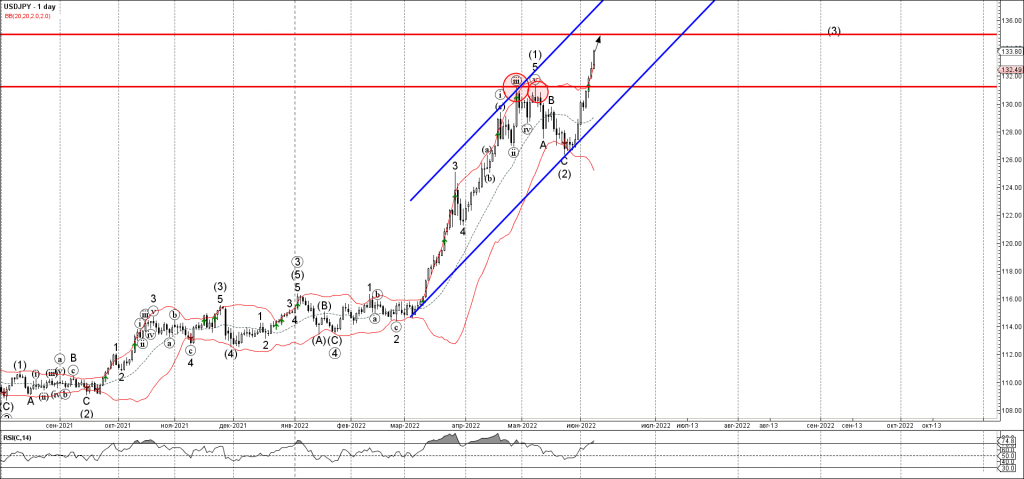
- USDJPY broke resistance level 131.20
- Likely to reach resistance level 135.00
USDJPY continues to rise after the earlier breakout of the resistance level 131.20 (top of the previous impulse waves (iii) and (1)).
The breakout of the resistance level 131.20 accelerated the active sharp upward impulse wave (3).
USDJPY can be expected to rise further toward the next resistance level 135.00 (the target price for the completion of the active impulse wave (3)).
Silver Wave Analysis
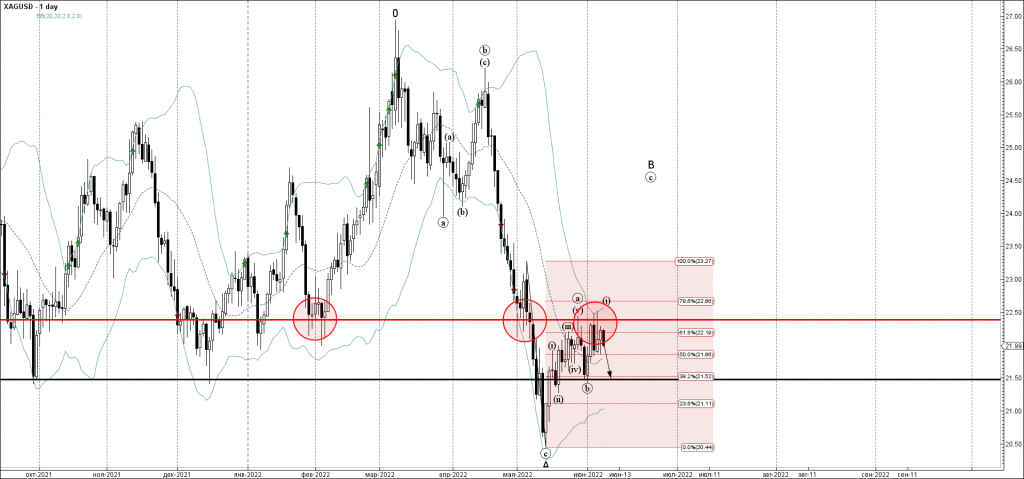
- Silver reversed from key resistance level 22.40
- Likely to fall to support level 21.50
Silver recently reversed down from the key resistance level 22.40 (which has been reversing the price from the end of May).
The resistance level 22.40 was further strengthened by the upper daily Bollinger Band and by the 61.8% Fibonacci correction of the downward impulse from the start of May.
Silver can be expected to fall further toward the next support level 21.50 (low of the previous corrective wave (b)).
Euro Completes Rebound and Prepares for Another Round of Declines
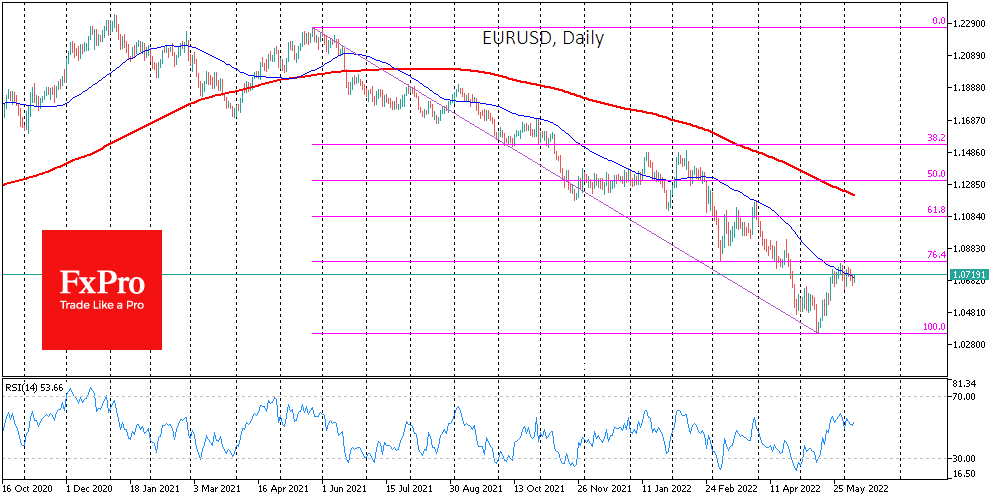
The single currency returned under 1.0700 after three days of decline. Late last month, EURUSD failed to consolidate above the 50-day moving average, confirming the prevalence of the downtrend.
The bounce in the pair in the second half of last month should be seen as a technical correction after accumulated oversold conditions after 12 months of a downtrend. That bounce lost its strength on the approach of the 50-day moving average and near the 76.4% Fibonacci retracement line. Such shallow corrections are characteristic of strong trending markets, setting up for a further leg down.
The EURUSD is in a reduced volatility mode waiting for another ECB decision tomorrow. Earlier, in AUD and NZD examples, we saw that raising the rate by 50 points does not guarantee a surge in the currency, even if the decision was more hawkish than the markets expected.
The lull in the euro could be a case of waiting and looking for a suitable excuse to resume a selloff in EURUSD, and the ECB meeting followed by a press conference looks like a pretty significant one.
The market is prepared that the ECB will not change policy now but will signal a rate hike at the end of July and complete its QE purchases by the end of this month. On the fundamental analysis side, this stance is much softer than competitors, continuing to put pressure on the euro.
Helping the euro not to repeat the fate of the yen tomorrow might be the unexpected resolve of the ECB and a higher speed of monetary policy normalisation compared to the US. The euro zone’s monetary authorities are bound by the region’s weak macroeconomic performance and high debt burdens in several countries.
Europe finds itself somewhere in the middle between the US and Japan regarding the balance of economic growth and the ability to digest rate hikes. The single currency could find itself in its dynamics against the dollar and yen somewhere between these poles.
Can the US Economy Avoid Recession?
The American economy is losing power. The housing market has started to show cracks and businesses are warning they might fire workers as they attempt to defend profit margins. Quite frankly, history suggests that avoiding a recession would be a miracle. The good news is that recession doesn’t always mean Armageddon - it could be mild instead. In this piece, we examine the potential effects in the FX market.
Slowing down
Storm clouds are gathering over the world’s largest economy. Consumers are feeling the burn of high inflation, as soaring food and energy prices force them to spend more on necessities. With real incomes falling so sharply, people are drawing down on the savings they accumulated during the lockdowns to fill the gap and maintain their lifestyle.
Federal Reserve officials have decided to go to war against inflation. They are raising interest rates with brute force to reduce demand across the economy, even though most of this inflation is caused by supply shocks that the Fed has no control over. The aim is to cool demand without causing too much damage and sparking a recession, so that there is a soft landing.
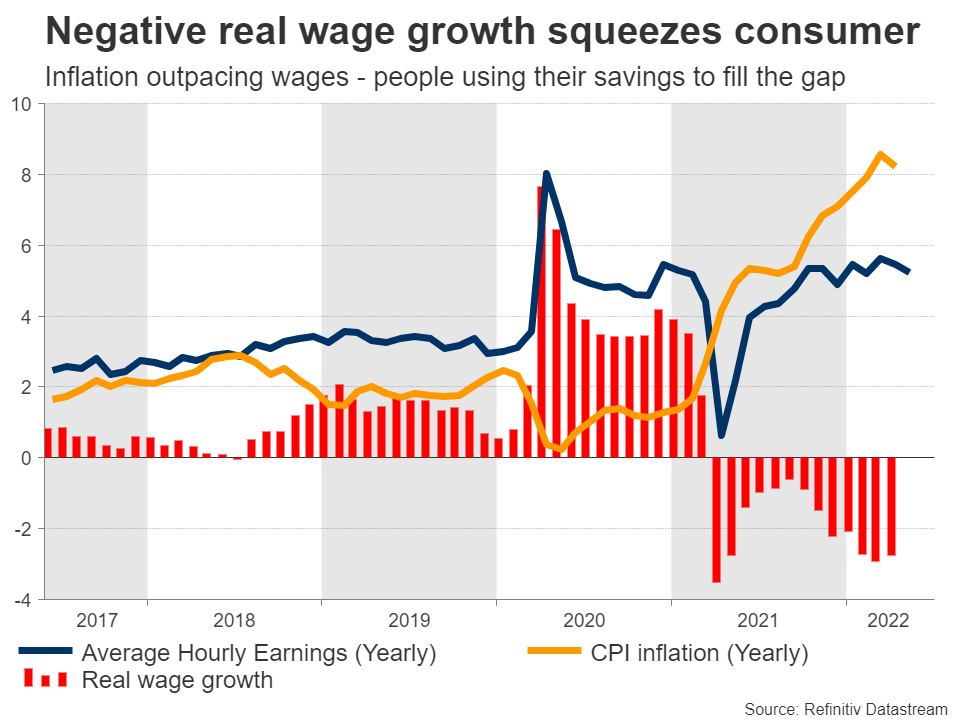
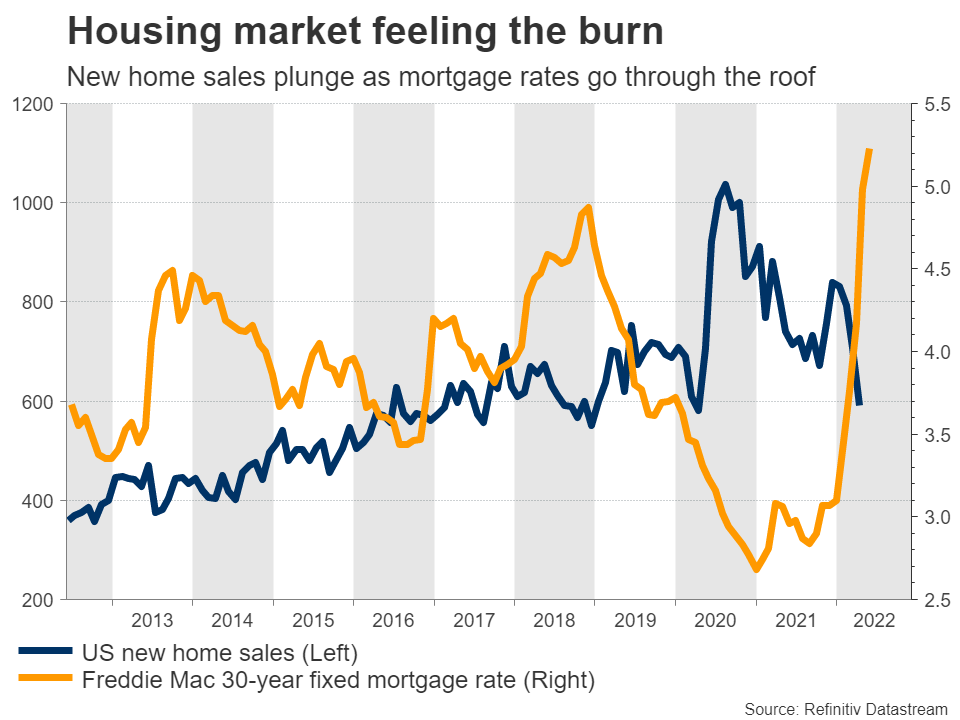
The impact is already visible in the housing market, where soaring mortgage rates have seen home sales decline dramatically in recent months. This is crucial because many Americans are used to refinancing their homes at ever-higher prices, which may not be possible anymore. Hence, household wealth is under pressure and the selloff in stock markets is making things worse.
At the same time, government spending is being rolled back at a stunning pace. Fiscal stimulus played a central role in boosting demand last year, but now many are criticizing the government for spending too much and amplifying inflationary forces.
The labor market has been a bastion of strength but even that is unlikely to remain immune for long as the economy slows. Some of the nation’s biggest employers like Amazon have already warned they could freeze hiring or lay off workers to manage costs, as they desperately try to protect profit margins from soaring inflation.
A look at history
Unfortunately, there haven’t been many soft landings over the past century. Almost every time that the Fed has embarked on a series of rate increases to fight inflation, the endgame has been a recession.
There have been three exceptions to this pattern - 1994, 1984, and 1965. The common characteristic in these episodes was that the Fed was trying to prevent inflation from moving even higher. This is a very different situation than today, when it is actively trying to bring inflation down.
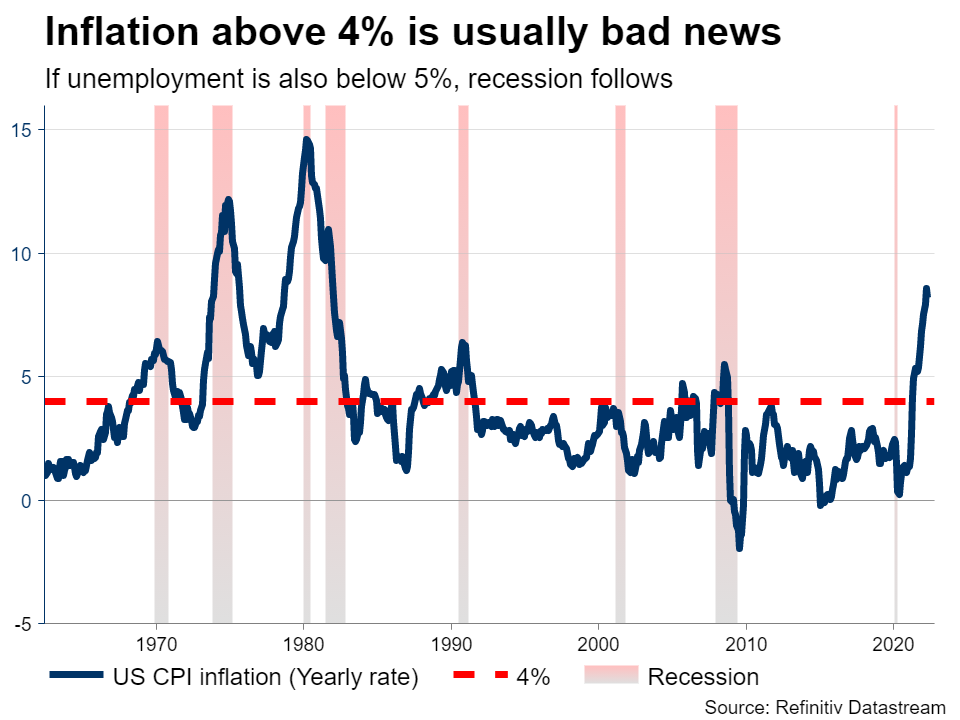
In fact, since 1955 there has never been an instance when inflation was above 4% and the unemployment rate was below 5% that wasn’t followed by a recession in the next two years. The US economy has already overshot both metrics by a mile.
Investors on alert
The bond market is already flashing warning signals. The most popular indicator that a recession is imminent is when long term Treasury yields fall below shorter term ones. It shows that investors are betting on a severe slowdown in economic growth and it has preceded recessions with terrifying accuracy over the last five decades.
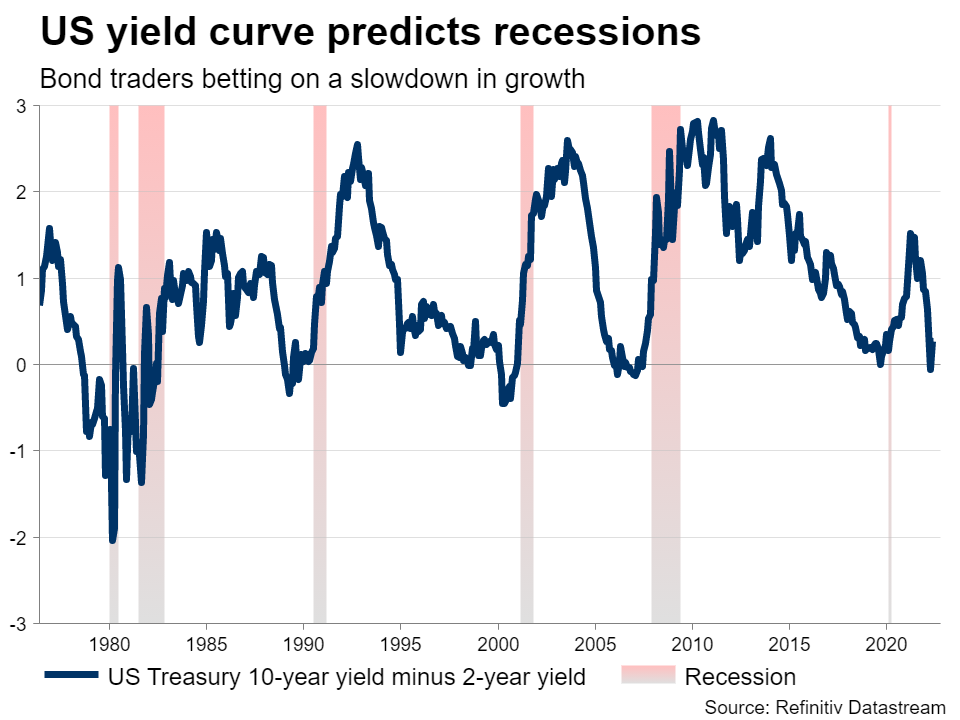
This happened earlier this year, so bond traders are saying the distribution of outcomes has indeed shifted in this direction. Prominent economists like former Treasury Secretary Larry Summers share this view, along with business leaders like the CEO of JPMorgan Chase, who recently warned a hurricane is about to hit the economy.
Some good news
While a downturn seems increasingly likely, it is fruitful to remember that a recession is not the end of the world. There have been thirteen recessions since the end of World War II and most of them were ‘plain vanilla’ - brief and shallow. The prolonged suffering many people experienced after the 2008 crisis was an extreme outlier, not the norm.
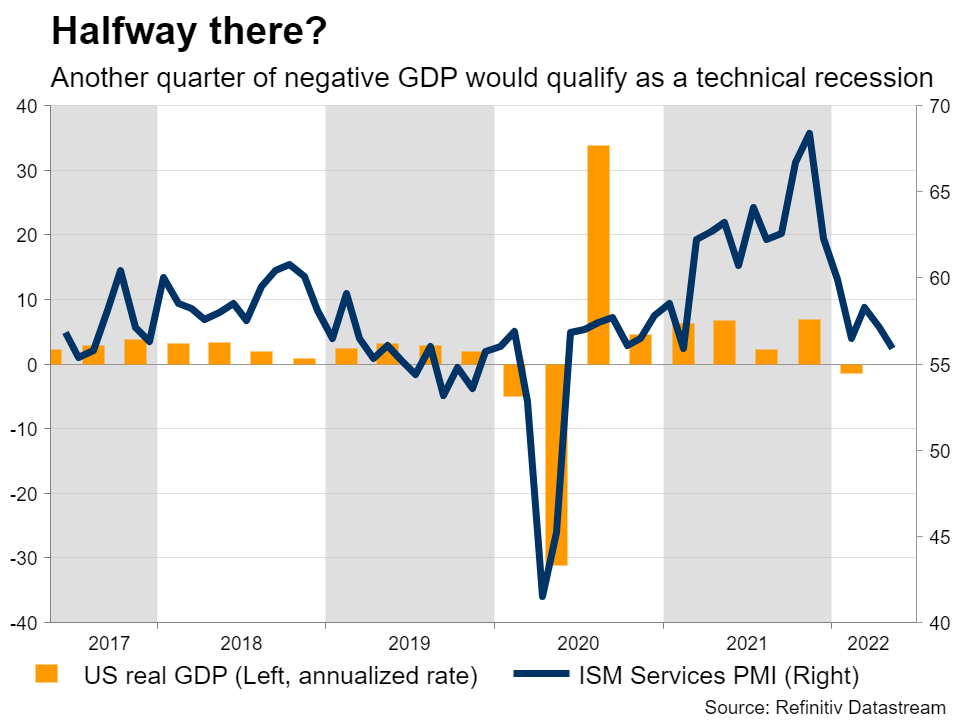
A couple of quarters of negative GDP growth would qualify as a recession but not necessarily a crisis. In fact, we are already halfway there. Economic growth in the US turned negative in the first quarter and the Atlanta Fed GDPNow model estimates growth at only 0.9% this quarter.
Another point to consider is that historically, the Fed has reversed course at the first sign of trouble. After all, an economic slump would probably destroy enough demand to crush inflation. This is another argument as to why any recession might be mild. The Fed will take its foot off the brakes as soon as the engine starts to fail.
Market implications
The US dollar typically performs well when investors panic about a recession, even if the crisis originates from America. This dynamic boils down to the dollar’s reserve currency status acting as a hedge against uncertainty and the unparalleled liquidity it offers businesses even during times of market stress.
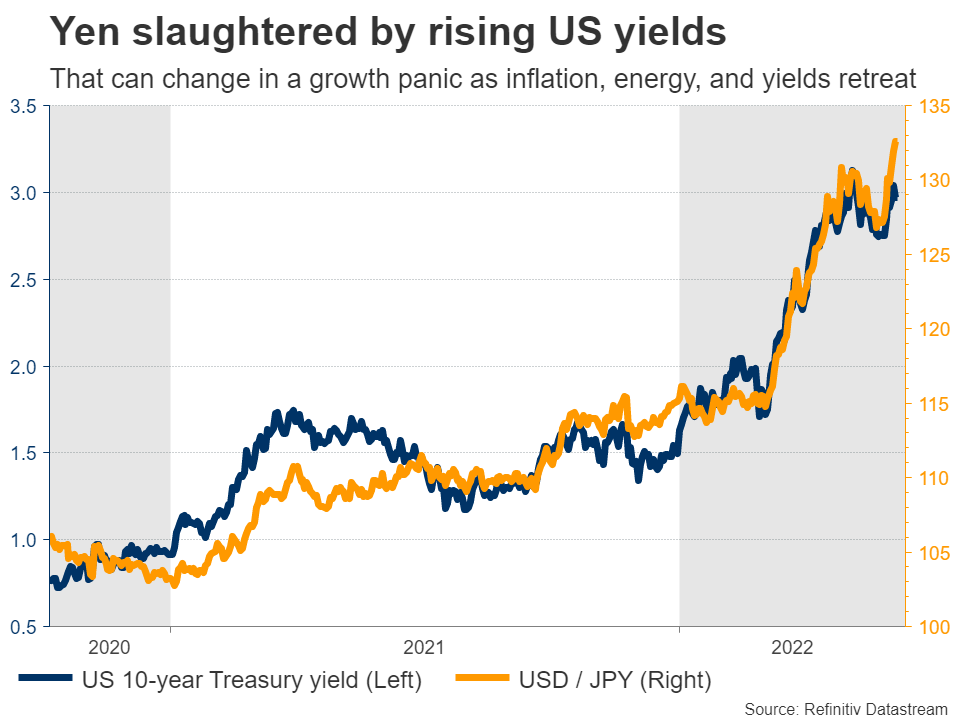
Another currency that’s likely to shine is the Japanese yen. The yen has been slaughtered so far this year by rising yields in the rest of the world and a trade shock as energy prices soared. But in case a recession hits, inflation expectations and yields globally are likely to fall back alongside energy prices, helping the yen to recover.
Meanwhile, the currencies likely to underperform in this scenario are the commodity-linked dollars, and to a lesser extent the British pound. The Australian and New Zealand dollars are tied to global growth since their economies rely on commodity exports, while sterling has a strong correlation to stock markets, trading almost like a proxy for global risk sentiment. Therefore, pairs like aussie/yen or sterling/yen could experience the sharpest moves.
All told, a recession is not inevitable. There is a path where the Fed manages to engineer a soft landing with growth slowing just enough to cool inflation. It just doesn’t seem very realistic from a historical perspective. Instead, let’s hope that any downturn turns out to be mild, causing little damage and ending quickly.
EURGBP Ascends Sharply after Decline Pauses
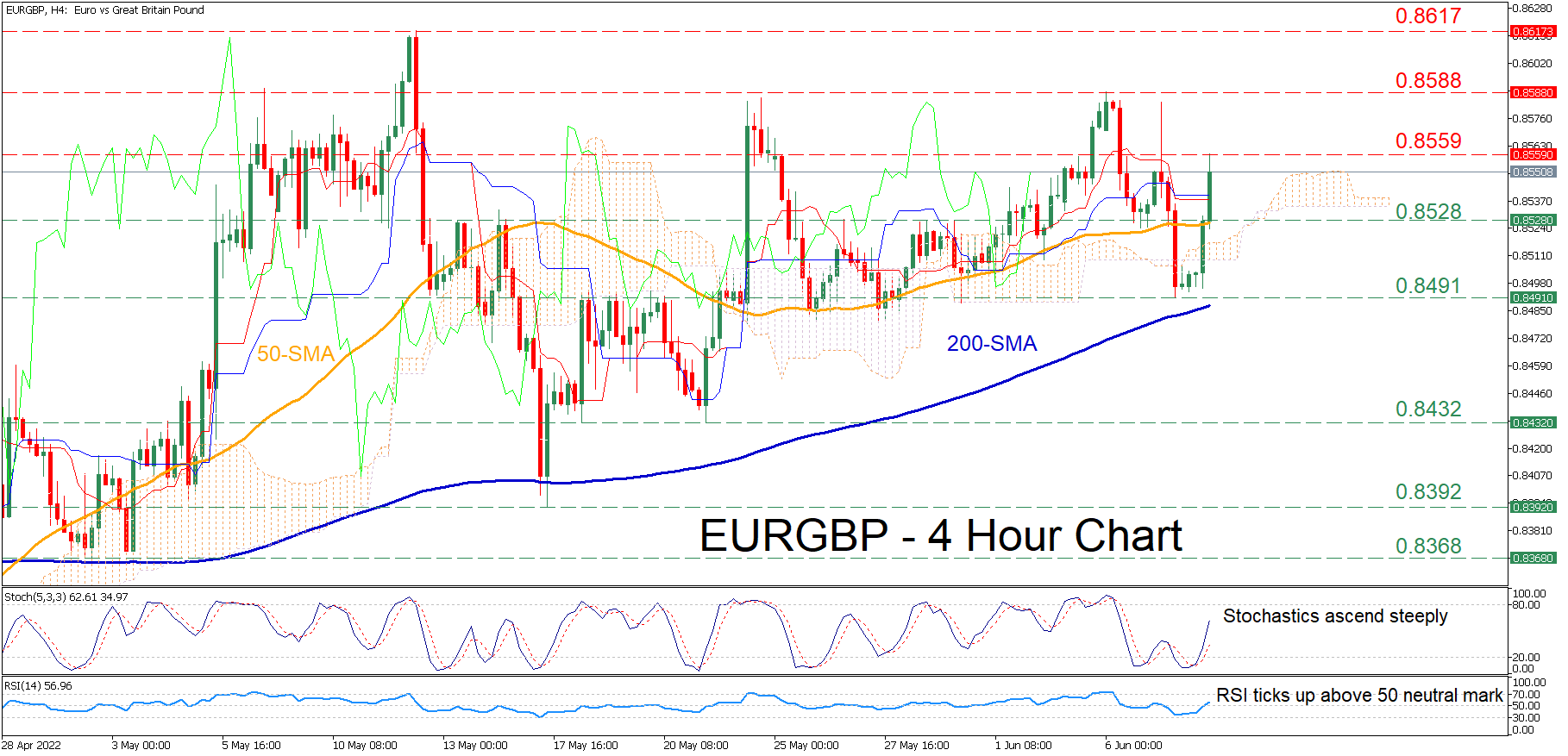
EURGBP experienced a minor pullback after its uptrend failed to cross above the 0.8588 region. However, the pair quickly bounced back and recouped part of its losses, while the ascending 50- and 200-period simple moving averages (SMAs) paint a bright technical picture.
The momentum indicators suggest that positive momentum is strengthening. Specifically, the stochastic oscillator is climbing steeply, while the RSI is sloping upwards beyond its 50-neutral mark. Moreover, the price is trading above the Ichimoku cloud, endorsing a broader bullish short-term picture.
To the upside, should the advance resume, the 0.8559 barrier might act as the first line of defence. Jumping above this level, the price could challenge the recent high of 0.8588. Failing to stop there, the bulls may aim for the May peak of 0.8617.
Alternatively, if bullish pressures wane, the pair could descend towards 0.8528, which overlaps with the 50-period SMA. Diving beneath that region, the recent low of 0.8491 could halt any further declines. Should that floor collapse, the spotlight might turn to 0.8432 before the 0.8392 obstacle appears on the radar.
Overall, EURGBP appears to have the necessary momentum to push higher and erase its recent drop. However, a dive beneath the 0.8491 level could alter its short-term picture back to negative.
Japanese Yen is Slip Slidin’ Away
Yen descent continues
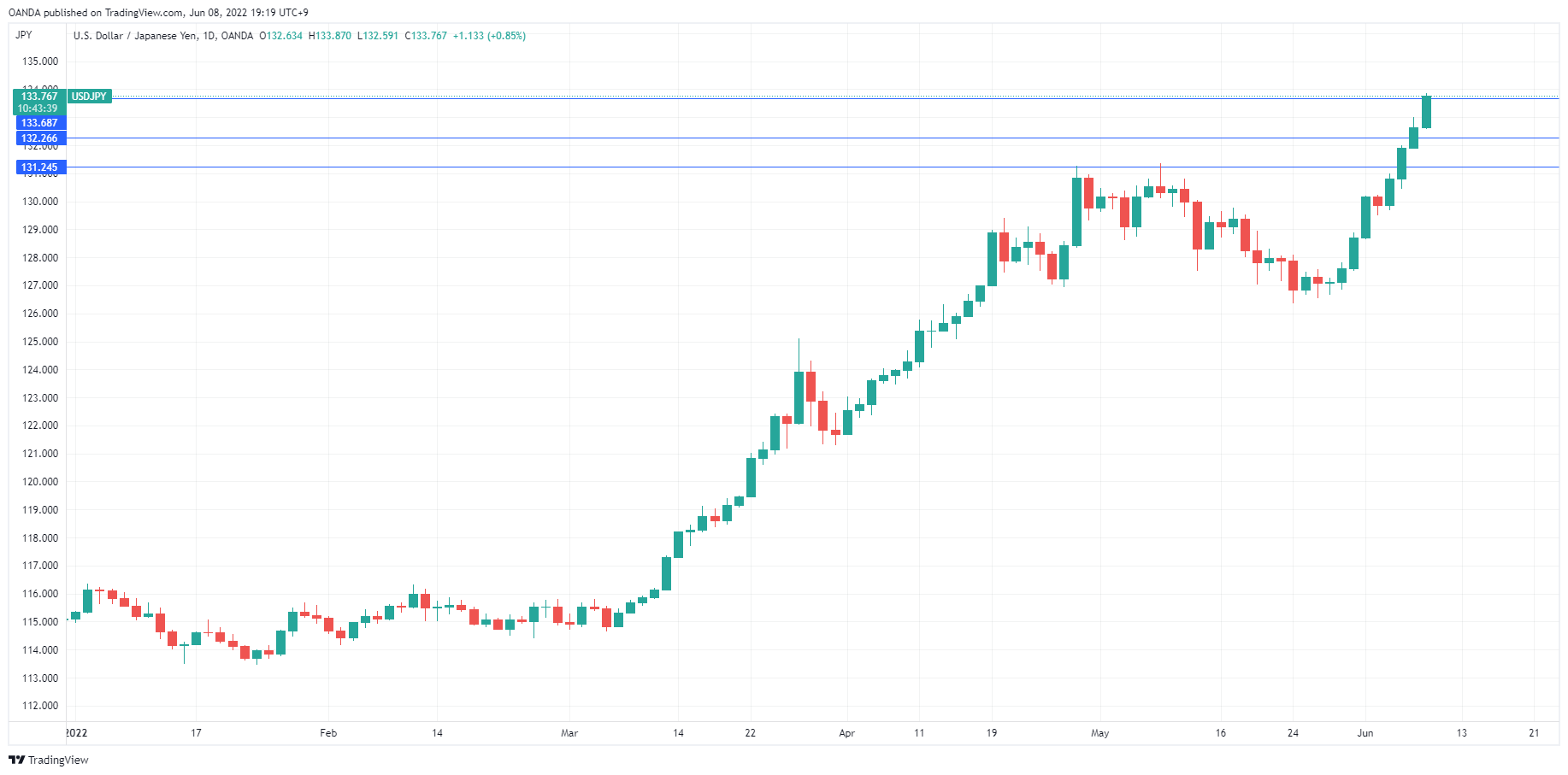
The Japanese yen can’t seem to buy a break. USD/JPY has jumped 0.84% today and has surged 2.22% this week. The pair is currently trading at 133.76, yet another 20-year high.
The yen has mustered just one winning session in the past nine, but there hasn’t been any response from Japanese officials, either at the Bank of Japan or at the Ministry of Finance (MOF). What is notable about today’s losses is that US Treasury yields are lower and yet USD/JPY has still rallied. That could rattle Tokyo and result in some comments about officials expressing concern about the exchange rate, the type of empty rhetoric which we have seen before.
Earlier in the week, BoJ Governor Kuroda said that monetary tightening was not suitable and that the BoJ intended to maintain its ultra-loose policy. Japan’s economy remains fragile, and with inflation rising but still below the Bank’s inflation target of 2%, Kuroda can afford to continue this policy. The cost has been a rapidly descending yen, but Kuroda has stated on more than one occasion that a weak yen is mostly positive for the economy. As the yen continues to fall, speculators are likely to join the party and bet against the yen until the BoJ or MOF intervene to bolster the currency, but so far there is no sign of that happening. Unless US yields make a sharp U-turn lower, the risk of the Japanese yen remains tilted downwards.
The yen is also under strong pressure from the euro. EUR/JPY has fallen for 10 consecutive trading sessions and has touched a seven-year high. The ECB is expected to end its QE programme this month and embark on a rate-hike cycle in July. This would leave the Bank of Japan as the only major central bank that has not joined the tightening bandwagon.
USD/JPY Technical
- USD/JPY is testing resistance at 133.68. Above, there is resistance at 1.3638
- There is support at 132.26 and 131.24
AUD/USD Elliott Wave Analysis: RBA and China Reopening are Good for Aussie Bulls
RBA surprised and hiked more than expected this week; they lift the interest rate to 0.85% from 0.35% during the latest meeting, but Aussie did not rally much. We have seen 60 point move before the pair slowed down, despite the fact that the board expects to take further steps in the process of normalizing monetary conditions in Australia over the months ahead. Decisions will depend on upcoming data.
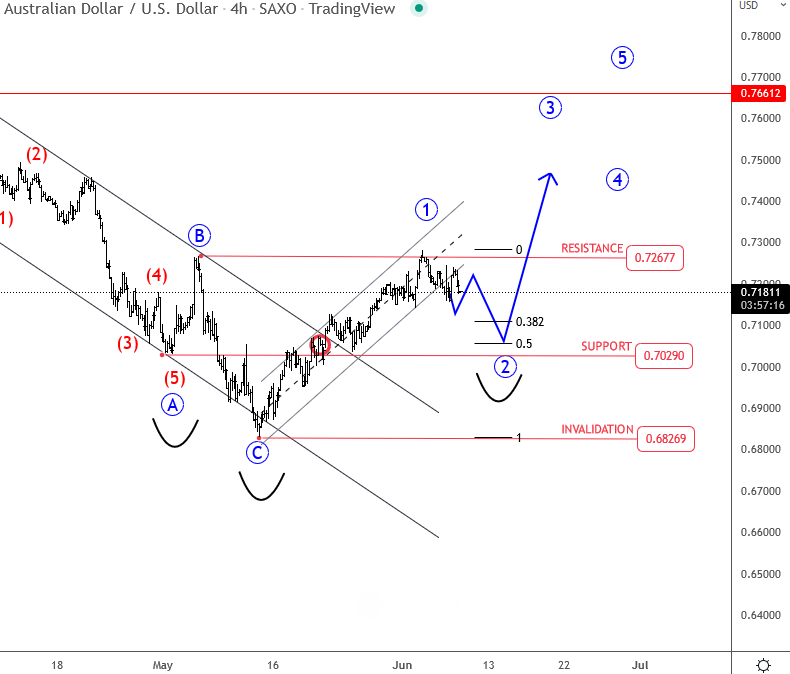
Technically speaking Aussie is trying to wake up along with stocks, so seems like wave C is already in place, unless this is still a higher degree leg A from the 0.7661 highs. Well, at this stage it's too early to confirm any new long-term bottom, but at least in the short-term, we should be aware of more upside after recently broken trendline resistance in the first leg, so more upside can be coming after pullback. Support is at 0.70/30 which can be also a base for a right shoulder. Some resistance is now at 0.7267 for end of the first leg.
Big picture
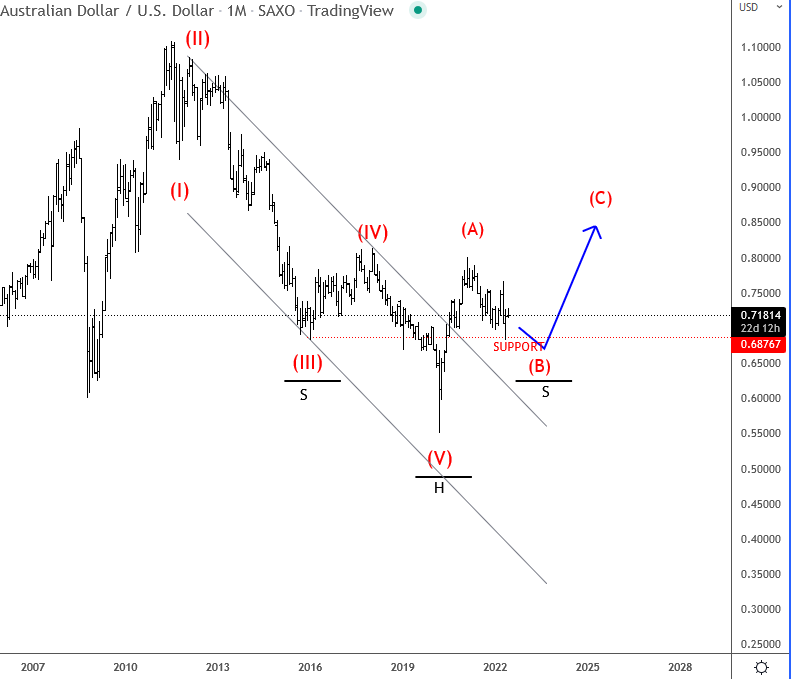
Ideally, the weakness from the start of April belongs to a higher degree of corrective set-back from 2021 highs which can stop this year around 0.6800 area especially as RBA sees a lot more rate increases in the months ahead. So at some point policy gap between RBA and FED will narrow which can be a catalyst for a bounce on Aussie in the second part of 2022. Bounce on stocks would also be very positive for the Aussie.