

Sample Category Title
OECD Downgrades Growth Outlook
Market movers today
Today's highlight is the ECB meeting where we expect a formal end to the APP programme. Discussion will focus on the possibility of ECB could move by 50bp at a later stage. Markets are pricing in around 40% of a 50bp hike in July. We also focus on potential fragmentation tools. ECB's new staff projections is expected to see upward revision of inflation and downward revision on growth.
In Sweden, we get the household consumption and April GDP-indicator and Riksbank's Breman will attend a seminar to discuss inflation, monetary policy and sustainability (for more details, see the Nordic section).
The 60 second overview
ECB today: The main event today is the ECB meeting and the expected wind-down of the QE as well as preparing for rate hikes. The inflation outlook is expected to be revised upwards and the growth outlook downwards. The discussion on the policy path centres around a 50bp rate hike already in July. Markets are pricing in around 40% of a 50bp hike in July. Hence, even though there is a lot priced in, the risk is still on the upside for rates and spreads between Italy and Germany. Lagarde will most likely be asked about market fragmentation, but we do not expect much action on this from the ECB at this meeting. Hence, the risk is more pressure on the periphery and especially Italy after the meeting despite the widespread BTPS-Bund spread.
OECD revise growth forecasts lower: Yesterday, OECD published its new global forecast, downgrading significantly their growth forecast for the global economy in 2022 by 1.5pp to 3% compared to their last update in December 2021. They expect economic growth to remain subdued in 2023. The reason for the meagre growth outlook is the war in Ukraine and the impact of higher oil and other commodity prices along with the COVID-related lockdowns in China. In general their forecast for 2022 squares well with ours, also seeing near-term economic growth holding up fairly well. However, in 2023, we are significantly more downbeat on the growth prospects in the US, fearing a mild recession, while OECD expects positive growth. On the other hand, we see a bigger rebound in China than OECD as we think the policy stimulus will support domestic demand. Our forecasts for the euro area in 2023 are fairly identical expecting about 1.6%-1.8% in real GDP growth. Market reactions to the release of the OECD forecasts were muted.
Equities: Equities were lower yesterday as the stagflation fear dominated and slowly but steadily took risk appetite lower during the day. No single event or data point behind the move yesterday but yields across the curve and on both sides of the Atlantic moved higher. This could sound like the stagflation trade coming back but that was not the case. With higher yields, one could have expected value to outperform growth but that was not the case yesterday. Hence, investors are struggling to find out whether to fear stagflation or central bank tightening led recession. Moves in US more less the reverse of Tuesday with Dow -0.81%, S&P 500 -1.1%, Nasdaq -0.7% and Russell 2000 -1.5%. Asian markets are mostly lower this morning with Japan going against the trend as the yen keeps weakening against most other currencies. Futures in Europe and US are lower this morning.
FI: Global yields once again rose after the decline on Tuesday. 10Y Treasuries is back above 3%, while 10Y Germany is again above 1.30%. The curve steepened from the long end. The rise in yields also lead to a modestly wider Bund ASW-spread despite the solid activity in the primary market with plenty of new bond deals. The rise in yields comes despite the focus on risk of a recession and negative sentiment in the bond market.
FX: JPY weakness continues to be the dominant theme as we head into the ECB meeting. USD/JPY has now broken above 134. EUR/USD continues to trade around 1.07 while the Scandies did little in yesterday's session.
Credit: Sentiment in the secondary market remained downbeat yesterday where iTraxx Xover widened more than 8bp and Main 1.5bp. However, recent days' widening should also be seen in light of the string of new issues that have come to the market ahead of tomorrow's ECB meeting.
Nordic macro
Riksbank's Breman will attend a seminar to discuss inflation, monetary policy and sustainability. Published on the website at 09.15. Any hints about coming hikes (50bps?) will be in focus. Our call is for 50bp hike at the next meeting but inflation and inflation expectations released next week will be more or less crucial.
We expect that the weak demand shown in GDP for Q1 released last week will also be reflected in the monthly indicator out today (household consumption and April GDP-indicator). Non-essential consumption is usually the first one to decrease which we also expect to see in today's figures. Especially clothing and restaurants and hotels have had a tough time since the start of the pandemic so far. However, we see no rise in bankruptcies.
Also, production data is out today. During March, production numbers came out flat compared to February while the order inflow came out strong in contrast to the order inflow in PMI. If PMI is correct, new orders in hard data should decrease from here, which seems reasonable given the weaker global demand.
And Today’s Theme is
Inflation. The chop-fest range trading beguiling currency, bond, and equities markets in the US this month continued overnight. Overnight, New York decided that it was in fact worried about inflation, having dismissed it the day before. Tomorrow, perhaps, they won’t be once again. That saw equities retreat, US yields firm, with US 10-years back above 3.0% once again, while the US Dollar also booked some modest gains.
Ignoring the noise elsewhere, oil continued its march higher, Brent crude jumping 2.40% to 123.95 a barrel overnight. An unexpected rise by official US Crude Inventories of 2.0 million barrels, and distillates by 2.5 million barrels provided no solace to oil markets, as gasoline stocks remained flat. Most of the price rise can probably be attributed to fighting talk by the UAE Oil Minister at a conference yesterday.
According to Reuters, Minister Suhail al-Mazrouei said the OPEC+ shortfall to target was 2.6 million barrels, with OPEC+ compliance at 200%. He also warned that a reopening of China would place further stress on supplies. He also said that we were nowhere near peak oil prices. Gulp. In other news difficulties monitoring Iran’s nuclear compliance puts a new nuclear deal, and more Iranian crude on international markets, as far away as ever.
That leads nicely into China, where markets were awaiting this morning’s May Balance of Trade release. The trade balance has exploded higher to $78.76 billion, led by exports increasing by 16.90%, while imports climbed by 4.10%. I suspect port reopenings have flattered the data. However, from my point of view, the trade data is irrelevant to a much more important development that has occurred today. This morning, Shanghai residents awoke to the news that the Shanghai district of Minhang, home to two million people, has been placed under strict lockdown with mass testing scheduled for Saturday. Markets have been naively pricing in that the easing of restrictions in Beijing and Shanghai was the final victory over omicron, and thus, peak covid-zero.
As I have said repeatedly with regards to covid-zero country’s experiences, the country has to get lucky 100% of the time, the virus has to only get lucky once. China is no different from anywhere else in this respect and buying the dip for a China bounce is a perilous activity. Covid-zero is going nowhere in China, and nor is the virus. Thus, the chances of extended restrictions returning, with the ensuing drop in China's economic activity, remain as high as ever. They could repeat over and over again. About the only good news from this development is that it might take the edge off the oil rally.
Still, the news isn’t all bad on the inflation front. The US Treasury Secretary indicated overnight that the US was looking to “reconfigure” tariffs on Chinese imports. Translation: we’ll drop a lot of them to try and slow inflation down ahead of November’s mid-term elections. Indonesia today, has also announced an export acceleration scheme to ship at least one million tonnes of palm oil and derivatives to international markets according to Channel News Asia. And yesterday from Reuters, India indicated it would soon allow 1.2 million tonnes of wheat exports after banning exports previously.
Neither development will materially move the dial on food inflation thanks to the Russia/Ukraine conflict, but it does show both an understanding and willingness by exporting countries, of the downstream impacts globally and the need to assist in mollifying them. Like China’s covid-zero policy though, nobody should be naïve enough to expect them not to return and bite the global economy again. Food nationalism will continue to be a real issue throughout 2022 and into 2023.
China’s trade date was the only tier-1 Asia data release today. Philippine’s trade balance held steady at $-4.8 billion for April, barely changing from March. Imports rose 22.80% YoY, likely reflecting skyrocketing food and energy prices. Indonesia’s May Consumer Confidence leapt higher to 128.90, and the rising cost of living or not, it's hard to see any recessionary signs here in Jakarta. Pak President’s removal of the mask mandate seems to have magically restored activity of pre-pandemic levels, and the traffic is well and truly back to normal here. So much so, that Jakarta’s local government has expanded the odd/even car restrictions to a larger part of the Big Durian.
This afternoon's undoubted highlight will be the European Central Bank policy meeting, perhaps the most anticipated one of the year. Given her recent guidance, ECB President Lagarde has primed markets for an ending to their quantitative easing but don’t call it quantitative easing programme, this month or next, as well as two 0.25% rate hikes in July and September. The rates curve has fully priced this in, with 130bps of hikes expected by year-end. I think that’s punchy myself, given that Europe is moving into a war economy, with a lot of inflation imported and beyond its control thanks to the conflict in the East.
By default, one would expect that much of the Euro’s recent recovery is down to those rate hiking expectations as well. So, this afternoon will be all about the press conference as it would be a huge surprise if they hiked by 0.25% today as well. (note: I have already used huge surprise and central bank this week and I was wrong) A rate hike today could shake EUR/USD out of its 1.0700/1.0800 malaise and open gains to 1.1000. On the other hand, If Ms Lagarde has blinked and become dovish again, the adjustment lower by the ECB rates curve and EUR/USD could get quite emotional.
The US calendar is dead ahead of tomorrow's Inflation main event. US Jobless Claims may see traders grasping at straws on a slow news day. Otherwise, I suspect we will see another mood-swing session from the FOMO gnomes of Wall Street, with any excuse to buy, the genetically pre-programmed default option.
Shanghai restrictions weigh on Asian equities
The moody range-trading that has typified US equity markets in June continued overnight as Wall Street decided that inflation was a concern, after all, sending equity markets lower. The S&P 500 fell by 1.08%, the Nasdaq finished 0.73% lower, while the Dow Jones lost 0.82%. Futures on all three remain negative today, easing by around 0.15%.
Asian markets were never likely to have a good start after a weaker New York session, but the lockdown of the Minhang district of Shanghai has delivered a much-needed wake-up call around the reality of China’s covid-zero policy to regional markets. Asia has started today in the red on renewed China slowdown fears, ignoring mighty Chinese trade numbers. The only exceptions are Japan, where a plummeting Yen has lifted the Nikkei 225 0.30% higher, and Jakarta, where the palm oil export scheme has lifted the JCI 0.50% higher.
Elsewhere, it is a sea of red today. South Korea’s Kospi has fallen by 0.60%, Mainland China’s Shanghai Composite eased by 0.45%, with the CSI 300 losing 0.55%. Hong Kong’s Hang Seng has also fallen by 0.50%, with the positive sentiment of the overnight China tech ADR rally evaporating in a sea of mass testing stations.
Regionally, Singapore has fallen by 0.50%, with Taipei losing 0.45%, and Kuala Lumpur falling by 0.70% as the government faces ever-higher fuel subsidy bills with oil's rally. An ironic outcome for an oil predicting nation. Bangkok has managed a 0.20% gain today, with Manila tumbling by 0.90%. Australian markets aren’t liking the Shanghai news either, the All Ordinaries have lost 0.95%, while the ASX 200 has fallen by 0.90%.
With the ECB meeting today, and nerves around China’s covid-zero policy and its impact on growth, along with a surge in oil prices overnight, Europe is unlikely to have any reason to click the buy button this afternoon. That may all change post the ECB is the central bank is more dovish than expected. Conversely, if the ECB delivers a hawkish surprise, European equities are likely to remain pressured.
Currency markets continue to range trade
US yields climbed higher overnight which was enough to lift the dollar index to a 0.20% gain to 102.55. It has given most of that back in Asia, falling to 102.40 thanks to a modest Yen rally. Another inconclusive session leaves support/resistance at 101.30 and 102.70.
EUR/USD edged higher to 1.0715 overnight, adding another 0.15% to 1.0730 in Asia as JPY strength has spread, once again, to the broader FX market in Asia today. Resistance is between 1.0770 and 1.0830 remains a formidable barrier, while support remains at 1.0650. The outcome of today’s ECB meeting will set the tone for the single currency for the rest of the session.
Sterling fell 0.45% to 1.2535 overnight as economic worries, leadership concerns, and the Northern Island protocol weighed on the Sterling. Like the other majors, it remains in a choppy range-trading scenario overall. Resistance remains at 1.2670, 1.2800, and 1.3000. Support is still at 1.2460 and 1.2400.
It was another feeding frenzy by USD/JPY overnight, by far the highlight in an otherwise dull night for currency markets. The disparity between US and Japan monetary policies was once again to the fore. USD/JPY leapt by 1.22% to 134.25 overnight. In Asia, nerves around invention have spurred some long-covering, pushing it slightly lower to 133.95. The Relative Strength Index (RSI) is overbought, but not grossly so, so I do not foresee an aggressive move lower just yet, that may have to wait for 135.00 to trade.
Although I can see an increase in rhetoric about the currency from Tokyo increasing, I do not believe we are close to intervention by the authorities at all. A far more likely occurrence would be some sort of tinkering with the BOJ’s yield curve control policy. Given the vehemence around no change from the BOJ and MOF, that would be a huge surprise as well. ("Huge surprise" used for the 3rd time, danger Will Robinson!) A move by the BOJ in this regard would provoke an ugly washout of USD/JPY long positioning, potentially targeting 125.00. In the meantime, it is business as usual. Support is at 132.65 with the next upside target being 135.00.
Both AUD/USD and NZD/USD fell once again overnight, and I will admit to some confusion over the recent price action. AUD/USD fell 0.55% to 0.7190, easing to 0.7180 in Asia. NZD/USD fell 0.65% to 0.6445 where it remains in Asia. Although the reason behind the negatively eludes me, the technical picture is becoming more soggy than a wet piece of paper. Both currencies have broken below ascending one-month trendlines. Failure of 0.7150 and 0.6425 respectively, suggests another material move lower is occurring.
USD/Asia continues to range trade, with regional currencies almost unchanged today after a directionless New York session. Ominously, the Indian Rupee shrugged off a 0.50% rate hike by the RBI yesterday and the USD/INR is trading at 77.678, near its highs for the year. Similarly, USD/MYR, USD/THB and USD/PHP are all closing in on their year’s highs again. The rally in oil prices could also cause USD/KRW to play catchup and appears to be weighing on all four. A higher than expected US CPI number tomorrow could complicate that picture further, lifting Fed hiking expectations.
UAE Oil Minister lifts oil prices
Oil prices shot higher overnight with the UAE oil minister warning that China’s reopening and the inability of OPEC+ members to pump at production targets posed more upside risks to oil prices. Tensions around Iran’s nuclear programme also diminished hopes of more Iranian crude on international markets. Finally, although US crude inventories rose by 2 million barrels, gasoline production was flat, keeping up the squeeze on refined products in the US.
That saw Brent crude ratchet higher by 2.40% to $123.75 a barrel, while WTI rallied by 2.25% to 122.45 a barrel. In Asia, oil prices have remained flat, with the lockdown of the Minhang district in Shanghai spurring China covid-zero part two fears, crimping demand in Asia today. That said, it is indicative of how tight supplies are that oil has not retreated on that news today.
That leaves the chart picture looking positive with the respective RSIs still not yet in overbought territory. Brent crude has traced out a series of highs at $124.25 marking initial resistance. After that, the road opens to $125.00 and $128.00 a barrel, bringing the Ukraine invasion highs back into sight. WTI has resistance at $123.15, the overnight high, and then $125.00 and $127.00 a barrel. Support is at $119.35 and $117.50 a barrel.
Gold remains in a coma
With little movement in the US Dollar overnight, gold remained sedated as well, closing almost unchanged at $1853.35 an ounce. In Asia, a slightly lower US Dollar has seen gold crawl modestly higher to $1855.00 an ounce. It seems that like currency markets, we are going to have to wait for tomorrow's US Inflation data to create a directional move one way or the other. In the meantime, bring a good book.
Gold has resistance at $1870.00, followed by the 100-DMA at $1890.00, and then $1900.00, where I expect there to be options-related sellers in the first instance. Support is at $1837, $1830.00, and then $1780.00 an ounce. I do not discount a disorderly retreat if the latter fails. The wider $1830.00 to $1870.00 range seems set to continue until Friday.
USD/JPY Daily Outlook
Daily Pivots: (S1) 133.05; (P) 133.76; (R1) 134.97; More...
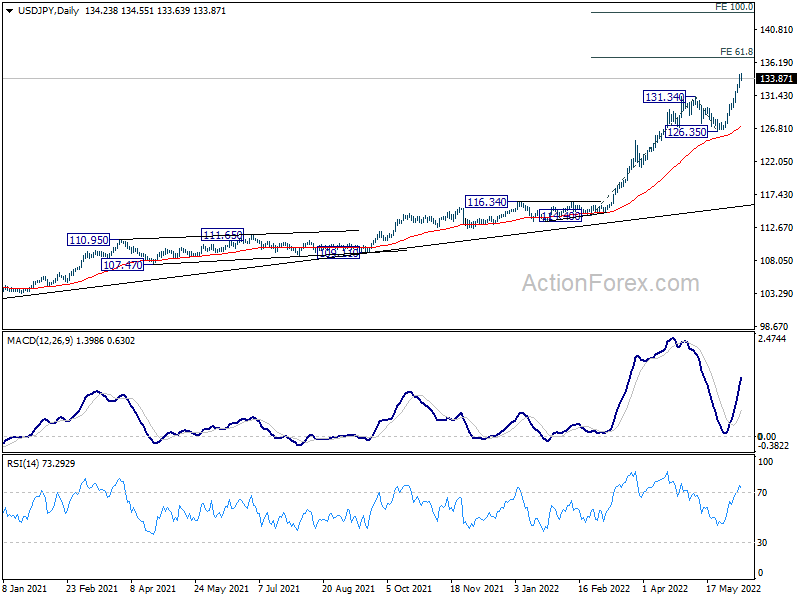
USD/JPY is retreating mildly but intraday bias stays on the upside. Current up trend should target 61.8% projection of 114.40 to 131.34 from 126.35 at 136.81. Firm break there will target 100% projection at 143.29. On the downside, below 132.30 minor support will turn intraday bias neutral to bring consolidations first, before staging another rally.
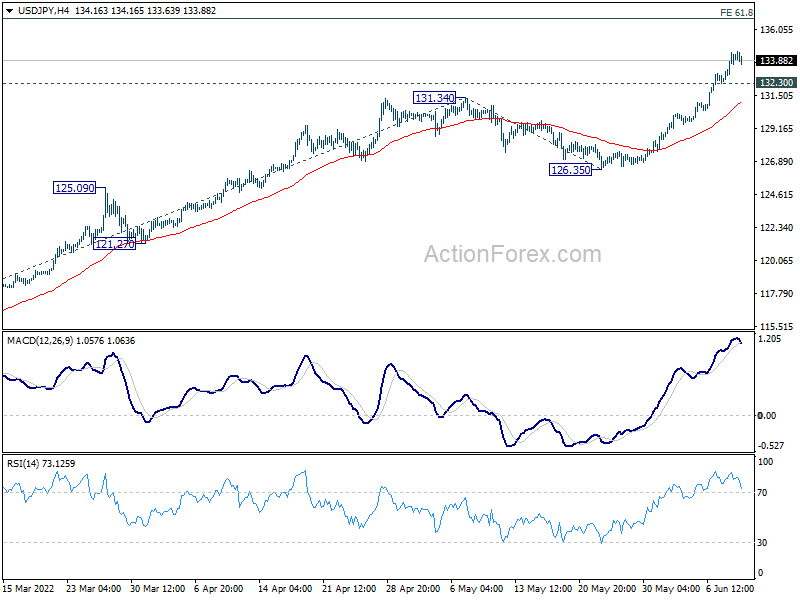
In the bigger picture, current rally is seen as part of the long term up trend form 75.56 (2011 low). Next target is 100% projection of 75.56 (2011 low) to 125.85 (2015 high) from 98.97 at 149.26, which is close to 147.68 (1998 high). This will remain the favored case as long as 126.35 support holds.
Euro Bulls Await ECB for Guidance, Yen Licking Wounds
Yen is recovering slightly in Asian session today, digesting recent steep selloff. The climax selling is temporarily past as focuses turn to ECB policy decision today and US CPI tomorrow. Euro is trading mixed for the moment, except versus Yen and Swiss Franc. To be specific, it's range bound against Dollar, Sterling, Aussie and Canadian. The reaction to ECB would be important to decide the next move in Euro for the near term.
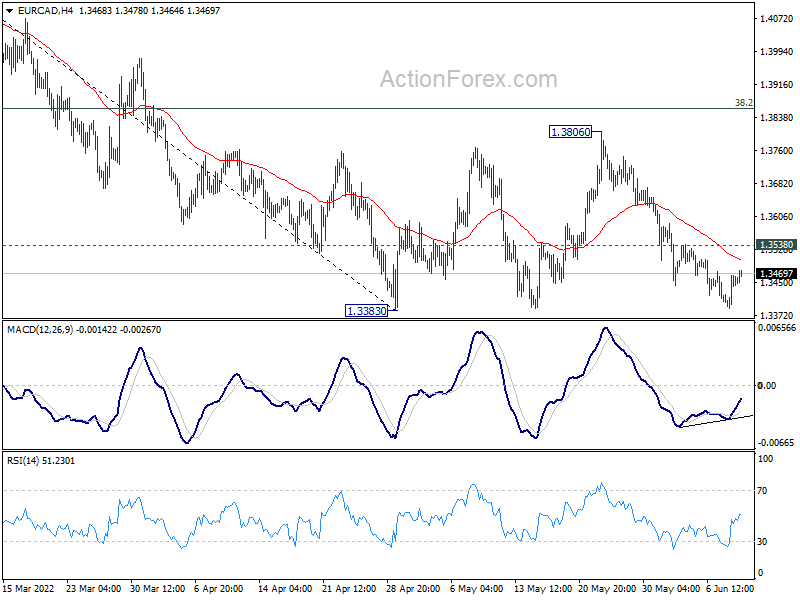
Technically, levels to watch include 1.0786 resistance in EUR/USD, 0.8617 resistance in EUR/GBP, 1.4965 minor resistance in EUR/AUD and 1.3538 minor resistance in EUR/CAD. Powerful break of these levels together will confirm that Euro bulls are fully on board, at least for the near term. Otherwise, there might still be some reservations among them.
In Asia, Nikkei closed up 0.18%. Hong Kong HSI is down -0.90%. China Shanghai SSE is down -1.07%. Singapore Strait Times is down -0.31%. Japan 10-year JGB yield is up 0.0031 at 0.251. Overnight, DOW dropped -0.81%. S&P 500 dropped -1.08%. NASDAQ dropped -0.73%. 10-year yield rose 0.057 to 3.029.
BCC: UK inflation to hit 10% in Q4, no GDP growth in Q2 & Q3 with contraction in Q4
In the new economic forecasts, British Chambers of Commerce projected that UK inflation rate will reach 10% in Q4 this year, "comfortably outpacing average earnings growth". That would be the highest since CPI records began in 1989. CPI is only expected to finally fall back to BoE's target of 2% by the end of 2024. BoE interest rate is expected to rise to 2% in 2022, and 3% in 2023.
GDP growth in 2022 was downgraded slightly from 3.6% to 3.5%. Quarter on quarter GDP growth is expected to " flatline with no growth expected in Q2 and Q3 before contracting by 0.2% in Q4". Growth is expected to slow sharply to just 0.6% for 2023, before recovering slightly to 1.2% in 2024.
Alex Veitch, Director of Policy at the British Chambers of Commerce, said: "Our latest forecast indicates that the headwinds facing the UK economy show little sign of reducing with continued inflationary pressures and sluggish growth. The war in Ukraine came just as the UK was beginning a Covid recovery; placing a further squeeze on business profitability."
IMF: Recent Yen depreciation reflect fundamentals
IMF Japan mission chief Ranil Salgado said Yen's recent movements "reflect fundamentals", adding, "we see both positive and negative effects in yen depreciation."
He noted that risks to inflation in Japan are on the upside. But, "inflation in the medium-term will remain well below the BOJ's target once the cost-push factors go away," he said.
"We consider it appropriate for the BOJ to maintain monetary easing until inflation is achieved in a stable and durable manner."
EUR/USD ready for range breakout? Some ECB previews
ECB policy decision and press conference are the major focuses of the day. The central bank is widely expected to announce the end of net asset purchases after this month. That would set the stage for a rate hike "some after after" in July.
Markets are expecting a 25bps rate hike in July, followed by a 50bps move in September. That would bring interest rate comfortably back into positive territory, finally after eight years of negative rate policy. President Lagarde will affirm the latter view, but she'd keep the options open on the pace of tightening.
Suggested readings on ECB:
- ECB Meeting: Setting the Stage for Higher Rates
- ECB Preview – Ready for Lift-Off
- EUR/CHF Set for Breakout as Focus Turns to ECB
- Get Ready for ECB to Hikes Rates (Just Not Tomorrow)
- Key Inflection Point for the ECB at this Week's Meeting
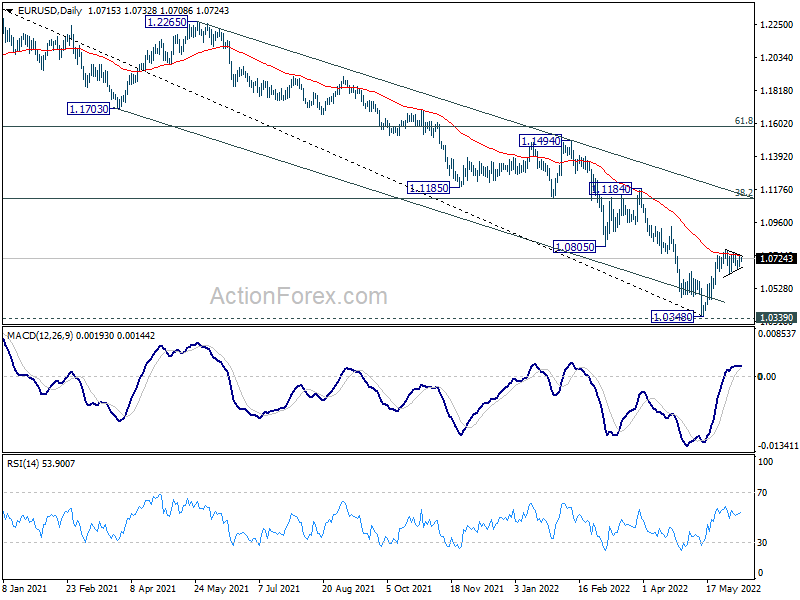
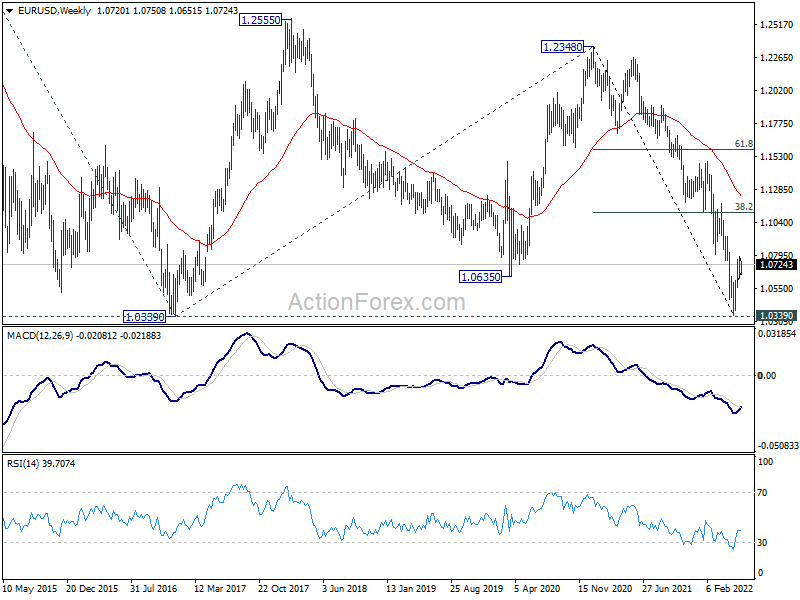
EUR/USD's reaction to ECB is definitely worth a watch today. It should first be noted that EUR/USD had just bounced off above 1.0339 (2017 low) in May. An upside breakout from the near term range today will have 1.0805 support turned resistance and 55 day EMA taken out firmly. That should confirm medium term bottoming at 1.0348. In this case, even as a correction to the down trend from 1.2348, EUR/USD should rise further to channel resistance (now at 1.1159), which is close to 38.2% retracement of 1.2348 to 1.0348 at 1.1112.
USD/JPY Daily Outlook
Daily Pivots: (S1) 133.05; (P) 133.76; (R1) 134.97; More...
USD/JPY is retreating mildly but intraday bias stays on the upside. Current up trend should target 61.8% projection of 114.40 to 131.34 from 126.35 at 136.81. Firm break there will target 100% projection at 143.29. On the downside, below 132.30 minor support will turn intraday bias neutral to bring consolidations first, before staging another rally.
In the bigger picture, current rally is seen as part of the long term up trend form 75.56 (2011 low). Next target is 100% projection of 75.56 (2011 low) to 125.85 (2015 high) from 98.97 at 149.26, which is close to 147.68 (1998 high). This will remain the favored case as long as 126.35 support holds.
Economic Indicators Update
| GMT | Ccy | Events | Actual | Forecast | Previous | Revised |
|---|---|---|---|---|---|---|
| 23:01 | GBP | RICS Housing Price Balance May | 73% | 76% | 80% | |
| 23:50 | JPY | Money Supply M2+CD Y/Y May | 3.20% | 3.60% | 3.60% | 3.40% |
| 02:00 | CNY | Trade Balance (USD) May | 78.8B | 59.0B | 51.1B | |
| 02:00 | CNY | Exports (USD) Y/Y Apr | 16.90% | 8% | 3.90% | |
| 02:00 | CNY | Imports (USD) Y/Y May | 4.10% | 2% | 0.00% | |
| 02:00 | CNY | Trade Balance (CNY) May | 502.9B | 400B | 325B | |
| 02:00 | CNY | Exports (CNY) Y/Y May | 15.30% | 13.10% | 1.90% | |
| 02:00 | CNY | Imports (CNY) Y/Y May | 2.80% | -9% | -2.00% | |
| 06:00 | JPY | Machine Tool Orders Y/Y May P | 23.70% | 25.00% | ||
| 11:45 | EUR | ECB Interest Rate Decision | 0.00% | 0.00% | ||
| 11:45 | EUR | ECB Deposit Rate Decision | -0.50% | -0.50% | ||
| 12:30 | EUR | ECB Press Conference | ||||
| 12:30 | USD | Initial Jobless Claims (Jun 3) | 208K | 200K | ||
| 14:30 | USD | Natural Gas Storage | 94B | 90B |
EUR/USD ready for range breakout? Some ECB previews
ECB policy decision and press conference are the major focuses of the day. The central bank is widely expected to announce the end of net asset purchases after this month. That would set the stage for a rate hike "some after after" in July.
Markets are expecting a 25bps rate hike in July, followed by a 50bps move in September. That would bring interest rate comfortably back into positive territory, finally after eight years of negative rate policy. President Lagarde will affirm the latter view, but she'd keep the options open on the pace of tightening.
Suggested readings on ECB:
- ECB Meeting: Setting the Stage for Higher Rates
- ECB Preview – Ready for Lift-Off
- EUR/CHF Set for Breakout as Focus Turns to ECB
- Get Ready for ECB to Hikes Rates (Just Not Tomorrow)
- Key Inflection Point for the ECB at this Week's Meeting
EUR/USD's reaction to ECB is definitely worth a watch today. It should first be noted that EUR/USD had just bounced off above 1.0339 (2017 low) in May. An upside breakout from the near term range today will have 1.0805 support turned resistance and 55 day EMA taken out firmly. That should confirm medium term bottoming at 1.0348. In this case, even as a correction to the down trend from 1.2348, EUR/USD should rise further to channel resistance (now at 1.1159), which is close to 38.2% retracement of 1.2348 to 1.0348 at 1.1112.
BCC: UK inflation to hit 10% in Q4, no GDP growth in Q2 & Q3 with contraction in Q4
In the new economic forecasts, British Chambers of Commerce projected that UK inflation rate will reach 10% in Q4 this year, "comfortably outpacing average earnings growth". That would be the highest since CPI records began in 1989. CPI is only expected to finally fall back to BoE's target of 2% by the end of 2024. BoE interest rate is expected to rise to 2% in 2022, and 3% in 2023.
GDP growth in 2022 was downgraded slightly from 3.6% to 3.5%. Quarter on quarter GDP growth is expected to " flatline with no growth expected in Q2 and Q3 before contracting by 0.2% in Q4". Growth is expected to slow sharply to just 0.6% for 2023, before recovering slightly to 1.2% in 2024.
Alex Veitch, Director of Policy at the British Chambers of Commerce, said: "Our latest forecast indicates that the headwinds facing the UK economy show little sign of reducing with continued inflationary pressures and sluggish growth. The war in Ukraine came just as the UK was beginning a Covid recovery; placing a further squeeze on business profitability."
IMF: Recent Yen depreciation reflect fundamentals
IMF Japan mission chief Ranil Salgado said Yen's recent movements "reflect fundamentals", adding, "we see both positive and negative effects in yen depreciation."
He noted that risks to inflation in Japan are on the upside. But, "inflation in the medium-term will remain well below the BOJ's target once the cost-push factors go away," he said.
"We consider it appropriate for the BOJ to maintain monetary easing until inflation is achieved in a stable and durable manner."
Technical Outlook and Review
DXY:
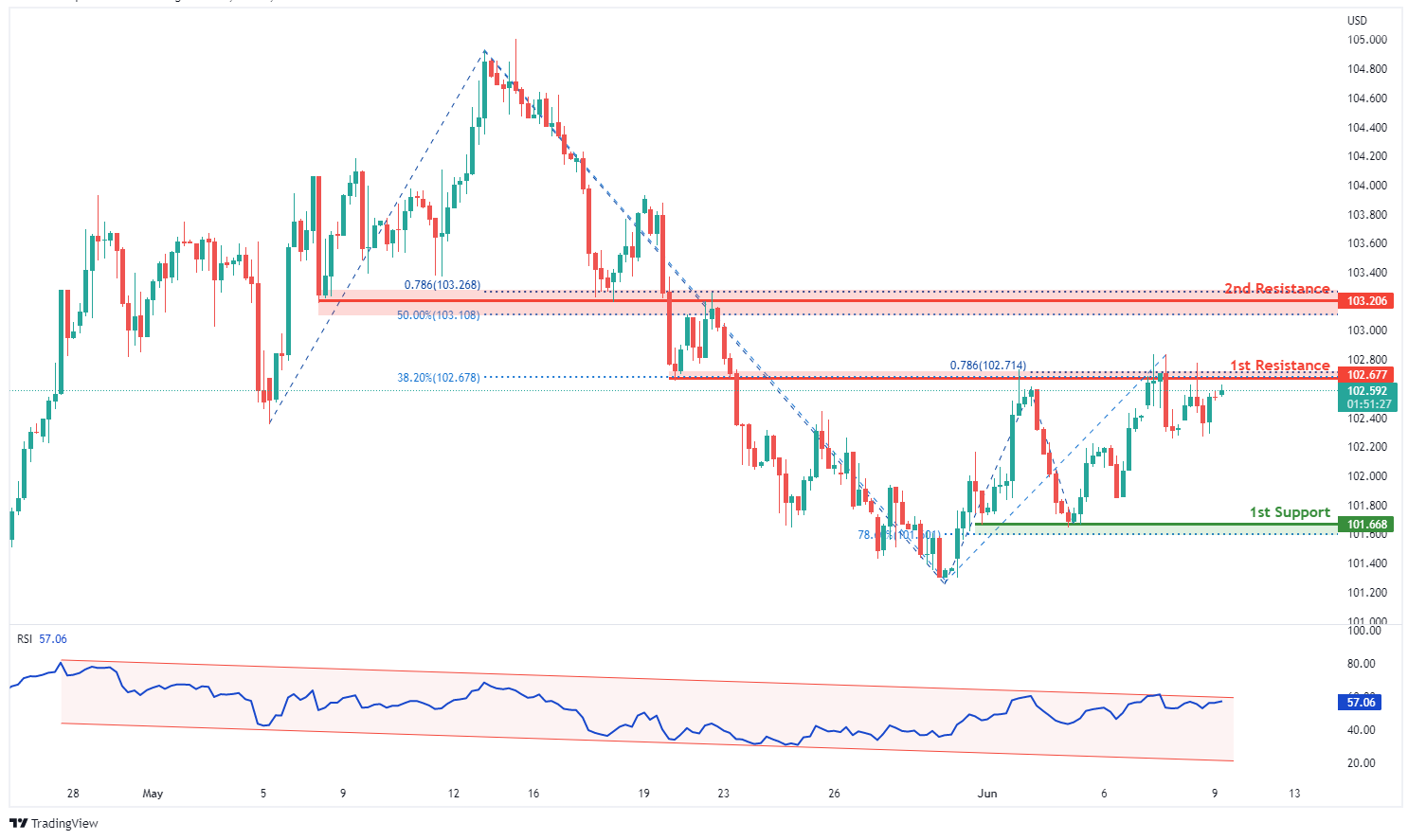
On the H4, with RSI moving in a descending channel, we have a bearish bias that price will drop to our 1st support at 101.668 where the horizontal swing low support and 78.6% fibonacci retracement are from our 1st resistance at 102.677 in line with the horizontal overlap resistance, 38.2% fibonacci retracement and 78.6% fibonacci projection. Alternatively, price may break 1st resistance structure and head for 2nd resistance at 103.206 where the horizontal overlap resistance, 78.6% fibonacci projection and 50% fibonacci retracement are.
Areas of consideration:
- H4 time frame, 1st resistance at 102.677
- H4 time frame, 1st support at 101.668
XAU/USD (GOLD):
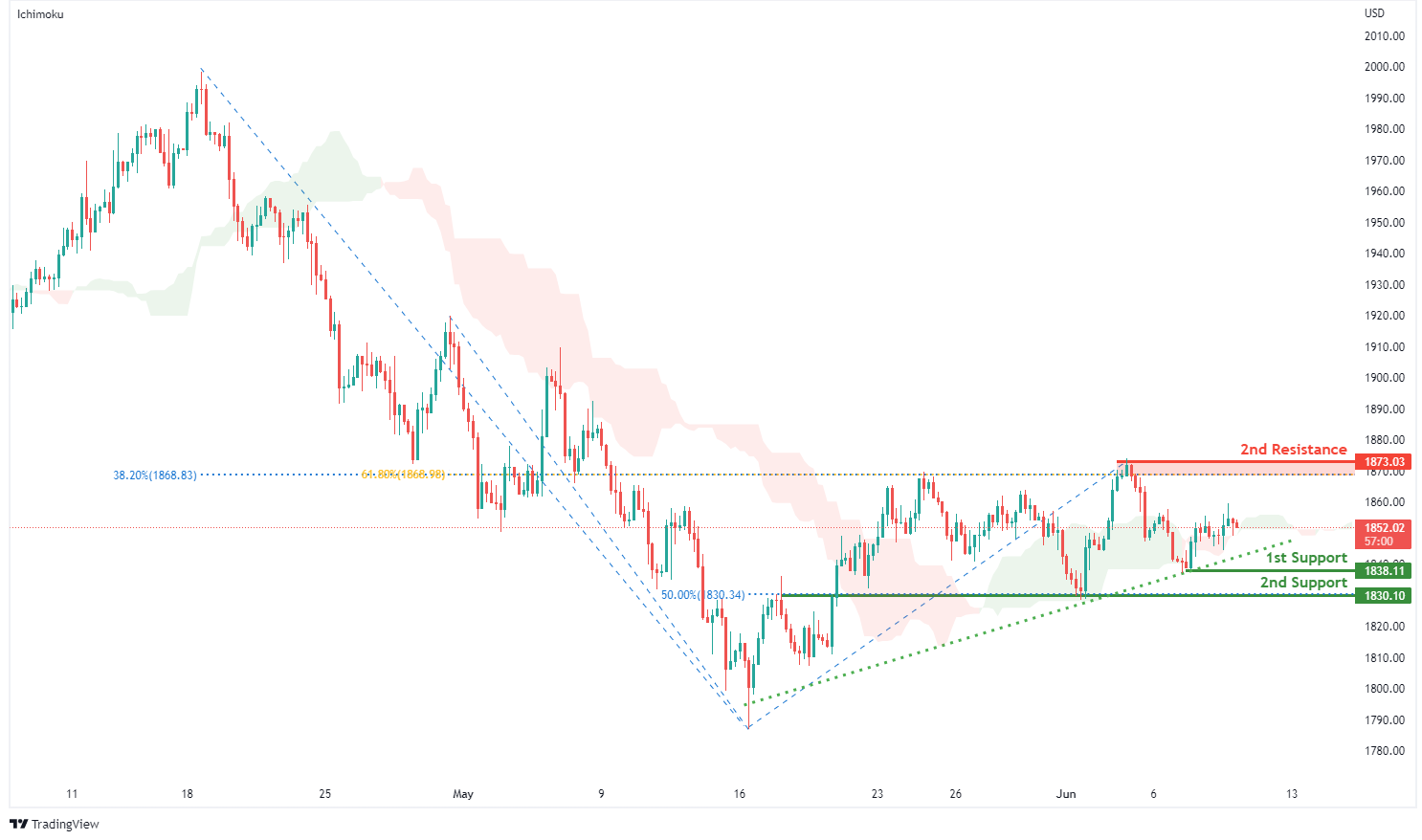
On the H4, with prices bouncing off ichimoku indicator, we have a bullish bias that price will rise from our 1st support at 1838.11 where the horizontal swing low support is to our 1st resistance at 1873.03 in line with swing high resistance, 61.8% fibonacci retracement and 38.2% fibonacci retracement. Alternatively, price may break 1st support structure and head for 2nd support at 1830.10 in line with overlap support and 50% fibonacci retracement.
Areas of consideration:
- H4 time frame, 1st Resistance at 1873.03
- H4 time frame, 1st Support at 1838.11
GBP/USD:
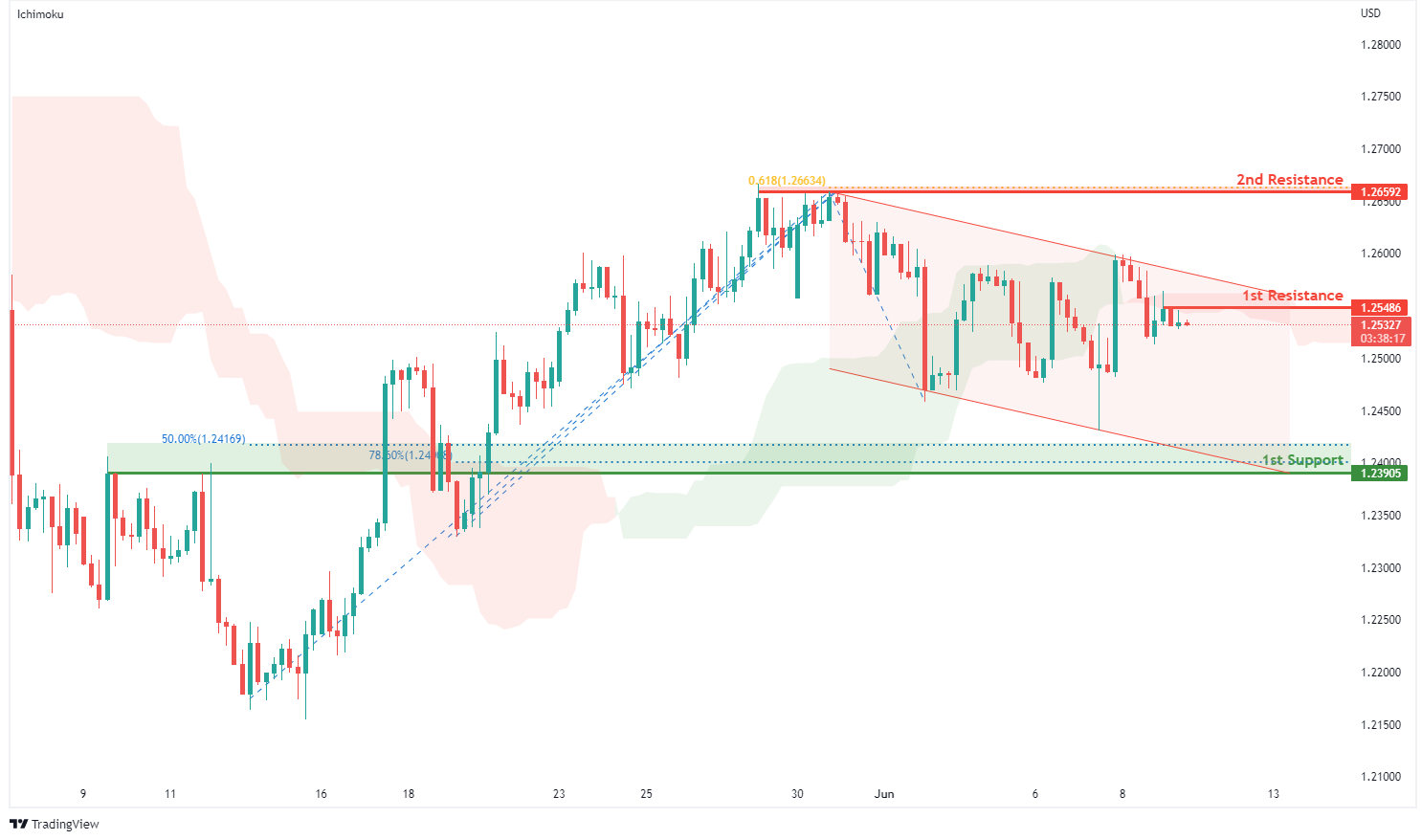
On the H4, with prices moving below the ichimoku indicator, we have a bearish bias that price will drop from our 1st resistance at 1.25486 where the horizontal swing high resistance is to our 1st support at 1.23905 in line with the 50% Fibonacci retracement, 78.6% fibonacci retracement and overlap support. Alternatively, price may break 1st resistance structure and head for 2nd resistance at 1.26592 where the horizontal swing high resistance and 61.8% fibonacci projection are.
Areas of consideration:
- H4 1st resistance at 1.25486
- H4 1st support at 1.23905
USD/CHF:
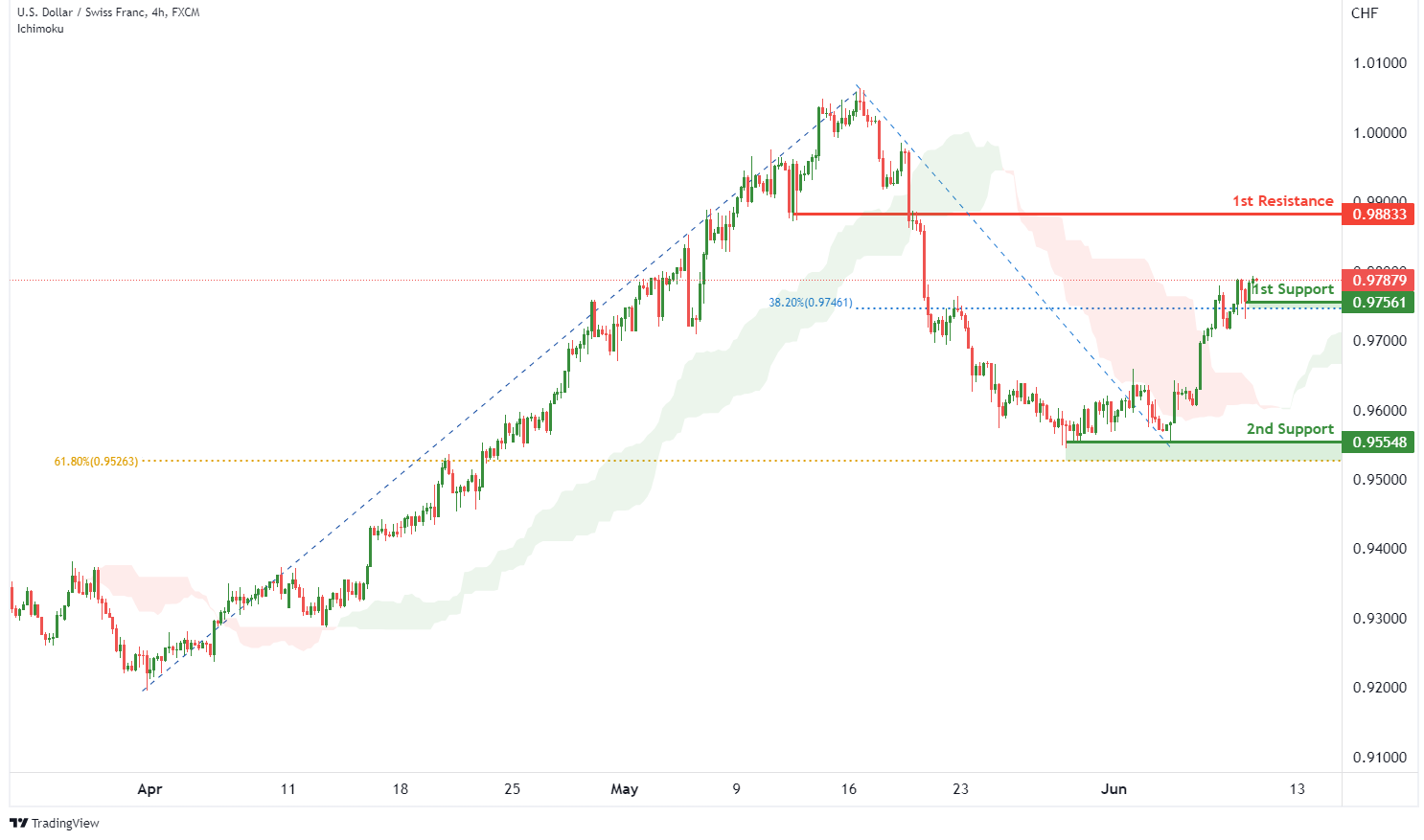
On the H4, with price moving above the ichimoku cloud, we have a bullish bias that price will rise to our 1st resistance at 0.98833 where the pullback resistance is from our 1st support at 0.97561 in line with the swing low support and 38.2% Fibonacci retracement. Alternatively, price may break 1st support structure and head for 2nd support at 0.95548 where the swing low support and 61.8% fibonacci retracement are..
Areas of consideration
- 1st support level at 0.97561
- 1st resistance level at 0.98833
EUR/USD :
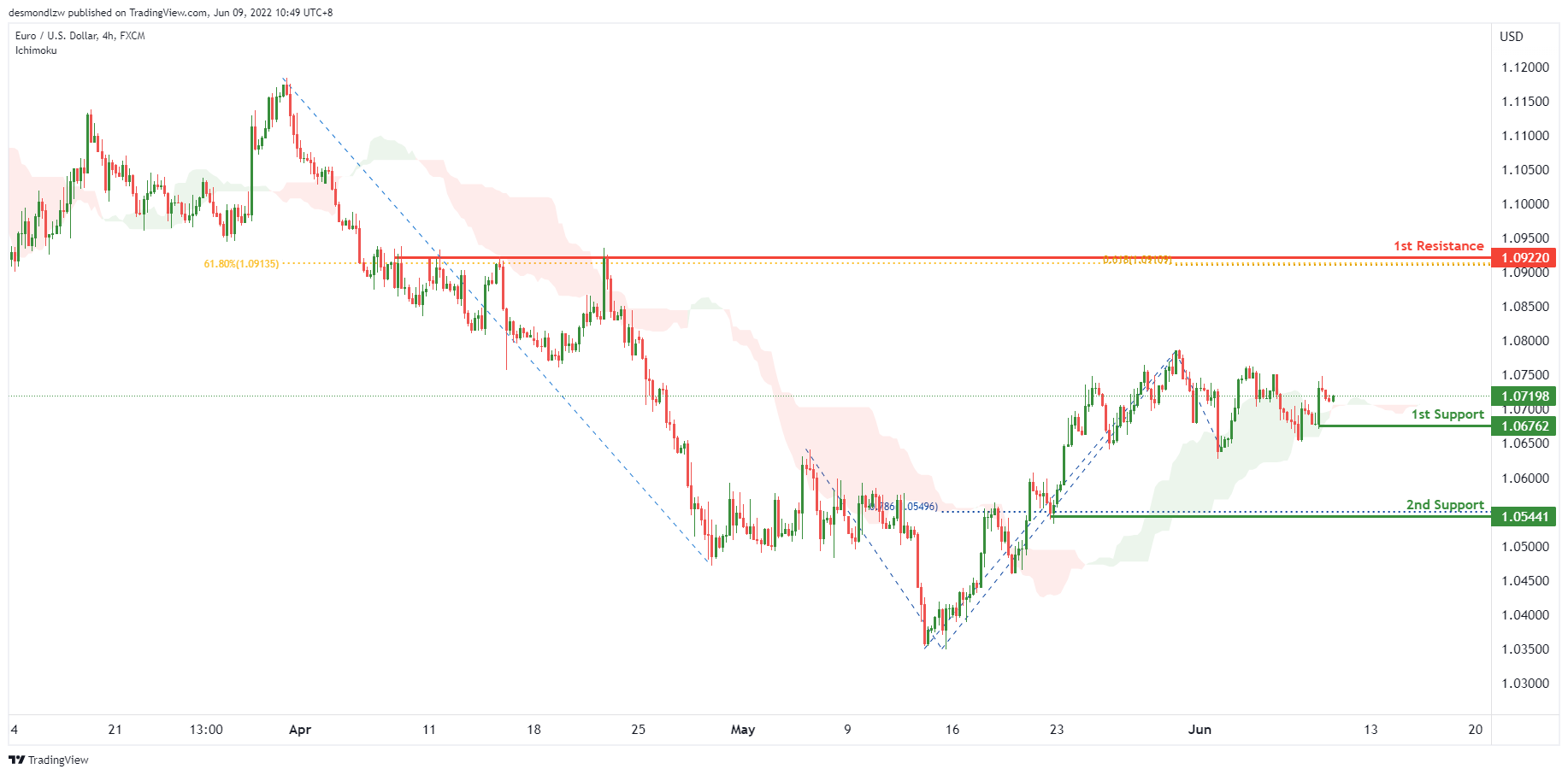
On the H4, with price bouncing off the ichimoku cloud, we have a bullish bias that price will rise from the 1st support at 1.06762 in line with the to the pullback support to the 1st resistance at 1.09220 in line with the 61.8% fibonacci retracement and 61.8% fibonacci projection. Alternatively, price may break support structure at the 1st support and drop to the 2nd support at 1.05441 at the swing low in line with the 78.6% fibonacci retracement.
Areas of consideration :
- H4 1st resistance at 1.09220
- H4 1st support at 1.06762
USD/JPY:
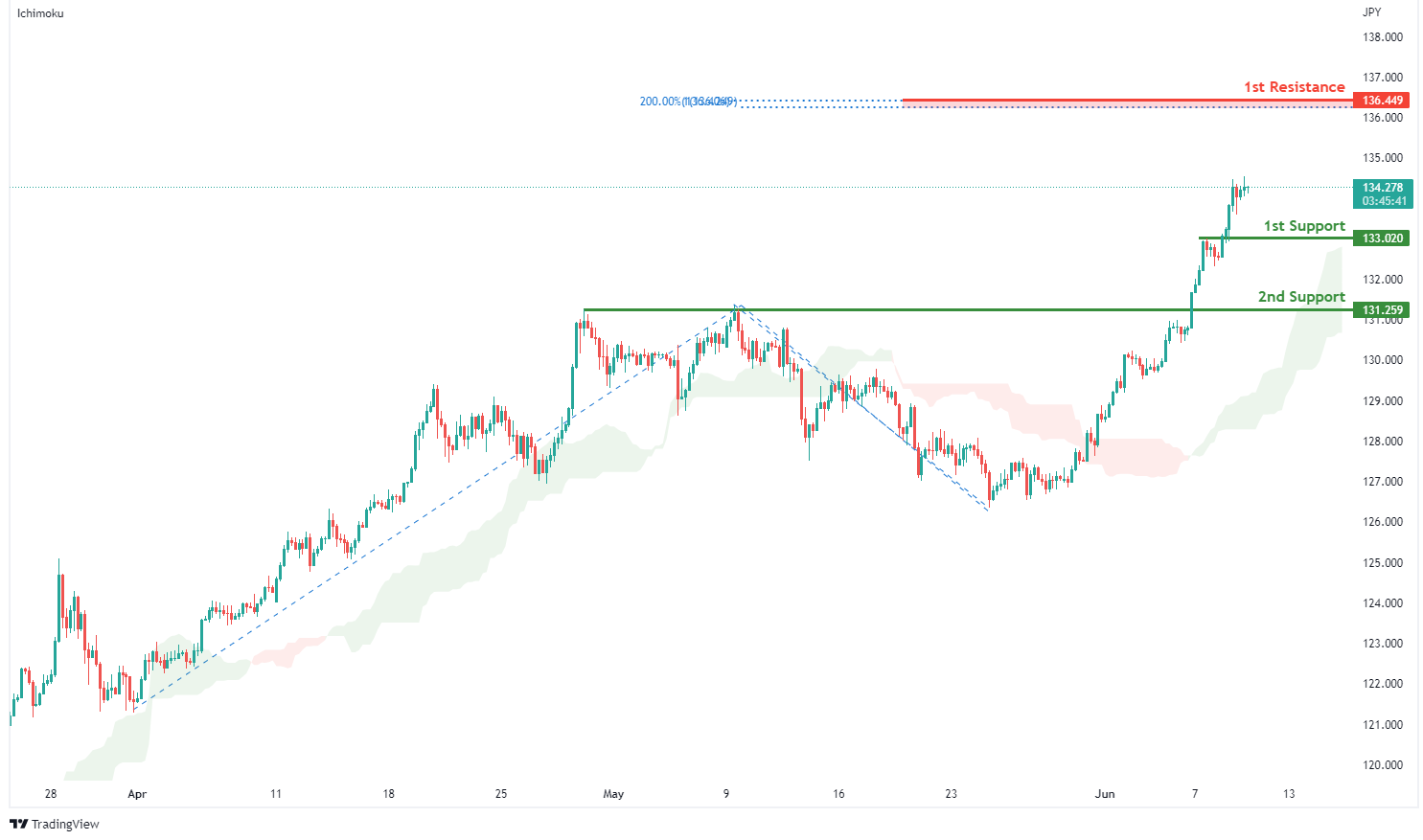
On the H4, with prices moving above the ichimoku indicator, we have a bullish bias that price will rise from our 1st support at 133.020 where the horizontal pullback support is to our 1st resistance at 136.449 in line with the 200% fibonacci extension and 100% fibonacci projection. Alternatively, price may break 1st support structure and head for 2nd support at 131.259 where the horizontal overlap support is.
Areas of consideration:
- H4 time frame, 1st resistance at 136.449
- H4 time frame, 1st support at 133.020
AUD/USD:
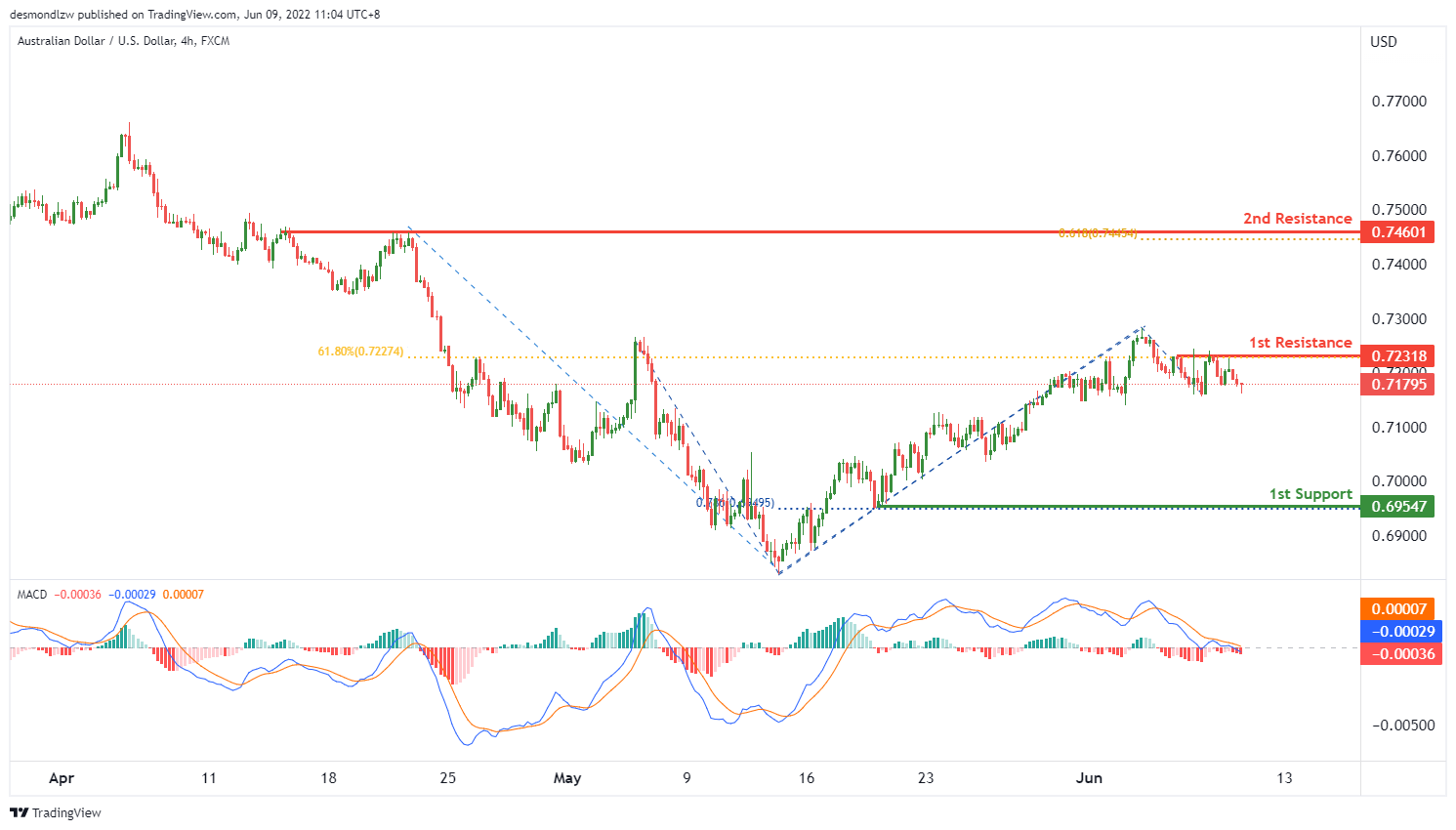
On the H4, with price moving into a bearish pressure area on the MACD indicator, we have a bearish bias that price will drop from the 1st resistance at 0.72318 at the multiple swing highs in line with the 61.8% fibonacci retracement to the 1st support at 0.69547 at the swing low in line with the 78.6% fibonacci projection. Alternatively, price may rise from the 1st resistance to the 2nd resistance at 0.74601 in line with the 61.8% fibonacci projection and multiple swing highs.
Areas of consideration
- H4 1st resistance at 0.72318
- H4 1st support at 0.69547
NZD/USD:
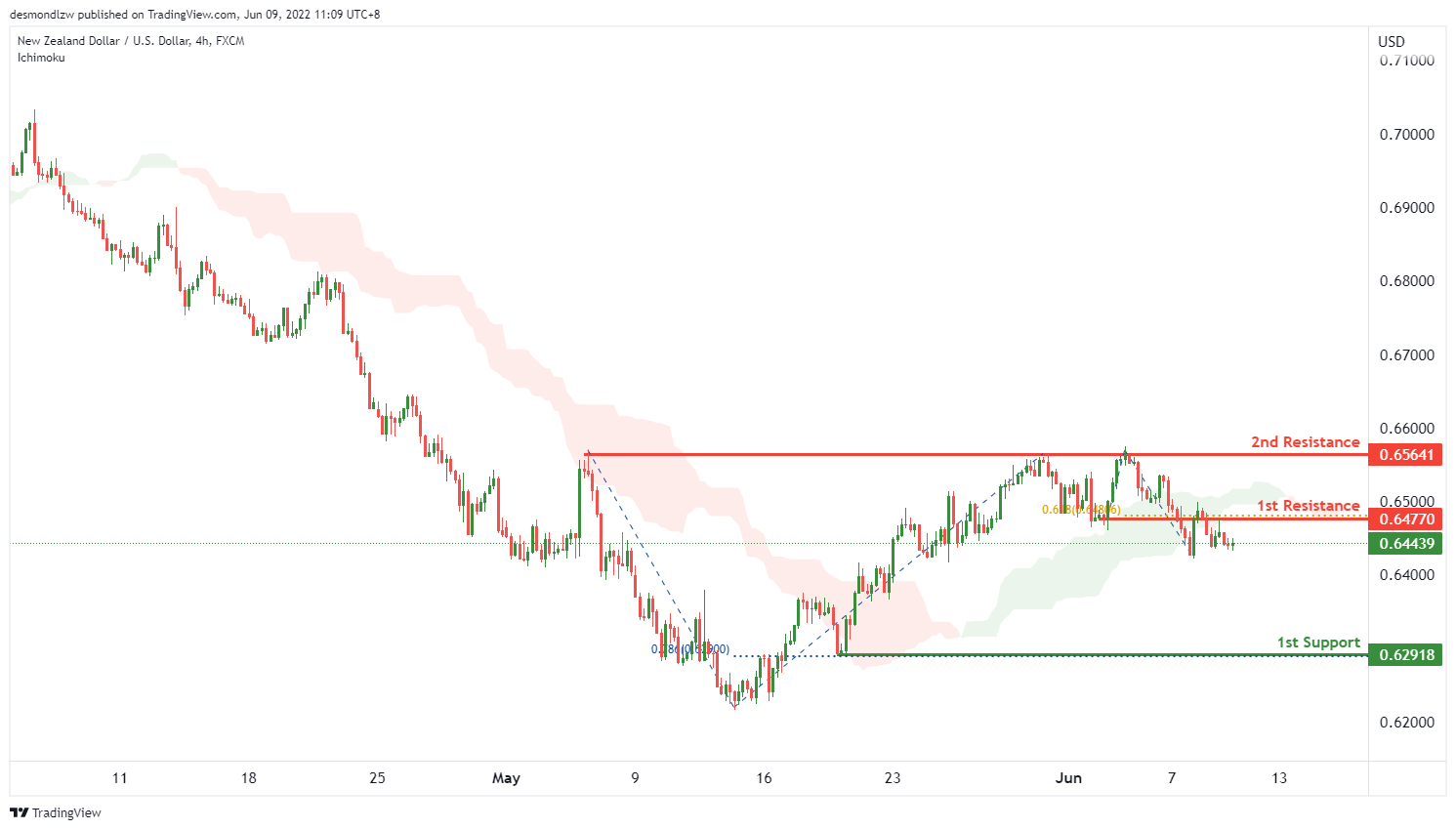
On the H4, with price moving below the ichimoku cloud, we have a bearish bias that price will drop from the 1st resistance at 0.64770 in line with the 61.8% fibonacci projection to the 1st support at 0.62918 in line with the 78.6% fibonacci retracement. Alternatively, price may bounce off the 1st resistance and rise to the 2nd resistance at 0.65641 in line with the overlap swing high.
Areas of consideration:
- H4 time frame, 1st support at 0.62918
- H4 time frame, 1st resistance at 0.64770
USD/CAD:
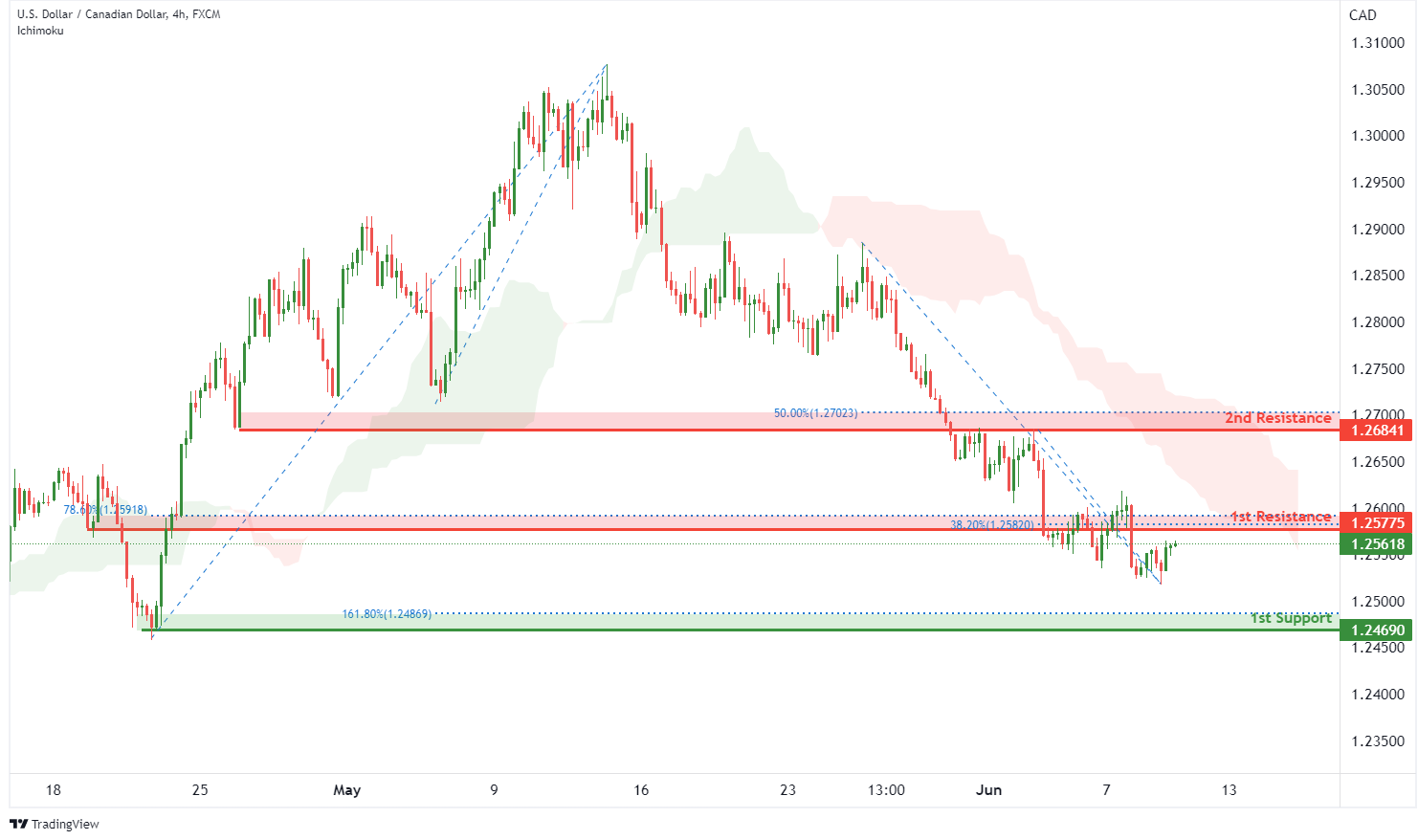
On the H4, with price moving below our ichimoku cloud, we have a bearish bias that price will drop to our 1st support at 1.24690 in line with the horizontal swing low support and the 161.8% Fibonacci extension from our 1st resistance at 1.25775 where the pullback resistance, 78.6% fibonacci retracement and 38.2% fibonacci retracement are. Alternatively, price may break structure and head for our 2nd resistance at 1.26841 in line with overlap resistance and 50% fibonacci retracement.
Areas of consideration:
- H4 time frame, 1st resistance at 1.25775
- H4 time frame, 1st support at 1.24690
OIL:
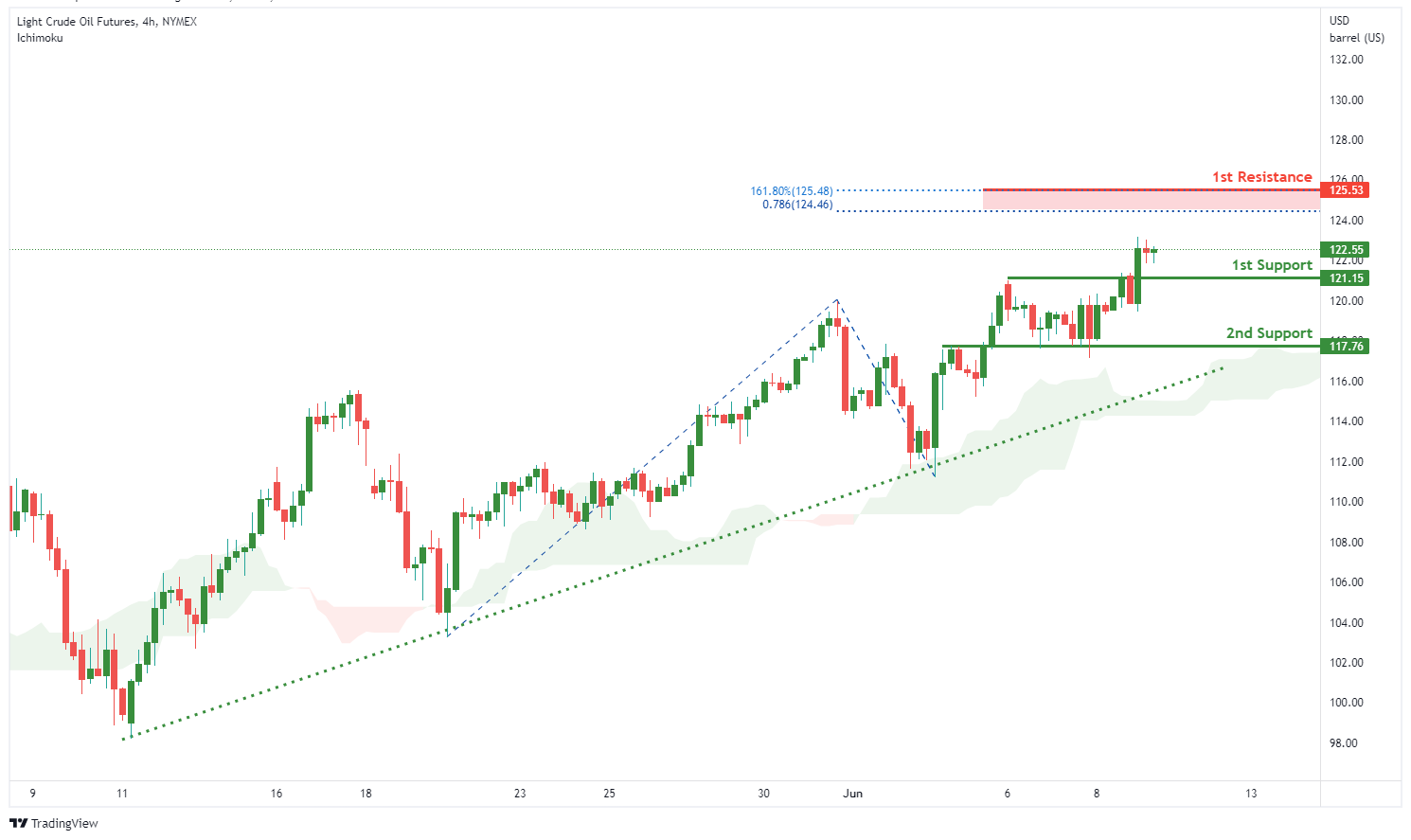
On the H4, with price moving above the ichimoku cloud, we have a bullish bias that price will rise from our 1st support at 121.15 where the horizontal pullback support is to our 1st resistance at 125.53 in line with the 78.6% fibonacci projection and 161.8% Fibonacci extension. Alternatively, price may break structure and head for 2nd support at 117.76.
Areas of consideration:
- H4 time frame, 1st resistance of 125.53
- H4 time frame, 1st support of 121.15
Dow Jones Industrial Average:
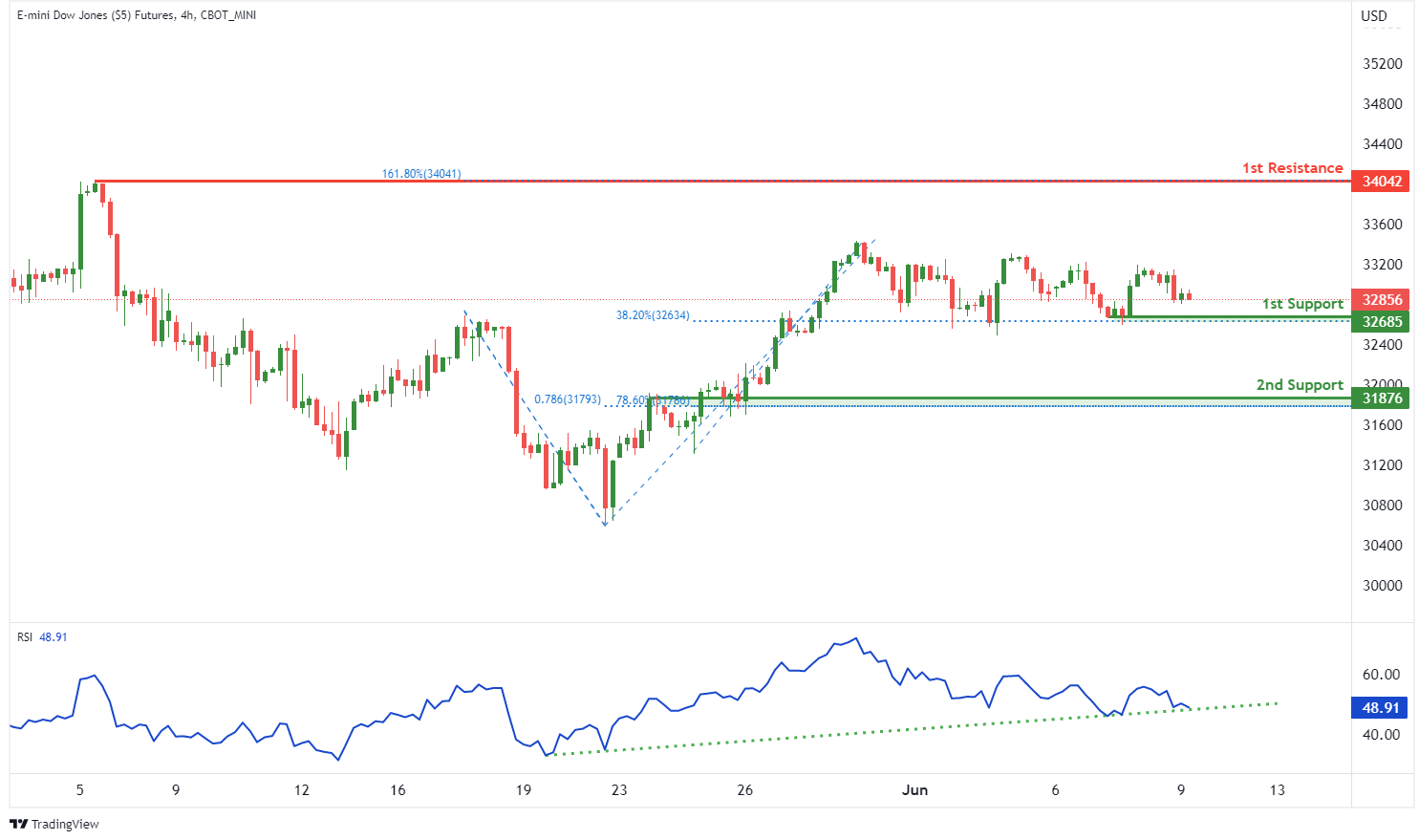
On the H4, with RSI moving in an ascending trendline, we have a bullish bias that price will rise from our 1st support at 32685 where the horizontal swing low support and 38.2% fibonacci retracement are to our 1st resistance at 34042 in line with the swing high resistance and 161.8% Fibonacci extension. Alternatively, price may break structure and head for 2nd support at 31876 where the pullback support, 78.6% fibonacci projection and 78.6% fibonacci retracement are.
Areas of consideration :
- H4 time frame, 1st resistance at 34042
- H4 time frame, 1st support at 32685
Elliott Wave View: DAX Looking to Start a New Bullish Cycle
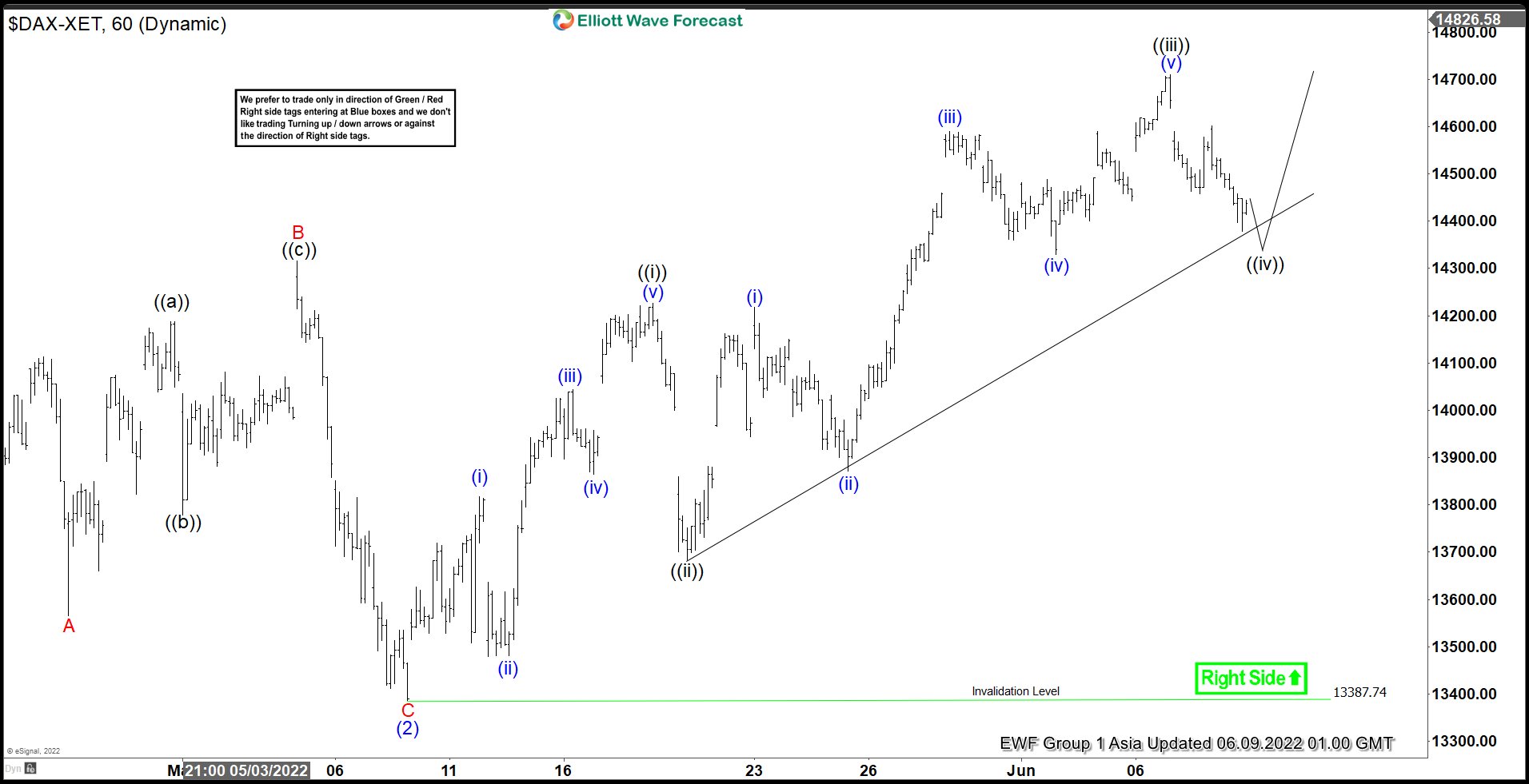
The 3/7/2022 low of 12438.85 in $DAX completed correction to the cycle from March 2020 low (Covid-19 low). From 3/7/2022 low, DAX has turned higher in a 5 waves impulse Elliott Wave structure. Up from 3/7, wave (1) ended at 14925.25 and pullback in wave (2) ended at 13387.74 as the 1 hour chart below shows. Internal of wave (2) unfolded as a zigzag where wave A ended at 13566.2, wave B ended at 14315.24, and wave C ended at 13386.32.
The Index has turned higher in wave (3) with the internal as another 5 waves in lesser degree. Up from wave (2) low at 13387.74, wave ((i)) ended at 14226.47 and dips in wave ((ii)) ended at 13683.59. Index then extends higher in wave ((iii)) towards 14709.38. Expect wave ((iv)) pullback to end soon and Index to make 1 more push higher in wave ((v)) to end wave 1. Afterwards, it should pullback in wave 2 to correct cycle from 5/9/2022 low before the rally resumes. Near term, as far as 5/9/2022 pivot low at 13387.74 stays intact, expect dips to find support in 3, 7, or 11 swing for further upside.
DAX 60 Minutes Elliott Wave Chart
Eco Data 6/9/22
[php_everywhere instance="1"]