Sample Category Title
Bitcoin Fails to Escape Tight Range ahead of US CPI
Bitcoin ended last week on a positive note, snapping its record losing streak of nine weeks. However, the bulls failed to capitalize on that development and the price has dived again beneath the $30,000 psychological mark, extending its sideways pattern. Many investors suggest that major cryptocurrencies experienced a relief rally and might eventually resume their downtrend, while others point out that the market could be approaching its bottom. Therefore, the latest US CPI report awaited on Friday, could shed some light on this puzzle and provide crypto traders with fresh directional impetus.
Inflation remains a key driver
Since the beginning of 2022, major cryptocurrencies have been moving in tandem with equity markets, exhibiting a higher positive correlation with tech stocks. In general, risky assets have been negatively impacted by the ongoing monetary tightening as most central banks have entered an interest rate hike cycle in their effort to scale down inflationary pressures. Thus, the big question that lies ahead is how strong policymakers can slam the brakes on economies without causing a recession.
On Friday, the May US CPI print will hit the markets, with investors anticipating signs that the inflation rate has indeed peaked in the United States. Should that scenario play out, the Fed might be able to proceed with a slower rate hike pace, which could essentially reduce the likelihood of a recession and boost investors’ risk appetite. On the other hand, a stronger-than-expected reading would force the Fed to act more aggressively, inducing further downside pressures on risky assets. Therefore, crypto traders would be closely scrutinizing the upcoming inflation data to determine the direction of Bitcoin’s next breakout move from its long-lasting rangebound pattern.
Constrained supply could boost prices
Bitcoin prices significantly depend on the supply-demand balance as the process of mining is the sole way to generate new coins. Last week, the New York State Senate approved a controversial proof-of-work (PoW) mining ban bill that will prohibit any new Bitcoin mining operations in the state, significantly deteriorating Bitcoin’s supply outlook. Specifically, the proposed bill would not only forbid the opening of new mining facilities but also reject the renewal of existing mines’ licenses unless they could operate with 100% renewable energy sources.
In addition, a worrisome sign for the crypto space is that Bitcoin miners have been recently offloading their long-term holdings to cover rising costs in the anticipation of lower prices. Bitcoin mining was an attractive sport when miners could get away with high energy prices as Bitcoin was trading at $50,000 or $60,000. However, soaring energy costs alongside cryptos trading at more than 50% off their peaks may now force most miners to go out of business. Overall, the short-term downside pressures induced by the recent accelerating sell-off in the miners’ effort to withstand the elevating energy prices could be eventually offset by weakening supply.
Technical picture remains intact
Bitcoin has been trading sideways since the beginning of May, unable to adopt a clear direction. Although the king of cryptocurrencies managed to jump above the $32,000 mark during the past week, its upside move failed to strengthen further and the price quickly returned into the tight $31,000-$29,000 range.
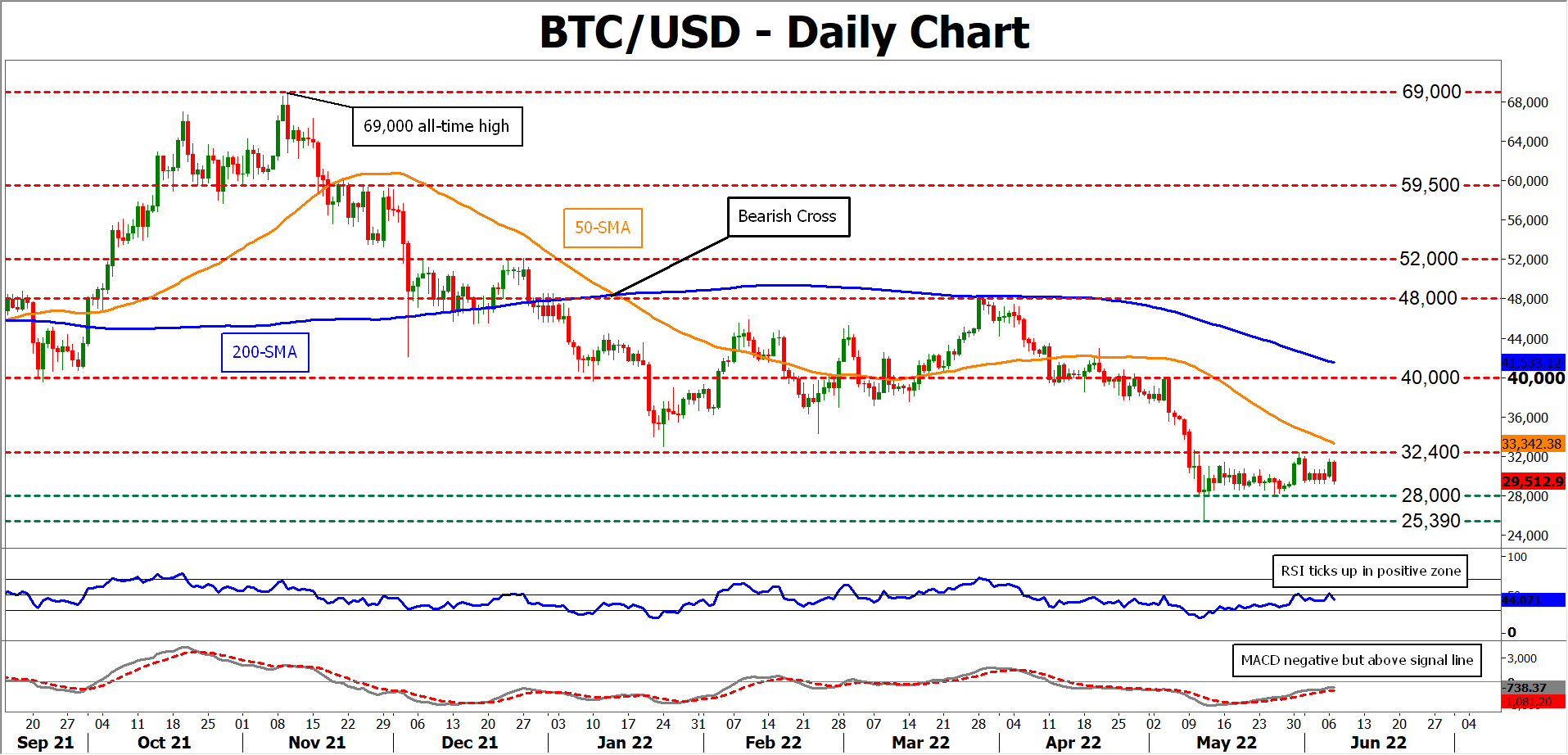
In the positive scenario, bullish actions could send the price to test the recent peak of $32,400 before the attention shifts to the $40,000 psychological mark.
On the flipside, should selling interest intensify, Bitcoin’s price may descend towards $28,000, which is the lower boundary of its recent sideways pattern. A violation of the latter could pave the way for the 2022 low of $25,390.
EUR/USD Mid-Day Outlook
Daily Pivots: (S1) 1.0669; (P) 1.0711 (R1) 1.0737; More...
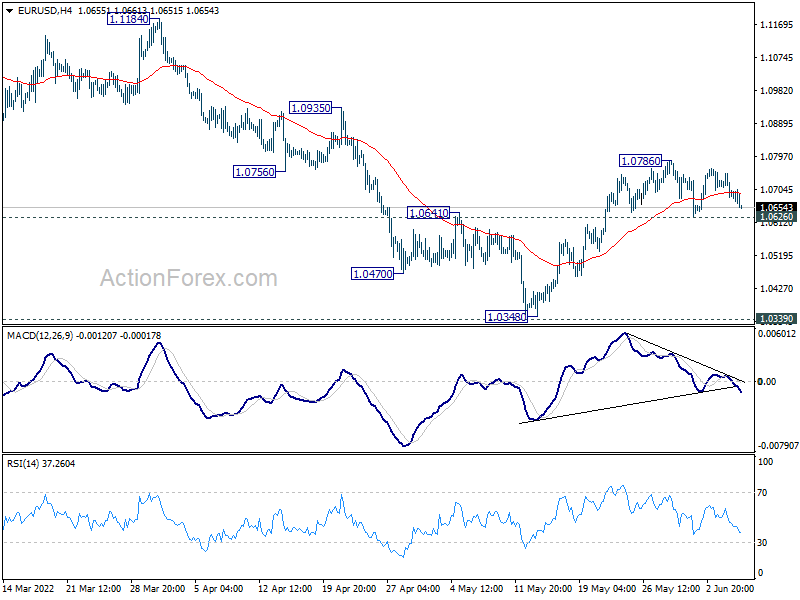
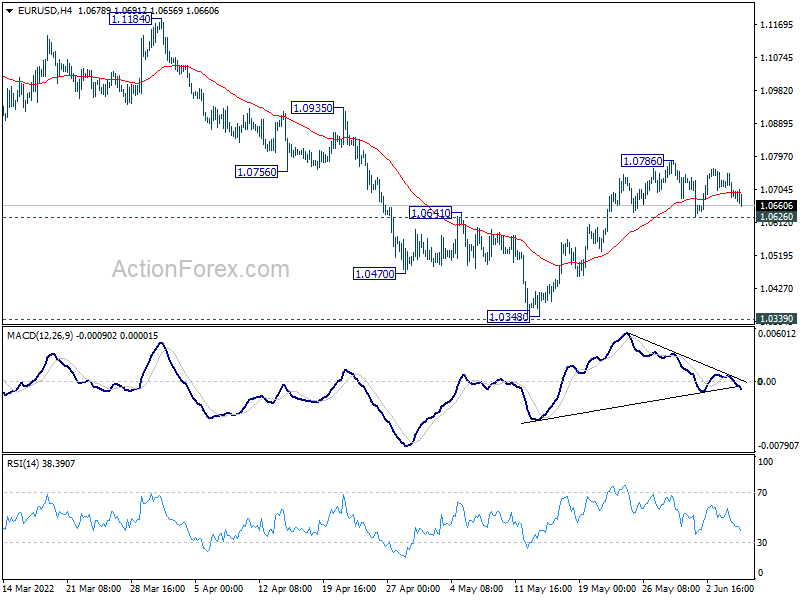
Intraday bias in EUR/USD stays neutral at this point. On the downside, break of 1.0626 minor support will indicate rejection by 55 day EMA, and turn bias back to the downside for retesting 1.0348. On the upside, break of 1.0786, and sustained trading above 55 day EMA (now at 1.0757) will target 1.0935 resistance next.
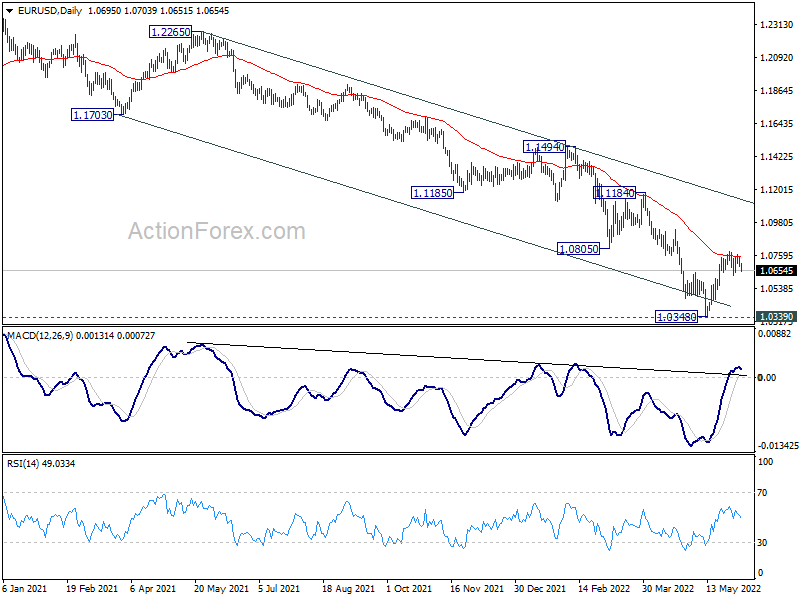
In the bigger picture, focus stays on 1.0339 long term support (2017 low). Decisive break there will resume whole down trend from 1.6039 (2008 high). Next target is 61.8% projection of 1.3993 to 1.0339 from 1.2348 at 1.0090. However, firm break of 1.0805 support turned resistance will delay this bearish case and bring medium term corrective rebound first.
GBP/USD Mid-Day Outlook
Daily Pivots: (S1) 1.2479; (P) 1.2528; (R1) 1.2580; More...
Intraday bias in GBP/USD remains neutral with focus on 1.2457 minor support. Sustained break there will suggest that rebound from 1.2154 has completed. Intraday bias will be back on the downside for resting this low. On the upside, above 1.2666 will target 55 day EMA (now at 1.2707) and above.
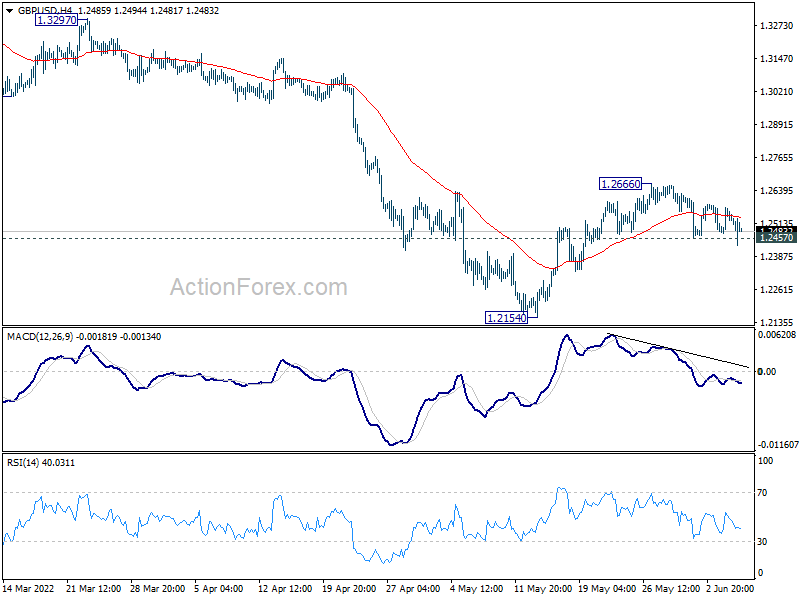
In the bigger picture, fall from 1.4248 (2018 high) could be a leg inside the pattern from 1.1409 (2020 low), or resuming the longer term down trend. Deeper decline is expected as long as 1.2999 support turned resistance holds. On resumption, next target is 1.1409 low.
USD/JPY Mid-Day Outlook
Daily Pivots: (S1) 130.88; (P) 131.44; (R1) 132.46; More...
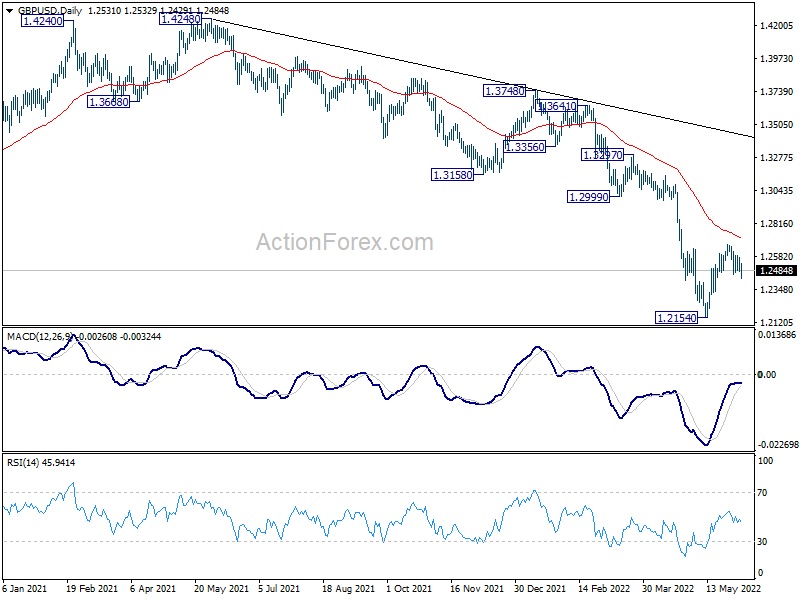
Intraday bias in USD/JPY remains on the upside for the moment. Current up trend should target 61.8% projection of 114.40 to 131.34 from 126.35 at 136.81 next. On the downside, below 130.97 minor support will turn intraday bias neutral to bring consolidations first, before staging another rally.
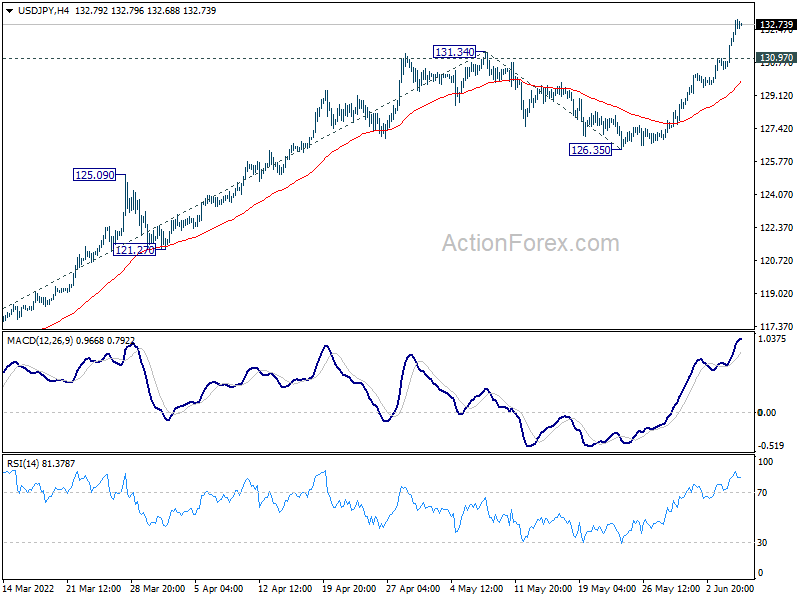
In the bigger picture, current rally is seen as part of the long term up trend form 75.56 (2011 low). Next target is 100% projection of 75.56 (2011 low) to 125.85 (2015 high) from 98.97 at 149.26, which is close to 147.68 (1998 high). This will remain the favored case as long as 126.35 support holds.
USD/CHF Mid-Day Outlook
Daily Pivots: (S1) 0.9637; (P) 0.9675; (R1) 0.9745; More...
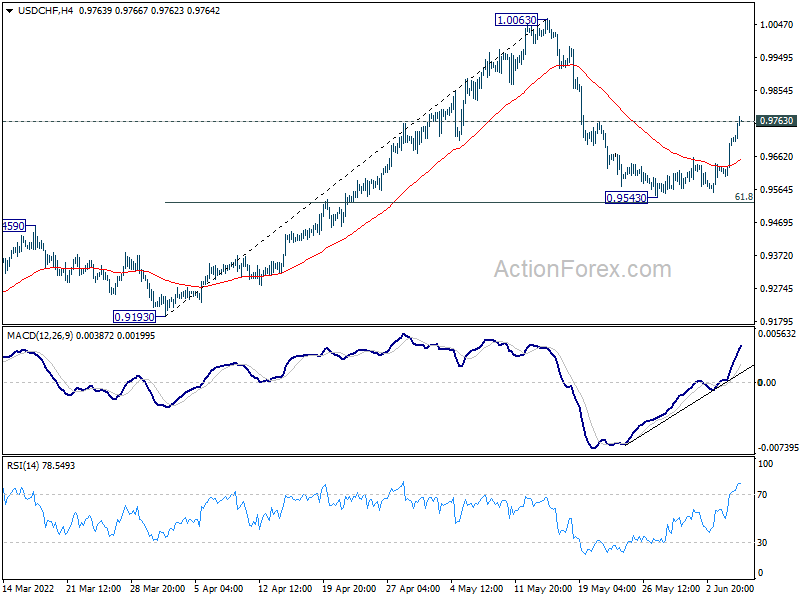
US/CHF's breach of 0.9763 minor resistance suggests that pull back from 1.0063 has completed at 0.9854 already, ahead of 61.8% retracement of 0.9193 to 1.0063 at 0.9525. Intraday bias is back on the upside for retesting 1.0063 resistance first. Firm break there will resume larger up trend. In case of another fall, strong support is still expected from 0.9525 to bring rebound.
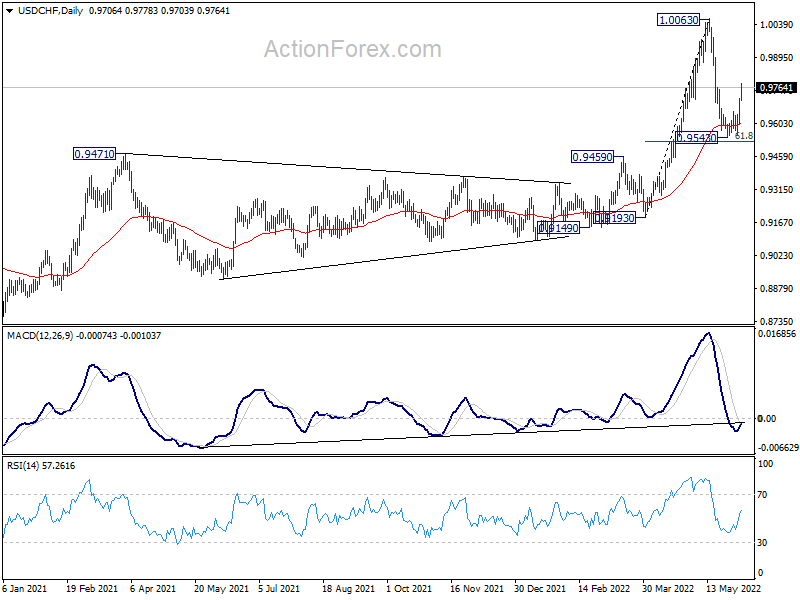
In the bigger picture, down trend from 1.0342 (2016 high) should have completed with three waves down to 0.8756 (2021 low) already. Rise from 0.8756 is likely a medium term up trend of its own. Next target is 1.0237/0342 resistance zone. This will remain the favored case as long as 0.9471 resistance turned support holds. However, sustained break of 0.9471 will extend long term range trading with another falling leg.
Yen and Franc Weakness Continues, Aussie Rally Faded Quickly
Selloff in Yen and Swiss Franc is still the main theme today even though US and Germany benchmark yields are retreating slightly. Australia was only lifted very briefly by the larger than expected rate hike by RBA. Though, Aussie is maintaining gains against Kiwi, which is the worst performing one for the day. On the other hand, Dollar, Canadian, and Sterling are the stronger ones while Euro is mixed.
Technically, USD/CHF's break of 0.9763 minor support argues that pull back from 1.0063 has completed. Stronger rebound would be seen back to retest this high. The question is whether the Franc's weakness is its own, or it's leading other European majors. Hence, eyes will be on 1.0626 minor support in EUR/USD and 1.2457 minor support in GBP/USD.
In Europe, at the time of writing, FTSE is down -0.24%. DAX is down -1.12%. CAC is down -1.07%. Germany 10-year yield is down -0.0081 at 1.315. Earlier in Asia, Nikkei rose 0.10%. Hong Kong HSI dropped -0.56%. China Shanghai SSE rose 0.17%. Singapore Strait Times rose 0.15%. Japan 10-year JGB yield rose 0.0043 to 0.250.
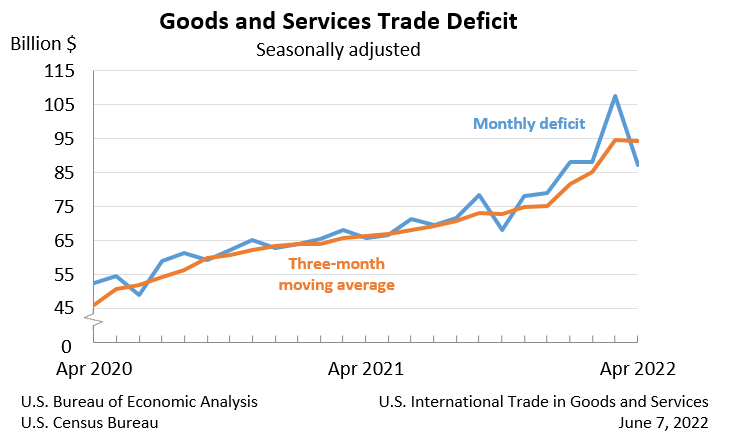
US exports of goods and services rose 3.5% mom in Apr, imports dropped -3.4% mom
US exports of goods and services rose 3.5% mom to USD 252.6B in April. Imports dropped -3.4% mom to USD 339.7B. Trade deficit narrowed from USD 107.7B to USD 87.1B, versus expectation of USD 89.3B.
In Q1, goods and services trade deficit with China increased USD 22.9B to USD 112.7B. The deficit with Canada increased USD 9.6B to USD 19.1B. The surplus with the United Kingdom increased USD 2.5B to USD 5.8B.
Eurozone Sentix investor confidence rose to -15.8, real economy is not suffering as quickly and as severely than expected
Eurozone Sentix Investor Confidence rose from -22.6 to -15.8 in June, above expectation of -20.0. Current Situation Index rose from -10.5 to -7.3. Expectations Index rose from -34.0 to -24.0.
Sentix said, "the real economy is not suffering as quickly and as severely from phenomena such as rising inflation and supply chain problems as one might have suspected.
"While consumers are already suffering much more from rising prices, many companies are still benefiting from inflation-related pull-forward effects. So far, many companies have also been able to pass on their sharply rising costs to their customers.
"But this is likely to be a finite phase. At a certain point, end consumers will have to cut back. Then, at the latest, the ability of companies to pass on their costs without restriction will also come to an end. In addition, there is a foresee-able change in monetary policy, which could also become more restrictive in the Eurozone from July.
"On the other hand, it should be positive that according to the sentix topic barometer the inflation peak should have been passed for the time being."
From Germany, factory orders dropped -2.7% mom in April, worse than expectation of -0.5% mom. Swiss foreign currency reserves were unchanged at CHF 925B in May.
UK PMI services finalized at 53.4, worrying combination of slower growth and higher prices
UK PMI Services was finalized at 53.4 in May, down from April's 58.9. That's the weakest level since February 2021. PMI Composite was finalized at 53.1, down from April's 58.2. S&P Global added that business activity expansions eased for the second month running. Input cost and prices charged inflation hit fresh record highs. Growth projections were lowest since October 2020.
Tim Moore, Economics Director at S&P Global Market Intelligence: "May data illustrate a worrying combination of slower growth and higher prices across the UK service sector. The latest round of input cost inflation was the steepest since this index began in July 1996, while the monthly loss of momentum for business activity expansion was a survey-record outside of lockdown periods."
RBA hikes by 50bps to 0.85%, more normalization over the months ahead
RBA raises cash rate target by 50bps to 0.85% today, larger than expectation of 40bps. Interest rate on exchange settlement balances is also lifted by 50bps to 75bps. The central bank also maintains tightening bias, as "the Board expects to take further steps in the process of normalizing monetary conditions in Australia over the months ahead."
In the accompanying statement, RBA said inflation in Australia has "increased significantly", and is "expected to increase further", before declining back towards the 2-3% target range next year. The economy is "resilient" while labour market is "strong".
One source of uncertainty is "how household spending evolves", given the "increasing pressure" from higher inflation, and interest rates. The central scenario is for strong household consumption growth this year, but RBA will pay close attention to various influences on consumption.
Australia AiG services dropped to 49.2, back in mild contraction
Australia AiG Performance and Services Index dropped sharply from 57.8 to 49.2 in May, indicating mild contraction. Sales dropped -13.0 pts to 50.7. Employment dropped -10.4 to 47.4. New orders dropped -3.3 to 49.7. Input prices dropped -9.1 o 68.7. Selling prices dropped -3.6 to 61.9. Average wages dropped -9.8 to 57.4.
Innes Willox, Chief Executive of Ai Group, said: "The Australian services sector contracted mildly in May after a period of healthy expansion in the earlier months of 2022. Performance was mixed across the sector with strong growth in logistics, retail trade and personal, recreational & other services offset by sharp declines in business & property services and health & education services."
USD/CHF Mid-Day Outlook
Daily Pivots: (S1) 0.9637; (P) 0.9675; (R1) 0.9745; More...
US/CHF's breach of 0.9763 minor resistance suggests that pull back from 1.0063 has completed at 0.9854 already, ahead of 61.8% retracement of 0.9193 to 1.0063 at 0.9525. Intraday bias is back on the upside for retesting 1.0063 resistance first. Firm break there will resume larger up trend. In case of another fall, strong support is still expected from 0.9525 to bring rebound.
In the bigger picture, down trend from 1.0342 (2016 high) should have completed with three waves down to 0.8756 (2021 low) already. Rise from 0.8756 is likely a medium term up trend of its own. Next target is 1.0237/0342 resistance zone. This will remain the favored case as long as 0.9471 resistance turned support holds. However, sustained break of 0.9471 will extend long term range trading with another falling leg.
Economic Indicators Update
| GMT | Ccy | Events | Actual | Forecast | Previous | Revised |
|---|---|---|---|---|---|---|
| 22:30 | AUD | AiG Performance of Services Index May | 49.2 | 57.8 | ||
| 23:01 | GBP | BRC Like-For-Like Retail Sales Y/Y May | -1.50% | -1.70% | ||
| 23:30 | JPY | Labor Cash Earnings Y/Y Apr | 1.70% | 1.50% | 1.20% | |
| 23:30 | JPY | Overall Household Spending Y/Y Apr | -1.70% | -1.00% | -2.30% | |
| 04:30 | AUD | RBA Interest Rate Decision | 0.85% | 0.75% | 0.35% | |
| 05:00 | JPY | Leading Economic Index Apr P | 102.9 | 102.3 | 100.8 | |
| 06:00 | EUR | Germany Factory Orders M/M Apr | -2.70% | -0.50% | -4.70% | -4.20% |
| 07:00 | CHF | Foreign Currency Reserves (CHF) May | 925B | 926B | 925B | |
| 08:30 | EUR | Eurozone Sentix Investor Confidence Jun | -15.8 | -20 | -22.6 | |
| 08:30 | GBP | Services PMI May F | 53.4 | 51.8 | 51.8 | |
| 12:30 | USD | Trade Balance (USD) Apr | -87.1B | -89.3B | -109.8B | -107.7B |
| 12:30 | CAD | Trade Balance (CAD) Apr | 1.5B | 1.9B | 2.5B | 2.3B |
| 14:00 | CAD | Ivey PMI May | 64.3 | 66.3 |
US exports of goods and services rose 3.5% mom in Apr, imports dropped -3.4% mom
US exports of goods and services rose 3.5% mom to USD 252.6B in April. Imports dropped -3.4% mom to USD 339.7B. Trade deficit narrowed from USD 107.7B to USD 87.1B, versus expectation of USD 89.3B.
In Q1, goods and services trade deficit with China increased USD 22.9B to USD 112.7B. The deficit with Canada increased USD 9.6B to USD 19.1B. The surplus with the United Kingdom increased USD 2.5B to USD 5.8B.
RBA, UK Data, Boris, Oil, Gold, Bitcoin
Stock markets are back in the red on Tuesday, giving back the bulk of Monday's gains in a sign of ongoing uncertainty as to the direction of equity markets and the economy.
There is clearly appetite at these levels but that's not being backed up by momentum of any kind. Hardly surprising given the sheer uncertainty around inflation, interest rates and the economy. Central banks are racing to catch up but that may come at a great cost.
The RBA overnight became the latest to join the super-sized club, following in the footsteps of the Fed, BoC and RBNZ, among others. The decision to hike by 50 basis points came as quite a shock to the markets, with 25 priced in ahead of the meeting. It was the biggest hike in more than two decades and another sign of policymakers belatedly recognising the urgency of the inflation problem. And there's plenty more to come.
The ECB is very late to the party but will likely announce an end to net asset purchases on Thursday and a desire to raise rates from next month, bringing the deposit rate out of negative territory in the third quarter. This doesn't exactly fall into the bracket of recognising the urgency but then it is the ECB, so by its standards perhaps it does.
The BoE was early to the party compared to many of its peers and it's also been the first to concede defeat on a recession, something others may follow on in the months ahead. If today's UK BRC retail sales data is a sign of things to come then the BoE is right to be so pessimistic. The cost-of-living crisis has well and truly arrived and the data suggests households are already cutting back. The final PMI data, while much better than the flash reading, was also a big drop from April and reflects the more pessimistic outlook.
One thing the UK won't have to deal with (yet) is political uncertainty after Boris survived the no-confidence vote. He didn't exactly do it in emphatic fashion though, leaving many to believe he has merely postponed his departure rather than prevent it altogether.
Oil struggling to hold above $120
Oil is continuing to struggle around $120 on Tuesday, with Brent and WTI very slightly lower. We've seen $120 broken on a few occasions over the last week but each time it's been quickly repelled in a sign of momentum starting to run a little thin. The fundamentals remain bullish for oil prices as China continues to reopen and the OPEC+ "production hike" does little to alleviate the tightness in the market. Still, it's been a very strong run over the last month, with the price up more than 20% from the May lows. We could potentially see some profit-taking in the short-term but it's hard to imagine it being too severe, barring significant growth downgrades or a surge in Covid cases in China.
Gold consolidation continues
As has so often been the case in recent weeks, gold is continuing to fluctuate around $1,850 today and showing little sign of a burst in either direction. It struggled once more around $1,870 on Friday, reinforcing it as a key area of resistance to the upside, while $1,830 continues to be the first line of support below. We may have to wait for the inflation data at the end of the week for an interesting move in either direction.
Another failed break higher
Bitcoin is also trading around the same level it has for most of the last month but at least the price action this week has been a little more interesting. A 6% rally on Monday has been followed by a 6% decline today, taking bitcoin back below $30,000 and confusing crypto traders in the process. It's really struggling to hang onto rallies much to the frustration and perhaps even concern of the crypto crowd. This remains a key level and a break to the downside could cause far more stress than it did almost a month ago.
Australian Dollar Swings after RBA Shocker
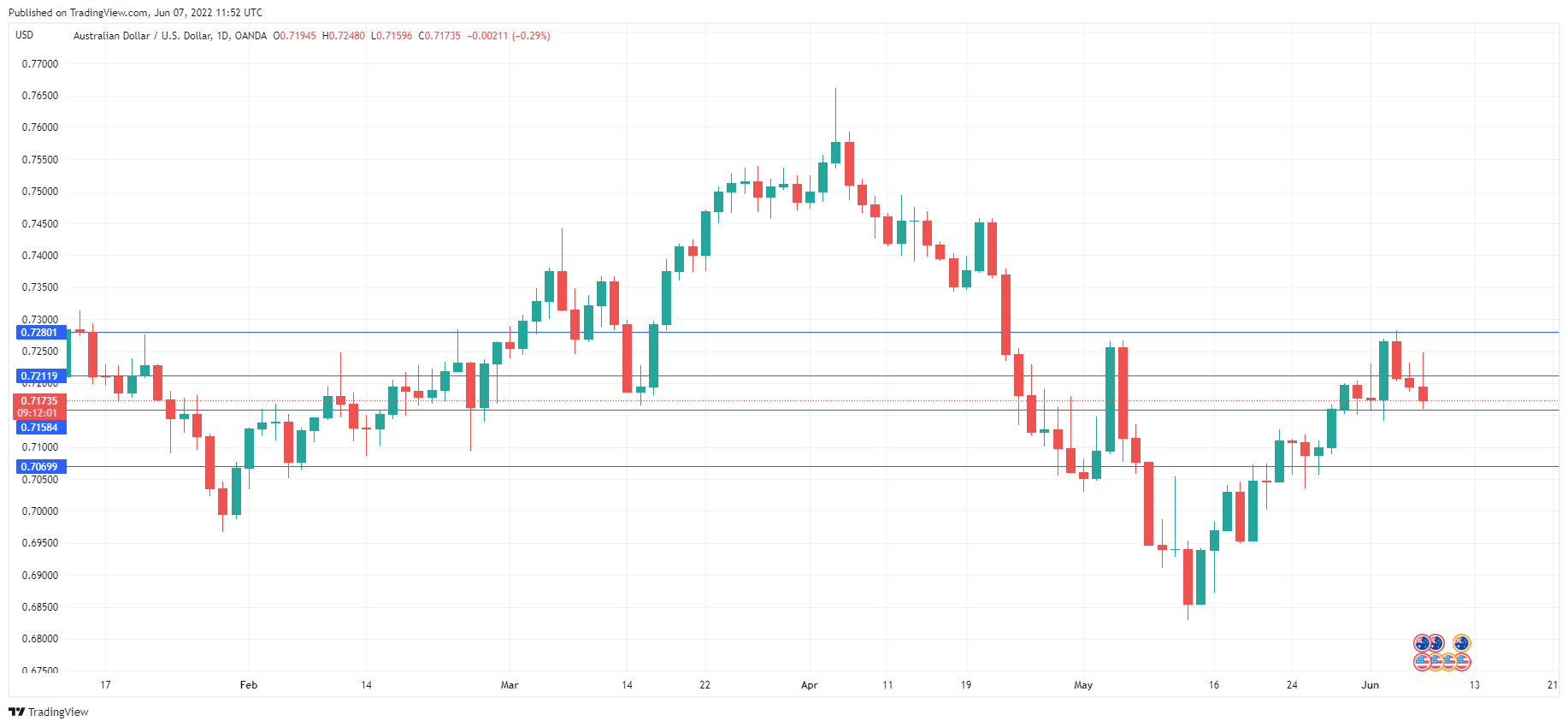
The Australian dollar showed some bounce on Tuesday, courtesy of the RBA rate decision. AUD/USD produced a flash spike of 60 points after the move and touched a daily high of 0.7248, but was unable to consolidate. In the European session, the Aussie is trading at 0.7180, unchanged on the day.
RBA surprises with 50bp hike
The RBA had a huge surprise up its sleeve, as it delivered a 50bp rate hike, bringing the cash rate to 0.85%. The meeting was live, with the markets had expected a modest 25bp rise, although there were some forecasts of a 40bp increase as well. The super-size 50bp move indicates that the RBA is determined to curb inflation with an aggressive rate-tightening cycle. At the same time, the RBA runs the risk of appearing to be in panic mode with such a large hike and runs the risk of losing credibility if inflation doesn’t start to ease soon.
The RBA’s rate statement was not particularly hawkish, considering the massive rate hike. That could explain why the Australian dollar was not able to capitalize on the rate hike, as the spike quickly fizzled. The statement noted that inflation had accelerated more than anticipated and was expected to increase further before declining next year. The Bank expressed confidence that today’s rate hike would contribute to inflation falling “over time”. The statement also noted that the economy was resilient and the labour market remains strong.
The US dollar received a boost from US Treasury yields, as the 5, 10 and 30-year yields are all above the 3 per cent level. The upward move in US yields could be related to this week’s USD 96 billion in government bond sales in the 3, 10 and 30-year tenors. Will yields remain above 3% during the week? If so, the dollar could show some strong movement after the CPI release on Friday.
AUD/USD Technical
- AUD/USD tested resistance at 0.7211 earlier in the day. The next resistance line is 0.7280
- 0.7158 is under pressure in support. Below, there is support at 0.7069
GBP/USD: Keeps Traction But Downside Remains at Risk as Negative Tone Prevails in Fundamentals
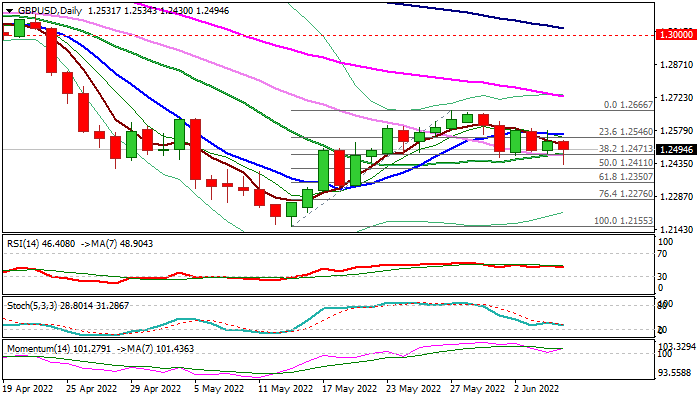
Cable bounces from a daily low at 1.2430 (the lowest since May 19, after being hit by the story about confidence vote on PM Boris Johnson.
Although Johnson survived the vote, he suffered significant political damage as 41% of Conservative MP’s voted against him, with focus on two elections on June 23, which would further undermine Johnson’s position if Conservatives lose these seats.
On the other side, better than expected UK May Services and Composite PMI’s slightly improved the sentiment and gave a temporary boost to the sterling, despite British businesses continued to slow, as a result of increased pressure from surging inflation.
Also, expectations on more aggressive BOE that would push interest rate to 2.25% towards the end of the year, could keep the pound afloat.
Technical studies are still conflicting as bullish momentum continues to rise and MA’s are mixed, while RSI is just below neutral zone.
Today’s renewed probe through key 1.2470 support (Fibo 38.2% of 1.2155/1.2866 upleg / converged 20/30DMA’s / lows of past four days) was so far rejected, suggesting that initial signal of bear-trap is forming, however lift and close above 10DMA (1.2563) which capped the action in past five days, is needed to confirm positive signal and shift near-term focus higher.
Conversely, sustained break of 1.2470 pivotal support zone would generate fresh bearish signal and risk deeper drop, with loss of 1.2411 (50% retracement of 1.2155/1.2666 upleg) to signal an end of corrective phase from 1.2155 (May 13 low).
Res: 1.2534; 1.2563; 1.2589; 1.2616.
Sup: 1.2470; 1.2430; 1.2411; 1.2350.