Sample Category Title
EUR/CHF Daily Outlook
Daily Pivots: (S1) 1.0327; (P) 1.0360; (R1) 1.0411; More....
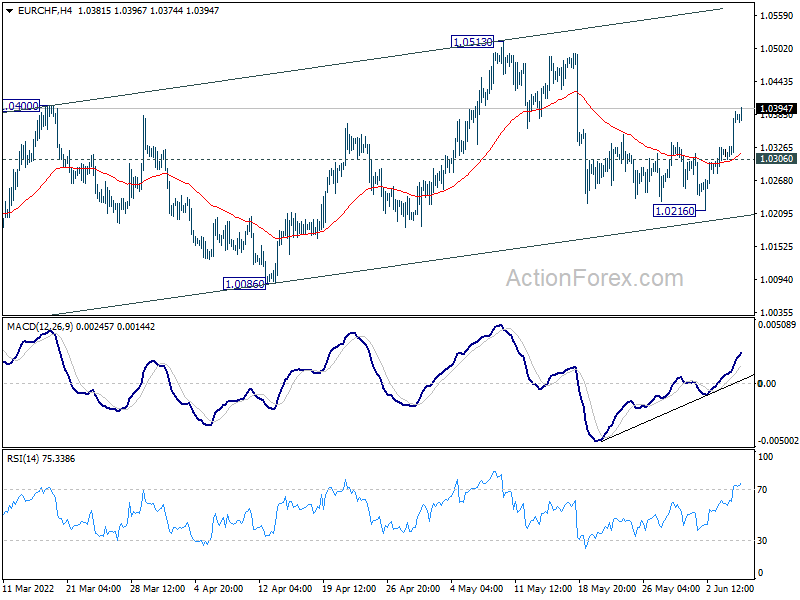
EUR/CHF's break of 1.0349 minor resistance suggests that pull back from 1.0513 has completed at 1.0216 already. More importantly, the development indicates that whole rebound from 0.9970 is still in progress. Intraday bias is back on the upside for retesting 1.0513 resistance next. On the downside, below 1.0306 minor support will turn intraday bias neutral again.
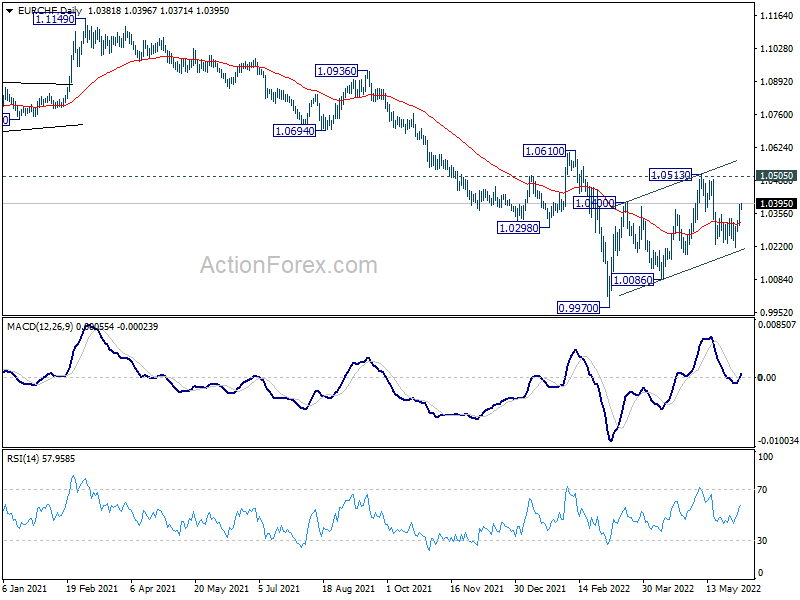
In the bigger picture, as long as 1.0505 support turned resistance (2020 low) holds, long term down trend from 1.2004 (2018 high) is expected to continue. Next target is 100% projection of 1.2004 to 1.0505 to 1.1149 at 0.9650. However, firm break of 1.0505 will suggest medium term bottoming, and bring stronger rebound towards 1.1149 structural resistance.
US Treasuries Underperformed German Bunds
Markets
Last week’s sell-off in core bond markets simply continued at the start of the new one. The main move occurred around the start of US dealings without firm trigger. US Treasuries underperformed German Bunds. The Germany yield curve bear steepened with yields rising by 3 bps (2-yr) to 5.3 bps (30-yr). The breakdown of the 10-yr yield showed that both real yields and inflation expectations contributed to the move. The German 10-yr yield pushed above 1.3% for the first time since June 2014, leaving the key 1.13%-1.23% resistance zone firmly behind. The next long term technical references stand at 1.9% (50% retracement on 2008-2020 decline to 2.09% (2013 top).
The US yield curve bear steepened as well with yields adding 7.4 bps (2-yr) to 12 bps (20-yr) in a daily perspective. The US 10-yr yield reconquered the psychological 3% barrier after a brief spell north of it early May. The key technical reference is the 2018 top at 3.26%.
US stock markets attempted to copy the positive mood in Europe (+1-1.5%), but their efforts were blocked by the intensity of the bond sell-off. Main US indices eventually closed flat (Dow) to 0.4% higher (Nasdaq).
The dollar was better bid, arriving this morning at first minor resistance at 102.73 (DXY). Taking out that level suggests an end to the technical correction since mid-May. Similar reference in EUR/USD is 1.0627/42. Going into this week’s pivotal ECB meeting, we believe that the single currency could offer some counterweight still, especially given the empty US eco calendar until Friday’s CPI inflation and Michigan consumer confidence.
The Japanese yen is the biggest victim in the current climate. USD/JPY sets a new 20-yr high in the high 132-area. The 2002 top at 135.04 serves as next resistance. BoJ governor Kuroda isn’t helping JPY much by stressing the outlier dovish monetary policy position. Powerful easing with yield curve control as a pillar remains the motto. The BoJ watches the impact of the weak yen, but the currency policy is up to the finance ministry. FM Suzuki later reiterated his warning that they are monitoring the FX rate and their economic impact with a sense of urgency. These soft verbal interventions can’t counter JPY weakness.
UK PM Johnson lives to fight another day after narrowly surviving a Tory-triggered no confidence vote in parliament. The pyrrhic victory (211-148) shows a bigger than feared internal rebellion which hurts Johnson’s credibility even further. Lack of internal successor and fear for election defeat suggest that Johnson could nevertheless stick somewhat longer in office. After the vote, he promised to present a plan for the economy together with Chancellor Sunak next week. The plan should focus on the supply-side reform and tax cuts. Sterling is a tad softer this morning at EUR/GBP 0.8570. First minor resistance lingers around at 0.86.
News Headlines
The Reserve Bank of Australia hiked by 50 bps, bringing the cash rate to 0.85%. Markets expected the RBA to continue with a 25 bps pace. The move follows high and increasing inflation on the back of global as well as domestic factors. The latter includes capacity constraints in some sectors and a tight labour market. The economy is resilient with an upswing in business investment underway and terms of trade at a record high. Consumer spending is being supported by growing wages but the impact of inflation on household’ budgets is a source of uncertainty. Housing prices have declined amid rising interest rates and may affect household wealth/spending at some point. For now, the central bank expects policy rates to rise further with the size and timing guided by the incoming data and the outlook for inflation and the labour market. Australian swap yields surge more than 13 bps at the front-end. The Aussie dollar tried to settle above 0.72 but ran into resistance soon. AUD/USD currently changes hands around 0.718. At its policy meeting this Thursday, the ECB will strengthen its commitment on preventing fragmentation when it starts raising policy rates for the first time in more than a decade, the Financial Times reported. Citing people involved in the discussions, a majority in the council is expected to support a proposal for a new bond-buying programme if needed to counter borrowing costs for the likes of Italy should they spiral out of control. Several policy makers want Thursday’s statement to formally include the possibility of such a mechanism to be created.
Three, is a Magic Number
US yields were on the move last night, with the curve from the 5-year to 30-year tenor now all above three per cent. That was enough to crimp the perpetual FOMO bulls of the stock market, with Wall Street finishing just above flat, while the US Dollar also booked some gains. Gold fell slightly while oil also gave back early gains, Brent crude finishing almost flat, just shy of $120.00 a barrel.
One notable loser was the Japanese Yen, with USD/JPY climbing to two-decade highs around 131.90 overnight, before adding another 0.50% to 132.60 today. With the US/Japan rate differential hollowing out the cross, Japanese authorities resorted to verbal intervention this morning, BOJ officials saying a rapid Yen weakening was undesirable.
The US yield curve is starting to look pretty flat now between the 5-year and 30-year tenors, which is making me a little nervous. An 8.50%+ US inflation print could see it start to price in a recession and head to inversion in parts, as the data reinforce Fed tightening. In a stagflationary environment, central banks don’t have a good choice, just least bad ones. That said I don’t think the US is at stagflation yet, but if oil stays above $120.00 a barrel, it might soon be.
Looking at the price action overnight, I am not entirely convinced that the US bond move was driven by inflation and Fed tightening fears. Yes, the US Dollar rallied, but stripping out the Yen, it wasn’t a currency bonfire. US equities still finished modestly higher, and gold’s retreat was limited, it is still boring everyone to death with range trading. The move higher in US yields could well be in anticipation of the $96 billion of US government bond sales hitting markets this week in the 3, 10 and 30-year tenors. Time will tell although if most of the US curve is still above 3.0% come Friday, the post-US inflation price action could be frisky indeed.
Turning to the Asia-Pacific, are on the Reserve Bank of Australia policy decision at 1230 SGT today. The market is heavily weighted to a 0.25% rate hike to 0.60%, as am I. It would be a huge surprise if the RBA did a reverse Prince, didn’t let the doves cry, and hiked by 0.40%. That would see AUD/USD a lot higher and the battlers on the stock market having a bad day, as well as sending a message that the RBA had entered panic mode. A 0.25% hike is priced in and should have minimal impact on the Australian Dollar which remains at the mercy of US-derived sentiment flows, like its flightless bird cousin across the Tasman. A change in tone to a more hawkish post-rate-decision statement could see some AUD strength though.
Japanese Household Spending also disappointed this morning, improving slightly from March, but falling by 1.70%, it was well below forecasts. That would have been another reason to buy USD/JPY today, with t byhe rhetoric emanating from the Bank of Japan this morning, sounding a bit more nervous than previously.
The rest of the Asian calendar is dead today, although we did get UK BRC Retail Sales YOY for May this morning, Retail Sales improved ever so slightly, but are still solidly negative at -1.50%. The UK has a post-Jubilee railway strike yesterday, and Boris Johnson survived a no-confidence vote. In BoJo’s case, TINA came to his rescue, there is no alternative. The railway strike is what I believe will be a summer/autumn/winter of discontent for the UK as the cost of living soars and the Bank of England waves the white flag. War in Eastern Europe and a UK Government still seemingly intent on invalidating the Brexit agreement over Northern Island all add up to me struggling to find a reason for GBP/USD to ever see a 1.3000 handle in 2022.
The data calendar across Europe is similarly second-tier with a few construction PMIs, and the US releases its April Balance of Trade. That is expected to improve to a mere deficit of $89.5 billion, however, this data is not usually market impacting. It looks like we have 24 hours ahead of markets being driven by headlines and sentiment swings once again. Roll on Friday.
Asian equities are mixed once again
Higher US bond yields took the edge of Wall Street overnight, which was happy to tail chase the China reopening trade higher, especially as US-listed China equities performed very well. That left Wall Street closing modestly higher. The S&P 500 rose by 0.31%, the Nasdaq gained 0.40%, and the Dow Jones added just 0.07%. In Asia, US futures have continued falling, and all three major indexes are down 0.40% this morning, although that is not translating into universal negativity with Asian markets.
Asian markets are mixed once again, with the growth-centric North Asia heavyweights doing well, for the most part, whiles the more value-orientated ASEAN markets are once again struggling, perhaps unnerves by $120.00 oil. The slumping Yen has seen Japan’s Nikkei 225 rise by 0.60% today, though South Korea’s Kospi has fallen by 1.35% as it plays catchup to Friday after being on holiday yesterday. Taipei is also struggling, edging 0.40% lower.
In Mainland China, the reopening trade remains at full strength, with US-listed Chinese equities pricing in the worst is over overnight as well. That has been helped along by the belief that China has reached “peak-crackdown” on its tech giants. We shall see. The Shanghai Composite has risen by 0.50% today, with the CSI 300 climbing by 0.65%. Rather surprisingly, Hong Kong’s Hang Seng is almost unchanged, edging 0.10% lower.
In regional markets, the rise of both oil and US yields appears to be weighing on sentiment. Singapore is 0.20% lower, while Kuala Lumpur has fallen by 0.50%. Jakarta has unwound some of yesterday's losses, climbing by 0.50%, with Bangkok dropping by 0.80%, with Manila adding 0.15%. Australian markets are retreating ahead of the RBA policy decision in what appears to be a defensive move against a hawkish surprise. The ASX 200 and All Ordinaries have fallen by 0.90%.
European markets jumped on the China reopening trade overnight, along with the possibility that Russia might “allow” Ukrainian wheat exports. Germany and France’s leaders should probably ask the Ukrainian first though. That rally is unlikely to be repeated today with higher US yields spurring an equity retreat in the US overnight, and US futures mired in the red this morning in Asia.
US Dollar rises in Asia
The spike in US yields across the curve overnight unwound early US Dollar selling, sending the dollar index to a modest 0.24% for the day, closing at 102.41. US Dollar strength continues in Asia, perhaps helped by BOJ comments that now is not the time to consider an easy monetary policy exit. The dollar index has risen by 0.20% to 102.60 today, climbing back above the pivot point at 102.35. Support/resistance lies at 101.30 and 102.70 and remains in a wide and noisy range.
EUR/USD finished slightly lower at 1.0695 overnight, as US yields capped an attempted rally through 1.0750. It has edged lower to 1.0685 in Asia. Resistance between 1.0770 and 1.0830 remains a formidable barrier, with support at 1.0650. With the ECB expected to swing to a tightening bias this week, losses should be limited unless US yields continue to march higher from here.
Sterling finished 0.30% higher at 1.2530 overnight as PM Johnson survived a leadership vote. It has fallen to 1.2505 in Asia though as US Dollar strength continues. A rise through resistance at 1.2670 opens a potentially larger rally to 1.2800 and 1.3000, while the failure of support at 1.2460 could see Sterling retest 1.2400.
A widening US/Japan rate differential overnight saw USD/JPY soar higher and has had the Bank of Japan making plenty of comments on the wires today. The BOJ’s comments that they will not change monetary policy are cancelling out any impact of “rapid Yen fall undesirable” comments. USD/JPY rallied by 0.82% to 131.90 overnight, and it has gained another 0.55% to 132.60 this morning. USD/JPY should theoretically be on the way to 135.00 now, but it remains entirely at the mercy of the direction of US yields. If US yields retreat this week, USD/JPY could easily find itself back below 130.00.
AUD/USD has fallen through trendline support at 0.7195 this morning to 0.7175. Although AUD/USD has lost 0.50% over the last 24 hours, the move lower appears like markets trimming long positions ahead of the RBA, rather than a turn in sentiment. AUD/USD has support at 0.7150, with resistance between its 50/100/200-day moving averages (DMAs) between 0.7225 and 0.7255. It could trade both sides of that range post-RBA. A hawkish statement could see AUD/USD closer to 0.7300 by the end of the Asian day.
USD/Asia moved higher on Monday as US yields rose, but overall, there is no sign of panic, merely a technical move in response. That could all change by Friday if US yields are still above 3.0% and US inflation rises above 8.50%, but for now, US Dollar strength is mostly playing out versus the Japanese Yen. USD/Asia is slightly higher this morning, rising by around 0.20%.
Oil is steady in Asia
Oil’s intraday gains overnight were pared back in New York as US yields and the US Dollar climbed, leaving both Brent crude and WTI slightly lower for the session. Brent crude finished 1.05% lower at $119.95 a barrel, and WTI finished 1.10% lower at $119.00 a barrel. Asian markets are very much in wait-and-see mode, with Brent crude slightly higher at $120.15 a barrel, and WTI edging higher to $119.25 a barrel.
Whichever way you look at it though, both Brent and WTI prices are nearing post-Ukraine highs, stripping at the days of the initial hostilities themselves. Returning Venezuelan and Libyan production to Europe and North America, should it occur, will not be material enough in the shorter term to force prices lower. Refining margins globally suggest that demand for petrol and diesel remain in heavy demand, with the refining logjam in refined products backstopping crude prices.
Additionally, the damp squib OPEC+ meeting outcome, with some production bones thrown to some angry dogs, and a potential recovery in demand from Mainland China is it has got on top of omicron, provides yet more reasons to believe that physical demand will keep prices elevated.
Brent crude has resistance at $122.00, and $124.00, with support distant at $116.00 and $112.50 a barrel. WTI has resistance at $121.00, with distant support at $115.00 and $111.25 a barrel.
Gold’s flip-flop ranging continues
Gold continues to bore traders to death as range trading and reversals by a thousand cuts continue. Overnight, a stronger US Dollar and firmer US yields pushed gold 0.50% lower to $1842.00 an ounce, where it remains in yet another moribund Asian session.
The chart picture shows gold is now eroding resistance at $1870.00, touching $1874.00 an ounce on Friday. But overall, resistance at $1870.00 remains intact, followed by the 100-DMA at $1889.00, and then $1900.00. Support is at $1844.00 has given way, opening further falls to $1830.00, and then $1780.00 an ounce. I do not discount a disorderly retreat if the latter fails.
Gold remains at the mercy of intraday directional moves by the US Dollar and US yields.
Get More Hawkish
Risk appetite wanes as the US 10-year yield stretches above the 3% psychological mark. The US stock indices failed to extend gains on Monday, as Friday’s strong jobs report ruled out the expectations that the Federal Reserve (Fed) would slow tightening as a result of heavier pressure on the economy.
Inflation is the only metric that matters for the Fed right now, and tension among investors will likely remain high before Friday’s CPI release in the US. The US CPI is expected to have stabilized near the 8.3% mark in May. Last month’s reading was better than the previous month but not as good as market predictions. A second month disappointment could keep the Fed hawks alert and spoil the rally that the US equity indices recorded during the second half of May.
Good and bad news
A couple of factors play in favour of possible relief on inflation, and they include the softer chip shortage, lower shipping prices and easing fertilizer prices. Also, everybody is very enthusiastic about the fact that China is reopening again - except my friends in Shanghai who are woken up at the middle of the night to get tested.
But energy prices aren’t easing. The barrel of US crude extended gains to $121.50 on Monday, and last week’s announcement that OPEC would pump more oil didn’t help improving the price pressure. A further rise in crude oil seems inevitable after the bears failed the OPEC test last week. On the topside, the next resistance stands at $130 per barrel.
It’s not only the Fed
Today, the Reserve Bank of Australia (RBA) raised the interest rates by 50bps to 0.85% while analysts were expecting an increase to 0.60%.
The European Central Bank (ECB) is expected to deliver a hawkish policy stance on Thursday’s meeting. The Europeans are not expected to raise the rates this week, but rather in July.
What we will see this week is the new economic projections from the ECB that will show the implications of the Ukrainian war, especially via the soaring food and energy prices. The new economic projections should finally confirm that the criteria needed for the ECB to raise its rates are finally met. A part of me is secretly looking for a surprise rate hike this week (hush!)
In the FX, the EURUSD remains under the shadow of a strong dollar, yet the higher possibility of a more hawkish ECB policy offers interesting opportunity to increase long exposure to the euro during price pullbacks.
Gold and Bitcoin on the same boat
Bitcoin tumbled more than 6% to below the $30K mark, and a significant recovery is unlikely if we continue seeing further upside pressure on the US yields front.
The same goes for Gold. The higher US yields pressure the yellow metal lower. The price of an ounce is again below its 200-DMA and has potential to extend weakness toward $1800 mark.
Boris Johnson Survives No-Confidence Motion
Market movers today
In the euro area, we get the Sentix investor confidence number for June, which is expected to decline modestly, after the sharp setback seen after the Russian invasion of Ukraine in February.
The World Bank releases its global economic prospects report today, where focus will be on how countries are managing a flurry of external shocks such as higher food and oil prices along with tightening of global financial conditions.
Later this week, the ECB meeting on Thursday is a key focus point along with the US CPI inflation numbers on Friday. Tomorrow the Polish central bank announces its rate decision.
The 60 second overview
Boris Johnson survived a no-confidence vote in his conservative party: The no-confidence vote was called over the so-called "partygate". While 211 Tory MPs voted for Johnson in the confidence motion, 148 voted against him. Following the results, observers question whether his long-term future of his leadership over the conservative party although he can stay on for now. Boris Johnson refused to call early elections after the results were known, calling for the party to move on and focus on delivery of the policy agenda. The GBP was little changed after the motion.
The Reserve Bank of Australia hiked its cash rate by 50bp to 0.85% this morning, while consensus was expecting a 25bp hike. AUD/USD rose sharply after the rate decision. Both global and domestic factors continue to accelerate inflation, and the very tight labour market conditions are expected to support wage inflation going forward. As local economy is doing well, and inflation pressures continue increasing, RBA is willing to front-load the rate hikes. While the hike was larger than we had expected, we still think relative rates are unlikely to provide much long-lasting support for the AUD/USD. Market is very aggressively priced, seeing the cash rate peaking around 4.5% by May 2023. As we see global growth risks rising towards next year, we think risks are tilted towards a shorter hiking cycle.
Russia and Turkey tentatively agree to resume transporting agricultural products in the Black Sea: Turkey offered Ukraine assistance in clearing the water area of the port of Odessa from mines and escorting ships loaded with grain under the auspices of the UN. But Kyiv fears that Odessa will be unprotected and could become an object of attack. Russian Foreign Minister Sergei Lavrov will hold talks with Turkish officials in Ankara on the plan. Grain prices have been rising sharply after the war in Ukraine broke out, as Russia and Ukraine are some of the most important grain producers. This has threatened food security in especially the developing world.
Equities: Global equities headed higher yesterday despite some risk appetite faded in the US cash session. Cyclicals once again beating defensives and with yesterday outperformance it was the eighth time in the last nine sessions with cyclicals outperforming. Cumulative outperformance almost 5% which fits well with our call of relief rally where the most oversold sectors regain the most. VIX ticked a bit higher yesterday, now back north of 25. Our correction monitor shows a z-score of -0.8, down from -1.6 just three weeks ago and hence also indicating that risk appetite has been increasing within other asset classes as well. Asian markets are mixed this morning, though with most markets lower. Both European and US futures lower as well.
FI: With most of Europe out yesterday, and UK coming back in after Jubilee, it was a rather thin market session. FT's sources story suggesting that ECB can frontload a year of redemptions of EUR200bn gave some initial support to euro area spreads. On the day, spreads were generally tighter but the tightening seemed rather idiosyncratic. Although Spain was one of the least performers as banks were mandated for a new 10y benchmark bond. Curves steepened from the long end.
FX: It has been a fairly slow start to the week with very limited moves in majors space excl. RUB. The most notable moves have been the setback to CHF and JPY but also the EUR has exhibited some broader based weakness. GBP did little on the Boris Johnson-vote while NOK and CAD have enjoyed support from the recent rise in oil. EUR/SEK still trades just south of the 10.50-mark.
Credit: There was a broad-based positive sentiment in credit markets yesterday where iTraxx Xover tightened to 436.9bp (-9.0bp) and Main to 87.5bp (-1.8bp).
EUR/USD Daily Outlook
Daily Pivots: (S1) 1.0669; (P) 1.0711 (R1) 1.0737; More...
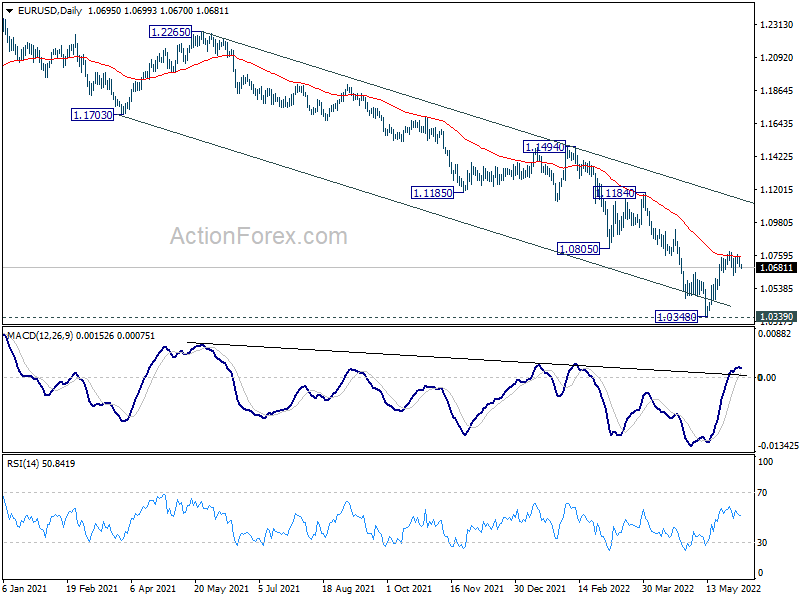
Intraday bias in EUR/USD remains neutral for the moment. On the downside, break of 1.0626 minor support will indicate rejection by 55 day EMA, and turn bias back to the downside for retesting 1.0348. On the upside, break of 1.0786, and sustained trading above 55 day EMA (now at 1.0757) will target 1.0935 resistance next.
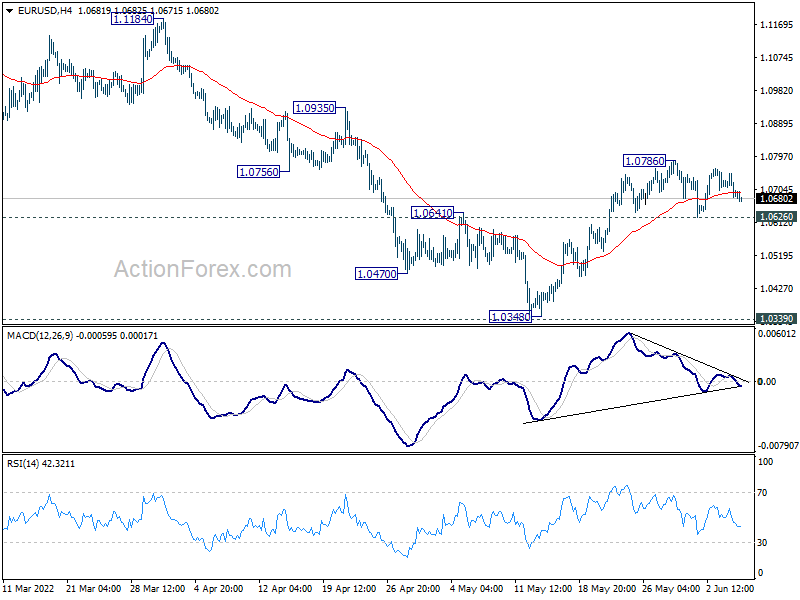
In the bigger picture, focus stays on 1.0339 long term support (2017 low). Decisive break there will resume whole down trend from 1.6039 (2008 high). Next target is 61.8% projection of 1.3993 to 1.0339 from 1.2348 at 1.0090. However, firm break of 1.0805 support turned resistance will delay this bearish case and bring medium term corrective rebound first.
GBP/USD Daily Outlook
Daily Pivots: (S1) 1.2479; (P) 1.2528; (R1) 1.2580; More...
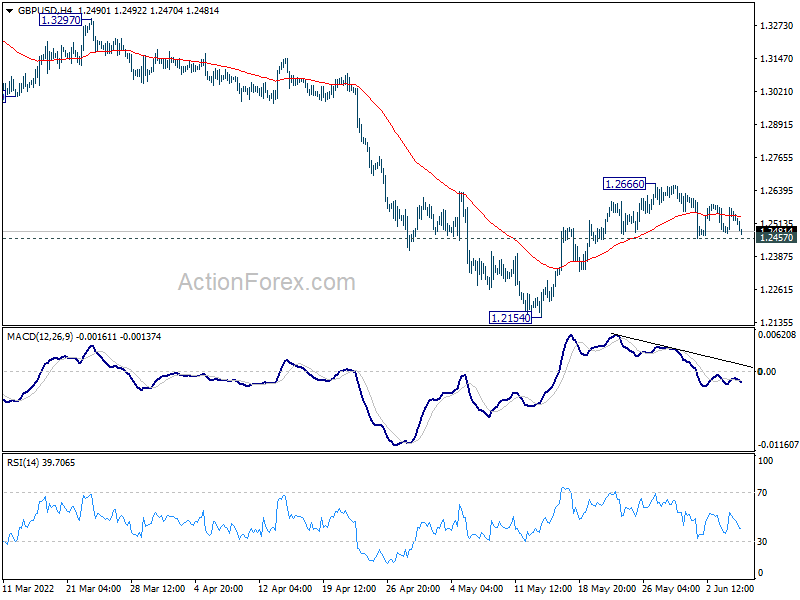
Intraday bias in GBP/USD remains neutral for the moment. On the downside, break of 1.2457 minor support will suggest that rebound from 1.2154 has completed. Intraday bias will be back on the downside for resting this low. On the upside, above 1.2666 will target 55 day EMA (now at 1.2707) and above.
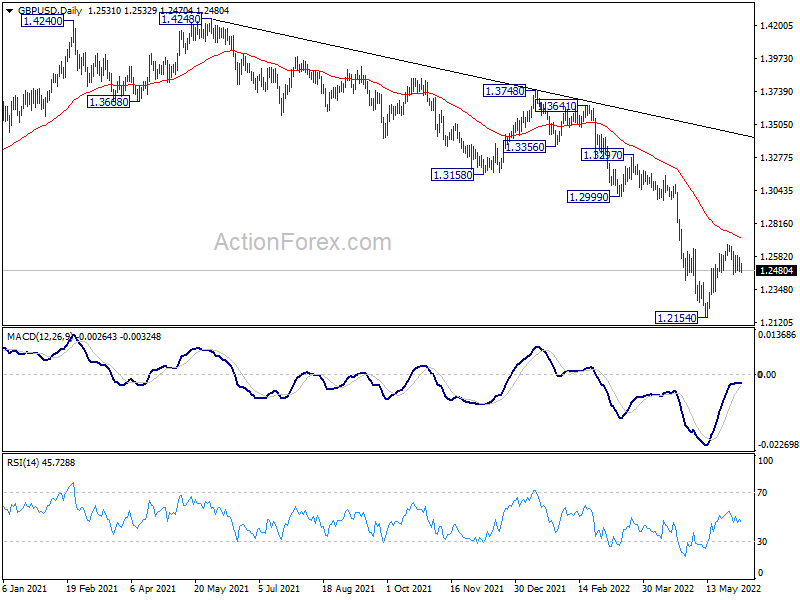
In the bigger picture, fall from 1.4248 (2018 high) could be a leg inside the pattern from 1.1409 (2020 low), or resuming the longer term down trend. Deeper decline is expected as long as 1.2999 support turned resistance holds. On resumption, next target is 1.1409 low.
USD/CHF Daily Outlook
Daily Pivots: (S1) 0.9637; (P) 0.9675; (R1) 0.9745; More...
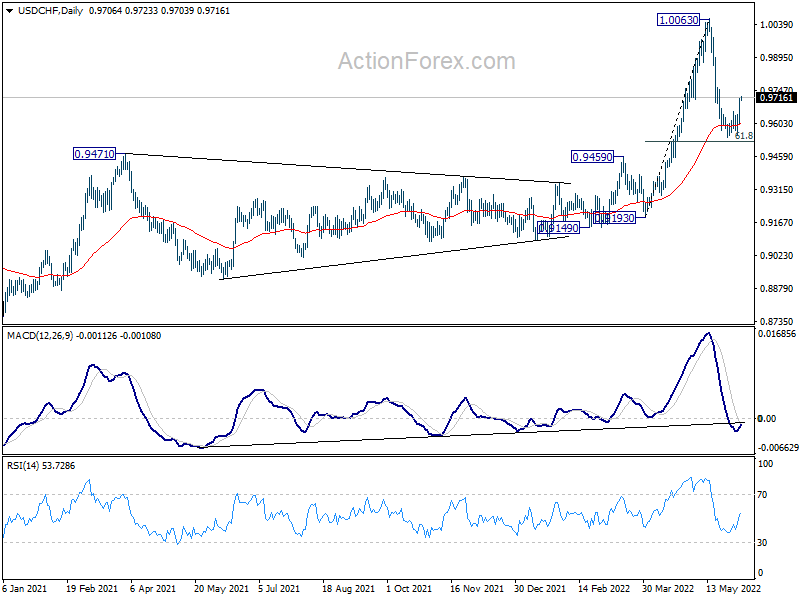
Intraday bias in USD/CHF remains neutral first with focus on 0.9763 minor resistance. Break there will suggest that the pull back from 1.0063 has completed. Bias will be back on the upside for retesting 1.0063 high. In case of another fall, strong support is still expected from 61.8% retracement of 0.9193 to 1.0063 at 0.9525 to bring rebound.
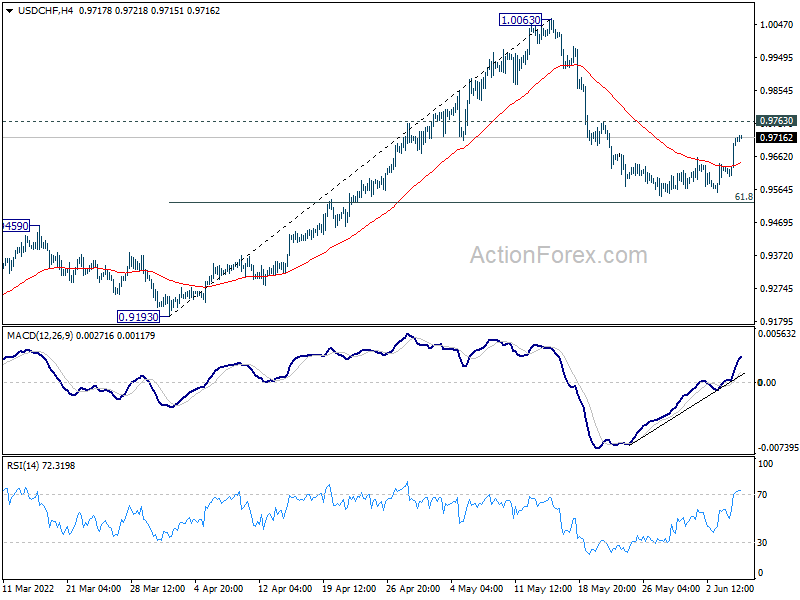
In the bigger picture, down trend from 1.0342 (2016 high) should have completed with three waves down to 0.8756 (2021 low) already. Rise from 0.8756 is likely a medium term up trend of its own. Next target is 1.0237/0342 resistance zone. This will remain the favored case as long as 0.9471 resistance turned support holds. However, sustained break of 0.9471 will extend long term range trading with another falling leg.
USD/JPY Daily Outlook
Daily Pivots: (S1) 130.88; (P) 131.44; (R1) 132.46; More...
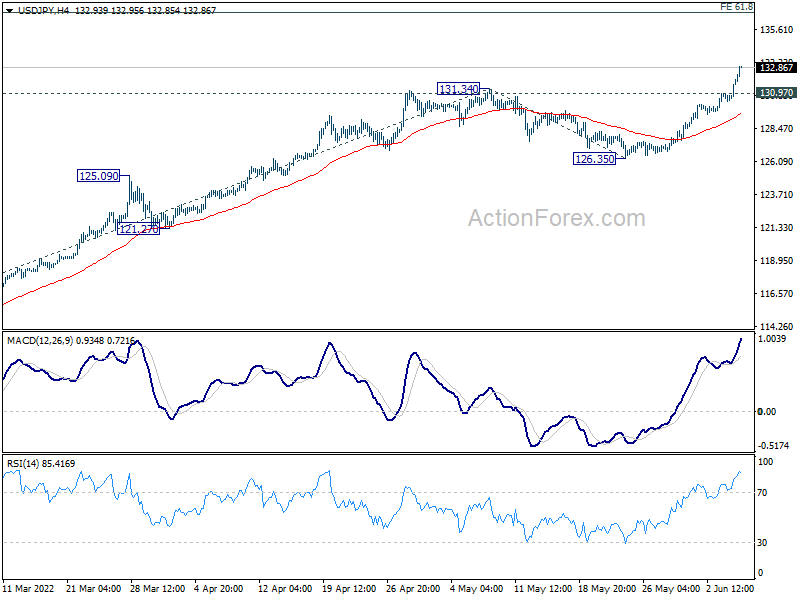
USD/JPY's strong break of 131.34 resistance confirms up trend resumption. Intraday bias remains on the upside. Next target is 61.8% projection of 114.40 to 131.34 from 126.35 at 136.81. On the downside, below 130.97 minor support will turn intraday bias neutral to bring consolidations first, before staging another rally.
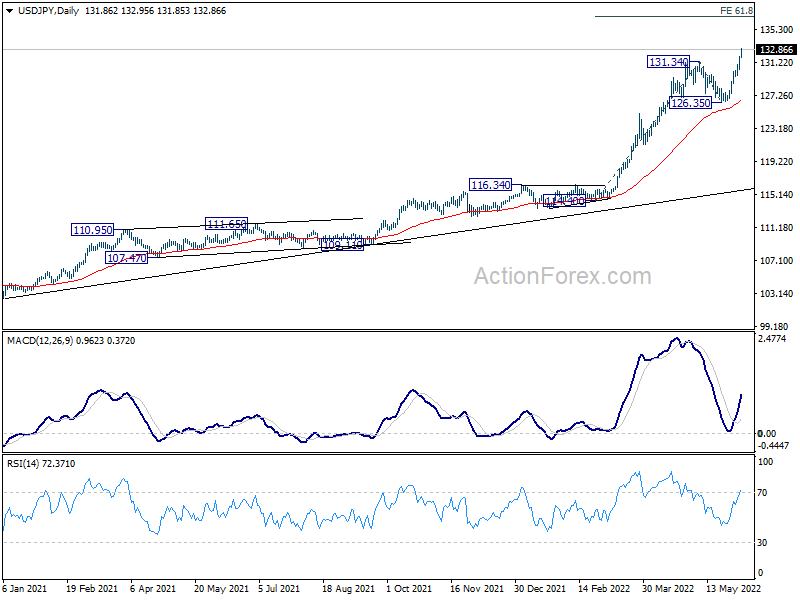
In the bigger picture, current rally is seen as part of the long term up trend form 75.56 (2011 low). Next target is 100% projection of 75.56 (2011 low) to 125.85 (2015 high) from 98.97 at 149.26, which is close to 147.68 (1998 high). This will remain the favored case as long as 126.35 support holds.
USD/CAD Daily Outlook
Daily Pivots: (S1) 1.2543; (P) 1.2572; (R1) 1.2609; More...
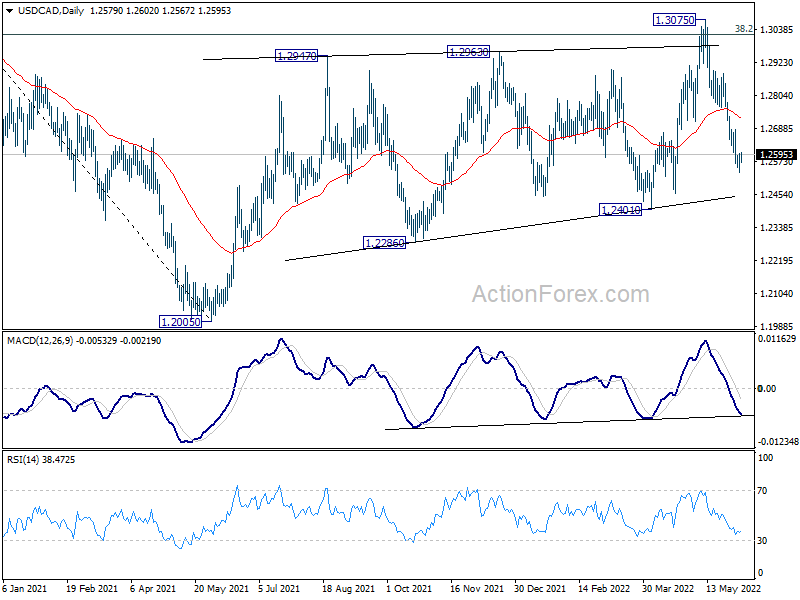
USD/CAD continues to lose downside momentum, but further decline is still expected with 1.2685 minor resistance intact. Decisive break of 1.2401 support will argue that whole rebound from 1.2005 has completed, after rejection by 1.3022 fibonacci resistance. Deeper fall would then be seen to retest this low. On the upside, above 1.2685 minor resistance will turn bias back to the upside for stronger recovery.
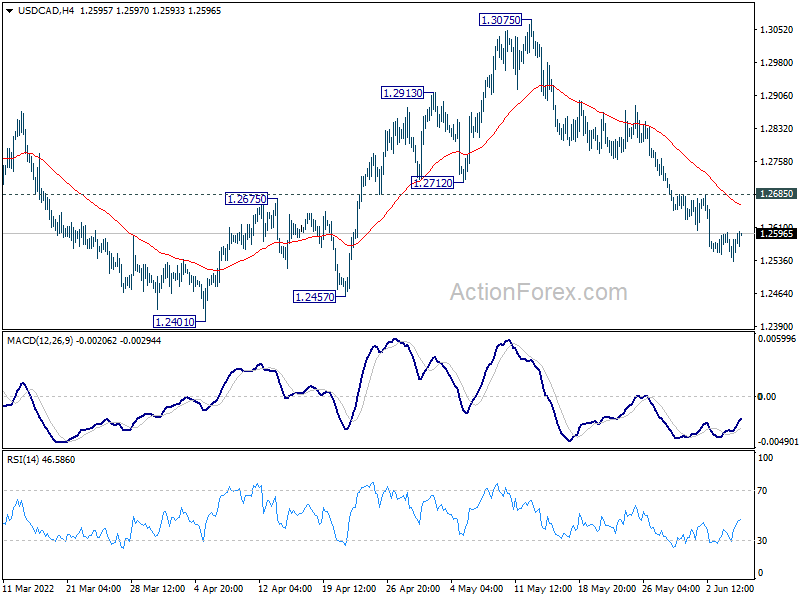
In the bigger picture, focus stays on 38.2% retracement of 1.4667 (2020 high) to 1.2005 (2021 low) at 1.3022. Sustained break there should confirm that the down trend from 1.4667 has completed after defending 1.2061 long term cluster support. Further rise would then be seen towards 61.8% retracement at 1.3650. However, rejection by 1.3022 will maintain medium term bearishness. Break of 1.2005 will resume the down trend from 1.4667 and that carries larger bearish implications too.