Sample Category Title
GBP/CAD holding above 2016 low, awaiting wave of UK data
Sterling is a major focus this week with a batch of economic data featured, starting from jobs today, to inflation and retail sales. Risks to the inflation outlook are on both sides as BoE Governor Andrew Bailey explained. Thus, the path of monetary policy, as well as the Pound's movements, are also highly uncertain.
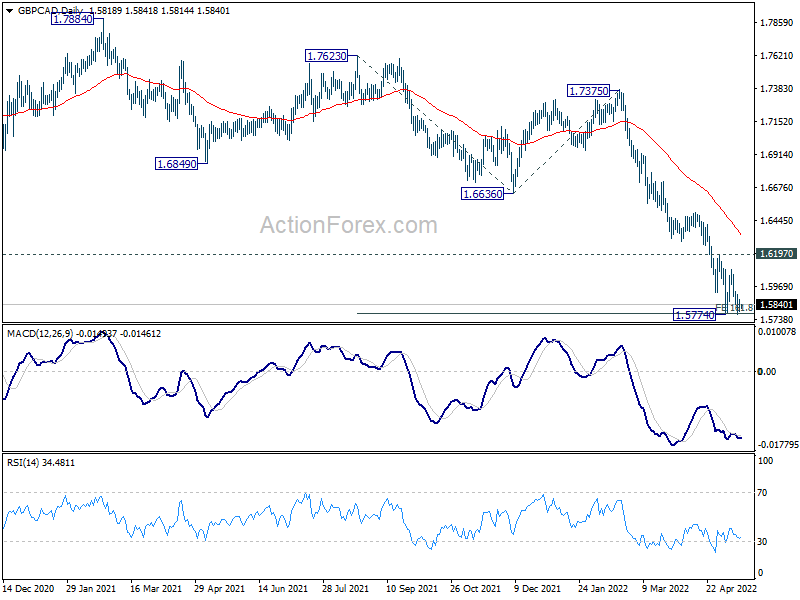
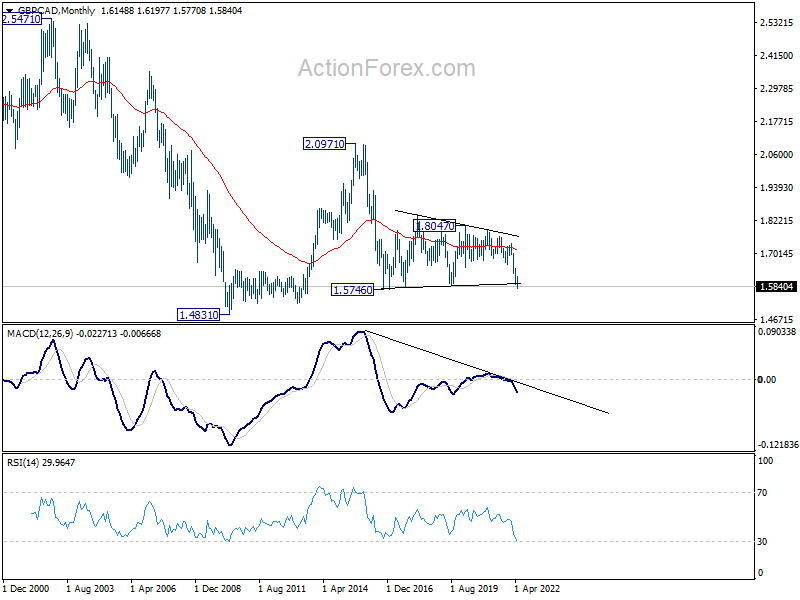
GBP/CAD's decline slowed after falling to 1.5774 earlier in the month, hitting 161.8% projection of 1.7623 to 1.6636 from 1.7375 at 1.5778. More importantly, it's now close to long term support at 1.5746 (2016 low). Further decline will remain in favor as long as 1.6197 resistance holds. Break of 1.5774 could easily push GBP/CAD through 1.5746 to resume the down trend from 2.0971 (2015 high). Such development will also raise the chance of resuming larger down trend from 2.5471 (2002 high) through 1.4831 (2010 low) in the medium term. It could be rather significant.
RBA considered 15bps, 25bps, 40bps hikes in May
In the minutes of May 3 meeting, RBA revealed that three options on interest rate hikes were considered, including 15bps, 25bps and 40bps.
Raising the cash rate by 15bps was not preferred "given that policy was very stimulatory and that it was highly probable that further rate rises would be required." And argument for 40bps "could be made given the upside risks to inflation and the current very low level of interest rates".
But the preferred option of was 25bps, as "a move of this size would help signal that the Board was now returning to normal operating procedures after the extraordinary period of the pandemic"
(RBA) Minutes of the Monetary Policy Meeting of the Reserve Bank Board
Sydney – 3 May 2022
Members present
Philip Lowe (Governor and Chair), Michele Bullock (Deputy Governor), Mark Barnaba AM, Wendy Craik AM, Ian Harper AO, Carolyn Hewson AO, Steven Kennedy PSM, Carol Schwartz AO, Alison Watkins AM
Others present
Luci Ellis (Assistant Governor, Economic), Christopher Kent (Assistant Governor, Financial Markets)
Penelope Smith (Deputy Secretary)
Alexandra Heath (Head, International Department), Bradley Jones (Head, Economic Analysis Department), Marion Kohler (Head, Domestic Markets Department)
International economic developments
Members commenced their discussion of international developments by noting that inflation had risen further in recent months, and in many advanced economies was higher than it had been in several decades. The strong recovery in global demand, ongoing disruptions to global supply chains and increases in commodity prices following Russia's invasion of Ukraine had contributed to inflation significantly exceeding earlier forecasts and being well above central banks' targets. As a result, central banks had hastened the pace at which they were withdrawing policy accommodation. Members noted that inflation developments over prior months had clouded the global outlook and, alongside the effects of the war in Ukraine, had prompted a significant downgrade in global growth expectations.
Real wages in advanced economies had fallen over the preceding year as consumer prices increased by more than wages despite the tightening in labour markets. Members noted that this reduction in household purchasing power had contributed to sharp falls in consumer sentiment in a number of economies – particularly in the euro area and the United Kingdom, where electricity and gas prices had risen markedly. Further declines in real wages were likely as prices continued to increase more rapidly than wages. Members observed that this created additional uncertainty about the outlook for household consumption, despite some countries employing fiscal measures to address cost-of-living pressures and household balance sheets generally being in good shape. The effects on consumption from the sharp increases in food and energy prices were likely to be largest for low-income households, particularly in commodity-importing economies.
Members noted that commodity prices remained high and volatile. The disruptions to global energy supplies resulting from Russia's invasion of Ukraine had occurred at a time when supply chains were already strained, in large part owing to strong underlying demand; global shipping costs had risen further as oil prices increased. While analysts' forecasts and market pricing had indicated that energy and non-energy commodity prices were expected to decline over the course of 2022, this was to levels that were still substantially higher than before the war. Prices for some agricultural products, particularly wheat, had risen further. A sharp increase in fertiliser prices had raised concerns about rationing by farmers, which could depress agricultural output and sustain upward pressure on some food prices in the period ahead. Other commodity price movements had been mixed and most metals prices had eased from recent highs.
Members agreed that the economic outlook in China had become significantly more challenging. The risk of further disruptions to global goods supply had increased, as restrictions on mobility were imposed in parts of China following recent outbreaks of COVID-19. The authorities had continued with actions to suppress the virus while easing fiscal and monetary policy in support of the recently announced growth target for 2022. Timely indicators suggested that mobility restrictions were weighing on consumer spending, manufacturing activity and movements through Chinese ports. And while the effects on Chinese exports had been modest to date, members noted that disruptions to goods production and distribution networks would become more evident if there were further outbreaks of COVID-19. In such an event, there would be additional pressure on global supply chains and the price pressures for globally traded goods would persist.
Members observed that the recent downgrade to the outlook for global growth had followed a strong rebound in activity. In advanced economies, this strength had been underpinned by the relaxation of mobility restrictions and accommodative policy settings. Consumption of goods remained strong, even as the consumption of services normalised. The recovery in economic activity in many emerging market economies was well underway, but less advanced. The robust recovery in activity in many advanced economies had seen unemployment rates decline to around generational lows and high levels of job vacancies indicated strong ongoing demand for labour. Economies with very tight labour markets, such as the United States and the United Kingdom, were experiencing particularly rapid increases in labour costs and broad-based price pressures.
Domestic economic developments
Turning to domestic economic conditions, members observed that price pressures were intensifying and there was upward pressure on wages. Activity and conditions in the labour market had been resilient in the face of global and domestic supply shocks, and strong underlying momentum was expected to be sustained over the course of the year.
The key domestic development since the previous meeting was that inflation had increased to its highest rate in many years. Headline inflation was 2.1 per cent in the March quarter and 5.1 per cent over the year. Fuel and new dwelling costs accounted for around half of the quarterly increase. Trimmed mean inflation had increased to 1.4 per cent in the quarter and 3.7 per cent in year-ended terms. This increase in underlying inflation was consistent with a broadening of inflationary pressures.
Information from the Bank's liaison program indicated that upstream price pressures were increasingly being passed on to final consumer prices of many goods, as supply chain pressures persisted and demand remained strong. Members noted it was possible that firms' price-setting behaviours were undergoing a change from the pre-pandemic period, with businesses becoming more confident that raising prices would not significantly reduce demand or erode their competitive position.
The forecasts for inflation had been revised materially higher compared with those presented three months earlier. Headline inflation was expected to peak at around 6 per cent in year-ended terms, and trimmed mean inflation at around 4¾ per cent, in the second half of the year. Headline inflation was expected to be boosted by large increases in the prices of fuel and new dwellings over the remainder of 2022, and to remain higher than underlying inflation for some time. As supply-side disruptions eased, both headline and underlying inflation were forecast to moderate to around the top of the 2 to 3 per cent target range by mid-2024. The underlying drivers of inflation were anticipated to evolve over the forecast period, with the effects of global supply-side disruptions and dwelling cost inflation easing while domestic labour costs picked up. These forecasts were based on an assumption of further increases in interest rates, in line with expectations derived from surveys of professional economists and financial market pricing.
In their discussion of the labour market, members noted that conditions had strengthened further since the start of the year and were the tightest in many years. The unemployment rate had been steady in March but had declined over the first quarter as a whole, and the participation rate and employment-to-population ratio were both at historically high levels. High vacancy rates and other leading indicators of labour demand suggested that employment growth was likely to remain strong over the remainder of the year. As a result, the unemployment rate was forecast to decline to around 3½ per cent in early 2023, a little lower than previously expected, and to remain around this level for some time. This would be the lowest rate of unemployment in almost half a century.
Members observed that information received over the preceding month, particularly through the Bank's liaison program, had indicated that labour costs were rising at a faster pace and that this was likely to continue. Liaison indicated that many firms were having difficulty hiring workers with the right skills. Given the tight labour market and increase in job mobility, more firms were having to pay higher wages to attract and retain staff, and labour costs were picking up at a faster rate than over the preceding year. Looking ahead, growth in the Wage Price Index (WPI) was forecast to be around 3¾ per cent by the end of the forecast period, which would be the fastest pace since 2012. The outlook for broader measures of labour costs had also been revised up; average earnings were expected to increase at a faster pace than the WPI, as firms turned to bonuses, allowances and other measures to attract and retain workers. While the inertia arising from multi-year enterprise agreements and current public sector wages policies would continue to weigh on aggregate wages growth in the near term, a period of faster growth in labour costs overall was in prospect.
Turning to activity, the disruptions of the Omicron outbreak and the east coast floods had caused the economic recovery to slow in the March quarter. However, strong growth was expected to resume over the remainder of the year as household spending patterns continued to normalise and incomes rose. The significant increase in commodity prices was set to see the terms of trade peak later and at a higher level than previously assumed, boosting national income. Overall, the growth outlook remained positive for the current and subsequent year. Output was expected to expand by 4¼ per cent in 2022, in line with previous forecasts. Growth was then expected to moderate to 2 per cent in 2023 as the recovery matured and the extraordinary policy support put in place during the pandemic was withdrawn.
Timely indicators suggested that household consumption had been resilient to disruptions in the March quarter. The outlook was for consumption to grow at a solid pace in the current and subsequent year, supported by strong household balance sheets and a further increase in disposable income. The household saving rate, which was still high, was expected to decline over coming years. However, higher interest rates, higher inflation and slower growth in household wealth (including housing prices) were expected to weigh on consumer spending in the period ahead. Members also noted that the pressure on household budgets from recent increases in fuel and food prices would be felt most acutely by lower-income households, which typically have smaller savings buffers and spend a larger share of their income on essential items.
The outlook for dwelling and business investment remained positive, although capacity constraints related to materials and skilled labour shortages was a growing challenge for firms. Dwelling investment had been curtailed by supply disruptions, including poor weather conditions on the east coast, but was expected to remain at a high level given the large pipeline of work. Non-mining business investment had also been disrupted by supply issues in late 2021, but was expected to pick up momentum in the period ahead. Mining investment had remained subdued despite the strength in commodity prices; however, a modest increase was expected over the forecast period, owing to sustaining investment for some major iron ore and energy projects, as well as increased exploration and production for some metals and minerals. The pipeline of public engineering work was anticipated to support a high level of public investment for several years.
Members noted that housing market conditions had become more varied across the country in preceding months. Prices had declined a little in Sydney and Melbourne alongside falling auction volumes and clearance rates. However, in most other capital cities and regional areas, price growth remained strong, supported by a low number of properties for sale. Growth in advertised rents had also been particularly strong in these parts of the country, consistent with very low vacancy rates. The flooding events in recent months were expected to add short-term pressure to rental markets in affected regions on the east coast.
Public spending had declined at the end of 2021, but was expected to increase strongly over the first half of 2022 and remain at a high level over the forecast period, in line with projections in the latest state government updates and the Australian Government Budget.
Members noted that the recovery in services trade would boost both exports and imports, although overall net trade was expected to reduce output growth slightly over the forecast period. Resource exports had been adversely affected over the second half of 2021 by weather and maintenance-related disruptions, and manufactured exports continued to be affected by global supply-chain disruptions. The recent strength in rural exports was expected to continue on account of favourable growing conditions and strong global demand for grains amid supply disruptions in Eastern Europe. A recovery in travel and education exports was in train following the reopening of Australia's international border. Import volumes were expected to increase at a solid pace in the period ahead, in line with the strength in domestic demand and recovery in travel imports.
Members concluded their discussion of the outlook by noting several sources of risk and uncertainty. Globally, it remained uncertain how and when supply-side problems would be resolved. Recent events – including Russia's invasion of Ukraine and the responses to COVID-19 outbreaks in China – posed additional upside risks to inflation and downside risks to global growth. Another source of uncertainty related to how household spending in advanced economies, including in Australia, would respond to a period of rising interest rates and the decline in real wages. Some Australian households had incurred more debt than previously and many had never experienced rising interest rates. Housing prices in Australia could also be more sensitive to rising interest rates than assumed, which would be likely to result in lower household wealth and consumption. At the same time, there was also potential for consumer spending in Australia to be stronger than forecast, given that households in aggregate had not begun to draw down on the savings accumulated during the pandemic and the high household saving rate could normalise more quickly than assumed. Another source of domestic uncertainty related to the behaviour of prices and labour costs at unusually low levels of unemployment, given the limited recent historical experience to draw on. The extent to which the reopening of the international border would alleviate acute areas of labour shortages was also uncertain, given that the border reopening would also add to demand in the economy.
International financial markets
Global financial conditions had become less accommodative over the preceding month, reflecting surprisingly high inflation outcomes and upward revisions to the expected paths of policy rates for most advanced economies.
Most central banks had begun to withdraw some of the substantial monetary stimulus that had been put in place in response to the pandemic. Several central banks had raised their policy rates. The Bank of Canada and the Reserve Bank of New Zealand had both raised their policy rates by 50 basis points during the preceding month. Members noted that Sveriges Riksbank had increased its policy rate by 25 basis points, in response to higher-than-expected inflation, having indicated as recently as February that it did not expect to increase its policy rate until at least 2024. A number of other central banks – including the US Federal Reserve and the Bank of England – were expected to raise their policy rates again in early May. Members noted that expectations for the European Central Bank's first rate increase had been brought forward and that many market participants thought this could occur as early as July.
Several central banks in advanced economies had indicated that they were seeking to return policy rates to a neutral setting quickly, and may increase policy rates further thereafter, to avoid the risk of a rise in longer-term inflation expectations to levels that would be inconsistent with their inflation targets. Members noted that there was significant uncertainty around estimates of what level of policy rates would be consistent with a neutral setting and that these estimates could change over time.
In addition, several central banks had decided to allow their asset portfolios to decline gradually as bonds matured, or they planned to start that process soon. The US Federal Reserve had indicated that it was likely to start allowing its bond holdings to begin declining following its May meeting at a faster pace than market participants had expected earlier in 2022. By contrast, the European Central Bank had indicated that it was likely to cease asset purchases in July, but would maintain the size of the portfolio for an extended period after it had commenced raising its policy rate. The Bank of Japan had increased its purchases of 10-year government bonds to maintain its target of 0 ± 25 basis points for 10-year yields.
Since the beginning of the year, government bond yields had risen substantially, driven by expectations of higher inflation and the withdrawal of monetary policy stimulus. The relatively large increase in US Treasury yields had contributed to a significant appreciation of the US dollar since the beginning of the year, while the relative stability of yields on Japanese Government bonds had contributed to a depreciation of the yen. Members noted that the Australian dollar had also depreciated since the previous meeting, but had remained above its levels at the beginning of the year on a trade-weighted basis.
Credit spreads on corporate debt had increased, although investors expected borrowers to be generally well placed to withstand higher interest rates. Most major equity markets had declined, reflecting revisions to the expected path of monetary policies and a deterioration in the near-term outlook for growth in China. Equity prices in Australia had been little changed since the beginning of the year, as the resources sector had benefited from the high level of commodity prices.
Monetary policy in China had been eased a little further amid headwinds to growth. Chinese equity markets had declined significantly since the start of the year and the renminbi had depreciated noticeably over the preceding month; this was consistent with the declining differential between interest rates in China and the United States, and signs that growth in China had slowed. Members also noted that there had been a net outflow of foreign portfolio investor capital from China in 2022.
Domestic financial markets
Domestic financial conditions had remained very accommodative, although a range of market interest rates had risen further. Yields on 10-year Australian Government Securities had risen by around 40 basis points since the previous meeting, exceeding 3 per cent for the first time since 2015. Members observed that market participants had brought forward their expectations for an increase in the cash rate following the Board's decision at the April meeting, the minutes from that meeting and the higher-than-expected CPI outcome. Market pricing implied expectations of an increase in the cash rate of at least 15 basis points at the present meeting, and a further 25 basis point increase in June. Market participants expected the cash rate to increase to around 2½ per cent by the end of 2022. Most market analysts also expected an increase in the cash rate target at the present and subsequent meetings.
Wholesale funding costs for banks (which are linked to money market interest rates) had risen, but banks' overall funding costs and lending rates had remained low. The sharp rise in long-term yields had also seen fixed rates for new loans rise further, although competitive pressures had seen both new and average outstanding variable mortgage rates drift down to new lows. Growth in total credit had remained close to its fastest pace of the preceding decade, and demand for housing finance had remained robust. Growth in housing credit to owner-occupiers had eased slightly, although growth in credit to housing investors had picked up further. Growth in business debt had remained high, driven by the borrowing of larger firms. Members noted the importance of banks maintaining their lending standards.
Considerations for monetary policy
In considering the policy decision, members noted the underlying strength of the Australian economy and its ongoing resilience. The monetary and fiscal policy measures that had been put in place to support the economy through the pandemic, alongside the rapid development of COVID-19 vaccines, had contributed to this positive outcome.
The Australian economy was being supported by household and business balance sheets that were generally in good shape, an upswing in business investment and a large pipeline of construction work. Macroeconomic policy settings also remained supportive of growth and national income was being boosted by higher commodity prices.
The resilience of the Australian economy was particularly evident in the labour market. Members noted that the unemployment rate had declined over prior months to multi-decade lows and labour force participation had increased to a record high. The Bank's central forecast was for a further decline in the unemployment rate to around 3½ per cent by early 2023. Members noted that aggregate wages growth had been subdued during 2021 and was no higher than prior to the pandemic. However, more timely evidence from liaison and business surveys indicated that labour costs were rising in a tight labour market and a further pick-up was likely over the period ahead.
Inflation in the March quarter had increased substantially and was above the target range of 2 to 3 per cent. Although the rise in inflation largely reflected global factors, members noted that strong domestic demand and capacity constraints were also playing a role. This was evident in the broadening of inflationary pressures, with firms more prepared to pass through cost increases to consumer prices. Inflation was expected to increase further in the near term but decline back towards the top of the target range by mid-2024 as supply-side disruptions are resolved. These forecasts were based on a technical assumption of the cash rate increasing to around 1¾ per cent by the end of 2022 and around 2½ per cent by the end of 2023.
The Board considered whether the condition that it had earlier set for an increase in the cash rate had been met. This was for actual inflation to be sustainably within the 2 to 3 per cent target range, which was likely to require a faster rate of wages growth than had been experienced over the preceding years.
Inflation was now above the target and was not forecast to return to the target range until mid-to-late 2024. While the significant rise in inflation had been largely the result of global factors, which were likely to have a more temporary effect on inflation, the flow of information on inflation and wages over the preceding month had been consistent with more persistent inflationary pressures arising from limited spare capacity in the domestic economy. Members observed that it would be more difficult to return inflation to the target if the inflation psychology in Australia were to shift in an enduring way.
Members considered whether it was necessary to wait for March quarter data on the Wage Price Index and broader measures of wages growth from the national accounts to be published. They agreed that this information would be helpful; however, the recent evidence on wages growth from the Bank's liaison and business surveys was clear.
Members agreed that the condition the Board had set to increase the cash rate had been met. They also agreed that further increases in interest rates would likely be required to ensure that inflation in Australia returns to the target over time. In making its decisions, the Board agreed that it will continue to be guided by the evidence on both inflation and the labour market, while noting that significant uncertainties remain.
Globally, it was not yet clear how the various supply-side problems will be resolved. Domestically, there was uncertainty about how household spending would respond to the erosion of real wages, as wages have not kept pace with consumer prices. There is no contemporary experience as to how labour costs and prices in Australia would behave at an unemployment rate below 4 per cent. Members also considered how households would respond to rising interest rates, given the high level of household debt and the significant increases in financial buffers over the preceding couple of years. The Board will continue to monitor these and other issues closely as it determines the timing and extent of future interest rate increases.
Members considered three options for the size of the rate increase at the present meeting – raising the cash rate by 15 basis points, 25 basis points or 40 basis points. Members agreed that raising the cash rate by 15 basis points was not the preferred option given that policy was very stimulatory and that it was highly probable that further rate rises would be required. A 15 basis point increase would also be inconsistent with the historical practice of changing the cash rate in increments of at least 25 basis points. An argument for an increase of 40 basis points could be made given the upside risks to inflation and the current very low level of interest rates. However, members agreed that the preferred option was 25 basis points. A move of this size would help signal that the Board was now returning to normal operating procedures after the extraordinary period of the pandemic. Given that the Board meets monthly, it would have the opportunity to review the setting of interest rates again within a relatively short period of time, based on additional information.
Members also discussed the reinvestment strategy for bond maturities of the stock of bonds purchased by the Bank during the pandemic. Although only a small value of government bonds held by the Bank would be maturing in 2022, the value of maturing bonds held by the Bank would start to rise with the April 2023 bond maturity.
One option was to reinvest bonds as they matured, which would maintain the stimulus associated with the stock of bonds held by the Bank, but would be inconsistent with the strength of the economy and the high level of inflation. By contrast, the option of not reinvesting bonds as they matured would mean the stimulus associated with bond purchases would be removed gradually and predictably. Members also noted that, while selling bonds would remove the stimulus provided by the Bank's balance sheet more quickly, that effect would be modest compared with the effect of increases in the cash rate. Moreover, the Bank's balance sheet would start to diminish quite quickly in 2023 as a significant share of the Term Funding Facility would roll off by September 2023, and the remainder would roll off by June 2024.
The Board decided that it would not reinvest the proceeds of maturing government bonds, consistent with the decision to start withdrawing from extraordinary monetary policy settings. However, the Board did not currently plan for the Bank to sell the government bonds it had purchased during the pandemic and it intended to allow the portfolio to run down in a predictable way as bonds mature. While contributing to the withdrawal of monetary stimulus, this would also recognise that the cash rate remains the primary tool for achieving the desired stance of monetary policy.
Members noted that in some years' time, after the Bank's balance sheet had reduced further, the Board would need to consider the broader issue of the longer-term optimal size and composition of the balance sheet, including the size of Exchange Settlement balances. In this context, it might consider the use of longer-term bond holdings, although this would be driven by the appropriate operating framework in light of evolving conditions and would not have implications for, or have a bearing on, the stance of monetary policy.
The decision
The Board decided to increase the cash rate target by 25 basis points to 35 basis points and to increase the interest rate on Exchange Settlement balances from zero per cent to 25 basis points.
The Board decided that the Bank would not reinvest the proceeds of maturing government bonds that it had purchased during the pandemic and had no current plans for the Bank to sell these bonds.
Dollar Consolidates Ahead of US Retail Sales as Rate Hike bets Stall
Retail sales will be in focus in the United States this week as the data out on Tuesday (12:30 GMT) is expected to show that American consumers have yet to be deterred by rising prices. Amid all the talk that the Federal Reserve’s aggressive tightening of monetary policy might tip the US economy into recession, a solid set of numbers could allay those fears, boosting the US dollar, which appears to be consolidating from last week’s 20-year high.
Fed’s rate hike path gets blurrier after the summer
Expectations about how many times the Fed will raise rates this year have taken a bit of a pause over the past 10 days or so, having surged at the start of the month. The Fed has signalled that it won’t go faster than 50 basis points – at least not in the June and July meetings. September is a different story, but if the early signs that inflation may have started to peak take further shape until then, rate hikes could slow to 25 bps increments in the autumn.
However, even in that ‘optimistic’ scenario, the tightening in financial conditions since the beginning of the year when the Fed was still buying bonds would be very sharp by historical standards. It shouldn’t be surprising therefore that even if Fed rate hike expectations are levelling off, the risk of a substantial slowdown in economic growth remains elevated.
US consumers are still spending
The US economy unexpectedly contracted in the first quarter, and although this was mainly down to technical factors such as declining inventories, a hit to consumption by the jump in the cost of living could drag on Q2 GDP. Two successive quarters of negative growth are technically defined as a recession – something that the Fed wants to avoid. However, persistently high inflation is even less desirable, not just by policymakers, but by the public as well.
For now, the world’s largest economy remains in relatively good shape, showing very few strains from the spike in energy prices and the broader turmoil caused by the war in Ukraine. In particular, the main driver of the American economy – the consumer – has kept spending throughout these latest economic and geopolitical storms.
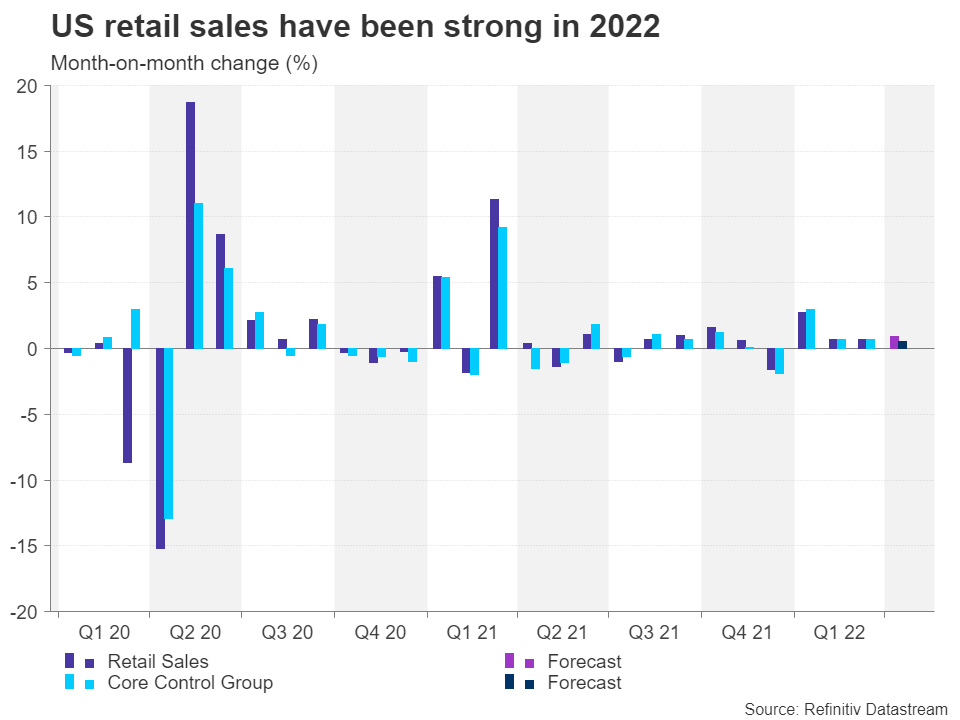
Retail sales rose by 0.7% m/m in March and they are projected to have climbed even more strongly in April, by 0.9% m/m. One of the core measures, the control group of retail sales that’s used in GDP calculations is forecast to have risen by a healthy 0.5% m/m pace following March’s upwardly revised 0.7% gain.
Dollar is off its highs
The data could give the dollar a leg up as long as they don’t disappoint, while better-than-expected figures might revive bets of further hawkish tilts to come from the Fed. The greenback is currently testing the 129 level against the yen, easing from last week’s two-decade high of 131.34. The bulls are likely to meet resistance at 130 if they attempt to re-challenge that top. If successful, the 161.8% Fibonacci extension of the May downtrend at 133.71 would become the next upside target.
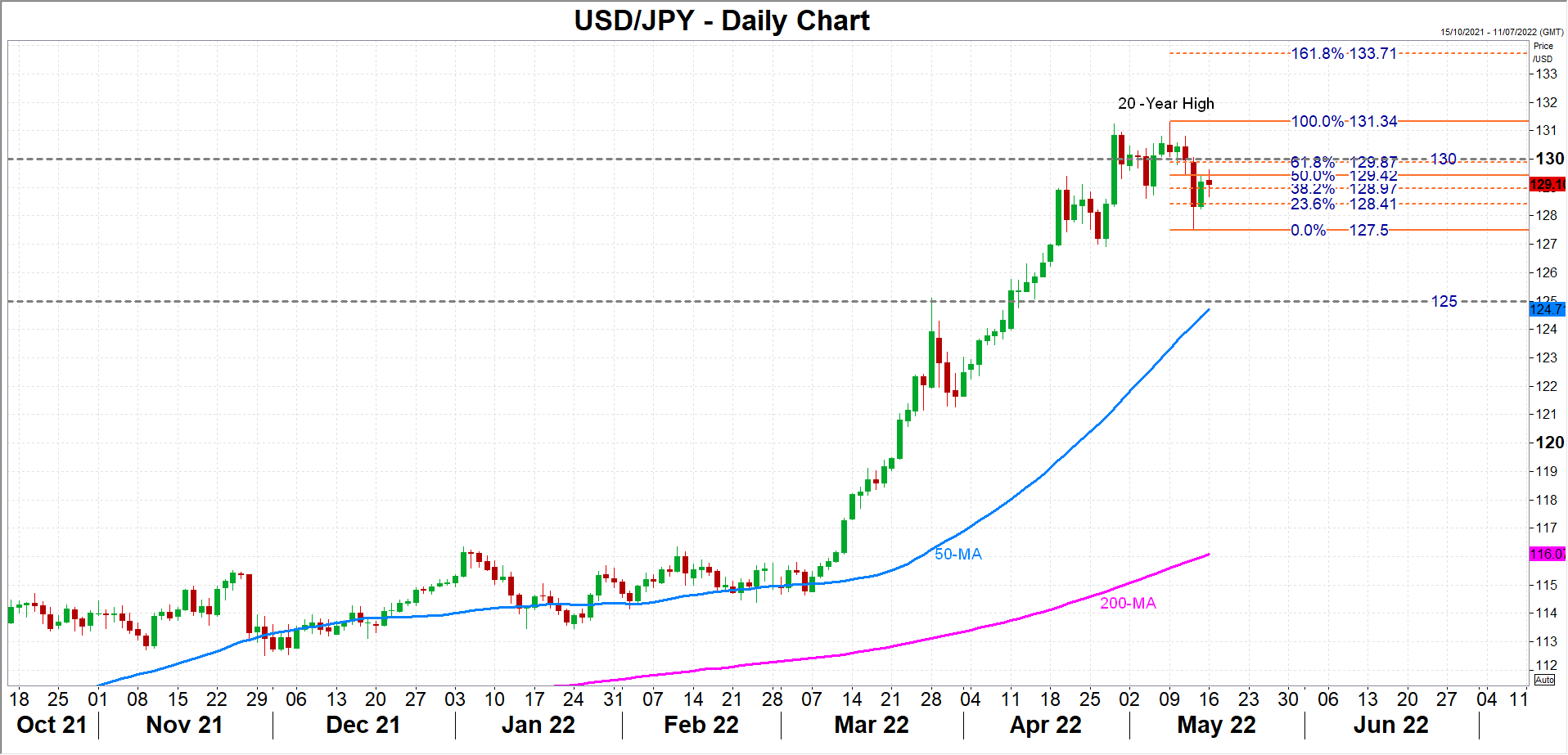
However, if retail sales aren’t as strong as is being predicted, dollar/yen could slip towards key support in the 127.50 area. A negative surprise cannot be ruled out as consumer surveys have been less robust than the hard data lately. The University of Michigan’s consumer sentiment index has been trending lower since the second half of 2021 and plummeted to depths not seen since October 2011 in the preliminary reading for May.
Is the housing market a concern?
Another risk for the dollar this week is the possibility of evidence that the Fed’s rate increases are starting to hurt the housing market. Building permits and housing starts for April are due on Wednesday, followed by existing home sales on Thursday. There are some signs that property demand is slowing as mortgage rates go up, so a further indication of this could see the dollar rally and rate hike speculation cooling again.
Sterling’s Focus Switches to a Crowded Schedule, as Selling Pressures Intensify
It will be a packed week for the British pound. The UK employment report will be published on Tuesday at 06:00 GMT, while on Wednesday and Friday investors will pay attention to CPI inflation (06:00 GMT) and monthly retail sales (06:00 GMT) respectively to get more evidence on the economy. The Bank of England (BoE) is becoming increasingly conservative, and if the releases can buck this trend, the pound could appreciate, but only modestly.
UK CPI inflation to print new highs
Despite the fact that the issue of high cost of living is a worldwide occurrence, it is possible that Britons will end up having it worse than anybody else.
Last week, Kristin Forbes, who had previously served on the Monetary Policy Committee of the Bank of England, issued a stern warning, stating that "there are approximately six elements that feed through into inflation, and the UK ticks every box."
Higher energy prices, disruptions in supply chains, and lingering effects of the pandemic are making life difficult for people in most of the world's nations. On the other hand, it is anticipated that price pressures would be more severe and endure for a longer period in the UK.
The UK is going to be hit with a particularly poisonous mix of these pricing drivers. In addition, the country is increasing taxes on households, which is something that very few other governments are willing to do during a period of rising living expenses.
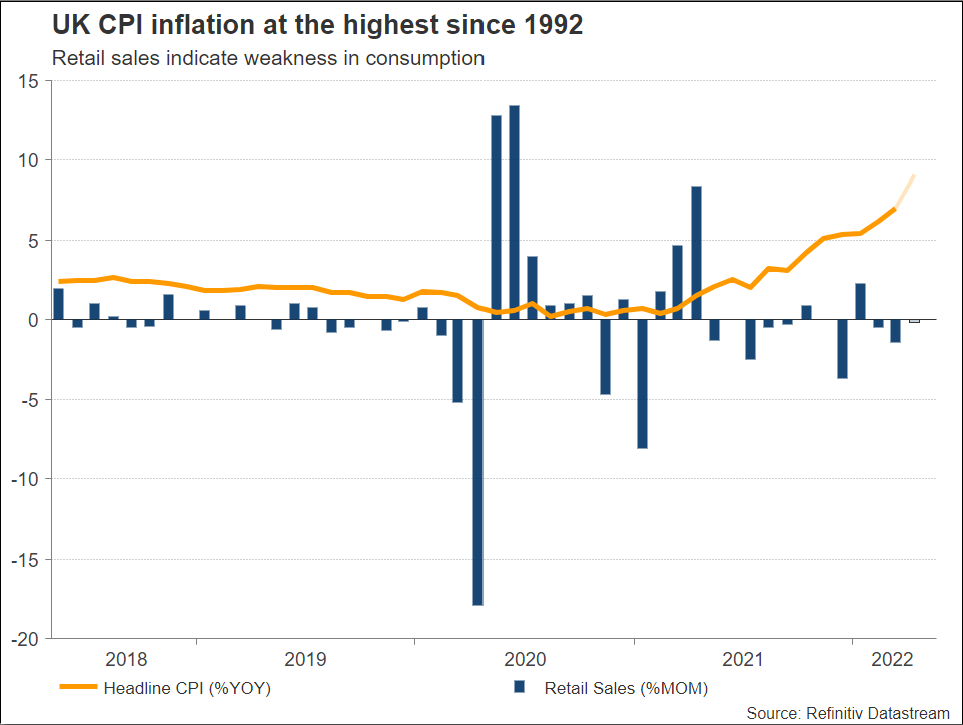
The inflation rate has already increased to 7%, the highest since March 1992, but economists anticipate that the pressures will become even more severe and will continue to be elevated in the UK for a longer period.
The Bank of England's most recent set of pessimistic projections predicted that the rate of inflation will hit double digits by the end of the year; levels that hadn't been seen in almost four decades. The figures for April are anticipated to show that inflation jumped to 9.1%.
Labor market remains tight; retail sales expected to fall again
The unemployment rate for March is predicted to remain steady at 3.8% as before, which was the lowest it had been since the end of 2019. Up until the start of the coronavirus pandemic in December 2019 to February 2020, the unemployment rate had been going down since late 2013. Since then, it has gone up, but now it is back to where it was before the coronavirus pandemic.
After a 1.4% decrease in March, retail sales in the UK are forecasted to fall 0.2% in April on Friday. Affordability is beginning to weigh on consumers, who are spending less than the rise in prices. Non-store retailing had the biggest negative impact.
Since wages have been failing to keep pace with inflation, and now there are hints that hiring may be slowing as well, the April retail sales report should reflect the extent of the stress on consumers.
BoE made four rate hikes in May; tensions with Brussels and Northern Ireland remain
During its May meeting, the Bank of England made its fourth straight rate hike, which drove borrowing costs to their highest level since early 2009. Only three members voted for a 50bps rise. Following Russia's invasion of Ukraine, inflationary pressures have risen dramatically around the world, resulting in a significant deterioration in the UK's economic prospects. Household incomes in the UK are likely to fall by about 1% in Q2 and by 1% in Q4 as a result of the slowdown in the economy, according to the latest estimates.
The rise in tensions amongst London and Brussels over Northern Ireland is another factor that is making life difficult for sterling. The government of the United Kingdom is dissatisfied with the lack of progress in the discussions aimed at upgrading the Northern Ireland protocol, and it has threatened to abandon the border checks that are needed by the Brexit treaty over the Irish Sea. If the UK takes action without consulting the EU, there is a chance that the EU may punish them by delaying the Brexit trade deal.
GBP/USD remains strongly negative
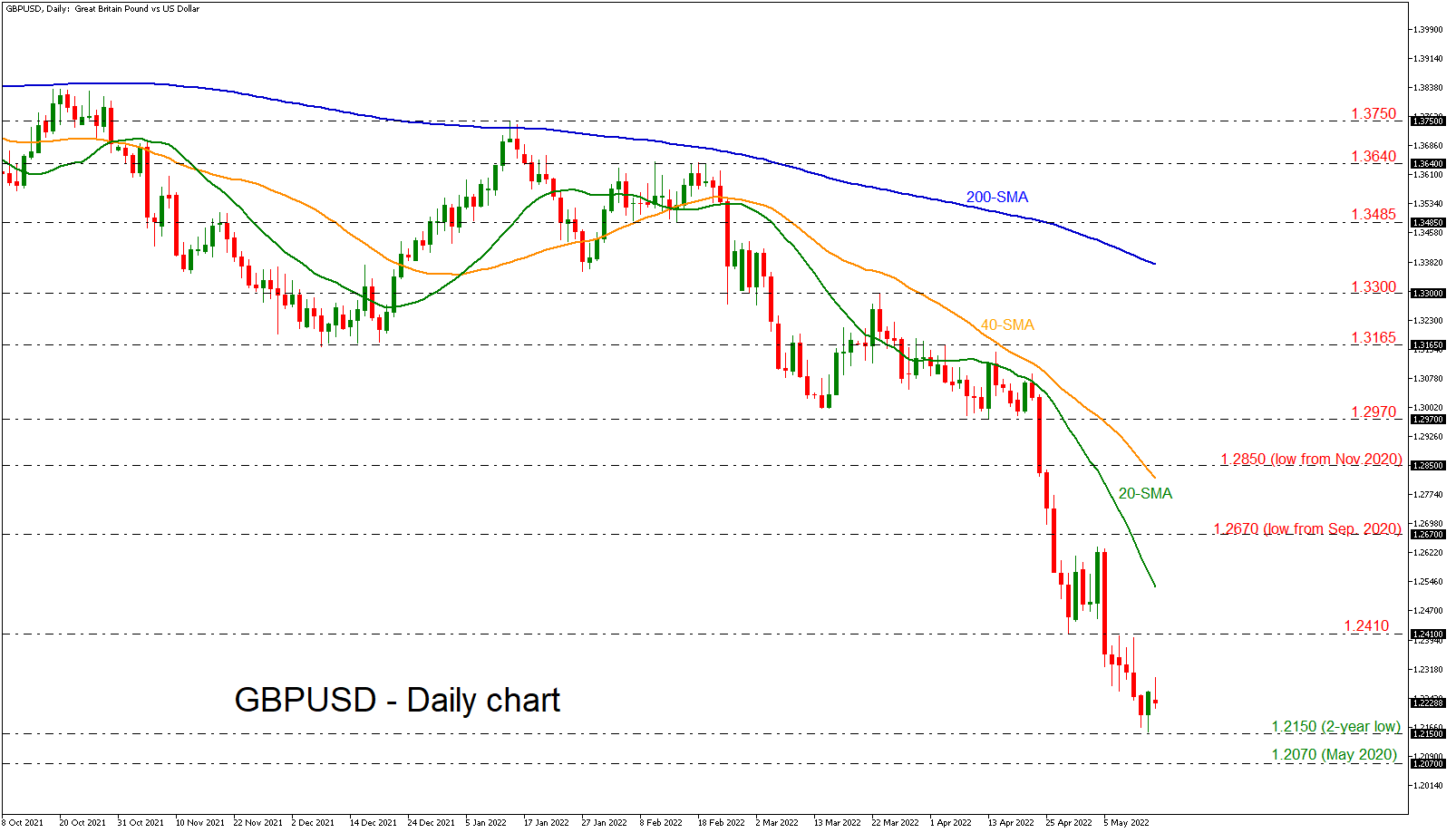
Turning to pound/dollar, the pair geared above the two-year low of 1.2150 today, opening with a negative gap. The next resistance could pop up around 1.2410 and then probably near the 20-day simple moving average (SMA) currently at 1.2530 and the 1.2670 mark. A positive surprise in the data, and overall, a brighter outlook for the UK economy, may helping the pound to reach those levels and even drift higher.
Alternatively, disappointing data releases could pressure the pair towards the two-year low of 1.2150 ahead of a plunge towards 1.2070, taken from the lows on May 2020. More downside pressures could open the way for steeper decreases until the trough of 1.1410, registered in March 2020.
USD/JPY: Price Rally Stalls at 131.35
After a parabolic rise, USD/JPY registered its first weekly loss on Friday, providing traders the first opportunity to question whether this marks the end to the yen’s misfortune this year. Considering the prevailing uncertainty in financial markets, traders would be wise to measure up the opportunities in either direction, whilst cautiously sizing their positions.
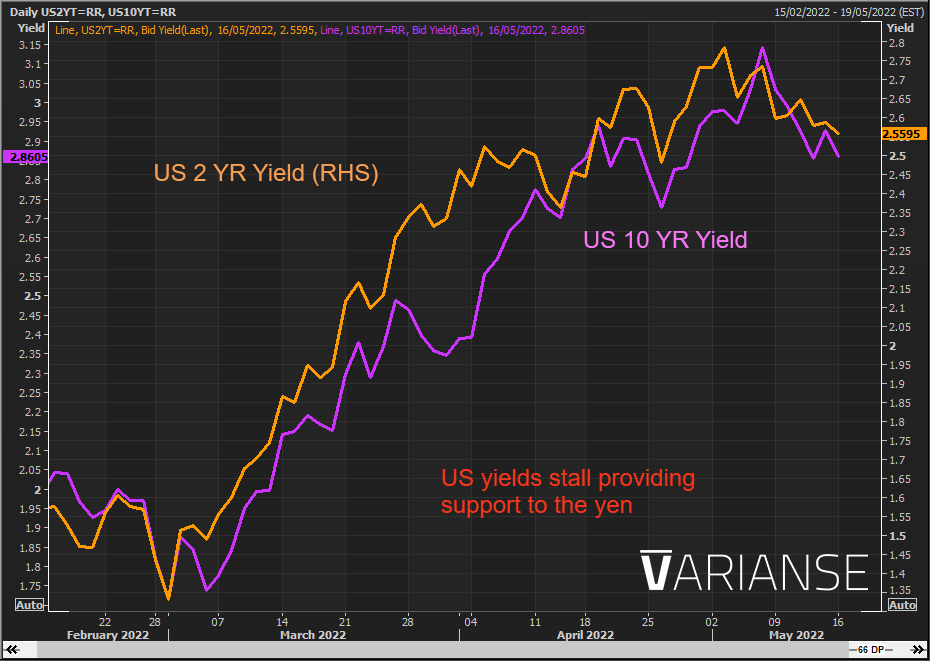
If you are USD/JPY bear, you’re basically singing up to a fundamental narrative where global growth is faltering, and/or expectations around further Fed tightening have peaked, and/or Bank of Japan’s ends it commitment to monetary policy easing. To varying degrees, all three outcomes have become more likely in recent days, but their joint probability remains low.
Any of one of those outcomes, however, could lead to a dramatic retracement given just how quickly the pair has risen over prior eight weeks. Were price to break below 127.50, then the most obvious point of support would be the 125.11, which acted as prior resistance in March. The December 2016 118.667 looks like a bigger area of support as we highlighted in a April.
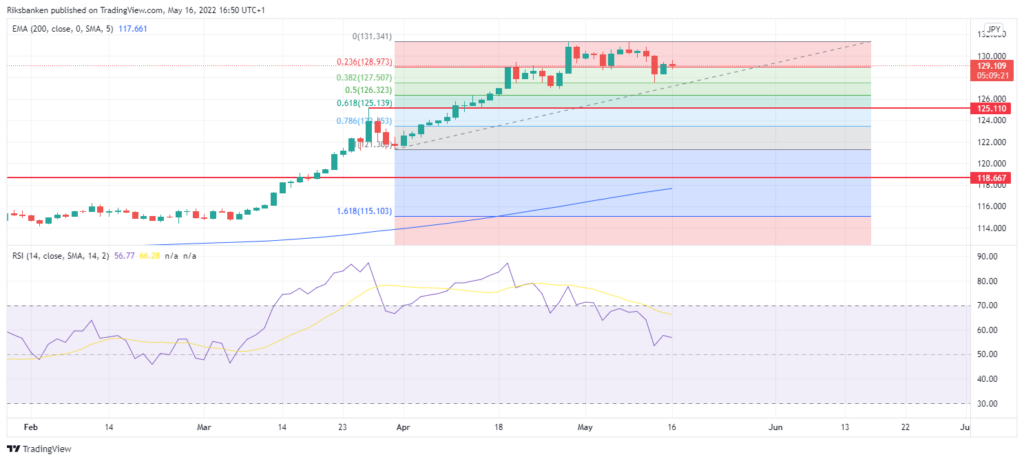
That said, USD/JPY bulls still have reasons to be optimistic. Last week’s losses may mark a consolidation ahead of a bigger move higher in the pair. Buyers would be wagering on a continued move higher in Fed expectations and US yields, reluctance on BoJ intervention to support the yen and a commitment to ultra-accommodative policy, and a buoyant global and US economy.
A break above last week’s swing high of 131.35, would provide greater technical confirmation of a continuation in USD/JPY’s upward trend, in absence of any continuation pattern forming. A quick rejection of the 39.2% Fibonacci level retracement level between the March swing low and the May swing high, certainly adds credibility to a further continuation, but it is still early doors in terms of price development.
USDCHF Wave Analysis
- USDCHF reversed from party
- Likely to rise to 1.0100
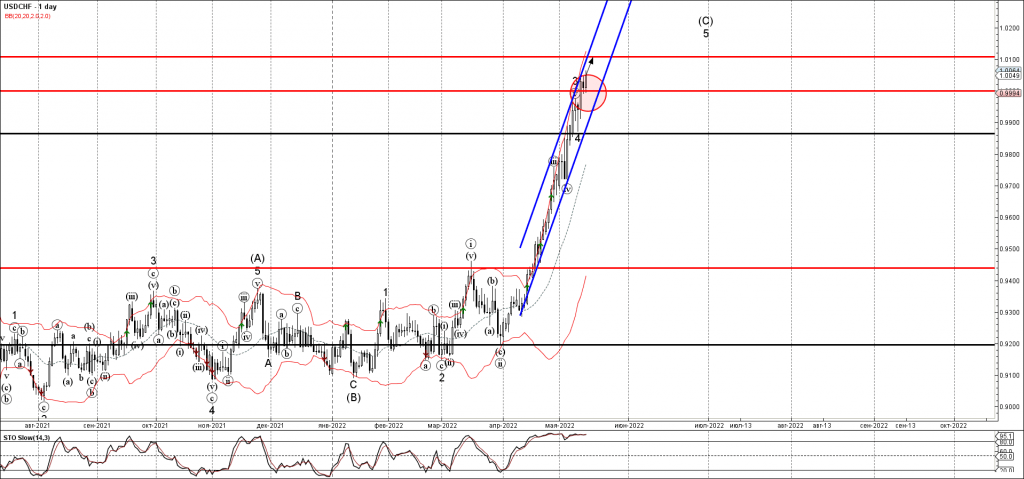
USDCHF continues to rise after the earlier upward reversal from the strong support at parity, 1.000 (earlier resistance from the start of May).
The upward reversal from the parity continues the active short-term impulse waves 5 and (C).
USDCHF can be expected to rise further toward the next resistance level 1.0100, coinciding with the upper trendline of the daily up channel from the start of April.
Gold Wave Analysis
- Gold reversed from support zone
- Likely to rise to resistance level 1825.00
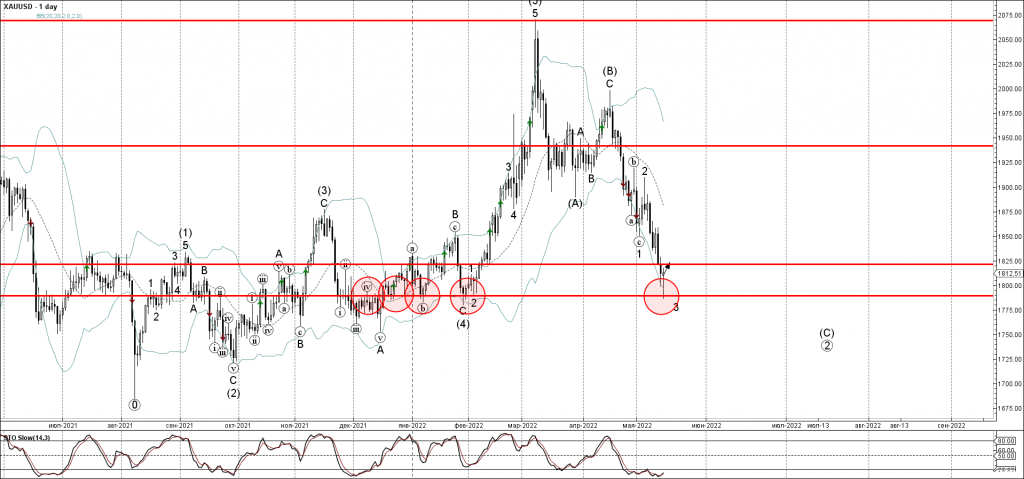
Gold today reversed up from the support zone located between the key support at 1790.00 (which has been reversing the price from December) and the lower daily Bollinger Band.
The upward reversal from the support zone is currently forming the daily Hammer candlesticks reversal pattern.
Given the strongly oversold daily Stochastic – Gold can be expected to rise further toward the next resistance level 1825.00.
Eco Data 5/17/22
[php_everywhere instance="1"]
US Bond Market May Decide Dollar Fortune this Week
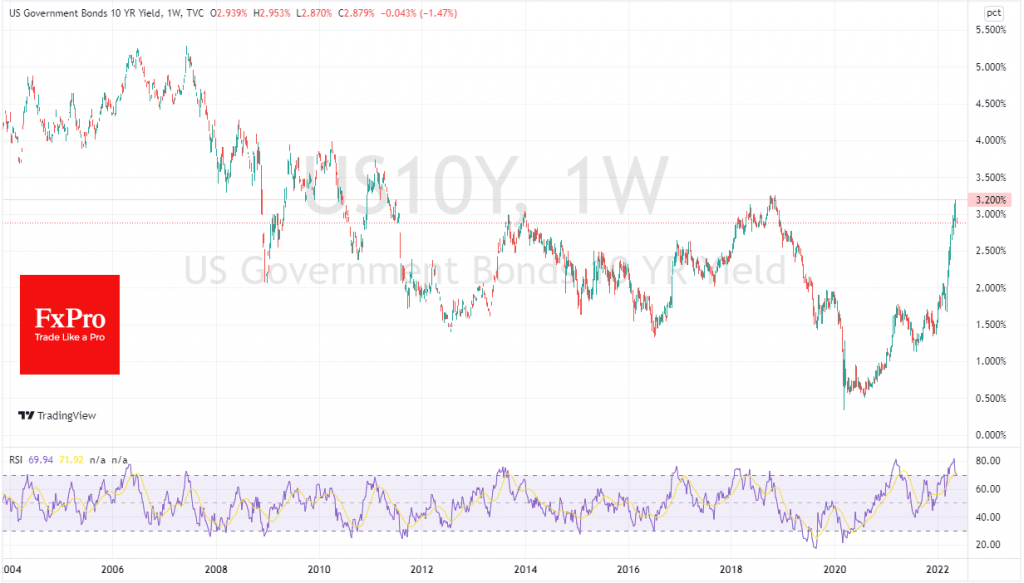
US 10-year bond yields fell last week, retreating from the 3.2% mark. This is one of the most critical levels of the debt market during the previous ten years, so investors and traders should pay increased attention to further developments.
10-year yields have reversed to the downside near the 3.2% level five times since mid-2011, asserting an era of ultra-low interest rates. The last time was in 2018.
Both then and now, attempts by the debt market to consolidate at current yield levels have caused stock market turbulence and notably strengthened the dollar against its major peers.
At the end of last week, yields fell from that height. This week it remains to be seen whether we have seen a trend reversal or only temporary market fluctuations near past significant levels.
A renewed rise in yields of 10-year US government bonds could be the trigger for an even more furious flight out of risky assets, rushing capital into the dollar.