

Sample Category Title
EUR/JPY Daily Outlook
Daily Pivots: (S1) 133.97; (P) 134.51; (R1) 135.27; More....
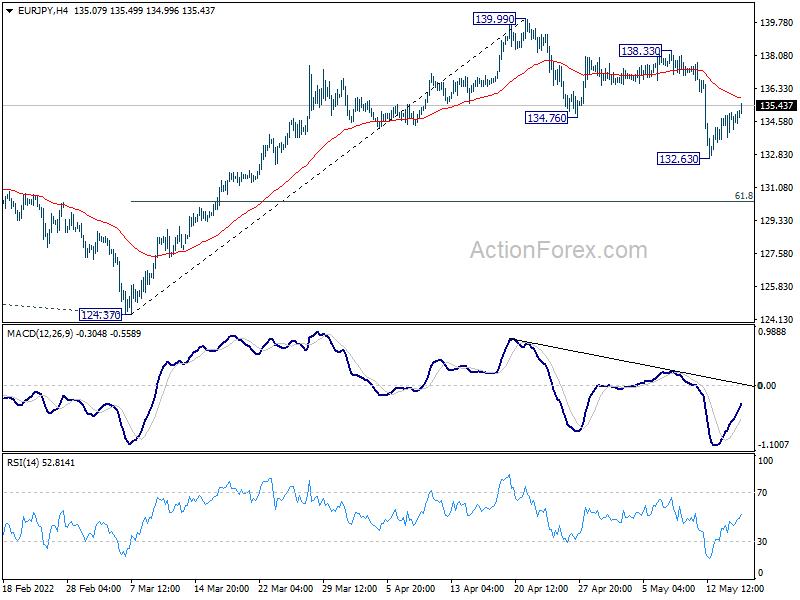
EUR/JPY's price actions from 139.99 are seen as a corrective pattern. Deeper fall could still be seen as long as 138.33 resistance holds. Below 132.63 will target 61.8% retracement of 124.37 to 139.99 at 130.33. Nevertheless, break of 138.33 will indicate that the correction has completed, and bring retest of 139.99 high next.
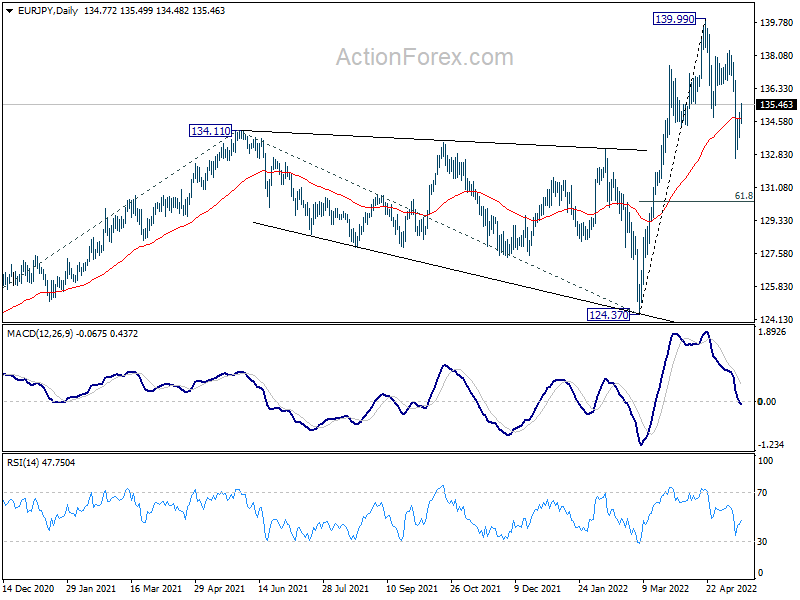
In the bigger picture, up trend from 114.42 (2020 low) is in progress. Such rise is seen as the third leg of the pattern from 109.30 (2016 low). Next target will be 100% projection of 114.42 to 134.11 from 124.37 at 144.06. In any case, outlook will now remain bullish as long as 124.37 support holds, in case of deep pull back.
EUR/GBP Daily Outlook
Daily Pivots: (S1) 0.8445; (P) 0.8490; (R1) 0.8514; More...
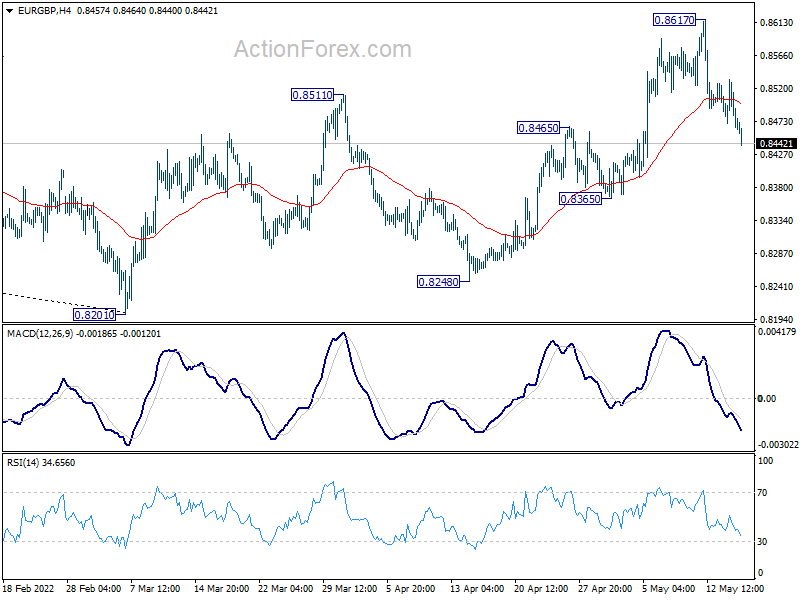
EUR/GBP's pull back from 0.8617 extends lower today but stays above 0.8365 support. Intraday bias remains neutral and further rally is still in favor. On the upside, break of 0.8617 will resume rise from 0.8201 medium term bottom to 0.8697 medium term fibonacci level. However, break of 0.8365 will dampen this bullish view, and turn bias back to the downside instead.
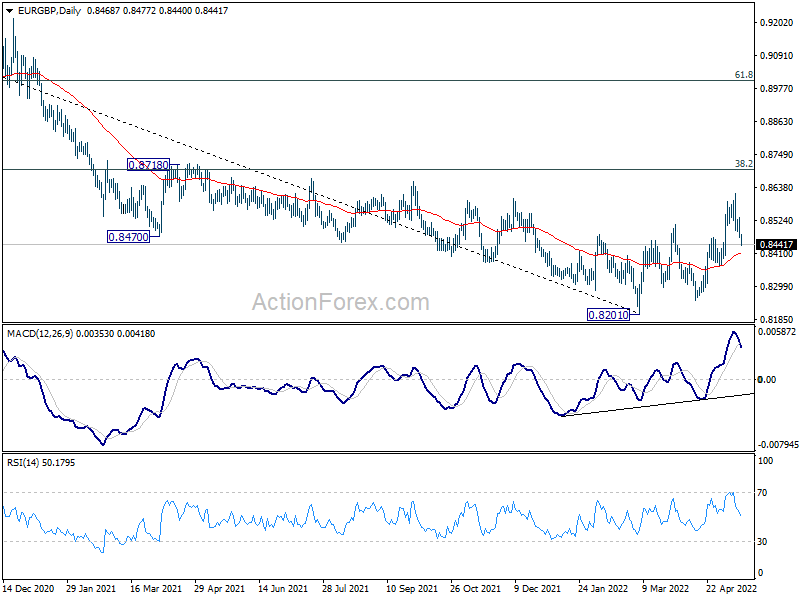
In the bigger picture, a medium term bottom could be in place at 0.8201, on bullish convergence condition in daily and weekly MACD. Rise from there could either be a correction to the down trend from 0.9499 (2020 high), or a medium term up trend itself. In either case, further rise should be seen to 38.2% retracement of 0.9499 to 0.8201 at 0.8697. Sustained break there will target 61.8% retracement at 0.9003.
Bailey’s Comments Sounded Much More Combative in Fighting Inflation than Previous BoE-Meeting Suggested
Markets
Dismal monthly Chinese eco data (April) only dented risk sentiment somewhat during Asian dealing. Calm returned in Europe, also following big swings last week. German Bunds ceded ground, underperforming US Treasuries. Dynamics changed again somewhat as US investors entered dealings. They preferred a more cautious approach with a very weak US Empire Manufacturing Survey and rising Covid-levels in NY sounding the alarm bell.
Daily US yield changes eventually ranged between -4 bps (5-yr) and +1.9 bps (30-yr) with the belly of the curve outperforming the wings. The German curve flattened with yields 3 bps higher at the front end and 1.9 bps lower at the very long end of the curve. 10-yr yield spread changes vs Germany ended broadly stable with Greece underperforming (+6 bps).
The dollar ceded ground with the trade weighted greenback searching resistance-turned-support around the 104 big figure. EUR/USD 1.0341 survived twice last week with the pair creating some breathing space near 1.0450. Sterling outperformed with BoE governor Bailey’s testimony before the Commons treasury committee outweighing looming brexit worries with PM Johnson about to sign off on unilateral changes to the Northern Irish Protocol. EUR/GBP returned sub 0.85, changing currently hands at 0.8460.
Bailey’s comments sounded much more combative in fighting inflation than the previous BoE-meeting suggested. Unlike a fortnight ago, the onus was clearly on runaway inflation and the very tight labour market (as proven by this morning’s labour market report) rather than on the grim growth outlook. Bailey can’t prevent inflation from running above 10% (currently 7%), warned for the apocalyptic risk of food inflation and said that price pressure has to get back to the 2% target, even as it comes with a cost for the economy. Three-month SONIA futures traded slightly (2-3 bps) higher on the day. They discount a 2% BoE policy rate by the turn of the year (currently 1%) with policy rate peak around 2.25%-2.5% mid next year. Asian bourses gain around 0.5% this morning with China outperforming. Core bonds drift away. The eco calendar contains details of the first quarter EMU GDP figure (0.2% Q/Q) and especially US retail sales. High inflation will at some point start affecting US consumption as well. It could strengthen belief that at least for now, sufficient Fed tightening is discounted, suggesting consolidation ahead for core bonds and taking away momentum from the dollar. Speeches by central bankers, including Fed Powell and ECB Lagarde, are wildcards today.
News Headlines
The Reserve Bank of Australia considered three options related to the size of its first rate hike this cycle earlier this month. Minutes released today showed that a 15 bps hike to bring the policy rate to 0.25% didn’t make sense according to the board since policy was extremely stimulative and rates would have to be raised further anyway. A 40 bps step (to 0.50%) was a possibility as well but didn’t make the cut either. Instead, the RBA chose for a regular 25 bps hike, arguing that the high meeting frequency (monthly) gives provides ample opportunities to review the pace. Market bets for a higher-than-normal rate hike at the June meeting are gently creeping higher (>30 bps currently discounted). There’s a total of 240 bps additional tightening discounted by the end of the year. The Aussie dollar tops AUD/USD 0.70 this morning, with part of the appreciating following the RBA Minutes. The Hungarian forint yesterday temporarily weakened 2% to beyond EUR/HUF 390 before trimming losses. The pair still closed near the record lows seen in the wake of the Russian invasion. The swings followed PM Orban’s inaugural speech after being sworn in for a fifth term. In it, he launched a fresh attack against Europe and warned for a decade of “danger, uncertainty and war”. Domestically, Orban mentioned a string of (pre-election) programs, including household utility and family subsidies, that he intends to keep in place. Food, fuel and mortgage price caps are set to expire in July unless they are extended. Hungary is also still involved in a rule-of-law dispute with the EU. The Commission currently withholds already more than €7bn of pandemic aid.
May RBA Board Minutes Make a Clear Case for First Rate Hike
The Minutes for the RBA May Board meeting highlight the importance of the Bank’s liaison surveys for assessing inflation challenges. Pricing power; labour shortages; and rising labour costs all support the decision in May. There is also some encouraging evidence that our call for a 40 basis point increase on June 7 is likely to be seen by the Board as the best policy.
The Minutes of the Reserve Bank Board meeting of May 3 emphasise just how important the Bank’s liaison surveys have been in framing policy.
Information from Liaison is attributed to highlighting to the Board that:
- “Firms’ price setting behaviours were undergoing a change from the pre – pandemic period, with businesses becoming more confident that raising prices would not significantly reduce demand or erode their competitive position.”
- “Labour costs were rising at a faster pace and this was likely to continue.”
- “The outlook for broader measures of labour costs had also been revised up … as firms turned to bonuses, allowances and other measures to attract and retain workers.”
- “Many firms were having difficulty hiring workers with the right skills.”
This accumulated evidence from the Liaison surveys and other business surveys justified the need to raise the cash rate in May before the standard Wage Price Index data printed on May 18 and the broader measures of wages growth (including average weekly earnings) that would print in the national accounts on June 1
The Minutes noted that “the recent evidence on wages growth from the Bank’s liaison and business surveys was clear.”
The Risks to the Outlook
The Minutes carefully outline the impressive list of risks to the Bank’s central case that “Inflation was expected to increase further in the near term but decline back towards the top of the target range by mid-2024 as supply side disruptions are resolved.”
These risks include:
- Uncertainty around how and when the supply-side problems would be resolved.
- Inflation pressures were also emanating from domestic pressures as there was limited but unknown spare capacity in the labour market
- The sensitivity of household spending and house prices to rising rates and declining real wages.
- The impact of the accumulated savings buffer and the high household savings rate to higher rates.
- The behaviour of prices and wages when the unemployment rate hits 50 year lows.
- The extent to which the reopening of the international border alleviates acute areas of labour shortages.
Policy
The Minutes outline the Board’s decision on the day. Three options were considered once it was decided to raise the cash rate.
The 15 basis points option which was favoured by most analysts and the market was dismissed by the Board because policy settings were already “very stimulatory”; further rate rises would be required; and a 15 basis point increase would be inconsistent with the historical practice of changing the cash rate increments of “AT LEAST” 25 basis points.
The case for 40 basis points “could be made given the upside risks to inflation and the current very low level of interest rates.” That case remained open without any real argument against it, although “given the Board meets monthly, it would have the opportunity to review the setting of interest rates again within a relatively short period of time”.
Taken, literally, that argument might justify never moving by more than 25 basis points.
It has been our argument that the move on June 7 should be 40 basis points. The lack of a clear argument against the 40 in May in the minutes and the fact that they refer to the level of rates being “very stimulatory” supports that case.
At his press conference the Governor referred to “business as usual”.
That may have been interpreted as “25 basis point movements.” However, the minutes imply that “business as usual” means movements of “at least” 25 basis points.
Another key argument supporting the likely 40 basis point policy is the description of the actions of other central banks in the minutes. “Several central banks in advanced economies had indicated that they were seeking to return policy rates to a neutral setting quickly and may increase policy rates further thereafter.”
But the minutes correctly note the significant uncertainty around the level of the neutral rate.
It is for that reason that we have advocated the policy of front end loading the tightening cycle with an immediate 40 basis point move – adopt a larger increment early in the cycle when it is clear that rates are well below that neutral level.
The minutes also set out clearly that the Board is unlikely to move away from its decision to not reinvest the proceeds of maturing bonds. Reinvesting the proceeds would not be consistent with the strength of the economy or the inflation challenge. Allowing an orderly run off would be gradual and predictable.
The Board argues that selling bonds would have a modest effect relative to raising the cash rate. And the balance sheet contraction would be assisted by the repayment by the banks of around $180 billion of the Term Funding facility by the banks and other DTI’s.
Conclusion
We remain comfortable with our forecast that the terminal rate in the tightening cycle will be 225 basis points.
But as the minutes highlight quite clearly there is formidable uncertainty around that target.
However, the minutes do provide some support to our view that the next move in the cycle on June 7 will be an increase of 40 basis points rather than 25.
40 basis points would not conflict with “business as usual”; the grounds for dismissing the case for 40 at the May meeting are not strongly made as is the case with the 15 basis point option; the minutes refer to other central banks wanting to reach neutral “quickly” while the uncertainties highlighted by the minutes do not really come into play until the cash rate is significantly higher than the current 35 basis points
We have also seen the slightly uncomfortable evidence that the Bank’s private liaison surveys are playing a critical role in their assessments of their task to bring inflation back to the top of the target band by 2024. The word “uncomfortable” refers to the fact that the Liaison surveys are not publicly available.
However, the overall messages from the Liaison surveys – a return of some pricing power to business; labour shortages; various non-wage methods used to attract and retain staff and fast increasing labour costs are unlikely to be credibly contradicted by the Wage Price Index (May 18) and Average Weekly Earnings (June 1), which are set to print before that June 7 meeting.
Equity Selloff Eases, Oil Rebounds
The selloff in US and European equities continued Monday, yet the size of the slide wasn’t alarming, and the Dow Jones index could even eke out a small 0.08% gain, as energy stocks led gains.
Occidental Petroleum was one of the biggest gainers, with a 5.7% jump at yesterday’s session to the highest levels in more than 3 years as crude oil reversed the early negative trend and spiked near $115 per barrel on news that the EU came closer to banning the Russian oil imports.
Investors kept unloading the technology stocks however, with Twitter losing another 8% on rumours that Musk is now looking for a cheaper deal to buy Twitter, as he is concerned that the spam accounts certainly make up more than 5% of the total accounts.
US and European futures hint at a positive start Tuesday.
Reflation
The recession talk remains the major catalyzer of the market moves, and migration from tech to value continues. The latter explains why the FTSE 100 is 5% up ytd, while the S&P500 is at the cusp of the bear market.
Technology stocks have a relatively heavy weighting in major American indices. Apple, Microsoft, Amazon, Alphabet and Tesla make up to more than 20% of the S&P500.
Therefore, the positive divergence of the FTSE 100 will likely remain in play as long as the energy prices remain upbeat. Plus the pound has cheapened almost 10% since the beginning of the year – making the money-making British energy companies look even more appetizing for investors.
In the FX
The US dollar is softer across the board, but the dollar index consolidates near a 20-year high. Due today, the US retail sales is expected to have improved in April. A good figure will likely remain the Fed hawks in charge of the market, while a soft read would only dampen the mood on the idea that the economy is softening but there is nothing the Federal Reserve (Fed) could do about it.
Else, Eurozone will reveal its latest GDP update (0.2% in Q1). The second quarter will likely be worse due to rising energy costs and the war on the continent. The European Central Bank (ECB) is expected to start raising the rates by this summer to tame inflation, and a hawkish shift in ECB polivy could help the EURUSD gain strength before testing parity.
But where the EURUSD would dip depends on if, and by how much the dollar strengthens from the actual levels. A slower global selloff could ease the positive pressure on the dollar and help the EURUSD recover before seeing parity. But if the global positive pressure on the dollar continues, parity will be the next step for the single currency.
Strong Oil Demand
Market movers today
Today, we will get US April retail sales and industrial production data. Particularly retail sales is interesting to watch as we keep a close eye on how US consumers are coping with the erosion of purchasing power resulting from high inflation.
Otherwise, data calendar is light but we have a bunch of central bank speakers in the wires. In the US, we will hear comments from Fed's Bullard, Kashkari, Powell and Mester. ECB's Lagarde and Riksbank's Ohlsson are also due to speak today.
The 60 second overview
Gas: According to revised EU guidelines, EU energy companies can continue to buy natural gas from Russia without breaching sanctions even if it requires opening an account in Gazprombank. It should end near-term possibility of disruptions to EU gas flows as next round of payments to Russia is due.
Oil: Oil prices climbed higher yesterday with Brent closing in on the USD115/bbl mark - the highest since March. Strong demand is pushing prices higher. In the US, the driving season nears, which has led to a surge in diesel and gasoline prices. China eyes an end to lockdown in Shanghai, which would trigger a rebound in oil demand.
Fed: New York Fed President John Williams yesterday affirmed other Fed members' position that inflation in the US is running far too high. He further supported additional 50bp rate increases at upcoming meetings in a push to get the real interest rate back to zero next year.
FI: It was a session of two tales. A weak morning with rates selling off by 5-6bp, but a similar strong rally in the afternoon left rates slight lower on the day. Most countries recorded a minor rally in the 10y+, but most observed in Germany, i.e. wider spreads. However, as the short end sold off, we did see some flattening of the curves. The shorter dated papers sold off by 2-3bp yesterday, reflecting also that Villeroy said that he expects a 'decisive June meeting, and an active summer'. July pricing does now point to 28bp. Bund ASW was again volatile and ended 2bp lower at 76bp.
FX: EUR/USD was relatively quiet yesterday trading slightly higher to 1.043 but we still expect fundamentals to take the cross down towards parity over the coming 12M. EUR/GBP moved back below 0.85 (GBP/USD back above 1.23) but we expect GBP to weaken in coming months. CAD, AUD, NZD and GBP were the winners yesterday, appreciating 0.5-0.6% versus USD. EUR/CHF, EUR/NOK and EUR/SEK all rose yesterday.
Credit: Credit markets began the week in slight risk-off mode, following along the soft tone in European equities. ITraxx Main widened by 1.5bp to close at 93.5bp, while Xover widened 5.9bp to close at 451.9bp. On the other hand, the tone in primary markets was supportive, with European Pulp & Paper company UPM printing a 7Y green EUR benchmark. The deal was well bid at around 3x oversubscription and the spread ended up printing 22bp tighter than the IPT of +110bp.
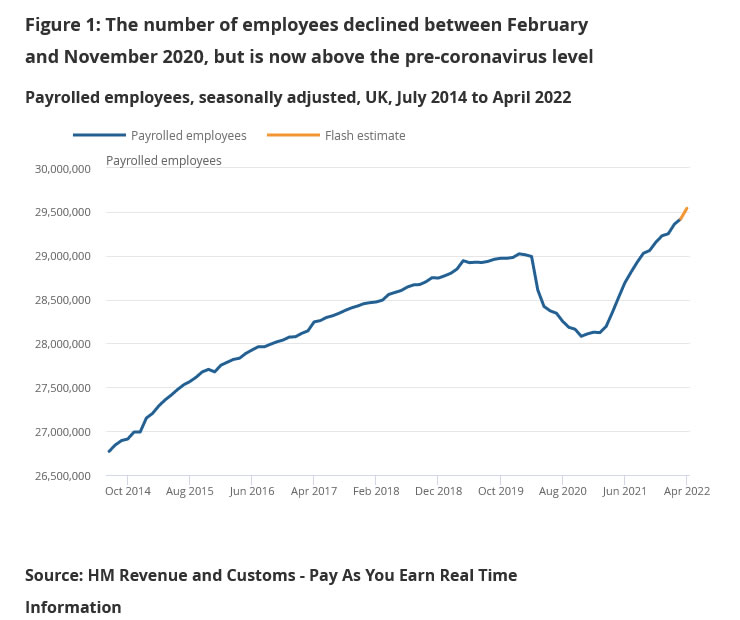
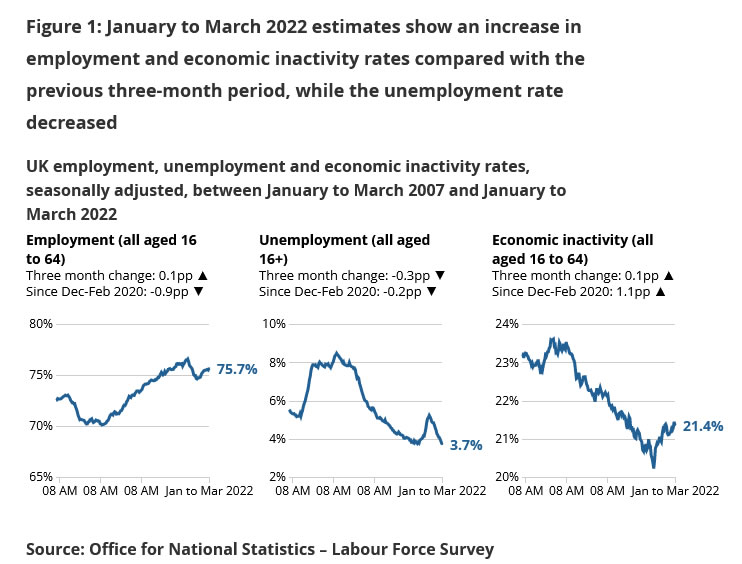
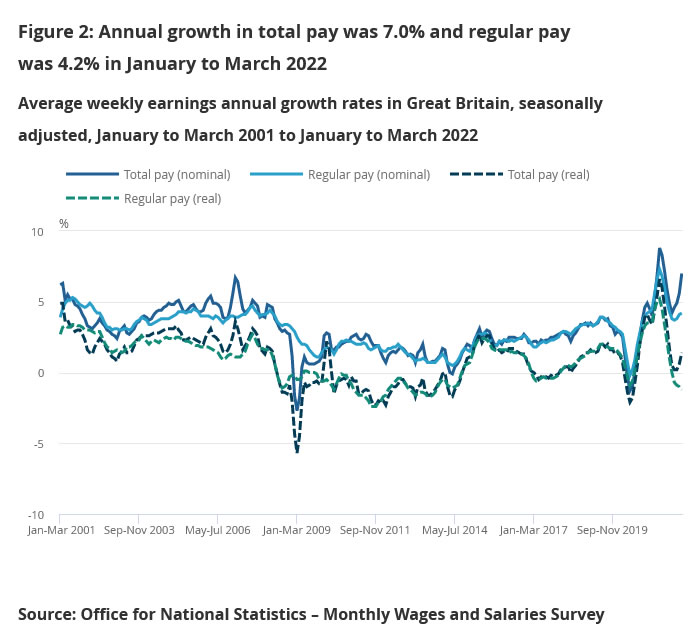
UK payrolled employees rose 131k in Apr, unemployment rate dropped to 3.7% in Mar
In April, UK payrolled employees rose 0.4% mom, or 131k, to 29.5m. Claimant count dropped -56.9k, versus expectation of -42.3k.
Unemployment rate dropped from 3.8% to 3.7%, versus expectation of being unchanged at 3.8%. Employment rate rose to 75.7%. Average earnings including bonus jumped 7% 3moy, versus expectation of 5.4%. Average earnings excluding bonus rose 4.2% 3moy, matched expectations.
EUR/AUD Daily Outlook
Daily Pivots: (S1) 1.4910; (P) 1.5014; (R1) 1.5075; More...
EUR/AUD's break of 1.4961 minor support suggest that corrective rise from 1.4318 has completed with three waves up to 1.5277. Rejection by 1.5354 support turned resistance retains near term bearishness. Intraday bias is back on the downside for 1.4597 support first. Break there will bring retest of 1.4318 low.
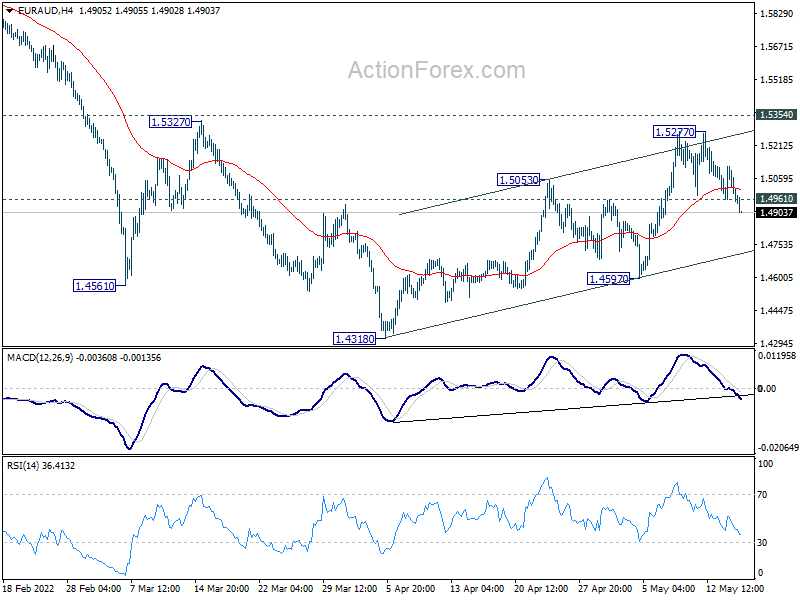
In the bigger picture, as long as 1.5354 support turned resistance holds, larger down trend form 1.9799 (2020 high) is still expected to continue. On resumption, next target is 61.8% projection of 1.9799 to 1.5250 from 1.6434 at 1.3623, which is close to 1.3624 long term support (2017 low). However, firm break of 1.5354 will indicate medium term bottoming and bring stronger rally back to 1.6434 key resistance.

Aussie Rises on Stabilizing Sentiment, Sterling Awaits Data
Overall risk sentiment is stable in Asian session today. Australian and New Zealand Dollar are trading mildly higher as recoveries extend, while Sterling is also slightly higher. On the other hand, Yen is softening together with Swiss Franc and Dollar, and that is in-line with risk trades. Euro and Canadian Dollar are mixed for now.
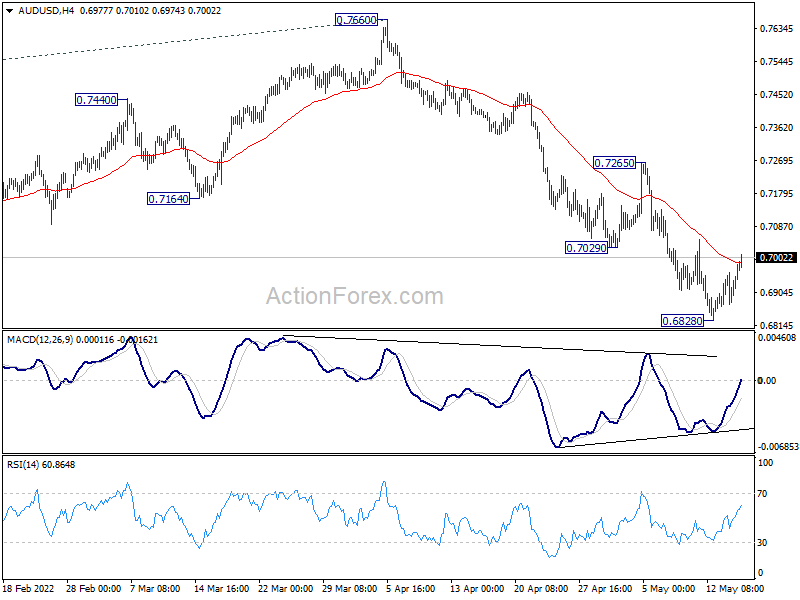
Technically, there are some early signs of turn around in overall risk sentiment. Hence, some focuses will be on commodity currencies today. EUR/AUD's break of 1.4961 minor support raises the chance that corrective rise from 1.4318 has already completed with three waves up to 1.5277. Underlying strength of Aussie would be further affirmed if AUD/USD could break through 0.7029 support turned resistance. But of course, the fall in EUR/AUD could be accompanied by breakdown in EUR/USD through 1.0339 low, which signal Euro's weakness instead. Let's see.
In Asia, at the time of writing, Nikkei is up 0.28%. Hong Kong HSI is up 2.23%. China Shanghai SSE is up 0.29%. Singapore Strait Times is up 0.39%. Japan 10-year JGB yield is up 0.0024 at 0.246. Overnight, DOW rose 0.08%. S&P 500 dropped -0.39%. NASDAQ dropped -1.20%. 10-year yield dropped -0.058 to 2.877.
RBA considered 15bps, 25bps, 40bps hikes in May
In the minutes of May 3 meeting, RBA revealed that three options on interest rate hikes were considered, including 15bps, 25bps and 40bps.
Raising the cash rate by 15bps was not preferred "given that policy was very stimulatory and that it was highly probable that further rate rises would be required." And argument for 40bps "could be made given the upside risks to inflation and the current very low level of interest rates".
But the preferred option of was 25bps, as "a move of this size would help signal that the Board was now returning to normal operating procedures after the extraordinary period of the pandemic".
BoE Bailey: There were range of views on both sides of the narrow path we are navigating
At the report to the Treasury Committee, BoE Governor Andrew Bailey reiterated that most MPC members judge that "some degree of further tightening in monetary policy might still be appropriate in the coming months".
But he also acknowledged there are "risks on both sides of that judgement", and a "range of views among these members on the balance of risks". "This reflects the narrow path we are navigating, given the magnitude of the risks on both sides of our inflation projections," he added.
Reflecting risks on one side of that "narrow path", three MPC members voted for 50bps hike in May, instead of 25bps.
Reflecting risks on the other side, there were also a "range of views about the need for, and extent of, any further tightening in policy in the coming months". Some members judged that "the risks around activity and inflation over the policy horizon were more evenly balanced and that such guidance was not appropriate at this juncture.
GBP/CAD holding above 2016 low, awaiting wave of UK data
Sterling is a major focus this week with a batch of economic data featured, starting from jobs today, to inflation and retail sales. Risks to the inflation outlook are on both sides as BoE Governor Andrew Bailey explained. Thus, the path of monetary policy, as well as the Pound's movements, are also highly uncertain.
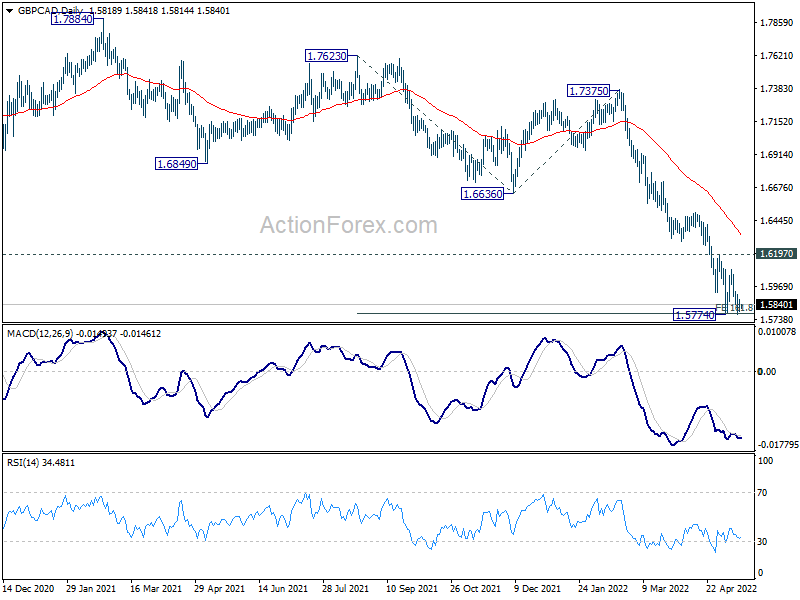
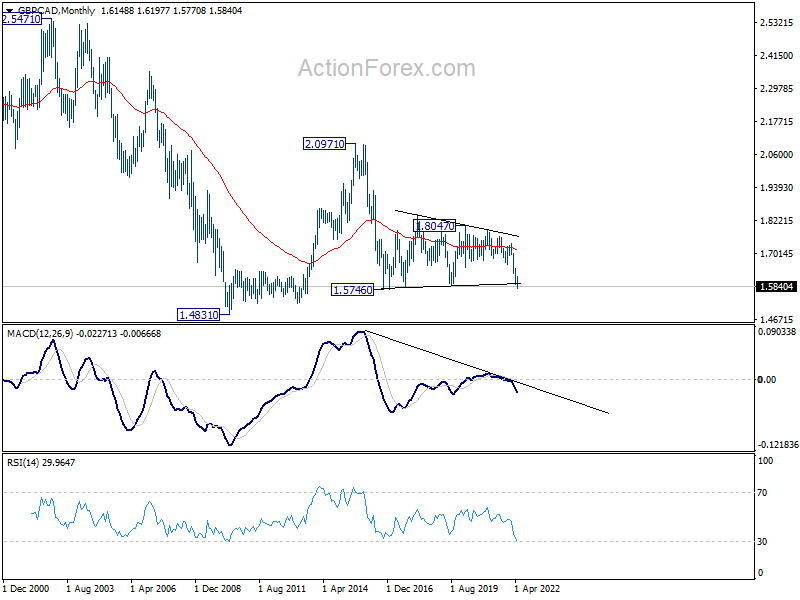
GBP/CAD's decline slowed after falling to 1.5774 earlier in the month, hitting 161.8% projection of 1.7623 to 1.6636 from 1.7375 at 1.5778. More importantly, it's now close to long term support at 1.5746 (2016 low). Further decline will remain in favor as long as 1.6197 resistance holds. Break of 1.5774 could easily push GBP/CAD through 1.5746 to resume the down trend from 2.0971 (2015 high). Such development will also raise the chance of resuming larger down trend from 2.5471 (2002 high) through 1.4831 (2010 low) in the medium term. It could be rather significant.
Looking ahead
UK employment, Italy trade balance, Eurozone GDP will be released in European session. Later in the day, US will release retail sales, industrial production, business inventories and NAHB housing index.
EUR/AUD Daily Outlook
Daily Pivots: (S1) 1.4910; (P) 1.5014; (R1) 1.5075; More...
EUR/AUD's break of 1.4961 minor support suggest that corrective rise from 1.4318 has completed with three waves up to 1.5277. Rejection by 1.5354 support turned resistance retains near term bearishness. Intraday bias is back on the downside for 1.4597 support first. Break there will bring retest of 1.4318 low.
In the bigger picture, as long as 1.5354 support turned resistance holds, larger down trend form 1.9799 (2020 high) is still expected to continue. On resumption, next target is 61.8% projection of 1.9799 to 1.5250 from 1.6434 at 1.3623, which is close to 1.3624 long term support (2017 low). However, firm break of 1.5354 will indicate medium term bottoming and bring stronger rally back to 1.6434 key resistance.
Economic Indicators Update
| GMT | Ccy | Events | Actual | Forecast | Previous | Revised |
|---|---|---|---|---|---|---|
| 01:30 | AUD | RBA Meeting Minutes | ||||
| 04:30 | JPY | Tertiary Industry Index M/M Mar | 1.30% | 1.20% | -1.30% | |
| 06:00 | GBP | Claimant Count Change Apr | -42.3K | -46.9K | ||
| 06:00 | GBP | ILO Unemployment Rate (3M) Mar | 3.80% | 3.80% | ||
| 06:00 | GBP | Average Earnings Including Bonus 3M/Y Mar | 5.40% | 5.40% | ||
| 06:00 | GBP | Average Earnings Excluding Bonus 3M/Y Mar | 4.20% | 4.00% | ||
| 08:00 | EUR | Italy Trade Balance (EUR) Mar | 0.79B | -1.66B | ||
| 09:00 | EUR | Eurozone GDP Q/Q Q1 P | 0.20% | 0.20% | ||
| 09:00 | EUR | Eurozone Employment Change Q/Q Q1 P | 0.50% | 0.50% | ||
| 12:30 | USD | Retail Sales M/M Apr | 1.10% | 0.50% | ||
| 12:30 | USD | Retail Sales ex Autos M/M Apr | 0.30% | 1.10% | ||
| 13:15 | USD | Industrial Production M/M Apr | 0.40% | 0.90% | ||
| 13:15 | USD | Capacity Utilization Apr | 78.60% | 78.30% | ||
| 14:00 | USD | Business Inventories Mar | 1.80% | 1.50% | ||
| 14:00 | USD | NAHB Housing Market Index May | 76 | 77 |
GBP/CAD holding above 2016 low, awaiting wave of UK data
Sterling is a major focus this week with a batch of economic data featured, starting from jobs today, to inflation and retail sales. Risks to the inflation outlook are on both sides as BoE Governor Andrew Bailey explained. Thus, the path of monetary policy, as well as the Pound's movements, are also highly uncertain.
GBP/CAD's decline slowed after falling to 1.5774 earlier in the month, hitting 161.8% projection of 1.7623 to 1.6636 from 1.7375 at 1.5778. More importantly, it's now close to long term support at 1.5746 (2016 low). Further decline will remain in favor as long as 1.6197 resistance holds. Break of 1.5774 could easily push GBP/CAD through 1.5746 to resume the down trend from 2.0971 (2015 high). Such development will also raise the chance of resuming larger down trend from 2.5471 (2002 high) through 1.4831 (2010 low) in the medium term. It could be rather significant.