

Sample Category Title
USD/JPY Mid-Day Outlook
Daily Pivots: (S1) 128.68; (P) 129.15; (R1) 129.59; More...
USD/JPY is staying in consolidation from 131.34 and intraday bias remains neutral. Another fall cannot be ruled out and below 127.51 will target 125.09 cluster support (38.2% retracement of 114.40 to 131.34 at 124.86). On the upside, firm break of 131.34 will resume larger up trend.
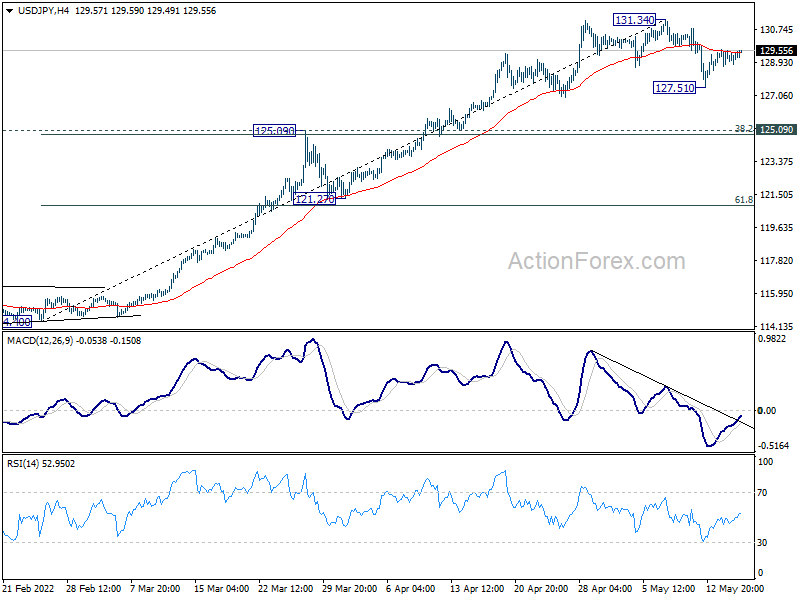
In the bigger picture, current rally is seen as part of the long term up trend form 75.56 (2011 low). Sustained trading above 61.8% projection of 75.56 (2011 low) to 125.85 (2015 high) from 98.97 at 130.04 will pave the way to 100% projection at 149.26, which is close to 147.68 (1998 high). For now, this will remain the favored case as long as 121.27 support holds.
USD/CHF Mid-Day Outlook
Daily Pivots: (S1) 0.9997; (P) 1.0030; (R1) 1.0053; More....
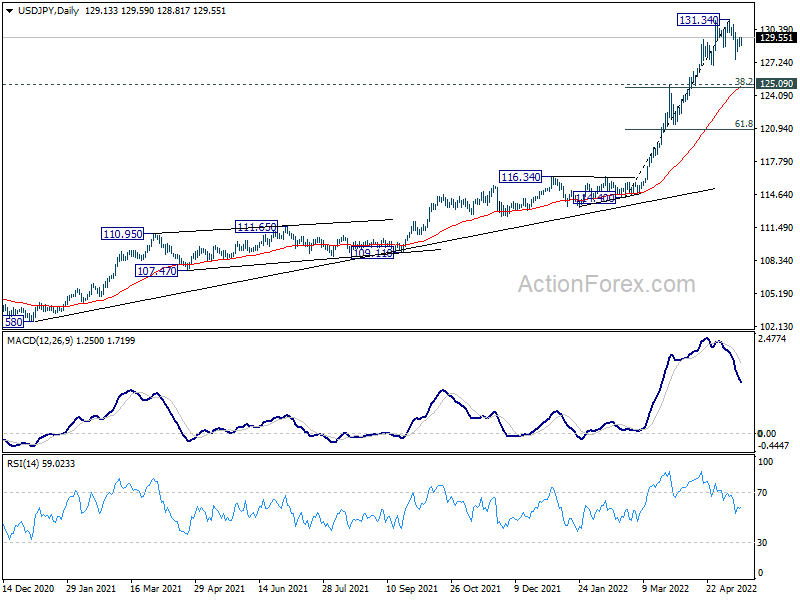
Intraday bias in USD/CHF remains neutral for the moment. Considering bearish divergence condition in 4 hour MACD, break of 0.9871 support will indicate short term topping at 1.0063. Intraday bias will be turned to the downside for 38.2% retracement of 0.9193 to 1.0063 at 0.9731. On the upside, above 1.0063 will resume larger up trend.
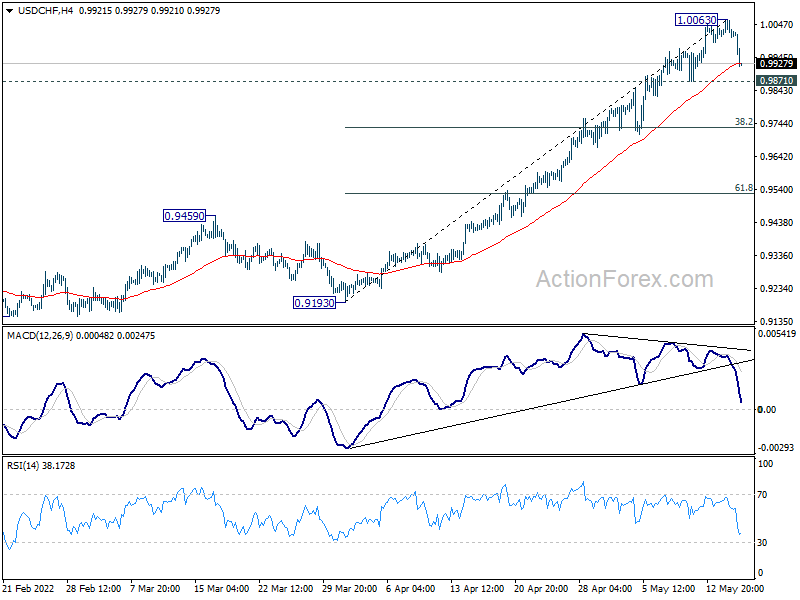
In the bigger picture, down trend from 1.0342 (2016 high) should have completed with three waves down to 0.8756 (2021 low) already. Rise from 0.8756 is likely a medium term up trend of its own. Next target is 161.8% projection of 0.8756 to 0.9471 from 0.9149 at 1.0306, which is close to 1.0342 (2016 high). This will remain the favored case as long as 0.9459 resistance turned support holds.
GBP/USD Mid-Day Outlook
Daily Pivots: (S1) 1.2250; (P) 1.2290; (R1) 1.2362; More..
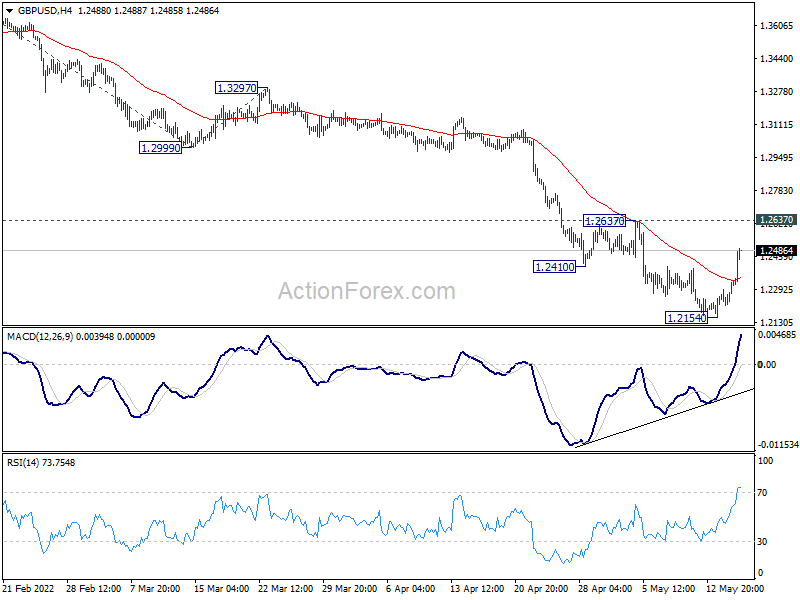
Intraday bias in GBP/USD remains neutral first. Considering bullish convergence condition in 4 hour MACD, break of 1.2637 will confirm short term bottoming at 1.2154. Intraday bias will be turned back to the upside for 55 day EMA (now at 1.2831). On the downside, break of 1.2154 will resume the down trend from 1.4248 to 200% projection of 1.3641 to 1.2999 from 1.3297 at 1.2013 next
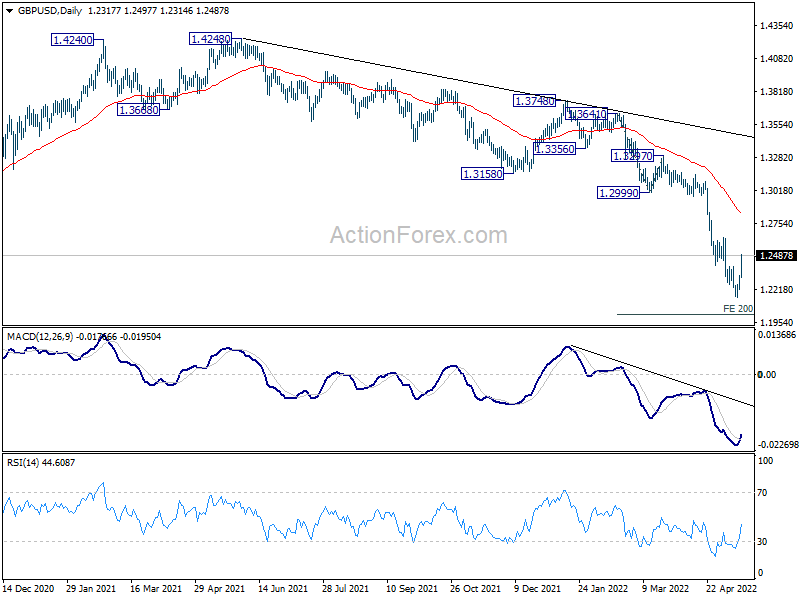
In the bigger picture, based on current momentum, fall from 1.4248 (2018 high) at least at the same degree as the rise from 1.1409 (2020 low). That is, fall from 1.4248 could be a leg inside the pattern from 1.1409, or resuming the longer term down trend. In either case, deeper decline is expected as long as 1.2999 support turned resistance holds. Next target is 1.1409 low.
EUR/USD Mid-Day Outlook
Daily Pivots: (S1) 1.0402; (P) 1.0422 (R1) 1.0455; More...
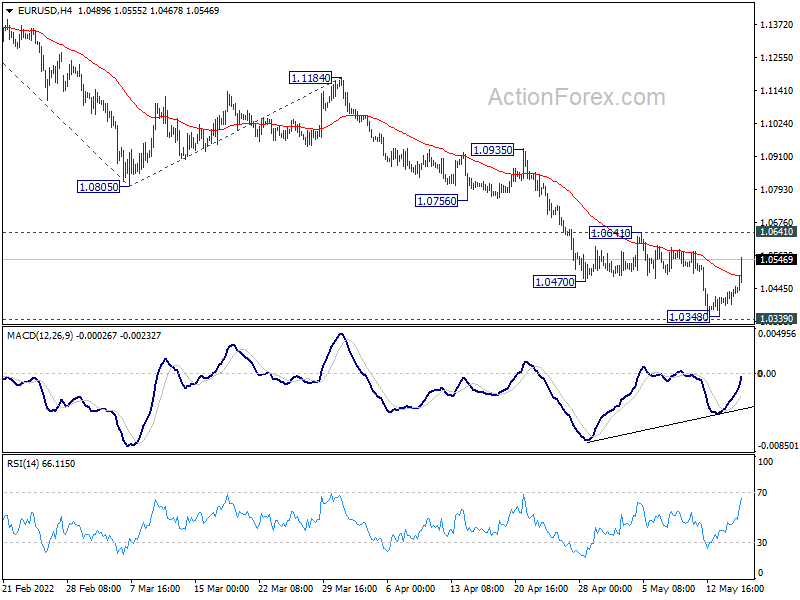
EUR/USD is still limited below 1.0641 resistance and intraday bias stays neutral first. On the upside, firm break of 1.0641 resistance will confirm short term bottoming at 1.0348, ahead of 1.0339 long term support. Intraday bias will be turned back to the upside for 1.0805 support turned resistance. On the downside, however, decisive break of 1.0339 will carry larger bearish implication and target 161.8% projection of 1.1494 to 1.0805 from 1.1184 at 1.0069.
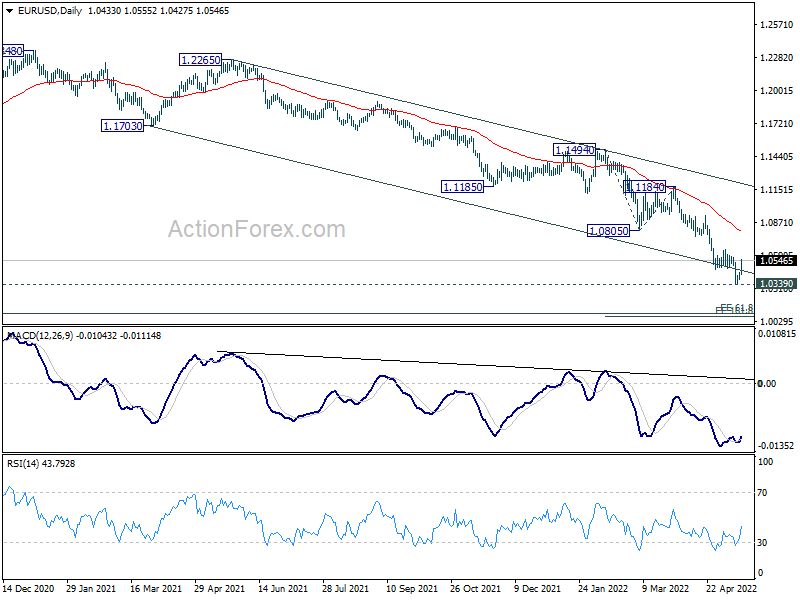
In the bigger picture, break of medium term channel support suggests downside acceleration. Current decline from 1.2348 (2021 high) is probably resuming long term down trend from 1.6039 (2008 high). Decisive break of 1.0339 will confirm this bearish case. Next target is 61.8% projection of 1.3993 to 1.0339 from 1.2348 at 1.0090. This will now remain the favored case as long as 1.0805 support turned resistance holds.
Euro and Sterling Rebound Strongly, Dollar and Yen Turn Weaker
Yen and Dollar falls broadly today as risk-on sentiment is gaining steam. European majors are making a strong come back too. Sterling is boosted by upbeat job market data. Euro is also lifted after a ECB policymaker threw out the idea of a 50bps rate hike. Commodity currencies are mixed for the moment, slightly on the soft side.
Technically, EUR/USD's rebound raises the chance of successfully defending 2017 low. Immediate focus is now on 1.0641 resistance. Firm break there will at least confirm short term bottoming and bring stronger rebound. If that happens, focus will also be on 1.2637 resistance in GBP/USD and 0.9871 support in USD/CHF. Break of these levels will also add to the case of extended pull back in Dollar.
In Europe, at the time of writing, FTSE is up 0.79%. DAX is up 1.44%. CAC is up 1.17%. Germany 10-year yield is up 0.101 at 1.040. Earlier in Asia, Nikkei rose 0.42%. Hong Kong HSI rose 3.27%. China Shanghai SSE rose 0.65%. Singapore Strait Times rose 0.34%. Japan 10-year JGB yield rose 0.0010 to 0.245.
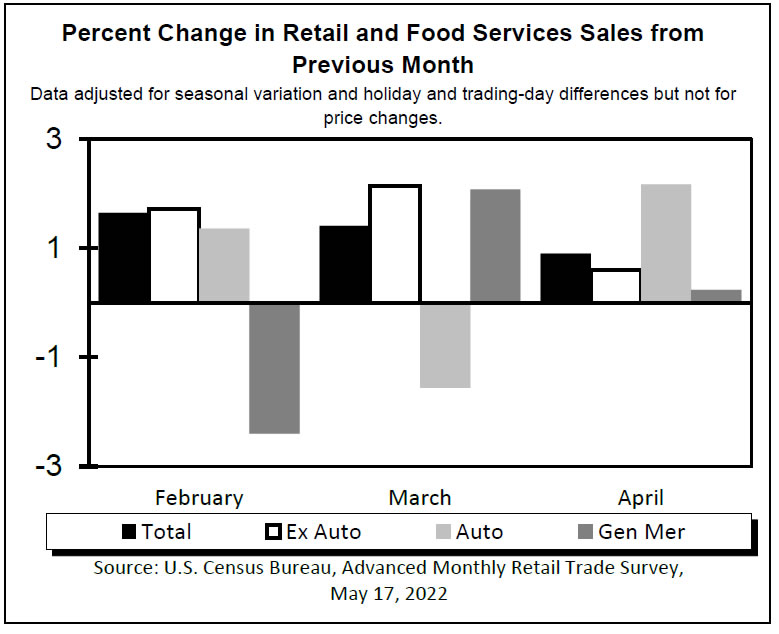
US retail sales rose 0.9% mom in Apr, ex-auto sales up 0.6% mom
US retail sales rose 0.9% mom to USD 677.7B in April, below expectation of 1.1% mom. Ex-auto sales rose 0.6% mom, above expectation of 0.3% mom. Ex-gasoline sales rose 1.3% mom. Ex-auto, ex-gasoline sales rose 1.0% mom. Retail trade rose 0.7% mom.
Total sales for the three-period, February through April, were up 10.8% from the same period a year ago.
ECB Knot: 25bps hike realistic, 50bps must not be excluded
ECB Governing Council member Klaas Knot told Dutch TV program College Tour, "the first interest rate hike is now being priced in for the monetary policy meeting of 21 July." A 25bps hike " seems realistic to me."
He also added that if inflation is "broadening further or accumulating... a bigger increase must not be excluded either."
"In that case a logical next step would amount (to) half a percentage point," he said.
Released today, Eurozone GDP grew 0.3% qoq in Q1, above expectation of 0.2% qoq. Employment rose 0.5% qoq, matched expectations.
UK payrolled employees rose 131k in Apr, unemployment rate dropped to 3.7% in Mar
In April, UK payrolled employees rose 0.4% mom, or 131k, to 29.5m. Claimant count dropped -56.9k, versus expectation of -42.3k.
Unemployment rate dropped from 3.8% to 3.7%, versus expectation of being unchanged at 3.8%. Employment rate rose to 75.7%. Average earnings including bonus jumped 7% 3moy, versus expectation of 5.4%. Average earnings excluding bonus rose 4.2% 3moy, matched expectations.
RBA considered 15bps, 25bps, 40bps hikes in May
In the minutes of May 3 meeting, RBA revealed that three options on interest rate hikes were considered, including 15bps, 25bps and 40bps.
Raising the cash rate by 15bps was not preferred "given that policy was very stimulatory and that it was highly probable that further rate rises would be required." And argument for 40bps "could be made given the upside risks to inflation and the current very low level of interest rates".
But the preferred option of was 25bps, as "a move of this size would help signal that the Board was now returning to normal operating procedures after the extraordinary period of the pandemic".
EUR/USD Mid-Day Outlook
Daily Pivots: (S1) 1.0402; (P) 1.0422 (R1) 1.0455; More...
EUR/USD is still limited below 1.0641 resistance and intraday bias stays neutral first. On the upside, firm break of 1.0641 resistance will confirm short term bottoming at 1.0348, ahead of 1.0339 long term support. Intraday bias will be turned back to the upside for 1.0805 support turned resistance. On the downside, however, decisive break of 1.0339 will carry larger bearish implication and target 161.8% projection of 1.1494 to 1.0805 from 1.1184 at 1.0069.
In the bigger picture, break of medium term channel support suggests downside acceleration. Current decline from 1.2348 (2021 high) is probably resuming long term down trend from 1.6039 (2008 high). Decisive break of 1.0339 will confirm this bearish case. Next target is 61.8% projection of 1.3993 to 1.0339 from 1.2348 at 1.0090. This will now remain the favored case as long as 1.0805 support turned resistance holds.
Economic Indicators Update
| GMT | Ccy | Events | Actual | Forecast | Previous | Revised |
|---|---|---|---|---|---|---|
| 01:30 | AUD | RBA Meeting Minutes | ||||
| 04:30 | JPY | Tertiary Industry Index M/M Mar | 1.30% | 1.20% | -1.30% | |
| 06:00 | GBP | Claimant Count Change Apr | -56.9K | -42.3K | -46.9K | |
| 06:00 | GBP | ILO Unemployment Rate (3M) Mar | 3.70% | 3.80% | 3.80% | |
| 06:00 | GBP | Average Earnings Including Bonus 3M/Y Mar | 7.00% | 5.40% | 5.40% | 5.60% |
| 06:00 | GBP | Average Earnings Excluding Bonus 3M/Y Mar | 4.20% | 4.20% | 4.00% | 4.10% |
| 08:00 | EUR | Italy Trade Balance (EUR) Mar | -0.08B | 0.79B | -1.66B | -1.77B |
| 09:00 | EUR | Eurozone GDP Q/Q Q1 P | 0.30% | 0.20% | 0.20% | |
| 09:00 | EUR | Eurozone Employment Change Q/Q Q1 P | 0.50% | 0.50% | 0.50% | |
| 12:30 | USD | Retail Sales M/M Apr | 0.90% | 1.10% | 0.50% | |
| 12:30 | USD | Retail Sales ex Autos M/M Apr | 0.60% | 0.30% | 1.10% | |
| 13:15 | USD | Industrial Production M/M Apr | 0.40% | 0.90% | ||
| 13:15 | USD | Capacity Utilization Apr | 78.60% | 78.30% | ||
| 14:00 | USD | Business Inventories Mar | 1.80% | 1.50% | ||
| 14:00 | USD | NAHB Housing Market Index May | 76 | 77 |
US retail sales rose 0.9% mom in Apr, ex-auto sales up 0.6% mom
US retail sales rose 0.9% mom to USD 677.7B in April, below expectation of 1.1% mom. Ex-auto sales rose 0.6% mom, above expectation of 0.3% mom. Ex-gasoline sales rose 1.3% mom. Ex-auto, ex-gasoline sales rose 1.0% mom. Retail trade rose 0.7% mom.
Total sales for the three-period, February through April, were up 10.8% from the same period a year ago.
ECB Knot: 25bps hike realistic, 50bps must not be excluded
ECB Governing Council member Klaas Knot told Dutch TV program College Tour, "the first interest rate hike is now being priced in for the monetary policy meeting of 21 July." A 25bps hike " seems realistic to me."
He also added that if inflation is ""broadening further or accumulating... a bigger increase must not be excluded either."
"In that case a logical next step would amount (to) half a percentage point," he said.
Japan May Shrink, But Will the Yen Follow?
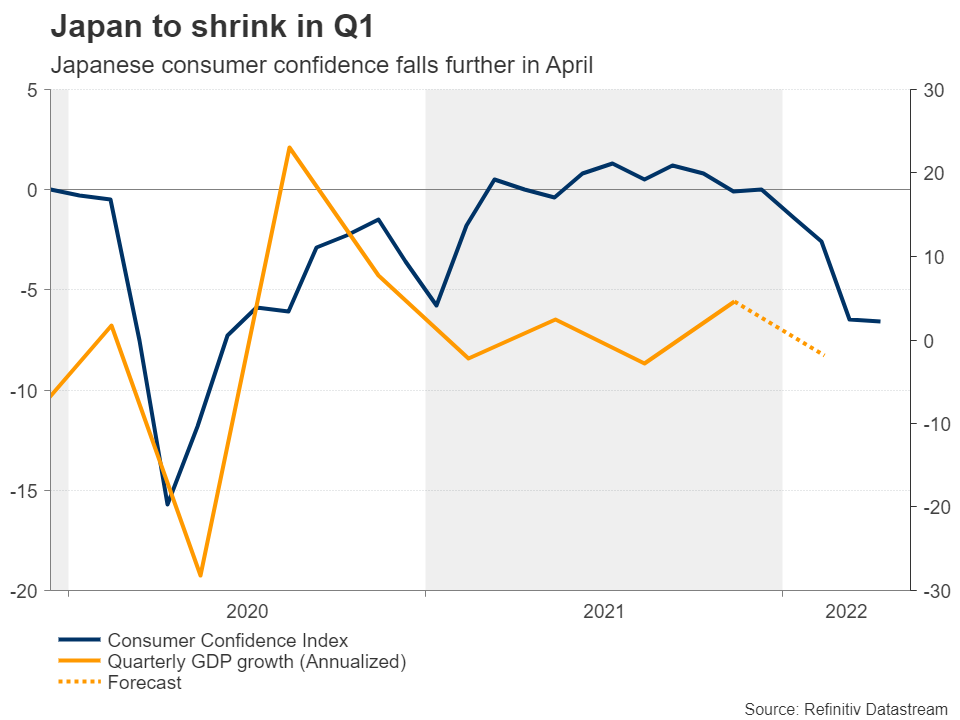
Despite its super accommodative monetary policy, Japan will probably join the group of economies that shrank in the first quarter of the year when Q1 GDP growth figures come out on Wednesday at 00:50 GMT. A slowdown in April’s exports on Thursday (00:50 GMT) and a huge inflation spike on Friday (00:30 GMT) may point to a discouraging start to the second quarter as well, further downgrading the outlook for the economy. That said, the bruised Japanese yen managed to gain some ground on the back of its safe haven status, and the recovery may have just started.
Japan to enter contraction in Q1
The Japanese yen claimed its first weekly gain after two months of continuous harsh selling that squeezed it to a two-decade low against the US dollar. The recovery took place after the US economy unexpectedly announced a contraction in the first quarter, raising concerns that an aggressive policy tightening by the Fed could further damage the economy more than it may balance inflation. As a result, investors sought safety in traditional bond markets, pressing the US Treasury yields lower; the widening spread between the rising US yields and the muted Japanese equivalents have been weighing heavily on the yen and the latest pause has finally breathed some life back into the yen.
The question that arises now is whether the yen will sustain its weekly advantage as a barrage of data releases are expected to paint a picture of a sluggish economy that cannot efficiently benefit from persisting negative interest rates and the massive bond buying delivered by the Bank of Japan (BoJ). Analysts estimate an annualized contraction of 1.8% and a quarterly decline of 0.4% in the three months to March from an expansion of 4.6% and 1.1% previously. Recall that household spending diminished 2.3% in real terms in March from the previous year, while consumer confidence faced another deterioration in April. Hence, an economic downturn is now looking increasingly likely.
National CPI inflation could face huge increase
Other data will indicate that April has not been kind to the economy either. Exports are said to have risen at a softer pace of 13.8% y/y compared to 14.7% previously, whilst imports are forecast to surge from 31.2% y/y to 35%.
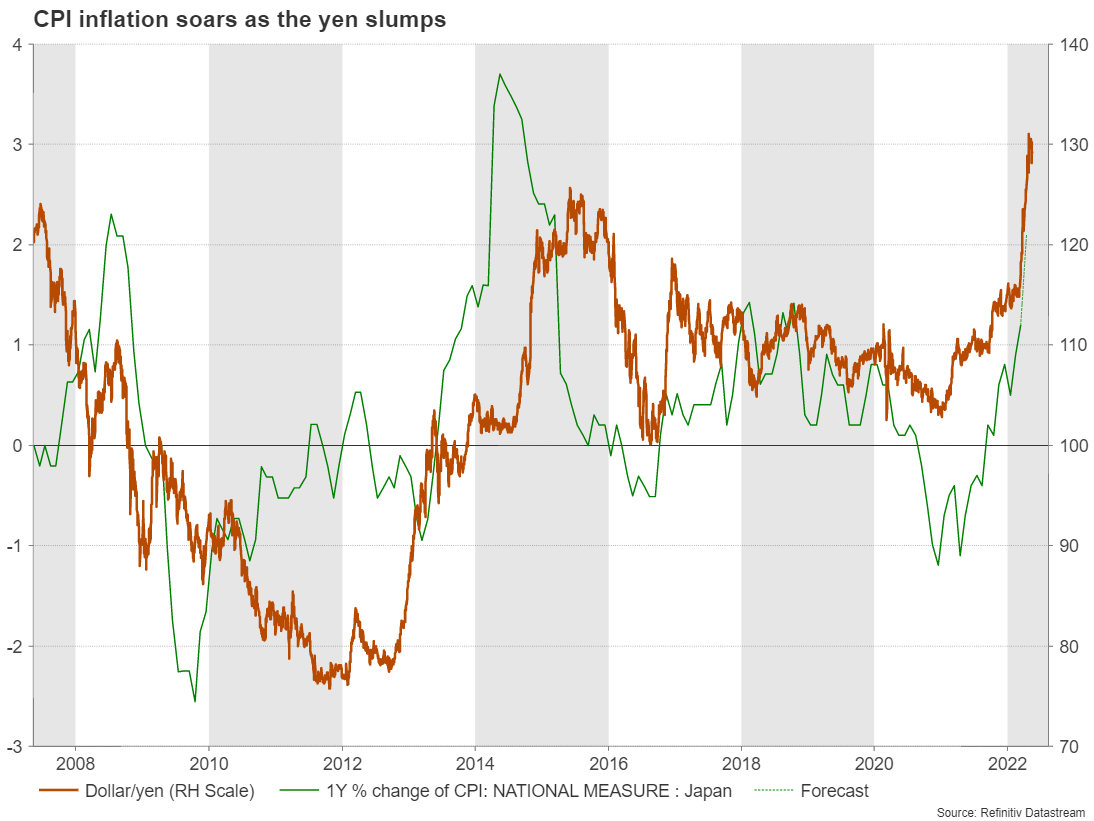
Although Japan is famous for its deflationary mindset, rising input prices from energy to corn and transportation costs have probably forced businesses to pass on costs to consumers in April, especially as a considerable depreciation in the Japanese yen, which is the longest in 50 years against the greenback, has exacerbated the impact from surging raw material prices. The producer price index jumped by 10% y/y in the same month, data showed on Monday, while Friday’s national core CPI figure is expected to stage a huge bounce up to 2.1% y/y from 0.8% previously for the first time in seven years.
Demand for safe havens could help the yen
However, it’s worthy to note that the FX depreciation effect varies by company. Businesses who depend on imports and serve mostly local markets such as Sony face bigger currency headwinds than companies in the car and software industry whose production lines are overseas and are less affected by FX volatility.
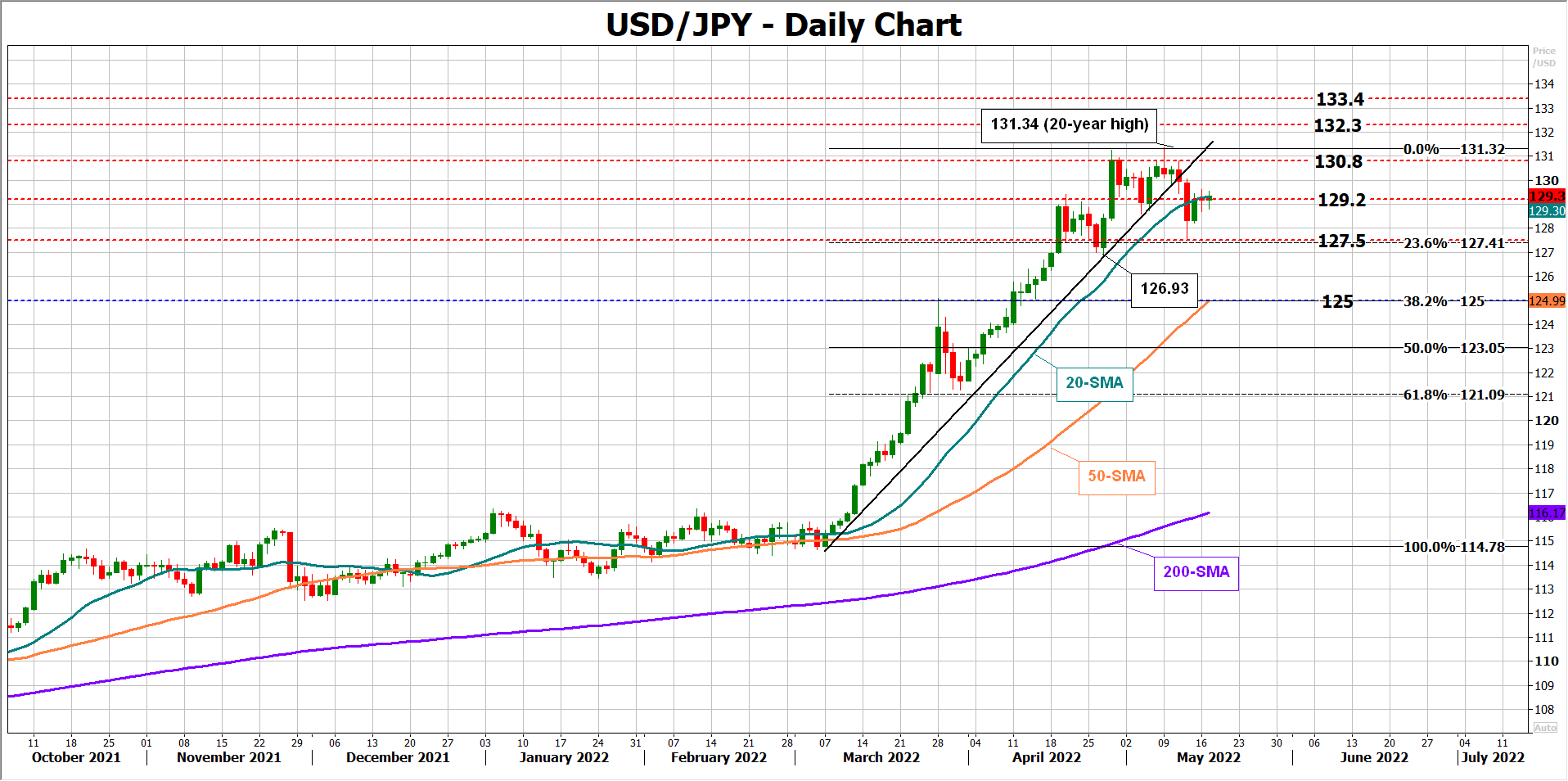
Nevertheless, the BoJ governor clearly said on Monday that the central bank is not targeting FX markets even though recent moves in the currency were undesirable, and it will patiently continue monetary easing. Should bond yields keep losing steam this week, a worse-than-expected GDP report could strengthen the yen’s safe-haven status, pressing dollar/yen back to the 127.50 – 126.93 support region. A steeper inflation upturn could bolster the bullish action later in the week, with investors likely looking next at the 125.00 level and the 50-day simple moving average.
Alternatively, if easy monetary settings deter a contraction or allow a milder economic decline, with inflation arriving weaker-than-expected too, the pair may push above the key 129.20 resistance with scope to test the broken supportive trendline around 130.80 and the previous top of 131.24. Higher, the spotlight will turn to the 132.30 – 133.40 zone taken from early 2002.
Bitcoin’s Short-Term Upward Channel
On Monday, Bitcoin was down 3.6%, ending the day around $29.9, but is trading back above $30K on Tuesday morning. Ethereum has little changed over the past 24 hours (-0.4%), remaining near $2000. Other altcoins from the top 10 changed in price from -2.7% (Polkadot) to 1.2% (Solana).
Total crypto market capitalisation, according to CoinMarketCap, rose 0.1% overnight to $1.30 trillion. Bitcoin’s dominance index fell 0.1 points to 44.3%. The Cryptocurrency Fear and Greed Index was down 6 points to 8 by Tuesday, hitting its lowest level since August 2019.
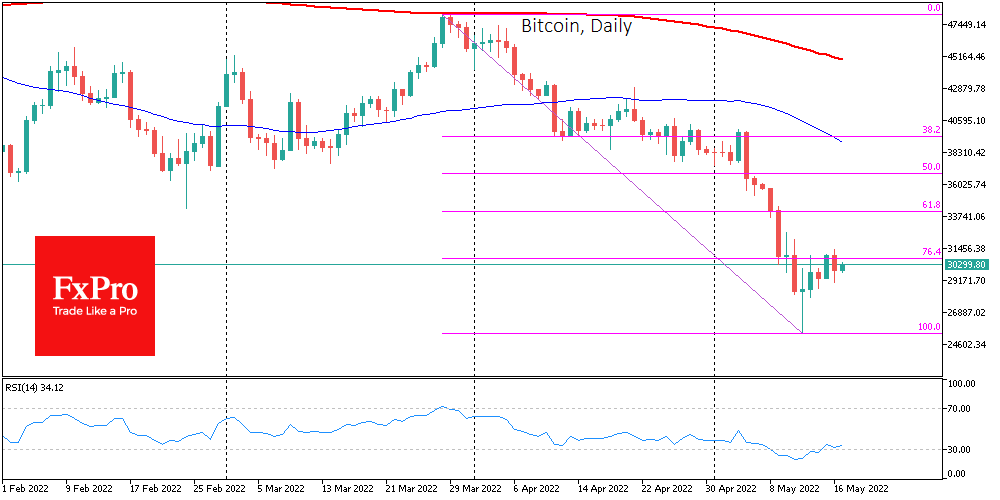
Technically, the crypto market on Monday followed the cautious sentiment of the stock market. We note that after hitting lows on May 12th, a short-term upward channel is forming in BTCUSD with increasingly higher local lows and local highs.
Such dynamics of the flagship crypto resemble the work of traders of institutional managers, who moderately “buy the fear” or fix the profit from the short positions. So far, there is little reason to argue that a prolonged rise will follow the current buying, as the fundamentals (tightening markets, slowing economy) remain in place.
According to CryptoQuant, institutional investors continue to buy BTC through market makers despite the decline in the crypto market.
Sam Bankman-Fried, CEO of cryptocurrency exchange FTX, believes bitcoin has no future as a payment network because of its low scalability and negative impact on the environment. There is a need for an alternative blockchain-based Proof-of-Stake (PoS) protocol for payments.
IMF managing director Kristalina Georgieva called for a new public infrastructure for payment systems, including digital currencies.
Do Kwon, founder of the Terra ecosystem, presented a new plan to rehabilitate the project. On May 18th, the developer intends to present Terraform Labs team with a new management system for the Terra fork, decoupling it from the TerraUSD (UST) stable coin.
Oil: The final Upward Momentum?
Crude oil has added 15% since last Wednesday, rising to $112/bbl WTI and $113/bbl Brent. Both grades reached new two-month highs on Tuesday morning, despite a decidedly bearish news backdrop.
A sharper than previously estimated slowdown in China and not yet agreed package with Russian Crude oil phased embargo was met with buying in Crude, despite those suggesting lower demand and higher supply.
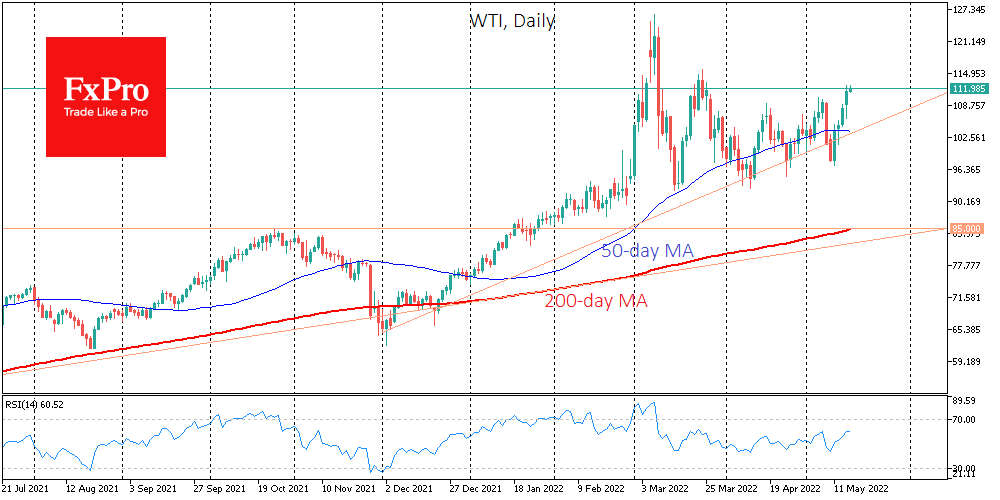
Since early April, WTI has seen a sequence of higher highs and higher lows. Oil’s dip under the uptrend line last week only encouraged buyers, kick-starting the latest upward momentum.
This is the third time Brent has reached that horizon, from which it has rolled back in April and early May. A consolidation above $114 could signal a new buying wave and quickly take prices to the $120 area – near the late March peaks.
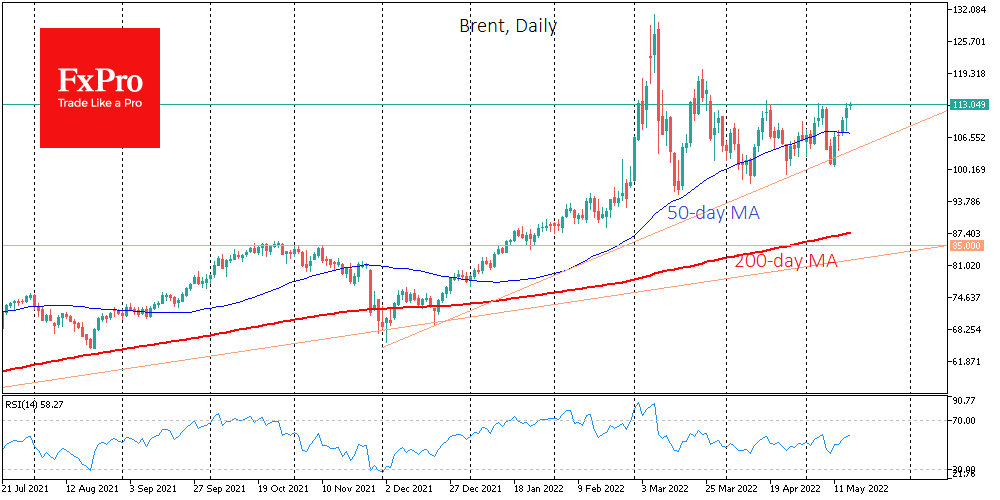
In this case, the North Sea Brent lags behind the US WTI as the supply-demand balance favours the latter. It should not be surprising if WTI becomes more expensive than the heavier Brent in a few weeks, restoring the historic balance broken by tight OPEC+ quotas and once rampant US production.
Nevertheless, be prepared that the oil rally that started from lows in April 2020, culminating in the war events in Ukraine, is coming to an end. The global economy and energy consumption are slowing to recover while the cartel continues to raise quotas.
Temporarily, due to lower investment in production in previous quarters, OPEC has not kept pace with production increases. Still, this balance will change sooner rather than later, promising to keep the price from rising.