

Sample Category Title
EUR/AUD Daily Outlook
Daily Pivots: (S1) 1.4912; (P) 1.4986; (R1) 1.5083; More...
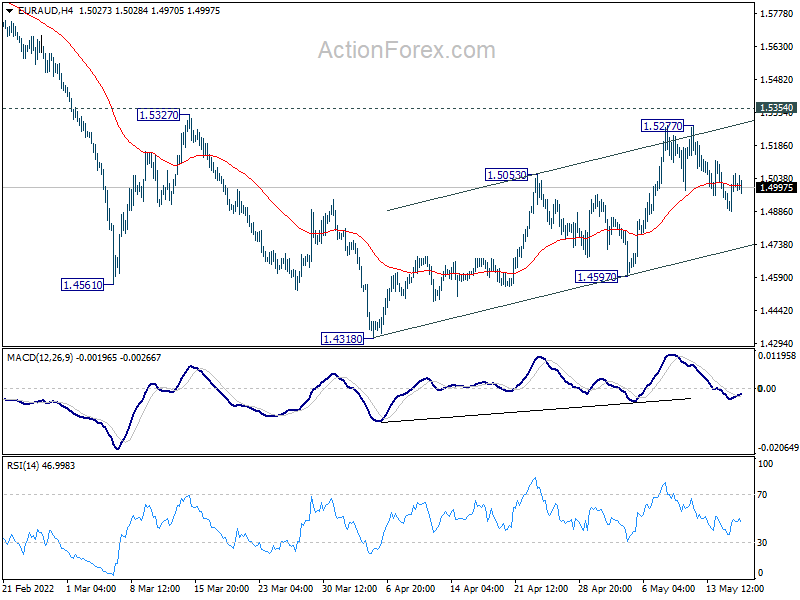
Intraday bias in EUR/AUD stays mildly on the downside for 1.4597 support. Corrective rise from 1.4318 could have completed with three waves up to 1.5277. Rejection by 1.5354 support turned resistance retains near term bearishness. Break of 1.4597 will bring retest of 1.4318 low next.
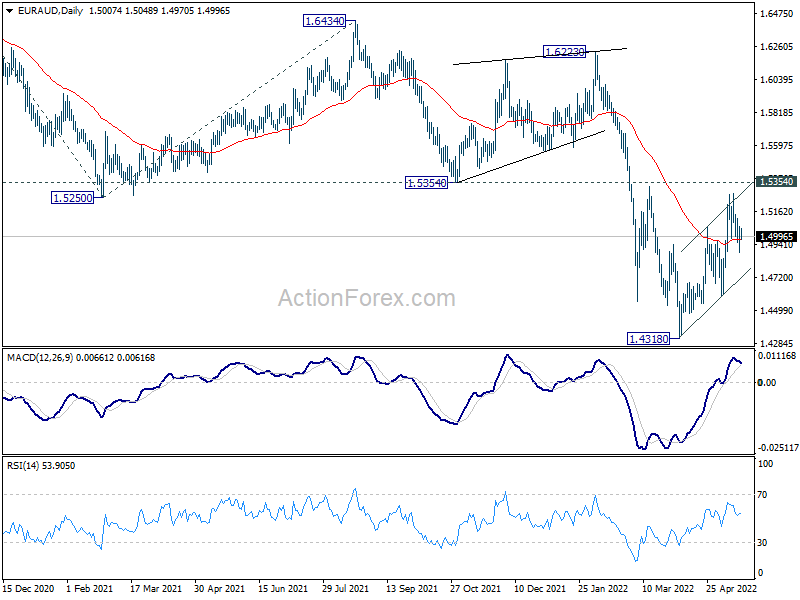
In the bigger picture, as long as 1.5354 support turned resistance holds, larger down trend form 1.9799 (2020 high) is still expected to continue. On resumption, next target is 61.8% projection of 1.9799 to 1.5250 from 1.6434 at 1.3623, which is close to 1.3624 long term support (2017 low). However, firm break of 1.5354 will indicate medium term bottoming and bring stronger rally back to 1.6434 key resistance.
EUR/CHF Daily Outlook
Daily Pivots: (S1) 1.0448; (P) 1.0467; (R1) 1.0502; More....
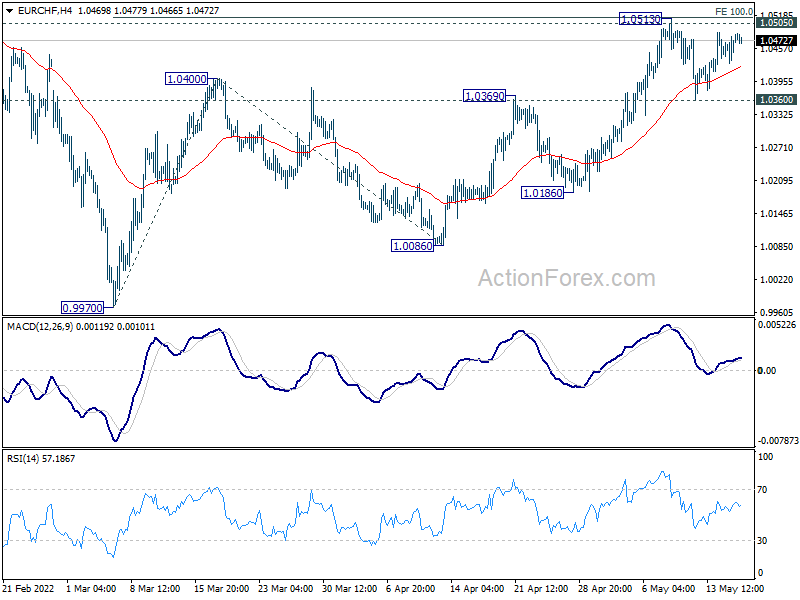
Intraday bias in EUR/CHF remains neutral and outlook is unchanged. On the downside, break of 1.0360 will suggest that rebound from 0.9970 has completed as a three-wave corrective move at 1.0513. That came after rejection by 100% projection of 0.9970 to 1.0086 from 1.0400 at 1.0516 and 1.0505. Intraday bias will be turned back to the downside for 1.0186 support first. On the upside, however, sustained break of 1.0505 long term resistance will carry larger bullish implications. Next target is 161.8% projection at 1.0782.
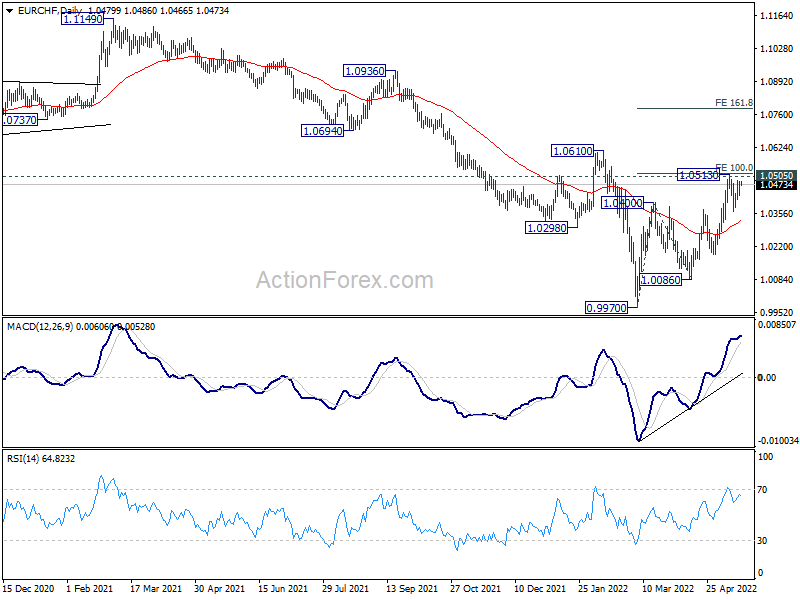
In the bigger picture, as long as 1.0505 support turned resistance (2020 low) holds, long term down trend from 1.2004 (2018 high) is expected to continue. Next target is 100% projection of 1.2004 to 1.0505 to 1.1149 at 0.9650. However, firm break of 1.0505 will suggest medium term bottoming, and bring stronger rebound towards 1.1149 structural resistance.
EUR/USD Daily Outlook
Daily Pivots: (S1) 1.0468; (P) 1.0512 (R1) 1.0594; More...
Intraday bias in EUR/USD stays neutral and outlook is unchanged. Considering bullish convergence condition in 4 hour MACD, break of 1.0641 resistance will confirm short term bottoming at 1.0348, ahead of 1.0339 long term support. Intraday bias will be turned back to the upside for 1.0805 support turned resistance. On the downside, however, decisive break of 1.0339 will carry larger bearish implication and target 161.8% projection of 1.1494 to 1.0805 from 1.1184 at 1.0069.
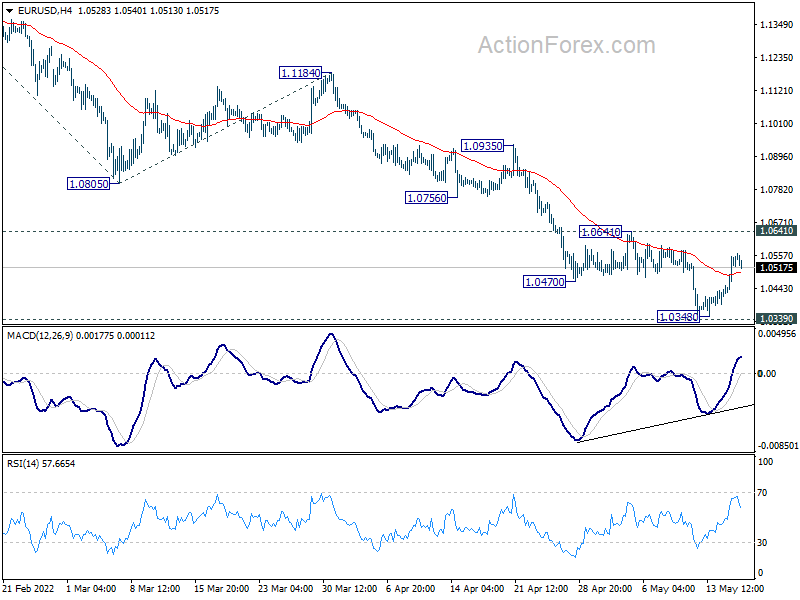
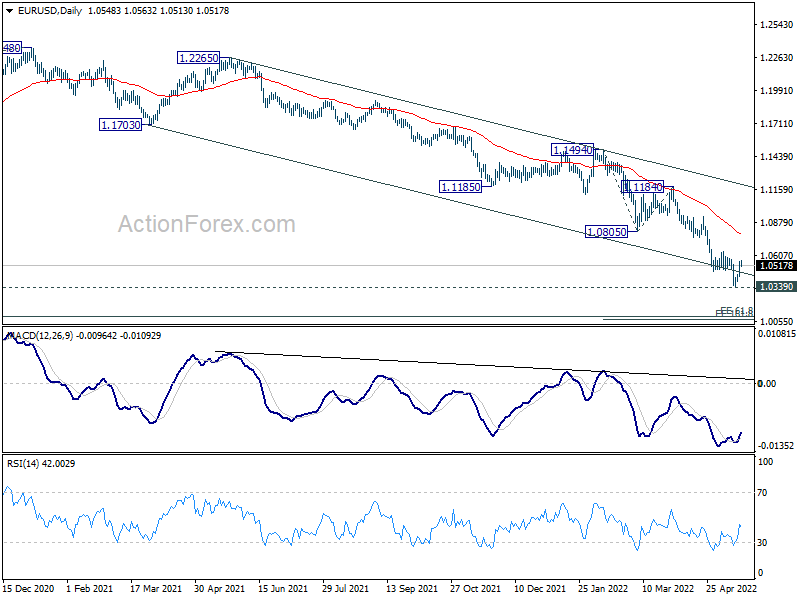
In the bigger picture, break of medium term channel support suggests downside acceleration. Current decline from 1.2348 (2021 high) is probably resuming long term down trend from 1.6039 (2008 high). Decisive break of 1.0339 will confirm this bearish case. Next target is 61.8% projection of 1.3993 to 1.0339 from 1.2348 at 1.0090. This will now remain the favored case as long as 1.0805 support turned resistance holds.
GBP/USD Daily Outlook
Daily Pivots: (S1) 1.2374; (P) 1.2436; (R1) 1.2557; More..
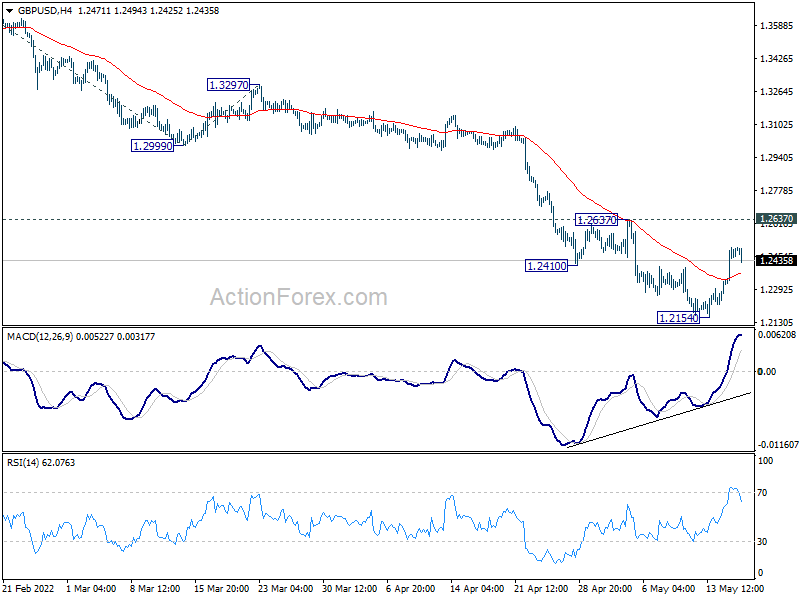
Intraday bias in GBP/USD remains neutral and outlook is unchanged. Considering bullish convergence condition in 4 hour MACD, break of 1.2637 will confirm short term bottoming at 1.2154. Intraday bias will be turned back to the upside for 55 day EMA (now at 1.2816). On the downside, break of 1.2154 will resume the down trend from 1.4248 to 200% projection of 1.3641 to 1.2999 from 1.3297 at 1.2013.
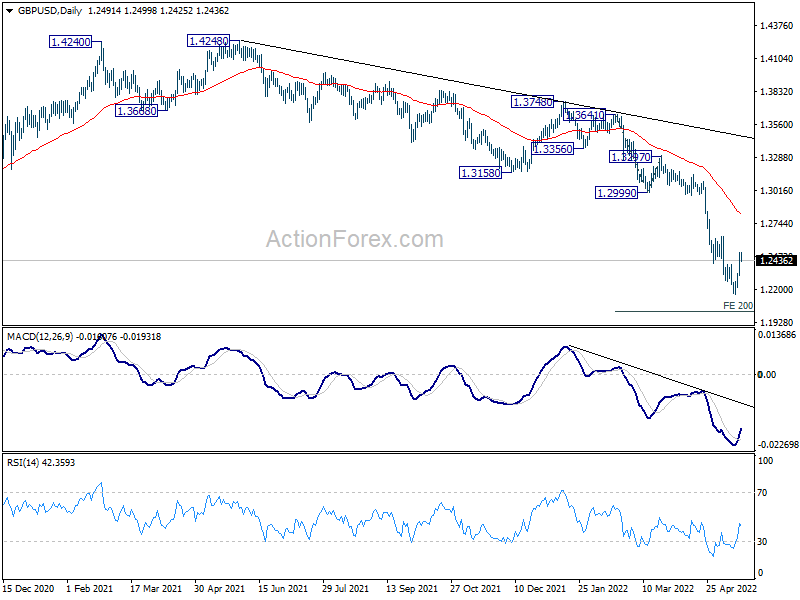
In the bigger picture, based on current momentum, fall from 1.4248 (2018 high) at least at the same degree as the rise from 1.1409 (2020 low). That is, fall from 1.4248 could be a leg inside the pattern from 1.1409, or resuming the longer term down trend. In either case, deeper decline is expected as long as 1.2999 support turned resistance holds. Next target is 1.1409 low.
USD/CHF Daily Outlook
Daily Pivots: (S1) 0.9896; (P) 0.9963; (R1) 1.0006; More....
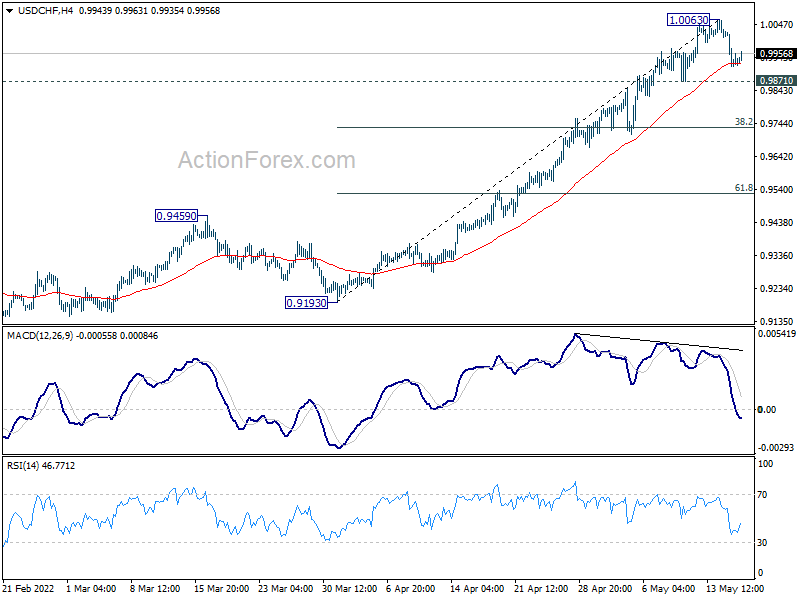
Intraday bias in USD/CHF remains neutral at this point and outlook is unchanged. Considering bearish divergence condition in 4 hour MACD, break of 0.9871 support will indicate short term topping at 1.0063. Intraday bias will be turned to the downside for 38.2% retracement of 0.9193 to 1.0063 at 0.9731. On the upside, above 1.0063 will resume larger up trend.
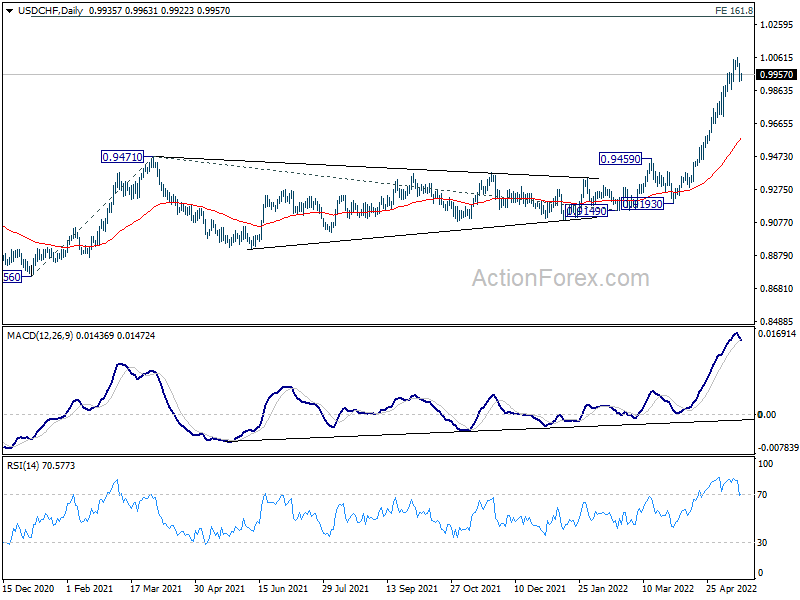
In the bigger picture, down trend from 1.0342 (2016 high) should have completed with three waves down to 0.8756 (2021 low) already. Rise from 0.8756 is likely a medium term up trend of its own. Next target is 161.8% projection of 0.8756 to 0.9471 from 0.9149 at 1.0306, which is close to 1.0342 (2016 high). This will remain the favored case as long as 0.9459 resistance turned support holds.
USD/JPY Daily Outlook
Daily Pivots: (S1) 128.87; (P) 129.32; (R1) 129.82; More...
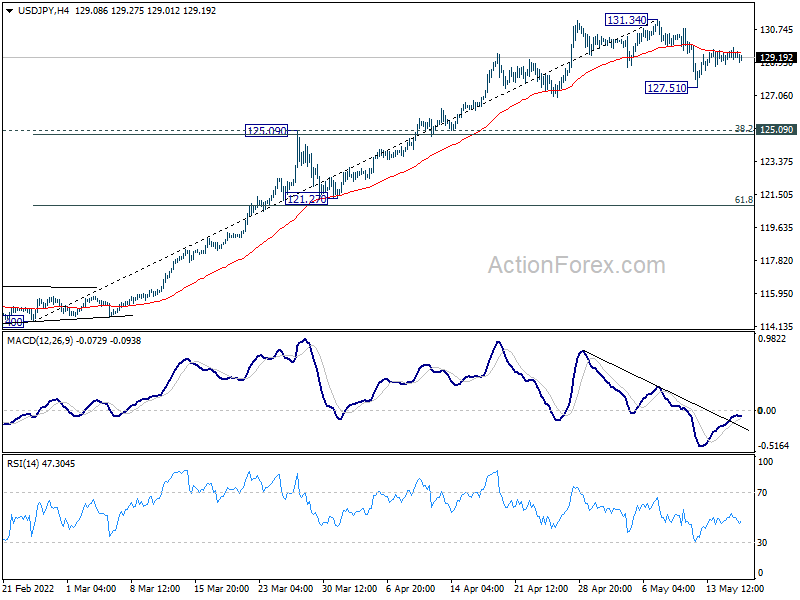
USD/JPY's consolidation from 131.34 is still extending and intraday bias remains neutral. Another fall could be seen and break of 127.51 will target 125.09 cluster support (38.2% retracement of 114.40 to 131.34 at 124.86). On the upside, firm break of 131.34 will resume larger up trend.
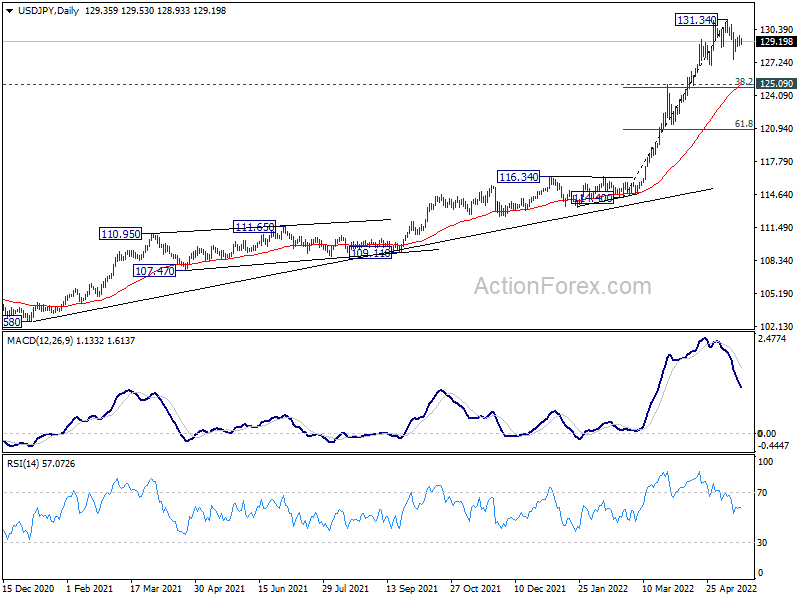
In the bigger picture, current rally is seen as part of the long term up trend form 75.56 (2011 low). Sustained trading above 61.8% projection of 75.56 (2011 low) to 125.85 (2015 high) from 98.97 at 130.04 will pave the way to 100% projection at 149.26, which is close to 147.68 (1998 high). For now, this will remain the favored case as long as 121.27 support holds.
AUD/USD Daily Report
Daily Pivots: (S1) 0.6985; (P) 0.7013; (R1) 0.7059; More...
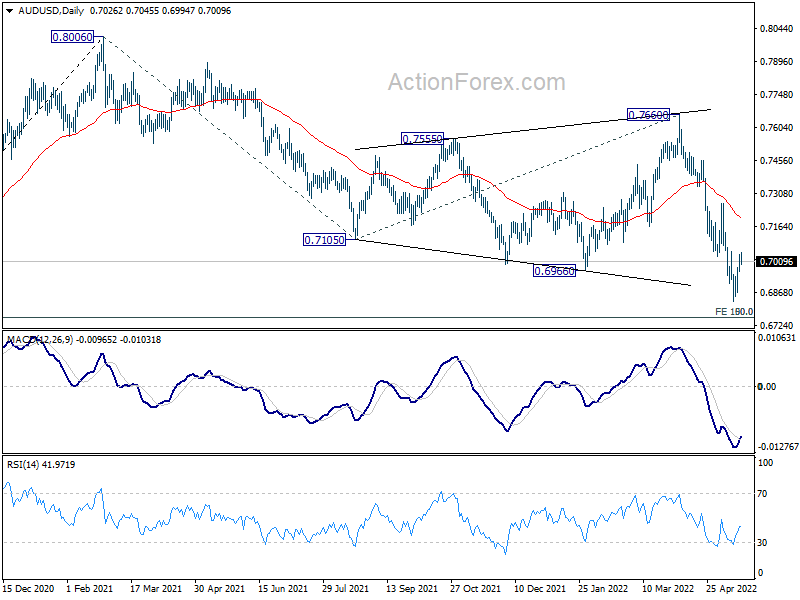
Intraday bias in AUD/USD remains neutral and outlook is unchanged. On the upside, firm break of 0.7029 support turned resistance will indicate short term bottoming, and bring stronger rebound back to 0.7265 resistance. Rejection by 0.7029 will retain near term bearishness. Break of 0.6828 will resume larger fall from 0.8006, and target 0.6756/60 medium term fibonacci level next.
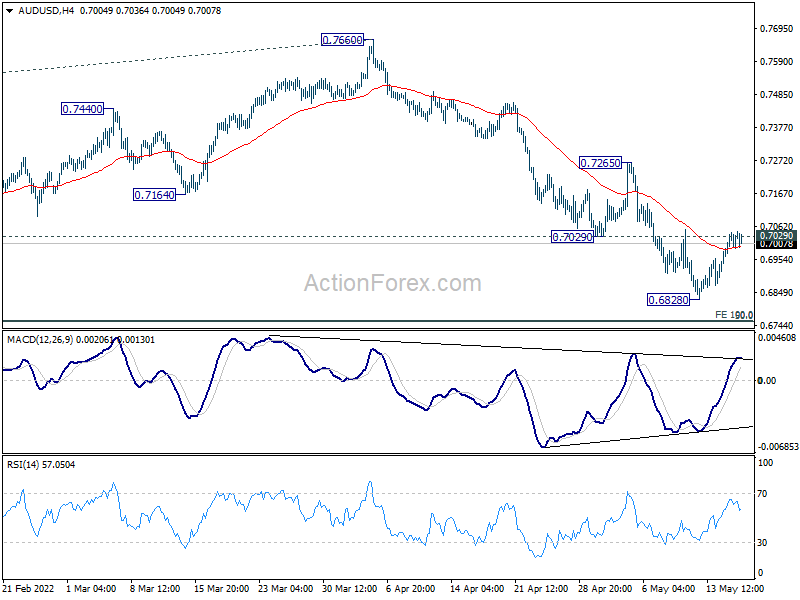
In the bigger picture, price actions from 0.8006 are seen as a corrective pattern to rise from 0.5506 (2020 low). Deeper fall should be seen to 50% retracement of 0.5506 to 0.8006 at 0.6756. This coincides with 100% projection of 0.8006 to 0.7105 from 0.7660 at 0.6760. Strong support is expected from 0.6756/60 cluster to contain downside to complete the correction. However, sustained break of 0.6756/60 would argue that AUD/USD is indeed already in a medium term down trend.
The Dollar Threw the Towel on FX Markets
Markets
Yesterday’s trading session turned out to be an interesting one. As on Monday, it started with a better risk mood in Europe with core bonds returning to sell-off mode after last week’s correction. UK Gilts initially underperformed following up on BoE governor Bailey’s testimony for a Commons Committee. He sounded much more combative against inflation than suggested by the May policy meeting. Around noon, ECB Knot raised the stakes in the central bank’s calling for >25 bps rate hikes if warranted by the data. His comments prompted a reaction in short term European money markets as well as on bonds markets (start new intraday downleg).
FOMC Chair Powell ended the 24 hour hawkish central bank tour by stressing the unconditional tightening plans. “Restoring price stability is an unconditional need. It is something we have to do.” Even as “there could be some (economic) pain involved”. If needed, the Fed won’t shy away to make monetary policy restrictive. Powell’s comments dealt the final intraday blow to US Treasuries. In between the rhetoric, we had strong UK labour market data, an upward revision to EMU Q1 GDP and decent US retail sales all helping to put last week’s growth worries to bed. At least for now.
The US yield curve bear flattened with yields rising by 14.3 bps (3-yr) to 7.9 bps (30-yr). German yields rose by 7.3 bps (30-yr) to 12.7 bps (5-yr). The UK yield curve bear flattened as well with yields ending 20.8 bps (2-yr) to 11.5 bps (30-yr) higher. The hawkish rhetoric and fierce bond sell-off didn’t translate into a new sell-off on stock markets, suggesting that bourses could be heading for a period of some consolidation. Technical pictures for now don’t confirm a sustained improvement yet.
The dollar threw the towel on FX markets following last week’s intense test of key resistance levels (eg EUR/USD 1.0341). There was an element of euro strength as well in the rebound to EUR/USD 1.0535. EUR/GBP initially dived from a 0.8468 open to 0.84 before rebounding towards the 0.8435 area. Brexit worries for now play second fiddle. UK April inflation accelerated as expected from 7% Y/Y to 9% Y/Y for the headline reading and from 5.7% Y/Y to 6.2% Y/Y for the underlying core measure. Today’s eco calendar is fairly uneventful. US housing data and final EMU inflation numbers won’t stir trading. Central bank comments remain a wildcard. The pace of yesterday’s bond sell-off is unlikely to be repeated in these conditions. EUR/USD’s rebound was a good one, but the pair still has to take out first minor resistance at 1.0642. The bearish picture only turns morning neutral beyond 1.08.
News Headlines
Japanese first quarter GDP contracted less than feared, declining 0.2% q/q (-1% annualized) vs 0.4% expected. This was mainly because of private consumption, which held up better during Covid curbs than foreseen (flatlining vs consensus for a -0.5% fall). Business spending rose 0.5%. Exports rose 4.7% but imports soared with double digits, resulting in a negative net-export contribution. Inventories were built up during the previous quarter and may be drawn down during the current one. Pent-up consumer demand is expected to support growth this quarter, pushing the other way. But high energy prices and its effect on spending poses downside risks to the outlook. The Japanese yen is little affected by the data. USD/JPY trades stable in the low 129 area. Australian wage growth in the first three months of the year rose by 0.7% q/q to be up 2.4% year-over-year. Both were slightly below expectations of 0.8% and 2.5% respectively but it’s still the biggest annual growth since 2018. The sectors posting the biggest gains were rental/property (3.1% q/q), manufacturing (2.7% q/q) and arts & recreation services (2.7% q/q). It serves as important input to the Reserve Bank of Australia, who tied sufficient wage growth to the start of the tightening cycle. However, with inflation already having accelerated above target, the RBA didn’t want to await today’s reading when it met earlier this month (+25 bps to 0.35%). The Australian dollar temporarily lost a few ticks this morning. AUD/USD tested the 0.70 figure.
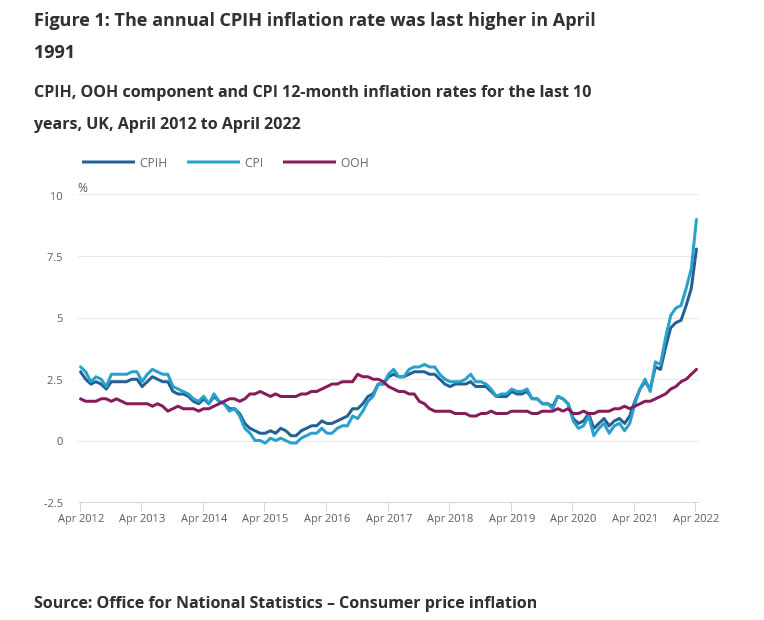
UK CPI rose to 9% yoy in Apr, core CPI up to 6.2% yoy
UK CPI accelerated sharply from 7.0% yoy to 9.0% yoy in April, but missed expectation of 9.1% yoy. CPI core rose from 5.7% yoy to 6.2% yoy, matched expectations. RPI accelerated form 9.0% to 11.1% yoy, matched expectations.
Headline CPI was another record high since the National Statistics series began in 1997. It's also the highest record rate in the constructed historical series which began in 1989.
Based on the recently published modelled consumer price inflation data by the ONS, CPI was last higher sometime around 1982, where estimates range between approximately 6.5 % in December to nearly 11% in January.
In response to the release, Chancellor of the Exchequer Rishi Sunak said: "Today's inflation numbers are driven by the energy price cap rise in April, which in turn is driven by higher global energy prices.
"We cannot protect people completely from these global challenges but are providing significant support where we can, and stand ready to take further action."
Also released, PPI input came in at 1.1% mom, 18.6%, versus expectation of 2.6% mom, 20.7% yoy. PPI output was at 2.3% mom, 14.0% yoy, versus expectation of 1.6% mom, 12.5% yoy. PPI output core was at 1.6% mom, 13.0% yoy, versus expectation of 1.6% mom, 12.6% yoy.
A Wobbly Rebound
The US equity markets rallied yesterday after taking over a positive session from the Europeans. However, the US retail sales data didn’t necessarily hint at slowing spending, and Jerome Powell didn’t say things that investors would normally like to hear.
Resilient spending is no good news for the Fed’s inflation battle
US retail sales grew more than 8% on yearly basis in April, more than around 7.30% printed a month earlier, meaning that Americans continue spending despite tighter economic conditions.
Unfortunately, the resilience of spending means that the Federal Reserve’s (Fed) actions don’t result in desired cooling effect on inflation.
Inflation mostly comes from the supply side, especially from the soaring energy and food prices as a result of pandemic-hit supply chains and the war in Ukraine. Whereas, the monetary tools are intended to control the demand side - and bring inflation by cooling down demand. If demand doesn’t ease fast enough, the Fed must tighten faster.
So, it’s no surprise Jerome Powell said that the Fed is resolved to curb inflation even if it means pushing the rates into restrictive territory. If that ‘involves moving past broadly understood levels of neutral we won’t hesitate to do that’, he said.
Powell’s words didn’t hit the investor appetite immediately. Nasdaq rallied more than 2.50% yesterday, as the S&P500 rebounded 2%. But mixed activity in US futures hint that appetite may not remain as strong in the coming sessions.
In the FX
The US dollar eased from two-decade highs. Prospects of higher US rates, and the positive divergence between the Fed and other central banks should prevent the dollar from falling significantly, as other central banks are also tightening their purses’ strings, but they sound timider when it comes to the timing and the intended sizes of the eventual moves.
The EURUSD rebounded past the 1.05 level yesterday on the back of a broad-based softening in the US dollar. But the US 10-year yield remains steady around the 3% mark, and poised to move higher, parallel to the expectations of solid rate hikes in the US in the coming months.
Eurozone’s final inflation data is due today, and should confirm a rise to 7.5% in April, an eye-watering number which should keep the European Central Bank (ECB) hawks and the euro bulls alert, and help the single currency consolidate its latest gains against the US dollar.
Gold trades around the $1800 mark. In one hand, the positive pressure on the US yields weighs on appetite for the non-interest-bearing gold. On the other hand, the high volatility and the looming uncertainties support safe haven inflows toward the safe haven metal. Yet, the long-term risks remain tilted to the downside. The yellow metal is below its 200-DMA - which now acts as resistance to any positive attempt, and is preparing to test the long-term triangle base - if broken should confirm a further negative outlook.
Crude oil spiked above the $115 per barrel, but bumped into top sellers above this level. Solid support approaching the $120 mark will likely be hard to clear, as the rising energy prices have a curbing effect on demand at the actual levels, and automatically cool down the rally.