

Sample Category Title
Powell: Fed Will Hike Rates Until Inflation is Under Control
Market movers today
Finland and Sweden are due to submit their official applications to join NATO in Brussels at 8:00 CET today. The accession process will kick off with consultations between NATO experts and Finnish and Swedish delegations to ensure both countries are able to meet the obligations and commitments of a NATO membership. Assuming no obstacles there, NATO then prepares accession protocol to the Washington Treaty for each invitee country. These amendments will then need to be verified and signed in each member state. We expect the whole process to take at least weeks but depending on opposition from current member states, such as Turkey, it could also take longer.
Another quiet day on data front, but Euro Area final HICP data from April is out. Details should give a more accurate picture of how the core price pressures are developing. UK CPI is also out.
Also, ECB's Müller and Fed's Evans and Harker on the wires.
The 60 second overview
Fed chair Jerome Powell: Powell did not say anything new yesterday, at least not of significance, although the tone remained hawkish. Powell mentioned that the Fed will continue to hike interest rates until inflation is under control (probably the most hawkish comment yet) and that 50bp is on the table at the next meetings. Powell also mentioned that the Fed will not hesitate moving rates beyond neutral if needed. A new thing was that Powell said that markets are processing Fed policy thinking pretty well. Overall, forward guidance seems to be clear and so far the Fed is not talking up expectations of an even larger 75bp rate hike. Other FOMC members also spoke yesterday and there seems to be broad-based support for this approach.
US data: US retail sales for April were decent and March was revised significantly higher as well. Retail sales are nominal but the increases were overall larger than price increases based on CPI and hence real private consumption seemingly had a strong start to Q2. Industrial and manufacturing production in April were strong as well. This supports the case for further Fed tightening despite rising recession risks associated with rapid tightening of financial conditions.
Positive risk sentiment: Yesterday was a good day for risky assets (equities up, USD lower and a steeping of the US yield curve) but signals are more mixed this morning. This more volatile investment environment is likely to continue, in our view.
Russian default?: The Biden administration is likely to block Russia's ability to pay US bondholders starting from next week, increasing the risk of a (technical) default. The default is technical in nature, as it would not be because of lack of money.
Equities: Risk on yesterday, with equities generally higher and cyclicals beating the tape. In the new equity strategy we argued that equities will move higher on peak monetary repricing and overdone recession fears. Yesterday was an example of both, with macro data and an uneventful interview with Powell boosting sentiment. Implied volatility moved lower too, yet still close to 30 which opens up for a long relief rebound in equities. Dow 1.3%, S&P 500 2%, Nasdaq 2.8%, Russell 2000 3.2% but futures lower this morning.
FI: The hawkish statements from central bankers continue and rates are being pushed higher again. Yesterday, Fed Chairman Powell stated that the Federal Reserve will raise rates until there is "clear and convincing signs" that inflation is coming down and if they need to go to neutral rate then that was acceptable. This is seen as the Federal Reserve being ready to move in terms of 50bp steps rather than just one 50bp hike followed by 25bp steps. This was probably the most hawkish statement from Powell so far. Furthermore, ECB's Knot was opening the possibility of a 50bp move even though the base case was still a 25bp.
FX: EUR/USD rallied yesterday rising from 1.045 to 1.055. EUR/GBP briefly declined back below 0.84 on a strong jobs report but moved back to the mid 0.84's, as EUR appreciated and negative Brexit headlines hit the wires. GBP/USD is trading closer to 1.25. NOK price action remains volatile although importantly spot seems to have settled over the last week.
Credit: Credit indices went into slight risk on mode yesterday following some relief to equities as well. Itrax main tightened by 1.3 Bp to close at 90.5bp while Xover tightened 5.7bp to close at 445bp.
Nordic macro
In Sweden, the agenda today is very thin awaiting Riksbank's Flodén's speech tomorrow. Riksbank buys SEK 270 mln corporate bonds in 2023-2027 maturities. Kommuninvest potentially issues muni bonds in 2024-2027 maturities.
USD/CAD Daily Outlook
Daily Pivots: (S1) 1.2791; (P) 1.2825; (R1) 1.2843; More...
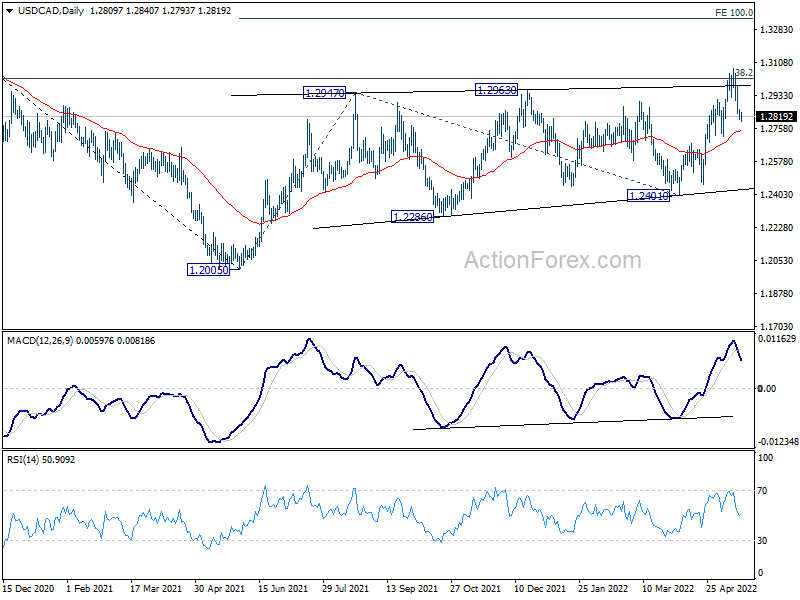
Intraday bias in USD/CAD stays neutral and outlook is unchanged. Pull back from 1.3075 could extend lower, but further rise is in favor with 1.2712 support intact. On the upside, break of 1.3075 will resume the rise from 1.2401. Sustained trading above 1.3022 fibonacci level will carry larger bullish implications. Next target will be 100% projection of 1.2005 to 1.2947 from 1.2401 at 1.3343. On the downside, however, break of 1.2712 support will indicate rejection by 1.3022 key fibonacci resistance, and bring deeper decline back to 1.2401 support.
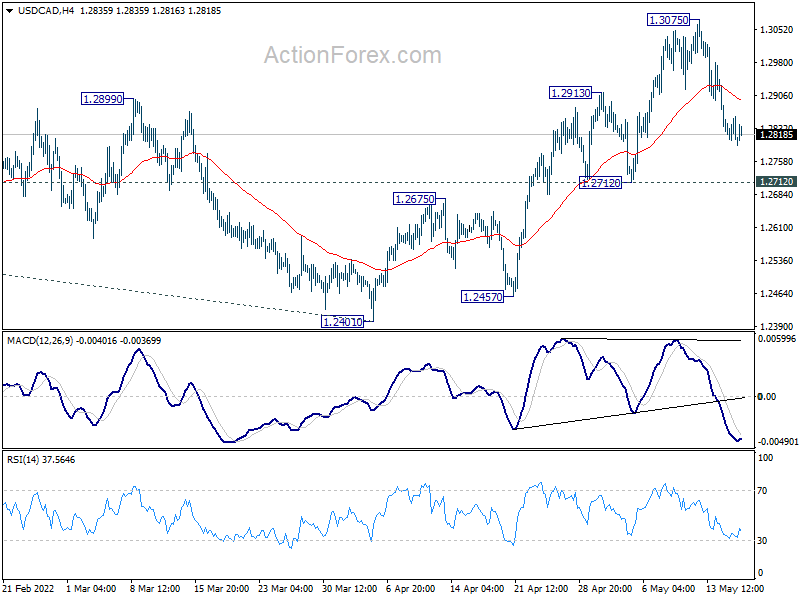
In the bigger picture, focus stays on 38.2% retracement of 1.4667 (2020 high) to 1.2005 (2021 low) at 1.3022. Sustained break there should confirm that the down trend from 1.4667 has completed after defending 1.2061 long term cluster support. Further rise would then be seen towards 61.8% retracement at 1.3650. However, rejection by 1.3022 will maintain medium term bearishness. Break of 1.2005 will resume the down trend from 1.4667 and that carries larger bearish implications too.
Dollar Holding On to Near Term Support, UK and CA CPI Featured
The forex markets are engaging in sideway trading in very tight range in Asian session. Dollar and Yen remain the weaker ones for the week. But so far, there is not following selling to push them through near term support level yet. Overall risk sentiment is crucial in determining the next move. While US stocks staged a strong rebound overnight, Asian markets are just mixed, with softness seen in Hong Kong and China. The lack of committed risk buying also drags down Aussie and Kiwi a little bit.
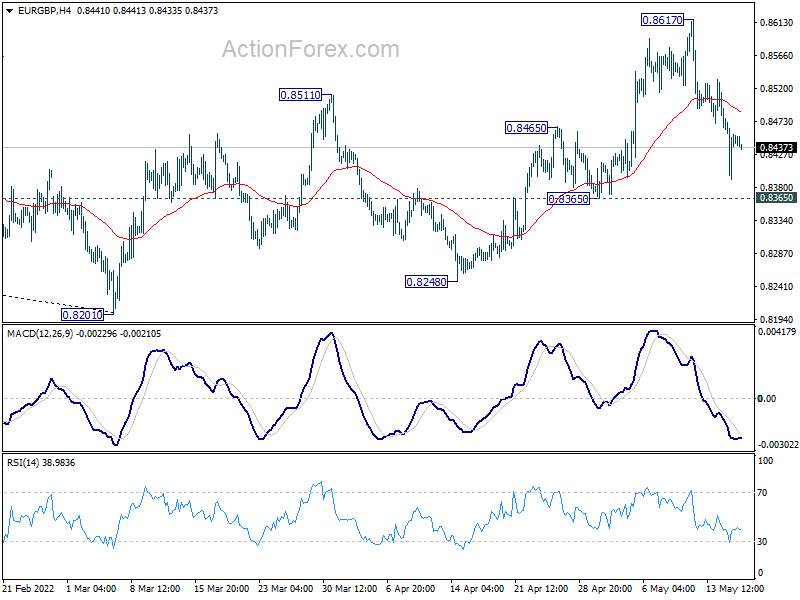
Technically, firstly, focus will stay on some near term levels in Dollar pairs, including 1.0641 resistance in EUR/USD, 1.2637 resistance in GBP/USD and 0.9871 support in USD/CHF. Firm break of these level will confirm short term topping in the greenback, and turn it into a "longer-lasting" near term correction phase. At the same time, attention will also be on some sterling pairs, including 0.8365 support in EUR/GBP and 162.16 resistance in GBP/JPY. Break of these two levels (in reaction to CPI data?) will push the Pound for a stronger near term rebound at least.
In Asia, at the time of writing, Nikkei is up 0.66%. Hong Kong HSI is down -0.32%. China Shanghai SSE is down -0.21%. Singapore Strait Times is up 0.89%. Japan 10-year JGB yield is up 0.0031 at 0.248. Overnight, DOW rose 1.34%. S&P 500 rose 2.02%. NASDAQ rose 2.76%. 10-year yield rose 0.091 to 2.968.
Fed Powell wont' hesitate to move past neutral rate to tame inflation
Fed Chair Jerome Powell said yesterday, "this is a time for us to be tightly focused on the time ahead and getting inflation back down to 2%.... What we need to see is inflation coming down in a clear and convincing way... If we don't see that, we will have to consider moving more aggressively".
"If that involves moving past broadly understood levels of 'neutral' we won't hesitate to do that," he added. "We will go until we feel we are at a place where we can say 'yes, financial conditions are at an appropriate place, we see inflation coming down.'"
"We'll go to that point. There won't be any hesitation about that," he said.
Fed Kashkari: What I don't know is how much are we going to need to do
Minneapolis Fed President Neel Kashkari said yesterday, "my colleagues and I are going to do what we need to do to bring the economy back into balance... What I don't know is how much are we going to need to do ... if we get some help on the supply side, then we won't have to do as much; if we don't get any help on the supply side, we are going to have to do more."
But he also cautioned, "if the recession is effective in bringing inflation down, but then you're pushing the unemployment rate way up, now all of a sudden you might be moving from one type of imbalance to the opposite type of imbalance. Like any kind of system, you want to avoid over-correcting if you can."
Fed Evans expects completing any 50bps, plus some 25bps this year
Chicago Fed President Charles Evans said, "front-loading is important to speed up the necessary tightening of financial conditions, as well as for demonstrating our commitment to restrain inflation, thus helping to keep inflationary expectations in check."
As for the pace of tightening, he said, "I'm expecting that before December, we will have completed in any 50s and have put in place at least a few 25s."
"If we need to, we will be well positioned to respond more aggressively if inflation conditions do not improve sufficiently or, alternatively, to scale back planned adjustments if economic conditions soften in a way that threatens our employment mandate," Evans explained.
BoE Cunliffe: There's no intrinsic value around crypto assets
BoE Deputy Governor Jon Cunliffe said at a web event, "There's a long tail of retail investors who have invested in cryptoassets. Do they all understand what they've invested in? I think not. For that long tail of retail investors, I'm not sure they do understand. They don't really see this as a financial investment."
"There's no intrinsic value around crypto assets," Cunliffe said. "They move with sentiment. They're being moved mainly as a risky asset, and prices have been going down pretty consistently."
"If you have that as a proportion of your portfolio, you have to realize it is highly speculative," Cunliffe said. "You could lose all your money. You could make a sizable capital gain. It's important for investors to understand the characteristics of this investment."
Japan GDP contracted -0.2% qoq, -1.0% annualized in Q1
Japan GDP contracted -0.2% qoq in Q1, better than expectation of -0.4% qoq. In annualized term, GDP contracted -1.0%, first negative growth in two quarters, but better than expectation of -1.8%. GDP deflator dropped -0.4% yoy, also better than expectation of -1.2% yoy.
Economy minister Daishiro Yamagiwa said the economy has not returned to pre-pandemic levels but that further downside would likely be limited. He also expected the economy to pick up even though uncertainty remains due to Ukraine situation. Also, China's zero-covid policy is having a significant impact on supply chains.
Australia Westpac leading index dropped to 0.88%, expects 40bps RBA hike in Jun
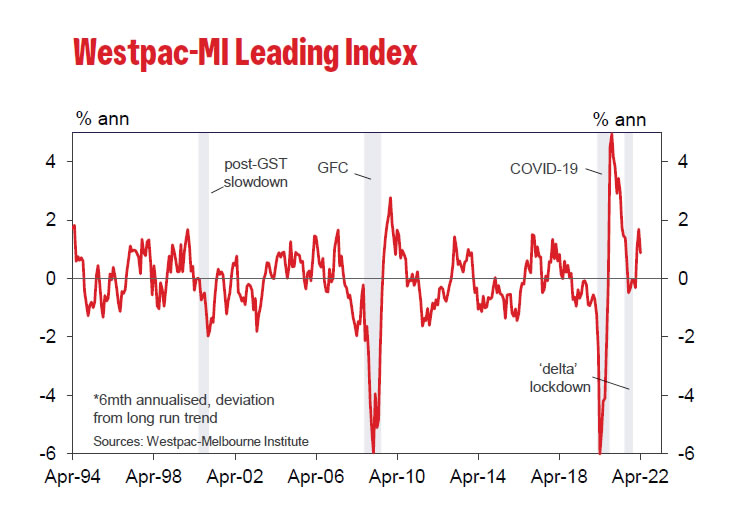
Australia Westpac-MI leading index dropped from 1.69% to 0.88% in April. Westpac recently revised down growth forecast for 2022 from 5.5% to 4.5%, reflecting the sharp increase in cost of living, and an earlier and more rapid RBA tightening policy.
As for RBA meeting on June 7, Westpac expects the central bank to hike by a further 40bps to 0.75%, even though most analysts favored a cautious move of 25bps. Westpac said, "It is also much more prudent to front load the increases where at a stage in the cycle when rates are clearly below what might be considered a 'neutral' level.
Looking ahead
Inflation data are the main focuses of the day. UK will release CPI and PPI. Eurozone will release CPI final. Canada will also release CPI. US will publish building permits and housing starts.
USD/CAD Daily Outlook
Daily Pivots: (S1) 1.2791; (P) 1.2825; (R1) 1.2843; More...
Intraday bias in USD/CAD stays neutral and outlook is unchanged. Pull back from 1.3075 could extend lower, but further rise is in favor with 1.2712 support intact. On the upside, break of 1.3075 will resume the rise from 1.2401. Sustained trading above 1.3022 fibonacci level will carry larger bullish implications. Next target will be 100% projection of 1.2005 to 1.2947 from 1.2401 at 1.3343. On the downside, however, break of 1.2712 support will indicate rejection by 1.3022 key fibonacci resistance, and bring deeper decline back to 1.2401 support.
In the bigger picture, focus stays on 38.2% retracement of 1.4667 (2020 high) to 1.2005 (2021 low) at 1.3022. Sustained break there should confirm that the down trend from 1.4667 has completed after defending 1.2061 long term cluster support. Further rise would then be seen towards 61.8% retracement at 1.3650. However, rejection by 1.3022 will maintain medium term bearishness. Break of 1.2005 will resume the down trend from 1.4667 and that carries larger bearish implications too.
Economic Indicators Update
| GMT | Ccy | Events | Actual | Forecast | Previous | Revised |
|---|---|---|---|---|---|---|
| 23:50 | JPY | GDP Q/Q Q1 P | -0.20% | -0.40% | 1.10% | |
| 23:50 | JPY | GDP Deflator Y/Y Q1 P | -0.40% | -1.20% | -1.30% | 1.10% |
| 00:30 | AUD | Westpac Leading Index M/M Apr | -0.20% | 0.30% | ||
| 00:30 | AUD | Wage Price Index Q/Q Q1 | 0.70% | 0.80% | 0.70% | |
| 04:30 | JPY | Industrial Production M/M Mar F | 0.30% | 0.30% | 0.30% | |
| 06:00 | GBP | CPI M/M Apr | 2.60% | 1.10% | ||
| 06:00 | GBP | CPI Y/Y Apr | 9.10% | 7.00% | ||
| 06:00 | GBP | Core CPI Y/Y Apr | 6.20% | 5.70% | ||
| 06:00 | GBP | RPI M/M Apr | 0.90% | 1.00% | ||
| 06:00 | GBP | RPI Y/Y Apr | 11.10% | 9.00% | ||
| 06:00 | GBP | PPI Input M/M Apr | 2.60% | 5.20% | ||
| 06:00 | GBP | PPI Input Y/Y Apr | 20.70% | 19.20% | ||
| 06:00 | GBP | PPI Output M/M Apr | 1.60% | 2.00% | ||
| 06:00 | GBP | PPI Output Y/Y Apr | 12.50% | 11.90% | ||
| 06:00 | GBP | PPI Core Output M/M Apr | 1.60% | 2.00% | ||
| 06:00 | GBP | PPI Core Output Y/Y Apr | 12.70% | 12.00% | ||
| 09:00 | EUR | Eurozone CPI Y/Y Apr F | 7.50% | 7.50% | ||
| 09:00 | EUR | Eurozone Core CPI Y/Y Apr F | 3.50% | 3.50% | ||
| 12:30 | CAD | CPI M/M Apr | 0.70% | 1.40% | ||
| 12:30 | CAD | CPI Y/Y Apr | 6.30% | 6.70% | ||
| 12:30 | CAD | CPI Common Y/Y Apr | 2.90% | 2.80% | ||
| 12:30 | CAD | CPI Median Y/Y Apr | 3.90% | 3.80% | ||
| 12:30 | CAD | CPI Trimmed Y/Y Apr | 4.70% | 4.70% | ||
| 12:30 | USD | Building Permits Apr | 1.83M | 1.87M | ||
| 12:30 | USD | Housing Starts Apr | 1.77M | 1.79M | ||
| 14:30 | USD | Crude Oil Inventories | 2.1M | 8.5M |
Australia Westpac leading index dropped to 0.88%, expects 40bps RBA hike in Jun
Australia Westpac-MI leading index dropped from 1.69% to 0.88% in April. Westpac recently revised down growth forecast for 2022 from 5.5% to 4.5%, reflecting the sharp increase in cost of living, and an earlier and more rapid RBA tightening policy.
As for RBA meeting on June 7, Westpac expects the central bank to hike by a further 40bps to 0.75%, even though most analysts favored a cautious move of 25bps. Westpac said, "It is also much more prudent to front load the increases where at a stage in the cycle when rates are clearly below what might be considered a 'neutral' level.
Japan GDP contracted -0.2% qoq, -1.0% annualized in Q1
Japan GDP contracted -0.2% qoq in Q1, better than expectation of -0.4% qoq. In annualized term, GDP contracted -1.0%, first negative growth in two quarters, but better than expectation of -1.8%. GDP deflator dropped -0.4% yoy, also better than expectation of -1.2% yoy.
Economy minister Daishiro Yamagiwa said the economy has not returned to pre-pandemic levels but that further downside would likely be limited. He also expected the economy to pick up even though uncertainty remains due to Ukraine situation. Also, China's zero-covid policy is having a significant impact on supply chains.
Fed Evans expects completing any 50bps, plus some 25bps this year
Chicago Fed President Charles Evans said, "front-loading is important to speed up the necessary tightening of financial conditions, as well as for demonstrating our commitment to restrain inflation, thus helping to keep inflationary expectations in check."
As for the pace of tightening, he said, "I'm expecting that before December, we will have completed in any 50s and have put in place at least a few 25s."
"If we need to, we will be well positioned to respond more aggressively if inflation conditions do not improve sufficiently or, alternatively, to scale back planned adjustments if economic conditions soften in a way that threatens our employment mandate," Evans explained.
BoE Cunliffe: There’s no intrinsic value around crypto assets
BoE Deputy Governor Jon Cunliffe said at a web event, "There's a long tail of retail investors who have invested in cryptoassets. Do they all understand what they've invested in? I think not. For that long tail of retail investors, I'm not sure they do understand. They don't really see this as a financial investment."
"There's no intrinsic value around crypto assets," Cunliffe said. "They move with sentiment. They're being moved mainly as a risky asset, and prices have been going down pretty consistently."
"If you have that as a proportion of your portfolio, you have to realize it is highly speculative," Cunliffe said. "You could lose all your money. You could make a sizable capital gain. It's important for investors to understand the characteristics of this investment."
Fed Kashkari: What I don’t know is how much are we going to need to do
Minneapolis Fed President Neel Kashkari said yesterday, "my colleagues and I are going to do what we need to do to bring the economy back into balance... What I don't know is how much are we going to need to do ... if we get some help on the supply side, then we won't have to do as much; if we don't get any help on the supply side, we are going to have to do more."
But he also cautioned, "if the recession is effective in bringing inflation down, but then you're pushing the unemployment rate way up, now all of a sudden you might be moving from one type of imbalance to the opposite type of imbalance. Like any kind of system, you want to avoid over-correcting if you can."
Fed Powell wont’ hesitate to move past neutral rate to tame inflation
Fed Chair Jerome Powell said yesterday, "this is a time for us to be tightly focused on the time ahead and getting inflation back down to 2%.... What we need to see is inflation coming down in a clear and convincing way... If we don't see that, we will have to consider moving more aggressively".
"If that involves moving past broadly understood levels of 'neutral' we won't hesitate to do that," he added. "We will go until we feel we are at a place where we can say 'yes, financial conditions are at an appropriate place, we see inflation coming down.'"
"We'll go to that point. There won't be any hesitation about that," he said.
Aussie Fires Up Ahead of Jobs Data and Australian Federal Election
The Australian dollar is in the midst of a rebound after last week plumbing almost two-year lows, but the path higher could get trickier as employment data is incoming and a federal election is days away. As the Reserve Bank of Australia embarks on its rate hike cycle, wage figures for the first quarter will be watched on Wednesday along with the April jobs report on Thursday, both due at 01:30 GMT. But political risks are on investors’ radar too as Australians could vote for a change in government when they head to the polls on May 21.
RBA begins tightening cycle just as China shuts down
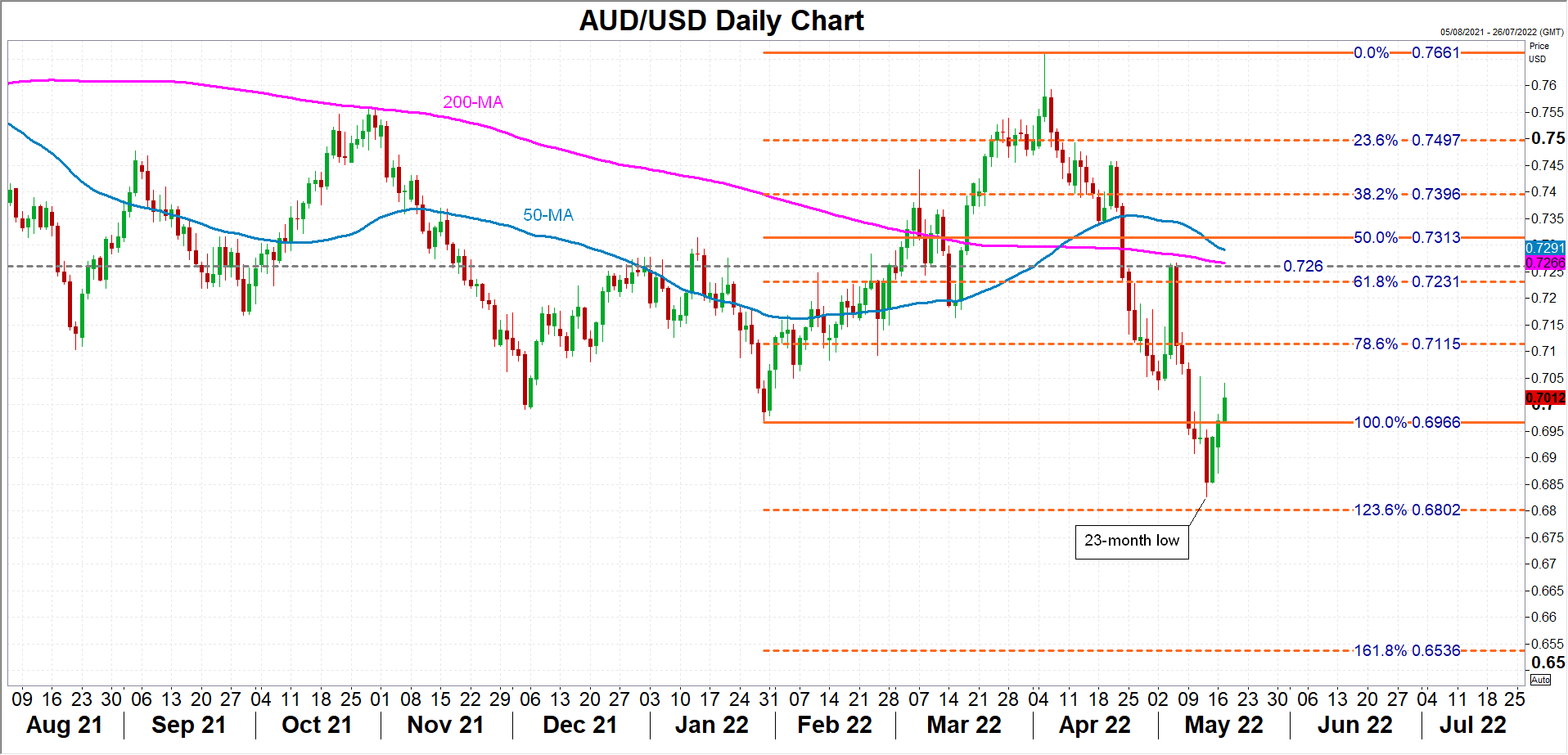
The commodity-linked aussie hasn’t been having a very good time lately. Although the currency came out of the Ukraine geopolitical storm not only unscathed but even managing to rally along with most commodities, the China slowdown scare has been less kind to the local dollar. China is Australia’s largest export market so the recent lockdowns in Shanghai and Beijing have prompted concern about both country’s growth prospects. Subsequently, the aussie plunged more than 10% from the April peak of $0.7661 to the May trough of $0.6827.
But like most other central banks, the RBA has a more pressing issue on its hands – high inflation. The consumer price index jumped to a two-decade high of 5.1% y/y in the first three months of the year. This probably influenced the Bank’s decision to raise the cash rate by 25 basis points instead of the expected 10 bps in May. The minutes of that meeting revealed that an even large increase was also on the table.
Labour market is key to pace of rate hikes
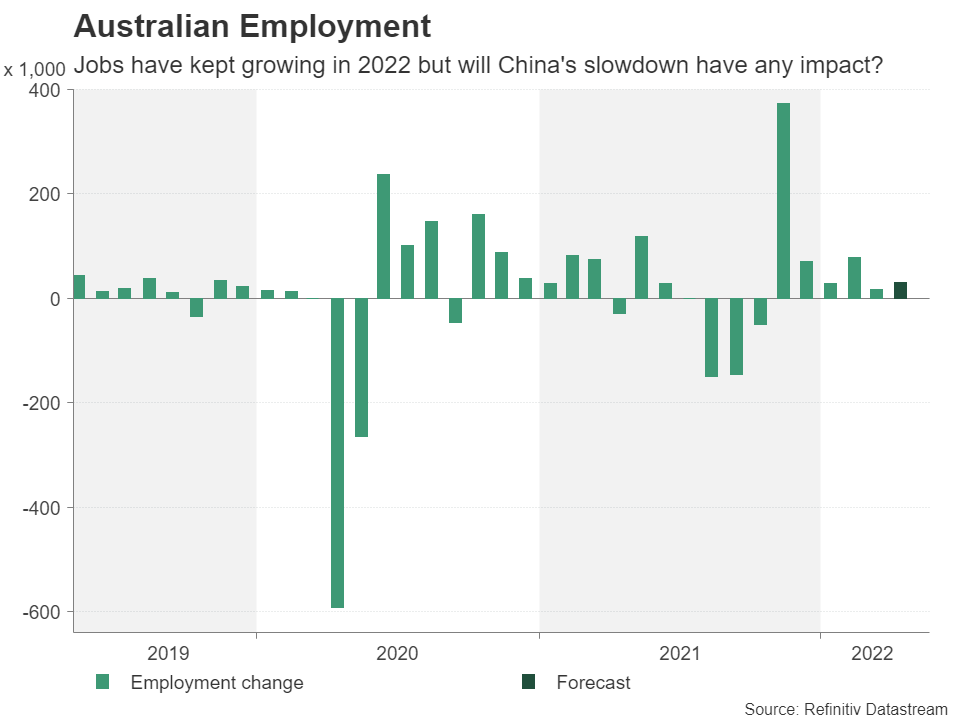
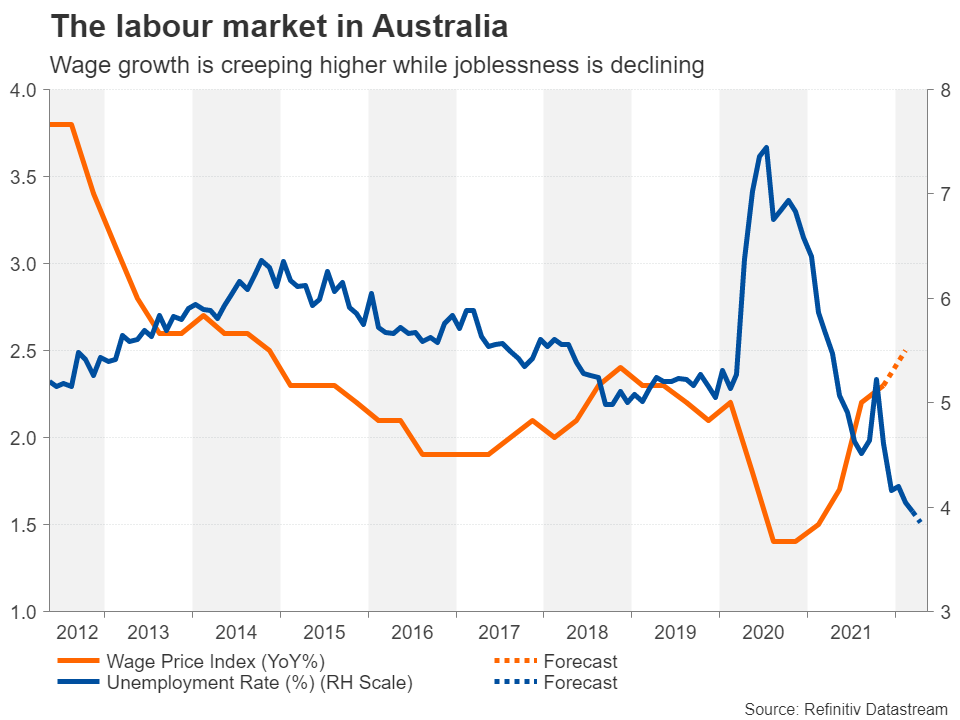
Expectations are now growing that the RBA will hike rates by 40 bps to 0.75% in June and this time round, it could be this week’s jobs numbers that sway the decision. The unemployment rate has fallen to 4% - a level not seen since early 2008. It’s expected to have dropped even lower in April to 3.9%. Employment is forecast to have risen by 30k, picking up pace from the prior month’s 17.9k gain.
Just as important, if not more, for policymakers will be the wage price index. The RBA had repeatedly stressed in the past that it wants to see higher wage growth before beginning to tighten policy and it may now be getting what it wished for. The wage price index likely grew by 2.5% y/y in the first quarter, accelerating slightly from 2.3% in the prior quarter.
Can the aussie extend its rebound?
If the wage and employment figures reinforce the view of a tight labour market, the aussie could stretch its rebound towards the $0.7260 area that encapsulates both the May highs as well as the 200-day moving average.
However, there are still several downside risks that may pull the aussie back down again. If the recovery falters, the aussie could surpass May’s 23-month low to breach the $0.68 level and tumble towards the 161.8% Fibonacci extension of the January-April uptrend at $0.6536.
China and election risks
The main threat to the Australian economy right now is if there’s a fresh virus outbreak in China that sparks a new round of lockdown restrictions just as existing ones are about to be eased. But another potential risk is the federal election on Saturday.
The ruling coalition between the Liberal and National parties led by Prime Minister Scott Morrison is lagging behind the opposition Labor Party in the polls. Although the gap has started to narrow in recent days and in some polls the coalition has regained the lead, it’s unclear if Morrison will be able to turn his fortunes around on time.
Coalition is struggling in the polls
Having enjoyed a boost in popularity from its handling of the pandemic, the government has come under pressure to do more to alleviate the burden on households from the surge in living costs. The timing of the RBA’s first post-pandemic rate hike hasn’t done it any favours either as borrowing costs are going up too.
The Labor party is proposing a rise in the minimum wage as a way to minimise the pain for households, something the coalition was initially opposed to before backtracking after coming under criticism for its stance.
Another concern for voters is climate change as the increased frequency of floods and fires in recent years has made this a hot topic during the elections. But the main parties’ policies fall short of cutting emissions as a priority, although Labor’s targets are slightly tougher.
No standouts in economic policies
But as far as markets are concerned, economic policies are what matter and there isn’t a great deal of difference separating Labor from the Liberal-National coalition. This is especially true after Labor said they would not repeal the tax cuts introduced by the current government.
If the coalition does have an edge over the economy and business policies, it might be offset by Labor’s less hostile stance towards China. The two countries’ relations have featured heavily in the election campaign as Australians are wary of China’s growing influence in the Asia-Pacific region. Morrison has put trade links with China on the line several times during his tenure. For example, he led the global calls for the origins of Covid-19 to be investigated. China responded by banning the import of Australian beef, wine and other products.
Is Australia headed for a hung parliament?
Hence, market reaction to the election outcome will likely be limited, with a win for the incumbent prime minister boosting the aussie and domestic stocks only modestly. The worst case scenario for investors, however, is if neither party is able to achieve a majority and the election results in a hung parliament.
This often creates some uncertainty while new political alliances are hashed out. If that were to fail, a minority government would be the only way forward, which might bring about a period of instability. So traders will probably be only slightly bothered if the coalition is voted out but Labor wins a clear majority, while a hung parliament could weigh on the aussie more significantly.