Sample Category Title
Eco Data 5/5/22
[php_everywhere instance="1"]
FOMC press conference live stream
https://www.youtube.com/watch?v=ELHQgcFBFpI
Fed hikes by 50bps, starts balance sheet runoff, highly attentive to inflations risks
Fed raises interest rate target by 50bps to 0.75% to 1.00% as expected. It also announced to start the balance sheet runoff, by USD 95B as expected (USD 60B treasuries and USD 35B MBS). The decision was by unanimous vote.
The FOMC is "highly attentive to inflations risks". The accompany statement noted that the implications of invasion of Ukraine by Russia for US economy are "highly uncertain". " The invasion and related events are creating additional upward pressure on inflation and are likely to weigh on economic activity." Meanwhile, lockdowns in China are "likely to exacerbate supply chain disruptions"
Fed pledged to "adjust the stance of monetary policy as appropriate if risks emerge that could impede the attainment of the Committee's goals".
(FED) Federal Reserve Issues FOMC Statement
Although overall economic activity edged down in the first quarter, household spending and business fixed investment remained strong. Job gains have been robust in recent months, and the unemployment rate has declined substantially. Inflation remains elevated, reflecting supply and demand imbalances related to the pandemic, higher energy prices, and broader price pressures.
The invasion of Ukraine by Russia is causing tremendous human and economic hardship. The implications for the U.S. economy are highly uncertain. The invasion and related events are creating additional upward pressure on inflation and are likely to weigh on economic activity. In addition, COVID-related lockdowns in China are likely to exacerbate supply chain disruptions. The Committee is highly attentive to inflation risks.
The Committee seeks to achieve maximum employment and inflation at the rate of 2 percent over the longer run. With appropriate firming in the stance of monetary policy, the Committee expects inflation to return to its 2 percent objective and the labor market to remain strong. In support of these goals, the Committee decided to raise the target range for the federal funds rate to 3/4 to 1 percent and anticipates that ongoing increases in the target range will be appropriate. In addition, the Committee decided to begin reducing its holdings of Treasury securities and agency debt and agency mortgage-backed securities on June 1, as described in the Plans for Reducing the Size of the Federal Reserve's Balance Sheet that were issued in conjunction with this statement.
In assessing the appropriate stance of monetary policy, the Committee will continue to monitor the implications of incoming information for the economic outlook. The Committee would be prepared to adjust the stance of monetary policy as appropriate if risks emerge that could impede the attainment of the Committee's goals. The Committee's assessments will take into account a wide range of information, including readings on public health, labor market conditions, inflation pressures and inflation expectations, and financial and international developments.
Voting for the monetary policy action were Jerome H. Powell, Chair; John C. Williams, Vice Chair; Michelle W. Bowman; Lael Brainard; James Bullard; Esther L. George; Patrick Harker; Loretta J. Mester; and Christopher J. Waller. Patrick Harker voted as an alternate member at this meeting.
Gold’s Bearish Bias Calmed by Support Boundary
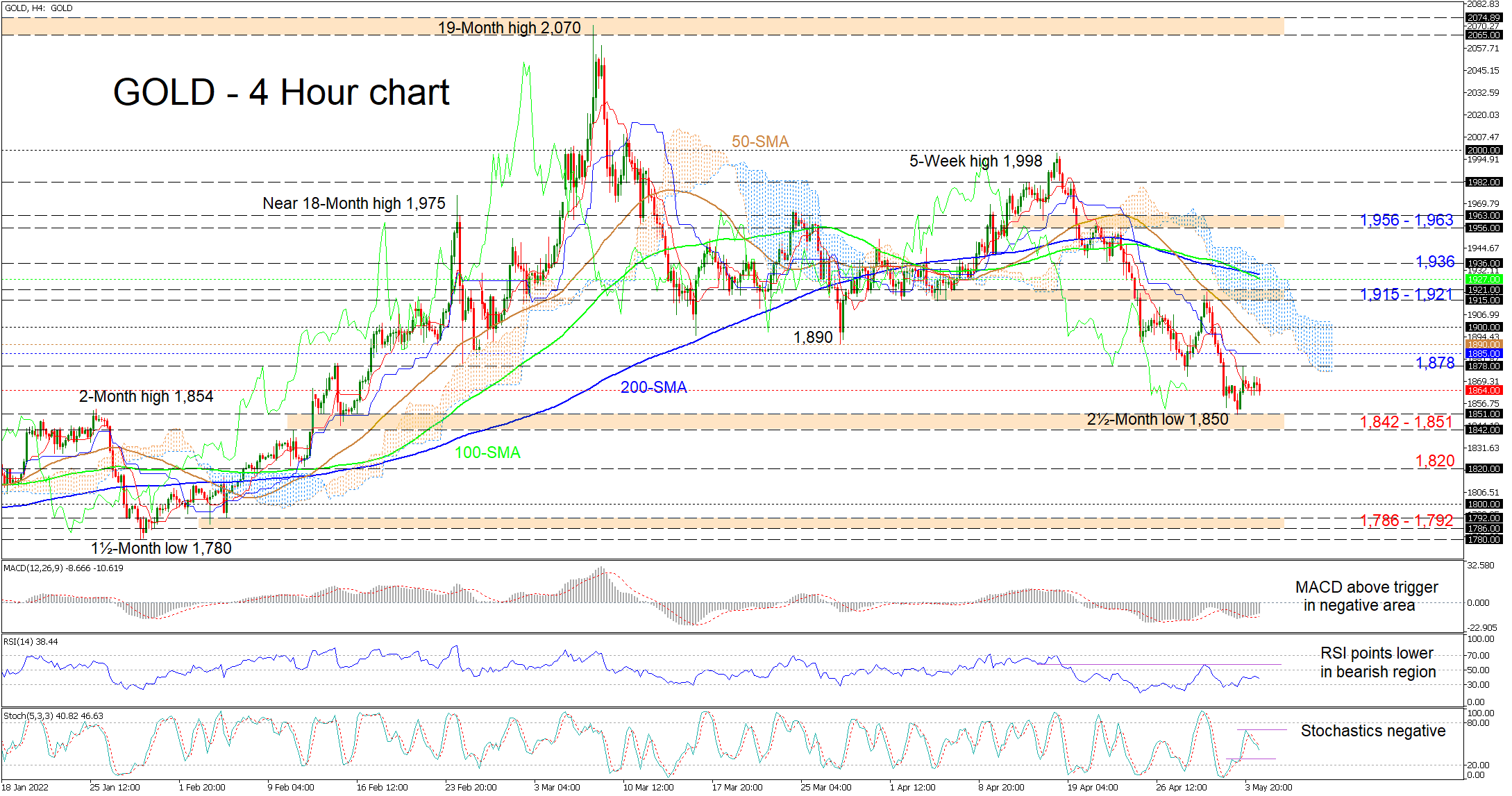
Gold is tiptoeing across the flattened red Tenkan-sen line at 1,864 after the more than two-week decline from the 2,000 price vicinity bounced off a support zone that stretches back to mid-February. The descending slopes of the simple moving averages (SMAs) are endorsing the recent downward trajectory in the commodity.
Currently, the Ichimoku lines are indicating a pause in the downward driving forces, while the short-term oscillators are exhibiting weak negative momentum. The MACD, in the bearish region, is holding above its red trigger line, reflecting that the recent fading in negative impetus is lingering. The RSI has regained a minor dip but is showing that negative momentum remains weak in bearish territory. Meanwhile, the stochastic oscillator is promoting downward price action in the yellow metal.
If sellers steer the price back below the red Tenkan-sen line at 1,864, downside constraints could commence at the nearby 1,842-1,851 support barrier. However, diving past this border may reinforce negative tendencies in the commodity, with sellers subsequently aiming for the 1,820 mark. Overlooking the latter obstacle, the precious metal may then snowball towards the 1,800 handle and the 1,786-1,792 support band slightly beneath.
Alternatively, if buyers re-emerge, congested upside friction may emanate from the 1,878 high, the blue Kijun-sen line at 1,885 and the descending 50-period SMA at 1,890. Should the price conquer these obstacles and lift beyond the 1,900 barrier and the Ichimoku cloud, the bulls may then challenge the key 1,915-1,921 resistance border. If buying interest endures and the price oversteps this resistance and the approaching longer-term 100- and 200-period SMAs too, the 1,936 inside swing low may then try to hinder advances from reaching the 1,956-1,963 boundary.
Summarizing, gold is sustaining a bearish bias beneath the SMAs and the 1,915-1,921 resistance band. A break below the 1,842-1,851 support may intensify the bearish bearing, while a climb north of the 1,900 handle is necessary to heighten positive beliefs.
Pound Drifting ahead of Fed, BoE Meetings
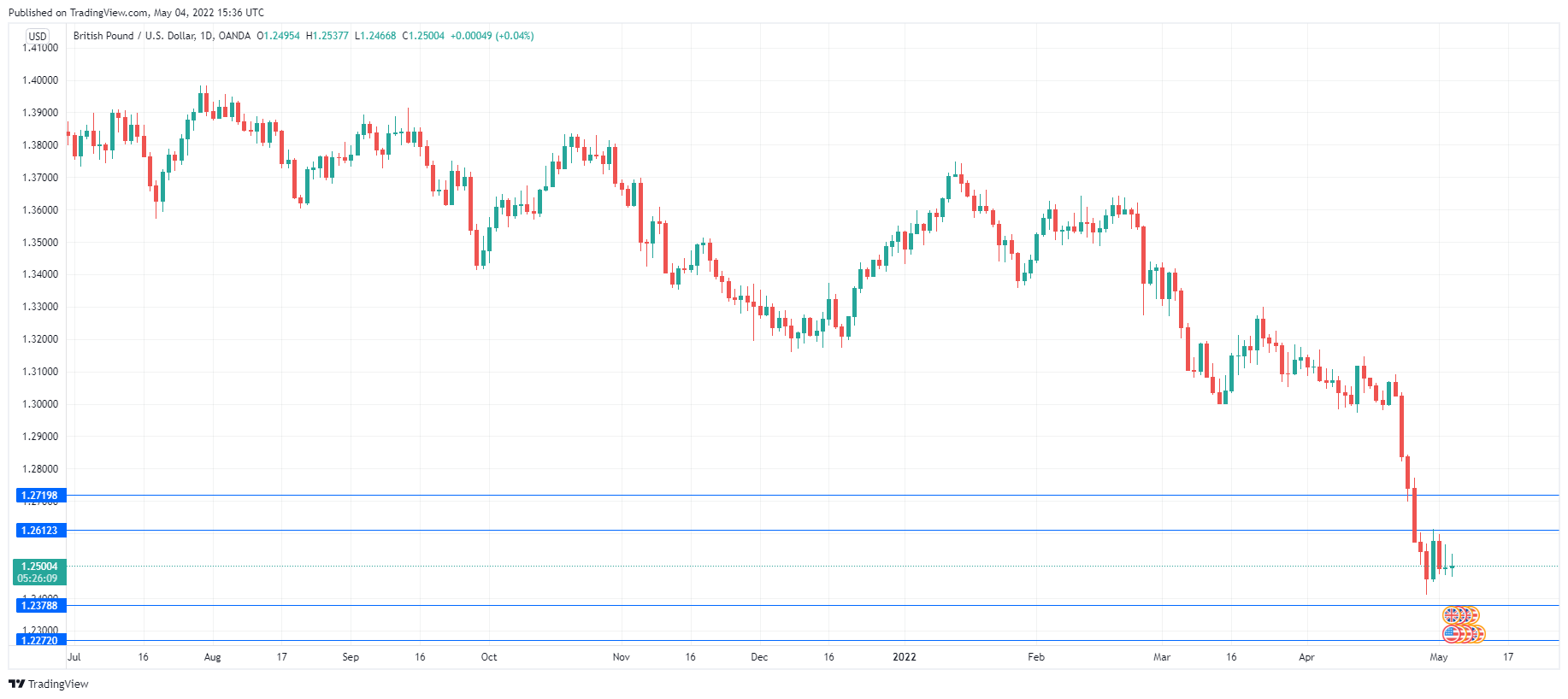
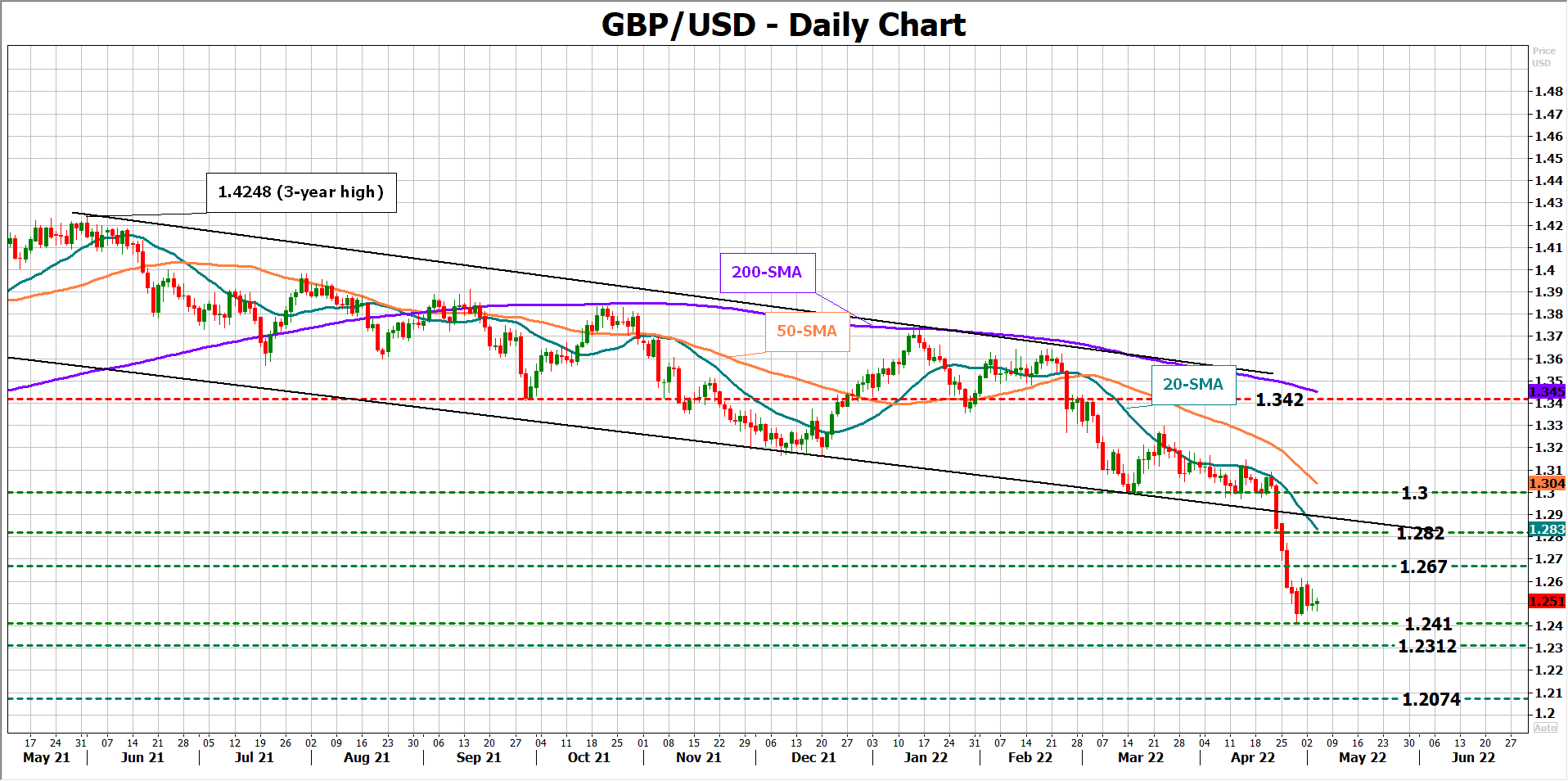
The British pound is showing little movement for a second straight day, as GBP/USD trades just below the 1.25 level.
BoE expected to raise rates
Nobody can accuse the BoE of lacking an aggressive policy, although perhaps it should have done so earlier. The central bank has hiked rates at three straight meetings, and the streak is expected to continue at the May meeting on Thursday. The markets have priced in a 25-basis point hike, which would raise the Official Bank Rate to an even 1.00%.
The BoE’s hawkish stance hasn’t stemmed the pound’s plunge, with GBP/USD falling 4.31% in the month of April. I don’t expect the pound to get much relief after a 0.25% hike, and the risk to sterling remains tilted to the downside.
The primary driver behind the rate-hike cycle has been the urgency in dealing with soaring inflation, which hit 7% in March, a 30-year high. Like other central banks, the BoE faces the challenge of lowering inflation without choking off growth and sending the economy spinning into a recession. Governor Bailey recently acknowledged that the BoE is treading a “narrow path” between inflation and growth and has signalled that he will raise rates at a slower pace than the Fed, which is poised to raise rates by a half-point later today and possibly at upcoming meetings as well.
The Fed holds its policy meeting later today, and anything other than a half-point increase would be a huge surprise. A half-point increase has been priced in, but it is nevertheless a significant event. It will mark the Fed’s largest rate increase in 20 years and shows the Fed’s commitment to lower inflation. Investors will be monitoring the hawkishness of the rate statement, as well as the size of the trim to the Fed’s balance sheet (quantitative tightening), and an aggressive message from the Fed would likely boost the US dollar.
GBP/USD Technical
- GBP/USD faces resistance at 1.2612 and 1.2719
- There is support at 1.2379 and 1.2272
USDJPY Indecisive ahead of FOMC Policy Decision
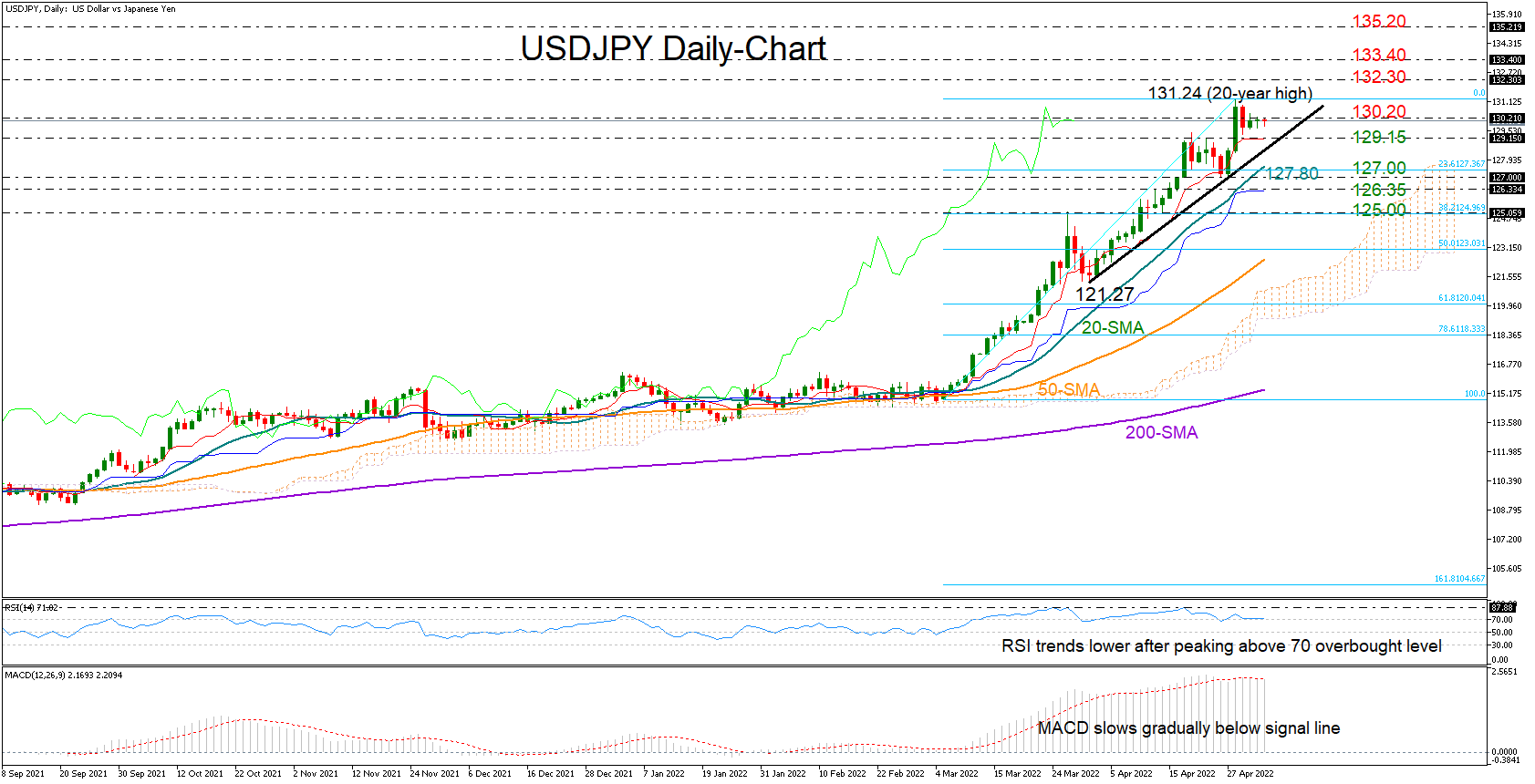
USDJPY has barely been moving so far this week ahead of the FOMC policy announcement, facing strong rejection around the 130.20 barrier.
Although the pair remains close to its recent 20-year top of 131.24, the possibility for a downside correction is technically growing larger as the RSI and the MACD trend southwards, with the former set to exit the overbought territory and the latter gradually sliding below its red signal line.
Nevertheless, how meaningful any pullback could be is still a question. The pair is effectively preserving its bullish trajectory above the tentative ascending trendline currently seen around 129.15, while the 20-day simple moving average (SMA) may also prevent an outlook deterioration below the previous low of 126.93. Note the 23.6% Fibonacci retracement of the 114.64 - 131.24 upleg is also in the neighborhood. Nevertheless, if selling pressures further exacerbate below the flattening blue Kijun-sen line at 126.35 as well, the price may tumble to 125.00.
In the event the bulls gear above 130.20, they will attempt to breach the 131.24 top and pin new higher highs around the 2002 resistance of 132.30. The 133.40 mark had been a key barricade in the same period. Hence, any successful close higher from here could easily provide access to the 2002 peak of 135.20.
Summarizing, USDJPY is currently in wait-and-see mode. A step above 130.20 or below 129.15 could direct market sentiment accordingly.
NZ Dollar Steady after Solid Jobs Report
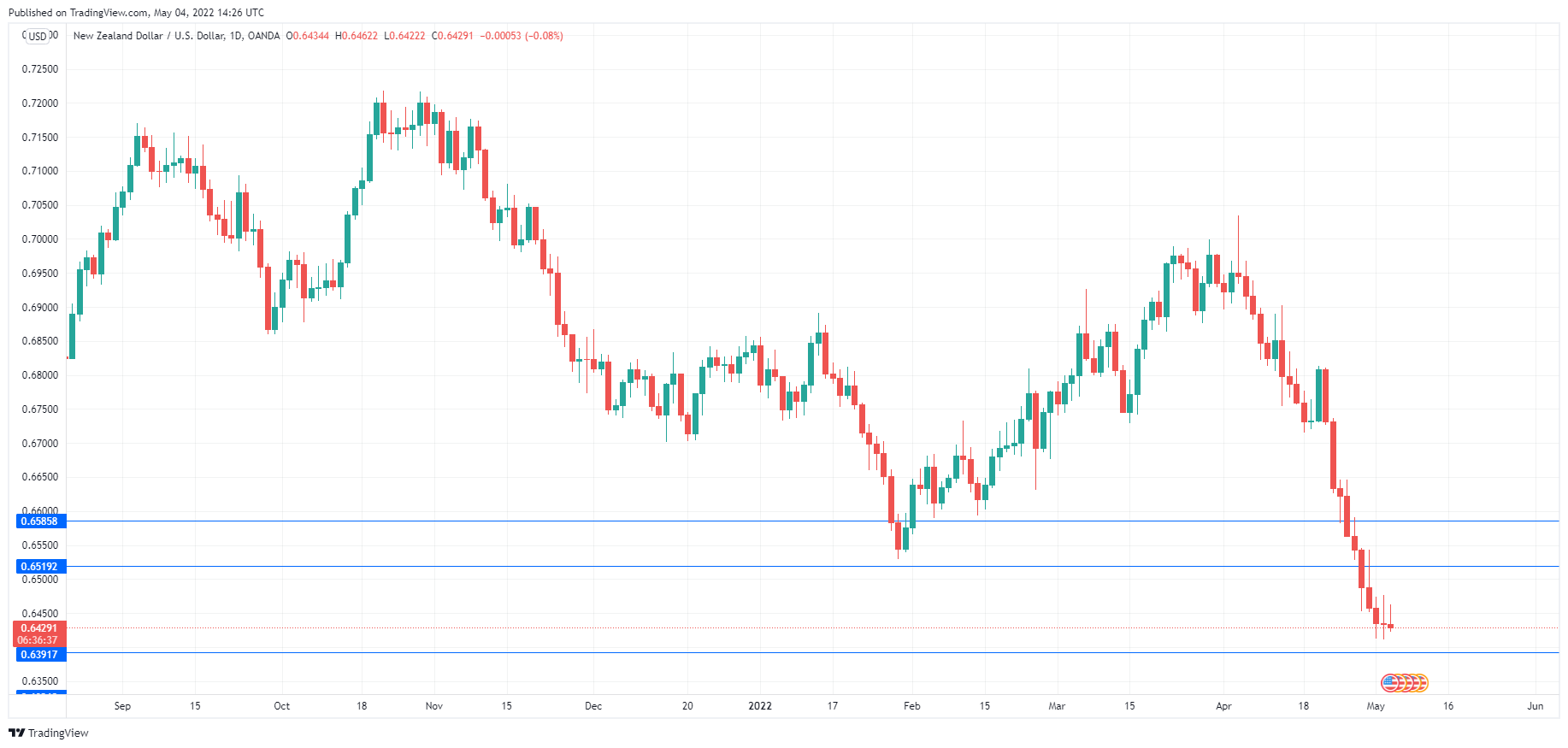
The New Zealand dollar is in positive territory on Wednesday, as the currency looks for its first winning session since April 20th.
Strong jobs report boosts New Zealand dollar
The New Zealand labour market remains robust, as confirmed by the Q1 employment report. The unemployment rate remained at a record low of 3.2%, matching expectations. Employment growth fell to 2.9%, (3.1% exp.), which was down from the 3.5% gain in Q1.
What was perhaps more significant was wage growth, which climbed to 3.1% YoY, its highest level since 2008. The RBNZ places great weight on wage growth and this upswing will raise pressure on the central bank to deliver another 0.50% rate hike at the May 25th meeting, which would bring the Official Cash Rate to 2.0%.
Inflation hit 6.9% in the first quarter and the RBNZ is determined to curb inflation expectations, which like CPI, continues to accelerate. The RBNZ delivered a 0.50% in April and has telegraphed the markets that more tightening is needed. Despite the RBNZ’s hawkish stance, the New Zealand dollar has been steamrolled by its US cousin. NZD/USD plunged 6.88% in the month of April, even with the 0.50% rate hike in April.
The Fed holds its policy meeting later today, with a 0.50% rate increase a virtual certainty. Such a move will be highly significant, as it would mark the Fed’s largest rate increase in 20 years and demonstrates that the Fed is committed to reducing inflation, which has hit 40-year highs. The half-point increase has been priced in, but what remains uncertain is the tone of the rate statement and how aggressively will the Fed scale back its balance sheet (quantitative tightening). If the Fed delivers a hawkish message to the markets in addition to the rate hike, the US dollar will likely respond with gains.
NZD/USD Technical
- There is support at 0.6391 and 0.6325
- We find resistance at 0.6519 and 0.6585
BoE Policy Meeting: A Normal Rate Hike Amid Stagflation Fears
The Bank of England will review its policy and update its economic projections on Thursday, a day after the Fed, with the announcement scheduled for release at 12:00 GMT. A rate hike is already baked in, but what is still uncertain is how aggressive the central bank is planning to be as the toxic mix of heating inflation and slowing economic growth is making any decision in either direction risky to take.
BoE the only player in town amid stagflation fears
Operating on a slim fiscal budget, the British Prime Minister, Boris Johnson, clearly stated that government spending will not be enough to offset the rising living cost immediately for everyone besides the unfortunate families. In particular, he explained that increasing financial support could fuel more inflation at a time when consumers are already facing higher taxes and mounting energy bills. Therefore, the central bank will probably be the only player in town in the short term, aiming to cool inflation before the economy erodes it because of a slowdown, or in other words before it gets trapped in stagflation.
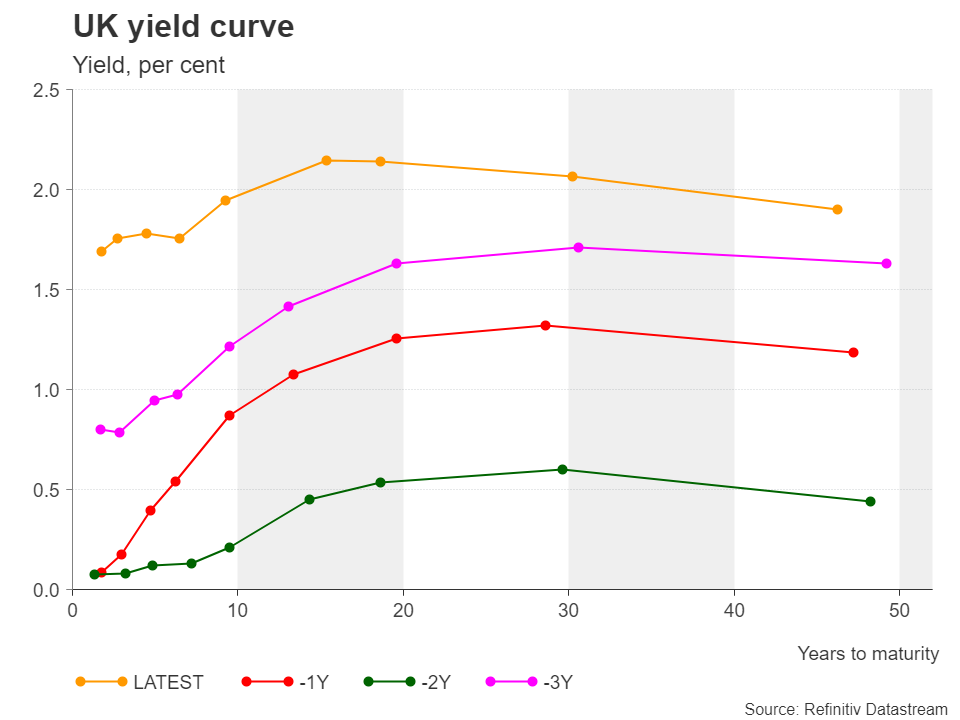
But the job will not be easy. Unlike the Fed, the BoE has adopted a careful approach over its tightening era, expressing unease particularly about faster rate increases even though inflation hit a new three-decade high of 7.0%y/y in March and could run even higher later in the year according to the BoE’s previous projections. Exacerbating inflation expectations is probably the last thing policymakers would like to cause through a quick stimulus reduction as the series of higher highs in bond yields show no signs of abating, with the 10-year yield topping recently at a seven-year high marginally above 2.0%. The higher the yields rise, the larger borrowing costs become for businesses, and therefore the bigger the risk of an economic slowdown. Note that the negative yield curve reversal is relatively steeper in the UK than in the US, while the one for the Eurozone is interestingly flat – a yield curve inversion is a signal that investors fear the economy will take a downhill turn, though it should not be taken as given.
Avoid sharp rate hikes
Of course, the war in Ukraine and China’s pandemic-related supply disruptions, which are the major global inflationary drivers, are out of the central bank’s control, though it would be reckless if policymakers abandon their tightening plans entirely as inflation risks are looking more real than growth risks at the moment.
Hence, the board will probably approve another rate hike this month, driving its benchmark rate to the highest since 2009, but it may refrain from sharper increases and deliver a normal one of 25 bps instead as investors widely anticipate. Such a rate hike could even be considered a moderate step compared to the 50bps rate hikes in Canada and New Zealand and therefore could still be compliant to the BoE’s April’s guidance. However, how divided the voting board will be remains to be seen. Currently investors expect eight policymakers out of nine to back a 25 bps rate hike. Besides, with the savings rate evaporating and real disposable income falling into the negative area, the economy could be more fragile against sudden financial shocks. Recall that retail sales slumped to 0.9% y/y in March from 7.2% y/y in the preceding month. Policymakers could provide some direction on the economic outlook when they unveil their new GDP and CPI inflation forecasts this week.
Bond selling
Another key question and perhaps the most crucial one is how the central bank will manage its 875bln pounds gilt portfolio. Policymakers had previously disclosed that they consider selling government bonds once interest rates reach 1.0% but given the current unfavorable economic backdrop and the sanctioned Russian business, the central bank may delay any quantitative tightening actions. Perhaps by announcing a consultation period, it could provide some time for thought and data examination before policymakers provide any exact details about when and how bond selling will be made.
GBP/USD
Regarding the market reaction, futures markets are pricing a 65% probability for a 25 bps rate hike. Such a rate decision could be viewed as conservative, especially if the central bank paints a cloudier picture for the UK economy and postpones any bond selling activities. Hence, pound/dollar could slump below the 1.2410 low and continue towards 1.2312 – that being the 61.8% Fibonacci retracement of the 2020 rally. Lower, the price may stabilize around the May 2020 low of 1.2074.
In the bullish scenario where the BoE meets expectations of a normal 25 bps rate hike but sets a timetable about when and how quantitative tightening could take place, or in the most hawkish case it boosts rates by 50bps, the pair may stretch its bounce off 1.2410 and towards the former support area of 1.2670. Beyond that, the next target will be the 20-day simple moving average (SMA) and the 1.2820 level.
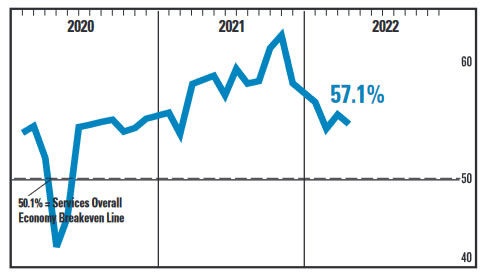
US ISM services dropped to 57.1 in Apr, prices at all-time high
US ISM Services PMI dropped from 58.3 to 57.1 in April, below expectation of 59.0. Looking at some details, business activity/production rose from 55.5 to 59.1. New orders dropped from 60.1 to 54.6. Employment dropped from 54.0 to 49.5. Prices rose from 83.8 to 84.6, an all-time high.
ISM said: "There was a pullback in the composite index, mostly due to the restricted labor pool (impacting the Employment Index) and the slowing of new orders growth. Business activity remains strong; however, high inflation, capacity constraints and logistical challenges are impediments, and the Russia-Ukraine war continues to affect material costs, most notably of fuel and chemicals."