Sample Category Title
Not OPEC’s Problem
The Fed raised the interest rate by 50bp for the first time since 2000 and said there will be more 50bp hikes in the coming meetings. And the major US indices rallied as the Fed played down the possibility of a 75bp hike.
That’s the magic of expectations.
The reduction of the Fed balance sheet will start with an initial combined amount of $47.5 billion and reach the $95 billion level within three months.
The S&P500 rebounded 3%, as Nasdaq, which had started the day in the negative ended the day 3.40% higher, at around 13535. The Dow gained 2.80% as well, and all this Fed optimism sent a positive wave to the global equities, as European stock indices rallied more than 2% in the overnight trading, shrugging off the weakness of yesterday, that was mostly due to the rally in oil prices on news that Europe would finally ban the Russian oil and gas.
At this point, many expect the Fed to raise the rates above the neutral-rate estimate of about 2.5% by the end of this year to tame inflation, and Bloomberg economists believe that the balance sheet will come back to the pre-pandemic levels by 2024. But we will still be only half-way from the levels pre-2007/2008 subprime crisis. Therefore, there is still a lot of room for more Fed hawkishness.
How hawkish the Fed could get depends on inflation.
ADP disappoints
Yesterday’s ADP report showed that the US economy added 250’000 new private jobs in April, which came in well below the near 400K expected by analysts. And more critically, the data showed that businesses with less than 50 workers shed jobs, highlighting the challenges that small business are facing in the actual high inflation environment. And these small businesses account for around 40% of the US economic activity, meaning that the inadequately dovish policy that the Fed conducted so far is doing more harm than good to the economic tissue.
Therefore, the weakness in the US jobs figures doesn’t necessarily mean that the Fed would change the course of its policy in the coming months.
Yesterday’s decision sent the US 10-year yield below the 3%, and the dollar index dived below the 103 mark, but the Fed hawks will remain in charge of the market despite the weakness that we may see in economic data from here.
BoE to raise, as well
The Bank of England (BoE) is also expected to raise its policy rate by 25bp to 1% at today’s monetary policy meeting to tame the rising inflation in Britain. That would be the fourth straight rate hike to push the bank rate to a 13-year high in England.
The hawkish tone from the BoE hasn’t helped sterling recover against the US dollar over the past months. Cable rapidly came around the 1.25 mark after slipping below the 1.30 support about two weeks ago, and today’s decision will certainly not change the bearish trend as it is clear that the US dollar is the one that leads in this dance.
Oil up
Energy prices remain under a decent positive pressure as the European nations now consider walking away from the Russian oil as the next step of the economic sanctions that they impose on Russia as a result of the war in Ukraine.
But the European decision is not OPEC’s problem. OPEC countries will stick to their plan to increase the daily output by around 430K barrels per day. On the other hand, the OPEC countries haven’t been able to meet the daily quotas over the past couple of months, so it doesn’t really make sense to have quotas in place if the producer countries fall repeatedly behind their target.
There is also a political power battle around oil supply, as OPEC remains allied with Russia, and plays against the US' will to increase the oil output and the OPEC countries are not willing to replace the Russian oil. Therefore, the OPEC decision will only play a minor role in energy prices.
The war in Ukraine, the sanctions on Russian oil, combined to capacity restrictions, other disruptions like attacks and social unrest in oil producer countries and the lack of investment should continue increasing the gap between supply and demand and give investors enough reason to remain bullish in oil in the short to medium run.
But, it also looks like the oil rally will likely remain capped below the $120/130 area, as above this price range, the slowing demand could also slow the rally. Therefore, levels we saw at the beginning of the Ukrainian war, may be the peak levels.
Eyes Turn Towards BOE after Powell Talks Down Expectations of a 75bp Hike
Market movers today
After the Fed decision yesterday, markets will shift their attention to the Bank of England (BoE) meeting today. In line with consensus and market pricing, we expect BoE to hike the Bank Rate to 1.00% from 0.75%, but stick to its softer guidance on the pace of future rate increases compared to what markets are expecting (read more in Bank of England Update Preview: Another rate hike and active QT, 2 May).
We expect Norges Bank to stay on hold at today's meeting, but to reiterate that it will most likely hike in June. This would be consistent with the guidance put out in March, and as it is only an "interim" meeting followed by nothing more than a press release, the threshold for deviating from plan would normally be high. The development since the March meeting has been mixed, but as wage and inflation figures have been marginally to the downside, there should be no reason for Norges Bank to depart from its plan for a gradual normalisation of monetary policy.
OPEC+ convenes for its regular meeting and markets will look out for any indications of planned output increases after the EU is working on a Russian oil embargo this year.
The Czech and Polish central banks are expected to raise their policy rates by 50bps and 100bps, respectively, taking their policy rates to 5.50% to combat the high inflation pressures experienced in the countries for more than a year.
The 60 second overview
Federal Reserve: As expected, the Fed delivered a 50bp rate hike, the first one of its kind since May 2000, taking the Fed funds target range to 0.75-1.00%. Also as expected, Fed chair Jerome Powell hinted that the Fed will hike by 50bp at the "next couple of meetings". Powell supported risk sentiment by saying that the Fed is not "actively considering" a larger 75bp rate hike although he did not rule it out. The Federal Reserve announced QT will start in June and that the cap will increase to a total of USD95bn over three months (starting by USD47.5bn/month). We keep our Fed call unchanged still expecting 50bp rate hikes in June and July and 25bp in September, November, December, January 2023 and March 2023. We still see risks skewed towards more aggressive tightening (75bp or more meetings with 50bp). See our Fed Research - Review: 50bp rate hike but no appetite for 75bp (yet), 4 May.
EU sanctions: The EU is yet to reach an agreement on its sixth round of sanctions against Russia. The current debate includes a proposal for a phased-in ban on imports for Russian crude (over the next six months) and refined oil (by the end of this year), exclusion of Sperbank and two other Russian banks from SWIFT, a bar for European ships to transport Russian oil and petroleum to any parts of the world and a crackdown on Russian broadcasters that the EU blames for disinformation (see FT). Within EU, the sixth sanctions package has proved the most difficult thus far to agree with. Hungary is the most vocal opponent of the oil embargo, but Slovakia, Czech Republic and Bulgaria have also voiced their concerns. As a further sign of a rift, Greece is objecting to the ban on European fleet to transport Russian oil products.
Equities: For the first day in a very long time, equities rallied as a result of the Fed meeting. This was not on the back of a dovish message from the Fed. It was the response to the lack of a hawkish message, which is a market mover in itself these days. S&P500 surged 3%, driven by primarily cyclicals and growth names. However, the rally was broad based with almost all sectors higher and banks, communication services and tech leading. S&P500 closed up 3%, Nasdaq 3.2%, Dow 2.8% and Russell 2000 2.7%.
FI: Risk had a tough day again yesterday which lead to spread widening in EUR rates space across all jurisdictions as we awaited the Fed decision last night. Fed delivered a 50bp hike and a gradual QT scheme starting with USD47.5bn in June to up to USD95bn from September (whereby 30bn and up to 60bn is in treasuries). During the press conference, Powell signalled more 50bp rate hikes at the "next couple of meetings". Powell supported risk sentiment by saying that the Fed is not "actively considering" a larger 75bp rate hike although he did not rule it out. Rates responded by sending shorter dated papers lower by 14bp (2y), while 10y UST rallied only 4bp, and yet again the 10Y UST was rejected by the 3% mark. The BTPs were generally under pressure against peers with short-end spreads widening 11bp (6bp in the 10y point) and traded just shy of 200bp yesterday, however we remain quite some distance from where we would expect ECB to intervene.
FX: We focus on the fact that FOMC is highly motivated to curb inflation pressures and see downside risks to our EUR/USD forecast of 1.05 in 12M. Everyone expects the BoE to hike the Bank Rate by 25bp to 1.00%, today.
Credit: Credit markets were soft from the opening and widened throughout the day, with iTraxx Xover closing 13.8bp wider and Main 2.9bp wider. Hence, CDS indices are now back to the level where they stood in May 2020.
Nordic macro
We expect Norges Bank to stay on hold at today's meeting, but to reiterate that it will most likely hike in June. This would be consistent with the guidance put out in March, and as it is only an "interim" meeting followed by nothing more than a press release, the threshold for deviating from plan would normally be high. The development since the March meeting has been mixed, but as wage and inflation figures have been marginally to the downside, there should be no reason for Norges Bank to depart from its plan for a gradual normalisation of monetary policy.
USD/JPY Daily Outlook
Daily Pivots: (S1) 129.79; (P) 130.04; (R1) 130.38; More...
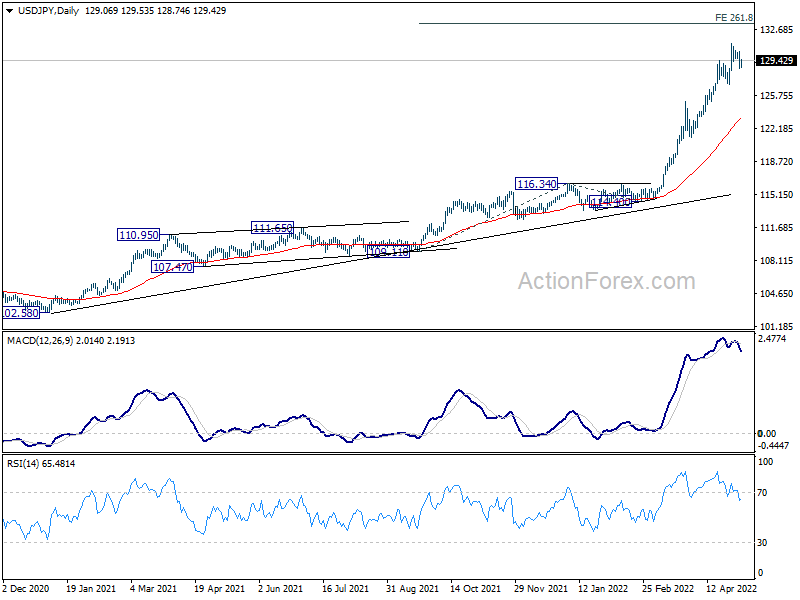
USD/JPY dips notably as correction from 131.24 extends, but stays well above 126.91 support. Near term outlook remains bullish with further rally expected. On the upside, break of 131.24 will resume recent up trend to 261.8% projection of 109.11 to 116.34 from 114.40 at 133.26. However, considering bearish divergence condition in 4 hour MACD, break of 126.91 will confirm short term topping and turn bias back to the downside for 121.27/125.09 support zone.
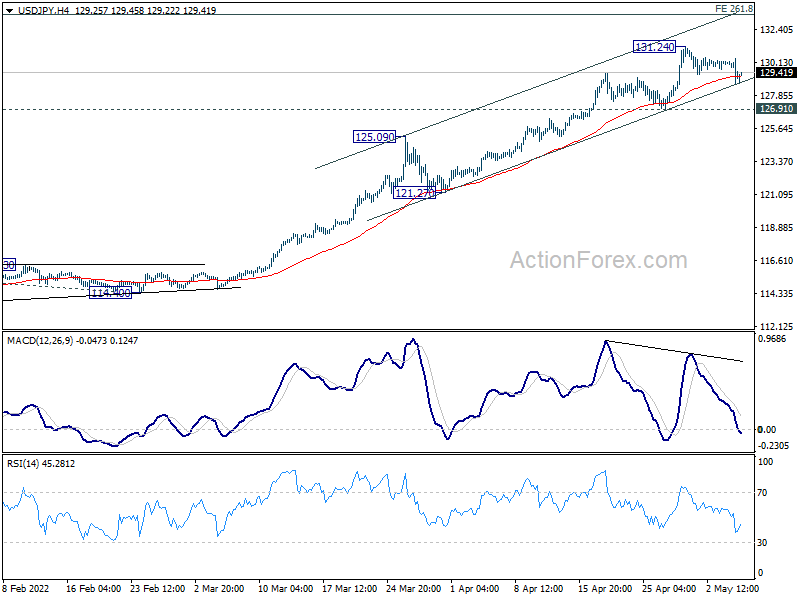
In the bigger picture, current rally is seen as part of the long term up trend form 75.56 (2011 low). Sustained trading above 61.8% projection of 75.56 (2011 low) to 125.85 (2015 high) from 98.97 at 130.04 will pave the way to 100% projection at 149.26, which is close to 147.68 (1998 high). For now, this will remain the favored case as long as 121.27 support holds.
Dollar Down, Stocks Surged after Powell Surprise, BoE Next
Dollar dropped notably overnight after Fed Chair Jerome Powell surprised the markets by ruling out a 75bps rate hike. The comment also boosted US stocks sharply higher. Risk-on sentiment helped commodity currencies rebound. But European majors are lagging behind. Yen is so far mixed, with slight retreat in US 10-year yield. BoE rate decision would provide more volatility to the markets, and non-farm payrolls tomorrow too.
Technically, it's still early to call for a deep correction in Dollar, no to mention a bearish reversal. Nevertheless, AUD/USD's breach of 0.7228 minor resistance suggest short term bottoming. USD/CAD could also break through 1.2717 support to indicate short term topping too. Other levels to watch will include 1.0756 support turned resistance in EUR/USD and 126.91 support in USD/JPY.
In Asia, Japan is on holiday. Hong Kong HSI is up 0.52%. China Shanghai SSE is up 0.76%. Singapore Strait Times is down -0.16%. Overnight, DOW rose 2.81%. S&P 500 rose 2.99%. NASDAQ rose 3.19%. 10-year yield dropped -0.043 to 2.917.
Fed hikes by 50bps, starts balance sheet runoff, highly attentive to inflations risks
Fed raised interest rate target by 50bps to 0.75% to 1.00% as expected. It also announced to start the balance sheet runoff, by USD 95B as expected (USD 60B treasuries and USD 35B MBS). The decision was by unanimous vote.
The FOMC is "highly attentive to inflations risks". The accompany statement noted that the implications of invasion of Ukraine by Russia for US economy are "highly uncertain". " The invasion and related events are creating additional upward pressure on inflation and are likely to weigh on economic activity." Meanwhile, lockdowns in China are "likely to exacerbate supply chain disruptions"
Fed pledged to "adjust the stance of monetary policy as appropriate if risks emerge that could impede the attainment of the Committee's goals".
DOW jumped 2.8% as Fed Powell ruled out 75bps hike
US stocks staged a strong rebound overnight after Fed Chair Jerome Powell ruled out a 75bps hike. In the post-meeting press conference, he clearly said in a rare fashion, "a 75 basis point increase is not something that the committee is actively considering." Traders were swift in adjusting their expectations. Just a day ago, markets were pricing in 99% chance of a 75bps hike in June.
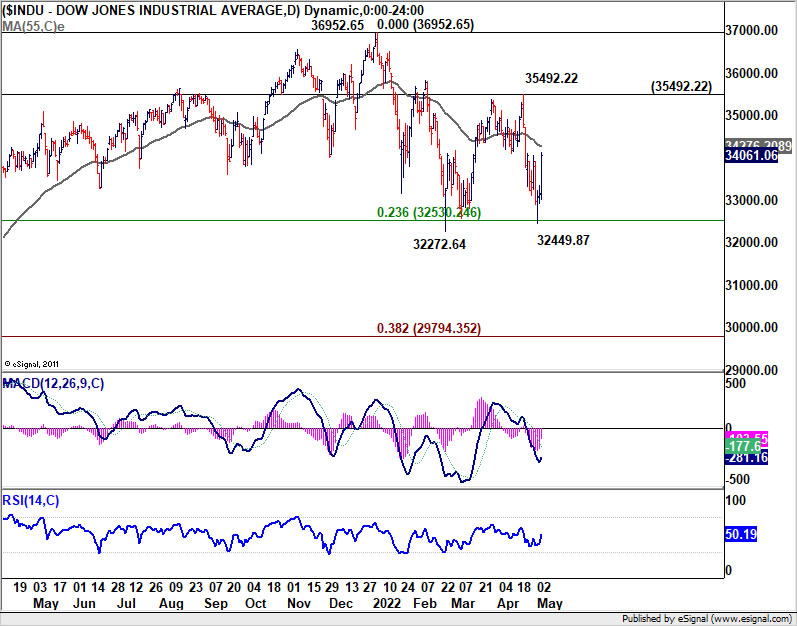
DOW closed up 932.27 pts or 2.81% at 34061.06. Immediate focus is now back on 55 day EMA (at 34276.20). A weekly close above this level will set the base for further rally back to 35492.22 resistance in the near term. Break there will bring retest of 36952.65 high. Overall, while corrective pattern from 36952.65 could still extend for while. The range should have been set in this case.
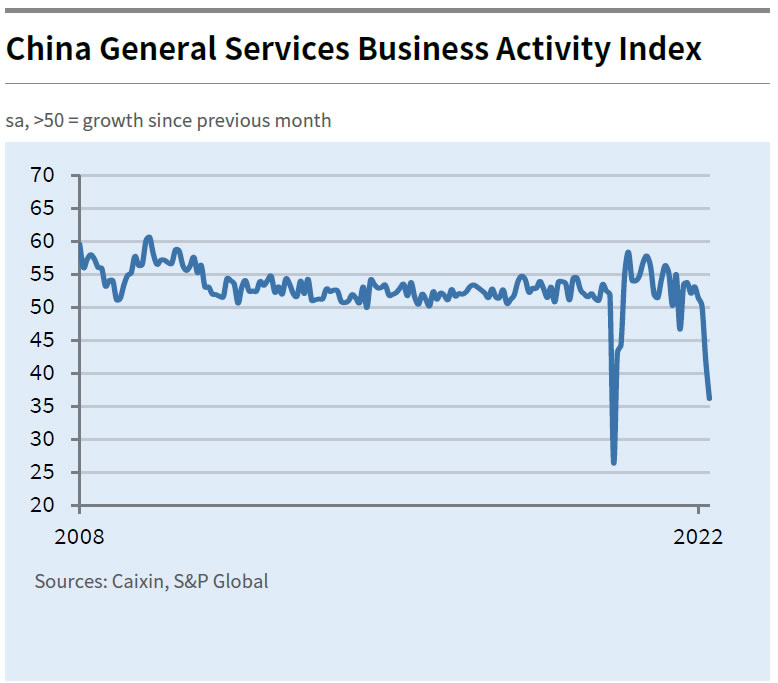
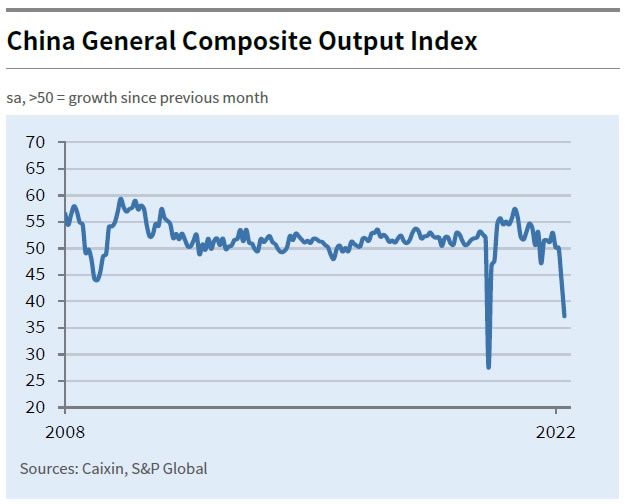
China Caixin PMI services dropped to 36.2 in Apr, PMI composite down to 37.2
China Caixin PMI Services dropped from 42.0 to 36.2 in April, below expectation of 40.9. That's the second straight month of steep decline, and the worst reading since February 2020. Caixin said decline in new business gathered pace but employment fell only slightly. PMI Composite dropped from 43.9 to 37.2, also the worst since the onset of the pandemic.
Wang Zhe, Senior Economist at Caixin Insight Group said: "Overall, in April, local Covid outbreaks continued and activity in the manufacturing and service sectors continued to contract, with services shrinking more. Demand was under pressure, external demand deteriorated, supply shrank, supply chains were disrupted, delivery times were prolonged, backlogs of work grew, workers found it difficult to return to their jobs, inflationary pressures lingered, and market confidence remained below the long-term average."
BoE to hike another 25ps, a look at bearish GBP/AUD
BoE is widely expected to continue with its tightening cycle, and raise Bank rate by 25bps to 1.00% today. Focus is firstly on the voting, on the whether any hawks would push for faster pace of hikes. Secondly, BoE might make a decision to actively shrink its balance sheet. Thirdly the new economic projections will also be scrutinized for the policy path and economic outlook.
Here are some previews:
- BoE Policy Meeting: A Normal Rate Hike Amid Stagflation Fears
- BoE Preview: MPC Won't Deviate Much from Recent Hawkish Path
- BoE Meeting Preview – A Trade-off Between Growth and Inflation
- Bank of England Preview: Another Rate Hike and Active QT
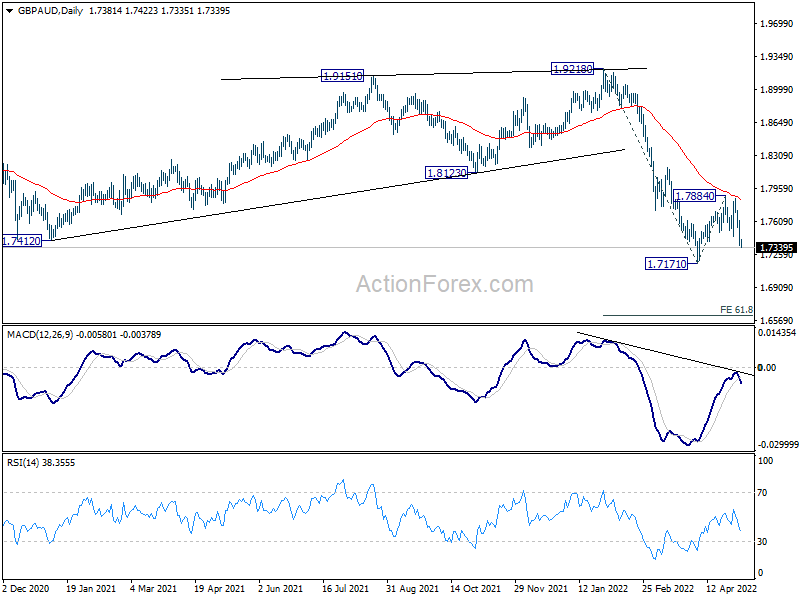
GBP/AUD is a pair to watch for the near term, considering the possible return of risk-on sentiment too. The corrective recovery from 1.7171 might have completed at 1.7884, after failing to break through 55 day EMA. That is, medium term down trend might be ready to resume.
For the near term, deeper decline is in favor to retest 1.7171 support first. Firm break there will confirm this bearish case, and target 61.8% projection of 1.9218 to 1.7171 from 1.7884 at 1.6619. In any case, outlook will stay bearish as long as 1.7884 resistance holds.
Elsewhere
Australia building permits dropped -18.5% mom in March, versus expectation of -12.0% mom. Australia trade surplus widened to AUD 9.31B in March, versus expectation of AUD 7.80B. Germany factor orders dropped -4.7% in March, versus expectation of -0.5%.
Swiss CPI, France industrial output, UK PMI services will be released in European session. later in the day, US will release jobless claims and non-farm productivity.
USD/JPY Daily Outlook
Daily Pivots: (S1) 129.79; (P) 130.04; (R1) 130.38; More...
USD/JPY dips notably as correction from 131.24 extends, but stays well above 126.91 support. Near term outlook remains bullish with further rally expected. On the upside, break of 131.24 will resume recent up trend to 261.8% projection of 109.11 to 116.34 from 114.40 at 133.26. However, considering bearish divergence condition in 4 hour MACD, break of 126.91 will confirm short term topping and turn bias back to the downside for 121.27/125.09 support zone.
In the bigger picture, current rally is seen as part of the long term up trend form 75.56 (2011 low). Sustained trading above 61.8% projection of 75.56 (2011 low) to 125.85 (2015 high) from 98.97 at 130.04 will pave the way to 100% projection at 149.26, which is close to 147.68 (1998 high). For now, this will remain the favored case as long as 121.27 support holds.
Economic Indicators Update
| GMT | Ccy | Events | Actual | Forecast | Previous | Revised |
|---|---|---|---|---|---|---|
| 01:30 | AUD | Building Permits M/M Mar | -18.50% | -12.00% | 43.50% | 42.00% |
| 01:30 | AUD | Trade Balance (AUD) Mar | 9.31B | 7.80B | 7.46B | 7.44B |
| 01:45 | CNY | Caixin Services PMI Apr | 36.2 | 40.9 | 42 | |
| 06:00 | EUR | Germany Factory Orders Mar | -4.70% | -0.50% | -2.20% | -0.80% |
| 06:30 | CHF | CPI M/M Apr | 0.20% | 0.60% | ||
| 06:30 | CHF | CPI Y/Y Apr | 2.50% | 2.40% | ||
| 06:45 | EUR | France Industrial Output M/M Mar | 0.00% | -0.90% | ||
| 08:30 | GBP | Services PMI Apr F | 58.3 | 58.3 | ||
| 11:00 | GBP | BoE Interest Rate Decision | 1.00% | 0.75% | ||
| 11:00 | GBP | MPC Official Bank Rate Votes | 8--0--1 | 8--0--1 | ||
| 11:30 | USD | Challenger Job Cuts Y/Y Apr | -30.10% | |||
| 12:30 | USD | Initial Jobless Claims (Apr 29) | 176K | 180K | ||
| 12:30 | USD | Nonfarm Productivity Q1 P | -2.30% | 6.60% | ||
| 12:30 | USD | Unit Labor Costs Q1 P | 7.40% | 0.90% | ||
| 14:30 | USD | Natural Gas Storage | 69B | 40B |
Technical Outlook and Review
DXY:
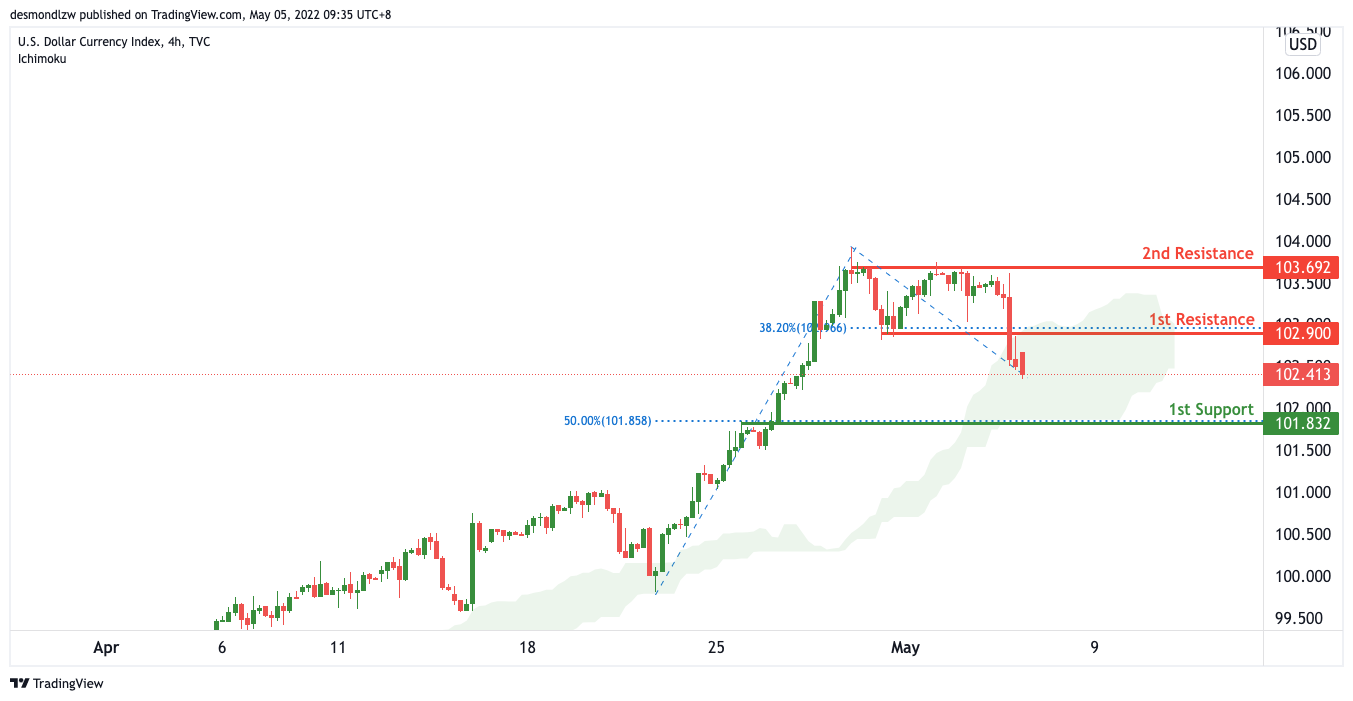
On the H4, with price expected to reverse off the ichimoku cloud resistance, we have a bearish bias that price will drop from our 1st resistance at 102.900 where the 38.2% Fibonacci retracement and pullback resistance is to our 1st support at 101.832 in line with the 50% Fibonacci retracement. Alternatively, price may break 1st resistance structure and head for 2nd resistance where the horizontal swing high resistance is.
Areas of consideration:
- H4 time frame, 1st resistance at 102.900
- H4 time frame, 1st support at 101.832
XAU/USD (GOLD):
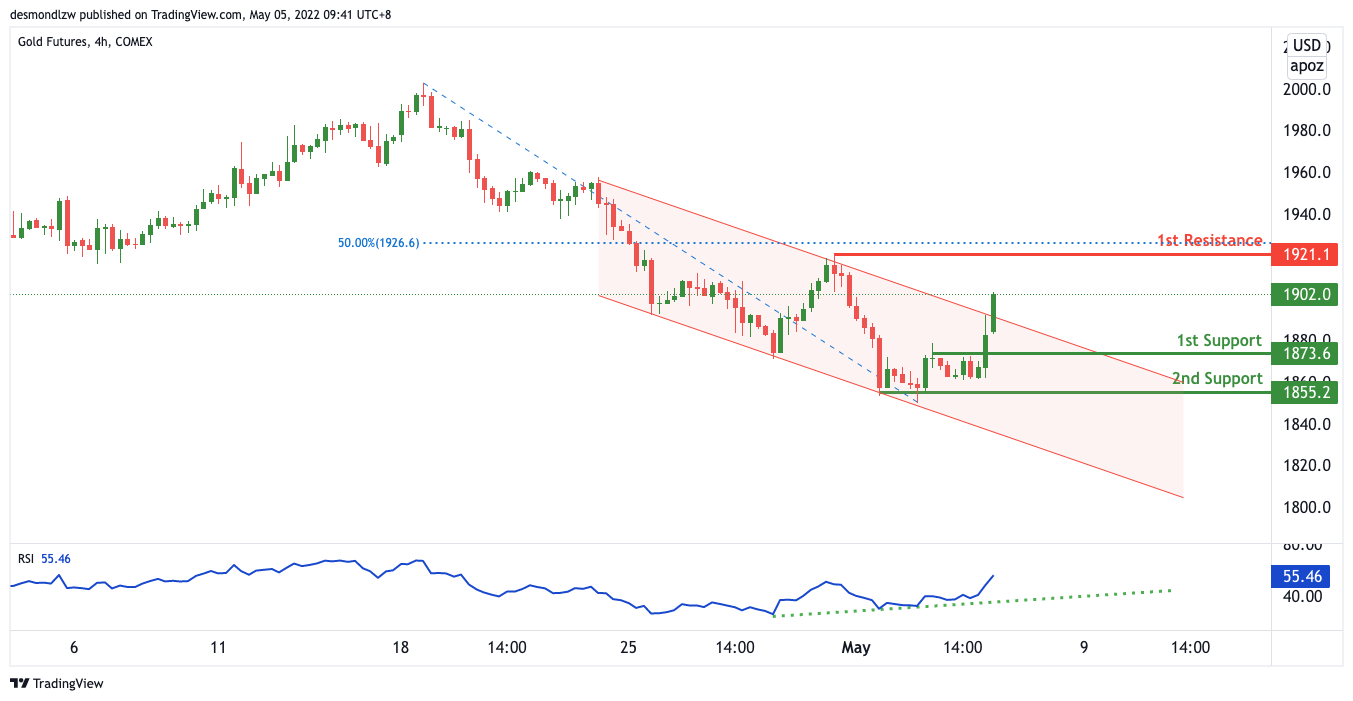
On the H4, with price moving above the stochastics indicator support, we have a bullish bias that price will rise to our 1st resistance at 1921 where the swing high resistance is from our 1st support at 1873 in line with the horizontal pullback support. Alternatively, price may break 1st support structure and head for 2nd support where the horizontal swing low support is.
Areas of consideration:
- H4 time frame, 1st Resistance at 1921
- H4 time frame, 1st Support at 1873
GBP/USD:
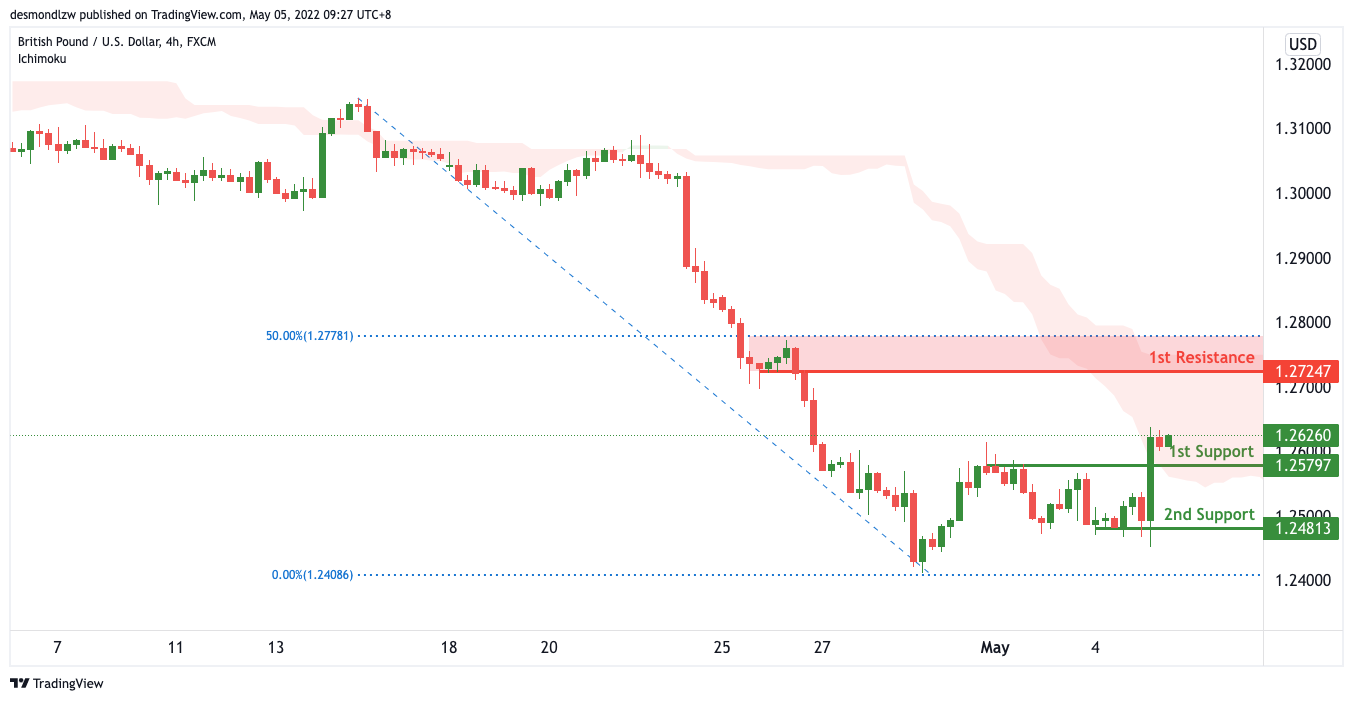
On the H4, with price expected to bounce off the ichimoku cloud, we have a bullish bias that price will rise to our 1st resistance at 1.27247 where the swing high resistance and 50% Fibonacci retracement is from our 1st support at 1.25797 in line with the horizontal pullback support. Alternatively, price may break 1st support structure and head for 2nd support where the horizontal swing low support is.
Areas of consideration:
- H4 1st resistance at 1.27247
- H4 1st support at 1.25797
USD/CHF:
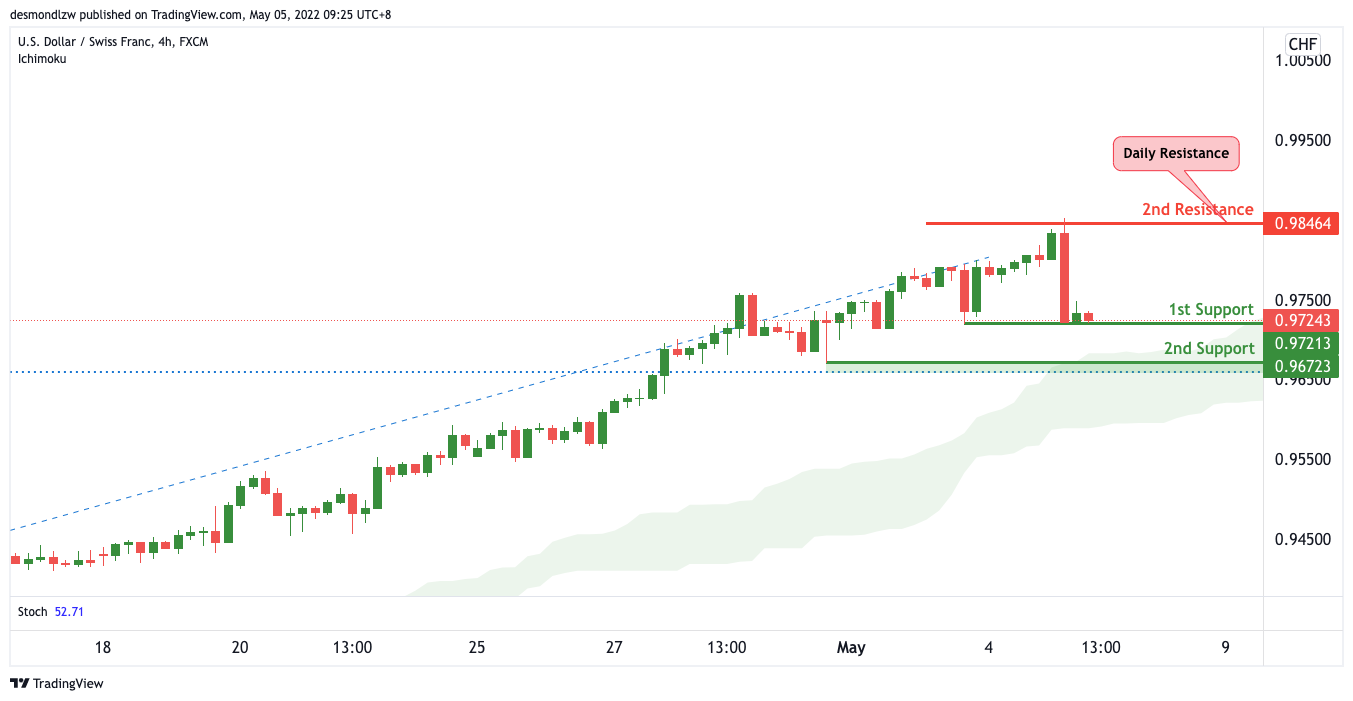
On the H4, with price moving above the ichimoku cloud, we have a bullish bias that price will rise to our 1st resistance at 0.98464 where the daily resistance is from our 1st support at 0.97213 in line with the horizontal swing low support. Alternatively, price may break 1st support structure and head for 2nd support where the horizontal swing low support is.
Areas of consideration
- 1st support level at 0.97213
- 1st resistance level at 0.98464
EUR/USD :
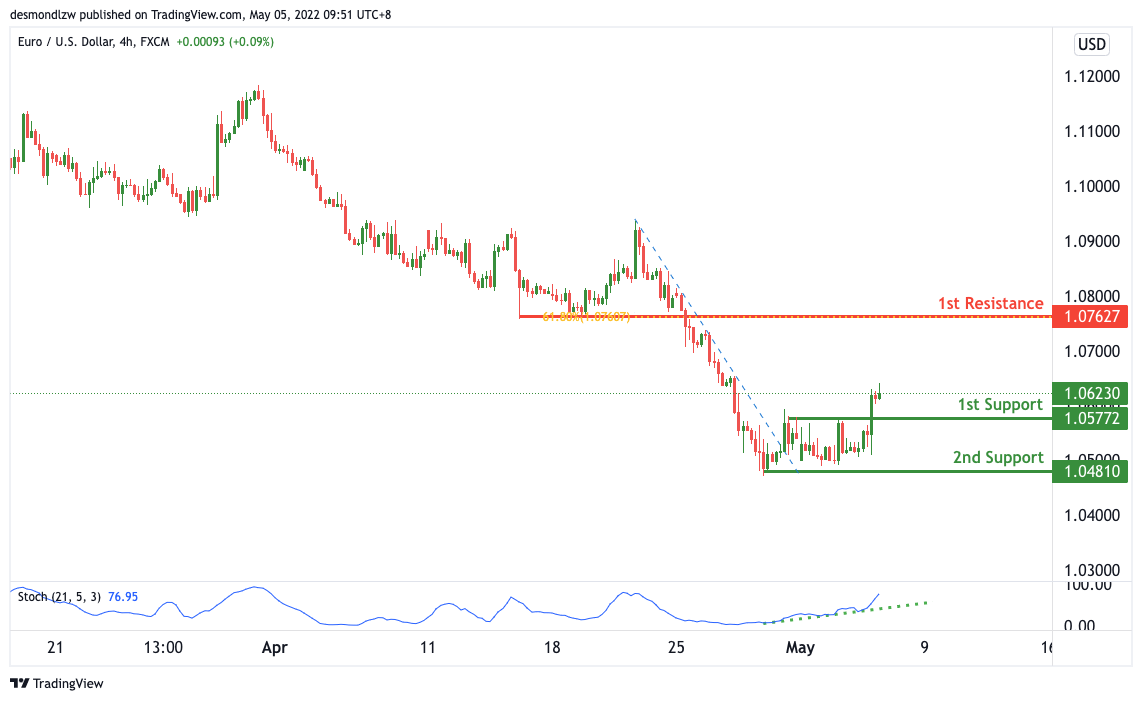
On the H4, with price moving above the ichimoku cloud, we have a bullish bias that price will rise to our 1st resistance at 1.07627 where the 61.8% Fibonacci retracement is from our 1st support at 1.05772 in line with the horizontal pullback support. Alternatively, price may break 1st support structure and head for 2nd support where the horizontal swing low support is.
Areas of consideration :
- H4 1st resistance at 1.07627
- H4 1st support at 1.05772
USD/JPY:
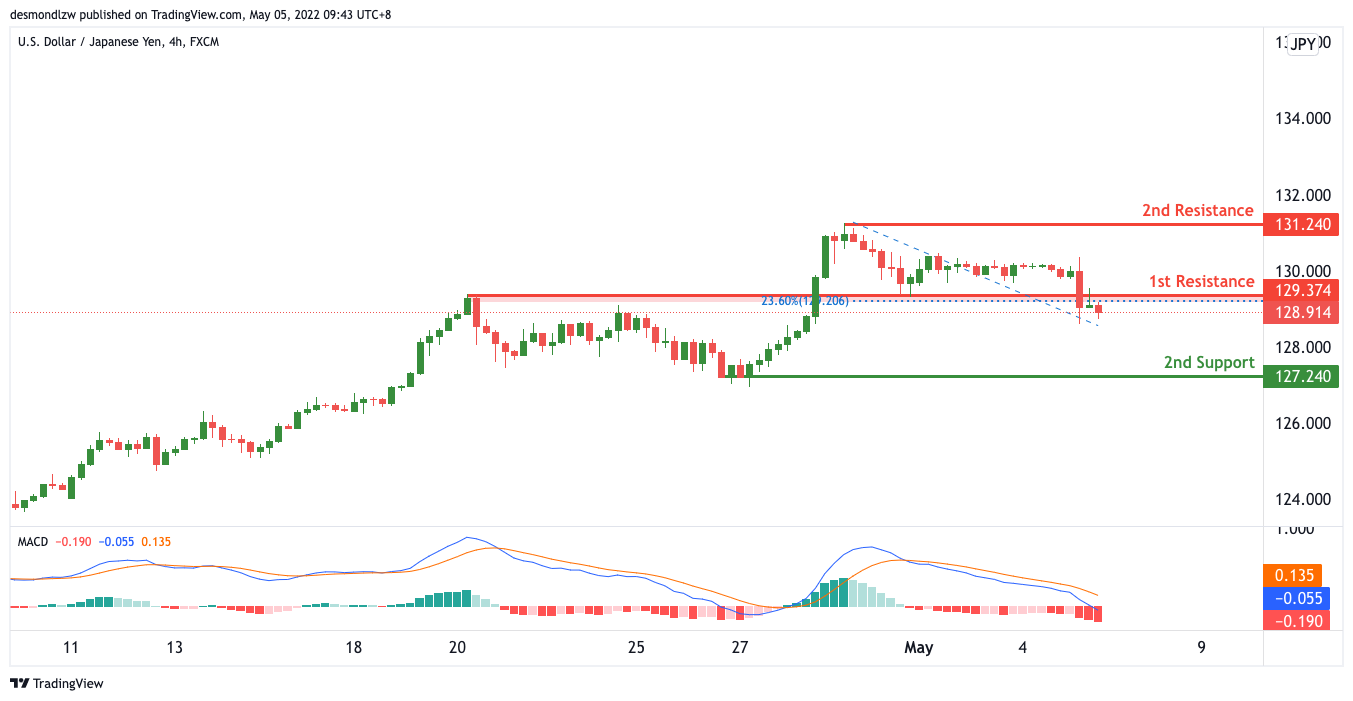
On the H4, with the MACD indicating bearishness, we have a bearish bias that price will drop from our 1st resistance at 129.374 where the 23.6% Fibonacci retracement and pullback resistance is to our 1st support at 127.240 in line with the horizontal swing low support. Alternatively, price may break 1st resistance structure and head for 2nd resistance where the horizontal swing high resistance is.
Areas of consideration:
- H4 time frame, 1st resistance at 129.374
- H4 time frame, 1st support at 127.240
AUD/USD:
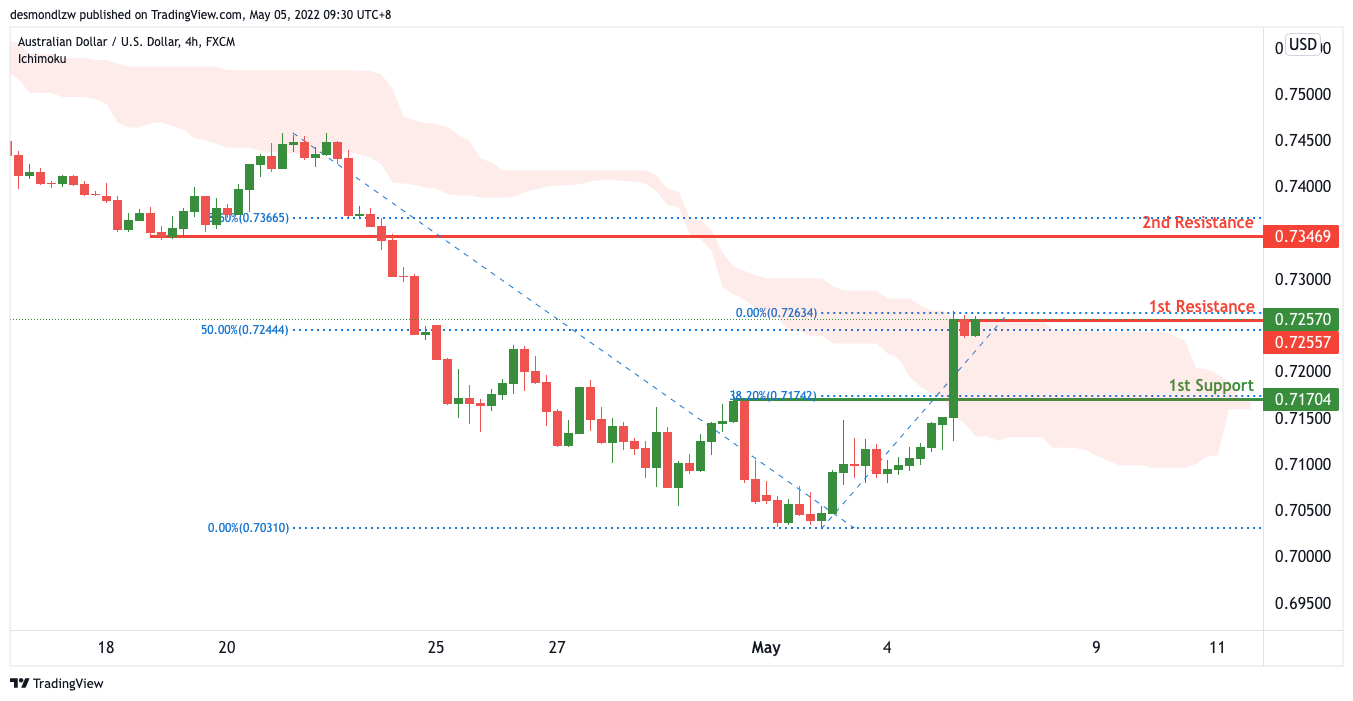
On the H4, with price expected to reverse off the ichimoku cloud, we have a bearish bias that price will drop from our 1st resistance at 0.72570 where the 50% Fibonacci retracement is to our 1st support at 0.71704 in line with the horizontal pullback support. Alternatively, price may break 1st resistance structure and head for 2nd resistance where the horizontal pullback resistance is.
Areas of consideration
- H4 1st resistance at 0.72570
- H4 1st support at 0.71704
NZD/USD:
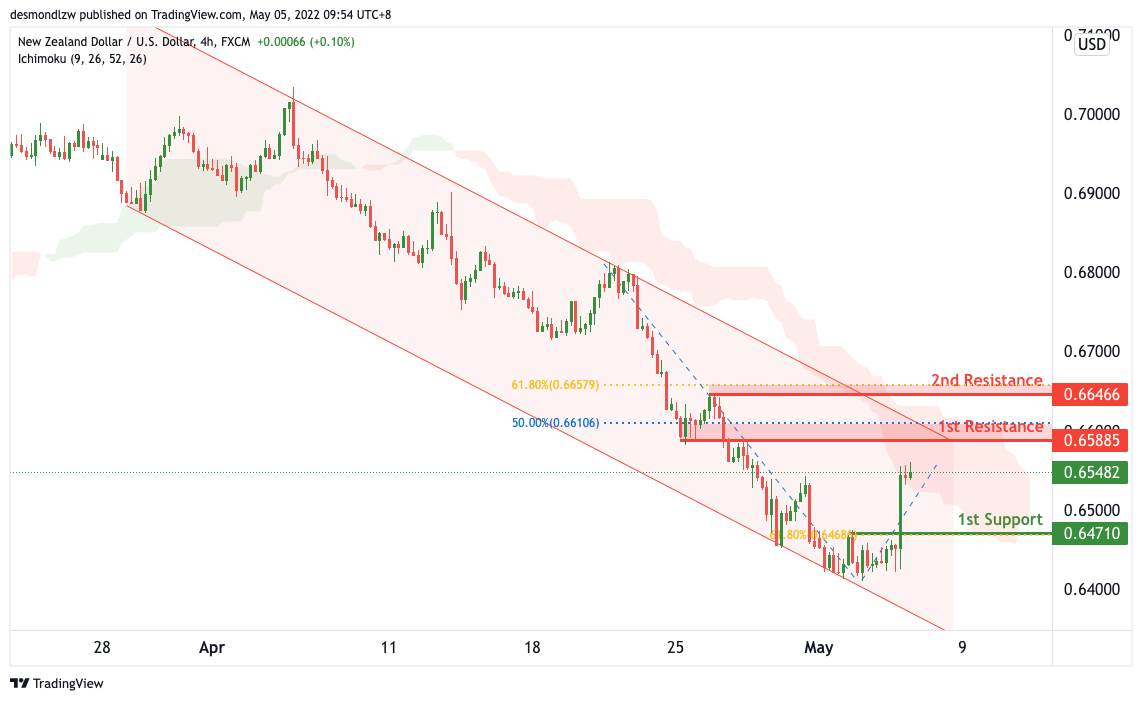
On the H4, with price moving below the ichimoku cloud, we have a bearish bias that price will drop from our 1st resistance at 0.65885 where the 50% Fibonacci retracement is to our 1st support at 0.64710 in line with the horizontal pullback support. Alternatively, price may break 1st resistance structure and head for 2nd resistance where the horizontal swing high resistance and 61.8% Fibonacci retracement is.
Areas of consideration:
- H4 time frame, 1st support at 0.64197 0.64710
- H4 time frame, 1st resistance at 0.65885
USD/CAD:
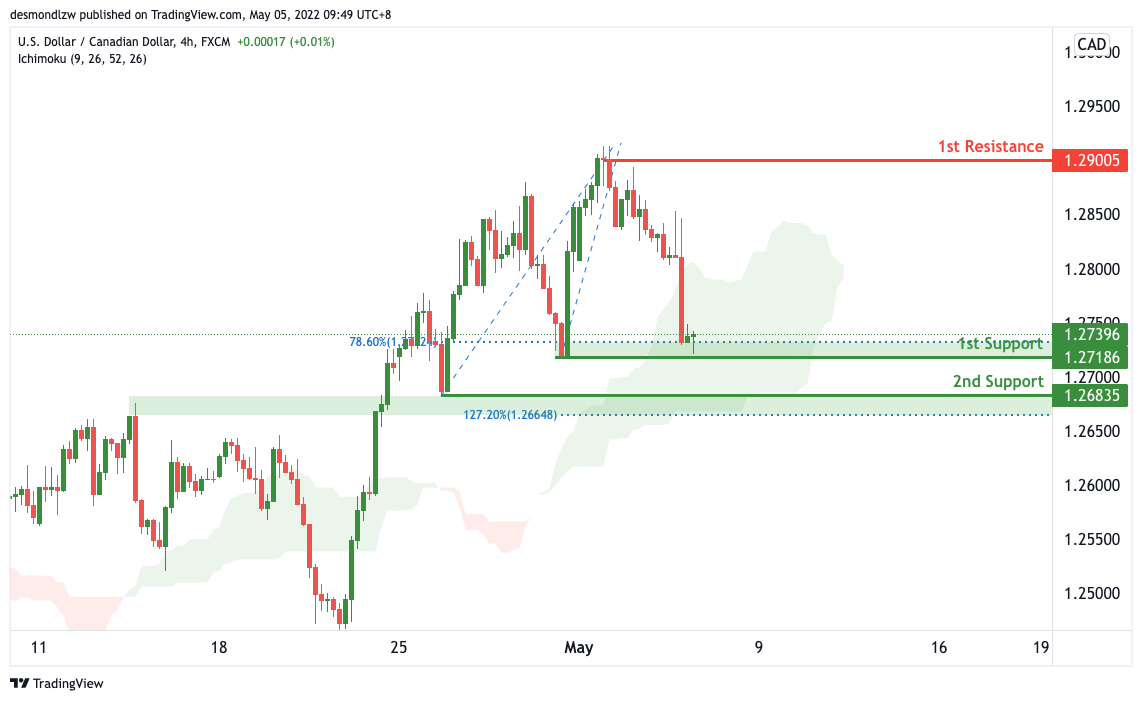
On the H4, with price expected to bounce off the ichimoku cloud where the 78.6% Fibonacci retracement and horizontal swing low is, we have a bullish bias that price will rise to our 1st resistance at 1.29005 where the swing high resistance is from our 1st support at 1.27186 in line with the horizontal swing low support and 78.6% Fibonacci retracement. Alternatively, price may break 1st support structure and head for 2nd support where the horizontal pullback support is.
Areas of consideration:
- H4 time frame, 1st resistance at 1.29005
- H4 time frame, 1st support at 1.27186
OIL:
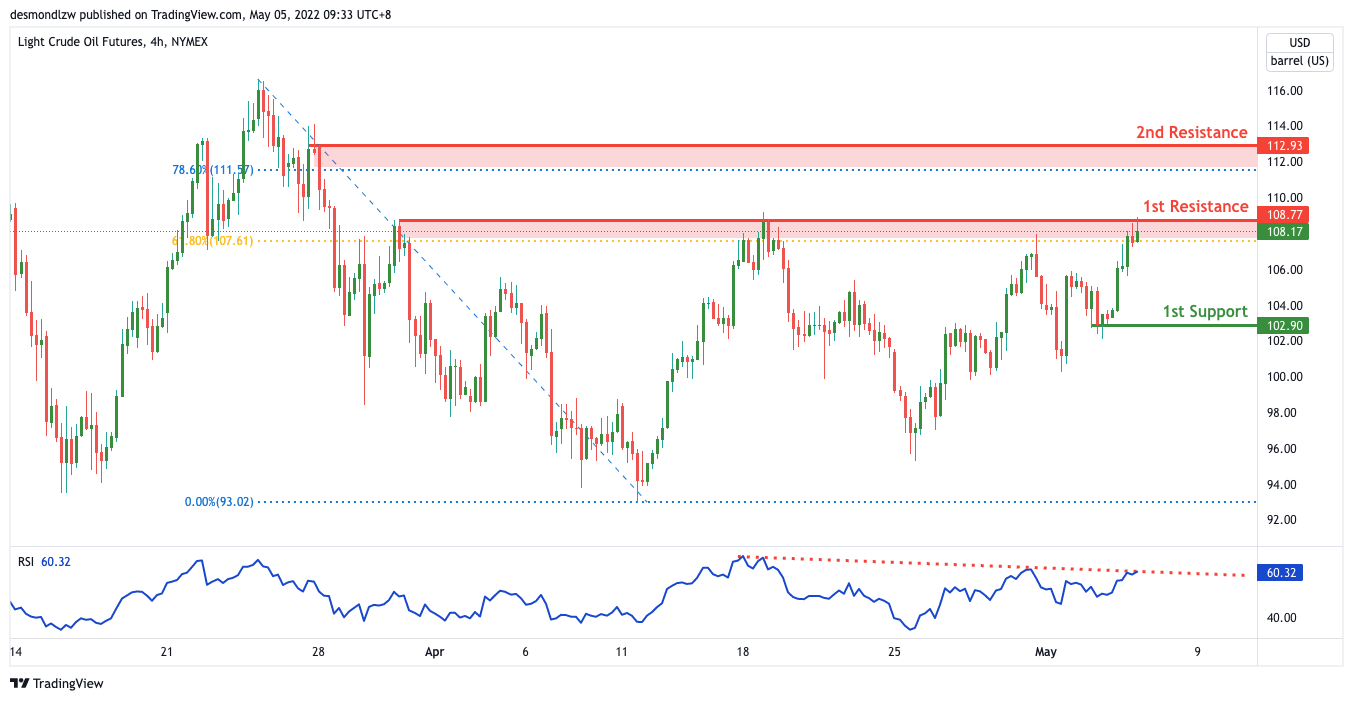
On the H4, with price expected to reverse off the stochastics indicator, we have a bearish bias that price will drop from our 1st resistance at 108.17 where the 61.8% Fibonacci retracement and swing high resistance is to our 1st support at 102.90 in line with the horizontal swing low support. Alternatively, price may break 1st resistance structure and head for 2nd resistance where the horizontal pullback resistance is.
Areas of consideration:
- H4 time frame, 1st resistance of 108.17
- H4 time frame, 1st support of 102.90
Dow Jones Industrial Average:
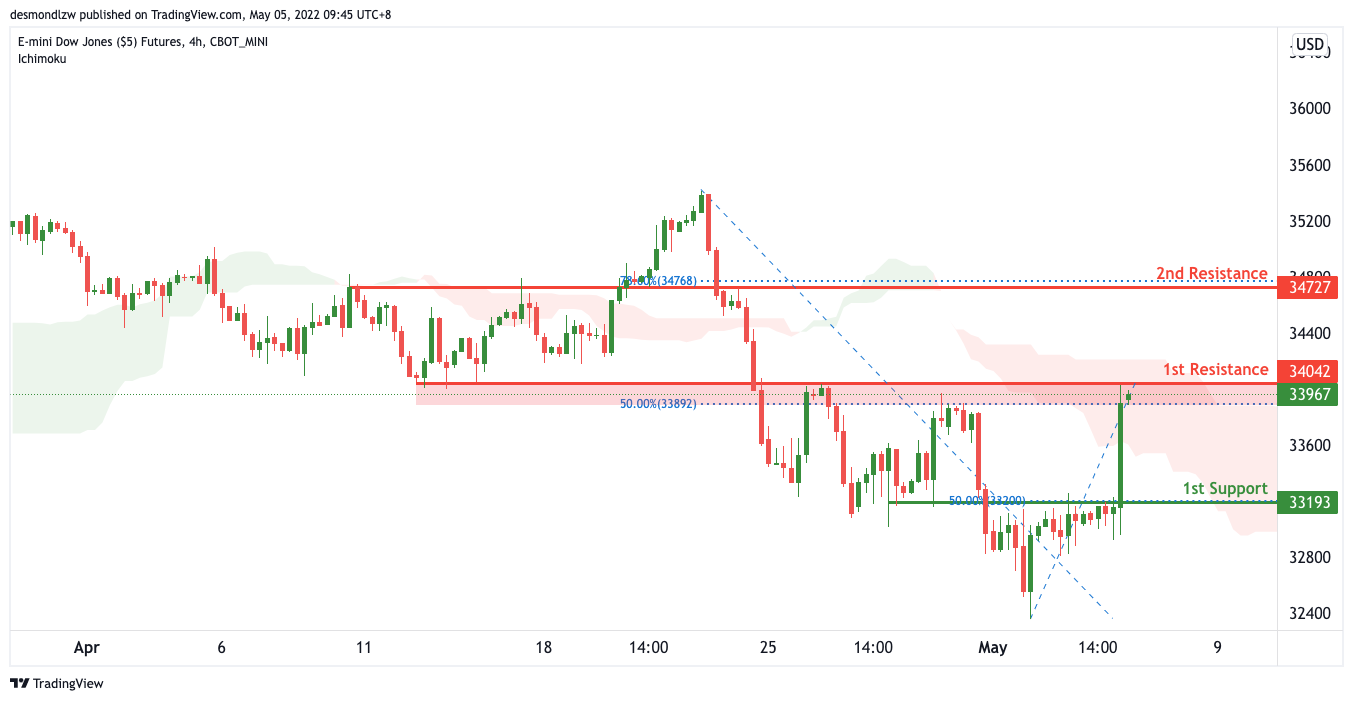
On the H4, with price expected to reverse off the ichimoku cloud, we have a bearish bias that price will drop from our 1st resistance at 34042 where the horizontal pullback resistance and 50% Fibonacci retracement is to our 1st support at 33193 in line with the 50% Fibonacci retracement. Alternatively, price may break 1st resistance structure and head for 2nd resistance where the horizontal pullback resistance and 38.2% Fibonacci retracement.
Areas of consideration :
- H4 time frame, 1st resistance at 34042
- H4 time frame, 1st support at 33193
BoE to hike another 25ps, a look at bearish GBP/AUD
BoE is widely expected to continue with its tightening cycle, and raise Bank rate by 25bps to 1.00% today. Focus is firstly on the voting, on the whether any hawks would push for faster pace of hikes. Secondly, BoE might make a decision to actively shrink its balance sheet. Thirdly the new economic projections will also be scrutinized for the policy path and economic outlook.
Here are some previews:
- BoE Policy Meeting: A Normal Rate Hike Amid Stagflation Fears
- BoE Preview: MPC Won't Deviate Much from Recent Hawkish Path
- BoE Meeting Preview – A Trade-off Between Growth and Inflation
- Bank of England Preview: Another Rate Hike and Active QT
GBP/AUD is a pair to watch for the near term, considering the possible return of risk-on sentiment too. The corrective recovery from 1.7171 might have completed at 1.7884, after failing to break through 55 day EMA. That is, medium term down trend might be ready to resume.
For the near term, deeper decline is in favor to retest 1.7171 support first. Firm break there will confirm this bearish case, and target 61.8% projection of 1.9218 to 1.7171 from 1.7884 at 1.6619. In any case, outlook will stay bearish as long as 1.7884 resistance holds.
China Caixin PMI services dropped to 36.2 in Apr, PMI composite down to 37.2
China Caixin PMI Services dropped from 42.0 to 36.2 in April, below expectation of 40.9. That's the second straight month of steep decline, and the worst reading since February 2020. Caixin said decline in new business gathered pace but employment fell only slightly. PMI Composite dropped from 43.9 to 37.2, also the worst since the onset of the pandemic.
Wang Zhe, Senior Economist at Caixin Insight Group said: "Overall, in April, local Covid outbreaks continued and activity in the manufacturing and service sectors continued to contract, with services shrinking more. Demand was under pressure, external demand deteriorated, supply shrank, supply chains were disrupted, delivery times were prolonged, backlogs of work grew, workers found it difficult to return to their jobs, inflationary pressures lingered, and market confidence remained below the long-term average."
DOW jumped 2.8% as Fed Powell ruled out 75bps hike
US stocks staged a strong rebound overnight after Fed Chair Jerome Powell ruled out a 75bps hike. In the post-meeting press conference, he clearly said in a rare fashion, "a 75 basis point increase is not something that the committee is actively considering." Traders were swift in adjusting their expectations. Just a day ago, markets were pricing in 99% chance of a 75bps hike in June.
DOW closed up 932.27 pts or 2.81% at 34061.06. Immediate focus is now back on 55 day EMA (at 34276.20). A weekly close above this level will set the base for further rally back to 35492.22 resistance in the near term. Break there will bring retest of 36952.65 high. Overall, while corrective pattern from 36952.65 could still extend for while. The range should have been set in this case.
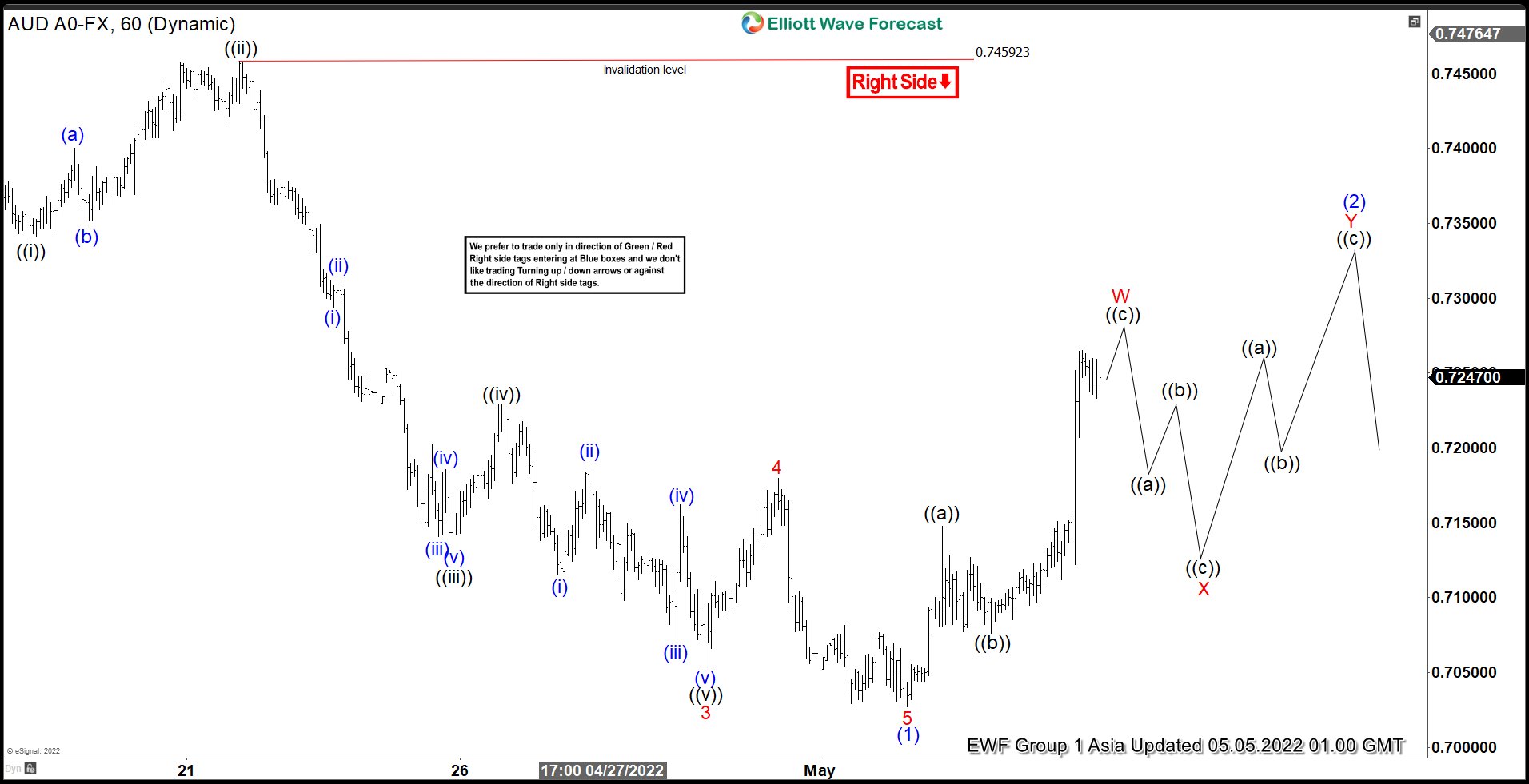
Elliott Wave View: AUDUSD Rally is Likely Just a Counter Trend
Short Term Elliott Wave View in AUDUSD suggests cycle from April 5 high ended at 0.7027 in wave (1). Down from April 5 high, wave 1 ended at 0.7396 and rally in wave 2 ended at 0.7493. Pair then extends lower in wave 3 towards 0.705, and rally in wave 4 ended at 0.718. Final leg lower wave 5 ended at 0.7027 which completed wave (1). Wave (2) rally is currently in progress as a double three Elliott Wave structure.
Up from wave (1), wave ((a)) ended at 0.7147 and pullback in wave ((b)) ended at 0.7076. Expect wave ((c)) to end soon and this should complete wave W. Pair should then pullback in wave X in 3 swing before it turns higher in wave Y as another 3 swing zigzag structure. At this point, we can’t use Fibonacci extension to measure the potential target for wave (2) as we don’t have wave W and X fully formed yet. We could use Fibonacci retracement of wave (1) to estimate target for wave (2). A 50% – 76.4% retracement of wave (1) comes at 0.734 – 0.751 where wave (2) may be complete. Near term, as far as pivot at 0.7658 high stays intact, expect rally to fail in 3, 7, 11 swing for further downside.
AUDUSD 60 Minutes Elliott Wave Chart
FOMC Steps Up the Pace of Monetary Tightening
Summary
- As universally expected, the FOMC raised its target range for the federal funds rate by 50 bps today. The range now spans 0.75% to 1.00%.
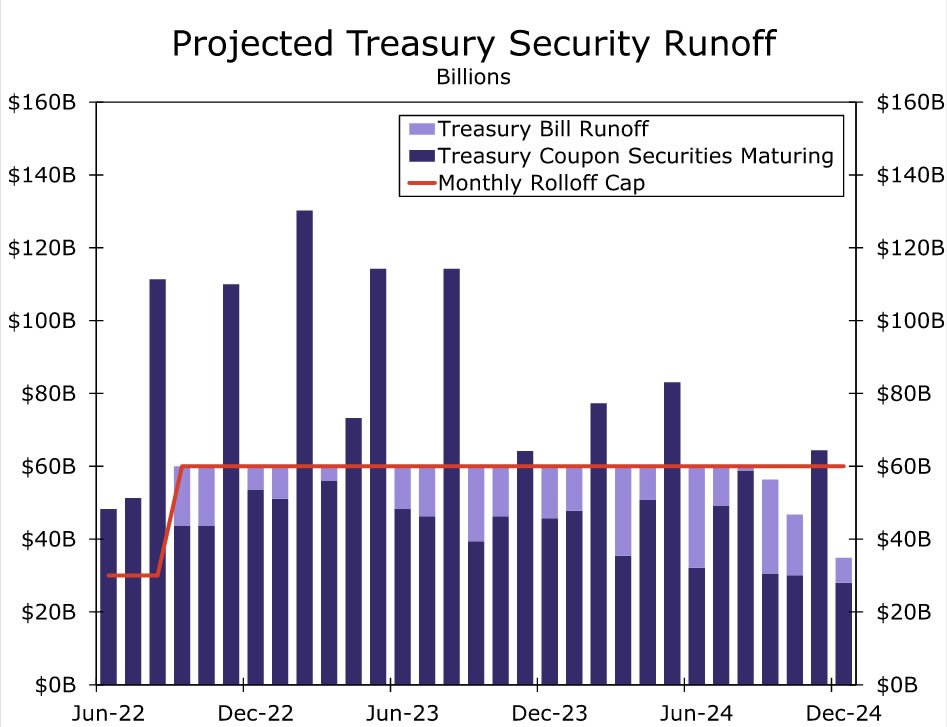
- The Committee also announced a plan to begin shrinking the Fed's balance sheet. Specifically, it will allow up to $30 billion worth of Treasury securities and up to $17.5 billion worth of MBS to roll off the balance sheet starting on June 1.
- These caps will be in place for three months. Starting in September, the monthly caps will jump to $60 billion and $35 billion, respectively.
- We did not read the statement as overly hawkish. The Committee remains concerned about inflation, and characterized it as "elevated." But it also noted that the conflict between Russia and Ukraine is "likely to weigh on economic activity."
- In his post-meeting press conference, Chair Powell said that a 75 bps rate hike is "not something the Committee is actively considering." But he also said there is a "broad sense" that 50 bps are on the table for the next "couple" of meetings.
- Unless the economic outlook changes materially over the next six weeks, a 50 bps rate hike at the June 14-15 FOMC meeting seems all but assured. Thereafter, the outlook for rate hikes will depend increasingly on incoming data.
FOMC Delivers on Its Widely Anticipated 50 bps Rate Hike
As universally expected, the Federal Open Market Committee raised its target range by 50 bps at the conclusion of today's policy meeting. The decision to raise the target range, which now spans 0.75% to 1.00%, was unanimously supported by all ten voting members of the Committee. The FOMC shrugged off the modest decline in real GDP that occurred in Q1-2022 and instead focused on the fact that "household spending and business fixed investment remained strong." The statement went on to say "job gains have been robust in recent months, and the unemployment rate has declined substantially." In other words, the FOMC does not seem to be overly concerned at present about the state of real economic activity. But the Committee is resolute in its aim to bring down inflation, noting it is "highly attentive to inflation risks." The FOMC continues to characterize inflation as "elevated" due to "supply and demand imbalances related to the pandemic, higher energy prices, and broader price pressures."
The Committee also announced steps to start reducing the size of the Fed's balance sheet, which currently stands at $8.9 trillion. Starting on June 1, the Federal Reserve will allow up to $30 billion worth of Treasury securities to roll off the central bank's balance sheet for the following three months (Figure 1). The Fed will also allow up to $17.5 billion worth of mortgage-backed securities (MBS) to roll off the balance sheet. These caps are a bit below our expectations of $40 billion and $25 billion, respectively. The FOMC's plan is then to increase the size of the monthly caps to $60 billion and $35 billion, respectively, beginning in September, and to maintain the monthly caps at those levels for an indefinite period of time. These terminal caps of $60 billion and $35 billion were in line with our expectations.
There was no "dot plot" released after today's meeting—the Committee publishes its Summary of Economic Projections (SEP) only in March, June, September and December—so there was no explicit reference to the FOMC's current thinking regarding the pace of tightening going forward. In our view, the statement was rather balanced, and we do not think that it signals an even more rapid pace of tightening than what many observers anticipate. Yes, the Committee noted that inflation is "elevated" due, at least in part, to "demand imbalances." Higher rates can help to moderate growth in aggregate demand. But the FOMC also said that "the implications for the U.S. economy" from "the invasion of Ukraine by Russia ... are highly uncertain." Not only are these developments "creating additional upward pressure on inflation," but they are likely to weigh on economic activity. The statement also said that the "COVID-related lockdowns in China are likely to exacerbate supply chain disruptions."
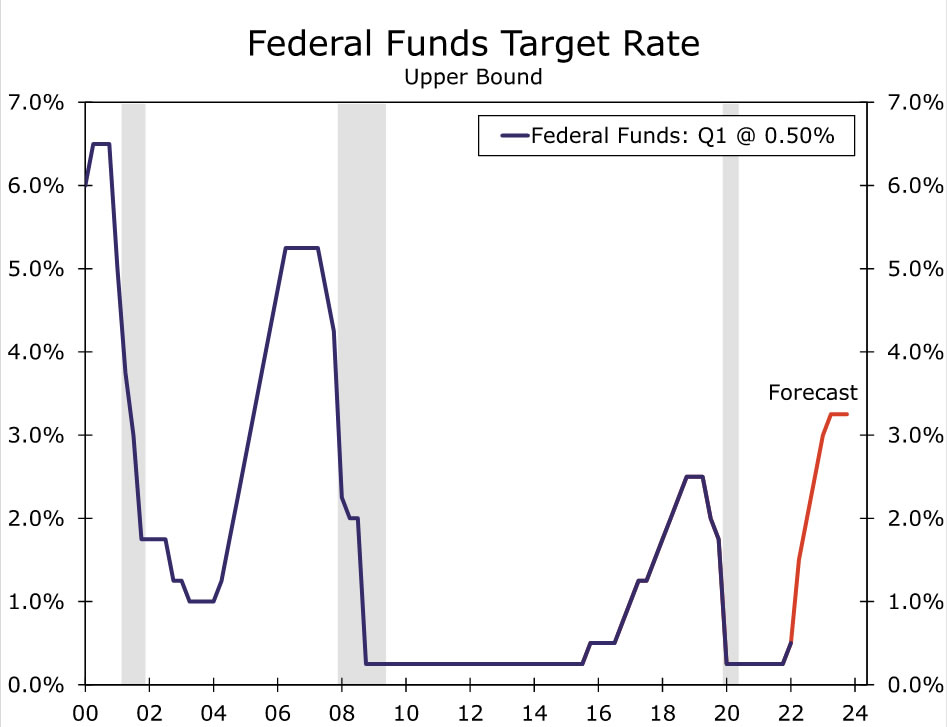
The bottom line is that the FOMC likely will be hiking rates further. Indeed, it explicitly said that further tightening "will be appropriate." In our view, another 50 bps rate hike at the June 14-15 FOMC meeting is all but assured, unless the economic outlook changes materially over the next six weeks. Thereafter, the pace of tightening will start to depend more on incoming data. We currently project that the FOMC will increase its target range for the fed funds rate by 25 bps at the July 26-27 meeting (Figure 2). But with the market fully priced for a 50 bps rate hike at that meeting, we acknowledge that the risks to our current outlook are skewed to the upside. In that regard, Chair Powell noted in his post-meeting press conference that a 75 bps rate hike is "not something the Committee is actively considering," but there is a "broad sense" that 50 bps are on the table for the next "couple" of meetings. Stay tuned.