Sample Category Title
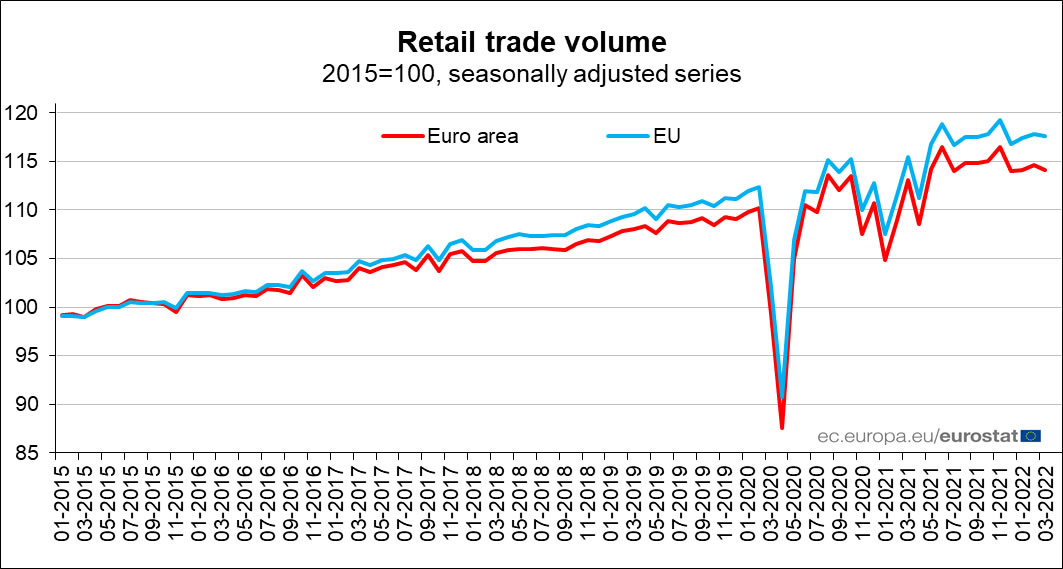
US goods and services trade deficit widened to USD 109.8B in Mar
US goods and services exports rose 5.6% mom to USD 241.7B in March. Imports rose 10.3% mom to USD 351.5B. Trade deficit widened from USD 89.2B to USD 109.8B, larger than expectation of USD 106.6B.
Deficit with China increased USD 7.4B to USD 48.6B. Deficit with Canada increased USD 3.7B to USD 10.3B in March. Deficit with the European Union decreased USD 1.3B to USD 15.6 B.
Dow Jones Wave Analysis
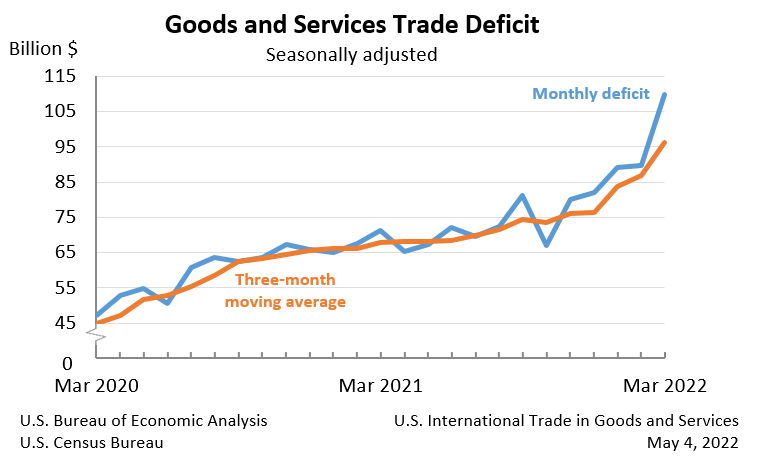
- Dow Jones reversed from support level 32460.00
- Likely to rise to resistance level 35000.00
Dow Jones recently reversed up from the key support level 32460.00 (which has been reversing the index from the start of this year), standing near the lower weekly Bollinger Band.
The support area near the support level 32460.00 was further strengthened by the 38.2% Fibonacci correction of the weekly upward impulse from 2020.
Given the clear weekly uptrend – Dow Jones can be expected to rise further toward the next resistance level 35000.00.
USDCAD Wave Analysis
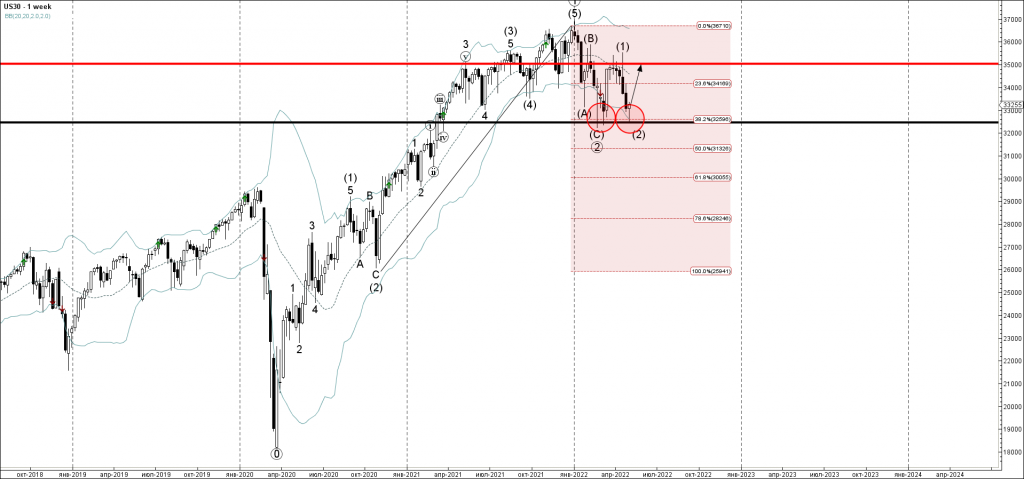
- USDCAD reversed from key resistance level 1.2890
- Likely to fall to support level 1.2750
USDCAD recently reversed down strongly from the key resistance level 1.2890 (which has been reversing the price from last August), standing near the upper daily Bollinger Band.
The downward reversal from resistance level 1.2890 stopped the previous short-term impulse wave 3 of the impulse wave (3) from April.
Given the strength of the aforementioned resistance level 1.2890 , overbought daily Stochastic – USDCAD can be expected to fall further toward the next support level 1.2750
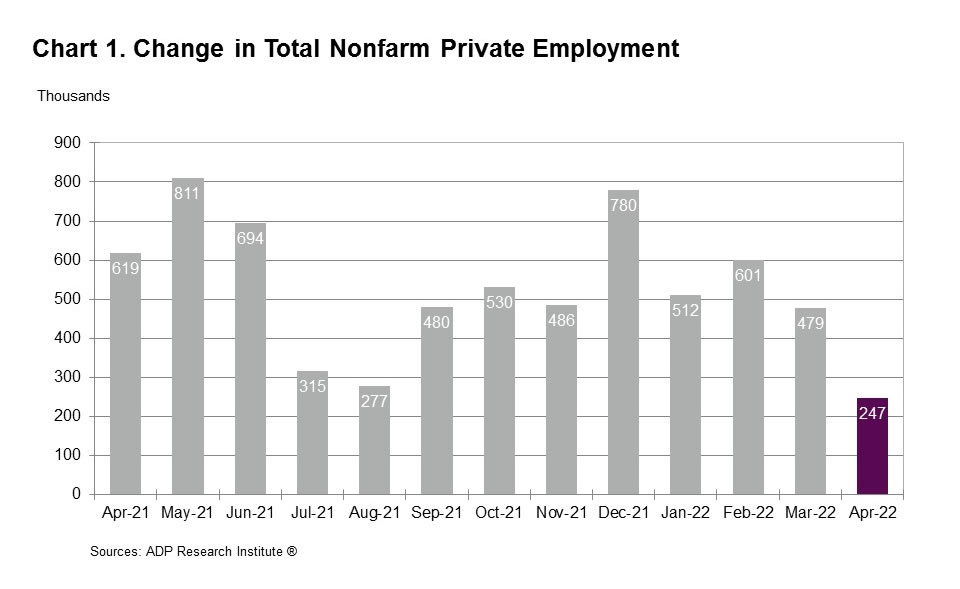
US ADP jobs grew 247k only, recovery showed signs of slowing
US ADP private employment grew 247k only in April, well below expectation of 370k. By company size, small businesses lost -120k jobs. Medium businesses added 46k jobs. Large businesses added 321k jobs. By sector goods-producing jobs grew 46k. Service-providing jobs grew 202k.
"In April, the labor market recovery showed signs of slowing as the economy approaches full employment," said Nela Richardson, chief economist, ADP. "While hiring demand remains strong, labor supply shortages caused job gains to soften for both goods producers and services providers. As the labor market tightens, small companies, with fewer than 50 employees, struggle with competition for wages amid increased costs."
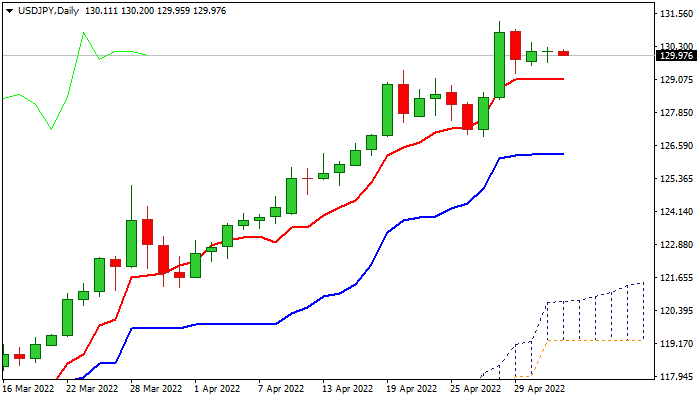
USD/JPY Outlook: Bulls May Accelerate on Clear Break of 130 Pivot, Fed Eyed for Fresh Signal
Bulls are taking a breather after a massive 13% advance in past two months cracked psychological 130 barrier but failed to register a monthly close above here.
Consolidation should be ideally contained by sideways-turned daily Tenkan-sen (129.09) to keep bulls intact for push through pivots at 130.00 and 130.65 (psychological / Fibo 76.4% of 147.68/75.55 bear-phase) and acceleration towards 2002 peak at 135.16.
Fed’s policy meeting is key risk event and decision is likely to spark fresh advance of the dollar, if the central bank maintains its hawkish stance for a several rate hikes in coming months.
However, deeper pullback on profit-taking from dollar’s 20-year high, remains on the table as possible scenario, especially if chief Powell’s comments about the central bank’s future steps disappoint markets.
Larger structure is expected to remain bullish if extended dips find ground above key supports at 127.60/126.94 (rising 20DMA / Apr 27 trough), while break here would generate initial reversal signal and lead to a deeper correction.
Res: 130.47; 130.65; 131.24; 132.17.
Sup: 129.09; 128.33; 127.60; 126.94.
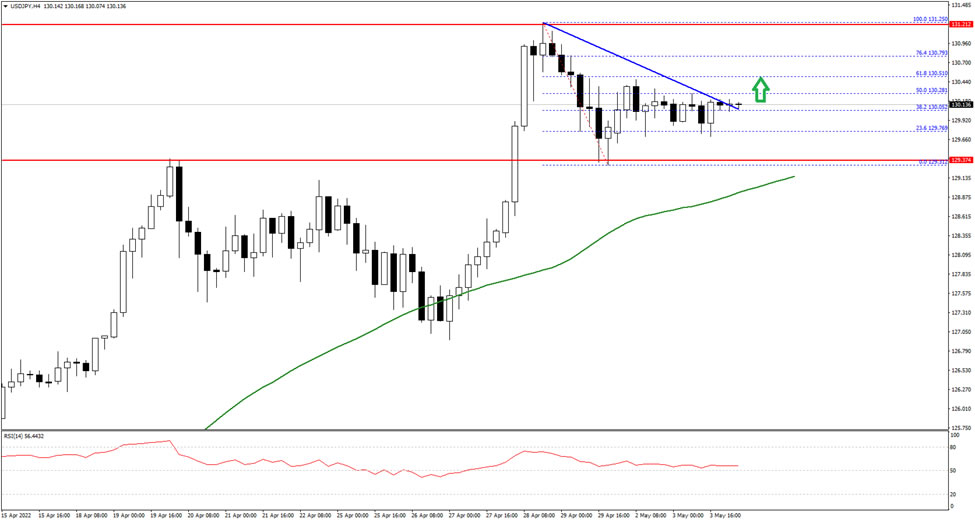
USD/JPY Pair Formed a New Multi-Year High at 131.25
The US Dollar gained pace above the 130.00 resistance against the Japanese Yen. The USD/JPY pair even traded above 130.50 and formed a new multi-year high at 131.25.
Recently, there was a downside correction below 130.00. However, the bulls were active near the 129.30 level. It is now back above 130.00 and trading well above the 50 hourly simple moving average.
On the upside, an immediate resistance is near the 130.40 level. A clear break above the 130.40 resistance could push the price towards 131.00. The next major resistance is near the 131.20 level or 131.500 on FXOpen.
On the downside, an initial support is 129.80. The next major support sits near the 129.30 level, below which there is a risk of more downsides. In the stated case, the pair could even trade below the 50 hourly simple moving average.
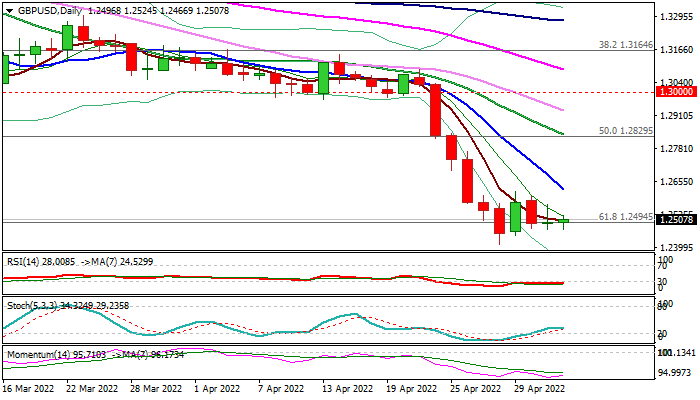
GBP/USD Outlook: Post-Fed Bearish Continuation is Likely Scenario, But Traders Remain Cautious
Cable is trading in a very quiet mode in early Wednesday, ahead of key event of the day – FOMC rate decision.
The pair is holding at the lower side of the near-term consolidation range, which extends into fifth consecutive day.
Overall structure remains negative, although the action struggles at key Fibo support at 1.2494 (Fibo 61.8% of 1.1409/1.4249) after a massive drop in April cracked support but failed to register a monthly close below this level.
Daily studies give initial signal of possible bounce as 14-d momentum reverses deeply in negative territory and RSI is oversold, however more evidence is needed to signal rebound.
Falling 10DMA (1.2625) reinforces the upper boundary on near-term consolidation range and marks initial resistance, violation of which would ease downside pressure, with extension through pivotal 1.2750/1.2800 resistances (Fibo 38.2% of 1.3298/1.2411 bear-leg / daily Kijun-sen) to confirm the pattern.
The US Federal Reserve ends two-day policy meeting today, with wide expectations for a 50 basis points hike and start of reductions of its $9 trillion balance sheet, in central bank’s attempts to put high inflation under control, after the Fed started its current cycle of policy tightening in mid-March.
Recent hawkish comments from Fed’s policymakers reinforced expectations for central bank’s aggressive stance in the coming months that strongly inflated dollar recently, but markets will look for a confirmation on tonight’s comments from Fed’s chief Jerome Powell.
Although majority of market observers bets for a 0.5% rate raise, some analysts think the Fed might opt for more aggressive action today on 0.75% hike that would further inflate dollar and send sterling below the recent 21-month low at 1.2411, towards June 2020 higher low at 1.2251.
On the other side, many traders think that 0.5% hike has been priced in and stretched dollar index is facing headwinds from key longer-term barriers at 103.80 (peaks of 2017/2020/2022), signaling good selling opportunity, unless the Fed raises rate more than expected, or Powell’s comments being less hawkish than expected.
Res: 1.2625; 1.2723; 1.2750; 1.2797.
Sup: 1.2466; 1.2411; 1.2359; 1.2251.
EURGBP Portrays Feeble Bullish Tone, Broader Bias Neutral
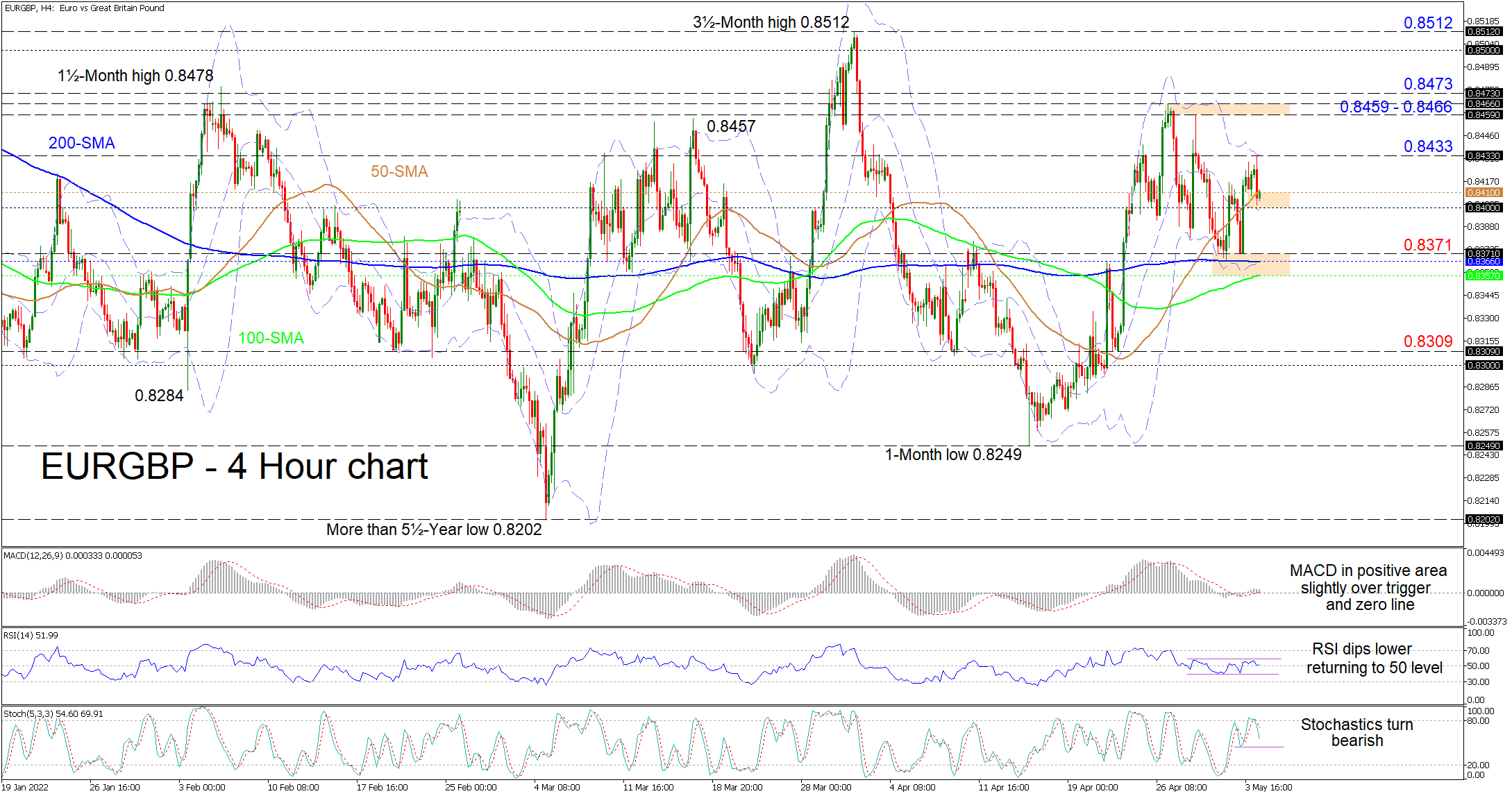
EURGBP is trading between the supporting mid-Bollinger band and its capping upper Bollinger band, struggling to sustain its upside vibe north of its rising 50-period simple moving average (SMA). The 200-period SMA, which has stabilized for some time now, continues to sponsor a horizontal trajectory in the pair, while the bullish 50- and 100-period SMAs are endorsing upward price action, aimed at the upper regions of a trading range that started from the beginning of the year.
The range has been widening constantly and now stretches from a lower mark of 0.8202 until a ceiling of 0.8512. The short-term oscillators are mixed, exhibiting conflicting messages in directional momentum. The MACD, in the positive region, is holding a little bit north of its red trigger and zero lines, while the negatively charged stochastic oscillator is suggesting that sellers are ahead. Meanwhile, the RSI is flirting with the 50 threshold, failing to signal a distinct clue regarding driving momentum.
Sellers would need to drive the price below the 0.8400 handle, where the mid-Bollinger band also resides, in order to reinforce negative hopes in the pair. Sinking past the mid-Bollinger band, the bears may then target a critical region of support existing from 0.8371 until the 100-period SMA at 0.8357. Should this fortified support barrier fail to provide footing for buyers, the April 22 trough at 0.8309, and the 0.8300 hurdle could come under heavy attack should profound selling endure past the 100-period SMA.
On the other hand, if buying powers strengthen, resistance could commence at the 0.8433 high, coupled with the upper Bollinger band. Piloting beyond the upper Bollinger band, the bulls may be encouraged to challenge the 0.8459-0.8466 resistance band, moulded by the April highs, as well as the adjacent 0.8473 border. Should the bulls successfully overrun these congested resistance obstacles, the road opens for a revisit of the 0.8500 mark and the 0.8512 ceiling of the trading range.
Summarizing, EURGBP is holding on to its neutral-to-bullish tone above the 0.8357-0.8371 support section. That said, a price dive past this mentioned support is likely to shift the directional outlook towards the lower end of the range. Yet, a climb in the pair past the 0.8459-0.8466 boundary may bring about a retest of the ceiling of the range.
Dollar’s Make-or-Break Point
The dollar is near the extremes of the world’s most popular currencies. The dollar index is near the peaks of March 2020 and January 2017. Investors and traders have pushed the dollar to a vital turning point over the past six years, anticipating one of the most hawkish decisions in decades.
Today’s FOMC decisions will determine whether we see the formation of a DXY triple top and the start of a dollar pullback or whether we see further momentum building with the benefit of dollar buyers.
The FOMC is expected to raise its key rate by 50 points – the sharpest tightening since 2001 – along with the announcement of the start of asset sales from the Fed’s balance sheet at $95bn per month.
Market participants are also laying down a near 100% chance of a 75-point rate hike at the subsequent meeting in June, plus a 50-point in July. Such steep rate hikes were last experienced by the US in the 1980s, battling double-digit inflation.
The Fed’s extreme action is justified and necessary in terms of inflation and current employment data. It is also widely believed that the Fed has been late in tightening and will now need to tighten the screws even further to get the economy back on a sustainable trajectory.
If today’s comments reinforce market expectations that the rate could exceed neutral by the end of the year, the dollar will gain the fundamentals for further strength. On the one hand, a strong dollar will work to reduce inflationary pressures. But on the other hand, it could cause an economic shock and worsen the conditions for the Fed to sell bonds into the market, putting additional stress on the financial system.
For the DXY, in this case, a new growth horizon opens with potential targets near the 2002-2003 peaks at 120 over the next 12-18 months.
However, we cannot rule out that comments from the Fed would be vaguer, which markets initially could see as a dovish stance. In this scenario, the Fed would express its concern about the impact of rates on the economy and soften expectations for future hikes. This has the potential to form a reversal in the dollar, which now has a very hawkish scenario built into its exchange rate.
In a dovish scenario, the DXY risks forming another peak and heading towards the lower end of last year’s range, around 90 by 2023.
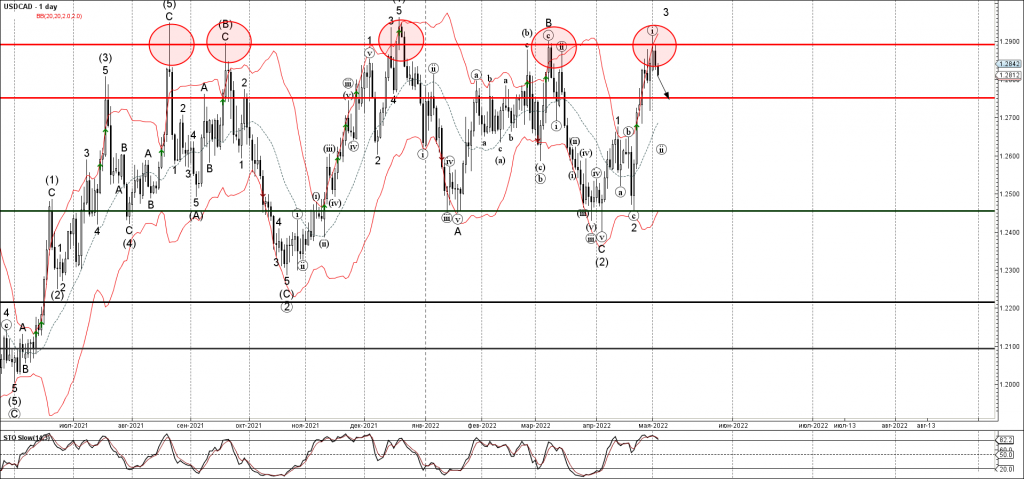
Eurozone retail sales dropped -0.4% mom in Mar, EU down -0.2% mom
Eurozone retail sales dropped -0.4% mom in March, worse than expectation of -0.2% mom. Volume of retail trade decreased by -2.9% for automotive fuels, and by -1.2% for non-food products, while it increased by 0.8% for food, drinks and tobacco.
Retail sales contracted -0.2% mom in EU. Among Member States for which data are available, the largest monthly decreases in the total retail trade volume were registered in Spain (-4.0%), Luxembourg (-3.3%) and France (-1.9%). The highest increases were observed in Slovenia (+11.4%), Latvia (+11.1%), and Hungary (+7.3%).